 |
| Bad Bertrich 60+ (July): I scored +5=1-3, gaining 40.6 Fide elo and 160 euros |
WORST PERFORMANCE
My score in September's Northumberland Open of +1=0-3 (I also received a compulsory full-point bye) lost 26.8 ECF elo and 40.2 Fide elo.
My score in September's Northumberland Open of +1=0-3 (I also received a compulsory full-point bye) lost 26.8 ECF elo and 40.2 Fide elo.
MOST ENJOYABLE NEW TOURNAMENT
 |
| Bad Bertrich 60+ (July): very good playing conditions, and there was even better walking in the Eifel mountains of Rhineland-Palatinate |
FAVOURITE PREVIOUSLY-PLAYED TOURNAMENT
 |
| So many to choose from, but the lovely weather on the Costa Blanca in November helped the Cap Negret 65+ edge it |
BEST WIN
Not so many to choose from, but I enjoyed the following game in March, and it was brief.
Bad Wörishofen Round Seven
Spanton (1911) - Holger Hinz (2006)
Bad Wörishofen Round Seven
Spanton (1911) - Holger Hinz (2006)
Pirc
1.e4 d6 2.d4 Nf6 3.Nc3 g6 4.f4 Bg7 5.Nf3 a6!?
This is seventh-most popular in ChessBase's 2025 Mega database, the main moves being 5...c5 and especially 5...0-0.
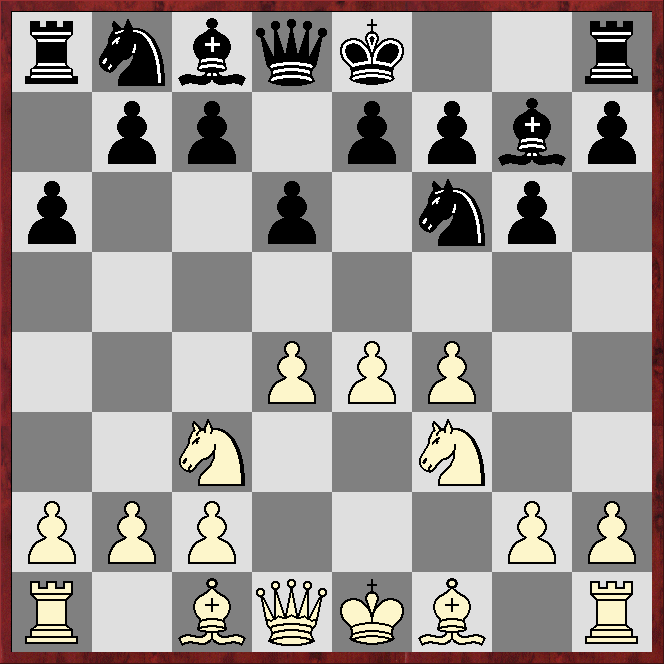 |
| How should White respond? |
*****
*****
*****
*****
6.a4!?
The main line in Mega25 runs 6.Bd3 0-0 7.0-0 b5 8.e5 Ne8, with a positionally won game for White, according to Stockfish17 and Dragon1.
6...0-0 7.Bd3 Nc6 8.0-0 e5!?
Stockfish17 prefers the main move in Mega25, 8...Bg4, while Dragon1 likes 8...Nb4. After the latter, Jiří Nun (2365) - Andrzej Adamski (2350), Wrocław (Poland) 1980, continued 9.e5!? dxe5 10.fxe5 Ng4?! 11.Ne4 Nxd3 12.Qxd3, with White enjoying the upper hand, according to the engines (but ½–½, 35 moves).
9.fxe5 dxe5 10.d5 Ne7!?
This may be a novelty. Known moves are 10...Nd4 and 10...Nb4.
11.Nxe5!? Nxe4?!
A better capture seems to be 11...Nfxd5, when 12.Nxd5 Nxd5 13.Nxf7 Rxf7 14.Rxf7 Kxf7 15.Bc4! gives White at least the upper hand, according to the engines. However, their top suggestion is 11...c6!?, when 12.dxc6?? loses to 12...Qd4+ etc. White's best may be 12.Bg5!?, when the long, but largely forcing, line 12...cxd5! 13.Bxf6 Qb6+ 14.Kh1 Bxf6 15.Nxd5 Nxd5 16.Nc4 Qd4 17.exd5 Bf5!? leaves White with a slight edge, according to the engines.
12.Nxe4 Bxe5
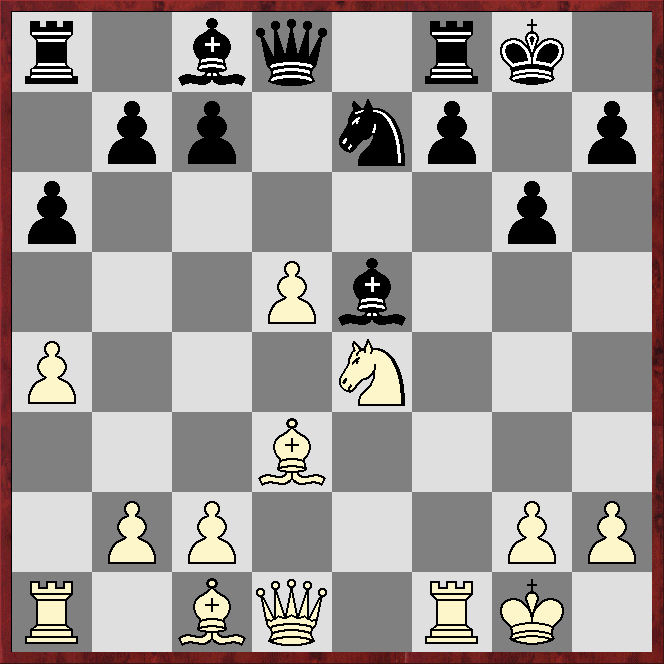 |
| White to play and gain what the engines reckon is a winning advantage |
*****
*****
*****
*****
13.Bh6?!
The engines give 13.Bg5!? Bf5 14.Nf6+ Bxf6 (14...Kg7? 15.Bxf5 gxf5? 16.Qh5 leads to mate, while 14...Kh8? 15.Qe1 is not much better) 15.Bxf6 Bxd3 16.Qxd3 Qd7 17.c4, one line continuing 17...Nf5 18.Rf3 Rae8 19.c5!? Ng7 20.Rg3 Qg4 21.d6 cxd6 22.cxd6 Qd7 23.Be7 etc.
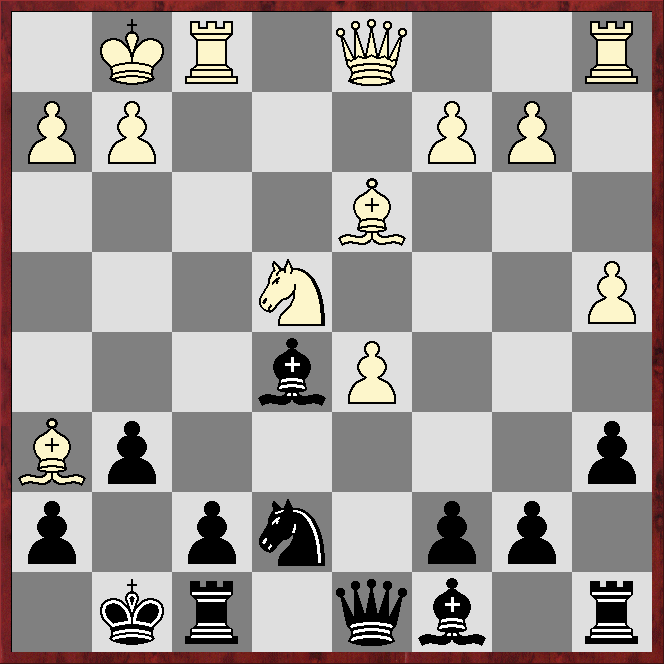 |
| How should Black proceed? |
*****
*****
*****
*****
13...Bg7?!
Probably best is 13,,,Nxd5!?, when after 14.Bxf8 Ne3 15.Qf3 Nxf1 16.Rxf1 Qxf8 White's lead in development partially compensates for being a pawn down and for facing the bishop-pair. However the engines' 14.h3 may give White equality, although after 14...Re8 the engines disagree as to whether 15.Qf3 or 15.Bg5 is correct.
14.Bxg7 Kxg7 15.Bc4
Now Qd4+ is a huge threat.
15...Nf5 16.g4!?
The engines suggest 16.Re1!? or 16.a5, claiming a slight edge for White.
 |
| What should Black play? |
*****
*****
*****
*****
16...Qe7?
After 16...Nd6? Black loses in a similar way to the game, but 16...Qh4 holds the balance, according to the engines, as long as Black meets 17.Rf4 with 17...h5.
17.Qd3 Nd6 18.Qd4+ f6 19.Nxf6! Rxf6
After 19...Nxc4? White has several winning lines, the simplest perhaps starting with 20.Nd7+.
20.g5 Bf5 21.Rae1!
This is even better than immediately capturing on f6.
21...Qd8 22.gxf6+ 1-0
A likely continuation was 22...Qxf6 23.Re7+ Nf7 24.Qxf6+ Kxf6 25.Rxc7, when White is the exchange and a pawn up, and enjoys a continuing attack.


