Showing posts with label Czech Seniors Open Championship. Show all posts
Showing posts with label Czech Seniors Open Championship. Show all posts
Monday, 25 August 2025

Sunday, 24 August 2025
Czech 65+ Open Championship Round Nine
Libor Titěra (1843) - Spanton (1982)
*****
*****
*****
*****
*****
1.b4
1.b4
This is arguably a space-gaining improvement over play in my round-seven game.
1...e5 2.Bb2 f6!?
More popular in ChessBase's 2025 Mega database are 2...d6 and 2...Bxb4!?
 |
| How should White respond? |
*****
*****
*****
*****
3.b5!?
This is the top choice of Stockfish17 and Dragon1.
3...a6
The main line in Mega25 runs 3...d5 4.e3 Be6 5.Nf3 Bd6, with what the engines reckon is an equal position.
4.a4 axb5 5.axb5 Rxa1 6.Bxa1 d5 7.e3 Bd6 8.c4 Ne7!?
This may be a novelty. Known moves are 8...c6 and 8...Be6.
9.Nc3 Be6 10.Qb3 c6 11.d4?
Too loosening. The engines suggest various moves, including 11.cxd5, 11.bxc6, 11.Bb2 and 11.Nf3.
 |
| How should Black proceed? |
*****
*****
*****
*****
11...Qa5
Exchanging on d4, and then playing ...Qa5, is also strong.
12.Bb2 Bb4 13.Nf3 dxc4
Getting on with development with 13...Nd7 or 13...Kf7!? may be even stronger.
14.Bxc4 Bxc4 15.Qxc4 e4?
White is at least equal after this. Instead 15...Nd5 16.bxc6! bxc6 17.Kd2 Qa4! 18.Qd3 (forced) 0-0 gives Black the upper hand, according to the engines.
16.Nd2 Nd5?
The game is roughly equal after 16...Bxc3!? 17.Bxc3 cxb5!?, according to the engines.
 |
| What should White play? |
*****
*****
*****
*****
17.Nxd4!?
This is good enough for a pleasant advantage, but the engines come up with a piece sacrifice in the shape of 17.Ndxe4!! f5 18.0-0! (18.Ke2!? also seems good), and if 18...fxe4 then 19.Ra1 Bxc3 (there is nothing better) 20.Rxa5 Bxa5 21.Qc2!, when Black has rook and two knights for queen and pawn, but the engines reckon Black's lack of coordination gives White a large advantage, eg 21...0-0 22.Qxe4 Be1!? 23.Qe6+ Kh8 24.f3, with e4 to come.
The engines suggest Black may be better off meeting 17.Nde4!! with 17...Nxc3!? 18.Bxc3 Bxc3+ 19.Nxc3 Qa1+ 20.Nd1 Qa5+ 21.Ke2 Qxb5 22.Qxb5 cxb5, when Black has restored material equality, but the doubled and isolated b pawns are a major weakness, especially as White has a protected passer.
17...Bxd2+
Also possible is 17...cxd5, but with best play it transposes, according to the engines.
18.Ke2 cxd5
 |
| How should White continue? |
*****
*****
*****
*****
19.Qc8+?!
White has at least the upper hand after 19.Qxd5!, according to the engines, eg 19...Qb4 20.Qxe4+ Kf7 21.Qxb7+ Kg6 22.Qe4+ Kh6 (22...Kf7? loses to 23.Qd5+) 23.Qc2 Bxe3 24.fxe3 Qxb5+ 25.Kf2 Nc6 26.Rd1, after which White emerges with an extra pawn and the safer king.
Trying to extricate the black bishop with 19...Bb4?! backfires after 20.Rc1!, with Qxe4(+) to come.
 |
| Black to play and draw |
*****
*****
*****
*****
19...Qd8?
Correct is 19...Kf7! (or 19...Ke7!), when 20.Qxh8? loses to 20...Qxb5+ 21.Kxd2 Qxb2+ 22.Kd1, and now the move I missed, 22...Nc6, after which White does not have a perpetual and cannot save the rook. However the engines show White has equal chances after 20.Qxb7+, eg 20...Ke6 21.Ra1 Qb4 22.Ra7!?, when Black probably has to take a draw, one way being 22...Qc4+ 23.Kxd2 Qd3+ 24.Kc1 Qf1+ etc.
20.Qe6+?!
LT offered a draw, but winning was 20.Qxb7!, eg 20...Bb4?! 21.Rc1 0-0 22.Rc7 etc, or 20...Qd7!? 21.Qxd7+ (21.Qxb8+? Kf7 22.Qxh8 Qxb5+ 23.Kxd2 Qxb2+ allows Black perpetual check) Nxd7 22.Kxd2, when White's extra pawn is decisive, according to the engines.
20...Qe7
I probably should have taken the draw.
21.Qc8+ Qd8?
This should lose in the same manner as after 19...Qd8?, but 21...Kf7!? 22.Qxh8 Ba5!, although leaving Black the exchange down, gives Black a lot of play, the engines fluctuating between calling the game equal or just slightly better for White.
½–½
Saturday, 23 August 2025
Czech 65+ Open Championship Round Eight
Spanton (1982) - František Kulhavý (1886)
*****
*****
*****
*****
*****
Sicilian Bb5(+)
1.e4 c5 2.Nf3 Nc6 3.Bb5 e6 4.Bxc6 bxc6 5.d3 Qc7!?
More popular in ChessBase's 2025 Mega database are 5...d5 and especially 5...Ne7, although the text is the top choice of Stockfish17 and, for a long time Dragon1, although given plenty of time the latter switches to the even more obscure 5...Rb8!?
 |
| How should White respond? |
*****
*****
*****
*****
6.e5!?
6.e5!?
One of the issues for Black in 4.Bxc6 lines is finding a role for the light-square bishop. The point of the text is to make it less easy for Black to play ...e5, with ...d6 or ...d5 to come, opening the c8-h3 diagonal. However the main move in Mega25 is 6.0-0, and if 6...e5, Dragon1 recommends 7.c3, with d4 to come, while Stockfish17 prefers 7.Nh4!?, with f4 to come.
6...Ne7
The engines fluctuate between the text and the more popular 6...f6!?, with Stockfish17 coming to prefer the latter, after which the main line in Mega25 runs 7.Qe2 fxe5 8.Nxe5 Nf6, with an equal game, according to the engines.
7.Qe2 Ng6 8.h4 d6?!
FK offered a draw, having made a move the engines reckon is much inferior to 8...f6!?
 |
| How should White proceed? |
*****
*****
*****
*****
9.b3!?
All three games in Mega25 saw 9.exd6 Bxd6, after which the engines like 9.Na3 or 9.Nc3. However they reckon best is the positional pawn sacrifice 9.h5!?, which is not in Mega25. After 9...Nxe5 10.Nxe5 dxe5 11.h6!? they reckon White has at least the upper hand. The text, which is also a novelty, has similar ideas to 9.h5!?, but is less forcing.
9...Nxe5
The engines suggest 9...f6, but give White at least a slight edge after 10.exd6 or 10.h5!?
10.Nxe5 dxe5
 |
| White is a pawn down but has a positionally won game, according to the engines |
*****
*****
*****
*****
11.Bb2 f6
This is the engines' main move.
After 11...Bd6 12.Nd2 Black will probably be obliged to play ...f6 anyway. However White should avoid 12.f4? exf4 13.Bxg7 Rg8 as Black will get in ...e5, freeing the light-square bishop while remaining a pawn up.
12.Nd2 Ba6 13.0-0-0 Qa5?!
The queen was usefully employed on c7, covering c6 and e5 (the latter being important as e6 is unprotected).
Getting on with development looks sensible, perhaps starting with joining White in castling long.
14.Kb1
Even stronger is 14.Qh5+, and if 14...g6 then 15.Qf3, with threats to c6 and f6.
14...Rd8?
Definitely better is 14...0-0-0.
15.Qh5+ g6
The engines suggest giving up castling rights with 15...Ke7 or 15...Kd7.
16.Qf3 Be7
This is the engines' top choice, but White is left with almost an embarrassment of good replies.
17.h5!? Kd7?!
It is almost certainly better to offer back the pawn, but keep lines closed, with 17...g5 18.Qxc6+ Kf7 19.Qf3 Qc7 (or Stockfish17's interesting exchange sacrifice 19...Rd4!?).
18.Qe4
Even stronger is 18.Ne4!, one idea being 18...f5 can be met by 19.Bxe5! (I missed that 19...fxe4+?! runs into 20.dxe4+).
18...Qb4 19.Nc4!?
This lets Black swop off the light-square bishop, but that opens the d file with tempo.
19...Bxc4 20.dxc4+ Kc7 21.hxg6 hxg6
 |
| What should White play? |
*****
*****
*****
*****
22.Rxh8??
The simple 22.Qxg6 keeps a large advantage.
22...Rxh8??
Missing 22...Rxd1+ 23.Bc1 Qd2, when White is lost, eg 24.Kb2 Qxc1+ 25.Kc3 Qa1#.
23.Bxe5+ Kb6 24.Bb2
 |
| Black cannot avoid going a pawn down, and with an unsafe king |
*****
*****
*****
*****
24...Rd8
There is nothing better.
25.Rxd8 Bxd8 26.Qxe6 Qd2
This is the best try, according to the engines.
27.Bxf6!
Safely grabbing a second pawn.
27...Bc7 28.Qe3 Qd1+ 29.Kb2 Qh5 30.Be7 Qf5 31.b4 Be5+ 32.c3 Qd7!?
Setting a trap.
33.Bxc5+ Kb7 34.Bd4
But not 34.Qxe5?? as Black has perpetual check starting with 34...Qd2+.
The game finished:
34...Bb8 35.Qe4 a6 36.Qxg6 Be5 37.Bxe5 1-0
Friday, 22 August 2025
Czech 65+ Open Championship Round Seven
Jiří Fišer (1860) - Spanton (1982)
*****
*****
*****
*****
*****
*****
*****
1.b3
1.b3 d5 2.bb2 Nf6 3.Nf3 Bf5 4.g3!?
This is Stockfish17's top choice; Dragon1 prefers 4.c4 or 4.Nh4!?, the latter being a favourite of Hungarian grandmaster István Csom.
4...c5 5.Bg2 Nc6 6.d3 Qc7!? 7.Nbd2 e5!?
 |
| Is Black's broad pawn-centre strong or an overreach? |
*****
*****
*****
*****
Stockfish17 calls the position equal, but Dragon1 gives Black a slight edge, or at least the better part of equality.
8.Nh4
The engines dislike this apparent-novelty.
Evgeny Romanov (2594) - Matthias Blübaum (2674), European Championship (Reykjavík) 2021, went 8.e4!? dxe4 9.dxe4 Be6 (9...Nxe4?! 10.Nxe5; 9...Bxe4? 10.Nxe4 Nxe4 11.Nxe5 Nxe5 12.Bxe4) 10.0-0 Rd8 11.Qc1!? Be7, when Black was at least equal, according to the engines (0-1, 59 moves).
Evgeny Romanov (2594) - Matthias Blübaum (2674), European Championship (Reykjavík) 2021, went 8.e4!? dxe4 9.dxe4 Be6 (9...Nxe4?! 10.Nxe5; 9...Bxe4? 10.Nxe4 Nxe4 11.Nxe5 Nxe5 12.Bxe4) 10.0-0 Rd8 11.Qc1!? Be7, when Black was at least equal, according to the engines (0-1, 59 moves).
8...Be6 9.e4 Be7
The engines much prefer 9...0-0-0!?
10.a3?!
It is hard to see the point of this move, unless it is to discourage Black from long castling.
10...Rd8 11.Qe2?
The engines suggest 11.Nf5 or 11.exd5.
11...Nd4 12.Bxd4
This is better than retreating the queen, according to the engines.
12...cxd4 13.0-0 0-0
 |
| Now both sides have castled, how would you assess the position? |
*****
*****
*****
*****
Black has the bishop-pair, more space in the centre and pressure down the half-open c file, all of which add up to a positionally won game, according to the engines.
14.Nf5 dxe4
The engines prefer 14...Bxf5, which surrenders the bishop-pair but gives White doubled pawns, while also strengthening Black's centre.
15.dxe4
White should have taken the chance to play 15.Nxe7+, according to the engines, meeting 15...Qxe7 with 16.Ne4!?
15...Rc8 16.Nxe7+ Qxe7
The bishop-pair has gone, but White has the better remaining bishop, and continued pressure down the c file.
17.Nf3 Rc5 18.a4
Probably not 18.b4?! Bc4, but perhaps 18.Ne1!?, which gets played anyway soon, is better.
18...Rfc8 19.Ra2 Qc7 20.Ne1 Rc3 21.h3 h6 22.Kh2 Nh7 23.h4!? Nf6 24.Bh3!? Qd7 25.Bxe6 Qxe6 26.f3!? Re3 27.Qd2
 |
| How should Black proceed? |
*****
*****
*****
*****
27...Rcc3
Even stronger seems to be the engines' 27...Nxe4!? 28.fxe4 Qg4, their main line running 29.Qg2!? Re2 30.Rf2 Rxe1, and if White tries the tricky 31.Rxf7!?, then 31...Rc3, and if 32.Rf8+!? then 32...Kxf8 33.Qf2+ Kg8 34.Qxe1 Re3 winning.
28.Nd3 Nh5 29.Qg2 Qe7 30.Rf2 Rc6!? 31.Qh3 Rf6
Almost certainly stronger is 31...Rg6!?, and if 32.g4 then 32...Nf6, when the knight threatens to sac on either e4 or g4.
32.Qg4 g6 33.Ra1 Ng7?!
This relinquishes a lot of Black's advantage. Probably better is giving up on the kingside and returning to pressure the queenside with 33...Rc6 or 33...Qc7.
34.Raf1?!
Probably better is the engines' 34.Qc8+!? Kh7, and now 35.Raf1.
34...Kh7?!
This lets White transpose into the previous note. Instead 34...Rc6 returns to pressurising the queenside, while keeping the white queen out of Black's position.
35.Qc8!? Rc6 36.Qb8
JF offered a draw in my time.
36...f6 37.Rd2?!
White is at least equal after 37.Qxa7, according to the engines.
37...b6 38.Kg2 Ne6 39.Rff2?
The engines suggest 39.a5!?, and if 39...bxa5 then 40.Ra1 with what they reckon is a completely equal position.
39...Qd7
This seems to have been a good time for ...g5.
This seems to have been a good time for ...g5.
40.Qa8
Black threatened to trap White's queen with 40..Rc8.
40...Rc8
This is still good, but even better is 40...g5, according to the engines.
41.Qd5 Qxd5 42.exd5 Nc7 43.Nb4?
Correct is 43.d6 Nd5 44.f4 with counterplay, leaving Black only slightly better, according to the engines.
43...a5 44.d6 axb4 45.dxc7 Rxc7
 |
| How would you assess this rook-and-pawn ending? |
*****
*****
*****
*****
Black is only one pawn up, and has doubled pawns, but Black's advantage is worth much more than a minor piece, according to the engines.
46.f4 Rcc3?
This allows White unnecessary activity. Correct is 46...Kg7.
47.fxe5 Rxg3+ 48.Kf1 fxe5 49.Rf7+ Kg8 50.Rdf2 Rc8
 |
| White is two pawns down, but the activity of the white rooks, the weakness of Black's pawns, and the restricted state of Black's king mean the position is equal, according to the engines |
*****
*****
*****
*****
51.R7f6?
Both 51.Re7, attacking Black's passer, and 51.Rb7, threatening to double on the seventh rank, while also threatening b6, hold the balance, according to the engines.
51...e4 52.R2f4
 |
| Black to play and win |
*****
*****
*****
*****
52...d3?
52...h5 is good, but best is 52...e3!?, eg 53.Rxd4 Re8 54.Ke1 e2 etc. Perhaps White's best try is 53.Re6, but 53...g5 (not 53...Rxc2? as 54.Re8+ draws) 54.hxg5 Rxc2 wins, since 55.Rxd4 fails to 55...Rf2+ 56.Ke1 Rg1#, and if 55.gxh6 then 55...Rgg2, when there is no good answer to ...e2+.
53.cxd3 exd3 54.Rd6
 |
| Note that the c8 rook cannot invade White's position as White has a draw by repetition with Re8+ etc |
*****
*****
*****
*****
54...g5 55.hxg5
Not 55.Rg6+ Kh7 56.Rff6 as Black has 56...Rc1+ 57.Kf2 gxh4 58.Rxg3 hxg3+ 59.Kxg3 d2, after which the d pawn queens.
55...hxg5 56.Rxb4
Also drawing is 56.Rff6.
56...Rc2 57.Rbd4 Rh3 58.Kg1
Not 58.Rxd3?? Rh1#.
58...Re3 59.Kf1 Rc1+ 60.Kf2 Re2+ 61.Kf3 Rf1+ 62.Kg4 Kf7 63.Rxd3 Rg2+ 64.Kh3 Rgg1?
Having overpressed, 64...Rfg1 was necessary to comfortably hold the draw.
However, JF now offered a draw, although I waited for him to move before making a deicsion.
65.Rd7+
White is better after 65.Rxb6, but the game should probably be drawn (even if Black does not take the draw offer).
65...Ke6 66.R3d6+ Kf5 67.Rd5+ Kg6 68.R5d6+ Kf5 ½–½
And not 68...Kh5?? 69.Rh7#.
Thursday, 21 August 2025
Czech 65+ Open Championship Round Six
Spanton (1982) - Vladimír Dvořák (1912)
*****
*****
*****
*****
*****
*****
French 3.Nc3 Be7
1.Nc3 e6 2.d4 d5 3.e4 Be7!?
The position after 3...Be7!? occurs 1,247 times in ChessBase's 2025 Mega database. Among those who have played it are Nigel Short and Fabiano Caruana, while it was a favourite of Oleg Romanishin's in the 1970s.
 |
| How should White respond? |
*****
*****
*****
*****
4.e5!?
Most popular is 4.Nf3, but Stockfish17 prefers the text, while Dragon1 suggests 4.Bd3!?
4...c5 5.Qg4 Kf8!?
Dragon1 prefers 5...g6, but Stockfish17 fluctuates between the two moves.
6.Nf3 h5!?
There is only one example of this move in Mega25, but it is Stockfish17's top choice; Dragon1 prefers 6...b6.
7.Qf4 cxd4!?
The engines agree this is an improvement over the known 7...Nh6.
8.Nxd4
This is OK, but better is the engines' 8.Nb5! Nc6 9.Nbxd4.
8...g5!? 9.Qe3
The engines reckon 9.Qd2!? gives White a slight edge.
9...Nc6 10.Bd3 Nh6 11.h3 Kg7?!
The engines strongly dislike this, suggesting 11...Qc7 or 11...Nf5!?
 |
| How should White proceed? |
*****
*****
*****
*****
12.Bd2
The engines reckon 12.f4 gives the upper hand, and 12.Nce2 gives at least a slight edge.
12...f5!? 13.exf6+?!
Probably better is 13.f4. After the text Black's central pawns are free to advance.
13...Bxf6 14.Nce2?
Not 14.Nxe6+?? Bxe6 15.Qxe6? Re8 etc, but better is 14.Nxc6, although after 14...bxc6 Black's central dominance provides protection for the black king. Dragon1 reckons the resulting position is completely equal, but Stockfish17 marginally prefers Black.
14...Nxd4 15.Nxd4 e5!?
Black's hanging pawns are mobile and strong.
16.Nb3 e4 17.Be2 Nf5 18.Qc5 Be6
Probably even stronger is 18...Bxb2 19.Rd1 Bf6 20.0-0 Be6.
19.Bc3?
Better is 19.c3.
 |
| How should Black continue? |
*****
*****
*****
*****
19...Qc8?!
This largely lets White off the hook, whereas there is no good answer to 19...Rc8!, eg 20.Bxf6+ Qxf6 21.Qxa7 Rxc2! 22.Qxb7+ Bf7, after which Black is temporarily a pawn down, but has a very strong attack. Possibly better is 20.Qb4!?, but 20...Bxc3+ 21.bxc3 Qf6! is good for Black.
20.Bxf6+ Kxf6 21.Qxc8?!
There was no need to help Black develop the queen's rook.
21...Raxc8 22.0-0-0 Ke5 23.c3
Now 23...Rac8 leaves Black at least slightly better, according to the engines, but VD played ...
23...Bf7
... and offered a draw.
24.Nd4 Nxd4 25.Rxd4 h4!? 26.Re1 Bg6 27.f3 Rhf8 28.Bd3 Rf4
 |
| White has what looks like immense pressure against the hanging pawns, but it turns out there is no way to exploit this |
*****
*****
*****
*****
29.Bc2 Rc4 30.Rxc4 dxc4 31.a4 a5
 |
| White to play and lose |
*****
*****
*****
*****
32.b3?
White should 'do nothing', the position remaining completely equal
32...cxb3 33.Bxb3 Kf6!
 |
| There is no defence |
*****
*****
*****
*****
34.Bd5
This (and 34.Bd1, which comes to the same thing) is best, according to the engines.
34...exf3 35.Bxf3 Rxa4 36.Bxb7?
Restoring material equality, but making the win simple. Better is keeping rooks on with 36.Kb2, but 36...b5 leaves Black up the equivalent of a minor piece, or maybe more, according to the engines.
36...Ra1+ 37.Kd2 Rxe1 38.Kxe1 Ke5
Other moves also win, including 38...a4.
39.Kf2
Or 39.Bc6 Be4.
39...a4 40.Ba6 Bf7 41.Bd3 a3 42.Bb1 Kf4 0-1
Wednesday, 20 August 2025
Czech 65+ Open Championship Round Five
Václav Lexa (1877) - Spanton (1982)
*****
*****
*****
*****
*****
*****
*****
*****
*****
*****
QGD Tarrasch
1.d4 d5 2.c4 e6 3.Nc3 c5
Two years ago in the same tournament our game went 3...Nf6 4.Bg5 c5!? 5.cxd5 cxd4 6.Qxd4 Be7 7.e3!? exd5 8.Nf3 0-0!?, with an equal position, according to Stockfish17 and Dragon1. Although I won that game in 22 moves, I did not want to find out if VL had prepared an improvement.
4.cxd5 exd5 5.e3!?
This is the second choice of the engines, and has been played by grandmasters, but is much less successful than the mainline 5.Nf3.
5...Nf6 6.g3!?
This gives a strange impression, but the engines are OK with it, and there are 39 examples of the resulting position in ChessBase's 2025 Mega database.
 |
| How should Black respond? |
*****
*****
*****
*****
6...Nc6
The engines also like 6...cxd4 and 6...Bg4.
7.Bg2 Bg4
The engines suggest 7...cxd4 or 7...h5!?
8.Qb3?!
This is strongly disliked by the engines. They reckon White is slightly better after 8.Nge2.
8...cxd4
The only game in Mega25 to reach the position saw 8...c4!?, which is the top choice of the engines.
9.Nxd5
Possible is 9.exd4!?, the point being 9...Nxd4 10.Qa4+ Nc6 11.Bg5 is sharp and may give enough compensation for a pawn, although Dragon1 is less sure than Stockfish17. The engines fluctuate between the two moves, and also 9.h3!?
9...Nxd5 10.Bxd5 Bb4+
 |
| How should White proceed? |
*****
*****
*****
*****
11.Kf1!?
Not 11.Bd2? Bxd2+ 12.Kxd2 Qa5+! (this is even stronger than 12...dxe3+), after which the white king has no good square as both 13.Kc2 and Kd3 can be met by 13...Nb4+, eg 13.Kd3 Nb4+ 14.Ke4 f5+ 15.Kxd4 (15.Ke5 Nc6+ 16.Kf4 Qc7+ 17.Kg5 h6+ 18.Kg6 Ne5#) Nxd5 16.Qxd5 Rd8 etc. That leaves 13.Kc1, but 13...Qe1+ 14.Kc2 Nb4+ wins the white queen.
11...Qe7 12.a3!?
This is Stockfish17's top choice, although it comes to also like 12.Kg2. Dragon1 suggests 12.e4, marginally ahead of 12.Kg2.
12...Bc5 13.Qa4?
White is fine, according to the engines, after 13.h3, with 14.e4 possible whether the bishop retreats to h5, f5 or e6.
 |
| How should Black proceed? |
*****
*****
*****
*****
13...0-0!?
The engines also like 13...Rd8!? as there is no need to defend c6.
14.e4
After 14.Bxc6 bxc6 15.Qxc6? Rac8 White has very little chance of surviving Black's attack.
14...Ne5 15.Qb3 d3!? 16.h3 Bh5 17.Bf4 Qf6?!
Developing the queen's rook makes sense, and even the speculative 17...Bxf2!? is probably good for Black after 18.Kxf2 Rac8. However the text, which at first glance looks good as it pins White's dark-square bishop, gives White the chance to beat off Black's attack.
 |
| What should White play? |
*****
*****
*****
*****
18.Qc3!
The engines agree this is best.
18...Be2+?
Better is 18...Nd7, although that allows 19.Qxd3!? as 19...g5 can be simply met by 20.Be3. Dragon1 suggests 19...Qxb2, but 20.Ra2 (necessary to protect f2) leaves Black with at best a slight edge, according to the engines.
19.Nxe2 dxe2+
 |
| Can you see why 18...Be2+? was wrong? |
*****
*****
*****
*****
20.Kxe2
White has a winning advantage, according to the engines, after the remarkable 20.Kg2! Black can save both hanging pieces with 20...Nd7, but 21.Qxf6 Nxf6 22.Bxb7 Rae8 23.b4! Bd4 24.Ra2 will see White emerge material ahead and with the bishop-pair, eg 24...Nxe4 25.Rxe2 g5! 26.Bc1. Slightly better may be 20...Bd6, but it is still good for White, eg 21.Qe3 Ng6 22.Bxd6 Qxd6 23.Qxe2.
20...Qa6+ 21.Kd2 Nd7
The engines give 21...Bd4!, the point being 22.Qxd4?? loses to 22...Nf3+. White has to play 22.Qb3, when 22...g5! 23.Bxe5 Bxe5 leaves White a pawn up, but with an exposed king in a position with opposite-coloured bishops. Dragon1 reckons White has the upper hand, but Stockfish17 gives White only a slight edge, and it would be a difficult middlegame for White to negotiate.
22.Be3
The engines give 22.Rac1!?, the idea being to meet 22...Bxf2 with 23.Rhf1, when White has given back the pawn but is ahead on development and has threats, along with the bishop-pair. Instead of immediately grabbing the f pawn, the engines give 22...Rad8!? 23.Kc2, and now 23...Bxf2, but still prefer White after 24.Kb1!?
22...Rac8 23.b4?!
The engines still like Rac1.
23...Bxe3 24.Qxe3
 |
| Black has full compensation for a pawn, according to the engines |
*****
*****
*****
*****
24...Nf6 25.Rhc1?!
The engines prefer 25.Qd3!?, meeting both 25...Qd6 and 25...Qb6 with 26.Ke2.
25...Nxd5
25...Rcd8!? is slightly stronger, according to the engines.
26.exd5 Rcd8 27.Rc5?
Equal is 27.Qd3!? Qxd3+ 28.Kxd3 Rxd5, as is 27...Qh6+ 28.Kc3 Qxh3 29.Kb3, according to the engines.
27...b6 28.Rc3 Rxd5+ 29.Rd3 Rfd8?
This looks natural, but throws away the win, which was to be had, it seems, with more than one continuation, including 29...Rxd3+ and possibly 29...Qb7, but most convincing is 29...Rdd8!, to which there appears no satisfactory answer. Perhaps the best try is 30.Kc2, but the engines give 30...Qc4+ 31.Rc3 Qb5! 32.Rd1 Qa4+ 33.Rb3 Rxd1 34.Kxd1 Re8 35.Qd3 Qc6 36.Rc3 Qh1+ 37.Kc2 Qxh3, after which Black is a pawn up and still has much the safer king. There is a long way to go to convert the extra pawn, and there are plenty of alternative moves before reaching this point, but the engines are convinced Black is winning.
30.Rxd5 Rxd5+ 31.Ke1 Qb5 32.Rd1 Rxd1+ 33.Kxd1
VL offered a draw in my time.
 |
| Dead equal? |
*****
*****
*****
*****
Yes, according to the engines, one point being Black sooner or later has to spend a tempo preventing back-rank mate.
33...g6 34.Kd2 Qd7+ 35.Ke2 Qxh3
Winning a pawn, but only temporarily.
36.Qe8+ Kg7 37.Qe5+ Kf8!? 38.Qb8+ Kg7 39.Qxa7
After 39.Qe5+ the only way to keep the game going is 39...Kh6 40.Qf4+ Kh5!?, although 41.Qxf7 gives White a tiny edge, according to Dragon1 (Stockfish17 reckons the ending is still equal).
The text means White has the smaller of the two pawn-majorities, and has the majority that is on the farside from the kings, but Black still has the draw in hand.
39...Qe6+ 40.Kf1 h5 41.Qa6 Qc6 42.Qd3!?
Centralising the queen. It allows ...
42...b5!?
... which means one pawn is now holding up two on the queenside, but that does not change the engines' assessment of complete equality.
43.Qd4+ f6 44.Qe3 g5 45.Qd3 h4!? 46.gxh4 gxh4
 |
| A passed pawn is normally a major asset in a queen-and-pawn ending, even though here it has come at the cost of accepting three isolanis, but the engines steadfastly maintain their verdict of completely equal |
*****
*****
*****
*****
47.Qf5 Qc1+ 48.Ke2
Also fine is 48.Kg2!? as following 48...Qg5+ 49.Qxg5 fxg5 White has 50.a4 (50.f4!? may also hold the draw), after which both sides queen a pawn.
48...Qc4+ 49.Ke1 Qc3+ 50.Kf1 Qa1+!? 51.Kg2 Qe5!?
Continuing to take risks in the hope of somehow conjuring up a win.
 |
| How should White proceed? |
*****
*****
*****
*****
52.Qd7+
The Syzygy endgame tablebase shows 52.Qxe5 fxe5 53.Kh3 Kf6 54.Kxh4 is a draw, provided Black finds 54...Kf6 55.Kg3 e4!
Another try is 52.Qg4+ Qg5 53.Kh3 Kg6 54.Qxh4, but it seems Black holds with, among other moves, 54...Qd5 and 54...f5, but 54...Qxh4+?? 55.Kxh4 is a winning pawn-ending for White.
52...Kh6 53.Kh3 f5 54.Qd2+
Not 54.Kxh4?? Qh2#.
54...f4!?
 |
| White to play and gain a slight edge (Stockfish17) or even the upper hand (Dragon1) |
*****
*****
*****
*****
55.Kxh4??
After 55.Qc2! White is the one pushing for a win, although it seems 55...Qg5 56.Qe4 Qf6 holds, and other lines too, according to the engines.
The text was presumably played in the light of the reply ....Qg5+ only drawing, thanks to the f5 pawn being pinned after the black queen leaves g5. However that misses:
55...Qh5#
Tuesday, 19 August 2025
Czech 65+ Open Championship Round Four
FACED an international master on board two.
*****
*****
Spanton (1982) - Milan Babula (2086)
French Exchange
1.e4 e6 2.d4 d5 3.exd5 exd5 4.Nf3 Bd6 5.c4 Nf6!?
More popular is 5...c6, but there are 1,482 examples of the text in ChessBase's 2025 Mega database.
6.c5!?
Much more popular is 6.Nc3, but Dragon1 marginally prefers the text, while Stockfish17 fluctuates between the two moves.
6...Be7 7.Nc3 0-0 8.Bd3 b6
This is the prescribed response to White pushing on with the c pawn in the manner of this game, and in this case the move scores a fabulous 71% in Mega25, albeit from 36 games.
9.cxb6 axb6 10.0-0
 |
| Now both sides have castled, how would you assess the position? |
*****
*****
*****
*****
Thanks to having an isolated queen's pawn, White has an extra pawn island, but the isolani is not much of a weakness. Both sides have a half-open file, but it may be easier for White to exert pressure on the c file than it is for Black to do likewise on the a file. The engines reckon the game is equal.
10...Ba6!? 11.Bf4 c5!? 12.Bxb8!?
The engines dislike this. Dragon1 suggests 12.Ne5 or 12.Bxa6, in each case claiming a slight edge for White; Stockfish17 reckons 12.Bxa6 is equal, but 12.a3 may give a slight edge.
12...Bxd3 13.Qxd3 Rxb8 14.b3 Rc8 15.dxc5!? bxc5 16.Rfd1 d4!? 17.Ne4 Nd5 18.Rac1
The engines suggest 18.Qc4!?
18...f5!? 19.Ng3
19.Ned2!? allows 19....Nc3 with a double-threat to d1 and a2. However the position is not altogether clear, one line running 20.Re1 Nxa2 21.Ra1 Nb4 22.Qc4+ Kh8 23.Ne5 Bf6!? 24.Nf7+ Rxf7 25.Qxf7 Nc2 26.Qe6 Nxe1 27.Rxe1, when the engines reckon White's activity gives decent compensation for a pawn.
19...g6 20.Ne5?!
Almost certainly better is 20.Ne2, with equality, according to the engines.
20...Bf6 21.Nc4?
This loses a pawn. Better is retreating back to f3.
21...Nc3 22.Re1
Not 22.Rd2? Bg5.
22...Nxa2 23.Ra1 Nb4
 |
| Materially Black is up a protected passed pawn, but is the equivalent of almost a minor piece ahead, according to the engines |
*****
*****
*****
*****
24.Qf3?? Nc2 25.Ra7 Nxe1 26.Qb7 Be7!? 27.Ne5!?
After 27.Qxe7 Qxe7 28.Rxe7 Rfe8 Black is up the exchange and a passer.
27...Rc7!? 28.Qxc7 Qxc7 29.Rxc7 Bd6 0-1
Monday, 18 August 2025
Czech 65+ Open Championship Round Three
THE second of today's double-round games.
Jaroslav Lepík (1876) - Spanton (1982)
*****
*****
*****
Jaroslav Lepík (1876) - Spanton (1982)
London System
1.d4 d5 2.Nf3 e6 3.Bf4 Bd6 4.Ne5!?
There are 134 examples of this move in ChessBase's 2025 Mega database, and it scores 56%, which is much better than 4.Bxd6's 42%, although trailing 4.Bg3's 57% and especially 4.e3's 61%.
 |
| How should Black respond? |
*****
*****
*****
*****
4...f6
This is most popular in Mega25, and, given enough time, becomes Dragon1's top choice, but Stockfish17 marginally prefers 4...Ne7.
5.Nd3 Nc6 6.e3?!
All seven games to reach the position in Mega25 feature this move, but the engines strongly favour 6.Bxd6.
6...Qe7?!
This may be a novelty, and probably not a good one.
Kayden Troff (2490) - David Antón Guijarro (2665), Chess.com Blitz 2024, went 6...Nge7 7.Bxd6 Qxd6 8.Nd2!? e5 9.c3 Bf5, with equality, according to the engines (½–½, 62 moves).
The engines suggest 6...e5!, which also seems to be a novelty, and this time a good one. I tried, but failed, to make the move work during the game. However the engines show that after 7.dxe5 fxe5 the white bishop has to retreat as 8.Nxe5?? Bxe5 9.Bxe5 Nxe5 10.Qh5+ loses to the simple 10...Nf7 (or 10...Ng6). However the retreat 8.Bg3 leaves Black with the centre.
7.Bxd6!?
The engines agree this is best.
7...cxd6!? 8.Nc3
Now ...e5 is prevented for the foreseeable future.
8...f5 9.Be2
The engines suggest 9.g4!? or the immediate 9.Nf4.
9...Nf6 10.Nf4 0-0 11.0-0
JL offered a draw.
 |
| How would you assess the position? |
*****
*****
*****
*****
Black has a bad bishop, and White has a well-posted knight at f4. But Black has a preponderance of pawns on the centre two files, more kingside space and a slight lead in development. The engines reckon Black is slightly better.
11...Ne4?!
But they strongly dislike this, preferring 11...Kh8 or 11...Bd7.
12.Bb5?
However, after this, Black gets on top - on the queenside, rather than what might have seemed the more promising kingside.
The engines give 12.Nxe4 dxe4 (they reckon White has the upper hand after 12...fxe4 13.f3!?) 13.d5!? Ne5 14.dxe6 Bxe6 15.Qd4, when the most significant feature of the position is probably Black's backward d pawn on a half-open file.
12...Nxc3 13.bxc3 Na5!
The c4 square will make a great outpost.
14.a4!?
This is the engines' top choice.
14...Bd7 15.c4!?
Stockfish17 fluctuates between this and 15.f3, perhaps on the basis that the pawn is doomed anyway in the long run?
15...Nxc4
Not 15...dxc4? 16.Bxd7 Qxd7 17.d5 e5 18.Ne5, with good compensation for a pawn.
16.Bxc4 dxc4 17.d5?!
This thrust is no longer good.
The engines suggest 17.a5!?, effectively isolating the black c pawn as Black does not want to make the bishop really bad by playing ...d5.
17...e5 18.Ne2 f4!? 19.exf4 exf4 20.Nd4 Qf7
Probably not 20...f3?! 21.Nxf3 Bg4 as both 22.Re1 and 22.Ra3!? leave Black with little or no advantage. However the engines prefer moving either rook to the e file.
21.Qf3
After 21.Nf3? Black has several strong moves, including 21...Qg6 and 21...Rac8.
21...Rfe8 22.Rfb1 Rab8 23.Rb4
The engines suggest taking care of White's potential back-rank problems with 23.h3, or playing 23.a5.
23...Re5 24.Rxc4
After pressing the clock, JL offered a draw.
24...Qxd5 25.Qxd5+ Rxd5
 |
| How should White proceed? |
*****
*****
*****
*****
26.c3?
This may look like a solid stabilising move, but it is a serious mistake. Instead 26.Rc7 gives good drawing chances, although Dragon1 reckons Black still has an edge after 26...Bg4 (Stockfish17 disagrees).
26...Rc5
Simple and strong.
After ...
27.Rxc5 dxc5
... Black no longer has an isolani, and the the knight is expelled from its central post.
... Black no longer has an isolani, and the the knight is expelled from its central post.
28.Ne2
Black is also winning after 28.Nb5, according to the engines.
28...g5 29.Rd1?
This speeds the end. Following the game, JL suggested the better 29.f3, and after 29...Re8 developing the king with 30.Kf2. However, Black remains a pawn up and with the better minor piece for cooperating with a rook.
29...Bxa4! 30.Rd5 Re8 0-1
Czech 65+ Open Championship Round Two
THE first of today's double-round games.
French Alekhine-Chatard
As far as I can recall, this is the first time I have faced an opponent with a Fide rating but no national one.
1.Nc3 e6 2.d4 Nf6 3.e4 d5 4.Bg5 Be7 5.e5 Nfd7 6.h4 c5!?
This has been played by Nigel Short, Victor Korchnoi and other top grandmasters, but more popular in ChessBase's 2025 Mega database are 6...Bxg5, 6...h6 and especially 6...a6.
 |
| How should White respond? |
*****
*****
*****
*****
7.Nb5?!
There are 290 examples of this move in Mega25, it scores 58% and has been played by grandmasters, but it is almost certainly a mistake.
There are 290 examples of this move in Mega25, it scores 58% and has been played by grandmasters, but it is almost certainly a mistake.
Correct is 7.Bxe7, when 7...Qxe7 is strongly met by 8.Nb5, so Black should probably prefer 7...Kxe7!?, when 8.Nb5? Qa5+ leaves Black with the upper hand, according to Stockfish17 and Dragon1, but White has several promising alternatives to 8.Nb5?, including 8.Qd2, 8.dxc5!?, 8.f4 and 8.Nf3.
 |
| Black to play and refute Nb5 |
*****
*****
*****
*****
7...Nc6?!
This is the engines' second choice, but almost certainly stronger is 7...f6, when White has nothing better than 8.exf6, after which 8...Nxf6 leaves Black with the upper hand, according to the engines.
8.Nd6+ Kf8 9.c3?!
Probably best is 9.Qh5 g6 10.Qh6+ (not in Mega25) Kg8 11.Bxe7 Qxe7 12.0-0-0!, when a likely line given by the engines runs 12...Nxd4 13.Qe3 Nf5 14.Nxf5 gxf5 15.Be2, which they reckon gives White more than enough for a pawn, although the position remains sharp.
Also promising is 9.Bxe7+, when 9...Qxe7?! 10.c3 is very good for White, according to the engines, but they reckon 9...Kxe7!? is not so clear, eg 10.c3? fails to 10...cxd4 11.cxd4 Qa5+ etc, so White should probably play 10.f4 or 10.Qg4, with about equal chances.
9...cxd4!?
9...cxd4!?
This is an improvement over the known move 9...h6?, when 10.Bxe7+ would have left White with a knight firmly entrenched in Black's position, to the menace of the black king.
10.Bxe7+?
Better is 10.cxd4, when 10...Qa5+ is comfortably parried by 11.Bd2, followed by 12.Nxc8. Possibly Black should play 10...f6!?, when the engines disagree as to White's best response, but it may be 11.exf6 Nxf6 12.Nb5, when the chances seem to be roughly even.
10...Kxe7!
This is definitely best. After 10...Qxe7? White consolidates with 11.cxd4, and has a pleasant advantage in a stabilised position.
 |
| How should White proceed? |
*****
*****
*****
*****
11.f4!?
Objectively better, at least according to the engines, is 11.cxd4, but 11...Qa5+ 12.Qd2 (12.Ke2?! Qb6) Qxd2 13.Kxd2 Nxd4 leaves White a pawn down, without any compensation and with no hope of creating complications around Black's king.
11...Qa5+
Even stronger, according to the engines, is the 'greedy' 11...dxc3.
12.b4!?
PP offered a draw.
12...Qa3? ½–½
Black is winning after 12...Qb6!, according to the engines, eg 13.b5!? Ncxe5! 14.fxe5 dxc3!, when Black has three pawns and the initiative for a knight. That is a really difficult line, to both see and to properly assess, but after the text Black is lost.
 |
| Can you see why the final position is winning for White? |
*****
*****
*****
*****
The engines give 13.Nb5 Qb2 14.Rb1 Qxa2 15.cxd4!, after which Black has no good response to 16.Nc3 Qa3 17.Rb3, trapping the black queen.
In fact Black's objectively best try after 13.Nb5 is 13...Qa6!, eg 14.Nc7 can be met by 14...Qa3, when White's best is repeating the position with 15.Nb5 Qa6!, after which White should probably play 16.cxd4 (this could also have been played at move 14), when both 16...Nxb4 17.Kf2! and 16...Qb6 17.a4!? win for White, according to the engines, but it remains very complicated, and clearly both players were out of their depth for a godly proportion of the game's 12 moves.
Sunday, 17 August 2025
Czech 65+ Open Championship Round One
Petr Macura (1773) - Spanton (1982)
*****
*****
Albin Countergambit
1.d4 d5 2.c4 e5 3.Nc3!?
Stockfish17 and Dragon1 prefer the main move, 3.dxe5, but the text is Stockfish17's second choice.
 |
| How should Black respond? |
*****
*****
*****
*****
3...dxc4!?
This is the most popular move in ChessBase's 2025 Mega database, and is the top choice of the engines.
Frank Marshall is the first in Mega25 to have played 3.Nc3!?, in 1904, and he played it again in 1907. But when he reached the position as Black in 1911 he replied 3...exd4, the idea after 4.Qxd4 being to gambit a pawn with 4...Nc6!? 5.Qxd5 Be6.
The immediate 3...Nc6!? transposes to a position that normally arises from a Chigorin (1.d4 d5 2.c4 Nc6 3.Nc3 e5!?), and is probably simply good for White after the mainline 4.cxd5.
4.dxe5!?
The commonest continuation in Mega25 is 4.d5 Nf6 5.e4 c6 6.Bxc4, with an equal position, according to the engines, but they reckon there are improvements for both sides in that short line.
4.e3, transposing to a line of the Queen's Gambit Accepted, is suggested by the engines.
4...Qxd1+ 5.Kxd1!?
The engines fluctuate between the text and preferring to recapture with the knight.
5...Be6 6.a3?!
Presumably worrying about a knight landing on b4, but this is almost certainly the wrong use of a tempo.
6...Bc5 7.e3 Nc6 8.Bd2?!
It is a sign of how desperate White's position is already that the engines cannot decide whether this casual surrender of a pawn is bad or 'just' dubious.
8...Nxe5 9.Kc2?!
However they immediately flash red at this, although their recommended 8.Nf3 leaves Black a pleasant choice between damaging White's pawn-structure with 9...Nxf3, and plopping the queen's knight into d3. In both cases Black remains a pawn up.
9...Nf6 10.h3?!
Again almost certainly a waste of time.
10...Bf5+ 11.Kc1 0-0-0
 |
| Black has all but completed development, while White is at least four moves away from connecting rooks |
*****
*****
*****
*****
It is true that Black's extra pawn is doubled and could prove vulnerable, but it is hard to see how White can get at it, and meanwhile it both cramps White's position and a creates a piece outpost at d3.
The engines reckon Black's advantage is worth about a minor piece.
12.Na4?! Be7
Now ...b5 will come with tempo.
13.f3 Rd7 14.g4!?
This is Stockfish17's top choice.
14...Bd3 15.Bxd3 Nxd3+ 16.Kc2 Rhd8 17.Rh2
This is best, according to the engines.
17...b5 18.Nc3 c6 19.Rd1 a5 20.Ra1
The engines suggest 20.g5.
20...Nxb2!? 21.Ne4!? Nxe4 22.fxe4 Bf6 23.Bxa5 Re8 24.g5 Be5 25.Re2 Nd3 26.Rd1 Ra7 0-1
Saturday, 16 August 2025
Getting There (Olomouc)
CAUGHT British Airways' 10:15 from Heathrow to Prague, then the Airport Express bus to Prague's main station, a train direct to Olomouc, and finally walked to my hotel, which is also the venue, arriving just before 18:15 local time.
Friday, 15 August 2025
Annual Treat
AM making final preparations for flying to Prague tomorrow, from where I will be traveling to Olomouc, which is hosting the CzechTour's summer festival.
There are at least seven tournaments - the exact number depends on entries to round-robin norm events.
I have entered the Czech 65+ championship, which is open to foreigners, and has 106 entries, including four from England.
There are nine mostly-16:00 rounds over eight days, and the time control, although not specified in the regulations, is almost certainly 40 moves in 90 minutes, with 30 minutes to finish and a 30-second increment throughout
Overall there are 275 entries, including four grandmasters and 11 international masters, from 28 countries.
 |
| The venue hotel is centrally located and has long-since banished the ideals of communist non-service |
Sunday, 18 August 2024
Saturday, 17 August 2024
Olomouc Round Nine
FACED an international master on top board.
*****
*****
*****
*****
*****
Zdeněk Beil (2185) - Spanton (1980)
Catalan
1.d4 d5 2.Nf3 e6 3.c4 Nf6 4.g3 Bb4+ 5.Bd2 Be7 6.Qc2!?
Much more popular is 6.Bg2, but the lines often transpose.
6...0-0 7.Bg2 Nbd7 8.0-0 c6 9.a4!?
The main move in ChessBase's 2024 Mega database is 9.Bf4, returning the tempo Black lost by playing the king's bishop to b4 and then to e7. The text was chosen by Magnus Carlsen when he reached this position, for the only time in Mega24, in 2016. Grandmaster Mihail Marin called it "a highly original and virtually unexplored plan, typical for Carlsen." He added: "The structure resulting after Black's natural answer is supposed to be completely inoffensive, but Magnus had his own views about it."
 |
| What should Black play? |
*****
*****
*****
*****
9...b6
Marin was referring to 9...a5, which is the top choice of Stockfish16.1 and Dragon1, but they are OK with the text, which is their second choice.
10.Rc1
This was Carlsen's reply to 9...a5.
10...Ba6 11.b3 dxc4 12.bxc4 c5 13.a5 Bb7 14.e3 Qc7 15.Nc3 Rfc8?!
This leaves Black's light-square bishop dangerously short of squares.
16.Qb3
Missing a chance to seemingly put Black in big trouble after 16.a6 Bc6 (16...Bxf3 is even worse, according to the engines, eg 17.Bxf3 Rab8?! 18.Nb5 Qd8 19.Nxa7) 17.d5! exd5 18.cxd5 Nxd5 19.Nd4. The same position is also reached by 16.d5! cxd5 17.a6 Bc6 18.cxd5 Nxd5 (or 18...Bxd5 19.Nxd5 Nxd5 20.e4 N5f6 21.e5!? Nxe5 22.Nxe5 Qxe5 23.Re1 Qc7 24.Rad1 with a huge initiative) 19.Nd4. The lines are sharp, but strongly favour White, according to the engines.
16...Qd8
The engines suggest 16...bxa5!?, but prefer White.
17.d5
Even stronger is 17.a6 Bc6 18.Rd1!?, according to the engines.
17...exd5 18.Nxd5!?
Perhaps 18.cxd5 is better.
18...Nxd5 19.a6!?
Black has at least a slight edge after 19.cxd5 Nf6.
19...Bxa6 20.Rxa6
The engines prefer 20.cxd5!?
20...Nc7?
Definitely better is 20...Nb4, and then 21...a5.
21.Ra2 a5
 |
| After the dust has somewhat settled, how would you assess the position? |
*****
*****
*****
*****
Black is a pawn up, but White has the bishop-pair and strong pressure against the black queenside. The engines give White the upper hand.
22.Bc3 Bf6 23.Rd1 Bxc3?!
After 23...Qe7 24.Rad2 Nf8 Black seems to be holding on.
24.Qxc3 Qf6?!
Again the engines prefer ...Qe7.
25.Qxf6 Nxf6 26.Ne5
 |
| Black does not seem to have a defence to White's threats |
*****
*****
*****
*****
26...Rd8 27.Rb1!? Ra6!? 28.Bb7 Rda8!? 29.Rab2!? a4!?
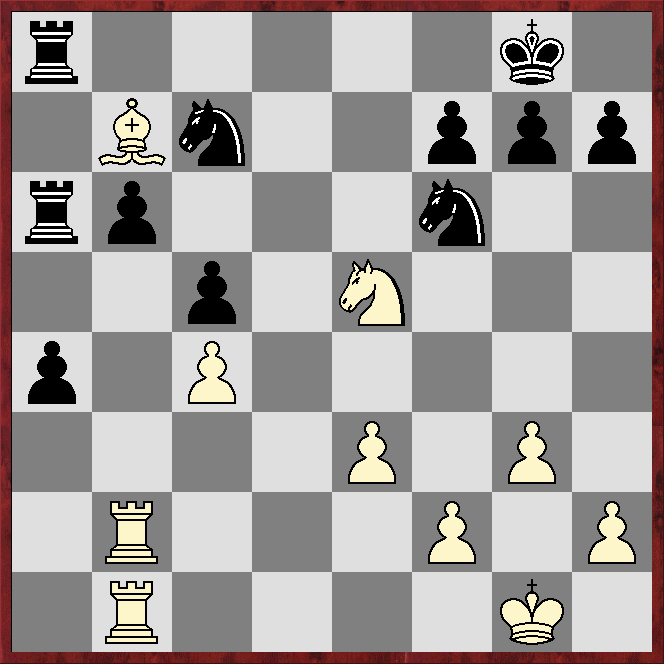 |
| White to play and win |
*****
*****
*****
*****
30.Rxb6??
This turns a winning position into a losing one. Capturing either rook is strong, eg 30.Bxa8 Nxa8 31.Ra2 Nc7 32.Rba1 b5 33.cxb5 Nxb5 34.Rxa4 etc.
30...Rxb6 31.Rxb6 a3 32.Bxa8
Or 32.Rb1 Rb8 etc.
32...a2 33.Rb8+ Nce8 34.Nd7 a1=Q+ 35.Kg2 g6??
Missing that after 35...Nxd7 36.Rxe8+ Black has 36...Nf8.
36.Nf6+ Qxf6 37.Rxe8+ Kg7
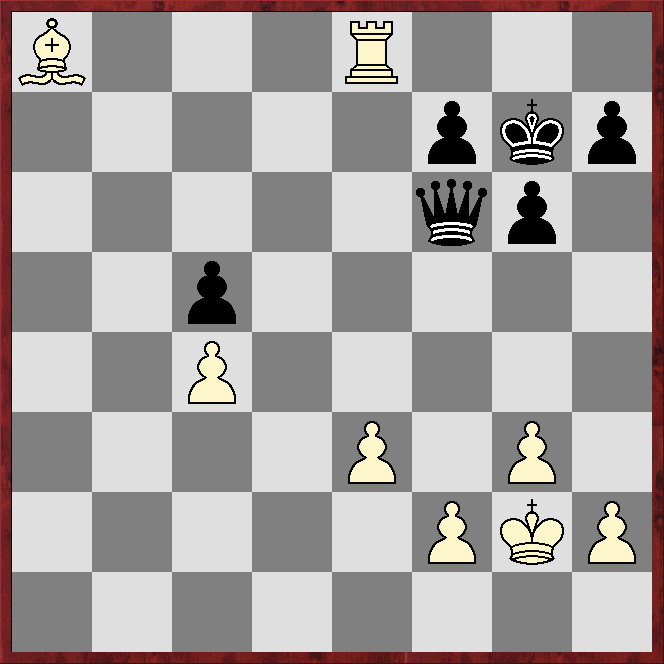 |
| How would you assess this ending? |
*****
*****
*****
*****
White has rook, bishop and pawn for a queen, with no weaknesses and a safe king. Dragon1 calls the game completely equal, but Stockfish16.1 gives White a slight edge, and it is certainly easier for White to play.
38.Bd5 Qd6
An only-move - otherwise White plays Rb8 and wins the f7 pawn.
39.e4 g5 40.e5 Qc7 41.e6 fxe6 42.Rxe6 h6 43.Re4
Perhaps 43.Be4!? is trickier to meet, eg 43...h5?, tyring to set a trap, rebounds after 44.Rg6+ Kf8 45.Rxg5 Qe7 46.Rf5+ etc. Instead 43...Qf7 apparently holds.
43...Qd6 44.h4!? gxh4 45.Rxh4 Qf6 46.Re4 Qb2 47.Re6 Qc3 48.Rc6 Qd4 49.Ra6 Qd1 50.Ra2 Qd4 51.Ra8 Qc3 52.f3!?
A last try.
52...Qc2+ 53.Kh3 Qf5+ 54.g4 Qb1 55.Kg3 Qg1+ 56.Kf4 Qd4+ ½–½
Subscribe to:
Posts (Atom)