Showing posts with label Doubled pawns. Show all posts

Friday, 14 June 2024

Davos Round One

FACED a Singaporean.

Spanton (1942) - Hui Kwang Ng (1434)
Sicilian (Bb5+)
1.e4 c5 2.Nf3 Nc6 3.Bb5 Qc7!?
This is seventh-most popular in ChessBase's 2024 Mega database, but there are 1,657 examples of the move and it has been played by grandmasters.
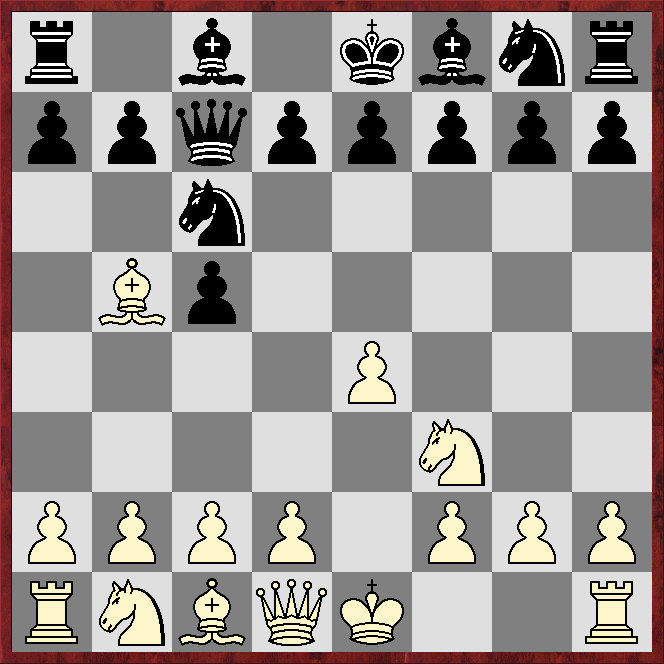
How should White respond?
*****
*****
*****
*****
*****
4.Nc3
This is second in popularity to 4.0-0.
4...e6 5.Bxc6!?
Again, castling is more popular. The idea of the text is to capture on c6 before Black is in position to recapture with the king's knight.
How should Black recapture?
*****
*****
*****
*****
*****
5...bxc6!?
This is almost as popular as 5...Qxc6, and is preferred by Stockfish16 and Komodo14.1. After 5...Qxc6 the mainline in Mega24 runs 6.d4 cxd4 7.Nxd4, when the engines reckon White's lead in development gives the upper hand.
6.e5!?
Preventing 6...e5, which would allow Black to open the c8-h3 diagonal for the light-square bishop, but more popular are 6.0-0 and 6.d3. The engines also like 6.b3!?, which does not appear in Mega24.
6...h6?!
This seems to be a novelty, and probably not a good one. The engines give 6...f6, claiming at least equal chances.
7.d3 d6!?
The engines are OK with this, but after ...
8.exd6
... Black is saddled with doubled pawns, and they are weak, or at least the front one is, even though they are not on a half-open file.
8...Bxd6 9.Ne4 Bb7?!
The engines suggest 9...Be7!?, the idea being to meet 10.Be3 Nf6 11.Nxc5 with 11...Nd5, when at least some lines have been opened for the bishops.
10.Be3 Qe7
Again the engines suggest ...Be7!?, one point being 11.Bxc5?? loses to 11...Bxc5 12.Nxc5 Qa5+ etc.
11.Qd2
Sealing the fate of the c5 pawn.
11...Nf6 12.Nxd6+ Qxd6 13.Qc3 c4!?
The engines are happy enough with this as there is no way to save the pawn (without giving up the g7 pawn after 13...Nd7).
14.Qxc4
Black is a pawn down, and has the weaker pawn-structure
*****
*****
*****
*****
*****
14...Nd7 15.0-0 0-0 16.Rfe1 c5 17.Qg4 Nf6
The engines' 17...f5!? seems to give better chances.
18.Qg3 Qxg3 19.hxg3 Rac8 20.a4!? a6 21.Ne5 Rfd8 22.Ra3 Rd5 23.Nc4 Nd7 24.Rb3 Bc6 25.Nb6 Nxb6 26.Rxb6 Bxa4 27.b3 Rc6??
A blunder, but the engines reckon Black was already lost.
28.Rb8+ (1-0, 36 moves).
Remarkably, all 26 games in round one went to form.

Wednesday, 27 March 2019

Steinitz Gem

HERE is another interesting clash from the book 500 Master Games Of Chess.
It is the sixth game of the Lasker-Steinitz rematch held in Moscow from November 1896-January 1897, and was one of only two Steinitz wins (the match finished in Lasker's favour +10=5-2).
I guess I must have seen the game before, but I could not remember it when going over the moves. Tartakower's notes are in italics.
Lasker (2855) - Steinitz (2794)*
Ruy Lopez, Deferred Steinitz
1.e4 e5 2.Nf3 Nc6 3.Bb5 a6 4.Ba4 d6
The 'Steinitz Defence Deferred' is sound and lasting.
5.d4
This straightforward move is the strongest against the Steinitz Defence proper (3...d6 4.d4). Here, curiously enough, it proves to be the least energetic.
My main analysis engines Stockfish10 and Komodo9 reckon the text dissipates White's advantage. Nevertheless, 5.d4 has been played by Shirov and other strong players.
5...Bd7
A rather anxious reply.
Tartakower gives a lot of analysis to support his claim that Black should have "boldly" played 5...b5 6.Bb3 Nxd4 7.Nxd4 exd4, giving the game "an incisive character." That is indeed the main line in this variation today.
6.Bb3!?
Releasing his hold without necessity. He could have kept up the tension by 6.c3, after which Black could have continued straightforwardly by 6...Nf6, or more insidiously by 6...Nge7, followed by ...Ng6, …Be7 etc, or finally by 6...g6, followed by 7....Bg7 etc, with a playable game.
Lasker had used 6.c3 to beat Steinitz at St Petersburg the previous year and Blackburne earlier in 1896 at Nuremberg. The subtle idea behind 6.Bb3!? will become clear later.
6...Be7
Of course not 6...Nf6 7.Bg5 etc (this must be misprint for 7.Ng5, although Black is still alive after 7...d5! eg 8.exd5 Nd4).
7.dxe5 dxe5 8.Qd5 Be6 9.Qxd8+ Rxd8 10.Bxe6 fxe6 11.c3
Who stands better, and why?
*****
*****
*****
*****
*****
White's plan, initiated by his sixth move, is now clear: elimination of the queens and creation of a doubled pawn in the hostile camp. But, for once, Dr Lasker, the great endgame player, is at fault; he overlooks that a genuine endgame is still very far off. Black already commands the open d file, and will soon operate on the f file as well.
Note that Black has a sizeable lead in development. White has a knight in play, while Black has developed a knight, bishop and rook, and it is Black to move. Nevertheless, pawn-structure cannot be ignored - the engines reckon White is a tiny bit better (a fifth of a pawn, according to Stockfish10; a tenth of a pawn, according to Komodo9). The game becomes one of positional manoeuvre.
11...Nf6 12.Nbd2 Bc5
And here is, in addition, a diagonal which will be under Black's management.
13.b4 Ba7 14.a4 b5
Cutting short White's designs on the extreme queen's wing.
15.Ke2
Useless would be 15.axb5 axb5 16.Ra6 Bb6 (or 16.Nxe5 Bxf2+).
15...Bb6
Evading the threat 16.axb5 axb5 17.Nxe5.
16.axb5 axb5 17.Ne1 Rf8 18.f3 Rf7 19.Nb3?
A very natural desire to let the inactive bishop into the open. Yet it is a tactical inadvertence by which Black will be enable dto turn his positional advantage into one of material. 19.Rf1 is necessary as a preliminary measure.
Or, as an anonymous analyst in ChessBase's 2019 Mega database puts it: "A gross mistake that is seldom found in Lasker's games."
19...Nxe4!
Gain of a pawn of which the protection is illusory (20.fxe4 Rf2#). The rest is a question of technique.
20.Bb2 Nd6
Threatens not only 21...Nc4, but also the breakthrough (even against 21.Nd2) by 21...e4 etc.
21.Rf1 Nc4 22.Bc1 Ne7 23.Bg5 Nd5!
Well calculated. This sacrifice of the exchange enables Black to take the hostile king under the concentrated fire of four batteries.
24.Bxd8
There is nothing better.
24...Nf4+ 25.Kd1 Rd7+ 26.Kc2
Or 26.Kc1 Ne2+ etc.
26...Ne3+ 27.Kb2 Nxf1 28.Bg5 Ne3 29.Bxf4 exf4
After a few exchanges, Black remains with only an extra pawn, but with the same overwhelming positional advantage.
30.Rc1 e5 0-1
Practically a 'zugzwang' position for White, while Black can further intensify the pressure by 31...Rd6 and …Rg6 or …Rh6.
*The ratings are historical retro analysis from chessmetrics.com and should not be taken too seriously.