Showing posts with label English Four Knights. Show all posts

Wednesday, 24 December 2025

All About That Bass VII

MOST of us have an opponent against whom nothing seems to work.
When the opponent is considerably stronger, this is not surprising, but when ratings are not so different, the results are harder to explain.
My biggest bogeyman is probably John Bass, whose record against me is +6=1-0.
Seven games is not a huge sample, but such a poor performance on my part must signify something.
So in this mini-series I am looking at my games against JB to try to discover what is going on.
Here is our latest encounter.

Spanton (1980) - Bass (1932)
Central London League 1925
English Four Knights
1.c4 e5 2.Nc3 Nf6 3.Nf3 Nc6 4.e4!?
This was a Nimzowitsch favourite.
4...Bb4 5.d3 0-0 6.Be2 d6 7.0-0
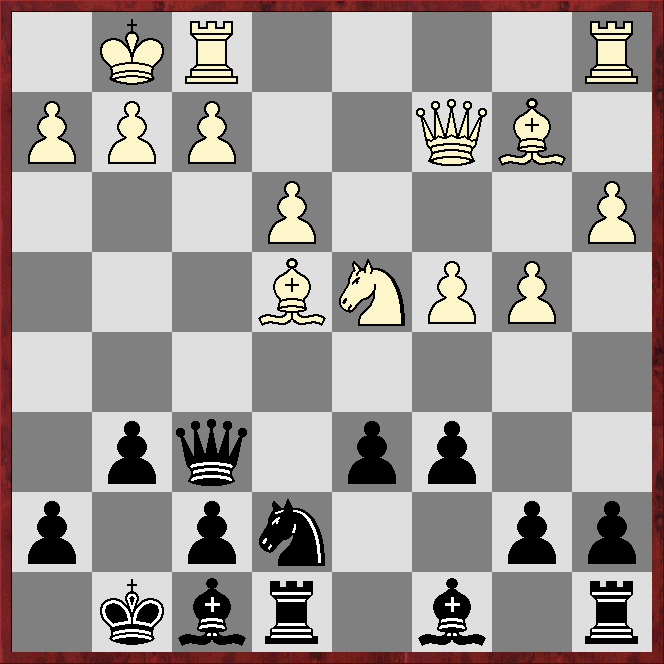
Now both sides have castled, how would you assess the position?
*****
*****
*****
*****
*****
White has more queenside space, and the hole at d4 is probably not a serious weakness, but White has a passive and bad light-square bishop, while Black's bad bishop is outside the pawn-chain, and therefore active. Stockfish17.1 and Dragon1 rate the game as equal.
7...h6 8.h3 Bxc3!? 9.bxc3 Re8 10.Rb1 Ne7 11.c5!? Ng6 12.cxd6 Qxd6!? 13.Qc2 b6 14.Rd1 Bb7 15.Be3 Rad8 16.Nh2 c5 17.Ng4 Nxg4 18.Bxg4 Qc7 19.Bh5 Nf4!? 20.Bxf4 exf4 21.Bf3
There has been much manoeuvring, and quite a few exchanges, but the position remains equal, according to the engines
*****
*****
*****
*****
*****
21...Re7 22.Qa4 Bc6 23.Qc4 Bb7 24.a4 Qc8 25.Bg4 Qc7 26.Ra1 Bc8 27.Bxc8 Qxc8 28.a5
More prudent is 28.f3.
28...f3! 29.axb6?
White is only slightly worse after 29.Re1, according to the engines.
29...axb6
This is enough for an edge, but stronger is 29...fxg2! 30.Kxg2 (30.bxa7? Qxh3) axb6.
30.Kh2?
The engines suggest 30.Re1 or 30.Qa6.
30...fxg2 31.Rg1?!
If 31.Kxg2?!, then 31...Qc6. Best may be 31.Re1.
31...Qc7+ 32.Kxg2 Qf4 33.Rad1 Re6 34.Qa2 Rg6+ 35.Kf1 Rxg1+ 36.Kxg1 Qf3 37.Rd2 Rxd3 38.Rxd3 Qxd3 39.Qa8+ Kh7 40.Qd5!?
This is Dragon1's top choice, but the ending is lost anyway.
40...Qxd5 41.exd5 Kg6 42.c4 Kf6 43.f4 g5 44.Kf2!? gxf4 45.Kf3 Ke5 46.h4 b5 47.cxb5 Kxd5 48.Kxf4 c4 49.Ke3 Kc5 0-1
LESSON: carelessness about king safety was followed by sub-optimal tactics that left me with a losing position.

Wednesday, 3 December 2025

Benidorm Bali Round Seven

FACED a Malaysian junior (born 2010).

Spanton (1896) - Taj Prasshad Nambiyar Chanthiran (1518)
English Four Knights
1.c4 e5 2.Nc3 Nf6 3.Nf3 Nc6 4.e4!?
Nimzowitsch pioneered this move, and the associated pawn-formation with a grip over d5, but a hole at d4. Botvinnik is credited with refining the idea by playing e4 before developing the king's knight, which then went to e2, in conjunction with a kingside fianchetto.
How should Black respond?
*****
*****
*****
*****
*****
4...Bb4
This was a popular reply from the beginning, along with 4...Bc5, and has today established itself as the main continuation.
5.d3 h6!?
Nakamura and other grandmasters have played this, but more popular are 5...0-0 and especially 5...d6.
6.Be2 d6 7.Bd2 Bc5!?
A known idea, but apparently a novelty in this exact position. The move is liked by Stockfish17.1 and Dragon1, along with another apparent-novelty, 7...a5!?
8.0-0 0-0
Now both sides have castled, how would you assess the position?
*****
*****
*****
*****
*****
*****
White has more space on the queenside and has a grip over d5, but a hole at d4. Both white bishops are passive, while Black's dark-square bishop is technically bad, in that Black's centre pawns are on dark squares, but is outside the pawn-chain and is the most active piece on the board. The engines reckon the game is completely equal.
9.Na4 Qe7 10.a3 a5 11.Rb1 Ba7 12.b4 axb4 13.axb4 Nd4 14.Nc3 Nxe2+!?
Black wins the bishop-pair, but swops off White's bad bishop.
15.Qxe2 Bg4 16.h3 Bh5 17.Be3 c6
Maintaining the bishop-pair with 17...Bb8!? does not look appealing, and 17...b6? is simply bad after 18.Ra1 or 18.b5!?
18.b5 Bxe3
Black is slightly better after this, according to the engines, but they reckon 18...Bd4!? is stronger.
19.fxe3!?
It is hard to say which recapture is better - the engines are split on the matter - but I thought this was the less-drawish choice.
19...c5?!
Black is slightly better after 19...Nd7 or 19...Qd8, according to the engines, but they reckon the text leaves White slightly better.
20.g4 Bg6 21.Nh4!?
Black cannot exploit this tactically, because White threatens Nxg6, which in turn threatens Nxe7+, but they reckon White should be playing on the queenside with 21.Ra1 or 21.Qb2.
21...Bh7 22.Nf5 Bxf5 23.Rxf5 Nh7 24.Qf2 Ra3!?
Counterplay, but the engines reckon 24...g6!? gives complete equality, despite the hole at f6.
25.Nd5 Qd7 26.Rd1
Black to play and lose
*****
*****
*****
*****
*****
26...Rfa8??
Black is only slightly worse after 26...g6!? or 26...Qd8, according to Stockfish17.1, although Dragon1 awards White the upper hand.
27.Nb6 Qe7 28.Nxa8 Rxa8 29.Kh2 f6 30.Qf1 Nf8 31.Ra1 Rxa1!?
The engines are not overly critical of this, although swopping rooks when the exchange down is rarely a good idea.
32.Qxa1 Ne6 33.Qa8+ Kh7 34.Qc8
How should Black proceed?
*****
*****
*****
*****
*****
34...Nf4?!
This 'clever' combination wins back the exchange, but at the cost of allowing White to swop off into an easily won pawn ending. However, Stockfish17.1 reckons White's advantage is anyway worth almost a rook, and Dragon1 is even more effusive.
35.exf4 g6 36.fxe5 gxf5 37.Qxf5+ Kg8 38.Qg6+ Qg7 39.Qxg7+
The game finished:
39...Kxg7 40.exd6 Kf7 41.Kg3 Ke6 42.Kf4 Kxd6 43.Kf5 Ke7 44.Kg6 b6 45.h4 1-0

Wednesday, 4 June 2025

Miniatures 3

IN this occasional series I am going through my decisive games of 20 moves or fewer.

Spanton (140 BCF) - C Sergeant*
Doncaster & District League 1980
English Four Knights
1.c4 e5 2.Nc3 Nf6 3.Nc3 Nf6 4.e3!?
I had been much taken by Raymond Keene's The Openings In Modern Theory And Practice, which came out in 1979 in hardback. One of the lines covered in the book is this interesting move in the Four Knights Variation of the English.
4...Bb4
This is the main reply, scoring 47% in ChessBase's 2025 Mega database.
5.Qc2 0-0
This is the commonest continuation, although also popular is giving up the bishop-pair with 5...Bxc3!?, when the main line in Mega25 runs 6.Qxc3 Qe7 7.a3!? d5 8.d5 8.d4 exd4 9.Nxd4 Nxd4 10.Qxd4 c5!? 11.Qh4, with an unclear position that sees Stockfish17 and Dragon1's evaluations fluctuate, but generally favouring White.
How should White proceed?
*****
*****
*****
*****
*****
6.Nd5!?
This seems to have been first played by Vasja Pirc at the 1936 Olympiad in Warsaw. He lost to Andor Lilienthal, and the move did not catch on, but it was revived in the 1960s and 1970s by, among others, Benko, Korchnoi, Miles and Keene.
6...Re8 7.a3
The main move in Mega25 is 7.Qf5!?, and this was played against me in Kevin Thurlow (2283) - Spanton (2274), States & Regions Division Two Correspondence 2021, which continued 7...d6 8.Nxf6 gxf6!? (Korchnoi and Timman beat Keene with the text in 1977, and it is probably slightly better than 8...Qxf6, played by Ljubojević in a draw against Keene, also in 1977) 9.Qh5 d5 10.Bd3!? e4 11.cxd5 Bf8 12.a3!? exd3 13.dxc6, and now I played the apparent-novelty 13...a5!? (known, and preferred by the engines, is 13...bxc6), when 14.cxb7 Bxb7 was approximately equal (½–½, 27 moves).
7...Bd6!?
The engines do not like this, preferring the main move 7...Bf8 or the rare 7...e4!?
8.Bd3
Stockfish17 prefers 8.Ng5!?, but Dragon1 fluctuates between the two moves.
8...g6?!
Probably better is 8...h6.
9.Nxf6+?!
This is the engines' second choice, at least for a while (Stockfish17 comes to promote 9.Rb1 to second place), but they much prefer 9.h4!?
9...Qxf6 10.0-0 Bf8 11.Be4 d6 12.b4 Ne7 13.d4 exd4 14.Nxd4 c6 15.Bb2
White's play along the long dark diagonal is the most significant feature of the position - Black has to be careful
*****
*****
*****
*****
*****
15...Qg5?!
Occupying the diagonal with 15...Bg7 is probably better (the reply 16.Nxc6?? would be a gross error in view of 16...Qxb2).
16.Nf3 Qg4??
Correct is 16...Qh6, so if, as in the game, 17.Qc3, Black has 17...Bg7.
17.Qc3 f6
There is no better way of preventing Qh8 with mate, but Black is anyway lost.
18.Qxf6 Rd8 19.Ng5 1-0
*I have no further details, although the ECF has an unrated CR Sergeant listed as Active and a member of NCB (presumably National Coal Board), but without a rating history.
LESSON: a fianchettoed king's position without the bishop occupying the hole at g7 (g2 for White) can be very vulnerable to play on the long diagonal.