Showing posts with label Hedgehog. Show all posts

Thursday, 29 May 2025

Bodensee Senioren Round Five

FACED my first Austrian.

Spanton (1937) - Josef Granabetter (1840)
Maróczy Bind
1.e4 c5 2.Nf3 e6 3.d4 cxd4 4.Nxd4 a6 5.c4 Nf6 6.Nc3 Qc7 7.Be3
The commonest move in ChessBase's 2025 Mega database is 7.a3!?
7...d6 8.Be2 Nbd7 9.0-0 b6 10.Rc1 Bb7
Black has set up a Hedgehog that will be completed by ...Be7 and ...0-0
*****
*****
*****
*****
*****
According to Wikipedia: "Although Black's position is cramped, it has great latent energy, which may be released if Black is able to play ...b5 or ...d5 at some point. These pawn breaks are particularly effective because White usually places pawns on c4 and e4 (the Maróczy Bind)."
11.f3 Rc8 12.b3 Qb8 13.Qd2 Be7 14.Rfd1 0-0
Now both sides have castled, how would you assess the position, which occurs 152 times in Mega25?
*****
*****
*****
*****
*****
White's extra space gives a slight edge, according to Stockfish17 and Dragon1.
Can you guess White's most popular continuation?
*****
*****
*****
*****
*****
15.Nc2!?
The main line in Mega25 runs 15.Bf1!? Bd8!? 16.Qf2 Bc7 17.g3!? Rfe8 18.Bg2, when Dragon1 gives White a slight edge, but Stockfish17 reckons Black has equalised. If you correctly guessed White's move, and especially if you expected Black's reply, you are either familiar with the theory or should seriously consider taking up the Hedgehog.
The text, which is second-most popular in Mega25, unveils pressure against d6 and b6.
15...Qa8!?
Normal is 15...Bd8!? (16.Qxd6?! Bc7) or 15...Rfe8.
16.Na4 d5?
Thematic, but the loss of a pawn is too much. The engines give 16...Qb8, the idea being to meet 17.Nxb6 with 17...Nxb6 18.Bxb6 Bxe4.
17.exd5
Even stronger, according to the engines, is 17.cxd5, eg 17...exd5 18.e5 Ne8 19.f4 b5 20.Bg4!?
17...exd5 18.Nxb6
Not 18.Bxb6?? Nxb6 19.Nxb6 Bc5+ etc.
18...Nxb6 19.Bxb6 dxc4 20.Bxc4 Bc5+ 21.Bxc5 Rxc5 22.Ne1 Rh5
Black has pressure against the weakened white kingside, but not enough for a pawn, according to the engines
*****
*****
*****
*****
*****
23.Qf4 Qa7+ 24.Kh1 Nd5 25.Bxd5 Rxd5 26.Rxd5 Qxd5 27.Nd3 a5
The engines suggest 27...h6 or 27...Rd8. albeit giving White the upper hand.
28.h3 h6 29.Qe5 Qa8 30.Nf4
How should Black proceed?
*****
*****
*****
*****
*****
30...Bc6??
Black has to go in for 30...Bxf3!? 31.gxf3 Qxf3+, when 32.Kh2 Qf2+ 33.Ng2 Qxa2 leaves White up a knight for two pawns, but with only a slight edge (Stockfish17) or at most the upper hand (Dragon1).
Also losing is 30...Bb7?? 31.Rc7 (31.Nh5 is also strong), eg 31...Re8 32.Qf5 Rf8 33.Ng6 etc.
31.Nh5 1-0

Tuesday, 12 December 2023

Benidorm U2000 Round Nine

FACED a Spain-registered player in the last round.

Spanton (1743) - Vladislav Oreshkin (1916)
English Symmetrical
1.g3 Nf6 2.c4 e6 3.Bg2 c5 4.Nf3 Nc6 5.0-0 Qc7 6.Nc3 a6 7.b3 Rb8 8.a4!?
Somewhat surprisingly, at least to me, this move not appear in ChessBase's 2024 Mega database. Known moves are 8.Bb2 and 8.d4.
8...d6 9.d4 cxd4 10.Nxd4 Be7 11.Bb2 0-0
Now both sides have castled, how would you assess the position?
*****
*****
*****
*****
*****
Black has a central pawn-majority, but White has more space on the central-queenside, and the white bishops are more active than their Black counterparts. Stockfish16 and Komodo14.1 give White a slight edge.
12.Rc1 Rd8
If Black had seen what was coming, he might have preferred the engines' 12...Nxd4 13.Qxd4 b6, with a Hedgehog position that the engines reckon slightly favours White.
How should White proceed?
*****
*****
*****
*****
*****
13.Nd5! Qd7!?
This is best. Black certainly should not play 13...Qa5?? as that loses a piece to 14.Nxc6 bxc6 15.Nxe7+. Also bad is 13...exd5?, eg 14.cxd5 Bd7 15.dxc6 bxc6 16.Bxc6, after which White is a pawn up and has targets at d6 and a6. And if 13...Nxd5!? then 14.cxd5 exd5 15.Bxd5 Bd7 16.e3 with kingside play is very strong.
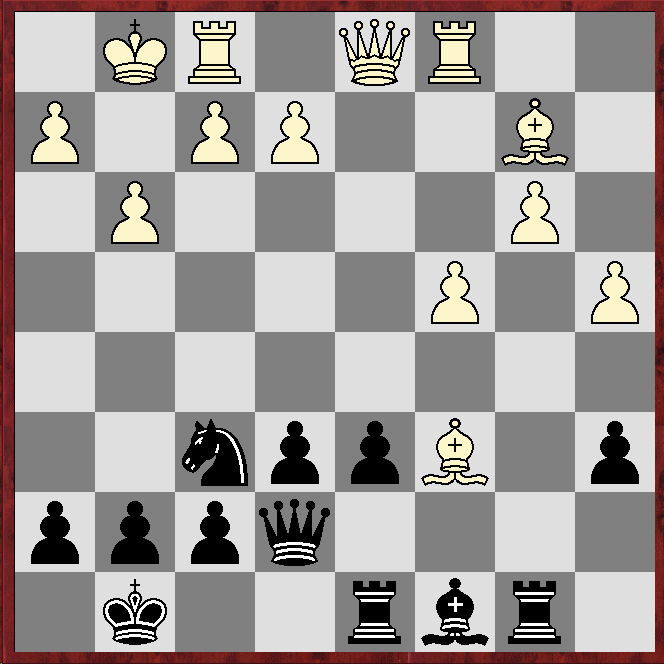
14.Nxc6 bxc6 15.Nxe7+ Qxe7 16.Bxc6
White is a pawn up and has the bishop-pair
*****
*****
*****
*****
*****
16...Rb6 17.Bg2 e5 18.Qd3 Nd7 19.Ba3 Nc5 20.Bxc5 dxc5 21.Bd5 Bh3 22.Rfd1 Rdb8 23.Rb1 g6 24.Qf3 h5 25.Qd3 Kg7 26.Qc3 f6 27.Qd3 Bf5 28.e4 Bh3 29.Qe3 Bd7 30.Qd3 Bh3 31.Qe3 Bd7 32.Qd3 ½–½
I could see no way to make progress. After 32...Bh3 the engines give best-play as something like 33.a5!? Rb4 34.Rd2 Qc7 35.Ra2 Qd7 36.f3 Qe7 37.Qe3, claiming White has the upper hand, but not making progress, as far as I can tell.

Sunday, 13 January 2019

Early Hedgehog

A hedgehog formation in chess comes about when one player, usually Black, arranges his forces along the back three ranks and waits for an opportune moment to counterattack.
The one exception to this is that the c pawn is advanced to the fourth rank and exchanged for the opponent's d pawn.
Without this exchange, the opening is technically not a Hedgehog, although it could still have many hedgehog-like qualities.
I always assumed using the word hedgehog to describe a chess set-up was quite a modern thing.
Indeed, according to grandmaster Lubomir Kavalek, writing online for HuffPost, "(Yugoslav GM) Ljubomir Ljubojević is credited with developing the Hedgehog in the modern era - in the early 1970s."
But Kavalek goes on to point out that the earliest known game to feature a hedgehog formation, although it was not given that name then and was only rediscovered many years later, was a game of the German GM Friedrich Sämisch in 1922.
However, the term hedgehog was already in use by the early 1950s, as I discovered while going through 500 Master Games Of Chess by Tartakower and du Mont.
Here is the opening of the game cited by Tartakower.
His comments are in italics - mine in normal type.
James Aitken - Samuel Reshevsky
Scotland - USA, Stockholm Olympiad 1937
Ruy Lopez
1.e4 e5 2.Nf3 Nc6 3.Bb5 a6 4.Ba4 Nf6 5.0-0 Be7 6.Re1 b5 7.Bb3 d6 8.c3 Na5 9.Bc2 c5 10.d4 Qc7 11.h3
If 11.Nbd2 is more incisive, 11.a4 bolder and 11.d5 more circumspect, the move in the text is perfectly sound.
All four moves are still played today by strong grandmasters, although most popular is 11.Nbd2.
11...0-0
A non-committal reply, which is the most widely used. Other possible continuations are 11...Bd7, followed by ...Rc8, bearing on the queenside, or 11...Nc6 on the centre, or even 11...g5 on the kingside.
11...g5?! is highly questionable, and I can find no evidence of it having ever been played. I guess Tartakower's idea is 12.Bxg5 Rg8, but then 13.h4 (or 13.a4, as preferred by Stockfish10 and Komodo9) seems to simply leave Black a pawn down with little compensation.
12.Nbd2 Nc6 13.d5
He decides to block the centre in order to concentrate on the kingside. Other playable lines are 13.a4 or 13.Nf1, with the positional sacrifice of a pawn.
Lasker and Tarrasch debated the sacrifice line in their 1908 world championship match, playing 13...cxd4 14.cxd4 Nxd4 15.Nxd4 exd4. In game three Lasker played 16.Ng3 and lost; in game five he chose 16.Bg5 and won. Note that 16.Qxd4?? is a gross blunder because of 16...Qxc2.
13...Nd8
A playable alternative is 13...Nb8.
14.Nf1
Without interpolating the interesting episode 14.a4, White unwaveringly pursues the object he has set himself by the preceding move: a direct kingside attack.
14...Ne8
Black's counterplay aims at effecting the counterthrust ...f5.
15.g4
Preventing, as it does, the enemy threat, this move is more energetic than 15.Ng3.
15...g6 16.Bh6
Or at once 16.Ng3.
16...Ng7 17.Ng3 f6
There is a great deal of resistance in the "hedgehog position" which Black has adopted.
There are 54 games with this position in ChessBase's 2019 Mega database
OK, today this would not be recognised as a Hedgehog, but Black's kingside does have a spindly hedgehog appearance.
The remaining moves were: 18.Kh1 Nf7 19.Be3 Kh8 20.Rg1 Bd7 21.Qe2 c4 22.Nd2 Rg8 23.Rg2 Raf8 24.f3 Qc8 25.Rag1 f5 26.Nxf5 gxf5 27.exf5 Nxf5 28.gxf5 Bxf5 29.Rxg8+ Rxg8 30.Rxg8+ Kxg8 31.Qg2+ Kf8 32.Bxf5 Qxf5 33.Ne4 h5 34.Kh2 Qh7 35.Qd2 Nh8 36.Bg5 Qf5 37.Bxe7+ Kxe7 38.Qf2 Nf7 39.Qa7+ Kf8 40.Qb8+ Kg7 41.Kg2 Qf4 42.Qa7 Qc1 43.Nxd6 Qd2+ 44.Kf1 Qxd5 45.Ne4 h4 46.Qf2 Qd1+ 47.Kg2 Qd8 48.Qa7 Qd3 49.Qf2 Qb1 50.Qxh4 Qxb2+ 51.Kg3 Kf8 52.Qf6 Qc1 53.Qxa6 Qg1+ 54.Kh4 Qe3 55.Qc8+ Kg7 56.Qg4+ Kf8 57.Qc8+ Kg7 ½-½