Showing posts with label Milner-Barry Gambit. Show all posts

Tuesday, 8 December 2020

New & Improved Milner-Barry Gambit (conclusion)

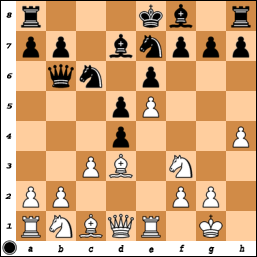
THE position after 1.e4 e6 2.d4 d5 3.e5 c5 4.c3 Nc6 5.Nf3 Qb6 6.Bd3 cxd4 7.0-0!? is a rare bird.
Just 59 games reach it in ChessBase's 2020 Mega database, but early results are promising, with White scoring +31=6-22, which is a healthy 58%.
In 46 of the games whites had a rating which averaged at 2115, and they performed at 2164, ie +49pts.
Black players had a rating in 48 games, also averaging at 2115, and they performed at 2023, ie -92pts.
As I have detailed, strong players almost invariably play 7...Bd7 rather than immediately capturing on c3.
One point of their choice is that if White replies 8.cxd4, the game transposes into a regular Milner-Barry Gambit.
If White plays Jonny Hector's choice 8.Re1 or Magnus Carlsen's novelty 8.Nbd2!?, Black still has the option of capturing on c3.
Even at club level, players are well capable of finding 7...Bd7 - it occurs in 42 of the 59 games in Mega20.
There is much still to be learned about the New Milner-Barry.
The Cuban international master Osmel Garcia Carey, for example, has his own ideas about how to play the gambit, preferring to meet 7...Bd7 with 8.Kh1!?, while the Australian amateur Adrian Flitney likes 8.Qe2!?
For what it is worth, the analysis engine Stockfish12 does not approve of Garcia Carey's idea, but Komodo11.01 is fine with it.
Both engines reckon Flitney's move is playable, although in this case Komodo11.01 is slightly less keen than Stockfish12.

Monday, 7 December 2020

New & Improved Milner-Barry Gambit (part four)

AT high levels Black usually meets 1.e4 e6 2.d4 d5 3.e5 c5 4.c3 Nc6 5.Nf3 Qb6 6.Bd3 cxd4 7.0-0!? with 7...Bd7.
But what happens if Black makes the white pawn-sac permanent by immediately capturing on c3?
There are seven games in ChessBase's 2020 Mega database that reach the position after 7...dxc3.
The bad news is White scores a pitiful +1=0-6, but the situation is not as bad as that implies - five of the whites were unrated and the other two were 1775 and 1638.
Further, two of the whites replied to 7...dxc3 with 8.Be3??, which loses on the spot to 8...cxb2.
To slightly redress the balance I want to start by looking at the one game in Mega20 that White won.

Veronika Buchkovska - Dariy Koval
Lviv (Ukraine) Winter Cup 2016
1.e4 e6 2.d4 d5 3.e5 c5 4.c3 Qb6 5.Nf3 Nc6 6.Bd3 cxd4 7.0-0!? dxc3 8.Nxc3
The natural move, giving what John Watson at chesspublishing.com calls "obvious compensation."
Position after 8.Nc3
8...Bb4?!
Five games reach the position after 8.Nxc3 in Mega20, and Black has replied with five different moves (I will look at the alternatives below). The text develops the black dark-square bishop so it will not be shut in by ...Nge7, but the bishop invites harassment on b4.
9.Re1 Bc5?
Seeking to take advantage of White unprotecting f2, but the idea is flawed both positionally and tactically.
10.Qe2
Even stronger is 10.Na4! as 10...Bxf2+?? drops a piece to 11.Kf1.
10...Nd4?
The analysis engines Stockfish12 and Komodo11.01 show 10...Bd7! gives Black a reasonable game as 11.Na4 can be met by 11...Nd4 12.Nxd4 Bxa4.
11.Nxd4 Bxd4 12.Nb5 Bd7
Black can hardly defend the d6 square with 12...Bc5 as then 13.b4! Be7 (13...Bxb4 14.Rb1 etc) 14.Be3 Qd8 15.Rac1 is horrific.
13.Nd6+ Ke7 14.Qd2?!
Hardly subtle. The engines much prefer offering a rook with 14.b3!?, one point being that accepting the sacrifice with 14...Bxa1?! runs into 15.Ba3 with what seems a winning attack.
14...Bc5?!
Seeking to evict the troublesome knight, but apparently missing the main point of White's last move. Better is 14...f6, when 15.exf6+ Bxf6 (not 15...Kxd6? 16.Qf4+ e5 17.fxg7! exf4 18.Bxf4+ Kc5 19.Rac1+ Kb4 20.Bd2+ Ka4 21.Bc2+ Kb5 22.a4+ Kc6 23.Bd3+ Qc5 24.Rxc5+ Kxc5 25.b4+ Kc6 26.Bb5+ winning - a long but largely forced line) 16.Nb5 Bxb5 17.Qb4+ Kf7 18.Bxb5 leaves White with sufficient compensation for her pawn deficit.
15.Qg5+ f6??
Black had to play 15...Kf8, although the engines reckon White is better.
16.Qxg7+ (1-0, 23 moves).

That game was full of mistakes, but it does illustrate how play can get very tactical very quickly after 7...dxc3. Now here is the first game in Mega20 to feature 7...dxc3.

Carlos Utman - Luis Rojas Keim (2310)
Chilean Championship (Santiago) 1993
1.e4 e6 2.d4 d5 3.e5 c5 4.c3 Nc6 5.Nf3 Qb6 6.Bd3 cxd4 7.0-0!? dxc3 8.Nxc3 a6?!
This protects the b5 square, which proved a major factor in Black's undoing in the last game, but it does nothing about Black's lag in development.
9.a3!?
White replies with equal slowness. Probably better is 9.Na4. Also possible is 9.Be3!? as 9...Qxb2 10.Na4 Qa3 11.Nb6 Rb8 12.Qc2 gives White great compensation for two pawns, according to the engines. A sample line continues 12...Nh6 (12...Qe7 13.Bxa6!) 13.Rab1 Be7 14.Rb3 Qa5 15.Rc1, when the engines cannot find a decent move for Black.
9...Nge7 10.h4!?
As a rule, h4 in this sort of position is less effective when Black can immediately reply ...Ng6 without fearing h5.
10...Ng6 11.Qe2 Nd4 12.Nxd4 Qxd4 13.h5 Nf4
Black can probably also get away with 13...Nxe5!?
14.Bb5+??
White had to play 14.Bxf4 Qxf4 15.Rac1 or 14.Qg4 Qxd3 13.Qxf4, with just-about enough compensation for a pawn in both cases, according to the engines.
14...axb5 15.Qxb5+ Bd7 (0-1, 33 moves).

Utman-Rojas Keim illustrates that both players need to develop quickly, ideally with threats. Black's probable minor-slip at move eight could have caused big problems. As it was, despite White playing seemingly sub-optimal moves, White still had a lot of compensation for being a pawn down.
In the next game Black gets on with development.

Oswaldo Caminos - Mario Guevara (2260)
San Salvador Championship 1995
1.e4 e6 2.d4 d5 3.e5 c5 4.c3 Nc6 5.Nf3 Qb6 6.Bd3 cxd4 7.0-0!? dxc3 8.Nxc3 Bd7
This looks a sensible move.
9.Qe2
Preparing Be3. But the engines like an immediate 9.Be3!?, when 9...Qxb2?! 10.Nb5 Rc8 11.Re1 a6 (11..Nxe5 12.Rb1 Nxf3+ 13.Qxf3 with  a huge lead in development that is worth much more, according to the engines, than Black's extra pawns) 12.Rb1 Qxa2 13.Re2 Qa5 14.Bb6! wins the black queen. If 10...Kd8? then 11.Bc1 (11.Rb1 is also strong) Qb4 (11...Qxa1 12.Bg5+)  12.Rb1 with a huge attack.
Black should probably meet 9.Be3!?, according to the engines, with 9...Qd8, but White's compensation for a pawn is obvious.
9...Bc5?!
Probably better is 9...Nge7 or 9...Rc8.
10.Bf4?!
As in Buchkovska - Koval, White misses the chance to play 10.Na4!?, when 10...Qb4 11.Nxc5 Qxc5 12.Be3 gives White great compensation for a pawn, including the bishop-pair and Black being left with a bad bishop. Perhaps Caminos was put off by 10...Nd4 11.Nxd4 Bxa4, but the engines reckon 12.Qg4! Ne7 13.Nf3 gives White a very good game.
10...Nb4 11.Bb1?!
White probably should have settled for 11.Bb5 Bxb5 12.Nxb5 a6 13.Nd6+ Bxd6 14.exd6, which is a little unclear but probably better for Black.
11...d4!
Caminos must have missed the strength of this move.
12.a3
Or 12.Ne4 bb5.
12...dxc3 13.axb4 cxb2 14.Qxb2 Qxb4 15.Qxb4 Bxb4 16.Be4 Bc6 17.Bxc6+ bxc6 18.Rfb1 c5 19.Nd4?
The engines reckon White should have played 19.Bd2 Bxd2 20.Nxd2 with good chances of getting one pawn back, after which he will have some drawing chances.
19...Ne7 20.Nb5 Nd5 (0-1, 23 moves).

Caminos - Guevara again shows how the game can quickly get tactical after 7...dxc3. It also illustrates, in the notes rather than the game, White's thematic shots Be3!? and Na4.
The next game is another example of missed tactical opportunities in the New Milner-Barry Gambit.

Ole Overmark (1775) - Arun Vijay Cithu (1501)
Xtracon (Helsingør, Denmark) 2016
1.e4 e6 2.d4 d5 3.e5 c5 4.c3 Nc6 5.Nf3 Qb6 6.Bd3 cxd4 7.0-0!? dxc3 8.Nxc3 f6?!
Again a non-developing move by Black, and again it is probably too slow, but White must react energetically.
9.exf6
The engines again like 9.Be3!?, when 9...Qxb2? 10.Nb5 is immediately winning, they reckon, eg 10...Kd8 11.Rb1 Qxa2 12.Ra1 Qb2 13.Bd2!? Nxe5 14.Bc3 Nxf3+ 15.Qxf3 Qb3 16.Rfb1, trapping the black queen.
So Black should probably retreat the queen with 9...Qd8, when best may be 10.Bb5!? (10.Qc2 also seems good) Bd7 11.Re1 Bb4 12.a3 Bxc3 13.bxc3 with what the engines reckon is more than enough compensation for a pawn. Note that 13...Nxe5? 14.Nxe5 Bxb5 fails to 15.Qh5+ etc.
9...Nxf6 10.Ng5?!
The engines reckon White is at least slightly better after 10.Bf4.
10...Be7?!
Probably better is 10...Bd6.
11.Re1
The engines give 11.Bxh7!, eg 11...Nxh7 12.Qh5+ Kd7 13.Nxe6!, when 13...Kxe6? 14.Qxd5+ is good for White, but even stronger seem to be 14.Re1+ and 14.Nxd5. Black could try 13...Nb4, to cover d5, but 14.Re1 and 14.Nxg7 seem good, eg 14.Re1 Ng5 (14...Nc2 15.Nxd5) 15.Qxh8 Nxe6, when material is approximately equal but White's attack continues.
11...e5?!
Black should return the pawn with 11...0-0 12.Nxe6 Bxe6 13.Rxe6 with a roughly equal game, according to the engines.
12.a3?
Capturing on h7 again works. The text is too slow.
12...0-0!?
This may be best, but it should lead to sharp play.
13.Na4?
The knight has no real follow-up, and in fact the move drives the black queen where it wants to go.
White could still play Bxh7+, eg 13.Bxh7+ Nxh7 14.Qxd5+ Kh8 15.Nf7+ Rxf7 16.Qxf7, when material is again roughly equal, but this time Black's king is much safer and the black pieces are much better coordinated. Stockfish12 gives Black the upper hand although Komodo11.01 reckons the black edge is a lot smaller.
13...Qc7?!
Almost certainly better is 13...Qd8, when Black is a pawn up, controls the centre and has no problems with king safety.
14.h3??
Again Bxh7+ was White's best chance.
14...h6 15.Nf3 e4 (0-1, 52 moves).

Overmark - Cithu once again shows the tactical nature of the New Milner-Barry Gambit. White must be alert for combinations, especially when Black fails to catch up in development.
The next game is a rating mis-match, but the 525-point underdog is not the first to make a dubious move.

Jordi Caixal Piqué (1638) - Sergio Romero Calduch (2163)
Salou (Spain) U2300 2018
1.e4 e6 2.d4 d5 3.e5 c5 4.c3 Nc6 5.Nf3 Qb6 6.Bd3 cxd4 7.0-0!? dxc3 8.Nxc3 f5?!
Again a non-developing move, and again probably wrong.
9.Bxf5?!
9.exf6 would transpose to the previous game, while once again the engines like Be3.
The text is not as ridiculous as it may look at first sight, but it is almost certainly not best.
9...exf5 10.Nxd5 Qd8 11.Bg5?
Stockfish12 gives 11.Ng5 Nb4!? 12.Qa4+ Bd7 13.Qb3 Nxd5 14.Qxd5 Nh6 15.Qxb7 Qc8 16.Qf3 Bc6 17.Qh5+ g6 18.Qh3 f4 19.e6 with an unclear position but one that probably favours Black (Komodo11.01 is less sure).
Komodo11.01 gives 11.Qb3 Be6 12.Nf6+ gxf6 13.Qxe6+ Qe7 14.Qxf5 fxe5, but prefers Black.
After the text, White is busted.
11...Nge7 12.Bxe7
There is nothing better.
12...Nxe7!? 13.Nf4 Qxd1 14.Rfxd1 g6
Black has two bishops for knight and pawn, and no real worries about king safety (0-1, 27moves).

There are no games with 8...Nge7 in Mega20, but it is worth taking a quick look at it as ...Nge7 often features in games between strong players covered earlier in this series.
The engines like 9.Re1 and, once again, 9.Be3.
As usual, 9...Qxb2? fails to 10.Nb5.
So  the engines prefer 9...Qd8 10.Bg5 a6 with a sample line continuing 11.Rc1 h6 12.Be3, when White has more than enough for a pawn, according to Stcokfish12, but Komodo11.01 reckons the chances are equal.
The engines also quite like 9...Qa5!? 10.Rc1 Ng6, when Komodo11.01 reckons 11.Nb5 gives White a slight edge although Stockfish12 calls it even. Note that the e5 pawn is almost certainly poisoned, for example 11.h4 Ngxe5?! 12.Nxe5 Nxe5 13.Nb5 Bc6 14.Bf4 e5 15.Re1 f6 16.Qh5+ with a very strong attack.

Sunday, 6 December 2020

New & Improved Milner-Barry Gambit (part three)

JONNY Hector last played the New Milner-Barry Gambit (1.e4 e6 2.d4 d5 3.e5 c5 4.c3 Nc6 5.Nf3 Qb6 6.Bd3 cxd4 7.0-0!?) in 2015, according to ChessBase's 2020 Mega database.
The reason it is again attracting attention is because Magnus Carlsen played it in September, and came up with a novelty on move eight.
Carlsen - Pentala Harikrishna
St Louis Rapid 2020
1.e4 e6 2.d4 d5 3.e5 c5 4.c3 Nc6 5.Nf3 Qb6 6.Bd3 cxd4 7.0-0!? Bd7 8.Nbd2!?
Position after 8.Nbd2!?
This looks really weird. John Watson at chesspublishing.com compares the text with Jonny Hector's favoured 8.Re1, saying: "This [Re1] does seem to give White better attacking chances, if only because the combination of ...dxc3 and Nxc3 gives White’s knight dangerous prospects so Black has to either allow that or commit to less promising moves."
But you may recall from part two of this series that the analysis engines Stockfish12 and Komodo11.01 quite often like an early Nbd2, even though it means White cannot recapture on c3 with the queen's knight. Indeed, give them a little time and they come to like it at move eight at least as much as Re1.
8...Rc8
Clearly 8...dxc3 is critical. After the just-about compulsory reply 9.bxc3 (9.Nb3?! cxb2 10.Bxb2 looks like a poor version of the Danish Gambit), the engines give 9...Nge7 10.Nb3 Ng6 (they also like 10...Qc7) 11.Qe2 Be7 12.Rb1 0-0 (again they also like ...Qc7) 13.Nbd4 (Stockfish12 also likes 13.h4) Qc7 14.Re1 Rfc8!? 15.h4 with a position where they reckon White has more-or-less full compensation for a pawn. This needs tests, as grandmasters like to say - but will it get any at a high level?
9.Nb3 dxc3
The engines reckon alternatives are good for White, eg Stockfish12's main alternative line runs 9...Qc7 10.Re1 (10.cxd4 is also good, according to the engine) dxc3 (Stockfish12 reckons this is practically forced) 11.bxc3 Nge7 12.Rb1 with a slight edge for White despite being a pawn down. Komodo11.01 comes to also rate 9...Qc7 as the main alternative, but for a while prefers 9...Nge7, continuing 10.Nbxd4 Nxd4 11.Nxd4 Nc6 12.Nf3 with a slight edge for White in a materially equal position.
10.bxc3 Qc7 11.Re1 Nge7 12.h4
This is the move we have seen Hector play after Black plays ...Nge7. The main idea seems to be to discourage ...Ng6 as the black king's knight will later be hit by h5.
12...Ng6
Harikrishna plays it anyway as here White has to first protect e5 before being able to push the h pawn.
13.Qe2 Be7 14.h5 Ngxe5?!
Black will get three pawns for a knight, but that is not usually enough in a middlegame.
The engines give 14...Nh4, when 15.Nxh4 Bxh4 16.h6 g6 17.Ba3 Be7 18.Bxe7 Nxe7 19.Qe3 is unclear. Komodo11.01 wants for some time to continue with 19...Qxc3!?, but Stockfish12's 20.Rec1 Qb4 21.Rab1 gives White dangerous play, as Komodo11.01 comes to recognise.
15.Nxe5 Qxe5 16.Qxe5 Nxe5 17.Rxe5 Bf6 18.Re3 Rxc3 19.Rb1 d4 20.Rg3 0-0 21.Bb2 Rfc8!?
Now Harikrishna imaginatively offers the exchange. The engines agree this is Black's best shot, but they much prefer White.
22.Bxc3 dxc3
(The second time Black has played ...dxc3)
23.Rd1 Bc6 24.Bc2 Kf8
Black has just three pawns for a rook, but he has the bishop-pair on an open board and his material deficit is apparently not enough to resign at a rapid time-control even when facing the world champion.
25.Re3 b6 26.Nd4!?
Probably even stronger is 26.Bxh7 but Carlsen was presumably reluctant to risk unblockading the advanced c pawn in case he had missed something in his calculations.
26...Bd5 27.a4 g6 28.hxg6 hxg6 29.Nb5 Rc4?!
Seemingly stronger is the engines' 29...a6 30.Nd6 Rc6 31.Ne4 Bg7, albeit still much favouring White.
30.Nxa7 Rb4
Harikrishna is staking all on advancing the c pawn.
31.Nb5 Rb2 32.Rc1!?
Returning the exchange, but after ...
32...Bg5 33.Nxc3 Bxe3 34.fxe3
... White emerges up a knight for a pawn (1-0, 47 moves).

Saturday, 5 December 2020

New & Improved Milner-Barry Gambit (part two)

SWEDISH grandmaster Jonny Hector launched the New Milner-Barry Gambit at the elite level in the following game.
Hector (2550) - Rafael Vaganian (2600)
Bundesliga 2007
1.e4 e6 2.d4 d5 3.e5 c5 4.c3 Nc6 5.Nf3 Qb6 6.Bd3 cxd4 7.0-0!? Bd7
Strong players have shown no inclination to make White's pawn sac permanent by capturing on c3. No doubt this is because they feel White's compensation is very real, but it may partly be because ...Bd7 is also the main continuation after the normal Milner-Barry Gambit move 7.cxd4.
8.Re1 Nge7
Hector has also faced 8...Rc8 and 8...Nh6, and I will cover these moves later, but he has not faced 8...dxc3.
Six different moves appear in ChessBase's 2020 Mega database after 8...dxc3 9.Nxc3, but none appears more than twice. The analysis engines Stockfish12 and Komodo11.01 give best-play as 9...Rc8 (not one of the six in Mega20!) 10.a3 Nge7 11.Na4 Qd8 12.Nc5 Ng6!? 13.Nxb7 Qc7 14.Nd6+ Bxd6 15.cxd6 Qxd6 16.Be3 with a slight edge for White.
9.h4!?
Hector has played this aggressive pawn-thrust all five times he has reached the position after 8...Nge7.
Position after 9.h4!?
9...Rc8
Hector (2537) - Michael Roiz (2680), Politiken Cup (Helsingør, Denmark) 2008, saw 9...h6 10.h5 Rc8 11.Bc2 (the engines prefer 11.a3 a6 12.b4 or 11.Nbd2!? dxc3 12.bxc3 Na5 13.Rb1) dxc3 12.Nxc3 d4!? (this may be premature) 13.Na4 (13.Ne4!? is a possible improvement) Qc7 14.Be4 Nd5 15.Bxd5 exd5 16.Nxd4 Nxd4 17.Qxd4 Qc4 18.Qxc4 Rxc4 19.Nc3, which the engines reckon is slightly better for Black (but ½–½, 27 moves).
Hector (2614) - Tomas Karlsson (2293), Swedish Championship (Växjö) 2008, varied with 10...a6. The game continued 11.Bc2 (again the engines prefer 11.a3 or 11.Nbd2!?) dxc3 12.Nxc3 Qc7 13.Bf4 b5 14.Rc1 Qb7 15.Nh2!? Rc8 16.Ng4 Na5 17.Qf3 Nc4 18.b3 Nb6 19.Ne2, when the engines agree Black's cramped position gives White more than enough compensation for a pawn (1-0, 43 moves).
Hector (2592) - Anton Frisk Kockum (2332), Swedish Team Championship 2010-11, went 9...a6 10.Bc2 (the engines like 10.Nbd2!?) Rc8 11.h5 h6 (the engines prefer 11...dxc3!?) 12.cxd4 Nf5!? 13.Bxf5 exf5 14.Nc3, when Stockfish12 prefers White but Komodo11.01 reckons the position is equal (1-0, 46 moves).
It was Hector who varied in Hector (2539) - Arne Matthiesen (2345), Danish Chess Championship (Helsingør) 2012: 9...h6 10.Na3 Nf5!? 11.Bxf5 Bxa3 12.bxa3 exf5 13.cxd4 0-0 with a messy position, although the engines give a slight edge to Black (but ½–½, 42 moves).
As you can see, the diagrammed position is something of a tabiya for the New Milner-Barry Gambit. There are no clearly defined paths for either player, so familiarity with the ideas, as illustrated in Hector's games, is especially important.
10.a3
Hector (2485) - Lars Hansen (2239), Deltalift Open (Tylösand, Sweden) 2015, went 10.h5 a6 11.a3 dxc3!? 12.Nxc3 d4!? (premature?) 13.Na4 (the engines much prefer 13.Ne4!?) Qa7 14.b4, when Stockfish12 reckons Black is better but Komodo11.01 calls the position equal (1-0, 36 moves).
10...a6 11.Bc2!?
For once the engines like this manoeuvre. The idea, I presume, is to oblige Black to either take on c3, in which case White replies Nxc3, or to allow White to capture on d4, in which case Black is no longer a pawn up.
11...dxc3 12.Nxc3 Na5 13.Rb1 Qc7 14.Bf4 Nc4 15.Bd3!?
The bishop has spent three tempi to end up on d3, which is hardly ideal, but the engines like 15.Bd3!? along with 15.h5.
15...b5 16.a4 bxa4!?
This is best, according to the engines.
17.Nxa4 Ng6 18.Bg3 Bb4 19.Re2 Ne7 20.Ra1 Qa7 21.Rc2 Bb5
The engines reckon White more-or-less equalises after this, although they find it hard to agree on what to put in its place. One line they both quite like runs 21...Qb8!? 22.b3 Na5 23.Rxc8+ (23.Bxa6 Rxc2 24.Qxc2 0-0 is better for Black, according to the engines) Bxc8 24.Nd4 Nac6 25.Nxc6 Nxc6, when they reckon White does not have full compensation for a pawn.
22.Nc3 Bc6 23.Qe2 a5 24.Na2 Qb6
The engines prefer 24...Bc5.
25.Rac1?!
Offering the exchange as the rook on c2 has nowhere to run.
How should Black proceed?
*****
*****
*****
*****
*****
25...h6?!
Critical is 25...Ba4, when it is hard to believe White gets enough compensation.
The engines reckon best-play after 25...Ba4 goes 26.Bxc4 Bxc2 27.Bb5+ Kf8 28.Nxb4 axb4, when White has the bishop-pair but is the exchange and a pawn down.
Also possible is 26.Nxb4 axb4 27.Bxc4 Bxc2 28.Bb5+ Kf8, but this is just a transposition.
Finally 26.Rxc4 dxc4 27.Bxc4 0-0 leaves White the exchange down without any apparent compensation.
Both players presumably thought something in these lines was no good for Black, but I cannot work out what they saw.
26.Bf4!?
White renews his offer ...
26...Ba4!?
... and this time Black accepts.
However, the engines no longer like ...Ba4 so much, preferring 26...0-0.
27.Bxc4 dxc4
Capturing on c2, which was the engines' answer to 26.Bxc4, is no longer so strong, eg 27...Bxc2 28.Be3 Bc5 (28...Qb7?? 29.Ba6)) 29.Bb5+ Kd8 (the engines marginally prefer this over 29...Kf8) 30.Rxc2 Bxe3 31.Rxc8+ Kxc8 32.fxe3 with an unclear position.
28.Be3!?
28.Rxc4 is equal, according to the engines.
28...Qb7
White does not have enough for the exchange after 28...Bc5!? 29.Rxc4 Bb5 30.Rxc5 Qxc5 31.Qd2 Qd5 32.Rxc8+ Nxc8 33.Qxa5, according to the engines. But Black faces great practical difficulties and can easily lose on the spot, eg 33...0-0?? 34.Nc3.
29.Rxc4 Rxc4 30.Qxc4 0-0 31.Nxb4 axb4 32.Bc5 Rc8 33.Ra1 Bb3!?
A simpler way to a draw seems to be the engines' 33...Nd5 34.Rxa4 Qc7 and 35...Qxc5.
34.Qxb4 Qxb4 35.Bxb4 Nd5 36.Bd2 Rc2
Black's activity more-or-less compensates for being a pawn down.
37.Bc1 Rc7?!
But the rook is not so active here, which is why the engines want to restrict the white knight by 37...Re2 or 37...Rc4.
38.Nd4 Bc2 39.Bd2 Rc4 40.Bc3 Bd3 41.Ra3 Nxc3!?
Bishop-and-rook is usually a better combination than a knight-and-rook. On the other hand there is an old rule-of-thumb that is easier to realise a one-pawn advantage when the pieces are of different types.
42.bxc3 g5 43.hxg5 hxg5 44.Nf3 Rc5 45.c4 Be2 46.Nd4
A critical position - how should Black proceed?
*****
*****
*****
*****
*****
46....Bxc4!?
Vaganian must have been tempted by 46...Rxe5!? but presumably he assessed the ending after 47.c5 Re4 48.c6! (48.Nxe2 Rxe2 49.Rc3 Ra2 50.c6 Ra8 looks very drawish) Rxd4 49.c7 Rc4 50.Ra8+ Kg7 51.c8=Q Rxc8 52.Rxc8 as promising for White. Stockfish12 reckons the ending is equal, but Komodo11.01 reckons White is 0.68 better.
Black could also try 46...Bh5!? with what seem decent drawing chances, eg 47.Rc3 Kf8 (47...Rxe5? 48.c5) 48.Nb3 Rxe5 49.c5 Ke8 50.c6 Kd8, although this is not clear after the engines' 51.Nc5!?
47.Rc3 Kg7 48.Nf3 Rc6
So 49.Nd2 can be met by 49...Bd5.
49.Nxg5 Bd5 50.Rg3 Rc1+ 51.Kh2 Kg6
Worse is 51...Kf8? 52.Nh7+ Ke7 53.Ra3, eg 53...Rb1 54.Nf6 with much the better game for White.
52.f3!?
52.Nxe6+ looks strong and is preferred by the engines but after 52...Kf5 53.Ng7+ Kxe5 a pair of pawns has come off the board, which (generally speaking) is not what the player looking for a win wants.
52...Ra1
The engines like 52...Rf1. The point is that if White continues as in the game with 53.Nh3+ Kh6 54.Rg4, Black has 54...Bxf3! 55.gxf3 Rxf3, after which White's winning chances are very small as Black should be able to swop off the last white pawn.
53.Nh3+ Kh6 54.Rg4 Rc1?
Now the white king gets into play. Black had to strike quickly with 54...Re1, when 55.Ng5 Kg6 56.Nxe6+ Kf5 57.Ng7+ Kxe5 has swopped off a pair of pawns. White could protect the e5 pawn with 55.Rg5, but then his rook and knight are tied to their posts. And protecting the e5 pawn with 55.f4 destabilises the white rook, eg 55...Ra1 56.Ng5 Kh5 57.Kh3 (57.Rg3 Kh4 58.Nxf7 Rh1+! 59.Kxh1 Kxg3=) Rh1+ 58.Kg3 Ra1.
55.Kg3 Rc8 56.Ng5 Rf8 57.Nh3 f6 58.exf6 Rxf6
Black has managed to exchange a pair of pawns, but the white king is well-placed to play a crucial role while the black king is out of play, at least for a while..
59.Nf4 Rf5 60.Kf2 Kh7 61.Ke3 Bb7 62.Rh4+ Kg8
Forced.
63.Rh6 e5 64.Nh3 Kg7 65.Rb6 Bd5 66.Rd6 Bf7 67.Nf2 Rf6 68.Rd7
68.Rxf6+ Kxf6 is a tablebase draw,
68...Ra6 69.Ng4 Ra3+ 70.Ke4 Ra4+ 71.Kf5 Kf8 72.Nxe5
Winning a second pawn seals the deal.
The game finished:
72...Ba2 73.f4 Kg8 74.g4 Ra6 75.Kg5 Re6 76.Ng6 1-0

Friday, 4 December 2020

New & Improved Milner-Barry Gambit

THE Milner-Barry Gambit in the French Defence is a reasonably well-known continuation by White in the Advance Variation that has been extensively analysed.
White offers two pawns - only one is usually taken - for an attack that can be quickly deadly at club level.
I can remember winning a game, long before I had played in my first tournament, after the moves 1.e4 e6. 2.d4 d5 3.e5 c5 4.c3 Nc6 5.Nf3 Qb6 6.Bd3 cxd4 7.cxd4 Nxd4?? (there are 71 examples of this move since 1991 in ChessBase's 2020 Mega database) 8.Nxd4 Qxd4?? 9.Bb5+ etc.
The players on the black side of this line in Mega20 include three rated over 2000.
As is well-known (but not by everyone, clearly) Black should prefer 7...Bd7, after which Nimzowitsch used to play the sorry-looking 8.Be2, although he managed to beat Tarrasch and Duras from this position in a tournament in 1912.
Nimzowitsch's heroics not withstanding, the position after 8.Be2 is a tempo down on one that can be reached after 6.Be2.
The Milner-Barry Gambit, named after London player and WW2 code-breaker Sir Stuart Milner-Barry, starts with White playing 8.0-0!?, thus ignoring the threat to the d4 pawn that became real after 7...Bd7.
Starting point of the Milner-Barry Gambit
Black now usually grabs the pawn with 8...Nxd4, after which the main line runs 9.Nxd4 Qxd4 10.Nc3.
Black then has to decide between grabbing a second pawn with 10...Qxe5, or declining it, normally with 10...a6.
Gligorić and Uhlmann in Understanding The Chess Openings - The French Defence (RHM Press 1975) say taking the second pawn is "extremely risky."
They give 10...a6 an exclamation mark, saying the single-pawn sac is a gambit "which theory considers insufficient but which practice has shown to be not without danger."
French Defence expert Uhlmann gave similar verdicts in Winning With The French (Batsford 1995*) although, if anything, he was more complimentary about the gambit, calling it "certainly a dangerous weapon in the hands of an experienced attacking player," and again giving 10...a6 an exclamation mark.
However, by the time another French expert, US international master John Watson, wrote the third edition of Play The French (Everyman 2003), the theoretical tide had turned against Sir Stuart's pet line, Watson's verdict being: "It has now been relegated to a rare sideline."
Since then Topalov has beaten Morozevich with it at the world blitz championship, and Smerdon has used it at regular time controls (drawing with Akopian, losing to Sadler), but generally speaking it is probably fair to say most players agree with Watson.
Certainly modern analysis engines, including Stockfish12 and Komodo11.01, reckon Black has the upper hand after the much-praised 10...a6 (but reckon 10...Qxe5 leads to dead equality).
At this point it is time to introduce the "New & Improved" Milner-Barry in the shape of 7.0-0!?
Starting point of the New Milner-Barry Gambit
The move first appears in Mega20 in a game in 1980, although the position after 7.0-0!? had been reached once before by transposition.
The first game featuring two rated players came two decades later.
Philippe Langevin (2180) - Yann Marteau (2317)
French Team Championship 2000
1.e4 e6 2.d4 d5 3.e5 c5 4.c3 Qb6 5.Nf3 Nf6 6.Bd3 cxd4 7.0-0!? Bd7!?
There are only eight games in Mega20 with the critical 7...dxc3.
Watson, in his November French Defence update at chesspublishing.com, writes: "Since White has obvious compensation after 7...dxc3 8.Nxc3 (compare the main lines of the Milner-Barry), strong players of Black have traditionally chosen 7...Bd7."
No doubt this is true, although even 7...Bd7 has only 42 games in Mega20 (but then Watson almost certainly has a larger personally-compiled database).
A major problem in deciding on the merits of 7...dxc3 is that it appears in only two games in which both players were rated, and even then only one of the players in those games was rated over 1775.
I will try later, with the help of Stockfish12 and Komodo11.01, to give some idea of what is going on.
Meanwhile, back to Langevin - Marteau.
8.a3!?
Giving Black a second chance to capture on c3.
The Swedish grandmaster Jonny Hector has had success with 8.Re1!?, while Magnus Carlsen recently beat Harikrishna with 8.Nbd2!? I will look at their games later.
Note that 8.cxd4 transposes to a regular Milner-Barry Gambit.
8...a5!?
White has good compensation for a pawn after 8...dxc3 9.Nxc3, according to the engines. They give best-play as 9...Nge7 10.Be3 Qd8 (10...Qxb2? 11.Nb5 is very strong for White), which is unclear but dangerous for Black, eg 11.Bg5 h6? 12.Nb5 wins for White.
9.cxd4
Retaking the pawn, at least temporarily, and reaching a mainline position of the French Advance which more often comes about from the move-order 6.a3 a5 7.Bd3 Bd7 8.0-0!? cxd4 9.cxd4.
9...Nxd4 10.Nxd4 Qxd4 11.Nc3 Qb6
It would be fascinating to learn if either Langevin or Marteau knew they were following fairly-mainline theory (Korchnoi had played 11...Qb6 two years earlier, and later in 2000 it was played by Anand).
12.Nb5?!
Most strong players, including Shirov, have applied kingside pressure with 12.Qg4.
12...Bxb5 13.Qb3
This is the 'clever' point of White's play. He will regain his piece, but meanwhile Black has swopped off his traditionally bad light-square bishop.
13...Ne7?!
This looks natural but almost certainly better is 13...Bc5 14.Bxb5+ Kf8, as in Srđan Benderać (2356) - Milan Vukić (2491), Bosnia & Herzegovina Team Championship (Jahorina) 2003, when the engines reckon Black is slightly better (but 1-0, 32 moves).
14.Be3 a4?
Better is 14...Qc7 15.Bxb5+ Nc6, although the engines agree White has at least enough compensation for a pawn.
15.Bxb5+ Nc6 16.Qxd5 Qc7 17.Qc4
White has got his pawn back while still having the 'compensation' of more-active pieces and queenside pressure.
17...Be7 18.f4 0-0
There is no way to defend a4.
19.Bxa4 Rfc8 20.Rac1 Qa5 21.Bb3 Bd8
Not 21...Nxe5?? 22.Qxc8+ Rxc8 23.Rxc8+ Bxf8 24.fxe5 Qxe5 25.Bc5 with a massive material advantage.
White went on to win in 52 moves.
*A translation of a German book published four years earlier.