Showing posts with label Queen's Fianchetto Defence. Show all posts

Tuesday, 28 July 2026

Miniatures 41

IN this occasional series I am going through my decisive games of 20 moves or fewer.

Spanton (156 BCF) - M O'Connell (100 BCF)
Barbican (London) Rapid 1991
Queen's Fianchetto Defence
1.e4 b6 2.d4 Bb7 3.Nc3 e6 4.Nf3 Be7!?
The main line in ChessBase's 2026 Mega database runs 4...Bb4 5.Bd3 Nf6 6.Qe2 d5 7.e5 Ne4 8.Bd2 Nxd2 9.Qxd2, with a slight edge for White, according to Stockfish18 and Dragon1.
5.Bd3 d6!? 6.Qe2 Nd7 7.Bf4!?
This is the engines' top choice.
7...Ngf6
How should White proceed?
*****
*****
*****
*****
*****
8.0-0
The engines like long castling.
8...0-0 9.e5 Bxf3?!
This is not in Mega26. The engines prefer the known 9...dxe5.
10.Qxf3 Ne8 11.Rfe1 d5 12.Re3 Bg5?
The engines suggest 12...g6, albeit giving White the upper hand.
13.Qh5 Bh6?
Best play, according to the engines, runs 13...h6 14.Bxg5 Qxg5 15.Qh3!? Qe7!? 16.Ne2, with promising kingside chances for White.
14.Rg3 Kh8 15.Bxh6 gxh6 16.Qxh6 f5 17.exf6 Rf7 18.Rg7! 1-0
LESSON: playing an offbeat opening as Black requires good tactical control, as early positional concessions are inevitable.

Wednesday, 15 October 2025

Miniatures 14

IN this occasional series I am going through my decisive games of 20 moves or fewer.

David Ratcliffe (154 BCF) - Spanton (151 BCF)
North London Autumn Major 1989
Queen's Fianchetto Defence
1.d4 Nf6 2.c4 b6!? 3.Nf3
Possibly best is 3.Nc3 Bb7 4.Qc2, as Euwe and Teichmann played against Alekhine.
3...Bb7 4.e3 e6 5.Nc3 Bb4
This position, which occurs 4,285 times in ChessBase's 2025 Mega database, could easily arise from a Nimzo-Indian or Queen's Indian move-order
*****
*****
*****
*****
*****
6.Bd3 Ne4 7.Qc2 f5 8.0-0 Nxc3
Alekhine played 8...Bxc3 in a 1920 game, but nine years later Capablanca preferred the text.
9.bxc3 Bxf3 10.gxf3 Bd6!?
The engines reckon this is better than Capablanca's 10...Qg5+.
11.f4 Qh4 12.f3 g5?!
Black should castle, or play ...Nc6 and then castle (kingside), according to the engines.
13.fxg5 h6 14.Qf2?
Murtas Kazhgaleyev (2578) - Arystanbek Urazayev (2446), Kazakhstan Championship (Almaty) 2019, went 14.g6 Rg8 15.e4 Nc6 16.exf5 exf5 17.Bxf5, when Black does not seem to have enough for two pawns (1-0, 27 moves).
14...Qxg5+?
The engines reckon Black has the upper hand after 14...hxg5 15.Qxh4 Rxh4.
15.Kh1 Nc6 16.e4 Qh5 17.e5 Be7 18.f4 Bh4?
This loses a piece, although the engines reckon White is positionally winning anyway after the better 18...Rg8.
19.Be2! Qg6
Or 19...Bxf2 20.Bxh5+ Kd8 21.Rxf2.
20.Qxh4 1-0
LESSON: improving on Capablanca is all well and fine, but of little value if a piece is dropped a few moves later.

Thursday, 26 June 2025

Summer Club: Round Eight

AM playing in a summer daytime tournament organised by Surrey's Coulsdon Chess Fellowship. It takes place on 10 Wednesday afternoons, the time control being 90 minutes with a 30-second increment.

Spanton (1940 ECF/1954Fide) - Michael Woolley (1258 ECF/1466 Fide)
Queen's Fianchetto Defence
1.d4 b6 2.e4 Bb7 3.Bd3 e6 4.f4!?
Stockfish17 and Dragon1 do not like this.
How should Black respond?
*****
*****
*****
*****
*****
4...d6
Most popular in ChessBase's 2025 Mega database is 4...Nf6, but the engines prefer 4...c5 or 4...d5.
5.Nf3 Nf6 6.Nc3 Be7 7.0-0 Nbd7 8.Qe2 c5?!
The engines strongly dislike this, suggesting 8...0-0.
9.e5 Nd5 10.Ne4 Nb4?
Better is 10...0-0!? or 10...dxe5.
11.Nxd6+
This is good enough for the upper hand, according to the engines, but they reckon even stronger is 11.exd6 Bf6 12.Bb5!?
11...Bxd6 12.exd6 Nxd3 13.Qxd3 cxd4 14.Qxd4 0-0
Now both sides have castled, how would you assess the position?
*****
*****
*****
*****
*****
White is up a pawn, which is passed, has a lead in development and has more space - all in all, a winning advantage, according to the engines.
15.Ne5?!
The engines much prefer 15.b3 or 15.c4.
15...Rc8 16.c4 Qf6?!
The engines reckon that after 16...f6 or 16...Nc5 White has, at best, the upper hand, although no longer winning.
17.Be3 Nxe5?! 18.fxe5
Now the passer is protected.
18...Qg6 19.Rf2
This is probably better than creating kingside light-square weaknesses with 19.g3?!
19...Qe4?
With queens off the board, White's passed pawn becomes even more of a threat.
20.Rad1 f6!? 21.exf6 Rxf6 22.Qxe4 Bxe4 23.d7 Rd8 24.Bg5
Black is about to go down the exchange and a pawn, and without hope of reaching an ending of opposite-coloured bishops
*****
*****
*****
*****
*****
The game finished:
24...Bc6 25.Rfd2 Kf7 26.Rd6 Bb7 27.b4 h6!? 28.Bxf6 gxf6 29.c5 bxc5 30.bxc5 Bd5 31.c6 Ke7 32.c7 Rxd7 33.c8=Q Rxd6 34.Rc1
MW now picked up his king, used it to 'capture' my queen, and resigned.

Thursday, 5 June 2025

Summer Club: Round Five

AM playing in a summer daytime tournament organised by Surrey's Coulsdon Chess Fellowship. It takes place on 10 Wednesday afternoons, the time control being 90 minutes with a 30-second increment. There was no round last week.

Spanton (1940 ECF/1954 Fide) - David C Clayton (1511 ECF/1641 Fide)
Queen's Fianchetto Defence
1.e4 b6 2.d4 Bb7 3.Nc3 e6 4.f4!?
This has been played by grandmasters, but is disliked by Stockfish17 and Dragon1, who give as best 4.Bd3.
4...Bb4 5.Bd3 Nf6 6.Qe2 d5 7.e5 Ne4
Black scores 67% with this move in ChessBase's 2025 Mega database.
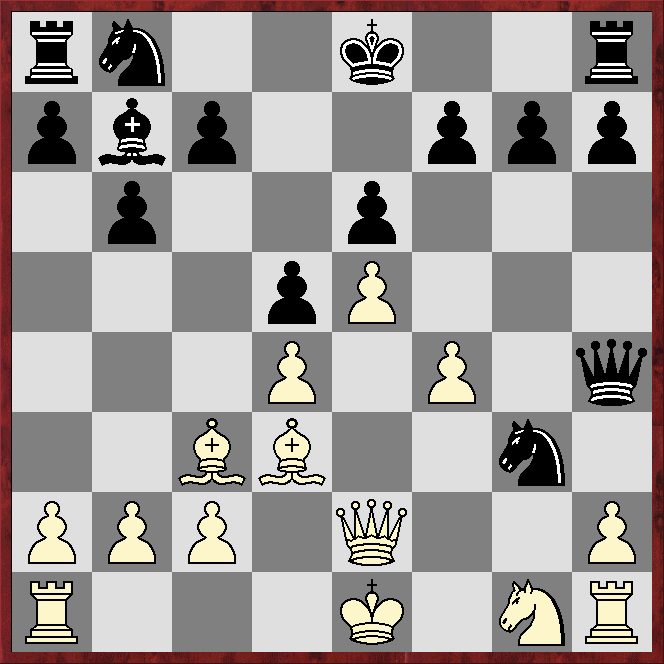
The engines reckon White has only one move to maintain the balance
*****
*****
*****
*****
*****
8.Bd2
Most popular in Mega25 is 8.Bxe4?!, but after 8...dxe4 White has problems, eg 29 of 36 games in Mega25 saw 9.Be3?!, when Black is positionally winning after 9...Bxc3? 10.bxc3, according to the engines, one line running 10...Qd5 11.c4 (this is best, according to the engines) Qa5+ 12.Qd2 Qa4 13.c5 bxc5 14.dxc5 Ba6 15.Ne2 Nc6 16.Kf2!? Rd8 17.Qc3 Bxe2!? 18.Kxe2 0-0, when Black has much the safer king, among other advantages.
The text is reasonable, but the engines suggest 8.Qg4!?, one point being 8...Nxc3 can be successfully met by 9.a3!, so Black's best may be 8...g6, or 8...Bxc3+ 9.bxc3 g6.
8...Bxc3+
The immediate 8...Qh4+ may be slightly stronger.
9.Bxc3 Qh4+ 10.g3
Apparently a novelty, but a forced one as 10.Kd1?? Nf2+ and 10.Kf1?? Qxf4+ are dreadful for White.
10...Nxg3
How should White proceed?
*****
*****
*****
*****
*****
11.hxg3!?
Giving up the exchange as well as a pawn. After 11.Qf2 Nf5 12.Nf3 Qxf2+ 13.Kxf2 the engines reckon Black is at best slightly better.
11...Qxh1 12.0-0-0
How large is Black's advantage?
*****
*****
*****
*****
*****
Black is up the exchange and a pawn, but does not have even a half-open file for the rooks. Meanwhile White has a large lead in development, and the more-secure king. The engines reckon Black has the upper hand, but has only one continuation that maintains this evaluation.
*****
*****
*****
*****
*****
12...Qh6?!
The move is 12...Nc6!, although the engines reckon Black is not worse after 12...g6 (Stockfish17) or 12...a5 (Dragon1).
13.Nf3?!
Developing looks natural, but much stronger seems to be 13.Bd2!, when Black may have nothing better than 13...g6 14.f5 Qg7 15.fxe6 fxe6, after which 16.Bg5 is promising.
13...g6 14.Bb4?!
The engines still like Bd2, or 14.g4 followed by 15.Bd2.
14...Nc6 15.Ba3 0-0-0 16.Ba6?
Allowing an exchange of bishops eases Black's defensive task. Instead 16.Bb5 keeps some pressure, although the engines give Black at least the upper hand.
16...Bxa6!?
The engines like this, provided it is followed up properly.
17.Qxa6+ Kb8 18.Ne1!? Qg7?!
Getting the queen to the queenside looks sensible, but the engines much prefer 18...Ka8 or 18...Qh2!?
19.Nd3!
What should Black play?
*****
*****
*****
*****
*****
19...Qg8?
Not 19...Nxd4? 20.Nc5! bxc5 21.Bxc5 etc, although White has to be aware that the tempting 20.Nb4? fails to 20...Rc8! 21.Rxd4 c5. However, correct is 19...Ka8!, allowing the b7 square to be covered, if necessary, by ...Rb8.
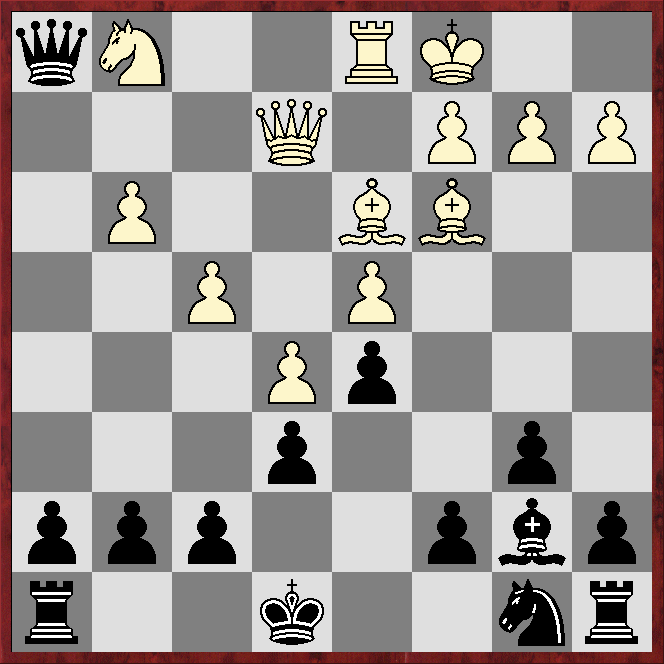
White to play and win
*****
*****
*****
*****
*****
20.Nc5! bxc5
Or 20...Na5 21.b4.
21.Bxc5
Not 21.Qxc6? Qe8.
21...Qe8
Also losing is 21...Nb4!? 22.Bxb4, eg 22...c5 23.Qb5+ Ka8 24.Qc6+ Kb8 25.Bxc5 Qe8 26.Bxa7+ (26.Bd6 also wins) Kxa7 27.Qc7+ Ka6 28.Rd3 etc.
22.Rd3
White's build-up may look ponderous, but there is nothing Black's pieces can do about it.
22...Ka8 23.Ra3 Kb8?!
This allows a simple mate, but also hopeless is 23...Qd7, when several moves win, including 24.b4!? and 24.Bxa7, eg 24.b4!? Qc8 25.Qxc6+ Qb7 26.Rxa7+ Kb8 27.Qxb7#.
'Best', according to the engines, but I use the word loosely, is 23...Rd6!?, but 24.exd6 cxd6 25.Bxa7 Qc8 26.Qa4 Kb7 27.Qb5+ Kc7 28.Bb6+ Kd7 29.Ra7+ Ke8 30.Rc7 wins for White.
24.Rb3+ Ka8 25.Qb7#

Sunday, 10 October 2021

Calvià Round One

MY game from last night.

Spanton (1731) - Enrique Fernando Asensio Ramos (2104)
Jobava-Prié/Queen's Fianchetto Defence
1.Nf3 Nf6 2.d4 b6!? 3.Nc3!?
This has been played by  Alexander Alekhine, Max Euwe, Boris Spassky and Tigran V Petrosian, but commoner responses in ChessBase's 2021 Mega database to Black's slightly unusual second move are 3.g3, 3.c4, 3.e3, 3.Bf4 3.Bg5 and even 3.Nbd2.
3...Bb7 4.Bf4
Normal is 4.Bg5. None of the aforementioned world champions chose the text.
4...e6.5.a3 Be7
Black has a classic Queen's Indian set-up.
6.e3 Ne4!?
This is a normal move in many Queen's Indian positions, but here it seems somewhat time-consuming.
7.Nxe4 Bxe4 8.Bd3 Bxd3 9.Qxd3 d5
Position after 9...d5
Black, as well as gaining a full share of the centre, has, as a  result of the knight manoeuvre and the move 9...d5, engineered a position in which Black has a good-versus-bad bishop. But the white bishop is active and the black one is passive, and White has a useful lead in development. The analysis engines Stockfish14 and Komodo12.1.1 reckon White has the upper hand.
10.Ne5!?
Aimed at making it awkward for Black to develop his queenside, but the engines reckon the move is over-elaborative, preferring 10.c4 or 10.0-0.
10...a6?!
This seems weakening and slow.
On 10...f6 I planned 11.Qb5+ when Black is obliged to play 11...Kf8 as 11...c6? 12.Nxc6 Qd7? fails to 12.Bxb8 Nxa7.
Best, according to the engines, is 10...0-0, although White has an edge after 11.0-0 or 11.c4. If, instead, White plays 11.Qb5 the engines reckon 11...c5 equalises.
11.0-0 0-0 12.c4 Bd6 13.Bg3
I think I rejected 13.cxd5 because of 13...f6, but the engines give 14.Qe4!?, when 14...fxe5 15.dxe5 Be7 16.d6 is strong for White.
13...Bxe5 14.Bxe5 Nd7 15.Bg3 c6
The engines prefer 15...c5, albeit with an edge for White.
16.cxd5 exd5 17.Rac1
White is still better after this, but stronger seems to be preceding the rook move with 17.Bd6!? Re8 as then 18.Rac1 wins a pawn.
17...Qf6 18.Rc3 Rfe8!?
The engines prefer simple defence with 18...Rfc8, when they reckon White has a slight edge.
19.Rfc1 Re6 20.Qc2 c5!?
Active defence.
21.dxc5 bxc5
Or 21...Nxc5 22.b4 Ne4 23.Rc8+ Re8 24.Rxa8 Rxa8 25.Qc8+ Qe8 26.Qxe8 Rxe8 27.Rc6 with advantage to White.
22.Qb3?!
Probably better is 22.Qd2.
22...d4?
Black is almost equal after 22...c4!?, according to the engines, as 23.Qb7 can be answered by 23...Nb6.
23.exd4 Rae8 24.Re3?!
The simple 24.h3 is almost certainly stronger, eg 24...cxd4 (24...Qxd4?? 25.Rd3) 25.Rc8 with pressure.
24...cxd4
This seems better than 24...Rxe3 25.fxe3 cxd4 when my intended 26.Rf1 and the engines' 26.Qd5!? are both promising.
25.Rxe6 Qxe6 26.Qxe6 fxe6 27.f4?!
This looks odd, and probably is. The idea is to prevent the black central pawns linking, but the engines prefer the more-conventional 27.Rc7 or 27.Kf1.
27...Nf6 28.Rd1 Rc8!? 29.Rxd4 Rc1+ 30.Kf2 Rc2+ 31.Kf3 Rxb2 32.Ra4 Rb3+ 33.Ke2 Rb6 34.Bf2 Rc6 35.Bd4 Nd5
Who stands better?
*****
*****
*****
*****
*****
A bishop usually works better than a knight with a rook, and here Black has an extra pawn-island. But the bishop has no target, apart from a temporary one at g7, and the knight has a great outpost. The engines reckon White is a tad better.
36.Be5 Kf7 37.Kd3 g6 38.Rc4 Rb6 39.Ra4 Ke7 40.Ra5 Kd7 41.Ra4 Kc8 42.g3
Another pawn on a dark square, but there were lines in which Black might be able to make a quick raid on the kingside with his rook or knight.
42...Kb7 43.Kc2 Rc6+ 44.Kd2 Kb6 45.Rd4 Kb5 46.Bg7 Rc4!?
I have been unable for 10 moves or so to come up with a plan for making progress, while AR has come up with a plan for Black.
47.Rxc4 Kxc4 48.Bf8 Kb3!?
Decentralising the king in a position in which the game may come down to a race between passed pawns, with yours aided by a knight and the opponent's by a bishop, is a very risky proposition. However the engines reckon the position remains equal, and no doubt AR had our rating difference in mind.
49.Kd3 a5 50.Kd4 a4?
Black holds with 50...Nb6 or 50...Nf6, according to the engines.
51.Ke5 Nc7 52.Kf6 Nb5 53.Kxe6?!
This should be good enough, but 53.Kg7 is simpler.
53...Nxa3 54.g4 Nc2 55.f5 gxf5 56.gxf5 Nd4+
White to play and win
*****
*****
*****
*****
*****
57.Kf6?
I rejected the winning 57.Ke5 because of 57...Nc6+ when 58.Kf6 is too slow and 58.Ke6 Nd4+ is a repetition. I missed that 58.Kd5 wins, eg 58...Nb4 59.Bxb4 Kxb4 60.f6, the point being the white pawn queens with check.
57...Kc4 58.Ke5 Nf3+ 59.Ke6 Nd4+ 60.Ke5 Nf3+ 61.Ke6 Nd4+ 62.Ke5 ½–½
The full standings can be seen at http://chess-results.com/tnr560234.aspx?lan=1