Showing posts with label Riviera. Show all posts
Showing posts with label Riviera. Show all posts
Saturday, 6 September 2025

Friday, 5 September 2025
Riviera Round Seven
Adrian Pickersgill (1835 ECF/1919 Fide) - Spanton (1947 ECF/1982 Fide)
*****
*****
*****
*****
*****
*****
*****
*****
*****
Giuoco Piano
1.e4 e5 2.Nf3 Nc6 3.Bc4 Bc5 4.c3 Nf6 5.d3 a6!?
This is third in popularity in ChessBase's 2025 Mega database, behind 5...0-0 and especially 5...d6.
6.Bb3!?
This bishop retreat is the main continuation.
6...Ba7!?
And this is the commonest reply.
7.0-0 d6 8.Nbd2 0-0
 |
| Now both sides have castled, how would you assess the position? |
*****
*****
*****
*****
*****
The central and kingside pawn-formations are symmetrical, and there is nothing majorly different elsewhere. Stockfish17 and Dragon1 reckon chances are equal.
9.h3 Ne7
The engines prefer the more-popular 9...h6, or 9...Re8.
10.Re1 Ng6 11.Nf1 Be6 12.Ng3
White cannot win a pawn with 12.Bxe6 fxe6 13.Qb3 Qd7 14.Qxb7?? as 14...Rfb8 wins the queen since 15.Qxa6 fails to 15...Bxf2+ etc.
12...Qd7
The engines suggest 12...h6 or 12...c5!?
13.d4 c6?!
This sets a trap, but probably better is 13...Bxb3 and 14...h6.
 |
| How should White proceed? |
*****
*****
*****
*****
14.Bg5
This is the engines' top choice, but note that 14.d5?! cxd5 15.exd5 can be met by 15...Bxh3!? 16.gxh3 Qxh3 with a strong attack, not least thanks to the white queen's knight hanging. Best play, according to the engines, continues something like 17.Re3!? e4!? 18.Nh2!? Qh4!? 19.Nf5!? Qg5+ 20.Ng3 Rae8 21.Kh1 Qh4!? 22.Nf5 Qxf2, when Black seems to have more than enough for a bishop, but the line is fiendishly difficult, and there are many alternatives along the way, eg 18.Nxe4 Nxe4 19.Rxe4 Rae8 20.Ng5!? Qg3+ 21.Kh1 Qxf2, when Black only has two pawns for a bishop, but with what seems an even stronger attack.
14...Bxb3?!
Probably the immediate 14...Ne8 is better.
15.Qxb3 Ne8 16.Rad1 h6 17.Be3 Qc7 18.Nf5
 |
| The contrast with the previous diagrams could hardly be starker, without any bits being exchanged - White has a big lead in development and activity |
*****
*****
*****
*****
18...Kh7 19.Qc2 Rad8?
This somewhat natural looking move loses material.
 |
| What should White play? |
*****
*****
*****
*****
20.Qd2
Possibly even stronger is the engines' 20.Bxh6!? gxh6 21.Qd2.
20...Rh8 21.dxe5
This wins a pawn.
21...Bxe3 22.Rxe3 d5 23.exd5 Rxd5 24.Qe1 Qd7 25.Rxd5 Qxd5 26.b3 Nc7 27.c4 Qd7
 |
| White has emerged a sound pawn up, but the engines reckon White's advantage is worth closer to a minor piece |
*****
*****
*****
*****
28.Qb1 Rd8 29.Nd6 Ne8 30.Nxe8 Rxe8 31.Nh4 Re6 32.Nxg6 Rxg6 33.Rg3 Qe6 34.Rxg6?
Misjudging the ending.
34...Qxg6 35.Qxg6+!?
This is Dragon1's top choice, and for quite some time is regarded by it as giving White the upper hand, but keeping queens on may well have been better.
35...Kxg6
 |
| White cannot save the extra pawn |
*****
*****
*****
*****
36.f4 Kf5 37.g3 g5 38.fxg5
AP offered a draw.
38...Kxg5?
The pawn recapture draws.
 |
| White to play and win |
*****
*****
*****
*****
39.e6!
Now White will be able to create a kingside passer to divert Black's king, allowing White's king to successfully invade the queenside.
39...fxe6 40.Kf2 Kf5
39...fxe6 40.Kf2 Kf5
 |
| White has one winning move |
*****
*****
*****
*****
41.Ke3
This looks natural, but the engines show the winning move is 41.Kf3! The point is that if Black replies 41...c5, which draws after the text, White has 42.g4+, eg 42...Ke5 43.Ke3 b6 44.a4 Kf6 45.h4 etc.
41...h5?
Drawing is 41...c5. Indeed White has to be careful as 42.g4+? loses to 42...Kg5 etc. White can try 42.Kf3, but 42...Ke5! draws, eg 43.g4 Kd4 44.h4 e5 45.g5 hxg5 46.hxg5 Kd3 47.g6 e4+ 48.Kf4 e3, after which both sides queen.
42.g4+?
Several moves win, including 42.b4, 42.Kf3 and 42.c5.
42...hxg4 43.hxg4+ Kxg4 44.Ke4 a5
Also drawing is 44...c5.
45.Ke5 Kf3 46.Kxe6 Ke4 47.Kd6 Kd4 48.Kc7
 |
| Black to play and draw |
*****
*****
*****
*****
48...a4?
48...a4?
Drawing is 48...Kc3 49.Kxb7 Kb2 50.Kxc6 Kxa2 51.Kb5 Kxb3 etc.
The game finished:
49.Kxb7 c5 50.bxa4 Kxc4 51.a5 Kd3 52.a6 c4 53.a7 c3 58.a8=Q c2 1-0
Thursday, 4 September 2025
Riviera Round Six
Spanton (1947 ECF/1982 Fide) - Michael Stinton-Brownbridge (1804 ECF/1855 Fide)
*****
*****
Sicilian Accelerated Dragon
1.e4 c5 2.Nf3 g6 3.d4 cxd4 4.Nxd4 Nc6 5.Nc3 Bg7 6.Nxc6!?
As MS-B pointed out in the postmortem, capturing on c6 in open Sicilians is usually frowned on as it strengthens Black's centre. Nevertheless there are 1,442 examples of the move in ChessBase's 2025 Mega database.
6...bxc6
This scores 64% in Mega25.
7.Bc4 d6 8.0-0 e6?!
The main line in Mega25 runs 8...Nf6 9.e5!? dxe5 10.Qxd8+ Kxd8 11.Re1, when Stockfish17 and Dragon1 reckon White has enough compensation for a pawn, but no more. However, note that 11.Bxf7? lets Black trap the bishop with 11...e6.
9.Bf4
 |
| How should Black proceed? |
*****
*****
*****
*****
9...d5?!
Black should almost certainly prefer 9...e5, or 9...Bxc3!? 10.bxc3 and then 10...e5, although the engines give White at least the upper hand.
10.exd5 cxd5?!
The engines suggest 10...Bxc3, which was played in Spanton (1850) - John Waterfield (1905), World Team Senior Championship (Struga, North Macedonia) 2023. That continued 11.bxc3 cxd5 12.Bb5+ Bd7 13.Bxd7+ Qxd7, when 14.c4 would have given White at least the upper hand, according to the engines.
Aleksandr Shimanov (2581) - Qi B Chen (2485), Chess.com Blitz 2022, went 10...exd5?! 11.Nxd5! cxd5 12.Qxd5 Be6 13.Qc6+ Kf8 14.Bxe6 fxe6, when the engines reckon the simple 15.Qxe6 would have won easily.
 |
| White to play and get a winning advantage |
*****
*****
*****
*****
11.Nxd5! Ne7? 1-0
MS-B resigned without waiting for 12.Nc7+.
Better was 11...exd5, but 12.Bxd5 Be6 13.Bc6+ Kf8 is overwhelming, eg 14.Bxa8 Qxa8 15.Qd6+ Ne7 16.Bg5 Qe8 17.Rad1 h6 18.Bxe7+ Kg8 (even worse is 18...Qxe7? 19.Qb8+ Qe8 20.Rd8) 19.Rfe1 etc.
Wednesday, 3 September 2025
Riviera Round Five
William Ingham (1716 ECF/1769 Fide) - Spanton (1947 ECF/1982 Fide)
*****
*****
*****
*****
*****
*****
*****
Colle
1.d4 d5 2.Nf3 c5!?
 |
| How should White respond to Black's aggressive second move? |
*****
*****
*****
*****
3.e3
This is the commonest continuation in ChessBase's 2025 Mega database, but also popular are 3.dxc5!?, 3.c3 and especially 3.c4!?, which is the top choice of Stockfish17 and Dragon1.
3...Nc6 4.c3 Bg4!?
This was a favourite move of Alexander Alekhine's, but is not liked by the engines.
5.Nbd2
All three of Alekhine's opponents played the text, but the engines reckon 5.dxc5!? gives at least a slight edge, one point being the reply 5...e5, tried by Paul Keres in a 1932 game, can be met by 6.b4, when 6...e4 7.h3 Bh5 8.g4 Bg4 was played in A Peet - Keres, Estonian Cities Match 1932. The engines reckon White has a winning advantage (but 0-1, 29 moves).
5...e5?!
This is probably too ambitious. The engines prefer 5...cxd4 or 5...e6, both of which were played by Alekhine.
6.dxe5 f6!?
Apparently a novelty. After the known 6...Ne5 the engines reckon 7.h3 Nxf3+ 8.Nxf3 Be6 (8...Bh5? 9.Qa4+) 9.Bb5+ Bd7 10.Bxd7+ Qxd7 11.Ne5 Qe6 12.Qa4+ gives White the upper hand.
7.Qa4
The engines prefer this over capturing on f6, but even stronger, according to them, are 7.Bb5 and 7.h3, eg 7.h3 Bh5 8.Qb3 Qd7 9.e6! Qxe6 10.Qxb7 Rb8 11.Qa6, when White is a pawn up and, they reckon, has the better position.
7...Bd7 8.Qb3 c4!?
The engines agree this is best.
9.Qc2!
After 9.Qxb7 Rb8 10.Qa6 Rb6 11.Qa4 Nxe5 12.Qd1 White is winning, according to the engines. However they reckon 9...fxe5! gives complete equality, which is why they agree the text is White's best continuation.
9...fxe5?!
Probably better is 9...Nxe5.
10.e4!?
Black's centre collapses after this.
10...Nf6 11.exd5 Nxd5 12.Bxc4 Nf4 13.0-0
 |
| Not only is White up a pawn, but the black king will have problems reaching safety, and e5 is weak |
*****
*****
*****
*****
13...Qc7 14.Ng5 Be7!? 15.Nde4
Not 15.Bf7+?? as Black replies 15...Kf8, while 15.Nf7? Rf8 gives Black good play.
Not 15.Bf7+?? as Black replies 15...Kf8, while 15.Nf7? Rf8 gives Black good play.
15...h6 16.Bxf4
This gives a large advantage, but it seems 16.Nf7!? is even stronger, eg 16...Rf8 17.Bxf4 exf4 18.Ned6+ Bxd6 19.Rfe1+ Be5 20.Qg6! Ne7 21.Qh5 g6 22.Qxe5 Qxe5 23.Nxe5.
16...exf4
Possibly better is giving up a second pawn with 16...hxg5!? as after 17.Bxg5 Black can castle long.
 |
| How should White proceed? |
*****
*****
*****
*****
17.Ne6
I feared 17.Nf6+?, missing that after 17...Bxf6 18.Qg6+? Kd8 19.Nf7+ Kc8 20.Nxh8 Black has 20...Ne5 with much the better game.
However even stronger than the text may be 17.Nf7 as 17...Rf8 transposes to the note at White's 16th move.
17...Bxe6 18.Bxe6 Qe5 19.Bh3 0-0
 |
| Now Black has belatedly castled, how would you assess the position? |
*****
*****
*****
*****
White is a pawn up and has the safer king. The engines agree White is winning.
20.f3
The engines point out 20.Nd2!, with Nf3 to come.
20...Qc7!?
The queen on e5 is a target for White's rooks, and the text also sets up the possibility of ...Nd4!? or ...Nb4!?
21.Rad1 Rad8 22.Rxd8+ Rxd8 23.Rd1?
WI offered a draw in my time.
23...Rxd1+ 24.Qxd1 Qb6+ 25.Kf1
The engines reckon White keeps an advantage with 25.Kh1!? Qxb2 26.Be6+ and 27.h3 or 27.g3.
25...Qxb2 26.Qb3+ Qxb3 27.axb3
 |
| How would you assess this minor-piece ending? |
*****
*****
*****
*****
The engines reckon it is equal, but there is quite a bit of play in the position.
27...Kf7 28.Ke2 Na5 29.Bc8 b6 30.Ba6 Ke6 31.b4 Nc6 32.g3!?
The engines are happy with this, although it opens the possibility of Black creating a passed h pawn after ...fxg3 hxg3.
32...Ke5!? 33.Bc4 a5 34.bxa5 bxa5
 |
| Black has an outside passed pawn, but the engines reckon the position remains equal |
*****
*****
*****
*****
35.Nf2 fxg3 36.hxg3 a4!? 37.Ne4
Not 37.Bb5 a3 38.Bxc6?? a2. However the engines prefer 37.f4+.
37...Na5 38.Ba2 Nb3
Perhaps 38...h5 is marginally better, not worrying about 39.Bf7 as that can be met by 39...a3.
39.Kd1
Black threatened the forking 39...Nc1+. However the engines reckon White is fine after 39.Bxb3.
39...Na5
The engines suggest 39...Nc5!?, reckoning the opposite-coloured bishops ending after 40.Nxc5 Bxc5 is slightly better for Black (Dragon1), although Stockfish17, after at first agreeing with this assessment, quite quickly comes to regard the position as equal.
40.Nd2 Nb7 41.Ne4 g5 42.Ke2
The engines are unsure about this, but reckon 42.Nf2 maintains equality.
42...h5 43.Nf2?!
This retreat seems to give Black an unexpected chance. The engines suggest 43.Ke3, albeit giving Black a slight edge.
 |
| How can Black take advantage of White's last move? |
*****
*****
*****
*****
43...Nc5!
This is strong despite allowing knights to come off.
44.Nd3+?
The engines reckon White should keep knights on with, for example, 44.Ke3, but then they like 44...Kf6!?, the point being to be able to meet 45.f4 with 45...g4, which they agree gives Black at least the upper hand.
44...Nxd3 45.Kxd3 h4 46.gxh4 gxh4 47.Ke2
 |
| Black to play and win |
*****
*****
*****
*****
*****
47...h3?
Winning is 47...Bc5 48.Kf1 h3, eg 49.Bc4 a3 50.Ba2 Kf4 51.Be6 Kg3 etc.
48.Kf2 Kf4 49.Kg1 Kg3 50.f4 Bf6
Capturing the f pawn makes no difference to the game's outcome. Indeed, as we will see, capturing both white pawns makes no difference - the position is drawn.
51.Kh1 Bxc3 52.f5 a3 53.f6!?
Dragon1 at first thinks this loses, but then fluctuates between Black winning and having the upper hand.
Bxf6 54.Bc4 Be5 55.Ba2 Kf2 56.Bc4 Ke3 57.Ba2 Kd3 58.Bd5 Kc3 59.Be6 Kb2 60.Bd5 h2 61.Be6 ½–½
Tuesday, 2 September 2025
Riviera Round Four
Maurice Staples (1928 ECF/1915 Fide) - Spanton (1947 ECF/1982 Fide)
*****
*****
*****
1.Nc3
1.Nc3 c5 2.Nf3 d5 3.d4 e6!?
Stockfish17 and Dragon1 dislike this, preferring 3...Nf6 or 3...Nc6.
 |
| How should White proceed? |
*****
*****
*****
*****
4.Bf4
The engines reckon White is slightly better after 4.e4!?, which has been the top choice of grandmasters and scores an excellent 67% in ChessBase's 2025 Mega database.
4...Bd6?!
The engines like 4...Nf6, one point being 5.Nb5? costs White two tempi as 5...Qa5+ has to be met by 6.Nc3. After the text Black has difficulties.
5.Bxd6 Qxd6 6.e4!
This gives White a strong initiative.
6...Ne7!?
Apparently a novelty, and an improvement over the known 6...a6? The engines also like 6...c4!?, but reckon both moves leave White with the upper hand.
Tatyana Fomina (2214) - Siim Kanep (2333), Karksi (Estonia) Rapidplay 2009, went 6...a6? 7.dxc5 Qxc5 8.exd5 Nf6!? (this is best, according to the engines) 9.dxe6 Bxe6, when White is much better, and would have been winning after 10.Qd4!?, according to the engines (but 0-1, 53 moves).
7.dxc5!
MS spent somewhere in the region of 25 minutes on this move, flying in the face of John Nunn's advice to never take more than 20 minutes. Nunn wrote in Secrets Of Practical Chess (Gambit 1998):
"I have observed that if a player spends more than 20 minutes over a move, the result is almost always a mistake." Every rule has its exceptions, and the text is one of them - the engines agree it is the best continuation.
Note that 7.e5 can be met b7 7...Qb6, with more-or-less equality, according to the engines.
7...Qxc5 8.exd5 exd5
Dragon1 prefers recapturing with the knight; Stockfish17 is unsure.
9.Qd4!?
The same idea as with the engines' suggestion in Fomina-Kanep. Black is obliged to swop queens, bringing the white king's knight to the centre of the board, and on a blockading square. Meanwhile White is ready to castle long, adding extra pressure on the isolated queen's pawn.
9...Qxd4 10.Nxd4 Nbc6?!
Probably better is 10...Be6, although White maintains a good IQP position.
11.Bb5?!
Missing the win of a pawn by 11.Ndb5 0-0 (both 11...Kd7? and 11...Kd8? fail to 12.0-0-0) 12.Nc7 Rb8 and 13.N(either)xd5.
11...0-0 12.Bxc6 Nxc6!?
The engines agree this is slightly better than 12...bxc6.
13.0-0-0
 |
| Now both sides have castled, how would you assess the position? |
*****
*****
*****
*****
The isolani is a weakness without redeeming features (Black has no prospects of an attack), and White is ahead on development. The engines give White the upper hand.
13...Be6 14.Rhe1 Rad8?!
Almost certainly better is 14...Rfe8, not worrying about a white knight moving to b5 to threaten a fork on c7 as that can be met by 15...Re7.
15.f3
The engines give 15.Rxe6!? fxe6 16.Nxe6 Rxf2 17.Nxd8 Nxd8 18.Nxd5, claiming a winning advantage for White.
15...Rfe8 16.Ncb5 Re7?!
Probably better is 16...Nxd4, eg 17.Rxd4 Bd7!? 18.Rxe8+ Bxe8 19.Nc3 Bc6, although the engines reckon White is at least slightly better.
17.Nxc6 bxc6 18.Nd4 c5??
Black remains worse after 18...Rc8, but keeps drawing chances.
19.Nc6 Red7 20.Nxd8 Rxd8
 |
| White's advantage is the equivalent of being up at least a minor piece and a pawn, according to the engines |
*****
*****
*****
*****
21.Re3 a6 22.Ra3 Rd6 23.Ra5 c4 24.c3 Kf8 25.b4 Ke7 26.Kb2 Kd7 27.a4 Kc7 28.Rc5+ Kb7? 29.Rxc4! 1-0
Monday, 1 September 2025
Riviera Round Three
Spanton (1947 ECF/1982 Fide) Gerald Moore (2010 ECF/1928 Fide)
*****
*****
*****
Sicilian Bb5(+)
1.e4 c5 2.Nf3 Nc6 3.Bb5 Nf6!?
This is fourth in popularity in ChessBase's 2025 Mega database, behind 3...d6, 3...e6 and especially 3...g6, but is the best-scoring percentagewise.
 |
| How should White respond? |
*****
*****
*****
*****
4.Qe2
The main line in Mega25 runs 4.Nc3 Qc7 (also popular is 4...g6) 5.0-0 Nd4 6.Re1!? a6!? 7.Bf1 Ng4!? 8.g3 Nxf3+ 9.Qxf3 Ne5 10.Qe2 e6, with a slight edge for White, according to Stockfish17 and Dragon1, although Black scores a resounding 60% with this line in Mega25.
4...g6 5.c3 Bg7 6.0-0 0-0
 |
| With both sides castling early, how would you assess the position? |
*****
*****
*****
*****
The engines give White the better side of equality.
7.d4 d5!?
The engines fluctuate between the text and the more-normal 7...cxd4.
8.e5 Ne4 9.Nbd2 Nxd2 10.Bxd2 cxd4 11.cxd4 Qb6 12.Be3 Bg4 13.Rfc1?
Not only does this lose a pawn, but White is left with multiple weaknesses.
13...Bxf3 14.gxf3 Nxd4 15.Bxd4 Qxd4 16.Rc7?!
The engines much prefer 16.e6!? or 16.Rd1, but even so reckon Black's advantage is worth about a minor piece.
16...e6 17.Re1 a6 18.Bd3 Rab8 19.Bb1 Bh6!
The engines agree this is best - Black is going after White's weakened kingside.
20.Rd1 Qh4 21.Kg2 Bf4 22.Rh1 Qg5+ 23.Kf1 Qxe5 24.Qxe5 Bxe5 25.Rc2 Rfc8 26.Re2 Bf4 27.Kg2 Rc5 28.h4 Rbc8 29.h5 Rc1 30.Ree1 Rxe1 31.Rxe1 Rc1!? 32.Rxc1 Bxc1
 |
| White has obtained an ending of opposite-coloured bishops, but Black's advantage is too large to give real drawing chances |
*****
*****
*****
*****
33.hxg6 fxg6!?
This gives Black a second passed pawn, but the engines reckon 33...hxg6 is even stronger.
34.b3 Kg7 35.Kg3 e5 36.Kg4 Kf6 37.a4 Bd2 38.Bd3 Be1 39.Kg3 h5 40.Bc2 g5 41.Bd3 Bd2 42.Bh7 Bf4+ 43.Kh3 a5 44.Bg8 d4 45.Bc4 Ke7 46.Bd3 Kd6 47.Kg2 Kc5 48.Kf1 Kb4 49.Bc4 Kc3 50.Ke2 h4 51.Be6 Kc2 52.Kf1 d3 53.Bf5 0-1
Sunday, 31 August 2025
Riviera Round Two
Neil Coward (1779 ECF/1768 Fide) - Spanton (1947 ECF/1982 Fide)
*****
*****
*****
*****
*****
*****
Giuoco Piano
1.e4 e5 2.Nf3 Nc6 3.Bc4 Bc5 4.c3 Nf6 5.d4 exd4 6.cxd4 Bb4+ 7.Nc3 Nxe4 8.0-0 Bxc3 9.bxc3!?
The main line in ChessBase's 2025 Mega database runs 9.d5 Bf6 10.Re1 Ne7 11.Rxe4 d6 12.Bg5!? Bxg5 13.Nxg5 h6 14.Qe2!? hxg5 15.Re1 Be6!? 16.dxe6 f6 17.Re3 c6, with at least a slight edge for Black, according to Stockfish17 and Dragon1, although there are quite a few interesting alternatives along the way that engine evaluations suggest are worth exploring.
Steinitz played the text with his first two whites against Lasker in their 1896 world championship match, losing both games.
 |
| How should Black respond? |
*****
*****
*****
*****
9...d5
In Mega25 there are 47 games with the blunder 9...Nxc3??, although only 24 of them featured the piece-winning reply 10.Qe1+, and of those 24, White only managed to win 18.
10.Bd3
Steinitz played 10.Ba3?! in both his games against Lasker, as he had done against Schlechter at Hastings 1895. Schlechter's cautious reply 10...Be6?! allowed Steinitz to equalise, according to the engines, but Lasker's 10...dxc4 gave Black a large advantage.
10...0-0
 |
| Now both sides have castled, how would you assess the position? |
*****
*****
*****
*****
White has the bishop-pair, but that is not sufficient for a pawn unless there are other factor(s). The engines give Black a slight edge.
11.Bxe4!?
This was played by James Mason in 1904 in what seems to have been the first game to reach the position, but the text has been largely superseded by 11.Qc2.
11...dxe4 12.Nd2
Stockfish17 prefers Mason's 12.Ng5, but Dragon1 rates the two moves the same.
12...Re8 13.Re1 Bf5 14.Nc4 Qf6 15.Ne3 Rad8!?
The engines agree that getting on with development is slightly better than preserving the bishop by 15...Bg6.
16.Qb3 b6 17.Bb2!?
The bishop's position on b2 does not look promising, but it helps facilitate advancing the c pawn by latently covering the d pawn. Obvious alternatives are 17.Ba3, but the bishop is then largely hitting thin air, and 17.Nxf5 Qxf5 18.Be3, but then the knight may tun out to be the better remaining minor piece, especially if it manages to occupy c4.
17...Qg6 18.Qb5 Bd7 19.Qb3 Kh8
The engines much prefer 19...Na5 or 19...Be6!? After the latter, the forking 20.d5 is not much of a threat as Black has 20...Na5.
20.Kh1
The engines reckon this is a good time for 20.c4.
20...Ne7 21.d5 f5 22.c4?!
White should probably take time out to try to prevent 22...f4 by playing 22.g3!?, although 22...f4!? anyway is not bad, and there is no doubt 22.g3!? weakens the white king's position.
22...f4 23.Nc2 Nf5 24.Qc3 Nh4 25.Rg1 Bg4
I was tempted to play 25...Nf5?! in the hope White would reply 26.Rae1?, when 26...e3! wins as 27.fxe3 fails to 27...Ng3+! However, White has a major improvement in 26.g3!, and if 26...f3 the engines give 27.g4!?, claiming Black is only slightly better.
26.Ne1?
Better is 26.Nd4, but Black is well on top.
 |
| How should Black proceed? |
*****
*****
*****
*****
26...f3?
This allows complete equality, whereas White is hard-pressed to answer other moves, including 26...Nf5. After 26...Nf5 White can try 27.h3, but a sample line runs 27...Qh5 28.Kh2 Rd6 29.f3 exf3 30.Nxf3 Re2 with an overwhelming Black attack.
27.gxf3 Nxf3 28.Qxg7+!
Not 28.Nxf3?? bxf3+ 29.Qxf3, hoping for 29...Qxg1+?? 30.Rxg1 exf3, and either 31.Rxg7 or 31.Bxg7+, as Black instead has 29...exf3 30.Rxg6 hxg6 with a simple win.
28...Qxg7 29.Bxg7+ Kxg7 30.Rxg4+ Kh8 31.Nxf3 exf3 32.Rf4 Rf8 33.Rxf8+ Rxf8
 |
| Material is level and it is a rook-and-pawn ending that the engines agree is completely equal, but there is still play in the position |
*****
*****
*****
*****
34.Re1 Rf4 35.Re8+ Kg7 36.Re7+ Rf7 37.Re3
The pawn ending after 37.Rxf7+? Kxf7 is won for Black, eg 38.h4 Kf6 39.Kh2 Ke5 40.Kg3 Ke4 41.h5 a6 42.h6 (42.a4 Kd4 43.Kxf3 Kxc4 44.Ke4 b5 etc) b5 43.cxb5 axb5 44.Kg4 Kxd5 45.Kxf3 c5 46.Ke3 c4 47.a3 Ke5 48.Kd2 Kf5 49.Kc3 Kg6 50.a4 bxa4 51.Kxc4 Kxh6 etc.
37...Kg6 38.h3 h5 39.Kh2 Rf4 40.Re6+ Kg5 41.Rc6 Rf7 42.Re6 Kf4
 |
| White to play and maintain equality |
*****
*****
*****
*****
43.Rh6?
The engines give 43.Kg1! as equal, but other moves may hold, eg 43.Kh1 Rg7 44.a4 Rg2 45.Rf6+ Ke4 46.Rf7 Rxf2 is only slightly better for Black, according to Stockfish17, although Dragon1 reckons Black is winning.
43...Rg7 44.Rxh5 Rg2+ 45.Kh1 Rxf2
 |
| Material is still equal, but Black's passed pawn is much more advanced and therefore much more dangerous than White's |
*****
*****
*****
*****
46.Rh7 Kg3
Simply capturing the a pawn is much stronger, according to the engines, but the text, which threatens mate, also wins.
47.Rg7+ Kxh3 48.Rh7+ Kg3 49.Rg7+ Kf4 50.Rxc7 Rxa2 51.Rf7+ Ke3 52.Re7+ Kd4 53.Kg1 Kxc4 54.d6 Rd2 55.Rc7+ Kb5 56.d7 a5
The a pawn cannot be stopped.
57.Kf1 a4 58.Ke1 Rd3 59.Kf2 Kb4 60.Rc6 b5 61.Rc7 a3 62.Ra7 Kb3 63.Ra5 b4 0-1
Saturday, 30 August 2025
Riviera Round One
Spanton (1947 ECF/1982 Fide) - Russell James (2167 ECF/2090 Fide)
*****
*****
*****
Maróczy Bind
1.e4 c5 2.Nf3 e6 3.c4 Nc6 4.d4 cxd4 5.Nxd4 Nf6 6.Nc3 Bb4 7.Nxc6
This is easily the most popular move in ChessBase's 2025 Mega database, and it is the top choice of Stockfish17 and Dragon1, but after ...
7...bxc6
... Black is better placed than usual in the Maróczy to get in the break ...d5.
8.Bd3 e5!?
Nevertheless this is the main continuation, although an annotation in Mega25 shows Paul Keres called the move dubious when Miguel Najdorf played it at Buenos Aires 1964.
9.0-0 0-0
 |
| Now both sides have castled, how would you assess the position? |
*****
*****
*****
*****
White's light-square bishop is bad, but will not necessarily stay that way, especially if Black gets in ...d5. Black's d pawn is backward, but is not easily attacked. The engines reckon the position is equal.
10.Be3
René Letelier Martner - Najdorf, Buenos Airies 1964, went 10.f4 Bc5+ (Keres gave this a ?, according to Mega25, but the move seems fine) 11.Kh1 d6 12.f5 h6!? 13.g4 d5 14.g5 dxc4? (there is no doubting this is bad - the engines suggest 14...dxe4 or 14...hxg5, albeit preferring White) 15.gxf6 Qxd3 16.fxg7 Kxg7? (the game goes on after 16...Rd8, although 17.Bxh6 is good for White) 17.Qg4+ Kh7 18.Bxh6! 1-0 (Black is getting mated, whether or not the bishop is captured). Keres's annotations here appear to be an example of even a very strong player getting carried away by the result of a game - something that rarely happens when engines are to hand).10...d6
Just about playable is 10...d5!?, as long as Black does not fall for 11.cxd5 cxd5? (11...Bxc3 is better) 12.Nxd5 Nxd5 13.exd5 Qxd5?? 14.Bxh7+ etc.
11.h3 Be6 12.Rc1 Re8
This may be a novelty. Known moves are 12...Qe7, 12...Qd7, 12...Bxc3 and 12...Nd7!?
13.f4
The engines suggest 13.Na4!?, when one line runs 13...d5 14.cxd5 cxd5 15.a3 Bf8 16.Nc5, with what they reckon is a slight edge for White.
13...exf4 14.Rxf4!?
The engines much prefer 14.Bxf4.
14...Nd7!
This is best, according to the engines.
 |
| How should White proceed? |
*****
*****
*****
*****
15.Ne2!?
RJ after the game strongly advocated 15.e5?!, but White seems to have nothing, whichever way Black captures the pawn, eg 15...Nxe5 16.Bxh7+!? Kxh7 17.Qh5+ Kg8 18.Rh4 Ng6. I had seen this in the game, and now 19.Qh7+ Kf8 leaves Black winning, according to Stockfish17. However Dragon1 for quite some time reckons 20.Rh5 leaves Black only slightly better. But 20...Qc7 21.Ne4 Bg4! seems to confirm Black as having at least the upper hand, although the line remains sharp.
15...Ne5
This is not just a good outpost for the knight - Black also threatens 15...Qg5.
16.Rf1?!
Probably better is 16.Rf2.
16...Bc5!?
Also strong is 16...Qh4!?
17.Qd2?
More-or-less forced is the awkward-looking 17.Bxc5 dxc5 18.Rc3, but both 18...Qh4 and 18...Re7!? give Black the upper hand, according to the engines.
17...Qg5 18.Nf4
This seems best, but inadequate.
18...Bxh3! 19.Bxc5 dxc5 20.Qe3?!
Probably better is 20.Qf2.
20...Bxg2!
The blows keep coming. Black wins a second pawn, and swops off into a highly favourable late-middlegame.
21.Nxg2 Qxe3+ 22.Nxe3 Nxd3
 |
| Black's advantage is worth almost a rook, according to the engines |
*****
*****
*****
*****
23.Rcd1 Rad8 24.Nf5 Nxb2 25.Ne7+ Kf8 26.Rxd8 Rxd8 27.Nxc6 Rd6 28.Rb1 Rxc6
Not 28...Nxc4?? 29.Rb8+ Rd8 30.Rxd8#.
The game finished:
29.Rxb2 Rb6 30.Rc2 a5 31.Rh2 Rb1+ 0-1
Thursday, 28 August 2025
Riviera Chess
AM making final preparations for traveling to Torquay tomorrow for the third Riviera congress on the Devon coast.
There are two morning tournaments and two afternoon ones, all ECF and Fide rated, with pairings
apparently based on players' live ECF ratings.
I have entered the open, which has seven daily rounds at 14:30, ending next Friday.
The time control for all tournaments is 90 minutes, with a 30-second increment, and there are 85 entrants.
Saturday, 17 May 2025
Riviera Updated
THERE are now 13 entries for the Riviera congress in Torquay, which starts on Saturday August 30.
Sunday, 15 September 2024
Lessons From Torquay VII: Wide But Shallow v Deep But Narrow
OLD instructional books often emphasise the importance of knowing a limited opening repertoire in depth.
I cannot claim to be an expert on the variation - this was just my seventh time playing it - but I believe it to be one of those openings that, in the absence of much theoretical knowledge, is easier for the attacker to play.
As it turned out, my opponent told me after the game, which he lost on time at move 28, that he used to play the Alekhine-Chatard with white many years ago, but had forgotten the theory.
Frequently switching openings was regarded as a cardinal sin, and a sure bar to improvement.
Some grandmasters took this advice to extremes; Lev Alburt, for example, was (in)famous for his devotion to Alekhine's Defence.
But the advice made particular sense for club players, since nine times out of 10 an opponent would not know what you played.
In those circumstances, sticking to your tried and trusted routine was probably as much of a surprise to the opponent as playing something completely new.
The database age has changed all that, as exemplified by Magnus Carlsen, who plays a huge range of openings, including frowned-upon club favourites such as the Ponziani.
These days, having a limited opening repertoire, however deep, makes you a relatively easy target for an opponent's preparation.
In round seven at Torquay I had white against an opponent who, according to ChessBase's 2024 Mega database, almost always meets 1.e4 with 1...e5.
I opened 1.Nc3, partly hoping he would reply 1...e5, when 2.e4 transposes to double-e pawn openings, but 2.Nf3 is an interesting alternative.
Instead he played 1...d5, which is the most popular continuation.
I could have kept the game in independent lines with 2.e4!?, which is easily the top choice in Mega24, but preferred 2.d4, to which came 2...Nf6.
Popular today is 3.Bf4, the Jobava-Prié, but I played the 'traditional' 3.Bg5, ie the Veresov, to which I was pleased to see the reply 3...e6.
Objectively that is a perfectly reasonable choice, second in popularity only to 3...Nbd7, but it allowed me to continue with 4.e4, making the game a French Classical - hardly what a black double-e pawn player is likely to be looking for.
After the further moves 4...Be7 5.e5 Nfd7 6.h4!? we reached the starting point of the Alekhine-Chatard Attack.
 |
| 6.h4!? is the top choice of Stockfish16.1 and Dragon1, albeit narrowly over 6.Bxe7, and scores an excellent 61% in Mega24 |
As it turned out, my opponent told me after the game, which he lost on time at move 28, that he used to play the Alekhine-Chatard with white many years ago, but had forgotten the theory.
LESSON: databases mean having a narrow repertoire is a dangerous business. The player able to make best use of transpositional possibilities can place opponents at a substantial practical disadvantage.
Saturday, 14 September 2024
Lessons From Torquay VI: Magnus The Not-So-Magnificent
MY round-six game began 1.e4 c5 2.Nc3 Nc6 3.f4 g6 4.Nf3 Bg7 5.a4!?
*****
 |
| This position occurs 208 times in ChessBase's 2024 Mega database |
*****
*****
*****
*****
In 123 of those games, Black played 5...e6, which scores 81% if White continues 6.Bc4?!
Magnus Carlsen is among those who have played 5...e6, admittedly in online blitz against a much-lower rated opponent.
But Stockfish16.1 reckons the reply 6.e5!? gives White a slight edge, although Dragon1 comes to view the game as equal.
Instead of 5...e6, they prefer 5...b6!?, and the move I played, 5...a6!?
LESSON: Magnus Carlsen may be the best-ever chess player, and plays a wide variety of openings in which he often comes up with surprising, but engine-approved, continuations. However, he is not infallible.
Thursday, 12 September 2024
Lessons From Torquay V: Not All R+P Endings Are Drawn
THE saying that all rook-and-pawn endings are drawn has been variously attributed, although I always understood it to have originated with Savielly Tartakower.
*****
Whoever first said it, and although his intent was undoubtedly humorous, there is a lot of truth behind the aphorism, especially when pawns are equal, or the superior side has only a one-pawn advantage.
The following position arose in my round-five game.
 |
| Black has just played 32...Be5-c7 |
*****
*****
*****
*****
Black's advantage in this ending stems mainly from having the better rook-and-minor-piece combination and, despite it being an ending, from being ahead on development.
The number of pawns is equal, which encouraged me to play 33.Nd6?!, but after 33...Bxd6 34.cxd6 Re3 it soon became clear Black had a large advantage, and my opponent had little trouble bringing home the full point.
Stockfish16.1 and Dragon1 suggest instead 33.Nf6, after which White has the more-active minor piece.
Black is still better, but White has more drawing chances than in the game.
LESSON: a rook-and-pawn ending often offers salvation in a difficult position, but some such endings are just too bad to be entered into with any reasonable hope.
Wednesday, 11 September 2024
Lessons From Torquay IV: Beware Tunnel Vision
THE following position arose in my round-four game.
*****
 |
| I have just recaptured on e7 |
*****
*****
*****
*****
*****
*****
*****
Black threatens two multi-forks: 19...Nb4, attacking queen, bishop and a2 pawn, and 19...Ne3, attacking queen, queen's rook, f5 pawn and g2 pawn.
White has nothing better than 19.Qd2, which prevents 19...Nb4 but allows 19...Ne3?
However, this is a mistake, partly because, after 20.Rde1, Black is struggling to find a good continuation.
Stockfish16.1 and Dragon1 suggest 20...Bxf5 or 20...Nd5, but in each case give White the upper hand.
But what makes 19...Ne3? even worse is it misses winning a pawn by 19...Bxf5!
LESSON: beware focusing on just one aspect of a position, no matter how promising it seems at first.
Tuesday, 10 September 2024
Lessons From Torquay III: Use A Mantra
AUSTRALIAN international master, and first world correspondence champion, Cecil Purdy wrote many instructional articles aimed at club players.
*****
One of his favourite themes was how to avoid mistakes - not only those of commission, ie making bad moves, but also those of omission, ie failing to exploit opponents' mistakes.
I mention this because if I had followed his advice I would not have missed the huge winning chance that arose in my round-three game.
 |
| Black has just played 32...Ng4-e5? |
*****
*****
*****
*****
It is easy to find White's winning move when given a position in which you are told the opponent has just made a mistake.
True, after 33.Rxe5!, Black can, instead of allowing 33...Kxe5 34.Nf3+ etc, try 33...Bxd4, but it does no good as White has 34.Rxd5+.
Purdy's advice was to use a mantra at every move, which makes missing such opportunities difficult, even for a rabbit.
Purdy's advice was to use a mantra at every move, which makes missing such opportunities difficult, even for a rabbit.
His original mantra was a little long-winded, but he later simplified it, and I have adopted a simple version of my own, which is to be used every time the opponent moves.
Step One: work out the basic idea(s) behind the opponent's move. This is normally fairly obvious - it develops a piece, attacks an enemy piece, gains space, removes a piece from danger, etc.
Step Two: use the mantra CAPTURES CHECKS HANGERS THREATS.
First I look at every possible capture I can make, no matter how absurd at first glance. Most of these can be dismissed at once, but some will deserve further consideration.
Next I look at every possible check, assuming there are any, and again most of these will be of no consequence.
Then I look for hangers, ie enemy pieces and pawns that are unprotected, and so are 'hanging'. Two hangers can mean there are double-attacks available, and even one hanger can make for a tempo-gaining manoeuvre.
Finally I look for threats, by which I basically mean possibilities for my pawns and pieces to attack higher-value enemy pieces.
Then I repeat the process for my opponent, ie I look at the opponent's possible CAPTURES CHECKS HANGERS THREATS.
All this takes quite some time to write down, but is usually much quicker to perform.
Step Three: I go through the normal process of selecting my move (the mantra may already have discovered a necessary or desirable move).
Step Four: I visualise the position after my intended move, and repeat the mantra for my opponent in the new position.
So what went wrong in the diagrammed position?
Well, it is is easy to get lazy and dispense with the mantra, especially when your position is already good.
And it is easy to forget the mantra in the heat of battle or, perhaps more pardonably, when short of time.
LESSON: adopt some sort of mantra for finding and avoiding mistakes, and use it!
Monday, 9 September 2024
Lessons From Torquay II: Take Your Time
I LOST in round two in 14 moves.
*****
The rot started as early as move seven in the following position from a Scotch.
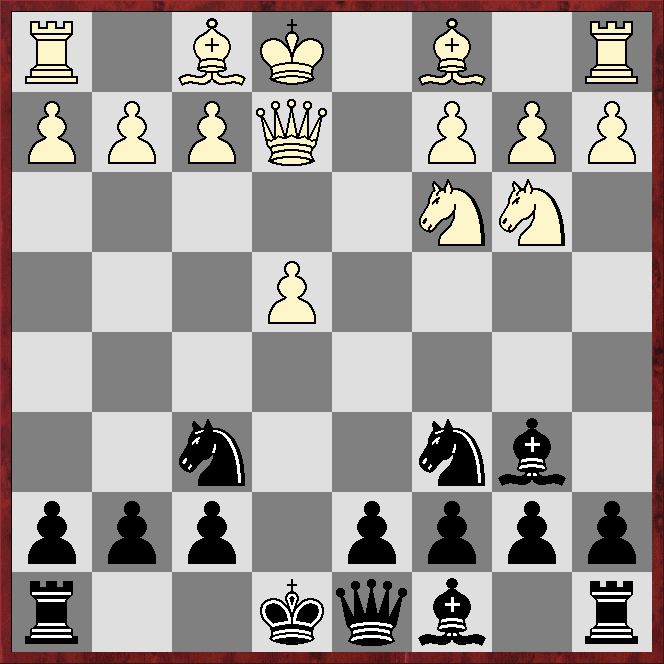 |
| White has just played 7.Qe2!? |
*****
*****
*****
*****
*****
*****
The engines suggest 7...a5, which advances on the part of the board where White is probably going to castle, and 7...0-0, which introduces the possibility of quickly bringing a rook to the half-open e file.
Grandmasters have also played 7...d6, which restrains the e pawn as well as opening a diagonal for Black's light-square bishop.
I played 7...Qe7?!, apparently putting pressure on e4.
But the pressure is largely illusory as, after 8.Bg5, Black should avoid 8...h6?, since White has 9.d5!
I had originally planned to continue 9...Qxe4??, but that loses the queen after 10.Nxf6+ etc.
Instead I played 9...Qe5, but after 10.Nxf6+ gxf6 the engines reckon Black is already lost.
The time control was 90 minutes, with a 30-second increment.
From my scoresheet I can see that, after 10 moves, my opponent had 65 minutes left, while I had 85 minutes.
In other words, despite being out of theory in a sharp position, I had used just 7.5 minutes.
LESSON: all the time in the world will not save a completely lost position.
Sunday, 8 September 2024
Lessons From Torquay: Play Where You Are Stronger
THE following position was reached in my round-one game.
*****
 |
| I have just captured on e4 |
*****
*****
*****
*****
*****
*****
*****
White is more-active and has more space in the centre, but Black has pressure against the white queenside.
Black played 21...Nf6?!, which looks natural as it gains a tempo on the white rook.
But the knight has few prospects on f6, and Stockfish16.1 and Dragon1 reckon White now has the upper hand.
Better is 21...Rb8, which develops a piece and adds to the queenside pressure.
But best of all, according to the engines, is 21...Nb6, putting pressure on the queenside, and intending to follow up with ...a5 and ...a4, which increases the pressure and develops the rook without moving it.
LESSON: as a general rule it makes sense to play where you are stronger. Sometimes you have no choice - a threat has to be countered. But if you concentrate on where you are weaker, you are in danger of becoming passive and slowly succumbing in the long run.
Saturday, 7 September 2024
Summing Up Torquay
MY score in the Riviera Fide open of +4=0-3 gained 20.3 ECF elo and 1.2 Fide elo.
The dates of next year's congress were announced as Saturday August 30 to Friday September 5.
Friday, 6 September 2024
Riviera Round Seven
Spanton (1931 ECF/1980 Fide) - Maurice Staples (1989 ECF/1967 Fide)
*****
*****
*****
French Alekhine-Chatard
1.Nc3 d5 2.d4 Nf6 3.Bg5 e6 4.e4 Be7 5.e5 Nfd7 6.h4!?
 |
| How should Black respond to this popular gambit, first played by Adolf Albin in 1890? |
*****
*****
*****
*****
6...h6!?
This is second in popularity in ChessBase's 2024 Mega database, behind 6...a6, after which the mainline runs 7.Qg4 Bxg5 8.hxg5 c5 9.g6!? f5 10.Qf4 h6 11.Nf3, with the upper hand for White, according to Stockfish16.1 and Dragon1. The engines quite like accepting the gambit with 6...Bxg5 7.hxg5 Qxg5, but then the most popular continuation goes 8.Nh3 Qe7 9.Qg4 g6 10.0-0-0, with White getting at least enough compensation for a pawn, according to the engines.
7.Bxe7 Qxe7 8.f4!?
More popular in Mega24 is 8.Qg4, but the engines prefer the text.
8...Nb6!?
Normal is 8...a6.
9.Qg4 Kf8?!
The engines strongly dislike this, preferring 9...0-0 or 9...Rg8!?, albeit giving White the upper hand.
10.Bd3 Nc6 11.Nge2 Nb4 12.0-0-0 Bd7 13.Kb1 Nxd3
 |
| How should White recapture? |
*****
*****
*****
*****
14.cxd3!?
The engines slightly prefer 14.Rxd3, but I wanted to keep the remaining black knight off the c4 square.
14...f5 15.Qh5!?
The engines prefer 15.exf6, or retreating the queen to h3.
15...Be8!?
Keeping queens on, now it is possible to lock the kingside, after which the white king will become the more-threatened of the two monarchs.
16.Qf3 h5 17.Rc1 Rc8 18.g3 g6 19.Ng1!?
Heading for the g5 outpost.
19...Kg7 20.Nh3 Bd7 21.Ng5 c5!?
The engines much prefer keeping the c file half-closed, suggesting 21...a5 (both like this), or 21...Na8!? (Stockfish16.1), or 21...Na4 (Dragon1).
 |
| How should White reply? |
*****
*****
*****
*****
22.dxc5!
It is important not to let Black push the c pawn further, eg 22.Ne2 c4 equalises, according to the engines.
22...Rxc5
Capturing with the queen can be met, as in the game, by 23.Ne2.
23.Ne2 Rhc8 24.Qe3 Rb5?!
The engines suggest 24...Na4, but reckon both 25.Nd4 and 25.Qd2 give White at least the upper hand.
25.Rxc8 Bxc8 26.Nd4 Ra5
Not 26...Qc5? 27.Ndxe6+ etc.
27.Qd2 Ra6
Perhaps better is 27...Rc5, putting a major piece on the open file, but the engines reckon 28.Nb3 Rc6 29.Qa5 is winning.
28.Rc1 1-0 (Time)
The threat is 29.Rc7!, and if 28...Kg8 then 29.Qc3 leads to White occupying the seventh rank with deadly effect.
Swanning Around
THE main bird-life in Torquay is seagulls and pigeons, as would be expected in a seaside resort.
 |
| But there was a more-regal visitor to the harbour this morning |
Subscribe to:
Posts (Atom)