Showing posts with label Sicilian Sozin. Show all posts

Saturday, 31 May 2025

Bodensee Senioren Round Seven

FACED my second German.

Spanton (1937) - Bernhard Willin (1857)
Sicilian Sozin
1.Nc3 c5 2.Nf3 Nc6 3.e4
Offering transposition into a mainline Sicilian.
3...d6
3...e5!? takes the game into independent lines.
4.d4 cxd4 5.Nxd4 Nf6 6.Bc4
Via an unusual move-order the game has reached the starting point of the Sozin Attack against the Classical Variation of the Sicilian.
There are 24,371 examples of this position in ChessBase's 2025 Mega database
*****
*****
*****
*****
*****
6...Bd7
This is third-most popular, trailing 6...Qb6 and especially 6...e6.
Note that 6...Nxe4? is a mistake, despite occurring nine times in Mega25, the point being 7.Nxe4 d5 fails to 8.Nxc6 bxc6 9.Bb3, after which 9...dxe4? loses the black queen to 10.Bxf7+!
7.0-0 a6 8.Bb3 e6 9.Be3 Be7 10.f4 Qc7 11.f5 Nd8?
Apparently a novelty, and a not a good one. Robert Fischer - Rodolfo Tan Cardoso, Match (New York) 1957, went 11...Nxd4 12.Bxd4 b5 13.a3 e5 14.Be3 Bc6 15.Nd5 Nxd5 16.Bxd5 Bxd5 17.Qxd5 Rc8 18.c3, with a slight edge for White, according to Stockfish17 and Dragon1 (1-0, 46 moves).
12.Qf3 e5!?
This comes to be Stockfish17's top choice, and Dragon1's second choice, at least for a while (marginally behind 12...0-0), but the engines agree White has a winning attack.
13.Nde2 h5!?
The engines like this, along with 13...Nc6.
14.Qg3
The engines prefer 14.Nd5!? Nxd5 15.Bxd5, not worrying about 15...Qxc2?! 16.Rfc1 Qxb2 as 17.Rab1 Qa3 18.Rb3!? gives much more than enough for two pawns, eg 18...Qa5 (18...Qxa2?! 19.Nc3 Qa5 20.Bb6, and the black queen is trapped) 19.Nc3 Rc8 20.Bb6 Rxc3!? 21.Qxc3 Qxc3 22.Rcxc3!?, after which Black has two pawns for the exchange, but is roughly the equivalent of being down a minor piece and a pawn, according to the engines.
14...Rh7
The engines give 14...Bc6!, the point being 15.Qxg7?! lets Black force a draw by repetition, ie 15...Rg8 16.Qh6 Ng4 17.Qh7 (17.Qxh5?? Nxe3) Nf6 etc.
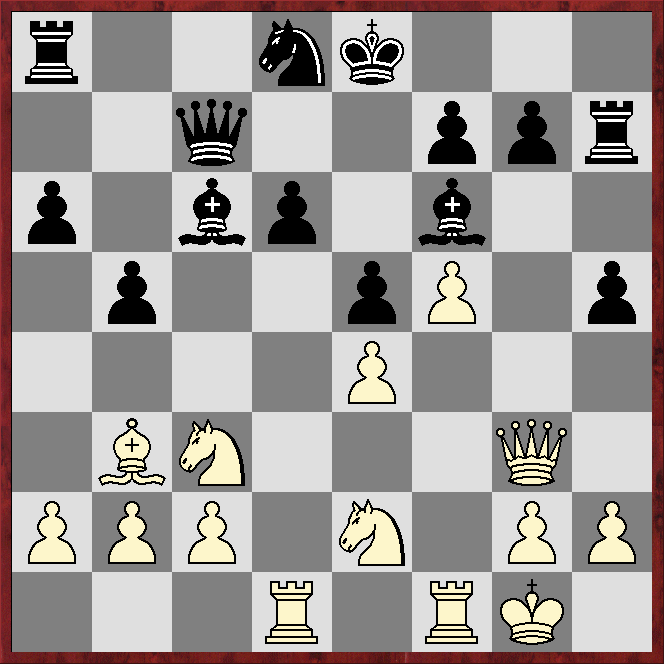
15.Bg5 Bc6 16.Bxf6 Bxf6 17.Rad1 b5
How should White proceed?
*****
*****
*****
*****
*****
18.Bd5
This becomes Dragon1's top choice, although Stockfish17 prefers 18.h3!? or 18.Kh1.
18...Nb7
The engines dislike this, preferring 18...h4!? or 18...Kf8!?
19.Qf3 h4 20.Kh1 Kf8!? 21.Bxc6 Qxc6 22.Nd5 Rc8
On 22...Qxc2 the engines give 23.b4, claiming White has much more than enough for a pawn.
23.Nec3!?
The engines fluctuate between this and 23.Nxf6.
23...Bd8 24.f6 g6
There does not appear to be a good continuation for Black.
25.Ne7!
Sacrificing a pawn to get at Black's king.
25...Bxe7 26.fxe7+ Kxe7
Even worse is 26...Kf8 27.Nd5 etc.
27.Nd5+ Kf8
Forced. Both 27...Ke8?! and 27...Kd7?! can be met by 28.Nf6+, while 27...Kd8? allows 28...Qf6+ and 29...Qe7#.
28.Qf6 Re8 29.Qxg6 Rg7 30.Qh6 Qxc2
White has mate in three
*****
*****
*****
*****
*****
31.Qh8+ Rg8 32.Rxf7+! Kxf7 33.Qf6#

Friday, 13 November 2020

Bobby Fischer v The Sicilian (part five)

Sicilian Classical/Sozin
Fischer's favourite weapon against the Classical variation of the Sicilian, 1.e4 d6 2.Nf3 d6 3.d4 cxd4 4.Nxd4 Nf6 5.Nc3 Nc6, was the Sozin, 6.Bc4.

Starting position of the Sicilian Sozin

Black blocks the white light-square bishop with 6...e6
7.Bb3
More popular today is 7.Be3, but the text was Fischer's usual response and the lines often transpose. The position is identical to ones he reached against the Najdorf, except Black has played ...Nc6 rather than ...a6.
7...Be7 8.Be3 0-0 9.0-0
Fischer usually preferred this to the commoner 9.Qe2, which is often played with the intention of castling long. After the text we come to a major parting of the ways.
A)
9...a6 10.f4 Nxd4
An exchanging manoeuvre we have seen before. Black swops off a piece that could assist White's kingside attack.
11.Bxd4 b5 12.a3!?
Fischer played this novelty (at least it is the first time it appears in ChessBase's 2020 Mega database) against Spassky in game four of their 1972 re-match.
The mainline continuation is 12.e5 dxe5 13.fxe5 Nd7 14.Ne4 Bb7 15.Nd6 Bxd6 (15...Qc7!?) 16.exd6 Qg5!? 17.Qe2 (17.Rf2 is also popular) e5, and now 18.Bc3 Qg6 19.Rad1 was slightly better for White in Nigel Short (2655) - Garry Kasparov (2805), World Championship Game 14 (London) 1993, although the game was drawn in 39 moves.
12...Bb7 13.Qd3 a5!? 14.e5 dxe5 15.fxe5 Nd7 16.Nxb5 Nc5
White has sacrificed a pawn for the bishop-pair and active piece-play. Fischer now played 17.Bxc5, but after 17...Bxc5+ 18.Kh1 Qg5 Spassky had plenty of compensation and the game was drawn in 45 moves.
A possible improvement came in Konstantinos Moutousis (2330) - Vladimir Tukmakov (2565), European Team Championship (Haifa, Israel) 1989, which saw 17.Qe3!? Nxb3 18.Qxb3 a4 19.Qd3 Qd5 20.Rf2 Rfd8 21.Rd1, although that too ended in a draw (in 64 moves).
Perhaps White's best chance for an edge is to play the mainline e5 at move 12.
B)
9...Bd7 10.f4 Nxd4
Again this knight-exchange is Black's normal continuation.
11.Bxd4 Bc6 12.Qe2 b5!?
This pawn thrust was very topical in the 1950s and 1960s and is still the main line today.
13.Nxb5 Bxb5 14.Qxb5 Nxe4 15.f5 Bf6 16.Qd3 Bxd4
Fischer - Raymond Weinstein, US Championship (New York) 1958, saw 16...d5 17.Bxf6 Nxf6 with a level game (but 1-0, 58 moves).
Fischer twice faced the text during a 1964 simul tour. After ... 
17.Qxd4 d5
... my main analysis engines, Stockfish12 and Komodo11.01, reckon White can gain a substantial advantage with 18.fxe6 fxe6 19.Rxf8+ Kxf8 (19...Qxf8?! 20.Bxd5!) 20.c4.
All in all, 9...Bd7 seems a tough nut to crack. A possible improvement is 16.Bxf6!? Qxf6 17.Rad1 Qg5 18.Qe2, which was played in Konstantinos Klokas (2219) - Bartłomiej Heberla (2513), European Championship (Dresden) 2007. Komodo11.01 reckons White is better, and Klokas did go on to win in 33 moves, but Stockfish12 rates the position as level, and the win had little to do with the opening.
C)
9...Na5!?
As always in Bc4 lines, playing to exchange the bishop is an option, but here it is generally thought to take too much time.
10.f4 b6
The main move, but 10...Nxb3 11.axb3 a6 is a popular alternative, when the main line runs 12.Qf3 Qc7 13.g4 with a dangerous attack.
11.e5 Ne8 12.f5!? dxe5 13.fxe6 Nxb3
This is the most-popular move in Mega20, but the engines reckon a major improvement is 13...fxe6!? 14.Rxf8+ Bxf8 15.Bxe6+ Bxe6 16.Nxe6 Qxd1+ 17.Rxd1 with only a small edge for White.
14.Nc6! Qd6 15.Qxd6 Bxd6 16.axb3 Bxe6 17.Na7 Rb8
White is much better, according to the engines, but went on to lose in 45 moves in Fischer- Viktor Korchnoi, Candidates (Curaçao, Dutch Antilles) 1962.

Black develops the queen with 6...Qb6
Playing ...e6 is automatic for some Sicilian players when faced with Bc4, but ...Qb6 is a popular alternative.
7.Nxc6!?
Fischer beat Pal Benko in 1959 with 7.Nde2 and beat Anthony Saidy in 1966 with 7.Nb3, but by 1971 he was apparently convinced the text, which avoids losing a development tempo, is best. For what it is worth, Stockfish12 agrees but Komodo11.01 prefers the mainline 7.Nb3.
7...bxc6
Mega20 has one game that went 7...Qxc6?? 8.Bb5 1-0.
8.0-0 e6 9.Bf4!?
The main move is 9.Qe2. The text, which seems to have been a novelty, was played by Fischer in a Manhattan Chess Club blitz game against Robert Byrne.
9...Qxb2!?
A brave decision. The engines reckon 9...Ba6 is safer, but slightly better for White.
10.Qd3 Qb4
Later games saw 10...e5!?, but then 11.Rab1 Qa3 12.Rb3 gives White very strong play.
11.Rab1 Qc5 12.Rfd1 e5
The engines prefer 12...Ng4 or 12...d5, but in each case with advantage to White.
13.Bg5 Be7 14.Bxf6 gxf6
White has very good compensation for a pawn, and Fischer went on to win in 26 moves. Although Fischer did not play it, the engines point out White can immediately get a big advantage with 15.Nd5! since 15...cxd5 runs into 16.Bxd5.

Black prepares to fianchetto the king's bishop with 6...g6?!
There are 1,136 examples of this move in Mega20, but White can immediately cause Black serious problems.
7.Nxc6 bxc6 8.e5 Ng4
Fischer faced 8...Nd7 in a 1964 simul, quickly getting a large advantage with 9.exd6 exd6 10.0-0 d5?! 11.Nxd5 etc.
Also good for White is 8...d5 9.exf6 dxc4 10.Qf3, and even better is 8...dxe5? 9.Bxf7+! Kxf7 10.Qxd8.
9.exd6!
The more-popular 9.e6?! is much less clear after 9...f5.
9...Qxd6 10.Qxd6 exd6
Now 11.0-0 and 11.Bf4 are roughly equally popular, and both give White good play.

Black develops with 6...Bd7
7.Bb3 g6
Fianchettoing after ...Bd7 is the main move, but Fischer also faced 7...e6 8.0-0 Be7 9.Be3 0-0 10.f4, which transposes to line B) in Black blocks the white light-square bishop with 6...e6.
8.f3 Na5!?
Fischer faced this move in 1959 (Candidates') and 1960 (Mar del Plata), winning both times.
The main line today runs 8...Nxd4 9.Qxd4 Bg7 10.Be3 0-0, when best might be the engines' 11.Qd3!? as the normal objection to this, the tempo-gaining manoeuvre ...Nd7-c5, does not apply here as Black, if wanting to play this, has to spend a tempo moving the light-square bishop. However, the normal 11.Qd2 may also be enough for a small edge.
9.Bg5 Bg7 10.Qd2 h6 11.Be3 Rc8 12.0-0-0 Nc4 13.Qe2
The engines claim a large advantage for White after 13.Bxc4!? Rxc4 14.Kb1, but the position seems unclear.
13...Nxe3 14.Qxe3
Fischer - Svetozar Gligorić, Candidates' (Yugoslavia) 1959, continued 14...0-0 15.g4 Qa5 16.h4 with an initiative (1-0, 32 moves).
Fischer - Luis Marini, Mar del Plata (Argentina) 1960, saw 14...Qb6 15.Qd2 Qc5 16.f4 h5 17.Nf3 Bh6?! (17...0-0 may be better, but probably still good for White) 18.e5, again with an initiative (1-0, 35 moves).

Friday, 31 July 2020

Champion Repertoire (part eight)

A REPERTOIRE based on the games of Mikhail Tal, who was world champion from 1960-61, will suit attacking players who love studying sharp mainline theory.
White
Start with 1.e4, aiming to play open lines of the Sicilian: 1...c5.
After 2.Nf3 d6 3.d4 exd4 4.Nxd4 Nf6 5.Nc3, Tal scored 74% against 5...a6 with 6.Bg5, 79% against 5...Nc6 with 6.Bg5, 81% against 5...e6 with 6.Be2 and 72% against 5...g6 with 6.Be3.
Against 2...Nc6 3.d4 cxd4 4.Nxd4 Nf6 5.Nc3 e5 he scored 71% with 6.Ndb5 d6 7.Bg5.
Against 2...e6 3.d4 cxd4 4.Nxd4 a6 he scored 74% with 5.Nc3, and against 4...Nc6 he scored 69% with 5.Nc3, rising to 83% when he met 5...Qc7 with 6.Be3.
He was happy going down the main line of the Spanish: 1...e5 2.Nf3 Nc6 3.Bb5 a6 4.Ba4 Nf6 5.0-0 Be7 6.Re1 b5 7.Bb3, usually meeting 7...d6 with 8.c3 0-0 9.h3 and 7...0-0 with 8.c3 d6 9.h3, scoring 68%.
He met the Marshall Attack: 7...0-0 8.c3 d5 with the main line 9.exd5 Nxd5 10.Nxe5 Nxe5 11.Rxe5, but after 11...c6 he played both 12.d4 Bd6 13.Re1 Qh4 14.g3, scoring 67%, and 12.Bxd5 cxd5 13.d4 Bd6 14.Re3, scoring 63%.
In the main line of the Open Defence: 5...Nxe4 6.d4 b5 7.Bb3 d5 8.dxe5 Be6 he scored 64% with 9.c3.
Against the Steinitz Deferred: 4...d6 Tal scored 85% with 5.0-0.
Against the Berlin: 3...Nf6 he scored 72% with 4.0-0, happily entering the main line of what is now known as the Berlin Wall: 4...Nxe4 5.d4 Nd6 6.Bxc6 dxc6 7.dxe5 Nxf5 8.Qxd8+ Kxd8 9.Nc3. Tal's opponents more often played 5...Be7, against which he had disappointing results the five times he played the main move 6.Qe2, scoring just 50% in ChessBase's 2020 Mega database, but scoring a win and a draw when he refined this with the line 6.dxe5 0-0 7.Qe2.
Tal met other third moves in the Spanish too infrequently to give a repertoire recommendation.
Against the Petrov: 2...Nf6 he scored 64% with the main line 3.Nxe5 d6 4.Nf3 Nxe4 5.d4 d5 6.Bd3.
Tal met the Philidor: 2...d6 three times, scoring two wins and a draw with 3.d4.
Against the French: 1...e6 2.d4 d5 he played the Tarrasch: 3.Nd2 marginally more often than the Winawer: 3.Nc3.
The vast majority of Tal's opponents replied to 3.Nd2 with 3...c5, when Tal scored 73% with 4.Ngf3.
The main reply to this in his games was 4...Nc6, when he scored 79% in the seven games he played 5.Bb5 and in the seven when he played 5.exd5.
Today 4...cxd4 is probably more popular. Tal always played the main line, 5.exd5 Qxd5 6.Bc4 Qd6 7.0-0 Nf6 8.Nb3 Nc6 9.Nbxd4 Nxd4 10.Nxd4, although he only scored 50% with it, albeit against top-class opposition.
Against 3...Nf6 Tal scored 92% with 4.e5 Nfd7 5.c3 c5 6.Bd3 (White's last two moves were often reversed) Nc6 7.Ne2.
Tal met other third moves in the French Tarrasch too infrequently to give a repertoire recommendation.
Against the Caro-Kann: 1...c6 Tal scored a stupendous 95% with 2.c4!? Most opponents replied 2...d5, against which he usually transposed into a Panov Attack with 3.exd5 cxd5 4.d4 Nf6, scoring 71% with 5.Nc3. A handful of opponents replied 2...e5, which Tal beat whether he continued 3.d4!? or 3.Nf3.
Against the Pirc: 1...d6 2.d4 Nf6 3.Nc3 g6 Tal scored 88% with the Austrian Attack: 4.f4 Bg7 5.Nf3.
Against Alekhine's Defence 1...Nf6 he generally went for a modest centre with 2.e5 Nd5 3.d4 d6 4.Nf3, scoring 63%.
Tal rarely faced the Scandinavian: 1...d5, but on two of the three times he reached the position after 2.exd5 Nf6 3.d4 Nxd5 he preferred what is now the fashionable 4.Nf3!? to the main move 4.c4.
Black v 1.e4
Aim for a Sicilian Najdorf: 1...c5 2.Nf3 d6 3.d4 cxd4 4.Nxd4 Nf6 5.Nc3 a6, with which Tal scored 65%.
Against 6.Bg5 Tal's most-common response was 6...e6 7.f4 Qb6, when White usually sacrifices a pawn with 8.Qd2 Qxb2, or plays 8.Nb3 and castles long. Either way, both players need to know a fair bit of theory.
Against 6.Be2 Tal scored 62% with 6...e5, usually continuing 7.Nb3 Be7 8.0-0 0-0.
Against 6.Bc4 he scored 70% with 6...e6 7.Bb3 b5.
Against 6.f4 he liked 6...e6, meeting today's favourite, 7.Qf3, with 7...Qb6 8.Nb3 Qc7.
The moves 6.Be3 and 6.g3 were rare birds in Tal's day but, as against 6.f4, he preferred 6...e6 to the 'Najdorf move' 6...e5.
Tal faced 6.a4 twice, winning both times with 6...Nc6.
He usually met 4.Qxd4 with an immediate 4...Nc6, and he scored 77% by meeting 3.Bb5+ with 3...Bd7.
Against 2.Nc3 Tal scored 78% with 2...Nc6, meeting both 3.g3 and 3.f4 with 3...g6.
He varied his replies against 2.c3 but scored an impressive 75% with 2...d5.
Black v 1.d4 and Others
After 1...Nf6 2.c4 e6 3.Nc3 Tal scored just 49% with his most-common choice 3...Bb4 but 65% with 3...c5. The latter games usually continued 4.d5 exd5 5.cxd5 d6, a position Tal often reached via the move-order 2...c5 3.d5 e6 4.Nc3 exd5 5.cxd5 d6.
Tal twice faced the main line 6.e4 g6 7.f4 Bg7 8.Bb5+, scoring a win and a draw with 8...Nfd7.
Much more popular in his games was 7.Nf3, a position often reached via the move-order 6.Nf3 g6 7.e4. After the main continuation, 7...g6 8.Be2 0-0 9.0-0 Re8 10.Nd2, Tal scored 78% with 10...Na6.
Against 3.Nf3 Tal scored just 51% with his most-common choice 3...d5 but 70% with 3...c5.
In the main line after the latter, 4.d5 exd5 5.cxd5, Tal scored 75% with the slightly unusual 5...g6 6.Nc3 Bg7. It was only after 7.e4 that he at last played 7...d6, transposing to a position I have already covered.
There seems no good way for White to exploit the delay in playing ...d6 - none of Tal's opponents pushed the d pawn to d6presumably fearing the pawn would be weak in the long run - so perhaps the main effect of delaying ...d6 is to gain time on the clock.
Against 3.g3 Tal scored 75% with 3...c5, rising to 80% in the main line 4.d5 exd5 5.cxd5 d6. If White declined to push the pawn, instead opting for 4.Nf3 cxd4 5.Nxd4, Tal scored 70% by taking over the centre with 5...d5 6.Bg2 (6.cxd5?! Qxd5) e5.
Against 2.Nf3 Tal scored 68% with the immediate 2...c5.
He only faced the Trompowsky 2.Bg5 three times, winning both games in which he replied 2...e6.
Against the English: 1.c4 Tal scored best (64%) with 1...e5. All his opponents continued 2.Nc3, which Tal usually met with 2...Nf6, scoring 67% with 3,g3 Bb4 and 87% with 3.Nf3 d6.
Against 1.Nf3 Tal usually replied 1...Nf6, scoring 63% with 2.c4 c5 and 89% with 2.g3 g6 3.Bg2 Bg7.

Tal won the 1959 Candidates' Tournament in large part thanks to beating Bobby Fischer in all four of their games. Here is the shortest.
Fischer - Tal
Candidates' (Yugoslavia) 1959, Round 13
Sicilian Sozin
1.e4 c5 2.Nf3 d6 3.d4 cxd4 4.Nxd4 Nf6 5.Nc3 a6 6.Bc4
White has a big choice at move six, but the text was very much a Fischer speciality.
6...e6 7.Bb3
This may well look strange to anyone not au fait with the Sozin Variation but it is the main move, the point being to stop ...b5 coming with tempo.
7...Be7
Fourteen(!) rounds later Tal against the same opponent preferred 7...b5.
8.f4 0-0 9.f3 Qc7 10.0-0
Both players will probably have known a game played the previous year, Khana Muchnik - Lev Polugaevsky, USSR Championship Semi-Final (Baku), that was agreed drawn after 10.f5 Nc6 11.Be3 Nxd4 12.Bxd4 b5 13.0-0-0 b4 14.Na4 Rb8 15.fxe6 fxe6.
10...b5 11.f5!?
This may be premature. The analysis engines Stockfish11 and Komodo11.01 reckon White should take time out to counter Black's queenside expansion by playing 11.a3!?, but that seems slow.
11...b4 12.Na4
How should Black proceed?
*****
*****
*****
*****
*****
12...e5!
This opens the b3-f7 diagonal but gains a bigger foothold in the centre and stops White opening the f file.
13.Ne2 Bb7 14.Ng3 Nbd7 15.Be3 Bc6 16.Bf2
Preparing a defence of e4.
16.Qb7 17.Rfe1 d5
An old rule-of-thumb has it that when Black can successfully play ...d5 in the Sicilian he has at least equalised. Certainly the engines reckon Black is much better.
18.exd5 Nxd5 19.Ne4 Nf4 20.c4 g6 21.fxg6 f5!?
Also strong is the simple 21...hxg6.
22.g7
22.gxh7+ Kh8.
22...Kxg7 23.Qg3+ Kh8 24.Nec5 Nxc5 25.Bxc5 Bxc5+ 26.Nxc5 Qc7
The smoke has cleared and material is level, but White is busted. Black's minor pieces are more active than White's and the apparent weakness of the black king is illusory.
27.Qe3 Rae8!
This is much stronger than 27...Nxg2?! 28.Qxe5+ Qxe5 29.Rxe5.
28.Re2
This is tantamount to resigning but hopeless for White is 28.g3 Nh3+ 29.Kf1 f4.
The game finished:
28...Nxe2+ 29.Qxe2 Bxg2 30.Nxa6 Qa7+ 31.Kxg2 Rg8+ 32.Kh3 Qg7 33.Bd1 Re6 0-1