Showing posts with label South Wales. Show all posts

Sunday, 24 July 2022

Lessons From South Wales IX

IN round nine at the South Wales International I had white against an 1857.
The full game can be seen at S9 but here I want to concentrate on the opening, which featured a popular line in the Veresov.
The game began 1.d4 d5 2.Nc3 Nf6 3.Bg5, at which point there are three moves that each feature more than 4,000 times in ChessBase's 2022 Mega database, including 3...Bf5, which can be thought of as a 'liberated bishop' approach.
4.f3 and 4.Bxf6!? are popular continuations, but I preferred 4.e3, all three moves appearing more than 1,000 times in Mega22.
The main idea after 4...e6 is to challenge the developed black bishop with 5.Bd3, when 5...Bg6 is reasonably common but usual is 5...Bxd3.
How should White recapture?
*****
*****
*****
*****
*****
Most popular now is emphasising development with 6.Qxd3, but Stockfish15 and Komodo13.02 slightly prefer my choice of 6.cxd3!?, which gives greater central control and half-opens the c file, but leaves the white pawn-structure a little less flexible.
Black's commonest response is 6...Be7, but the game saw 6...c6!?, which is preferred by Stockfish15 but not Komodo13.02. After the further moves 7.Nf3 Nbd7 I got in 8.Ne5, intending to follow up with a quick f4.
Most popular in Mega22 is the routine 8.0-0, but the engines like an immediate advance in the centre with 8.e4!?
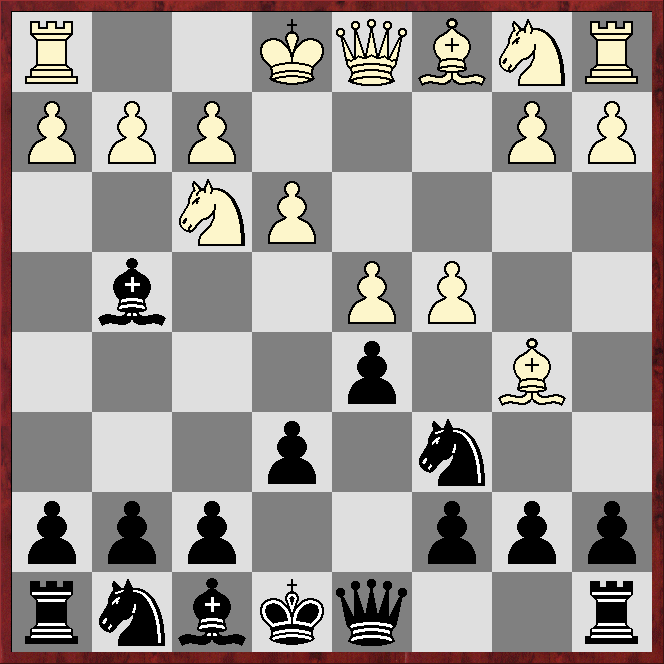
Position after the engine-recommended 8.e4!?
*****
*****
*****
*****
*****
Kurt Richter, a pioneer of the Veresov (it is sometimes called the Richter Attack), had this position as White in 1933, and, 70 years later, so did Igor Miladinović, who is well-known for playing the Chigorin Defence to the Queen's Gambit: 1.d4 d5 2.c4 Nc6. The point about the latter playing the Veresov is that the Veresov often resembles a Chigorin or Pseudo-Chigorin (without an early c4 by White) with colours reversed and White having an extra tempo.
After 8.e4!? the most popular move in Mega22, albeit from a small sample, is 8...Be7, when an interesting continuation is 9.e5 Ng4 10.Bd2!? with a position not easy to assess, although the engines give White a tiny edge.
Instead of 8...Be7 the engines reckon Black should prepare to break the pin on the king's knight with 8...h6!? Then 9.Bh4 can be met by 9...g5 or 9...Qb6, when Stockfish15 prefers Black although Komodo13.02 calls the position equal.
Perhaps White's best response to 8...h6!? is 9.Bd2, reaching a position not in Mega22. Stockfish15 continues 9...Be7 10.0-0 0-0 11.e5 Nh7 12.Ne2!?, fluctuating between claiming a slight edge for White and rating the position as equal. Komodo13.02 prefers 9...Bb4!? 10.e5 Ng8!? 11.0-0 Ne7 12.a3 Bxc3!? 13.Bxc3, reckoning Black has more-or-less equalised.
CONCLUSION: 3...Bf5 against the Veresov is both active and solid. It is not easy for White to get a theoretical advantage in the opening, and much depends on the players' familiarity with the middlegame positions that typically arise.

Saturday, 23 July 2022

Lessons From South Wales VIII

IN round eight at the South Wales International I had Black against an 1873.
The full game can be seen at S8 but here I want to concentrate on the interesting system White used against the Berlin Defence in the Spanish.
After 1.e4 e5 2.Nf3 Nc6 3.Bb5 Nf6 the most popular moves are 4.0-0, 4.d3 and 4.Nc3, all of which have been tried by Magnus Carlsen. But Vishy Anand, Peter Svidler and Michael Adams are among modern grandmasters who have played 4.Qe2!? The move was also a favourite with old-time greats,including Howard Staunton, Henry Bird and Mikhail Chigorin.
How should Black proceed?
*****
*****
*****
*****
*****
One of the main points of Qe2 is it protects e4 while still allowing White to build a centre with c3 and d4. A popular reply is the cautious 4...d6, but the immediate 5.d4 gives White a slight edge, according to Stockfish15 and Komodo13.02. I preferred the more-active 4...Bc5, which is possible because, although 5.Bxc6 dxc6?! 6.Nxe5 Qe7 7.Nd3 favours White thanks to the attack on the black dark-square bishop, Black has 5...bxc6, when 6.Nxe5 Qxe7 7.Nd3 runs into 7...Ba6.
Easily White's commonest continuation is 5.c3, to which I replied 5...d6, which, as with ...d6 at move four, may be overly cautious. The game continued 6.0-0 but the engines' 6.d4 exd4 7.cxd4 Bb4+ looks good for White after both 8.Nc3 or 8.Bd2.
Probably best for Black at move five is to castle, preventing an immediate d4 and keeping the option of ...d5. The mainline then in ChessBase's Mega 2022 runs 6.0-0 Re8 7.d3 h6, reaching an equal position, according to the engines.
CONCLUSION: 5.Qe2!? is by no means a refutation of the Berlin, but Black needs to play actively to avoid allowing White to gain an advantage.

Friday, 22 July 2022

Lessons From South Wales VII

IN round seven at the South Wales International I had white against a Fide master rated 2289.
The full game can be seen at S7 but here I want to concentrate on the opening, which featured a line of the currently fashionable Tartakower Variation of the Caro-Kann.
That starts 1.e4 c6 2.d4 d5 3.Nc3 dxe4 4.Nxe4 Nf6 5.Nxf6+ exf6.
How should White continue?
*****
*****
*****
*****
*****
I played what is easily the commonest continuation in ChessBase's 2022 Mega database, 6.c3. This may look slow but is likely to be needed at some point to support the d pawn, to let White possibly set-up a queen-bishop battery on the b1-h7 diagonal and to make protection of b2 easier.
The vast majority of games in Mega22 continue 6...Bd6 7.Bd3 0-0, and now 8.Qc2 is most popular but Magnus Carlsen is among those who have preferred 8.Ne2.
After 8...Re8 9.0-0 the continuation 9...Nd7 is probably considered best theoretically, although 9...Qc7, 9...Na6, 9...Bg4, 9...h5?!, 9...f5 and 9...g6 have also been tried by grandmasters.
The most popular reply to ...Nd7 is 10.Bf4, when Magnus Carlsen (2863) - Rasmus Svane (2613), Lichess Online Blitz 2020, saw 10...Nf8 11.Bxd6 Qxd6 12.Re1 with a position Stockfish15 and Komodo13.02 reckon is equal (but 1-0, 51 moves). I played 10.Ng3, when 10...g6 covered the f5 and h5 squares.
My 11.Qf3!? has been played by a 2446 but is not liked by the engines. Stockfish15 reckons 11.Bh6!? gives White a slight edge after 11...f5 12.Qd2, while Komodo13.02 prefers 11.Ne4 Be7 12.Re1, again claiming a slight edge for White.
After Qf3 the game saw 11...Nb6 12.Ne4 Be7, which also occurred in Aleksandra Dimitrova (2246) - Anna Gvanceladze (2238), Moscow Women's Championship 2017.
My 13.Re1 may be a novelty and is preferred by the engines to the Moscow game's 13.Bf4, but after 13...Be6 the engines do not like 14.Bd2, after which 14...f5 15.Ng3 a5 saw Black get a queenside initiative. Instead they reckon 14.Bf1!? is good, when 14...f5 15.Nc5!? Bxc5 16.dxc5 Na4 17.b3!? Nxc5 18.c4 is a promising pawn sacrifice, according to the engines, who prefer White's bishop-pair to Black's extra but doubled pawn.
CONCLUSION: the Tartakower Variation of the Caro-Kann has been around more than 120 years and is still evolving. It gives Black easy development at the cost of an inferior pawn-structure. White's superior structure is an endgame asset, but there is much play left before any ending is reached.

Wednesday, 20 July 2022

Lessons From South Wales V

IN round five at the South Wales International I had white against a 1754.
The full game can be seen at S5 but here I want to concentrate on the gambit I played against my opponent's Sicilian.
The game began 1.e4 c5 2.Nf3 e6, which I met with a kingside fianchetto that has been played by at least four reigning or future world champions, Bobby Fischer, Garry Kasparov, Vishy Anand and Magnus Carlsen.
After 3.g3 Nc6 4.Bg2 the main move is 4...Nf6, but my game saw 5...d6, which is narrowly the second-most popular continuation in ChessBase's 2022 Mega database.
Following 5.0-0 Nf6 6.Qe2 Qc7 I played to build a centre with 7.c3, when Stockfish15 and Komodo13.02 agree with the game's response of 7...e5.
How should White proceed?
*****
*****
*****
*****
*****
A 2572 played 8.Rd1, which occurs eight out of 21 times in Mega22, while a 2510 chose 8.Na3, which occurs five times. The engines like the latter, and also 8.h3.
I preferred 8.d4!?, hoping the uncastled state of the black king would justify my pawn offer. The game continued 8...exd4 9.cxd4 Be7?! 10.dxc5 dxc5 11.Bf4 with a clear advantage to White.
Critical is 9...cxd4, transposing to Qingyu Yuan (2373) - Nodirbek Abdusattorov (2627), Chess.com Blitz 2021. That game ran 10.Na3 Be7!? 11.Nb5 Qb6 12.Rd1, when 12.Bg4 would have been fine for Black. Abdusattorov played the inferior 12...0-0? but won anyway.
The engines prefer a more-direct approach with 10.Rd1, although note White is not threatening 11.Nxd4?? as that loses to 11...Nxd4 12.Rxd4 Qxc1+.
The engines fluctuate between two main replies for Black, one indirectly defending d4 and the other getting on with kingside development.
A) 10...Bg4, which they reckon should be met with 11.Nbd2. Now 11...Qc8!? (better than 11...Qd7, according to the engines) stops h3, but White can instead play 12.Nb3, after which the sacrificed pawn will be regained with a slight edge, eg 12...Be7 13.Nbxd4 0-0 14.Bf4.
B) 10...Be7 is possible because, as explained above, White is not threatening Nxd4. Instead White can play 11.h3, preventing ...Bg4. After 11...0-0 12.Na3 White is again ready to recapture the sacrificed pawn, emerging with at least a slight edge.
CONCLUSION: 8.d4!? seems a fully sound sacrifice. If the sac is not accepted, White can gain space without loss of tempo with 9.d5, so Black probably needs to find an improvement earlier in the opening.

Tuesday, 19 July 2022

Lessons From South Wales IV

IN round four at the South Wales International I had black against a 2125.
The full game can be seen at S4 but here I will concentrate on what I should have played instead of blundering a pawn on move five.
The game began as a Colle, 1d4 d5 2.Nf3 Nc6 3.e3, which I combatted with the Chigorin-style 3...Bg4, one idea of which is to play for a quick ...e5.
White countered with 4.Bb5, to which I replied with the main move in ChessBase's 2022 Mega database, 4...e6.
The continuation 5.c4 first appears in Mega22 as recently as 1996.
How should Black respond?
*****
*****
*****
*****
*****
The position resembles a mainline Chigorin with Nf3, except the white light-square bishop has been developed outside of the pawn chain.
I played 5...a6?, losing a pawn to 6.Bxc6+ bxc6 7.Qa4 Ne7 8.Ne5 Bh5 9.Nc3 (not 9.Nxc6?? Qd7) f6 10.Nxc6.
The most popular continuation in Mega22 is 5...Bb4+ 6.Bd2 Bxd2+ 7.Nbxd2 Ne7, reaching a position Stockfish15 and Komodo13.02 reckon favours White. One line given by them runs 8.cxd5 exd5 9.Qb3!? (probably a novelty) Rb8 10.h3, when the engines agree White has a slight edge.
They instead recommend 5...Qd7!?, when Nenad Sulava (2466) - Igor Miladinović (2501), Ano Liosia (Athens) 1999, saw 6.exd5 Qxd5?! 7.Qa4?! Bxf3 8.Nc3!? Bd1! 9.Kxd1?! Qxg2 10.d5?? Qxh1+ (0-1, 26 moves). Many probable improvements are available on this play, starting as early as move six. Miladinović is a Chigorin specialist, but the more-normal Chigorin move 6...exd5 is the way to go, according to the engines. They continue 7.h3 Bxf3!? 8.Qxf3 f5!? 9.Nc3 Nf6 10.Bd2 Bb4!? 11.a3 Bxc3 12.Bx3 0-0 13.0-0 Ne4, when the white bishop-pair is a negligible factor. Stockfish15 gives White a slight edge, but Komodo13.02 at first reckons the position is equal, although it comes to more-or-less agree with Stockfish15.
CONCLUSION: almost anything is better than the game's 5...a6?, but moves such as 5...Qd7!? and 7...Bxf3!? are somewhat counter-intuitive, so it is probably fair to say White's position is easier to play.

Monday, 18 July 2022

Lessons From South Wales IIII

IN  round three I had white against a 2106.
The full game can be seen at S3 but here I want to concentrate on the instructive rook-and-pawn ending.
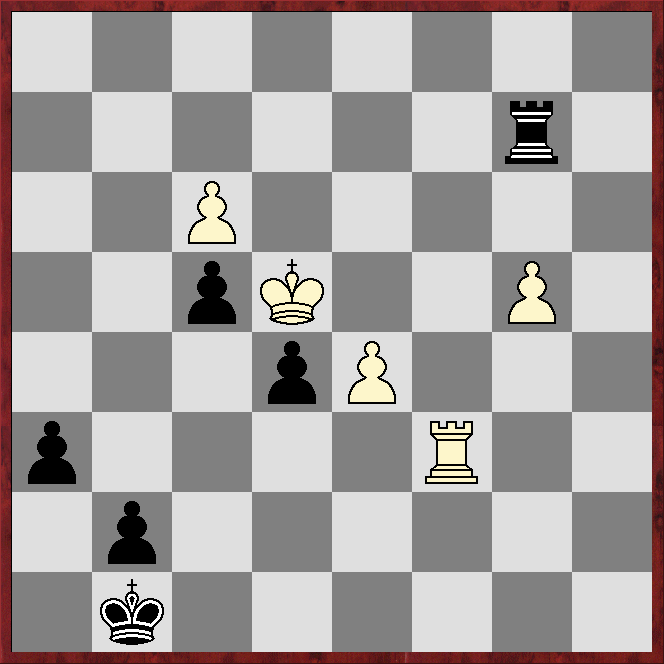
The ending arose after White's 38th move
*****
*****
*****
*****
*****
Material is equal. White has a passed pawn and should be able to easily create a second one, but Black can win the g2 pawn, thus making the h pawn a protected passer. Stockfish15 reckons the position is dead-equal, but Komodo13.02 gives White a slight edge.
38...Rg1 39.Kd3
This gives the king the option of supporting either the b or f pawn.
Not 39.Rg6?! Kf7 40.Rg4?, when Black has several winning moves, including 40...g5, eg 41.b4 Kf6 42.d6 axb4 43.axb4 Ra1 etc.
39...Rxg2 40.b4 axb4 41.axb4 Rb2
How should White proceed?
*****
*****
*****
*****
*****
42.Ke4!
This is the best try as 42.d6? loses to 42...Rxb4, with ....Rd4+ to come, while both 42.Kc4 e4 43.fxe4 f3 44.Kd3 f2 and 42.Kc3 Rf2 43.b5 Rxf3+ are dead-equal, according to the engines.
How should Black respond?
*****
*****
*****
*****
*****
42...Rxb4+?
This loses whereas 42...Re2+ 43.Kf5 e4 gives good drawing chances, eg 44.fxe4 f3 45.Rc1 f2 46.Rf1 g5!, or 44.d6!? Kf7 45.Rc7+ Kf8 46.Re7+ Kd8 47.Rxe4 g6+!? 48.Kxf4 Rb2, although neither line is simple.
White to play and win
*****
*****
*****
*****
*****
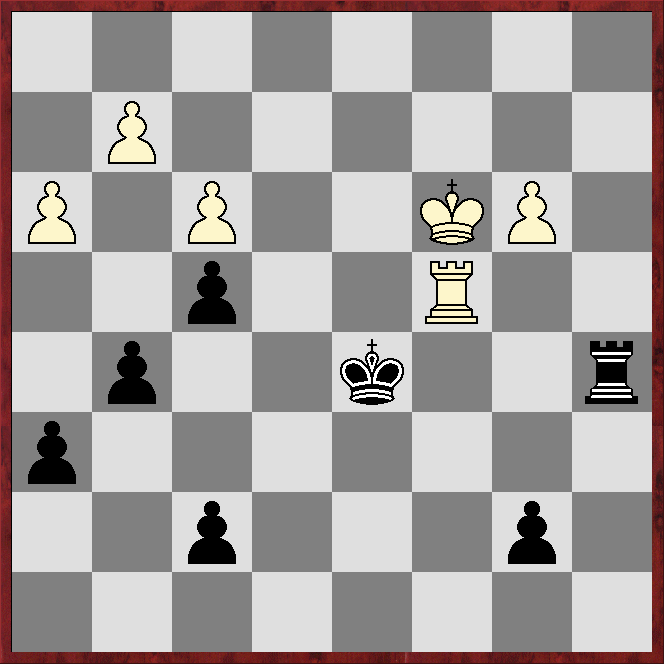
43.Kxe5?
This lets Black draw. The winning plan consists of using the e pawn to shelter the white king from checks so the king can usher forward the passed pawn, eg 43.Kf5 e4 44.d6 Rd4 45.Kg6 (45.fxe4 also wins) Kf8 46.Rc8#, or 43...Rb8 44.d6 Kf7 45.Rc7+ Kf8 46.Ke6 Re8+ 47.Kd7 Kf7 48.Rc8 Re6 49.Kc7 etc, or 43...Kf7 44.Rc7+ Kf8 45.d6 Rd4 46.Ke6 g5 47.d7 etc.
Black to play and draw
*****
*****
*****
*****
*****
43...Rb8?
Most moves along the b file hold, according to the engines, but not the text. Easiest is the active 43...Rb3, eg 44.d6 Kf7 45.d7 Re3+ 46.Kxf4 Rd3, or 46.Kd6?! Rd3+ 47.Kc7?? (better is 47.Ke5 Rxd7 48.Kxf4) Ke7 etc. If 44.Kxf4 then 44...Kf7 equalises.
White to play and win
*****
*****
*****
*****
*****
44.d6
Pushing the passed pawn is the only way to win, eg 44.Ke5? Re8+ 45.Kd7 Kf7 draws.
The game finished:
44...Re8+ 45.Kd5 Kf7 46.d7 Re3 47.Rd6 Rd3+ 48.Ke5 1-0

Sunday, 17 July 2022

Lessons From South Wales II

IN round two at the South Wales International I had black against a 2190.
The full game can be seen at S2 but here I will concentrate on the early opening.
The game began with 1.Nf3, and I replied 1...Nc6, one point of which is that 2.g3 is well-met by 2...e5.
Instead the commonest continuation is 2.d4, when 2...d5 prevents both 3.e4 and 3.d5.
Most popular now is 3.c4, bringing about a mainline of the Chigorin, but the game saw 3.g3, when my reply 3...Bg4 is in the spirit of the Chigorin, although 3...Bf5 and 3...Nf6 are popular alternatives.
After 4.Bg2 I played 4...Qd7, which is easily the commonest continuation in ChessBase's 2022 Mega database and strongly hints at opposite-side castling.
How should White proceed?
*****
*****
*****
*****
*****
Normal is 5.h3, but the game's 5.0-0!? is also popular and is the choice of the analysis engines Stockfish15 and Komodo13,02.
Black usually responds by castling long, but I preferred 5...h5!?, which is rare but has been played by a 2653.
After 6.c4 the game Meri Arabidze (2438) - Aleksandr Rakhmanov (2653), Chess.com blitz 2021, saw 6...e6 7.Nc3 dxc4 8.Qa4 h4 9.Qxc4, when Black blundered with 9...hxg3?? Both players missed the winning 10.Ne5, eg 10...Nxe5 11.dxe5 gxh2+ 12.Kh1, when the black light-square bishop is hanging and White also threatens Bxb7 followed by Bc6. The engines give 9...Bxf3 10.Bxf3 0-0-0, claiming an advantage for White.
However 6...e6 is probably better than my 6...Bxf3?!
After 7.Bxf3 I should probably have continued with 7...dxc4, when 8.d5 Ne5 9.Bg2 allows 9...h4. The engines reckon White has the upper hand, but Black is a pawn up and the position is not completely clear.
Instead my 7...h4? was met b7 8.cxd5, when White is a pawn up and winning, according to the engines.
CONCLUSION: Chigorin set-ups are ambitious, but easier to play for White, many of whose moves are intuitive, as in this game, while Black often has to find unusual and accurate ideas.

Saturday, 16 July 2022

Lessons From South Wales

IN round one at the South Wales International I had white against an unrated.
The full game can be seen at S1 but here I will concentrate on the sharp opening.

Play began 1.e4 e6 2.d4 d5 3.Nc3 Nf6 4.Bg5.
My opponent continued with 4...Be7, the most popular move in ChessBase's 2022 Mega database.
At club level a commonly played alternative is 4...Bb4, the McCutcheon Variation, while at elite levels it is probably correct to say the main continuation these days is 4...dxe4, the Burn Variation.
Part of the popularity of the Burn with grandmasters is, I suspect, due to its recommendation by French Defence expert John Watson in the third edition of Play The French (Everyman Chess, 2003).
After 5.e5 Nfd7 (5...Ne4!? and 5...Ng8?! are also tried by strong players) the natural continuation is 6.Bxe7, but Garry Kasparov is among those who have preferred 6.h4!?
This gambit is credited to Adolf Albin, who played it at a Vienna tournament in 1890, but is usually known as the Alekhine-Chatard Attack.
Although Albin's 1890 opponent, Adolf Csank, took the offered pawn and obtained a draw, the gambit is usually declined.
Stockfish15 reckons the best way of declining is 6...h6, eg 7.Bxe7 Qxe7 8.f4 a6, albeit conceding White has at least a slight edge (Komodo13.02 reckons the position is equal).
The latter engine prefers to decline with the move my opponent chose, 6...0-0!?
How should White continue?
*****
*****
*****
*****
*****
The most popular line in Mega22 runs 7.Bd3 c5 8.Qh5 g6 9.Qh6, when Stockfish15 reckons White has a positionally won game but Komodo13.02 calls the position dead-equal.
I preferred the arguably more-direct 7.Qg4!?
White threatens 8.Bh6 - how should Black respond?
*****
*****
*****
*****
*****
7...Kh8
This is Komodo13.02's choice but most popular in Mega22 is 7...f5, although the engines reckon 8.Bxe7 Qxe7 9.Qg5 gives White at least a  slight edge.
Stockfish15 likes 7...f6!? despite the reply 8.Qxe6+. After the further moves 8...Kh8 9.exf6 Nxf6 Stockfish15 reckons Black's lead in development gives good compensation for a pawn.
I developed with 8.Nf3, and the engines agree with the game continuation of 8...c5, which attacks the white centre (8...f5?! also occurs in Mega22 but the engines strongly dislike it, reckoning any reasonable reply - 9.Qh5, 9.Qf4, 9.Qg3, 9.Bxe7 - gives White an advantage).
How should White proceed?
*****
*****
*****
*****
*****
9.Bd3!
This is possible, and good, since 9...c4? loses to a simple combination, ie 10.Bxh7 Kxh7 11.Bxe7 Qxe7 12.Qh5+ with mate to follow.
An interesting alternative is 9.Nb5, which is preferred by Stockfish15 for a short while. After 9...Nc6 the engine reckons 10.Bd3 gives White the upper hand, but Komodo13.02 calls the position dead-equal.
9...f5
The engines agree this is Black's best chance, and it has the practical advantage that the reply 10.exf6, which White normally wants to play in such positions, allows at least equality, according to the engines, after 10....Nxf6. Nevertheless 10.exf6 was played in three of the six games in Mega22 to reach the position.
I preferred 10.Qf4, which was met by 10...Nc6, continuing Black's pressure against the white centre.
Herman van Riemsdijk (2420) - Alfeu Bueno (2200), Festa da Uva Rapid (Caxias do Sul, Brazil) 2010, continued 11.g4? cxd4 12.Nxd4 Ndxe5 13.Nxc6 Nxd3+ 14.cxd3 bxc6 (0-1, 40 moves), but 11.0-0-0 was an easy-to-find improvement.
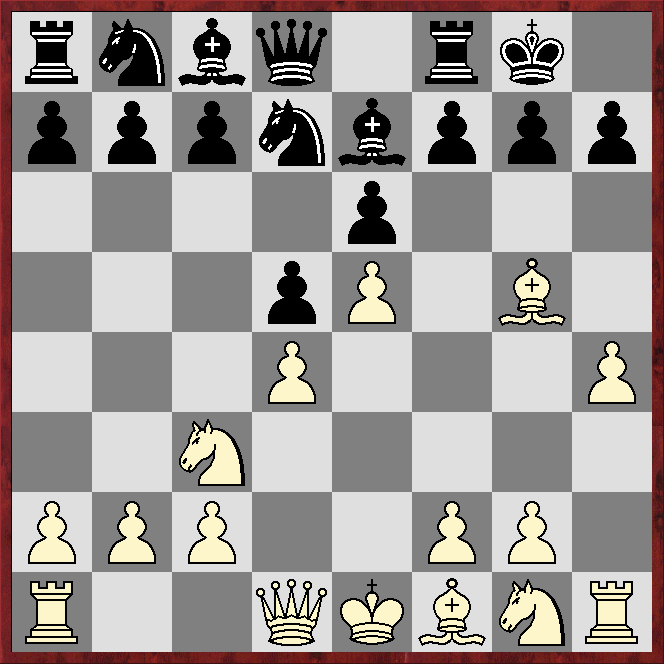
The opening can be thought to have ended and the middlegame begun as one side has connected rooks - how would you assess the position?
*****
*****
*****
*****
*****
White has a substantial lead in development and more space in the centre, but the position is closed and Black has obvious counterplay on the queenside. The inclusion of opposite-side castling adds to the difficulty of being sure of any evaluation, but Stockfish15 gives White the upper hand, while Komodo13.02 reckons White has a slight edge.
CONCLUSION: the Alekhine-Chatard Attack is a sharp system in which Black is under early pressure. The conflicting assessments of the engines are various points is testament to how complicated play can be.

Thursday, 14 July 2022

Summing Up South Wales

MY score of +3=3-3 saw me gain 12.8 Fide elo. I also won a share of the veterans' prize, along with Rudy van Kemenade, David Robinson and Roger de Coverly, and should receive £37.50.
There are pix of the tournament in progress, illustrating the great playing conditions, at SW.

South Wales Round Nine

MY game from the last round.

Spanton (1889) - David Robinson (1857)
Veresov
1.d4 d5 2.Nc3 Nf6 3.Bg5 Bf5 4.e3 e6 5.Bd3 Bxd3 6.cxd3!?
Going for speedy development with 6.Qxd3 was preferred in David Bronstein - Robert Fischer, Mar del Plata (Argentina) 1960. That game continued 6...c5 7.Bxf6!? gxf6!? 8.dxc5!? Nd7!? 9.e4 dxe4 10.Qxe4?! Nc5 11.Qf3 Bg7, when Stockfish15 and Komodo13.02 slightly prefer Black (½–½, 65 moves).
6...c6 7.Nf3 Nbd7 8.Ne5!?
After 8.0-0 Black can prevent Ne5 with 8...Bd6 but then 9.e4 is slightly better for White, according to the engines.
8...Be7 9.0-0 0-0 10.f4 Ne8 11.Qh5!?
This ultimately leads to nothing special for White. The engines prefer 11.Bxe7, which Komodo13.02 reckons gives a slight edge although Stockfish15 calls the position equal.
11...f6 12.Nxd7 Qxd7 13.Bh4 f5 14.Na4
Switching to queenside play.
14...Nf6 15.Qe2 Qc7 16.Rfc1 Qa5 17.Qc2 Bd6 18.Bxf6!?
Misplacing the black king's rook for the coming queenside play, but it turns out Black does not need this rook on the queenside.
18...Rxf6 19.a3 Qc7 20.b4 a6 21.Rab1
How should Black respond?
*****
*****
*****
*****
*****
21...g5!
This gives Black strong kingside counterplay, diverting White's forces from the queenside.
22.g3 Rg6 23.Kh1 Kh8 24.Rg1 Rag8 25.Qf2 Qg7 26.Nc5 h5?!
Black may have a slight edge after 26...Qf7, according to Stockfish15, although Komdo13.02 disagrees.
27.fxg5 Bxc5 28.bxc5 Rxg5 29.Rbf1
The engines reckon White is slightly better after 29.Qf4.
29...Rg4 30.Rb1 Qc7 31.Qb2 R4g7 32.Rbf1 Kh7 33.Rf4 Qa5?!
Moving the queen out of contact with the kingside is probably a mistake.
How should White proceed?
*****
*****
*****
*****
*****
34.Qb4
34.Rh4 Kh6 35.e4!? gives strong play, eg 35...dxe4 36.dxe4 Qd8 37.Qd2+ Rg5 38.Re1, when the black king is clearly the more endangered.
After the text DR offered a draw and played:
34...Qxb4
I played on but the position is dead-equal and remained so (½–½, 48 moves).

Wednesday, 13 July 2022

South Wales Round Eight

WAS upfloated in my second game of the third double-round day.

Dominic Gibbs (1873) - Spanton (1989)
Spanish Berlin
1.e4 e5 2.Nf3 Nc6 3.Bb5 Nf6 4.Qe2!?
Other moves are more popular but the text was pioneered by Howard Staunton and has been recommended in at least one popular repertoire book.
4...Bc5 5.c3
5.Bxc6!? has been tried by strong players. After 5...dxc6?! 6.Nxe5 Qe7 (or 6...Qd4) White has 7.Nd3, keeping the extra pawn as 7...Nxe4? runs into 8.f3. Better is 5...bxc6, when 6.Nxe5 Qe7 7.Nd3 can be met by 7...Ba6 with more than enough compensation for a pawn.
5...d6
The mainline in ChessBase's 2022 Mega database goes 5...0-0 6.0-0 Re8 7.d3 h6 with an equal position, according to Stockfish15 and Komodo13.02.
6.0-0
The engines reckon White has a slight edge after 6.d4!? exd4 7.cxd4 Bb4+ 8.Bd2.
6...0-0 7.a4!?
There are only two examples of this move in Mega22 but it is liked by the engines. Normal is 7.Rd1.
7...a6 8.Bc4
This position usually arises with White to move after being reached from a Giuoco Piano move-order
*****
*****
*****
*****
*****
8...Be6 9.Bxe6 fxe6 10.b4 Ba7 11.d3 Qe8 12.Be3 Qh5!?
I felt 12...Bxe3 13.fxe3 led to a too-drawish position, but the engines prefer it to the text.
13.Bxa7 Rxa7 14.Nbd2
DG offered a draw.
How should Black respond?
*****
*****
*****
*****
*****
White has more space on the queenside and the black queen's rook is awkwardly placed, but Black has pressure against the white kingside. Stockfish15 reckons the position is equal but Komodo13.02 gives White a slight edge. Clearly the position is very playable for Black, but ...
14...g5?!
... is too ambitious, according to the engines.
15.b5 axb5 16.axb5 Rxa1 17.Rxa1 Nd8 18.Nf1 g4 19.Ne1 Qg6 20.f3!?
The engines prefer counterplay with 20.Ra8 or 20.Ra7.
20...gxf3!?
Komodo13.02 likes 20...h5 but Stockfish15 prefers the text. 
21.Nxf3 Nh5 22.Ne3
22.Kh1 or 22.N1d2 may be better.
22...Nf4 23.Qf1
How should Black proceed?
*****
*****
*****
*****
*****
23...Nxd3!?
This wins a pawn but the engines prefer 23...Nf7!? or 23...d5 as after ...
24.Qxd3 Rxf3
... White has 25.b6!, when 25...cxb6 (best) 26.Qxd6 is at least equal.
The game saw:
25.Ra4?! Qg5 26.Ra8!
The only move to keep the game going.
26...Rf8 27.h3 h5 28.Nc2?!
Probably better is the engines' 28.Nf1.
28...Qc1+ 29.Kh2 Qf4+ 30.Qg3 Kh7?!
Almost certainly better is 30...Kf7, unpinning the black knight.
31.Qxf4 exf4 32.Nd4?!
The engines reckon 32.Rc8 equalises.
32...e5 33.b6!? c6?!
Black has an advantage after 33...cxb6.
How should White respond?
*****
*****
*****
*****
*****
34.Nxc6! bxc6!?
Stockfish15 agrees with sacrificing the exchange but Komodo13.02 prefers going a pawn down after 34...Ne6 35.Rxf8 Nxf8 36.Nd8 Nd7 37.Nxb7 Nxb6 38,Nxd6, when Black seems to have good drawing chances.
35.b7 Nxb7 36.Rxf8 Nc5 37.Rc8 Nxe4 38.Rxc6
Black's extra pawn and active king give decent compensation for the exchange
*****
*****
*****
*****
*****
38...Kg6 39.Rc8 Kf5 40.Kg1 Ng3 41.c4 Ke4 42.c5 dxc5 43.Rxc5 Kd4 44.Rc8 e4 45.Kf2 Nh1+ 46.Ke1 Ke3 47.Rc3+ Kd4 48.Rc8 Kd3 49.Ra8 Ng3 ½–½

Monday, 11 July 2022

South Wales Round Seven

FACED a titled player today.
War memorial? No, it is a drinking fountain erected after the death in 1859 of John Randall, much-praised manager of the nearby Dunraven Estate

Spanton (1889) - John R Richardson (FM 2289)
Caro-Kann Tartakower
1.e4 c6 2.d4 d5 3.Nc3 dxe4 4.Nxe4 Nf6 5.Nxf6+ exf6 6.c3 Bd6 7.Bd3 0-0 8.Ne2 Re8 9.0-0 Nd7 10.Ng3
The mainline in ChessBase's 2022 Mega database runs 10.Bf4 Nf8 11.Bxd6 Qxd6 12.Ng3 with a position Stockfish15 and Komodo13.02 reckon is equal.
10...g6 11.Qf3 Nb6 12.Ne4 Be7 13.Re1 Be6 14.Bd2 f5 15.Ng3 a5 16.Rad1!? a4
Not 16...Bxa2 as 17.Nxf5! gives White a large advantage, the point being 17...gxf5?? 18.Qxf5 leads to mate in three.
17.Bc2 Bf8 18.Bb1?!
Probably better is 18.b3 axb3 19.Bxb3!?, although the engines slightly prefer Black.
18...Qd5!?
With a compromised kingside pawn-majority, Black would not normally want to exchange queens. But White's queen is active, and Black has hopes of pressurising the white queenside with minor pieces and the queen's rook.
19.Qxd5 Bxd5 20.Ne2?!
The knight has better prospects after 20.Nf1, as after the text play runs ...
20...Nc4 21.Bc1 Bd6
... and it is possible White's best now is 22.Ng3!?
22.b3 axb3 23.axb3 Na3 24.Bxa3 Bxa3?!
This seems to throw away most of Black's advantage. After 24...Rxa3 25.c4 Be6 Black is positionally winning, according to the engines.
25.Bd3!? Bb2
25...Bxb3 26.Rb1.
26.c4 Be4
How should White proceed?
*****
*****
*****
*****
*****
27.f3?
Both 27.Bxe4 and 27.Kf1 equalise, according to the engines.
27...Bxd3 28.Rxd3 Ba3 29.Kf1 Bb4 30.Nc3!?
Giving up a pawn, but the engines agree it is preferable to 30.Red1 Ra2, eg 31.Ng3 h5 32.h4 Bd6, or 31.Nc1 Rc2 32.d5 (best, according to the engines) Kg7 33.d6 Bc5! 34.R3d2 Rxd2 35.Rxd2 Rd8 etc.
30...Rxe1+ 31.Kxe1 Ra2 32.Kf1 Bxc3 33.Rxc3 Rd2 34.h3?
Better is 34.d5 cxd5 35.Ke1! (this gives more drawing chances than 35.cxd5, according to the engines), eg 35...Rd4 36.Ke2 dxc4 37.bxc4, which is dead-equal, according to Stockfish15, although Komodo13.02 gives Black a slight edge. If 35...Rxg2 then 36.cxd5 gives strong counterplay.
34...Kg7 35.d5 cxd5 36.cxd5 Rxd5 37.Ke2 g5?!
The engines do not like this, preferring to improve the pieces first, eg 37...Rd4 or 37...Kf6.
38.Re3?!
White should take the chance to gain kingside space with 38.h4!? or 38.f4!?, according to the engines, one point being capturing the attacking pawn is met by 39.Rc4, after which the sacrificed pawn is recovered and Black's kingside is smashed, eg 38.h4!? gxh4 39.Rc4 Rb5 40.b4. However the engines reckon Black remains better if he avoids capturing, eg 38.h4!? h6.
38...Kf6 39.Rc3 Ke5?
Black cannot afford to leave the seventh rank undefended. The engines reckon 39...Rd4 and 39...Rb5 maintain a large advantage.
40.Ke3?
Missing the opportunity. After 40.Rc7 Rb5 41.Rxf7 White has equalised, according to Stockfish15, although Komodo13.02 gives Black a slight edge.
40...f4+ 41.Ke2 h6 42.Rc7 Rb5 43.Rc3
It is too late for a rook raid, eg 43.Rxf7 Rxb3 44.Rh7 Rb6!? leaves Black well on top.
43...Kd4 44.Kd2 Ra5 45.Rc4+ Kd5 46.Kc3
How should Black proceed?
*****
*****
*****
*****
*****
46...Ra2
This wins, but so does the pawn ending, although it is harder to calculate, eg 46...Rc5 47.Kd3 Rxc4 48.bxc4+ Kc5 49.Kc3 b6 50.Kd3 Kb4 51.Kd4 f6 52.Kd3 Kb3 53.Kd4 Kc2! 54.c5 (54.Kd5 Kd3 etc) bxc5+ 55.Kxc5 Kd2 56.Kd4 Ke2 etc.
47.Rd4+ Ke5 48.Re4+ Kf6 49.Rb4 Rxg2 50.Rxb7 Rxg3 51.Rb6+ Kg7 52.b4 Rxf3+ 53.Kc4 Rxh3 (0-1, 59 moves).

South Wales Round Six

WAS downfloated yesterday evening.
Bridgend's Old Bridge, parts of which go back to the early 1400s

Roger de Coverly (1914) - Spanton (1889)
QGD Dutch Gambit
1.d4 d5 2.c4 e6 3.Nc3 Nf6 4.Bg5 c5!? 5.cxd5 cxd4
5...Qb6!? is the Peruvian Gambit.
6.Qa4+!?
This has been played by grandmasters but the mainline in ChessBase's 2022 Mega database runs 6.Qxd4 Be7 7.e4 Nc6 8.Qd2, when almost equally popular are 8...Nxe4!?, 8...Nxd5!? and 8...exd5.
6...Qd7
6...Bxd7? 7.Qxd4 costs Black a pawn.
7.Qxd4
White loses a piece after 7.dxe6? Qxa4 8.exf7+ Kxf7 9.Nxa4 b5. 
7...Nc6 8.Qd1!?
The main move in Mega22 is 8.Qd2 but Stockfish15 for quite some time prefers the text, before switching to 8.Qh4 or 8.Qd3. Komodo13.02 at first likes 8.Qd2 but later switches to 8.Qh4 or 8.Qa4.
8...Nxd5 9.Nxd5 Qxd5 10.Qxd5 exd5
How would you assess this queenless middlegame?
*****
*****
*****
*****
*****
Black has an isolated queen's pawn but has easy development for the pieces. The engines reckon the position is equal.
11.0-0-0?!
This leads to sharp play that probably favours Black.
11...Be6
I tried to make 11...Nb4 12.a3 Bf5!? work. After 13.axb4 Rc8+ 14.Kd2 Bxb4+ 15.Ke3 Black, for a knight, has a pawn, a large lead in development and the safer king. Komodo13.02 reckons that is enough for at least equal chances, while Stockfish15 gives Black the upper hand. However even better may be the engines' 11...Bf5!?, eg 12.Rxd5 Be4 13.Rd2 Rc8 with a ferocious attack.
12.e3 Rc8 13.Bb5?!
Probably better is sidestepping with 13.Kb1, when the engines reckon Black is slightly better.
13...Be7!?
Speeding development but allowing Black's good bishop to be exchanged. The engines prefer going after the white dark-square bishop with 13...f6 or 13...h5!? and then challenging the white light-square bishop with ...a6.
14.Bxe7 Kxe7 15.Bxc6?
Better is again sidestepping, 15.Kb1, and if 15...Nb4 then simply 16.a3, while 15...Bf5+ is neutralised by 16.Bd3.
15...Rxc6+ 16.Kb1 Rhc8?
This 'automatic' move throws away most of Black's advantage, whereas 16...Bf5+ 17.Ka1 Rc2 gives Black at least the upper hand.
17.Ne2
Now White can hold along the second rank.
17...Rc2 18.Rhe1 Bf5 19.Ka1
As RdC pointed out in the postmortem, 19.Nd4?? loses instantly to 19...Rc1#, as does 19.Rxd4??.
How should Black proceed?
*****
*****
*****
*****
*****
19...Be6
The engines give 19...d4!?, and if 20.exd4 then 20...Kd7, threatening 21...Re8.
20.f3 g5 21.g4 h6 22.Kb1 R2c4 23.a3 a5 24.Nd4
This will prove a great outpost for the knight for the rest of the game.
24...Rb8 25.Rc1 Rc8 26.b3 Rxc1+ 27.Rxc1 Rxc1+ 28.Kxc1
How would you assess this minor-piece ending?
*****
*****
*****
*****
*****
White has a good knight and Black a semi-bad bishop (only the d pawn cannot occupy a dark square). Black also has an IQP, but it will be difficult for the white king to cross the halfway line, and the engines reckon the ending is equal.
28...Kd6 29.Kd2 Ke5 30.Kc3 Bd7 31.a4!?
Putting white pawns on light squares restricts the black bishop but creates potential targets. The engines are OK with the move, and certainly 31.b4 axb4+ 32.Kxb4 b6 leaves the white king in its own side of the board.
31...b6 32.h3!? f6 33.Ne2!? b5 34.axb5 Bxb5 35.Nd4 Bd7 36.Kd3
The white king can advance after 36.b4 axb4+ 37.Kxb4 but the position remains dead-equal, according to the engines.
36...Kd6 37.f4 Kc5 38.Kc3 Bc8 39.fxg5
Not 39.f5? as Black has 39...Ba6 followed by ...Bf1 etc.
39...hxg5 40.Kd2 Bd7 41.Kc3 Bc8
RdC offered a draw as he played ...
42.Kd2
... but I felt it was worth playing on to see what the bishop could achieve.
42...Ba6 43.Ke1 Bd3 44.Kf2 Kd6 45.Kg3 Bg6 46.h4 gxh4+ 47.Kxh4 Ke5 48.Kg3
The engines reckon also dead-equal is 48.Nc6+!? Ke4 49.Nxa5 Kxe3, although it is probably easier for Black to play.
48...Ke4 49.Kf2 Be8 50.Ne6 Kd3
Not 50...Bd7?? 51.Nc5+.
51.Kf3 Kc3 52.Nd4 Bg6 53.Nc6 Kxb3 ½–½

Saturday, 9 July 2022

South Wales Round Five

THIS is my evening game from today's double-round day.
Popular with chess players?

Spanton (1889) - Paul Bridges (1754)
Sicilian ...e6
1.e4 c5 2.Nf3 e6 3.g3!?
There are many more-popular moves but Fischer, Kasparov and Carlsen are among those who have tried the text, so who cares if engines are unimpressed?
3...Nc6 4.Bg2 d6 5.0-0 Nf6 6.Qe2
The mainline in ChessBase's 2022 Mega database runs 6.Re1 Be7 7.c3 0-0 8.d4 cxd4 9.cxd4, which Stockfish15 and Komodo13.02 reckon slightly favours White.
6...Qc7!?
The engines prefer 6...Be7 - there are 600 examples of the move in Mega22.
7.c3 e5
How should White proceed?
*****
*****
*****
*****
*****
8.d4!?
There is one example of this positional pawn sac in Mega 22;  the engines like 8.Na3.
8...exd4
Qingyu Yuan (2373) - Nodirbek Abdusattorov (2627),  Chess.com Blitz 2021, saw 8...cxd4 9.cxd4 exd4 10.Na3 Be7 11.Nb5 Qb6 12.Rd1, when 12...Bg4 would have given Black a good game. Abdusattorov played the inferior 12...0-0?, but won anyway.
9.cxd4 Be7?!
Black almost certainly has to play 9...cxd4, transposing to the above-mentioned game. After the text White gets a strong initiative.
10.dxc5
The engines reckon 10.d5 is even stronger, but arguably it is a matter of taste.
10...dxc5 11.Bf4 Qb6 12.Nc3 0-0
The engines prefer 12...Be6 but reckon White is winning (Stockfish15) or at least has the upper hand (Komodo13.02) after 13.Rad1.
13.Nd5 Qa5
Black loses a piece after 13...Nxd5?? 14.exd5.
14.Rfd1
Possibly even stronger is 14.Bc7, eg 14...Qa4 15.b3 Qa3 (15...Qxe4?? 16.Nxf6+ etc)  16.Nxe7+ Nxe7 17.Bd6 Re8 18.Qc2.
14...Bd8 15.Bd2 Qa4 16.b3 Qa3
16...Qxe4?? loses the queen thanks to 17.Nxf6+.
17.Bc3 Nd7
Avoiding a smashed kingside.
18.Ne1!? Nde5
The engines prefer giving up a pawn by 18...Nd4, but agree White is winning.
19.Nc2 Qa6 20.Qxa6 bxc6
There is no longer any question of a white mating attack, but White retains a large advantage
*****
*****
*****
*****
*****
21.Nce3 f6 22.f4 Ng6 23.Nc4 Rb8 24.Rac1 Bb6 25.h4 Nge7 26.Kh2!?
The engines reckon there is no need for this safety-first move, but it reduces the odds of accidents.
26...Nxd5!?
The engines at first slightly prefer 26...Be6, although Komodo13.02 comes to favour the text.
27.cxd5 Nd8 28.Re1 Nf7 29.d6 Rd8
How should White continue?
*****
*****
*****
*****
*****
30.Re7?
This throws away most of White's advantage. Obvious and good is 30.Rcd1.
*****
*****
*****
*****
*****
30....Kf8?
Correct is 30...Nxd6, when 31.Bd5+ can be met by 31...Kf8. Best may be 31.Nxd6, eg 31...Rxd6 32.Re8+ Kf7 33.Rce1, but Black defends with 33...Bd8.
31.Rce1 Nxd6 32.Nxd6 Rxd6 33.Re8+ Kf7 34.h5!?
I thought this led to a mating net, and I was more-or-less right, but simplest is 34.R1e7+ Kg6 35.Rg8 etc.
How should Black respond?
*****
*****
*****
*****
*****
34...Re6
The engines agree with my calculations that Black's objectively best chance is 34...Bd8, when I intended 35.Ba5!?, eg 35...Bb7 (35...Bxa5 36.R1e7#) 36.Bxd8 Rbxd8 37.R1e7#.
*****
*****
*****
*****
*****
35.Bc6??
White has a simple win with 35.R1xe6 Bxe6 36.Rxb8.
35...Rxe1 36.Rxe1 Bg4?!
PB offered a draw in my time.
The text looks aggressive, but 36...Bb7 is a better way to achieve a draw, although I intended to play on with 37.Bd7.
37.Bd5+ Kf8 38.h6
*****
*****
*****
*****
*****
38...Re8??
In the postmortem PB suggested 38...Rd8, but White still has at least a slight edge after 39.hxg7+ Kxg7 40.Re7+.
39.hxg7+ 1-0

South Wales Round Four

PLAYED today.
The short arm of the law

Hugh Murphy (2125) - Spanton (1889)
Colle
1.d4 d5 2.Nf3 Nc6 3.e3 Bg4 4.Bb5!?
The commonest move in ChessBase's 2022 Mega database is 4.Be2, but Stockfish15 and Komodo13.02 prefer the text and 4.c4!?
4...e6 5.c4 a6?
This loses a pawn. Better is 5...Ne7 or 5...Qd7!?
6.Bxc6+ bxc6 7.Qa4 Ne7 8.Ne5 Bh5 9.Nc3
Not 9.Nxc6?? Qd7.
9...f6 10.Nxc6 Qd7 11.Nxe7 Qxa4 12.Nxa4 Bxe7 13.cxd5 exd5
White has an extra pawn and the better pawn-structure - Black's bishop-pair does not give enough compensation
*****
*****
*****
*****
*****
14.Bd2 0-0 15.Rc1 Rfc8 16.Ba5 Be8 17.Nc3 c6 18.Na4!? Rcb8 19.b3 Rb5 20.Bb6 Rb8 21.Bc5 Bd8 22.0-0 Bc7 23.Nc3 R5b7 24.Ba3 Kf7 25.Rc2 Kg8!?
To make 26...Bg6 possible. If 25...Ke6?! White has a choice of strong moves, including 26.e4.
26.Rfc1
But now 26.e4?! is answered by 26...Bg6.
26...Bg6 27.Rb2 Be8 28.Na4 Bb6 29.Bd6 Rd8?
Better is 29...Rc8 or 29...Ra8.
How should White proceed?
*****
*****
*****
*****
*****
30.Nxb6
Eliminating the bishop-pair and the possibility of an opposite-coloured bishop ending.
30...Rxd6
Not 30...Rxb6? 31.Bc7 etc, but the text leaves Black with a bad bishop versus a good knight and little prospect of counterplay.
The game continued:
31.Na4 a5 32.Rbc2 Kf7 33.Kf1 Rd8 34.Ke1 Ke7 35.Rc5 Ra8 36.Kd2 Kd6 37.f3 Re7 38.Nc3 Bg6 39.Ne2 Ra6 40.Nc3 Ra8 41.Re1 Ra6 42.e4 dxe4 43.fxe4 Ra8 44.Kd3 Ra6 45.Ke3 Ra8 46.Kf4 Ra6 47.Na4 Bf7 48.Nb2 Bg8 49.Rec1 Bf7 50.Kf3 Bg8 51.Nd3 Be6 52.R5c3 Rb6 53.Kf2 a4?!
At last a hint of counterplay, but the result is a worsening of Black's position and a quick finish.
54.bxa4 Bxa2 55.a5 Ra6 56.Nb4 Rxa5 57.Nxc6 1-0

Friday, 8 July 2022

South Wales Round Three

PLAYED this evening.
St Illtyd's Church seen through the gateway of Bridgend's Newcastle

Spanton (1889) - Alex Bullen (2106)
Caro-Kann Classical
1.e4 c6 2.d4 d5 3.Nc3 dxe4 4.Nxe4 Bf5 5.Ng3 Bg6 6.Nf3 Nd7 7.h4 h6 8.h5 Bh7 9.Bd3 Ngf6!?
This has been played by grandmasters but the mainline in ChessBase's 2022 Mega database runs 9...Bxd3 10.Qxd3 e6 11.Bd2 Ngf6 12.0-0-0 Be7, which Stockfish15 and Komodo13.02 reckon gives equal play.
10.Bxh7 Nxh7 11.Bf4
11.Qd3!? and especially 11.Qe2 are popular alternatives, the former offering the chance to return to the mainlines after 11...Nhf6.
11...e6 12.Ne4!?
The engines reckon White is slightly better after 12.Qe2 or 12.0-0.
12...Ndf6 13.Qe2
Not 13.Nc5? Bxc5 14.dxc5 Qa5+ and 15...Qxc5.
13...Nxe4 14.Qxe4 Nf6 15.Qe2 Bb4+!?
Weakening the white queenside in anticipation of White castling long.
16.c3 Be7 17.Ne5 Nd5
Gevorg Harutjunyan (2417) - Alexandr Kharitonov (2523), Ilyumzhinov Cup (internet) 2006, saw 17...0-0 18.0-0-0 Qd5 19.Kb1 Qe4+ 20.Qxe4 Nxe4 21.Nd3 with a slight edge for White, according to the engines (1-0, 52 moves).
18.Bd2 a5 19.a3
Preparing c4, but Komodo13.02 wants the immediate 19.c4, and if 19...Nb4 then 20.0-0 or 20.Bc3.
19...Bg5 20.Rd1
The engines prefer 20.0-0-0!?
20...Bxd2+ 21.Rxd2 0-0 22.c4 Nb6!?
The engines prefer 22...Nf6 or 22...Ne7.
23.Rh3 Nd7 24.Rg3
How should Black defend against White's kimgside pressure?
*****
*****
*****
*****
*****
24...f5?!
Probably better is 24...Nf6, the point being 25.Ng4 can be met by 25...Nxg4 (not 25...Nxh5? 26.Nxh6+ Kh7 27.Qxh5 gxh6 28.Rdd3 with a winning attack) 26.Qxg4 Qf6 27.Rdd3 R(either)d8 with equality.
25.Nxd7?!
Almost certainly better is 25.Ng6 Re8 26.Re3.
25...Qxd7 26.Rg6 Rae8
How should White proceed?
*****
*****
*****
*****
*****
27.Qe5?!
This allows dangerous counterplay, whereas 27.f4 ties Black down, albeit Black is holding, according to the engines.
27...f4 28.Qe4!?
Not 28.Qxa5? Rf5 29.Qc3 Rxh5 as Black gets a strong attack.
28...Rf5 29.Rg4?!
Probably better is 29.f3 or 29.Re2.
29...e5
Possibly stronger is 29...f3!? 30.gxf3 Rxh5.
30.d5 Rxh5 31.f3?
The engines reckon 31.Rg6 gives enough compensation for the pawn.
31...Rd8?
Black has a large advantage, according to the engines, after 31...Rh1+, eg 32.Ke2 g5 or 32.Kf2 Qd6.
32.Rg6 Qe7 33.dxc6 Rh1+ 34.Ke2 Rxd2+ 35.Kxd2 bxc6 36.Rxc6 Qd7+
How should White respond?
*****
*****
*****
*****
*****
37.Qd5+
Immediately losing is 37.Kc3?? Rc1+ 38.Kb3 Qd1+ 39.Ka2 Ra1#, while 37.Kc2? Qd1+ 38.Kc3 Qc1+ 39.Kb3 (39.Qc2?? Qe3+ 40.Qc3 Rc1+ etc) Qe3+ 40.Ka4 (best) Qxe4 41.fxe4 Rg1 gives Black a better rook-and-pawn ending than in the game.
37...Qxd5+ 38.cxd5 Rg1 39.Kd3 Rxg2 40.b4 axb4 41.axb4 Rb2
What should White play?
*****
*****
*****
*****
*****
42.Ke4!
This seems the best try as both 42.Kc4 e4 43.fxe4 f3 44.Kd3 f2 45.Rc1 and 42.Kc3 Rf2 43.b5 Rxf3+ are dead-equal, according to the engines.
Black to play and draw (probably)
*****
*****
*****
*****
*****
42...Rxb4+?
This loses whereas 42...Re2+ 43.Kf5 e4 seems to hold, eg 44.fxe4 f3 45.Rc1 f2 46.Rf1 g5!, or 44.d6!? Kf7 45.Rc7+ Kf8 46.Re7+ Kd8 47.Rxe4 g6+!? 48.Kxf4 Rb2, although neither line is simple to see over-the-board.
43.Kxe5?
This may look natural but it allows Black to draw. Winning is 43.Kf5, after which the d pawn races through to queen, helped by the white king using the e pawn as a shield from checks. If 43...Kf7 then 44.Rc7+ is very strong.
43...Rb8?
Passive. The rook should stay active, so the engines reckon most moves along the b file are good enough, but easiest is 43...Rb3, eg 44.d6 Kf7 45.d7 Re3+ 46.Kxf4 Rd3 etc. Indeed White could carelessly lose in this line, ie 46.Kd6?! Rd3+ 47.Kc7?? (47.Ke5 probably holds) Ke7 etc. Another try after 43...Rb3 is 44.Kxf4 but simply 44...Kf7 is dead-equal.
White to play and win
*****
*****
*****
*****
*****
44.d6
Other moves draw, but now the position is hopeless for Black.
44..Re8+ 45.Kd5 Kf7 46.d7 Re3 47.Rd6 Rd3+ 48.Ke5 1-0

South Wales Round Two

THIS is my second game from yesterday's double-round.

Alistair Hill (2190) - Spanton (1889)
Pseudo-Chigorin
1.Nf3 Nc6 2.d4 d5 3.g3 Bg4 4.Bg2 Qd7 5.0-0!?
More popular is 5.h3 to avoid ...Bh3, but Stockfish15 and Komodo13.02 prefer the text.
How should Black proceed?
*****
*****
*****
*****
*****
5...h5!?
The mainline runs 5...0-0-0 6.c3 (6.c4 is also common) f6 7.b4 with advantage to White, according to the engines, which reckon 5...Bh3 6.c4 Bxg2 7.Kxg2 e6 also favours White.
6.c4 Bxf3?!
This may be a novelty. Known moves are 6...e6 and 6...e5?, while 6...dxc4 7.d5 0-0-0?! 8.Nc3 strongly favours White, according to the engines.
7.Bxf3 h4?
Better is 7...dxc4, and if 8.d5 then 8...Ne5.
8.cxd5 Nb4
I had originally intended 8...hxg3 9.hxg3 Qh3, missing the simple 10.Re1, and also missing that White could play 9.fxg3 Qh3 10.Rf2.
9.Qb3 e6 10.dxe6 fxe6 11.Bd2 Nd5?
As AH pointed out in the postmortem, better is 11...a5, meeting 12.a3 with 12...a4.
12.Qxb7
Preventing long castling as well as grabbing a pawn.
12...Rd8 13.Nc3 hxg3 14.hxg3 Ngf6 15.Bg5 Be7 16.e4 Nxc3 17.bxc3 e5 18.Bg2
The engines point out also possible is 18.dxe5 as 18...Qh3 19.Rfd1 Ng4 can be met by 20.Qc6+ Kf7 21.Qc4+ Ke8 22.Rxd8+ Bxd8 23.Qe6+ Kf8 24.Bg2 Qh2+ 25.Kf1 Bxg5 26.Rb1. If in this line 21...Kg6 then 22.Qe6+, eg 22...Kxg5 23.Qf5+ Kh6 24.Bxg4.
18...0-0 19.dxe5 Ng4 20.Qb3+ Kh8 21.Rad1 Qe8 22.Rxd8 Bxd8 23.Bxd8 Qxd8 24.Qe6
White has a massive advantage.
The game finished:
24...Nxf2 25.Rxf2 Qd1+ 26.Bf1 Rxf2 27.Rxf2 1-0

Thursday, 7 July 2022

South Wales Round One

FACED an unrated in the first round today.

Spanton (1889) - Luke Jones
French Alekhine-Chatard.
1.e4 e6 2.d4 d5 3.Nc3 Nf6 4.Bg5 Be7 5.e5 Nfd7 6.h4!?
This pawn offer scores an excellent 61% in ChessBase's 2022 Mega database, while the main move, 6.Bxe7, scores a still-very-good 59%.
Black has a huge choice of replies
*****
*****
*****
*****
*****
6...0-0!?
Most popular in Mega22 is 6...a6 7.Qg4 Bxg5 8.hxg5 c5, although Stockfish15 and Komodo13.02 reckon White is better. Second-most popular in Mega22 is accepting the sacrifice with 6...Bxg5 7.hxg5 Qxg5, when 8.Nh3 Qh4!? 9.g3 Qe7 10.Qg4 is roughly equal, according to the engines.
The text looks like a case of castling into it but is reasonably popular and has been tried by strong grandmasters. Part of the thinking behind the move is that the black king is unlikely to make it to the queenside so might as well try to find safety on the kingside while making Black's pieces a little easier to coordinate.
7.Qg4
Somewhat more popular is 7.Bd3, which is preferred by Stockfish15 although not by Komodo13.02.
7...Kh8!?
The commonest move in Mega22 is 7...f5, when the engines reckon 8.Bxe7!? Qxe7 9.Qg5 is good for White.
8.Nf3 c5 9.Bd3 f5
On 9...c4 I planned 10.Bxh7! Kxh7 111.Bxe7 Qxe7 12.Qh5+ with mate to follow.
How should White proceed?
*****
*****
*****
*****
*****
10.Qf4!?
Three of six games in Mega22, including ones featuring white players rated 2424 and 2330, saw 10.exf6?!, but the engines agree Black is fine after 10...Nxf6. Stockfish15, but not Komodo13.02, prefers  over the text10.Qh5!?, which does not appear in Mega22.
10...Nc6 11.0-0-0
Herman van Riemsdijk (2420) - Alfeu Bueno (2200), Festa da Uva Rapid (Caxias do Sul, Brazil) 2010, saw 11.g4? cxd4 12.Nxd4 Ndxe5 13.Nxc6 Nxd3+ 14.cxd3 bxc6 (0-1, 40 moves).
11...a6 12.dxc5!? Nxc5 13.Kb1?!
White keeps a slight edge after 13.Ne2 or 13...Bxe7, according to the engines.
13...Nxd3+?!
Probably better is the engines' 13...Ne4, which they reckon gives Black a slight edge. The text gains the bishop-pair, but Black cannot keep it as White can exchange dark-square bishops at will.
14.Rxd3 Rb8 15.Nd4 Nxd4!?
This is the engines' choice, ahead of 15...Bd7, but now Black faces the prospect of a bad bishop-v-good knight middlegame and ending.
16.Rxd4 Qc7 17.Bxe7 Qxe7 18.Ne2
Both d4 and f4 are good squares for the knight.
18...Bd7 19.Qe3 Qc5 20.Nf4
The engines reckon 20.c4!? is even stronger, thanks to the pin on the d pawn.
20...Rbc8 21.c3
Again the engines prefer c4!?
21...a5?
Missing White's threat. Possibly best is 21...Qe7, although White has the upper hand, according to the engines.
22.h5 b5
Black can prevent the coming fork with 22...Kg8!? but both 23.c4!? and 23.h6 are strong.
23.Ng6+! hxg6?
Disastrous, but 23...Kg8 24.Nxf8 also wins for White.
24.hxg6+ Kg8 25.Qh3 1-0