.jpg) |
| Teplice (Czechia), Cracovia (Kraków) and Tegernsee (Bavaria) |
Showing posts with label Tegernsee. Show all posts
Showing posts with label Tegernsee. Show all posts
Tuesday, 6 January 2026
My Burgeoning Collection Of Chess Fridge-Magnets

Monday, 29 April 2024
Winning Chess
THE Tegernsee Senioren Cup was won by the top seed, Austrian international master Harald Schneider-Zinner (2335).
*****
*****
*****
*****
*****
His score of +6=3-0 meant he finished a half-point ahead of the field of 181 players.
Perhaps his most important win came in round eight, with black against then joint-leader Gottfried Schumacher (2102), a German Fide master.
Schumacher (2102) - Schneider-Zinner (2335)
Queen's Gambit Declined
1.d4 Nf6 2.Nf3 d5 3.c4 e6 4.Nc3 Be7 5.e3
 |
| The somewhat passive, or at least slow, 5.e3 is probably the oldest continuation in the position, dating back to 1881 in ChessBase's 2024 Mega database |
*****
*****
*****
*****
Seven years were to pass before Johannes Zukertort introduced 5.Bf4 in a loss to Amos Burn at the British Chess Association congress in London.
And another four years passed before Salomon (aka Samuel) Lipschütz played 5.Bg5 in a draw against Jackson Showalter in their match for the US championship.
5...0-0 6.Bd3 dxc4 7.Bxc4 a6
Black plans to both expand on the queenside with ...b5, in the process gaining a tempo on White's light-square bishop, and to pressure the white centre with ...c5 and ...Bb7.
 |
| How should White meet this plan? |
*****
*****
*****
*****
8.a3
The stem game, Abram Rabinovich - Dawid Janowski, Prague 1908, saw White prevent Black's expansion with 8.a4, the game continuing 8...c5 9.0-0 Nc6 10.dxc5 Bxc5 11.Qe2 Qc7 12.e4 Ng4!? with a slight edge for Black, according to Stockfish16 and Komodo14.1 (0-1, 37 moves).
Most popular in Mega24 is 8.0-0, reaching a position Hikaru Nakamura played with white in at least three online blitz games in 2020, winning all three. A typical continuation runs 8...b5 9.Bd3 Bb7, when most popular in Mega24 is 10.a3, but Nakamura (2763) preferred 10.Qe2!? in his blitz win over Sanan Sjugirov (2663).
8...c5 9.0-0 b5 10.Be2!?
The engines reckon this and 10.Ba2 are roughly equal in value, but they are not so keen on 10.Bd3, the point seeming to be that in many lines White plays dxc5, when, with the black queen's knight developed to d7, ...Nxc5 hits White's light-square bishop.
10...Nbd7 11.dxc5 Nxc5 12.b4
 |
| How would you assess this near-symmetrical position? |
*****
*****
*****
*****
The white queen's knight is more actively placed than its black counterpart, but the latter can go to b6, from where it will eye the important c4 and d5 squares. Meanwhile White's dark-square bishop will be obstructed on b2. Nevertheless it is White to move, and that can be important in symmetrical (and near-symmetrical) positions. The engines reckon the position is equal.
13.Bb2 Bb7 14.Qb3 Qb6 15.Rfd1 Rac8 16.Rd2!?
The engines prefer completing development with 16.Rac1, claiming Black is slightly better after the text.
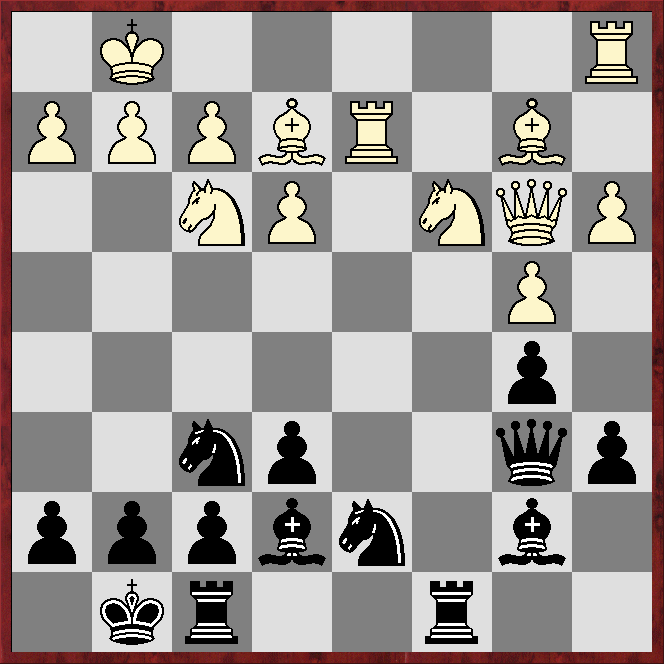 |
| How should Black respond? |
*****
*****
*****
*****
16...Bxf3!?
This seems to be a novelty. Known is 16...Rfd8, while the engines suggest, among other moves, 16...Bc6!? (Stockfish16) and 16...h6 (Komodo14.1.
17.gxf3!?
This is Stockfish16's choice. Komodo14.1 marginally prefers 17.Bxf3 Ne5 18.Be2 Nc4 19.Bxc4 Rxc4 20.Rad1.
17...Qb7 18.Ne4?!
The engines suggest 18.f4!?, fighting for the e5 square, or 18.Rad1.
18...Nxe4 19.fxe4 Nb6
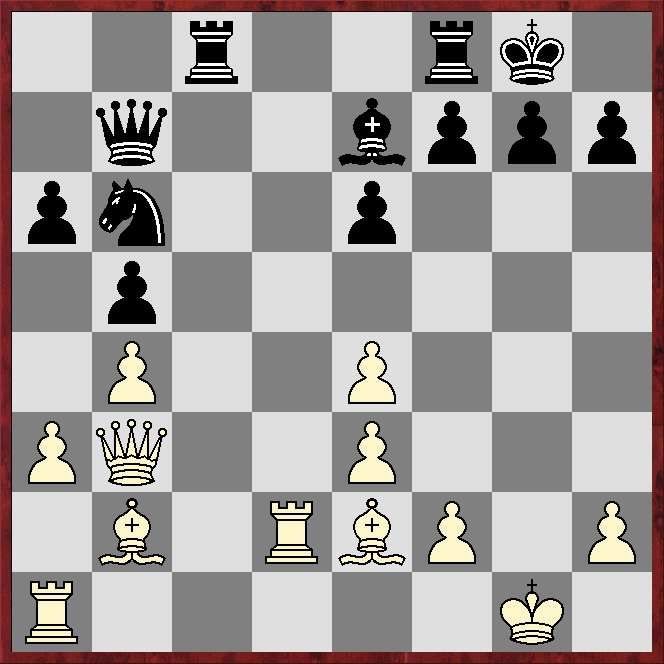 |
| White's bishop-pair does not fully compensate for the damaged pawn-structure, according to the engines |
*****
*****
*****
*****
20.Rad1!?
Hoping activity will compensate for being a pawn down, but the engines prefer defending the pawn, either directly with 20.f3 or 20.Bd3, or indirectly with 20.Bd4.
20...Qxe4 21.Ba1?!
Perhaps hoping to set up a battery on the long dark diagonal, but Black will always have ...Bf6, and anyway the process is slow. The engines suggest 21.Rd4, but give Black at least the upper hand.
21...Bf6
Even stronger, according to the engines, is 21...Qg6+ with ...Nc4 likely to follow.
22.Rd6?
The engines give 22.Qd3 Qh4 23.Bxf6 Qxf6 24.Qd4, albeit preferring Black.
22...Bxa1 23.Rxb6
Or 23.Rxa1 Nd5!?, when White's lack of coordination spells trouble, eg 24.Re1!? Rc3 25.Qb2 Qg6+ 26.Kh1 Qf5 with strong pressure, or 24.Rxa6 Nc3 (the reason why the engines suggest 24.Re1!?) 25.Qb2 Qg6+ 26.Kh1 Qf5 27.f3 Rfd8, after which White has regained the sacrificed pawn but still suffers from poor coordination.
23...Rc3?!
23...Rc3?!
Black is winning after this, according to the engines, but much stronger is their suggestion of 23...Be5.
24.Qa2
After 24.Qb1! Qxb1 25.Rxb1 Rxa3 Black is two pawns up, but opposite-coloured bishops and the weakness of a6 give White hope, eg 26.Bf3 Bf6 27.Bb7 Rb8 28.Rxa6 Rxa6 29.Bxa6, when White has won back a pawn and there is a long way to go before Black can hope to exploit the extra kingside pawn.
24...Rc2 25.Qxa1 Rxe2 26.Qd4 Qf3?!
Much stronger is 26...Qg6+, and if 27.Kf1 then 27...Qc2, when White cannot defend both f2 and d1.
27.Rf1 Rc8 28.Qe5?
Necessary is 28.Qf4, when 28...Qxf4 29.exf4 Re4 30.Rxa6 Rxf4 leaves Black a pawn up in a rook-and-pawn ending, which is far from clear.
28...Rxf2! 0-1
Sunday, 28 April 2024
Lessons From Tegernsee IX
IN round nine my opponent shocked me - well, surprised me, at least - when, after 1.d4 d5 2.Nf3 e6, he thought for quite some time and then uncorked 3.Bg5!?
I thought the move was quite amateurish, but, as I pointed out in my notes to the game, the move has an impressive pedigree, having been played by world champions Lasker, Petrosian and Carlsen.
If Black replies 3...Nf6, we have a Torre Attack.
I preferred 3...Be7, after which the natural 4.Bxe7 helps Black's development but swops off Black's better bishop.
Stockfish16 and Komodo14.1 reckon Black has already equalised, but of course there is lots of play in the position.
CONCLUSION: modern chess, even at the highest level, as exemplified by Magnus Carlsen, often sees White heading for positions that, while objectively offering little from a theoretical perspective, put both players on their own resources, and if White happens to feel more comfortable in the position arising, that may be as good as having a theoretical edge.
Saturday, 27 April 2024
Lessons From Tegernsee VIII
IN round eight my higher-rated opponent, with white, offered a draw after six innocuous moves.
There were many reasons in favour of me accepting, including: he was higher rated, I was tired, I had black, and I was having a good tournament andso did not need to chase lost rating points.
But I played on, losing a very interesting game in 57 moves.
I did not, and do not, regret my decision, not least because I travel hundreds of miles to play chess, not to not-play chess.
CONCLUSION; such decisions come down to personal choice. I have no doubt which way my decision will almost certainly go in such cases, but I would suggest it is a good idea to come to the board having decided beforehand what to do if an early draw offer is made.
Thursday, 25 April 2024
Lessons From Tegernsee VII
THE following position arose in my round-seven game in which I had white against a 2068.
*****
 |
| Black has just castled - how would you assess the position? |
*****
*****
*****
*****
*****
*****
*****
It arose from a Veresov, and is fairly typical of that opening in that Black has pressure on the queenside, while White seems well-placed in the centre and on the kingside.
Indeed, I felt I had promising chances against Black's king, not least thanks to Black having played ...h6.
Accordingly, having moved the white king to the corner, I continued 14.Rg1?!, but that is disliked by Stockfish16 and Komodo14.1.
They reckon Black's queenside attack is coming first, and so Stockfish16 suggests 14.Nd1, meeting 14...c5 with 15.c3.
Komodo14.1 is, if anything, even more defensive with its recommendation of 14.Rac1!?
I discussed the position later with someone who gave up the Veresov in favour of the Jobava-Prié (3.Bf4 instead of 3.Bg5).
He reckoned a main reason he gave up the former was because of the type of position I got, he having learnt by bitter experience that such positions tend to favour Black.
CONCLUSION: visually it is still not obvious to me that Black has a slight edge in the diagram, but such is the engines' verdict. Opposite-flank play is rarely easy to judge 100% correctly, but experience seems to show that in the Veresov, at least, Black is often ahead of White in terms of making an attack count.
Tuesday, 23 April 2024
Lessons From Tegernsee VI
THE following position arose in my round-six game.
*****
 |
| I have just played 25...h4!? |
*****
*****
*****
*****
*****
*****
*****
At first glance 25...h4!? may look strange as, after 26.gxh4, the pawn cannot be recaptured.
Not only that but the game continuation, 26.g4?, threatens to fork Black's queen and bishop.
My 1982-rated opponent presumably thought I had blundered, or at least had been careless.
But it rarely pays to regard the opponent as an idiot, and here White should have realised that since, on the surface, ...h4 was senseless, there had to be something more that he was missing.
Indeed, I met g4 with 26...Bxf4!, and White compounded matters by continuing 27.e4.
However, even after the main variation, 27.exf4 Rxe1+ 28.Rxe1 Rxe1+ 29.Qxe1 Qxd4+, followed by 30...Qxd3, White is the equivalent of almost a rook down, according to Stockfish16 and Komodo14.1
CONCLUSION: David Bronstein pointed out that (I paraphrase) "losing your objective attitude to a position nearly always means ruining your game," and that is the case whether you treat an opponent with contempt or exaggerated respect.
Monday, 22 April 2024
Lessons From Tegernsee V
IN my round-five game I reached the following position with white against a 2061.
*****
 |
| Position after my opponent found the best continuation in a tricky situation, 8...Nf6-g4! |
*****
*****
*****
*****
*****
*****
*****
I saw that after 9.Qxg4!? Black does not lose a piece as he has 9...d5.
Instead our game went 9.Bxf7+ Kxf7 10.Qxg4 Bxe5, when Stockfish16 and Komodo14.1 reckon Black's bishop-pair and central pawn-majority compensate for having a weakened king's position.
The engines reckon 9.Qxg4!? is the stronger option, eg 9...d5 10.Qe2 dxc4 11.f4, claiming a slight edge for White.
Also interesting is 10.Qf3 dxc4 11.Qxc6+ Bd7 12.Qxc4 Bxe5 13.0-0, when Black may not have enough compensation for a pawn.
CONCLUSION: it is easy to let excitement at a 'spectacular' or 'clever' continuation override the fact that a mundane move may be better.
Sunday, 21 April 2024
Lessons From Tegernsee IV
IN my round-four game my opponent, rated 2001, was clearly dissatisfied with his position out of the opening.
*****
*****
 |
| Here he played 16.d4 and offered a draw |
*****
*****
*****
*****
After the further moves 16...e4 17.Bg2 Re8 18.Bg5 h6 19.Bxf6 Qxf6 20.d5? cxd5 21.Qxd5 he had apparently missed that I had a strong backward-bishop move.
 |
| Position after 21...Be6 |
*****
*****
*****
*****
White promptly resigned.
If he had thought for a while, he would surely have realised that after 22.Qxb7 Bxb3 23.axb3 the game is far from over.
True, Black is the exchange and a pawn up, but White has assets too, including a protected passed pawn and the only light-square bishop (not to mention being the higher-rated player).
CONCLUSION: it is important to keep a cool head. Many positions have hidden resources, but emotion can get in the way of clear thinking, so it is vital to give oneself time to calm down after encountering an unexpected setback.
Saturday, 20 April 2024
Lessons From Tegernsee III
THERE is a well-known equalising combination in chess when Black uses the king's knight to capture a protected pawn on e4.
*****
*****
The point is that when White recaptures with the queen's knight, Black plays ...d5, forking the white knight and a white bishop on c4.
Here is a simple example arising after 1.e4 e5 2.Nc3 Nf6 3.Nc3 Nc6 4.Bc4.
 |
| Black's best continuation is the equalising combination that starts with 4...Nxe4! |
*****
*****
*****
*****
There are 8,357 examples of 4...Nxe4! being played in this position in ChessBase's 2024 Mega database.
After 5.Nxe4 d5 Black has equalised, and is at least slightly better if White continues with the most popular move in Mega24, 6.Bxd5?!
Trying to avoid this sequence with 5.Bxf7+?! Kxf7 6.Nxe4 leaves Black with the centre and the bishop-pair after 6...d5 7.Neg5+ Kg8.
Now consider the following position, which arose in my round-three game in the Senioren Cup after I played 8.a4.
 |
| There are 8,540 examples of this position from the Philidor in Mega24 |
*****
*****
*****
*****
My 2159-rated opponent played 8...Nxe4?
This has has been played by people rated 2200+, but is a mistake, as our game continuation of 9.Rxe4 d5 10.Bxd5 showed.
As a matter of fact even 9.Nxe4?! is good enough for the upper hand, according to Stockfish16 and Komodo14.1, after 9...d5 10.Bxd5 cxd5 11.Nc3, eg 11...e4 12.Nxd5!
CONCLUSION: chess cannot be played on general principles and famous motifs alone - no matter how familiar a position may seem, calculation is required.
Thursday, 18 April 2024
Lessons From Tegernsee II
THERE are two types of 'automatic' move in chess.
*****
One comes in the opening, when following theory and/or preparation.
I know there are some players who, even when they have the white pieces, like to spend a minute or two getting themselves into the right mood before starting the game (why they cannot do this before the clock starts, rather than afterwards, I do not understand).
The other kind of 'automatic' move comes when a move is forced, eg a recapture.
But be sure the move really is forced.
James Mason, who was the strongest player in the world for part of the 1880s, according to Chessmetrics, wisely stated: "Never make a good move too soon."
My opponent in round two would have done well to bear that in mind when the following position arose in our game.
 |
| I have just captured a pawn on c6 |
*****
*****
*****
*****
Almost without pausing my opponent replied 19...Qxe3+?, but after 20.Kd1 he was completely lost.
The a8 rook is hanging, and White threatens 21.Re1 with 22.Re8# to come.
Black should have played 19...Rb8, after which White is well on top, but the game goes on.
CONCLUSION: before playing an 'automatic' move, make sure it really is forced. It might be a mistake, or, as Mason pointed out, even if it is a good move, there might be a better one.
Tuesday, 16 April 2024
Lessons From Tegernsee
IN round one I had black against a Fide master.
*****
*****
*****
*****
The game started as a Queen's Gambit Declined: 1.d4 d5 2.c4 e6 3.Nc3 Nf6.
Usually, at least at club level, the continuation is the Exchange Variation: 4.cxd5.
However, my opponent played what is the commonest continuation in ChessBase's 2024 Mega database: 4.Bg5.
I replied 4...c5!?, which is only fifth-most popular in Mega24, but scores up to 13 percentage points better than the more-popular moves.
White normally continues 5.cxd5, the line being sometimes known as the Dutch-Peruvian Gambit.
The gambit splits at this point: 5...Qb6!? is the Peruvian line, while I played the Dutch line, 5...cxd4.
After 6.Qxd4 Be7, my opponent played the main continuation, 7.e4.
 |
| There are 150 examples of this position in Mega24 |
*****
*****
*****
*****
Eight games saw 7...0-0?!, 141 featured the natural 7...Nc6, and just one continued with the move I played, 7...exd5!?
It only occurs once, but is the top choice of Stockfish16 and Komodo14.1.
Thanks to a transposition, there are actually two games in Mega24 with the position after 7...exd5!?
One continued 8.exd5, after which the engines reckon 8...Nc6 equalises.
The other game saw 8.e5, and Black was in trouble after replying 8...Ng8?!
I improved on this with 8...Nc6, and after 9.Bb5 the engines reckon 9...Nd7 would have at least equalised.
So what should White play at move eight?
 |
| Position after 7...exd5!? |
*****
*****
*****
*****
The engines reckon the best tries for an advantage are A) 8.Bb5+ and B) 8.Bxf6.
A) 8.Bb5+
They agree best-play runs 8...Nc6 9.Bxf6 Bxf6 10.e5, at which point they split.
Stockfish16 continues 10...Be7 11.Qxd5 0-0 (Komodo14.1 suggests 11...Qb6!?) 12.Nf3 a6!? 13.Qxd8 Rxd8 14.Bxc6 bxc6 15.Rd1 Bg4 16.0-0 f6!?
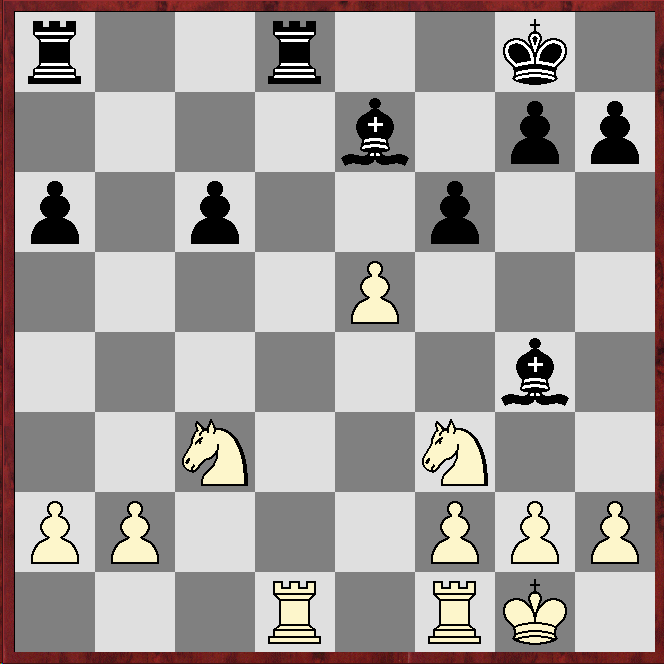 |
| White is a pawn up, but Black's bishop-pair and general activity give enough compensation, according to Stockfish16 (Komodo14.1 reckons White has a slight edge) |
*****
*****
*****
*****
Komodo14.1 (after 10.e5) continues 10...Bg5 11.Qc5!? (both engines prefer this to 11.Qxd5) d4!? 12.Nd5!? Bd7 13.Nf3 Be7 14.Nxe7 Qxe7 15.Rc1!? Rd8 16.0-0 a6 17.Bd3 0-0.
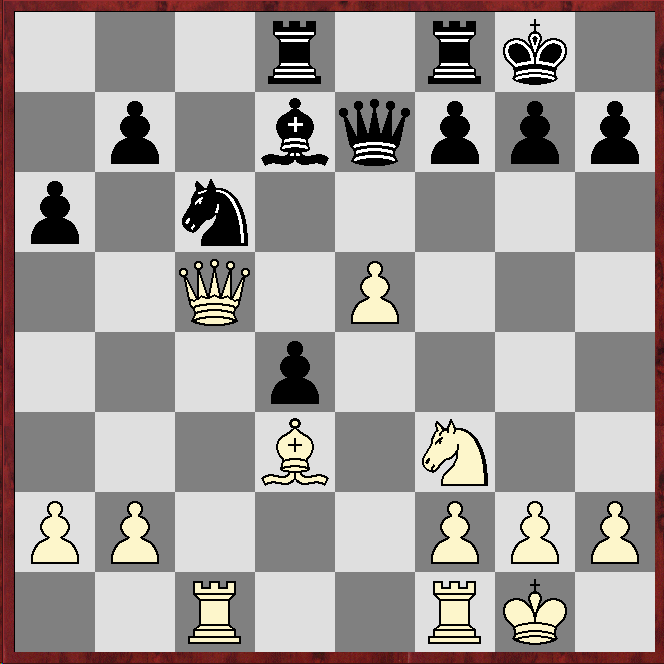 |
| Both engines reckon White has a slight edge |
*****
*****
*****
*****
B) 8.Bxf6
After this the engines agree best-play runs 8...Bxf6 9.e5 Nc6 10.Bb5, which is a transposition to A).
CONCLUSION: 4...c5!? is a little-known but viable alternative to more-popular, but less-successful and less-active, moves.
The above analysis only scratches the surface of both sides' possibilities, but the lines are sharp, and the better-prepared player should have a practical advantage.
Monday, 15 April 2024
Summing Up Tegernsee
MY score of +4=1-4 in the Senioren Cup for players born before 1975 gained 32.2 Fide elo.
There was late drama when, relaxing after the tournament, Lufthansa texted me to say they had cancelled my 14:45 plane today from Munich airport.
Instead they offered me a late-evening flight, which I declined as I was able to make a late-afternoon booking with British Airways.
I am hoping the £242 cost will be covered to a large extent by a refund and compensation from Lufthansa, although I will not be surprised if somehow I do not qualify for compensation.
 |
| I spy a spy - fun in a Rottsch-Egern garden |
Sunday, 14 April 2024
Tegernsee Round Nine
Michael Bohnstorff (2030) - Spanton (1886)
*****
*****
*****
*****
*****
*****
*****
*****
Queen's Pawn Irregular
1.d4 d5 2.Nf3 e6 3.Bg5!?
There are 1,809 examples of this move in ChessBase's 2024 Mega database, with practitioners including Emanuel Lasker, Tigran Petrosian and Magnus Carlsen.
3...Be7 4.Qc1!?
Stockfish16 and Komodo14.1 are OK with this rare continuation, but it makes a strange impression.
4...h6 5.Bxe7 Qxe7
 |
| The only upside about this manoeuvre from White's view, as far as I can see, is that Black's good bishop has been exchanged |
*****
*****
*****
*****
6.e3 Nf6 7.c4 0-0 8.Nc3 Nbd7 9.Be2 dxc4 10.Bxc4 e5 11.0-0
 |
| How should Black proceed? |
*****
*****
*****
*****
11...e4
Stockfish16 gives 11....exd4!? 12.exd4 Nb6, claiming equality. Komodo14.1 suggests 11...c6!?, again claiming equality.
12.Nd2
The engines like 12.Nh4!?, eg 12...Nb6 (12...g6?? 13.Nxg6) 13.Ng6 Qd8 14.Bb3 Re8 15.Nf4, when Stockfish16 gives White a slight edge, but Komodo14.1 calls the position equal.
12...c5 13.Re1 Re8 14.Nf1!? Nb6 15.Bb3 Bf5 16.Ng3 Bg6 17.dxc5!?
This looks a little odd, at least at first, but it is the engines' top choice.
 |
| Can you see White's idea? |
*****
*****
*****
*****
17...Qxc5?!
I saw that 18.Nxe4?? loses to 18...Nxe4, but if I had spotted White's real idea I should have preferred 18...Nbd7!, which the engines agree is equal.
18.Nd5! Qd6
Or 18...Qxc1 19.Nxf6+ gxf6 20.Raxc1 with at least a slight edge, according to the engines.
19.Nf4
Probably better is 19.Qc7!?, eg 19...Qd8 20.Nxf6+ Qxf6 and either 21.Qxb7 or 21.Rad1.
19...Rac8 20.Qd1 Qxd1 21.Rexd1 Bh7
 |
| After a brief flurry of tactics, how would you assess the position? |
*****
*****
*****
*****
The most significant feature is probably that Black's bishop is somewhat out of play, which is presumably why the engines give White a slight edge.
22.Rac1 Kf8 23.Kf1 Ng4!? 24.h3 Ne5 25.Nd5 Rxc1 26.Rxc1 Nd3?!
Tempting, but challenging control of the open c file with 26...Rc8 is more important.
27.Rc7
 |
| What should Black play? |
*****
*****
*****
*****
27...Rc8?
Necessary is 27...Nxd5, but 28.Bxd5 Re7 29.Rc8+ Re8 30.Rxe8+ Kxe8 31.Nxe4 wins a pawn.
28.Rxf7+! Ke8
Objectively better, according to the engines, is 28...Kxf7!? 29.Nxb6 Kf6 30.Nxc8, but it would be astonishing if White did not go on to win.
29.Nxb6?!
Even stronger are 29.Rxg7 and 29.Nc7+!?
29...Rc1+ 30.Ke2 Bg8?
Better, or at least less worse, is 30...Rb1 31.Rxg7! Rxb2+ 32.Kf1 Rb1+ 33.Bd1!? (only move to avoid a draw) Rxd1+ 34.Ke2 Ra1 35.Nc4 Rxa2+ 36.Nd2 Ra1 37.N(either)xe4 Bxe4 38.Nxe4 Ne5 39.Rxb7, although White emerges two pawns up.
31.Rxb7
Possibly 31.Rxg7 is even stronger.
31...Bxb3 32.axb3 axb6 33.Nxe4 Nxb2 34.Rxb6 Rc2+ 35.Kf3 Nd3
*****
 |
| White is three pawns up, and altogether the white position is worth a rook (Stockfish16) or at least a minor piece and a pawn (Komodo14.1) |
*****
*****
*****
*****
36.Rb7 Kf8 37.b4 Rc4 38.Nc5!?
Stockfish16 is fine with this, but Komodo14.1 is less sure. The downside is White, as well as losing one of his extra pawns, allows a rook-and-pawn ending. The upside is White no longer has any weaknesses, and accidents are much less likely without knights on the board.
38...Nxc5 39.bxc5 Rxc5 40.g4 g5 41.Rh7 Rc6
 |
| Although Black is now 'only' two pawns down, White's advantage has apparently grown thanks to the simplification, and is worth the equivalent of more than a rook and pawn (Stockfish16) or at least more than a rook (Komodo14.1) |
*****
*****
*****
*****
42.Ke4 Kg8 43.Rd7 Rc1 44.f4 Rh1 45.fxg5
Remaining two pawns up, but even stronger is creating connected passed pawns with 45.f5!?, according to the engines.
45...hxg5 46.Rd5 Rxh3 47.Rxg5+ Kf7
 |
| This looks similar to the notorious drawn ending of rook, h pawn and f pawn against rook, but the fact that here there is no pawn on a rook's file makes all the difference |
*****
*****
*****
*****
48.Kf4 Rh1 49.Ke5 Rg1 50.e4 Ke7 51.Rg6 Kf7 52.Rf6+ Ke7 53.Rf4 Ra1 54.Kf5 Ra5+ 55.e5 Kf7 56.g5 Kg7 57.Rb4 Ra7 58.Rb5 Rf7+ 59.Kg4 Re7 60.Rd5 Ra7 61.Rd6 Ra5 62.Kf5 Ra7 63.Rg6+ Kh7
 |
| How should White finish the game? |
*****
*****
*****
*****
64.Kf6?
There are many wins, but perhaps simplest is starting with 64.Rd6.
64...Ra6+ 65.e6 Rxe6+ 66.Kxe6 ½–½
Random Shots Around Rottach-Egern
 |
| Town hall |
 |
| Italian restaurant |
 |
| Fountain |
 |
| Permanent maypole - unusual in not being painted in the Bavarian state colours of white and cornflower blue |
 |
| Park |
Saturday, 13 April 2024
Tegernsee Round Eight
FACED a Luxembourg-registered player.
Jobava-Prié
1.d4 d5 2.Nc3 Nf6 3.Bf4 e6 4.Nb5!?
This looks rather crude, but is the main continuation in ChessBase's 2024 Mega database.
 |
| How should Black respond? |
*****
*****
*****
*****
4...Bb4+
This and 4...Bd6!? are roughly equally popular, but much more common is 4...Na6.
5.c3 Ba5 6.e3
GS offered a draw.
The mainline in Mega24 runs 6.a4 a6 7.b4 and either 7...Bxb4 or 7...axb5.
6...a6
Almost certainly not 6...c6?! 7.Nd6+.
7.Na3 0-0 8.Bd3 Qe7!?
This may be a novelty.
 |
| What should White play? |
*****
*****
*****
*****
9.Qc2
Stockfish16 and Komodo14.1 suggest 9.Nb1!? or 9.Nf3!?, even though the latter allows 9...Bxc3+!? 10.bxc3 Qxa3. They reckon White gets full compensation for a pawn with 11.Qb3!?, and is even better after 11...Qxb3 12.axb3 c6.
9...c5 10.dxc5!? e5
Also possible is 10...Qxc5 as 11.b4? fails to 11...Bxb4.
11.Bg5 e4 12.Bf1!?
Leaving the e2 square for the king's knight.
12...Nc6 13.Ne2 Qe5?
The engines reckon Black has at least enough for a pawn after, for example, 13...h6.
14.Bf4
The bishop turns out to be very well-placed here thanks to covering b8.
14...Qf5 15.0-0-0!? b6!? 16.cxb6
Probably not 16.b4?! Bxb4 17.axb4 Nxb4 with an unclear position, eg 18.Qb2 bxc5! gives promising compensation, according to the engines, but not 18...Nd3+? 19.Rxd3! exd3 20.Nd4.
16...Bxb6 17.Nd4
The engines reckon 17.Qd2!? leaves White with the upper hand.
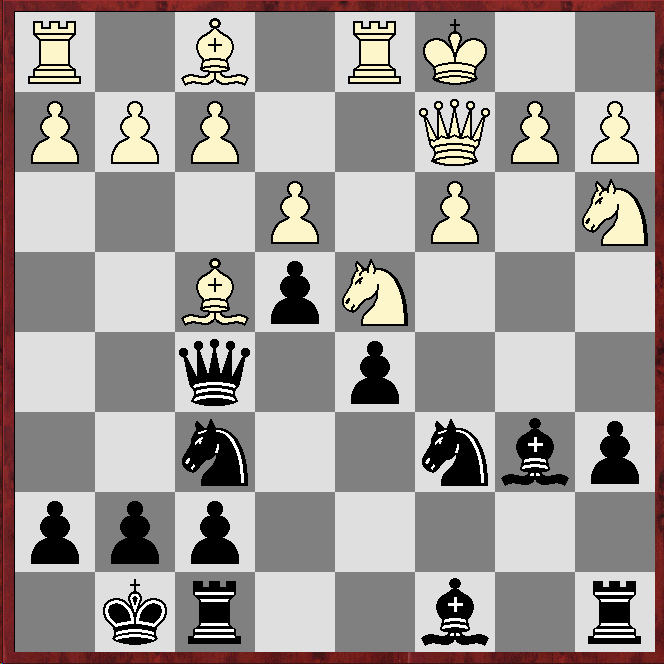 |
| Black more-or-less has to capture on d4, but with which piece? |
*****
*****
*****
*****
17...Nxd4
Stockfish16 slightly prefers the bishop capture, but Komodo14.1 fluctuates between the two moves, coming to see them as equal
18.cxd4 Bd7 19.Kb1 Rfc8 20.Qd2 Ba4 21.b3 Be8
18.cxd4 Bd7 19.Kb1 Rfc8 20.Qd2 Ba4 21.b3 Be8
Black has promising play after 21...Qd7? 22.bxa4?! Qxa4, but 22.Qb4! puts an end to Black's fun.
22.Be2 a5?!
It was almost certainly better to swop off White's annoying dark-square bishop with 22...Bc7.
23.Rc1 a4 24.b4 Qd7?!
Trying to get the queen into play on the queenside, but the engines strongly dislike this, preferring 24...Bd8!?, 24...h5, 24...Qg6 or 24...Bd7!?
25.Rxc8 Qxc8 26.Rc1 Qb7 27.Nb5 a3 28.Nd6 Qe7 29.Nc8!? Qb7 30.Nxb6 Qxb6 31.Bc7
Even stronger, according to the engines, is 31.Rc5.
31...Qb7 32.Bd6?!
Again the engines much prefer Rc5.
32...Bb5 33.Bxb5 Qxb5 34.Rc2?
Weakening the back rank. White is still better after 34.Bc5, or even 34.Rc5, one point about the latter being 34...Qf1+ 35.Qc1 Qxg2?? allows White to mate.
34...Ne8
Probably better is 34...Nd7!?, and if 35.Bc5, to prevent the knight arriving at c4 via b6, then 35...Qf1+ 36.Qc1 Qxg2 is completely equal, according to the engines.
35.Bc5 Qf1+ 36.Qc1 Qxg2!?
This is Komodo14.1's choice, but Stockfish16 prefers 36...Qa6 or 36...Qb5 to restrain the b pawn.
37.f4 Qh3?
Keeping pressure on the white kingside, but the queen becomes out of play. Best, according to the engines, is 37...Qg6 38.b5 and either 38...h6 or 38...h5 to avoid back-rank problems. However the engines reckon White is at least slightly better.
38.b5 Nc7?
The passed pawn is too dangerous to play like this. Possibly best is 38...Qc7, and if 39.b6 then 39...Qc6.
39.b6 Nb5 40.b7 Rb8 41.Bb4 Na7 42.Rc7 g6?!
Pushing the h pawn is slightly better.
43.Bxa3 Kg7 44.Bxd6
Even stronger seems to be 44.Rxf7+!?
44...Qe6
Also hopeless is 44...Nb5 45.Be5+ and either 46.Rxf7 or 46.Qg1!?
45.Qc5 Nc8 46.Be5+ Kh6 47.Qf8+ Kh5 48.Qxf7 Qb6+ 49.Ka1 Qa6 50.Qxh7+ Kg4 51.bxc8=Q+ Rxc8 52.Qd7+
The only winning move, but plenty good enough.
The game finished:
52...Kf3 53.Qxc8 Qf1+ 54.Rc1 Qg2 55.Qc2 Qxc2 56.Rxc2 Kxe3 57.a4 1-0
Summer Time
TEGERNSEE is mainly a summer tourism destination, or at least a good-weather one - summer-like days start earlier in the year in places such as Bavaria that enjoy a continental climate.
This morning I saw hot-air balloons over the lake, one of them very close to Rottach-Egern.
Yesterday, while having a late lunch on the terrace at Café Angermaier, which is perhaps halfway between Rottach-Egern and Enterrottach, I watched half-a-dozen hang-gliders circling over a mountain in what was blazing sunshine.
 |
| Unfortunately none of the hang-gliders has come out in my photo |


Friday, 12 April 2024
Tegernsee Round Seven
Spanton (1886) - Detlev Schötzig (2068)
*****
Veresov
1.d4 d5 2.Nc3 Nf6 3.Bg5 c6!?
More popular in ChessBase's 2024 Mega database are ...Bf5, ...e6 and especially ...Nbd7, but world champions Botvinnik, Karpov and Kramnik are among those who have played the text.
4.e3 Qb6 5.a3!?
Indirectly defending the b2 pawn as the black queen is trapped after 5...Qxb2?? 6.Na4.
5...Bf5 6.Bd3 Bxd3 7.Qxd3 Nbd7
Possible is 7...Qxb2!? 8.Rb1 Qxa3 as Stockfish16 and Komodo14.1 do not believe 9.Rxb7 gives White full compensation.
8.Nf3 e6
Again ...Qxb2 is possible, although this time the engines reckon White does have enough for a pawn.
9.0-0 h6 10.Bxf6!? Nxf6 11.Ne5 Rc8 12.f4 Bd6 13.Kh1!? 0-0
 |
| Now both sides have castled, how would you assess the position? |
*****
*****
*****
*****
Play is not particularly forcing, and there is a lot of play available, but, for what it is worth, the engines agree Black has a slight edge, or at least the better side of equality.
14.Rg1?!
Hoping to open lines on the kingside, but the plan is probably too slow. Among moves liked by the engines is 14.Nd1!?, the idea being to solidify the queenside with c3.
14...c5 15.Na4 Qa5 16.Nxc5 Bxc5 17.b4?
Black is only slightly better, according to the engines, after 17.dxc5 Qxc5 18.c3.
17...Bxb4 18.axb4 Qxb4
Even stronger is the engines' 18...Ne4!, eg 19.Qxe4 Qxa1 or 19.Rgf1 Nf2+. Best may be 19.Qe2, but after 19...Qxb4 Black can meet 20.Rxa7 with 20...Qb2.
19.Rxa7?
I originally intended the correct 19.Rgb1, but then I saw 19...Qc3, missing that 20.Rxa7 Qxc2 21.Qxc2 Rxc2 22.h3 is fine for White. However 19...Qe7 20.Rxa7 Ne4 21.Kg1 Nd6 gives Black the upper hand, according to the engines, presumably because c2 is weaker than b7, especially with White having the additional weakness of e3.
19...Ne4 20.Rf1 Qb2 21.Qb3
There is nothing better.
21...Rxc2 22.Qxb2
Not 22.Qxb7?? Nf2+ (the immediate 22...Rc1 23.Qa6 Nd2 also wins) 23.Kg1 Nh3+! 24.Kh1 Rc1 etc.
22...Rxb2 23.Rc1 g5?!
Black still has at least the upper hand after this, but calmer moves, eg 23...Nd6, were probably better.
24.fxg5 hxg5 25.h3!?
Perhaps 25.Kg1 is better.
25...Ng3+ 26.Kh2 Nf5 27.Ng4 Nh4 28.Rc7!?
The engines agree this is the best chance.
28...Rxg2+ 29.Kh1 Re2 30.Raxb7 Nf5 31.Rc3?
Better is 31.Kg1, meeting 31...Ra8 with 32.Ra7. However 32...Rxa7 33.Rxa7 Nxe3 34.Nh6 Kg7 35.Nxf7 Kf6 is winning, according to the engines.
31...Ra8 32.Rb1 Ng3+ 33.Raa2 0-1
Spanton Random
AFTER two largely wet days the good weather returned yesterday.
Here are fairly random shots taken then while walking around the lake from Rottach-Egern to Bad Weissee.


Thursday, 11 April 2024
Tegernsee Round Six
FACED an Italian.
*****
*****
*****
Maurizio Diotallevi (1982) - Spanton (1886)
QGD Exchange
1.Nf3 d5 2.d4 e6 3.c4 Nf6 4.cxd5!?
An unusual point at which to enter the Exchange Variation of the Queen's Gambit Declined. More-popular moves include 4.g3 and especially 4.Nc3. Nevertheless the list of names of players who have tried the text reads like a modern who's who of super grandmasters: Carlsen, Caruana, Kramnik, Arkell ...
4...exd5 5.Nc3 c6 6.Qc2 g6!?
The point of this move is to punish White for having spent a tempo on developing the king's knight before the king's bishop (in line with advice given to novices about developing knights before bishops!). If White had played e3 instead of Nf3, the text could be met by Bd3, preventing ....Bf5, the latter generally being regarded as an equaliser in Exchange lines of the QGD.
7.Bg5 Bf5?!
But this may be premature. More usual is 7...Be7 or 7...Bg7, with ...Bf5 to come. But note that 7...h6? runs into 8.Bxf6 Qxf6 9.Nxd5!
 |
| How should White respond? |
*****
*****
*****
*****
8.Qc1?!
This seems a novelty, and almost certainly not a good one. The obvious 8.Qb3 causes Black a major headache as 8...b6 can be met by 9.e4! dxe4 10.Ne5 Qe7 (10...Be6 11.Bc4) 11.Bb5!, when Stockfish16 and Komodo14.1 reckon Black has nothing better than 11...cxb5, but then comes 12.Nd5. The line 9...Bxe4 10.Nxe4 dxe4 does not appear in ChessBase's 2024 Mega database, but again the continuation Ne5 is very strong. Black could try 8...Nbd7, when 9.Qxb7 Rb8 gives Black promising counterplay, but the engines point out that 9.e4!, although it also does not appear in Mega24, is once more strong.
8...h6 9.Bf4 Nbd7 10.e3
The engines suggest 10.h3, presumably to preserve White's dark-square bishop, but they reckon 10...Ne4 leaves Black slightly better.
10...Nh5 11.Bg3 Nxg3 12.hxg3 Bg7
 |
| Half-opening the h file for White is often problematic if Black intends castling short, but here the Black kingside looks solid |
*****
*****
*****
*****
13.Nh4 Bg4 14.Bd3 0-0 15.Qc2
White's pressure against g6 may appear intimidating, but it is countered easily enough.
15...Qf6 16.Na4 Rfe8 17.0-0 Rac8 18.b4
 |
| A Minority Attack is White's standard plan in this type of position; Black has to decide how much to defend on the queenside, and how much to counterattack on the other flank |
*****
*****
*****
*****
18...a6?!
There was no need for this as White was not yet threatening to push the b pawn (19.b5? cxb5 leaves Black well on top), so Black should probably be getting on with kingside play.
19.Rfe1 h5 20.Nc5 Nxc5?!
This makes b7 weak. The engines suggest 20...Rc7.
21.bxc5 Bh6 22.f4?!
The engines like 22.Rab1 or 22.Be2, but disagree as to who is better (Stockfish16 marginally prefers Black; Komodo14.1 just prefers White). The text is aggressive, but weakens e3.
22...Rc7!?
Even stronger, according to the engines, is 22...Re6.
23.Nf3 Bxf3 24.gxf3 Rce7 25.Qf2!
This is the only decent move, according to the engines, as 25.Qd2 runs into 25...h4, when White does not have the defence that is available after the text.
25...h4!?
 |
| White to play and draw |
*****
*****
*****
*****
*****
26.g4?
Missing Black's threat. Drawing is 26.gxh4 Bxf4 27.exf4 Rxe1+ 28.Rxe1 Rxe1+ 29.Qxe1 Qxd4+ 30.Kg2 Qxd3 31.Qe8+ Kg7 32.Qe5+ Kh7 33.Qe7.
26...Bxf4! 27.e4
This does not help, but, unlike in the previous note, 27.exf4 Rxe1+ 28.Rxe1 Rxe1+ 29.Qxe1 Qxd4+ 30.Kg2 Qxd3 31.Qe8+ Kg7 32.Qe5+ Kh7 33.Qe7 no longer saves White as Black has 33...Qd2+ and 33...Qxf4.
27...Bg3 28.Qe2
Or 28.Qe3 dxe4 29.fxe4 Rxe4! 30.Bxe4 Rxe4! 31.Qd2 Bxe1 32.Rxe1 Rxg4+, after which Black is three pawns up and has a winning attack.
28...Bxe1 29.Rxe1 Qxd4+ 30.Qe3 Qxe3 31.Rxe3 g5
White is the exchange and two pawns down. The game finished:
32.Re2 Re5 33.Rc2 dxe4 34.fxe4 Rxe4!? 0-1
Subscribe to:
Posts (Atom)