ANOTHER sparkling gem from 500 Master Games Of Chess by Savielly Tartakower and Julius du Mont.
Notes in italics are algebraicised from the book.
Jacques Mieses - Akiba Rubinstein
German Chess Congress (Breslau - now Wrocław, Poland) 1912
Bishop's Opening
1.e4 e5 2.Bc4 Nf6 3.d4!?
An intrepid advance.
This move, which has been played by Magnus Catrlsen, scores 58% in ChessBase's 2022 Mega database, comparing favourably with the 57% of 3.d3, the 54% of 3.Qe2!?, the 51% of 3.Nc3, and the 47% of 3.Nf3.
3...exd4
After 3...Nxe4 4.dxe5 (threatening 5.Qd5) Nc5 5.f4 White has the initiative.
4.Nf3
An identical position can be reached via the Petrov Defence: 1.e4 e5 2.Nf3 Nf6 3.d4 (Steinitz's Continuation) exd4 4.Bc4 etc.
Of no value would be 4.e5 d5 5.Bb3 Ne4 etc.
4...Nxe4
Producing serious complications.
The following could not be recommended: 4...Bb4+ 5.c3 dxc3 6.bxc3 etc, or 4...Bc5, reverting to a variation of the Scotch Gambit. But the most reasoned course is to lead into an academic continuation of the Two Knights Defence by 4...Nc6 (5.0-0 - the Max Lange Attack).
The main continuation in Mega22 runs 4...Nc6 5.e5 d5 6.Bb5 Ne4 7.Nxd4 Bd7 8.Bxc6!? bxc6 9.0-0, reaching a position that occurs 4,834 times in Mega22, with White scoring 55%.
5.Qxd4
After 5.0-0 Be7 6.Re1 d5 Black has freed his game.
5...Nf6
Neither 5...Nd6 nor 5...Nc5 is desirable.
6.Bg5
White's superior development compensates for the pawn he has given up.
As a rule of thumb a pawn in the opening can be thought of as worth 2.5 tempi. Several experts quote three tempi, others "two-to-three" tempi, and as usual much depends on the position.
 |
| Who, if anyone, stands better? |
*****
*****
*****
*****
*****
White has developed four pieces against Black's one. It is Black to move, and that move can be used to develop a piece. At some point, however, Black will have to spend a tempo moving a pawn to allow the light-square bishop to be developed. But that move could come with tempo, for example if Black could safely play ...d5, hitting the white light-square bishop. In addition Black can expect to develop the queen's knight with tempo as on c6 it will hit the white queen. The analysis engines Stockfish14.1 and Komodo12.1.1 reckon Black is slightly better.
6...Be7 7.Nc3 Nc6
Another line of defence is 7...c6 8.0-0-0 d5 etc, or 7...0-0 8.0-0-0 c6 etc.
8.Qh4 d6 9.0-0-0
Linear pressure.
9...Be6
Castling would be far more dangerous because of 10.Bd3, with latent threats.
10.Bd3?!
Still preventing Black from castling. If 10.Rhe1 [then] 10...Bxc4 11.Bxf6 Be6, again closing the e file.
10.Rhe1 is almost certainly the better move, and if 10...Bxc4 then 11.Qxc4, when the engines reckon White, if anyone, is better.
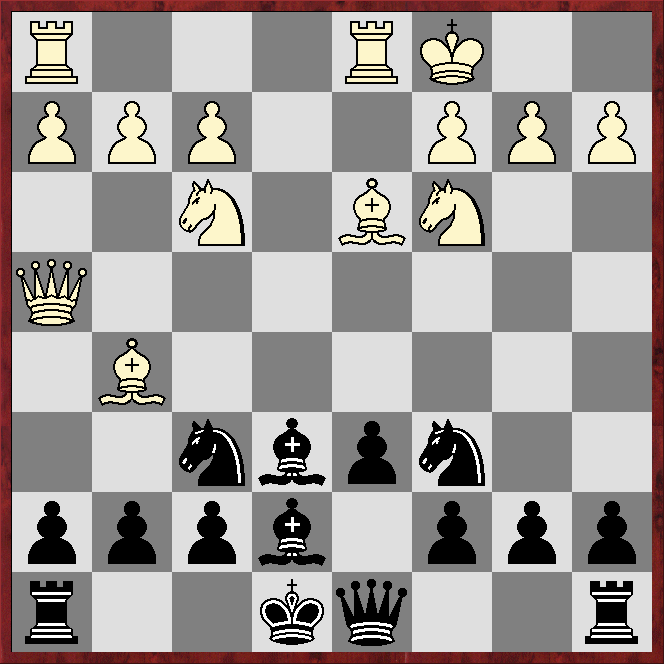 |
| How should Black proceed? |
*****
*****
*****
*****
*****
10...Qd7
Keeping queenside castling in reserve, Preparatory measures such as 10...a6 or 10...h6 would only mean loss of time, calling for the reply 11.Rhe1.
The text is the main line in Mega22, and scores very well for Black. But the engines prefer 10...h6!?, meeting 11.Rhe1 with 11...a6!? or 11...Qd7, in both cases claiming an advantage for Black.
11.Bb5!?
This manoeuvring to and fro by the bishop has its reasons. Here it prevents 11...0-0-0, after which would follow 12.Ne5 Qe8 13.Nxc6 bxc6 14.Ba6+ Kd7 15.Na4 (threatening mate), and the king hunt has only begun.
The engines reckon 15.Na4? is a mistake thanks to 15...Nd5, but they give White a large advantage after 15.Qa4.
11...0-0 12.Nd4?!
Preventing above all 12...Bf5 (13.Nxf5 Qxf5 14.Bd3, followed by 15.Bxf6 and wins). Ineffective would be 12.Ne5 Qe8.
The engines strongly dislike the text, preferring the developing 12.Rhe1.
12...a6
Even stronger, according to the engines, is 12...h6!?, but they reckon the text is also good enough for an advantage.
13.Bd3
Returning to the al-important diagonal.
13...Ne5
Besides containing a slight pitfall, the text move is intended at last to get rid of the adverse king's bishop.
14.f4
Keeping his adversary on the alert. After 14.Rhe1, the reply 14...c5 would be still more efficacious. [The authors missed that 14...c5? fails to 15.Rxe5! dxe5 16.Nxe6 Qxe6 17.Bxf6.]
The following, intending to win a pawn, but losing a piece instead, is a mistake: 14.Bxh7+ Nxh7 15.Bxe7 Ng6, and Black wins.
14...Nxd3+ 15.Rxd3 c5
In order to able to place his queen's bishop at f5, for if at once 15...Bf5 [then] 16.Re3 Rae8 17.Rxe7 Rxe7 18.Bxf6 gxf6 19.Nd5, and Black is at bay.
The engines reckon the simple 16.Nxf5 gxf5 17.g4 is strong, while in the line quoted above 16.Re3? can be met by 16...Bd8, which the engines reckon favours Black.
16.Rg3
Seeing that his opponent is not amenable, White intensifies his attack. If now 16...cxd4 [then] 17.Bxf6 Bxf6 18.Qxf6 g6 19.Qxd4 etc.
16...Kh8 17.Nf3?
If 17.Nxe6 [then] fxe6 18.Rh3 Rf7, and White's attack is finely mastered.
Nevertheless this was White's best line as Whiter seems busted after the text.
17...Ng8?!
In order to eliminate the other bishop, which is so troublesome for Black. White must exchange, in view of the threat 18...f6.
Much stronger, according to the engines, is 17...Rae8.
18.Bxe7 Qxe7!?
The engines prefer 18...Nxe7, and if, as in the game, 19.Ng5 then simply 19...h6.
19.Ng5 Nh6
If 19...Nf6 [then] 20.Nxh7 and wins, and if 19...h6, Black's knight will remain locked out for a long time to come, although White at the moment has no decisive attack at his disposal.
20.Re1
Preventing 20...f6.
20...Qd7 21.Rge3 Rfe8?!
The sequel will show that 21...Rae8 had some points in its favour.
22.Nce4 Bf5
At last Black succeeds in occupying the coveted diagonal. The crisis is at hand.
23.Nf6!
This 'break-up sacrifice' was so to speak 'in the air' ever since Black's 19th move, but now it is reinforced by the unmasking of the e file. The thrilling play hereafter offers an attractive illustration of well-balanced attack and defence - both perfectly conducted.
23...gxf6 24.Qxh6 Bg6?!
Almost certainly better is 24...fxg5, although after 25.Qf6+ Kg8 26.Re7 Bg6 27.Rxe7 Rxe1+ 28.Kd2 Rae8 the engines give White the upper hand.
25.Nxh7!
This sacrifice, a sequel to the preceding one (23.Nf6), shows its real significance only on White's next move. Without this possibility White would have had to retire and agree to exchanges, bringing Black, with his extra pawn, nearer to victory.
25...Bxh7
 |
| White to play and win |
*****
*****
*****
*****
*****
26.Rg3?
A magnificent point. White's linear pressure culminates in a double threat of mate (27.Qg7# or 27.Qxf6#).
But Black has a defence, whereas after the engines' 26.Qxf6+ Kg8 27.f5! White has a large advantage, eg 27...Rxe3 28.Rxe3 Qd8 29.Rg3+ etc.
26...Rxe1+ 27.Kd2 Re2+!
Mega22 has the game agreed drawn here, although Tartakower and du Mont continue:
28.Kd1
White cannot take the rook, otherwise 28...Qe6+, followed by 29...Rg8, parries all threats. And if 28.Kc1, then not hastily 28...Rxc1+ 29.Kd1, but calmly 28...Re1+, continuing his series of checks.
28...Re1+
Drawn by perpetual check.


