Showing posts with label Bishop's Opening. Show all posts

Tuesday, 9 June 2026

Miniatures 38

IN this occasional series I am going through my decisive games of 20 moves or fewer.

M Wadud (136 BCF) - Spanton (147 BCF)
Upminster Major 1991
Bishop's Opening/King's Gambit
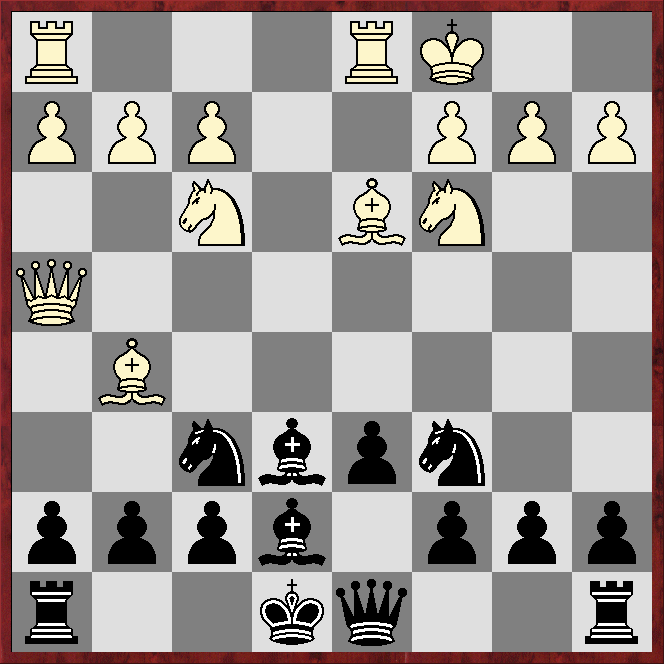
1.e4 e5 2.Bc4 Bc5 3.f4!?
This move goes back at least to a game of Frank Marshall's in 1925. The position can also arise from a King's Gambit via the move-order 1.e4 e5 2.f4 Bc5 3.Bc4!?
How should Black respond?
*****
*****
*****
*****
*****
3...Bxg1
Marshall's opponent played 3...d6, but Stockfish17 and Dragon1 suggest a novelty in 3...d5!?
4.Rxg1
The zwischenzug 4.Qh5! is preferable.
4...Qh4+ 5.g3?
Better is 5.Kf1, when 5...Qxh2?! 6.Nc3 leaves Black dangerously behind in development. However, Black can instead get on with development, eg 5...Nf6, with what the engines reckon is the upper hand.
5...Qxh2 6.Kf1?!
The unpalatable 6.Rf1!? is probably better.
6...d5! 7.f5!?
The threat of 7...Bh3+ with a quick mate means White does not seem to have anything better, but White is losing a piece, to go with an already lost pawn.
7...dxc4 8.d4 cxd3 9.Qxd3 Bd7 10.Na3 Nf6 11.Bg5 Ng4 12.Qf3?! Qh5 13.Ke2!?
The second bishop cannot be saved, emphasising the desperateness of White's position.
13...Qxg5 14.Nb5? 0-1
LESSON: White in the King's Gambit needs to constantly be aware of the danger of allowing ...Qh4+.

Wednesday, 10 September 2025

Miniatures 8

IN this occasional series I am going through my decisive games of 20 moves or fewer.

Christopher Rice (168 BCF) - Spanton (ungraded)
North London Spring Congress 1989
Bishop's Opening
1.e4 e5 2.Bc4 Nf6 3.d4!?
This gambit scores 58% in ChessBase's 2025 Mega database.
How should Black respond?
*****
*****
*****
*****
*****
3...Nxe4!?
This has been played by grandmasters, but Stockfish17 and Dragon1 prefer the more popular 3...Nc6 and 3....exd4.
4.dxe5 Bc5?
The engines reckon 4...c6 leaves White with 'only' the upper hand.
5.Qd5!? Bxf2+
This is the commonest continuation in Mega25, but better may be 5...Qh4.
6.Kf1 Qh4
The other known moves, 6...0-0 and 6...Qe7, allow 7.Qxe4.
7.Qxf7+ Kd8 8.Nc3 Nxc3
Or 8...Bxg1 9.Nxe4, when the threats include Bg5+.
9.Nf3 1-0
LESSON: it is hard to survive White's gambits in double-e pawn openings without knowing some theory.

Sunday, 7 September 2025

Miniatures 5

IN this occasional series I am going through my decisive games of 20 moves or fewer.

Geoffrey Stearn (158? BCF)- Spanton (ungraded)
Sutton Easter 1989
Bishop's Opening
1.e4 e5 2.Bc4 Nf6 3.Nf3!?
As I was to discover over the coming months, this move is typical of GS's aggressive style, and my lifetime score against him is +0=0-5.
3...Nxe4
Principled, but not prudent.
4.Nc3!?
Continuing the gambit theme. Stockfish17 and Dragon1 want White to play 4.Nxe5, or 4.d3 and then Nxe5.
4...Nxc3
Again, principled, but not prudent.
5.dxc3
The engines give Black at least a slight edge
*****
*****
*****
*****
*****
5...d5?
Most popular, and best, according to the engines, is 5...f6!?
6.Bxd5 Nc6?
The engines want Black to prioritise getting the king to safety with 6...Be7!?, although 7.Nxe5 leaves White a pawn up.
7.Bxc6+
Even stronger seems to be 7.Ng5!?
7...bxc6 8.Qxd8+ Kxd8 9.Nxe5 Ke8 10.Be3 Bd6!?
The engines disapprove of holding on to the c6 pawn.
11.Nxc6 Bb7 12.Nd4 Bxg2!? 13.Rg1 Be4 14.h4
Not 14.Rxg7? Bg6 etc.
14...Rb8 15.0-0-0 a5 16.f3 Bg6 17.Rg5 a4 18.a3 f6 19.Ra5 Kf7?? 20.h5 1-0
LESSON: this game illustrates the advice of Cecil Purdy, the first world correspondence champion, who  warned that neglecting development in the opening for the sake of an advantage in an endgame that may never arise (in other words, grabbing a pawn early on) is not a "paying proposition."

Thursday, 24 April 2025

English 65+ Round One

John Morrish (1644 ECF/1786 Fide) - Spanton (1985 ECF/1922 Fide)
Evans Gambit
1.e4 e5 2.Bc4 Bc5 3.Nf3 Nc6 4.b4
The Evans Gambit is a rare bird in the modern tournament scene.
4...Bxb4 5.c3 Bd6!?
The Stone-Ware Defence is an even rarer riposte - there are just 541 examples of 5...Bd6!? in ChessBase's 2025 Mega database.
How should White respond?
*****
*****
*****
*****
*****
6.d4
This is easily the most popular move, and is liked by Stockfish17 and Dragon1 along with 6.0-0
6...Nf6 7.dxe5!?
The main line in Mega25 runs 7.0-0 0-0 8.Re1 h6!? 9.Nbd2 Re8 10.Bd3!? (10.Qb3 is also popular, and is preferred by the engines) Bf8 11.Nxe5 Nxe5 12.dxe5 Rxe5, with White having full compensation for a pawn, according to the engines.
7...Bxe5
Not 7...Nxe5? 8.Nxe5 Bxe5 9.f4 Bd6 10.e5, and if 10...Qe7 then simply 11.Qe2.
8.Nxe5 Nxe5 9.Bb3
White has the bishop-pair and easy development, but that is not enough for a pawn, according to the engines
*****
*****
*****
*****
*****
9...0-0 10.Bg5
The engines prefer castling, as after the text ...
10...h6
... puts White in a predicament.
11.Bh4
This looks natural, but the engines much prefer giving up the bishop-pair by capturing on f6, or keeping the bishop-pair while maintaining a pin on the black king's knight by 11.f4!? Ng6 12.f5!? Ne5 13.Bh4.
11...Ng6 12.Bg3!?
Offering a second pawn, presumably on the basis that 12.Bxf6 Qxf6 leaves White with no compensation for a single pawn.
12...Nxe4 13.0-0 Nxg3 14.fxg3 d6 15.Nd2 Ne5 16.Qc2 Bd7 17.Rf4 a5!? 18.a3
On 18.Raf1 Black has 18...a4!?, when 19.Bxa4 Bxa4 20.Rxa4 Rxa4 21.Qxa4 Qg5 leaves Black 'only' a pawn up materially, but in a simplified position in which White has queenside pawn-weaknesses.
18...Qe7 19.Raf1 Bb5 20.c4
There appears to be nothing better.
20...Bc6 21.Ne4?
This loses further material
*****
*****
*****
*****
21...Ng6 22.Rg4
Or 22.Nf6+ gxf6 23.Rxf6 Qe3+ 24.Kh1 Be4.
22...h5 23.Rxg6
If 23.Nf6+ gxf6 24.Rxg6+ fxg6 25.Qxg6+, Black has 25...Qg7.
23...Bxe4 24.Qe2 fxg6 25.Re1 Qf6!? 0-1

Monday, 6 May 2024

Bodensee Senioren Round Two

PLAYED a German.

Horst Prüsse (2015) - Spanton (1902)
Giuoco Piano
1.e4 e5 2.Bc4 Bc5!? 3.Nf3 Nc6 4.c3 Nf6 5.d4 exd4 6.cxd4 Bb4+ 7.Bd2 Bxd2+ 8.Nbxd2 d5 9.exd5 Nxd5
This well-known position occurs 4,716 times in ChessBase's 2024 Mega database
*****
*****
*****
*****
*****
10.0-0
The mainline in Mega24 runs 10.Qb3 Nce7 11.0-0 0-0 12.Rfe1 c6, when White has at least the better side of equality, according to Stockfish16 and Komodo14.1.
10...0-0
With both sides castled, how should White proceed?
*****
*****
*****
*****
*****
11.h3!?
This sacrifices, or more likely, in many cases, drops, a pawn, but it has been played by the likes of Howard Staunton, Johann Löwenthal and George MacDonnell. However none of their opponents replied with what the engines reckon is the best move:
11...Nb6!
It is easy to overlook this possibility, which removes a blockader and leaves the black kingside looking somewhat bare.
12.d5 Nxd5
The engines slightly prefer 12...Nb4!?
13.Ne4 Nf6!?
This may be a novelty. Known moves are 13...Nce7 and especially 13...Nb6. After the latter, which is also the engines' choice, play might continue 14.Bb3 a5 15.Qc1!? a4 16.Bc2 h6, when the engines reckon White does not have enough for a pawn, but it is easy for Black to go wrong.
14.Qxd8 Nxd8
The engines slightly prefer 14...Rxd8 15.Neg5 Rf8!?
15.Nxf6+ gxf6 16.Rfe1 Be6 17.Rac1!? Bxc4 18.Rxc4 Ne6 19.Nd4!?
This is good enough for a draw, as is 19.Rg4+ and probably other moves.
19...Nxd4 20.Rxd4 Rfe8 21.Kf1 Rxe1+ 22.Kxe1 Re8+ 23.Kd2 Re6 24.Rg4+ Kf8 25.Rh4 Kg7 26.Rg4+ Kh8 27.Rc4 c6 28.Rd4 Re7 29.Rf4 Kg7 ½–½

Wednesday, 28 September 2022

Nothing New Under The Sun

A COMMON observation made about Magnus Carlsen's playing style is that he is very good at conjuring wins out of seemingly sterile positions.
It is not just 'run-of-the-mill' pundits who make this claim.
Even some of the world's greatest players acknowledge this ability of the current world champion.
For example, Anatoly Karpov said of Carlsen in a 2016 interview: "He can convert a minimal advantage into a real one."
But crediting players with such an ability is nothing new, as the following example from 500 Master Games Of Chess by Savielly Tartakower and Julius du Mont shows.
Notes in italics are algebraicised from the book.

Rudolf Charousek - Emil Schallopp
German Chess Federation Congress (Köln) 1898
Bishop's Opening
In the following elegant game White engineers a win out of practically 'nothing'. His exploitation of an increasing pressure on the open f file is an object lesson in logic.
1.e4 e5 2.Bc4 Nf6 3.d3
An ultra-solid continuation.
3...Bc5
Black also resorts to the quietest reply.
Calling 3...Bc5 "the quietest reply" seems rather unfair, especially when 3...d6 and 3...h6 are available.
4.Nc3 d6 5.Be3
Lifeless would be 5.Na4 Bb6 6.Nxb6 axb6, and Black has some compensation for the elimination of his controlling bishop (a [semi-]open a file, a compact mass of pawns on the queenside [and] a general simplification of the contest).
5...Bxe3
Presenting his adversary with an as yet invisible asset in the [semi-]open f file. An easier continuation is 5...Bb6, or even 5...Nc6 as after 6.Bxc5 dxc5 Black's pressure on the d file would compensate him for his doubled c pawns.
6.fxe3 c6 7.Qe2 0-0 8.Nf3 b5 9.Bb3 a5 10.a4
Very readily White blocks up the queenside, so as to devote the more energy to the opposite wing, where the [semi-]open f file furnishes him with an ideal base of action.
10...b4 11.Nb1
More useful than 11.Nd1.
Stockfish15 agrees with this verdict but Komodo13.02 marginally prefers the d1 retreat. If then, as in the game, 11...Nbd7, Komodo13.02's idea, at least at first, is 12.Nf2 (it later prefers 12.0-0), eg 12...d5 13.0-0 Re8 14.Nd2, although both engines reckon 14...Nc5 gives Black the upper hand.
11...Nbd7 12.Nbd2 Nc5 13.0-0 Nxb3 14.Nxb3 Ba6 15.Qe1
Evading the threat 15...Nxe4.
15...Ne8 16.Qg3 g6 17.Rf2 Ng7 18.Raf1 f5?
Restless play, which only precipitates events to his detriment. Better is 18...Qe7.
The engines agree the text is a mistake but 18...Qe7? is worse as it allows 19.Nxa5. It seems unlikely 18...Qe7 ("18...Q-K2" in the book) is a typo as 18...Qc7? is no better, thanks to the reply 19.Ng5. The engines reckon 18...f6 is equal.
How should White proceed?
*****
*****
*****
*****
*****
19.Nh4?
This parries the threat of 19...fxe4 and attacks the f5 pawn a fourth time, whereas it is effectively defended but twice (on account of a potential pin on the g file).
But the correct way to parry Black's threat to capture on e4 is 19.Nfd2, according to the engines, after which they reckon White has a slight edge.
*****
*****
*****
*****
*****
19...f4?!
Almost certainly better is the engines' 19...Nh5 20.Qh3, and now 20...f4, when 21.g3?! and 21.g4? seem to be successfully countered by 21...Bc8, so White should probably play 21.exf4, but then 21...Nxf4 gives Black at least equality.
20.exf4 exf4?
Black had to play 20...Nh5, when the engines reckon 21.Qg5 Nxf4 22.Qxd8 gives White a slightly better version of best play in the previous note.
21.Rxf4
Winning the pawn fairly and squarely, as the fork ...g5 is not applicable now or on the next move.
21...Rxf4 22.Qxf4 Qc7
For if 22...g5 [then] 23.Qf7+ Kh8 24.Nf5 etc.
23.Nc5
An elegant manoeuvre. But not 23.Nxa5 on account of 23...Nh5 24.Qg5 Bxd3 etc.
As the engines point out, 25.cxd3 wins for White, eg 25...Rxa5 26.Nf5! Kh8 27.b3 Qb8 28.Qh6 Ra8 29.Nd4, after which White is up a protected passed pawn and has the safer king and better-coordinated pieces.
23...Nh5 24.Nxa6 Qb6+ 25.Qf2 Qxf2+ 26.Kxf2! Rxa6 27.Ke3
It is hard to imagine that this position should lead to an easy and rapid win.
How would you assess the position?
*****
*****
*****
*****
*****
White is a pawn up and has the more-active king and rook. The engines agree White is winning, and while "an easy and rapid win" may not be expected, Tartakower/du Mont's last comment seems more connected with their first comment on this game rather than on the position the game has reached.
27...Kg7 28.Nf3 Nf6
Or 28...h6 29.Nd4 etc.
29.Ng5 h6?!
Almost certainly better is the engines' 29...Ra8.
30.Ne6+ Kf7 31.Nc5
A 'deflecting sacrifice'. In a twinkling Black's game collapses.
31...dxc5
Or 31...Ra7 (parries 32.Nd7) 32.e5 dxc5 (32...dxe5 33.Ne4, winning the knight) 33.Rxf6+ followed by 37.Rxc6 and wins.
32.e5 Ke6 33.Rxf6+ Kxe5 34.Rxg6 1-0
A very strangely annotated game by Tartakower and du Mont. Naturally it is easy to appear wise with the help of powerful engines, but one wonders how many of Carlsen's 'wins out of nothing' would stand up to rigorous analysis.

Monday, 16 May 2022

Top Draw

ANOTHER sparkling gem from 500 Master Games Of Chess by Savielly Tartakower and Julius du Mont.
Notes in italics are algebraicised from the book.

Jacques Mieses - Akiba Rubinstein
German Chess Congress (Breslau - now Wrocław, Poland) 1912
Bishop's Opening
1.e4 e5 2.Bc4 Nf6 3.d4!?
An intrepid advance.
This move, which has been played by Magnus Catrlsen, scores 58% in ChessBase's 2022 Mega database, comparing favourably with the 57% of 3.d3, the 54% of 3.Qe2!?, the 51% of 3.Nc3, and the 47% of 3.Nf3.
3...exd4
After 3...Nxe4 4.dxe5 (threatening 5.Qd5) Nc5 5.f4 White has the initiative.
4.Nf3
An identical position can be reached via the Petrov Defence: 1.e4 e5 2.Nf3 Nf6 3.d4 (Steinitz's Continuation) exd4 4.Bc4 etc.
Of no value would be 4.e5 d5 5.Bb3 Ne4 etc.
4...Nxe4
Producing serious complications.
The following could not be recommended: 4...Bb4+ 5.c3 dxc3 6.bxc3 etc, or 4...Bc5, reverting to a variation of the Scotch Gambit. But the most reasoned course is to lead into an academic continuation of the Two Knights Defence by 4...Nc6 (5.0-0 - the Max Lange Attack).
The main continuation in Mega22 runs 4...Nc6 5.e5 d5 6.Bb5 Ne4 7.Nxd4 Bd7 8.Bxc6!? bxc6 9.0-0, reaching a position that occurs 4,834 times in Mega22, with White scoring 55%.
5.Qxd4
After 5.0-0 Be7 6.Re1 d5 Black has freed his game.
5...Nf6
Neither 5...Nd6 nor 5...Nc5 is desirable.
6.Bg5
White's superior development compensates for the pawn he has given up.
As a rule of thumb a pawn in the opening can be thought of as worth 2.5 tempi. Several experts quote three tempi, others "two-to-three" tempi, and as usual much depends on the position.
Who, if anyone, stands better?
*****
*****
*****
*****
*****
White has developed four pieces against Black's one. It is Black to move, and that move can be used to develop a piece. At some point, however, Black will have to spend a tempo moving a pawn to allow the light-square bishop to be developed. But that move could come with tempo, for example if Black could safely play ...d5, hitting the white light-square bishop. In addition Black can expect to develop the queen's knight with tempo as on c6 it will hit the white queen. The analysis engines Stockfish14.1 and Komodo12.1.1 reckon Black is slightly better.
6...Be7 7.Nc3 Nc6
Another line of defence is 7...c6 8.0-0-0 d5 etc, or 7...0-0 8.0-0-0 c6 etc.
8.Qh4 d6 9.0-0-0
Linear pressure.
9...Be6
Castling would be far more dangerous because of 10.Bd3, with latent threats.
10.Bd3?!
Still preventing Black from castling. If 10.Rhe1 [then] 10...Bxc4 11.Bxf6 Be6, again closing the e file.
10.Rhe1 is almost certainly the better move, and if 10...Bxc4 then 11.Qxc4, when the engines reckon White, if anyone, is better.
How should Black proceed?
*****
*****
*****
*****
*****
10...Qd7
Keeping queenside castling in reserve, Preparatory measures such as 10...a6 or 10...h6 would only mean loss of time, calling for the reply 11.Rhe1.
The text is the main line in Mega22, and scores very well for Black. But the engines prefer 10...h6!?, meeting 11.Rhe1 with 11...a6!? or 11...Qd7, in both cases claiming an advantage for Black.
11.Bb5!?
This manoeuvring to and fro by the bishop has its reasons. Here it prevents 11...0-0-0, after which would follow 12.Ne5 Qe8 13.Nxc6 bxc6 14.Ba6+ Kd7 15.Na4 (threatening mate), and the king hunt has only begun.
The engines reckon 15.Na4? is a mistake thanks to 15...Nd5, but they give White a large advantage after 15.Qa4.
11...0-0 12.Nd4?!
Preventing above all 12...Bf5 (13.Nxf5 Qxf5 14.Bd3, followed by 15.Bxf6 and wins). Ineffective would be 12.Ne5 Qe8.
The engines strongly dislike the text, preferring the developing 12.Rhe1.
12...a6
Even stronger, according to the engines, is 12...h6!?, but they reckon the text is also good enough for an advantage.
13.Bd3
Returning to the al-important diagonal.
13...Ne5
Besides containing a slight pitfall, the text move is intended at last to get rid of the adverse king's bishop.
14.f4
Keeping his adversary on the alert. After 14.Rhe1, the reply 14...c5 would be still more efficacious. [The authors missed that 14...c5? fails to 15.Rxe5! dxe5 16.Nxe6 Qxe6 17.Bxf6.]
The following, intending to win a pawn, but losing a piece instead, is a mistake: 14.Bxh7+ Nxh7 15.Bxe7 Ng6, and Black wins.
14...Nxd3+ 15.Rxd3 c5
In order to able to place his queen's bishop at f5, for if at once 15...Bf5 [then] 16.Re3 Rae8 17.Rxe7 Rxe7 18.Bxf6 gxf6 19.Nd5, and Black is at bay.
The engines reckon the simple 16.Nxf5 gxf5 17.g4 is strong, while in the line quoted above 16.Re3? can be met by 16...Bd8, which the engines reckon favours Black.
16.Rg3
Seeing that his opponent is not amenable, White intensifies his attack. If now 16...cxd4 [then] 17.Bxf6 Bxf6 18.Qxf6 g6 19.Qxd4 etc.
16...Kh8 17.Nf3?
If 17.Nxe6 [then] fxe6 18.Rh3 Rf7, and White's attack is finely mastered.
Nevertheless this was White's best line as Whiter seems busted after the text.
17...Ng8?!
In order to eliminate the other bishop, which is so troublesome for Black. White must exchange, in view of  the threat 18...f6.
Much stronger, according to the engines, is 17...Rae8.
18.Bxe7 Qxe7!?
The engines prefer 18...Nxe7, and if, as in the game, 19.Ng5 then simply 19...h6.
19.Ng5 Nh6
If 19...Nf6 [then] 20.Nxh7 and wins, and if 19...h6, Black's knight will remain locked out for a long time to come, although White at the moment has no decisive attack at his disposal.
20.Re1
Preventing 20...f6.
20...Qd7 21.Rge3 Rfe8?!
The sequel will show that 21...Rae8 had some points in its favour.
22.Nce4 Bf5
At last Black succeeds in occupying the coveted diagonal. The crisis is at hand.
23.Nf6!
This 'break-up sacrifice' was so to speak 'in the air' ever since Black's 19th move, but now it is reinforced by the unmasking of the e file. The thrilling play hereafter offers an attractive illustration of well-balanced attack and defence - both perfectly conducted.
23...gxf6 24.Qxh6 Bg6?!
Almost certainly better is 24...fxg5, although after 25.Qf6+ Kg8 26.Re7 Bg6 27.Rxe7 Rxe1+ 28.Kd2 Rae8 the engines give White the upper hand.
25.Nxh7!
This sacrifice, a sequel to the preceding one (23.Nf6), shows its real significance only on White's next move. Without this possibility White would have had to retire and agree to exchanges, bringing Black, with his extra pawn, nearer to victory.
25...Bxh7
White to play and win
*****
*****
*****
*****
*****
26.Rg3?
A magnificent point. White's linear pressure culminates in a double threat of mate (27.Qg7# or 27.Qxf6#).
But Black has a defence, whereas after the engines' 26.Qxf6+ Kg8 27.f5! White has a large advantage, eg 27...Rxe3 28.Rxe3 Qd8 29.Rg3+ etc.
26...Rxe1+ 27.Kd2 Re2+!
Mega22 has the game agreed drawn here, although Tartakower and du Mont continue:
28.Kd1
White cannot take the rook, otherwise 28...Qe6+, followed by 29...Rg8, parries all threats. And if 28.Kc1, then not hastily 28...Rxc1+ 29.Kd1, but calmly 28...Re1+, continuing his series of checks.
28...Re1+
Drawn by perpetual check.

Monday, 11 April 2022

Tegernsee R8 Game

PLAYED April 2.

Thomas Bertram (1709) - Spanton (1912)
Senioren Cup
Giuoco Piano
1.e4 e5 2.Bc4 Bc5!?
More popular are 2...Nc6 and especially 2...Nf6, but after the latter White has a dangerous gambit in 3.d4!? exd4 4.Nf3!? Having said that, the main line in the gambit continues 4...Nc6 5.e5 d5 5.Bb5 Ne4 6.Nxd4 with what Stockfish14 and Komodo12.1.1 reckon is an equal position.
3.Nf3
Transposing to the Giuoco Piano in this way is easily White's commonest response.
3...Nc6 4.0-0 Nf6 5.Nc3
Can you find an equalising combination for Black?
*****
*****
*****
*****
*****
No.
5...Nxe4??
This well-known idea fails spectacularly here.
6.Bxf7+?
This gives White a large advantage, but Bxf7+ in these positions is nearly always inferior to Nxe4, and this is no exception as 6.Nxe4 wins a piece thanks to 6...d5 7.Nxc5.
6...Kxf7 7.Nxe4 Be7 8.d4!
Much better than the quiet 8.d3, after which 8...d5 equalises, according to the engines.
8...d5!
This is best, according to the engines. Black speeds development without worrying about the possibility of losing a pawn.
9.Neg5+ Bxg5?!
Better seems to be the engines' 9...Kg8!?, the point being 10.dxe5 can be met by 10...h6 11.Nh3 Bxh3, when White's shattered kingside gives a fair bit of compensation for a pawn.
10.Bxg5!?
Prioritising development. Komodo12.1.1, but not Stockfish14, prefers 10.Nxg5.
10...Qd6
Despite first appearances, this does not save a pawn, so the engines' 10...Qd7!? may be better.
11.dxe5 Nxe5 12.Bf4
This wins a pawn but the engines slightly prefer 12.Nxe5+!? Qxe5 13.Qh5+ g6 14.Qf3 Qf5 15.Qg3 with good attacking chances.
12...Nxf3+ 13.Qxf3 Qf6 14.Qxd5+ Be6 15.Qh5+ g6 16.Qe5?!
Letting queens come off the board, when the black king is so exposed, greatly reduces White's winning chances.
16...Qxe5 17.Bxe5 Rhd8 18.a3?!
18.Bf4, covering the d2 entry square, is almost certainly better.
18...Rd2 19.Rac1 c6 20.Bf4 Re2 21.Rfe1 Rxe1+ 22.Rxe1 Bf5 23.Bg5 Re8 24.Rxe8 Kxe8
Komodo12.1.1 reckons White has a slight edge, but Stockfish14's verdict of equal is surely right.
25.c3 Kd7 26.Kf1 Kd6 27.Ke2 Kd5 28.h4
TB offfered a draw.
28...Kc4 29.Kd2 a5 30.Bd8 a4 ½–½

Monday, 7 March 2022

One Queen Good, Two Queens Better ... But Are They Enough?

HERE is another flawed but exciting encounter from 500 Master Games Of Chess by Savielly Tartakower and Julius du Mont.
White wins the black queen and later promotes a pawn to gain a second queen, but Black also has chances.
Notes in italics are algebraicised from the book.

Robert Franz - Carl Mayet
Berlin 1858
Bishop's Opening
1.e4 e5 2.Bc4 Nf6
This is the active defence which first tarnished the reputation of this opening and caused it to disappear almost altogether from the modern repertory.
3.Nf3
An identical position occurs in Petrov's Defence after 1.e4 e5 2.Nf3 Nf6, and now 3.Bc4, instead of the accepted continuations 3.Nxe5 or 3.d4 or 3.Nc3.
3...Nxe4 4.Nxe5!?
This recovers the pawn but allows Black to obtain a footing in the centre (4...d5). Better is the sacrifice of a pawn for the sake of a prospective attack by 4.Nc3.
The text, which is Stockfish14.1's choice, scores just 33% in ChessBase's 2022 Mega database, against 53% for 4.Nc3, which Komodo12.1.1 marginally prefers over 4.d3.
4...d5
Throwing back the bishop, and hoping later on to get rid of the knight as well.
5.Bb3?!
The engines much prefer 5.Be2.
How should Black proceed?
*****
*****
*****
*****
*****
5...Be6
5...Qg5!?, as apparently first played by Johannes Zukertort in an 1862 club game against an unknown opponent, is very hard to meet. That game continued 6.0-0? (the commonest move in Mega22, but already losing) Qxe5 7.d3 B d6 8.g3 Ng5 9.Re1 Nf3+ 10.Kf1? Bh3#. The engines reckon White should probably play 6.d3, but 6...Qxg2 7.Qf3 Qxf3 8.Nxf3 Nf6 was very good for Black in Yury Krasnov (2368) - Vladimir Afromeev (2573), Igriashvili Memorial (Tula, Russia) 2006 (0-1, 51 moves).
6.0-0 Bd6 7.d4 Qf6?
7...f6 would be faulty on account of 8.Qh5+ g6 (8...Ke7 9.Nd3 etc) 9.Nxg6 Bf7 10.Bxd5 etc. The simplest would be 7...0-0.
It seems correct that 7...f6?! (the engines recommend 7...0-0 or 7...Nc6) is faulty, but 10.Bxd5? allows Black to survive with 10...Bxg6. Instead the engines reckon 10.Nc3!? is strong, and if 10...Bxg6 then 11.Qxd5, eg 11...f5 (this is best, according to the engines) 12.Qe6+ Qe7 (12...Kf8?? 13.Bh6#) 13.Qc8+ Qd8 14.Qxb7 Nd7 15.Nb5 Rb8 16.Nxd6+ cxd6 17.Qxa7, when White has four pawns and a bishop for a pair of knights, and Black's king is exposed.
8.f4?
Guarding the outpost and threatening 9.f5, which incites Black to take immediate countermeasures.
The engines show 8.f3 greatly embarrasses Black's awkward piece-configuration, eg 8...Ng5 9.Nc3 c6 10.f4 Ne4 11.f5 Nxc3 12.bxc3 Bd7 13.Qh5! Be7 14.Qe2! 0-0 15.Ng4, or 9...Nc5 10.Ng4 Bxg4 11.fxg4 Qh4 12.g3 Bxg3 13.Qe2+ Ne6 14.hxg3 Qxg3+ 15.Qg2.
8...c5?
Meaning to reply to 9.f5 by 9...cxd4 10.fxe6 Qxe5 etc. A passive and more cautious course would be 8...c6 9.f5 Bc8.
The engines reckon 8...c6 9.f5 Bc8 is good for White after, for example, 10.Nd2, while the first line is a disaster for Black, as shown below. They reckon Black needs to play 8...Nc6 or possibly 8...0-0!?
9.Ba4+?!
Far more troublesome than 9.c3 because of 9...Nc6, with the threat 10...cxd4 11.cxd4 Nxd4.
The engines reckon 9.c3 Nc6?! (they prefer 9...0-0) fails to 10.f5, but this is academic as White has 9.f5 cxd4 10.fxe6 Qxe5 (as given in the book after Black's eighth move) 11.exf7+ Kf8 12.Bf4 Qe6 13.Bxd6+ Qxd6 14.Qxd4 with a strong attack.
9...Ke7?!
Forfeiting castling with a good grace, for if 9...Nd7 [then] 10.f5 cxd4 11.fxe6 Qxe5 12.exd7+, winning a piece. The most rational continuation, however, is 9...Bd7.
The engines reckon 9...Bd7 10.c4 is good for White, and so prefer 9...Nc6!?, meeting 10.Nxc6 with 10...Bd7, and 10.Bxc6 bxc6 11.Nxc6 with 11...0-0. In the last line Black is a pawn down but has a handy lead in development.
10.c4
Instead of being content with the solid 10.c3, White throws his forces into the turmoil.
10...dxc4?
If 10...cxd4 11.cxd5 Bxd5 12.Nc3 etc, White has the advantage.
12.Nc3??  is a blunder that leaves Black on top after 12...dxc3 13.Qxd5 Bc5+, the point being 14.Kh1? results in mate, viz 14...Ng3+! 15.hxg3 Qh6#. However the engines reckon 12.Nd2 does give White an advantage. In any event 10...cxd4 is better than the text.
11.Qc2
Even stronger, according to the engines, is 11.Qe1.
11...Bf5
With the counterthreat of 12...Ng3. If 11...Bd5 [then] 12.Re1, winning a piece, eg 12...Qf5 13.Nc3 etc, or 12...Bxe5 13.Rxe4 etc.
12.Qxc4
Here again White could have maintained a pressure by 12.g4 or 12.Re1, eg [after 12.Re1] 12...Bxe5 13.Rxe4 etc, or 12...Ng3 13.Ng4+ etc.
12...cxd4 13.Qb5 b6 14.Re1 Bc5 15.b4
Both sides display much imagination.
After a complicated opening, Black is a pawn up but White has the safer king and is winning, according to the engines
*****
*****
*****
*****
*****
15...a6 16.Qc4 b5 17.Qd5 Bxb4 18.Rxe4 Bxe4 19.Qxe4 Rc8
Intrepid play. The following alternatives would lead to nothing: 20...Ng4+ 21.Qe6, or 20...Nc6+ 21.Kd8 [this must be a typo for 21.Kf8 or 21.Kd6, both of which win for Black] etc.
20.Qb7+
Winning the adverse queen by force. The continuation 20.Bd2 (or 20.Ba3 or 20.Bb2) is playable.
20...Kd8?!
The engines reckon 20...Nd7 is less catastrophic.
21.Nxf7+ Qxf7 22.Qxf7 Rxc1+ 23.Kf2 Nd7 24.Bb3
Or 24.Qg8+ Bf8 25.Bb3 Kc7, and White still has to cope with difficulties.
24...Kc7 25.Qxg7 Bc5
Although Black has only a rook for a queen, he never relaxes his threats.
26.f5
Better is 26.Be6 at once.
26...Re8 27.Be6 Re7 28.Qg3+ Kb7 29.Qd3 Kb6 30.a4 Ne5 31.a5+ Kc7 32.Qe4 d3+ 33.Kg3 Bd6 34.Qa8!? Nc6+ 35.Kh4 Be5!?
Objectively Black should probably prefer 35...Rxe6 36.fxe6 d2 37.Nxd2 Rxa1, after which White's material advantage is 'only' queen and pawn for rook and bishop, but the position is much simplified, so reducing Black's swindling chances.
36.Qc8+ Kd6 37.Nd2?
White is still winning after this, but much stronger is 37.Ra3, maintaining his queen-for-rook advantage.
37...Bxa1
By hard work Black has doubled the compensation for his lost queen, but now White's passed f pawn is showing enterprise.
38.Ne4+ Ke5
White to play and win
*****
*****
*****
*****
*****
39.f6?
Winning, according to the engines, is 39.Nf2!, eg 39...Kd6 (39...d2 40.Qg8 seems even better for White) 40.Nxd3 Rd1 41.Nf2 Rd4+ 42.Kg3, while 39.Nd2 is apparently good enough for a draw after 39...Kf4! 40.Nb3.
39...Rxe6 40.f7 Rh6+ 41.Kg5 Rg6+ 42.Kh5
Black to play and win
*****
*****
*****
*****
*****
42...Kxe4
There is no answer to the engines' 42...Rf1!, eg 43.Qe8+ Kd5 44.Ng3 Rxg3! 45.hxg3 Bg7 etc, or 43.Ng4 d2 44.Nf3+ Rxf3 45.gxf3 Rf6 etc.
43.f8=Q
The balance of power between two queens and two rooks, bishop and knight does not tell the whole tale. Black's passed and advanced d pawn represents a permanent asset.
Black to play and draw
*****
*****
*****
*****
*****
43...Be5?
Black has to play 43...Bf6! to block the f file, according to the engines, but not 43...Rf6? as then White has 44.Qg4+
White to play and win
*****
*****
*****
*****
*****
44.Qf3+?
A cursory glance at the position makes it hard to believe that the two white queens cannot, between them, engineer a perpetual check.
The position is indeed now drawn, according to the engines, but 44.Qf2 is good for White and even more convincing is 44.Qcf5+, eg 44...Kd4 45.Qf2+ Kd5 46.Q8f7+ Kd6 47.Qxh7.
44...Kd4 45.Qcf5 Rc3 46.Q3e4+ Kc5 47.Qf8+?!
Best seems to be Stockfish14.1's 47.Qe1!?, but the myriad of possibilities makes it hard even for engines to be definite.
47...Rd6 48.Qf2?!
Best may be 48.Qe1!?, but then 48...b4 is winning, according to Stockfish14.1, although Komodo12.1.1 only gives Black a slight edge.
48...Rd4 49.Qf8+ Bd6 50.Qf2 d2
The charter of victory.
51.Qxc6+ Kxc6 52.Qxd4 Rc5+ 53.Kh6 Rd5 54.Qb6+ Kd7 55.Qb7+ Ke6 56.Qc8+ Ke5 57.Qh8+
The checks also eventually run out after 57.Qc3+ or 57.Qe8+
57...Kf4 58.Qf6+ Ke4 59.Qf3+ Kd4 60.Kxh7
Or 60.Qf2+ Kc3 61.Qf3+ Rd3 62.Qf6+ Kc2 etc.
60...Kc4 61.Qe4+ Rd4 62.Qc2+ Kd5 63.Qf5+ Be5 64.Qf3+ Kc4 65.Qd1
A queen's agony.
Also insufficient is 65.Qe2+ Kc3 66.Qf3+ Rd3 67.Qc6+ Kb2 etc.
65...Rd3 66.h4 Bc3 67.h5 Re3 68.Qf1+ Kb3 69.Qd1+ Kb2 0-1

Saturday, 19 February 2022

MacDonnell Gambit

HERE is another interesting clash from 500 Master Games of Chess by Savielly Tartakower and Julius du Mont.
Notes in italics are algebraicised from the book.

George MacDonnell - Samuel Boden
British Chess Association Challenge Cup (London) 1869*
Bishop's Opening
1.e4 e5 2.Bc4 Bc5 3.b4!?
A fancy opening, the invention of the Scotch master himself.
This gambit, a sort of Accelerated Evans, is better than it may appear. Wilhelm Steinitz was a keen user of it in simuls.
3...Bxb4
Or 3...Bb6 4.a4 (if not 4.Bb2 d6, or 4.Nf3 d6 5.d4 etc) a5 5.b5 Nf6 6.d3, and White has a strong game.
4.c3
After 4.f4 ("MacDonnell's Double Gambit") Black's best plan, instead of acceptance by 4...exf4 5.Nf3 etc, is to advance in the centre by 4...d5 5.exd5 e4 6.Ne2 Nf6 etc.
Stockfish14.1 and Komodo12.1.1 reckon f4 is at best dubious and probably a mistake, although it is how Steinitz liked to play the opening.
4...Bc5 5.d4
White tries to outflank the enemy in preference to reverting to the "Evans Gambit" formation by 5.Nf3 Nc6 6.d4 etc.
5...exd4 6.cxd4 Bb4+ 7.Kf1!?
Threatening 8.Qb3 or 8.Bxf7+ Kxf7 9.Qb3+ followed by ...Qxb4(+).
How should Black proceed?
*****
*****
*****
*****
*****
7...Ba5?!
If  7...Be7 [then] 8.Qb3. But 7...Nc6 brings another piece into the lists, eg 8.Qb3 Qe7 etc, or 8.d5 Ne5 etc.
The engines reckon best is 7...Ne7!?, eg 8.Qb3 d5! 9.Qxb4 (9.exd5 Bd6; 9.Bxd5 Nxd5 10.exd5 a5) 9.Qxc4 b6!?
8.Qh5
To be considered is the continuation 8.Bxf7+ Kxf7 9.Qh5+ g6 10.Qxa5, also dislodging the hostile king.
Black to play and find a move that keeps him in the game
*****
*****
*****
*****
*****
8...d5
The only possible parry.
9.Bxd5 Qe7 10.Ba3 Nf6
Black always finds the right answer.
White to play and obtain an advantage
*****
*****
*****
*****
*****
11.Bxf7+?
The game is roughly equal after 11.Bxe7 Nxh5 12.Bg5, but 11.Qg5! is best, according to the engines, eg 11...Bb4 12.Qxg7 Rf8 (or 12...Rg8 13.Bxb4 Rxg7 14.Bxe7 Nxd5 15.Ba3) 13.Bxb4 Qxb4 14.Qxf6 Qb2 15.Nf3 Qxa1 16.Ke2, when White has a pawn and an attack for the exchange.
11...Qxf7 12.Qxa5 Nc6 13.Qa4!?
The engines prefer 13.Qe1 or 13.Qb5, albeit giving Black at least the upper hand.
13...Nxe4
Re-establishing the numerical balance, but dynamically Black's chances are superior. 
14.Nf3 Bd7
Threatening 15...Ne5, and preparing to castle on the queenside, his only chance.
15.Nbd2 Nxd2 16.Nxd2 0-0-0
This contains the astute threat 17...Nxd4 18.Qxa7 (18.Qxd4 Bb5+, winning the queen) Bb5+ 19.Ke1 (or 19.Kg1 Ne2+) Qe8+ 20.Kd1 Ba4+ 21.Kc1 Ne2+ 22.Kb1 Qg6+, forcing the mate.
17.Rb1 Qd5
Throwing the whole weight of the queen into the fray, in preference to spasmodic enterprises such as 17...Nxd4 18.Qxa7 Bb5+ etc, or 17...Qxa2 18.Qb5 b6 etc.
18.Nf3 Bf5 19.Rd1 Rhe8 20.Bc5
In order to guard, as far as possible, the pawns at d4 and a2. He expects only 20...b6 (which would be telling enough), but Black has prepared a far more ingenious and skilful scheme to settle the issue. White's battered position is already beyond repair. If, for instance, 20.Qb3 [then] 20...Qxb3 21.axb3 Bc7 wins a vital pawn, and if 20.h4 [then] 20...Bg4 etc.
Black to play and finish in style
*****
*****
*****
*****
*****
20...Qxf3!
A "break-up sacrifice" of the queen.
As the book annotations point out, 20...b6 is also very strong, as are several other moves, but the text is the prettiest finish.
21.gxf3 Bh3+ 22.Kg1 Re6
Threatening a fatal check.
23.Qc2
Watching the fateful square (g6), but another and diabolical machination puts an end to all resistance.
23...Rxd4!?
Most elegant.
Again Black had several ways of converting his advantage, including 23...Ne5 and 23...Nxd4.
24.Bxd4 Nxd4 0-1
*The year is given in the book as 1865, but 1869 seems correct.

Saturday, 12 February 2022

Early Immortal?

THIS sparkling gem from 500 Master Games Of Chess by Savielly Tartakower and Julius du Mont features opponents whose chess is little-known today but who were famous in their time for other activities.
White is Thomas Bowdler, who published a cleaned-up "family" edition of Shakespeare that omitted words that could not "with propriety be read aloud."
Black is Henry Conway, a veteran of the War of the Austrian Succession and the Seven Years War who opposed British attempts to suppress the American Rebellion and rose to become Commander-in-Chief of the British army.
Notes in italics are algebraicised from 500 Master Games Of Chess.

Bowdler - Conway
London (casual) 1788
Bishop's Opening
A forerunner of the "Immortal Game." White gives up the two rooks in their corners and all his pieces except queen and bishop, and drives a successful king hunt to its logical conclusion.
1.e4 e5 2.Bc4
The 'truth' - as it was known in those far-off days.
2...Bc5
This symmetrical variation is called the Classical Defence.
Much more popular today is 2...Nf6, although then White scores well in ChessBase's 2022 Mega database after 3.d4!? (58%) and 3.d3 (57%).
3.d3
A quite continuation. 3.Nc3 leads back into the Vienna Game, and 3.Nf3 Nc6 into the Giuoco Piano.
For what it is worth, the text is the top choice of Stockfish14.1, at least for a while.
3...c6
Pawn strategy. But after an active development by 3...Nf6 4.Qe2 (preventing 4...d5) 0-0 Black has a very good game.
Today the main reply to 3...Nf6 is 4.Nf3, when 4...d5?! 5.exd5 seems good for White.
4.Qe2 d6
If, instead, 4...Nf6, White is already able to play 5.f4, and to obtain the initiative after 5...exf4 6.e5 etc, or 5...d6 6.Nf3 etc. As Black, by his last move, has renounced expansion in the centre, the proceeding move has robbed his queen's knight of its natural development at c6.
Today 4...Nf6 is usually met by 5.Nf3. The problem with 5.f4?! exf4 (Carl Schlechter's 5...d5!? also looks good) 6.e5 is Black has 6...0-0 7.Bxf4 d5 with excellent play. In any case there seems nothing wrong with "expansion in the centre" by 4...d5!?, eg 5.exd5 cxd5 6.Qxe5+ Ne7 7.Bb5+ Nc6 8.Qxg7?! Rg8 9.Bxc6+ bxc6 10.Qc3 Qb6 11.Kf1 Bxf2, which Stockfish14.1 and Komodo12.1.1 reckon favours Black.
5.f4
Intensifying the struggle. 5.Nc3 first would be sound and strong. It will be noticed that players of the Philidor era preferred, in the opening, to pay attention to pawns rather than pieces.
5...exf4 6.Bxf4 Qb6!?
A double attack against White's king's knight and b pawn. How can it be parried?
Position after 6...Qb6!?
*****
*****
*****
*****
*****
7.Qf3?
By not defending either point, but staging an astute unmasking combination.
Unfortunately the engines show the combination is faulty. However they reckon 7.Bb3! is good for White, and if 7...Bxg1 then 8.Nd2 Bc5 9.d4! Bxd4 10.0-0-0, when White is down knight and pawn but has a huge attack, eg 10...Be6 11.Nc4 Bxc4 12.Qxc4 Be3+ 13.Kb1! Nh6 14.Bxh6 0-0 15.Bxe3 Qxe3 16.Rhf1 with much the better game.
7...Qxb2
Starting his queen on an expedition which, in the end, will prove ill-fated. Similarly, if  7...Bxg1 [then] 8.Bxf7+ etc. But by first of all blocking up the f file by 7...Nf6, Black could have maintained his threats. It is true, however, that the wondrous consequences of the continuation in the text were hard to foresee.
The engines agree 7...Nf6 is strong, but reckon the text is stronger.
8.Bxf7+
An ambush.
8...Kd7
Clearly not 8...Kxf7, because of the recoil 9.Be5+. Playable would be 8...Kf8 9.Ne2 Nf6.
The engines reckon best is 8...Kd8!?, meeting 9.Bg5+ with 9...Nf6 or 9...Kc7.
9.Ne2 Qxa1
A spirit of consistency. Or 9...Nf6 10.Kd2 Qxa1.
10.Kd2
In order to play 11.Rf1, to be followed by Nbc3, relying both on his attack and on the difficulties the black queen will experience in getting clear of this "wasps' nest."
10...Bb4+?!
He stresses his advantage in material instead of trying to consolidate his gains, either by 10...Nf6 or 10...Qf6.
11.Nbc3
Sensation! He gives up another rook rather than allow Black redress the balance by 11.c3 Qb2+ 12.Ke3 Nf6 13.cxb4 Kc7 14.h3 Rf8 etc, or by 11.Kc1 Qf6 etc.
In the first line the engines reckon ...Kc7 is a mistake, much preferring 13...Ke7 or 13...Rf8.
11...Bxc3+
By playing 11...Qxh1 at once Black would still maintain his king's bishop in its defensive functions.
12.Nxc3 Qxh1 13.Qg4+
The final assault.
13...Kc7 14.Qxg7
At once 14.Qg3 would be powerful.
The engines reckon neither move saves White.
14...Nd7 15.Qg3
And not 15.Qxh8, because of 15...Qxg2+, followed by ...Ngf6, and Black takes his revenge by imprisoning the queen.
15...b6
An illusory refuge. Or, eg 15...Ne7 16.Bxd6+ Kd8 17.Bc7#. Or 15...Ne5 16.Bxe5 dxe5 17.Qxe5+ etc, with improved chances for White. But 15...b5 would give the black king more breathing space than the move in the text.
16.Nb5+
A beautiful surprise, which spreads a mating net around the black king.
The engines agree the text is White's best chance, but they find a winning defence for Black.
Black to play and win
*****
*****
*****
*****
*****
16...cxb5??
This turns a win into a loss. The engines reckon 16...Kb7 17.Nxd6+ and 16...Kd8 17.Bxd6 are dead-equal, but winning is 16...Kb8!, eg 17.Nxd6 a6 (or 17...a5) and the black king finds refuge on a7.
17.Bxd6+ Kb7
An amusing detail: 17...Kc6 18.Bd5#.
17...Kd8 18.Bc7+ Ke7 19.Bh5 also leads to a quick mate.
18.Bd5+ Ka6 19.d4
Opening the door by this turn of the key.
19...b4?
There is no saving clause.
Better resistance is put up by the engines' 19...Nc5!? 20.dxc5 b4 21.cxb6! Bd7 22.Bxb4 Bc6!? 23.Bxc6 Rd8+ 24.Bd5 Rxd5+ 25.exd5 axb6, when Black is still, temporarily, ahead on material but is lost after 26.Bc3.
20.Bxb4 Kb5 21.c4+ Kxb4 22.Qb3+ Ka5 23.Qb5#.

Wednesday, 28 October 2020

'Secret' Gambit Repertoire For White (part three)

THERE are many gambits for White after 1.e4 e5, two of the best-known being the King's Gambit (2.f4) and the Danish Gambit (2.d4 exd4 3.c3).
I am recommending a line so little-known that I reckon most chess players would struggle to name it, and an even larger proportion would struggle to spell the name correctly even if they vaguely knew it*.
It starts with the moves 2.Bc4 Nf6 3.d4!?
White has a very good chance of getting this on the the board as 2...Nf6 is easily the most-played reply to the Bishop's Opening (2.Bc4) - it occurs 67.6% of the time in ChessBase's 2020 Mega database.
But 3.d4!? is considered so dangerous that Larry Kaufman, in his classic book The Chess Advantage In Black And White (McKay 2004), cited it as a reason for his recommending Black meet the Bishop's Opening with 2...Nc6.
You can understand his point - 3.d4!? scores 59% in Mega20, and has had the seal of approval of being played by Magnus Carlsen.
Here is a rather embarrassing example of how quickly things can go wrong for Black.

Chris Rice (166 BCF) - Spanton (ungraded)
North London Spring 1989
1.e4 e5 2.Bc4 Nf6 3.d4!? Nxe4?!
This is probably a mistake already, although Mega20 has 13 examples of it being chosen by players rated 2300+.
4.dxe5 Bc5?
Bad. Probably best is 4...c6 to stop White's next.
5.Qd5!
A simpler way to an advantage, albeit not as good as the text, is the prosaic 5.Bxf7+ Kxf7 6.Qd5+ etc.
5...Bxf2+ 6.Kf1 Qh4
The only move that prevents mate and defends both of Black's en-prise pieces.
7.Qxf7+ Kd8 8.Nc3 Nxc3 9.Nf3 1-0
The final position - Black either loses the queen or allows 10.Bg5#

So what should Black play?
Here are Black's most-popular responses in Mega20.

Black declines the second pawn with 4...Nc6
3...exd4 4.Nf3
Probably premature is 4.e5?! thanks to the reply 4...d5.
The position after 4.Nf3 can also arise from a Petrov move-order: 1.e4 e5 2.Nf3 Nf6 3.d4 exd4 4.Bc4.
4...Nc6
Declining the second pawn is normal, but I will cover the critical 4...Nxe4!? below.
5.e5
We have reached a mainline position that also arises in the Two Knights Defence: 1.e4 e5.2.Nf3 Nc6 3.Bc4 Nf6 4.d4 exd4 5.e5. Clearly, if you know your opponent is unfamiliar with the Two Knights, eg he meets the Italian Game (1.e4 e5 2.Nf3 Nc6 3.Bc4) with 3...Bc5, there is a good chance he will already be out of his known theory.
5...d5
This is often the crucial reply in double-e pawn openings when White plays e5.
6.Bb5 Ne4 7.Nxd4 Bd7 8.Bxc6 bxc6
More than 5,000 games reach this position in Mega20, with White scoring a healthy 55% by continuing 9.0-0.
White's most obvious plan is to launch a kingside attack (Black will almost certainly castle short), using his kingside pawn-majority. But endgames should also favour White as Black has queenside weaknesses.

Black grabs the e pawn
4...Nxe4!? 5.Qxd4 Nf6 6.Nc3!?
More popular is 6.Bg5 but the text scores much better in Mega20, is preferred by my main analysis engines Stockfish12 and Komodo11.01 and has been the choice of strong players including Frank Marshall, Boris Avrukh (2625) and Ruifeng Li (2535).
6...Nc6 7.Qh4 Be7 8.Bg5
White scores 52% in this position from a small sample size in Mega20. The engines reckon White has full compensation for the pawn deficit, which should give good practical chances.

Black gives a check
4...Bb4 5.c3
5.Bd2!? is a playable alternative, eg 5...Bxd2 6.Nbd2 when White's lead in development gives decent compensation for Black's extra, but doubled, pawn.
5...dxc3 6.bxc3
Again White has an interesting alternative, this time with 6.0-0, which has been played by Ruifeng Li and Josef Přibyl.
6...Bc5
Some strong players have tried 6...d5!? After 7.exd5 Bd6 8.0-0 0-0 the game Josef Přibyl - Vladimír Tichý, Prague U26 Championship 1968, continued 9.Bg5 Bg4 10.h3 Bh5 11.Nbd2 h6 12.Bxf6!? Qxf6 13.Ne4 Qf4 14.Nxd6 cxd6!? 15.Qd4 Qxd4 16.Nxd4 with perhaps a tiny edge for White (1-0, 59 moves).
7.e5 d5
The only move, eg 7...Qe7? fails to 8.0-0 Ng4 9.Bg5.
8.exf6 dxc4 9.Qe2+!?
This seems more effective than 9.Qxd8+ Kxd8 10.fxg7 Re8+.
9...Be6 10.fxg7 Rg8
Alexandra Kosteniuk coolly castled here in a blitz game, but also interesting is a suggestion from the engines: 11.Ng5 Qe7 12.Nxe6 Qxe6 13.Qxe6+ fxe6 14.Nd2!?

Black develops in Italian-style
4...Bc5 5.0-0
Equally popular is 5.e5!?
5...0-0 6.e5 Ne4?
This is the commonest move in Mega20, but it is a losing mistake. Black should try 6...d5, when Alexandra Kosteniuk (2557) - Antoaneta Stefanova (2500), Huai'an IMSA Women's Blitz (Jiangsu, China) 2017, saw 7.Bb3!? Ne4 8.c3 Bb6 9.cxd4 when White is better, but the game was drawn in 46 moves.
7.Bd5 Nxf2 8.Rxf2 d3 9.Qxd3 Bxf2+ 10.Kxf2
Material is almost level (Black has rook and pawn for two minor pieces), but White's lead in development and the bishop-pair on an open board give a big advantage, according to the engines.

Black immediately hits back in the centre
4...d5!? 5.exd5 Nxd5
This line was tested as far back as Harry Pillsbury - Frank Marshall, Paris 1900, which continued 5...Bb4+ 6.c3 Qe7+ 7.Be2!? dxc3 8.bxc3 Bc5 with a roughly level game (but 0-1, 30 moves).
6.0-0!?
This seems stronger than the more-popular 6.Qxd4.
6...Nb6!?
Other moves are more-usually seen, but the engines reckon this is Black's best try.
7.Bg5! f6
This ugly move is virtually forced, eg 7...Be7?! runs into 8.Bxe7 Qxe7 9.Re1 Be6 10.Bxe6 fxe6 11.Nxd4 etc.
8.Re1+ Be7 9.Bb3
White has a pleasant advantage as Black dare not capture the g5 bishop, eg 9....fxg5? 10.Nxg5 Rf8 (the engines' second-best line for Black runs 10...Qd6?! 11.Nf7) 11.Qh5+ g6 12.Qxh7 with a winning attack. Best play, according to the engines, continues 12...Qd6 13.Nd2 Kd8!? 14.Nf7+ (14.Nde4 is also very strong) Rxf7 15.Bxf7 when White has more-or-less regained his sacrificed material and has an ongoing attack.

Black holds on to the d4 pawn
4...c5!? 5.0-0 Nc6 6.Ng5 Ne5
Not 6...d5? 7.exd5 Nxd5 8.Qh5 g6 9.Qf3.
7.Bb3 h6 8.f4! hxg5 9.fxe5 Qc7 10.Bxg5 Qxe5 11.Bf4
Black remains a pawn up, but it is doubled and White has more than enough compensation.

Black avoids 2...Nf6
There are 27,941 examples in Mega20 of Black playing 2...Nf6 after 1.e4 e5 2.Bc4.
The next most-popular moves are 2...Nc6 (recommended by Kaufman) with 7,112 games and 2...Bc5 with 3,954 games.
In both cases I suggest White continues 3.Nf3.
After 1.e4 e5 2.Bc4 Nc6 3.Nf3 Nf6 4.d4 exd4 the game has transposed to the Two Knights Defence considered above under Black declines the second pawn with 4...Nc6.
Black could avoid this with 4...Nxe4?!, but then 5.dxe5 is strong. Even worse is 4...Nxd4? 5.Bxf7+! etc.
If Black instead plays 3...Bc5 we reach the starting position of the Giuoco Piano. We are also likely to reach this position from the move-order 1.e4 e5 2.Bc4 Bc5 3.Nf3 Nc6.
White could continue with Evans' Gambit (4.b4!?) or with 4.c3 Nf6 5.d4 exd4 6.cxd4 Bb4+ 7.Nc3!?, but blacks should be prepared for these gambits.
Instead I am recommending 4.0-0, which is almost always met with 4...Nf6, after which 5.d4!? is an interesting gambit.
Black has three main responses.
A) 5...Nxd4?! 6.Nxe5 0-0 7.Be3 Ne6 8.Bxe6 Bxe3 9.Bxf7+ with a winning advantage for White.
6....0-0 is overwhelmingly the most-popular try in Mega20, but in view of what is a semi-forcing losing line for Black, Stockfish12 and Komodo11.01 give 6...Qe7!?, after which the simplest way to an advantage for White is 7.Bxf7+ Kf8 8.Nd3.
B) 5...exd4 6.e5 d5 7.exf6 dxc4 8.fxg7!? (Nigel Short has played this move, which the engines agree is slightly better than the more-popular 8.Re1+) Rg8 9.Bg5!? (again the preference of Short and the engines over the very-slightly more-popular 9.Re1+) Be7 (this is most popular and is best, according to the engines) 10.Bxe7 Kxe7. The king capture is more-or-less forced, according to the engines, but now White gets a good game with 11.Re1+.
C) 5...Bxd4!? (this far-from-obvious move is almost certainly Black's best reply) 6.Nxd4 Nxd4 7.f4 d6 8.fxe5 dxe5 9.Bg5. White has the bishop-pair and open lines for a pawn. Most popular now is 9...Be6 but 10.Na3 gives White full compensation, according to the engines. They suggest 9...Qe7, one point of which is ...Qc5 might come with a nasty threat. It is not clear how White should proceed. Komodo11.01 gives 10.Na3, which has proved most popular in practice; Stockfish12 suggests the prophylactic 10.Kh1!? An interesting alternative, only appearing once in Mega20, is 10.Qd3!?, which deals with the ...Qc5 threat by protecting White's light-square bishop. The engines reckon best-play then goes 10...Be6 11.Bxe6 Nxe6 12.Bxf6 gxf6 13.Nc3 c6, when Black is still a (doubled) pawn up but is under continuing pressure. One plausible line given by Stockfish12 runs 14.Rf2 Rd8 15.Qe3 Qc5 16.Qxc5 Nxc5 17.Raf1 Nd7, when Black still has a slight material edge but his pieces are uncoordinated and White has full compensation, according to both engines..

*1.e4 e5 2.Bc4 Nf6 3.d4!? is the Urusov Gambit, named after 19th-century Russian Prince Sergei Semyonovich Urusov.

Tuesday, 10 September 2019

Morphy v The Petrov (part two)

PAUL Morphy's second outing against the Petrov came in the semi-final of the first American Chess Congress, which was run in New York in 1857 as a knockout.
Despite the relative success of his opening play in his previous experience of the Petrov, against Johann Löwenthal seven years earlier (only poor endgame technique saw him held to a draw), Morphy chose a much sharper line for this game.
Morphy - Theodor Lichtenhein
Petrov Defence Boden–Kieseritzky Gambit
1.e4 e5 2.Nf3 Nf6 3.Bc4!?
The Boden–Kieseritzky Gambit is often considered a line of the Bishop's Opening as it commonly arises from the move-order 1.e4 e5 2.Bc4 Nf6 3.Nf3!? Nigel Short is among strong modern players to have tried it from a Petrov move-order.
3...Nxe4 4.Nc3
White's most-popular choice, but the engines Stockfish10 and Komodo10 prefer 4.d3!? Their top-choice reply is 4...Nc5, when Stockfish10 continues 5.Nc3 Nc6 6.0-0 Ne6 7.Re1, with what Stockfish10 reckons is a large advantage for Black, but Komodo10 regards as dynamically equal. After 4...Nc5, Komodo10 gives 5.Bg5!? (not to be found in ChessBase's 2019 Mega database) Be7 6.Bxe7 Qxe7 7.0-0, when both engines prefer Black.
4...d5!?
Löwenthal, in Morphy's Games Of Chess, wrote: "Mr Lichtenhein is justly considered the originator of this defence of …d5: the move is a good one and deserves the consideration of the chess analyst."
The main move, 4...Nxc3, will be covered later in this series.
5.Bxd5
This was to be Lichtenhein's choice when he twice had to face his own defence. He won both games.
5...Nf6 6.Bb3 Bd6 7.d3 0-0 8.h3 h6 9.Be3 Nc6 10.Qd2 Na5 11.g4 Nxb3 12.axb3 Bd7 13.Rg1 Nh7
This is condemned as "too passive" by an unnamed ChessBase commentator, but is liked by Stockfish10. Komodo10 prefers 13...Bc6 or 13...Re8.
14.Ne4 Kh8
"Again passive," according to the ChessBase commentator.
The engines want Black to sac a pawn with 14...a5!? 15.Rxa5 Qe7, the idea being that Black will get the open a file.
15.g5 h5 16.Nh4 g6 17.Qe2
The engines reckon White is better after opening the centre with 17.d4, or preparing such an opening with 17.0-0-0.
17...Bc6
Löwenthal: "It was injudicious of Black to abandon the diagonal commanded so effectively by the queen's bishop." On the other hand, the anonymous ChessBase commentator reckons "the black position looks still OK." The engines side with Lowenthal's verdict.
18.f4?
This was a good point to castle long, which will surely be necessary sooner rather than later.
18...exf4 19.Bd4+
The black king looks in danger but, as noted in ChessBase, the open e file is problematic for White's king.
19...Kg8 20.Nf5 Re8!
It seems Morphy missed this. White would be winning after 20...gxf5? 21.Nf6+ Kg7 22.Qxh5.
21.Nh6+
21.0-0-0 may have been a little better, but still good for Black.
21...Kf8 22.0-0-0 Bxe4?
Removing a piece menacing Black's king, but almost certainly winning was 22...Nxg5, which ChessBase describes as "easy to find and critical." Best play, as given by ChessBase and confirmed by the engines, runs 23.Nxf7 Kxf7 24.Nxg5+ Qxg5 25.Qxe8+ Rxe8 26.Rxg5 f3, "and Black has two strong pawns [and the bishop-pair] for the exchange. He will play for a win."
23.dxe4
Black is a pawn up, but White's forces are zeroing in on the black king, while Black is lagging in development.
23...Qe7?
Best seems to be 23...Re6, although the engines prefer White after 24.e5 or 24.h4.
Complicated is 23...Nxg5?!, but White seems to be better after 24.e5, eg 24...Nxh3 35.Qc4 Qd7 36.Rxg6!
White to make his 24th move
24.e5?
A slip, although Black's defence is difficult to find. Correct was 24.Qc4 (threatening to win the black bishop with e5) Qe6 25.Qc3, when White again threatens to trap the black bishop, eg 25...Rad8 26.Bg7+ Ke7 27.e5. Black's best, according to the engines, is 25...Red8 26.Bc5 Bxc5 (or 26...Ke8 27.Rd5 f6 28.Qc4! Kd7 29.gxf6 Bxc5 30.f7+, with a huge position for White) 27.Qxc5+ Kg7 28.Qc3+ Nf6! 29.Rdf1 (Komodo10 prefers 29.Rde1, but Stockfish10's choice seems stronger) Kh7 30.Nxf7 Qa6 31.Nxd8 Qa1+ 32.Kd2 Nxe4+ 33.Kd3 Qxf1+ 34.Rxf1 Nxc3 35.Nxb7 Nd5 36.c4+, with much the better ending for White. These are very complicated lines, but the engines are almost completely in agreement on their analysis.
24...Bxe5
Löwenthal suggests 24...Bc5, but White's attack continues, eg 25.Qf2 Bxd4 26.Rxd4 f3! (Black cannot allow 27.Rxf4) 27.Qxf3 Nxg5 28.Qf4 Qxe5 29.h4 Qxf4+ 30.Rxf4 Re4! 31.Rff1! Rxh4 32.Rxg5 Kg7 33.Nf5+ Kf6 34.Rxg6+ fxg6 35.Nxh4+, when White has a knight for two pawns. Another long, but fairly forced, line.
25.Bxe5 Qxe5 26.Rd7 Qg7?
Black draws with 26...Nxg5 26.Rxg5 Qf6!, eg 27.Qd2 Re7 28.Rd8+ Re8 29.Rd7 etc.
27.Qc4 Re7 28.Rxe7 Kxe7 29.Re1+ 1-0
White has a mate-in-five.