Showing posts with label English Seniors Championships. Show all posts

Wednesday, 30 April 2025

Winning Chess

THE English 65+ championship was won by second-seed Paul Townsend, of York, on tiebreaks from international masters Chris Baker and Paul Littlewood.
Townsend's score of +4=3-0 saw him occupy top board for the last five rounds, and included this win from round five.

Paul Townsend (2229 ECF/2149 Fide) - Stephen Dilleigh (2044 ECF/2024 Fide)
Réti
1.c4 e6 2.Nf3 d5 3.g3 dxc4!?
This scores an excellent 52% in ChessBase's 2025 Mega database, 11 percentage points better than the much more popular 3...Nf6.
4.Bg2
Richard Réti preferred 4.Qa4+.
4...Nf6
The main line in Mega25 runs 4...a6!? 5.0-0 Nf6 6.a4 Nc6 7.Qc2 (also popular is 7.Na3) Na5!? 8.Na3 Qd5!? 9.Rd1 Bd7, with a slight edge for Black, according to Stockfish17 and Dragon1.
5.Qa4+ Nbd7 6.Qxc4 c5 7.Qb3!?
This relatively modern continuation - the first example in Mega25 is from a game of Arshak Petrosian's in 1977 - scores a very good 61% in the database.
How should Black respond?
*****
*****
*****
*****
*****
7...Rb8
This is the commonest move.
8.a4 Bd6!?
Possibly a novelty. Known moves are 8...b6 and 8...Be7.
9.Na3 a6 10.Nc4 Bc7 11.a5 0-0 12.0-0
Now both sides have castled, how would you assess the position?
*****
*****
*****
*****
*****
Black will have trouble developing his queenside without allowing weaknesses. The engines reckon White is slightly better.
12...b5 13.axb6 Nxb6 14.Nxb6 Rxb6 15.Qc2 Rb5
White's b pawn is weak, but so are Black's a and c pawns.
16.d3 Bb7 17.Nd2!? Bxg2 18.Kxg2 Qd5 19.e4!? Qb7 20.Nc4 Nd7 21.Bd2 Ne5 22.Bc3 Nxc4 23.dxc4 Rb6 24.Rfd1 Rd6 25.Rxd6 Bxd6 26.f3 Be7 27.Qa4 Rd8?
Hoping to create counterplay, but it should never materialise. The engines suggest 27...Ra8 or 27...Qc7!? The idea of the latter is to meet 28.Qxa6 with 28...Bf6!?, when 29.Bxf6 gxf6 allows the black rook the opportunity to occupy the d file much more effectively, or to pressurise down the b file, eg 30.Qa3 (30.Rd1 Rb8) Rb8 31.Qc3 Qe5 32.Qxe5 fxe5, when the engines reckon Black, despite being  a pawn down, is completely equal.
28.Qxa6 Qd7 29.Rf1?
As is often the case, passive rook play is a mistake. The engines reckon White is winning after 29.Qa7.
29...h5
The engines also like 29...Qd3.
30.Rf2 Qd1 31.Qa7 Rd7 32.Qb8+ Rd8 33.Qe5 Bf6 34.Qxc5 Bxc3 35.bxc3 Qe1 36.Qxh5 Rd1!? 37.Qc5 Qg1+?
This spends a tempo driving the white king to safety, whereas 37...Rc1 prepares to win back one pawn (c3) and put pressure on what will be the remaining passer (c4), with good drawing chances.
38.Kh3 g6 39.Qe3 Re1 40.Qd4 e5 41.Qd8+?
Both 41.Qd2 and 41.Qb6 are winning, according to the engines.
41...Kg7 42.Rg2 Qf1 43.Qd2 Qxf3
Black is still two pawns down for the moment, but White cannot save e4 
*****
*****
*****
*****
*****
44.Rf2 Qxe4 45.c5 f5!? 46.Qg5
Black to play and draw
*****
*****
*****
*****
*****
46...Rg1?
The queen-and-pawn ending, forced after 46...Re2, is completely equal, according to the engines.
47.Rd2 Qg4+!?
This is the engines' top choice, but the rook-and-pawn ending is hopeless for Black.
48.Qxg4 fxg4+ 49.Kxg4 Rc1 50.Rd3 Ra1 51.c6 Ra5 52.Rd7+ Kf6 53.Rd6+ Kf7 54.Kf3 Rc5 55.Ke4 g5 56.Rh6 Rxc3 57.Kxe5 Kg7 58.Rd6 Kf7 59.Kd5 Rc2 60.Rd7+ Ke8 61.Rh7 Kd8 62.Kd6 Rd2+ 63.Ke6 Rc2 64.c7+ Kc8 65.Kf6 g4 66.Kf5 Rc4 67.Rg7 Kb7 68.Rxg4 Rxc7 69.h4 1-0

Tuesday, 29 April 2025

Summing Up Kenilworth

MY score in the English 65+ championship of +2=2-1 (I also took two halfpoint byes) gained eight ECF elo and 14.2 Fide elo.

Monday, 28 April 2025

English 65+ Round Seven

Ian Snape (2223 ECF/2098 Fide) - Spanton (1985 ECF/1922 Fide)
Réti
1.c4 e6 2.g3 d5 3.Bg2 d4!?
This is the top choice of Stockfish17 and Dragon1.
4.Nf3 c5 5.d3 Nc6 6.0-0 Nf6 7.e3 Be7 8.exd4 cxd4 9.Re1 0-0
Now both sides have castled, how would you assess the position?
*****
*****
*****
*****
*****
Black has more space in the centre, but White has a queenside pawn-majority that could be useful in an ending. Stockfish17 gives White a slight edge, but Dragon1 is less sure.
10.b3 Bb4!? 11.Re2
Black is at least equal after 11.Nbd2 Bc3 12.Rb1 Nb4 13.Ba3 a5, while 11.Bd2 can be met by withdrawing the black dark-square bishop, leaving the white dark-square bishop misplaced.
11...a5 12.Bb2 Re8 13.a3 Bc5 14.Ne5 Nxe5 15.Rxe5 Bd6 16.Re1
The engines like 16.Rb5!?
16...e5 17.Nd2 Bg4 18.Bf3 Qd7 19.Bxg4 Qxg4 20.Qxg4 Nxg4 21.Ne4 Bc7 22.h3 Nh6 23.c5!?
How should Black respond?
*****
*****
*****
*****
*****
23...Nf5
The engines suggest 23...f6 or 23...Reb8, in each case claiming equality. But given more time, Dragon1 comes to reckon the text also equalises, and Stockfish17 is happy with it.
24.b4 axb4 25.axb4 Ne7?!
But the engines dislike this, preferring 25...b5 or 25...f6.
26.b5
Also strong is 26.Nd6.
26...b6 27.cxb6 Bxb6 28.Nd6 Rxa1 29.Rxa1 Rb8 30.Nc4 Nd5??
This blunders the e pawn and makes the black d pawn weak. Instead 30...f6 leaves Black only slightly worse, according to the engines.
31.Nxe5 f6 32.Nc6 Rb7 33.Bxd4 Bxd4?
Hastening the end.
34.Ra8+ 1-0

Sunday, 27 April 2025

English 65+ Round Six

TOOK a halfpoint bye in round five.

Spanton (1985 ECF/1922 Fide) - Geoffrey Moore (2051 ECF/1983 Fide)
Spanish Cozio
1.e4 e5 2.Nf3 Nc6 3.Bb5 Nge7 4.Nc3!?
More popular in ChessBase's 2025 Mega database are 4.c3 and especially 4.0-0.
4...a6!?
The main line in Mega25 runs 4...g6 5.d4 exd4 6.Nc3!? Bg7 7.Bg5 h6 8.Bf6 Bxf6 9.Nxf6+ Kf8 10.0-0, with at least a slight edge for White, according to Stockfish17 and Dragon1.
5.Bc4!? Ng6 6.d4 Be7!?
The engines prefer 6...exd4 or 6...Bb4.
7.d5 Nb8?!
The engines strongly dislike this, suggesting 7...Na5 or 7...b5!?
How should White proceed?
*****
*****
*****
*****
*****
8.Be3
The engines like 8.d6!?, meeting 8...cxd6 with 9.h4, and 8...Bxd6 with 9.Ng5, in both cases claiming White is winning.
8...d6 9.h3 Nd7 10.Qd2 0-0 11.Ne2?!
This gives up what remains of White's advantage, according to the engines, which suggest 11.a4.
11...c5
The engines like 11...b5 12.Bb3 Nc5!?
12.dxc6
The engines suggest fighting for the f5 square with 12.Ng3 or 12.Bd3.
12...bxc6 13.Bb3?!
This is strongly disliked by the engines, which suggest 13.h4 (not a sacrifice as Black cannot both capture h4 and defend d6).
13...Nf6 14.Nc3 Qc7 15.Rd1 Bb7 16.0-0
Now both sides have castled, how would you assess the position?
*****
*****
*****
*****
*****
Black's central pawn-majority more than offsets having an extra pawn-island. The engines give Black a slight edge.
16...Rad8 17.Bg5!
The only move that stops the black pawns rolling.
17...Nh5 18.g3?!
After 18.Bxe7 Nxe7 19.Qe3 White seems to have enough pressure to restrain Black's central pawns.
18...Nf6?!
Black has the upper hand after 18...Bxg5 19.Qxg5 Nf6, according to the engines.
19.Qe2 h6 20.Bxf6 Bxf6 21.Rd2 Rfe8 22.Rfd1 Nf8!? 23.Bc4
How should Black proceed?
*****
*****
*****
*****
*****
23...Ne6!?
The engines agree Black has no need to defend a6, which is why they equally like 23...Bc8!? But they are also fine with 23...a5.
24.Bxe6
After 24.Bxa6 Nd4 25.Nxd4 exd4 Black has more than enough compensation for a pawn.
24...Rxe6 25.Qc4
Threatening 26.Nd5.
25...Qc8 26.Kh2?!
The engines reckon 26.Qb3 gives complete equality.
26...Be7 27.Kg2!? Rf8 28.Kh2!?
The text sets a little trap, but basically I was unable to come up with an active plan.
28...Kh8
Not 28...f5? 29.Rxd6!
29.Qd3?!
Best, according to the engines, is 29.Na4!?, even though this allows 29...d5.
29...Rg6
This gives a winning advantage, according to the engines, but even stronger seems to be 29...d5!?, the point being 30.exd5? cxd5 31.Nxd5 loses to 31...e4 32.Nxe7 exd3 33.Nxc8 Bxf3 34.Rc1 Rxc8.
30.Re1 f5 31.exf5 Qxf5 32.Qxf5 Rxf5 33.Re3 Rgf6 34.Kg2 Rf8 35.g4?!
Best, according to the engines, is 35.Nh4!?, but 35...Bxh4 36.gxh4 c5+ is clearly good for Black.
35...R5f7 36.Kg3 Rd8?
Going passive throws away much of Black's advantage. The engines reckon Black is winning after 36...Kh7, eg 37.a3 a5 38.b3 Rf4 39.Rdd3 Ba6 40.Rd2 d5 41.Nd1 Bxa3.
37.Red3 Rff8 38.Nh4 Bxh4+?!
This allows equality, whereas 38...Kh7 is better for Black, although Stockfish17 is much more enthusiastic than Dragon1 about Black's position.
39.Kxh4 d5
The d pawn at last advances, but piece exchanges mean the pressure exerted by Black's central pawns is no longer critical
*****
*****
*****
*****
*****
40.Ne4 Rf4 41.Nc5 Bc8 42.f3 Rc4 43.Ne4 Kg8?!
Best seems to be 43...Bd7!?
44.a3?!
Black's position comes under intense pressure after 44.b3!? Rb4 45.Nc5 Rf4 46.Re2, eg 46...Re8 47.Kg3 Rf7 48.c4.
44...Rf8 45.Nd6 Rcf4 46.Nxc8!? Rxc8 47.Rc3 e4?
A mistake. Other moves hold, including 47...d4 and 47...Kf7.
48.fxe4 dxe4 49.Re2 g5+ 50.Kg3 Kf7?
GM offered a draw.
Superior to the text is 50...c5!? 51.Rc4 Re8!? 52.Rxc5 Re6, although White is much better.
51.h4?
After 51.Rf2 Rxf2 52.Kxf2 Black's pawn weaknesses should tell.
51...Ke6 52.hxg5 hxg5 53.Rh2 Kd5 54.Rh6 Rcf8!? 55.Rg6 Rf3+ 56.Rxf3 Rxf3+ 57.Kg2 Rf8 58.Rxg5+ Kd4
White has won a pawn, but the advanced d pawn gives enough counterplay
*****
*****
*****
*****
*****
59.Rg6 Ke3 60.Re6!? Rf2+ 61.Kg1 Rxc2 62.g5 Rxb2 63.Rxc6 Rb5 64.Rxa6 Rxg5+ 65.Kf1 Rf5+ 66.Ke1 Rf2 67.Rb6 Re2+ 68.Kf1 Ra2 69.Rb3+ Kf4 70.Ke1 ½–½

Saturday, 26 April 2025

English 65+ Round Four

Philip Bonafont (2118 ECF/1976 Fide) - Spanton (1985 ECF/1922 Fide)
Sicilian Hyper-Accelerated Dragon
1.e4 c5 2.Nf3 g6 3.c3 d5!?
Much more popular, and slightly more successful percentage-wise in ChessBase's 2025 Mega database, is 3...Bg7, but Stockfish17 and Dragon1 much prefer the text.
4.exd5 Qxd5 5.d4 Bg7
How should White proceed?
*****
*****
*****
*****
*****
6.Nbd2!?
This is only fifth-most popular in Mega25, but is the top choice of the engines, along with the commonest move 6.Na3. After the latter, the main line in Mega25 runs 6...cxd4 7.Bc4 Qe4+ 8.Be3!? Nh6 (8...dxe3? 9.Bxf7+! etc) 9.cxd4, with a completely equal position, according to the engines.
6...cxd4 7.Bc4 Qh5!?
This is Dragon1's top choice, while Stockfish17 prefers 7...Qc5!?, but both engines also like 7...Qd8, which is the chief move in Mega25, where the main line continues 8.Nxd4 Nf6 9.0-0 0-0, with a slight edge for White, according to Dragon1; equality, according to Stockfish17.
8.Qb3 Nh6 9.Nxd4 0-0 10.N2f3 Nc6!?
The engines are OK with this, but prefer 10...e5, 10...Nf5 or 10...Nd7!?
11.Nxc6 bxc6 12.0-0
Now both sides have castled, how would you assess the position?
*****
*****
*****
*****
*****
Black's isolanis and White's better coordination add up to a slight edge, according to the engines.
12...Qa5?!
The engines do not like this, preferring 12...Ng4, the idea being to meet 13.Re1 with 13...Ne5.
13.Re1 e6 14.Bf4 Ba6 15.Bxa6 Qxa6 16.Rad1 Rfd8 17.Bc7!?
Even stronger, according to the engines, is 17.h3!?, and if 17...Nf5, then 18.g4!?
17...Rd5 18.c4 Rc5?
Better is 18...Rxd1 19.Rxd1 Re8, albeit with the upper hand for White, according to the engines.
19.Re4 Rc8 20.Rd7 Rf5!?
The engines suggest 20...Re8, but agree White has a positionally won game.
21.g4!? Rc5
Giving up the exchange with 21...Rxf3!? brings no relief after 22.Qxf3.
22.Qd3?
As PB pointed out afterwards, 22.h3 leaves White with a winning position, as do other moves.
Black to play and win
*****
*****
*****
*****
*****
22...Rd5!
This completely turns the tables. There is no defence.
23.Rd4
Or 23.Rxd5 cxd5, when White has two pieces en prise and the c pawn remains pinned.
23...Bxd4 24.Rxd5 cxd5 25.Qxd4 Rxc7 26.Qf4 Qxc4 0-1

Friday, 25 April 2025

English 65+ Round Three

TOOK a halfpoint bye in round two.

Spanton (1985 ECF/1922 Fide) - Chris Leeson (1750 ECF)
Petrov
1.e4 e5 2.Nf3 Nf6 3.Nxe5 d6 4.Nf3 Nxe4 5.d3!? N6 6.d4 c6!? 7.Bd3 Be7 8.0-0 0-0
Now both sides have castled, how would you assess the position?
*****
*****
*****
*****
*****
White, at least for now, has more space and a more-active king's bishop - enough for a slight edge, according to Stockfish17 and Dragon1.
9.h3!?
The engines like this, the idea being to restrict Black's light-square bishop.
9...h6!? 10.Nh4!?
The engines prefer developing with 10.Bf4 or 10.Re1.
10...d5 11.Nf5 Bxf5 12.Bxf5
White has won the bishop-pair, but it has cost tempi.
12...Nbd7 13.Nd2 Qc7 14.Nf3 Bd6 15.Be3 Bf4!? 16.Re1 Rae8 17.Qd2 Bxe3 18.Rxe3 Rxe3 19.Qxe3 Re8 20.Qd2 Ne4 21.Bxe4 Rxe4 22.Re1 Rxe1+ 23.Qxe1 Kf8
The bishop-pair is long gone, the pawn-structure is symmetrical, and occupation of the open file brings no advantage
*****
*****
*****
*****
*****
24.Qb4+ Ke8 25.Qa3 a6 26.Qd3 Qf4!? 27.Qe2+ Kf8 28.c3 Qf5 29.a3 Qe6!? 30.Qxe6 fxe6 31.Kf1 Ke7 32.Ke2 Kf6
CL offered a draw.
How would you assess the knight-and-pawn ending?
*****
*****
*****
*****
*****
Completely equal, according to the engines.
33.Ke3 g5 34.h4 g4 35.Nh2 Kf5 36.Nf1 e5 37.Ng3+ Ke6 38.dxe5 Nxe5
Recapturing with the king also maintains equality.
39.Kf4 c5
39...Nd3+?! 40.Kxg4 probably favours White, or at best (for Black) is equal.
40.b3 b5 41.Nf5 Nd3+ 42.Kxg4 Nf2+ 43.Kf4 Nd3+ 44.Kg4 Nf2+ ½–½

Thursday, 24 April 2025

Upsetting Chess

IN the first round of the English 65+ championship there were a few minor upsets when heavily outrated players drew with their betters, but no major upsets, ie no one managed to beat a stronger opponent.
By contrast, the first round of the English 50+ championship saw no minor upsets, but there was a major one when the top-seeded grandmaster lost.

Mark Hebden (2451 ECF/2383 Fide) - Natasha Regan (2072 ECF/2056 Fide)
Queen's Gambit Accepted
1.d4 d5 2.c4 dxc4 3.Nf3 Nf6 4.e3 e6 5.Bxc4 a6
This is second in popularity in ChessBase's 2025 Mega database, albeit a long way behind 5...c5.
6.0-0 Nbd7!?
In Mega25 the text scores three percentage points better than the more popular 6...b5 and 6...c5, which nevertheless are preferred by Stockfish17 and Dragon1.
How should White respond?
*****
*****
*****
*****
*****
7.a3!?
The engines prefer the much more popular 7.a4, which seeks to prevent Black's normal queenside expansion in the QGA.
7...b5 8.Ba2 c5 9.Nc3 Bb7
The game has transposed to a fairly well-known position, with 256 examples in Mega25
*****
*****
*****
*****
*****
10.Qe2 Qb6 11.Rd1 Be7!?
Deviating from Hebden (2485) - Matthew Sadler (2480), Hastings Challengers 1991-2, which saw 11...Rd8 12.e4 cxd4 13.Nxd4 Ne5 14.Bf4 Ng6 15.Be3 Bc5 16.Nc2 0-0 17.Bxc5 Qxc5, with a slight edge for Black, according to the engines (0-1, 34 moves).
12.e4 cxd4?!
The same response to e4 as in Hebden-Sadler, but this time the engines reckon it is dubious, preferring 12...b4 or 12...c4.
13.Nxd4 Ne5 14.Bf4 Ng6!?
This is an improvement on the known move 14...Nc6?, when the engines point out the strength of 15.Nxc6 Bxc6 (15...Qc6 is even worse, they reckon) 16.Nd5!, eg 16...exd5 17.exd5 Bb7 18.d6 etc, or 16...Bxd5 17.exd5 exd5 18.Bxd5 Nxd5 19.Rxd5 Rd8 20.Re5 Rd7 21.Re1 Qd8 22.Re4!? Rb7!? (22...f6 23.Bd6) 23.h4!? f6 24.b4!? Kf7 25.Qa2+ Kf8 26.Qe6 Rd7 27.Qa6 etc.
15.Be3 Qc7 16.Rac1 Qe5!?
The black queen is well-placed in the centre of the board, if it can escape harassment from White's pieces and pawns
*****
*****
*****
*****
*****
17.f3 h5!?
Going for it, but the engines prefer 17...0-0.
18.a4?
Hebden apparently underestimates the danger he is in on the kingside. However, while the engines agree the text is bad, and agree White should be slightly better, they struggle to decide exactly how the slight edge should be realised, but perhaps best is 18.Qf2, allowing for the possibility of Qg3 in some lines.
18...b4 19.Nb1 Bd6 20.g3
This is Dragon1's top choice, at least for a while, whereas Stockfish17 suggests 20.Kf1!?, which is obviously not what White wants to be playing.
20...h4 21.g4!?
Perhaps 21.Qg2 is a little better, but Black is on top.
21...Nxg4!?
By no means the only good move.
22.fxg4 Qxe4 23.Qf3
How should Black proceed?
*****
*****
*****
*****
*****
23...Bxh2+!
After 23...Qe5 24.Qxb7! Black has nothing better than 24...Qxe3+, when 25.Kf1 gives a completely equal position, according to the engines.
24.Kg2??
White had to try 24.Kxh2 Qe5+ 25.Bf4 Nxf4 26.Qxb7, when an immediate discovered check is only good enough for a draw However the engines continue 26...0-0!, which Dragon1 reckons is winning, although for quite some time Stockfish17 gives Black only a slight edge after 27.Qc7!? The position is very murky, but best may be 27...Qe3 28.Qb7 Qh3+ 29.Kg1 Qxg4+ 30.Kf1 Qh3+ 31.Kg1 Qg3+ 32.Kh1 Rad8, when the position is still unclear, but probably favours Black, although it is hard to say by how much.
The text overlooks, among other things, that it puts the g4 pawn en prise.
24...Qxg4+ 0-1

English 65+ Round One

John Morrish (1644 ECF/1786 Fide) - Spanton (1985 ECF/1922 Fide)
Evans Gambit
1.e4 e5 2.Bc4 Bc5 3.Nf3 Nc6 4.b4
The Evans Gambit is a rare bird in the modern tournament scene.
4...Bxb4 5.c3 Bd6!?
The Stone-Ware Defence is an even rarer riposte - there are just 541 examples of 5...Bd6!? in ChessBase's 2025 Mega database.
How should White respond?
*****
*****
*****
*****
*****
6.d4
This is easily the most popular move, and is liked by Stockfish17 and Dragon1 along with 6.0-0
6...Nf6 7.dxe5!?
The main line in Mega25 runs 7.0-0 0-0 8.Re1 h6!? 9.Nbd2 Re8 10.Bd3!? (10.Qb3 is also popular, and is preferred by the engines) Bf8 11.Nxe5 Nxe5 12.dxe5 Rxe5, with White having full compensation for a pawn, according to the engines.
7...Bxe5
Not 7...Nxe5? 8.Nxe5 Bxe5 9.f4 Bd6 10.e5, and if 10...Qe7 then simply 11.Qe2.
8.Nxe5 Nxe5 9.Bb3
White has the bishop-pair and easy development, but that is not enough for a pawn, according to the engines
*****
*****
*****
*****
*****
9...0-0 10.Bg5
The engines prefer castling, as after the text ...
10...h6
... puts White in a predicament.
11.Bh4
This looks natural, but the engines much prefer giving up the bishop-pair by capturing on f6, or keeping the bishop-pair while maintaining a pin on the black king's knight by 11.f4!? Ng6 12.f5!? Ne5 13.Bh4.
11...Ng6 12.Bg3!?
Offering a second pawn, presumably on the basis that 12.Bxf6 Qxf6 leaves White with no compensation for a single pawn.
12...Nxe4 13.0-0 Nxg3 14.fxg3 d6 15.Nd2 Ne5 16.Qc2 Bd7 17.Rf4 a5!? 18.a3
On 18.Raf1 Black has 18...a4!?, when 19.Bxa4 Bxa4 20.Rxa4 Rxa4 21.Qxa4 Qg5 leaves Black 'only' a pawn up materially, but in a simplified position in which White has queenside pawn-weaknesses.
18...Qe7 19.Raf1 Bb5 20.c4
There appears to be nothing better.
20...Bc6 21.Ne4?
This loses further material
*****
*****
*****
*****
21...Ng6 22.Rg4
Or 22.Nf6+ gxf6 23.Rxf6 Qe3+ 24.Kh1 Be4.
22...h5 23.Rxg6
If 23.Nf6+ gxf6 24.Rxg6+ fxg6 25.Qxg6+, Black has 25...Qg7.
23...Bxe4 24.Qe2 fxg6 25.Re1 Qf6!? 0-1

Tuesday, 22 April 2025

Championship Chess

AM making final preparations for traveling to Kenilworth, Warwickshire, tomorrow for the English 65+ championship.
It starts on Thursday, with seven rounds over five days, but I am taking halfpoint byes on the double-round days.
The time control is 90 minutes with a 30-second increment, and there is also a 50+ championship.
Across the two tournaments there are 71 entries.

Wednesday, 15 January 2025

Friday, 27 December 2024

It's Official

THE English Chess Federation has confirmed the diary dates of Apr 24-28 for the English Seniors and May 26-31 for the Cambridge International.

Tuesday, 24 December 2024

Diary Heads-Up

ONE of the great bargains of modern chess is ChessMoves, the magazine of the English Chess Federation.
It comes free with membership of the ECF, and since membership is more-or-less compulsory for English people wanting to play competitive chess in England, ChessMoves is effectively a freebie.
The ECF could easily turn out any old tosh, but on the contrary ChessMoves is full of interesting articles, many of which are highly instructive.
The latest issue arrived in my email inbox today, with grandmaster Danny Gormally's piece, headed Time, Planning and Speed, being the pick of the articles, at least on a first read-through.
But at least as interesting to me are the dates for the English Seniors Championships and the Cambridge International, announcements which were eagerly anticipated.
The seniors' events will apparently be at Kenilworth Holiday Inn from April 24-28, while the Cambridge tournament is down for May 26-31.
I write apparently because a little later in the magazine there appears: "The English Seniors Championships usually takes [sic] place around May, but there are no further details at this stage."
Nevertheless, it is probably a good idea to at least pencil in the above dates.
Unfortunately, the Kenilworth clashes with tournaments planned for Guildford, Oxford, Yarmouth and elsewhere, but such clashes are difficult to avoid in today's chess world.

Friday, 7 June 2024

Winning Chess

THE English 65+ championship at Kenilworth, Warwickshire, was won by international master Paul Littlewood, whose score of +5=1-1 left him a half-point clear of the field.
Going into the last round, he was tied in the lead with IM Peter Large, Fide master Terry Chapman and 15th seed Paul Hutchinson.
Large and Chapman drew, which left the door open for Littlewood.

Paul Hutchinson (2038 ECF/1970 Fide) - Paul Littlewood (2274 ECF/2317 Fide)
King's Indian Defence
1.d4 Nf6 2.Nf3 g6 3.c4 Bg7 4.Nc3 0-0 5.Bg5!?
This is second-most popular in ChessBase's 2024 Mega database - narrowly ahead of 5.g3, but well behind 5.e4.
5...h6 6.Bh4 d6 7.e3 c6 8.Be2 a6 9.Qc2
The main move is 9.0-0, against which Littlewood has lost twice in games in Mega24.
9...b5 10.b4?!
This may be a novelty, and is not liked by Stockfish16 and Komodo14.1. The commonest continuation in Mega24, albeit from a small sample, is 10.a3, while the engines like 10.0-0.
10...a5 11.bxa5
Not 11.a3? axb4.
11...g5 12.Bg3 b4 13.Nb1 Qxa5 14.0-0
Now both sides have castled, how would you assess the position?
*****
*****
*****
*****
*****
Black has pressure against the white queenside, but can also choose to play on the kingside. The engines reckon Black is at least slightly better.
14...Nh5 15.Nbd2 f5?!
The engines much prefer 15...Nxg3 or 15...Bf5.
16.Nb3 Qc7 17.Rad1?!
The engines give 17.c5, claiming at least a slight edge for White.
17...Nxg3 18.hxg3 c5 19.Ne1!? Be6 20.Bf3 Ra3 21.d5?!
Closing lines looks natural when facing the bishop-pair, but the text makes White's remaining bishop bad, and weakens dark squares. Instead 21.dxc5 dxc5 22.Bd5 deals with the bishop-pair, and gives White at least a slight edge, according to Komodo14.1, although Stockfish16 reckons the position is equal.
21...Bc8!?
The engines give Black a positionally won game
*****
*****
*****
*****
*****
22.Nd3 Nd7 23.e4 g4 24.Be2 fxe4 25.Nf4 Ne5 26.f3?
The engines reckon this sacrifice makes matters much worse.
26...exf3 27.gxf3 Bf5 28.Qc1 gxf3 29.Bxf3 Rxa2
Black is two pawns up, one of which is a protected passer,  and has the bishop-pair, as well as the safer king
*****
*****
*****
*****
*****
30.Rd2 Ra3 31.Bd1 Qd7 32.Bc2 Bxc2 33.Qxc2 Qf5 34.Qd1 Qg4
Now White cannot avoid queens coming off.
35.Qxg4 Nxg4 36.Nc1?! Rxg3+ 37.Kh1 Rh3+!? 38.Kg1 Bd4+ 39.Rxd4!?
Desperation.
The game finished:
39...Rg3+ 40.Kh1 cxd4 41.Nce2 Rh3+ 42.Kg1 d3 43.Nd4 Rg3+ 44.Kh1 Rxf4!? 45.Rxf3 d2 0-1

Thursday, 6 June 2024

Lessons From Kenilworth VI

THE following position was reached in my round-seven game.
White has just played the apparent-novelty 13.Nd2-c4
*****
*****
*****
*****
*****
*****
*****
*****
A sensible move is 13...a6, but I played 13...Nd4?, reasoning that 14.cxd4 Bxb5 gives Black at least equality.
However my opponent replied 14.Nxd4!, and after the more-or-less forced line 14...exd4 15.Bxf6 gxf6 16.Nxd6 Qxd6 (16...cxd6 may be a tad better, according to Stockfish16 and Komodo14.1) 17.Bxd7 Qxd7 White had 18.Rad1, enjoying the upper hand.
LESSON: when contemplating sharp moves it is vital to fully consider not only obvious replies but also less-obvious alternatives.

Wednesday, 5 June 2024

Lessons From Kenilworth V

MY round-six game featured the Exchange Variation of the French Defence, quickly reaching the following position.
White has just played 9.Rf1-e1
*****
*****
*****
*****
*****
*****
*****
My opponent, without much thought, played 9...0-0?
As he admitted later, as soon as he had played the move he realised White had the chance to play a Greek Gift Sacrifice.
In some ways he was unlucky - of the four games to reach the position in ChessBase's 2024 Mega database, only one continued with the move I played, 10.Bxh7+!
LESSON: it is easy to let one's guard down during a game, for example when up a lot of material, or, as here, when the opponent plays a 'boring' opening such as the Exchange Variation of the French. But failing to concentrate throughout is a recipe for mistakes.

Tuesday, 4 June 2024

Lessons From Kenilworth IV

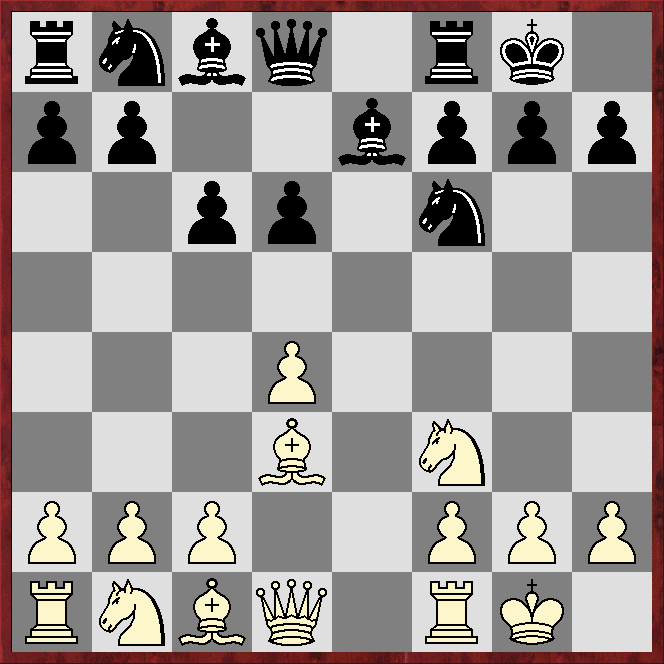
THE following well-known position from the Berlin Wall variation of the Spanish occurred in my round-five game.
There are 7,386 examples of this position in ChessBase's 2024 Mega database
*****
*****
*****
*****
*****
*****
*****
In the early days of the variation in the 1880s and early 1890s, White usually continued with 9.Nc3, and occasionally 9.Bg5+.
Emanuel Lasker, in a consultation game against three amateurs in 1896, introduced 9.Rd1+!?, which also occurred in my game.
I was somewhat surprised by Rd1 as I knew the move has been criticised on the ground that the d1 square should be reserved for the queen's rook, with the king's rook used to either enable the push f4 or to support the e pawn.
However Vladimir Kramnik's successful use of the Berlin Wall in his world championship match against Garry Kasparov apparently caused a rethink.
In that match Kramnik liked to play ...Bd7 and ...Kc8, with the king ideally later manoeuvring via b7 to c6.
So whites revived 9.Rd1+!?, more-or-less forcing 9...Ke8 as 9...Bd7 seems well-answered by 10.Ng5.
9.Rd1+!? is a favourite of Gata Kamsky, and has been played by, among others, Fabiano Caruana and Magnus Carlsen.
Not only that, but the move is the top choice of Komodo14.1 (Stockfish16 prefers the commoner 9.Nc3).
LESSON: it is easy to nod one's head in agreement at the 'illogicality' of a move such as 9.Rd1+!? But as usual the real strength of a move depends not on general considerations, but on detailed analysis.

Monday, 3 June 2024

Lessons From Kenilworth III

MANY years ago, before I had even seen a chess clock, never mind used one, I played a friendly game against another child, whose name I can no longer recall.
What I can remember is that he got upset because, although I correctly, as he saw it, said "Check!" when I attacked his king, I refused to say "Queen!" when I attacked his queen.
He insisted that saying "Queen!" was required by the rules of chess - just as much as the rules, in his view, prescribed saying "Check!"
I cannot recall how we resolved the matter, but I was reminded of the incident after my round-four game (I had taken a half-point bye in round three) in the English 65+ championship.
The game reached the following position in the opening, which became an Accelerated Dragon after starting as a Modern.
White has just played 8.Bc1-d2
*****
*****
*****
*****
*****
Clearly Black has to be wary of a discovered "Queen!"
However, even if it were White to move in the diagrammed position, there is no useful move available to the white knight.
Indeed the two commonest continuations in ChessBase's 2024 Mega database are 8...Nf6 and 8...Qb4.
In the game Black played 8...Rb8, after which a white knight-move is again of no particular consequence.
Instead I played 9.Qf3, when Black has to prevent 10.Qxf7+ as well as making sure the white knight has no useful discovered attack on the black queen.
One way of doing this is 9...f6?!, but such an ugly and weakening move could only be a last resort.
A game in Mega24 saw 9...Nf6, which Stockfish16 and Komodo14.1 agree is best, albeit reckoning the sharp 10.0-0-0 would give White a slight edge.
Our game featured another move that appears in Mega24, 9...e6?
The Mega24 game continued with 10.0-0, after which the engines reckon White has the upper hand, although Black went on to win.
No better is 10.Nd5, the engines claiming the reply 10...Qc5 gives Black a slight edge.
However 10.Nb5! is a very strong discovered "Queen!" - so strong that the engines agree the game's 10...Qxd2+!? is the best reply available.
LESSON: a discovered attack on the queen is to be as feared as a discovered attack on the king, and should be countered unless 100% sure it is harmless (and even then it will often do no harm to avoid such a discovery anyway).

Sunday, 2 June 2024

Lessons From Kenilworth II

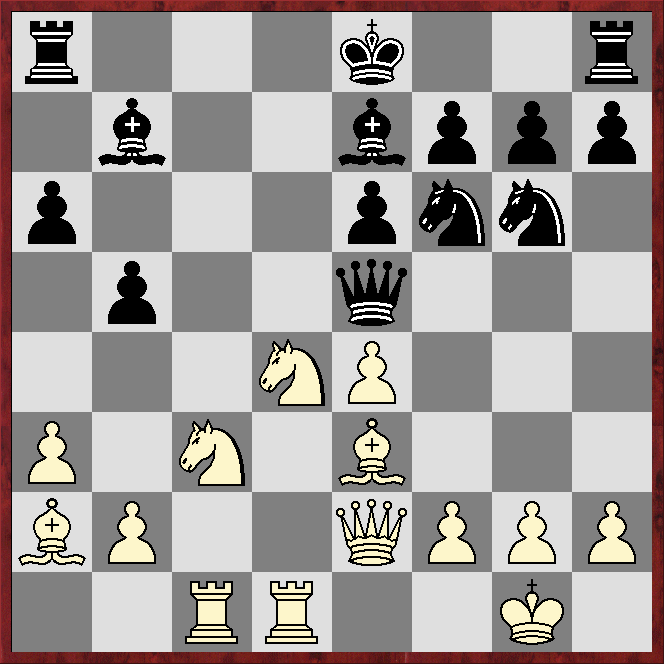
THE following position was reached in my round-two game at the English 65+ championship.
Black has just played 29...Rf8-e8
*****
*****
*****
*****
*****
*****
*****
*****
Opposite-coloured bishops are well-known to be drawish in endings, but the presence of rooks ameliorates that effect, and rival pawn-majorities further reduces the drawing tendency.
Even so, Stockfish16 calls the position completely equal, while Komodo14.1 reckons 30.Kh3, trying to activate the white majority, gives White a slight edge.
Instead the game saw 30.g4?, after which Komodo14.1 reckons Black has the upper hand, and Stockfish16 goes so far as to give Black a positionally won game.
My opponent explained in the postmortem he was worried about me playing ...g4, but there are much better ways of countering it, including 30.Kh3, 30.gxh4 and 30.Rd1.
The move chosen should have raised multiple alarm bells: it makes White's task of creating a passed pawn much harder, it leaves a weak hole at f4 and it makes the f pawn backward.
LESSON: when a move has obvious positional defects, it is imperative to consider alternatives, even if these do not prevent the move (here ...g4) that worries you.

Saturday, 1 June 2024

Lessons From Kenilworth

THE following position was reached in my round-one game from the English 65+ championship.
Black has just played 23...Qe6-g6
*****
*****
*****
*****
*****
*****
*****
*****
White is a pawn up but faces multiple threats, the most dangerous of which is 24...Qxg2#.
Clearly the extra pawn is going to have to be given back, but the question is, how to do it in such a way that minimises the damage?
24.Qf1? prevents mate, but the queen becomes passive, and after 24...Nxh3+ the white king is forced from cover.
Stockfish16 and Komodo14.1 reckon 24.Ne1!? and 24.Ne3 both leave the position completely equal, but the latter is the more-human move, improving a badly placed piece as well as attending to the main threat.
Instead I played 24.g3?, which is easily the worst move of the lot.
Black could reply 24...Nxh3+ with a large advantage, but even better is ignoring the threat to the black knight and instead playing 24...Qxe4.
After the further moves 25.gxf4 Qxf3 material was level, but White had a knight and two pawns en prise, and the white king was badly exposed.
LESSON: Wilhelm Steinitz taught that, when under pressure (I am paraphrasing), the defender should make as few concessions as possible. If one move (here 24.Ne3) both deals with the chief danger and improves the position of a piece, while having no obvious drawback, there need to be very good reasons to reject it in favour of another option.

Thursday, 30 May 2024

Summing Up Kenilworth

MY score in the English 65+ championship of +3=1-2 (I also took a half-point bye) gained 17.8 ECF and 12.8 Fide elo.