Showing posts with label Cambridge. Show all posts
Showing posts with label Cambridge. Show all posts
Friday, 27 December 2024
It's Official
THE English Chess Federation has confirmed the diary dates of Apr 24-28 for the English Seniors and May 26-31 for the Cambridge International.

Tuesday, 24 December 2024
Diary Heads-Up
ONE of the great bargains of modern chess is ChessMoves, the magazine of the English Chess Federation.
It comes free with membership of the ECF, and since membership is more-or-less compulsory for English people wanting to play competitive chess in England, ChessMoves is effectively a freebie.
The ECF could easily turn out any old tosh, but on the contrary ChessMoves is full of interesting articles, many of which are highly instructive.
The latest issue arrived in my email inbox today, with grandmaster Danny Gormally's piece, headed Time, Planning and Speed, being the pick of the articles, at least on a first read-through.
But at least as interesting to me are the dates for the English Seniors Championships and the Cambridge International, announcements which were eagerly anticipated.
The seniors' events will apparently be at Kenilworth Holiday Inn from April 24-28, while the Cambridge tournament is down for May 26-31.
I write apparently because a little later in the magazine there appears: "The English Seniors Championships usually takes [sic] place around May, but there are no further details at this stage."
Nevertheless, it is probably a good idea to at least pencil in the above dates.
Unfortunately, the Kenilworth clashes with tournaments planned for Guildford, Oxford, Yarmouth and elsewhere, but such clashes are difficult to avoid in today's chess world.
Wednesday, 28 February 2024
Tuesday, 27 February 2024
Cambridge Round Nine
FACED a junior (born 2006).
*****
*****
*****
Mohammed Aayan Ismail (2301 ECF/2111 Fide) - Spanton (1916 ECF/1766 Fide)
Catalan
1.d4 d5 2.c4 e6 3.Nf3 Nf6 4.g3 Bb4+ 5.Bd2 Be7!? 6.Bg2 0-0 7.0-0 Nbd7 8.Qc2 c6 9.Nc3!?
An unusual continuation. The main moves in ChessBase's 2024 Mega database are 9.b3, 9.Rd1 and especially 9.Bf4, but the text has also been played by grandmasters.
 |
| How should Black respond? |
*****
*****
*****
*****
9...dxc4
This is the commonest continuation, and is the top choice of Stockfish16 and Komodo14.1.
10.e4 b5 11.e5 Nd5 12.Ne4
 |
| How should Black proceed? |
*****
*****
*****
*****
12...f5?!
This seems to be a novelty, and probably not a good one. Normal is 12...h6, with a slight edge for Black, according to the engines.
13.exf6 N7xf6 14.Ne5 Bd7!?
13.exf6 N7xf6 14.Ne5 Bd7!?
The engines prefer 14...Qc7, the idea being to follow-up with ...Nd7 or ...c5.
15.b3 c3!?
Returning the pawn in a bid to keep lines closed, but perhaps better is 15...cxb3 or 15...Nxe4!?
16.Nxc3 Nxc3 17.Qxc3 Nd5 18.Qc2 Rc8 19.Ba5!?
The engines prefer targeting he weak e pawn directly with 19.Bh3 or 19.Rfe1, but agree White has at least the upper hand after the text.
 |
| How should Black reply? |
*****
*****
*****
*****
19...Qxa5?
Better is 19...Qe8.
20.Nxd7 Rfd8 21.Qe4 Bf6
If 21...Nc7, then 22.Bh3, and the e pawn falls anyway.
22.Qxe6+ Kh8 23.Bxd5 Re8!?
Also deeply unpleasant is 23...cxd5 24.Nxf6 etc.
The game finished:
24.Qf5 Bxd4!? 25.Rad1 Bxf2+!? 26.Rxf2 cxd5 27.Nf8! Re1+ 28.Kg2 1-0
Monday, 26 February 2024
Cambridge Round Eight
Spanton (1916 ECF/1766 Fide) - Ian Gooding (2099 ECF/1910 Fide)
*****
French Exchange
1.e4 e6 2.d4 d5 3.exd5 exd5 4.Nf3 Nc6!?
The main moves are 4...Nf6 and 4...Bd6, but the text is also popular - more so than the aggressive 4...Bg4.
5.Bd3 Bg4 6.c3 Bd6 7.0-0 Qd7 8.Re1+ Nge7 9.Nbd2
 |
| Which way should Black castle? |
*****
*****
*****
*****
9...0-0
A common recommendation for higher-rated blacks, seeking to avoid the drawish tendencies of the Exchange Variation of the French Defence, is to castle on the opposite side from White. Indeed, in ChessBase's 2024 Mega database, there are 187 examples of the text, but 623 of 9...0-0-0. Not only that, but with the latter Black scores an amazing 61%, compared with a lower, but still very good, 53% for the former. However, Stockfish16 and Komodo14.1 much prefer the text, and certainly White's play on the queenside after 9...0-0-0 looks more promising than Black's on the kingside.
10.Qc2
A common-enough move, but the engines prefer 10.Nf1.
10...Bf5 11.Nf1 Bxd3 12.Qxd3 Ng6 13.Ng3 Rfe8 14.Bd2 a6!?
This was also Ukrainian grandmaster Vladimir Tukmakov's choice in the 2000 Slovenian team championship against Croatian international master Boris Golubovic.
15.Qf5 Qxf5 16.Nxf5
15.Qf5 Qxf5 16.Nxf5
The Golubovic (2466) - Tukmakov (2582) game was agreed drawn at this point.
16...Bf8 17.h4 Nge7 18.Nxe7+ Nxe7 19.Re2 Nf5 20.Rae1 Nd6 21.Rxe8 Rxe8 22.Rxe8 Nxe8 23.Bf4 c6 24.a4 f6 25.Kf1 Nd6 26.Bxd6 Bxd6 27.Ke2 Kf7 28.Ne1 Ke6 ½–½
Sunday, 25 February 2024
Cambridge Round Seven
FACED a junior (born 2010).
*****
*****
*****
Max Pert (2210 ECF/2082 Fide) - Spanton (1916 ECF/1766 Fide)
Jobava-Prié
1.d4 d5 2.Nc3 Nf6 3.Bf4 a6!?
As I pointed out in the introduction to my series on ideas behind the Jobava-Prié, this 'duffers' move' has been played by "those well-known non-duffers Carlsen, Caruana, Svidler and Nakamura."
4.e3 Bf5 5.f3 e6 6.g4 Bg6 7.h4 h6 8.Bd3
 |
| How should Black continue? |
*****
*****
*****
*****
8...Bh7
Stockfish16 and Komodo14.1 prefer 8...Bxd3, but disagree as to whether White should reply 9.Qxd3 or 9.cxd3.
9.Nge2 c5 10.Bxh7 Nxh7 11.Qd2 Nc6 12.dxc5 Bxc5 13.0-0-0 Qe7
The engines prefer 13...Rc8 or 13...0-0!?
14.Nd4 Nxd4 15.exd4 Bb4 16.Qe3 Bd6!? 17.Rde1 Bxf4 18.Qxf4 0-0-0
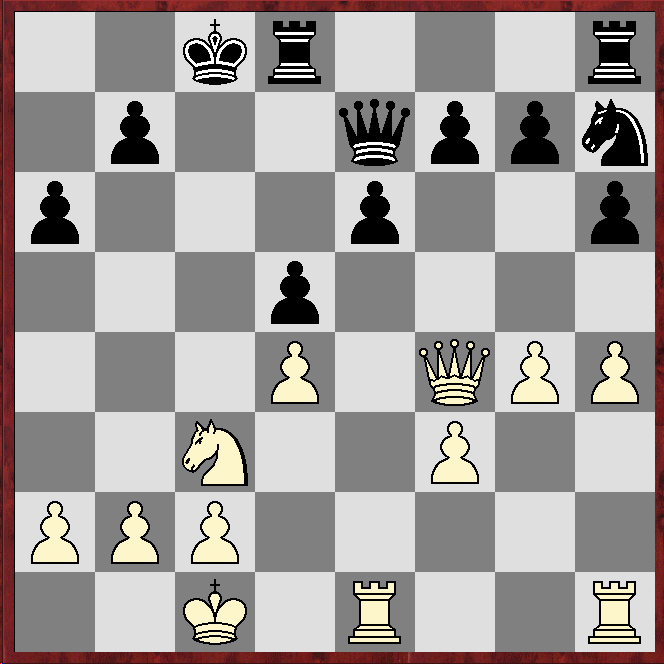 |
| Now both sides have castled, how would you assess the position? |
*****
*****
*****
*****
White has more space and the better-coordinated pieces. The engines reckon White has a slight edge.
19.Qe5 Qf6 20.f4 Rd7 21.f5 Qxe5 22.Rxe5 Nf6!?
The engines prefer 22...Rd6.
23.fxe6 fxe6 24.Rg1!?
This may be too passive. The engines reckon 24.Rxe6 Nxg4 25.Na4 gives White the upper hand.
24...Rd6 25.g5 Nd7 26.Re3 hxg5 27.hxg5 Rh4 28.Ne2 Kd8 29.b3 Rc6?!
The engines prefer the consistent 29...Ke7. Note that White is not threatening to play c4, so there was no need to remove the rook from its position of protecting d5 and, at the same time, providing latent pressure against d4.
30.Rf1 Rg4?!
Probably 30...Ke8 is better.
31.Nf4 e5!? 32.dxe5 Rxg5 33.e6 Nf6 34.e7+ Kd7?!
Probably better is 34...Kd8, but 35.Rh1 is strong.
35.Nh3 Rg2 36.Rxf6! Rgxc2+
 |
| White to play and win |
*****
*****
*****
*****
37.Kb1 1-0
Note that 37.Kd1? only draws after 37...Rc1+ 38.Ke2 R1c2+.
Saturday, 24 February 2024
Cambridge Round Six
Spanton (1916 ECF/1766 Fide) - Ole Bay-Petersen (1826 ECF/1672 Fide)
*****
*****
*****
Franco-Benoni
1.e4 e6 2.d4 c5!?
 |
| How should White respond to Black's somewhat unusual opening? |
*****
*****
*****
*****
*****
Actually, the position is arguably not all that unusual - there are 8,270 examples in ChessBase's 2024 Mega database. Surprisingly, at least to me, 4,274 games (52%) saw White continue with 3.Nf3, transposing into an ...e6 Sicilian. I guess there are two main reasons for this: i) whites want to stay in their known theory; ii) they reason the opponent, being a 1...e6 player, will not welcome playing the black side of a Sicilian.
3.d5
This must be the theoretically approved response, but it has the practical defect that Black will probably have greater experience of the resulting lines.
3...exd5 4.exd5 d6 5.Nf3 a6 6.a4
This is almost a reflex-reply to ...a6 in Benoni-like setups, but Komodo14.1 suggests preventing ...b5 with 6.c4!?, while Stockfish16 wants White to ignore Black's 'threat', and instead play 6.Bd3!?
6....Nd7 7.Nc3 g6?!
Black probably cannot afford in this particular setup the luxury of fianchettoing the kingside bishop, even though that is the normal idea in Benoni setups.
 |
| How can White exploit Black's slow play? |
*****
*****
*****
*****
8.Bf4
White is better after this, but stronger seems to be Stockfish16's 8.Qe2+!? If 8...Qe7?!, then 9.Ne4, threatening 10.Nxd6+, is very unpleasant. Even worse is 8...Ne7? 9.Ne4, which leaves 8...Be7 - not what Black wants to play after ...g6.
8...Ndf6 9.Be2 Bg7 10.Qd2 h6!? 11.0-0 Ne7 12.Rfe1 g5!?
This is the type of move novices are warned against, but the position is similar to those arising from the Hippopotamus, in which, with the centre relatively locked and White having committed to castling short, Black launches a pawn-led kingside attack.
13.Be3 0-0 14.h3 Nf5 15.Bd3 Nxe3 16.Rxe3 Nd7!?
More promising is 16...Nh5, with pressure against the white king's position.
17.Rae1 Ne5
Consistent, but the engines reckon Black should eat humble pie and play 17...Nf6!?
18.Nxe5 Bxe5 19.Rxe5!?
The engines reckon 19.Qe2 is also strong, but the text creates practical problems, as well as being good anyway.
19...dxe5 20.Rxe5
 |
| In return for the exchange, White has a passed pawn, and tempting black kingside weaknesses to target, while also enjoying a large lead in development |
*****
*****
*****
*****
20...Bd7
The engines suggest 20...Qf6!?, which develops a piece with tempo, while bringing help to to the black kingside.
21.d6 b6?
Black does not have time to defend c5. However, after the engines' 21...Qf6 the simple 22.Rxc5 is good.
22.Nd5 Re8 23.Ne7+ Rxe7
Slightly better, according to the engines, but still clearly losing, is 23...Qxe7!?
24.dxe7 Qe8 25.Rxg5+! Kh8
Or 25...hxg5 26.Qxg5+ Kh8 27.Qh6+ Kg8 28.Qh7#.
26.Qc3+ 1-0
Friday, 23 February 2024
Cambridge Round Five
Benedict Keohane (2063 ECF/1926 Fide) - Spanton (1916 ECF/1766 Fide)
*****
*****
*****
*****
*****
*****
King's Gambit
1.e4 e5 2.f4 Bc5 3.Nf3 d5!? 4.Nxe5!?
More common in ChessBase's 2024 Mega database is 4.exd5, but the text has been recommended in several books and is preferred by Stockfish16 and Komodo14.1.
4...dxe4!?
This used to be regarded as refuted, but has been revived.
 |
| How should White respond? |
*****
*****
*****
*****
5.Qh5!?
The mainline in Mega24 runs 5.Bc4 Nh6 6.Qh5 0-0 7.Nxf7 Bf2+!? 8.Kxf2 Qd4+ 9.Ke1, and now 9...Nxf7 gave equality, according to the engines, in Anthony Milnes (2019) - Spanton (1969), Guernsey 2016 (½–½, 34 moves).
5...Be6 6.Nxf7 Bf2+!? 7.Kxf2 Bxf7 8.Qe5+ Ne7 9.Qxg7!?
This must be the critical continuation. Two games reach the position in Mega24, one continuing 9.Bb5+?! and the other 9.b3!? I have additionally faced 9.Qxe4!?
9...Rg8 10.Qe5
White can grab a third pawn with 10.Qxh7!?, when 10...Qd4+ 11.Ke1 Rh8 12.c3 Qf6 13.Qxe4 leaves White four pawns up. Komodo14.1 reckons Black has enough compensation; Stockfish16 reckons Black has more than enough.
10...Nc6 11.Qc5
After 11.Qxe4, going three pawns up, the engines recommend 11...Qd6, followed by ...0-0-0, claiming the upper hand for Black.
11...Nd5 12.g3?!
The engines suggest 12.Nc3!?
12...Nxf4! 13.d3
Not 13.gxf4? Qh4+ 14.Ke3 (or 14.Ke2 Bh5+ etc) 14...Qe1+ 15.Be2 Qxh1.
13...Ne6 14.Qc3 Ncd4 15.dxe4 Qf6+ 16.Kg2 0-0-0 17.Bc4 Nf4+ 18.Bxf4 Qxf4 19.Bxf7
The engines prefer 19.Re1 or 19.Nd2, but agree Black is winning.
19...Qxe4+ 20.Kh3 Qf5+ 21.Kg2 Qxf7
Black is still winning after this, but even stronger is 21...Qe4+ 22.Kh3 Rd6 (this could also have been played at move 20), after which Black has a forced mate.
22.Nd2
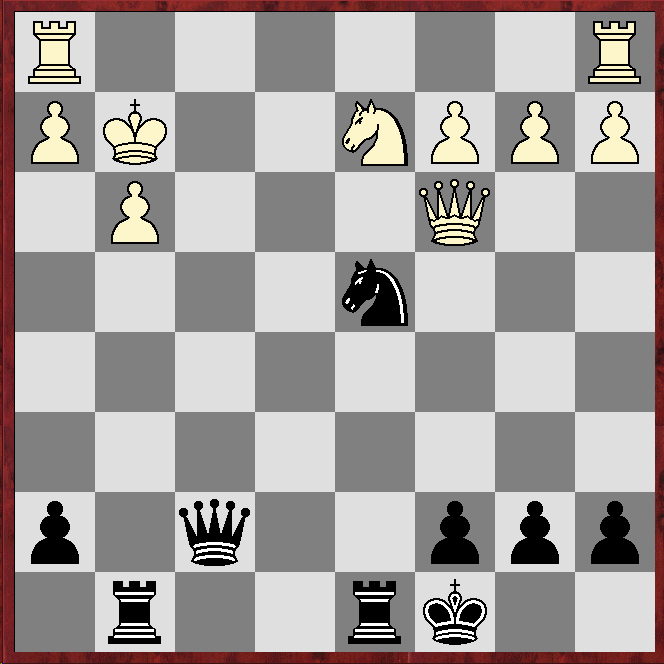 |
| Black to play and win |
*****
*****
*****
*****
22...Qd5+?
The easiest win is probably 22...Ne2, eg 23.Qe3 Qd5+ 24.Nf3 Rde8 25.Nd4!, threatening both 26.Qxf3+ and 26.Re2+.
23.Nf3 Rgf8 24.Rhf1?
The engines reckon White is, at worst, only slightly inferior after R(either)d1.
24...Nxf3 25.Rxf3
 |
| Black to play and win |
*****
*****
*****
*****
25....Qd2+?
Winning is 25...Qxf3 26.Qxf3 Rd2+ and 27...Rxf3.
26.Kg1 Rxf3 27.Qxf3 Qxc2 28.Qg4+ Kb8 29.Qg5 Qd3
The engines prefer 29...Rf8!?
30.Rf1 b6 31.Qf5 Qd4+ 32.Rf2 Rd7 33.Kg2 Kb7 34.b3 a5
I offered a draw.
 |
| How would you assess the position? |
*****
*****
*****
*****
White has the smaller, and therefore faster-moving, pawn-majority. But this is probably not significant as long as queens are on the board, as they make it problematic for either side to leave his king exposed.
35.Qf3+ Qd5?!
The engines reckon that after ...
36.Qxd5+ Rxd5
... the position remains equal, but it is surely easier for White to play.
37.h4 h5 38.Rc2 Rd3 39.Re2 Kc6 40.Re6+ Kd5!?
The engines do not like this, wanting the king to withdraw to b7 or d7.
41.Rh6 Ke4 42.Rxh5 Rd2+ 43.Kh3 Rxa2 44.Rb5 Kf3?!
The engines agree this makes matters worse, but they cannot agree on what Black should play -suggestions include 44...Rf2, 44...c5 and 44...Rd2.
45.Rf5+ Ke4 46.Kg4 Rb2 47.Rb5?
White should push the passed h pawn.
 |
| Black to play and draw |
*****
*****
*****
*****
47...Rd2
The engines reckon 47...c5! gives complete equality, eg 48.Rxb6 c4 49.h5 Rxb3 50.Ra6 c3 51.Rxa5 c2 52.Rc5 Kd3 53.h6 Rb4+ 54.Kf3 Rb1 55.h7 Rh1 etc.
48.h5 Rd6 49.Rg5 c5!? 50.Rg6 Rd4 51.Rxb6 Kd3+ 52.Kf5 a4!?
Desperation, but the game is well gone.
53.bxa4 c4 54.h6 c3 55.h7 Rd8 56.Rc6 c2 57.Kg6 Kd2 58.Kg7 Rd7+ 59.Kg8 Rd8+ 60.Kg7 Rd7+ 61.Kh6 Rd8 62.g4 c1=Q 63.Rxc1 Kxc1
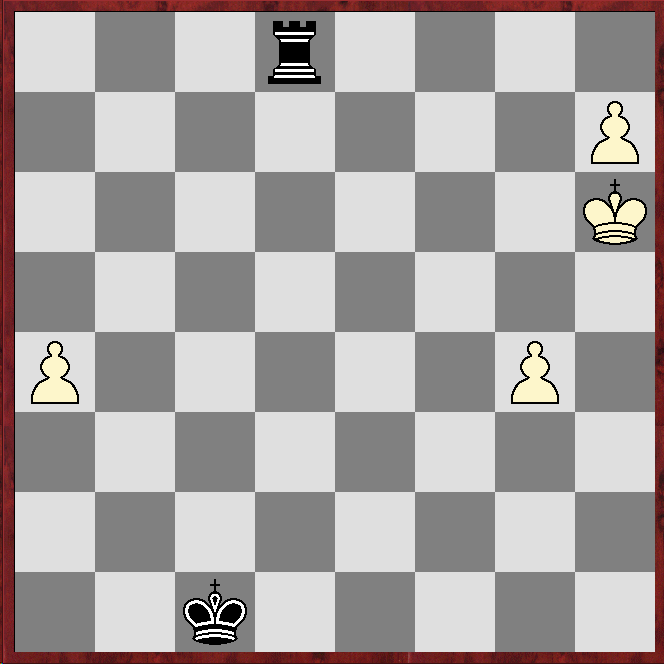 |
| White's three pawns easily beat Black's rook |
*****
*****
*****
*****
The game finished:
64.g5 Kd2 65.g6 Kc3 66.g7 Rd6+ 67.Kg5 1-0
Thursday, 22 February 2024
Cambridge Round Four
DOWNFLOATED against a junior (born 2008).
Nina Pert (2158 ECF/2010 Fide) - Spanton (1916 ECF/1766 Fide)
Sicilian Accelerated Dragon
1.e4 c5 2.Nf3 g6 3.d4 cxd4 4.Nxd4 Nc6 5.Nxc6!? bxc6 6.Qd4
This line seems to have been first played by Emanuel Lasker in 1892, and was a favourite of Harry Pillsbury.
6...Nf6 7.e5 Nd5 8.Bc4!?
The main continuation in ChessBase's 2024 Mega database runs 8.e6 f6 9.exd7+ Bxd7 10.Bc4, with an equal game, according to Stockfish16 and Komodo14.1.
8...Qb6 9.Qe4 Bg7 10.0-0 0-0
 |
| Now both sides have castled, how would you assess the position? |
*****
*****
*****
*****
White has more space in the centre, but Black has a central pawn-majority, and is slightly better, according to the engines.
11.Nd2!?
This apparent-novelty is liked by the engines. Known moves are 11.Bb3!?, 11.Nc3!? and 11.Bxd5!?
11...Ba6 12.Re1 Nc7!? 13.Bxa6 Qxa6 14.Nf3 d5 15.Qh4 Rae8 16.a4!?
Preparing a rook lift.
16...Ne6 17.Ra3 f6 18.Qh3 Qc8 19.Bh6 Nc5 20.Qh4 Ne4 21.Bxg7 Kxg7 22.e6 g5?
Weakening. The engines reckon Black is slightly better after 22...c5.
23.Qh3 c5 24.Qf5 Rd8 25.Rd3 Qb7
The engines suggest 25...Qb8, but give White has the upper hand.
 |
| White to play and win |
*****
*****
*****
*****
26.Rxe4!!
Bearing in mind White, among other things, is susceptible to a back-rank mate, this seems to me a remarkable combination.
26...dxe4 27.Nxg5! fxg5 28.Qxg5+ Kh8 29.Qe5+ Rf6 30.Rxd8+ Kg7 31.Rd7
White has a forced mate. The game finished:
31...Qb6 32.Rxe7+ Kg6 33.Qxe4+ 1-0
Wednesday, 21 February 2024
Cambridge Round Three
Spanton (1916 ECF/1766 Fide) - Ian Reynolds (1882 ECF/1951 Fide)
Nimzo-Indian
1.d4 Nf6 2.c4 e6 3.Nc3 Bb4 4.Bd2!? 0-0 5.Nf3 d5 6.e3 b6 7.Rc1 Bb7 8.Bd3 Nbd7 9.cxd5 exd5 10.0-0
 |
| Now both sides have castled, how would you assess the position? |
*****
*****
*****
*****
*****
It occurs 243 times in ChessBase's 2024 Mega database. Stockfish16 and Komodo14.1 reckon the position is equal.
10...Rc8
The main move in Mega24 is 10...a6, but the engines prefer 10...Be7!?
11.Nb5 Bxd2 12.Qxd2 a6?!
The engines prefer 12...c5, one point being 13.Nxa7 is met by 13...Ra8 14.Nb5 Rxa2,
13.Na7 Ra8 14.Nc6 Qe8
The engines fluctuate between preferring the text and 14...Bxc6.
15.Qb4?!
White has the upper hand after, for example, 15.b4, according to the engines.
15...Bxc6 16.Rxc6 Nc5 17.Rxc5 bxc5 18.Qxc5 Qd7
IR offered a draw in my time, explaining he was tired after a double-round day, and anyway was the exchange up.
 |
| Should I have accepted the draw? |
*****
*****
*****
*****
The engines reckon White's active pieces, combined with Black's queenside weaknesses, mean White is slightly better, despite being down rook for bishop and pawn.
19.Rc1 a5 20.Bb5 Qd6!? 21.Qc2
Black has the upper hand after 21.Qxd6? cxd6, according to the engines, but they prefer 21.Bc6!?
21...g6!? 22.Ne5 Rab8 23.Ba4
The engines like 23.a4!?
23...c5!? 24.Nc6 c4
The engines are fine with giving back the exchange, but reckon a better way of doing it is 24...cxd4!? 25.Nxb8 Rxb8 26.exd4 Rb4 27.Bb3 Rxd4.
25.Nxb8 Rxb8 26.b3 Qa3 27.h3 Kg7!?
As will be seen, it can important in some lines that the black rook is not captured with check.
28.f3!? Rc8 29.Bb5 Rb8 30.Ba4 Rc8 31.Qd2?!
Probably better is 31.Qb1, or the engines' 31.Ra1!?
 |
| Can you find an interesting combination for Black? |
*****
*****
*****
*****
31...cxb3!
The engines agree this is Black's best chance for an advantage.
The engines agree this is Black's best chance for an advantage.
32.Rxc8 bxa2 33.Rc1 a1=Q 34.Rxa1 Qxa1+ 35.Qd1
 |
| Should Black keep queens on? |
*****
*****
*****
*****
35...Qxd1+
The engines marginally prefer keeping queens on, but agree the position is anyway equal.
36.Bxd1 Nd7 37.Kf2 Nb6 38.Ke2 Kf6
The passed pawn cannot be successfully pushed, eg 38...a4 39.Kd3 a3 40.Bb3, after which progress is impossible.
39.Kd3 Ke6 40.e4 f6 41.Bb3 Kd6 42.Kc3 g5 43.Ba2 h6 44.Kd3 Ke6
IR offered a draw (more-or-less correctly).
45.g4 Kd6 46.Bb3 Ke6 47.exd5+!?
It might seem as if Black has walked into a trap, but the position remains equal.
47...Kd6
Not 47...Nxd5?? 48.Ke4 etc.
48.Ke4 a4 49.Ba2 a3
Over a drink after the game, IR suggested the engines' evaluation of the game may not have risen above +1.00 for either side at any point. Basically he was right ... until my next move.
 |
| How should White proceed? |
*****
*****
*****
*****
50.Kf5?
This is losing. Instead White should mark time with 50.Bb3, eg 50...Nf4!? 51.Kf5 Nc3 52.Kf6 Nxd5+, but not 52...a2? 53.Bxa2 Nxa2 54.Kg6, after which the white pawns win. Alternatively 50.f4 also draws, eg 50...gxf4 51.Kxf4 Nxd5+ 52.Kf5 Nc3 53.Bb3 Ne2 etc.
50...Nxd5 51.Bb3 Nf4 52.Kxf6
 |
| Black to play and win |
*****
*****
*****
*****
52...Nxh3
The engines show the winning plan starts with 52...Ne2!, eg 53.Kg6 Nd4 54.Ba2 Nxf3 55.Kxh6 Ke5 56.Kg6 Kf4 etc.
53.Kg6 Ng1 54.Kxh6 Nxf3 55.Ba2 Nxd4 56.Kxg5 Ke7 57.Kg6 Kf8 58.Kf6 Nc3 59.Bb1 Nb4 60.g5
I offered a draw.
60...a2 61.Bxa2 Nxa2 62.g6 Nb4 ½–½
Tuesday, 20 February 2024
Cambridge Round Two
James Cole (2116 ECF/1940 Fide) - Spanton (1916 ECF/1766 Fide)
*****
*****
*****
*****
*****
*****
Catalan
1.d4 d5 2.c4 e6 3.Nf3 Nf6 4.g3 Bb4+ 5.Bd2 Be7!?
 |
| Black's well-known manoeuvre with the dark-square bishop loses a tempo but is generally considered to misplace White's dark-square bishop, which otherwise would probably be fianchettoed |
*****
*****
*****
*****
6.Bg2 0-0 7.Qc2 c6 8.0-0 b6 9.Rd1 Bb7
9...Ba6!? 10.Ne5 marginally favours White, according to Stockfish16, although Komodo14.1 disagrees.
10.Bf4 Nbd7 11.Ne5 Nxe5
The engines suggest 11...Nh5 12.Bd2 Nhf6!?, a popular continuation in ChessBase's 2024 Mega database.
12.dxe5 Nd7 13.e4?!
The engines much-prefer 13.cxd5, followed by 14.e4.
13...g5?!
Probably a novelty, and probably not a good one. The engines reckon Black is at least slightly better after 13...dxc4, the main points being, presumably, White's bishops are badly restricted, and Black has the better-structured pawn-majority.
 |
| How should White proceed? |
*****
*****
*****
*****
14.Be3
This looks normal, but the engines like 14.exd5!?, eg 14...gxf4? 15.dxc6, or 14...cxd5 15.cxd5 gxf4 16.dxe6, with a complicated position that slightly favours White, according to the engines.
14...Nxe5?!
The position is completely equal after 14...dxc4, according to the engines. The problem with the text is it helps open lines to Black's weakened kingside.
15.exd5 cxd5 16.cxd5 Bxd5 17.Nc3 Qc7?!
White has a winning position after this, according to the engines, which reckon necessary is 17...Qc8!?, keeping a watch on what turns out to a very vulnerable f5 square. Nevertheless the engines reckon their suggestion leaves White with the upper hand.
18.Bxd5 exd5 19.Qf5
 |
| The black position is collapsing |
*****
*****
*****
*****
19...Ng6
The engines suggest 19...Rae8, 19...d4 or 19...f6, but reckon White is winning.
20.Nxd5 Qb7 21.Bxg5 Bxg5 22.Qxg5 f5 23.Nf4
Even stronger seems to be the engines' 23.Nf6+, and if 23...Kh8 then 24.Rd7.
23...Qe7!? 24.Qxe7 Nxe7 25.Rd7 Ng6 26.Ne6 Rf7 27.Rad1 Rxd7
Not 27...Ne5?? 28.Rd8+ etc.
28.Rxd7 Re8
 |
| What should White play? |
*****
*****
*****
*****
29.Rd8!?
Getting rooks off the board is usually commendable in a pawn-up ending as their presence often increases drawing chances, but here the resulting knight-and-pawn ending seems not very favourable for White.
29...Rxd8 30.Nxd8 Ne5
 |
| Both black pieces are a little better-placed than the white ones |
*****
*****
*****
*****
31.b4
The engines suggest 31.f4, 31.b3 or 31.Kf1, claiming a winning advantage for White.
31...b5!?
Possibly better is 31...Nf3+ and 32...Nd4.
32.Ne6 Nc6 33.Nc7 Nxb4 34.Nxb5 Nxa2 35.Nxa7 Kf7
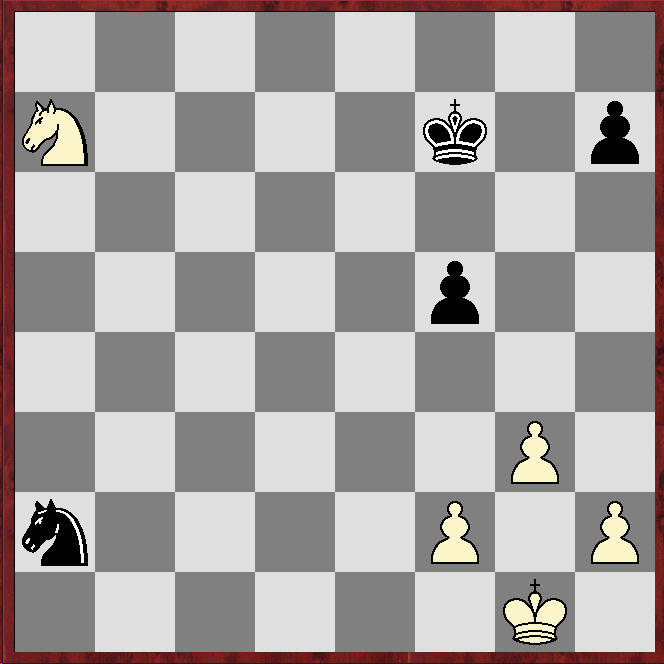 |
| White remains a pawn up, but that is probably not enough with all pawns being on one side of the board |
*****
*****
*****
*****
36.f4 Ke6 37.Nc6 Nc3 38.Nd4+ Kf6 39.Kg2 Nd5 40.Kf3 h5 41.Ke2 Kg6
A possibly simpler way to draw is 41...h4, and if 42.Kf3 hxg3 43.Kxg3 White's passed h pawn is not going anywhere, fast or slow, it would seem.
42.Nf3 Kf6 43.Kd3 Ke6 44.Nd4+ Kf6 45.Nc2 h4 46.Kc4 hxg3 47.hxg3
Not 47.Kxd5?? gxh2.
47...Ne7 48.Kc5 Ng8 49.Ne3 Ke6 50.Nc2 Nh6 51.Nd4+ Kf6 52.Kd6 Ng4 53.Nc2 Nf3 54.Ne3 ½–½
Monday, 19 February 2024
Cambridge Round One
Spanton (1916 ECF/1766 Fide) - Norman Hutchinson (1979 ECF/1962 Fide)
*****
*****
*****
*****
*****
*****
Caro-Kann Classical
1.e4 c6 2.d4 d5 3.Nc3 dxe4 4.Nxe4 Bf5 5.Ng3 Bg6 6.Nf3 Nd7 7.h4 h6 8.h5 Bh7 9.Bd3 Bxd3 10.Qxd3
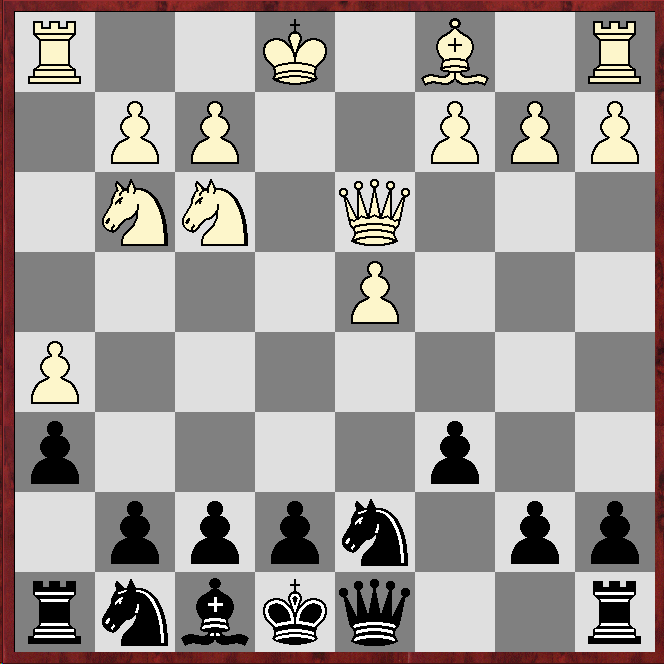 |
| There are 23,714 examples of this position in Chessbase's 2024 Mega database |
*****
*****
*****
*****
*****
10...e6 11.Bf4 Qa5+ 12.Bd2 Bb4 13.c3 Be7 14.c4 Qc7 15.0-0-0 Ngf6 16.Ne4 b5 17.c5!?
Giving up the d5 square, but keeping lines closed on the queenside and hoping to later use the d6 square.
17...a5 18.Nxf6+
This may be a novelty. Susanto Megaranto (2492) - Mohammed Al-Sayed (2486), Asia Classical (Doha, Qatar) 2006, went 18.Kb1 a4 19.Nxf6+ Nxf6 20.Ne5 Nd5, with an equal game, according to Stockfish16 and Komodo14.1 (½–½, 67 moves).
18...Nxf6 19.Ne5!?
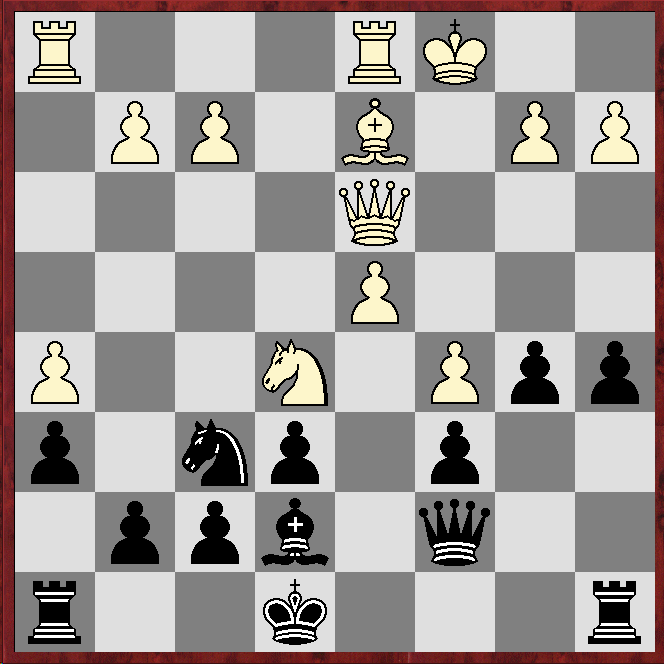 |
| How should Black respond? |
*****
*****
*****
*****
*****
19...Rd8?!
The engines reckon best-play runs 19...Bxc5 20.Ng6 fxg6 21.Qxg6+ Qf7 22.dxc5 0-0 with equality.
20.Qg3 Rxd4?!
The engines are not keen on this, but cannot decide what is best, suggestions including 20...Rf8!?, 20...Rg8, 20...Bf8 and 20...Rh7.
21.Qxg7
Almost certainly better is the engines' 21.Bxa5!? Rxd1+ 22.Rxd1, when 22...Qxa5? fails to 23.Nxc6. Instead Black should perhaps play 22...Qb8, but the engines reckon White is winning, eg 23.Nxc6 Qxg3 24.fxg3 with strong queenside play.
21...Rh7
The engines prefer 21...Rf8!?, claiming complete equality, eg 22.Rhe1 Rd5 23.Ng4 Nxh5 24.Qxh6 Rg8 25.f3 Qg3, but the position remains sharp.
22.Qg3 Nd7?
Probably best is the engines' 22...Bxc5 23.Bc3 Rxd1+ 24.Rxd1 Be7, although they reckon White has more than enough compensation for a pawn.
 |
| White to play and gain a winning advantage |
*****
*****
*****
*****
23.Nxd7?
I rejected 23.Qg8+ because of 23...Nf8, but the engines reckon 24.Bc3! wins, eg 24...Rd5 25.Rxd5 cxd5 26.Kb1! Qxc5 27.Ng6! fxg6 28.hxg6. Possibly even stronger is their other main line, 23.Bc3! Qxe5 24.Qg8+ Bf8 25.Bxd4 Qg5+ 26.Qxg5 hxg5 27.g4 Nxc5 28.Bxc5 Bxc5 29.Rd2, when Black does not seem to have enough for the exchange.
23...Qxg3 24.fxg3 Rxd7 25.Bxa5 Rxd1+ 26.Rxd1 Rg7
 |
| Black is temporarily a pawn down, but that will not last, and the ending is easier for Black to play |
*****
*****
*****
*****
27.Bd2 Rxg3 28.Bxh6 Rxg2
 |
| How should White continue? |
*****
*****
*****
*****
29.Bf4?!
The engines reckon 29.Rh1! just about holds, but they also reckon 29.Rd2!? is better than the text.
29...Rg4 30.Bd6 Bg5+
Also strong is 30...Rc4+ 31.Kb1 Bxd6 as 32.cxd6? Rh4 is hopeless, but 32.Rxd6 Rxc5 33.h6 Ke7 34.h7! Rh5 35.Rxc6 Rxh7 36.Rc5 b4 is also very difficult for White, eg 37.Rc4 b3! 38.axb3 Kd6, when Black's connected passers are much better than White's doubled isolanis.
31.Kc2 Rh4
The engines' 31...Rc4+! obliges White to block the third rank with 32.Kb3 or 32.Kd3, reducing White's counterplay, while they reckon even worse is 32.Kb1?!
32.Rd3 Rxh5 33.Ra3 f5 34.Ra8+?!
Probably better is immediately going after the c6 pawn with 34.Ra6.
34...Kf7 35.Rf8+ Kg7 36.Re8 f4!?
This wins, according to the engines.
37.Rxe6 Rh2+ 38.Kd3
 |
| Black to play and win |
*****
*****
*****
*****
38...Kf7?
Also insufficient, it seems, is 38...Rxb2?! 39.Be5+ Kf7 40.Rxc6 Rxa2 as White has 41.Rb6, but winning is 38...Rh3+ as the f pawn cannot be stopped.
39.Re2
Stockfish16 reckons 39.Bxf4!? Bxf4 40.Rxc6 is also completely equal, but Komodo14.1 gives Black a slight edge.
39...Rh3+ 40.Ke4 Re3+!? 41.Rxe3 fxe3 42.Kd3 Ke6 43.b3
Other moves also draw, eg 43.a3 e2!? 44.Kxe2 Bc1 45.b3 Bxa3 46.Kd3 Kd5 47.Kc3 Bxc5 48.Bxc5 Kxc5 49.b4+ with a drawn pawn-ending.
43...b4 44.Bf8 Kd5 45.Bd6 Bh6 ½–½
Saturday, 17 February 2024
Cambridge
AM making final preparations for traveling to Cambridge tomorrow for the English Chess Federation's 2nd Cambridge International.
I will be staying at the Holiday Inn Express, "a convenient hotel three miles from the city centre."
The event's capacity of 120 entrants was met long ago, the list including eight grandmasters, 14 international masters and 11 Fide masters.
Leading the seedings, by more than 100 elo, is England's Michael Adams, but 21 other countries are also represented.
The venue is the University Arms Hotel, where the tournament runs from Monday to Saturday.
 |
| University Arms - "Cambridge's leading luxury hotel since 1834" |
The format of the tournament is unusual, with Monday, Wednesday and Friday being double-round days, games starting at 10:30 and 16:30; Tuesday and Thursday have a game at 16:30; Saturday at 10:30.
The time control is 90 minutes, with a 30-second increment.
Baku accelerated pairings will be used, although, since I am seeded in the fourth quarter, that means I should still get a relatively tough opponent in round one.
Subscribe to:
Posts (Atom)