Showing posts with label Piece for 3 pawns. Show all posts

Monday, 12 August 2024

Olomouc Round Four

Spanton (1980) - Josef Kolek (1853)
Modern
1.e4 d6 2.d4 g6 3.Nc3 Bg7 4.f4 Nc6!?
This is fourth in popularity in ChessBase's 2024 Mega database behind 4...c6, 4...a6 and especially 4...Nf6.
How should White respond?
*****
*****
*****
*****
*****
5.d5!?
This has been played by grandmasters, but Stockfish16.1 and Dragon1 prefer 5.Nf3 and, even more so, 5.Be3.
5...Nb8
Slightly more popular is 5...Nd4!?
6.Nf3 Bg4!?
The engines strongly dislike this, favouring 6...c6.
7.h3 Bxf3 8.Qxf3 Nd7 9.Bc4!?
This may be a novelty; known moves are 9.Bb5 and 9.Be3.
9...Ngf6 10.0-0 0-0
Now both sides have castled, how would you assess the position?
*****
*****
*****
*****
*****
White's bishop-pair and space advantage in the centre and on the kingside look impressive, but the engines only give White a slight edge, presumably because they believe Black is reasonably well-placed to exert counterplay.
11.Be3 c6 12.a4 c5?!
The engines strongly dislike this, reckoning it gives White a positionally won game. They recommend 12...cxd5, followed by pressure against the white queenside.
13.Rae1 a6 14.Bd2!?
This retreat is the engines' top choice, along with 14.Kh1.
14...Ne8 15.g4 Nc7 16.g5 Rb8 17.a5
The engines prefer playing on the kingside with 17.h4 or 17.Be2!?
17...b5 18.axb6 Rxb6 19.b3 Nb5 20.Nxb5 axb5 21.Bd3!?
The engines reckon 21.Be2 keeps an advantage.
21...Rb8
The engines suggest 21...c4!? 22.bxc4 bxc4 23.Bxc4 Qc7, claiming Black has full compensation for a pawn. They also like 21...Qc7, reckoning 22.c4 bxc4 23.Bxc4!? is completely equal.
22.h4 Qc7 23.Qe2 Qb7
The engines suggest 23...c4!? 24.bxc4 bxc4 25.Bxc4 Bd4+ and 26...Rb2, again claiming Black has good compensation for a pawn.
24.Rb1 b4?!
Closing the queenside leaves White with more-or-less a free hand on the kingside.
25.h5 Ra8 26.Kh2 Nb6?!
This may be too slow. The engines give 26...Ra2, albeit awarding White the upper hand.
27.Rbd1 e6?
Counterplay is necessary, but not this way, according to the engines. They again give ...Ra2.
28.hxg6 exd5 29.exd5?
Capturing with check on h7 or f7 is much stronger, according to the engines.
29...Rae8?
The engines reckon Black should capture on g6, probably with the f pawn.
30.gxf7+ Qxf7 31.Qf3 Nd7!?
Capturing on d5, either way, loses to 32.Bc4.
Black threatens 32.Ne5!
*****
*****
*****
*****
*****
32.Qg4 Nb6 33.g6!? Qxd5
How should White proceed?
*****
*****
*****
*****
*****
34.Bxb4!?
This is sound, but even stronger are 34.Rg1 and especially 34.f5!?, according to the engines.
34...Qc6?!
The engines reckon Black should 'fall' for the combination by playing 34...cxb4!?, although 35.Bc4 Nxc4 36.Rxd5 Ne3 37.Qf3 Nxf1+ 38.Qxf1 leaves Black with insufficient compensation for a queen.
35.Qh5?
Much stronger is 35.gxh7+ Kh8 36.Rg1!?
35...h6 36.Bd2
White is a pawn up and retains the bishop-pair, but has the more-exposed king
*****
*****
*****
*****
*****
36...d5 37.f5!? c4
What should White play?
*****
*****
*****
*****
*****
38.Bxh6!
This is much stronger than 38.Be2, after which Black starts to get active with 38...Re5, eg 39.Bxh6? allows 39...Bxh6 40.Qxh6 Rxe2+.
38...cxd3!? 39.Rxd3?
This throws away all of White's advantage. Best is 39.Bxg7 Qc7+ 40.Kh1 Qxg7 41.f6! Rxf6 42.Rxf6 Qxf6 43.Qh7+ Kf8 44.g7+ Ke7 45.g8=N+!? (45.g8=Q also wins) Kd6 46.Nxf6 etc.
39...Bxh6 40.Qxh6 Re2+ 41.Kh3 Qc7 42.Rg3 Qg7
Who stands better?
*****
*****
*****
*****
*****
Neither side, according to the engines, although the position remains sharp.
43.Qh4 Re4
Not 43...Qh8?? 44.Qxh8+ Kxh8 45.g7+.
44.Qh5 Rf6 45.c4!? d4!? 46.Kg2 Nd7 47.Qf3?!
The engines reckon 47.Rh1 and 47.c5 maintain equality.
How should Black proceed?
*****
*****
*****
*****
*****
47...Qe7
Black is at least slightly better after 47...Re5!?, according to the engines, although they disagree how to continue after 48.Qh5 Nf8 49.Qg4.
48.Rf2?
Best may be 48.Qh5, when 49.g7 is a serious threat.
48...Qe5??
Now White is winning, whereas 48...Ra6, with ...Ra1 and ...Nf6 threatened, wins for Black, according to the engines (they also reckon 48...Rc6 gives an advantage). Best play after 48...Ra6 might continue 49.c5 Nf6 50.Qd3 Ra1 51.Qc4+ Kg7, after which White seems to have nothing better than 52.Qf7+!? Qxf7 53.gxf7+ Kxf7, when Black's material advantage, combined with White's weak pawns, should tell.
49.Rh3?
Winning is 49.Qh5 with g7 to come.
49...Rd6 50.Qh5
A move too late as Black has ...
50...Qg7
... after which the engines call the game completely equal, although again it remains sharp.
51.Ra2 Nf6 52.Ra8+ Re8 53.Rxe8+ Nxe8 54.Qf3 d3 55.Qe4!
The only move that holds the balance.
55...Qd7 56.Rh7 Nf6!?
Prompting liquidation into an ending that only White can win, but which is fairly easily drawn.
57.Rxd7 Nxe4 58.Rxd6 Nxd6
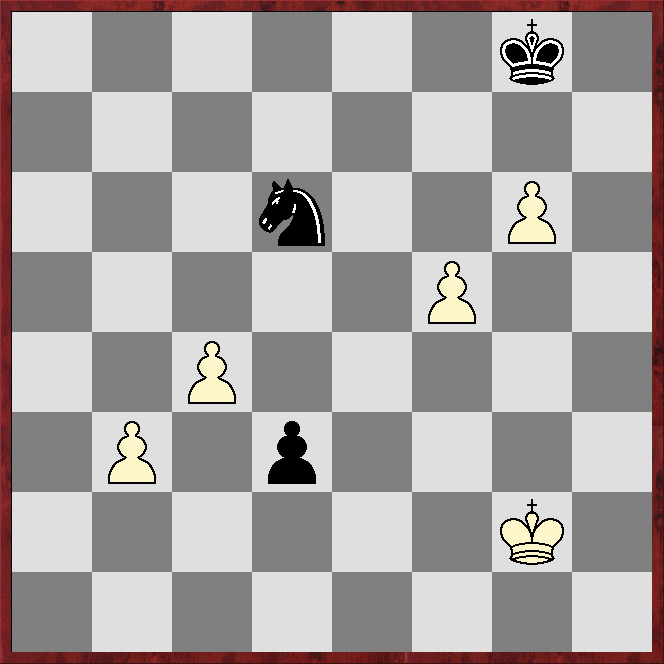
Pawns versus a knight
*****
*****
*****
*****
*****
59.Kf2 Nxf5 60.Ke1 Kg7 61.Kd2 Kxg6 62.Kxd3 Kf6 63.Ke4 Ke6 64.b4 Nd6+ 65.Kd4 Nb7 66.c5 Kd7 67.Kc5 Kc7
JK offered a draw in my time.
68.c6 Nd8 69.b5 Kb6
69...Nxc6 70.bxc6 Kc8 is a drawn pawn-ending.
70.Kd6 Nf7+
Also drawing is 70...Nb7+!?
71.Kd7 Ne5+ 72.Kd6 Nf7+ 73.Ke6 Ng5+ 74.Kd7 Ne4 75.c7 Nc5+ 76.Kd6 Nb7+ ½–½

Friday, 28 June 2019

Compensation For The Exchange

ONE of the trickiest things to evaluate in chess is how much compensation is needed when sacrificing the exchange.
Some books give the impression exchange sacrifices are available in almost every game.
But at club level they are rare birds indeed - the exchange is often lost, but seldom sacrificed.
Depending on whom you take as your authority, the exchange is worth somewhere between 1.5 and 1.75 pawns, with the latter figure being more commonly favoured.
One of the problems at club level is that most players still use the traditional piece-value table: P-1, N-3, B-3, R-5, Q-9.
This creates several anomalies, eg giving up bishop and knight for rook and pawn on f7 would seem to be an even trade - 6pts each - and so should favour the player giving up the bishop and knight as the opponent loses castling rights. In practice, this is nearly always a bad trade.
Another anomaly is that a minor piece is no stronger than three pawns - again this is rarely the case in the opening or the middlegame (although in an ending it all depends on the placement of the remaining material).
The traditional table also gives the impression that two pawns are needed to compensate for the exchange.
I prefer to use a table discovered - the right word, I believe - by international master (now grandmaster) Larry Kaufman.
He used a computer to analyse almost 300,000 games, coming up with the following average piece values: P-1, N-3.25, B-3.25, R-5, Q-9.75 (his full article, which is a fascinating read, can be seen here: https://www.chess.com/article/view/the-evaluation-of-material-imbalances-by-im-larry-kaufman).
The values are not hugely different from the traditional ones, and it is nice to see confirmation of the amazing coincidence that knights and bishops, despite being very different in their actions, have the same average strength. Think how difficult it would be to devise a game from scratch with such a feature.
But while knight and bishop are on average equal, two bishops are better than knight and bishop or two knights. Kaufman's computer analysis showed that on average the bishop-pair is worth half a pawn.
This new table immediately clears up the anomalies mentioned above. Giving up bishop and knight for rook and pawn is now losing 6.5pts for 6pts. Actually, taking into account that the bishop-pair is lost, it is actually giving up 7pts for 6pts - rarely will positional factors compensate for that.
Similarly, three pawns are no longer worth a bishop (as with all material evaluations, the caveat "on average" is implied).
Getting back to sacrificing the exchange, it can be seen that the sacrificer is giving up 1.75pts. So getting a pawn for the exchange loses 0.75pts. And if the winner of the exchange has had to give up the bishop-pair, the material deficit is just 0.25pts.
In other words, giving up the exchange when you have a pawn and the bishop-pair as compensation is almost an even trade - the placement of the remaining material on the board is likely to determine whether the sacrifice is sound.
All of this is a preamble to my game last night in round three of the Pimlico Summer open tournament.
Black to make his 17th move in Richard Black (188) - Spanton (171)
*****
*****
*****
*****
*****
My main analysis engines want Black to play around the knight, eg Stockfish10 gives 17...Qc6 18.b4 Be6 19.Qd3 with a slight edge to White. But I felt I had to get rid of the monster.
17...Bf8!? 18.Bg5 Bxd6
18...Be7 19.Bxe7 seemed positionally hopeless to me.
19.Bxd8
White takes the exchange. I was actually more worried about 19.cxd6!?
19...Bxc5
For the exchange, Black has a pawn and the bishop-pair - as discussed above, this is almost full material compensation. Positionally, at first glance, Black might even seem to be better as White has doubled and isolated b pawns. However, Black has problems smoothly completing development, and this gives White the initiative.
20.Bf6?!
This natural-looking move is not liked by the engines, and their reasoning will soon become apparent.
20...Bd4 21.Qd2 Qf5 22.Bg5
Intending to get rid of the bishop-pair by playing Be3, but the manoeuvre Bd8-f6-g5 has cost White a tempo.
22...Be6
Stockfish10 and Komodo9 slightly prefer 22...Bd7!? The point after 23.Be3 is to continue 23...Bc6 24.Bxe3 Rd8, when Black has lost the bishop-pair but gained active pieces.
23.Be3 Rd8 24.f4?!
This looks weakening. The engines prefer 24.Rfe1, eg 24...Bxb3 25.Qb4 Bd5 26.Bxd4 Qg5 27.g4 exd4 28.Qxd4, when only White can reasonably hope to win, but Black seems to have decent drawing chances.
24...Bxb3
I rejected 24...Qe4 because of 25.Rae1 exf4 26.Rxf4??, missing that Black can simply take the rook on f4 because White's bishop is pinned.
25.fxe5 Qxe5 26.Bxd4 Qxd4+ 27.Qxd4 Rxd4 28.Rac1 Be6
Could I have played 28...a5 and tried to activate my queenside majority? Stockfish10 is at first quite keen on the idea, but its evaluation soon changes to =. Komodo9 also quite likes the move, but reckons the position remains even. To me, 28...a5 looked rather loosening.
29.Rfd1 Rb4 30.Rd2 h5 31.Rc3 Kg7 32.Kf2 Kf6 33.Ke3 Ke5 ½–½

Friday, 17 May 2019

Three Pawns Or A Piece?

WHICH is stronger?
As with most things in chess, a lot depends on the position.
But generally the consensus is that a piece is worth more than three pawns in the opening and much of the middlegame, but the pawns become stronger in an ending.
The situation arose today as early as the 20th move in my round-seven game from the Bad Wiessee Senioren-Cup.
Black to make his 20th move in Spanton (1880) - Werner Mattgey (1766)
*****
*****
*****
*****
*****
While it is true to say White has three pawns for a piece, it is more precise to say White has three pawns and a dark-square bishop for a pair of knights.
White also has the bishop-pair in a position with diagonals for them to work on, and more space.
Both players have an isolani, and White has doubled c pawns.
Komodo9 gives White a slight edge; Stockfish10 at first gives Black a slight edge, but soon changes to dead-eye equality.
20...Ng6
This prevents the annoying 21.Bf4, but the knight will become a target for White's kingside pawn-advance. The engines suggest 20...Na5 or 20...Kf7.
21.Kf2 Nce7
Stockfish10 much prefers 21...Nd8, but Komodo9 comes to prefer the text, and also 21...Na5. I guess it shows just how difficult these unbalanced positions are to assess, and to play.
22.Bg5 Kg7 23.h4 Ng8 24.h5 N6e7
Black has not done anything so very wrong, apparently, but by now both engines reckon White has the upper hand.
25.Bf4?
Careless. It was better to bring up the king, which will almost certainly be needed anyway to force home a pawn.
25...c6?
An automatic reply, but it makes his bishop bad and, more importantly, misses a chance to get rid of one of White's pair of connected passed pawns. Correct was 25...Nf6, when 26.Bd3 (or 26.Kh3) Nxh5 27.Bxc7 greatly reduces White's advantage. Worse is 26.Be2? Nxe4+, while 26.h6+ only preserves the h pawn in the short term.
26.g4 Kh7
This hardly helps, but it seems Black is lost whatever he plays.
27.Kg3 Nf6 28.Kh4 e5?
No better is 28...Nxg4? 29.Bg5.
The text hopes for 29.Bxe5? Nxg4 (although White is still better).
29.dxe5 1-0
On a brighter note, the sun came out this morning. It is starting to cloud over this afternoon (it has just gone noon Berlin-time as I type), so if I intend to go walking, which I do, I need to get started asap.
The venue-hotel early this morning, with snow-capped Bavarian alps in the background