Showing posts with label QGD Ragozin. Show all posts

Wednesday, 12 November 2025

Cap Negret Round Five

FACED a Belgian Fide master on a live board.

Johan Goormachtigh (2188) - Spanton (1896)
QGD Ragozin
1.d4 d5 2.Nf3 e6 3.c4 Nf6 4.Nc3 Bb4 5.cxd5 exd5 6.Bf4!? 0-0 7.e3 Bf5
Our game from the same tournament last year went 7...c6 8.Bd3 Nbd7 9.0-0 Re8 10.Qc2, with a slight edge for White, according to Stockfish17.1 and Dragon1 (½–½, 59 moves).
8.Qb3 c5!? 9.dxc5 Qa5 10.Be2
The engines reckon White is at least slightly better after 10.a3 or 10.Nd4.
10...Nd7 11.0-0
The engines still prefer a3, or Bd6.
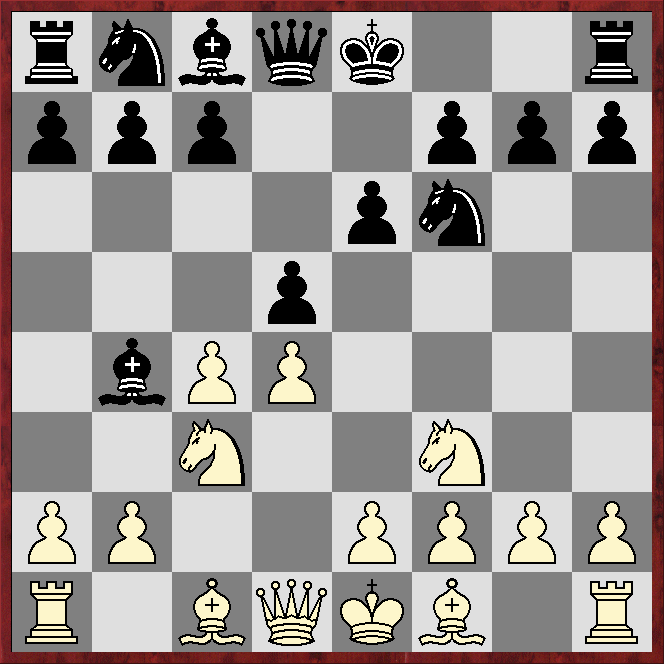
Now both sides have castled, how would you assess the position?
*****
*****
*****
*****
*****
Black has an IQP and is a pawn down, but that pawn-deficit is about to be erased with tempo, driving the white queen to the back rank. The engines prefer Black.
11...Nxc5 12.Qd1 Rfd8?!
Shant Sargsyan (2594) - Alan Pichot (2630), Abu Dhabi Online Blitz, went 12...Bxc3 13.bxc3 Nce4, when Black had a slight edge (Dragon1), although Stockfish17.1 is less enthusiastic about Black's position (0-1, 45 moves).
13.Nd4
Even stronger, according to the engines, is the immediate 13.Nb5.
13...Bg6?
Black should probably play 13...Bxc3, although the engines reckon 14.Nxf5 Bxb2 15.Rb1 Qc3 16.Bf3 gives White more than enough for a pawn.
14.Ncb5 Ne6?
14...Na6 defends the sensitive c7 square, but White is positionally winning according to the engines, eg 15.a3 Be7 16.b4 Qb6 17.Rc1 Rac8 18.Qb3, although the game is far from over.
15.Nxe6 fxe6 16.Bc7 Qa6 17.Nd4!? b5 18.Bxb5 Qb7 19.Bxd8 Rxd8 20.Qa4 Bd6 21.Nxe6
The flurry of tactics is complete, and White has emerged up the exchange and two pawns
*****
*****
*****
*****
*****
21...Rb8 22.Bc6!?
Simpler is 22.Nd4, but the text is also good, and may even be better (the engines are unsure).
22...Qxb2 23.Qd4 Qc2!?
This loses another pawn, but with queens off the board Black's position is hopeless.
24.Bxd5 Qf5 25.Nf4+ Kh8 26.Be6 Qe5 27.Qxe5 Bxe5 28.Nxg6+ hxg6 1-0

Sunday, 24 November 2024

Lessons From Altea VI: That Old Familiar Feeling

In round seven of the Cap Negret 65+ seniors, against Belgian Fide master Johan Goormachtigh (2173), I played a new opening - new to me, that is - over the board for the first time.

The game began 1.d4 d5 2.Nf3 e6 3.c4 Nf6 4.Nc3 Bb4, the starting point of the Ragozin Variation of the Queen's Gambit Declined.
Previously I had mostly played 4...Be7 and especially 4...c5, but decided to try something new after picking up an old ChessBase DVD on the Ragozin as a "material" prize at a tournament - cannot recall which one - earlier this year.
In preparing for the game I had seen that Goormachtigh usually meets the Ragozin with the main reply, 5.Bg5, although he also once played 5.Qa4+.
Against me he chose 5.cxd5, which is second-most popular in ChessBase's 2025 Mega database, and has been the main weapon of Garry Kasparov (you may not be surprised to learn Magnus Carlsen has played all three moves, and 5.e3 and 5.Qb3).
I replied 5...exd5, and the game continued 6.Bf4!?, which is the top choice of Dragon1, marginally ahead of the commoner 6.Bg5. Stockfish17 fluctuates between the two moves, and also likes 6.Qa4+.
After the further 6...0-0 7.e3 the game reached an instructive point.
How should Black proceed?
*****
*****
*****
*****
*****
Drawing on my experience of the Exchange Variation of the QGD, especially from the black side, I played 7...c6.
The move appears 26 times in Mega25, is perfectly reasonable and has been played by grandmasters.
The resulting pawn-structure is immediately reminiscent of the QGD Exchange, and indeed can arise from that variation, as is shown by the fact that the position after 7...c6 occurs, thanks to transpositions, 37 times in Mega25.
However, I discovered after the game that the most popular move in the diagrammed position is 7...c5!?, which I immediately recognised as a typical idea in the Ragozin.
During the game I was put off 7...c5!? by the reply 8.dxc5, which turns out to be the mainline in Mega25.
But the engines continue 8...Qa5 9.Be5 Nfd7!?, claiming equality, one line running 10.Bd6 Rd8 11.Rc1 Nxc5 12.Be7 Nd3+!? 13.Bxd3 Bxe7 14.h3 Nc6 15.0-0 Rb8!?
Summing up, then, my understanding post-game is that 7...c5!? is possible, and indeed may be the best move in the position, because White is not exerting as much pressure on the black centre as would be the case, for example, if the white dark-square bishop were on g5.
True, I should have been able to work this out over the board, and so not dismiss 7...c5!? so lightly.
But I am sure a greater familiarity with the ideas of the Ragozin would have made 7...c5!? much easier to find or, rather, having found it, to actually play it.
LESSON: contrary to the old proverb, in chess at least familiarity breeds contentment.

Wednesday, 13 November 2024

Cap Negret Round Seven

FACED a Belgian Fide master.

Johan Goormachtigh (2173) - Spanton (2009)
QGD Ragozin
1.d4 d5 2.Nf3 e6 3.c4 Nf6 4.Nc3 Bb4 5.cxd5
This is second in popularity to 5.Bg5.
5...exd5 6.Bf4!?
The mainline in ChessBase's 2024 Mega database runs 6.Bg5 h6 7.Bh4 g5!? 8.Bg3 Ne4 9.Nd2!? Nxg3 10.hxg3 c6, with a slight edge for White, according to Dragon1, although Stockfish17 is less sure. Note that 9...Nxc3 10.bxc3 Bxc3 11.Rc1 seems to give White good compensation for a pawn.
6...0-0 7.e3 c6
This may be a little passive. Most popular in Mega24 is 7...c5!?
The position looks like a mainline Exchange Variation of the Queen's Gambit Declined, but with the black dark-square bishop on b4 instead of e7, and the white dark-square bishop on f4 instead of g5 
*****
*****
*****
*****
*****
It is difficult to say whom the changes benefit. The engines reckon White is slightly better in the diagrammed position, but they also reckon White is slightly better in the analogous position from the Exchange Variation.
8.Bd3 Nbd7 9.0-0 Re8 10.Qc2 Nf8 11.h3 Ne6 12.Bg3!?
This may be a novelty. The known move is 12.Bh2.
12...g6!?
A familiar idea from the Exchange Variation. One possible follow-up is ...Ng7 and ...Bf5 to swop light-square bishops.
13.a3
Where should the attacked bishop go?
*****
*****
*****
*****
*****
13...Be7
The engines prefer 13...Bd6 or 13...Bf8.
14.b4 a6 15.Na4 Ng7 16.Nc5 Nfh5 17.Bh2 Bd6 18.Ne5 Qe7 19.a4 f6?!
The engines reckon White is only slightly better after 19...Nf6.
20.Nf3 Bxh2+ 21.Kxh2 Ne6 22.b5 Nxc5 23.Qxc5 Qxc5 24.dxc5 axb5 25.axb5 Bd7
After a flurry of exchanges, White's Minority Attack has made progress, but how should White proceed?
*****
*****
*****
*****
*****
26.Nd4
This is Dragon1's top choice, whereas Stockfish17 prefers 26.b6.
26...Ng7 27.Rfb1
But here the engines agree 27.b6 is best.
27...Ne6
The engines like 27...Rxa1!? 28.Rxa1 cxb5!?, claiming White at best has a slight edge.
28.Rxa8
The engines reckon 28.Nxe6 Bxe6 29.b6 gives at least a slight edge.
28...Rxa8 29.bxc6 bxc6 30.Nxe6 Bxe6 31.Rb6 Bd7 32.Ba6 Bc8?!
Probably better is 32...Kf7, and if 33.Bb7, then 33...Rb8.
33.Bxc8 Rxc8
How would you assess this rook-and-pawn ending?
*****
*****
*****
*****
*****
White has an active rook versus a passive one. Dragon1 reckons that gives the upper hand, but Stockfish17 calls the position completely equal.
34.Rb7 h5 35.Kg3 Re8!?
The rook will be less passive on e6.
36.Rc7 Re6 37.Kf4 Re4+ 38.Kf3 Re6 39.Ke2!?
The only way to try to make progress.
39...d4 40.e4!? f5!?
Dragon1 strongly dislikes this, but Stockfish17 is fine with it.
41.Kd3 fxe4+ 42.Kxd4
How should Black continue?
*****
*****
*****
*****
*****
42...Rf6?!
Both 42...h4 and 42...g5 give complete equality, according to Stockfish17, although Dragon1 reckons White in each case is slightly better.
What should White play?
*****
*****
*****
*****
*****
43.Kxe4
Stockfish17 reckons 43.g4!? is winning, eg 43...Rxf2 44.Rxc6 Kf7 45.g5!? Rf3 46.Kxe4 Rxh3 47.Rf6+ Kg7 48.c6. For much of the line, Dragon1 reckons the position is equal, but it comes to give White the upper hand.
43...Rxf2 44.Rxc6 Rxg2 45.Rf6 Kg7 46.Rf3 Rc2 47.Kd5 g5 48.c6 Kg6 49.Rf8 Rc3 50.Kd6 Rxh3 51.c7 Rc3 52.c8=Q Rxc8 53.Rxc8
How would you assess this rook-versus-pawns ending?
*****
*****
*****
*****
*****
Endgame tablebases show the position is drawn, but Black has to start with three only-moves.
53...Kf5!
The white king has to be shouldered away.
54.Kd5 h4!
Other moves lose, eg advancing the king now fails, one line running 54...Kf4 55.Rc4+! Kf3 56.Ke5 h4 57.Kf5 h3 58.Rc3+! Kg2 59.Kg4! h2 60.Rc2+ Kg1 61.Kg3 h1=N+ (the only hope - but White has a winning reply) 62.Kf3! g4+ 63.Kxg4 Nf2+ 64.Kf3 Nd3 65.Rd2 Ne5+ 66.Kf4! Nc4 67.Rd4 (other moves also win) Nb2 68.Kf3 Kf1 69.Rd2 etc.
55.Rf8+ Kg4
The third only-move on the trot, but this one is obvious.
56.Ke4 h3 57.Rh8 Kg3 58.Kf5 g4 59.Kg5 h2 ½–½

Friday, 9 August 2024

Correspondence Chess

Jo Primrose (2062) - Spanton (2277)
PC Gibbs Memorial Section A
QGD Ragozin
1.d4 d5 2.c4 e6 3.Nc3 Nf6 4.Nf3 Bb4
This is Black's third-most popular continuation in ChessBase's 2024 Mega database, behind 4...c6 and especially 4...Be7.
4...Bb4 seems relatively modern, the first game in Mega24 being from 1889
*****
*****
*****
*****
*****
5.Bg5
This is commonest, but Stockfish16.1 and Dragon1 prefer 5.cxd5 and 5.Qa4+.
5...h6 6.Bxf6!?
Giving up the bishop-pair is the mainline, although Magnus Carlsen is among those who have tried 6.Bh4.
6...Qxf6 7.e3 0-0 8.Rc1 dxc4!?
Another strange-looking move, but again it is the mainline. The point, I believe, is that after ...
9.Bxc4
... Black can immediately hit the white centre.
9...c5 10.0-0
Now both sides have castled, how would you assess the position?
*****
*****
*****
*****
*****
Black has the bishop-pair, but White is ahead on development and has two pawns against one on the two central files. The engines reckon the position is equal.
10...cxd4
This gets rid of the central majority.
11.Nxd4!?
Gaining a central space advantage with 11.exd4 is not popular.
11...Bd7 12.Ne4!?
Much more popular is 12.Qb3.
12...Qe5!?
There is just one example of this move in Mega24; the other 21 games saw 12...Qe7.
13.Qc2!?
This is probably a novelty. Michał Krasenkow (2620) - Grzegorz Gajewski (2615), Polish Championship (Warsaw) 2017, went 13.Qd3 Nc6 14.f4 Qa5 15.Nb3 Qb6 16.Rf3 Rad8, with a slight edge for Black, according to the engines (0-1, 60 moves).
13...Nc6 14.Nf3 Qc7 15.Bd3 Be7!? 16.a3 Rfd8 17.b4 a6 18.Nc5 Rac8 19.Bh7+ Kh8 20.Be4 Be8!?
How would you assess this middlegame?
*****
*****
*****
*****
*****
Black still has the bishop-pair and has caught up in development, but White is a little more active. The engines reckon the position is equal.
21.Qb3 Qb8 22.Qb1 Rc7 23.Nb3 Bf6 24.h3 b6 25.Bd3 Qa7 26.Be2 Ne7 27.Rxc7 Qxc7
Can White grab the a6 pawn?
*****
*****
*****
*****
*****
28.Rc1
28.Bxa6 is possible, the engines continuing 28...Nd5 29.Qc1 Qa7 30.Bd3 Ra8 with ...Qxa3 to come. If 29.Rc1 Qa7 30.b5, Black has 30...Nc7, with at least a slight edge, according to the engines.
28...Qa7 29.Nbd4 Kg8 30.Bd3 g6 31.Qb3 Kg7 32.Qb1 Bd7 33.e4!?
After much manoeuvring by both sides, White seeks to imbalance the game in the centre
*****
*****
*****
*****
*****
33...Kg8!?
Giving the dark-square bishop a retreat square.
34.e5 Bg7 35.Qb3 Qa8!? 36.Re1 Nc6 37.Be4 Nxd4!? 38.Nxd4 Qa7 39.Nf3
How would you assess the result of White's expansion?
*****
*****
*****
*****
*****
White has more space, but Black has pressure against the e5 pawn, and exchanges have meant more freedom for the bishops. The engines reckon Black is slightly better.
39...Rc8 40.Qe3 Bb5 41.g3 Qc7 42.Rd1!?
Can Black grab the e5 pawn?
*****
*****
*****
*****
*****
42...Bf8!?
42...Bxe5 can be met by 43.Bxg6, with equality, according to the engines. The text is the start of a plan to pressurise the white queenside.
43.Bd3 Ba4 44.Re1 a5 45.Ba6 Rd8 46.Be2 Rd5 47.Rc1 Qd8 48.h4 axb4 49.axb4 Kg7
Defending h6, to force White to defend b4.
50.Qe4 Bd1!?
Giving up the bishop-pair, but forcing exchanges in an attempt to exploit the weakness of the white b pawn in an ending.
51.Bxd1 Rxd1+ 52.Rxd1 Qxd1+ 53.Ne1
Not 53.Kg2? as 53...Qa4 wins a pawn.
53...b5 54.Kg2 Qb3 55.Nd3 Qc3
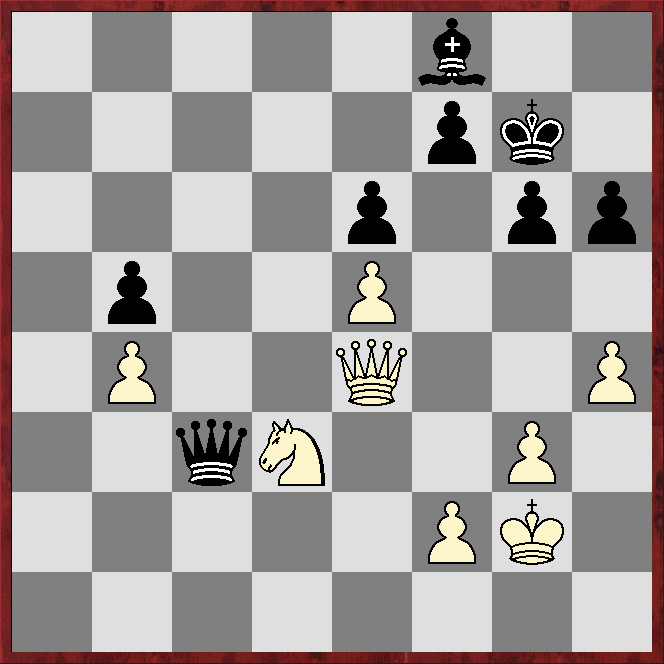
How would you assess this ending?
*****
*****
*****
*****
*****
Knight and queen often work better together than bishop and queen, but here the latter pair has a fixed target at b4 (indeed all the white pawns are on dark squares). The engines reckon Black has the better side of equality.
56.g4 Be7 57.h5 g5 58.f3
White's kingside pawns are no longer potential targets for the bishop, but the white king looks a little less safe.
58...Bd8
This brings up a critical moment.
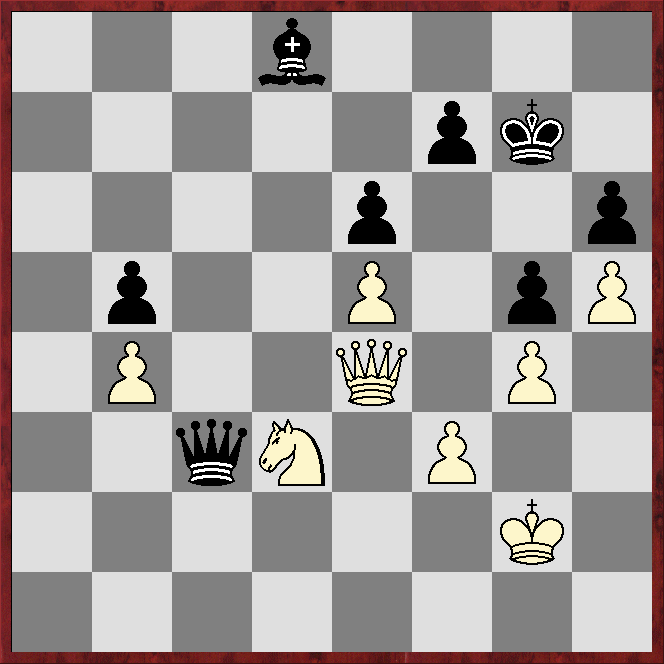
How should White proceed?
*****
*****
*****
*****
*****
59.Nc5?!
This is Dragon1's top choice for a long while, but it comes to agree with Stockfish16.1 that 59.Qe3 is better.
59...Bb6 60.Nd3
Dragon1 prefers 60.Nxe6+!? fxe6 61.Qg6+, but after 61...Kf8 62.Qxh6+ Ke7 63.Qf6+!? (on 63.Qxg5+ Kd7 the black king escapes the checks, and the engines agree Black's bishop is worth more than White's three extra pawns) Kd7 64.Qf7+ Kc6 65.Qxe6+ Kb7 66.Qd5+ Qc6 the checks run out, and the engines again agree the bishop is worth more than three pawns.
60...Bb6
Another critical point
*****
*****
*****
*****
*****
61.Kg3?!
The engines reckon 61.Kf1 puts up stiffer resistance, but they much prefer Black, eg 61...Bd4 62.Ke2 Qc2+ 63.Ke1 Qb1+ 64.Ke2 Qg1 65.Kd2 Qg2+ 66.Kd1 Bc3 with continuing strong pressure (Black is winning, according to Dragon1; has the upper hand, according to Stockfish16.1).
61...Qa1 62.Qe1 Qa2 63.Qc3 Be3 64.Qe1 Bd4 65.f4!?
This is best, according to the engines, but it leaves the white king more exposed. After their second choice, 65.Nf2?!, play might run 65...Qb2 66.Nd3 Qc2 67.Nf2 Bc3, after which the b4 pawn falls sooner or later.
65...Qc2!?
The engines prefer 65...gxf4+, but the text is also good.
66.Qe4 Bg1!?
Again capturing on f4 was a serious alternative.
67.Kf3
White loses the queen and is mated after 67.fxg4?? Qh2+ etc.
67...gxf4 68.Kxf4 Qd1!?
The engines come to prefer this over other moves, once it is inputted on the board.
69.Kg3 Qf1 70.Kh4 Bh2 71.Qe3 Qh1 72.Qe1
The engines prefer 72.Nf2, but agree Black is winning.
72...Qf3 73.Qf2
Forced, but after ...
73...Qxf2+ 74.Nxf2 Bxe5
... White is a pawn down and could resign.
The game finished:
75.Ne4 f5 76.Nc5 Kf7 77.gxf5 exf5 78.Kh3 Kf6 79.Nd3 Bd6 80.Kg2 Ke6 81.Kf3 Kd5 82.Ke2 Kc4 0-1
A rare example of Black winning at correspondence chess.