Showing posts with label Sicilian Irregular. Show all posts

Monday, 27 July 2026

Miniatures 40

IN this occasional series I am going through my decisive games of 20 moves or fewer.

Spanton (156 BCF) - Glenn Cross (148 BCF)
Isle Of Man Major 1991
Sicilian Irregular
1.e4 c5 2.d4 cxd4 3.Nf3!?
This is how Paul Morphy liked to play against the Sicilian.
3...d6 4.Bc4
But Morphy continued with 4.Nxd4. One point of the text is to leave open the possibility of a Morra Gambit.
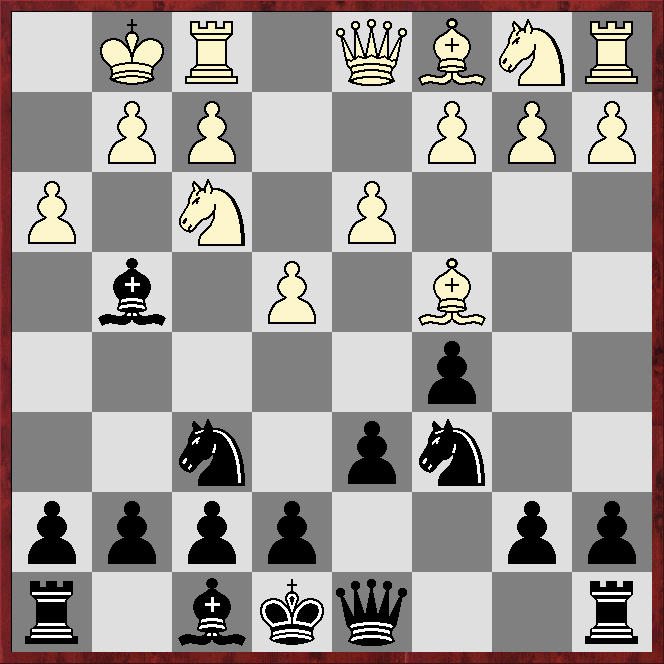
4...Bg4?
Normal is 4...Nf6, but other moves are also liked by Stockfish17 and Dragon1, eg 4...e6 and 4...Qa5+.
Five games reach this position in ChessBase's 2025 Mega database
*****
*****
*****
*****
*****
5.0-0?
All five saw 5.Bxf7+!
5...Nc6? 6.Bxf7+! Kxf7 7.Ng5+ Ke8 8.Qxg4 Nf6 9.Qe6 Qd7??
The black king needs the d7 square, so the queen should probably go to b6 or c7.
10.Qf7+ Kd8 11.Ne6+ Kc8 12.Nxf8 Ne5 13.Nxd7 1-0
LESSON: bishop sacs on f7 are a common theme in openings where Black plays neither ...e6 nor ...d5.

Sunday, 19 February 2023

Graz Game Two

Spanton (1883) - Bjarne Schmidt (1555)
U2000
Sicilian Closed
1.e4 d6 2.Bc4!?
There is nothing special about this move, except it probably puts both players on their own resources at a very early stage.
2...Nf6 3.d3 c5!?
We now have a Closed Variation of the Sicilian, but with the white light-square bishop developed outside of the pawn-chain
*****
*****
*****
*****
*****
4.Nf3
There are 12 games of Serbian grandmaster Miodrag Savić with this position as white in ChessBase's 2023 Mega database. His score of +6=5-1, outperforming his average rating by 53 elo - 35 is roughly normal - suggests he may be on to something. The 'something', however, may simply be an example of familiarity breeding contentment.
4...Nc6 5.0-0 Bg4 6.h3
How should Black meet the attack on the queen's bishop?
*****
*****
*****
*****
*****
6...Bxf3!?
Strong grandmasters have played the text, but 6...Bh5 is almost three times more popular in Mega23.
7.Qxf3 Nd4 8.Qd1 b5!? 9.Bb3
Stockfish15 and Komodo13.02 much prefer 9.Bd5!? After 9...Nxd5 10.exd5 they reckon White is at least slightly better.
9...Nxb3 10.axb3
How would you assess the position now White no longer has the bishop-pair?
*****
*****
*****
*****
*****
*****
White has pressure down the half-open a file and has the better bishop (based on the pawn-structure). The engines reckon White has a slight edge.
10...g6 11.Re1!?
This may throw away much of the white advantage. The point is White's pawn-structure suggests kingside play is White's best option, and that would normally include playing f4, in which case the king's rook is already well-placed. I was concerned about holes the move f4 would leave on the white kingside, and I felt I had promising play in the centre.
11...Bg7 12.e5 dxe5 13.Rxe5 Qd6
The engines point out 13...Nd5!?, which blocks the white attack on c5 and reveals a black attack on the e5 rook.
14.Qe2?!
The game is equal after 14.Qf3 (hitting a8) and after the retreat 14.Re1. according to the engines.
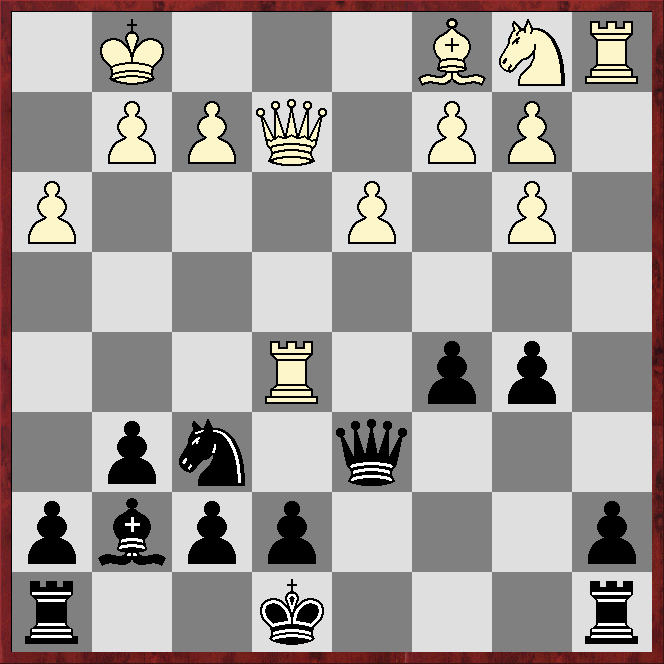
How can Black exploit White's last move?
*****
*****
*****
*****
*****
14...Ng4!
Also good, according to the engines, is 14...Nd5, but the text makes it easy for White to go wrong.
What should White play?
*****
*****
*****
*****
*****
15.Rxe7+?
Even worse is 15.Re4?? Qh2+ 16.Kf1 Qh1#, but counterattacking with 15.Qf3 gives White time to save the rook and avoid mate, eg 15...0-0 (15...Qxe5?? 16.Qxa8+ Kd7 17.Rxa7+) 16.Re1 Qh2+ 17.Kf1 Ne5 18.Qg3 Qxg3 19.fxg3 Nc6, although the engines give Black a slight edge.
15...Qxe7 16.Qxe7+ Kxe7 17.hxg4
White has a pawn for the exchange, but Black is winning, according to the engines
*****
*****
*****
*****
*****
17...Rhe8 18.Nc3 a6 19.Be3 Bd4 20.Nd5+
The engines prefer 20.Kf1 or 20.g5!?
20...Kd6 21.Nc3 Kc6 22.Bxd4 cxd4 23.Ne4 f5!?
Evicting the knight, but creating kingside weaknesses. I thought this was a mistake, but the engines are OK with it.
24.gxf5 gxf5 25.Ng3
How should Black proceed?
*****
*****
*****
*****
*****
25...Kd5!?
The engines at first much-prefer 25...f4!?, even though that allows 26.Ne4, giving White a strongly centralised knight. However Stockfish15, at least, comes to like the dynamic text, albeit fluctuating between it and 25...f4!?
26.Nxf5 Re2 27. c4+ Ke5
This is Komodo13.02's top choice for a while, but both engines come to plump for 27...dxc3 28.bxc3 Rd2 29.c4+ Ke5.
28.Ng3?!
Probably better is 28.Nh4!?, threatening Nf3 followed by Nxd4.
28...Rxb2 29.Re1+ Kf6 30.Ne4+ Kf7!?
Withdrawing while staying relatively centralised, but the engines prefer 30...Kg6 or 30...Kg7.
31.Nd6+ Kf8!?
This is best, according to the engines, but Black's king is no longer much-more active than its white counterpart.
32.cxb5 Rxb3 33.bxa6 Rxd3 34.Ra1
How would you assess the position after the recent flurry of exchanges?
*****
*****
*****
*****
*****
Black remains up the exchange for a pawn. White's passed a pawn is threatening, but seems well-contained, and Black also has a threatening passer. Stockfish15 reckons the position is completely equal; Komodo13.02 gives Black the upper hand.
34...Rb3 35.Kf1 d3 36.Ke1 Rb2 37.Nc4 Re2+ 38.Kf1 Re6 39.Rd1 Raxa6 40.Nb2
Not 40.Rxd3?? Ra1+ and mate.
40...Ra2 41.Nxd3 Rh6 42.Kg1 Rd6 43.Kf1 Rh6 44.Kg1 ½–½

Saturday, 1 February 2020

My Best Ever Tournament (part six)

Spanton (2096) - Thorsten Cmiel (2260)
Lausanne Round 6
Sicilian Irregular/English Symmetrical
1.e4 c5 2.c4!?
Sticking with the system I lost with in the previous round, but I felt the loss had little or nothing to do with the opening.
2...g6 3.Ne2 Nc6 4.d4 Bg7!?
4...cxd4 is much more popular.
5.d5 Nd4 6.Nxd4
Vladimir Georgiev (2555) played 6.Nbc3!? in a win over a 2365 in a Danish open eight years ago, but I would be very surprised if the text is not better.
6...cxd4
Vasily Smyslov's choice in a 1962 draw with Ludek Pachman.
7.Bd3 e5?!
Smyslov preferred 5...d6. The problem with the text is it creates a lever for a white kingside attack.
8.0-0 d6 9.f4 exf4?!
From my original notes: "Helping White's development, weakening Black's pawns and making room for White to play e5 cannot be right."
Jan Timman once lost an Olympiad game as White after his Argentine opponent here played 9...f6. The analysis engines Stockfish10 and Komodo10 like 9...Nh6!?, which was played by an unrated in 1986.
10.Bxf4 Nf6 11.e5
Even stronger may be 11.Qa4+, going after the d6 pawn.
11...Nh5 12.exd6?!
Almost certainly better is 12.Qf3, one point being 12...dxe5 can be met by 13.Bxe5. So instead Black should probably play 12...Nxf4 13.Qxf4 0-0, when 14.exd6 transposes to the game, as does 12...0-0 13.exd6 Nxf4 14.Qxf4.
12...0-0?!
Probably better was 12...Nxf4 (however, Komodo10 only comes to prefer this after being shown it on the board) 13.Qe1+ Ne6 14.dxe6 Bxe6 15.Qg3 with a roughly level position.
13.Qf3 Nxf4 14.Qxf4 Qb6!?
The engines slightly prefer the more cautious (read: passive, if Black goes on to lose) 14...Qe8.
How should White proceed?
*****
*****
*****
*****
*****
15.Nd2!
15.b3 Bf5 gives Black a small edge, according to the engines.
15...Qxb2
The engines approve, but now White gets a strong attack.
16.Rab1
16.Rfb1?! hands the initiative to Black after 16...Qc3.
16...Qa3
This is better than 16...Qxa2 17.Ra1 Qb2 18.Ne4, according to the engines. My original notes have Frtiz5's recommendation of 17.d7?! Bxd7 18.Rb7, which Frtiz5 reckoned was slightly better for White, but the modern engines rate it as level. Note that here 16...Qc3 is well-met by 17.Rf3 or 17.Rb3.
17.Rb3 Qa5
If 17...Qxa2, the engines reckon White is much better after 18.c5, eg 18...Qa5 19.Rc1 b6 (best, according to the engines) 20.c6! Qxd5 21.Rb5 Qe6 22.Nf3 (22.Ne4!?) with strong play despite being two pawns down.
18.Rb5?!
My notes show I was hoping for 18...Qd8? 19.c5, which is indeed strong for White. However, the engines come to very much prefer 18.d7!? Bxd7 19.Rxb7 with an initiative.
18...Qa3
18...Qxa2!? 19.Rbb1!? leaves White with more than enough compensation for his pawn deficit, according to Stockfish10, but Komodo10 reckons the position is balanced.
19.Rb3 Qa5
Clearly TC was ready to acquiesce to a draw.
20.Ne4!?
Komodo10's second choice (behind 20.d7!?, as in the note at White's move 18).
20...Qxa2
Correct, according to the modern engines.
Fritz5 reckoned 20...f5 21.Ng5 b6 22.Qh4 h6 23.Ne6 Bxe6 24.dxe6 Qe5 is equal, but Stockfish10 and Komodo10 continue 25.e7 Rfe8 26.c5! bxc5 27.Bc4+ Kh7 28.Qg3! Qxg3 29.Rxg3 Be5 30.Bf7 Bxd6 (or 30...Bxg3 31.Bxe8 Bxd6 32.Bc6) 31.Bxg6+ Kh8 32.Bxe8, when Black has a pawn for the exchange but little hope of saving a half-point. This is a long line, but much of it is forced.
21.Rbb1 b6?!
This stop's White central attack beginning with 22.c5, but now White gets time for a kingside attack. The engines reckon White's advantage is smaller after 21...Bf5!? 22.Rxb7.
22.Nf6+ Bxf6
Not 22...Kh8? 23.d7, eg 23...Bb7 24.Rf3 etc.
23.Qxf6 Qa3?!
This could have worked out well for Black, but objectively better is the engines' 23...Bd7 24.Rbe1 Qd2, although White is well on top after the simple 25.Qxd4.
24.Bxg6?
I originally gave this an exclamation mark, even though my engines at the time thought it loses.
Today's engines reckon the calm 24.Rf3 is much better, eg 24...Qa2 25.h3 (this is more about preventing …Bg4 rather than creating a bolthole for the white king, I believe) Qd2 26.Qe7.
24...hxg6 25.Rf4 Bh3?
Stockfish10 and Komodo10 reckon 25...Bg4! 26.Rxg4 Qe3+ leaves White the equivalent of just half-a-pawn or so better. Probably coming to the same thing is 25...Qe3+ 26.Kh1 Bg4, but then White has the extra option of 27.Rbf1!?
26.Rh4 Qe3+ 27.Kh1 Bxg2+ 28.Kxg2 1-0