First American Chess Congress
Final - Game 5
1.e4 c5 2.Nf3 e6 3.d4 cxd4 4.Nxd4 Bc5 5.Be3
Morphy played 5.Nb3 in his previous two games of the match as White. The text remains a popular choice today, albeit trailing the knight retreat, and is the choice of the analysis engines Stockfish10 and Komodo10.
5...Qb6
GM Vladimir Epishin, an expert in this line as Black, has played the more cautious 5...d6.
6.Nb5!?
Morphy must have anticipated the possibility of 5...Qb6, so it is interesting that in his first game with 5.Be3 he does not give Black the opportunity to capture the possibly-poisoned b2 pawn. I guess he was focused on occupying the hole at d6.
6...Nf6
If 6...Bxe3, White can play 7.Nd6+ Kf8 8.fxe3 Qxe3+ 9.Be2, when, for a pawn, Morphy has the type of position he excelled in - smooth development, an outpost at d6 and attacking chances against a king that has lost castling rights. Black does not have to take the e3 pawn, at least not immediately, eg 8...Nc6 keeps his options open, when White has to chose between continuing to offer a pawn, and temporarily abandoning his knight outpost to protect both e3 and b2 with 9.Nc4.
7.Bxc5 Qxc5 8.Nd6?!
This looks natural, but may not be best. The engines like 8.N1c3!, the point being to delay occupying d6 so the outpost becomes permanent when it is finally occupied, which is not the case after the text.
8...Ke7
Black gives up castling rights to evict the knight, but this is a better version of moving the king than in the note to Black's sixth move.
9.Nxc8+ Rxc8 10.Bd3
Now it is Black who has a lead in development, and the initiative that goes with it. The only fly in the ointment is the position of his king. It looks reasonably safe behind a phalanx of pawns, and is well-placed for an ending, but could become vulnerable to attacks from either flank as well as down the middle.
10...Nc6 11.0-0 h5
A more-promising use of ...h5 than in their last encounter.
12.Nd2 h4 13.h3!?
White's h pawn becomes a target for Black, but Morphy judged this to be a lesser evil than allowing ...h3.
13...g5 14.a3
Seeking counterplay, which is often cited as the No1 requirement for successful defence.
14...Rg8 15.b4 Qb6 16.Nc4 Qb7 17.f3 Ne5 18.Nxe5 Qxe5 19.Qd2 Rg7?!
White's kingside looks suspect, but Paulsen is unable to find a way through, and it is not clear what his last move is aimed at as doubling on the g file looks less than promising. Stockfish10 suggests 19...Qd4+ 20.Qf2 (this seems safer than the engine's alternative of 20.Kh1) Qxf2+ 21.Rxf2 d6, when Stockfish10 reckons Black has the upper hand, but there is certainly no danger of a knockout blow.
20.Rad1 Rd8
Protecting the d pawn so the knight is free to move, but a better way of freeing the knight may have been to play 20...d6. Paulsen was presumably reluctant to move a pawn, especially a pawn protecting his king, from off a light square, where it blunts the actions of the white bishop.
21.Qf2 b6 22.f4
Morphy grabs the chance to activate his queen and king's rook.
22...gxf4 23.Qxf4 Qg5 24.Rf2 Qxf4 25.Rxf4 Rdg8 26.Rd2 Rh8
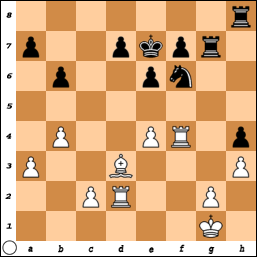 |
| Who has the advantage? |
*****
*****
*****
*****
Black's attack is gone and he is left with a weak pawn at h4. But we are close to an endgame, and his king is better placed than White's for that. White has backward pawns at g2 and c2, but the latter is unlikely to be a problem. He also has an isolated e pawn, but it is not especially weak. The engines reckon the position is dead-equal. The game might come down to who better utilises his minor piece.
27.e5!
A strong move that makes the white bishop look much better. More to the point is that White's rooks might be able to occupy the weak squares in front of Black's backward d and f pawns. Black can solve this problem by playing ...d6 or ...f6, but then White will no longer have an isolani. On the other hand, Black's e pawn will become a protected passer.
27...Nd5 28.Rd4 f6 29.exf6+ Nxf6 30.Rc4 Kd8 31.a4 Nd5 32.Be4 Nc7?!
A difficult decision, but on c7 the knight looks awkwardly out of reach of the kingside. An anonymous ChessBase annotator gives 32...Nf4 33.Bb7 Ng6 as holding the balance.
33.Bf3 d5?!
This weakens e6. The engines suggest 33...Rh6, while preferring White.
34.Rc6 Rd7
ChessBase suggests 34...Rf8, but White has, as in the game, 35.Bg4, and if 35...Rf4 (counterplay presumably being the point of ...Rf8), one line liked by the engines runs 36.b5!? Rxa4 37.Bxe6 Nxe6 38.Rxe6 Rd7 39.Re5 d4 40.Rh5, when White's rooks are more active. However, it is not clear this is enough to win.
35.Bg4 Rh6 36.Re2 Ke7 37.Kh2 Kf7 38.g3 hxg3+ 39.Kxg3
Morphy has solved the problem of his backward g pawn, and now has a passed h pawn to somewhat match Black's passed e pawn. But the main difference in the position is the greater activity of White's pieces.
39...Re7 40.h4 Ne8?!
Bringing the knight to the kingside looks logical, but the engines do not like it, perhaps because now Black's king is tied to defending e6. They suggest counterplay with 40...Rf6!?, a sample line running 41.c3 Rf1 42.h5 Kf6 43.Rh2 Rg1+ 44.Kh4 Kg7 45.Rf2 Kh7 46.Rf6 Re1, when Black may be holding.
41.h5?
Impetuous. Better was 41.Re5 as then 41...Nf6?? fails to 42.Bxe6+.
41...Nf6!
This now works as 42.Bxe6+ Rxe6 43.Rc7+ (not 43.R(either)xe6?? as 43...Nxh5+ 44.Kg4 Rxe6 45.Rxe6 Kxe6 46.Kxh5 Kf5 is a winning pawn-ending for Black) Kf8 44.Rxe6 Nxh5+ 45.Kg4 Rxe6 46.Kxh5 Re7 47.Rxe7 Kxe7 is a drawn pawn-ending.
42.Rcxe6 Rxe6
Black maintains the balance with ChessBase's 42...Rc7!, eg 43.R6e5 Rc3+ 44.Kh4 Rc4 45.Kg5 Rxg4+ 46.Kxh6 Ng8+ 47.Kh7 Nf6+ etc.
43.Bxe6+ Kg7?
Better was 43...Kf8 so Black can win the h pawn without the white rook penetrating via e7. White's edge of having the better minor piece to cooperate with a rook will be minimal as all the remaining pawns are on one side of the board.
44.Bg4 Nxh5+
ChessBase gives this a question mark, but it is the engines' choice, and ChessBase's suggestions of 44...a5 and 44...Ne4+ also lose. Perhaps Black could have tried 44...Kf7!? to cover e7, although White remains a pawn up and with the better minor piece - in other words, White is still winning.
45.Bxh5 Rxh5 46.Re7+ Kf6
The old adage that all rook endings are drawn does not apply here.
47.Rxa7 Ke5 48.Ra6 Rg5+
If 48...Rh6, then simply 49.a5.
49.Kf3 Rf5+ 50.Ke2 b5
Desperation, but again trying to save the pawn by defending it with the black rook is met by a5.
51.axb5 Rf4 52.c3 d4 53.c4
53.cxd4+?? would be an absurd way to chuck a half-point.
53...Rh4 54.c5 Rh2+ 55.Kd3 Rh3+ 56.Kc2
And 56.Kc4?? would be an absurd way to chuck a whole point.
56...Rh2+ 57.Kb3 Rh3+ 58.Ka4 Kd5 59.Rd6+ Kc4 60.c6 Rh1 61.Rxd4+!?
61.Ka5 also wins, but Morphy's solution is simpler.
61...Kxd4 62.c7 Rh8 63.b6 Kc4 64.b7 1-0
The game apparently lasted ten hours.


