Showing posts with label Colonia de Sant Jordi. Show all posts

Thursday, 7 November 2024

Lessons From Mallorca IX: Accuracy

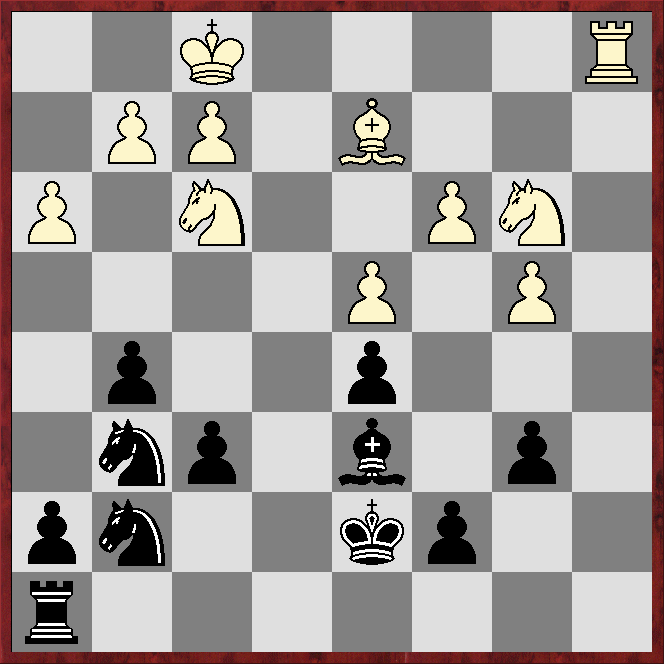
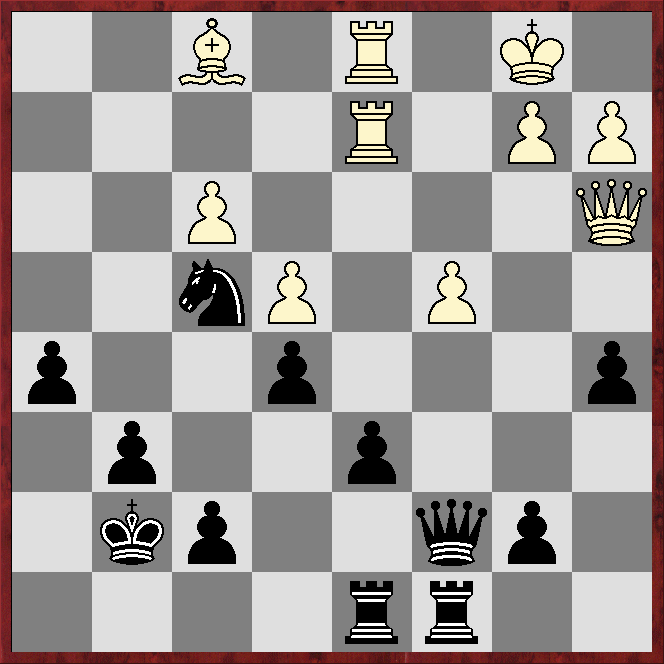
THE following position arose after 32 moves in my round-nine game at the Colònia de Sant Jordi U2400.
Black's pieces are more actively placed than White's, and with 'normal' play Black would probably have an edge, but the position favours White, thanks to having a 'bolt from the blue'
*****
*****
*****
*****
*****
I played 33.c4+!
After the obvious, and best, reply, 33...dxc4, the correct follow-up is 34.Nc3+! Kxb4 35.Rb1, after which Black has problems, eg 35...b5 36.d5 Nef4?! (36...Ka5!? is objectively better, but White simply plays 37.dxe6) 37.Nd3+ Ka5 48.Nxb5 Bb4 49.Nxf4 Bxd2 40.Nxg6.
Alternatively Black can try 35...Ka5, but 36.Nxc4+ Ka6 37.Nb5 (37.Nxd6 is also strong) Bf4 38.Bxf4 Ngxf4 39.Nbd6! cxd6 40.Nxd6 wins the black rook, as Stockfish17 and Dragon1 point out, thanks to the threat of 41.Ra1#.
The game saw 34.d5?, the point being 34...Nef4?? loses to 35.Nd4#. But Black has the winning intermezzo 34...Be5!, leaving Black the equivalent of a rook or more ahead.
LESSON: imaginative play (33.c4+) is great, but is wasted if followed by a shoddy continuation (34.d5?) thanks to poor calculation.

Wednesday, 6 November 2024

Lessons From Mallorca VIII: Planning

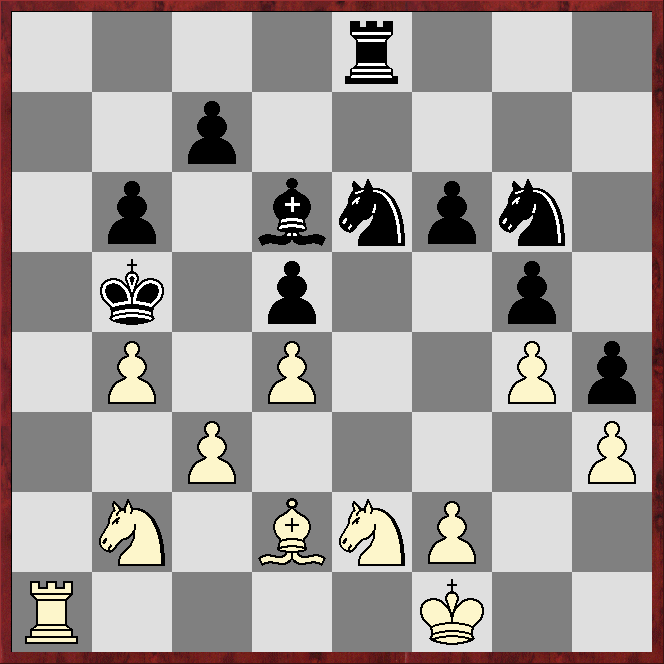
MY round-eight game at the Colònia de Sant Jordi U2400 reached then following instructive position after 30 moves.
Black has just played 30...Kh8-g7 - how would you assess the position and, more importantly, what is the correct plan for both sides?
*****
*****
*****
*****
*****
*****
White has bishop for three pawns, but Black controls the open file and has a pair of passed pawns supported by the king, while the white king is on the opposite side of the board. Stockfish17 and Dragon1 reckon chances are about equal.
Having played the game, and looked at it afterwards with the engines, I am fairly confident about the following assessments.
1. In the long run, if nothing game-changing happens, White's extra piece will tell.
2. Black must therefore try to create something game-changing in the short, or at least medium, term. Clearly a mating attack with the rooks is not on the cards, so the game-changing event must be the threat of promoting one of the passed pawns. It may look like the pawns could be lost if they are advanced, but if they are not advanced, Black is lost anyway.
3. White's correct strategy is therefore to restrain and, if possible, blockade the passers.
In the game neither player seemed to fully grasp these essentials.
White at first ignored the kingside in favour of giving the bishop a firm outpost, which of course has its positional plus points, but the engines reckon kingside restraint was the priority.
Black spent time adjusting queenside pawns, and dithered about advancing on the kingside. By the time the latter was attempted, it was too late - the black kingside was easily restrained (blockading proved unnecessary, thanks to Black's dilatory play), and White was able to switch to decisively opening a file on the queenside (made easier by Black's earlier unnecessary pawn-moves there).
LESSON: a correct plan, except in weird tactical situations, usually has logical foundations based on imbalances in the position.

Tuesday, 5 November 2024

Lessons From Mallorca VII: No Surrender!

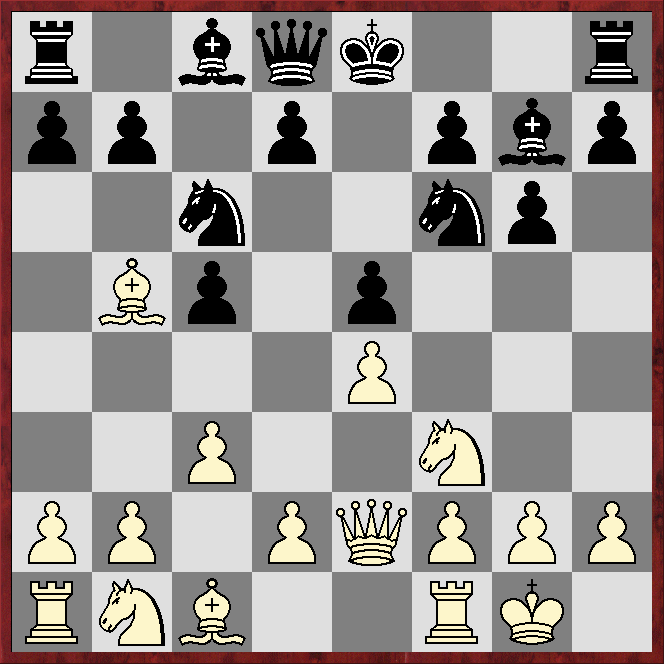
THE following position was reached after 18 moves in my round-seven game at the Colònia de Sant Jordi U2400.
Black has just played 18...Bd6-f8?
*****
*****
*****
*****
*****
*****
*****
White is a pawn down, but has compensation worth more than a minor piece, according to Stockfish17 and Dragon1.
White's first move is fairly obvious, or, at least, is a move that clearly does no harm to White's position, namely 19.Ng4.
After the reply 19...Bg7 the engines reckon 20.d6! wins, eg 20...cxd6 21.Bxf6 Bxf6 22.Rxb6! (the simple 22.Nxh6+ also wins, according to the engines) Qxb6 23.Nxf6+ etc.
Admittedly the strength of the pawn-push d6 is not obvious in the diagrammed position, but it becomes easier to spot after 19.Ng4 Bg7, either immediately, or in the less convincing, but still quite promising continuation 20.Bxf6 Bxf6 21.d6!?
In the game 19.Bg3? was played, when Black would have been winning after the engines' 19...Nc5!? 20.Bxe5 Ncxe4, and anyway was a sound pawn up after the game's 19...d6.
LESSON: in a sharp position a move that gives up a pin and retreats an attacking piece is unlikely to be the way to play.

Monday, 4 November 2024

Lessons From Mallorca VI: Structure v Dynamism

MY round-six game at the Colònia de Sant Jordi U2400 reached the following instructive position shortly out of the opening.
18...Ng8-e7 has just been played in what is an Exchange Variation of the Spanish - one that has not gone well for Black
*****
*****
*****
*****
*****
*****
Black no longer has doubled c pawns, but is a tempo behind in development, and the d pawn is vulnerable unless it can be get protection by successfully advancing to d4.
*****
*****
*****
*****
*****
In order to prevent 19...d4, I played 19.c3?, which restrains the d pawn and frees the c2 square for White's king.
The move has its good points, positionally, but as my opponent pointed out after the game, White has the far superior 19.Nc3, which wins a pawn as 19...d4 can be met by 20.Na4.
LESSON: a piece-initiative, which is what 19.Nc3 gives, is often a surer way to an advantage than adjusting the pawn-structure.

Saturday, 2 November 2024

Lessons From Mallorca V: Double Trouble

THERE are several lines in double-e-pawn openings in which White gets a chance to use the king's knight to capture Black's pawn on e5.
Probably the best-known is in the Petrov: 1.e4 e5 2.Nf3 Nf6, when White's commonest, and possibly best, continuation is 3.Nxe5.
White does not try to gain a material advantage by hanging onto the pawn, but rather to gain a positional advantage after Black levels material by capturing on e4.
There are other openings, however, where White's capturing on e5 only really makes sense if the idea is to hang onto the pawn.
These lines tend to be double-edged in that being a pawn up will likely be a significant advantage in any ending, and, since the capture gives White a central pawn-majority, may well be a very useful advantage in the middlegame.
However, if White proves unable to hold onto the pawn, Black will probably have at least equalised, and may well gain an advantage.
An example of this occurred in my round-five game at the Colònia de Sant Jordi U2400, which reached the following position after six moves (it arose from the Rossolimo Variation of the Sicilian, but the central structure is that of a double-e-pawn opening).
Black has just played 6...Bg7!?
*****
*****
*****
*****
*****
The game continued 7.Bxc6!? bxc6 8.Nxe5 0-0!?
Castling is probably Black's best move, as trying to win the pawn back with 8...Qe7 can be countered by 9.Nf3!, when either capture on e4 is a blunder that loses a piece.
There followed 9.d3 Re8 10.Nf3 d5, reaching a position that also occurred in two relatively high-level games, Ilya Smirin (2594) - Pavel Eljanov (2655), Netanya (Israel) 2019, and Sayantan Das (2459) - Adham Fawzy (2490), Guwahati (India) 2022.
Those games saw 11.Bg5 Qb6 12.Bxf6 Bxf6, after which Black is slightly better (Dragon1) or at least has the better side of equality (Stockfish17), and Black went on to win both games.
I preferred 11.e5!?, which may be a novelty.
Position after 11.e5!?
*****
*****
*****
*****
*****
The engines suggest 11...Nd7 or 11...Bg4, awarding Black at least equal chances.
My opponent chose 11...Ba6, and after the further moves 12.Re1 Ng4 13.Bf4 it might be thought White has successfully held onto the extra pawn on e5 as it seems to be overprotected - attacked thrice, but defended four times.
However this is illusory, as Black showed with 13...Nxe5!?, when after 14.Nxe5 f6 15.Qd2 fxe5 Black gets back the pawn and emerges with the bishop-pair and control of the centre.
The engines agree Black is better
*****
*****
*****
*****
*****
Now it may be that slight improvements can be found for both sides, but as this position and the two high-level games show, White's play after grabbing the pawn is not easy.
LESSON: before spending tempi with the aim of winning a pawn in the opening, even an important central pawn, it is essential to consider all the opponent's options for counterplay. Grabbing such a pawn may be an example where the old joke applies: "Don't do it, even if it is sound!"

Friday, 1 November 2024

Lessons From Mallorca IV: How's The King?

THE following position was reached in my round-four game at the Colònia de Sant Jordi U2400.
Black has just captured on d5
*****
*****
*****
*****
*****
*****
*****
*****
White has three ways of recapturing, although I suspect most players would fairly quickly rule out 19.exd5, partly because it leaves both white rooks on files blocked by a white pawn, and because it gives Black what might prove in the middlegame a useful kingside pawn-majority.
The move 19.cxd5 is quite desirable positionally in that it gains space, opens a file on which White already has a rook, and gives the bishop a little more freedom.
The move played, 19.Rxd5?, also has desirable positional qualities, not least that it pressurises Black's backward d pawn, which remains on a half-open file.
But the move is a mistake for a tactical reason - it gives Black a tempo to attack the white king's position.
The game continued 19...Nf4 20.Rd2 Qg5, when White has no good defence to Black's twin threats of checkmate at g2 and winning the white queen with ...Nh3+.
LESSON: grandmaster Nigel Davies's truism that king safety is the most important factor in chess should always be at the forefront of analysis.

Thursday, 31 October 2024

Lessons From Mallorca III: Timely Reminder

LOOK at the comparative 10-move clock times from my round-three game at the Colònia de Sant Jordi U2400.

Moves...My Lead On The Clock
10          15 minutes
20          59 minutes
30          71 minutes
40          66 minutes
50          70 minutes
60          73 minutes
The game ended in a draw on move 63.

The standard of play could be described as laughable, if it were not simply atrocious.
In my write-up of the game, published here the following day, I labelled two of my moves dubious (?!), five bad (?) and three as blunders (??).
Naturally such assessments are at least partly subjective, but there can be no doubt a major cause of my bad play was playing too quickly.
What of my opponent, you may ask?
Well, I called one of his moves dubious (?!), 10 bad (?) and one a blunder (??).
He can partly be excused by his lower rating, although 1882 is hardly beginners' standard.
But the main cause of his bad play was his poor handling of the clock, although in his case it was playing too slowly.
He spent about 30 minutes on one move in the opening.
Admittedly the result was an apparent novelty that gets a seal of approval from Stockfish17 and Dragon1, but it flies in the face of grandmaster John Nunn's admonition to never spend more than 20 minutes on a move.
The time control was 40 moves in 90 minutes, with 15 minutes to finish and a 30-second increment throughout.
My opponent left himself 27 minutes (plus the increment) at move 20, and nine minutes (plus the increment) at move 30.
In effect we were at times both rushed - he through procrastination, I through laziness.
And yet I am sure both of us were well aware that even engines, with all their multitude of tactical calculations, make mistakes when forced to give quick evaluations.
LESSON: proper use of time is as important to a chess player as opening knowledge, middlegame planning, endgame technique and accurate analysis.

Wednesday, 30 October 2024

Lessons From Mallorca II: Warning Signs

IN my round-two game at the Colònia de Sant Jordi U2400 I grabbed what turned out to be a very hot pawn.
The critical position arose after White played 15.Nb5-a3.
Black to play and win a pawn
*****
*****
*****
*****
*****
*****
During the game I can remember being pleased with myself for spotting the apparent strength of 15...Nc3!?, which more-or-less obliges White to reply 16.Qe1 as 16.Qd2 is hit by 16...Nd4!, when 17.Nxd4 Qxd4! wins a pawn, as Black can meet 18.Qxd4? with 18...Nxe2+ etc.
However, even this line is far from clear, as Stockfish17 and Dragon1 point out the strength of 18.Re1!?, when 18...Qxd2 19.Bxd2 Ne4 20.Be3 leaves White with what the engines reckon is full compensation for a pawn.
Nevertheless, 16.Qe1 is the better move, and I could not resist replying 16...Na4?!, although I knew I would come under pressure.
White continued 17.e4?!, but the engines agree the move I feared, 17.Nc4, is much stronger.
Position after 17.Nc4
*****
*****
*****
*****
*****
I planned 17...Nb6, which is best, as 17...b5? loses horribly to several moves, including 18.Nh4!?
After 17...Nb6 the engines give 18.Nxb6 Qxb6 19.Ba3, when the black king will be trapped in the centre a long time.
Best play, according to the engines, runs 19...Be4 20.Qc1!? h6!? 21.Qe3!? Bd5, with what they claim is a won game for White.
The position is certainly not resignable, but a sample line runs 22.Rfb1 Qc7 23.Qd3 f5!? 24.Nh4!? Bxg2 25.Kxg2 Ba7 26.d5 0-0-0!? 27.d6 Qa5!? 28.Ng6 Rhe8 29.Ra2 with continuing strong pressure.
Admittedly the game would go on, but I suspect few players would want the black pieces here
*****
*****
*****
*****
*****
Going back to the game's 15.Nb5-a3, what are the warning signs that my mini-combination, 15...Nc3!? 16.Qe1 Nxa4?!, was inadvisable?
Here is the position after I have grabbed the pawn
*****
*****
*****
*****
*****
I believe the following are warning signs.
1. Black is behind in development - three minor pieces in play (the bishop on b8 does not count as it will almost certainly have to move again), while White, in addition to having developed three minor pieces, has castled and developed the queen's rook (the latter courtesy of my capturing the white a pawn).
2. The black knight at a4 is hanging, ie it is unprotected by a friendly piece or pawn, and, as John Nunn cautions, "loose pieces drop off."
3. White has a simple plan to prevent kingside castling, ie 17.Nc4 followed by Ba3.
LESSON: Cecil Purdy, the first world correspondence champion, advised (I paraphrase) that 'neglecting development for an advantage in an endgame that may never arise is not a paying proposition'.

Tuesday, 29 October 2024

Lessons From Mallorca: Danger Of Analogous Positions

IN my round-one game at the Colònia de Sant Jordi U2400 I played the Richter-Rauzer Variation of the Sicilian.
The game began 1.e4 c5 2.Nf3 Nc6 3.d4 cxd4 4.Nxd4 Nf6 5.Nc3 d6 6.Bg5.
This was the first time I have reached the position, with either colour.
My theoretical knowledge was virtually zero - indeed I knew no more than the basic idea behind the move, which is summed up in Wikipedia thus: "The move 6.Bg5 was Kurt Richter's invention, threatening to double Black's pawns after Bxf6 and forestalling the Dragon by rendering 6...g6 unplayable."
Ignore the first part of that sentence - Richter was at most four years old when the move was first played.
However the basic idea behind the move - an attempt to make the Dragon "unplayable" - is correct, although not everyone agrees 6...g6!? 7.Bxf6 is all that bad for Black.
Indeed it has been played by plenty of grandmasters, and is a speciality of some, including 2700+ Russian star Daniil Dubov, albeit it is a line he likes to play at fast time-controls.
I knew nothing of this, but I knew Black's commonest reply to 6.Bg5 is 6...e6, so I was slightly surprised when my opponent chose 6...Qb6!?
There are 1,778 games in ChessBase's 2024 Mega database with the position after 6...Qb6!?
*****
*****
*****
*****
*****
White's normal continuation, 7.Nb3, occurs 1,458 times in Mega24, and is the top choice of Dragon1.
Stockfish17 for a long time suggests 7.Be3!?, which occurs 112 times, but scores 60% - nine percentage points more than 7.Nb3.
However, given enough time, Stockfish17 comes to marginally prefer Dragon1's choice.
I played 7.Bxf6!?, which, like the other two moves, has also been played by grandmasters, and occurs 136 times, although scoring only 47%.
The engines reckon my choice is dubious - after all, it gives up the bishop-pair and strengths Black's centre, albeit weakening the black kingside.
After 7...gxf6 I felt more-or-less obliged to play 8.Nb3, although the engines prefer the rare 8.Bb5!?
Now I do not believe 7.Bxf6!? is a mistake - my choosing it places me in the company of at least two 2600+ players.
However, my reason for choosing it was a mistake, in as much as I played a move that I knew (or thought I knew) was good after 6...g6!?, but in a position in which my opponent had played something completely different.
Instead of analysing the position, I played on the general principle of wanting to punish an opponent who had not chosen the main line.
LESSON: general principles make a useful starting point for considering a position, but analysis must prevail.

Monday, 28 October 2024

Summing Up Mallorca

MY score in the Colònia de Sant Jordi U2400 of +3=3-3 lost exactly four Fide elo.
Tournament playing hall

Sunday, 27 October 2024

Sant Jordi Round Nine

FACED an American.

Spanton (2013) - Bob Holliman (1930)
French Exchange
1.e4 e6 2.d4 d5 3.exd5 exd5 4.Nf3 Nc6!?
Commoner moves are 4...Bg4, 4...Nf6 and especially 4...Bd6.
5.c3
The mainline in ChessBase's 2024 Mega database runs 5.Bb5!? Bd6 6.c4!? dxc4!? 7.d5!? a6 8.Ba4!? b5 9.dxc6 bxa4 10.0-0 Ne7 11.Qxa4 0-0, all of which first occurred, at least in Mega24, in Garry Kasparov (2770) - Evgeny Bareev (2680), Paris Immopar Rapid 1991. Stockfish17 and Dragon1 reckon the resulting position is equal, although Kasparov went on to win.
5...Bd6 6.Bd3 Nge7 7.0-0 Bg4 8.Re1 Qd7 9.Nbd2 0-0-0!?
Castling queenside is often touted as a good way for Black to avoid the perceived drawish nature of 3.exd5, although here the move is strongly disliked by the engines. Nevertheless the text has been played by Alekhine, Spielmann, Psakhis, Szabo and Short, who may be better judges of such imbalanced setups. 
How would you assess this position, which occurs 601 times in Mega24?
*****
*****
*****
*****
*****
Black is ahead on development, but White is well-placed to commence queenside operations - better placed, it would seem, than Black on the kingside. The engines reckon White has the upper hand.
10.b4 f6!?
This has been played by Caruana. The engines prefer the most popular move, 10...Ng6, although Psakhis and Short chose 10...Rde8.
11.a4!?
The engines like 11.Qa4.
11..g5?!
Twelve of 17 games in Mega24 saw the text, but the engines reckon it is too slow.
12.a5
Almost certainly not 12.b5?! Na5.
12...Bf5
How should White proceed?
*****
*****
*****
*****
*****
13.Nb3
The engines' 13.Bf1!, which would apparently have been a novelty, never crossed my mind, but it makes perfect sense. From f1 the light-square bishop continues to have an influence on the queenside, and strengthens White's kingside defences. True, Black's light-square bishop controls b1, but it also impedes some of Black's kingside options.
13...Bxd3 14.Qxd3 Qf5 15.Qxf5
Again the engines want White to avoid exchanges, probably by 15.Qf1!?
15...Nxf5 16.Re6 Rdf8
White is on top after 16...g4?! 17.Rxf6 gxf3 18.Rxf5 fxg2 19.Bh6, according to the engines.
17.Bd2 Ng7 18.Re2 Re8 19.Rae1 Rxe2 20.Rxe2 b6 21.h3 Kd7 22.Kf1 Ne7 23.Re1 Ng6 24.axb6 axb6 25.Ra1
25.Ra1 stops the black rook from using the open a file, but White's rook is unlikely to find any joy there
*****
*****
*****
*****
*****
25...h5 26.Ng1!? Nf5 27.g3 h4 28.g4 Ng7 29.Ne2 Ne6 30.Nbc1 Kc6!? 31.Nd3 Kb5 32.Nb2 Re8
If Black had seen what was coming, he should have preferred 32...Nef4, when the engines give best-play as 33.Nxf4 Nxf4 (33...Bxf4 34.Be3) 34.Bxf4 Bxf4, awarding Black at least the better side of equality.
How can White exploit Black's last move?
*****
*****
*****
*****
*****
33.c4+! dxc4
More-or-less forced as 33...Kc6?! loses material to 34.cxd5+ Kxd5 35.Nxc3+! Kxd4 36.Rd1, when the threat is mate-in-three starting with 37.Be1+. Black can stave this off with 36...Nef8! (36...Bxb4 37.Ne2+ Kc5 38.Nd3+ and 39.Nxb4), but 37.Nb5+ Kd5 38.Bxg5+ Kc6 39.Nxd6 cxd6 40.Bxf6 leaves White a sound pawn up.
34.d5?
White is lost after this, whereas 34.Nc3+! Kxb4 35.Rb1 is strong, eg 35...b5 36.d5 Nef4?! (the engines' 36...Ka5!? is probably better, but simply answered by 37.dxe6) 37.Nd3+ Ka5 38.Nxb5+ Bb4 39.Nxf4 Bxd2 40.Nxg6, or 35...Ka5 36.Nxc4+ Ka6 37.Nb5 Bf4 38.Bxf4 Ngxf4 39.Nbd6! cxd6 40.Nxd6, when,  thanks to the threat of 41.Ra1#, White wins the black rook. These are sharp lines, but in any event 34.Nc3+! is much better than the text.
34...Be5!
Not 34...Nef4?? 35.Nd4#.
35.dxe6
There is nothing better, but Black is roughly equivalent of more than a rook ahead, according to the engines.
35...Bxb2 36.Rb1 Be5 37.Bc3 Rxe6 38.Bxe5 Rxe5 39.Nd4+ Ka6 40.Nc6 Rd5 41.b5+ Kb7
Not so clear is 41...Rxb5?! 42.Nb8+.
42.Rb4 Nf4 43.Ke1? Nd3+ 0-1

The Weather Changed ...

... briefly but dramatically

Saturday, 26 October 2024

Sant Jordi Round Eight

FACED a Fide master.

Daniel Martín Rueda (2251) - Spanton (2013)
Giuoco Piano
1.e4 e5 2.Nf3 Nc6 3.Bc4 Bc5 4.d3 Nf6 5.Nbd2!?
A relatively rare continuation - there are eight more-popular moves in ChessBase's 2024 Mega database - but it has been played by grandmasters.
Relatively rare, but the position occurs 487 times in Mega24
*****
*****
*****
*****
*****
5...0-0 6.h3 d6 7.c3 a6 8.Bb3 Be6 9.Bc2 h6 10.g4!?
How should Black respond to this pawn thrust?
*****
*****
*****
*****
*****
10...Nxg4?!
Apparently a novelty, and almost certainly an unsound one, but it does give practical chances. Sergey Makarichev (2540) - ldar Ibragimov (2580), Russian Team Championship (Kazan) 1995, went 10...Nh7 11.Rg1 d5 12.exd5 Bxd5 13.Ne4 Be7 14.Qe2, with a slight edge for White, according to Stockfish17 and Dragon1 (1-0, 28 moves).
11.hxg4 Bxg4 12.Rg1
DMR spent 24 minutes on this move, which is the top choice of the engines.
12...Qd7 13.Bb3
The engines give best-play as 13.Nf1 f5 14.exf5!? Qxf5 15.d4 Qh5 16.Rxg4!? Qxg4 17.dxc5 Qxf3 18.Bb3+ Kh7 19.Qxf3 Rxf3 20.cxd6 cxd6, when they reckon Black's rook and two pawns are no match for White's two bishops.
13...Kh8 14.Qc2 f5 15.Nh4 Ne7?!
Probably better is 15...Rf6.
16.exf5 Bxf5 17.Nxf5 Bxf2+!?
Sacrificing (temporarily) a third minor piece, but it seems the best move available. There follows a forced sequence ...
18.Kxf2 Qxf5+ 19.Nf3 Qxf3+ 20.Ke1
... at the end of which the engines reckon White's two bishops give at least a slight edge over Black's knight and three pawns.
20...Rf6 21.Qe2
The engines' 21.Qh2!? may be a little stronger.
21...Raf8 22.Be3 Qh3 23.Kd2 Nf5 24.Rae1 Nxe3 25.Qxe3 Rf3
The engines suggest 25...Qxe3+ or 25...Rf2+, but give White the upper hand.
26.Qe4 Qh2+ 27.Kc1 Qf4+ 28.Qxf4 R3xf4
The engines fluctuate between the text and recapturing with the e pawn.
29.Rg2?!
Much stronger, according to the engines, is 29.d4.
29...g5 30.Be6?!
Again the engines prefer pushing the d pawn, or first doubling on the e file with 30.Rge2.
30...Kg7 31.c4?!
The game is equal, according to the engines, after 31.Reg1.
How can Black exploit White's last move?
*****
*****
*****
*****
*****
31...b6
It seems it was time to get the kingside passers rolling, and that can begin immediately with 31...h5!?, one point being 32.Rxg5? runs into 32...Kf6, after which 33.Rxh5 Kxe6 leaves Black a pawn up.
32.Kd2 a5?
Playing on the wrong side of the board, and making it easy for White to open a file there later. The engines reckon 32...h5!? and 32...Kg6 give complete equality.
33.Bd5?!
White has the upper hand after the restraining 33.Rh1, according to the engines.
33...Kf6?
The engines agree 33...g4 is completely equal. The text almost forces White to play the best move.
34.Rh1 Kg7 35.Ke2
The passed duo is fixed, so White ensures there will be no black invasion, and can then decisively open a file on the queenside
*****
*****
*****
*****
*****
35...Rh8 36.a3 Kf6 37.Rgh2 Kg7 38.b4 axb4 39.axb4 Rff8
There is no defence.
40.Ra1 Re8 41.Rf2 Rhf8 42.Rxf8 Kxf8 43.Rf1+!
The sure way to win, whereas 43.Ra8!? Rxa8 44.Bxa8 is unclear, with Dragon1 at first reckoning Black is winning, but coming to see the ending as completely drawn, whereas Stockfish17 also fluctuates, eventually coming to give White the upper hand, and finally deciding White is, after all, winning.
43...Ke7 44.Rf7+ Kd8 45.Rh7 Re7 46.Rxh6 Rg7 47.Kf3 Ke7 48.Kg4 1-0

Sant Jordi Round Seven

I WAS downfloated.

Josep María Sayrol Clols (2002) - Spanton (2013)
Evans Gambit
1.e4 e5 2.Nf3 Nc6 3.Bc4 Bc5 4.b4 Bxb4 5.c3 Bd6!?
This move is fourth in popularity, behind 5...Bc5, 5...Be7 and especially 5...Ba5
*****
*****
*****
*****
*****
6.d4 Nf6 7.0-0 0-0
Now both sides have castled, how would you assess the position?
*****
*****
*****
*****
*****
White's extra room for manoeuvring, combined with the awkward siting of Black's dark-square bishop, more than compensate for being a pawn down, according to Stockfish17 and Dragon1.
8.Re1 b6
The mainline in ChessBase's 2024 Mega database runs 8...h6 9.Nbd2 Re8, which the engines reckon gives a slight edge to White.
9.Bg5 h6 10.Bh4 Bb7 11.Nbd2 Re8
Black returned the pawn in Antonios Pavlidis (2307) - Vladimir Georgiev (2539), Thessaloniki Triandria (Greece) 2009, with 11...Be7!? 12.Nxe5, when 12...Na5!? 13.Ng6!? Nxc4 14.Nxe7+ Qxe7 15.Nxc4 gave White the upper hand, according to the engines (1-0, 34 moves).
12.Rb1 a5?!
This has little relevance to what is happening in the centre and kingside, and (at least temporarily) takes away the a5 square from Black's knight. Dragon1 reckons 12...Be7!? completely equalises; Stockfish17 disagrees, preferring 12...exd4 13.cxd4, and now 13...Be7, albeit both engines then give White at least a tiny pull.
13.Nf1 a4 14.Ng3!
The engines agree this is best.
How should Black proceed?
*****
*****
*****
*****
*****
14...g6?!
White's attack is far too powerful after 14...g5? 15.Nxg5 hxg5 16.Bxg5, but best may be 14...Bf8.
15.Qe2?!
Much stronger, according to the engines, is 15.Qd2, eg 15...Kg7 16.Bd5 Be7 17.Bxf7! Kxf7 18.Qxh6 with a huge attack, a sample line running 18...Rg8 (18...Bf8? 19.Ng5+) 19.dxe5 Ng4 20.Qf4+ etc, or 15...Bf8 16.dxe5 Nxe5 17.Nxe5 Rxe5 18.Qf4 etc.
15...Ra5!?
The engines slightly prefer this to 15...exd4, when they reckon 16.Qd3!? gives White at least a slight edge.
16.d5!?
This cuts off Black's queenside pieces from assisting on the kingside, at least in the short and medium term, but it also takes pressure off the e5 square and severely hampers White's light-square bishop. The engines still suggest Qd2.
16...Nb8 17.Nf1!?
This retreat is the engines' top choice, even though Black is not threatening to trap White's light-square bishop with ...g5 (the reply Nxg5 would be catastrophic for Black).
17...Na6?!
The engines strongly dislike this, reckoning 17...Bf8 gives complete equality.
18.Ne3 Bf8?
A move too late. The engines give 18...Kg7!?, although 19.Ng4 Be7 20.Nfxe5 puts White on top.
19.Bg3?
The engines reckon this turns a winning position into a losing one. After 19.Ng4 Bg7 20.d6! Black is busted, eg 20...cxd6 21.Bxf6 Bxf6 22.Rxb6! (22.Nxh6+ is also strong) Qxb6 23.Nxf6+ Kg7 (23...Kf8 24.Nxd7+; 23...Kh8 24.Qd2 g5 25.Nxg5!) 24.Nxe8+. The engines suggest 20...b5, but White has several winning lines, including 21.Bxf6 Bxf6 22.Rxb5 Rxb5 23.Bxb5 Nc5 24.dxc7 Qe7 25.Nxf6+ Qxf6 26.Qe3 and 27.Qxh6.
19...d6
Even stronger, according to the engines, is 19...Nc5!? 20.Bxe5 Ncxe4.
20.Bb5?!
Attacking the black king's rook and trapping the black queen's rook, but the engines prefer 20.Bh4!? or 20.Nd2.
20...Rxb5!?
White is close to equalising, according to the engines, after 20...Re7?! 21.Nd2!? (or 21.Nc4).
21.Rxb5 Nc5
Even better is 21...Nxe4, according to the engines.
22.Rbb1
The engines reckon White should give back the exchange with 22.Rxc5!?, although Black remains a pawn up.
22...Nfxe4 23.Qc2 f5!?
Suddenly it is White's pieces that are awkwardly placed and Black's that are active
*****
*****
*****
*****
*****
24.Rb4
White does not have an adequate answer, eg the engines' 24.h3 can be simply answered by 24...f4, but even stronger seems to be 24...Nxg3 25.fxg3 Bg7, when White's advantage of the exchange is more than offset by Black's bishop-pair, two pawns and superior pawn-structure.
24...Ba6 25.Nc4 Bxc4!? 26.Rxc4 b5 27.Rb4 Qc7 28.h3
The engines suggest 28.c4 bxc4 29.Rxc4, but agree Black is winning.
28...Nxg3 29.fxg3 e4 30.Nd4 Nd3 31.Rf1 Nxb4 32.cxb4 Bg7 33.Ne6 Be5 34.g4
The engines suggest offering the g3 pawn with, for example, 34.Qc1!?, but Black has several good replies, including 34...Bxg3 35.Qxh6 Rxe6! 36.dxe6 Qxe6 37.Qg5 Be5 38.Qd8+ Kh7 39.Qxc7+ Kh6, when Black's central passers should prevail easily.
What should Black play?
*****
*****
*****
*****
*****
34...c6!
Other moves are much less convincing, eg 34...fxg4 35.hxg4 more-or-less requires Black to give up the exchange with 35...Rxe6!? 36.dxe6 Qxe6, but 37.Qxc7 keeps White in the game as the black king is exposed.
35.gxf5 cxd5 36.Nf4 Qxf5 37.Ne2!?
This is best, according to the engines, but there comes:
37...Bh2+ 0-1
Result corrected (I originally typed 1-0)

Simple ...

... but effective

Friday, 25 October 2024

Sant Jordi Round Six

UPFLOATED against a Romanian Fide master.

Spanton (2013) - Gabriel Voiteanu (2110)
Spanish Exchange
1.e4 e5 2.Nf3 Nc6 3.Bb5 a6 4.Bxc6 dxc6 5.d4 exd4 6.Qxd4 Qxd4 7.Nxd4 Nf6!?
More common are 7...c5 and especially 7...Bd7, but the text is also popular with masters and at club level.
8.f3 c5 9.Nde2 Bd6!?
Now Black cannot maintain the bishop-pair. However, after ...
10.Bf4 Nh5 11.Bxd6 cxd6
... Black no longer has doubled pawns, but instead has a backward d pawn.
How would you assess the resulting position?
*****
*****
*****
*****
*****
The main feature of the position is the backward d pawn, which gives White the upper hand, according to Stockfish17 and Dragon1.
12.Nbc3 Be6 13.0-0-0 0-0-0 14.Nd5 Bxd5 15.Rxd5 Nf6 16.Rd2 d5?
Impatient. The engines reckon 16...Kc7 or 16...Rhe8!? keeps Black's disadvantage to a minimum.
17.e5 Ng8 18.Rhd1 Ne7 19.c3?
Too slow. Much better, as GV pointed out after the game, is 19.Nc3 d4 20.Na4, winning a pawn.
19...Kc7 20.a4 Kc6 21.Nf4 g5!? 22.Nh5 Nf5 23.Nf6 d4 24.g3 b5
How should White proceed?
*****
*****
*****
*****
*****
25.b4?
The game is completely equal, according to the engines, after moves such as 25.g4!?, 25.Kb1 and 25.axb5+.
25...Ne3 26.Re1 Nc4 27.Rd3?!
The engines suggest 27.bxc5 or 27.Rdd1, but agree Black is winning.
27...dxc3 28.axb5+ axb5 29.Rxd8 Rxd8 30.e6 fxe6 31.Rxe6+ Rd6 32.Rxd6+ Nxd6
How would you assess this knight-and-pawn ending?
*****
*****
*****
*****
*****
White, although temporarily a pawn down, is about to go a pawn up, but the key is that Black's queenside pawns are much closer to promoting than are White's kingside pawns, meaning Black has an advantage worth more than a queen (Dragon1) or at least more than a rook (Stockfish17).
33.bxc5 Kxc5 34.Nxh7 b4 35.Nxg5 b3 36.Ne6+
Or 36.Ne4+ Nxe4 37.fxe4 Kd4 38.e5 Kd3 39.e6 c2 (39...b2+ also wins) 40.e7 Kc3 41.e8=Q b2#.
36...Kc4 37.h4 Nb5 0-1

Imagination ...

... and a few seashells

Thursday, 24 October 2024

Sant Jordi Round Five

Spanton (2013) - Andrés Schenk Papke (2064)
Sicilian Bb5(+)
1.e4 c5 2.Nf3 Nc6 3.Bb5 g6 4.c3!?
The mainline in ChessBase's 2024 Mega database runs 4.0-0 Bg7 5.c3 Nf6 6.Re1 0-0 7.d4, with a slight edge for White, according to Stockfish17 and Dragon1.
4...Nf6 5.Qe2 e5!?
This rare continuation - just four games out of 401 in Mega24 - is a top choice of the engines, although they come to fluctuate between the text and the almost-as-rare 5...Qb6!?
How should White respond?
*****
*****
*****
*****
*****
6.0-0
The attempted refutation, starting with 6.Bxc6, should be met, according to the engines, by 6...bxc6 7.Nxe5 Bg7!?, when 8.0-0 0-0 transposes to the game.
6...Bg7!? 7.Bxc6!? bxc6 8.Nxe5 0-0!? 9.d3 Re8 10.Nf3 d5 11.e5!?
This seems to be a novelty. The games Ilya Smirin (2594) - Pavel Eljanov (2655),  Netanya (Israel) 2019, and Sayantan Das (2459) - Adham Fawzy (2490),  Guwahati (India) 2022, went 11.Bg5 Qb6 12.Bxf6 Bxf6, at which point the games split, but both were won by Black.
How should Black respond?
*****
*****
*****
*****
*****
11...Ba6
The engines give 11...Nd7 12.d4 f6 13.e6 cxd4 14.cxd4 Nf8, claiming Black has at least the better side of equality.
12.Re1 Ng4 13.Bf4 Nxe5!? 14.Nxe5 f6 15.Qd2 fxe5 16.Bg3 Qf6 17.Na3 Qf5?!
The engines dislike this, reckoning Black is at least slightly better after 17...Rad8, and after expanding on the kingside with 17...g5!? or 17...h5!?
18.Rad1 g5!? 19.Qe3 Re6!? 20.c4!? h5 21.f3 Rf8 22.h3 Qg6?!
The engines much prefer 22...g4 or 22...d4!?
How should White proceed?
*****
*****
*****
*****
*****
23.cxd5
According to the engines 23.Qxc5 gives White at least the upper hand, a sample line running 23...g4 24.fxg4 hxg4 25.h4 d4!? 26.Qxa7 Bc8, when they reckon Black does not have enough for two pawns.
23...cxd5 24.Qxc5 Bb7
This is more effective than it would have been in the previous note as there is no c6 pawn obstructing the bishop's action.
25.Qxa7!?
This may look recklessly greedy, but it is not clear there is a better move.
25...Bc6
The engines give 25...Rb6!? (threatening to trap the white queen) 26.Bf2 Rxb2 27.Rb1 Rxb1 28.Nxb1 Rf7, claiming Black has full compensation for a pawn.
26.Qe3
The engines do not like this, preferring 26.Qc5 or 26.Nc2.
26...g4 27.fxg4 hxg4 28.h4 Bh6 29.Qe2
How should Black proceed?
*****
*****
*****
*****
*****
29...e4?!
The engines suggest 29...Ree8!?, 29...d4 or 29...Bf4, all with equal chances.
30.d4?!
White has at least the upper hand after 30.dxe4 or 30.Nc3, according to the engines.
30...e3
The engines at first are very keen on 30...Rf3!?, until it is played on the screen, at which point they immediately switch to calling the position equal, although it becomes very sharp, eg 31.gxf3 gxf3 32.Qf2 Qg4 33.Nc2! (an only-move) e3 34.Nxe3 Bxe3 35.Rxe3 Rxe3 36.Re1 Re4, reaching what they reckon is complete equality.
31.Rf1?
Other moves are much better, including 31.Qd3.
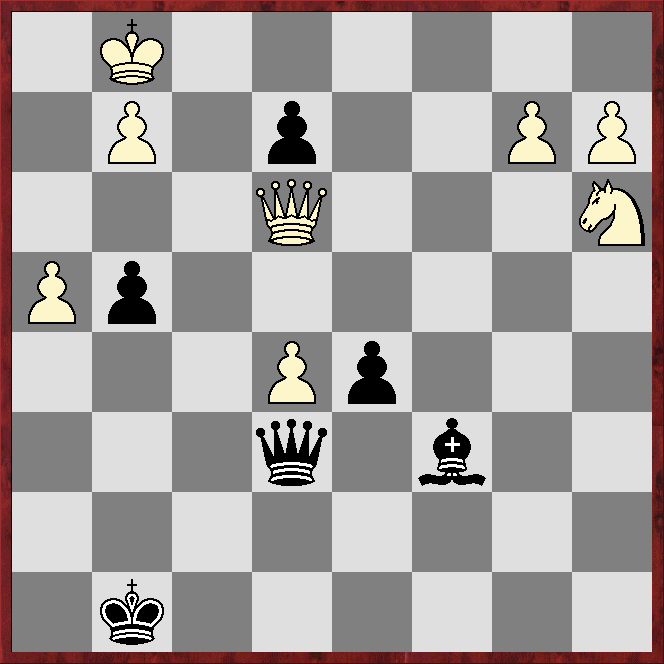
Black to play and win
*****
*****
*****
*****
*****
31...Ref6?
Moves such as 31...Rxf1+ and 31...Bb7!? preserve the balance, according to the engines, but they point out the strength of 31...Rf2!, when 32.Bxf2 exf2+ 33.Qxf2 loses to 33...Be3, while even worse is 32.Qa6 e2 33.Bxf2 exd1=Q 34.Rxd1 g3 35.Be1 Be3+ 36.Kh1 Qg4 etc.
32.Rxf6 Rxf6 33.Rf1?!
White has a winning advantage after 33.Nc2 or 33.Re1, according to the engines.
33...Rxf1+ 34.Qxf1 Qe6?
Black has enough for the two-pawn deficit after 34...Bg7, according to the engines, while 34...Qe4 is also better than the text.
35.Be5 Bg7 36.Qf4 e2!? 37.Qe3?
White wins comfortably after 37.Kf2.
37...Bxe5 38.dxe5
Black has two ways to draw - award yourself a gold star if you can spot either!
*****
*****
*****
*****
*****
38...d4
The more spectacular draw comes after 38...Bb5!! 39.Nxb5 Qb6!! 40.Nd4 Qxd4!! 41.Qxd4 e1=Q+ 42.Kh2 Qh4+ etc, but also rather special is 38...Qh6!! 39.Qxe2 (39.Qxh6?? e1=Q+ 40.Kh2 g3+ 41.Kh3 Bd7+) Qxh4, when the engines reckon White, despite being two pawns up, cannot make progress, eg 42.Nc2 g3 (threatens mate in two) 43.Qd3 Qh2+ 44.Kf1 Qh1+ 45.Ke2 Qxg2+ 46.Kd1 Qf2, after which White is probably best-advised to bail out with a perpetual by 47.Qg6+ etc.
39.Qxe2 g3 40.Qc4 Bd5 41.Qxd4 Kh8 42.b4 1-0

Life's A Beach

Not sure exactly what this is supposed to be, but it shows more imagination than the average 'sandcastle'

Wednesday, 23 October 2024

Sant Jordi Round Four

FACED a French junior (born 2010).

Rodrigue Hamm (1915) - Spanton (2013)
Maróczy Bind
1.e4 c5 2.Nf3 g6 3.d4 cxd4 4.Nxd4 Nc6 5.Be3 Bg7 6.c4 Nf6 7.Nc3 d6 8.Be2 0-0 9.0-0 Bd7 10.f3 Nxd4 11.Bxd4 Bc6 12.Qd2
After minor transpositions the game has reached a position occurring 4,330 times in ChessBase's 2024 Mega database
*****
*****
*****
*****
*****
12...a5 13.Nd5
The mainline in Mega24 runs 13.b3 Nd7!? 14.Be3!? Nc5 15.Rab1 Qb6!? 16.Rfc1 Rfc8, reaching a position that appears 875 times, slightly favouring White, according to Stockfish17 and Dragon1.
13...Nd7!? 14.Rac1!?
Placing a rook on a file that will probably become open if Black captures on d5, either willingly or because of White pressure. The commonest continuation in Mega24 is 14.Bxg7, although frequently in such Maróczy Bind positions Whites keep their better bishop on the board by retreating it to e3 or f2.
14...Bxd4+!? 15.Qxd4 e5!?
Gaining central space. Black hopes to mask the backward d pawn by manoeuvring the knight to d4.
16.Qd2
The engines suggest 16.Qe3, but 16...Bxd5 17.cxd5 Nc5 looks fine for Black.
16...Nc5 17.Rfd1 Ne6 18.Qe3 Bxd5
How should White recapture?
*****
*****
*****
*****
*****
19.Rxd5?
At first glance this may seem promising, but it allows Black a winning attack. Instead 19.cxd5 Nd4 gives a position in which Black's better minor-piece slightly outweighs White's central space advantage, according to the engines.
19...Nf4
This wins material.
20.Rd2
The engines prefer giving up the exchange with 20.Rd3!?
20...Qg5
As well as mate at g2, Black threatens to win the white queen with 21...Nh3+ etc.
21.Kf1 Qxg2+ 22.Ke1 Qxh2 23.Bf1 Qh4+ 24.Kd1 Qe7 25.Rh2 Kg7 26.Kc2 h5 27.Kb1 Rac8 28.Rd1 Qc7 29.Rhd2 Rfd8 30.Qa3
Black cannot save the d pawn, but exchanges on d6 will let Black successfully activate the passed h pawn
*****
*****
*****
*****
*****
30...h5 31.Rxd6!?
This hastens the end, but if Black is allowed to remain two pawns up White loses anyway.
31...Rxd6 32.Rxd6 h3 33.Rd2 Rd8 34.Qc3 h2! 35.Rxh2 Rd1+ 36.Kc2 Rxf1 (0-1, 45 moves)