Showing posts with label Evans' Gambit. Show all posts

Friday, 13 February 2026

League Chess

PLAYED on board one (of four) for Battersea against South Norwood last night in Croydon & District League's Dave Luckin division, where teams are allowed a rating total of 6600, ie a player-average of 1650.

Paul Dupré (1890) - Spanton (1928)
Evans Gambit
1.e4 e5 2.Nf3 Nc6 3.Bc4 Bc5 4.b4 Bxb4 5.c3 Bd6!?
The Stone-Ware Defence. It is fourth-most popular in ChessBase's 2026 Mega database, but scores better percentage-wise than the three more popular moves: 5...Bc5, 5...Be7 and 5...Ba5; but 5...Bf8!? scores even better, and it is hard imagining that becoming commonplace.
6.d4 Nf6 7.0-0 0-0
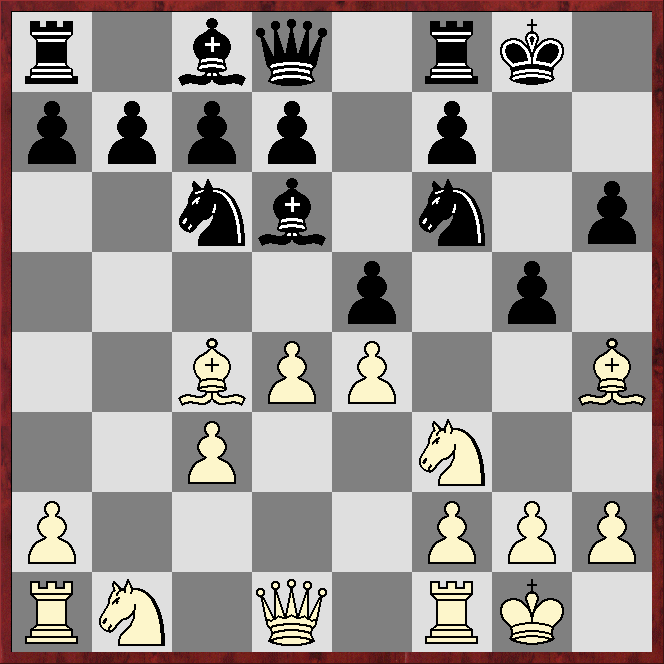
With both sides castling early, how would you assess the position?
*****
*****
*****
*****
*****
Black is a pawn up, but Black's setup looks clumsy. Meanwhile White enjoys a two-abreast classical pawn-centre, and, according to Stockfish17.1 and Dragon1, has a slight edge.
8.dxe5
The engines prefer developing with 8.Re1 or 8.Nbd2.
8...Nxe5
The engines suggest giving up the bishop-pair with 8...Bxe5!?, the point being that after 9.Nxe5 Nxe5 White has to spend a tempo dealing with Black's attack on the light-square bishop, eg 10.Bb3, when 10...d6 leaves Black up a pawn and not behind on development, albeit 11.f4 gives White more central/kingside space and an initiative (as well as the bishops).
9.Nxe5 Bxe5
How should White proceed?
*****
*****
*****
*****
*****
10.Ba3!
The engines agree this is best. The problem with 10.f4 Bd6 11.e5 is that Black has 11...Bc5+ 12.Kh1 and either ...Ne4 or ...d5.
10...Re8 11.f4 Bd6 12.e5
The e pawn is too vulnerable after 12.Bxd6?! cxd6.
12...Bxa3 13.Nxa3
Not 13.exf6?, when 13...Bb2 is bad enough for White, but even worse, according to the engines, is 13...Bc5+! 14.Kh1 Qxf6, when Black is two pawns up and has the bishop-pair.
13...d5!?
The only move, but quite a normal one in such positions following e5.
14.Bb3!
The engines reckon this apparent-novelty is an improvement on the known 14.Bb5, when Stephan Grochtmann (2010) - Jadranko Plenča (2435), Šolta (Croatia) 2022, continued 14...Nd7!? 15.Qh5?! c6 16.Bd3, after which 16...g6 would have left Black well on top, according to the engines (the game went 16...Nf8?! 17.Rae1 g6 18.Qh6 f5?? 19.exf6 1-0).
14...Ng4 15.Qf3 c6 16.Kh1?!
This is probably too slow. The point of the move is to make the pinning Rad1 possible, which presently is not on as 16.Rad1?? fails to 16...Qb6+ 17.Kh1 (17.Rd4 c5) Ne3. The engines suggest 16.h3 or 16.Nc2.
16...Qb6
Getting out of the pin before it arrives, but the engines do not like this prophylaxis, preferring 16...a5, 16...Qh4 or 16...Bf5.
17.Rae1 Bf5 18.Nc2
The engines suggest 18.h3 or 18.Bc2!?
What should Black play?
*****
*****
*****
*****
*****
18...Nh6!
This retreat is best, not least because it unties the bishop.
19.Nd4 Be4
How should White continue?
*****
*****
*****
*****
*****
20.Qh3
The exchange-sacrifice 20.Rxe4!? is Dragon1's top choice, but not Stockfish17.1's. After 20...dxe4 21.Qxe4 White has got back the sacrificed Evans pawn, but does not have enough for the exchange, according to both engines.
20...c5 21.Nf3 Rad8 22.Ng5 Bf5 23.Qf3
The engines prefer 23.Qh4 or 23.Qg3, but agree Black is on top.
23...c4!
This makes the d pawn backward, but of more importance is that White's bishop does not have a good move.
24.Ba4
24.Bd1 f6!? is very good for Black.
24...Re7
The rook is hanging, ie unprotected, but there seems no way for White to exploit this, and meanwhile the white bishop is also loose
*****
*****
*****
*****
*****
25.h3 Bd3 26.Rg1
Forced, as 26.Rf2? can be met by 26...f6!?
26...Qa5 27.e6!?
Opting for complications in view of 27.Bd1 Qxc3.
27...f6
Possibly even stronger is 27...Qxa4!? 28.exf7+ Rxf7.
28.Nf7!? Nxf7 29.exf7+ Rxf7 30.Be8!? Rf8 31.Bh5 g6 32.f5 gxh5 33.Qg3+ Kh8
Also winning, but somewhat hairy-looking, is 33...Kf7!?
34.Re7 Rg8 35.Qh4 Rg5 36.Rge1 Be4
White's threats are over.
The game finished:
37.R1xe4 dxe4 38.Qxe4 Qb5 39.h4 Rg4 40.Rxh7+ Kxh7 41.Qe7+ Rg7 0-1
The match finished 2-2.
My Battersea Season 2025-6
Date       Event  Colour  Rating  Opp's Rating  Score  Season's Perf
16/9/25   CLL       W       1936         1952             0           1552
18/9/25   CLL       W       1936         1797             =           1675
16/10/25 CLL       W       1889         2047             0           1665
23/10/25 CLL       B        1889         1823             1           1805
18/11/25  LL         W       1891         1980             =           1840
20/11/25  CLL      W       1891         1866             1            1911
25/11/25  BCC     B        1891         1817             1            1955
9/12/25    LL         W       1904         1982             1            2008
16/12/25  LL         B        1904         2046             0            1968
18/12/25  CLL      B        1904         2066             1            2018
6/1/26      CLL      W       1929         2150             =            2066
7/1/26      LL         W       1929         1971             =            2058
8/1/26      CLL      B        1929         1800?           =            2038
13/1/26    LL         B        1929         2035             1            2067
27/1/26    LL         B        1929         2089             0            2041
29/1/26    CLL      B        1929         1882             =            2031
3/2/26      BCC     W       1928         1836             1            2043     
12/2/26    CDL      B        1928        1890              1            2057
CLL: Central London League
LL: London League
BCC: Battersea club championship
CDL: Croydon & District League
I also have a win-by-default in the Central London League

Thursday, 24 April 2025

English 65+ Round One

John Morrish (1644 ECF/1786 Fide) - Spanton (1985 ECF/1922 Fide)
Evans Gambit
1.e4 e5 2.Bc4 Bc5 3.Nf3 Nc6 4.b4
The Evans Gambit is a rare bird in the modern tournament scene.
4...Bxb4 5.c3 Bd6!?
The Stone-Ware Defence is an even rarer riposte - there are just 541 examples of 5...Bd6!? in ChessBase's 2025 Mega database.
How should White respond?
*****
*****
*****
*****
*****
6.d4
This is easily the most popular move, and is liked by Stockfish17 and Dragon1 along with 6.0-0
6...Nf6 7.dxe5!?
The main line in Mega25 runs 7.0-0 0-0 8.Re1 h6!? 9.Nbd2 Re8 10.Bd3!? (10.Qb3 is also popular, and is preferred by the engines) Bf8 11.Nxe5 Nxe5 12.dxe5 Rxe5, with White having full compensation for a pawn, according to the engines.
7...Bxe5
Not 7...Nxe5? 8.Nxe5 Bxe5 9.f4 Bd6 10.e5, and if 10...Qe7 then simply 11.Qe2.
8.Nxe5 Nxe5 9.Bb3
White has the bishop-pair and easy development, but that is not enough for a pawn, according to the engines
*****
*****
*****
*****
*****
9...0-0 10.Bg5
The engines prefer castling, as after the text ...
10...h6
... puts White in a predicament.
11.Bh4
This looks natural, but the engines much prefer giving up the bishop-pair by capturing on f6, or keeping the bishop-pair while maintaining a pin on the black king's knight by 11.f4!? Ng6 12.f5!? Ne5 13.Bh4.
11...Ng6 12.Bg3!?
Offering a second pawn, presumably on the basis that 12.Bxf6 Qxf6 leaves White with no compensation for a single pawn.
12...Nxe4 13.0-0 Nxg3 14.fxg3 d6 15.Nd2 Ne5 16.Qc2 Bd7 17.Rf4 a5!? 18.a3
On 18.Raf1 Black has 18...a4!?, when 19.Bxa4 Bxa4 20.Rxa4 Rxa4 21.Qxa4 Qg5 leaves Black 'only' a pawn up materially, but in a simplified position in which White has queenside pawn-weaknesses.
18...Qe7 19.Raf1 Bb5 20.c4
There appears to be nothing better.
20...Bc6 21.Ne4?
This loses further material
*****
*****
*****
*****
21...Ng6 22.Rg4
Or 22.Nf6+ gxf6 23.Rxf6 Qe3+ 24.Kh1 Be4.
22...h5 23.Rxg6
If 23.Nf6+ gxf6 24.Rxg6+ fxg6 25.Qxg6+, Black has 25...Qg7.
23...Bxe4 24.Qe2 fxg6 25.Re1 Qf6!? 0-1

Friday, 20 December 2024

What Do The Engines Say? 1. Evans' Gambit

MODERN computer programs are revolutionising how we approach openings.
This first became noticeable when supposedly-refuted moves started making a comeback as engines showed resources that had evaded the world's top players.
But more recently, as engines grow in strength, there has been a trend in the opposite direction, at least at the highest level.
Grandmaster Nigel Davies summed this up in a post at chesspublishing.com, where he recounted a conversation with Canadian GM Kevin Spraggett, who "opined to me that ancient openings are making a comeback because engines are finding flaws in the more risky ones."
Davies added: "I think there is a lot of truth in this, which is confirmed by the migration of top players to strictly classical openings."
Engines are still far from the stage of knowing all there is to know about openings.
Their play in that stage of the game is not on a par with their abilities in tactical middlegames.
So we cannot expect engines to tell us move-by-move how to play our favourite opening variations,
But their advice on what we should be looking at - the moves that show the most promise - is certainly well worth considering.
So in this series I will be looking at what the engines say about mainline opening positions, starting with the Evans Gambit.

After 1.e4 e5 2.Nf3 Nc6 3.Bc4 Bc5 4.b4 Stockfish17 and Dragon1 agree the pawn should be taken (with the bishop).
Position after Black takes the pawn
*****
*****
*****
*****
*****
Dragon1 reckons White has fair compensation, although it believes White no longer has the advantage that comes with moving first, while Stockfish17 already gives Black a slight edge.
However, the situation is not clear, as is shown by the engines' reaction to White's follow-up, 5.c3.
Stockfish17 recommends looking at 5...Ba5, which is the main continuation in ChessBase's 2025 Mega database, but Dragon1 fluctuates between that and the second-most popular move, 5...Be7.
One thing the engines are agreed on, however, is that 5...Bc5, which used to be touted in books as roughly as good as 5...Ba5 (5...Be7 rarely got a look-in), helps White, with Stockfish17 claiming it leaves White slightly better (Dragon1 is not so sure).

Saturday, 26 October 2024

Sant Jordi Round Seven

I WAS downfloated.

Josep María Sayrol Clols (2002) - Spanton (2013)
Evans Gambit
1.e4 e5 2.Nf3 Nc6 3.Bc4 Bc5 4.b4 Bxb4 5.c3 Bd6!?
This move is fourth in popularity, behind 5...Bc5, 5...Be7 and especially 5...Ba5
*****
*****
*****
*****
*****
6.d4 Nf6 7.0-0 0-0
Now both sides have castled, how would you assess the position?
*****
*****
*****
*****
*****
White's extra room for manoeuvring, combined with the awkward siting of Black's dark-square bishop, more than compensate for being a pawn down, according to Stockfish17 and Dragon1.
8.Re1 b6
The mainline in ChessBase's 2024 Mega database runs 8...h6 9.Nbd2 Re8, which the engines reckon gives a slight edge to White.
9.Bg5 h6 10.Bh4 Bb7 11.Nbd2 Re8
Black returned the pawn in Antonios Pavlidis (2307) - Vladimir Georgiev (2539), Thessaloniki Triandria (Greece) 2009, with 11...Be7!? 12.Nxe5, when 12...Na5!? 13.Ng6!? Nxc4 14.Nxe7+ Qxe7 15.Nxc4 gave White the upper hand, according to the engines (1-0, 34 moves).
12.Rb1 a5?!
This has little relevance to what is happening in the centre and kingside, and (at least temporarily) takes away the a5 square from Black's knight. Dragon1 reckons 12...Be7!? completely equalises; Stockfish17 disagrees, preferring 12...exd4 13.cxd4, and now 13...Be7, albeit both engines then give White at least a tiny pull.
13.Nf1 a4 14.Ng3!
The engines agree this is best.
How should Black proceed?
*****
*****
*****
*****
*****
14...g6?!
White's attack is far too powerful after 14...g5? 15.Nxg5 hxg5 16.Bxg5, but best may be 14...Bf8.
15.Qe2?!
Much stronger, according to the engines, is 15.Qd2, eg 15...Kg7 16.Bd5 Be7 17.Bxf7! Kxf7 18.Qxh6 with a huge attack, a sample line running 18...Rg8 (18...Bf8? 19.Ng5+) 19.dxe5 Ng4 20.Qf4+ etc, or 15...Bf8 16.dxe5 Nxe5 17.Nxe5 Rxe5 18.Qf4 etc.
15...Ra5!?
The engines slightly prefer this to 15...exd4, when they reckon 16.Qd3!? gives White at least a slight edge.
16.d5!?
This cuts off Black's queenside pieces from assisting on the kingside, at least in the short and medium term, but it also takes pressure off the e5 square and severely hampers White's light-square bishop. The engines still suggest Qd2.
16...Nb8 17.Nf1!?
This retreat is the engines' top choice, even though Black is not threatening to trap White's light-square bishop with ...g5 (the reply Nxg5 would be catastrophic for Black).
17...Na6?!
The engines strongly dislike this, reckoning 17...Bf8 gives complete equality.
18.Ne3 Bf8?
A move too late. The engines give 18...Kg7!?, although 19.Ng4 Be7 20.Nfxe5 puts White on top.
19.Bg3?
The engines reckon this turns a winning position into a losing one. After 19.Ng4 Bg7 20.d6! Black is busted, eg 20...cxd6 21.Bxf6 Bxf6 22.Rxb6! (22.Nxh6+ is also strong) Qxb6 23.Nxf6+ Kg7 (23...Kf8 24.Nxd7+; 23...Kh8 24.Qd2 g5 25.Nxg5!) 24.Nxe8+. The engines suggest 20...b5, but White has several winning lines, including 21.Bxf6 Bxf6 22.Rxb5 Rxb5 23.Bxb5 Nc5 24.dxc7 Qe7 25.Nxf6+ Qxf6 26.Qe3 and 27.Qxh6.
19...d6
Even stronger, according to the engines, is 19...Nc5!? 20.Bxe5 Ncxe4.
20.Bb5?!
Attacking the black king's rook and trapping the black queen's rook, but the engines prefer 20.Bh4!? or 20.Nd2.
20...Rxb5!?
White is close to equalising, according to the engines, after 20...Re7?! 21.Nd2!? (or 21.Nc4).
21.Rxb5 Nc5
Even better is 21...Nxe4, according to the engines.
22.Rbb1
The engines reckon White should give back the exchange with 22.Rxc5!?, although Black remains a pawn up.
22...Nfxe4 23.Qc2 f5!?
Suddenly it is White's pieces that are awkwardly placed and Black's that are active
*****
*****
*****
*****
*****
24.Rb4
White does not have an adequate answer, eg the engines' 24.h3 can be simply answered by 24...f4, but even stronger seems to be 24...Nxg3 25.fxg3 Bg7, when White's advantage of the exchange is more than offset by Black's bishop-pair, two pawns and superior pawn-structure.
24...Ba6 25.Nc4 Bxc4!? 26.Rxc4 b5 27.Rb4 Qc7 28.h3
The engines suggest 28.c4 bxc4 29.Rxc4, but agree Black is winning.
28...Nxg3 29.fxg3 e4 30.Nd4 Nd3 31.Rf1 Nxb4 32.cxb4 Bg7 33.Ne6 Be5 34.g4
The engines suggest offering the g3 pawn with, for example, 34.Qc1!?, but Black has several good replies, including 34...Bxg3 35.Qxh6 Rxe6! 36.dxe6 Qxe6 37.Qg5 Be5 38.Qd8+ Kh7 39.Qxc7+ Kh6, when Black's central passers should prevail easily.
What should Black play?
*****
*****
*****
*****
*****
34...c6!
Other moves are much less convincing, eg 34...fxg4 35.hxg4 more-or-less requires Black to give up the exchange with 35...Rxe6!? 36.dxe6 Qxe6, but 37.Qxc7 keeps White in the game as the black king is exposed.
35.gxf5 cxd5 36.Nf4 Qxf5 37.Ne2!?
This is best, according to the engines, but there comes:
37...Bh2+ 0-1
Result corrected (I originally typed 1-0)

Wednesday, 15 March 2023

Gambit Chess

PLAYED last night on board two (of eight) for Battersea 2 against Wimbledon in division two of the London League.

Neil Cannon (1986) - Spanton (1976)
Evans Gambit
1.e4 e5 2.Nf3 Nc6 3.Bc4 bc5 4.b4 Bxb4 5.c3 Bd6!?
The Stone-Ware Defence - probably better than its reputation.
6.0-0
Much more common in ChessBase's 2023 Mega database is 6.d4, after which the mainline runs 6...Nf6 7.0-0, transposing to the game.
6...Nf6 7.d4 0-0
Not 7...Nxe4? 8.dxe5 Nxe5 9.Nxe5 Bxe5 10.Qd5 Qe7 11.Re1 etc (but not 11.Qxe4?? Bxh2+ and 12...Qxe4).
8.Bg5
The main move in Mega23 is 8.Re1, which Stockfish15 reckons gives White a slight edge, but Komodo13.02 calls equal.
8...h6 9.Bh4 Be7!? 10.Qe2 d6
How should White proceed?
*****
*****
*****
*****
*****
11.dxe5
Victor Nithander (2465) - Emil Hermansson (2469), Swedish Team Championship 2008-9, saw 11.Rd1 Bg4 12.h3 Bh5 13.d5 Na5 14.g4 Nxc4 with a large advantage for Black, according to the engines (0-1, 37 moves).
11...Nxe5 12.Nxe5 dxe5 13.Rd1 Qe8 14.h3 Bd7 15.Nd2 Bc6
White leads in development but Black is a pawn to the good and with no weaknesses
*****
*****
*****
*****
*****
16.Bg3 Bd6 17.Bd3 Rd8 18.Bh4 Be7 19.Bg3 Bd6 20.Bh4 Be7 21.Bg3 Nd7
Declining threefold repetition - Black is better.
22.Nf3
I was more concerned about 22.Nc4 with Na5 to come, but the engines reckon 22...Bg5 23.Na5 Nc5 24.Nxc6 Qxc6 is good for Black.
22...Bf6 23.Nh4 g6!? 24.Qe3 Kg7
Can White equalise material by grabbing the a7 pawn?
*****
*****
*****
*****
*****
No, or, rather, yes, but he would regret it, eg 25.Qxa7? Qe7 26.Nf3 Nc5, after which White cannot save both the light-square bishop and the queen.
25.Nf3 b6 26.Bh4 Qe7 27.Bxf6+ Qxf6 28.Bc2 Nc5 29.a3 Ne6 30.Kh2 Rxd1 31.Rxd1 Rd8 32.Rxd8 Nxd8 33.Kg1
The king moves are to little effect, but it is difficult to suggest a constructive plan for White, who has the inferior bishop and pawn-structure as well as being a pawn down.
33...Qd6 34.c4 Ne6 35.Qc3 Nd4 36.Nxd4 Qxd4 37.Qd3 Qxd3
The engines prefer keeping queens on the board, but getting them off simplifies matters (at least for a human).
38.Bxd3 Kf6 39.Kf1 Ke6 40.Ke2 Kd6 41.Kd2
41.Ke3 Kc5 is no improvement.
41...Kc5 42.Kc3 b5 43.h4 f6 44.g3?!
Hoping to set up a blockade, but 44.cxb5 is almost certainly better, although losing.
44...bxc4 45.Bc2 a5 46.Bb1 Ba4 47.Ba2 Bb3! 48.Bxb3
White will end up in zugzwang after 48.Bb1.
48...cxb3 49.Kxb3 Kd4
The game finished:
50.Ka4 c5 51.Kxa5 c4 52.Kb6 c3 53.a4 c2 54.a5 c1=Q 0-1
Battersea 2 won the match 5.5-2.5.

Wednesday, 16 November 2022

Brno Game Four

Petr Brož (2037) - Spanton (1771)
Evans' Gambit
1.e4 e5 2.Nf3 Nc6 3.Bc4 Bc5 4.b4 Bxb4 5.c3 Bd6!?
This bishop retreat, which begins the Stone-Ware Defence, is the type of move beginners are warned against playing, but there are 443 examples of it in ChessBase's 2022 Mega database.
6.d4 Nf6
If 6...exd4 then Stockfish15 and Komodo13.02 like 7.0-0!?, claiming White is at least slightly better despite being two pawns down.
7.0-0 0-0
The greedy 7...Nxe4?! runs into 8.dxe5 Nxe5 9.Nxe5 Bxe5 10.Qd5 Qe7 11.Re1 Bxh2+ 12.Kf1!, after which 12...0-0 13.Rxe4 gives White a knight and a huge attack for three pawns.
8.Bg5!?
The engines prefer 8.Re1 or 8.Nbd2.
8...h6 9.Bh4 g5?!
This move often proves weakening, especially when, as here, the f7 pawn is pinned along the a2-g8 diagonal. The engines reckon best is 9...Be7!?, and if 10.dxe5?! then 10...Nxe4, after which Black is a pawn up and seems out of immediate danger. Instead of 10.dxe5?! the engines prefer 10.Nbd2 or 10.Re1, albeit giving Black at least a slight edge.
How should White respond?
*****
*****
*****
*****
*****
10.Bg3
This seems stronger than 10.Nxg5?! hxg5 11.Bxg5, when the engines reckon 11...Be7!? gives Black an advantage, although the position remains sharp.
10...Nxe4?!
All three games to reach the position after 10.Bg3 in Mega22 saw this continuation, but it is probably a mistake, although the engines disagree as to what Black should play. One line suggested runs 10...Re8 11.Qb3 Qe7 12.dxe5 b5!? 13.Bxf7+ Qxf7 14.exd6 cxd6, after which material is equal and Black's position looks a mess, but the engines reckon White has only a slight edge. The problem with the text is it opens the b1-h7 diagonal.
11.Bxe5?
White is winning, according to the engines, after 11.Qd3 or 11.Qc2.
11...Nxe5?!
Black has the advantage after 11...Bxe5, whereas the text allows White to recapture with tempo.
12.dxe5 Be7
I had originally intended 12...Bc5?, but it loses to 13.Qd5 Bxf2+ 14.Kh1 etc. However an improvement may be the engines' 12...g4!?, although the lines after 13.exd6, 13.Re1 and 13.Nbd2 are sharp and unclear.
13.Qc2
An improvement on the known move 13.Nbd2?
13...d5 14.exd6 Nxd6 15.Qg6+ Kh8 16.Qxh6+ Kg8
How would you assess the position?
*****
*****
*****
*****
*****
White has regained the gambited pawn and exposed the black king, but Black has the bishop-pair and White's rooks and queen's knight cannot quickly add to the White attack. I thought I was lost, but the engines give White just a slight edge.
17.Bb3
And now the position is equal, according to the engines. They reckon 17.Bd3 Nf5 favours Black, and instead suggest 17.Na3!?, when 17...Nxc4!? 18.Nxc4 exchanges off a useful black defender and brings the white queen's knight into the action. The engines prefer meeting 17.Na3!? with 17...g4!?, albeit slightly favouring White.
17...Bf5
Stockfish15 reckons 17...Nf5 and 17...a5 give complete equality. Komodo13.02 comes to like 17...a5 and the text, albeit giving White a tiny pull.
18.Nd4 Bh7 19.f4?!
This seems to be a mistake, the engines preferring 19.Nd2 or 19.Na3.
19...c5!?
The engines prefer 19...Ne4 or 19...a5, but again the lines are unclear.
20.Nf3?
Black is winning after this. Best play, according to the engines, runs 20.Rf3! Nf5 21.Nxf5 Bxf5 22.Na3 Qb6 23.fxg5 Qxh6 24.gxh6 with what they reckon is at least a slight edge for White. Also better than the text is 20.Bc2 Bxc2 21.Nxc2, although they prefer Black after 21...Ne4.
20...c4 21.fxg5!?
Perhaps White should play the dispiriting 21.Bd1, but White's attack is gone and the white pieces are uncoordinated, eg 21...Nf5 22.Qh3 Qd3 23.Nbd2 (23.Nxg5?? allows a simple mate starting with 23...Bc5+) Ne3 24.Re1 Qxc3 25.Ba4 gxf4.
21...Nxf5 22.Qxh7+!?
This is White's best try, according to the engines, which only shows how bad the white position is.
22...Kxh7 23.Bc2 Bxg5 24.Nxg5+ Qxg5 25.Na3 Kg7 26.Bxf5 Qe3+ 27.Kh1 Qxc3 28.Nc2 Rad8 29.a4
Not 29.Rf3+ Qxa1+! etc.
29...Rfh8 30.Ra3 Qe5 31.h3 c3 32.Rb3 Qe2 33.Rf3 Rd1+ 34.Kh2 Qe5+ 35.Rg3+ Kf6 36.Rbxc3 Rg8 37.Bg4 Rxg4!?
Giving up the exchange to reduce the danger of accidents and to expose the white king.
38.hxg4 Kg6
Materially, Black is 'only' up queen for rook and knight, but the open board and weak white pawns mean Black retains a large advantage.
39.Rce3 Qc5 40.Na3 Qc1 41.Rgf3 Rh1+ 42.Kg3 Qc7+ 43.Kf2
After 43.Rf4? Rf1 44.Ref3 Rxf3+ White loses a piece to 45.gxf3 Kg5 or 45.Kxf3 Qb3+ etc.
43...Ra1 44.Rc3 Ra2+ 45.Kg1 Qd7 46.Nc4 Qd1+ 47.Kh2 Qe2 48.Kg3!?
48.Rg3 is not much of an improvement.
48...Qxg2+ 49.Kf4 Rxa4 50.Ke3 Qg1+ 51.Kd3 Qd1+ 52.Ke3 Qd5 53.Rf5 Qxc4!? 0-1

Friday, 21 October 2022

Calvià Game Four

Johan Granholm (1509) - Spanton (1764)
Evans' Gambit
1.e4 e5 2.Nf3 Nc6 3.Bc4 Bc5 4.b4 Bxb4 5.c3 Bd6!?
This is the Stone-Ware Defence, which goes back to at least 1834.
6.d4 Nf6 7.Ng5!?
The mainline runs 7.0-0 0-0 8.Re1 h6 9.Nbd2 Re8, after which Stockfish15 reckons White has at least a slight edge, although Komodo13.02 reckons White only has enough compensation for a pawn. The aggressive text was played by Adolf Anderssen and Henry Bird, but is not liked by the engines.
7...0-0
How should White proceed?
*****
*****
*****
*****
*****
8.Qd3?!
Anderssen - Lionel Kieseritzky, Match Game Eight (London) 1851, went 8.f4 exf4?! (8...exd4!?) 9.e5 Bxe5 10.dxe5 Nxe5 11.Bb3 h6 12.Nh3, when 12...d5 would have been strong, according to the engines (1-0, 37 moves). Bird - Harry Pillsbury, Hastings 1895, saw 8.Nxf7!? Rxf7 9.Bxf7+ Kxf7 10.f4 exd4 11.e5 Be7 12.exf6 Bxf6 13.0-0 d5, when Black had more than enough for the exchange, according to the engines (0-1, 39 moves). The position is messy, but the text, apparently a novelty, seems dubious.
8...h6 9.Nf3 exd4 10.0-0 Re8 11.Re1 dxc3 12.Nxc3 Ne5 13.Nxe5 Bxe5 14.Bd2 d6
Even stronger, according to the engines, is 14...b5!? 15.Bxb5 c6, eg 16.Ba4 Ng4 17.g3 Qf6 with an initiative as well as an extra pawn.
15.f4 Bxc3 16.Bxc3
White has the bishop-pair - not enough for two pawns, but enough to give practical chances
*****
*****
*****
*****
*****
16....Be6 17.Bb5 c6 18.Ba4 b5 19.Bc2 Bc4 20.Qg3
How should Black defend?
*****
*****
*****
*****
*****
20...g6?
Weakening. The engines like 20...a5, but cannot agree on how to meet 21.a3.
21.Qh4?!
Probably better is 21.Rad1!?, when grabbing a third pawn by 21...Bxa2!? may be playable but the engines prefer 21...b4 22.Bb2 (22.Bxb4?? Qb6 etc) Nh5 23.Qf2 Qb6 24.Bd4 c5 25.Ba1, after which Stockfish15 gives White the upper hand but Komodo13.02 reckons, if anyone is better it is Black.
21...Nh5 22.Qg4?
Necessary is 22.Qf2, although the engines much prefer Black after 22...Qb6 23.Bd4 c5.
22...Kh7?
22...Qb6+ 23.Kh1 Qf2 wins more material.
23.e5?
Better is 23.Rad1, allowing 23...Qb6+ to be met by 24.Bd4.
23...dxe5??
Again the engines reckon ...Qb6+, Kh1 Qf2 is winning.
24.Qxh5 Bd3?!
Probably better is 24...Qb6+ 25.Kh1 Qf2 26.Be4 exf4 (Stockfish15) or 24...exf4 25.Rxe8 Qb6+!? 26.Kh1 Rxe8 (Komodo13.02).
25.Bxd3?
The engines strongly favour keeping queens on the board with 25.Qd1.
25...Qxd3 26.Qf3
JG offered a draw in my time.
26...Qxf3 27.gxf3 exf4
How would you assess this position?
*****
*****
*****
*****
*****
Black has four pawns for a bishop, but the f pawns are doubled and none of the pawns is close to promoting. Meanwhile the absence of queens means mating attacks are unlikely. Stockfish15 reckons the position is completely equal, but Komodo13.02 gives White a slight edge.
28.Kf2 Rad8 29.Rac2 g5
This makes another pawn a potential target for the bishop, but is necessary to develop the king and at least makes f4 less vulnerable.
30.Rxe8 Rxe8 31.Bd4 Rd8!? 32.Bxa7 Ra8 33.Bb6 Rxa2+ 34.Kg2 Re2!? 35.Rxc6!?
This lets Black force rooks off and undouble the f pawns. White is equal after 35.h4!?, according to Stockfish15, or 35.Ba5, according to Komodo13.02. However it is not clear the text is a mistake as after ...
35...Re6 36.Rxe6 fxe6
... Komodo13.02 reckons the position is equal, while Stockfish15 gives Black only a slight edge.
37.Kf2 Kg6 38.Ke2 Kf5 39.Bc5 h5 40.h3 e5 41.Be7 g4 42.fxg4+ hxg4 43.hxg4+
Not 43.h4?? as White cannot cope with the black pawn-phalanx, eg 43...g3 44.h5 e4 45.h6 f3+ 46.Ke3 g2 47.Kf2 e3+ 48.Kg1 Kg6 49.Bf8 e2 etc.
43...Kxg4
With all the white pawns off the board, only Black can realistically hope to win, but the position is drawn.
44.Bd6 e4 45.Bc5 Kg3 46.Bf2+??
Pinning the f pawn with 46.Bd6 draws.
46...Kg3 47.Bc5 f3+ 48.Ke1 b4 0-1

Saturday, 28 November 2020

Belgrade Round Five

FACED an unrated (born 2000) on bottom board today.
Luka Petković - Spanton (1831)
34th Belgrade Trophy International Round 5
Evans' Gambit
1.e4 e5 2.Nf3 Nc6 3.Bc4 Bc5 4.b4 Bxb4 5.c3 Bd6!?
This is the Stone-Ware Defence. The only bishop-retreat less popular in ChessBase's 2020 Mega database is 5...Bf8?!
6.d4 Nf6
Alexander McDonnell played 6...h6!? in game six of his fourth match against Louis-Charles de La Bourdonnais in 1834.
7.Nbd2
McDonnell perhaps feared 7.Bg5 or possibly 7.Ng5, although neither seems particularly frightening for Black.
The normal move in Mega20 is 7.0-0, but LP explained afterwards he played the text, which has also been played by Russian IM Bogdan Belyakov, to protect e4. However, after 7.0-0 the move 7...Nxe4? fails to 8.dxe5 Nxe5 9.Nxe5 Bxe5 10.Qd5.
7...0-0 8.Qc2!?
This may be a novelty. Castling is again normal.
8...b6
My analysis engines Stockfish12 and Komodo11.01 reckon Black should take the chance to free his congested position with 8...exd4!? 9.cxd4 Be7. They do not believe White has quite enough for his pawn sac, but this looks exactly the type of position an Evans player thrives in.
9.0-0 Bb7 10.Bb2
This is the engines' choice. They reckon White has full compensation for a pawn.
10...Nh5
The f4 square is weak, as is the f5 square for Black.
11.Be2?!
Almost certainly better is 11.g3. Black is not well-placed to exploit light-square weaknesses around White's white king, and, if necessary, the white light-square bishop can be dropped back to f1. The text, on the other hand, does not cover f4 and makes the light-square bishop a target.
11...Nf4 12.Nc4??
White is already lost after this.
The engines give 12.Bc4 or 12.Rfe1, but prefer Black.
12...Ba6 13.Rad1!?
This becomes Stockfish12's choice, but does not save White.
13...Na5 14.dxe5
Even worse is 14.Nfd2 Nxe2+.
The game finished:
14...Nxe2+ 15.Qxe2 Bxc4 16.Qe3 Bc5 17.Qf4 Bxf1 18.Kxf1 Nc4 19.Ba1 Qe7 20.g3 f6 21.exf6 Rxf6 22.Qg4 Rxf3!? 23.Qxf3 Rf8 24.Qd3 Rxf2+ 25.Ke1 Qf7 26.Qd5 Rf1+ 0-1


Saturday, 29 August 2020

Champion Of Champions

I WAS musing the other day on the fact there have been 16 classical world chess champions - a figure ideal for organising a knockout tournament.
If the champions were seeded by chronological order, this is what the bracket would look like.

Round of 16
1. Steinitz
v-------------------------
16. Carlsen

8.Tal
v--------------------------
9.Petrosian

6. Botvinnik
v--------------------------
11. Fischer

13. Kasparov
v--------------------------
4. Alekhine

3. Capablanca
v--------------------------
14. Kramnik

5. Euwe
v--------------------------
12. Karpov

7. Smyslov
v--------------------------
10. Spassky

15. Anand
v--------------------------
2. Lasker

There are some mouthwatering match-ups, including the opening specialists Kasparov and Alekhine going head-to-head and the clash between champion-of-the-West Fischer and communist hero Botvinnik.
But how to decide the matches?
Just for fun, I am going to organise two-game mini-matches based on the players' games in ChessBase's 2020 Mega database.
In a 'game' each champion will make the move in any given position that he has played most often in Mega20.
When a position is reached which does not appear in a champion's repertoire, the game will be adjudicated by my main analysis engines Stockfish11 and Komodo11.01.
Whichever champion scores most over a two-game match will advance to the next round.
As I say, this is just for fun, but what else is there to do in lockdown?

Round of 16
Match One: Steinitz v Carlsen
Game One
Wilhelm Steinitz - Magnus Carlsen
Evans' Gambit
1.e4
Steinitz played 1.e4 in almost 80% of his games with the white pieces.
1...e5
Carlsen's reply is not so predictable, but the text has been more popular with him than 1...c5.
2.Nf3
Perhaps surprisingly this move is not the runaway winner. It appears 85 times in Steinitz's games, compared with 78 for 2.Nc3 and 65 for 2.f4.
2...Nc6 3.Bc4
Steinitz played this more than twice as often as 3.Bb5.
3...Bc5 4.b4!?
We have what is widely regarded as an archetypal 19th-century opening.
4...Bb6
This has been Carlsen's response both times he faced the Evans.
5.b5
Game One ends here as we have reached a position that does not appear in Carlsen's games
Both engines evaluate this position as better for Black. Averaging their two evaluations, once the evaluations become stable, gives Carlsen a score of +52 (in other words Black is 52 hundredths of a pawn better) - a great start with the black pieces.

Game Two
Magnus Carlsen - Wilhelm Steinitz
Spanish Cozio Deferred
1.e4 e5 2.Nf3 Nc6 3.Bb5 a6!?
No Steinitz Defence - the great Czecho-Austro-American (Steinitz was born in Prague, then part of the Habsburgs' Austrian empire, but later became a US citizen) played Morphy's 3...a6 more frequently than he played his own defence, 3...d6.
4.Ba4 Nge7
A Steinitz favourite, beating out the Steinitz Defence Deferred: 4...d6. I guess 4...Nge7 is a Cozio Deferred.
Another short game, but again we have reached a position that does not occur in Carlsen's games
The engines again much prefer Carlsen's position, giving him an averaged score of +50.5, which adds up to a match score of +102.5 - a resounding victory.
So after one match the tournament bracket looks like this.

Round of 16                   Quarter-Finals
1. Steinitz
v-------------------------------Carlsen
16. Carlsen (+102.5)

8.Tal
v--------------------------
9.Petrosian

6. Botvinnik
v--------------------------
11. Fischer

13. Kasparov
v--------------------------
4. Alekhine

3. Capablanca
v--------------------------
14. Kramnik

5. Euwe
v--------------------------
12. Karpov

7. Smyslov
v--------------------------
10. Spassky

15. Anand
v--------------------------
2. Lasker

Tuesday, 7 July 2020

Champion Repertoire

ONE frequent piece of advice given to club players is to base an opening repertoire on the repertoire of a famous master.
The idea is that such a repertoire has already been worked out, so the club player 'merely' has to study the indicated lines.
This used to be easier said than done, but the advent of databases and, just as important, database-sorting tools such as ChessBase, mean obtaining a ready-made repertoire is relatively easy.
In this series I want to look at the repertoires of some of the best players in history.
I am starting with Wilhelm Steinitz - partly because he was the first official world champion but also because he favoured open games that are often recommended to club and improving players.
Steinitz had a long career - more than 40 years as a strong player - and naturally his openings varied over time.
The repertoire I am putting forward here consists wherever possible of his commonest choices: the lines for which he seemed to feel the highest affinity.
In cases where two or more possible lines are very close in popularity, I have gone for the line with which he had the greatest success.
White
Open with 1.e4 with the aim of playing the Italian Game: 1...e5 2.Nf3 Nc6 3.Bc4. If Black replies with 3...Bc5, hit him with Evans' Gambit: 4.b4!? Steinitz scored 92% with this in 19 games, according to the 2020 Mega database.
If Black plays the Two Knights Defence: 3...Nf6, go for rapid development with 4.d4. Steinitz more often played the so-called patzers' move 4.Ng5!? but scored just 25% with it.
When Black avoids the Italian Game by playing the Petrov: 2...Nf6, Steinitz scored a very impressive 90% with 3.d4.
Steinitz only faced the Philidor: 2...d6 four times. He twice played 2.Bc4 and twice played 2.d4, winning all four games. If adopting this Steinitz repertoire, I would suggest choosing 2.Bc4 as it is less well known.
Against the Classical French: 1.e4 e6 2.d4 d5 3.Nc3 Nf6 Steinitz scored 94% with 4.e5, which is known as the Steinitz Variation. After 4...Nfd7 he won all four games in which he played 5.Nce2!? which today is often called the Shirov-Anand Variation.
Against the Winawer: 3...Bb4 he scored 94% by exchanging on d5, the idea being to show the black dark-square bishop is misplaced on b4 (it usually goes to d6 in the French Exchange).
The Sicilian Defence: 1...c5 was not very popular in Steinitz's day but he won all six games in which he replied 2.Nc3. However he generally did not aim for a Closed Sicilian, instead continuing with 3.Nf3 and 4.d4. One advantage of this move-order today is that black players might easily be taken out of their usual Open Sicilian repertoire by playing something on move two they would normally only play against the Closed.
Other replies to 1.e4 only featured in 11 of Steinitz's games, but generally he played what are today still considered main lines, eg against the Scandinavian: 1...d5 his games went 2.exd5 Qxd5 (no opponent played 2...Nf6) 3.Nc3, while he met the Caro-Kann: 1...c6 2.d4 d5 with 3.Nc3.
Black v 1.e4
Steinitz almost always played 1...e5 against 1.e4.
Meet the Spanish: 1.e4 e5 2.Nf3 Nc6 3.Bb5 with 3...a6 4.Ba4 Nge7!? His games continued 5.d4 exd4 with the most-popular line running 6.Nxd4 Nxd4 7.Qxd4 b5 8.Bb3 d6 9.c3, whereupon he had most success with 9...Be6.
Steinitz never faced the Modern Exchange Variation: 4.Bxc6 dxc6 5.0-0, and played normal moves against the main alternatives, 5.d4 and 5.Nc3.
Against the Italian Game: 3.Bc4 he liked 3...Bc5. Meet Evans' Gambit: 4.b4!? with 4...Bxb4 5.c3 Ba5 and the mainline Giuoco Piano: 4.c3 Nf6 5.d4 with 5...exd4 6.cxd4 Bb4+.
Against the Scotch: 3.d4 exd4 4.Nxd4 he favoured his own variation, 4...Qh4, generally meeting the critical 5.Nb5 with 5...Qxe4+ 6.Be2 Bb4+ 7.Bd2 Kd8.
Against attempts to play the Four Knights with 3.Nc3 Steinitz liked 3...g6 when the main line ran 4.d4 exd4 5.Nxd4 Bg7 6.Be3 Nf6.
He met the Ponziani: 3.c3 with 3...d5.
The King's Gambit: 2.f4 was very popular in the 19th century. Steinitz always accepted it with 2...exf4, generally meeting 3.Nf3 with 3...g5, and 3.Bc4 with 3...Ne7. Clearly anyone adopting Steinitz's repertoire will have to do some serious studying here.
Black v 1.d4 and Others
Steinitz was generally happy to defend the Queen's Gambit: 1.d4 d5 2.c4 e6 3.Nc3 Nf6. Meet 4.Bg5 with 4...Be7, playing 5...0-0 against both 5.e3 and 5.Nf3. He never faced the Exchange Variation: 4.cxd5 as far as I can discover, but liked to meet 4.Nf3, the most-popular move in his day, with a delayed acceptance of the Queen's Gambit by 4...dxc4 5.e3 c5.
He only faced the London System: 2.Nf3 Nf6 3.Bf4 once, attacking vigorously on the queenside with 3...c5 4.e3 Nc6 5.c3 Qb6.
He rarely faced the English: 1.c4 but he liked a Dutch set-up, either with an immediate 1...f5 or by first playing 1...e6. Steinitz only once faced 1.Nf3, meeting it with 1...d5.

Here Steinitz plays the Evans against long-time rival Johannes Zukertort in their 1872 match.
Steinitz - Zukertort
Match (London), Game 2
1.e4 e5 2.Nf3 Nc6 3.Bc4 Bc5 4.b4 Bxb4 5.c3 Ba5 6.d4 exd4 7.0-0
This is still very much the main line of the Evans. In fact it is more mainline today than when it was played back in 1872.
How should Black proceed?
*****
*****
*****
*****
*****
7...dxc3!?
Grabbing a second pawn has fallen from popularity when compared with 7...d6 and 7...Nge7, the latter being recommended by Tim Harding in Evans Gambit And A System Vs. Two Knights' Defense (Chess Digest 1991).
8.Qb3 Qf6
This seems to have been first played by Jean Dufresne in a win over Adolf Anderssen in 1851. Black temporarily defends f7 and c3, but White has two main ways to deal with this.
9.Bg5!?
More popular today is 9.e5 but the text comes to be very slightly preferred by analysis engines Stockfish11 and Komodo11.01.
9...Qg6 10.Nxc3 Bxc3 11.Qxc3 Nf6!?
Zukertort's innovation. Previous games in ChessBase's 2020 Mega database feature 11...f6, 11...Nge7 and 11...Nh6.
12.Bd3!?
The engines' prefer 12.e5 but it is unclear whether this gives White any advantage.
12...0-0
It turns out Black can safely ignore White's 12th move, which may be more-or-less a loss of a tempo.
13.Rae1
If 13,e5 then 13...Ne4 14.Qc2 d5 15.exd6 f5 gives Black an edge, according to the engines.
13...b5?
A mistake. The engines reckon Black is better after 13...d5 14.Bxf6 Qxf6 14.Qxf6 gxf6 15.exd5 Nb4 16.Bc4 Rd8.
14.e5?!
Even stronger seems to be 14.Qd2!? when the threat of e5 is hard to meet now the black king's knight can no longer use e4 and now ...Nd5 no longer comes with a hit on the white queen.
14...Nd5 15.Qc2
Again Qd2 seems stronger - winning, according to Stockfish11. Komodo11.01 is not so impressed but comes to agree White is much better after best-play of 15...Qe6 16.Be4 Nde7 17.Nh4 Bb7 18.f4.
15...Qh5
This would not work against 15.Qd2 as White could meet 15...Qh5 with 16.Re4.
16.a3
Not 16.Re4? Ndb4.
16...h6 17.Bd2 Nde7?!
The engines prefer 17...Nce7, leaving the knight on d5 covering important central squares.
18.Re4 Ng6 19.Rfe1
Black remains two pawns up but White has completed his development, has the bishop-pair and can look forward to a powerful kingside attack.
19...Bb7 20.g4 Qh3 21.R1e3 f5?
The black queen is lost anyway but the engines reckon Black can still put up a fight after 21...Rae8 22.Bf1 Ncxe5 23.Bxh3 Nxf3+ 24.Rxf3 Bxe4.
22.exf6 Rxf6 23.Bf1 Qxf3 24.Qb3+ d5 25.Rxf3 Rxf3 26.Qxf3 dxe4 27.Qxe4 Nge5
Steinitz wrapped up the win with ...
28.f4 Nc4 29.Qe6+ Kh8 30.Bc3 N6e5 31.Bxc4 1-0

Tuesday, 25 February 2020

The Power Of Two Checks

"NEVER miss a check - it might be mate" is attributed to Joseph 'Black Death' Blackburne.
Chess historian Edward Winter traces the aphorism back to a simultaneous display given by Blackburne in Birmingham in 1890.
What could be more powerful than giving check? Well, giving checkmate is certainly up there, and giving double-check is usually not bad either (but then both of these are also examples of giving check).
My database of my games has 26 examples of games containing a double-check.
Perhaps surprisingly, the double-checker only won 14 of the games, losing seven and drawing five. That is a score of 63.5%.
Here is the second-oldest example among my games.
Anthony D Brown (143) - Spanton (156)
Highbury (rapidplay) 1991
Evans' Gambit
1.e4 e5 2.Nf3 Nc6 3.Bc4 Bc5 4.0-0 Nf6 5.b4!?
Captain Evans first played his gambit in a similar way in 1836, except that in that game Black played 4...d6 rather than 4...Nf6.
5...d5?!
The move ...d5!? is an interesting try against 4.b4, but here it is almost certainly inferior to 5...Bxb4.
6.exd5 Nxb4 7.Nxe5 Nbxd5 8.d4 Bb6?
Harry Pillsbury played the better 8...Bd6?! in a loss to Emanuel Schiffers in 1896.
Stockfish10 and Komodo10 reckon Black keeps his disadvantage to a minimum with 8...Be7 or 8...Bb4.
9.Ba3 Be6 10.Re1 Nf4?
Better is 10...c6.
11.Bb5+?
11.Qf3 is strong, as is the consolidating 11.c3. In both cases the black king makes a miserable impression.
11...c6
How should White proceed?
*****
*****
*****
*****
*****
12.Nxc6?
Unclear is 12.Bxc6+!? bxc6 13.Qf3, but the engines' 13...Qd5!? (13...Nd5 14.c4) 14.Qxf4 Bxd4 15.c3 Bxe5 16.Qxe5 Qxe5 17.Rxe5 0-0-0 seems to be at least fine for Black.
Also far from clear is 12.Nc3!?
12...bxc6?
The engines' 12...Qd5! 13.Nxa7+ Kd8 looks good for Black.
13.Bxc6+ Nd7 14.Qf3 Rc8 15.Qxf4 Rxc6 16.d5 Rxc2 17.dxe6 Nf6?
Better is 17...Qf6, but Black still succumbs to a double-check, eg 18.exd7+ Kxd7 19.Qa4+ Qc6 20.Qg4+ Kc7 21.Nd2!?
18.Qa4+ Nd7
Now comes double-check and mate.
19.exd7#

My most-recent game featuring a double-check came against a junior in August.
Spanton (1881) - Boris Stoyanov (1592)
Northumbria Masters 2019
Scandinavian Tiviakov
1.e4 d5 2.exd5 Qxd5 3.Nc3 Qd6 4.d4 Nf6 5.Nf3 g6!?
Kramnik, Caruana, Nakamura and Tiviakov are among grandmasters who have tried this, but the main move is 5...a6.
6.Bc4 a6 7.Ne5!?
The engines reckon 7.Ng5 is even stronger.
7...e6 8.Bg5 Bg7 9.Qf3
Black to make his ninth move
*****
*****
*****
*****
*****
9...Nbd7
An improvement on 9...Nc6?? 10.Ne4 Qb4+ 11.c3 Nxe5 12.Nxf6+ Kf8 13.dxe5 Bxf6 1-0 in  Davide di Trapani (2090) - Sergio Garofalo (1826), Modena (Italy) Championship 2012.
10.Ne4 Qb4+?
The engines give 10...Qxd4 11.Bxf6 Nxe5 12.Qf4 0-0 13.0-0 Qxc4 14.Qxe5 Bh6 15.Rfd1 with a strong attack for White.
11.c3 Nxe5
The game has transposed to di Trapani - Garofalo.
12.Nxf6+ Kf8 13.dxe5 Qxc4
Marginally better than 13...Bxf6, but still hopeless.
14.0-0-0 Ke7
Now comes double-check …
15.Ng8+ 1-0
… and it would have been mate, after 15..Kf8 or 15...Ke8, by 16.Rd8#.

Monday, 7 October 2019

Morphy v The Evans (conclusions)

PAUL Morphy's huge score of +11=0-2 (84.6%) against the Evans is testament to his tactical and positional superiority over his opponents, who included some of the leading masters of the day.
Morphy treated the Evans, both as Black and as White, in the same way he treated other open games, ie with speedy development.
Although he always accepted the gambit, he rarely grabbed a second pawn in the opening, preferring to complete development.
From a theoretical viewpoint, it is impossible to say whether Morphy concluded that 5...Ba5 or 5...Bc5 was superior.
He played 5...Ba5 in his first six Evans' Gambits as Black before switching to 5...Bc5 in the next five, which included both his losses.
When he returned to 5...Ba5 in game 12, it might be thought significant, but in game 13 he went back to 5...Bc5.
Modern authors are almost unanimous in considering 5...Ba5 superior, and it scores a much better percentage in ChessBase's 2019 Mega database.
But Victor Bologan, in his repertoire book Bologan's Black Weapons In The Open Games: How To Play For A Win If White Avoids The Ruy Lopez, devotes more space to 5...Bc5, which he reckons most Whites have little idea how to play against.
The Evans is a rare bird in modern chess, even at club level, which makes it tempting for Blacks to spend just a little time learning a method of declining the gambit without trying for a refutation.
It is interesting to note in this respect that after 4...Bb6!?, which has been played by Carlsen and Aronian, White scores 51% in Mega19, while scoring 59% against 4...Bxb4. Other methods of declining, eg 4...Be7 and 4...d5!?, fare much worse.

Sunday, 6 October 2019

Morphy v The Evans (part 13)

FOUR years after his game against Augustus Mongredien, Paul Morphy played his 13th and final Evans' Gambit as Black.
His opponent was old French foe - and close friend - Jules Arnous de Rivière.
Rivière - Morphy
Paris 1863
1.e4 e5 2.Nf3 Nc6 3.Bc4 Bc5 4.b4 Bxb4 5.c3 Bc5
Morphy returns to the move that saw his two losses against the Evans.
6.0-0 d6 7.d4 exd4 8.d4 Bb6 9.Nc3
This is generally regarded by theorists as White's best try in the Normal Position, and is the choice of the engines Stockfish10 and Komodo10. But George Botterill* implies that he prefers 9.h3, stating: "Instead of doing something frantic, White decides that he will preserve all the advantages of his position and starts by preventing the annoying ...Bg4. There are many cases in which the most effective way of handling a gambit is just to strengthen your position in a quiet and methodical way, rather than forcing an immediate crisis."
9...Bg4
Harding prefers 9...Na5, which is the only move covered by Bologan (Kaufman does not reach this position as he only covers 7...Bg4 and 7...Bb6).
10.Bb5
Harding gives this an exclamation mark, saying it is "the only good move." He adds: "White is a pawn down but he has good development and a strong pawn centre, which means he can switch pieces quicker from one wing to the other." However, Howard Staunton's 10.Qa4!? and Pierre de Saint Amant's 10.Be3!?, both of which get on with development, seem playable, although the engines prefer the text.
10...Bd7
Returning the development tempo that White lost with 10.Bb5. An opponent of Morphy's played 10...Kf8!? against him in 1857, and this is treated as the mainline by Botterill and Harding.
White to make his 11th move
*****
*****
*****
*****
*****
11.Bg5!?
A key moment from a theoretical viewpoint.
Botterill gives 11.e5! (his punctuation) Nge7 12.Bg5, calling it "attractive for White." However, the engines reckon 12...h6 13.Bh4 g5 at least equalises for Black.
Harding also gives an exclamation mark to e5, but after 11...Nge7 12.Bg5 only mentions 12...dxe5 and 12...0-0.
11...Nce7?!
It is hard to understand this move when Black could have proceeded with development with 11...Nge7 or forced the g5 bishop to move with 11...f6.
12.Bc4 Be6 13.Qa4+?!
The engines' 13.d5 and 13.Bxe6 look considerably stronger, eg 13.d5 Bd7 14.e5 is very problematic for Black.
13...Qd7 14.Bb5 c6 15.Bd3 f6 16.Bh4?!
16.Be3 was probably a better retreat. The engines also point out 16.Rab1!?, threatening Rxb6.
16...Ng6 17.Bg3
An interesting alternative was 17.Nd5!?, possible because 17...cxd5? runs into 18.Bb5.
17...N8e7 18.d5 Bf7 19.Nb5!?
This is playable, but does not really achieve anything.
19...Bc5 20.Rac1 0-0 21.Nbd4 Kh8?!
It seems that better was ...Ne5, which was also good on move 19.
22.Bc4 Ne5 23.Nxe5 fxe5 24.dxc6 bxc6 25.Nb3 Bb6 26.Rfd1
White has completed development and has long-terms pressure on Black's centre.
26...Bh5 27.Rd2 a5 28.Qa3 Rad8!? 29.Bxe5 Rxf2 30.Kh1??
As an anonymous annotator in ChessBase's 2019 Mega database points out, White is fine after 30.Rxf2 dxe5 31.Nc5! Qd4 32.Nd3.
30...Rxd2 31.Bxg7+ Kxg7 32.Nxd2
White is a bishop down and has no real attack against Black's king. The remaining moves were:
32...Qa7 33.Qg3+ Bg6 34.Rf1 Bd4 35.Nf3 Qc5 36.Bb3 Rf8 37.h4 Be5 38.Qg4 Qe3 0-1
*I have been comparing play with two specialist books: Open Gambits: Italian And Scotch Gambit play by George Botterill (Batsford 1986) and Evans Gambit And A System Vs. Two Knights' Defense by Tim Harding (Chess Digest, 1991); and with two respected repertoire books: The Chess Advantage In Black And White by Larry Kaufman (McKay Chess Library, 2004) and Bologan's Black Weapons In The Open Games: How To Play For A Win If White Avoids The Ruy Lopez by Victor Bologan (New In Chess, 2014).

Saturday, 5 October 2019

Morphy v The Evans (part 12)

PAUL Morphy returned to his first love of 5...Ba5 - the modern mainline - in his 12th Evans' Gambit as Black.
Augustus Mongredien - Morphy
Match game 7, Paris 1859
1.e4 e5 2.Nf3 Nc6 3.Bc4 Bc5 4.b4 Bxb4 5.c3 Ba5 6.0-0 Nf6 7.d4 0-0 8.d5?!
The same doubtful move as played against Morphy by Hardman Montgomery (see https://beauchess.blogspot.com/2019/09/morphy-v-evans-part-five.html).
8...Ne7 9.Qd3
Varying from Montgomery's 9.Qc2.
9...d6 10.h3 Ng6
Just for fun, see how many guesses it takes you to come up with White's next move
*****
*****
*****
*****
*****
11.Nh2?
White gambited a pawn and now switches into mega-defensive mode - no wonder Mongredien lost his match against Morphy +0=1-7.
11...Nh5 12.Bb3?
White had to get on with development … and hope for the best. The text allows Black strong kingside play.
12...Nhf4 13.Bxf4 Nxf4 14.Qf3 f5 15.exf5 Bxf5 16.g4!?
Desperation, but White's position was already lost.
16...Bd3 17.Qe3 Bb6 18.Qd2 Qh4 0-1

Friday, 4 October 2019

Morphy v The Evans (part 11)

PAUL Morphy's next Evans' Gambit opponent with the white pieces was James Kipping, a banker who had a plus score against Adolf Anderssen.
Kipping - Morphy
Birmingham 1858
1.e4 e5 2.Nf3 Nc6 3.Bc4 Bc5 4.b4 Bxb4 5.c3 Bc5 6.d4!?
Kipping postpones castling in favour of what was then a relatively new plan - now the most popular one - of immediately advancing in the centre.
6...exd4 7.cxd4 Bb6 8.d5!?
8.0-0 d6 would reach the Normal Position.
8...Na5 9.Bd3 d6
White's play has been double-edged. His light-square bishop is blocked by its own central pawns. On the other hand, White has more space and the black queen's knight is sidelined. The engines Stockfish10 and Komodo10 reckon White has full compensation for his sacrificed pawn.
10.Bb2 Nf6 11.h3 0-0 12.0-0 Nh5!?
The black king's knight eyes the undefended f4 square, but Morphy's main idea will be revealed by his next move
*****
*****
*****
*****
*****
13.Qd2 f5!?
Opening the centre for White's light-bishop might seem strange, but an exchange on f5 (or e4) will also help Black's light-square bishop and his king's rook.
14.Na3!?
The engines' second-choice, but they prefer 14.e5!?, after which 14...dxe5 15.Bxe5 Qxd5 16.Nc3 leaves White two pawns down but with tremendous activity.
Instead of the text, the natural-looking 14.Nc3 fxe4 15.Nxe4 allows the interesting exchange-sac 15...Rxf3!? The position is not clear, and Black is by no means forced to sacrifice, but it is understandable Kipping did not trust 14.Nc3.
One point about the text is that 14...fxe4 can now be met by 15.Bxe4, which would lose material, if the white queen's knight were on c3, to 15...Nc4 16.Qc2 Nxb2 17.Qxb2 Ng3 etc.
14...Ng3 15.Rfe1 fxe4 16.Bxe4 Bf5 17.Bxf5 Nxf5
Stronger may have been 17...Rxf5.
18.Re4 Qd7 19.Bc3 Bc5 20.Nc2 b6 21.Qg5 Rae8 22.Rae1 Rxe4 23.Rxe4 h6 24.Qg4 Rf7 25.Re6 c6 26.Ncd4?
A mistake in a tricky position. The engines reckon 26.Bf6!, forcing 26...Ne7, is equal after 27.Bxe7 Rxe7 28.Rxe7 Qxe7 29.Qc8+.
26...cxd5 27.Qg6 Ne7 28.Qg3 Nac6 29.Nxc6?
White had to save his rook by, say, 29.Re2, but Black is well on top in the simplified position that follows 29...Nxd4 30.Nxd4 Nf5 31.Nxf5 Qxf5.
29...Qxe6 30.Nd8 Qg6 0-1
White resigns because 31.Nxf7?? loses to 31...Qxg3, while 31.Qxg6 Nxg6 32.Nxf7 Kxf7 is another simplified position that should be an easy win for Black.

Thursday, 3 October 2019

Morphy v The Evans (part 10)

George Medley - Morphy
London 1858
1.e4 e5 2.Nf3 Nc6 3.Bc4 Bc5 4.b4 Bxb4 5.c3 Bc5 6.0-0 d6 7.d4 exd4 8.cxd4 Bb6
Once again, the Normal Position.
9.Bb2 Nf6 10.Nbd2 0-0 11.e5 dxe5 12.dxe5 Ng4!?
Morphy is the first to deviate from his loss against Journoud & Rivière.
13.h3 Nh6
Playable was 13...Nxf2!? 14.Rxf2 Bxf2+ 15.Kxf2, and now 15...Be6 to challenge the bishop-pair. Stockfish10 likes White, but Komodo10 reckons the position is equal.
14.Qa4 Bf5 15.Rad1 Qe7 16.Nb3
Morphy to make an uncharacteristic move
*****
*****
*****
*****
*****
16...Qb4!?
Morphy was not normally one to go for an exchange of queens, but perhaps he thought White's position was becoming menacing. The engines prefer getting on with development with 16...Rfd8.
17.Qxb4 Nxb4 18.Nbd4 Bxd4?!
Giving up the bishop-pair looks dubious. The engines suggest 18...Be4, but reckon White has full compensation for his pawn minus.
19.Nxd4 c6?
This is too slow. Development with 19...Rfd8 was better.
20.g4 Be4 21.f4?
Stronger was 21.Rfe1, and if 21...Bg6 (the bishop needs to cover f5 for the knight in the event of White pushing his g pawn), then 22.f4 wins material.
21...Kh8?!
Morphy had quite an off-day in this game. Better seems still to be ...Rfd8.
22.f5
The engines reckon 22.Ba3 and 22.e6 are stronger, but the text is good enough for an advantage.
22...Bd5 23.Bxd5 Nxd5
Black remains a pawn up, but his pieces are uncoordinated.
24.g5 Ng8 25.Rf3 Rfe8 26.e6 fxe6?!
26...f6 is probably better, but it is understandable Morphy did not want White to have a protected passed pawn on the sixth rank.
27.Nxe6 Rxe6?!
A desperate move that only speeds defeat.
28.fxe6 Nge7 29.Rf7 Rg8 30.Rdf1 1-0

Wednesday, 2 October 2019

Morphy v The Evans (part nine)

JULES Arnous de Rivière had the chance to play a third Evans' Gambit against Paul Morphy in Paris in 1858, this time in consultation with another French master, Paul Journoud.
Journoud & Rivière - Morphy
1.e4 e5 2.Nf3 Nc6 3.Bc4 Bc5 4.b4 Bxb4 5.c3 Bc5 6.0-0 d6 7.d4 exd4 8.cxd4 Bb6
Once again reaching the Normal Position.
9.Bb2 Nf6 10.Nbd2 0-0
So far the game has followed Rivière's last Evans' Gambit against Morphy, but here the partners play a major improvement over that game's 11.h3?!
11.e5 dxe5
Still the main reply today but, as stated in part eight of this series, the engines Stockfish10 and Komodo10 suggest the seeming-novelty 11...Nh5!?
12.dxe5 Nd5 13.Ne4 Be6 14.Nfg5 h6!?
This appears to be the best move in the position, even though it weakens the light squares around Black's king.
14...Nf4 was tried six years previously by Moheschunder Bannerjee ("Mohishunder Bonnerjee" in ChessBase's 2019 Mega database) in two games against John Cochrane in Calcutta. Cochrane replied 15.Bxe6?! both times and won the games, but Black seems to stand well after 15...Nxe6 or 15...fxe6. The engines reckon much better for White is 15.Qc2!, continuing 15...Bf5 16.Nxf7! Rxf7 17.Bxf7+, all of which was played in Mikhail Chernov (2188) - Andrei Kuznesov (2288), Siberia Championship 2012. That game continued 17...Kxf7 18.Nd6+! Kg8 19.Nxf5, when White was the exchange up and had pressure against Black's king. Worse in this line would be 18...cxd6? 19.Qxf5+ Kg8 20.Qxf4, when Black is again the exchange down but with less active play. It seems Chernov (b1994), now an FM, had prepared well.
15.Nxe6 fxe6 16.Qg4
Position after 16.Qg4 - as GM Nigel Davies might put it, Black's king has the wind blowing in his hair
*****
*****
*****
*****
*****
16...Kh8!
The 'obvious' 16...Qe7 fails to 17.Nf6+! Kh8 18.Bxd5 exd5 19.Qg6! gxf6 20.exf6 Qh7 (20...Qf7? 21.Qxh6+ is a pawn-down version of the same line) 21.Qg7+ (21.f7+?? d4) Qxg7 22.fxg7+ Kg8 23.gxf8+ Rxf8, all of which was seen in Cochrane - Bannerjee, Calcutta 1852. White is clearly better, being the exchange up for a pawn, but the game has a silly finish in Mega19 (and chessgames.com) in which White resigns despite maintaining his material advantage.
17.Rad1!
An improvement on yet another Cochrane - Bannerjee, Calcutta 1852, game, which saw 17.Qxe6 Nf4 18.Qg4, when 18...Bd4! wins for Black, eg 19.Rfd1 (19.Bxd4 loses a piece to 19...Qxd4) Nxe5 20.Rxd4 Nxg4 21.Rxd8 Raxd8, with Black up the exchange and a pawn.
17...Rf4?
Morphy loses his way in the complications. 17...Qe7 was better. White can win back his pawn with 18.Bxd5 exd5 19.Rxd5, but Black is slightly better after 19...Rad8 thanks to White's weak e pawn.
18.Qxe6 Rxe4 19.Bxd5 Nd4 20.Rxd4 Rxd4 21.Bxd4 Bxd4 22.Re1?!
White can safely grab a pawn with 22.Bxb7 Rb8 23.Be4.
22...Qg5 23.Bf3
It seems Bxb7 was still possible, but Black gets a strong initiative with 23...Rf8.
23...Rf8 24.Qc4 c5?
Morphy's instinct was always against pawn-grabbing, but the text lets White's e pawn advance with menaces. Equal was 24...Bxe5 25.Bxb7.
25.e6 Qe7 26.Qa4
The engines reckon that stronger was centralisation with 26.Qd3, eg 26...Rf6 27.Qe4 b5 28.Qd5 b4 29.Qd7 Rf7 30.Qc8+ Rf8 31.Qxf8+! Qxf8 32.e7, winning. This line is by no means forced, but Black faces a difficult defence in any event.
26...Qh4 27.Qc2 Qe7 28.Qg6!
This is even better than transposing to the previous note with 28.Qd3, as after 28.Qd3 Black is not forced to play 28...Rf6.
28...Rf6
This is now forced, so White can transpose to the strong line given at move 26.
29.Qe4 Rf8
The engines come to prefer this to 29...b5.
30.g3
A horrible blunder would be 30.Qxb7?? Qxb7 31.Bxb7 Bxf2+ etc.
30...b5 31.Re2 b4 32.Bh5 a5 33.Bf7 a4 34.Qc2 Ra8 35.Qc4 Rb8 36.Qd5?
A mistake that allows serious counterchances. Better was 36.Bg6!, the point being that if 36...b3, as in the game, White has 37.Qxa4 b2 38.Bb1, leaving him a pawn to the good over the game continuation.
36...b3 37.axb3 axb3 38.Bg6 b2 39.Bb1 Rd8??
The position was dead-equal, but this uncharacteristic blunder by Morphy costs him the game.
40.Qf5
40.Qe4 also wins. Morphy must have seen 39.Bb1 as simply a defensive move, missing that it also sets up a possible battery against h7. Black would have been fine after 39...g6 or 39...g5.
40...g5
Best, but no longer good enough as 39...Rd8?? has given White a decisive tempo.
41.Qg6 Bf6 42.Qxh6+ Kg8 43.Qg6+ Bg7?!
Black's king is too weak for any defence to succeed, but perhaps a better practical try was 43...Kh8, eg 44.Kg2 c4 45.Re3 Rd3!? (45...Qg7 46.Qe4) 46.Bxd3 cxd3 47.Re1 d2 48.Rd1 Qb7+ 49.f3 Be7, but 50.h4 gxh4 51.gxh4 looks convincing enough, despite Black having two pawns on the seventh.
Another try is 43...Qg7, but after 44.e7 the best Black can do is 44...Rd1+ 45.Kg2 Qxg6 46.Bxg6 Bxe7 47.Rxe7 c4 (47...b1=Q 48.Bxb1 Rxb1 49.Re5 is a fairly-simple winning rook-and-pawn ending) 48.Kf3 c3 (the best try as 48...b1=Q 49.Bxb1 Rxb1 50.Re5 is another easy win) 49.Rc7 Rc1 50.Rb7, when Black's connected passed pawns have been neutralised, and White should win with reasonable care.
44.Qh7+
There was nothing wrong with the simple 44.Rxb2.
44...Kf8 45.h4!?
White is probably still winning after this, but it is less clear-cut than a patient line such as 45.Qf5+ Kg8 46.Kg2.
45...Rd1+
45...gxh4 46.Qf5+ Bf6 47.Rxb2 (47.gxh4? Rd1+ 48.Kg2 Rxb1! 49.Qxb1 Qg7+ gives Black serious drawing chances thanks to the exposed white king) hxg3 48.fxg3 Qg7 49.Qf3, and White remains a pawn up, albeit with mutually endangered kings.
46.Kg2 Bf6
46...gxh4 can be met by 47.Re4! Rd4 48.Re3.
47.hxg5 Bd4?!
The engines much prefer 47...Qxh7 48.Bxh7 Bxg5 49.Rxb2 Be7, but White has three connected passed pawns, and the presence of opposite-coloured bishops does not seem to be enough to save Black.
48.Qf5+ Kg8
Or 48...Ke8 49.Qf3 Rxb1 50.Qa8+ Qd8 51.Qc6+ Ke7 52.Qb7+ Kd6 53.e7 Qe8 54.Qb6+ Kd7 55.Qb5+ Kc7 56.Qxe8 Rg1+ 57.Kxg1 b1=Q+ 58.Kg2 Qb7+ 59.f3.
49.Qg6+ Kh8 50.Re4 Qb7 51.e7 1-0