Showing posts with label Nigel Davies. Show all posts

Thursday, 21 May 2026

Lessons From Bregenz IV

I HAVE mentioned before on this blog that one of grandmaster Nigel Davies's favourite pieces of advice is that the most important factor in chess is the safety of the kings.
This was well-illustrated by two moves in quick succession in round four, where I was Black against Josef Nussbaumer (1742).
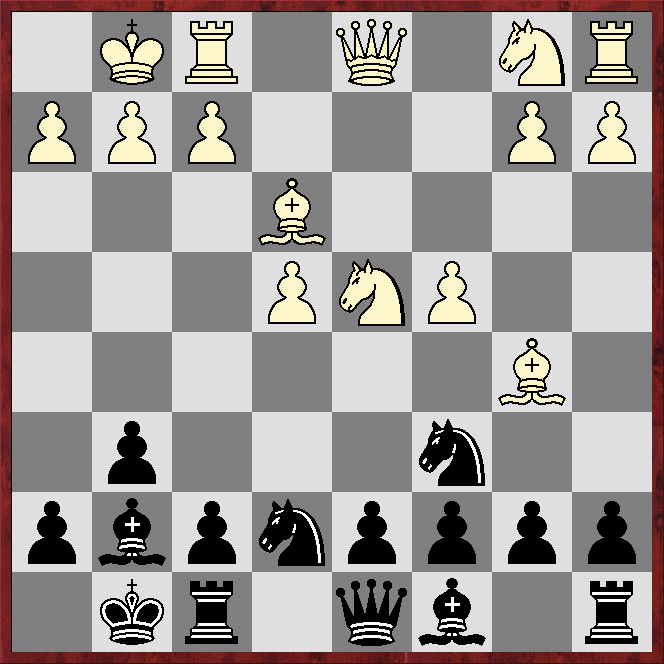
The following position was reached after 15 moves.
Black has just made a recapture on d7
*****
*****
*****
*****
*****
All 11 games to reach the position in ChessBase's 2026 Mega database continued with White getting the king to safety by castling kingside.
The wisdom of this was shown in our game, after JN started pushing his queenside pawn-majority with 16.a4?, only to be met with 16...Qc6, when it is not easy to decide what to do about White's bishop.
The game saw 17.Bf2!?, which may be best - Stockfish18 and Dragon1 are unsure.
I now played 17...e4?!, and JN wisely, if belatedly, got his king to (relative) safety with 18.0-0, even though this allows 18...exf3.
The engines much prefer 17...Qc4, keeping the white king in the centre, when best might be the engines' 18.b3!? Qxb3 19.0-0, although Black is well on top.
After 27...Qc4, the problem with the natural-looking 18.Qe2 is Black has 18...e4!, when 19.Qxc4 exf3+ gives Black a winning advantage, according to the engines, eg 20.Kf1 dxc4! (this is much stronger than 20...fxg2+ 21.Kxg2 dxc4 22.Rhe1, according to the engines) 21.gxf3 Rab8 22.Ra2 Rbd8! 23.Ra1 Rd2!? 24.Rb1 Ree2!? 25.Bxa7 Rxb2. Admittedly, Black has to find some sharp moves in this line, but they do highlight the danger of a king being uncastled and exposed, even with queens off the board.
LESSON: king safety trumps everything.

Tuesday, 4 February 2025

Crafty Tiger

I AM not sure how much I have thought about this, but in general I always believed it was a good idea to get strong opponents out of book as soon as possible.
My thinking - perhaps 'fearing' is a better word - was that higher-rated players would have greater opening knowledge, so it should be countered by getting to pastures new.
Conversely I have been happy to play known theory against lower-rated opponents, trusting to my (presumed) greater theoretical knowledge.
I  may be right about this, but a post on grandmaster Nigel Davies's Tiger Chess blog has given me food for thought.
He agrees that "you should consider the relative strength of your opponent."
But he adds: "If they [sic] are a better player it makes sense to minimise the importance of their improvisational skills by playing as many moves of opening theory as you can."
I guess the reasoning is that, as long as you are not going down a losing line, you should finish with a position that is equal, or at least very playable.
His recommendation against lower-rated opponents is also opposite to my thinking, in that he writes: "You might want to throw weaker players on their own resources."
However he adds the caveat "unless you know they have poor theoretical knowledge."
I am not sure who is correct in this matter, but I am sure most players, myself included, would rather trust the grandmaster's verdict.

Thursday, 26 December 2024

What Do The Engines Say? 7. Dutch

MODERN computer programs are revolutionising how we approach openings.
This first became noticeable when supposedly refuted moves started making a comeback as engines showed resources that had evaded the world's top players.
But more recently, as engines grow in strength, there has been a trend in the opposite direction, at least at the highest level.
Grandmaster Nigel Davies summed this up in a post at chesspublishing.com, where he recounted a conversation with Canadian GM Kevin Spraggett, who "opined to me that ancient openings are making a comeback because engines are finding flaws in the more risky ones."
Davies added: "I think there is a lot of truth in this, which is confirmed by the migration of top players to strictly classical openings."
Engines are still far from the stage of knowing all there is too known about openings.
Their play in that stage of the game is not on a par with their abilities in tactical middlegames.
We cannot expect engines to tell us move-by-move how to play our favourite opening variations,
But their opinions on what we should be looking at - the moves that show the most promise - are certainly well worth considering.
So in this series I will be looking at what the engines say about mainline opening positions.

THE pure Dutch 1.d4 f5 is the opening about which a world champion supposedly quipped: "If your opponent wants to play the Dutch, you shouldn't try to stop him."
Those words, or something like them, are usually attributed to Tigran Petrosian, although I have already seen them put in the unlikely mouth of Mikhail Botvinnik (unlikely because for many years he was the Dutch Defence's leading exponent).
Stockfish17 recommends continuing with the fashionable 2.Bg5!?, while Dragon1 prefers the traditional responses of 2.c4 and 2.g3.
Often these days the Dutch arises after Black first plays 1...e6, and White avoids a transposition to the French with 2.e4.
Following 1.d4 e6 2.c4 f5 the engines fluctuate between 3.g3, 3.Nc3 and 3.Nf3.
After 1.d4 e6 2.Nf3 f5 Stockfish17 is for quite some time torn between 3.g3 and 3.c4, but comes to agree with Dragon1 that the real choice is between 3.c4 and 3.Bf4, with both engines marginally preferring the latter.

Wednesday, 25 December 2024

What Do The Engines Say? 6. Spanish

MODERN computer programs are revolutionising how we approach openings.
This first became noticeable when supposedly refuted moves started making a comeback as engines showed resources that had evaded the world's top players.
But more recently, as engines grow in strength, there has been a trend in the opposite direction, at least at the highest level.
Grandmaster Nigel Davies summed this up in a post at chesspublishing.com, where he recounted a conversation with Canadian GM Kevin Spraggett, who "opined to me that ancient openings are making a comeback because engines are finding flaws in the more risky ones."
Davies added: "I think there is a lot of truth in this, which is confirmed by the migration of top players to strictly classical openings."
Engines are still far from the stage of knowing all there is too known about openings.
Their play in that stage of the game is not on a par with their abilities in tactical middlegames.
We cannot expect engines to tell us move-by-move how to play our favourite opening variations,
But their opinions on what we should be looking at - the moves that show the most promise - are certainly well worth considering.
So in this series I will be looking at what the engines say about mainline opening positions.

THE Ruy Lopez, aka the Spanish Torture, is a perennial White favourite.
Traditionally the main reply to 1.e4 e5 2.Nf3 Nc6 3.Bb5 has been 3...a6, which used to be called Morphy's Variation in deference to Paul Morphy.
But Stockfish17 and Dragon1 prefer the Berlin Defence, ie 3...Nf6, which may explain why it is so popular at elite level.
Anyone looking for something more offbeat might want to consider Cozio's 3...Nge7, which for a long time is Dragon1's second choice.

Tuesday, 24 December 2024

What Do The Engines Say? 5. Jobava-Prié

MODERN computer programs are revolutionising how we approach openings.
This first became noticeable when supposedly refuted moves started making a comeback as engines showed resources that had evaded the world's top players.
But more recently, as engines grow in strength, there has been a trend in the opposite direction, at least at the highest level.
Grandmaster Nigel Davies summed this up in a post at chesspublishing.com, where he recounted a conversation with Canadian GM Kevin Spraggett, who "opined to me that ancient openings are making a comeback because engines are finding flaws in the more risky ones."
Davies added: "I think there is a lot of truth in this, which is confirmed by the migration of top players to strictly classical openings."
Engines are still far from the stage of knowing all there is too known about openings.
Their play in that stage of the game is not on a par with their abilities in tactical middlegames.
We cannot expect engines to tell us move-by-move how to play our favourite opening variations,
But their opinions on what we should be looking at - the moves that show the most promise - are certainly well worth considering.
So in this series I will be looking at what the engines say about mainline opening positions.

The fashionable Jobava-Prié usually starts 1.d4 Nf6 2.Nc3 d5 3.Bf4, or 1.d4 d5 2.Nc3 Nf6 3.Bf4.
Starting point of the Jobava-Prié
*****
*****
*****
*****
*****
The main continuation in ChessBase's 2025 Mega database is 4...e6, and that is Stockfish17's recommendation.
White's most popular reply to that is 4.Nb5, which worries a lot of club players.
Then 4...Na6 is usually met by 5.e3, when Stockfish17 suggests completing kingside development with 5...Be7 and 5...0-0, before repelling the advanced white knight with 6...c6.
Dragon1 takes a different approach, marginally preferring the aggressive 4...c5!?
Black should not then fear 5.Nb5? as 5...Qa5+ 6.Nc3 cxd4 7.Qxd4 Nc6 leaves White in big trouble.
Better, but still not good, is 5.dxc5?! as Black has 5...d4.
In practice whites have usually gone for either the conventional 5.e3, when Dragon1 reckons both 5...a6!? and 5...Qa5!? give complete equality, or the sharp 5.e4!?
After the latte, both engines reckon Black is fine, but they fluctuate between 5...Nxe4 and 5...cxd4, while agreeing that the third-most popular move in Mega25, 5...dxe4!?, allows White a tiny edge.

Monday, 23 December 2024

What Do The Engines Say? 4. New London

MODERN computer programs are revolutionising how we approach openings.
This first became noticeable when supposedly refuted moves started making a comeback as engines showed resources that had evaded the world's top players.
But more recently, as engines grow in strength, there has been a trend in the opposite direction, at least at the highest level.
Grandmaster Nigel Davies summed this up in a post at chesspublishing.com, where he recounted a conversation with Canadian GM Kevin Spraggett, who "opined to me that ancient openings are making a comeback because engines are finding flaws in the more risky ones."
Davies added: "I think there is a lot of truth in this, which is confirmed by the migration of top players to strictly classical openings."
Engines are still far from the stage of knowing all there is too known about openings.
Their play in that stage of the game is not on a par with their abilities in tactical middlegames.
We cannot expect engines to tell us move-by-move how to play our favourite opening variations,
But their opinions on what we should be looking at - the moves that show the most promise - are certainly well worth considering.
So in this series I will be looking at what the engines say about mainline opening positions.

After 1.d4 Nf6, and after 1.d4 d5, the London System, 2.Nf3 and 3.Bf4, has been refined by the introduction of the New London, ie 2.Bf4.
This may be played with a mind to switching to the Jobava-Prié, which usually starts 1.d4, 2.Nc3 and then 3.Bf4, but more often the game stays within the bounds of a genuine London System.
After 1.d4 d5 2.Bf4 Stockfish17 and Dragon1 for a while fluctuate about how to respond, but come to settle on the aggressive 2...c5!?, marginally ahead of the conventional 2...Nf6.
After 1.d4 Nf6 2.Bf4 the engines like both 2...e6 and 2...d5, perhaps very marginally preferring the latter. If then 3.e3, which the engines seem to think best, there is a divergence. Stockfish17 likes 3...e6 but Dragon1 suggests the aggressive 3...c5!?

Sunday, 22 December 2024

What Do The Engines Say? 3. Sicilian Defence

MODERN computer programs are revolutionising how we approach openings.
This first became noticeable when supposedly refuted moves started making a comeback as engines showed resources that had evaded the world's top players.
But more recently, as engines grow in strength, there has been a trend in the opposite direction, at least at the highest level.
Grandmaster Nigel Davies summed this up in a post at chesspublishing.com, where he recounted a conversation with Canadian GM Kevin Spraggett, who "opined to me that ancient openings are making a comeback because engines are finding flaws in the more risky ones."
Davies added: "I think there is a lot of truth in this, which is confirmed by the migration of top players to strictly classical openings."
Engines are still far from the stage of knowing all there is too known about openings.
Their play in that stage of the game is not on a par with their abilities in tactical middlegames.
We cannot expect engines to tell us move-by-move how to play our favourite opening variations,
But their opinions on what we should be looking at - the moves that show the most promise - are certainly well worth considering.
So in this series I will be looking at what the engines say about mainline opening positions.

WOULDN'T it be great if engines were to tell us that the best way to play against the ever-popular Sicilian is, after all, one of those anti-Sicilians that authors of books tend to scorn (unless, of course, the whole idea of a book is to promote one such anti-Sicilian)?
Well, the engines do - up to a point.
Stockfish17 and Dragon1 at first favour meeting 1.e4 c5 with the conventional 2.Nf3, but 2.Nc3 is not far behind, and, given time, it takes over the No1 spot.
However, given more time, 2.Nf3 makes a comeback, while Dragon1 briefly flirts with 2.d4!?, albeit recommending meeting 2...cxd4 with 3.Nf3!?, which is how Paul Morphy liked to meet the Sicilian.
Nevertheless, for the human looking for an alternative to entering mainlines, the continuation 2.Nc3 comes with at least partial engine-approval.

Saturday, 21 December 2024

What Do The Engines Say? 2. French Defence

MODERN computer programs are revolutionising how we approach openings.
This first became noticeable when supposedly refuted moves started making a comeback as engines showed resources that had evaded the world's top players.
But more recently, as engines grow in strength, there has been a trend in the opposite direction, at least at the highest level.
Grandmaster Nigel Davies summed this up in a post at chesspublishing.com, where he recounted a conversation with Canadian GM Kevin Spraggett, who "opined to me that ancient openings are making a comeback because engines are finding flaws in the more risky ones."
Davies added: "I think there is a lot of truth in this, which is confirmed by the migration of top players to strictly classical openings."
Engines are still far from the stage of knowing all there is too known about openings.
Their play in that stage of the game is not on a par with their abilities in tactical middlegames.
We cannot expect engines to tell us move-by-move how to play our favourite opening variations,
But their opinions on what we should be looking at - the moves that show the most promise - are certainly well worth considering.
So in this series I will be looking at what the engines say about mainline opening positions.

WHEN hot-favourite Gukesh Dommaraju sat down with the white pieces for the first game of the world championship match, he was probably not expecting the champion, Liren Ding, to play the French Defence.
Gukesh met 1.e4 e6 2.d4 d5 with 3.Nc3, and, when Ding replied 3...Nf6, continued with the Steinitz Variation, ie 4.e5.
Stockfish17 and Dragon1 fluctuate between 3.Nc3 and 3.e5 (the fashionable - after a long time in the doldrums - Advance Variation), but come to settle on the former, albeit marginally.
After 3...Nf6 Stockfish17 agrees with 4.e5, but Dragon1, although at first also preferring that move, comes to give the edge to the more popular 4.Bg5.
Both engines reckon their move gives White a slight edge, while claiming the other move leaves the game equal.
However, allow Dragon1 a lot more time to consider the position, and it too comes to prefer 4.e5, albeit marginally.

Friday, 20 December 2024

What Do The Engines Say? 1. Evans' Gambit

MODERN computer programs are revolutionising how we approach openings.
This first became noticeable when supposedly-refuted moves started making a comeback as engines showed resources that had evaded the world's top players.
But more recently, as engines grow in strength, there has been a trend in the opposite direction, at least at the highest level.
Grandmaster Nigel Davies summed this up in a post at chesspublishing.com, where he recounted a conversation with Canadian GM Kevin Spraggett, who "opined to me that ancient openings are making a comeback because engines are finding flaws in the more risky ones."
Davies added: "I think there is a lot of truth in this, which is confirmed by the migration of top players to strictly classical openings."
Engines are still far from the stage of knowing all there is to know about openings.
Their play in that stage of the game is not on a par with their abilities in tactical middlegames.
So we cannot expect engines to tell us move-by-move how to play our favourite opening variations,
But their advice on what we should be looking at - the moves that show the most promise - is certainly well worth considering.
So in this series I will be looking at what the engines say about mainline opening positions, starting with the Evans Gambit.

After 1.e4 e5 2.Nf3 Nc6 3.Bc4 Bc5 4.b4 Stockfish17 and Dragon1 agree the pawn should be taken (with the bishop).
Position after Black takes the pawn
*****
*****
*****
*****
*****
Dragon1 reckons White has fair compensation, although it believes White no longer has the advantage that comes with moving first, while Stockfish17 already gives Black a slight edge.
However, the situation is not clear, as is shown by the engines' reaction to White's follow-up, 5.c3.
Stockfish17 recommends looking at 5...Ba5, which is the main continuation in ChessBase's 2025 Mega database, but Dragon1 fluctuates between that and the second-most popular move, 5...Be7.
One thing the engines are agreed on, however, is that 5...Bc5, which used to be touted in books as roughly as good as 5...Ba5 (5...Be7 rarely got a look-in), helps White, with Stockfish17 claiming it leaves White slightly better (Dragon1 is not so sure).

Tuesday, 10 December 2024

Lessons From Benidorm III: The #1 Factor In Chess

IN round four I reached the following position.
White has just castled
*****
*****
*****
*****
*****
*****
*****
*****
Known continuations are 8...a6 and 8...d6, which are the top choices of Stockfish17 and Dragon1.
I preferred to immediately break White's bind with an apparent-novelty, 8...f5!?
It is not a bad move per se, but Black must be aware after 9.exf5 Nxf5 10.Nxf5 Rxf5 that for the foreseeable future White will have the safer king, which, as grandmaster Nigel Davies enjoys pointing out, is the most important factor in chess.
LESSON: sometimes a move is objectively sound, but results in a player having to walk a thinner tightrope than is desirable for a human, even if engines have little trouble in such positions.

Sunday, 10 September 2023

Lessons From Torquay 2

REVERSED openings are a fascinating subset of opening theory.
Perhaps the best-known is the King's Indian Attack, which frequently sees the moves Nf3, g3, Bg2, 0-0, d3, Nbd2 and e4, although not necessarily in that order.
Naturally the opening is named because of its strong resemblance to the King's Indian Defence, in which Black often plays ...Nf6, ...g6, ...Bg7, ...0-0, ...d6 and, eventually, ...e5.
That is all fairly straightforward, but it can be argued that after the popular sequence 1.c4 e5 White is playing not just an English, but also a Reversed Sicilian with an extra tempo.
Similarly, grandmaster Nigel Davies, on his ChessBase DVD The Closed Sicilian, points out that after 1.c4 e5 2.Nc3 Nc6 Black is effectively playing the white side of a Closed Sicilian, but with a tempo less.
He argues that while a tempo in such positions affects the specifics of what each side can play, it is not hugely important, and so the same general principles apply as in the Closed Sicilian proper.
However there are other reversed openings in which a tempo makes a significant difference.
In my round-two game at the Riviera afternoon opening, the full score of which can be seen here, I played a Reversed Grünfeld.
After 1.Nf3 d5 2.g3 Nf6 3.Bg2 c5 4.0-0 Nc6 5.d4 cxd4 6.Nxd4 e5!? 7.Nxc6 bxc6 8.c4 Be6 9.Nc3, the following position was reached.
Black has what, at first glance, might seem a strong centre, but it is under intense pressure
This position is reached 236 times in ChessBase's 2023 Mega database, with White scoring a very impressive 67%.
Black's most-popular continuation in Mega23 is 9...Qd7, after which White's success rate rises to 75%.
The latest theory, as I understand it, is that Black is doing OK, if not completely equal, after both 9...Qd7 and 9...Rc8, the idea in both cases being to sacrifice the d pawn for activity.
Indeed after 9...Rc8 White's score falls to 51%, which is a little hard to explain as the two lines can easily transpose.
I played 9...h6, and after 10.Qa4 found myself on the back foot for more-or-less the whole game.
LESSON: taking on a known opening-setup a tempo down can be fraught with danger, especially when the setup involves the second player grabbing the lion's share of the centre.

Saturday, 4 February 2023

Lessons From Mariánské Lázně: King Safety (2)

THIS is effectively a repeat of the lesson from my round-two game, only in round nine my opponent was rated 1980, rather than 1692, and he did not have the excuse of making a positional mistake while winning material.
I have just played 16...e6-e5
*****
*****
*****
*****
*****
*****
*****
*****
After 17.Nfd5 White would have a slight edge (Stockfish15) or at least be equal (Komodo13.02).
Instead the game saw 17.Bd5?? exf4 18.Bxf7+ Qxf7 19.Bxf4, when White has rook and pawn for bishop and knight.
This is not an equal material trade, even though it would appear so using the traditional evaluations of 1:3:3:5:9, and especially so here as Black gets the bishop-pair.
But what makes the sequence truly horrific for White is the resulting sorry plight of the white king, bereft of its fianchettoed bishop.
One piece of advice I have seen several times is to 'talk' to your pieces.
If White had, mentally, asked his king what it felt about the light-square bishop going off on adventure, he might have realised the danger the king would be in.
The game only lasted three more moves: 19...Bh3 20.Rd1 Nf3+ 21.Kh1 Qf5!? 22.Ne4?! Bf1! 0-1.
Remember grandmaster Nigel Davies' truism: king safety is the most important factor in chess.

Wednesday, 25 January 2023

Lessons From Mariánské Lázně: King Safety

GRANDMASTER Nigel Davies is fond of emphasising that the most important factor in chess is king safety.
In some ways this is a truism since the only way to win a game of chess, short of the opponent resigning, is to deliver checkmate - 'merely' capturing every enemy piece, apart from the king, is not enough.
Most decisive games actually end with resignation, but only because the player resigning thinks checkmate is inevitable.
Games between complete novices, however, nearly always end with one of two results - checkmate or stalemate.
Draws in such games are theoretically possible, but rarely happen before the board is reduced to bare kings.
Even bare kings may not be enough, if a story told me by an arbiter at the British championships is true.
He reckons he saw a game in which two very young juniors got down to bare kings, but continued playing.
The arbiter left them to it and went to look at other games, only to return a few minutes later when he saw the boys resetting the pieces.
"That was a a draw, then?" the arbiter half-said/half-asked.
"Oh no," replied one of the boys, "my opponent managed to promote his king to a queen and so won."
The story is probably apocryphal - after all, how to you mate with a lone queen? - and anyway is something of a digression from the point of this post, which about king safety.
The critical position in my round-two game occurred at move 12.
I have just played 12.d5!?
*****
*****
*****
*****
*****
12...e4?!
Black is roughly equal, or at least only slightly worse, according to Stockfish15 and Komodo13.02, after 12...Bxf3 13.Bxf3 Nd4 or 12...Ne7.
The text wins the exchange after 13.Nxe4 Bxa1 but loses the game thanks to the chronic weakness of the black king, now it no longer has a fianchettoed bishop.
The game lasted a further 20 moves, but the result, at least according to the engines, was never in doubt.

Tuesday, 14 December 2021

Benidorm Under 2000 Games: Round Nine

PLAYED on Sunday.

Hikmet Bağcı (1572) - Spanton (1829)
French Winawer
1,e4 e6 2.d4 d5 3.Nc3 Bb4 4.e5 b6!?
This move is well-behind 4...c5 and 4...Ne7 in popularity, and is not liked by the analysis engines Stockfish14.1. and Komodo12.1.1. Nevertheless there are 3,761 examples of the text in ChessBase's 2022 Mega database.
5.a3
This and 5.Qg4 are almost equally popular. Both Karpov and Kasparov have faced 4...b6!? One of them replied 5.a3 and the other played 5.Qg4. Contrary to (my) expectation, it was Kasparov who played 5.a3 and Karpov who preferred 5.Qg4.
5...Bf8!?
Position after 5...Bf8!?
Black's play looks strange, certainly at first glance, but it is mentioned approvingly on grandmaster Nigel Davies's French Defence Strategy DVD for ChessBase. The idea is that the black dark-square bishop has induced White to close the centre in a way that makes both players' king's bishops good and queen's bishops bad. Black intends exchanging his bad black light-square bishop for its good white counterpart. Meanwhile the black dark-square bishop defends g7, which otherwise would be vulnerable to an attack from the white queen, which Black does not want to have to meet with ...g6. The drawbacks to Black's strategy are White has gained space and time.
6.f4
Kasparov preferred 6.Nf3, but the text is also popular with grandmasters.
6...Nh6 7.Bd3?!
This is Stockfish14.1's top choice for a while (later the engine switches between the text and 7.Nf3), but is dubious in my opinion as it loses a tempo compared with the line 7.Nf3 Ba6 8.Bxa6 Nxa6 9.Qd3 Nb8, which reaches the same position as occurs in the game but with White rather than Black to move.
7...Ba6 8.Nf3 Bxd3 9.Qxd3 c5 10.Be3 c4!?
Pushing on like this is nearly always a controversial decision. I liked the gain of space, supporting Black's long-term strategy of attacking on the queenside, but it takes pressure off the white centre. The engines prefer 10...Nf5 or 10...Nc6.
11.Qd2 Be7 12.0-0 0-0
Position after 12...0-0
The correct middlegame strategies for both sides are fairly clear, I believe. White's central pawns point to the kingside, which is where White has more space, so White should attack there. Black's central pawns point to the queenside, which is where Black has more space, so Black should attack there. Since both kings are on the kingside, the white attack is potentially more dangerous, meaning Black is probably well-advised to (try to) neutralise the white attack before proceeding on the queenside.
13.Ne2 Nc6 14.Kh1 f6 15.h3 fxe5 16.fxe5
The engines prefer 16.dxe5!? Nf5 Bf2.
16...Nf5 17.Bf2 b5?!
With White apparently having no immediate threats on the kingside, I thought I had time to to make a move on the queenside. The engines prefer 17...h5, which I rejected because it weakens g5.
18.g4 Nh4!?
The alternative, 18...Nh6 19.Be3 Nf7, represents a major loss of time.
19.Nxh4?!
Almost certainly better is 19.Bxh4, which not only exchanges White's bad bishop but, after 19...Bxh4 20.g5, traps the black bishop. Black would be obliged to sac the exchange for a pawn with 20...Rxf3 21.Rxf3 Bxg5, when the engines are divided: Stockfish14.1 reckons White is winning; Komdo12.1.1 only gives White a slight edge. I suspect the latter verdict is closer to the truth, but either way it seems clear White has an advantage.
19...Bxh4 20.Be3
Logical, at least from a positional view, is 20.Bxh4, but Black is fine after recapturing; indeed White has to be careful to maintain the balance.
20...Qe7 21.Kg2!?
This is Komodo12.1.1's top choice; Stockfish14.1 prefers 21.Kg1.
21...Rae8 22.Ng1 Qb7
Threatening ...Nxe5 in some lines.
23.Rf3 Rxf3 24.Nxf3 Be7 25.c3 a5 26.Bg5 Bf8!? 27.Qc2 b4 28.axb4 axb4 29.Bd2 bxc3 30.Ng5 g6
A necessary concession. It is a concession because now the f6 square is weak, and the black g pawn makes a target for the white h pawn.
31.Bxc3?
This turns the bishop into a proverbial 'fat pawn'. The engines reckon White has an advantage after the natural 31.bxc3.
31...Bh6 32.Nf3 Rb8 33.h4 Nb4!?
This permits White to (finally) swop off his bad bishop, but the result will be weaknesses at b2 and d4.
34.Bxb4
White can hardly allow ...Nd3.
34...Qxb4 35.Ra2
The engines give 35.Kg3!, the point being 35...Qxb2 36.Qxb2 Rxb2 lets White equalise with 37.Ra8+, eg 37...Bf8 38.Ng5 Rb6 39.Re8 Rc6 40.Nxe6 Kf7 41.Rxf8+ Kf7 42.Rf6+ Kd7 43.Rxc6. Instead they reckon White should play 35...Qe7 or 35...Qb7, with continued play against White's weaknesses.
How should Black proceed?
*****
*****
*****
*****
*****
35...Qf8!
The queen prepares to invade the white queenside, while at the same time giving the black rook access to b3.
36.Ra3 Qf4 37.Qe3?!
Probably slightly better, but still bad for White, is the engines' 37.Kh3 Bf8 38.Rc3 Bb4 (38...Be7 is also strong) 39.Qc1! Qf7 40.Re3 Rf8.
37...Bf8 38.Ra6 Rb3 39.Qe2 Re3 40.Qc1 h6 41.Rxe6?!
Not much better is 41.gxh6, according to the engines.
41...Qg4+ 42.Kf2 Rxf3+ 43.Qxf3 Qxe6 (0-1, 80 moves)

Wednesday, 2 December 2020

Belgrade Round Nine

FACED a senior (born 1930) in the last round of the 34th Belgrade Trophy International this afternoon.
Petar Petrović (FM 1956) - Spanton (1831)
English Symmetrical
1.c4 c5 2.Nc3 Nc6 3.g3 g6 4.Bg2 Bg7 5.e3!?
This move is very popular - there are more than 4,800 examples, including games by Kramnik, in ChessBase's 2020 Mega database. But grandmaster Nigel Davies on his English Opening DVD for ChessBase warns White against playing it. He says that after ...
5...Bxc6!?
... it is hard for White to make progress.
This might seem a rather sweeping statement at such an early stage, but this game illustrates some of Black's ideas.
6.bxc3
The analysis engines Stockfish12 and Komodo11.01 do not like Black's last move, and they agree this is the best reply.
6...f5!?
Position after 6...f5!?, another move not much liked by the engines. What is going on?
*****
*****
*****
*****
*****
Other moves have been tried here, but the point of the text is to inhibit e4. Black's plan is to play against White's dark-square bishop by restricting its access to much of the board. If the bishop cannot escape the queenside, Black will effectively be a piece up on the kingside.
7.d4
Edmar Mednis (2450) - Bent Larsen (2545), New York (Watson, Farley, Williams) 1990, saw 7.f4?!, which is almost certainly the wrong idea.
Perhaps best is a move that does not appear in Mega20, namely 7.e4!? After 7...fxe4 8.Bxe4 Nf6 9.Bg2 White has lost a lot of time, but has guaranteed that the dark-square bishop will play a full role in the game. I guess it depends on whether White really is seriously inconvenienced by the dark-square bishop being restricted, at least in the early stages.
7...Nf6 8.Ne2 b6 9.Rb1 Ba6
Komodo11.01 suggests 9...Bb7!?, meeting 10.dxc5 with 10...Qc7, and the further 11.cxb6 with 11.axb6, which both engines reckon is very good for Black despite the (temporary) pawn-minus.
10.Qa4 Qc8
Even stronger seems to be 10...Na5!? After 11.Bxa8?! Qxa8 12.0-0 Qf3 Black has huge compensation for the exchange. I was more concerned about 11.dxc5, but the engines reckon Black is much better after, among other moves, 11...Bxc4.
11.Ba3 Ne4 12.Bxe4?!
The engines strongly dislike this. Its only justification would be if White can follow up by winning a pawn by capturing on c5, but in the game that does not happen.
12...fxe4 13.0-0
Not 13.dxc5? Ne5.
13...0-0 14.Rfe1?!
White is already positionally lost, according to the engines, but it is hard to see how this helps. They give 14.Nf4, but reckon 14...d6 consolidates Black's advantage.
14...d6 15.Nf4 g5 16.Ng2
16.Nd5 is not catastrophic as 16...e6? runs into 17.Qxc6!, although after 17...Qxc6 18.Ne7+ Kf7 19.Nxc6 Rfc8 Black is slightly better, according to the engines. However 16...Rf7 17.Nc7 Qxc7 18.Qxa6 Raf8 leaves Black well on top.
16...Bb7!?
Freeing the queen for more important work than defending a bishop (and there is no rush to capture the weak c4 pawn).
17.Qc2 Rf6!
With a double-threat.
18.Qe2
Not 18.Qxe4? Nxd4. The engines suggest 18.h4 but agree 18...h6 keeps Black massively on top.
18...Qh3
White must lose at least a piece.
The game finished:
19.Qf1 Bc8 20.Nf4 gxf4 21.Qxh3 Bxh3 22.exf4 cxd4 23.Rbd1 Bg4 24.Rd2 dxc3 25.Rd5 Bf3 26.Re3 c2 27.Bb2 Nb4 28.Rd2 Rc8 29.Rc3 Nxa2 30.Rcxc2 Nb4 31.Rc3 Nd3 32.Ba1 Rf5 33.h4 Rfc5 34.Ra3 Rxc4 35.Kh2 Rc1 36.g4 Rh1+ 0-1
Monument to Prince Miloš Obrenović and the Second Serbian Uprising (against the Turks) of 1815 

Saturday, 20 July 2019

Morphy v The French (part four)

ACCORDING to Johann Löwenthal in Morphy's Games Of Chess, the following was part of a blindfold simul given in London in 1859 against eight opponents, "including, as is well known, the most-talented players of the old London Chess Club."
Morphy - George Walker*
1.e4 e6 2.d4 d5 3.exd5 exd5 4.Nf3 Bd6 5.Bd3 Nf6 6.0-0 0-0 7.Nc3 Bg4
Morphy has played his normal first seven moves. Walker's 7...Bg4 was already well-known in 1859, and remains the most-popular reply today along with 7...c6 (see parts two and six of this series for examples of the latter move).
8.h3
8.Nb5!? can be parried by 8...Be7 9.Bf4 Na6, although Komodo9 and Stockfish10 are happy with 8...Nc6!? 9.Nxd6 Qxd6, presumably because Black's lead in development is deemed sufficient compensation for the bishop-pair.
8...Be6?!
Maintaining the pin with 8...Bh5 is overwhelmingly more popular, although in practice White has scored very well with Steinitz's 9.g4!?
9.Be3 Nc6 10.Qd2 Qd7 11.Bf4
Löwenthal: "The best move. An examination of the position will prove that Black meditated the capture of h3 with the sacrifice of the bishop, which might have caused White some trouble. This step, however, on Mr Morphy's part, at once frustrates any such design."
11...Rfe8 12.Rae1 Rad8 13.Ne5
Löwenthal: "A fine move, acquiring a good attacking position."
13...Qc8?!
Löwenthal: "Taking the knight with either bishop or knight would have been exactly what his adversary desired."
But considering that Black feels obliged to take the knight next move anyway, it would probably have been a lesser evil to capture now.
14.Bb5
Löwenthal: "All this is admirably played, and considering that White is playing blindfold against such an able opponent, is quite marvellous."
14...Bxe5
How would you recapture?
*****
*****
*****
*****
*****
15.Bxe5?!
The engines much prefer White after 15.dxe5 Ne4 16.Nxe4 dxe4 17.Qc3.
15...Nxe5
Löwenthal: "Selecting the proper course of play, for 15...Bd7 would have cramped the game still further; and if 15...Rd6, then 16.f4 would have given White an excellent game."
Actually, 15...Bd7?? loses instantly to 16.Bxf6 gxf6 17.Nxd5. And if 15...Rd6?, then the simple 16.Bxd6 is strong (but so is 16.f4).
It may well be Löwenthal meant 15...Nd7 rather than 15...Bd7. The move is described in his book as "B. to Q's 2nd," and could be a printing error.
16.dxe5 Ne4 17.Nxe4 dxe4 18.Qf4 c6
Finally taking his king's rook off prise, as grandmaster Nigel Davies is fond of saying. The game was drawn eight moves later.
*Walker was a prolific, for his time, chess author, and an organiser of the first international tournament, London 1851.

Monday, 15 July 2019

Marvellous Meran

THIS is the second in an occasional series on How The Openings Got Their Names.
The Meran System, aka the Meran Variation, is a series of lines, many of them very sharp, in the Semi-Slav arising after the moves 1.d4 d5 2.c4 c6 3.Nf3 e6 4.Nc3 Nf6 5.e3 Nbd7 6.Bd3 dxc4 7.Bxc4 b5.
Start of the Meran … the early moves, especially Black's second, third and fourth, can be played in various orders
The Meran is named after a town-sized city in the South Tyrol that was part of Austria but was given to Italy, and renamed Merano, after World War One.
The city hosted a tournament in 1924 in which Rubinstein used the "Meran System" as Black to beat Grünfeld, who later in the same tournament switched to the black side of the system to beat Spielmann.
It probably will not surprise anyone to learn that the Meran had been played long before it got its name, including by Bernstein to draw with Capablanca in 1914.
When I discovered that an international tournament, the Gold Cup, is still played for in the city, I could not resist going. That was in 2013, and I have been back twice since.
Meran(o) - the linguistic split in the wider commune is apparently almost exactly 50% German, 50% Italian, but with the latter dominating in the city itself - has a beautiful setting amid snow-capped mountains whose lower slopes are covered in vineyards and apple orchards.
The modern Gold Cup is organised as part of the German-based ChessOrg.de series of tournaments, which includes Bad Wörishofen and Malta.
The Gold Cup is that rarity of modern tournaments of being a nine-rounder that is not Fide-rated.
I never managed to play the Meran in Meran(o), not least because 2.c4 is a rare follow-up to 1.d4 d5 at club level.
But here is a double-d pawn opening from round two of the 2014 Gold Cup.
Franz-Josef Schleime (1749) - Spanton (1949)
London System
1.d4 d5 2.Nf3 Nc6 3.Bf4 Bg4 4.e3 e6 5.Nbd2 Bd6 6.Bg3 e5!?
As is usual in the London System, White has two pawn breaks - e4 and c4. Black is using a pseudo-Chigorin set-up in which he has only one pawn break, ...e5, but White's move-order has allowed Black to get in his pawn break first, albeit at the cost of moving a man for the second time in the opening.
7.dxe5 Nxe5 8.Be2 Ng6?!
White was threatening to win a piece, but probably a better way of meeting that was to exchange on f3.
9.Bxd6 Qxd6 10.Nd4
Stockfish10 and Komodo9 want to dissolve Black's little centre with 10.c4, as grandmaster Nigel Davies played against me in a similar position in this month's South Wales International (https://beauchess.blogspot.com/2019/07/grandmaster-crush.html).
10...Bd7 11.Nb5 Qb6
I cannot recall why I did not play the simple 11...Bxb5 12.Bxb5+ c6.
12.Nc3 Nf6 13.Rb1 0-0 14.Nf3 Rad8 15.0-0
Not 15.Nxd5? Qa5+ 16.Nc3 Bh3.
15...Be6 16.Nd4?!
White's kingside proves surprisingly vulnerable after this. The engines suggest 16.b4!?
16...c5 17.Nxe6
Best, according to the engines, as 17.Nf3?, for example, runs into 17...d4.
fxe6 18.Bf3?
White is in big trouble after this, which is why the engines give 18.Bd3, albeit with a slight edge to Black.
18...Nh4 19.Bg4??
19.Be2 would have been met with the same move as in the game, so it seems best was 19.g3, but Black has the initiative after 19...Nxf3+.
19...d4
White loses a piece. The game finished:
20.exd4 Rxd4 21.Bxe6+ Qxe6 22.Qc1 Nxg2 0-1

Thursday, 11 July 2019

Mystery Solved

DREW with a 1937 this afternoon in round eight of the South Wales International after futilely trying for almost 60 moves to win a knight-v-bishop ending.
Perhaps more interesting was that after the game, grandmaster Nigel Davies cleared up something that had been puzzling me from the postmortem of our round-one game (https://beauchess.blogspot.com/2019/07/grandmaster-crush.html).
White to make his 13th move in Davies (GM2484) - Spanton (1900)
ND played 13.c4!?, commenting in the postmortem that after 13...dxc4 White was left with a little centre.
I tried to rationalise this in my blog by speculating that what he meant was White ends up with the only central pawn.
However, as he explained this evening, what he had intended to say was that his move dissolved my little centre (pawn on d5 versus pawn on e3), which makes much more sense.
It only goes to show that if you are not sure what a (much) stronger player is trying to say, ask!

Sunday, 7 July 2019

Grandmaster Crush

AM playing in the nine-round South Wales International, which is being held in a hot but spacious conference room in a Best Western on the outskirts of Bridgend.
The time control is a relatively slow one, at least for these days, of 40 moves in 90 minutes, a 30-minute windback, and a 30-second increment throughout.
The schedule is also rather unusual: 10.30am and 5pm today, 5pm Monday, 10.30am and 5pm Tuesday, 5pm Wednesday, 10.30am and 5pm Thursday, and 10.30am Friday.
Nigel Davies (GM2484) - Spanton (1900)
Round One
London System
1.Nf3 Nc6 2.d4 d5 3.Bf4 Bg4 4.Nbd2 e6 5.e3 Bd6 6.c3!? Nge7
6...Bxf4 7.exf4 Qd6 was Nigel Short's choice in a 1987 world championship blitz win over Eugenio Torre.
7.Be2 0-0 8.0-0 Ng6 9.Bg3 Bxg3 10.hxg3
I now played what turns out to be Komodo9's choice, but is very doubtful
*****
*****
*****
*****
*****
10...e5?!
The problem with this move will quickly become apparent.
My other thought, 10...f5?!, is also problematic, according to ND, because of 11.c4. But he reckoned 10...Ne7, my other postmortem suggestion, was probably fine, if a little better for White.
11.dxe5 Bxg3?!
Not 11...Ncxe5? as 12.Nxe5 Bxe2 13.Nxf7 wins a pawn for White. Even worse is 11...Ngxe5?? 12.Nxe5 Bxe2 13.Nxc6 etc. But engines point out Black does not have to hurry to win back the pawn as White cannot defend e5 in the long run; therefore something like 11...Re8 or 11...Qe7 leaves White just a bit better.
12.gxf3 Ncxe5 13.f4 Nd7 14.c4!?
As ND pointed out, the coming exchange of pawns leaves White with what he called a little centre, by which I presume he means White will be the only one with a central pawn.* White also gets pressure against the Black queenside.
14...dxc4 15.Nxc4 Qe7
Black's position may not look too awful, but Stockfish10 reckons White is already winning.
16.Bf3 Nc5?!
The knight becomes a target for White's queenside expansion. Better was the miserable-looking 16...Rab8.
17.Qc2 Rfe8 18.Rfd1 Rad8 19.b4 Nc6
Black loses a piece after 19...Ne4?? 20.Rxd8 etc.
20.a3 c5 21.b5 Nb8 22.b6!?
Black's queenside proves to be extremely vulnerable after this somewhat counter-intuitive thrust, although the engines reckon plenty of other moves also maintain White's big advantage.
22...axb6 23.Nxb6 Na6 24.Nd5 Qd6 25.Rab1 c4
The best move, according to Komodo9, but desperate stuff.
26.Qxc4 Qxa3 27.Rxb7 Rc8 28.Nf6+! 1-0
*Addendum (11/7/19): ND explained this evening that he had intended to say his move dissolved my little centre (pawn on d5 versus pawn on e3).

Saturday, 26 January 2019

French Exchange - Drawing Weapon?

THE Exchange Variation of the French Defence is often regarded as a drawing weapon, and not just at club level.
Numerous are the strong players who have swopped pawns in the hope of getting a draw when Black was considerably higher-rated or when a draw suited the tournament situation.
A famous example of the latter is at the 1990 Interzonal when Mikhail Gurevich needed a draw as White against Nigel Short to qualify for the Candidates'.
Gurevich switched to 1.e4 - an unusual choice for him - played the Exchange and suffered his only career loss against Short as White.
Another famous game in the French Exchange dates back to 1978 when Italian IM Stefano Tatai lost in 14 moves as White against Soviet GM Viktor Korchnoi.
Nigel Davies gives the Tatai-Korchnoi game on his French Strategy ChessBase DVD, where Davies says the French Exchange is only a drawing weapon when both players want a draw.
I think one of the problems of playing the French Exchange to draw as White is the danger of getting into a wrong mindset.
That is why I was quite pleased when my opponent in the last round of the Mariánské Lázně Seniors chose it this morning.
Peter Pekarcik is a Slovak without a Fide rating but had a tournament performance over the first eight rounds of 1720.
Pekarcik - Spanton (1943)
French Defence, Exchange Variation
1.e4 e6 2.d4 d5 3.exd5 exd5 4.Bd3
White's most popular choice in ChessBase's 2019 Mega database, but it is interesting that when Carlsen, Kasparov and Kramnik have played the French Exchange they preferred 4.Nf3.
4...c5!?
Much more popular are 4...Bd6, 4...Nc6 and 4...Nf6 but I remembered the text as being Korchnoi's pick against Tatai.
Black's 4...c5!? to a certain extent unbalances the position
5.dxc5
Tatai played 5.Nf3 and the game continued 5...Nc6 6.Qe2+ Be7 7.dxc5 Nf6 8.h3 0-0 9.0-0 Bxc5 10.c3? (too slow) Re8 11.Qc2? (11.Be3 was better but Black would still have an advantage) Qd6! (Korchnoi has a quick kingside attack in mind) 12.Nbd2 (Tatai is in big trouble after this but my main analysis engines Stockfish10 and Komodo9 cannot find a good move for White) Qg3 13.Bf5? (it seems that best was giving up a pawn by 13.Nd4 Nxd4 14.cxd4 Bxd4 15.Qb3, which at least prevents 15...Bxh3?? because of the reply 16.Bxh7+) Re2 14.Nd4 (there is nothing better) Nxd4 0-1 Tatai - Korchnoi, Beersheba 1978 (resignation is justified as Black will lose a pawn on d4 with further material loss to come).
The text is the commonest move in Mega19 but with it White scores just 37%.
5...Bxc5 6.Qe2+ Ne7 7.c3?!
The same slow move as played by Tatai, albeit not in exactly the same position. Morphy's games show development tempi are important in the French Exchange, which is why it is sometimes classified as an open game (rather than semi-open) because of the central pawn-exchange.
7...0-0 8.Nf3 Re8
Not 8...Bg4? 9.Bxh7+.
9.0-0 Bf5
The aggressive ...Bg4 is still not possible but it would be after 9...Ng6. Another sensible move for Black is 9...Nbc6.
10.Be3
The engines reckon White equalises(!) with 10.Bxf5 Nxf5 11.Qd3.
10...Bxe3 11.Qxe3 Ng6 12.Qd2 Bg4 13.Nd4 Nc6 14.Nxc6!?
Getting another pair of pieces off the board but strengthening Black's centre.
14...bxc6 15.Na3 Qd6 16.Nc2 Nf4 17.Ne3 Qd7 18.Qc2?!
I do not like this as it spends a tempo to force me to protect against a back-rank mate.
18...h6 19.Rae1 Rab8 20.b3 Re5 21.Nxg4 Qxg4 22.f3?!
Probably better is 22.g3 as the try 22...Qf3!? is only good enough for a draw after 23.gxf4 since the newly arrived pawn at f4 covers the g5 square.
22...Qg5?
More forcing is 22...Qe6 which effectively forces a transposition to the game position after White's next move.
23.Rxe5?
Definitely better is 23.g3, eg 23...Rbe8 24.Rxe5 Rxe5 with, at best, a small edge for Black.
23...Qxe5 24.g3??
But now g3 is a blunder, although the engines reckon Black has the upper hand, meeting 24.Rd1 or 24.Qd2 with 24...Re8.
24...Qe3+ 0-1
My win means I finish the tournament on +4=2-3, losing 23.8 elo.