ALEKHINE'S Defence (1.e4 Nf6) seems to be making something of a comeback in club chess, assuming it ever went away.
At least that has been my recent experience: I have faced Alekhine's Defence three times in the past year, which is as many times as in the previous ten years put together.
It has made me think I may need to come up with something more forcing than my usual reply of 2.Nc3.
The obvious place to start is ChessBase's 2019 Mega database. It features more than 61,000 games with 2.e5, with White scoring 54%. There are more than 22,000 games with 2.Nc3, when White's success rate drops to 48%.
Lots of other second moves have been given an outing, but only one has given White a plus score: 2.c4!?
White scores 55% - one percentage point more than with 2.e5 - from 30 games. That is a small sample size, but it is not as if 2.c4!? has only been played by rabbits. Among those with White have been Ildar Ibragimov (2637), Gennadi Kuzmin (2546), Peter Lukacs (2460) and Ta Lin (2410).
Now comes the really bizarre bit - only two games featured the reply 2...Nxe4, and both those were games between unrateds.
Why do players refuse the gift? What is it they fear?
Taking the four top players to have tried 2.c4!? in chronological order, we get the following:
Peter Lukacs (2460) - Nelson Pinal (2405)
Capablanca Memorial Group B 1983
1.e4 Nf6 2.c4!? g6!? 3.Nc3 Bg7 4.d4 d6
The game has transposed to a mainline King's Indian, which White won in 22 moves.
Ta Lin (2410) - Ian Rogers (2515)
Kuala Lumpur Zonal 1990
1.e4 Nf6 2.c4!? e6 3.Nc3 Bb4 4.f3!? d5
The game has transposed to a one-off position from the Flohr-Mikenas System in the English. It was apparently drawn in 17 moves, although the whole score in Mega19 looks suspicious (the final position is winning for White, according to Stockfish10 and Komodo9).
Gennadi Kuzmin (2546) - Andrei Kovalev (2459)
Ukraine October GM 1999
1.e4 Nf6 2.c4!? g6!? 3.Nc3 Bg7 4.d4 0-0 5.Be2 d6
The game has transposed to a mainline King's Indian. It is recorded as a win for Black in 22 moves, but in the final position White has a mate-in-eight and is anyway massively ahead on material.
Ildar Ibragimov (2637) - Elliott Liu (2162)
Las Vegas National 2006
1.e4 Nf6 2.c4!? g6!? 3.Nc3 Bg7 4.d4 d6
Once again the game has transposed to a mainline King's Indian. White won in 73 moves.
So what can be concluded? Sadly, I have not stumbled across a challenge to the Alekhine, let alone a refutation.
The fact is, despite the evidence from Mega19, c4 on move two against the Alekhine should be annotated 2.c4?! or, more probably, 2.c4?
Secondly, and more worryingly, there is some very dodgy data in Mega19, which can seriously skew statistics when sample sizes are small.
Showing posts with label Komodo9. Show all posts
Showing posts with label Komodo9. Show all posts
Tuesday, 20 August 2019

Saturday, 17 August 2019
Is This Really A Draw?
Spanton (1881) - Paul Vlkovic (1833), Olomouc seniors round nine
*****
*****
*****
*****
*****
*****
*****
*****
The answer seems to be: yes, it really is a draw
Both my main analysis engines, Stockfish10 and Komodo9, reckon Black is winning. Stockfish10 has Black at +3.42 pawns; Komodo9 at +2.24 pawns.
But as long as White keeps his rook protecting the f pawn, and threatens the bishop when possible, there seems no way for Black to make progress.
The engines try various manoeuvres, but nothing significantly changes, including the advantage they reckon Black has. That last point is often a tell-tale sign a position is drawn - otherwise the evaluation would change as one side improves its position.
My final score of +4=3-2 saw me gain 7.4 Fide elo. I came third-through-seventh - fourth on tiebreak.
 |
| Black has just played 59...Rb2-d2 and offered a draw |
*****
*****
*****
*****
*****
*****
*****
The answer seems to be: yes, it really is a draw
Both my main analysis engines, Stockfish10 and Komodo9, reckon Black is winning. Stockfish10 has Black at +3.42 pawns; Komodo9 at +2.24 pawns.
But as long as White keeps his rook protecting the f pawn, and threatens the bishop when possible, there seems no way for Black to make progress.
The engines try various manoeuvres, but nothing significantly changes, including the advantage they reckon Black has. That last point is often a tell-tale sign a position is drawn - otherwise the evaluation would change as one side improves its position.
My final score of +4=3-2 saw me gain 7.4 Fide elo. I came third-through-seventh - fourth on tiebreak.
Friday, 16 August 2019
More Double Trouble
FOR the second time in this year's Olomouc seniors, I was double-upfloated as Black against a titled player.
In round five it was against the top seed; today in round eight it was against the second seed.
Sergej Shilov (FM2129) - Spanton (1881)
Chigorin
1.d4 d5 2.Nf3 Nc6 3.c4 Bg4 4.cxd5 Bxf3 5.gxf3 Qxd5 6.e3 e5 7.Nc3 Bb4 8.Bd2 Bxc3 9.bxc3 Nf6!?
This has been recommended by Chigorin-guru Morozevich, although it is the first time I have played it. More common in ChessBase's 2019 Mega database are 9....Qd6 and 9...exd4.
10.c4 Qd6 11.d5 Nb8
Nigel Short is among those who have played the more popular 11...Ne7.
12.Rb1 b6 13.Rg1!?
This may be a new move; it is the choice of the analysis engine Stockfish10, although Komodo9 narrowly gives the nod to 13.Bb4.
13...g6 14.Bb4 c5 15.dxc6!?
Opening lines for the bishops, but the engines prefer to keep the protected passed pawn with 15.Bc3.
15...Qxd1+ 16.Rxd1 Nxc6 17.Ba3 Rd8 18.Bd3
*****
*****
*****
*****
*****
18...e4!?
I rejected the engines' 18...Nd7 because of 19.Bd5, when Stockfish10 gives 19...Na5 20.Bd5 Rc8. White then has a pleasant choice between winning a pawn with 21.Bxf7+ Kxf7 22.Rxd7+, and Stockfish10's preferred 21.Ke2!? Nxc4 22.Rc1 b5 23.Rgd1 a5 24.Bxc4 Rxc4 25.Rxc4 bxc4 26.Rd6, with plenty of play for being a pawn down (Black still has problems getting his king's rook into play, and the black queenside pawns are very weak).
19.fxe4
The engines prefer this to the alternative capture 19.Bxe4, but even better seems to be a move I did not consider, 19.Bc2! The point is that after 19...Rxd1+ 20.Kxd1, Black cannot play 20...exf3?? because of 21.Ba4 Kd7 22.Bb2. So in this line Black is more-or-less obliged to play 20...Kd8, when 21.fxe4 leaves White a pawn up. Black could instead try 19...Ne5!?, but then 20.Ba4 Nfd7 21.Rd5! is very strong for White, eg 21...Nxf3+ 22.Kd1 Nxg1? 23.Re5#. Black has alternatives in this last line, but none seems good.
19...Ne5 20.Ke2
Black is at least equal after 20.Be2? Rxd1+ followed by ...Nxe4.
20...Nxd3 21.Rxd3 Nxe4 22.Rgd1 Rxd3 23.Rxd3 f5 24.f3 Nf6
24...Nc5?! effectively forces a rook-and-pawn ending, but after 25.Bxc5 bxc5 26.Rd5 Ke7 27.Rxc5, I found it hard to believe Black has much chance of holding the ending a pawn down.
25.c5?!
I intended meeting 25.Rd6 with 25...0-0?! (not 25...Kf7?? 26.Rxf6+!), but Stockfish10 gives 26.Bb2 Ne8 27.Rd7 Rf7 28.Rd8 Re7 29.Ba3 Re6 30.Kd3, when Black is tied up. Better, therefore, seems to be the engines' 25...Nd7, although after 26.Re6+ Kd8 27.Bd6 Black is very passive.
25...Kf7
25...bxc5? loses the a pawn after 26.Bxc5.
26.c6
Not 26.cxb6? axb6 27.Rd6 as Black has 27...Ra8, and if 28.Bb2, then 28...Ne8=.
26...Rc8 27.Rd6 Ne8?!
I rejected 27...Rc7?! because of 28.Bb2? Ne8 29.Rd7+, missing that Black is close to winning after the simple 29...Ke6. However, the engines find 28.e4!, eg 28...Ne8 29.e5!
Best, therefore, seems to be pushing the a pawn to a6 or a5 to stop it being vulnerable to the white rook on White's seventh rank.
28.Rd7 Kf6?!
I thought 28...Kg8!?, which is the engines' choice, was simply not active enough, eg 29.Rxa7 Rxc6 30.Kd3, but the engines reckon White only has a slight edge after 30...Nc7.
29.Rxa7?!
Even stronger, according to the engines, is 29.Rxh7 Rxc6 30.Rxa7 Rc2+ 31.Kd3 Rxh2 (not 31...Rxa2?? 32.Be7+) 32.f4!? I guess the point is that White's pieces are much better coordinated than Black's, and anyway rook and bishop is nearly always a better combo than rook and knight.
29...Rxc6 30.Kd3
The engines prefer 30.Rxh7!? Rc2+ 31.Kd3 Rxa2, although the line is not as strong as first capturing on h7, as given in the previous note.
30...Nc7 31.Bb2+ Ke6 32.Bd4 h5?!
I looked at 32...f4! 33.exf4 but rejected it because 33...Kf5?? loses to 34.Be4. However, the engines show that the correct follow-up is 33...Nb5, when the game is equal.
33.Rb7 b5 34.h4 Kd7?
This loses by force. I did not like the look of 34...Kd6 35.f4, eg 35...Kd5 36.Be5, as Black is losing the b pawn, but the engines reckon White is only slightly better thanks to Black's activity in the line 36...Ne6 37.Rxb5+ Nc5+ 38.Ke2 Kc4.
35.Be5 Kc8 36.Rxc7+ Rxc7 37.Bxc7 Kxc7
*****
*****
*****
*****
*****
38.e4
The engines reckon this wins, but they are wrong, as we shall see.
Correct is 38.Kd4!, which Komodo9 comes to prefer over the text after a short while. Stockfish10 instantly prefers 38.Kd4!, but only by a narrow margin. After 38.Kd4!, best play proceeds 38...Kd6 39.f4 Kc6 40.Ke5 c5 41.Kf6 Kb4 42.Kxg6 Ka3 43.Kxh5 Kxa2 44.Kg6 b4 45.h5 b3 46.h6 b2 47.h7 b1=Q 48.h8=Q Qb6+ 49.Kxf5 Qxe3. White ends the race a pawn up, and can win in 58 moves, according to the Nalimov endgame tablebase.
After the text, White also emerges a pawn up, but this time the position is drawn.
38...fxe4+
Not 38...f4?? 39.e5, nor 38...Kd6?? 39.exf5 gxf5 40.Kd4.
39.Kxe4 Kd6 40.Kf4 Kc5 41.Kg5 Kb4 42.Kxg6 Ka3 43.f4 Kxa2 44.f5 b4 45.f6 b3 46.f7 b2 47.f8=Q b1=Q+
After 38.Kd4!, Black queens first, but the position is nevertheless a win for White. Here White queens first, but Black queens with check and so is in time to avoid Qa8+ etc.
48.Qf5 Qg1+ 49.Kxh5
White cannot win with a rook's pawn, although both engines believe White is winning, and I was able eventually to claim a draw by threefold repetition (½–½, 66 moves)
In round five it was against the top seed; today in round eight it was against the second seed.
Sergej Shilov (FM2129) - Spanton (1881)
Chigorin
1.d4 d5 2.Nf3 Nc6 3.c4 Bg4 4.cxd5 Bxf3 5.gxf3 Qxd5 6.e3 e5 7.Nc3 Bb4 8.Bd2 Bxc3 9.bxc3 Nf6!?
This has been recommended by Chigorin-guru Morozevich, although it is the first time I have played it. More common in ChessBase's 2019 Mega database are 9....Qd6 and 9...exd4.
10.c4 Qd6 11.d5 Nb8
Nigel Short is among those who have played the more popular 11...Ne7.
12.Rb1 b6 13.Rg1!?
This may be a new move; it is the choice of the analysis engine Stockfish10, although Komodo9 narrowly gives the nod to 13.Bb4.
13...g6 14.Bb4 c5 15.dxc6!?
Opening lines for the bishops, but the engines prefer to keep the protected passed pawn with 15.Bc3.
15...Qxd1+ 16.Rxd1 Nxc6 17.Ba3 Rd8 18.Bd3
 |
| Black faces a tricky task as White's bishops and better development more than outweigh his inferior pawn-structure |
*****
*****
*****
*****
18...e4!?
I rejected the engines' 18...Nd7 because of 19.Bd5, when Stockfish10 gives 19...Na5 20.Bd5 Rc8. White then has a pleasant choice between winning a pawn with 21.Bxf7+ Kxf7 22.Rxd7+, and Stockfish10's preferred 21.Ke2!? Nxc4 22.Rc1 b5 23.Rgd1 a5 24.Bxc4 Rxc4 25.Rxc4 bxc4 26.Rd6, with plenty of play for being a pawn down (Black still has problems getting his king's rook into play, and the black queenside pawns are very weak).
19.fxe4
The engines prefer this to the alternative capture 19.Bxe4, but even better seems to be a move I did not consider, 19.Bc2! The point is that after 19...Rxd1+ 20.Kxd1, Black cannot play 20...exf3?? because of 21.Ba4 Kd7 22.Bb2. So in this line Black is more-or-less obliged to play 20...Kd8, when 21.fxe4 leaves White a pawn up. Black could instead try 19...Ne5!?, but then 20.Ba4 Nfd7 21.Rd5! is very strong for White, eg 21...Nxf3+ 22.Kd1 Nxg1? 23.Re5#. Black has alternatives in this last line, but none seems good.
19...Ne5 20.Ke2
Black is at least equal after 20.Be2? Rxd1+ followed by ...Nxe4.
20...Nxd3 21.Rxd3 Nxe4 22.Rgd1 Rxd3 23.Rxd3 f5 24.f3 Nf6
24...Nc5?! effectively forces a rook-and-pawn ending, but after 25.Bxc5 bxc5 26.Rd5 Ke7 27.Rxc5, I found it hard to believe Black has much chance of holding the ending a pawn down.
25.c5?!
I intended meeting 25.Rd6 with 25...0-0?! (not 25...Kf7?? 26.Rxf6+!), but Stockfish10 gives 26.Bb2 Ne8 27.Rd7 Rf7 28.Rd8 Re7 29.Ba3 Re6 30.Kd3, when Black is tied up. Better, therefore, seems to be the engines' 25...Nd7, although after 26.Re6+ Kd8 27.Bd6 Black is very passive.
25...Kf7
25...bxc5? loses the a pawn after 26.Bxc5.
26.c6
Not 26.cxb6? axb6 27.Rd6 as Black has 27...Ra8, and if 28.Bb2, then 28...Ne8=.
26...Rc8 27.Rd6 Ne8?!
I rejected 27...Rc7?! because of 28.Bb2? Ne8 29.Rd7+, missing that Black is close to winning after the simple 29...Ke6. However, the engines find 28.e4!, eg 28...Ne8 29.e5!
Best, therefore, seems to be pushing the a pawn to a6 or a5 to stop it being vulnerable to the white rook on White's seventh rank.
28.Rd7 Kf6?!
I thought 28...Kg8!?, which is the engines' choice, was simply not active enough, eg 29.Rxa7 Rxc6 30.Kd3, but the engines reckon White only has a slight edge after 30...Nc7.
29.Rxa7?!
Even stronger, according to the engines, is 29.Rxh7 Rxc6 30.Rxa7 Rc2+ 31.Kd3 Rxh2 (not 31...Rxa2?? 32.Be7+) 32.f4!? I guess the point is that White's pieces are much better coordinated than Black's, and anyway rook and bishop is nearly always a better combo than rook and knight.
29...Rxc6 30.Kd3
The engines prefer 30.Rxh7!? Rc2+ 31.Kd3 Rxa2, although the line is not as strong as first capturing on h7, as given in the previous note.
30...Nc7 31.Bb2+ Ke6 32.Bd4 h5?!
I looked at 32...f4! 33.exf4 but rejected it because 33...Kf5?? loses to 34.Be4. However, the engines show that the correct follow-up is 33...Nb5, when the game is equal.
33.Rb7 b5 34.h4 Kd7?
This loses by force. I did not like the look of 34...Kd6 35.f4, eg 35...Kd5 36.Be5, as Black is losing the b pawn, but the engines reckon White is only slightly better thanks to Black's activity in the line 36...Ne6 37.Rxb5+ Nc5+ 38.Ke2 Kc4.
35.Be5 Kc8 36.Rxc7+ Rxc7 37.Bxc7 Kxc7
 |
| White to play and win |
*****
*****
*****
*****
38.e4
The engines reckon this wins, but they are wrong, as we shall see.
Correct is 38.Kd4!, which Komodo9 comes to prefer over the text after a short while. Stockfish10 instantly prefers 38.Kd4!, but only by a narrow margin. After 38.Kd4!, best play proceeds 38...Kd6 39.f4 Kc6 40.Ke5 c5 41.Kf6 Kb4 42.Kxg6 Ka3 43.Kxh5 Kxa2 44.Kg6 b4 45.h5 b3 46.h6 b2 47.h7 b1=Q 48.h8=Q Qb6+ 49.Kxf5 Qxe3. White ends the race a pawn up, and can win in 58 moves, according to the Nalimov endgame tablebase.
After the text, White also emerges a pawn up, but this time the position is drawn.
38...fxe4+
Not 38...f4?? 39.e5, nor 38...Kd6?? 39.exf5 gxf5 40.Kd4.
39.Kxe4 Kd6 40.Kf4 Kc5 41.Kg5 Kb4 42.Kxg6 Ka3 43.f4 Kxa2 44.f5 b4 45.f6 b3 46.f7 b2 47.f8=Q b1=Q+
After 38.Kd4!, Black queens first, but the position is nevertheless a win for White. Here White queens first, but Black queens with check and so is in time to avoid Qa8+ etc.
48.Qf5 Qg1+ 49.Kxh5
White cannot win with a rook's pawn, although both engines believe White is winning, and I was able eventually to claim a draw by threefold repetition (½–½, 66 moves)
Thursday, 15 August 2019
English Woes
ONE problem with playing the English against a stronger opponent is that Black can unbalance the position without taking undue risks.
Not only that, but Black can unbalance the game in a way that often gives a kingside attack - never an easy thing for a lower-rated player to defend.
Borivoj Novak (1637) - Spanton (1881)
Olomouc seniors round 7
1.c4 e5 2.Nc3 Nc6 3.Nf3 g6 4.g3
The mainline in ChessBase's 2019 Mega database runs 4.d4 exd4 5.Nxd4 Bg7 6.Nxc6 bxc6 7.g3, with a slight edge to White thanks to his better pawn-structure. Note that this virtually rules out a Black kingside attack.
4...Bg7 5.Bg2 d6 6.0-0 Nge7 7.d3 0-0 8.Bd2!?
The main move is 8.Rb1. The text may look like a bit of a nothing move, but it has been played by Romanishin and Pribyl.
8...Be6 9.Rc1!?
More normal in this type of position is Rb1, but 9.Rc1!? is liked by the analysis engine Komodo9.
9...Qd7 10. Ne4?!
Perhaps hoping for 10...h6? 11.Bxh6, but an obvious improvement is 10.Ng5.
10...Bh3 11.Neg5?
Now Black gets to exchange White's fianchettoed bishop, weakening the white king's position, and gets two free tempi for a kingside attack.
*****
*****
*****
*****
*****
11...Bxg2 12.Kxg2 h6 13.Nh3?!
Almost certainly better is 13.Ne4, even though this allows 13...f5 with tempo.
13...g5 14.Nhg1 Ng6 15.e4 g4 16.Nh4?
Better is 16.Ne1, when Stockfish10's evaluation of plus-over-minus strikes me as much more likely to be right than Komodo9's "=".
16...Nxh4+ 17.gxh4 f5 18.f3 fxe4 19.dxe4 h5?
I rejected the superior 19...gxf3+ because I could not see a clear follow-up after 20.Nxf3 Qg4+ 21.Kh1, when I somehow missed the simple 21...Qxe4.
20.Bg5?
The reply I expected, but White had better, eg 20.h3, which protects against the threat of ...gxf3+ followed by ...Qg4. Instead, one line given by the engines runs 20...Nd4 21.fxg4 Rxf1+ 22.Qxf1 Rf8, when Black, although a pawn down, is at least equal.
20...Nd4
Best was probably still ...gxf3+, but the text is also good enough for an edge.
21.f4?
The engines still want White to play h3, but now reckon Black has the upper hand (Stockfish10) or is the equivalent of just under half-a-pawn ahead (Komodo9).
21...exf4 22.Bxf4 Rae8 23.Qd3 Qe7 24.Rce1 Qxh4 25.Qg3!?
Getting queens off might be prudent, but it greatly reduces White's chances of a swindle.
25...Qxg3+ 26.hxg3
This loses a second pawn, but 26.Bxg3 Rxf1 27.Kxf1 is also miserable for White; indeed the engines switch between preferring 26.Bxg3 and 26.hxg3.
26...Re6 (0-1, 44 moves)
Not only that, but Black can unbalance the game in a way that often gives a kingside attack - never an easy thing for a lower-rated player to defend.
Borivoj Novak (1637) - Spanton (1881)
Olomouc seniors round 7
1.c4 e5 2.Nc3 Nc6 3.Nf3 g6 4.g3
The mainline in ChessBase's 2019 Mega database runs 4.d4 exd4 5.Nxd4 Bg7 6.Nxc6 bxc6 7.g3, with a slight edge to White thanks to his better pawn-structure. Note that this virtually rules out a Black kingside attack.
4...Bg7 5.Bg2 d6 6.0-0 Nge7 7.d3 0-0 8.Bd2!?
The main move is 8.Rb1. The text may look like a bit of a nothing move, but it has been played by Romanishin and Pribyl.
8...Be6 9.Rc1!?
More normal in this type of position is Rb1, but 9.Rc1!? is liked by the analysis engine Komodo9.
9...Qd7 10. Ne4?!
Perhaps hoping for 10...h6? 11.Bxh6, but an obvious improvement is 10.Ng5.
10...Bh3 11.Neg5?
Now Black gets to exchange White's fianchettoed bishop, weakening the white king's position, and gets two free tempi for a kingside attack.
 |
| Black has an attack that almost plays itself (not that I managed to play it accurately) |
*****
*****
*****
*****
11...Bxg2 12.Kxg2 h6 13.Nh3?!
Almost certainly better is 13.Ne4, even though this allows 13...f5 with tempo.
13...g5 14.Nhg1 Ng6 15.e4 g4 16.Nh4?
Better is 16.Ne1, when Stockfish10's evaluation of plus-over-minus strikes me as much more likely to be right than Komodo9's "=".
16...Nxh4+ 17.gxh4 f5 18.f3 fxe4 19.dxe4 h5?
I rejected the superior 19...gxf3+ because I could not see a clear follow-up after 20.Nxf3 Qg4+ 21.Kh1, when I somehow missed the simple 21...Qxe4.
20.Bg5?
The reply I expected, but White had better, eg 20.h3, which protects against the threat of ...gxf3+ followed by ...Qg4. Instead, one line given by the engines runs 20...Nd4 21.fxg4 Rxf1+ 22.Qxf1 Rf8, when Black, although a pawn down, is at least equal.
20...Nd4
Best was probably still ...gxf3+, but the text is also good enough for an edge.
21.f4?
The engines still want White to play h3, but now reckon Black has the upper hand (Stockfish10) or is the equivalent of just under half-a-pawn ahead (Komodo9).
21...exf4 22.Bxf4 Rae8 23.Qd3 Qe7 24.Rce1 Qxh4 25.Qg3!?
Getting queens off might be prudent, but it greatly reduces White's chances of a swindle.
25...Qxg3+ 26.hxg3
This loses a second pawn, but 26.Bxg3 Rxf1 27.Kxf1 is also miserable for White; indeed the engines switch between preferring 26.Bxg3 and 26.hxg3.
26...Re6 (0-1, 44 moves)
Tuesday, 13 August 2019
Double Trouble
RECEIVED a double upfloat against the top seed in round five of the Olomouc seniors this afternoon.
Zdenek Pokorny (FM2215) - Spanton (1881)
Giuoco Piano
1.e4 e5 2.Nf3 Nc6 3.Bc4 Bc5 0-0 Nf6 5.d3 a6
More popular are 5...d6, 5...0-0 and 5...h6, but the text has been played by Carlsen and other strong players.
6.c3 Ba7
The commonest follow-up to 5...a6, but it is perhaps significant that the world champion has preferred 6...d6.
*****
*****
*****
*****
*****
7.d4!?
Only eighth-most popular in ChessBase's 2019 Mega database, but the choice of the analysis engine Komodo9, at least for a while.
7...Nxe4?!
Grandmaster Igors Rausis has played this, which may carry a special recommendation, but the more popular 7...d6 could well be better.
8.dxe5 0-0 9.Bd5
Trying to trap the knight with 9.b4 is met by 9...d6, eg 10.Bd5 Nxf2 11.Rxf2 dxe5, which favours Black, according to Komodo9 and Stockfish10.
9...Nc5 10.Bg5 Qe8 11.Re1 Ne6
Stockfish10 strongly prefers 11...Ne7 or 11...h6, but Komodo9 is OK with the text.
12.Qd3
The engines like 12.Bh4, which is winning for White, according to Stockfish10, but gives White just a slight edge, according to Komodo9.
12...Ne7
12...Nxe5!? seems good for White after 13.Rxe5 f6 14.Re2 fxg5 15.Nxg5.
13.Be4 Nxg5 14.Nxg5 g6?!
I should have tried harder to make 14...Ng6 work, although the engines like White after 15.Nf3 or 15.Nd2.
15.Nd2 f5?
This creates more weaknesses, but even after the engines' 15...Qd8, White is much better.
16.Qh3 h5
16...Bxf2+! 17.Kxf2 exf4 18.Kg1 h5 is an improvement, but leaves White in command.
17.Bc2 Kg7 18.Bb3 Ng8 19.Qf3 Qe7 20.Qf4 Nh6 21.h3 b5 22.Rad1 Bb7 23.Ndf3 Bxf3 24.Nxf3 Nf7?
A mistake that lets White open more lines to the black king.
25.e6 dxe6 26.Rxe6 Qc5 27.Rd7!
ZD allows a capture with check on f2 because he has seen his way through to mate.
The game finished:
27...Rad8
Or 27...Qxf2+ 28.Kh2 Be3 (28...Qe3 29.Rxg6+! Kxg6 30.Nh4+ etc) 29.Qe5+ Kh7 30.Rf6 etc.
28.Qg5 Rxd7 29.Rxg6+ 1-0
Zdenek Pokorny (FM2215) - Spanton (1881)
Giuoco Piano
1.e4 e5 2.Nf3 Nc6 3.Bc4 Bc5 0-0 Nf6 5.d3 a6
More popular are 5...d6, 5...0-0 and 5...h6, but the text has been played by Carlsen and other strong players.
6.c3 Ba7
The commonest follow-up to 5...a6, but it is perhaps significant that the world champion has preferred 6...d6.
 |
| What would you play here? |
*****
*****
*****
*****
7.d4!?
Only eighth-most popular in ChessBase's 2019 Mega database, but the choice of the analysis engine Komodo9, at least for a while.
7...Nxe4?!
Grandmaster Igors Rausis has played this, which may carry a special recommendation, but the more popular 7...d6 could well be better.
8.dxe5 0-0 9.Bd5
Trying to trap the knight with 9.b4 is met by 9...d6, eg 10.Bd5 Nxf2 11.Rxf2 dxe5, which favours Black, according to Komodo9 and Stockfish10.
9...Nc5 10.Bg5 Qe8 11.Re1 Ne6
Stockfish10 strongly prefers 11...Ne7 or 11...h6, but Komodo9 is OK with the text.
12.Qd3
The engines like 12.Bh4, which is winning for White, according to Stockfish10, but gives White just a slight edge, according to Komodo9.
12...Ne7
12...Nxe5!? seems good for White after 13.Rxe5 f6 14.Re2 fxg5 15.Nxg5.
13.Be4 Nxg5 14.Nxg5 g6?!
I should have tried harder to make 14...Ng6 work, although the engines like White after 15.Nf3 or 15.Nd2.
15.Nd2 f5?
This creates more weaknesses, but even after the engines' 15...Qd8, White is much better.
16.Qh3 h5
16...Bxf2+! 17.Kxf2 exf4 18.Kg1 h5 is an improvement, but leaves White in command.
17.Bc2 Kg7 18.Bb3 Ng8 19.Qf3 Qe7 20.Qf4 Nh6 21.h3 b5 22.Rad1 Bb7 23.Ndf3 Bxf3 24.Nxf3 Nf7?
A mistake that lets White open more lines to the black king.
25.e6 dxe6 26.Rxe6 Qc5 27.Rd7!
ZD allows a capture with check on f2 because he has seen his way through to mate.
The game finished:
27...Rad8
Or 27...Qxf2+ 28.Kh2 Be3 (28...Qe3 29.Rxg6+! Kxg6 30.Nh4+ etc) 29.Qe5+ Kh7 30.Rf6 etc.
28.Qg5 Rxd7 29.Rxg6+ 1-0
Monday, 12 August 2019
White To Play And Draw (Possibly)
WAS on the back foot for most of the game today in round four of the Olomouc seniors.
But as the time control approached, I managed to gradually improve my position, while still being under pressure.
*****
*****
*****
*****
*****
*****
36.Ne2?
This allows a winning combination.
Correct was the more-or-less forcing line 36.Rxd6 Qxd6 37.Ne2 Qd3 38.Qxd3 Rxd3 39.Nxf4 exf4 40.Ne5 Rxb3 41.Nxc6 bxc6 42.Rxf4, when material is level, but Black has a dangerous farside passed pawn. The analysis engines Komodo9 and Stcokfish10 reckon Black is at least half-a-pawn better, but there is a lot of play left in the position.
36...Bxe4! 37.Qxe4 Rxd1 38.Rxd1 Rxd1+ 39.Nfg1 Qc5 40.b4 Qe3 0-1
But as the time control approached, I managed to gradually improve my position, while still being under pressure.
 |
| White to make his 36th move in Spanton (1881) - Ladislav Galvanek (1971) |
*****
*****
*****
*****
*****
36.Ne2?
This allows a winning combination.
Correct was the more-or-less forcing line 36.Rxd6 Qxd6 37.Ne2 Qd3 38.Qxd3 Rxd3 39.Nxf4 exf4 40.Ne5 Rxb3 41.Nxc6 bxc6 42.Rxf4, when material is level, but Black has a dangerous farside passed pawn. The analysis engines Komodo9 and Stcokfish10 reckon Black is at least half-a-pawn better, but there is a lot of play left in the position.
36...Bxe4! 37.Qxe4 Rxd1 38.Rxd1 Rxd1+ 39.Nfg1 Qc5 40.b4 Qe3 0-1
Sunday, 11 August 2019
Playing The Rating
PLAYING on in an equal position against lower-rated opposition leads to the occasional debacle.
But on the whole it is a worthwhile exercise - after all, there is a reason why an opponent's rating is lower.
In round three of the Olomouc seniors this afternoon, I had Black against a player with a Fide elo of 1568. I knew from Chess-db.com that he also had a national elo of 1716, but my Fide rating of 1881 meant I was determined to play on until the position was completely exhausted.
Black has the better bishop, but White's king is well-placed and the d6 pawn is backward. My main analysis engines Stockfish10 and Komodo9 reckon the position is dead-equal.
30...Rc8
Played on the off-chance White might agree to exchange rooks, which I felt would make the position marginally less drawish; or, at least, would make it easier for either side to slip up.
31.Rc2
White obliges - a perfectly reasonable decision, but one which gave me hope as the nature of the position is somewhat changed.
31...Rxc2 32.Kxc2 Kc6 33.Bb2 b5 34.axb5+ Kxb5 35.Bc3 Bb4
The engines' evaluation has not flickered - the position remains dead-equal. But here White has a tricky decision.
*****
*****
*****
*****
*****
36.g4?
I expected 36.Bb2, when I planned 36...Be1 to induce 37.f3, when I hoped to fix White's three kingside pawns with my g and h pawns. However, the engines reckon this is nothing for White to worry about - their evaluation remains 0.00.
36.Bxb4?! looks very iffy, eg 36...Kxb4 37.Kb2 a5 38.Kc2 a4 39.bxa4 Kxa4 40.Kc3 Ka3, when White's king will have to give way. One line runs 41.h4 Ka4 42.f3 Ka3 43.g3 Ka4 44.g4 g6 45.Kd3 Kb3 46.Kd2 Kc4 47.Ke3 Kc3 etc.
36...g6?
Letting White off the hook. Winning is 36...Bxc3 (or 36...hxg4, followed by exchanging bishops)37.Kxc3 hxg4 38.hxg4 a5, with play similar to the 36.Bxb4?! variation given in the previous note.
37.f3?
But now the win is back on. Correct was 37.Bb2.
37...hxg4 38.fxg4
38.Bxb4 Kxb4 39.fxg4 g5 transposes to the position in the game after 41.Kc2.
38.hxg4 Bxc3 39.Kxc3 a5 is a worse version of the game.
38...Bxc3 39.Kxc3 g5 40.Kb2 Kb4 41.Kc2 a5 42.Kb2 a4 43.bxa4 Kxa4 44.Kc3 Kb5
But not 44...Ka3? 45.Kd3 Kb4 46.Ke3 Kc4 47.h4! gxh4 48.g5 e5! with a draw.
45.Kb3
White offered a draw (after pressing his clock).
The text loses tamely. It was worth trying 45.h4!? gxh4 46.g5 h3 47.g6 h2 48.g7 h1=Q 49.g8=Q. Both sides queen, but after 49...Qe1+ 50.Kd3 Qe4+ Black will be two pawns up and should win comfortably.
45...Kc6 46.Kc3 Kd6 47.Kd3 e5 48.dxe5+
If 48.Ke3, then 48...exd4+ will transpose to the game.
48...Kxe5 49.Ke3 d4+ 50.Kd3 Kd5 51.Ke2 Ke4 52.Kd2 d3 53.Kd1 Ke3 1-0
If 54.Ke1, then the quickest win is 54...d2+ 55.Kd1 Kd3 56.h4 gxh4 etc.
But on the whole it is a worthwhile exercise - after all, there is a reason why an opponent's rating is lower.
In round three of the Olomouc seniors this afternoon, I had Black against a player with a Fide elo of 1568. I knew from Chess-db.com that he also had a national elo of 1716, but my Fide rating of 1881 meant I was determined to play on until the position was completely exhausted.
 |
| White has just played 30.Bd2-c1 and offered a draw in Pavel Kirs - Spanton |
30...Rc8
Played on the off-chance White might agree to exchange rooks, which I felt would make the position marginally less drawish; or, at least, would make it easier for either side to slip up.
31.Rc2
White obliges - a perfectly reasonable decision, but one which gave me hope as the nature of the position is somewhat changed.
31...Rxc2 32.Kxc2 Kc6 33.Bb2 b5 34.axb5+ Kxb5 35.Bc3 Bb4
The engines' evaluation has not flickered - the position remains dead-equal. But here White has a tricky decision.
 |
| Should White exchange bishops, avoid an exchange by withdrawing his bishop to b2, or leave the bishops in opposition and attack on the kingside with, say, g4? |
*****
*****
*****
*****
36.g4?
I expected 36.Bb2, when I planned 36...Be1 to induce 37.f3, when I hoped to fix White's three kingside pawns with my g and h pawns. However, the engines reckon this is nothing for White to worry about - their evaluation remains 0.00.
36.Bxb4?! looks very iffy, eg 36...Kxb4 37.Kb2 a5 38.Kc2 a4 39.bxa4 Kxa4 40.Kc3 Ka3, when White's king will have to give way. One line runs 41.h4 Ka4 42.f3 Ka3 43.g3 Ka4 44.g4 g6 45.Kd3 Kb3 46.Kd2 Kc4 47.Ke3 Kc3 etc.
36...g6?
Letting White off the hook. Winning is 36...Bxc3 (or 36...hxg4, followed by exchanging bishops)37.Kxc3 hxg4 38.hxg4 a5, with play similar to the 36.Bxb4?! variation given in the previous note.
37.f3?
But now the win is back on. Correct was 37.Bb2.
37...hxg4 38.fxg4
38.Bxb4 Kxb4 39.fxg4 g5 transposes to the position in the game after 41.Kc2.
38.hxg4 Bxc3 39.Kxc3 a5 is a worse version of the game.
38...Bxc3 39.Kxc3 g5 40.Kb2 Kb4 41.Kc2 a5 42.Kb2 a4 43.bxa4 Kxa4 44.Kc3 Kb5
But not 44...Ka3? 45.Kd3 Kb4 46.Ke3 Kc4 47.h4! gxh4 48.g5 e5! with a draw.
45.Kb3
White offered a draw (after pressing his clock).
The text loses tamely. It was worth trying 45.h4!? gxh4 46.g5 h3 47.g6 h2 48.g7 h1=Q 49.g8=Q. Both sides queen, but after 49...Qe1+ 50.Kd3 Qe4+ Black will be two pawns up and should win comfortably.
45...Kc6 46.Kc3 Kd6 47.Kd3 e5 48.dxe5+
If 48.Ke3, then 48...exd4+ will transpose to the game.
48...Kxe5 49.Ke3 d4+ 50.Kd3 Kd5 51.Ke2 Ke4 52.Kd2 d3 53.Kd1 Ke3 1-0
If 54.Ke1, then the quickest win is 54...d2+ 55.Kd1 Kd3 56.h4 gxh4 etc.
Friday, 9 August 2019
Attack v Defence
ASSESS this middlegame.
*****
*****
*****
*****
*****
*****
*****
*****
"Although the black king's defences appear to be adequate, the frontal attack, initiated by (15.Qg4), wins all along the line," writes Tartakower in 500 Master Games Of Chess. "What follows is a masterpiece of clarity and conciseness in chess."
Nevertheless, the engines Stockfish10 and Komodo9 reckon the position is dead equal.
15...Qe8?
"Or 15...Kf7 16.fxe5 dxe5 17.Rf3, and the black king's position remains precarious. After the text move, White's f pawn becomes a battering-ram."
The engines reckon the line given by Tartakower favours Black, if anyone, with Stockfish10 being particularly gung-ho at first after 17...Be7. Eventually both engines come to give Black a slight edge after 17...Be7, with Stockfish10 equally liking 17...Rh8. I presume their assessments are based on Black's king being safe behind its wall of pawns, especially now White has no kingside pawn breaks (h4-h5 is not feasible). Meanwhile, Black has the half-open h file to work down, and the better minor piece. After the text, White is able to use the pin on the g file to further his attack.
It should be noted that on general principles, 17...Kf7 was the more natural move in that a) it breaks a pin, and b) kings are usually safer when in touch with their defensive pawn-wall.
I think it also illustrates what is fairly well-known, ie that attack is easier than defence. One mistake by a defender can be fatal, while a mistake by the attacker often only leads to equality or at worse a slightly inferior position.
16.f5 exf5 17.exf5 Bxc3?
The bishop was hanging, and at first glance it seems a good idea to give it up for a knight that could help White's attack. But the engines much prefer 17...Bc5+ 18.Kh1 d5, denying the knight the e4 square while keeping the bishop for defence. However, they still like White's position, and it does look easier to play.
18.bxc3 Kg7 19.Rf3 Rh8
"If 19...g5, 20.h4, which the move in the text is to prevent."
20.fxg6 Qe7
"As 20...Qxg6 is not feasible, on account of 21.Qd7+, Black's position, with a powerful wedge driven into his game, gradually becomes hopeless."
21.h4 d5 22.Raf1 Raf8 23.h5 Rh6 24.R1f2 Rhh8 25.Qf5
"Vacating the g file for the triumphant entrance of the "third Musketeer."
25...Qd6 26.g4 Qe7
"Hoping to control the critical square g5."
27.g5!
"A decisive advance."
27...fxg5 28.Qxf8+ Rxf8 29.Rxf8 Qxf8
"There is nothing left. If 29...Qc5, 30.d4 exd4 31.R2f7+ Kh6 32.Rh7(or Rh8)#"
30.h6+
According to ChessBase's 2019 Mega database, the game ended here, but 500 Games continues:
30...Kxh6 31.Rxf8 Kxg6 32.Kg2 e4 33.dxe4 dxe4 34.Kg3 1-0
 |
| White has just played 15.Qd1-g4 in Tarrasch - Janowski, Ostend 1907 |
*****
*****
*****
*****
*****
*****
*****
"Although the black king's defences appear to be adequate, the frontal attack, initiated by (15.Qg4), wins all along the line," writes Tartakower in 500 Master Games Of Chess. "What follows is a masterpiece of clarity and conciseness in chess."
Nevertheless, the engines Stockfish10 and Komodo9 reckon the position is dead equal.
15...Qe8?
"Or 15...Kf7 16.fxe5 dxe5 17.Rf3, and the black king's position remains precarious. After the text move, White's f pawn becomes a battering-ram."
The engines reckon the line given by Tartakower favours Black, if anyone, with Stockfish10 being particularly gung-ho at first after 17...Be7. Eventually both engines come to give Black a slight edge after 17...Be7, with Stockfish10 equally liking 17...Rh8. I presume their assessments are based on Black's king being safe behind its wall of pawns, especially now White has no kingside pawn breaks (h4-h5 is not feasible). Meanwhile, Black has the half-open h file to work down, and the better minor piece. After the text, White is able to use the pin on the g file to further his attack.
It should be noted that on general principles, 17...Kf7 was the more natural move in that a) it breaks a pin, and b) kings are usually safer when in touch with their defensive pawn-wall.
I think it also illustrates what is fairly well-known, ie that attack is easier than defence. One mistake by a defender can be fatal, while a mistake by the attacker often only leads to equality or at worse a slightly inferior position.
16.f5 exf5 17.exf5 Bxc3?
The bishop was hanging, and at first glance it seems a good idea to give it up for a knight that could help White's attack. But the engines much prefer 17...Bc5+ 18.Kh1 d5, denying the knight the e4 square while keeping the bishop for defence. However, they still like White's position, and it does look easier to play.
18.bxc3 Kg7 19.Rf3 Rh8
"If 19...g5, 20.h4, which the move in the text is to prevent."
20.fxg6 Qe7
"As 20...Qxg6 is not feasible, on account of 21.Qd7+, Black's position, with a powerful wedge driven into his game, gradually becomes hopeless."
21.h4 d5 22.Raf1 Raf8 23.h5 Rh6 24.R1f2 Rhh8 25.Qf5
"Vacating the g file for the triumphant entrance of the "third Musketeer."
25...Qd6 26.g4 Qe7
"Hoping to control the critical square g5."
27.g5!
"A decisive advance."
27...fxg5 28.Qxf8+ Rxf8 29.Rxf8 Qxf8
"There is nothing left. If 29...Qc5, 30.d4 exd4 31.R2f7+ Kh6 32.Rh7(or Rh8)#"
30.h6+
According to ChessBase's 2019 Mega database, the game ended here, but 500 Games continues:
30...Kxh6 31.Rxf8 Kxg6 32.Kg2 e4 33.dxe4 dxe4 34.Kg3 1-0
Tuesday, 6 August 2019
What's So French About The French?
THIS is the fourth in an occasional series on How The Openings Got Their Names.
The French Defence (1.e4 e6 2.d4 d5) dates back to at least the 17th century, with Greco giving examples of winning with the white and black pieces (both games, assuming they really were games - his opponents are "NN" - saw White play the Advance Variation with 3.e5).
Louis-Charles De Labourdonnais chose the French to win a game in one of his matches against Alexander McDonnell, and many other top players in the 19th century tried it at least once.
Even Paul Morphy, lover of open games, used it to beat James McConnell, who is perhaps best known today for suffering a Philidor's Mate* in another game against a pre-teen Morphy in New Orleans in 1849.
One exception to the French's popularity in the 19th century was Wilhelm Steinitz, who labelled it "the dullest of all openings."
With his first move, 1...e6, Black erects a sort of Maginot Line against a quick attack on Paris and its environs (here represented by the black king and the f7 square). He follows with 2...d5, the counterthrust the real French army was unable to perform in 1940.
But enough with the laboured metaphor: the French Defence is named after a correspondence game between the chess clubs of London and Paris in 1834. What the opening was called before 1834, I have been unable to discover.
Here is an example of the French Defence that won the 1980 Doncaster & District Chess Association best-game prize.
David Tate (grade unknown) - Spanton (140)
Doncaster League
1.e4 e6 2.d4 d5 3.e5 c5 4.c3 Nc6 5.Nf3 Qb6 6.c3 c4
The standard response, preventing early white expansion with 7.b4.
7.Be2 Bd7 8.0-0 Nge7 9.Nbd2 f6?
Normal is 9...Na5.
10.Re1
Missing 10.Bxc4!, when 10...dxc4?? loses to 11.Nxc4 followed by 12.Nd6+ etc. Black therefore has to play 10...fxe5, but after 11.dxe5 Ng6 12.Ba2 Ncxe5 13.Nxe5 Nxe5, his position is very loose, eg 14.Qh5+ Ng6 15.c4, with the black king unlikely to find safety.
10...Ng6 11.exf6 gxf6 12.Nf1?!
Defending against Black's coming kingside attack, but this is probably too passive. The engines Stockfish10 and Komodo9 give 12.b3 cxb3 13.Nxb3 with an edge to White.
12...0-0-0 13.Ng3 Be7 14.Bf1 h5 15.Ne2 Bd6 16.Qc2 Rdg8 17.h4
This comes to be Stockfish10's choice, but White is in difficulties whatever he plays - Black has been allowed to build a strong attack on the kingside while White, without making any out-and-out bad moves, has failed to generate counterplay on the other flank.
17...Nce7 18.g3 Nf5 19.Kh1 e5 20.Bh3 e4 21.Nfg1 Qc7 22.Bxf5 Bxf5 23.Be3 Qg7 24.Qd2 Nxh4 25.Bf4 Qg4!
The concentration of forces around White's king is overwhelming.
26.Bxd6 Nxf3 27.Qf4 h4 28.Qxg4 hxg3+! 29.Kg2 Rh2+ 30.Kf1 Nd2#
*The finish of McConnell - Morphy, New Orleans 1849:
The French Defence (1.e4 e6 2.d4 d5) dates back to at least the 17th century, with Greco giving examples of winning with the white and black pieces (both games, assuming they really were games - his opponents are "NN" - saw White play the Advance Variation with 3.e5).
Louis-Charles De Labourdonnais chose the French to win a game in one of his matches against Alexander McDonnell, and many other top players in the 19th century tried it at least once.
Even Paul Morphy, lover of open games, used it to beat James McConnell, who is perhaps best known today for suffering a Philidor's Mate* in another game against a pre-teen Morphy in New Orleans in 1849.
One exception to the French's popularity in the 19th century was Wilhelm Steinitz, who labelled it "the dullest of all openings."
With his first move, 1...e6, Black erects a sort of Maginot Line against a quick attack on Paris and its environs (here represented by the black king and the f7 square). He follows with 2...d5, the counterthrust the real French army was unable to perform in 1940.
But enough with the laboured metaphor: the French Defence is named after a correspondence game between the chess clubs of London and Paris in 1834. What the opening was called before 1834, I have been unable to discover.
Here is an example of the French Defence that won the 1980 Doncaster & District Chess Association best-game prize.
 |
| My first chess trophy |
Doncaster League
1.e4 e6 2.d4 d5 3.e5 c5 4.c3 Nc6 5.Nf3 Qb6 6.c3 c4
The standard response, preventing early white expansion with 7.b4.
7.Be2 Bd7 8.0-0 Nge7 9.Nbd2 f6?
Normal is 9...Na5.
10.Re1
Missing 10.Bxc4!, when 10...dxc4?? loses to 11.Nxc4 followed by 12.Nd6+ etc. Black therefore has to play 10...fxe5, but after 11.dxe5 Ng6 12.Ba2 Ncxe5 13.Nxe5 Nxe5, his position is very loose, eg 14.Qh5+ Ng6 15.c4, with the black king unlikely to find safety.
10...Ng6 11.exf6 gxf6 12.Nf1?!
Defending against Black's coming kingside attack, but this is probably too passive. The engines Stockfish10 and Komodo9 give 12.b3 cxb3 13.Nxb3 with an edge to White.
12...0-0-0 13.Ng3 Be7 14.Bf1 h5 15.Ne2 Bd6 16.Qc2 Rdg8 17.h4
This comes to be Stockfish10's choice, but White is in difficulties whatever he plays - Black has been allowed to build a strong attack on the kingside while White, without making any out-and-out bad moves, has failed to generate counterplay on the other flank.
17...Nce7 18.g3 Nf5 19.Kh1 e5 20.Bh3 e4 21.Nfg1 Qc7 22.Bxf5 Bxf5 23.Be3 Qg7 24.Qd2 Nxh4 25.Bf4 Qg4!
The concentration of forces around White's king is overwhelming.
26.Bxd6 Nxf3 27.Qf4 h4 28.Qxg4 hxg3+! 29.Kg2 Rh2+ 30.Kf1 Nd2#
*The finish of McConnell - Morphy, New Orleans 1849:
 |
| 22...Qg1+ 23.Rxg1 Nf2# |
Sunday, 4 August 2019
Final Round: British Chess Championships 50+ Seniors
Timothy Headlong (2109/193) - Spanton (1900/168)
English
1.c4 e5 2.g3 Nc6 3.Bg2 g6 4.Nc3 Bg7 5.d3 d6 6.e3
Going for a Botvinnik formation with 6.e4 is the most popular move, but the text is Stockfish10's choice, along with 6.b3!?
6...Nge7 7.Nge2 0-0 8.0-0 Be6 9.Nd5
It is normal for White, as here, to play this as soon as Black has played ...Nc6 and ...Be6, and thus is unable to capture on d5 with the e7 knight.
9...Qd7 10.Rb1 Nd8 11.b4
*****
*****
*****
*****
*****
TH thought I should play 11...Nc8, so as to push the d5 knight back with 12...c6 without allowing an exchange of knights. This is a common plan for White in similar positions, with colours reversed, from the Closed Sicilian. I rejected it because I was not sure Black could afford to play so slowly, and anyway I wondered who was gaining more from not exchanging. TH said he felt Black would get a good position in the centre with ...c6 and ...d5.
The commonest move, at least in ChessBase's 2019 Mega database, is 11...c6, but I felt Black's queen would be slightly misplaced after 12.Nxe7+ Qxe7.
That left:
11...Nxd5 12.cxd5 Bh3 13.Qb3
We spent a lot of time in the postmortem looking at 13.Bxh3!?, which might be a novelty. The idea is that White will strongly pressurise Black's queenside before Black can organise a kingside attack. We did not come to a definite conclusion, despite help from FM Andrew P Lewis, except that it seemed to give both sides more chances than the game continuation.
13...Bxg2 14.Kxg2 c6 15.Nc3!?
Stockfish10 and Komodo9 reckon this is an improvement on 15.Bd2, which was played in Yuri Averbakh - László Szabó, Budapest 1970 (½–½, 42 moves).
15...cxd5 16.Nxd5 Ne6 17.f4
This is partly aimed at stopping ...Ng5, with ...Qh3+ to follow, but is that such a threat? Apparently not - the engines give 17.Bb2, very slightly preferring White; and if 17...Ng5?!, then 18.f4 as 18...Qh3+ 19.Kg1 Ne6 20.f5! gives White, rather than Black, a dangerous kingside initiative.
17...exf4 18.gxf4 Nc7 19.Nxc7
19.f5?! is aggressive, but does not seem to work, eg 19...Qc6 20.e4 Nxd5 21.exd5, and now the engines' 21...Qd7 (21...Qc3, which we looked at in the postmortem, is about equal) causes White big problems as 22.f6? fails to 22...Qg4+ 23.Kh1 Rfe8!
19...Qxc7 20.Bd2 Qd7 21.h3 Rac8 22.Rbc1 ½–½
I seem to have somewhat misassessed the position, as engines reckon Black is slightly better after 22...d5.
My final score of +1=5-1 saw me gain 24.8 Fide elo, with an ECF grading performance of 185.9.
English
1.c4 e5 2.g3 Nc6 3.Bg2 g6 4.Nc3 Bg7 5.d3 d6 6.e3
Going for a Botvinnik formation with 6.e4 is the most popular move, but the text is Stockfish10's choice, along with 6.b3!?
6...Nge7 7.Nge2 0-0 8.0-0 Be6 9.Nd5
It is normal for White, as here, to play this as soon as Black has played ...Nc6 and ...Be6, and thus is unable to capture on d5 with the e7 knight.
9...Qd7 10.Rb1 Nd8 11.b4
 |
| Black has three main ways to proceed |
*****
*****
*****
*****
TH thought I should play 11...Nc8, so as to push the d5 knight back with 12...c6 without allowing an exchange of knights. This is a common plan for White in similar positions, with colours reversed, from the Closed Sicilian. I rejected it because I was not sure Black could afford to play so slowly, and anyway I wondered who was gaining more from not exchanging. TH said he felt Black would get a good position in the centre with ...c6 and ...d5.
The commonest move, at least in ChessBase's 2019 Mega database, is 11...c6, but I felt Black's queen would be slightly misplaced after 12.Nxe7+ Qxe7.
That left:
11...Nxd5 12.cxd5 Bh3 13.Qb3
We spent a lot of time in the postmortem looking at 13.Bxh3!?, which might be a novelty. The idea is that White will strongly pressurise Black's queenside before Black can organise a kingside attack. We did not come to a definite conclusion, despite help from FM Andrew P Lewis, except that it seemed to give both sides more chances than the game continuation.
13...Bxg2 14.Kxg2 c6 15.Nc3!?
Stockfish10 and Komodo9 reckon this is an improvement on 15.Bd2, which was played in Yuri Averbakh - László Szabó, Budapest 1970 (½–½, 42 moves).
15...cxd5 16.Nxd5 Ne6 17.f4
This is partly aimed at stopping ...Ng5, with ...Qh3+ to follow, but is that such a threat? Apparently not - the engines give 17.Bb2, very slightly preferring White; and if 17...Ng5?!, then 18.f4 as 18...Qh3+ 19.Kg1 Ne6 20.f5! gives White, rather than Black, a dangerous kingside initiative.
17...exf4 18.gxf4 Nc7 19.Nxc7
19.f5?! is aggressive, but does not seem to work, eg 19...Qc6 20.e4 Nxd5 21.exd5, and now the engines' 21...Qd7 (21...Qc3, which we looked at in the postmortem, is about equal) causes White big problems as 22.f6? fails to 22...Qg4+ 23.Kh1 Rfe8!
19...Qxc7 20.Bd2 Qd7 21.h3 Rac8 22.Rbc1 ½–½
I seem to have somewhat misassessed the position, as engines reckon Black is slightly better after 22...d5.
My final score of +1=5-1 saw me gain 24.8 Fide elo, with an ECF grading performance of 185.9.
Friday, 2 August 2019
British Chess Championships 50+ Seniors Round 5
Alan Brusey (2054/181) - Spanton (1900/168)
Spanish Four Knights
1.e4 e5 2.Nf3 Nc6 3.Nc3 Nf6 4.Bb5 Bb4 5.0-0 0-0 6.d3 d6 7.Nce2
Overwhelmingly more popular is 7.Bg5, but the text is preferred by Stockfish10 and Komodo9, and has been played by strong players including Anand, Ivanchuk and Wei.
7...Qe7!?
The copycat 7...Ne7 and the aggressive 7...Bg4 are normal. The text, in conjunction with Black's next move, offers a pawn.
8.c3 Ba5 9.b4
White can win a pawn with 9.Bxc6 bxc6 10.Qa4 Bb6 11.Qxc6, but Black's bishop-pair and development-lead offer good compensation.
9...Bb6 10.a4 a6 11.Bc4 Be6 12.Bxe6 fxe6 13.Bxe3 Bxe3 14.fxe3 Ng4 15.Qd2 Qf6?
I thought I was getting a kingside initiative as 16.Nfd4?? loses to 16...Qh6, but White has a simple intermezzo.
16.h3 Nh6 17.Nfd4 Qg6 18.Nxc6 bxc6 19.Rxf8+
Simplification favours White, thanks to Black's queenside weaknesses; only Black has hopes of a kingside attack.
19...Rxf8 20.Rf1!?
The engines, especially Stockfish10, reckon this gives White a nice edge, but after the second pair of rooks is exchanged, White has to bear in mind that Black will be able to gain a tempo at will with a check on the f file.
20...Rxf1+ 21.Kxf1 d5
*****
*****
*****
*****
*****
22.exd5
Obvious, but the engines give 22.a5! The point is that 22...dxe4 23.d4 leaves Black with SIX isolated pawns. Black can dissolve one with 23...exd4, but 24.Qxd4 gives Black a miserable position despite his pawn-plus.
22...exd5 23.d4
The engines suggest 23.e4!?, but after 23...dxe4 24.dxe4 Qxe4 25.Qd8+ Kf7 26.Qxc7+ Kg6, the vulnerability of White's king makes a draw very likely.
23...Qb1+ 24.Qc1 Qd3 25.Kf2 Nf5 26.dxe5 Nh4?!
26...Qe4 gives simple equality, but I was getting greedy.
27.Nd4 Qe4 28.Qf1
28.Nf3 Nxf3 29.gxf3 Qxe5 is dead-equal.
28...Nf5 29.Qe2 Qxe5 30.Qf3
30.Kg1! offers the e pawn, but accepting is dubious as 30...Qe3+ 31.Qxe3 Nxe3 32.Nxc6 exposes Black's queenside weaknesses. So instead the engines give 30...Nxd4 31.cxd4 with what they reckon is a slight advantage for White.
30...Nxd4
I rejected the engines' 30...Nd6 because of 31.Nxc6, but after 31...Ne4+ 32.Kg1 the engines point out 32...Qd6 or 32...Qxe8, in either case with 33...Nxc3 to follow.
31.exd4 Qg5 32.Qe2
Threatening 33.Qxa6 and, more to the point, 33.Qe8#
32...h6 33.g4!?
Not what one would expect in such a position, but the mutually exposed kings means a draw is inevitable (barring a blunder).
The remaining moves were:
33...Qf4+ 34.Kg2 Kh7 35.Qf3 Qd2+ 36.Kg3 Qe1+ 37.Kg2 Qd2+ 38.Kf1 Qc1+ 39.Kg2 Qd2+ 40.Kg3 Qe1+ 41.Kg2 Qd2+ ½–½
Spanish Four Knights
1.e4 e5 2.Nf3 Nc6 3.Nc3 Nf6 4.Bb5 Bb4 5.0-0 0-0 6.d3 d6 7.Nce2
Overwhelmingly more popular is 7.Bg5, but the text is preferred by Stockfish10 and Komodo9, and has been played by strong players including Anand, Ivanchuk and Wei.
7...Qe7!?
The copycat 7...Ne7 and the aggressive 7...Bg4 are normal. The text, in conjunction with Black's next move, offers a pawn.
8.c3 Ba5 9.b4
White can win a pawn with 9.Bxc6 bxc6 10.Qa4 Bb6 11.Qxc6, but Black's bishop-pair and development-lead offer good compensation.
9...Bb6 10.a4 a6 11.Bc4 Be6 12.Bxe6 fxe6 13.Bxe3 Bxe3 14.fxe3 Ng4 15.Qd2 Qf6?
I thought I was getting a kingside initiative as 16.Nfd4?? loses to 16...Qh6, but White has a simple intermezzo.
16.h3 Nh6 17.Nfd4 Qg6 18.Nxc6 bxc6 19.Rxf8+
Simplification favours White, thanks to Black's queenside weaknesses; only Black has hopes of a kingside attack.
19...Rxf8 20.Rf1!?
The engines, especially Stockfish10, reckon this gives White a nice edge, but after the second pair of rooks is exchanged, White has to bear in mind that Black will be able to gain a tempo at will with a check on the f file.
20...Rxf1+ 21.Kxf1 d5
 |
| How should White meet Black's threat to capture on e4? |
*****
*****
*****
*****
22.exd5
Obvious, but the engines give 22.a5! The point is that 22...dxe4 23.d4 leaves Black with SIX isolated pawns. Black can dissolve one with 23...exd4, but 24.Qxd4 gives Black a miserable position despite his pawn-plus.
22...exd5 23.d4
The engines suggest 23.e4!?, but after 23...dxe4 24.dxe4 Qxe4 25.Qd8+ Kf7 26.Qxc7+ Kg6, the vulnerability of White's king makes a draw very likely.
23...Qb1+ 24.Qc1 Qd3 25.Kf2 Nf5 26.dxe5 Nh4?!
26...Qe4 gives simple equality, but I was getting greedy.
27.Nd4 Qe4 28.Qf1
28.Nf3 Nxf3 29.gxf3 Qxe5 is dead-equal.
28...Nf5 29.Qe2 Qxe5 30.Qf3
30.Kg1! offers the e pawn, but accepting is dubious as 30...Qe3+ 31.Qxe3 Nxe3 32.Nxc6 exposes Black's queenside weaknesses. So instead the engines give 30...Nxd4 31.cxd4 with what they reckon is a slight advantage for White.
30...Nxd4
I rejected the engines' 30...Nd6 because of 31.Nxc6, but after 31...Ne4+ 32.Kg1 the engines point out 32...Qd6 or 32...Qxe8, in either case with 33...Nxc3 to follow.
31.exd4 Qg5 32.Qe2
Threatening 33.Qxa6 and, more to the point, 33.Qe8#
32...h6 33.g4!?
Not what one would expect in such a position, but the mutually exposed kings means a draw is inevitable (barring a blunder).
The remaining moves were:
33...Qf4+ 34.Kg2 Kh7 35.Qf3 Qd2+ 36.Kg3 Qe1+ 37.Kg2 Qd2+ 38.Kf1 Qc1+ 39.Kg2 Qd2+ 40.Kg3 Qe1+ 41.Kg2 Qd2+ ½–½
Wednesday, 31 July 2019
Losing Objectivity
GRANDMASTER David Bronstein warned that "losing your objectivity almost always means losing the game."
I was reminded of his words during my round-three game from the 50+ seniors at the British Chess Championships.
*****
*****
*****
*****
*****
I felt my bishop-pair gave serious winning chances. But White's space advantage and Black's weak queenside pawns outweigh the bishops - so much so that the analysis engine Stockfish10 reckons White has the upper hand. Komodo9 also favours White, but only by about a half-pawn.
22.Ke2 Bc7 23.Kd3 Ke7 24.h3 Kd6 25.b4 g6?!
If I had assessed the position correctly, I would have grabbed my fair share of space in the centre with 25...e5.
26.e5+!?
This looks like White's best chance for an advantage. I had considered it, but did not realise what a precarious state it left me in.
26...Ke7
Black is close to losing after 26...fxe5?!, when both 27.Ke4 and 27.Ng5 seem promising.
27.Ke4
SD explained in the postmortem that he played this to provoke my reply.
27...f5+!?
Once this has been played on the board, Komodo9 comes to like it, but Stockfish10 prefers 27...h6 or 27...Bb8.
28.Kd4 h6 29.Nd2 g5 30.g4 Bd7
Giving up the bishop-pair, but by now even I realised the bishops give Black no advantage as they are so restricted.
31.Bxd7 Kxd7 32.b5 Ke7?
It looks like this should lose. Better was 32...fxg4 33.hxg4 Ke7, when it is not clear that White can make progress.
33.Nc4?
Missing his chance. White is almost certainly winning after 33.gxf5 exf5 34.Kd5. I believe SD was worried about 34...h5, but the engines give 35.Nf1!, eg 35...g4 36.hxg4 fxg4 37.Ng3 h4 38.Nf5+ etc.
33...f4 34.a4 Kd7 35.f3 Ke7 36.Nd2
SD spent quite some time looking at 36.a5? bxa5 37.b6? (37.Kc5 may hold) Bd8 38.Kc5, but 38...a4 wins for Black, eg 39.Kb4 Kd7 40.Kxa4 Kc6 etc, or 39.Kb5 Kd7 40.Na3 Be7.
36...Kd7
The engines reckon White is still much better, but the position is drawn.
The remaining moves were:
37.Ne4 Ke7 38.Nf6 Ke7 39.Ke4 Bd8 40.Nh5 Be7 41.Kd3 Bd8 42. Ke4 ½–½
I was reminded of his words during my round-three game from the 50+ seniors at the British Chess Championships.
 |
| White to make his 22nd move in Stephen Dilleigh (2000/182) - Spanton (1900/168) |
*****
*****
*****
*****
I felt my bishop-pair gave serious winning chances. But White's space advantage and Black's weak queenside pawns outweigh the bishops - so much so that the analysis engine Stockfish10 reckons White has the upper hand. Komodo9 also favours White, but only by about a half-pawn.
22.Ke2 Bc7 23.Kd3 Ke7 24.h3 Kd6 25.b4 g6?!
If I had assessed the position correctly, I would have grabbed my fair share of space in the centre with 25...e5.
26.e5+!?
This looks like White's best chance for an advantage. I had considered it, but did not realise what a precarious state it left me in.
26...Ke7
Black is close to losing after 26...fxe5?!, when both 27.Ke4 and 27.Ng5 seem promising.
27.Ke4
SD explained in the postmortem that he played this to provoke my reply.
27...f5+!?
Once this has been played on the board, Komodo9 comes to like it, but Stockfish10 prefers 27...h6 or 27...Bb8.
28.Kd4 h6 29.Nd2 g5 30.g4 Bd7
Giving up the bishop-pair, but by now even I realised the bishops give Black no advantage as they are so restricted.
31.Bxd7 Kxd7 32.b5 Ke7?
It looks like this should lose. Better was 32...fxg4 33.hxg4 Ke7, when it is not clear that White can make progress.
33.Nc4?
Missing his chance. White is almost certainly winning after 33.gxf5 exf5 34.Kd5. I believe SD was worried about 34...h5, but the engines give 35.Nf1!, eg 35...g4 36.hxg4 fxg4 37.Ng3 h4 38.Nf5+ etc.
33...f4 34.a4 Kd7 35.f3 Ke7 36.Nd2
SD spent quite some time looking at 36.a5? bxa5 37.b6? (37.Kc5 may hold) Bd8 38.Kc5, but 38...a4 wins for Black, eg 39.Kb4 Kd7 40.Kxa4 Kc6 etc, or 39.Kb5 Kd7 40.Na3 Be7.
36...Kd7
The engines reckon White is still much better, but the position is drawn.
The remaining moves were:
37.Ne4 Ke7 38.Nf6 Ke7 39.Ke4 Bd8 40.Nh5 Be7 41.Kd3 Bd8 42. Ke4 ½–½
Monday, 29 July 2019
"Over 15"
MY opponent this afternoon, in the first round of the 50+ seniors at the British Chess Championships, wrote "Over 15" on his scoresheet.
When I pointed out that everyone in the tournament was abundantly qualified for an over-15 event, he countered by saying that 15 sounded like 50, and there was no arguing with that.
Paul A O'Neill (2086/201) - Spanton (1900/168)
New London
1.d4 d5 2.Bf4
As I explained in a recent post about a trap in the London System (https://beauchess.blogspot.com/2019/07/london-system-trap.html), one of the points of the New London move-order, ie 2.Bf4 with Nf3 to come rather than 2.Nf3 followed by Bf4, is that it inconveniences Chigorin fanatics who might want to counter 1.d4 d5 2.Nf3 with 2...Nc6, intending to meet 3.Bf4 with 3...Bg4.
2...e6 3.e3 Bd6 4.Bg3 Nf6 5.Nbd2 0-0 6.Bd3 Nc6!?
Komodo9's second-choice, marginally behind 6...b6.
7.Ngf3 Re8?!
The most popular move in ChessBase's 2019 Mega database. It is also Komodo9's second choice (microscopically behind 7...Qe7). The idea is to force a quick ...e5, but White easily prevents that, after which the rook looks misplaced.
8.Ne5 Ne7
I thought 8...Bxe5?! 9.dxe5 Nfd7 was dangerous for Black after 10.f4 or 10.Nf3.
9.c3 Nf5
A normal move would be 9...c5, when White is for choice.
10.Bf4 Nh4?!
Very doubtful. Again ...c5 was normal, but Black always has to reckon with the thrust g4.
11.g3?
The natural 11.Bg5 leaves White strongly placed, as the reply 11...Nxg2? loses a piece to 12.Kf1.
11...Ng2+ 12.Kf1 Nxf4 13.gxf4
White's position with the half-open g file and a knight entrenched on e5 may look strong, but his awkwardly placed king and inability to pose problems on the dark squares mean Black is more-or-less secure from direct attack.
13...c5 14.Rg1 cxd4 15.cxd4 Bd7 16.Ndf3 Ne4
The engines Komodo9 and Stockfish10 do not like this, suggesting instead 16...Re7!?, which may be fine but certainly looks strange.
*****
*****
*****
*****
*****
No.
The try 17.Nxf7? Kxf7 18.Bxe4 dxe4 19.Ng5+ is well-answered by the engines' 19...Ke7. I would like to think I would have found ...Ke7 at the board, but I was intending the inferior 19...Kg8? 20.Qh5 Bb5+ 21.Kg2 (not 21.Ke1? Qa5+ 22.Kd1 Ba4+ 23.b3 Bxb3+! etc) h6, when the engines show White has a draw by repetition after 22.Nf7 Be2 23.Nxh6+ Kh7 24.Ng4+ Kg8 25.Nh6+ etc. In the postmortem we looked at 22.Qf7+ (instead of 22.Nf7) Kh8 23.Nxe6 Rxe6? 24.Qxe6 Qe7, with approximate equality, missing that Black does not have to surrender the exchange, eg 23...Qf6 gives Black a substantial advantage.
17.Nxd7!?
This surprised me, but it is Komodo9's top pick for quite a while, until it eventually prefers Stockfish10's 17.a4.
17...Qxd7 18.Ne5 Qe7 19.f3 Nf6 20.Kg2 Nh5 21.Od2
PO's other main thought was 21.Qc2, when my suggestion of 21...Rec8! 22.Bxh7+? Kh8 23.Qb1 g6?? fails to 24.Bxg6. But Black wins in this line with 23...Bxe5, when the follow-up ...g6 does indeed trap the white bishop.
21...f5 22.Rac1 Rec8 23.Rc2 Bxe5?!
Solid and good was 23...Rxc2 24.Qxc2 g6, as the white queen has no entry squares into Black's position on the c file.
24.dxe5?!
White is probably slightly better after 24.fxe5 Rxc2 25.Qxc2 Qg5+ 26. Kf2 (I had somehow missed this move) Qh4+ 27.Kf1.
24...Rxc2 25.Qxc2?
White is OK after 25.Bxc2.
25...d4! 26.exd4 Nxf4+ 27.Kh1 Qd7 28.Rc1?
Slightly better is the engines' 28.Qb3, but Black wins a pawn anyway after sidestepping with 28...Kh8.
28...Qxd4 0-1
When I pointed out that everyone in the tournament was abundantly qualified for an over-15 event, he countered by saying that 15 sounded like 50, and there was no arguing with that.
Paul A O'Neill (2086/201) - Spanton (1900/168)
New London
1.d4 d5 2.Bf4
As I explained in a recent post about a trap in the London System (https://beauchess.blogspot.com/2019/07/london-system-trap.html), one of the points of the New London move-order, ie 2.Bf4 with Nf3 to come rather than 2.Nf3 followed by Bf4, is that it inconveniences Chigorin fanatics who might want to counter 1.d4 d5 2.Nf3 with 2...Nc6, intending to meet 3.Bf4 with 3...Bg4.
2...e6 3.e3 Bd6 4.Bg3 Nf6 5.Nbd2 0-0 6.Bd3 Nc6!?
Komodo9's second-choice, marginally behind 6...b6.
7.Ngf3 Re8?!
The most popular move in ChessBase's 2019 Mega database. It is also Komodo9's second choice (microscopically behind 7...Qe7). The idea is to force a quick ...e5, but White easily prevents that, after which the rook looks misplaced.
8.Ne5 Ne7
I thought 8...Bxe5?! 9.dxe5 Nfd7 was dangerous for Black after 10.f4 or 10.Nf3.
9.c3 Nf5
A normal move would be 9...c5, when White is for choice.
10.Bf4 Nh4?!
Very doubtful. Again ...c5 was normal, but Black always has to reckon with the thrust g4.
11.g3?
The natural 11.Bg5 leaves White strongly placed, as the reply 11...Nxg2? loses a piece to 12.Kf1.
11...Ng2+ 12.Kf1 Nxf4 13.gxf4
White's position with the half-open g file and a knight entrenched on e5 may look strong, but his awkwardly placed king and inability to pose problems on the dark squares mean Black is more-or-less secure from direct attack.
13...c5 14.Rg1 cxd4 15.cxd4 Bd7 16.Ndf3 Ne4
The engines Komodo9 and Stockfish10 do not like this, suggesting instead 16...Re7!?, which may be fine but certainly looks strange.
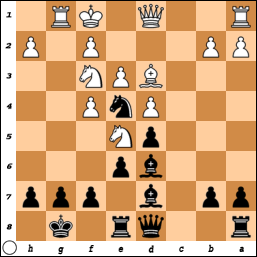 |
| Black has just played 16...Ne4. Can you find a strong combination for White? |
*****
*****
*****
*****
No.
The try 17.Nxf7? Kxf7 18.Bxe4 dxe4 19.Ng5+ is well-answered by the engines' 19...Ke7. I would like to think I would have found ...Ke7 at the board, but I was intending the inferior 19...Kg8? 20.Qh5 Bb5+ 21.Kg2 (not 21.Ke1? Qa5+ 22.Kd1 Ba4+ 23.b3 Bxb3+! etc) h6, when the engines show White has a draw by repetition after 22.Nf7 Be2 23.Nxh6+ Kh7 24.Ng4+ Kg8 25.Nh6+ etc. In the postmortem we looked at 22.Qf7+ (instead of 22.Nf7) Kh8 23.Nxe6 Rxe6? 24.Qxe6 Qe7, with approximate equality, missing that Black does not have to surrender the exchange, eg 23...Qf6 gives Black a substantial advantage.
17.Nxd7!?
This surprised me, but it is Komodo9's top pick for quite a while, until it eventually prefers Stockfish10's 17.a4.
17...Qxd7 18.Ne5 Qe7 19.f3 Nf6 20.Kg2 Nh5 21.Od2
PO's other main thought was 21.Qc2, when my suggestion of 21...Rec8! 22.Bxh7+? Kh8 23.Qb1 g6?? fails to 24.Bxg6. But Black wins in this line with 23...Bxe5, when the follow-up ...g6 does indeed trap the white bishop.
21...f5 22.Rac1 Rec8 23.Rc2 Bxe5?!
Solid and good was 23...Rxc2 24.Qxc2 g6, as the white queen has no entry squares into Black's position on the c file.
24.dxe5?!
White is probably slightly better after 24.fxe5 Rxc2 25.Qxc2 Qg5+ 26. Kf2 (I had somehow missed this move) Qh4+ 27.Kf1.
24...Rxc2 25.Qxc2?
White is OK after 25.Bxc2.
25...d4! 26.exd4 Nxf4+ 27.Kh1 Qd7 28.Rc1?
Slightly better is the engines' 28.Qb3, but Black wins a pawn anyway after sidestepping with 28...Kh8.
28...Qxd4 0-1
Friday, 26 July 2019
New York Giants
CONTINUING to go through Tartakower and du Mont's 500 Master Games Of Chess, I have reached a game played in the final of the first American Chess Congress, held in New York in 1857.
This event was organised as a series of knockout matches that happily ended with a final between the two strongest players, Paul Morphy and Louis Paulsen.
Both had been unbeaten in reaching the final, with each conceding just a single draw against their semi-final opponents.
According to Bill Wall's chess trivia, it cost $10 to play in the tournament, with an admission fee for spectators of $5.
These are much larger sums than they may seem at first sight. According to the Measuring Worth website, $10 in 1857 is worth almost $300 today if comparing consumer prices, and an eye-watering $4,000+ if comparing average incomes.
Notes in italics are algebraicised from 500 Master Games Of Chess.
Paulsen - Morphy
Spanish Four Knights
Although this game is adorned by one of the most famous queen sacrifices in the literature of the game, it also illustrates quite a number of additional tactical and strategic points; a temporary sacrifice, operations on open files, exploitation of a hole (d3), breaking up of the king's defences, irruption on the seventh rank, etc. Historically, this game spread Morphy's fame to Europe and presaged his coming triumphs in the old world.
1.e4 e5 2.Nf3 Nc6 3.Nc3
A forerunner of the modern style, Louis Paulsen prefers a quiet and solid opening, whereas the general tendency of his time was to play the gambits - King's, Scotch, Evans, etc.
3...Nf6 4.Bb5
The Spanish Four Knights, the most scientific of all. Playable also is 4.Bc4, the Italian, and 4.d4, the Scotch Four Knights. Less pugnacious is the restricted development 4.Be2, and Gunsberg's 4.a3, which is best answered by 4...Bc5, claiming the initiative.
4...Bc5
A more stimulating reply than the symmetrical 4...Bb4.
"Rubinstein's" 4...Nd4!? was apparently first played by Emil Schallopp in 1881 in a loss to … Paulsen.
5.0-0
This continuation, storing up energy, is better than hitting out at once with 5.Nxe5 (5...Nxe5 6.d4) or than 5.d3, renouncing any offensive in the centre.
5...0-0
After the more timid 5...d6, the initiative for a long time to come remains with White after 6.d4 exd4 7.Nxd4 Bd7 8.Nf5 0-0 9.Bg5 etc.
Paulsen beat Zukertort with this line in 1877.
6.Nxe5
This temporary sacrifice (6...Nxe5 7.d4) is not without risks for White, as his great adversary immediately tries to demonstrate. After 6.Bxc6 dxc6 7.Nxe5 Re8 8.Nd3 Bd4 etc, the game has lost some of its plasticity, and after 6.d3 d6 7.Bg5 Ne7 etc, leads to a slowing down of operations.
6...Re8
Aiming at the full development of his forces. After 6...Bd4 7.Nf3 Bxc3 8.dxc3 Nxe4 9.Re1 d5 10.c4 Nf6 11.Bg5, White has command of the central files. If 6...Nd4, 7.Bc4.
7.Nxc6
A careful defence is 7.Nf3 Nxe4 8.d4 Nxc3 9.bxc3 Bf8, and the position tends to equality.
7...dxc6 8.Bc4
An immediate and full retreat shows more prudence by 8.Be2 Nxe4 9.Nxe4 Rxe4 10.d3 Re8 11.c3 with 12.d4 to follow.
8.Be2 is not in ChessBase's 2019 Mega database, but is the choice of both Stockfish10 and Komodo9.
8...b5
Not yet 8...Nxe4 on account of 9.Nxe4 Rxe4 10.Bxf7+, for if 10...Kxf7, 11.Qf3+ followed by queen takes rook.
An interesting idea here is 8...Ng4 with 9.h3 Nxf2 10.Bxf7+ Kh8, and Black has the last word.
9.Be2 Nxe4 10.Nxe4 Rxe4 11.Bf3
He is hypnotised by Black's weakness at c6. More self-control is shown by 11.d3 Re6 12.c3, to be followed by 13.d4.
11...Re6 12.c3
An error of judgment. He underrates the dangers of the hole at d3. After 12.d3, White's game could be defended.
12...Qd3 13.b4?!
The engines reckon White is fine if he takes immediate steps to evict Black's queen, eg 13. Re1 Rxe1+ 13.Qxe1 Bd7 14.Qf1.
13...Bb6 14.a4?!
A clever plan. Beaten in the first skirmish, White wants to make up leeway in the second, and to release, by turning manoeuvres, the pressure established by Black's queen.
Despite Tartakower's words, Re1 again seems to be better.
14...bax4
Necessary because of the threat 15.a5. If 14...a6, 15.axb5 Qxb5 (evidently not 15...axb5, nor 15...cxb5), 16.d4, breaking the charm.
15.Qxa4 Bd7?
A mistake that allows White a chance, which he misses, to break the bind. Correct was 15...Bb7, covering both c6 and a6.
16.Ra2?
Intending 16.Qc2, but the immediate opposition of the queen by Qa6 is essential.
16...Rae8
A crushing concentration (threat: 17...Qxf1+).
17.Qa6
Too late.
*****
*****
*****
*****
*****
17...Qxf3!!
A splendid sacrifice of the queen, which breaks the hostile king's defence.
18.gxf3 Rg6+ 19.Kh1 Bh3 20.Rd1?
Clearly neither 20.d4 Bg2+ 21.Kg1 Bxf3# [this should read 21...Bxf3+ 22.Bg5 Rxg5#], nor 20.Rg1 Bg7+ 21.Rxg2 Re1+, followed by mate in two. Relatively better would have been 20.Qd3.
Morphy apparently spent 30 minutes over his 17th move, and it may well be a large portion of that time was spent on how to meet 20.Qd3.
*****
*****
*****
*****
*****
If 20.Qd3, the engines give 20...f5!, the idea being to stop the queen from sacrificing itself for the rook on g6, as 20...Bg2+? 21.Kg1 Bxf3+ fails to 22.Qxg6. After 22...hxg6, Black would have the bishop-pair and a pawn for the exchange, but 23.d3 would prevent Black's rook transferring to the g file, and White's superior pawn-structure would give him the advantage.
After 20.Rd1?, the game continued:
20...Bg2+ 21.Kg1 Bxf3+ 22.Kf1 Bg2+
Morphy has his whole plan cut and dried in his mind. Another method is 22...Rg2, with a view to ...Rxh2 and ...Rh1#.
23.Kg1 Bh3+
This wins very easily, but the engines point out a quicker finish, ie 23...Be4+ 24.Kf1 Bf5 etc.
24.Kh1 Bxf2 25.Qf1
The only chance of prolonging the game for a little while.
25...Bxf1 26.Rxf1 Re2 27.Ra1 Rh6 28.d4 Be3+ 0-1
This event was organised as a series of knockout matches that happily ended with a final between the two strongest players, Paul Morphy and Louis Paulsen.
Both had been unbeaten in reaching the final, with each conceding just a single draw against their semi-final opponents.
According to Bill Wall's chess trivia, it cost $10 to play in the tournament, with an admission fee for spectators of $5.
These are much larger sums than they may seem at first sight. According to the Measuring Worth website, $10 in 1857 is worth almost $300 today if comparing consumer prices, and an eye-watering $4,000+ if comparing average incomes.
Notes in italics are algebraicised from 500 Master Games Of Chess.
Paulsen - Morphy
Spanish Four Knights
Although this game is adorned by one of the most famous queen sacrifices in the literature of the game, it also illustrates quite a number of additional tactical and strategic points; a temporary sacrifice, operations on open files, exploitation of a hole (d3), breaking up of the king's defences, irruption on the seventh rank, etc. Historically, this game spread Morphy's fame to Europe and presaged his coming triumphs in the old world.
1.e4 e5 2.Nf3 Nc6 3.Nc3
A forerunner of the modern style, Louis Paulsen prefers a quiet and solid opening, whereas the general tendency of his time was to play the gambits - King's, Scotch, Evans, etc.
3...Nf6 4.Bb5
The Spanish Four Knights, the most scientific of all. Playable also is 4.Bc4, the Italian, and 4.d4, the Scotch Four Knights. Less pugnacious is the restricted development 4.Be2, and Gunsberg's 4.a3, which is best answered by 4...Bc5, claiming the initiative.
4...Bc5
A more stimulating reply than the symmetrical 4...Bb4.
"Rubinstein's" 4...Nd4!? was apparently first played by Emil Schallopp in 1881 in a loss to … Paulsen.
5.0-0
This continuation, storing up energy, is better than hitting out at once with 5.Nxe5 (5...Nxe5 6.d4) or than 5.d3, renouncing any offensive in the centre.
5...0-0
After the more timid 5...d6, the initiative for a long time to come remains with White after 6.d4 exd4 7.Nxd4 Bd7 8.Nf5 0-0 9.Bg5 etc.
Paulsen beat Zukertort with this line in 1877.
6.Nxe5
This temporary sacrifice (6...Nxe5 7.d4) is not without risks for White, as his great adversary immediately tries to demonstrate. After 6.Bxc6 dxc6 7.Nxe5 Re8 8.Nd3 Bd4 etc, the game has lost some of its plasticity, and after 6.d3 d6 7.Bg5 Ne7 etc, leads to a slowing down of operations.
6...Re8
Aiming at the full development of his forces. After 6...Bd4 7.Nf3 Bxc3 8.dxc3 Nxe4 9.Re1 d5 10.c4 Nf6 11.Bg5, White has command of the central files. If 6...Nd4, 7.Bc4.
7.Nxc6
A careful defence is 7.Nf3 Nxe4 8.d4 Nxc3 9.bxc3 Bf8, and the position tends to equality.
7...dxc6 8.Bc4
An immediate and full retreat shows more prudence by 8.Be2 Nxe4 9.Nxe4 Rxe4 10.d3 Re8 11.c3 with 12.d4 to follow.
8.Be2 is not in ChessBase's 2019 Mega database, but is the choice of both Stockfish10 and Komodo9.
8...b5
Not yet 8...Nxe4 on account of 9.Nxe4 Rxe4 10.Bxf7+, for if 10...Kxf7, 11.Qf3+ followed by queen takes rook.
An interesting idea here is 8...Ng4 with 9.h3 Nxf2 10.Bxf7+ Kh8, and Black has the last word.
9.Be2 Nxe4 10.Nxe4 Rxe4 11.Bf3
He is hypnotised by Black's weakness at c6. More self-control is shown by 11.d3 Re6 12.c3, to be followed by 13.d4.
11...Re6 12.c3
An error of judgment. He underrates the dangers of the hole at d3. After 12.d3, White's game could be defended.
12...Qd3 13.b4?!
The engines reckon White is fine if he takes immediate steps to evict Black's queen, eg 13. Re1 Rxe1+ 13.Qxe1 Bd7 14.Qf1.
13...Bb6 14.a4?!
A clever plan. Beaten in the first skirmish, White wants to make up leeway in the second, and to release, by turning manoeuvres, the pressure established by Black's queen.
Despite Tartakower's words, Re1 again seems to be better.
14...bax4
Necessary because of the threat 15.a5. If 14...a6, 15.axb5 Qxb5 (evidently not 15...axb5, nor 15...cxb5), 16.d4, breaking the charm.
15.Qxa4 Bd7?
A mistake that allows White a chance, which he misses, to break the bind. Correct was 15...Bb7, covering both c6 and a6.
16.Ra2?
Intending 16.Qc2, but the immediate opposition of the queen by Qa6 is essential.
16...Rae8
A crushing concentration (threat: 17...Qxf1+).
17.Qa6
Too late.
 |
| White's queen prevents Black sacing on f1, but ... |
*****
*****
*****
*****
17...Qxf3!!
A splendid sacrifice of the queen, which breaks the hostile king's defence.
18.gxf3 Rg6+ 19.Kh1 Bh3 20.Rd1?
Clearly neither 20.d4 Bg2+ 21.Kg1 Bxf3# [this should read 21...Bxf3+ 22.Bg5 Rxg5#], nor 20.Rg1 Bg7+ 21.Rxg2 Re1+, followed by mate in two. Relatively better would have been 20.Qd3.
Morphy apparently spent 30 minutes over his 17th move, and it may well be a large portion of that time was spent on how to meet 20.Qd3.
 |
| Black to play and win after the variation 20.Qd3 |
*****
*****
*****
*****
If 20.Qd3, the engines give 20...f5!, the idea being to stop the queen from sacrificing itself for the rook on g6, as 20...Bg2+? 21.Kg1 Bxf3+ fails to 22.Qxg6. After 22...hxg6, Black would have the bishop-pair and a pawn for the exchange, but 23.d3 would prevent Black's rook transferring to the g file, and White's superior pawn-structure would give him the advantage.
After 20.Rd1?, the game continued:
20...Bg2+ 21.Kg1 Bxf3+ 22.Kf1 Bg2+
Morphy has his whole plan cut and dried in his mind. Another method is 22...Rg2, with a view to ...Rxh2 and ...Rh1#.
23.Kg1 Bh3+
This wins very easily, but the engines point out a quicker finish, ie 23...Be4+ 24.Kf1 Bf5 etc.
24.Kh1 Bxf2 25.Qf1
The only chance of prolonging the game for a little while.
25...Bxf1 26.Rxf1 Re2 27.Ra1 Rh6 28.d4 Be3+ 0-1
Wednesday, 24 July 2019
Shazam!
TURNED out on top board last night for The Dogs Of Battersea against Shazam Druids in the 150-average division of London's Summer League.
*****
*****
*****
*****
*****
*****
*****
*****
37.Kd2
Yes, it is a rook-and-pawn ending, and, yes, material is equal, but on putting the game into ChessBase I was surprised that my main analysis engines, Komodo9 and Stockfish10, at first rate the position as about equal. The latter soon changes to giving White a slight edge, but Komodo9 sticks with an equals sign (albeit reckoning White is almost a fifth of a pawn ahead).
37...Ke8
Interesting but double-edged is 37...Rd6!? In order to play it, Black has to be confident the pawn-ending after 38.Rxd6 cxd6 is drawn. It may be, but White is certainly a little better. And anyway White is not forced to exchange rooks; he could play 38.Rd3 instead, and prepare to activate his kingside majority with similar play to the game.
38.g4 h6 39.h4 c6 40.Rd3 Ke7 41.a4 a5 42.Re3?
This gives drawing chances. Correct was 42.Ke3, as we shall see later in the game.
42...Rd6+ 43.Rd3 Re6?
The engines give 43...g5 as drawing, the point being that 44.Rxd6 Kxd6 45.Ke3 Ke5 46.h5 is met by 46...Kd6! (46...Ke6 may also draw, but is a lot more complicated) 47.f4 gxf4+ 48.Kxf4 Ke6, when there is no way for White to make progress.
In the above line, White can try 46.f4+!? gxf4+ 47.Kf3, but it seems Black holds with 47...b5! 48.axb5 cxb5 49.cxb5 c4 (49...Kd6 50.Kxf4 c4 transposes) 50.bxc4 Kd6 51.Kxf4 a4 52.g5 fxg5+ 53.hxg5 hxg5+ 54.Kf5! a3 55.e5+ Kc7 56.e6 a2 57.b6+! Kxb6 58.e7 a1=Q 59.e8=Q Qf1+. This would have been extremely difficult, for both sides, to work out over the board, but the engines are in complete agreement on their analysis.
44.Ke3 f5!
This is the engines' choice. Black cannot try to stay pat, eg 44...Ke8? 45.Kf4 Ke7, when 46.g5 gives White a protected passed pawn.
45.gxf5?!
It seems 45.Rd2!? was better, eg 45...fxg4 46.fxg4 g5 (best, according to the engines) 47.hxg5 hxg5 48.Rh2 Kd6 (Black cannot afford a pawn-ending) 49.Rh8 Rg6, when Black is very passive, but not necessarily lost.
45...gxf5 46.Kf4 fxe4 47.fxe4 Rf6+ 48.Kg4 Re6 49.Re3 Kf6?
Black almost certainly draws with 49...Re5, eg 50.Kf4 Rh5 51.Rh3 Ke6.
50.e5!
Also probably winning, but not so quickly, is 50.Kf4, as now 50...Re5 is met by 51.Rd3 Rh5 52.Kg4 Re5 53.Kf3 Rh5 54.Kg3 Re5 (White's dancing with the king is so Black's rook will capture on e5 without giving check) 55.Rxc6 Rxe4 56.Rxb6.
50...Ke7
Or 50...Rxe5 51.Rxe5 Kxe5 52.Kh5 etc.
51.Kf5 b5 52.Rg3 1-0
If 52...Kf7, then 53.Rg7+! wins.
The Dogs Of Battersea won the match 2.5-1.5.
My updated Battersea statistics for 2018-19
Event...Colour...Grade...Opponent's Grade...Result
CLL........B..........167...….........196...............…D
LL...…….B...…...167...………..159...………….D
CLL...…..B...…...167...………..161...………….W
CLL...…..B...…...167...………..190...………….D
LL...…….W...…..167...………..161...….………W
CLL...…..W...…..167...………..148...………….D
CLL...…..W...…..167...………..165...………….W
CLL...…..W...…..167...………..160...………….D
CLL...…..W...…..167...………..159...………….D
LL...…….B...…...167...………..168...………….D
LL...…….W...…..171...………..159...………….W
CLL...…..B...…...171...………..198...……….….L
CLL...…..B...…...171...………..169...…………..L
CLL...…..B...…...171...………..196...…………..L
LL...…….B...…...171...………..182...…………..D
CLL...…..W...…..171...………..189...…………..L
LL...…….B...…...171...………..178...…………..L
CLL...…..B...…...171...………..164...…………..D
LL...…….B...…...171...………..188...………….W
CLL...…..B...…...171...………..200...…………..L
LL...…….B...…...171...………..169...…………..L
CLL...…..W...…..171...………..186...…………..D
CLL...…..B...…...171...………..153...…………..D
LL...……W...…...171...………..188...…………..L
LL...……W...…...171...………..159...…………..L
LL...……W...…...171...………..153...…………..L
CLL...…..B...…...171...…….….172...……….....D
LL............B.........171................139..................W
LL...….….B...…..171...…….….214...……....….L
LL...……..B...…..171...………..173...……….….L
LL...…….W...…..171...………..166...…………..L
SL...……..B...…..171...………..167...………….W
LL...…….W...…..171...………..122...………….W
SL...……..B...…..171...………..159...………….W
SL...…….W...…..168...………..140(est)………W
SL...…….W...…..168...………..183...………….W
Overall this season for Battersea I have scored +11=12-13 for a grading performance of 168.
In season 2017-18 I scored +10=8-9 for a grading performance of 175.
CLL - Central London League; LL - London League; SL - Summer League
 |
| Black has just played 36...Ke8-e7 and offered a draw in Spanton (168) - David Rowson (183) |
*****
*****
*****
*****
*****
*****
*****
37.Kd2
Yes, it is a rook-and-pawn ending, and, yes, material is equal, but on putting the game into ChessBase I was surprised that my main analysis engines, Komodo9 and Stockfish10, at first rate the position as about equal. The latter soon changes to giving White a slight edge, but Komodo9 sticks with an equals sign (albeit reckoning White is almost a fifth of a pawn ahead).
37...Ke8
Interesting but double-edged is 37...Rd6!? In order to play it, Black has to be confident the pawn-ending after 38.Rxd6 cxd6 is drawn. It may be, but White is certainly a little better. And anyway White is not forced to exchange rooks; he could play 38.Rd3 instead, and prepare to activate his kingside majority with similar play to the game.
38.g4 h6 39.h4 c6 40.Rd3 Ke7 41.a4 a5 42.Re3?
This gives drawing chances. Correct was 42.Ke3, as we shall see later in the game.
42...Rd6+ 43.Rd3 Re6?
The engines give 43...g5 as drawing, the point being that 44.Rxd6 Kxd6 45.Ke3 Ke5 46.h5 is met by 46...Kd6! (46...Ke6 may also draw, but is a lot more complicated) 47.f4 gxf4+ 48.Kxf4 Ke6, when there is no way for White to make progress.
In the above line, White can try 46.f4+!? gxf4+ 47.Kf3, but it seems Black holds with 47...b5! 48.axb5 cxb5 49.cxb5 c4 (49...Kd6 50.Kxf4 c4 transposes) 50.bxc4 Kd6 51.Kxf4 a4 52.g5 fxg5+ 53.hxg5 hxg5+ 54.Kf5! a3 55.e5+ Kc7 56.e6 a2 57.b6+! Kxb6 58.e7 a1=Q 59.e8=Q Qf1+. This would have been extremely difficult, for both sides, to work out over the board, but the engines are in complete agreement on their analysis.
44.Ke3 f5!
This is the engines' choice. Black cannot try to stay pat, eg 44...Ke8? 45.Kf4 Ke7, when 46.g5 gives White a protected passed pawn.
45.gxf5?!
It seems 45.Rd2!? was better, eg 45...fxg4 46.fxg4 g5 (best, according to the engines) 47.hxg5 hxg5 48.Rh2 Kd6 (Black cannot afford a pawn-ending) 49.Rh8 Rg6, when Black is very passive, but not necessarily lost.
45...gxf5 46.Kf4 fxe4 47.fxe4 Rf6+ 48.Kg4 Re6 49.Re3 Kf6?
Black almost certainly draws with 49...Re5, eg 50.Kf4 Rh5 51.Rh3 Ke6.
50.e5!
Also probably winning, but not so quickly, is 50.Kf4, as now 50...Re5 is met by 51.Rd3 Rh5 52.Kg4 Re5 53.Kf3 Rh5 54.Kg3 Re5 (White's dancing with the king is so Black's rook will capture on e5 without giving check) 55.Rxc6 Rxe4 56.Rxb6.
50...Ke7
Or 50...Rxe5 51.Rxe5 Kxe5 52.Kh5 etc.
51.Kf5 b5 52.Rg3 1-0
If 52...Kf7, then 53.Rg7+! wins.
The Dogs Of Battersea won the match 2.5-1.5.
My updated Battersea statistics for 2018-19
Event...Colour...Grade...Opponent's Grade...Result
CLL........B..........167...….........196...............…D
LL...…….B...…...167...………..159...………….D
CLL...…..B...…...167...………..161...………….W
CLL...…..B...…...167...………..190...………….D
LL...…….W...…..167...………..161...….………W
CLL...…..W...…..167...………..148...………….D
CLL...…..W...…..167...………..165...………….W
CLL...…..W...…..167...………..160...………….D
CLL...…..W...…..167...………..159...………….D
LL...…….B...…...167...………..168...………….D
LL...…….W...…..171...………..159...………….W
CLL...…..B...…...171...………..198...……….….L
CLL...…..B...…...171...………..169...…………..L
CLL...…..B...…...171...………..196...…………..L
LL...…….B...…...171...………..182...…………..D
CLL...…..W...…..171...………..189...…………..L
LL...…….B...…...171...………..178...…………..L
CLL...…..B...…...171...………..164...…………..D
LL...…….B...…...171...………..188...………….W
CLL...…..B...…...171...………..200...…………..L
LL...…….B...…...171...………..169...…………..L
CLL...…..W...…..171...………..186...…………..D
CLL...…..B...…...171...………..153...…………..D
LL...……W...…...171...………..188...…………..L
LL...……W...…...171...………..159...…………..L
LL...……W...…...171...………..153...…………..L
CLL...…..B...…...171...…….….172...……….....D
LL............B.........171................139..................W
LL...….….B...…..171...…….….214...……....….L
LL...……..B...…..171...………..173...……….….L
LL...…….W...…..171...………..166...…………..L
SL...……..B...…..171...………..167...………….W
LL...…….W...…..171...………..122...………….W
SL...……..B...…..171...………..159...………….W
SL...…….W...…..168...………..140(est)………W
SL...…….W...…..168...………..183...………….W
Overall this season for Battersea I have scored +11=12-13 for a grading performance of 168.
In season 2017-18 I scored +10=8-9 for a grading performance of 175.
CLL - Central London League; LL - London League; SL - Summer League
Monday, 22 July 2019
Morphy v The French (part six)
ALTHOUGH it is not described as such in ChessBase's 2019 Mega database, Paul Morphy seems to have played this game blindfold.
His opponent is José María Sicre, a Cuban slave, and the game took place in Havana in 1862 (while the American Civil War was raging further north).
Morphy - Sicre
1.e4 e6 2.d4 d5 3.exd5 exd5 4.Nf3 Bd6 5.Bd3 Nf6 6.0-0 0-0 7.Nc3 c6
The same move as played by Löwenthal when he first tried the French against Morphy (see part two of this series).
8.Bg5 Bg4
Löwenthal played 8...h6. Sicre's choice is the main move today.
9.h3 Bxf3?!
But this casual surrender of the bishop-pair finds few followers in modern chess, although other famous names to have played it include Mason and Maróczy.
10.Qxf3 Nbd7 11.Rfe1 Qc7
*****
*****
*****
*****
*****
12.g4!?
Given enough time, this comes to be Stockfish10's choice, although Komodo9 remains unimpressed. I guess Morphy is arguing that Black, who is slightly behind in development (White has five pieces developed to Black's four, and it is White's move), is not well-placed to take advantage of the holes that will appear in White's kingside.
12...Rfe8 13.Be3
Avoiding exchanges and preparing to evict the black knight at f6.
13...Kh8?!
This loses a pawn ... or sets a cunning trap that Black fails to follow up properly. The engines suggest 13...g6, which at least protects the light squares, which could become vulnerable since White has the only light-square bishop.
14.g5 Ng8 15.Qxf7?!
Rushing the pawn-grab. It was probably better to continue building the attack with 15.Ne2 or 15.h4.
15...Re7?
But this is definitely a mistake. The engines point out 15...Ne5! 16.Qxc7 Nf3+ 17.Kh1 Bxc7 18.Rf1, when White is a pawn up and has the bishop-pair, but White's kingside weaknesses and problems coordinating his pieces mean Black has decent compensation.
16.Qh5
Withdrawing, but with a threat to mate.
16...Nf8 17.Qg4 Ne6 18.Bxh7!?
18.Ne2 was more prudent.
18...Nf6??
This loses in short order. Black had to try 18...Kxh7, when 19.Qh5+ Kh6 20.gxh6 g6 leaves Black's king relatively safe. Although White is two pawns up, the engines reckon he only has a slight edge, not least because it is now White, rather than Black, who is vulnerable on the light squares.
19.gxf6 gxf6 20.Bg6 (1-0, 27 moves)
To be concluded
His opponent is José María Sicre, a Cuban slave, and the game took place in Havana in 1862 (while the American Civil War was raging further north).
Morphy - Sicre
1.e4 e6 2.d4 d5 3.exd5 exd5 4.Nf3 Bd6 5.Bd3 Nf6 6.0-0 0-0 7.Nc3 c6
The same move as played by Löwenthal when he first tried the French against Morphy (see part two of this series).
8.Bg5 Bg4
Löwenthal played 8...h6. Sicre's choice is the main move today.
9.h3 Bxf3?!
But this casual surrender of the bishop-pair finds few followers in modern chess, although other famous names to have played it include Mason and Maróczy.
10.Qxf3 Nbd7 11.Rfe1 Qc7
 |
| Morphy to play, starting an interesting attack |
*****
*****
*****
*****
12.g4!?
Given enough time, this comes to be Stockfish10's choice, although Komodo9 remains unimpressed. I guess Morphy is arguing that Black, who is slightly behind in development (White has five pieces developed to Black's four, and it is White's move), is not well-placed to take advantage of the holes that will appear in White's kingside.
12...Rfe8 13.Be3
Avoiding exchanges and preparing to evict the black knight at f6.
13...Kh8?!
This loses a pawn ... or sets a cunning trap that Black fails to follow up properly. The engines suggest 13...g6, which at least protects the light squares, which could become vulnerable since White has the only light-square bishop.
14.g5 Ng8 15.Qxf7?!
Rushing the pawn-grab. It was probably better to continue building the attack with 15.Ne2 or 15.h4.
15...Re7?
But this is definitely a mistake. The engines point out 15...Ne5! 16.Qxc7 Nf3+ 17.Kh1 Bxc7 18.Rf1, when White is a pawn up and has the bishop-pair, but White's kingside weaknesses and problems coordinating his pieces mean Black has decent compensation.
16.Qh5
Withdrawing, but with a threat to mate.
16...Nf8 17.Qg4 Ne6 18.Bxh7!?
18.Ne2 was more prudent.
18...Nf6??
This loses in short order. Black had to try 18...Kxh7, when 19.Qh5+ Kh6 20.gxh6 g6 leaves Black's king relatively safe. Although White is two pawns up, the engines reckon he only has a slight edge, not least because it is now White, rather than Black, who is vulnerable on the light squares.
19.gxf6 gxf6 20.Bg6 (1-0, 27 moves)
To be concluded
Sunday, 21 July 2019
Morphy v The French (part five)
THE following game, part of a blindfold simul in Philadelphia in 1859, is not in Johann Löwenthal's Morphy's Games Of Chess.
Morphy - Samuel Smyth*
1.e4 e6 2.d4 d5 3.exd5 exd5 4.Nf3 Be6 5.Bd3 Nf6 6.0-0 h6!? 7.Ne5!?
The only occasion in the six games under consideration in which Morphy did not play 7.Nc3. Ironically, 7.Nc3 is one of the choices in this position, along with 7.Re1, of Stockfish10 and Komodo9.
7...Bd6 8.f4
So this is Morphy's idea - White has a fine outpost for his king's knight at e5, and if the knight is captured, White gets a pawn-wedge into Black's position.
8...Nc6 9.c3
Exchanging on c6 was the main alternative, but Black should be able to dissolve his doubled pawns by engineering ...c5 without too much trouble.
*****
*****
*****
*****
*****
9...Qe7?
It is not so much the fact that the black queen is on the same file as the black king, but that it has a bishop in front of it that is menaced by the possible thrust f5.
Safe was 9...0-0, but Black may have had aggressive queenside-castling in mind.
10.Rel Bxe5
Not 10...0-0-0?? (or 10...0-0??) 11.Nxc6 bxc6 12.f5 etc.
11.fxe5 Nd7 12.b4!
Partly in anticipation of Black castling long, but there is more to this move, as we shall soon see.
12...0-0?!
This loses material, but Black was in a bad way in any case.
13.b5 Na5 14.Ba3 Qg5 15.Bxf8 (1-0, 33 moves)
*Morphy's opponent was not the pushover this game makes him seem. He was probably the same Samuel Smyth who found local fame when, as a "handsome youth" of 18, he defeated the automaton The Turk when it visited Philadelphia in 1834.
Morphy - Samuel Smyth*
1.e4 e6 2.d4 d5 3.exd5 exd5 4.Nf3 Be6 5.Bd3 Nf6 6.0-0 h6!? 7.Ne5!?
The only occasion in the six games under consideration in which Morphy did not play 7.Nc3. Ironically, 7.Nc3 is one of the choices in this position, along with 7.Re1, of Stockfish10 and Komodo9.
7...Bd6 8.f4
So this is Morphy's idea - White has a fine outpost for his king's knight at e5, and if the knight is captured, White gets a pawn-wedge into Black's position.
8...Nc6 9.c3
Exchanging on c6 was the main alternative, but Black should be able to dissolve his doubled pawns by engineering ...c5 without too much trouble.
 |
| Black to play and make an instructive mistake |
*****
*****
*****
*****
9...Qe7?
It is not so much the fact that the black queen is on the same file as the black king, but that it has a bishop in front of it that is menaced by the possible thrust f5.
Safe was 9...0-0, but Black may have had aggressive queenside-castling in mind.
10.Rel Bxe5
Not 10...0-0-0?? (or 10...0-0??) 11.Nxc6 bxc6 12.f5 etc.
11.fxe5 Nd7 12.b4!
Partly in anticipation of Black castling long, but there is more to this move, as we shall soon see.
12...0-0?!
This loses material, but Black was in a bad way in any case.
13.b5 Na5 14.Ba3 Qg5 15.Bxf8 (1-0, 33 moves)
*Morphy's opponent was not the pushover this game makes him seem. He was probably the same Samuel Smyth who found local fame when, as a "handsome youth" of 18, he defeated the automaton The Turk when it visited Philadelphia in 1834.
Saturday, 20 July 2019
London System Trap
Tony Preece (1645/144) - Spanton (1900/171)
22nd 4NCL Telford U2000 Round 3
New London
1.d4 d5 2.Bf4
One of the points of the New London (1.d4 and 2.Bf4) as opposed to the old London System (1.d4, 2.Nf3 and 3.Bf4) is that it discourages Chigorin fanatics from playing 2...Nc6. In the traditional London System, Black can play a Pseudo-Chigorin, ie 1.d4 d5 2.Nf3 Nc6 3.Bf4 Bg4. However, in the New London White can meet 1.d4 d5 2.Bf4 Nc6 with 3.e3, when 3...Bg4 is not possible. Some strong players, for example Morozevich and Sokolov, have insisted on playing against the New London in a sort of Chigroin-style with 2...Bg4!?
2...e6 3.Nf3 Bd6 4.Bg3 Nf6 5.e3
The most-popular move in ChessBase's 2019 Mega database.
5...Ne4!?
Attempting to show that White's move-order is incorrect.
6.Bh4
Preserving the bishop-pair, at least for the moment. The analysis engines Stockfish10 and Komodo9 reckon White should get on with normal development, the point being that Black's gain of the bishop-pair will cost time and will half-open the h file.
6...Be7
6...g5!?
7.Bxe7 Qxe7
The result of these manoeuvres is that White, rather than Black, is behind in development, but Black has not gained the bishop-pair, and White has the better remaining bishop.
The engines reckon White is slightly better. I am not sure about that, but it proved a moot point as my opponent missed a key feature of the position.
8.Ne5? Qb4+ 9.Nd2
The only move.
9...Nxd2 10.Qxd2 Qxb2 (0-1, 61 moves)
Morphy v The French (part four)
ACCORDING to Johann Löwenthal in Morphy's Games Of Chess, the following was part of a blindfold simul given in London in 1859 against eight opponents, "including, as is well known, the most-talented players of the old London Chess Club."
Morphy - George Walker*
1.e4 e6 2.d4 d5 3.exd5 exd5 4.Nf3 Bd6 5.Bd3 Nf6 6.0-0 0-0 7.Nc3 Bg4
Morphy has played his normal first seven moves. Walker's 7...Bg4 was already well-known in 1859, and remains the most-popular reply today along with 7...c6 (see parts two and six of this series for examples of the latter move).
8.h3
8.Nb5!? can be parried by 8...Be7 9.Bf4 Na6, although Komodo9 and Stockfish10 are happy with 8...Nc6!? 9.Nxd6 Qxd6, presumably because Black's lead in development is deemed sufficient compensation for the bishop-pair.
8...Be6?!
Maintaining the pin with 8...Bh5 is overwhelmingly more popular, although in practice White has scored very well with Steinitz's 9.g4!?
9.Be3 Nc6 10.Qd2 Qd7 11.Bf4
Löwenthal: "The best move. An examination of the position will prove that Black meditated the capture of h3 with the sacrifice of the bishop, which might have caused White some trouble. This step, however, on Mr Morphy's part, at once frustrates any such design."
11...Rfe8 12.Rae1 Rad8 13.Ne5
Löwenthal: "A fine move, acquiring a good attacking position."
13...Qc8?!
Löwenthal: "Taking the knight with either bishop or knight would have been exactly what his adversary desired."
But considering that Black feels obliged to take the knight next move anyway, it would probably have been a lesser evil to capture now.
14.Bb5
Löwenthal: "All this is admirably played, and considering that White is playing blindfold against such an able opponent, is quite marvellous."
14...Bxe5
*****
*****
*****
*****
*****
15.Bxe5?!
The engines much prefer White after 15.dxe5 Ne4 16.Nxe4 dxe4 17.Qc3.
15...Nxe5
Löwenthal: "Selecting the proper course of play, for 15...Bd7 would have cramped the game still further; and if 15...Rd6, then 16.f4 would have given White an excellent game."
Actually, 15...Bd7?? loses instantly to 16.Bxf6 gxf6 17.Nxd5. And if 15...Rd6?, then the simple 16.Bxd6 is strong (but so is 16.f4).
It may well be Löwenthal meant 15...Nd7 rather than 15...Bd7. The move is described in his book as "B. to Q's 2nd," and could be a printing error.
16.dxe5 Ne4 17.Nxe4 dxe4 18.Qf4 c6
Finally taking his king's rook off prise, as grandmaster Nigel Davies is fond of saying. The game was drawn eight moves later.
*Walker was a prolific, for his time, chess author, and an organiser of the first international tournament, London 1851.
Morphy - George Walker*
1.e4 e6 2.d4 d5 3.exd5 exd5 4.Nf3 Bd6 5.Bd3 Nf6 6.0-0 0-0 7.Nc3 Bg4
Morphy has played his normal first seven moves. Walker's 7...Bg4 was already well-known in 1859, and remains the most-popular reply today along with 7...c6 (see parts two and six of this series for examples of the latter move).
8.h3
8.Nb5!? can be parried by 8...Be7 9.Bf4 Na6, although Komodo9 and Stockfish10 are happy with 8...Nc6!? 9.Nxd6 Qxd6, presumably because Black's lead in development is deemed sufficient compensation for the bishop-pair.
8...Be6?!
Maintaining the pin with 8...Bh5 is overwhelmingly more popular, although in practice White has scored very well with Steinitz's 9.g4!?
9.Be3 Nc6 10.Qd2 Qd7 11.Bf4
Löwenthal: "The best move. An examination of the position will prove that Black meditated the capture of h3 with the sacrifice of the bishop, which might have caused White some trouble. This step, however, on Mr Morphy's part, at once frustrates any such design."
11...Rfe8 12.Rae1 Rad8 13.Ne5
Löwenthal: "A fine move, acquiring a good attacking position."
13...Qc8?!
Löwenthal: "Taking the knight with either bishop or knight would have been exactly what his adversary desired."
But considering that Black feels obliged to take the knight next move anyway, it would probably have been a lesser evil to capture now.
14.Bb5
Löwenthal: "All this is admirably played, and considering that White is playing blindfold against such an able opponent, is quite marvellous."
14...Bxe5
 |
| How would you recapture? |
*****
*****
*****
*****
15.Bxe5?!
The engines much prefer White after 15.dxe5 Ne4 16.Nxe4 dxe4 17.Qc3.
15...Nxe5
Löwenthal: "Selecting the proper course of play, for 15...Bd7 would have cramped the game still further; and if 15...Rd6, then 16.f4 would have given White an excellent game."
Actually, 15...Bd7?? loses instantly to 16.Bxf6 gxf6 17.Nxd5. And if 15...Rd6?, then the simple 16.Bxd6 is strong (but so is 16.f4).
It may well be Löwenthal meant 15...Nd7 rather than 15...Bd7. The move is described in his book as "B. to Q's 2nd," and could be a printing error.
16.dxe5 Ne4 17.Nxe4 dxe4 18.Qf4 c6
Finally taking his king's rook off prise, as grandmaster Nigel Davies is fond of saying. The game was drawn eight moves later.
*Walker was a prolific, for his time, chess author, and an organiser of the first international tournament, London 1851.
Friday, 19 July 2019
Morphy v The French (part three)
AFTER his decent opening (spoiled by a late-game blunder) against Paul Morphy in game 10 of their 1858 match, Johann Löwenthal returned to the French in game 12.
Morphy - Löwenthal
1.e4 e6 2.d4 d5 3.exd5 exd5 4.Nf3 Nf6 5.Bd3 Be6?!
Löwenthal is the first to vary, but in Morphy's Games of Chess he comments: "Comparatively weak; bringing out the king's bishop is much better."
By no means does 5...Be6?! lose by force, but the point is that it is not clear at this early stage that Black's light-square bishop belongs on e6. Most popular today is maintaining symmetry with 5...Bd6.
6.0-0 Bd6 7.Nc3
Morphy has played the first seven moves that he always played against the French (with one exception, which we will come to later).
7...c6 8.Ne5
Löwenthal: "Gaining a good position."
8...Qb6
8...Bxe5?! was subsequently played in two other quite-high-profile 19th century games, but it is very doubtful if Black should give up his good bishop like this. However, Black will come to play ...Bxe5 in this game anyway.
9.Be3!? Nbd7
Grabbing a pawn with 9...Qxb2!? looks risky, especially against an attacking player such as Morphy.
10.f4!?
Löwenthal: "In Mr Morphy's hands, this move always seems productive of immediate advantage."
Morphy continues to offer his b pawn, confident he will get plenty of compensation.
10...Bxe5!?
This comes to be Komodo9's top choice, at least for some time, but Stockfish10 is not a fan. White is now clearly better.
11.fxe5 Ng4
As Löwenthal points out, 11...Nxe5?? loses to 12.Na4.
12.Qd2 Nxe3 13.Qxe3 Qxb2!?
The engines prefer White whether Black plays the text or 13...0-0.
14.Ne2 Qa3 15.Nf4 Qe7
Castling long is suggested by the engines, but White's king certainly looks safer.
16.Rab1 0-0-0
16...0-0?! 17.Rxb7 was hardly an option, but Black's king's position on the queenside looks draughty.
17.Be2!?
Giving the queen and knight quick access to the queenside.
17...Nb6 18.Qb3 Rd7
Moving the king into the line-of-fire by 18...Kb8!? was apparently better, although the engines reckon White has full compensation for his pawn-minus.
19.Nd3!?
The engines at first call this a mistake, because of Löwenthal's reply, but Morphy has a surprise in store.
19...Nc4
*****
*****
*****
*****
*****
20.Nc5!
Löwenthal: "Exceedingly well-played."
20...Rc7?
Löwenthal: "Had Black played 20...Nd2, White's answer would have been 21.Qa4 with a menaced checkmate."
But the engines reckon 21...Kb8 is a complete answer. Instead they give 21.Qg3 Nxf1 (21...Rg8? 22.Nxb7 Nxb1 23.Rxb1, with a very strong attack for White) 22.Bxf1 b6 23.Nxd7 Kxd7 24.Qxg7, when White has got his material back and has the better pieces.
21.Qa4
Löwenthal: "Mr Morphy subsequently observed that taking the knight with the bishop, before playing this move, would have been much stronger as then Black could not have advanced ...b6."
21...b6
The engines want Black to give up the exchange with 21...Kb8!?, but after 22.Bxc4 dxc4 23.Na6+ Ka8 24.Nxc7+ Qxc7 25.Qb4, White is much better.
22.Bxc4 bxc5
Löwenthal: "If the bishop had been captured, White might have replied with 23.Rxb6!, a winning move."
23.Ba6+ Kd7 24.Bb7 Rd8?
Löwenthal: "A blunder, of which Mr Morphy at once takes full advantage."
The engines give best play as 24...Qh4 25.c3 Rd8 26.Qa5 cxd4 27.Qc5 Ke8 28.Bxc6+, with Black losing too much material to have any real chance.
25.Bxc6+! 1-0
Morphy - Löwenthal
1.e4 e6 2.d4 d5 3.exd5 exd5 4.Nf3 Nf6 5.Bd3 Be6?!
Löwenthal is the first to vary, but in Morphy's Games of Chess he comments: "Comparatively weak; bringing out the king's bishop is much better."
By no means does 5...Be6?! lose by force, but the point is that it is not clear at this early stage that Black's light-square bishop belongs on e6. Most popular today is maintaining symmetry with 5...Bd6.
6.0-0 Bd6 7.Nc3
Morphy has played the first seven moves that he always played against the French (with one exception, which we will come to later).
7...c6 8.Ne5
Löwenthal: "Gaining a good position."
8...Qb6
8...Bxe5?! was subsequently played in two other quite-high-profile 19th century games, but it is very doubtful if Black should give up his good bishop like this. However, Black will come to play ...Bxe5 in this game anyway.
9.Be3!? Nbd7
Grabbing a pawn with 9...Qxb2!? looks risky, especially against an attacking player such as Morphy.
10.f4!?
Löwenthal: "In Mr Morphy's hands, this move always seems productive of immediate advantage."
Morphy continues to offer his b pawn, confident he will get plenty of compensation.
10...Bxe5!?
This comes to be Komodo9's top choice, at least for some time, but Stockfish10 is not a fan. White is now clearly better.
11.fxe5 Ng4
As Löwenthal points out, 11...Nxe5?? loses to 12.Na4.
12.Qd2 Nxe3 13.Qxe3 Qxb2!?
The engines prefer White whether Black plays the text or 13...0-0.
14.Ne2 Qa3 15.Nf4 Qe7
Castling long is suggested by the engines, but White's king certainly looks safer.
16.Rab1 0-0-0
16...0-0?! 17.Rxb7 was hardly an option, but Black's king's position on the queenside looks draughty.
17.Be2!?
Giving the queen and knight quick access to the queenside.
17...Nb6 18.Qb3 Rd7
Moving the king into the line-of-fire by 18...Kb8!? was apparently better, although the engines reckon White has full compensation for his pawn-minus.
19.Nd3!?
The engines at first call this a mistake, because of Löwenthal's reply, but Morphy has a surprise in store.
19...Nc4
 |
| How can White successfully meet Black's threat to fork at d2? |
*****
*****
*****
*****
20.Nc5!
Löwenthal: "Exceedingly well-played."
20...Rc7?
Löwenthal: "Had Black played 20...Nd2, White's answer would have been 21.Qa4 with a menaced checkmate."
But the engines reckon 21...Kb8 is a complete answer. Instead they give 21.Qg3 Nxf1 (21...Rg8? 22.Nxb7 Nxb1 23.Rxb1, with a very strong attack for White) 22.Bxf1 b6 23.Nxd7 Kxd7 24.Qxg7, when White has got his material back and has the better pieces.
21.Qa4
Löwenthal: "Mr Morphy subsequently observed that taking the knight with the bishop, before playing this move, would have been much stronger as then Black could not have advanced ...b6."
21...b6
The engines want Black to give up the exchange with 21...Kb8!?, but after 22.Bxc4 dxc4 23.Na6+ Ka8 24.Nxc7+ Qxc7 25.Qb4, White is much better.
22.Bxc4 bxc5
Löwenthal: "If the bishop had been captured, White might have replied with 23.Rxb6!, a winning move."
23.Ba6+ Kd7 24.Bb7 Rd8?
Löwenthal: "A blunder, of which Mr Morphy at once takes full advantage."
The engines give best play as 24...Qh4 25.c3 Rd8 26.Qa5 cxd4 27.Qc5 Ke8 28.Bxc6+, with Black losing too much material to have any real chance.
25.Bxc6+! 1-0
Subscribe to:
Posts (Atom)