Showing posts with label du Mont. Show all posts

Monday, 10 February 2025

Kasparov & Tartakower On A Chess Classic

THE King's Gambit, while by no means common, still appears in club-standard games.
What is rare these days, however, is Black trying to hang on to the extra pawn with 3...g5, which used to be almost universal.
Here is an exciting example from Savielly Tartakower and Julius du Mont's 500 Master Games Of Chess.
Notes in italics are algebraicised from the book, those underlined are by Garry Kasparov in ChessBase Magazine.

Jakob Rosanes - Adolf Anderssen
Breslau, Prussia (now Wrocław, Poland)
A classic, showing how mind can triumph over matter.
1.e4 e5 2.f4
Of course the most popular opening of the mid-19th century. Conventional wisdom at the time assumed that White had an obligation to fight for the initiative at any price. That is why material sacrifice at an early stage of the game was simply a show of good taste, and to decline the opponent's kind material offer was not considered an honourable option.
2...exf4 3.Nf3 g5 4.h4 g4 5.Ne5
This variation is known as the Kieseritzky Gambit.
One of the key-positions of underdeveloped chess theory.
5...Nf6
An active defence.
How should White proceed?
*****
*****
*****
*****
*****
6.Bc4?!
As this immediate action against f7 is easily met, 6.d4 is more useful.
6.d4 was later proved to be a much better move.
The text is easily the most popular continuation in ChessBase's 2025 Mega database, while 6.Nxg4!? is recommended by Stockfish17 and Dragon1.
6...d5 7.exd5 Bd6
Continuing to show an active spirit.
8.d4 Nh5!?
Maintaining the same spirit; not only does the text move guard the gambit pawn, but it indicates Black's future line of play,
9.Bb5+?
He gets entangled in an expedition, which neglects the safety of his own king. If 9.Nxg4 [then] 9...Ng3 etc. The best, in spite of all apparent dangers, is 9.0-0, eg 9...Qxh4 10.Qe1 Qxe1 11.Rxe1 Kf8 12.Nc3 etc.
9...c6!
Playing for sacrifices in material, in order to speed up his action on the sector which he recognises as the most important. Otherwise 9...Kf8 is playable.
Anderssen in action! It's time to change colours and play white!
10.dxc6 bxc6!?
The engines reckon 10...Nxc6 is much stronger.
11.Nxc6 Nxc6
If 11...Qd7 [then] 12.Nxa7 wins.
12.Bxc6+ Kf8!
Great play! 12...Bd7 13.Bxd7+ Qxd7 14.0-0 etc would deprive Black's attack of all vitality, and so he prefers to give up his QR for nothing more than an attacking 'tempo'.
13.Bxa8
White is rook and pawn up, but the engines agree Black is winning
*****
*****
*****
*****
*****
13...Ng3 14.Rh2
Better is Kf2.
Obviously [to] the unknown club player who was playing white it wasn't clear whether Black had sufficient compensation for the sacrificed rook.
This is a bit harsh on Rosanes who, according to ChessBase's 2025 Mega database, had a score against Anderssen of +2=0-2 (Rosanes had white in every game).
14...Bf5?!
The engines show direct play with 14...Qe7+ is much stronger, thanks to meeting 15.Kf2 with 15...Ne2!, eg 16.Qxe2 g3+ 17.Kf1 Qxe2+ 18.Kxe2 Ba6+, when one line runs 19.Ke1 gxh2 20.g4 Kg7 21.Bf3 Re8+ 22.Kf2 Re2+! etc, or 16.g3+!? fxg3 17.Kg2 gxh2 18.Bh6+ Kg8 19.Nd2 Ng3 etc.
15.Bd5 Kg7 16.Nc3 Re8+ 17.Kf2 Qb6
Threatening 18...Be5.
Any modern player would be jealous about Andersen's confidence in playing with a rook down. Meanwhile ...Be5 is a decisive threat.
18.Na4 Qa6
Threatening mate in four by 19...Qe2+ etc.
In other words, 19...Qe2+ 20.Qxe2 Rxe2+ 21.Kg1 Re1+ 22.Kf2 Rf1#.
19.Nc3
If 19.c4 [then] 19...Qxa4.
19...Be5!?
A great fight for the diagonal, which is but weakly defended by White's QP.
20.a4
Intending, after 20...Qb6, to play 21.Nb5 a6 22.c3 etc, but Black is disinclined to wait, and announces mate in four. If 20.dxe5 [then] 20...Qb6+ 21.Ke1 Qg1+ 22.Kd2 Qe3#.
Even the computer defence 20.Kg1 doesn't save White: 20...Qb6 (20...Qf1+ doesn't work [because of] 21.Qxf1 Bxd4+ 22.Be3!) 21.Rh1 Bxd4+ 22.Kh2 Qf6! is crushing.
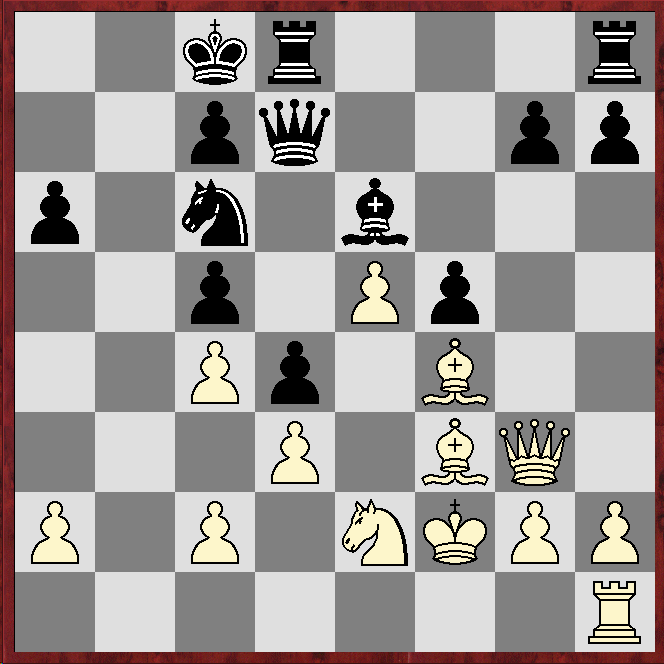
Black to play and win
*****
*****
*****
*****
*****
20...Qf1+!!
A splendid sacrifice of the queen, of which the object is to deflect the opposing queen from the protection of d4.
21.Qxf1 Bxd4+ 22.Be3 Rxe3!
A quiet preparation for the mate on the next move.
Despite the obvious inequality in the players' strength this game gives a clear idea of the chess fashions of Anderssen's time.
Not 22...Bxe3+? as the white king escapes after 23.Ke1, when Black has sacrificed too much material.
23.Kg1
Or 23.Nb5 Re2#. There could be no more impressive demonstration of the power of a double check.
23...Re1#

Thursday, 25 July 2024

King's Gambit

WHEN going through a book of games listed by opening it is natural to expect the first entry in the King's Gambit section to be special.
Here is the first King's Gambit in 500 Master Games of Chess by Savielly Tartakower and Julius du Mont.
Notes in italics are algebraicised from the book.

Lionel Kieseritzky - Ignazio Calvi
Match (Paris) 1842*
1.e4 e5 2.f4 exf4 3.Nf3 g5
The 'classical defence'.
4.h4
The most energetic reply.
4...g4 5.Ne5
Known as the 'Kieseritzky Gambit', this 'gambetto grande' was already well known in the 16th century.
It is easily the most popular continuation in ChessBase's 2024 Mega database.
5...h5!?
An ancient idea which scorns the consolidation of the inner lines, which is obtained chiefly by developing the pieces 5...Bg7 or 5....Nc6 or 5...Nf6 or 5....d5, followed by ...Nf6.
Stockfish16.1 and Dragon1 strongly dislike the text, preferring 5...Nf6, 5...d6 or 5...Qe7!?
6.Bc4 Rh7!?
A painstaking rook!
7.d4 d6 8.Nd3
How should Black proceed?
*****
*****
*****
*****
*****
8...f3!
The engines agree this is best. The point is a developing move, eg 8...Be7, allows White to develop smoothly with 9.Bxf4. This was illustrated in Harry Pillsbury - A Lissek, Vienna Blindfold Simul 1902, which continued 9...Bxh4+ 10.g3 Bg5 11.Nc3 Nc6 12.Bxg5!? Qxg5 13.Nf4 Nf6 14.Nd5?! Nxd5 15.Nxd5 f5?! 16.Qd3 with a position that remained sharp (1-0, 56 moves).
9.gxf3 c6?!
The engines reckon this is too slow, preferring 9...Nc6 or 9...Be7.
10.Nf4
Preventing both 10...d5 and 10...Be6.
10...Ne7?!
Less cumbersome would be 10...Nf6. The queen's knight could later on be developed via d7 to b6, and the king's bishop could find employment by ...Bh6 and eventually ...Bxf4.
11.Nc3 Nd7 12.Kf2?!
The engines are strongly against committing the king like this.
12...Rh8?!
Or first 12...Bg7 13.Qd3, and now only 13...Rh8 in view of the threat 14.e5.
The engines want to start opening lines to the white king with 12...gxf3, eg 13.Qxf3 Qb6 with ...Ne5 on the horizon.
13.Qd3 Bg7 14.Bd2 Kf8?!
The king relinquishes the critical e file, but remains in the danger zone.
Both Kieseritzky and Calvi are playing imaginatively, but dubiously, with their kings. The engines suggest 14...b5 or 14...Qb6.
15.Rae1 Qb6 16.Be3 Qc7?!
16...Qxb2 would be too risky.
Grabbing the b pawn is well-met by 17.Bb3 or 17.fxg4, according to the engines, but they reckon much better than the text is 16...gxf3.
17.Be6
A pretty episode.
Winning, according to the engines, is 17.Bxf7!? Kxf7 18.Qc4+, and even stronger, they reckon, is first 17.fxg4!?
17...b5
Hoping that the moment is favourable for a counteraction on the queenside.
18.b4?!
The engines reckon this throws away White's advantage, preferring 18.fxg4.
18...Nb6 19.Bb3 a5 20.a3 a4 21.Ba2 Bb7?
Rather than hope for things to happen in the distant future, he should have played 21...Bd7.
More to the point, according to the engines, is 21...d5 or 21...gxf3.
22.e5?!
Piercing the front.
The engines much prefer 22.fxg4 or 22.Nce2.
What should Black play?
*****
*****
*****
*****
*****
22...d5?!
He tries to keep the lines closed, for if eg 22...dxe5 23.dxe5 Bxe5 (or 23...Rd8 [then] 24.Bd4 etc) 24.Bd4 Bxd4+ 25.Qxd4 Rh7 26.Qf6 and wins.
The engines disagree with much of this analysis, eg they reckon 25...Rh6 is at least equal for Black. However they give 24.Bc5! as winning for White, the main threat being 25.Qf5. Therefore they reckon best is 23...Rd8, meeting 24.Bd4 with 24...Nd7, claiming at least a slight edge for Black.
23.e6
Energetic play.
The engines again much prefer fxg4 or Nce2.
23...Bc8 24.Bc1 Qd6 25.exf7 Kxf7?
A decisive mistake, allowing the hostile knight to get powerfully into play. Better would be the intermediary measure 25...Bf5, although Black's position would still be uneasy after 26.Qd2 Kxf7 27.Nce2 etc.
The engines agree the text is a mistake, but want to meet 25...Bf5 with 26.Ne4!? as they reckon 26.Qd2 gxf3 is good for Black. After 26.Ne4!? dxe4 (26...Qd7 may be better) 27.fxe4 Black should probably return the piece with 27...Ng6!?, as saving the bishop with, for example, 27...Bc8 can be met by the calm 28.c3!? with what the engines reckon is more than enough compensation for a knight.
26.Ne4 Qc7?!
Both 26...Qd7 and 26...Qd8 seem less worse.
27.Ng5+ Kg8 28.Rxe7?!
A sacrifice which has the double task of eliminating a defending piece and of speeding up the concentration of his own forces.
The engines reckon this lets Black back into the game, whereas 28.Ng6 seems overwhelming.
28...Qxe7 29.Re1 Qf6!?
He tries in vain to establish some counterscheme.
The engines like the text, giving White at best a slight edge
*****
*****
*****
*****
*****
30.Re8+ Bf8 31.Ng6 Bf5?
Completely equal, according to the engines, is 31...Bd7, eg 32.Rxa8 Nxa8 33.Nxh8 Bf5 and 34...Kxh8.
32.Qxf5!
Winning a piece.
32...Qxf5 33.Ne7+ Kg7 34.Nxf5+ Kf6 35.Re6+!? Kxf5 36.Bb1 1-0
White mates in two.
The game well-illustrates how difficult it is to analyse a sharp game reasonably accurately without an engine.
*It is listed in the book simply as "Paris, 1847," but was the first game of their match played in the French capital five years earlier.

Thursday, 2 May 2024

Rare Treat

THE following gem of a game has several unusual features.
For starters, it shows Mikhail Botvinnik on the losing side.
Not only that, but he loses in 26 moves after going pawn-grabbing ... twice.
Notes in italics are by Savielly Tartakower and Julius du Mont, algebraicised from 500 Master Games Of Chess.

Ilya Kan - Mikhail Botvinnik
Moscow 1935
Vienna Gambit
1.e4 e5
The future world champion would become famous for his love of the French Defence, but in this tournament, in which he shared first place with Salo Flohr, he only met 1.e4 with 1...e5, although Botvinnik did get a French after replying to 1.d4 with 1...e6.
2.Nc3 Nf6 3.f4 d5 4.fxe5 Nxe4 5.Nf3 Nc6 6.Qe2
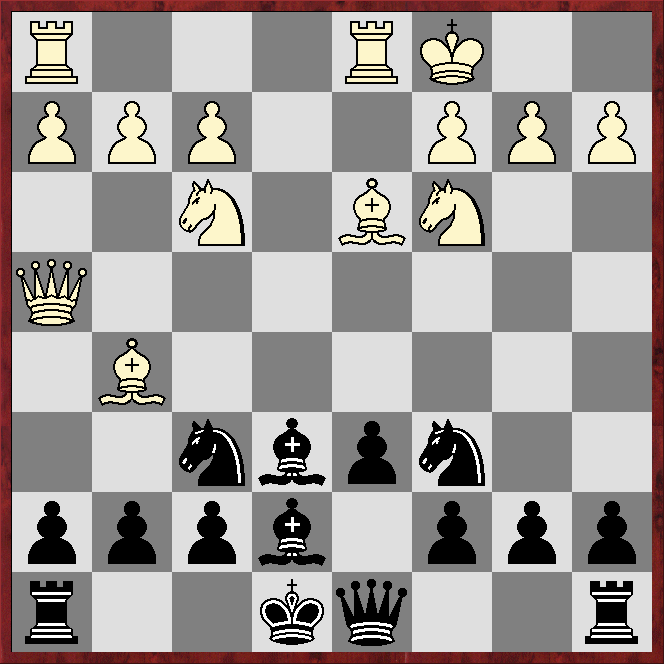
A grave disappointment would result from a quiet developing continuation by 6.Be2, eg 6...Bc5 (threat: 7...Nf2, "mating" the queen) 7.d4 Nxd4 (a cruel surprise) 8.Nxd4 Qh4+ 9.g3 Nxg3 10.Nf3 Bf2+ (more trouble) 11.Kxf2 Ne4+ 12.Ke3 Qh6+ (more convincing even than 12...Qf7+) 13.Kd4 c5+ 14.Kxd5 Qc6+ 15.Kc4 Be6+ and wins.
Position after 15...Be6+
*****
*****
*****
*****
*****
This is a fascinating line, but it is far from clear White is lost at the end of it.
After 16.Kd3 Nf2+ (stronger than 16...0-0-0+, according to Stockfish16 and Komodo14.1) 17.Ke3 Nxd1+ 18.Rxd1 White has three minor pieces, including the bishop-pair, for queen and pawn. Komodo14.1 believes Black is winning, but Stockfish16 gives Black only a slight edge.
The engines reckon Black has a significant improvement with 13...Qb6+!? 14.Kd3 Nf2+ 15.Kd2 Nxd1. After 16.Kxd1 (or 16.Rxd1) Black has a pawn more than in the authors' line, and the black queen is more active.
Everything up to 12...Qh6+ was seen in Torsten Lang (2374) - Tobias Bärwinkel (2319), German League 2007. That game continued 13.Ng5?! Qxg5+ 14.Kd4 Qh4? (14...c5+) 15.Nxe4 Qxe4+ 16.Kc3 d4+ 17.Kb3 0-0 with an unclear position (1-0, 48 moves).
6...Bf5 7.Qb5?!
An optimistic sally, which - succeeds! Caution dictates 7.d3.
The engines strongly agree with this, although in ChessBase's 2024 Mega database the text scores 33%, two percentage points higher than 7.d3.
7...Nc5
Instinctively, Black wants to protect his two pawns (d5 and b7). A reply which meets the case is at once 7...a6, and then if 8.Qxb7 or 8.Qxd5 [then] 8...Nb4, which shows that the white queen has entered the fray without due preparation.
8.d4 a6 9.Qe2 Ne4?!
The engines reckon Black is better after 9...Ne6, as played by Joseph Blackburne in a win over George Gossip at the 1889 USA Congress in New York.
10.Qe3!?
White has restored the balance, and now maintains the superior grouping of his forces (a good centre, open f file, etc). The 'pawn sacrifice' is basically sound.
10...Nxc3 11.bxc3 Bxc2
Accepting the Greek gift.
12.Qf2 Bf5 13.Ne4 Be6
The engines prefer the more-active 13...Be4.
14.Bd3
Well developed at the price of a pawn, this bishop is becoming very active.
14...Qd7 15.0-0 Na5 16.Nf5 0-0-0
Or 16...g6 17.Nh4 with fresh targets.
Now both sides have castled, how would you assess the position?
*****
*****
*****
*****
*****
As usual, positions with opposite-side castling are hard to evaluate. Komodo14.1 claims complete equality, but Stockfish16 gives Black a slight edge.
17.Qe2 Qc6 18.Rb1!? h6
Not 18...Qxc3? 19.Bd2 Qa3 20.Bxa6! etc.
19.Bd2 Nc4 20.Ne3 Nxe3!? 21.Bxe3 Qxc3?
Having had, at all times, a difficult game, Black has at least secured an advantage in material. As against this, the new [half-]open file will soon make itself felt.
Botvinnik's decision to grab a second pawn is extraordinary. Most club players, I believe, would avoid this error even if they could not see how it would be refuted.
22.Rfc1 Qa5 23.Qc2
The final assault.
23...c6 24.Bd2 Qc7 25.Qa4
All White's forces are cooperating. The two-fold threat now is 26.Bxa6 and 26.Ba5.
25...Rd7
There is no saving clause.
26.Bxa6! 1-0

Saturday, 2 March 2024

Classic Treat

ONE of the joys of looking at old games is they tend to be easier to understand.
Ideas now accepted as commonplace by club players were still to be worked out when many of the classic giants of chess were at the board.
Often these ideas are seen in simpler form than they now have, after many more decades of praxis.
Such games can be especially entertaining when featuring two world champions, in the following case Wilhelm Steinitz and his successor Emanuel Lasker.
Notes in italics are by Savielly Tartakower and Julius du Mont, algebraicised from 500 Master Games Of Chess.
Notes in bold italics are my translation from German of those by grandmaster Rainer Knaak in ChessBase's 2024 Mega database.

Steinitz - Lasker
London 1899
Vienna Gambit
A striking feature of the following fine game is Black's "double-sacrifice," followed by a quiet move, the logical result of ultra-rapid and concentric development.
London 1899 is remembered as one of the great tournaments, because almost all of the world's best were there (only Tarrasch was missing).
1.e4 e5 2.Nc3 Nc6 3.f4 d5 4.d3!?
Adopting his favourite continuation - tricky, but slow.
Today only 4.fxe5 is played.
The earliest game in Mega24 to reach the position after 3...d5 saw Carl von Jaenisch unsuccessfully, in 1851, play 4.exd5 against Howard Staunton, and 4.exd5 is a favourite of Hikaru Nakamura (Rainer's annotations appear to have been written in 2000).
How should Black respond?
*****
*****
*****
*****
*****
4...Nc6
The safest way to equalise is 4...exf4.
Three years earlier Lasker and Harry Pillsbury played 4...d4 in a consultation win against Steinitz and Mikhail Chigorin. But in 1909, when Lasker next reached the position, with black against Rudolf Spielmann, he preferred 4...exf4, albeit only drawing. For what it is worth, Stockfish16 and Komodo14.1 reckon the text is inferior to the other two moves.
5.fxe5 Nxe5 6.d4 Ng6
Remaining on the critical wing.
7.exd5
Only with 7.e5 can White hope for an advantage.
7...Nxd5 8.Nxd5
White hopes the black queen will not be so good on d5.
8...Qxd5
The black queen occupies a powerful square, whence it cannot very well be driven away (9.c4 would weaken White's position).
9.Nf3 Bg4 10.Be2 0-0-0 11.c3
This may lose time. White should castle.
11...Bd6
Already Black's forces have obtained a development.
12.0-0 Rhe8
Premature would be 12...Qh5 13.h3 Bxh3 13.Ng5 etc. The text move contains no direct threats, but it can eventually be followed by 13...f6 and 14...Nh5 etc.
How would you assess the coming middlegame?
*****
*****
*****
*****
*****
White has the only pawn on the two centre files, but Black has a large lead in development and the safer-looking king. The engines give Black at least a slight edge.
13.h3
Less impulsive would be 13.Bd2.
The engines prefer Steinitz's choice.
13...Bd7 14.Ng5?!
Here again 14.Bd2 is indicated.
Steinitz dreams of driving away the queen on d5 with Bf3, but this should happen with 14.c4, although it is difficult to judge whether White can then defend all his weaknesses.
14...Nh4
Naturally not 14...f6 15.Bf3 Qg8 16.Ne4 with good play for White.
The engines reckon Black would still have a slight edge after 16...Bf8!?
15.Nf3
The lesser evil is 15.Bf3.
It looks like White's knight manoeuvre was completely pointless. But if Black were to play 15...Nf5, 16.Ng5 would come and White would be ready to play Bf3 again. Giving up the bishop-pair with 15.Bf3 may not have been in White's interest, but nevertheless was necessary.
The engines are not so sure, reckoning that after 15.Bf3 Nxf3+ 16.Qxf3 Qxf3 17.Nxf3 Black gets a positionally won game with 17...Bb5 18.Re1 Rxe1+ 19.Nxe1 Re8.
What should Black play?
*****
*****
*****
*****
*****
15...Nxg2!
A "break-up sacrifice," of which the chief beauty lies in the fact that it requires a complementary sacrifice on the next move.
White has some defensive resources at hand, but the sacrifice still works.
16.Kxg2 Bxh3+
Taking the last defence by storm.
Even stronger, according to the engines, is 16...Re6, building up Black's attacking strength eg 17.Bd3 Rf6 18.Bg5!? Rxf3! 19.Rxf3 Qxg5+ 20.Kf1 Bg3 etc.
17.Kf2
Accepting the second sacrifice loses by force: 17.Kxh3 Qf5+ 18.Kg2 Qg4+ 19.Kh1 Qh3+ 20.Kg1 Qg3+ 21.Kh1 Re4 22.Bg5 Rg4 23.Rf2 Qxf2 24.Qf1 Qg3 etc.
17...f6!?
Whereas after 17...Bxf1 18.Bxf1 etc White could still offer a stubborn resistance. The text move brings into play Black's additional trump: an assault by pawns.
18.Rg1?
Better is 18.Rh1.
18...g5
Steinitz now defends against the difficult-to-stop advance of the g pawn by returning the piece.
19.Bxg5!?
The engines prefer 19.Bd2, but reckon Black is still winning.
19...fxg5 20.Rxg5
Numerically the games are even, but dynamically Black's forces, including the "two bishops," are overwhelming.
In addition to the miserable king's position, White has another handicap: the queen's rook is not developed.
20...Qe6 21.Qd3 Bf4 22.Rh1!?
If the threatened rook moves, Be3+ follows and the queen's rook is cut off.
22...Bxg5 23.Nxg5 Qf6+ 24.Bf3
Or 24.Nf3 Bg4, eg 25.Rg1 h5 26.Rg3 Rf8 27.Kg2 Rde8 28.Bd1 Qf4, threatening both ...h4 and ...Re3.
24...Bf5 25.Nxh7!? Qg6 26.Qb5 c6 27.Qa5 Re7 28.Rh5
There is nothing better, eg 28.Qxa7 Rxh7 29.Qa8+ Kc7 30.Qa5+ Kd7 etc.
28...Bg4 29.Rg5 Qc2+ 30.Kg3 Bxf3 0-1
Lasker won the first brilliancy prize for this game.

Thursday, 29 February 2024

Sacrificing The Exchange

CLUB players usually know many of the standard positional motifs developed by masters over the centuries.
But there is a big difference between knowing an idea and successfully implementing it over the board.
One of the hardest positional motifs for club players, I believe, is the exchange sacrifice.
That is why I was pleased - perhaps inordinately so - with the positional exchange-sacrifice I carried off in round six at Cambridge.
The following game, taken from 500 Master Games Of Chess by Savielly Tartakower and Julius du Mont, helps in trying to understand such sacrifices.
Notes in italics are algebraicised from the book.

Karel Hromádka - Mirko Schreiber
Munich Olympiad 1936, Czechoslovakia v Yugoslavia
Vienna Gambit
A beautiful game in the modern style, in which the strategy of the blockade, helped by a first sacrifice of the exchange, followed near the end by another, is entirely successful.
1.e4 e5 2.Nc3 Nf6 3.f4 d5 4.fxe5
The most energetic continuation.
4...Nxe4
White has three main continuations
*****
*****
*****
*****
*****
5.Qf3!?
An old continuation, favoured by Paulsen, but the usual 5.Nf3 is more natural.
An instructive "opening trap" is 5.d3, after which the plausible 5...Qh4+ 6.g3 Nxg3 7.Nf3 Qh5 8.Rg1 leads to Black's discomfiture, but the rational continuation 5...Nxc3 6.bxc3 d4 7.Nf3 c5 leaves Black with a very comfortable game.
Something strange has happened here, as 8.Rg1?? is a gross blunder - Black simply captures on f1. However 8.Nxd5 is another matter, although even this is not clear, eg the largely forcing ...Nxh1 9.Nxc7+ Kxd8 10.Nxa8 Bg4 11.Bg2 Nc6 12.d4 f6!? (this suggestion of Stockfish16 and Komodo14.1 may be a novelty) 13.Be3 fxe5 14.dxe5+ Kc8 gives Black full compensation for a pawn, according to the engines.
How should Black respond to White's somewhat unusual fifth move?
*****
*****
*****
*****
*****
5...f5!?
This is Stockfish16's top choice; Komodo14.1 prefers 5...Nc6!? More popular than these two moves combined, in ChessBase's 2024 Mega database, is 5...Nxc3.
6.d3
He decides to rid himself of the intruding knight without delay, as after 6.Nge2 Nc6 7.d4 Nb4 8.Kd1 c5 Black takes the lead.
6...Nxc3 7.bxc3 d4
More enterprising than 7...Be7 8.d4, which would round off White's game nicely.
8.Qg3
This very ingenious continuation in the gambit style improves White's chances, which would be far less propitious after 8.Be2 Nc6 etc, to say nothing of 8.cxd4 Qxd4 etc.
8...Nc6 9.Be2 Qd5
If 9...Be6, 10.Rb1.
The engines strongly dislike Rb1, claiming 10...dxc3 gives Black at least the upper hand. They suggest 10.c4 (Stockfish16) or 10.Bf3 (Komodo14.1).
10.Bf4!?
Methodical play. Another conception is 10.Bf3 Qxe5+ 11.Qxe5+ Nxe5 12.cxd4 Nxf3+ 13.Nxf3 with a fine centre, or 10...Qc5 11.Ne2 Nxe5 12.0-0, and White gives up worldly possessions for an attack.
Hromádka won with 10.Bf3 against František Treybal in 1912 and Heinrich Wolf in 1923. The text seems to have been a novelty.
10...Be6 11.c4!? Bb4+ 12.Kf2
The game being a closed one, the king is perfectly safe here.
12...Qd7 13.Rb1 0-0-0!?
He hopes to mount an attack on the kingside, but 13...0-0 affords greater resistance.
The engines marginally prefer the text.
14.Bf3 Bc5 15.Rb5 b6 16.Ne2 a6
How should White proceed?
*****
*****
*****
*****
*****
17.Rxc5!
A fine "positional sacrifice."
The engines agree the text is best, but in a way it is also forced as 17.Rbb1 Bxc4! is very good for Black. Be that as it may, what, after ...
17...bxc5
... does White have for the exchange?
Sacrificing the exchange has given White the upper hand, according to the engines 
*****
*****
*****
*****
*****
In purely material terms, White has a dark-square bishop for a rook. That means White has the bishop-pair, and, speaking generally, the bishop-pair plus a pawn is reckoned to give fair compensation for the exchange. Clearly White does not have enough compensation, materially, here. However, positionally, White's game is much more promising. Despite having only one rook, it is White who is likely to benefit most from the only open file. White's light-square bishop is also much more active than its black counterpart, and these two factors combined mean the black king is less-safe than White's. Nevertheless, Black has an obvious plan for a kingside attack, so the game is far from a foregone conclusion.
18.Rb1 Rdg8 19.h4!?
An important move, preventing 19...g5, and foreshadowing White's plan of establishing a blockade.
19...Nd8
He thinks he can oppose the enemy's aspirations by peaceful means, for the ruthless 19...g5 20.hxg5 h6 21.g6 h5 would require too much self-denial. But shutting the stable door after the horse is gone is nothing unusual.
Perhaps 19...h6 is better, although the engines prefer White after 20.h5.
20.Bg5 Qa4?
The engines suggest 20...Nc6!?, but reckon White is on top.
21.Rb2
Even stronger is the engines' 21.Bxd8 Kxd8 22.Qg5+.
21...Nf7
If 21...Qa3, 22.Bc1.
22.Nf4
The knight is out to eliminate Black's best defensive piece.
22...Qe8 23.Nxe6 Qxe6 24.Bd5 Qg6
24...Qxe5 can be successfully met by 25.Bxf7 or 25.Bf4.
25.e6 Nd6 26.Qe5
In order to be able to play 27.Be7 without exchanging queens. The blockade of Black's position is worthy of note.
26...Re8
How can White finish quickly?
*****
*****
*****
*****
*****
27.Rb6! 1-0
A beautiful final stroke, intended to eliminate Black's last defender.

Tuesday, 6 February 2024

Mother Of All King Marches

KING marches, where a king wanders over much of the board, surviving unscathed, are rare - certainly rarer than the closely related king hunts, where a king is driven across the board to destruction.
One of the most famous king marches occurred at Tilburg (Netherlands) 1991 in a game between Nigel Short and Jan Timman.
But it is possible the original such event happened in the following game from Vienna 1898.
Notes in italics are algebraicised from 500 Master Games Of Chess by Savielly Tartakower and Julius du Mont.

Mikhail Chigorin - Horatio Caro
Vienna Gambit
The white king's peregrinations are nothing short of amazing, and make it unique in the annals of master chess.
1.e4 e5 2.Nc3 Nf6
The Vienna Game: 1.e4 e5 2.Nc3 dates back to at least 1836, and was so named because of its popularity with Austrian players, and others, based in Vienna. White often, as in this game, plays what is effectively a delayed King's Gambit.
3.f4 d5 4.d3!?
An archaic continuation, recommended particularly by Steinitz.
How should Black respond?
*****
*****
*****
*****
*****
4...Bb4
Playing a kind of 'Ruy Lopez' with the colours reversed (and in which consequently the "defence" has an extra move thrown in).
After 4...d4, White can play 5.Nce2, or even 5.Nb1, with a compact game.
After 4...dxe4 5.fxe5 Ng4 6.Nxe4 (if 6.d4, 6...e3) Nxe5 7.d4 Ng6 8.Bd3 etc, White has the better chances.
After 4...exf4, White obtains a well-balanced position by 5.exd5 Bb4 6.Bxf4 Nxd5 7.Bd2 etc.
Marginally most popular in ChessBase's 2024 Mega database is 4...Nc6, after which 5.fxe5 Nxe5 6.d4 Ng6 gives an equal game, according to Stockfish16 and Komodo14.1
5.fxe5 Nxe4!?
A "correct" sacrifice in the sense that it ensures the draw by perpetual check.
6.dxe4 Qxh4+ 7.Ke2
If 7.Kd2, 7...d4, recovering the piece.
7...Bxc3 8.bxc3 Bg4+!?
The perpetual starts with 8...Qg4+, after which neither player can avoid repeating without contracting a lost game.
9.Nf3 dxe4 10.Qd4
In a most astute manner he maintains his extra piece. If now 10...exf3+, 11.gxf3, and the adverse bishop is held in a horizontal pin.
Komodo14.1, for quite some time after 9...dxe4, sees 10.Qd4 as winning for White, but eventually agrees with Stockfish16's verdict of equality.
10...Bh5
Insisting on regaining what is his due.
11.Ke3
The only correct reply.
The engines marginally prefer 11.Kd2.
How should Black continue?
*****
*****
*****
*****
*****
11...Bxf3!
A find! If now 12.gxf3, 12...Qe1+ 13.Kf4 (13.Be2 Qxh1) Qh4+ 14.Ke3 Qe1+ etc, White [sic] obtains a perpetual check.
12.Bb5+
A sworn enemy of the drawn games, the great Russian master plays 'va banque', although the decision is fraught with many hazards, But "there is nothing new under the sun." A game Steinitz-Blackburne, 'London' 1876, ran an identical course.
12...c6 13.gxf3 Qh6+!?
This was probably a prepared 'improvement' over the aforementioned Steinitz-Blackburne game, which saw 13...cxb5 14.Qxe4 Qh6+, with an equal position, according to the engines (but 1-0, 53 moves), and over Blackburne-Zukertort, Match (London) 1887), which saw 13...cxb5 14.Qxe4 Qxe4+ 15.Kxe4, again with an equal position, according to the engines (but 0-1, 60 moves).
14.Kxe4!?
Possibly better is 14.Ke2, as in Hermann Pusch - Bernhard Schippan, Bochum (West Germany) 1979, which continued 14...Qh3 15.Rd1!? 0-0!? 16.Bc4, with a completely equal position, according to the engines (but 1-0, 49 moves).
14...Qg6+ 15.Ke3 cxb5 16.Ba3 Nc6 17.Qd5 Qxc2
How would you assess this middlegame?
*****
*****
*****
*****
*****
White is a pawn up, but Black will have problems completing development, and clearly the most significant factor in the position is the precarious position of both kings. Komodo14.1 gives Black the upper hand, but Stockfish16 gives Black 'only' a slight edge.
18.Rac1 Qf5 19.Rhe1
An indirect defence of the KP (19...Qxe5+ 20.Kf2).
19...Rd8
The engines want Black to either protect his extra pawn with 19...a6, or give it up by 19...b4 so as to enable kingside castling.
20.Qxb5
Re-establishing the balance in material.
20...a6 21.Qb1
Definitely not 21.Qxb7, 21...Rd3+ etc.
21...Qg5+ 22.f4 Qg2 23.Bd6 Qh3+
Embarking on a series of checks, intended to keep the adverse king on the edge of a precipice.
24.Ke4!?
The engines prefer 24.Ke2 or 24.Kf2.
24...f5+ 25.Kd5 Qg2+ 26.Kc4 b5+
Where should the king go?
*****
*****
*****
*****
*****
27.Kd3?
The engines reckon White is more-or-less equal after 27.Kb3.
27...Qf3+?
Now the king escapes from the centre of the board, whereas the engines' 27...Na5 cuts off its retreat, a possible continuation being 28.Rc2 Qf3+ 29.Re3 Qd5+ 30.Ke2 Nc4, with a winning attack for Black, according to the engines.
28.Kc2 Qf2+ 29.Kb3 Rc8
With the potential threat of 30...Na5+ 31.Kb4 [31.Ka3 avoids checkmate, but 31...Nc4+ is devastating, eg 32.Kb4 a5+!? 33.Kxb5 Qb6+ etc] Rc4+, followed by 32...Ra4#.
If at once 29...Na5+, 30.Kb4 Nc4 31.Qxf5 Qb2+ 32.Kc5 Qf2+ 33.Kd5 Qd2+ 34.Kc6 Qg2+ 35.Kc7, and the white king prevails. However Black has a major improvement with 33...Qf3+ (other moves also improve on ...Qd2+) , eg 34.Qe4 Qh3!? 35.Kd4 Rf8, with complete equality, according to the engines.
30.Rc2 Qxf4 31.Kb2 Na5 32.Ka1
Of White's first 32 moves, 12 have been with the king, but the monarch has found safety
*****
*****
*****
*****
*****
32...Qc4 33.e6
Applying the closure.
33...Nc6?!
With the counterthreat of 34...Nd5.
Probably best is the engines' 33...Rd8!?, although that is a hard move to come up with after having played 33...Rdc8.
34.Qd1!?
Threatening the devastating 34.Qh5+
34...h5?!
Still best seems to be ...Rd8, but with a large advantage to White.
35.Rg1?!
Probably better are the engines' 35.Ba3 and 35.Bb4.
35...Rh7?
Or 35...Qxe6 36.Re2, and wins. Or 35...Nd4 36.cxd4 Qxc2 37.Qxc2 Rxc2 38.Rxg7, and White still must win.
The engines continue the latter line with 38...Rc6, which they reckon holds. Stockfish16 instead suggests 38.d5!?, claiming a win after 38...Rg8 39.Bf4!? Komodo14.1 at first calls this equal, but switches to giving White a slight edge.
36.Rxg7! 1-0

Thursday, 23 March 2023

They Don't Play Them Like That Anymore

HERE is a classic of British chess from 500 Master Games Of Chess by Savielly Tartakower and Julius du Mont.
I have algebraicised the notation; notes in italics are from the book.

Stuart Milner-Barry - Hugh Alexander
Cambridge 1932
Vienna Gambit
A feast for the eye and mind.
1.e4 e5 2.Nc3 Nc6
More popular today is 2...Nf6. Both moves can be met by the gambit 3.f4, but in the line with 2...Nf6 it is generally regarded as largely disarmed by the reply 3...d5.
3.f4
Garry Kasparov preferred the more-common 3.Bc4 in a 2016 win over Fabiano Caruana, but the text was Magnus Carlsen's choice in a 2017 loss to Yangyi Yu (both games were at blitz time controls).
3...exf4 4.Nf3 g5
There is nothing better than this 'classic defence'.
5.d4!?
The Pierce Gambit offering the KN, as in the famous Muzio Gambit, is not to be taken lightly.
Stockfish15 and Komodo13.02 prefer 5.g3!?, and if 5...g4 then 6.Nh4, although they reckon Black is better.
5...g4
Accepting the challenge, for after 5...Bg7 6.d5 Ne5 7.d6 etc White has the advantage. 5...d6 6.d5 is also in White's favour.
6.Bc4 gxf3 7.0-0
How should Black proceed?
*****
*****
*****
*****
*****
7...d5?!
Necessary emancipation. If 7...Bg7 8.Bxf4 Bxd4+ 9.Kh1, White has enduring chances.
This was tested in a 1993 game between two unrateds. White won, but the engines reckon 9...fxg2+ 10.Kxg2 Nf6 gives Black a winning advantage. The text is a mistake, according to the engines. Komodo13.02 gives 7...Nxd4!?, eg 8.Qxd4 Qg5 9.Rf2 Bc5 etc, while Stockfish15 prefers 7...Bg7 8.Qxf3 Bxd4+ 9.Kh1 Ne5 10.Qxf4 Qf6!?, claiming a large advantage for Black.
8.exd5 Bg4!? 9.Re1+
But 9.Qe1+ is better and affords equal opportunities. A bold but insufficient idea is the queen sacrifice: 9.dxc6 f2+ 10.Rxf2 Bxd1 11.cxb7 Bg4 12.Bb5+ Bd7 etc.
In this line the engines reckon 12.bxa8=Q!? Qxa8 13.Bxf4 equalises, even though White only has rook and two pawns for a queen.
9...Nge7!? 10.gxf3?!
More astute would be, first, 10.Ne4 Bg7 11.gxf3.
The engines strongly disagree with this analysis, preferring Milner-Barry's choice and, even more so, 10.Qd2!?
10...Bh3 11.Bxf4 Rg8+
The counter-pressure begins.
12.Bg3 Na5
At last the knight goes off prise.
White has little material compensation for being a piece down, but it is anyone's guess as to which king is safer
*****
*****
*****
*****
*****
13.Bn5+ c6 14.Ne4?!
Better, according to the engines, is 14.dxc6, although they prefer White after both 14...bxc6 and 14...Naxc6.
14...Bg7  15.Kh1?
If 15.dxc6 [then] 15...Qxd4+, and White, in view of the piece which has has given up, could not think of agreeing to an exchange of queens.
The engines continue this line with 16.Kh1, one point being 16...Qxd1?? loses to 17.cxb7+. Instead they give 16...0-0-0 17.cxb7+ Nxb7, albeit preferring Black. Nevertheless the text is a mistake, the engines reckoning 15.Bf1 or 15.d6 keeps White well in the game.
15...Qxd5
Now White has just a pawn for a knight, and has a bishop en prise
*****
*****
*****
*****
*****
16.c4 Qd7 17.d5!?
Seeking to obtain fresh resources.
White's only realistic hope is to get at the black king before Black's material preponderance determines matters.
17...Kf8!?
Also possible, but hair-raising, seems to be 17...cxb5!?, eg 18.d6 Bxb2!? (this appears stronger than 18...0-0-0?!) 19.Nc5 Qf5! 20.Rxe7+ Kf8!? 21.Nd7+ Kg7 22.Ne5 Bxe5 23.Rxe5 Qg6!, after which the engines reckon White's attack has run out of steam.
18.d6!?
Probably objectively better is 18.dxc6, but 18...Naxc6 leaves Black well on top.
18...Nf5 19.Nc5 Nxg3+ 20.hxg3 Qf5 21.d7
This looks very alarming.
21...Bd4!
An ingenious reply, fulfilling many functions: (i) masking the d file, (ii) unmasking the g file, (iii) deflecting the adverse queen eventually (22.Qxd4 Qxf3+), (iv) attacking the knight, (v) cutting off the king's flight as long as this bishop remains safe.
22.Nxb7!?
This allows a mating sequence, but White was lost anyway.
22...Qh5! 23.Re8+ Rxe8 24.dxe8=Q+ Kxe8 25.Qe2+ Kf8 26.Nxa5 Bg4+ 0-1
The young opponents have dared, in our scientific era, to play one of the most dangerous gambits in a masters' tournament, and it may well be said that the game does credit to winner and loser alike.

Tuesday, 14 February 2023

Kid's Stuff

HOW often do we see Black defend the King's Gambit by grabbing the f4 pawn and hanging on to it, at least temporarily, by ...g5?
I cannot recall when I last witnessed someone playing that way over the board.
Much rarer still is when such a strategy is used against the King's Gambit's cousin, the Vienna Gambit.
But here is an example that helped 12-year-old José Capablanca win a match for the championship of his native Cuba.
Notes in italics are algebraicised from 500 Master Games Of Chess by Savielly Tartakower and Julius du Mont.

Juan Corzo - Capablanca
Match Game Eight (Havana), 1901
1.e4 e5 2.Nc3 Nc6 3.f4!? exf4
Stockfish15 and Komodo13.02 reckon the text, which is easily the main move in ChessBase's 2022 Mega database, gives Black an edge, but it is certainly not to everyone's taste, especially as one can be sure White will have studied the consequences of the capture.
4.Nf3 g5
The 'classical defence'.
5.h4 g4 6.Ng5
The chances of this, the Hampe-Allgaier Gambit, are, in practical play, considerable.
The only alternative, 6.Ng1, casts doubt on White's entire opening plan.
6...h6 7.Nxf7 Kxf7 8.d4
More sustained is 8.Bc4+. An interesting attempt, in place of the text, is 8.Qxg4.
The engines reckon Corzo's move is best, and, despite Black being a whole knight up, give Black only the upper hand, rather than a winning advantage.
8...d5
Most incisive. A playable defence is also 8...f3. A less stubborn defence is 8...d6.
The engines strongly dislike Capablanca's choice, preferring 8...d6 and especially 8...f3.
9.exd5?!
Or, eg 9.Bxf4 Bb4 10.e5 (10.Bb5 Nge7) Be6 11.Be2 Qd7 12.0-0 Kg7, and Black succeeds in consolidating his position. Black's refutation of the text move is very effective.
The engines disagree with quite a lot of this analysis, especially the dismissal of 10.Bb5!?, which does not appear in Mega22 but which the engines reckon gives White the upper hand.
9...Qe7+ 10.Kf2
Not 10.Kd2 Qe3#. And if 10.Be2, [then] 10...f3 etc, or 10.Qe2 Nxd4.
10.Be2 f3 was played in match game six. It gives Black a winning advantage, although Capablanca later went wrong and only drew.
10...g3+ 11.Kg1
White's king is in a trap. Black's problem is how to take advantage of the fact.
What should Black play?
*****
*****
*****
*****
*****
11...Nxd4!
A far-seeing manoeuvre.
Other moves leave White at least equal, according to the engines.
12.Qxd4
If 12.Bxf4 [then] 12...Nf5.
12...Qc5 13.Ne2
He can neither play 13.Qxc5 Bxc5+, with mate to follow, nor 13.Be3 fxe3 14.Qxh8 e2+ etc.
13...Qb6
A beautiful point with tangible results: an immediate threat, 14...Bc5, and a distant threat of the QR obtaining control of a file after the exchange of queens.
14.Qxb6
The engines give 14.b4!? Bxb4 15.Be3!? fxe3 16.Qxh8 Qf6 17.Qxf6+ Nxf6 18.Nxg3, when Black is the exchange down but, according to the engines, has more than enough compensation, albeit Black is not as much ahead as in the game.
14...axb6 15.Nd4 Bc5 16.c3 Ra4
The final point of the combination.
17.Be2 Bxd4+ 18.cxd4 Rxd4
And, on balance, a valuable extra pawn for Black.
19.b3 Nf6
Neither now, nor on the next move, 19...Rxd5 20.Bc4.
20.Bb2
Combinative, but 20.Bf3 is better.
20...Rd2 21.Bh5+ Nxh5!? 22.Bxh8 f3
A 'vacating advance'.
23.gxf3 Nf4 24.Be5 Rg2+ 25.Kf1 Rf2+ 26.Ke1 Nd3+ 0-1

Wednesday, 9 November 2022

A Strong King?

IT is interesting to see when a new idea in chess came into being - or is thought to have come into being.
One of the most unusual, certainly in its day and still surprising to inexperienced players, is allowing Black to check the white king early in the King's Gambit by omitting the move Nf3.
The idea is often attributed to the first 'official' world champion, Wilhelm Steinitz.
I suspect many people would think Steinitz was responsible for playing as White 1.e4 e5 2.f4 exf4 3.d4!?
But as far as I can discover he never played this sequence with either colour - the earliest game in ChessBase's 2022 Mega database is Francis Sidney Ensor - Curt von Bardeleben, London Minor 1883, which continued 3...Qh4+ 4.Ke2 d5 5.exd5 Bd6 6.c4 b6 7.Nf3 Bg4 8.Kd2 Bxf3!? 9.Qxf3 with a slight edge for White, according to Stockfish15 and Komodo13.02 (but 0-1, 46 moves).
Fast-forward 136 years and the game Ian Nepomniachtchi (2776) - Liren Ding (2811), Chess.com Blitz 2019, varied with 8.Qe1 Qh5 9.h3?!, after which the engines reckon 9...Bxf3+ 10.gxf3 Ne7 gives Black a winning advantage. Ding was also better after the game's 9...Ne7, according to the engines, and won in 22 moves.
Perhaps, you might think, Steinitz should be credited with the sequence 1.e4 e5 2.f4 exf4 3.Bc4!?
But this goes back to at least 1590, and Steinitz only has one game as white with it in Mega22, although he has 12 games with Black, the reply 3...Ne7 being named after him despite being known since at least 1620.
However, where Steinitz did pioneer allowing an early queen check is in the Delayed - some would say Improved - King's Gambit, better known today as the Vienna Gambit.
His contribution is highlighted in the following game from 500 Master Games Of Chess by Savielly Tartakower and Julius du Mont.
Notes in italics are algebraicised from the book.

Steinitz - Gustav Neumann
Dundee 1867
Vienna Gambit
When this game was played, the extravagant move 4.d4, instead of the supposedly forced 4.Nf3, was at first thought to be due to an oversight on the part of the then world champion Steinitz*, for the resulting king hunt is truly alarming. In many subsequent games, however, he proved the virility of this paradoxical continuation, which supports even in the opening stages, his theory of: the king - a strong piece.
1.e4 e5 2.Nc3 Nc6
Steinitz had been meeting 2...Nf6 with 3.f4 since at least 1860, but then there is no question of a quick ...Qh4+.
3.f4 exf4
We now have a kind of 'King's Gambit Deferred' (1.e4 e5 2.f4 exf4 3.Nc3 Nc6), but more prudent is 3...Bc5, eg 4.fxe5 d6 5.exd6 Qxd6 and, for his pawn, Black has taken the lead.
Position after 3...exf4
*****
*****
*****
*****
*****
4.d4!?
Sensational!
Two year before Dundee, at Berlin Carlsbadgarten, Jules Arnous de Rivière - Neumann went 4.Bc4!? Qh4+ 5.Kf1 Bc5 6.g3? fxg3 7.Kg2 gxh2 8.Rxh2 Qg5+ 9.Kh1 Qxg1+ 10.Qxg1 Bxg1 11.Kxg1, after which White does not have enough for two pawns (but 1-0, 49 moves). The game was published in the German chess magazine Neue Berliner Schachzeitung. Did that game inspire Steinitz to try a similar idea against Neumann?
4...Qh4+ 5.Ke2 d6
He already sees that his task is not as easy as it looks, and that he must set to work with deliberation. After 5...d5 6.exd5 Bg4+ 7.Nf3 etc, Black's momentary pressure would drop to zero.
These moves were played in Steinitz - Johannes Zukertort, London 1872. Zukertort sacrificed a piece with 7...0-0-0!? 8.dxc6 Bc5!? 9.cxb7+ Kb8, getting interesting play (but 1-0, 51 moves). Komodo13.02 reckons 5...b6!? gives Black at least the upper hand, and also likes 5...g5. Stockfish15 likes 5...g5, and 5...Qh5+ 6.Nf3 g5.
6.Nf3
Beginning to recover territory.
6...Bg4 7.Bxf4 Bxf3
He is glad to displace the king still further, but a more pressing strategy would demand 7...f5. If 7...Qf6 [then] 8.Ke3 [the engines much prefer 8.Nd5].
8.Kxf3
In subsequent games Steinitz switched to 8.gxf3, but the engines prefer the text.
8...Nge7 9.Be2 0-0-0
Even stronger is ...Qf6, , according to the engines, now that White does not have the reply Nd5.
10.Be3
Evading the threat 10...Ne5+ 11.dxe5 dxe5, and Black recovers his piece with advantage.
This seems to be plain wrong as, even if it were Black's move after 9...0-0-0, the sequence 10...Ne5+?? 11.dxe5 dxe5 is simply met by the bishop retreat 12.Bd2.
10...Qf6+
He tries to keep the opposing king in chancery for, otherwise, there follows 11.g3 and Kg2, and White is out of all danger.
11.Kg3 d5 12.Bg4+
Not at once 12.e5 [because of] 12...Nf5+.
12...Kb8 13.e5 Qg6
With the threat of 14...h5. But 13...Nf5+ is a little better.
14.Kf2
The king makes his escape.
14...h5 15.Bh3 f6
He still has dreams of attack.
16.exf6 Qxf6+ 17.Qf3
He brings the adversary back to earth.
17...Qxf3+
Clearly not 17...Nxd4 18.Qxf6 gxf6 19.Bxd4. But also after 17...Qg6 18.Rhc1 Nb4 19.Qe2 Qf6+ 20.Kg1 the only result would be the furthering of White's intentions. After the exchange of queens, the grouping of the white forces proves superior.
The engines reckon 20.Kg1?! is suspect in view of 20...g5. They prefer 20.Qf3.
18.gxf3 g6 19.Ne2 Nf5?!
An anonymous ChessBase annotator gives this move a question mark, suggesting 19...Bh6, claiming equality, although Stockfish15, but not Komodo13.02, slightly prefers White.
20.Bxf5
Bringing about an almost symmetrical position in which White will be the first to attack weaknesses in the opposing formation (d5 and h5).
Steinitz was fond of the bishop-pair, but not a slave to them.
20...gxf5 21.c3 Bd6 22.Bf4 Kc8
Even if Black first occupies the open g file by 22...Rhg8 he would have to relinquish it again after 23.Rhg1 (eg 23...Kc8 24.Bxd6 etc, or 23...Bxf4 24.Nxf4 etc). The finish is impressive.
Position after 22...Kc8
*****
*****
*****
*****
*****
23.Rhg1 Kd7?!
Komodo13.02 wants to prevent the white king's rook coming to the seventh by 23...Bf8 or 23...Rh7, but still reckons White is winning. Stockfish15 also suggests 23...Bf8, or 23...a5!?, but again reckons White is winning.
24.Rg7+
One objective is achieved. All goes according to plan.
24...Ne7 25.Rag1 Ke6!?
The engines prefer 25...Ke8 or 25...h4.
26.Bxd6 Rxd6 27.Nf4+ Kf6 28.Nd3
Conquest of the 'strong point' at e5.
28...Rb6 29.b3 Rh6 30.Ne5 Rb5 31.a4!? Ra5
31...Rxb3 loses to 32.Nd7+ Ke6 33.Nc5+ etc.
32.b4 Ra6 33.Nd7+
A deeply-conceived victory.
Tartakower and du Mont have Neumann resigning here, although Mega22 adds the moves 33...Ke6 34.Nc5+.
*Today it is customary to think of Steinitz as having only been world champion from his defeat of Johannes Zukertort in 1886.

Tuesday, 8 November 2022

Viennese Treat

NOT surprisingly Savielly Tartakower includes some of his own games in 500 Master Games Of Chess, which he wrote with Julius du Mont.
The following effort against Rudolf Spielmann features an opening still popular today at club level, although it has fallen from fashion among the elite.
Notes in italics are algebraicised from the book.

Tartakower - Spielmann
Ostend 1907
Vienna Game
1.e4 e5 2.Nc3 Nf6 3.Bc4
Although the Vienna is no longer popular at the highest level, it is still occasionally played by very strong grandmasters, including Carlsen, Caruana, Nakamura and Ivanchuk. The text, which can lead to wild play, is particularly popular with Hikaru Nakamura.
3...Nxe4
An answer not devoid of commitments. If 3...Nc6 [then] 4.f4 Nxe4 5.Nf3 with a fine attack.
Stockfish15 and Komodo13.02 continue this line with 5...Nxc3 6.dxc3 Qe7!?, claiming Black has the upper hand. Garry Kasparov (2812) - Fabiano Caruana (2795), St Louis Blitz 2016, went 4.d3 Bc5 5.f4 d6 6.Nf3 exf4 7.Bxf4 0-0 8.Bg5!? (the engines suggest 8.Qd2) h6 9.Bh4 Be6 10.Bb3 Nd4 with a roughly equal position (but 1-0, 69 moves).
4.Qh5
The correct reply. Neither 4.Nxe4 d5 etc nor 4.Bxf7+ Kxf7 5.Nxe4 d5 etc would favour White's chances.
4...Nd6 5.Bb3
Lively play. 5.Qxe5+ Qe7 6.Qxe7+ Bxe7 etc could only equalise.
5...Nc6?!
More solid is 5...Be7, still giving back the pawn of his own free will (6.Qxe5), but speeding up his chances of castling.
The text leads to complications once considered as favouring Black, but, as explained below, theory has changed.
6.Nb5
Accepting the challenge, and initiating a clash of arms full of unexpected turns. If  6.d3 g6, White already loses some valuable territory.
6...g6
Compulsory, for if 6...Nxb5 [then] 6...Qxf7#.
7.Qf3
How should Black meet the renewed mating threat?
*****
*****
*****
*****
*****
7...Nf5!?
The mainline runs 7...f5 8.Qd5 Qe7 9.Nxc7+ Kd8 10.Nxa8 b6, reaching a position theory used to consider as very promising for Black. However modern engine analysis favours White's 'greed', although Stockfish15 and Komodo13.02 reckon White should avoid the commonest move in ChessBase's 2022 Mega database, 11.d3. They prefer the little-played 11.Ne2!? Bb7 12.Nxb6 axb6 13.Qd3. However there are many alternatives along the way and it is probably fair to say the position is unclear.
8.g4 a6
Or 8...Nh6 9.d4 threatening Bxh6.
9.d4 can be met by 9...d5, so the engines prefer 9.g5 Nf5 10.Qd5 Qe7 11.Nxc7+ Kd8 12.Nxa8, when White probably has a better version of the mainline given in the previous note.
9.gxf5 axb5 10.fxg6 Qe7
Forced, because of 10...f6 11.g7 Bxg7 12.Qh5+ Ke7 13.Qf7+ Kd6 14.Qxg7 and wins.
11.gxf7+
Quo non ascendam? [To what heights can I not rise?] Well-guarded by the king's bishop, this advanced passed pawn strongly influences events and imparts to the game a particularly original character.
11...Kd8 12.d3 Nd4 13.Qh5 Bg7
If 13...Nxb3 then not 14.Bg5 Nxa1 15.Bxe7+ Bxe7 etc (Black thus obtains three pieces for the queen), but 14.cxb3 with the threat eventually of  15.Bg5.
The engines much prefer 14.Bg5, but not rushing with capturing on e7, eg 14...Nxa1 15.Ne2 Nxc2+ 16.Kd2.
14.Nf3 Ra6
An active defence.
15.Nxd4
An active attack, without fearing the opening of the e file, which sooner or later must fall under White's domination.
15...exd4+ 16.Kf1
More plausible would b3 16.Kd1, but then Black would defend himself by the sacrifice of the exchange, 16...Re6, and White's queen's rook would remain out of action, whereas now both the white rooks find important work to do, one on the e file and the other on the g file.
The engines reckon Black is lost after either king move.
16...Rg6 17.Bd2 d6 18.Re1?!
The engines much prefer 18.Rg1.
18...Bg4!
An ingenious reply.
19.Rxe7
Better seems to be the engines' 19.Qxg6!?, meeting 19...Bh3 with 20.Qg2+ Bxg2 21.Kxg2, after which White has rook, bishop and pawn for a queen, but also the bishop-pair - a winning advantage, according to the engines. A better response may be 19...hxg6 20.Rxe7 Bh3+ 21.Ke2 Kxe7, although the engines much prefer White.
19...Bxh5 20.Re1 Bf3?!
This looks very threatening. If 20...Bg4 [then] 21.h3, and clearly not 20...Rf6 21.Bg5.
The engines reckon 20...Bh6!? 21.Bxh6 Rxh6 leaves White only slightly better.
21.Rg1 Be5
Obstructing at least the more dangerous file. After 21...Rxg1+ 22.Kxg1 h6 there follows 23.Re6.
The point being White threatens 24.Rg6 Bf8 25.Rg8. Black can stop this with 23...Bh5, but then 24.Re4 Rf8 25.Rh4 Bxf7 26.Bxf7 Rxf7 27.Bxh6 leaves White a pawn up and with two kingside passed pawns.
22.Bh6
An 'indirect irruption'. Now Black would like to give up the exchange if only to eliminate the obsession of the advanced pawn.
22...Ke7 23.Bg7!?
Continuing its mysterious zig-zag evolutions.
23...Rd8 24.Bxe5
Showing his hand at last. He prefers the gain of a second pawn with an intensified action of his queen's rook to the gain of the exchange by 24.f8=Q+ Rxf8 25.Bxf8+ Kxf8 etc.
24...dxe5 25.Rxe5+ Kf8 26.Rg3
Without pausing for 26.Rxb5 White presses the pursuit of the disorganised enemy. His aim is to outflank the adverse king on the right wing (g or eventually h file).
26...Bc6 27.Reg5 Rdd6 28.Rh5 Rxg3
If 28...h6 [then] 29.Rxh6, forcing, as already adumbrated, the entry into the hostile fortress.
29.hxg3 h6 30.g4
Still the same objective (31.g5 hxg5 32.Rh8+).
30...Bf3 31.Rxb5
Now the pawn has fallen, like a ripe fruit, into White's hands.
31...b6 32.Re5 Rd8 33.g5 h5 34.g6 1-0

Sunday, 6 November 2022

Short But Sweet

THE following instructive win, taken from 500 Master Games Of Chess by Savielly Tartakower and Julius du Mont, features Lajos Asztalos, a name unfamiliar to me.
But for a player of his time (1889-1956) he was active in tournaments in central Europe, usually finishing in a respectable position and scoring individual wins against the likes of Gyula Breyer, Richard Réti, Ernst Grünfeld, Edgard Colle, Frank Marshall and Frederick Yates.
Notes in italics are algebraicised from the book.

Jacques Mieses - Lajos Asztalos
Charousek Memorial (Košice, Czechoslovakia) 1918
Vienna Game
Black's aggressive strategy is very instructive, and  demonstrates that the king's fianchetto in an open game is not without risk.
1.e4 e5 2.Nc3 Nf6 3.g3
Very good, if slow, against 2...Nc6, this move is awkward here, where the adversary has duly prepared a counter-action in the centre.
3...d5
Black's well-known bid for freedom.
4.exd5 Nxd5 5.Bg2 Be6
The enterprising turn 5...Nxc3 6.bxc3 Bc5 7.Ne2 Nc6 8.0-0 0-0 etc has its points.
6.Nge2 Nc6 7.d3
If, less modestly, 7.d4, there follows 7...Nxc3 8.Bxc6+ (or 8.bxc3 9.Bd5 with a clear advantage for Black) bxc6 9.bxc3 Qd5 10.Rg1 Rd8 and Black has a fine game. Similarly, if 7.0-0 [then] 7...Be7 8.d4 (better 8.d3) Nxc3 9.bxc3 Bd5 and White must either give up the king's bishop - guardian of the castled king - or obstruct it by 10.f3.
7...Be7
Earlier the same year in Berlin the game Mieses - Carl Schlecter went 7...Bc5 8.0-0 0-0 9.Ne4 Be7 with approximate equality, according to Stockfish15 and Komodo13.02 (½–½, 39 moves).
8.0-0
A precarious lodging. A waiting move, such as 8.h3, was indicated.
Position after 8.0-0
*****
*****
*****
*****
*****
8...h5
Sounding the attack. The bellicose character of the subsequent play is indicated by the advance in the text, whereas, had he also castled, Black might have already called a peace conference.
Mieses - Yates, Scheveningen (Netherlands) 1913, saw 8...0-0 9.f4 Qd7 10.fxe5 Nxe5 11.Nf4 Nxf4 12.Bf4, after which 12...Bc5+ 13.Kh1 Ng6 would have given Black at least a slight edge, according to the engines. Yates played 12...Qd4+ 13.Kh1 Ng4 and won anyway in 48 moves.
9.h3
A well-known stratagem, intending to reply to 9...h4 by 10.g4, keeping the files closed.
The engines much prefer immediate central counterplay with 9.d4.
9...Qd7 10.Kh2 f5 11.d4
Trying to obtain a strong supporting square (at d4 or f4).
11...e4 12.Nf4 Nxf4 13.Bxf4 0-0-0
The engines reckon grabbing a pawn with 13...Nxd4 is even stronger.
14.f3?!
In his precarious situation White tries at least to bring his king's bishop back to life.
Much better, according to the engines, is 14.d5!?, although they reckon both 14...Bxd5 and 14...g5!? give Black the upper hand.
14...h4
A disintegrating advance, which had to be calculated to a nicety.
15.d5 hxg3+ 16.Kh1
If 16.Bxg3 [then] 16...f4 17.Bxf4 Bxh3 [the book has the impossible ...BxKP] 18.dxc6 Bxg2+ and wins.
16...g5
Continuing on the same strategic lines, which are both imaginative and energetic.
17.Bxg3 f4 18.dxc6
Still more disastrous for White would be 18.dxe6 Qxe6 etc.
18...Qxc6
The 'point' and the basis of all Black's calculations, for he will regain his piece at once, thanks to the intermediate attack on White's queen.
19.Qe1 fxg3 20.Qxg3 Bd6 21.Qe1 Bxh3
The decisive breach.
22.Nxe4 Bf5+ 23.Kg1 Bh2+ 24.Kf2 Qxc2+ 0-1
(25.Qe2 Bxe4). A game played by Black with sustained energy.

Wednesday, 28 September 2022

Nothing New Under The Sun

A COMMON observation made about Magnus Carlsen's playing style is that he is very good at conjuring wins out of seemingly sterile positions.
It is not just 'run-of-the-mill' pundits who make this claim.
Even some of the world's greatest players acknowledge this ability of the current world champion.
For example, Anatoly Karpov said of Carlsen in a 2016 interview: "He can convert a minimal advantage into a real one."
But crediting players with such an ability is nothing new, as the following example from 500 Master Games Of Chess by Savielly Tartakower and Julius du Mont shows.
Notes in italics are algebraicised from the book.

Rudolf Charousek - Emil Schallopp
German Chess Federation Congress (Köln) 1898
Bishop's Opening
In the following elegant game White engineers a win out of practically 'nothing'. His exploitation of an increasing pressure on the open f file is an object lesson in logic.
1.e4 e5 2.Bc4 Nf6 3.d3
An ultra-solid continuation.
3...Bc5
Black also resorts to the quietest reply.
Calling 3...Bc5 "the quietest reply" seems rather unfair, especially when 3...d6 and 3...h6 are available.
4.Nc3 d6 5.Be3
Lifeless would be 5.Na4 Bb6 6.Nxb6 axb6, and Black has some compensation for the elimination of his controlling bishop (a [semi-]open a file, a compact mass of pawns on the queenside [and] a general simplification of the contest).
5...Bxe3
Presenting his adversary with an as yet invisible asset in the [semi-]open f file. An easier continuation is 5...Bb6, or even 5...Nc6 as after 6.Bxc5 dxc5 Black's pressure on the d file would compensate him for his doubled c pawns.
6.fxe3 c6 7.Qe2 0-0 8.Nf3 b5 9.Bb3 a5 10.a4
Very readily White blocks up the queenside, so as to devote the more energy to the opposite wing, where the [semi-]open f file furnishes him with an ideal base of action.
10...b4 11.Nb1
More useful than 11.Nd1.
Stockfish15 agrees with this verdict but Komodo13.02 marginally prefers the d1 retreat. If then, as in the game, 11...Nbd7, Komodo13.02's idea, at least at first, is 12.Nf2 (it later prefers 12.0-0), eg 12...d5 13.0-0 Re8 14.Nd2, although both engines reckon 14...Nc5 gives Black the upper hand.
11...Nbd7 12.Nbd2 Nc5 13.0-0 Nxb3 14.Nxb3 Ba6 15.Qe1
Evading the threat 15...Nxe4.
15...Ne8 16.Qg3 g6 17.Rf2 Ng7 18.Raf1 f5?
Restless play, which only precipitates events to his detriment. Better is 18...Qe7.
The engines agree the text is a mistake but 18...Qe7? is worse as it allows 19.Nxa5. It seems unlikely 18...Qe7 ("18...Q-K2" in the book) is a typo as 18...Qc7? is no better, thanks to the reply 19.Ng5. The engines reckon 18...f6 is equal.
How should White proceed?
*****
*****
*****
*****
*****
19.Nh4?
This parries the threat of 19...fxe4 and attacks the f5 pawn a fourth time, whereas it is effectively defended but twice (on account of a potential pin on the g file).
But the correct way to parry Black's threat to capture on e4 is 19.Nfd2, according to the engines, after which they reckon White has a slight edge.
*****
*****
*****
*****
*****
19...f4?!
Almost certainly better is the engines' 19...Nh5 20.Qh3, and now 20...f4, when 21.g3?! and 21.g4? seem to be successfully countered by 21...Bc8, so White should probably play 21.exf4, but then 21...Nxf4 gives Black at least equality.
20.exf4 exf4?
Black had to play 20...Nh5, when the engines reckon 21.Qg5 Nxf4 22.Qxd8 gives White a slightly better version of best play in the previous note.
21.Rxf4
Winning the pawn fairly and squarely, as the fork ...g5 is not applicable now or on the next move.
21...Rxf4 22.Qxf4 Qc7
For if 22...g5 [then] 23.Qf7+ Kh8 24.Nf5 etc.
23.Nc5
An elegant manoeuvre. But not 23.Nxa5 on account of 23...Nh5 24.Qg5 Bxd3 etc.
As the engines point out, 25.cxd3 wins for White, eg 25...Rxa5 26.Nf5! Kh8 27.b3 Qb8 28.Qh6 Ra8 29.Nd4, after which White is up a protected passed pawn and has the safer king and better-coordinated pieces.
23...Nh5 24.Nxa6 Qb6+ 25.Qf2 Qxf2+ 26.Kxf2! Rxa6 27.Ke3
It is hard to imagine that this position should lead to an easy and rapid win.
How would you assess the position?
*****
*****
*****
*****
*****
White is a pawn up and has the more-active king and rook. The engines agree White is winning, and while "an easy and rapid win" may not be expected, Tartakower/du Mont's last comment seems more connected with their first comment on this game rather than on the position the game has reached.
27...Kg7 28.Nf3 Nf6
Or 28...h6 29.Nd4 etc.
29.Ng5 h6?!
Almost certainly better is the engines' 29...Ra8.
30.Ne6+ Kf7 31.Nc5
A 'deflecting sacrifice'. In a twinkling Black's game collapses.
31...dxc5
Or 31...Ra7 (parries 32.Nd7) 32.e5 dxc5 (32...dxe5 33.Ne4, winning the knight) 33.Rxf6+ followed by 37.Rxc6 and wins.
32.e5 Ke6 33.Rxf6+ Kxe5 34.Rxg6 1-0
A very strangely annotated game by Tartakower and du Mont. Naturally it is easy to appear wise with the help of powerful engines, but one wonders how many of Carlsen's 'wins out of nothing' would stand up to rigorous analysis.

Monday, 16 May 2022

Top Draw

ANOTHER sparkling gem from 500 Master Games Of Chess by Savielly Tartakower and Julius du Mont.
Notes in italics are algebraicised from the book.

Jacques Mieses - Akiba Rubinstein
German Chess Congress (Breslau - now Wrocław, Poland) 1912
Bishop's Opening
1.e4 e5 2.Bc4 Nf6 3.d4!?
An intrepid advance.
This move, which has been played by Magnus Catrlsen, scores 58% in ChessBase's 2022 Mega database, comparing favourably with the 57% of 3.d3, the 54% of 3.Qe2!?, the 51% of 3.Nc3, and the 47% of 3.Nf3.
3...exd4
After 3...Nxe4 4.dxe5 (threatening 5.Qd5) Nc5 5.f4 White has the initiative.
4.Nf3
An identical position can be reached via the Petrov Defence: 1.e4 e5 2.Nf3 Nf6 3.d4 (Steinitz's Continuation) exd4 4.Bc4 etc.
Of no value would be 4.e5 d5 5.Bb3 Ne4 etc.
4...Nxe4
Producing serious complications.
The following could not be recommended: 4...Bb4+ 5.c3 dxc3 6.bxc3 etc, or 4...Bc5, reverting to a variation of the Scotch Gambit. But the most reasoned course is to lead into an academic continuation of the Two Knights Defence by 4...Nc6 (5.0-0 - the Max Lange Attack).
The main continuation in Mega22 runs 4...Nc6 5.e5 d5 6.Bb5 Ne4 7.Nxd4 Bd7 8.Bxc6!? bxc6 9.0-0, reaching a position that occurs 4,834 times in Mega22, with White scoring 55%.
5.Qxd4
After 5.0-0 Be7 6.Re1 d5 Black has freed his game.
5...Nf6
Neither 5...Nd6 nor 5...Nc5 is desirable.
6.Bg5
White's superior development compensates for the pawn he has given up.
As a rule of thumb a pawn in the opening can be thought of as worth 2.5 tempi. Several experts quote three tempi, others "two-to-three" tempi, and as usual much depends on the position.
Who, if anyone, stands better?
*****
*****
*****
*****
*****
White has developed four pieces against Black's one. It is Black to move, and that move can be used to develop a piece. At some point, however, Black will have to spend a tempo moving a pawn to allow the light-square bishop to be developed. But that move could come with tempo, for example if Black could safely play ...d5, hitting the white light-square bishop. In addition Black can expect to develop the queen's knight with tempo as on c6 it will hit the white queen. The analysis engines Stockfish14.1 and Komodo12.1.1 reckon Black is slightly better.
6...Be7 7.Nc3 Nc6
Another line of defence is 7...c6 8.0-0-0 d5 etc, or 7...0-0 8.0-0-0 c6 etc.
8.Qh4 d6 9.0-0-0
Linear pressure.
9...Be6
Castling would be far more dangerous because of 10.Bd3, with latent threats.
10.Bd3?!
Still preventing Black from castling. If 10.Rhe1 [then] 10...Bxc4 11.Bxf6 Be6, again closing the e file.
10.Rhe1 is almost certainly the better move, and if 10...Bxc4 then 11.Qxc4, when the engines reckon White, if anyone, is better.
How should Black proceed?
*****
*****
*****
*****
*****
10...Qd7
Keeping queenside castling in reserve, Preparatory measures such as 10...a6 or 10...h6 would only mean loss of time, calling for the reply 11.Rhe1.
The text is the main line in Mega22, and scores very well for Black. But the engines prefer 10...h6!?, meeting 11.Rhe1 with 11...a6!? or 11...Qd7, in both cases claiming an advantage for Black.
11.Bb5!?
This manoeuvring to and fro by the bishop has its reasons. Here it prevents 11...0-0-0, after which would follow 12.Ne5 Qe8 13.Nxc6 bxc6 14.Ba6+ Kd7 15.Na4 (threatening mate), and the king hunt has only begun.
The engines reckon 15.Na4? is a mistake thanks to 15...Nd5, but they give White a large advantage after 15.Qa4.
11...0-0 12.Nd4?!
Preventing above all 12...Bf5 (13.Nxf5 Qxf5 14.Bd3, followed by 15.Bxf6 and wins). Ineffective would be 12.Ne5 Qe8.
The engines strongly dislike the text, preferring the developing 12.Rhe1.
12...a6
Even stronger, according to the engines, is 12...h6!?, but they reckon the text is also good enough for an advantage.
13.Bd3
Returning to the al-important diagonal.
13...Ne5
Besides containing a slight pitfall, the text move is intended at last to get rid of the adverse king's bishop.
14.f4
Keeping his adversary on the alert. After 14.Rhe1, the reply 14...c5 would be still more efficacious. [The authors missed that 14...c5? fails to 15.Rxe5! dxe5 16.Nxe6 Qxe6 17.Bxf6.]
The following, intending to win a pawn, but losing a piece instead, is a mistake: 14.Bxh7+ Nxh7 15.Bxe7 Ng6, and Black wins.
14...Nxd3+ 15.Rxd3 c5
In order to able to place his queen's bishop at f5, for if at once 15...Bf5 [then] 16.Re3 Rae8 17.Rxe7 Rxe7 18.Bxf6 gxf6 19.Nd5, and Black is at bay.
The engines reckon the simple 16.Nxf5 gxf5 17.g4 is strong, while in the line quoted above 16.Re3? can be met by 16...Bd8, which the engines reckon favours Black.
16.Rg3
Seeing that his opponent is not amenable, White intensifies his attack. If now 16...cxd4 [then] 17.Bxf6 Bxf6 18.Qxf6 g6 19.Qxd4 etc.
16...Kh8 17.Nf3?
If 17.Nxe6 [then] fxe6 18.Rh3 Rf7, and White's attack is finely mastered.
Nevertheless this was White's best line as Whiter seems busted after the text.
17...Ng8?!
In order to eliminate the other bishop, which is so troublesome for Black. White must exchange, in view of  the threat 18...f6.
Much stronger, according to the engines, is 17...Rae8.
18.Bxe7 Qxe7!?
The engines prefer 18...Nxe7, and if, as in the game, 19.Ng5 then simply 19...h6.
19.Ng5 Nh6
If 19...Nf6 [then] 20.Nxh7 and wins, and if 19...h6, Black's knight will remain locked out for a long time to come, although White at the moment has no decisive attack at his disposal.
20.Re1
Preventing 20...f6.
20...Qd7 21.Rge3 Rfe8?!
The sequel will show that 21...Rae8 had some points in its favour.
22.Nce4 Bf5
At last Black succeeds in occupying the coveted diagonal. The crisis is at hand.
23.Nf6!
This 'break-up sacrifice' was so to speak 'in the air' ever since Black's 19th move, but now it is reinforced by the unmasking of the e file. The thrilling play hereafter offers an attractive illustration of well-balanced attack and defence - both perfectly conducted.
23...gxf6 24.Qxh6 Bg6?!
Almost certainly better is 24...fxg5, although after 25.Qf6+ Kg8 26.Re7 Bg6 27.Rxe7 Rxe1+ 28.Kd2 Rae8 the engines give White the upper hand.
25.Nxh7!
This sacrifice, a sequel to the preceding one (23.Nf6), shows its real significance only on White's next move. Without this possibility White would have had to retire and agree to exchanges, bringing Black, with his extra pawn, nearer to victory.
25...Bxh7
White to play and win
*****
*****
*****
*****
*****
26.Rg3?
A magnificent point. White's linear pressure culminates in a double threat of mate (27.Qg7# or 27.Qxf6#).
But Black has a defence, whereas after the engines' 26.Qxf6+ Kg8 27.f5! White has a large advantage, eg 27...Rxe3 28.Rxe3 Qd8 29.Rg3+ etc.
26...Rxe1+ 27.Kd2 Re2+!
Mega22 has the game agreed drawn here, although Tartakower and du Mont continue:
28.Kd1
White cannot take the rook, otherwise 28...Qe6+, followed by 29...Rg8, parries all threats. And if 28.Kc1, then not hastily 28...Rxc1+ 29.Kd1, but calmly 28...Re1+, continuing his series of checks.
28...Re1+
Drawn by perpetual check.