Showing posts with label Vienna Game. Show all posts

Saturday, 8 August 2026

British 65+ Round Six

Paul Kenning (1831 ECF/1778 Fide) - Spanton (1940 ECF/2003 Fide)
Vienna Game
1.e4 e5 2.Nc3 Nf6 3.d4!?
This early central advance, reminiscent of the Centre Game (1.e4 e5 2.d4) scores 59% in ChessBase's 2026 Mega database, the same as the main move 3.f4, and up to 11 percentage points better than the other popular continuations, 3.Bc4, 3.Nf3 and 3.g3.
3...exd4 4.Qxd4 Nc6 5.Qd3!?
This is the main continuation, upping White's score in Mega26 to 62%.
How should Black respond?
*****
*****
*****
*****
*****
5...Bb4
This is the commonest continuation in the Centre Game, after the moves 1.e4 e5 2.d4 exd4 3.Qxd4 Nc6 4.Qe3 Nf6 5.Nc3, and it is also the commonest continuation in this line of the Vienna, but after it White's score in Mega26 climbs to 67%. Stockfish18 and Dragon1 suggest 5...Bc5 or 5...d5!?, one point being 5...d5!? 6.exd5 can be met by 6...Nb4.
6.Bd2 0-0 7.Nge2!?
Stockfish18 marginally prefers the much more common 7.0-0-0, but Dragon1 fluctuates between the two moves.
7...Re8 8.0-0-0
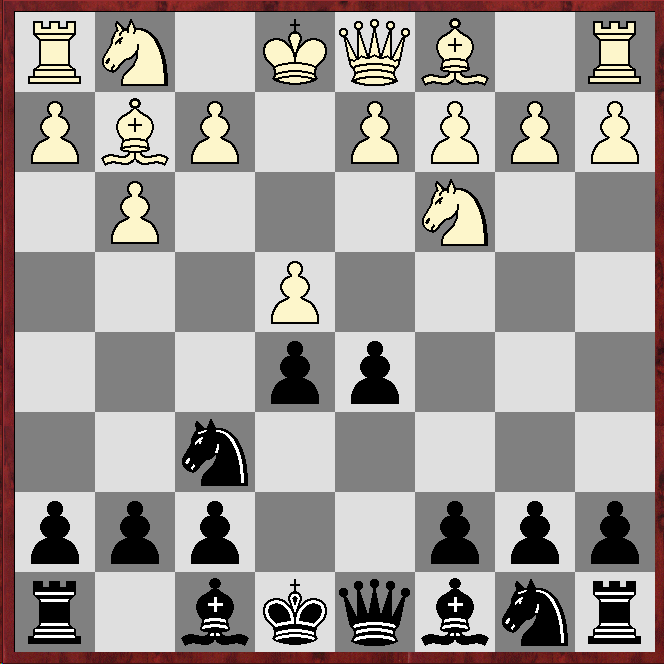
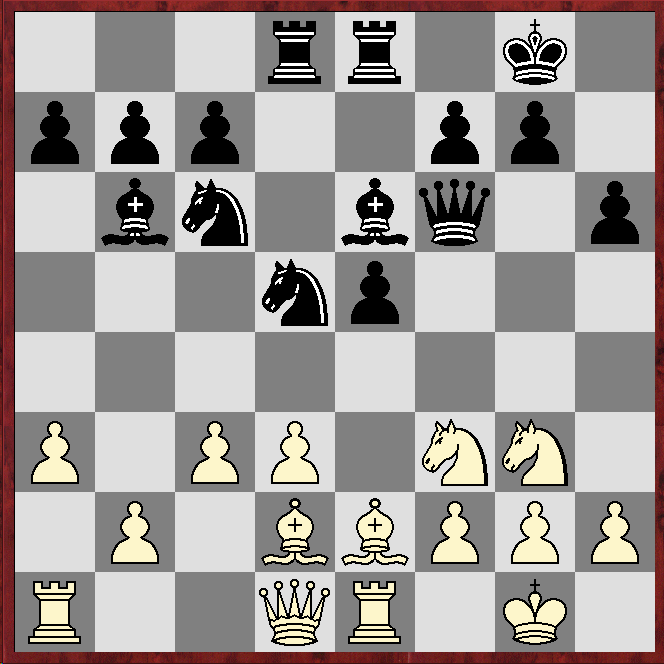
Now both sides have castled, how would you assess the position?
*****
*****
*****
*****
*****
White has the only pawn on the fourth rank, but, as is often the case with opposite-side castling, the position is both tricky to assess and to play. The engines reckon chances are equal.
8...Qe7?!
But not anymore! The engines suggest 8...Ne5 or 8...d6.
9.Bg5!
Moving the bishop for the second time, but it is worth it as the pin is hard to meet.
9...Ne5?!
Apparently a novelty, and probably not a good one, although it does come to be the engines' second choice, at least for a while, behind getting out of the pin immediately with 9...Qe6, after which the engines suggest another apparent-novelty in 9...f3!?, claiming White has at least the upper hand, a sample line running 10.Bh4 Ne5 11.Qd4!? Ba5 12.Qa4!? Qb6, reaching a position where the engines disagree as to how White should proceed, but agree White is winning.
10.Qg3
White's main threats are 10.f4 and 10.Nd5
*****
*****
*****
*****
*****
10...Bxc3!?
The engines suggest 10...c6, but reckon 11.a3!? (as well as 11.f4) is very strong, one line running 11...Bxa3!? 12.Bxf6!? Bxb2+ 13.Kxb2 Qxf6 14.Nd4, when Black does not seem to have enough for a knight. Alternatively, 11...Bc5 12.f4 Neg4!? 13.e5 d5!? 14.Bxf6!? Nxf6 15.exf6 Qxf6 also leaves Black significantly down on material.
11.Nxc3 Qe6 12.f4!?
This seems even stronger than 12.Bxf6 Qxf6 13.Nd5 Qd8 14.f4.
12...Nc6 13.e5 Nh5 14.Qf3 h6!?
Giving up a pawn to keep the game going, as 14...g6?! 15.g4 Ng7 16.Nd5 is horrendous.
15.Qxh5 gxh5 16.Qxg5
How big is White's advantage?
*****
*****
*****
*****
*****
White is roughly the equivalent of being up a piece and a pawn, according to the engines.
16...Nb4!?
If 16...d6, then 17.Nd5.
17.Kb1 d6 18.a3 a5!?
Desperation, but the game is lost anyway.
19.axb4 axb4 20.Nd5 dxe5 21.Qxe5 Qd7
White to play and win
*****
*****
*****
*****
*****
22.Nf6+?
White has several strong moves, the most convincing being 22.Qg5 and 22.Bb5!?, eg 22.Qg5 Qa4!? 23.Nf6+ Kf8 24.Qc5+ Re7 25.Rd8+ Qe8 26.Rxe8#, or 22.Bb5!? c6 23.Nb6 Rxe5 24.Rxd7 Bxd7 25.fxe5.
22...gxf6 23.Rxd7 fxe5 24.Rxc7
PK offered a draw.
Objectively, should Black accept?
*****
*****
*****
*****
*****
Stockfish18 reckons the game is completely equal after 24.Ra5 or 24.exf4. Dragon1 is less convinced, but reckons White has no more than the better part of equality.
½–½

Friday, 31 July 2026

Miniatures 44

IN this occasional series I am going through my decisive games of 20 moves or fewer.

Robert Willmoth (194 BCF) - Spanton (156 BCF)
Hastings Challengers 1991-2
Vienna Game
1.e4 e5 2.Nc3 Bc5!?
Very much third in popularity behind 2...Nc6 and especially 2...Nf6.
3.g3 f5?!
An extravagant choice, especially when straightforward and good moves such as 3...Nf6 are available.
4.exf5 Nf6 5.Bg2 d5 6.g4!? h5!?
This seems to a novelty, and is preferred by Stockfish18 and Dragon1 over the known 6...d4?! and 6...0-0.
How should White respond?
*****
*****
*****
*****
*****
7.h3!?
The engines agree this is best.
7...hxg4?!
Probably better is 7...Nc6.
8.hxg4 Rxh1 9.Bxh1 g6 10.g5 Nh5?!
The engines suggest 10...Ne4!? 11.Nxe4 dxe4, but reckon White is better after 12.f6!?
11.f6 Nxf6?
The engines give 11...e4 or 11...Be6, but much prefer White.
12.gxf6 Qxf6 13.Qf3 Qh4 14.Nxd5 Bg4?? 15.Nf6+ 1-0
LESSON: it is difficult to recover from early and frequent tactical mistakes.

Sunday, 12 April 2026

Thoughts On Daventry III

MY round-four game, in which I was Black against China's Ran Li, featured a new-to-me move in the Vienna.
After 1.e4 e5 2.Nc3 Nf6 I had previously faced and/or played what I thought was every reasonable move: f4, g3, Bc4, a3!? and Nf3.
However my opponent surprised me when she played 3.d4!?, explaining afterwards that, although the move might not be found in books, there has been quite a lot posted about it online.
ChessBase's 2026 Mega database shows the move goes back to at least a simul given by Isidor Gunsberg in Leeds in 1887.
Not only that, but the move's score in Mega26 of 59% is very good, although in games between rated players White only performs seven elo above White's average rating for those games.
Part of the move's success must be due to its surprise value.
The day after our game I was having breakfast in the same cafe as another U2000 competitor, Matthew Wilson.
Naturally we got to talking about our upcoming pairings and, when he learnt I had already faced his opponent, and that I had written the game up at my blog, he spent the next 30 minutes feverishly preparing.
Here is the result.

Ran Li (1701 ECF/1699 Fide) - Matthew Wilson (1858 ECF/1810 Fide)
Vienna Game
1.e4 e5 2.Nc3 Nf6 3.d4!? exd4 4.Qxd4 Nc6 5.Qc4!?
This keeps play in independent Vienna lines, whereas 5.Qe3 transposes to the Centre Game.
5...Bb4
I played 5...Be7, which was also Alexei Shirov's choice in the position in a blitz game, but the text is most popular, and is recommended by Stockfish17.1 and Dragon1.
6.Bd2 d6 7.0-0-0 0-0
Now both sides have castled, how would you assess the position?
*****
*****
*****
*****
*****
White has more space in the centre, but the queen will likely be harassed by the black light-square bishop. Stockfish17.1 gives Black a slight edge, although Dragon1 reckons the game is equal.
The same position was reached in my game, except that the black dark-square bishop was on e7 rather than b4. In that case both engines call chances equal.
8.f3 Be6 9.Qe2 a5 10.g4?!
The engines strongly dislike this, suggesting the paradoxical 10.a3!?
Can you see how Black takes advantage of White's last move?
*****
*****
*****
*****
*****
10...Ne5
The engines give 10...Bxc3! 11.Bxc3 Nb4, reckoning White has nothing better than giving up the a2 pawn as 12.a3 Na2+ 13.Kd2 Nxc3 is deeply unpleasant whichever way White captures on c3, eg 14.Kxc3 d5!? 15.g5 Nh5!? 16.Qe3 c5 17.exd5 Bxd5 18.Bc4 Re8! 19.Qxc5 Nf4 20.Rxd5!? Nxd5+ 21.Qxd5 Qc7 22.Nh3 Rac8 23..Rd1 Re5 24.Qd4 b5, or 14.bxc3 Nd7 15.Qe3 d5 16.e5 f6!? 17.exf6 Qxf6!? with a very strong attack.
11.g5 Nfd7 12.f4?!
This looks like an oversight, but the engines are not too unhappy with it.
12...Bg4 13.Qg2 Bxd1 14.Nxd1 Bxd2+ 15.Qxd2 Nc6
White has lost/sacrificed the exchange, but White's kingside attack is probably ahead of Black's on the queenside
*****
*****
*****
*****
*****
16.h4 Nc5 17.Nc3 Qd7
The engines prefer 17...Re8.
18.h5 f5?
Opening a diagonal to the black king can hardly be right. However, the engines agree Black needs to do something about White's attack, suggesting 18...Rae8!?
19.Bh3?
White is winning, according to the engines, after 19.Bc4+ Kh8 20.Nf3.
19...Ne7 20.Nge2 Qc6?
The queen is a target on c6. Perhaps ...Rae8 is still best, although the engines prefer White.
21.Nd4 Nxe4?
The queen should be moved, albeit White is winning, according to the engines.
22.Nxc6 Nxd2 23.Nxe7+ Kf7 24.Nxf5 Nc4
Instead of having bishop for rook, White has emerged with bishop and knight for rook
*****
*****
*****
*****
*****
25.Nd5 c6 26.g6+! hxg6 27.hxg6+ Kxg6 28.Kg5?
Black has to play 28.Kh7, but would be the equivalent of more than a rook down, according to the engines.
28...Rg5#

Sunday, 5 April 2026

4NCL Easter Round Four

FACED a Chinese woman.

Ran Li (1701 ECF/1699 Fide) - Spanton (1944 ECF/1908 Fide)
Vienna Game
1.e4 e5 2.Nc3 Nf6 3.d4!?
A relatively unusual continuation, but there are 1,152 examples in ChessBase's 2026 Mega database, where it scores a very good 59%. RL explained afterwards that although it has little or no coverage in books, there is quite a lot of information about it online.
3...exd4 4.Qxd4 Nc6 5.Qc4!?
After 5.Qe3 the game would have transposed to the fashionable Centre Game, the normal move-order being 1.e4 e5 2.d4 exd4 3.Qxd4 Nc6 4.Qe3 Nf6 5.Nc3, a position occurring 3,464 times in Mega26.
After 5.Qc4!?, how should Black respond?
*****
*****
*****
*****
*****
5...Be7
Most games have continued with the active 5...Bb4, a move also common in the Centre Game, but the text has been played by Rubinstein and Shirov.
6.Bd2
RL suggested the bishop might be better off on f4 or g5, and Stockfish17.1 and Dragon1 agree.
6...0-0 7.0-0-0
With both sides castling quickly, how would you assess the position?
*****
*****
*****
*****
*****
White has more central space, and is ahead on development, but the white queen will likely be harassed by a black minor piece, and the white king may have to spend a tempo going to b1. As usual, positions with opposite-side castling are difficult to assess, but, for what it is worth, the engines reckon chances are equal.
7...d6
The engines prefer 7...Re8 or 7...a6.
8.f3!?
They strongly dislike this, reckoning White has a slight edge after the more-energetic 8.f4.
8...Ne5
And here they like 8...Be6, claiming 9.Nd5 Bxd5!? 10.exd5 Ne5 gives Black at least a slight edge.
9.Qe2
RL explained that this is part of White's general strategy, with the queen later going to f2 and coming out on the kingside.
9...Be6 10.Qf2 c6!?
The engines like this, despite the weakening of d6.
11.Nh3 b5 12.Nf4
But probably not 12.Ng5?! Nfg4!
12...Qd7 13.Nxe6 Qxe6
The engines prefer 13...fxe6!?
14.Kb1 a5
The problem with ...b4 in such positions is usually that White can partially blockade Black's pawn-storm with Na4, but in this particular case the engines reckon 14...b4?! is best met by 15.Ne2!, eg 15...d5 16.Nd4 Qc8 17.Nf5 Qe6!? 18.Qg3 Ng6!? 19.Nd4!? Qc8 20.e5, with a strong initiative.
Perhaps best is 14...Rfd8!?
15.g4 a4 16.g5 Nfd7 17.f4 Nc4
How should White proceed?
*****
*****
*****
*****
*****
18.f5?!
RL rejected 18.Bxc4 because of 18...bxc4? (the engines much prefer 18...Qxc4), but 19.f5 is strong, whether 19...Qe5 is met by 20.Bf4 or 20.a3!? The engines reckon preserving the bishop-pair with 18.Bc1!?, while also adding to the defence of the queenside, leaves White with a positionally won game.
18...Nxd2+ 19.Qxd2 Qe5
Black is at least slightly better, according to the engines, but the position remains sharp.
20.f6!?
The engines fluctuate between this and 20.a3!?, which is a typical dilemma of not knowing whether attack or defence should take priority in games with opposite-side castling.
20...gxf6
More-or-less forced, as 20...Bd8?! 21.Bh3! Nc5 22.Qxd6 is good for White.
21.gxf6 Nxf6
21...Bxf6!? is safer, but after 22.Qxd6 the game is equal, according to the engines.
22.Rg1+ Kh8 23.Rg5!?
The engines are unsure whether to prefer the text or 23.a3!?, but agree Black is better.
What should Black play?
*****
*****
*****
*****
*****
23...Ne4
The engines prefer 23...Qe6, reckoning it forces 24.a3, after which both 24...b4 and 24...Rfb8 seem to give an edge.
24.Nxe4 Qxe4
How can White best prosecute the attack?
*****
*****
*****
*****
*****
25.Bd3??
Completely missing Black's reply. Instead 25.Rh5 is unclear, but promising (Dragon1 reckons White is winning; Stockfish17.1 gives White a slight edge). Play might proceed 25...Qg6 (not, as we thought in the postmortem, 25...f5??, as White wins with 26.Re1) 26.Qc3+! f6! (not 26...Bf6 27.Qh3 and 28.Bd3) 27.Qh3 Rf7 28.Bd3 Qg8 29.Bf5 Rg7 30.Be6 Qb8!? 31.a3, when Stockfish17.1 still gives White only a slight edge, but Dragon1 has downgraded White's advantage to having the upper hand.
25...Bxg5 26.Qxg5 Qe5 27.Qxg5 Qe5 28.Qh6 f5 0-1
Not everyone would resign here, especially at club level, but Black is up the exchange and two pawns, and the black king is safer than it has been for quite some time. Meanwhile, Black has a queenside attack.

Monday, 15 December 2025

Lessons From Benidorm VIII

MY round-nine game, in which I had black against Emilian-Paul Ioniță (1972), featured a sharp opening, decidedly out of fashion among the elite, but still popular at club level.
Because the opening is so rarely seen at the top, theory has at many points not kept up with the latest assessments of strong engines. 
The game began 1.e4 e5 2.Nc3 Nf6 3.Bc4.
Position after 3.Bc4
*****
*****
*****
*****
*****
I seem to have first had this position as Black in Guernsey 14 years ago, when I played 3...Nc6, and went on to lose. Two years later, in Gibraltar, I tried 3...c6!?, and again lost.
Since then I have only continued 3...Nxe4!?, scoring, including this Benidorm game, +5=1-3, performing 161 elo above my average rating in those games.
I thought ...Nxe4 was both well-known and best, so imagine my surprise on discovering in ChessBase's 2026 Mega database that two moves, 3...Bc5 and especially 3...Nc6, are much more popular.
Not only are those moves more popular, but they are preferred by Stockfish17.1 and Dragon1, although it should be added that they do not reckon the text is a mistake, or even dubious.
After the further moves 4.Qh5 Nd6 5.Bb3 I was aware that 5...Nc6 6.Nb5!? g6 7.Qf3 f5 8.Qd5 Qe7 9.Nxc7+ Kd8 10.Nxa8 featured in the first game of John Nunn's 1987 Batsford book, Secrets Of Grandmaster Play, co-authored with Peter Griffiths.
I had no desire to go down such a complicated line, especially as I knew that, while in the pre-computer era the compensation Black receives was regarded as very promising, engine analysis has shown ways for White to successfully hang on to the extra material.
I therefore played 5...Be7, which I had tried three times before, each opponent replying with the mainline 6.Nf3.
It seems, however, that Ioniță was aware the engines prefer, albeit marginally, 6.Qxe5, which he played quickly.
After 6...0-0 the commonest continuation in Mega26 is 7.Nge2, but Ioniță played 7.Nf3!?, which again is the engines' preference, although again they do not believe there is much difference between the two moves.
Position after 7.Nf3!?, which occurs 112 times in Mega26
*****
*****
*****
*****
*****
Black has two obvious continuations, both of which hit the white queen - 7...Nc6 and my choice, 7...Bf6!?
Of the first 10 games to reach the position after7.Nf3!? in Mega26, eight featured my choice, and the other two saw 7...c6!?
Ioniță continued with 8.Qf4!, which the engines agree gives White a slight edge (they reckon every other continuation is at least marginally favourable for Black).
After 8...Re8+ I was pleased with my position, since White must lose castling rights (9.Ne2? can be met by the winning 9...Re4!)
However, after 9.Kd1 Stockfish17.1 gives White a slight edge - the white king is safe on d1, and Black has difficulties both developing the queenside, and avoiding falling to tactics based around the vulnerability of f7, along with Black's lack of a pawn presence on the central squares.
Black's problems only gradually dawned on me, and their subtlety perhaps explains why Dragon1 reckons Black can equalise with the apparent-novelty 9...b6!? (Stockfish17.1 disagrees, reckoning the move increases White's advantage).
LESSON: going over sharp but unfashionable opening lines with modern engines is a good way to find improvements that are either unknown, or at least not known among players who have not done such work.

Friday, 5 December 2025

Benidorm Bali Round Nine

FACED  a Romanian.

Emilian-Paul Ioniță (1972) - Spanton (1896)
Vienna Game
1.e4 e5 2.Nc3 Nf6 3.Bc4 Nxe4!?
This well-known combination, which relies on 4.Nxe4 being met by 4...d5, is not the top choice of Stockfish17.1 or Dragon1 - they prefer 3...Bc5 or 3...Nc6.
4.Qh5 Nd6 5.Bb3 Be7!?
This has taken over from 5...Nc6 as the most popular continuation. After 5...Nc6 the main line in ChessBase's 2026 Mega database runs 6.Nb5!? g6 7.Qf3 f5 8.Qd5 Qe7 9.Nxc7+ Kd8 10.Nxa8, which used to be regarded as a very promising sacrificial line for Black, but the engines are unimpressed, awarding White at least a slight edge.
6.Qxe5 0-0 7.Nf3!?
More prudent, and a little more popular in Mega26, is 7.Nge2, but the engines reckon the more-aggressive 7.Nf3!? is a tad better.
7...Bf6!?
Trying to exploit the fact that White's king is uncastled, but White scores 64% in Mega26 against this move, so the other way to hit the white queen, 7...Nc6. may be better.
Where should the white queen go?
*****
*****
*****
*****
*****
8.Qf4!
This is the only way to gain an advantage, according to the engines, which reckon every other move gives Black at least a marginal edge.
8...Re8+
How should White proceed?
*****
*****
*****
*****
*****
9.Kd1
Also possible is 9.Kf1, but not 9.Ne2? as that loses to 9...Re4!, eg 10.Qg3 Nf5! 11.Qh3 d5 12.d3 Rxe2+! 13.Kxe2 Nd4+ 14.Nxd4 Bxh3.
9...Nc6 10.d3
Dragon1 prefers 10.Nd5!?, but Stockfish17.1 fluctuates between the two moves.
10...Ne7!
Taking the sting out of Nd5, and making it possible to hit the white queen with ...Ng6.
11.g4?!
Probably a novelty, but Stockfish17.1 prefers the known 11.h4, and Dragon1 likes another known continuation, 11.Nd5 Nxd5 12.Bxd5.
11...Ng6 12.Qg3 Nh4?!
Black is at least slightly better after 12...Bxc3!? 13.bxc3 Qf6, according to the engines.
13.Bf4
The engines fluctuate between the text and 13.Nd5.
13...Nxf3 14.Qxf3 Be5
The engines suggest 14...Bxc3 15.bxc3 Qf6, or offering the exchange with 14...Re6!?, but anyway much prefer White.
15.Kd2?!
White is positionally winning after 15.Bxe5 Rxe5 16.h4, according to the engines.
15...Qf6 16.Nd5
An only-move.
16...Bxf4+ 17.Qxf4 Qxf4+ 18.Nxf4
Now queens are off the board, how would you assess the position?
*****
*****
*****
*****
*****
Black has difficulties completing queenside development, and so is slightly worse, according to Dragon1, but Stockfish17.1 reckons the game is equal, presumably because it does not believe White can exploit Black's difficulties.
18...c6 19.Nh3!?
Dragon1 suggests gaining space with 19.a4, while Stockfish17.1 has a similar idea, but on the kingside, with 19.h4.
19...Kf8 20.Rae1 h6 21.g5 Nf5 22.Rxe8+ Kxe8 23.Re1+ Kf8 24.g6?
24.gxh6 Nxh6 25.Ng5 d5 is equal.
24...d5?
24...Nh4 threatens both a fork at f3 and a simple capture on g6.
25.Nf4?
Correct is 25.gxf7 Kxf7, with what the engines agree is a slight edge for Black.
25...Nd4?
Threatening a fork at f3, but not simultaneously threatening to capture on g6, so again ...Nh4 is the right way to gain a large advantage.
26.Re3 Bf5 27.gxf7 Kxf7 28.c3!? Nxb3+ 29.axb3
How would you assess this rook-and-minor-piece ending?
*****
*****
*****
*****
*****
Usually rook and bishop work better together than rook and knight, and here there is the added factor of White having two isolanis. But the kingside pawns are not easy for Black to get at, White occupies the open file, and White has good chances of finding the knight a good outpost square. The engines agree the position is equal.
29...g5 30.Ne2 Re8 31.Rf3 Kg6 32.Nd4 Bd7 33.b4 b6 34.Rg3 Kf6 35.Rf3+ Kg6 36.Rg3 Kf6 37.Rf3+ Kg6 ½–½

Tuesday, 12 March 2024

Bad Wörishofen Round Five

Boris Litfin (1938) - Spanton (1876)
Vienna Game
1.e4 e5 2.Nc3 Nf6 3.Bc4!? Nxe4!?
This 'equalising' capture is well-known, but is a lot less common in ChessBase's 2024 Mega database than 3...Bc5 and especially 3...Nc6.
4.Qh5
After 4.Nxe4 d5 Black has the upper hand, according to Stockfish16 and Komodo14.1.
4...Nd6 5.Bb3 Be7!?
The famous sacrificial line 5...Nc6 6.Nb5 g6 7.Qf3 f5 8.Qd5 Qe7 9.Nxc7+ Kd8 10.Nxa8 b6 used to be considered good for Black, but modern engines much prefer White.
6.Nf3 Nc6 7.0-0?!
The engines are not keen on this, but agree it is an improvement on Litfin (1818) - Spanton (1912), Bad Wörishofen U2000 2022, when I met 7.Nb5?! with the novelty 7...g6!, immediately gaining a large advantage (0-1, 43 moves). All six games in Mega24 to reach the position after 7.Nb5?!, including Shakhriyar Mamedyarov (2801) - Anish Giri (2782), Chess.com Blitz 2018, saw Black castle.
White's most popular seventh move in Mega24 is 7.Nxe5, after which 7...g6 8.Nxc6 dxc6 9.Qf3 is equal, according to the engines.
7...g6!?
Preventing White from quickly regaining the sacrificed pawn, but weakening the kingside. The engines again prefer this over castling.
8.Qg4 Nf5 9.Nd5!?
Stockfish16 fluctuates between the text and 9.Qe4. Komodo14.1 also likes 9.Qe4, along with 9.d3.
9...d6 10.Nxe7 Qxe7
How would you assess this middlegame?
*****
*****
*****
*****
*****
White has the bishop-pair and has castled, but Black is a pawn up and has a strong-looking centre. The engines reckon Black has a large advantage.
11.Qe4 Be6 12.Ba4 Bd7 13.d3 0-0-0!? 14.c3 Kb8
Not just a safety-first move, but preparing a sacrifice.
15.b4
How should Black continue?
*****
*****
*****
*****
*****
15...d5!?
The engines prefer the solidifying 15...f6, or 15...h5.
16.Qe1?!
With 16.Qxd5 Nxb4 17.cxb4 (best, according to the engines) Bxa4 18.Qxe5, White restores material equality, although thoughts of a queenside attack are gone, and the engines reckon White's inferior pawn-structure gives Black the upper hand.
After the text, White has fallen well behind in development, and Black gets a central initiative.
16...e4 17.dxe4 dxe4 18.Bxc6?
Better is the engines' 18.Ng5. After the text White no longer has the bishop-pair, and still has to do something about the attacked knight.
18...Bxc6 19.Nd4!?
The engines fluctuate between this and 19.Nd2 (19.Ng5?! h6 20.Nh3 Bb5 is surely even worse), which only goes to show how bad White's position is.
19...Nxd4 20.cxd4 Bb5 21.Qc3 Bxf1 22.Kxf1 Qd6 23.Be3 Qxh2 24.Rc1
White has pressure against the black queenside, but Black's material advantage (an exchange and two pawns) should tell
*****
*****
*****
*****
*****
24...Qd6 25.g3 Rd7 26.d5!?
This becomes the engines' top choice. If 26.Bf4, then 26...Qe7, and 26...Qa6+ followed by 27...Rc8, are plenty good enough. But not 26...Qxd4 as 27.Qxd4! (this is stronger than 27.Bxc7+) Rxd4 28.Be5 Rhd8 29.Bxc7+ Kx8 30.Bxd8 Rxd8 31.Rc7 gives drawing chances.
26...Rc8 27.Qd4 b6 28.Rd1 f5 29.a4 Rcd8 30.Qc4 Qe7 31.a5 Rd6 32.axb6 cxb6
How should White proceed?
*****
*****
*****
*****
*****
33.Bc5!?
Hoping for complications. On 33.Bf4 I intended 33...g5!? 34.Bxd6+ Qxd6, giving back the exchange but remaining two pawns up.
33...Qd7!?
The bishop can be taken, as, after 33...bxc5 34.bxc5 Qc7 the rook check 35.Rb1+ can be met by 35...Rb6, while queen checks, eg 35.Qb4+, can be met by 35...Qb7.
34.Be3?!
Black now goes three pawns up, as well as the exchange, so capturing on d6 is objectively much better.
34...Rxd5 35.Bf4+ Ka8 36.Rxd5 Qxd5 37.Qc7 Qd7 38.Qe5 Rc8
There is a much quicker finish after 38...Qd1+ or 38....Qd3+
39.Kg2 Qc6 40.Be3 Rd8 41.Qe7 Qd7 42.Qf6 Kb7 43.b5 Re8 44.Qh4!? Re5 45.Qf6 Rxb5 46.Qh8 a5 47.Bf4 Rc5 48.Be3 Rc8 49.Qa1 Qc6 50.Qg7+ Rc7 51.Qd4 h6 52.Kh2 Rd7 53.Qe5 Qd6 54.Qb5 h5!? 55.Bxb6!?
Winning two pawns, but the queens come off.
55...Qc6 56.Qxc6+ Kxc6 57.Bxa5 Kb5 58.Bc3 Kc4 59.Be5 Kd3 60.Bf4 Ke2 61.Kg2 Rd3 62.Bg5 Rf3 63.g4 Rxf2+ 64.Kg1 hxg4 65.Bh4 Rf3 66.Kg2 e3 67.Bg5 f4 68.Bh4 Rh3 0-1
Bizarrely, despite playing to the bitter end, BL did not try 69.Bf2, hoping for 69...exf2?? stalemate.

Sunday, 10 March 2024

Bad Wörishofen Round Three

Rudolf Forster (1925) - Spanton (1876)
Vienna Game
1.e4 e5 2.Nc3 Nf6 3.g3 d5 4.Bg2?!
Apparently going for rapid development, but that does not sit well with playing e4 and g3. The mainline in ChessBase's 2024 Mega database runs 4.exd5 Nxd5 5.Ng2 Nxc3 6.bxc3 Bd6, with an equal position, according to Stockfish16, although Kmodo14.1 prefers White.
How should Black proceed?
*****
*****
*****
*****
*****
4...dxe4
Stockfish16 and Komodo14.1 prefer 4...d4
 5.Nxe4 Nxe4 6.Bxe4 Bc5
Threatening 7...Bxf2+ 8.Kxf2 Qd4+ etc.
7.Ne2 Nc6 8.c3?!
It is hard to believe White has time for this. The engines give 8.d3, but award Black a slight edge.
8...Qf6 9.0-0!?
It took me ages to realise White could play this without catastrophe. Even so, after ...
9...Bh3 10.Bg2 Bxg2 11.Kxg2 h5
... the engines give Black the upper hand.
12.d4!?
Perhaps White should prefer 12.h4, or 12.b4 and then 13.h4.
12...exd4 13.cxd4 0-0-0 14.h4 Nxd4 15.Nxd4 Rxd4 16.Qc2 Qc6+
White to play and keep the game going
*****
*****
*****
*****
*****
17.Kh2?
Anything but this (apart from 17.Qe4??).
17...Rxh4+! 0-1

Wednesday, 27 December 2023

Kraków Seniors Round One

Jakub Marszałek (1345) - Spanton (1743)
Vienna Game
1.Nc3 Nf6 2.e4 e5 3.a3!?
An interesting bit of tricoration. One idea is that after 3...d5 4.exd5 Nxd5 White can play 5.Qh5.
Position after 5.Qh5 - this is a Steinitz Variation of the Scotch with colours reversed and White having the extra move a3, which cuts out the response ...Nb4
*****
*****
*****
*****
*****
3...Bc5
A more-measured response - hoping to make 3.a3!? seem irrelevant.
4.Be2 d5 5.exd5 Nxd5 6.d3 0-0
It still looks like a Reversed Scotch, but with White having played much more passively than Black normally would
*****
*****
*****
*****
*****
7.Nf3 Nc6 8.0-0 Re8 9.Ne4 Bb6!?
Looking after the kingside with 9...Be7 or 9...Bf8!? may be better.
10.c3
Stockfish16 and Komodo14.1 give 10.c4!? Nf6 11.Bg5 with an initiative, not least thanks to the threat of 12.c5.
10...h6 11.Ng3 Be6 12.Bd2 Qf6 13.Re1 Rad8
Black has activated every piece (apart from the king), while White is still to move his queen and king's rook - nevertheless the engines reckon the position is equal
*****
*****
*****
*****
*****
14.b4 Nf4 15.Bxf4 Qxf4 16.Qd2 Qf6 17.Ne4 Qe7 18.h3?!
Almost certainly too slow. The engines suggest something like 18.Ng3!? a6 19.Qc2 Qd7 20.a4 with more-or-less equal chances.
18...f5 19.Nc5!?
Even worse, according to the engines, is 19.Ng3 e4.
19....Bxc5 20.Bxc5 Qxc5
I have given back the bishop-pair but emerged a pawn up and with more space and the better pawn-structure
*****
*****
*****
*****
*****
21.Qb2 b6 22.Rad1 a5 23.Rd2?!
The engines much prefer 23.d4.
23...e4 24.d4 Qd6 25.Nh2 Ne5!? 26.Red1 Nc4 27.Bxc4 Bxc4 28.Nf1 f4 29.d5?
White should have done something about Black's threatened next move.
Black to play and get a large advantage
*****
*****
*****
*****
*****
29...e3 30.fxe3 fxe3 31.Re2
The engines agree this is best, but after ...
31...Bxe2 32.Qxe2 Qxa3
...Black is the exchange and two pawns up.
The game finished:
33.Rd3 Qc5 34.Kh2 Rxd5 35.Qa2 c6 36.Qe2? Qd6 37.Kh1 Rxd3 38.Qg4 e2 0-1

Tuesday, 8 November 2022

Viennese Treat

NOT surprisingly Savielly Tartakower includes some of his own games in 500 Master Games Of Chess, which he wrote with Julius du Mont.
The following effort against Rudolf Spielmann features an opening still popular today at club level, although it has fallen from fashion among the elite.
Notes in italics are algebraicised from the book.

Tartakower - Spielmann
Ostend 1907
Vienna Game
1.e4 e5 2.Nc3 Nf6 3.Bc4
Although the Vienna is no longer popular at the highest level, it is still occasionally played by very strong grandmasters, including Carlsen, Caruana, Nakamura and Ivanchuk. The text, which can lead to wild play, is particularly popular with Hikaru Nakamura.
3...Nxe4
An answer not devoid of commitments. If 3...Nc6 [then] 4.f4 Nxe4 5.Nf3 with a fine attack.
Stockfish15 and Komodo13.02 continue this line with 5...Nxc3 6.dxc3 Qe7!?, claiming Black has the upper hand. Garry Kasparov (2812) - Fabiano Caruana (2795), St Louis Blitz 2016, went 4.d3 Bc5 5.f4 d6 6.Nf3 exf4 7.Bxf4 0-0 8.Bg5!? (the engines suggest 8.Qd2) h6 9.Bh4 Be6 10.Bb3 Nd4 with a roughly equal position (but 1-0, 69 moves).
4.Qh5
The correct reply. Neither 4.Nxe4 d5 etc nor 4.Bxf7+ Kxf7 5.Nxe4 d5 etc would favour White's chances.
4...Nd6 5.Bb3
Lively play. 5.Qxe5+ Qe7 6.Qxe7+ Bxe7 etc could only equalise.
5...Nc6?!
More solid is 5...Be7, still giving back the pawn of his own free will (6.Qxe5), but speeding up his chances of castling.
The text leads to complications once considered as favouring Black, but, as explained below, theory has changed.
6.Nb5
Accepting the challenge, and initiating a clash of arms full of unexpected turns. If  6.d3 g6, White already loses some valuable territory.
6...g6
Compulsory, for if 6...Nxb5 [then] 6...Qxf7#.
7.Qf3
How should Black meet the renewed mating threat?
*****
*****
*****
*****
*****
7...Nf5!?
The mainline runs 7...f5 8.Qd5 Qe7 9.Nxc7+ Kd8 10.Nxa8 b6, reaching a position theory used to consider as very promising for Black. However modern engine analysis favours White's 'greed', although Stockfish15 and Komodo13.02 reckon White should avoid the commonest move in ChessBase's 2022 Mega database, 11.d3. They prefer the little-played 11.Ne2!? Bb7 12.Nxb6 axb6 13.Qd3. However there are many alternatives along the way and it is probably fair to say the position is unclear.
8.g4 a6
Or 8...Nh6 9.d4 threatening Bxh6.
9.d4 can be met by 9...d5, so the engines prefer 9.g5 Nf5 10.Qd5 Qe7 11.Nxc7+ Kd8 12.Nxa8, when White probably has a better version of the mainline given in the previous note.
9.gxf5 axb5 10.fxg6 Qe7
Forced, because of 10...f6 11.g7 Bxg7 12.Qh5+ Ke7 13.Qf7+ Kd6 14.Qxg7 and wins.
11.gxf7+
Quo non ascendam? [To what heights can I not rise?] Well-guarded by the king's bishop, this advanced passed pawn strongly influences events and imparts to the game a particularly original character.
11...Kd8 12.d3 Nd4 13.Qh5 Bg7
If 13...Nxb3 then not 14.Bg5 Nxa1 15.Bxe7+ Bxe7 etc (Black thus obtains three pieces for the queen), but 14.cxb3 with the threat eventually of  15.Bg5.
The engines much prefer 14.Bg5, but not rushing with capturing on e7, eg 14...Nxa1 15.Ne2 Nxc2+ 16.Kd2.
14.Nf3 Ra6
An active defence.
15.Nxd4
An active attack, without fearing the opening of the e file, which sooner or later must fall under White's domination.
15...exd4+ 16.Kf1
More plausible would b3 16.Kd1, but then Black would defend himself by the sacrifice of the exchange, 16...Re6, and White's queen's rook would remain out of action, whereas now both the white rooks find important work to do, one on the e file and the other on the g file.
The engines reckon Black is lost after either king move.
16...Rg6 17.Bd2 d6 18.Re1?!
The engines much prefer 18.Rg1.
18...Bg4!
An ingenious reply.
19.Rxe7
Better seems to be the engines' 19.Qxg6!?, meeting 19...Bh3 with 20.Qg2+ Bxg2 21.Kxg2, after which White has rook, bishop and pawn for a queen, but also the bishop-pair - a winning advantage, according to the engines. A better response may be 19...hxg6 20.Rxe7 Bh3+ 21.Ke2 Kxe7, although the engines much prefer White.
19...Bxh5 20.Re1 Bf3?!
This looks very threatening. If 20...Bg4 [then] 21.h3, and clearly not 20...Rf6 21.Bg5.
The engines reckon 20...Bh6!? 21.Bxh6 Rxh6 leaves White only slightly better.
21.Rg1 Be5
Obstructing at least the more dangerous file. After 21...Rxg1+ 22.Kxg1 h6 there follows 23.Re6.
The point being White threatens 24.Rg6 Bf8 25.Rg8. Black can stop this with 23...Bh5, but then 24.Re4 Rf8 25.Rh4 Bxf7 26.Bxf7 Rxf7 27.Bxh6 leaves White a pawn up and with two kingside passed pawns.
22.Bh6
An 'indirect irruption'. Now Black would like to give up the exchange if only to eliminate the obsession of the advanced pawn.
22...Ke7 23.Bg7!?
Continuing its mysterious zig-zag evolutions.
23...Rd8 24.Bxe5
Showing his hand at last. He prefers the gain of a second pawn with an intensified action of his queen's rook to the gain of the exchange by 24.f8=Q+ Rxf8 25.Bxf8+ Kxf8 etc.
24...dxe5 25.Rxe5+ Kf8 26.Rg3
Without pausing for 26.Rxb5 White presses the pursuit of the disorganised enemy. His aim is to outflank the adverse king on the right wing (g or eventually h file).
26...Bc6 27.Reg5 Rdd6 28.Rh5 Rxg3
If 28...h6 [then] 29.Rxh6, forcing, as already adumbrated, the entry into the hostile fortress.
29.hxg3 h6 30.g4
Still the same objective (31.g5 hxg5 32.Rh8+).
30...Bf3 31.Rxb5
Now the pawn has fallen, like a ripe fruit, into White's hands.
31...b6 32.Re5 Rd8 33.g5 h5 34.g6 1-0

Sunday, 6 November 2022

Short But Sweet

THE following instructive win, taken from 500 Master Games Of Chess by Savielly Tartakower and Julius du Mont, features Lajos Asztalos, a name unfamiliar to me.
But for a player of his time (1889-1956) he was active in tournaments in central Europe, usually finishing in a respectable position and scoring individual wins against the likes of Gyula Breyer, Richard Réti, Ernst Grünfeld, Edgard Colle, Frank Marshall and Frederick Yates.
Notes in italics are algebraicised from the book.

Jacques Mieses - Lajos Asztalos
Charousek Memorial (Košice, Czechoslovakia) 1918
Vienna Game
Black's aggressive strategy is very instructive, and  demonstrates that the king's fianchetto in an open game is not without risk.
1.e4 e5 2.Nc3 Nf6 3.g3
Very good, if slow, against 2...Nc6, this move is awkward here, where the adversary has duly prepared a counter-action in the centre.
3...d5
Black's well-known bid for freedom.
4.exd5 Nxd5 5.Bg2 Be6
The enterprising turn 5...Nxc3 6.bxc3 Bc5 7.Ne2 Nc6 8.0-0 0-0 etc has its points.
6.Nge2 Nc6 7.d3
If, less modestly, 7.d4, there follows 7...Nxc3 8.Bxc6+ (or 8.bxc3 9.Bd5 with a clear advantage for Black) bxc6 9.bxc3 Qd5 10.Rg1 Rd8 and Black has a fine game. Similarly, if 7.0-0 [then] 7...Be7 8.d4 (better 8.d3) Nxc3 9.bxc3 Bd5 and White must either give up the king's bishop - guardian of the castled king - or obstruct it by 10.f3.
7...Be7
Earlier the same year in Berlin the game Mieses - Carl Schlecter went 7...Bc5 8.0-0 0-0 9.Ne4 Be7 with approximate equality, according to Stockfish15 and Komodo13.02 (½–½, 39 moves).
8.0-0
A precarious lodging. A waiting move, such as 8.h3, was indicated.
Position after 8.0-0
*****
*****
*****
*****
*****
8...h5
Sounding the attack. The bellicose character of the subsequent play is indicated by the advance in the text, whereas, had he also castled, Black might have already called a peace conference.
Mieses - Yates, Scheveningen (Netherlands) 1913, saw 8...0-0 9.f4 Qd7 10.fxe5 Nxe5 11.Nf4 Nxf4 12.Bf4, after which 12...Bc5+ 13.Kh1 Ng6 would have given Black at least a slight edge, according to the engines. Yates played 12...Qd4+ 13.Kh1 Ng4 and won anyway in 48 moves.
9.h3
A well-known stratagem, intending to reply to 9...h4 by 10.g4, keeping the files closed.
The engines much prefer immediate central counterplay with 9.d4.
9...Qd7 10.Kh2 f5 11.d4
Trying to obtain a strong supporting square (at d4 or f4).
11...e4 12.Nf4 Nxf4 13.Bxf4 0-0-0
The engines reckon grabbing a pawn with 13...Nxd4 is even stronger.
14.f3?!
In his precarious situation White tries at least to bring his king's bishop back to life.
Much better, according to the engines, is 14.d5!?, although they reckon both 14...Bxd5 and 14...g5!? give Black the upper hand.
14...h4
A disintegrating advance, which had to be calculated to a nicety.
15.d5 hxg3+ 16.Kh1
If 16.Bxg3 [then] 16...f4 17.Bxf4 Bxh3 [the book has the impossible ...BxKP] 18.dxc6 Bxg2+ and wins.
16...g5
Continuing on the same strategic lines, which are both imaginative and energetic.
17.Bxg3 f4 18.dxc6
Still more disastrous for White would be 18.dxe6 Qxe6 etc.
18...Qxc6
The 'point' and the basis of all Black's calculations, for he will regain his piece at once, thanks to the intermediate attack on White's queen.
19.Qe1 fxg3 20.Qxg3 Bd6 21.Qe1 Bxh3
The decisive breach.
22.Nxe4 Bf5+ 23.Kg1 Bh2+ 24.Kf2 Qxc2+ 0-1
(25.Qe2 Bxe4). A game played by Black with sustained energy.

Thursday, 17 March 2022

Bad Wörishofen Round Six

In the centre-background is the main entrance to the Kurhaus, where the tournaments are being run
MY opponent in round six was someone I have played the last three times the Bad Wörishofen congress was held, ie from 2018-20.
In those games he out-rated me by 77 elo, 89 elo and 111 elo respectively, but I won all three games.
This year I out-rated him by 94 elo.

Boris Litfin (1818) - Spanton (1912)
U2000
Vienna Game
1.e4 e5 2.Nc3 Nf6 3.Bc4 Nxe4!?
This pseudo-sacrifice used to be highly topical, but more popular in ChessBase's 2022 Mega database are 3...Nc6 and 3...Bc5, both of which are preferred by Stockfish14.1 and Komodo12.1.1.
4.Qh5
4.Nxe4 is met by 4...d5, while 4.Bxf7+ Kxf7 5.Nxe4 is tricky, but should be better for Black after 5...d5.
4...Nd6 5.Bb3 Be7
Black can try to hold on to the extra pawn with 5...Nc6, but modern-engine analysis, I believe (I have not seen it), reckons White can emerge from the complications after 6.Nb5 with a large advantage.
6.Nf3
Less popular, but possibly slightly better, is 6.Qxe5!?, when the main line runs 6...0-0 7.Nge2 Nc6 with at least equality for Black.
6...Nc6 7.Nb5?!
This was played in Shakhriyar Mamedyarov (2801) - Anish Giri (2782), Chess.com Blitz 2018, but seems overly optimistic. White should almost certainly settle for 7.Nxe5 g6 8.Nxc6 dxc6 9.Qf3 with approximate equality.
How should Black proceed?
*****
*****
*****
*****
*****
7...g6!
All four games in Mega22, including Mamedyarov - Giri, saw 7...0-0, but the engines agree the text is considerably stronger (by about 2.2 pawns, according to Stockfish14.1; by about 0.8 of a pawn, according to Komodo12.1.1).
8.Nxd6 Bxd6
The point is that after 7...0-0 8.Nxd6 Black is forced to recapture by 8...cxd6, when the black pawns are disrupted and development is delayed, as 8...Bxd6? fails to 9.Ng5.
9.Qg4 Be7 10.d3 d6 11.Qg3 Na5 12.Bd2
Possibly better is the engines' 12.Bd5!? c6 13.Bxf7+! Kxf7 14.b4, albeit they reckon Black has at least a slight edge.
12...Nxb3 13.axb3 Bd7 14.h4 f5!? 15.Bh6 f4 16.Qh2 Bg4 17.Nxg5 Bxg5!?
White gets opposite-coloured bishops, but they will only likely become a drawish factor in an ending, rather than in a middlegame.
18.Bxg5 Qd7
Threatening to win the white bishop with 19...h6
19.Bh6!?
19.f3 may be better, but Black is still well on top, according to the engines.
19...Qc6 20.f3 Bf5 21.0-0!? 0-0-0
Playable, according to the engines, is 21...Qxc2!?, but it is exactly the type of greedy move an attacking player a pawn down is hoping for.
22.Kh1
Not 22.Rxa7?? Qb6+ etc.
22...Kb8
How would you assess this opposite-side castling position?
*****
*****
*****
*****
*****
Black is a pawn up, but that is not particularly relevant in such an unclear position. White arguably has the safer king, despite the ragged structure of the pawns in front of the white king, but the most-important factor, I believe, is the lack of coordination between the white pieces. Stockfish14.1 reckons Black is winning; Komodo12.1.1 gives Black the upper hand.
23.b4!?
Playing for complications.
23...Qxc2 24.Qg1 b6 25.Rfc1 Qxd3 26.Bg7 Rhg8 27.Bf6 Rdf8 28.Rxc7!?
White is lost anyway, but this does not help, if Black keeps a cool head.
28...Kxc7 29.Rxa7+ Kc6
Clearly not 29...Kb8?? 30.Qxb6+ Kc8 31.Qxc7#, and Black is also mated after 29...Kc8?? 30.Qxb6.
30.Qc1+ Qc2 31.Qf1 Qb1 32.b5+ Kd5 (0-1, 45 moves).

Friday, 17 December 2021

Rangers v Battersea 2

PLAYED last night.

Carsten Pedersen (2214 ECF) - Spanton (2044 ECF)
Central London League
Board Three (of five)
Vienna Game
1.e4 e5 2.Nc3 Nf6 3.Bc4 Nxe4
Magnus Carlsen has preferred 3...Nc6!? or 3...Bc5!?
4.Qh5 Nd6 5.Qxe5+!?
The main line in ChessBase's 2022 Mega database runs 5.Bb3 Be7 (5...Nc6 is also popular but modern theory reckons the complications after 6.Nb5 favour White)) 6.Nf3 Nc6 7.Nxe5 g6 8.Nxc6 dxc6 9.Qf3 0-0, when Black is at least equal, according to Stockfish14.1 and Komodo12.1.1.
5...Qe7 6.Qxe7+ Bxe7 7.Bb3 Nf5 8.Nf3 c6
Preparing ...d5 as well as defending against Nb5 or Nd5.
9.0-0 0-0 10.Re1
How should Black proceed?
*****
*****
*****
*****
*****
10...Re8?
I missed that 10...d5 11.g4? can be met by 11...Nh4, when White can hardly prevent the loss of a pawn, or at least the contraction of a serious weakness, eg 12.Nxh4 Bxh4 13.h3 h5 or 12.Rxe7 Nxf3+ 13.Kg2 Bxg4. The text is a self-pin.
11.g4 Nh6
Worse is 11...Nd6? 12.d4 with Bf4 to come.
12.h3 Kf8 13.d4 d5 14.Ng5 Bxg5 15.Bxg5 f6 16.Rxe8+ Kxe8 17.Re1+ Kf8
Not 17...Kf7 18.Bxh6 gxh6 19.Ne4.
18.Bf4
The engines prefer 18.Bxh6, but it may be largely a matter of taste - White is on top.
18...Nf7 19.Ne2 h5 20.f3 Na6 21.Bd2 hxg4 22.hxg4 Nd6 23.Bf4 Nf7 24.Ng3 g5 25.Bd2 Nd6 26.Kf2 Bd7 27.c3 Kf7?!
Getting the offside knight into play by 27...Nc7 is probably better.
28.Rh1 Rg8 29.Bc2 Nc7 30.Rh7+ Rg7 31.Rh6 Nce8 32.Nh5 Rg8 33.Rh7+ Ng7 34.Ng3 Bc8 35.b3
Opening a new front to activate the dark-square bishop on the a3-f8 diagonal.
35...Rd8 36.Rh6 Nde8 37.Bc1 Nc7 38.Bg6+ Kg8 39.Ba3 Rd7 40.Nh5 Nxh5 41.Bxh5 Nb5 42.Bb4 b6 43.Rxf6
The first material gain, but White has enjoyed a winning advantage for many moves, according to the engines.
43...a5 44.Bf8 Bb7 45.Bh6 Nxc3 46.Bg6 Rd8 47.a4 b5 48.axb5 Nxb5 49.Ke3 Nd6 50.Bxg5 Kg7 51.Bh5 Ba6? 52.Rg6+ 1-0
*Rangers won the match 4-1.

Sunday, 5 December 2021

Vienna Variations

THE 2021-22 season of the London League finally got underway last month.
I am playing for Battersea 2 in Division One West, our first match being on November 23 against our first team.

Philipp Even (2014 ECF) - Spanton (2019 ECF)
Board Two (of eight)
Vienna Game
1.e4 e5 2.Nc3 Nf6 3.f4 d5 4.exd5!?
Much more popular is 4.fxe5, but the analysis engines Stockfish14.1 and Komodo12.1.1 are almost equally keen on the text.
4...Nxd5 5.Qh5?!
More-conservative options such as 5.Nf3, 5.fxe5 and 5.Nxd5 are probably better.
5...Nxf4 6.Qxe5+ Qe7?!
The engines reckon 6...Ne6 gives Black a sizeable edge.
7.Qxe7+ Bxe7 8.d4 Ng6 9.Bd2 Bf5
Black is equal after 9...Nc6, according to the engines.
10.0-0-0 Nc6 11.Nb5?
White has a slight edge after 11.Nd5, according to the engines, and if, as in the game, 11...0-0-0, White can play 12.Nxe7+, winning the bishop-pair on a fairly open board with rival pawn-majorities.
11...0-0-0 12.Bc3?
This awkward-looking way of defending the d pawn lands White in trouble. Better is 12.c3.
12...a6 13.Na3 Bf6!?
This seems even stronger than smashing the white queenside with 13...Bxa3.
14.Nf3 Bg4 15.d5 Bxc3 16.bxc3
Not 16.dxc6? Bxb2+! 17.Kxb2 Rxd1.
16...Bxf3 17.gxf3 Ne5 18.h4
The f4 pawn cannot be saved.
18...Nxf3 19.h5 Nge5 20.Rh3 Ng5 21.Rg3 f6 22.c4 Nd7 23.Bd3 Rhe8 24.Rf1 Nc5 25.h6!?
How should Black proceed?
*****
*****
*****
*****
*****
25...gxh6?
Black is still better after this, but much stronger is 25...g6, the point being 26.Rxf6? fails to the forking 26...Nge4.
26.Rg4
Again 26.Rxf6? fails to a knight fork.
26...Nxd3+ 27.cxd3 Re3 28.Rxf6 Rxd3 29.Nc2 Rd6 30.Rxd6?!
White should avoid this exchange, according to the engines, eg 30.Rf8+ Rd8 31.Rd6, but after 31...Rh3 they reckon Black is still well on top.
30...cxd6 31.Rh4 Rh3 32.Rf4 Rf3 33.Rh4 Rf6 34.Ne3?!
D4 is a much better square for the knight, according to the engines.
34...Kd7 35.Kc2 Ke7 36.Kd3 Nf3 37.Rh1 Ne5+ 38.Ke4 Kd7
The black queenside is vulnerable.
39.a4
Objectively better might be 39.c5!?, but after 39...Nf7 40.cxd6 Nxd6+ Black has simplified the position.
39...b6 40.Rb1 Kc7 41.Rg1 Rg6 42.Rh1
What should Black play?
*****
*****
*****
*****
*****
42...Ng4?
Allowing a rook-and-pawn ending is the wrong plan. The engines suggest 42...Nd7!?, eg 43.Nf5 h5! 44.Ke3 h6 45.Rxh5 Rg5 46.Rxg5 hxg5, when Black is a pawn up in a knight-and-pawn ending. However, a probable improvement is 45.Nd4!?, eg 45...Ne5 46.Ne6+ Kb7 47.Rxh5 Nxc4+ 48.Ke4, although Black is still much better after 48...b5.
43.Nxg4 Rxg4+ 44.Kf5 Rxc4
Black is temporarily three pawns up, but the position is dead-equal, according to the engines.
45.Rxh6 b5 46.a5!?
An interesting attempt to complicate, but the position remains dead-equal, as it does after 46.axb5 and 46.Rxh7+, according to the engines.
46...Kb7 47.Rxh7+ Rc7 48.Rh8 b4 49.Ke6 b3 50.Rh3 Rc5 51.Rxb3+ Rb5 52.Rxb5+ axb5 53.a6+!?
Also drawing is 53.Kxd6 b4 54.Kc5 b3 55.d6 b2 56.a6+ Kxa6 57.d7 etc.
53...Kxa6 54.Kxd6 b4 55.Ke7 b3 56.d6 b2 57.d7 b1=Q 58.d8=Q
PE offered a draw.
The game finished:
58...Qh7+ 59.Ke8 Qg8+ 60.Ke7 Qg5+ 61.Ke8 ½–½

Friday, 11 October 2019

Automatically Bad

PLAYED in division one of the Central London League last night on board four for Battersea 2 against Rangers.
Carsten Pedersen (192) - Spanton (168)
Vienna Game
1.e4 e5 2.Nc3 Nf6 3.f4 d5 4.fxe5 Nxe4 5.Nf3 Be7 6.Qe2 f5!?
6...Nxc3 is overwhelmingly most popular.
7.d3
The normal move, presumably at least partly because the white queen looks awkwardly placed if the e file is opened by 7.exf6 Nxf6.
7...Nxc3 8.bxc3 0-0 9.Be3?
A novelty, and not a good one as it lets Black play a desirable move with tempo. Tartakower in a 1929 game at Scarborough chose 9.d4.
9...f4 10.Bf2 Nc6 11.d4 Bf5 12.Qd1 Qd7 13.Bd3 Kh8 14.h3 g5 15.Nh2 Qe6 16.Bxf5 Rxf5 17.0-0 Raf8?
An 'automatic' move, played almost immediately, to add pressure on the f file, but much better was 17...Na5.
Position after 17...Raf8?
*****
*****
*****
*****
*****
18.c4!
Now White is equal.
18...Na5 19.cxd5 Qxd5 20.Qf3 Rd8 21.Rfe1 Nc4 22.Rab1 b6 23.Qg4 Rdf8 24.Nf3 Qf7 25.Nh2
Black threatened the devastating 25...h5.
25...Qd5 26.Qf3 Rd8 27.Qg4 Rdf8 28.Qf3 Rd8 29.Qg4 ½–½
Rangers won the match 3-2.
My updated Battersea statistics for 2019-20
Event*..Colour...Grade...Opponent's Grade...Result
CLL..…...B....…..168...………169...……….....W
CLL...…..B...…...168...………196...…………..D
CLL...…..W...…..168...………176...…………..L
LL....……W...…..168...…....…175...………….D
CLL...…..B...…...168...………192...…………..D
Overall this season for Battersea I have scored +1=3-1 for a grading performance of 182.
In season 2018-19 I scored +12=12-13 for a grading performance of 169.
In season 2017-18 I scored +10=8-9 for a grading performance of 175.
*CLL: Central London League; LL: London League

Tuesday, 24 April 2018

Bad Wiessee (part three)

THE top seed, German FM Gottfried Schumacher, was my fourth-round opponent, and there was a surprise awaiting me as early as move four.
Schumacher (2283) - Spanton (1878)
1.e4 e5 2.Nc3 Nf6 3.Bc4 Nxe4
GS spent more than 25 minutes on his next move, explaining after the game that he had not previously come across 3...Nxe4.
4.Bxf7+?!
I assumed 'everyone' played 4.Qh5, but the text has been tried by 2400+ players and was used by Hua Ni (2587) to beat Yevgeniy Vladimirov (2621) at the 2004 Fide world championship knockout.
4...Kxf7 5.Nxe4 d5 6.Qf3+?!
This is tempting, and was played (unsuccessfully) in the 1890s by Mason and Mieses, but is probably just bad.
It looks as if White has to drop his queen's knight back to g3 or c3, when Black has time to castle by hand, eg ...Be7, ...Rf8 and ...Kg8, after which his bishop-pair and lovely centre must give him the edge.
6...Kg8 7.Ng5 Qd7
Not 7...Qxg5?? because of 8.Qxd5 and mates.
8.d4 e4 9.Qb3
Black to play his ninth move
9...Nc6
This is OK, but simpler and better was 9...h6. I rejected it because of 10.Nxe4, missing that after 10...Qe6 11.f3, Black can capture the knight straight away because his queen on e6 is protected by the c8 bishop.
10.Ne2 Na5 11.Qc3 Nc4??
I had originally intended 11...Nc6, the point of the manoeuvre being to break the pin on the d5 pawn. Instead I have set up my opponent with the same simple combination as was my undoing in a game earlier this month at St Albans.
12.Nxe4
I have quickly gone from being much better to  much worse, and I did indeed pay the full price for my weak play (1-0, 59 moves).