Showing posts with label Vienna Gambit. Show all posts

Tuesday, 21 October 2025

Miniatures 16

IN this occasional series I am going through my decisive games of 20 moves or fewer.

W Ransome (140 BCF) - Spanton (151 BCF)
London League
Vienna Gambit/King's Gambit Declined
1.e4 e5 2.Nc3 Bc5!?
This trails 2...Nc6 and especially 2...Nf6 in popularity, but scores as well as the latter, and one percentage point better than the former, in ChessBase's 2025 Mega database.
3.f4
Stockfish17 and Dragon1 are not keen on this, preferring 3.Nf3.
How should Black respond?
*****
*****
*****
*****
*****
3...d6
This is the engines' top choice. After 3...Bxg1!? (played by Staunton) 4.Rxg1 White seems to be doing well as 4...Qh4+? 5.g3 Qxh2 6.Rg2 gives White lots of play for a pawn.
4.Nf3
The game has transposed to a mainline position from the King's Gambit Declined.
4...Nc6
A common continuation, but theory prefers 4...Nf6, one point being 5.fxe5 dxe5 6.Nxe5?! is probably too greedy, eg 6...Qd4 7.Nd3 Bb6 8.Qf3 0-0 with obvious compensation for a pawn.
5.Bc4
Chigorin's favourite, but the engines prefer 5.Bb5, or going after the bishop-pair with 5.Na4.
5...Bg4 6.h3 Bxf3 7.Qxf3 Nd4 8.Qd3!?
Dragon1's choice, at least for a while, but not liked by Stockfish17.
8...exf4 9.h4?!
Effectively isolating the f4 pawn, but the engines prefer getting on with development, suggesting a move that is not in Mega25, 9.b4!?, intending 9...Bb6 10.Bb2.
9...Qd7?!
The engines much prefer 9...Nf6.
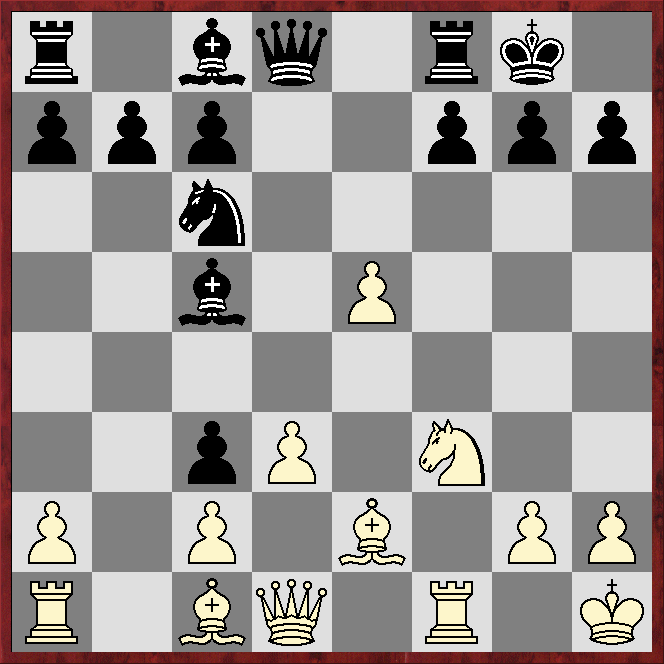
10.Ne2 Nxe2 11.Qxe2 0-0-0 12.d3 Nf6 13.Bxf4 d5 14.Bb3 dxe4 15.0-0-0!
Not 16.dxe4? Nxe4!
With a fairly open centre, and both sides castling long, the position is set for a sharp middlegame
*****
*****
*****
*****
*****
16...exd3 17.Rxd3
White is a pawn down, but has the bishop-pair and an initiative.
17...Rhe8??
The engines give 17...Qf5, eg 18.Rf1 Rxd3 19.Qxd3 Qxd3 20.cxd3 Rd8 21.Bxf7 Rxd3, reckoning White has enough for a pawn.
18.Rxd7 Rxe2 19.Rxc7+ 1-0
LESSON: there is no substitute for basic tactical skills.

Saturday, 5 October 2024

Crete Round Five

FACED a German.

Armin Thelen (1972) - Spanton (2013)
Amateur Chess Organization 50+ World Championship Group C
Vienna Gambit
1.e4 e5 2.Nc3 Nf6 3.f4 d5 4.fxe5 Nxe4 5.d3!?
How should Black proceed?
*****
*****
*****
*****
*****
5...Nxc3
This is the most popular move, whereas the tempting 5...Qh4!? has a bad reputation, despite being played by grandmasters. The mainline then continues 6.g3 Nxg3 7.Nf3 Qh5 8.Nxd5 Nxh1 9.Nxc7+ Kd8 10.Nxa8 Bg4 11.Bg2 (a key move, both defending f3 and attacking h1) Nc6 12.d4 and now, instead of 12...Bxf3?, Stockfish17 and Dragon1 recommend 12...f6!?, claiming complete equality.
6.bxc3 d4!? 7.Nf3 Nc6 8.Be2 Bc5 9.0-0!? dxc3+ 10.Kh1 0-0
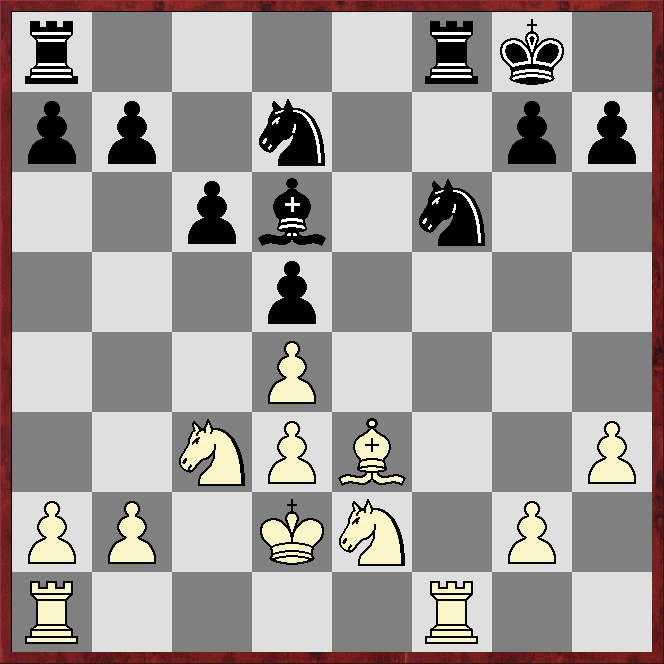
Now both sides have castled, how would you assess the position (it occurs 107 times in ChessBase's 2024 Mega database)?
*****
*****
*****
*****
*****
Black is a somewhat-precarious pawn up, but has a kingside looking short of pieces. The engines reckon Black is slightly better, but I suspect White's position is easier to play, at least at club level.
11.Qe1 Nd4 12.Bd1
This is the commonest continuation, but the engines also like 12.Qxc3!?, when they reckon best-play runs 12...Bb6 13.Qd2 Nxf3 14.Bxf3 Bd4 15.Ba3 Bxa1 16.Bxf8 Bxe5 17.Bc5, claiming White's lead in development is almost enough compensation for a pawn.
12...Nxf3 13.Bxf3 Qd4
The engines like Glenn Flear's 13...a5!?, the idea being the black queen's rook can quickly switch to the kingside via a6.
14.Qg3 Re8 15.Bh6 Bf8 16.Rae1 Be6!
This apparent-novelty - known moves are 16...Qa4 and 16...Qb6 - is liked by the engines.
17.Bxb7 Rab8
But they reckon a better follow-up is to sac the exchange with 17...Qa4!?, claiming 18.Bxa8 Rxa8 gives Black full compensation.
18.Bc6 Red8 19.Bg5 Rdc8 20.Rf4 Qc5 21.Be4 Rb4 22.Rh4
The engines suggest 22.d4!?, one point being 22...Rxd4 can be met by 23.Bxh7+! Kxh7 24.Qh4+ Kg8 25.Rxd4, winning the exchange.
22...g6
The engines suggest sacrificing the exchange with 22...Rxe4!?, when 23.Rhxe4 (best, according to the engines) Qa3 gives more-or-less enough compensation as White seemingly no longer has mating chances.
23.Bf6?!
White has the upper hand after 23.a3, according to the engines, eg 23...Rb2 24.d4!? Qb5 (24...Qxd4?? 25.Bxg6) 25.h3, averting any chance of back-rack mate and preparing to continue attacking on the kingside.
23...Bg7?
Black is slightly better after 23...Rcb8!, according to the engines, one point being that 24.Rxh7? Kxh7 25.Qh4+ fails to 25...Bh6 26.Bg5 Rb1 27.Qxh6+ Kg8 and 28...Qxe5.
24.Qg5?
Winning seems to be the engines' 24.Bxg7 Kxg7 25.a3!, eg 25...Rb5 (threatening 26...Qxe5) 26.d4 Qe7 27.Bc6! Rb6 28.d5 Bd7 29.Bxd7 Qxd7 30.Qxc3, after which White is a pawn up and with the better-coordinated pieces.
24...Qf2!
The engines agree this is best, and certainly not 24...Qf8? 25.Be7.
25.Rd1?
Necessary is the passive 25.Rg1, but Black is better.
25...Bxf6 26.exf6 Qd2?
'Clever', but White has no good answer to 26...Qxc2 or 26...Rcb8 (27.Qh6 Qxf6).
27.Qxd2 cxd2 28.h3 Rcb8 29.Rxd2 Rb1+?!
This leads nowhere. Instead 29...Bxa2 equalises.
30.Kh2 Rf1?
Also bad is 30...Bxa2? as White can reply, as in the game, 31.Bf3. Instead 30...R1b2 makes sense.
31.Bf3 Rb2!? 32.a3 Rb6 33.Ra4 a6 34.Rb4 Ra1?
Much better is 34...Rxb4 35.axb4 Rb1, although the engines reckon White is still winning.
35.c4?
Much better is 35.Rxb6 cxb6 36.Re2 (or 36.d4), when 36...Rxa3 37.d4 h5 38.d5 Bf5 39.d6 wins easily.
35...Rxa3 36.Rxb6 cxb6 37.Rb2?!
Almost certainly better is activating the king with 37.Kg3.
37...Rxd3 38.Rxb6 h5 39.c5
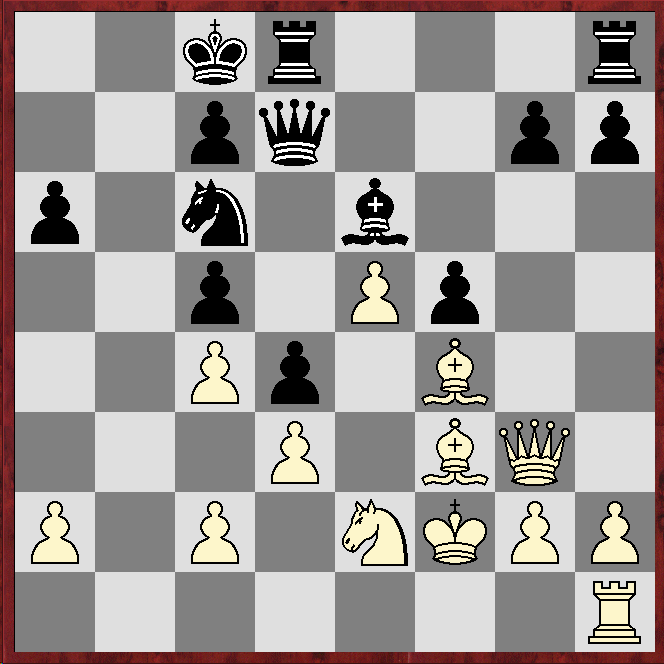
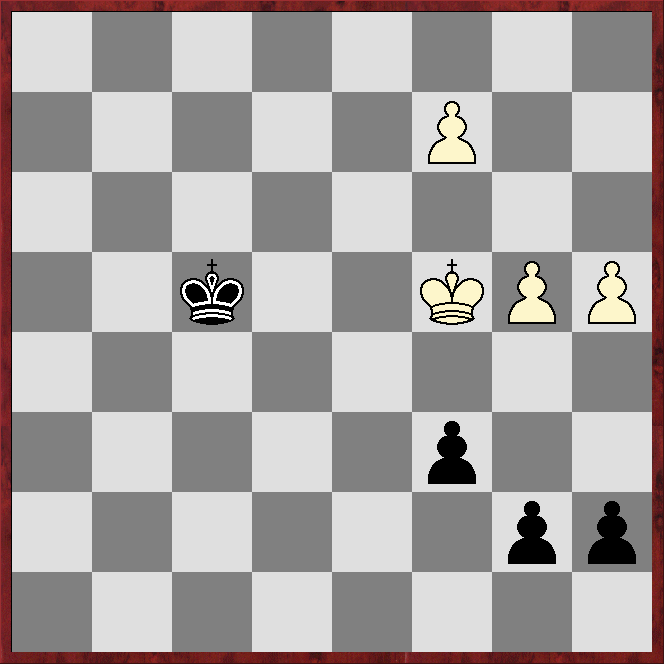
Black to play and draw
*****
*****
*****
*****
*****
39...Rd8?
Black holds with 39...Rc3 and 39...Kh7, according to the engines, eg 39...Rc3 40.c6 Kh7! 41.Rxa6 Kh6 42.h4=. White cannot make progress on the queenside as after, say 42.Ra7 Kg5 43.c7, the c pawn will not be able to further advance.
The game finished:
40.Rxa6 Rc8 41.c6 Kf8 42.Kg3 Ke8 43.Kf4 Kd8 44.g4 hxg4 45.Bxg4 Bxg4 46.hxg4 Kc7 47.Ra7+ Kxc6 48.Rxf7 Kd6 49.Kg5 Rc4 50.Ra7 Ke6 51.f7 1-0

Thursday, 22 August 2024

Darlington Round One

FACED a Scot.

Christopher Nield (1831 ECF/1773 Fide) - Spanton (1931 ECF/1980 Fide)
Vienna Gambit
1.e4 e5 2.Nc3 Nf6 3.f4 d5 4.fxe5 Nxe4 5.Qf3!?
This is third in popularity behind 5.d3 and especially 5.Nf3.
How should Black respond?
*****
*****
*****
*****
*****
5...f5
The text and 5...Nc6!? are the top choices of Stockfish16.1 and Dragon1, but most popular in ChessBase's 2024 Mega database is 5...Nxc3.
6.exf6!?
This seems to help Black more than White. The mainline in Mega24 runs 6.d3 Nxc3 7.bxc3 d4!?, with an equal game, according to the engines.
6...Nxf6 7.h3?
Slow and weakening. The engines suggest 7.d4, meeting 7...Bg4 with 8.Qe3+, and if 8...Be7, then 9.h3 with tempo.
7...Bd6 8.d4?!
Not 8.Nxd5?? Nxd5 9.Qxd5?? Bg3+ etc. However the engines much prefer giving check with the queen, eg 8.Qe2+, and if 8...Kf7!?, then 9.Qf2 Re8+ 10.Kd1, although they agree Black is winning.
8...0-0 9.Bg5 Qe8+ 10.Qe3?
Much better, according to the engines, is putting a piece on e2, whether it be queen, bishop or king's knight.
How should Black proceed?
*****
*****
*****
*****
*****
10...Bg3+?
This deprives White of castling rights, but throws away almost all of Black's considerable advantage, whereas the simple 10...h6 wins a piece. The problem with the text is that after ...
11.Kd2
... Black is more-or-less obliged to swop queens, after which White's king is safe.
11...Qxe3+
Not 11...Ne4+? 12.Nxe4 Qxe4 13.Qxg3 Qxd4 as Black does not get enough compensation after 14.Bd3.
12.Bxe3 Bf5 13.Bd3 Bxd3 14.cxd3!?
The engines marginally prefer the conventional 14.Kxd3.
14...c6 15.Nge2 Bd6 16.Rhf1 Nbd7
Now both sides have connected rooks, how would you assess the position?
*****
*****
*****
*****
*****
The engines give Black a slight edge, presumably based on the pawn-structure and, perhaps, Black having the marginally better bishop.
17.Nf4 Rf7 18.Rf3 Re8 19.Raf1 Rfe7 20.g4!? h6 21.a3 a5 22.Ng6 Rf7 23.g5!? hxg5 24.Bxg5 Kh7 25.Nh4 Bf8 26.Nf5 b5 27.Bf4 b4!?
This seems fine, if followed up correctly.
28.axb4 axb4 29.Na4?!
White probably should have played 29.Nd1, holding.
How should Black proceed?
*****
*****
*****
*****
*****
29...b3?
This makes the pawn weak. Instead the engines give 29...Ra8 30.b3 Ne4+!, taking advantage of the hanging knight on f5. After 31.dxe4 dxe4 White seems to have nothing better than 32.Nh6 gxh6 33. R3f2, ceding a pawn, as 33.Re3?! apparently loses to 33...Nb6!, eg 34.Nxb6 Ra2+ 35.Ke1 Ra1+ 36.Ke2 Rxf1 37.Rxf1 Rxf4+, when White is even worse off than in the first line.
30.Nd6 Bxd6 31.Bxd6 Re6 32.Bg3 Rf8 33.Nc3?
Black does not have a decent answer to 33.Kc3.
33...Rfe8 34.Ra1 Nh5 35.Bh4 Rg6 36.Ra7 Rg2+ 37.Rf2 Rxf2 38.Bxf2 Rf8 39.Ke3 c5!? 40.Rxd7 cxd4+ 41.Kxd4 Rxf2 42.Rxd5
CN offered a draw.
The game finished:
42...Nf6 43.Rb5 Rxb2 44.Kc4 Rh2 45.Rxb3 Rxh3 46.Ne4 Rh4 47.Kd4 Kg6 48.Rb5 Kh6 49.Ke3 Ng4+ 50.Kf3 g6 51.Kg3 Rh5 52.Rxh5+ gxh5 53.Kh4 Ne5 ½–½

Thursday, 2 May 2024

Rare Treat

THE following gem of a game has several unusual features.
For starters, it shows Mikhail Botvinnik on the losing side.
Not only that, but he loses in 26 moves after going pawn-grabbing ... twice.
Notes in italics are by Savielly Tartakower and Julius du Mont, algebraicised from 500 Master Games Of Chess.

Ilya Kan - Mikhail Botvinnik
Moscow 1935
Vienna Gambit
1.e4 e5
The future world champion would become famous for his love of the French Defence, but in this tournament, in which he shared first place with Salo Flohr, he only met 1.e4 with 1...e5, although Botvinnik did get a French after replying to 1.d4 with 1...e6.
2.Nc3 Nf6 3.f4 d5 4.fxe5 Nxe4 5.Nf3 Nc6 6.Qe2
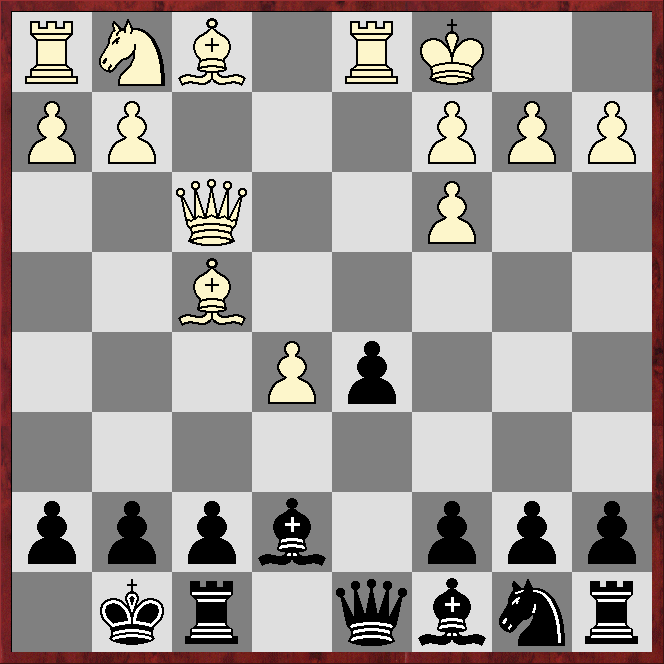
A grave disappointment would result from a quiet developing continuation by 6.Be2, eg 6...Bc5 (threat: 7...Nf2, "mating" the queen) 7.d4 Nxd4 (a cruel surprise) 8.Nxd4 Qh4+ 9.g3 Nxg3 10.Nf3 Bf2+ (more trouble) 11.Kxf2 Ne4+ 12.Ke3 Qh6+ (more convincing even than 12...Qf7+) 13.Kd4 c5+ 14.Kxd5 Qc6+ 15.Kc4 Be6+ and wins.
Position after 15...Be6+
*****
*****
*****
*****
*****
This is a fascinating line, but it is far from clear White is lost at the end of it.
After 16.Kd3 Nf2+ (stronger than 16...0-0-0+, according to Stockfish16 and Komodo14.1) 17.Ke3 Nxd1+ 18.Rxd1 White has three minor pieces, including the bishop-pair, for queen and pawn. Komodo14.1 believes Black is winning, but Stockfish16 gives Black only a slight edge.
The engines reckon Black has a significant improvement with 13...Qb6+!? 14.Kd3 Nf2+ 15.Kd2 Nxd1. After 16.Kxd1 (or 16.Rxd1) Black has a pawn more than in the authors' line, and the black queen is more active.
Everything up to 12...Qh6+ was seen in Torsten Lang (2374) - Tobias Bärwinkel (2319), German League 2007. That game continued 13.Ng5?! Qxg5+ 14.Kd4 Qh4? (14...c5+) 15.Nxe4 Qxe4+ 16.Kc3 d4+ 17.Kb3 0-0 with an unclear position (1-0, 48 moves).
6...Bf5 7.Qb5?!
An optimistic sally, which - succeeds! Caution dictates 7.d3.
The engines strongly agree with this, although in ChessBase's 2024 Mega database the text scores 33%, two percentage points higher than 7.d3.
7...Nc5
Instinctively, Black wants to protect his two pawns (d5 and b7). A reply which meets the case is at once 7...a6, and then if 8.Qxb7 or 8.Qxd5 [then] 8...Nb4, which shows that the white queen has entered the fray without due preparation.
8.d4 a6 9.Qe2 Ne4?!
The engines reckon Black is better after 9...Ne6, as played by Joseph Blackburne in a win over George Gossip at the 1889 USA Congress in New York.
10.Qe3!?
White has restored the balance, and now maintains the superior grouping of his forces (a good centre, open f file, etc). The 'pawn sacrifice' is basically sound.
10...Nxc3 11.bxc3 Bxc2
Accepting the Greek gift.
12.Qf2 Bf5 13.Ne4 Be6
The engines prefer the more-active 13...Be4.
14.Bd3
Well developed at the price of a pawn, this bishop is becoming very active.
14...Qd7 15.0-0 Na5 16.Nf5 0-0-0
Or 16...g6 17.Nh4 with fresh targets.
Now both sides have castled, how would you assess the position?
*****
*****
*****
*****
*****
As usual, positions with opposite-side castling are hard to evaluate. Komodo14.1 claims complete equality, but Stockfish16 gives Black a slight edge.
17.Qe2 Qc6 18.Rb1!? h6
Not 18...Qxc3? 19.Bd2 Qa3 20.Bxa6! etc.
19.Bd2 Nc4 20.Ne3 Nxe3!? 21.Bxe3 Qxc3?
Having had, at all times, a difficult game, Black has at least secured an advantage in material. As against this, the new [half-]open file will soon make itself felt.
Botvinnik's decision to grab a second pawn is extraordinary. Most club players, I believe, would avoid this error even if they could not see how it would be refuted.
22.Rfc1 Qa5 23.Qc2
The final assault.
23...c6 24.Bd2 Qc7 25.Qa4
All White's forces are cooperating. The two-fold threat now is 26.Bxa6 and 26.Ba5.
25...Rd7
There is no saving clause.
26.Bxa6! 1-0

Saturday, 2 March 2024

Classic Treat

ONE of the joys of looking at old games is they tend to be easier to understand.
Ideas now accepted as commonplace by club players were still to be worked out when many of the classic giants of chess were at the board.
Often these ideas are seen in simpler form than they now have, after many more decades of praxis.
Such games can be especially entertaining when featuring two world champions, in the following case Wilhelm Steinitz and his successor Emanuel Lasker.
Notes in italics are by Savielly Tartakower and Julius du Mont, algebraicised from 500 Master Games Of Chess.
Notes in bold italics are my translation from German of those by grandmaster Rainer Knaak in ChessBase's 2024 Mega database.

Steinitz - Lasker
London 1899
Vienna Gambit
A striking feature of the following fine game is Black's "double-sacrifice," followed by a quiet move, the logical result of ultra-rapid and concentric development.
London 1899 is remembered as one of the great tournaments, because almost all of the world's best were there (only Tarrasch was missing).
1.e4 e5 2.Nc3 Nc6 3.f4 d5 4.d3!?
Adopting his favourite continuation - tricky, but slow.
Today only 4.fxe5 is played.
The earliest game in Mega24 to reach the position after 3...d5 saw Carl von Jaenisch unsuccessfully, in 1851, play 4.exd5 against Howard Staunton, and 4.exd5 is a favourite of Hikaru Nakamura (Rainer's annotations appear to have been written in 2000).
How should Black respond?
*****
*****
*****
*****
*****
4...Nc6
The safest way to equalise is 4...exf4.
Three years earlier Lasker and Harry Pillsbury played 4...d4 in a consultation win against Steinitz and Mikhail Chigorin. But in 1909, when Lasker next reached the position, with black against Rudolf Spielmann, he preferred 4...exf4, albeit only drawing. For what it is worth, Stockfish16 and Komodo14.1 reckon the text is inferior to the other two moves.
5.fxe5 Nxe5 6.d4 Ng6
Remaining on the critical wing.
7.exd5
Only with 7.e5 can White hope for an advantage.
7...Nxd5 8.Nxd5
White hopes the black queen will not be so good on d5.
8...Qxd5
The black queen occupies a powerful square, whence it cannot very well be driven away (9.c4 would weaken White's position).
9.Nf3 Bg4 10.Be2 0-0-0 11.c3
This may lose time. White should castle.
11...Bd6
Already Black's forces have obtained a development.
12.0-0 Rhe8
Premature would be 12...Qh5 13.h3 Bxh3 13.Ng5 etc. The text move contains no direct threats, but it can eventually be followed by 13...f6 and 14...Nh5 etc.
How would you assess the coming middlegame?
*****
*****
*****
*****
*****
White has the only pawn on the two centre files, but Black has a large lead in development and the safer-looking king. The engines give Black at least a slight edge.
13.h3
Less impulsive would be 13.Bd2.
The engines prefer Steinitz's choice.
13...Bd7 14.Ng5?!
Here again 14.Bd2 is indicated.
Steinitz dreams of driving away the queen on d5 with Bf3, but this should happen with 14.c4, although it is difficult to judge whether White can then defend all his weaknesses.
14...Nh4
Naturally not 14...f6 15.Bf3 Qg8 16.Ne4 with good play for White.
The engines reckon Black would still have a slight edge after 16...Bf8!?
15.Nf3
The lesser evil is 15.Bf3.
It looks like White's knight manoeuvre was completely pointless. But if Black were to play 15...Nf5, 16.Ng5 would come and White would be ready to play Bf3 again. Giving up the bishop-pair with 15.Bf3 may not have been in White's interest, but nevertheless was necessary.
The engines are not so sure, reckoning that after 15.Bf3 Nxf3+ 16.Qxf3 Qxf3 17.Nxf3 Black gets a positionally won game with 17...Bb5 18.Re1 Rxe1+ 19.Nxe1 Re8.
What should Black play?
*****
*****
*****
*****
*****
15...Nxg2!
A "break-up sacrifice," of which the chief beauty lies in the fact that it requires a complementary sacrifice on the next move.
White has some defensive resources at hand, but the sacrifice still works.
16.Kxg2 Bxh3+
Taking the last defence by storm.
Even stronger, according to the engines, is 16...Re6, building up Black's attacking strength eg 17.Bd3 Rf6 18.Bg5!? Rxf3! 19.Rxf3 Qxg5+ 20.Kf1 Bg3 etc.
17.Kf2
Accepting the second sacrifice loses by force: 17.Kxh3 Qf5+ 18.Kg2 Qg4+ 19.Kh1 Qh3+ 20.Kg1 Qg3+ 21.Kh1 Re4 22.Bg5 Rg4 23.Rf2 Qxf2 24.Qf1 Qg3 etc.
17...f6!?
Whereas after 17...Bxf1 18.Bxf1 etc White could still offer a stubborn resistance. The text move brings into play Black's additional trump: an assault by pawns.
18.Rg1?
Better is 18.Rh1.
18...g5
Steinitz now defends against the difficult-to-stop advance of the g pawn by returning the piece.
19.Bxg5!?
The engines prefer 19.Bd2, but reckon Black is still winning.
19...fxg5 20.Rxg5
Numerically the games are even, but dynamically Black's forces, including the "two bishops," are overwhelming.
In addition to the miserable king's position, White has another handicap: the queen's rook is not developed.
20...Qe6 21.Qd3 Bf4 22.Rh1!?
If the threatened rook moves, Be3+ follows and the queen's rook is cut off.
22...Bxg5 23.Nxg5 Qf6+ 24.Bf3
Or 24.Nf3 Bg4, eg 25.Rg1 h5 26.Rg3 Rf8 27.Kg2 Rde8 28.Bd1 Qf4, threatening both ...h4 and ...Re3.
24...Bf5 25.Nxh7!? Qg6 26.Qb5 c6 27.Qa5 Re7 28.Rh5
There is nothing better, eg 28.Qxa7 Rxh7 29.Qa8+ Kc7 30.Qa5+ Kd7 etc.
28...Bg4 29.Rg5 Qc2+ 30.Kg3 Bxf3 0-1
Lasker won the first brilliancy prize for this game.

Thursday, 29 February 2024

Sacrificing The Exchange

CLUB players usually know many of the standard positional motifs developed by masters over the centuries.
But there is a big difference between knowing an idea and successfully implementing it over the board.
One of the hardest positional motifs for club players, I believe, is the exchange sacrifice.
That is why I was pleased - perhaps inordinately so - with the positional exchange-sacrifice I carried off in round six at Cambridge.
The following game, taken from 500 Master Games Of Chess by Savielly Tartakower and Julius du Mont, helps in trying to understand such sacrifices.
Notes in italics are algebraicised from the book.

Karel Hromádka - Mirko Schreiber
Munich Olympiad 1936, Czechoslovakia v Yugoslavia
Vienna Gambit
A beautiful game in the modern style, in which the strategy of the blockade, helped by a first sacrifice of the exchange, followed near the end by another, is entirely successful.
1.e4 e5 2.Nc3 Nf6 3.f4 d5 4.fxe5
The most energetic continuation.
4...Nxe4
White has three main continuations
*****
*****
*****
*****
*****
5.Qf3!?
An old continuation, favoured by Paulsen, but the usual 5.Nf3 is more natural.
An instructive "opening trap" is 5.d3, after which the plausible 5...Qh4+ 6.g3 Nxg3 7.Nf3 Qh5 8.Rg1 leads to Black's discomfiture, but the rational continuation 5...Nxc3 6.bxc3 d4 7.Nf3 c5 leaves Black with a very comfortable game.
Something strange has happened here, as 8.Rg1?? is a gross blunder - Black simply captures on f1. However 8.Nxd5 is another matter, although even this is not clear, eg the largely forcing ...Nxh1 9.Nxc7+ Kxd8 10.Nxa8 Bg4 11.Bg2 Nc6 12.d4 f6!? (this suggestion of Stockfish16 and Komodo14.1 may be a novelty) 13.Be3 fxe5 14.dxe5+ Kc8 gives Black full compensation for a pawn, according to the engines.
How should Black respond to White's somewhat unusual fifth move?
*****
*****
*****
*****
*****
5...f5!?
This is Stockfish16's top choice; Komodo14.1 prefers 5...Nc6!? More popular than these two moves combined, in ChessBase's 2024 Mega database, is 5...Nxc3.
6.d3
He decides to rid himself of the intruding knight without delay, as after 6.Nge2 Nc6 7.d4 Nb4 8.Kd1 c5 Black takes the lead.
6...Nxc3 7.bxc3 d4
More enterprising than 7...Be7 8.d4, which would round off White's game nicely.
8.Qg3
This very ingenious continuation in the gambit style improves White's chances, which would be far less propitious after 8.Be2 Nc6 etc, to say nothing of 8.cxd4 Qxd4 etc.
8...Nc6 9.Be2 Qd5
If 9...Be6, 10.Rb1.
The engines strongly dislike Rb1, claiming 10...dxc3 gives Black at least the upper hand. They suggest 10.c4 (Stockfish16) or 10.Bf3 (Komodo14.1).
10.Bf4!?
Methodical play. Another conception is 10.Bf3 Qxe5+ 11.Qxe5+ Nxe5 12.cxd4 Nxf3+ 13.Nxf3 with a fine centre, or 10...Qc5 11.Ne2 Nxe5 12.0-0, and White gives up worldly possessions for an attack.
Hromádka won with 10.Bf3 against František Treybal in 1912 and Heinrich Wolf in 1923. The text seems to have been a novelty.
10...Be6 11.c4!? Bb4+ 12.Kf2
The game being a closed one, the king is perfectly safe here.
12...Qd7 13.Rb1 0-0-0!?
He hopes to mount an attack on the kingside, but 13...0-0 affords greater resistance.
The engines marginally prefer the text.
14.Bf3 Bc5 15.Rb5 b6 16.Ne2 a6
How should White proceed?
*****
*****
*****
*****
*****
17.Rxc5!
A fine "positional sacrifice."
The engines agree the text is best, but in a way it is also forced as 17.Rbb1 Bxc4! is very good for Black. Be that as it may, what, after ...
17...bxc5
... does White have for the exchange?
Sacrificing the exchange has given White the upper hand, according to the engines 
*****
*****
*****
*****
*****
In purely material terms, White has a dark-square bishop for a rook. That means White has the bishop-pair, and, speaking generally, the bishop-pair plus a pawn is reckoned to give fair compensation for the exchange. Clearly White does not have enough compensation, materially, here. However, positionally, White's game is much more promising. Despite having only one rook, it is White who is likely to benefit most from the only open file. White's light-square bishop is also much more active than its black counterpart, and these two factors combined mean the black king is less-safe than White's. Nevertheless, Black has an obvious plan for a kingside attack, so the game is far from a foregone conclusion.
18.Rb1 Rdg8 19.h4!?
An important move, preventing 19...g5, and foreshadowing White's plan of establishing a blockade.
19...Nd8
He thinks he can oppose the enemy's aspirations by peaceful means, for the ruthless 19...g5 20.hxg5 h6 21.g6 h5 would require too much self-denial. But shutting the stable door after the horse is gone is nothing unusual.
Perhaps 19...h6 is better, although the engines prefer White after 20.h5.
20.Bg5 Qa4?
The engines suggest 20...Nc6!?, but reckon White is on top.
21.Rb2
Even stronger is the engines' 21.Bxd8 Kxd8 22.Qg5+.
21...Nf7
If 21...Qa3, 22.Bc1.
22.Nf4
The knight is out to eliminate Black's best defensive piece.
22...Qe8 23.Nxe6 Qxe6 24.Bd5 Qg6
24...Qxe5 can be successfully met by 25.Bxf7 or 25.Bf4.
25.e6 Nd6 26.Qe5
In order to be able to play 27.Be7 without exchanging queens. The blockade of Black's position is worthy of note.
26...Re8
How can White finish quickly?
*****
*****
*****
*****
*****
27.Rb6! 1-0
A beautiful final stroke, intended to eliminate Black's last defender.

Thursday, 23 March 2023

They Don't Play Them Like That Anymore

HERE is a classic of British chess from 500 Master Games Of Chess by Savielly Tartakower and Julius du Mont.
I have algebraicised the notation; notes in italics are from the book.

Stuart Milner-Barry - Hugh Alexander
Cambridge 1932
Vienna Gambit
A feast for the eye and mind.
1.e4 e5 2.Nc3 Nc6
More popular today is 2...Nf6. Both moves can be met by the gambit 3.f4, but in the line with 2...Nf6 it is generally regarded as largely disarmed by the reply 3...d5.
3.f4
Garry Kasparov preferred the more-common 3.Bc4 in a 2016 win over Fabiano Caruana, but the text was Magnus Carlsen's choice in a 2017 loss to Yangyi Yu (both games were at blitz time controls).
3...exf4 4.Nf3 g5
There is nothing better than this 'classic defence'.
5.d4!?
The Pierce Gambit offering the KN, as in the famous Muzio Gambit, is not to be taken lightly.
Stockfish15 and Komodo13.02 prefer 5.g3!?, and if 5...g4 then 6.Nh4, although they reckon Black is better.
5...g4
Accepting the challenge, for after 5...Bg7 6.d5 Ne5 7.d6 etc White has the advantage. 5...d6 6.d5 is also in White's favour.
6.Bc4 gxf3 7.0-0
How should Black proceed?
*****
*****
*****
*****
*****
7...d5?!
Necessary emancipation. If 7...Bg7 8.Bxf4 Bxd4+ 9.Kh1, White has enduring chances.
This was tested in a 1993 game between two unrateds. White won, but the engines reckon 9...fxg2+ 10.Kxg2 Nf6 gives Black a winning advantage. The text is a mistake, according to the engines. Komodo13.02 gives 7...Nxd4!?, eg 8.Qxd4 Qg5 9.Rf2 Bc5 etc, while Stockfish15 prefers 7...Bg7 8.Qxf3 Bxd4+ 9.Kh1 Ne5 10.Qxf4 Qf6!?, claiming a large advantage for Black.
8.exd5 Bg4!? 9.Re1+
But 9.Qe1+ is better and affords equal opportunities. A bold but insufficient idea is the queen sacrifice: 9.dxc6 f2+ 10.Rxf2 Bxd1 11.cxb7 Bg4 12.Bb5+ Bd7 etc.
In this line the engines reckon 12.bxa8=Q!? Qxa8 13.Bxf4 equalises, even though White only has rook and two pawns for a queen.
9...Nge7!? 10.gxf3?!
More astute would be, first, 10.Ne4 Bg7 11.gxf3.
The engines strongly disagree with this analysis, preferring Milner-Barry's choice and, even more so, 10.Qd2!?
10...Bh3 11.Bxf4 Rg8+
The counter-pressure begins.
12.Bg3 Na5
At last the knight goes off prise.
White has little material compensation for being a piece down, but it is anyone's guess as to which king is safer
*****
*****
*****
*****
*****
13.Bn5+ c6 14.Ne4?!
Better, according to the engines, is 14.dxc6, although they prefer White after both 14...bxc6 and 14...Naxc6.
14...Bg7  15.Kh1?
If 15.dxc6 [then] 15...Qxd4+, and White, in view of the piece which has has given up, could not think of agreeing to an exchange of queens.
The engines continue this line with 16.Kh1, one point being 16...Qxd1?? loses to 17.cxb7+. Instead they give 16...0-0-0 17.cxb7+ Nxb7, albeit preferring Black. Nevertheless the text is a mistake, the engines reckoning 15.Bf1 or 15.d6 keeps White well in the game.
15...Qxd5
Now White has just a pawn for a knight, and has a bishop en prise
*****
*****
*****
*****
*****
16.c4 Qd7 17.d5!?
Seeking to obtain fresh resources.
White's only realistic hope is to get at the black king before Black's material preponderance determines matters.
17...Kf8!?
Also possible, but hair-raising, seems to be 17...cxb5!?, eg 18.d6 Bxb2!? (this appears stronger than 18...0-0-0?!) 19.Nc5 Qf5! 20.Rxe7+ Kf8!? 21.Nd7+ Kg7 22.Ne5 Bxe5 23.Rxe5 Qg6!, after which the engines reckon White's attack has run out of steam.
18.d6!?
Probably objectively better is 18.dxc6, but 18...Naxc6 leaves Black well on top.
18...Nf5 19.Nc5 Nxg3+ 20.hxg3 Qf5 21.d7
This looks very alarming.
21...Bd4!
An ingenious reply, fulfilling many functions: (i) masking the d file, (ii) unmasking the g file, (iii) deflecting the adverse queen eventually (22.Qxd4 Qxf3+), (iv) attacking the knight, (v) cutting off the king's flight as long as this bishop remains safe.
22.Nxb7!?
This allows a mating sequence, but White was lost anyway.
22...Qh5! 23.Re8+ Rxe8 24.dxe8=Q+ Kxe8 25.Qe2+ Kf8 26.Nxa5 Bg4+ 0-1
The young opponents have dared, in our scientific era, to play one of the most dangerous gambits in a masters' tournament, and it may well be said that the game does credit to winner and loser alike.

Tuesday, 14 February 2023

Kid's Stuff

HOW often do we see Black defend the King's Gambit by grabbing the f4 pawn and hanging on to it, at least temporarily, by ...g5?
I cannot recall when I last witnessed someone playing that way over the board.
Much rarer still is when such a strategy is used against the King's Gambit's cousin, the Vienna Gambit.
But here is an example that helped 12-year-old José Capablanca win a match for the championship of his native Cuba.
Notes in italics are algebraicised from 500 Master Games Of Chess by Savielly Tartakower and Julius du Mont.

Juan Corzo - Capablanca
Match Game Eight (Havana), 1901
1.e4 e5 2.Nc3 Nc6 3.f4!? exf4
Stockfish15 and Komodo13.02 reckon the text, which is easily the main move in ChessBase's 2022 Mega database, gives Black an edge, but it is certainly not to everyone's taste, especially as one can be sure White will have studied the consequences of the capture.
4.Nf3 g5
The 'classical defence'.
5.h4 g4 6.Ng5
The chances of this, the Hampe-Allgaier Gambit, are, in practical play, considerable.
The only alternative, 6.Ng1, casts doubt on White's entire opening plan.
6...h6 7.Nxf7 Kxf7 8.d4
More sustained is 8.Bc4+. An interesting attempt, in place of the text, is 8.Qxg4.
The engines reckon Corzo's move is best, and, despite Black being a whole knight up, give Black only the upper hand, rather than a winning advantage.
8...d5
Most incisive. A playable defence is also 8...f3. A less stubborn defence is 8...d6.
The engines strongly dislike Capablanca's choice, preferring 8...d6 and especially 8...f3.
9.exd5?!
Or, eg 9.Bxf4 Bb4 10.e5 (10.Bb5 Nge7) Be6 11.Be2 Qd7 12.0-0 Kg7, and Black succeeds in consolidating his position. Black's refutation of the text move is very effective.
The engines disagree with quite a lot of this analysis, especially the dismissal of 10.Bb5!?, which does not appear in Mega22 but which the engines reckon gives White the upper hand.
9...Qe7+ 10.Kf2
Not 10.Kd2 Qe3#. And if 10.Be2, [then] 10...f3 etc, or 10.Qe2 Nxd4.
10.Be2 f3 was played in match game six. It gives Black a winning advantage, although Capablanca later went wrong and only drew.
10...g3+ 11.Kg1
White's king is in a trap. Black's problem is how to take advantage of the fact.
What should Black play?
*****
*****
*****
*****
*****
11...Nxd4!
A far-seeing manoeuvre.
Other moves leave White at least equal, according to the engines.
12.Qxd4
If 12.Bxf4 [then] 12...Nf5.
12...Qc5 13.Ne2
He can neither play 13.Qxc5 Bxc5+, with mate to follow, nor 13.Be3 fxe3 14.Qxh8 e2+ etc.
13...Qb6
A beautiful point with tangible results: an immediate threat, 14...Bc5, and a distant threat of the QR obtaining control of a file after the exchange of queens.
14.Qxb6
The engines give 14.b4!? Bxb4 15.Be3!? fxe3 16.Qxh8 Qf6 17.Qxf6+ Nxf6 18.Nxg3, when Black is the exchange down but, according to the engines, has more than enough compensation, albeit Black is not as much ahead as in the game.
14...axb6 15.Nd4 Bc5 16.c3 Ra4
The final point of the combination.
17.Be2 Bxd4+ 18.cxd4 Rxd4
And, on balance, a valuable extra pawn for Black.
19.b3 Nf6
Neither now, nor on the next move, 19...Rxd5 20.Bc4.
20.Bb2
Combinative, but 20.Bf3 is better.
20...Rd2 21.Bh5+ Nxh5!? 22.Bxh8 f3
A 'vacating advance'.
23.gxf3 Nf4 24.Be5 Rg2+ 25.Kf1 Rf2+ 26.Ke1 Nd3+ 0-1

Friday, 6 January 2023

Dama Negra Game Eight

Ricardo Pérez Pardo (1705) - Spanton (1895)
Vienna Gambit
1.e4 e5 2.Nc3 Nf6 3.f4 d5 4.fxe5 Nxe4 5.Qf3!?
This is less popular than 5.d3!? and especially 5.Nf3, but has been tried by Magnus Carlsen and can lead to sharp play.
5...Nxc3
This is the commonest response in ChessBase's 2023 Mega database, but refusing to capture with, say, 5...f5!?, is more circumspect.
6.dxc3
Building a centre with 6.bxc3 is marginally more popular.
6...Be7 7.Bf4 0-0 8.0-0-0
Both sides have quickly castled - how would you assess the position?
*****
*****
*****
*****
*****
White leads in development, has pressure against d5, has more space in the centre and has a useful half-open f file. Black has no weaknesses, and the white a pawn is unprotected, but the position looks, to me, easier for White to play. Stockfish15 and Komodo13.02 favour White, but not by much.
8...Be6 9.Bd3 f5?!
The engines strongly dislike this blocking move, which seems to be a novelty, preferring queenside development with 9...Nd7.
10.h4 Bxh4??
Grabbing a pawn in front of a castled king is rarely wise, especially where, as here, the pawn cannot be held. The engines agree White now has a won game.
11.Qh5 g5 12.Nf3 Qe8 13.Qxe8
Also strong is 13.Qh6.
13...Rxe8 14.Bxg5 Bxg5+ 15.Nxg5 Re7 16.Rh6 Bc8
Even worse is 16...Bd7 17.e6.
17.e6 Rg7 18.Nf3
White is still winning after this, according to the engines, but there are much stronger lines, eg 18.Nxh7! Rxh7 19.Rxh7 Kxh7 20.Bxf5+ Kg8 21.e7 Bd7 22.Bxd7 Nxd7 23.Rxd5 etc and 18.Bxf5! Rxg5 19.e7 Bd7 20.Rd5 Rg7 21.Be6+ Kh8 22.Bxd7 Rxe7 23.Bc8 c6 24.Rd8+ Kg7 25.Rh3 Na6 26.Rg3+ with a huge attack as 26...Kf7 (best, according to the engines) can be met by 27.Be6+!
18...Rg6 19.Rdh1
Even stronger, according to the engines, is 19.e7!? Bd7 20.Rxg6+ hxg6 21.Ne5 Kg7 22.Bxf5! gxf5 23.Rxd5.
19...Rxh6 20.Rxh6 Kg7 21.e7?
White is still much better, according to the engines, after, for example, 21.Rh3 Bxe6 22.Nd4.
21...Bd7 22.Rh5 Nc6 23.Bxf5 Bxf5 24.Rxf5 Nxe7 25.Re5 Kf6 26.Rh5 Rg8 27.Rxh7
RPD offered a draw.
27...Rxg2 28.Nd4 c6 29.b4!? Rg7 30.Rxg7 Kxg7 31.Kd2 Kf6 32.Kd3 Ke5 33.a4 Nc8 34.Nb3 Nd6 35.Na5 Kf4 36.c4 dxc4+ 37.Nxc4 Nxc4 38.Kxc4
Black to play and draw
*****
*****
*****
*****
*****
38...Ke4?
Three moves draw, according to the engines: 38...Ke3, 38...Ke5 and 38...Kf5!?. Stockfish15 reckons 38...b6!? also draws, but Komodo13.02 reckons it loses, or at least gives White the upper hand. Best play after 38...b6!? seems to be 39.b5 c5 40.Kd5 Ke3 41.Kc6 c4 42.Kb7 c3 43.Kxa7, which the Syzygy endgame tablebase shows is a draw.
39.Kc5 Ke5 40.a5
There is no defence to this.
40...b6 41.axb6 axb6 42,Kxc6 1-0

Wednesday, 9 November 2022

A Strong King?

IT is interesting to see when a new idea in chess came into being - or is thought to have come into being.
One of the most unusual, certainly in its day and still surprising to inexperienced players, is allowing Black to check the white king early in the King's Gambit by omitting the move Nf3.
The idea is often attributed to the first 'official' world champion, Wilhelm Steinitz.
I suspect many people would think Steinitz was responsible for playing as White 1.e4 e5 2.f4 exf4 3.d4!?
But as far as I can discover he never played this sequence with either colour - the earliest game in ChessBase's 2022 Mega database is Francis Sidney Ensor - Curt von Bardeleben, London Minor 1883, which continued 3...Qh4+ 4.Ke2 d5 5.exd5 Bd6 6.c4 b6 7.Nf3 Bg4 8.Kd2 Bxf3!? 9.Qxf3 with a slight edge for White, according to Stockfish15 and Komodo13.02 (but 0-1, 46 moves).
Fast-forward 136 years and the game Ian Nepomniachtchi (2776) - Liren Ding (2811), Chess.com Blitz 2019, varied with 8.Qe1 Qh5 9.h3?!, after which the engines reckon 9...Bxf3+ 10.gxf3 Ne7 gives Black a winning advantage. Ding was also better after the game's 9...Ne7, according to the engines, and won in 22 moves.
Perhaps, you might think, Steinitz should be credited with the sequence 1.e4 e5 2.f4 exf4 3.Bc4!?
But this goes back to at least 1590, and Steinitz only has one game as white with it in Mega22, although he has 12 games with Black, the reply 3...Ne7 being named after him despite being known since at least 1620.
However, where Steinitz did pioneer allowing an early queen check is in the Delayed - some would say Improved - King's Gambit, better known today as the Vienna Gambit.
His contribution is highlighted in the following game from 500 Master Games Of Chess by Savielly Tartakower and Julius du Mont.
Notes in italics are algebraicised from the book.

Steinitz - Gustav Neumann
Dundee 1867
Vienna Gambit
When this game was played, the extravagant move 4.d4, instead of the supposedly forced 4.Nf3, was at first thought to be due to an oversight on the part of the then world champion Steinitz*, for the resulting king hunt is truly alarming. In many subsequent games, however, he proved the virility of this paradoxical continuation, which supports even in the opening stages, his theory of: the king - a strong piece.
1.e4 e5 2.Nc3 Nc6
Steinitz had been meeting 2...Nf6 with 3.f4 since at least 1860, but then there is no question of a quick ...Qh4+.
3.f4 exf4
We now have a kind of 'King's Gambit Deferred' (1.e4 e5 2.f4 exf4 3.Nc3 Nc6), but more prudent is 3...Bc5, eg 4.fxe5 d6 5.exd6 Qxd6 and, for his pawn, Black has taken the lead.
Position after 3...exf4
*****
*****
*****
*****
*****
4.d4!?
Sensational!
Two year before Dundee, at Berlin Carlsbadgarten, Jules Arnous de Rivière - Neumann went 4.Bc4!? Qh4+ 5.Kf1 Bc5 6.g3? fxg3 7.Kg2 gxh2 8.Rxh2 Qg5+ 9.Kh1 Qxg1+ 10.Qxg1 Bxg1 11.Kxg1, after which White does not have enough for two pawns (but 1-0, 49 moves). The game was published in the German chess magazine Neue Berliner Schachzeitung. Did that game inspire Steinitz to try a similar idea against Neumann?
4...Qh4+ 5.Ke2 d6
He already sees that his task is not as easy as it looks, and that he must set to work with deliberation. After 5...d5 6.exd5 Bg4+ 7.Nf3 etc, Black's momentary pressure would drop to zero.
These moves were played in Steinitz - Johannes Zukertort, London 1872. Zukertort sacrificed a piece with 7...0-0-0!? 8.dxc6 Bc5!? 9.cxb7+ Kb8, getting interesting play (but 1-0, 51 moves). Komodo13.02 reckons 5...b6!? gives Black at least the upper hand, and also likes 5...g5. Stockfish15 likes 5...g5, and 5...Qh5+ 6.Nf3 g5.
6.Nf3
Beginning to recover territory.
6...Bg4 7.Bxf4 Bxf3
He is glad to displace the king still further, but a more pressing strategy would demand 7...f5. If 7...Qf6 [then] 8.Ke3 [the engines much prefer 8.Nd5].
8.Kxf3
In subsequent games Steinitz switched to 8.gxf3, but the engines prefer the text.
8...Nge7 9.Be2 0-0-0
Even stronger is ...Qf6, , according to the engines, now that White does not have the reply Nd5.
10.Be3
Evading the threat 10...Ne5+ 11.dxe5 dxe5, and Black recovers his piece with advantage.
This seems to be plain wrong as, even if it were Black's move after 9...0-0-0, the sequence 10...Ne5+?? 11.dxe5 dxe5 is simply met by the bishop retreat 12.Bd2.
10...Qf6+
He tries to keep the opposing king in chancery for, otherwise, there follows 11.g3 and Kg2, and White is out of all danger.
11.Kg3 d5 12.Bg4+
Not at once 12.e5 [because of] 12...Nf5+.
12...Kb8 13.e5 Qg6
With the threat of 14...h5. But 13...Nf5+ is a little better.
14.Kf2
The king makes his escape.
14...h5 15.Bh3 f6
He still has dreams of attack.
16.exf6 Qxf6+ 17.Qf3
He brings the adversary back to earth.
17...Qxf3+
Clearly not 17...Nxd4 18.Qxf6 gxf6 19.Bxd4. But also after 17...Qg6 18.Rhc1 Nb4 19.Qe2 Qf6+ 20.Kg1 the only result would be the furthering of White's intentions. After the exchange of queens, the grouping of the white forces proves superior.
The engines reckon 20.Kg1?! is suspect in view of 20...g5. They prefer 20.Qf3.
18.gxf3 g6 19.Ne2 Nf5?!
An anonymous ChessBase annotator gives this move a question mark, suggesting 19...Bh6, claiming equality, although Stockfish15, but not Komodo13.02, slightly prefers White.
20.Bxf5
Bringing about an almost symmetrical position in which White will be the first to attack weaknesses in the opposing formation (d5 and h5).
Steinitz was fond of the bishop-pair, but not a slave to them.
20...gxf5 21.c3 Bd6 22.Bf4 Kc8
Even if Black first occupies the open g file by 22...Rhg8 he would have to relinquish it again after 23.Rhg1 (eg 23...Kc8 24.Bxd6 etc, or 23...Bxf4 24.Nxf4 etc). The finish is impressive.
Position after 22...Kc8
*****
*****
*****
*****
*****
23.Rhg1 Kd7?!
Komodo13.02 wants to prevent the white king's rook coming to the seventh by 23...Bf8 or 23...Rh7, but still reckons White is winning. Stockfish15 also suggests 23...Bf8, or 23...a5!?, but again reckons White is winning.
24.Rg7+
One objective is achieved. All goes according to plan.
24...Ne7 25.Rag1 Ke6!?
The engines prefer 25...Ke8 or 25...h4.
26.Bxd6 Rxd6 27.Nf4+ Kf6 28.Nd3
Conquest of the 'strong point' at e5.
28...Rb6 29.b3 Rh6 30.Ne5 Rb5 31.a4!? Ra5
31...Rxb3 loses to 32.Nd7+ Ke6 33.Nc5+ etc.
32.b4 Ra6 33.Nd7+
A deeply-conceived victory.
Tartakower and du Mont have Neumann resigning here, although Mega22 adds the moves 33...Ke6 34.Nc5+.
*Today it is customary to think of Steinitz as having only been world champion from his defeat of Johannes Zukertort in 1886.

Monday, 24 January 2022

Can Black Really Accept The Vienna Gambit?

I WANT to look at some of the key points and interesting aspects of my games at Mariánské Lázně.
In round one - the full game cane be seen at https://beauchess.blogspot.com/2022/01/marianske-lazne-round-one.html - I reached with white, by an unusual move-order, the starting point of the Vienna Gambit.
Position after 3.f4
The game reached the diagram by 1.Nc3 Nf6 2.e4 e5 3.f4, but the normal move-order is 1.e4 e5 2.Nc3 Nf6 3.f4.
I have had this position, with white and black, 16 times, and on the previous 15 occasions the continuation was 3....d5. which occurs 7,319 times in ChessBase's 2022 Mega database.
Second-most popular is 3...d6, appearing 2,291 times, but my opponent in Mariánské Lázně played 3...exf4!?
This occurs 969 times, the earliest being a Gioachino Greco game or composition from 1620.
I replied, à la Greco, with 4.d4?!, but that is strongly disliked by the analysis engines Stockfish14.1 and Komodo12.1.1.
They prefer 4.e5, which is easily the main move in Mega22.
Black has only two reasonable-looking replies, although nine other moves occur in Mega22, including 4...Ng4?? (11 times) and 4...Nd5?? (seven times).

A) 4...Qe7?! (180 games)
The idea is to avoid having to immediately retreat the king's knight, but the text only puts off a necessary evil and meanwhile invites the white queen's knight to later come to d5 with tempo.
After 5.Qe2 Ng8 6.Nf3 the engines reckon Black's best-try is 6...Qe6!?
However after, for example, 7.d4 Bb4 8.Bf4 White has restored material equality, is ahead on development and has the lion's share of the centre.
Position after 8.Bxf4 - White is much better

B)  4...Ng8 (441 games)
This is effectively forced, and White's reply of 5.Nf3, developing  a piece, supporting e5 and preventing ...Qh4+, must be best.
Black has two obvious plans: (i) hold on to the extra pawn, (ii) challenge the white centre.
B1 5...g5
The engines at first like 6.Bc4 and 6.d4, but they come to prefer the most-popular response in Mega22,  6.h4, albeit at times fluctuating between h4 and d4.
Black should reply 6...g4. which gives at least equality against every continuation except the brave 7.Ng5!
B1.1 The key point is White can meet 7...h6?! with 8.Nxf7 Kxf7 9.Qxg4 d5 (what else?) 10.Qxf4+, when, for a knight, White has two pawns and a full-scale king-hunt.
A likely continuation is 10...Ke8 11.Be2 (threatening Bh5+ in some lines; also strong is11.Bb5+!? c6 12.Rf1) 11...Be6 12.0-0 Bg7 13.Bh5+ Kd7 14.Bf7!? Qe7 15.Nxd5 with excellent winning chances.
Position after 15.Nxd5 - White seems to be winning, but the whole line is very sharp
B1.2 Instead of 7...h6?! the engines give 7...d5 8.exd6 Bxd6 9.Bc4 (the only move to keep an advantage, according to the engines).
After 9...Qe7+ 10.Qe2 Be6 11.Nxe6 fxe6 12.Qxe6 White has got the pawn back and has the better position.
Alternatively 9...Nh6 10.0-0 0-0 11.d4 f3!? leaves White with a pleasant choice between recovering the pawn immediately with 12.gxf3 and building an attack with 12.Nce4.
The line with 9...Nh6 may be Black's most-promising in variations where Black holds on to the extra pawn, but still seems very good for White 
B2 5...d6
Attacking the white centre has a more-modern feel to it than the materialistic lines.
After 6.d4 dxe5 White should avoid 7.Nxe5? Qh4+ in favour of 7.Qe2!, which seems better than the more-popular 7.dxe5, but interesting is Stockfish14.1's 7.Bb5+!? c6 8.Bc4.
Position after 7.Qe2! - it occurs 13 times in Mega22 but blacks have tried eight different moves
B2.1 Stockfish14.1 reckons Black's best is 7...Be7, when 8.Qxe5 Nf6 9.Bxf4 c6 leaves White with an edge, according to the engines, after 10.Bd3 or 10.Bc4. But Black should beware the plausible 9...Qd6?!, when the engines reckon 10.Bb5+ Bd7 11.0-0-0 is positionally winning for White. 
B2.2 Komodo12.1.1 suggests 7...Be6, when 8.Bxf4!? exf4 9.d5 Qe7 10.dxe6 Qxe6 11.Qxe6+ fxe6 12.Bc4 gives White lots of compensation for two pawns, but the position looks unclear.

CONCLUSION: Black can accept the Vienna Gambit, and the rarity of such lines may give a well-prepared player practical chances as there are pitfalls for both sides. But objectively 3...exf4!? is almost certainly inferior to the mainline 3...d5.

Saturday, 15 January 2022

Mariánské Lázně Round One

PLAYED this afternoon.

Spanton (1825) - Jiří Štoček (1263)
Mariánské Lázně Seniors 50+
Vienna Gambit
1.Nc3 Nf6 2.e4 e5 3.f4 exf4!?
Normal is 3...d5, while grandmasters have also played 3...d6. Even so there are 969 examples of the text in ChessBase's 2022 Mega database.
4.d4?!
Almost certainly better is 4.e5 Ng8 6.Nf3. Black can avoid retreating the knight on move four by playing 4...Qe7?!, but 5.Qe2 forces ...Ng8 anyway.
4....Bb4 5.Bd3 Bxc3+?!
Surrendering the bishop-pair for what seems insufficient compensation. Gioachino Greco in 1620 gave a 'game' of his in which an unnamed opponent played 5...Qe7. Stockfish14.1 and Komodo12.1.1 like 5...d5, claiming Black is better.
6.bxc3 g5?!
Probably too greedy. The engines reckon 6...d5 keeps White's advantage to a minimum.
7.Nf3
I rejected the engines' top choice, 7.e5, because of 7...Nd5, but the engines sacrifice a second pawn with 8.Qf3!?, intending to meet 8...Nxc3 with 9.Bc4 or 9.Bd2, in both cases seriously embarrassing the advanced black knight. Black could instead offer back the pawn he has won by playing 8...Ne3, but after 9.Bxe3 fxe3 10.Qxe3 Black has no compensation for being behind in development, lacking space in the centre and having kingside weaknesses.
7...h6 8.h4
Again e5 is probably better, this time meeting 8...Nd5 with 9.0-0, and if 9...Nxc3 the engines give 10.Qe1 Nd5 11.c4 with a strong initiative.
8...g4
How should White proceed?
*****
*****
*****
*****
*****
9.Ne5?
This may look aggressive but the knight is easily kicked away with tempo. Sensible is 9.Nh2, while Stockfish14.1 also likes 9.Bxf4!?, meeting 9...gxf3 with 10.Qxf3, when the engines reckon White has more than enough for a piece, one plausible continuation being 10...d6 11.e5 dxe5 12.Bxe5 Nbd7 13.0-0 Nxe5 14.dxe5, after which White recovers the piece and emerges a pawn up while still having a strong attack.
9...d6 10.Nc4 Nh5
Suddenly the white king looks vulnerable.
11.Ba3?!
Probably better is the engines' 11.Qd2, intending to meet 11...Ng3 with 12.Rg1!?, the point being 12...Qxh4?! runs into 13.Qf2. Better, according to the engines, is 11...b5!? with an unclear position that the engines reckon favours Black.
11...Ng3 12.Rh2
The rook is badly out of play.
12...Qf6?!
Probably better is 12...b5, the idea of the engines being to meet 13.Na5 with 13...c5!? 14.Bxb5+ Bd7 15.Bxd7+ Qxd7, when Black is better coordinated.
13.Qd2 Nc6 14.0-0-0
How would you assess the position now White has safeguarded the king?
*****
*****
*****
*****
*****
White has the centre, a lead in development, and the bishop-pair on a board with unfixed pawn-chains. But the white king's rook remains out of play and Black is still a pawn up. Stockfish14.1 reckons Black is winning but Komodo12.1.1.1 only gives Black a slight edge.
14...Bd7
Stockfish14.1 much prefers 14...0-0!? but Komodo12.1.1 reckons castling and the text are of roughly equal value.
15.e5!?
Opening lines.
15...dxe5 16.d5?
Too fancy. After 16.dxe5 Black cannot recapture on e5 because he would lose down the e file, so has to play 16...Qe6, when 17.Qxf4 Nh5 18.Qe3 is unclear, although the engines reckon castling long gives Black a slight edge.
How should Black proceed?
*****
*****
*****
*****
*****
16...Ne7?!
I thought Black could not play 16...e4!? because of 17.dxc6, but after 17...Bxc6 Black has three pawns and an attack for a bishop. The engines reckon best-play goes 18.Be2 Rg8, when the black avalanche of pawns is very strong.
But even better is the engines' 16...0-0-0!, when 17.dxc6 Bxc6 again gives Black three pawns for a bishop only this time with an even stronger attack.
17.Nxe5! 0-0-0
Not 17...Qxe5? 18.Re1 Qf6 19.Bxe7 Qxe7 20.Rxe7+ Kxe7 21.Qxf4, eg 21...Nh5 22.Qe5+ etc.
18.Nxd7?
Correct is 18.Bxe7 Qxe7 19.Qxf4 with chances for both sides.
18...Rxd7 19.Bb2
Not 19.c4?? Qa1#.
19...Qd6
Probably best is the engines' 19...Rxd5!? 20.c4 Re5 21.Bxe5 Qxe5, when Black has two pawns and promising play for an exchange. Also interesting is 19...Ng6, when 20.c4 Ne5 leaves Black a pawn up.
20.c4 Rhd8 21.Re1 c6!?
Safe would seem to be 21...Kb8, while the engines suggest the wild-looking 21...b5!?
22.Qa5!?
Keeping the game going.
The continuation 22.Be5 Qa3+ 23.Bb2 Qd6 24.Be5 could be seen as an invitation to a draw, the point being White cannot play 23.Kb1? as 23...cxd5 opens the centre to Black's advantage.
What should Black play?
*****
*****
*****
*****
*****
22...b6?!
Both 22...Kb8?? and 22...a6?? lose the black queen to 23.Be5. But probably better than the text is 22...cxd5, when 23.Qxa7? loses to 23...Nc6 while 23.Ba3?! runs into 23...Qf6! 24.Bb2 d4 25.Qxa7 Nc6 with strong play for Black. Much less clear are 23.c5, eg 23...Qc7 24.Qxc7+ Rxc7 25.Be5 followed by 26.Bxf4, and 23.Be5, eg 23...Nc6 24.Bxd6 Nxa5 25.Bxf4 dxc4 26.Bh7!?
23.Qa6+ Rb7 24.Be5
Also interesting is 24.c5!? Komodo12.1.1 reckons the game is equal after both moves, but Stockfish14.1 agrees with me that the text is stronger (Komodo12.1.1 eventually comes to the same conclusion if given enough time).
24...Qb4?!
Komodo12.1.1 for a long while reckons 24...Qc5 25.Bxf4 Nh5 26.Be5 cxd5 is equal, but comes to like Stockfish14.1's quiet move 27.g3!, when the engines agree best-play runs 27...f6 28.Bd4 Qa5 (28...Qxd4? 29.Rxe7) 29.Qxa5 bxa5 30.Bc3!?, claiming a large advantage for White despite Black being a pawn up.
Best may be 24...Qd7!?, when the engines have a hard time deciding how White should proceed. Stockfish14.1. comes to like 25.Bxf4 Nh5 26.Bxh6, when White is a pawn up, but Komodo12.1.1 reckons 26...Kb8 leaves Black with more-or-less sufficient compensation.
25.c3 Qa5
Or 25...Qc5 26.Bf6, eg 26...Re8 27.Bxe7 Rxe7 28.Rxe7 Qxe7 29.dxc6 Kb8 30.Qxb7+ Qxb7 31.cxb7.
26.Qxa5 bxa5 27.Bxf4 Ngf5
A little better may be 27...Nh5 but the engines agree White is winning after the simple 28.Bxh6.
28.g3 cxd5
This is best, according to the engines, but after ...
29.cxd5
... White threatens to win the exchange with ...Ba6.
29...Rb6 30.d6!?
Black has to lose the exchange anyway, or give up a knight.
30...Nxd6?! 31.Rxe7
The game finished:
31...Rc6 32.Kc2 a4 33.Rxa7 Kb8 34.Rxa4 Rdc8 35.Rb4+ Ka8 36.Bxd6 Rxc3+ 37.Kd2 1-0
Mariánské Lázně central park

Friday, 1 February 2019

Goodnight Vienna

SUFFERED my third loss on the bounce for Battersea last night in a Central London League division one match for the second team against second-placed Rangers.
Carsten Pedersen (196) - Spanton (171)
Vienna Gambit
1.e4 e5 2.Nc3 Nf6 3.f4 d5 4.fxe5 Nxe4 5.Nf3 Be7
By far the most popular reply in ChessBase's 2019 Mega database, which is perhaps not surprising as Black scores 50% with this move.
6.Qe2
White's score increases to 52% after this. The idea is to oblige Black to exchange on d3 and follow up by castling long. The drawback is clear - White has blocked the development of his light-square bishop.
How should Black meet White's aggressive intentions?
*****
*****
*****
*****
*****
6...Nxc3
Can Black avoid this? The answer is probably yes. American GM Benjamin has played 6...f5 and 6...Nc5 while Karpov is among those who have tried 6...Ng5. However, the text is very much the commonest move.
7.dxc3 0-0
The main move, but Victor Bologan in Bologan's Black Weapons In The Open Games (New In Chess, 2014) covers a different plan, involving queenside castling, and that has been quickly gaining popularity. After his recommended 7...c5, the mainline goes 8.Bf4 Nc6 9.0-0-0 Be6 10.h4. Black then "almost automatically" plays 10...h6, which is liked by Stockfish10 and Komodo9, but Bologan suggests instead playing 10...Qd7, although the engines are not impressed.
8.Bf4 c6!?
The main move is 8...c5, as played by Gligoric, although Stockfish10 comes to prefer my choice. After 8...c5, the most popular line runs 9.0-0-0 Qa5 10.Kb1 Nc6 11.Qb5 Be6 12.Qxa5 Nxa5 with a position the engines reckon as equal.
9.0-0-0 Qa5 10.Kb1 Na6 11.Nd4 Nc5 12.Qf3
Black to make his 12th move
*****
*****
*****
*****
*****
12...Ne4?!
This seemed natural to me but the knight proves to be precariously placed. The engines give 12...Qb6 with unclear play.
13.Bd3 f5 14.exf6 Nxf6?
After this retreat Black has no hopes of a queenside attack while White's play in the centre and on the kingside becomes very menacing.
I should have given more consideration than I did to the positional pawn sac 14...Bxf6!? After 15.Bxe4 dxe4 16.Qxe4 the engines give 16...Bg4 with reasonable play for Black. The engines prefer White but Black's bishop-pair and the fact that White's extra pawn is doubled and cannot be used to create a passed pawn keep Black in the game.
15.Rde1
Also very good, and the move I feared more during the game, was 15.Nf5.
15...Bg4?
This temporarily gains a tempo but the bishop is very unstable on g4. I should have resigned myself to protecting the dark-square bishop by 15...Qd8 or 15...Rf7, but in either case White is much better.
16.Qg3 Bc5
This loses material but it was already too late to save the game, eg the engines reckon Black's best line is to give up the exchange by 16...Qd8 17.Bf5 Bxf5 18.Nxf5 Rf7 19.Nh6+.
17.Nb3 Qb6 18.Nxc5 Qxc5 19.Bd6
White wins the exchange and keeps the better position.
The remaining moves were:
19...Qb6 20.Bxf8 Rxf8 21.Rhf1 Bh5 22.Re7 1-0
Updated statistics
Battersea 2018-19
Event...Colour...Grade...Opponent's Grade...Result
CLL.........B..........167...….........196..............…D
LL...…….B...…...167...………..159...………….D
CLL...…..B...…...167...………..161...………….W
CLL...…..B...…...167...………..190...………….D
LL...…….W...…..167...………..161...….………W
CLL...…..W...…..167...………..148...………….D
CLL...…..W...…..167...………..165...………….W
CLL...…..W...…..167...………..160...………….D
CLL...…..W...…..167...………..159...………….D
LL...…….B...…...167...………..168...………….D
LL...…….W...…..171...………..159...………….W
CLL...…..B...…...171...………..198...……….….L
CLL...…..B...…...171...………..169...…………..L
CLL...…..B...…...171...………..196...…………..L
Overall this season for Battersea I have scored +4=7-3 for a grading performance of 174.
In season 2017-18 I scored +10=8-9 for a grading performance of 175.