Showing posts with label Giuoco Piano. Show all posts

Wednesday, 29 July 2026

Miniatures 42

IN this occasional series I am going through my decisive games of 20 moves or fewer.

Anthony D Brown (143 BCF) - Spanton (156 BCF)
Highbury (London) Rapid 1991
Giuoco Piano
1.e4 e5 2.Nf3 Nc6 3.Bc4 Bc5 4.0-0 Nf6 5.b4!?
A rare continuation, although it was played by Morphy, Staunton, Marshall and Tartakower, and is closely related to the Evans Gambit.
How should Black respond?
*****
*****
*****
*****
*****
5...d5?!
Black has the upper hand after 5...Bxb4, according to Stockfish18 and Dragon1.
6.exd5 Nb4 7.Nxe5 Nbxd5 8.d4 Bb6?
This lets White trap the black king in the centre. The engines suggest 8...Be7 or 8...Bb4.
9.Ba3 Be6 10.Re1 Nf4?
Better is the engines' 10...c6.
11.Bb5+?
White has a big advantage after several moves, especially 11.Qf3.
11...c6 12.Nxc6?
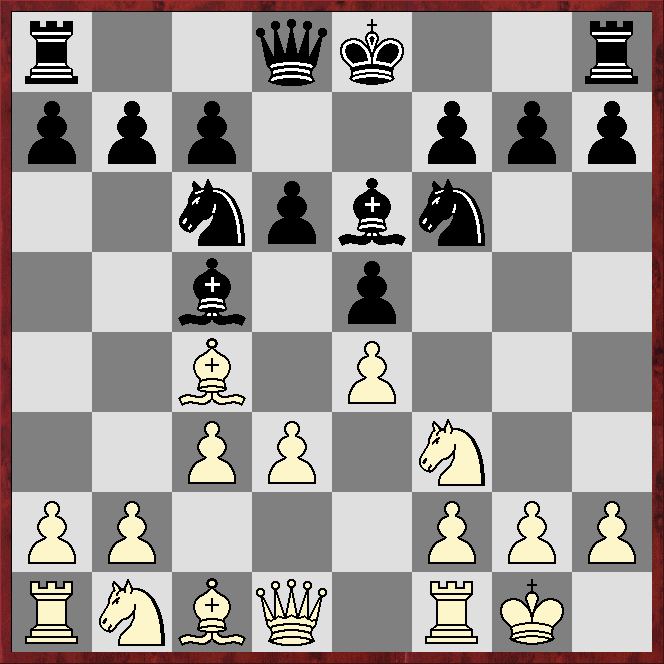
Black is only slightly better (Dragon1) or has the upper hand (Stockfish18) after 12.Bxc6!? bxc6 13.Qf3.
Black to play and gain a winning advantage
*****
*****
*****
*****
*****
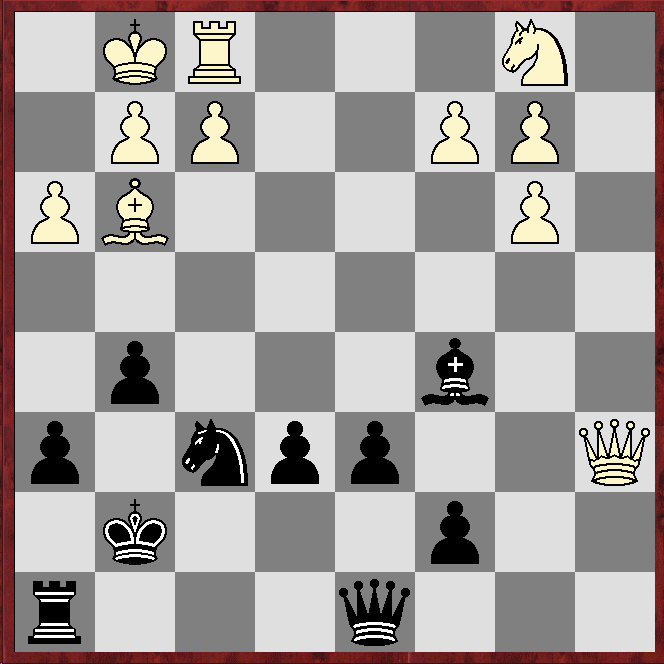
12...bxc6?
Correct is 12...Qd5!, one point being 13.Nxa7+ fails to the simple 13...Kd8 as Black threatens the a7 knight as well as mate in one.
13.Bxc6+ Nd7 14.Qf3!? Rc8 15.Qxf4 Rxc6 16.d5 Rxc2?!
Probably better is 16...Qc7.
17.dxe6 Nf6? 18.Qa4+ Nd7 19.exd7#
LESSON: tactics are easier when you have the safer king.

Sunday, 18 January 2026

Mariánské Lázně 50+ Round Two

FACED a Pole.

Ewa Balcerczak (1537) - Spanton (1915)
Giuoco Piano
1.e4 e5 2.Nf3 Nc6 3.Bc4 Bc5 4.d3 Nf6 5.a4!?
This rather unusual continuation dates back to only 1988 in ChessBase's 2026 Mega database, but has been tried by the likes of Carlsen, Anand and Nepomniachtchi.
How should Black respond?
*****
*****
*****
*****
*****
5...0-0
More popular in Mega26 are 5...a6, 5...a5 and especially 5...d6.
6.0-0
With both sides castling early, how would you assess the position?
*****
*****
*****
*****
*****
Nothing dramatic has happened, which is hardly surprising after so few moves, and the game is equal, according to Stockfish17.1 and Dragon1.
6...d6 7.c3 a6
Several players, including a 2500, have failed to appreciate that White's last move threatens to trap Black's dark-square bishop, eg Juan Antonio Urbina Pérez (2284) - Christopher Woojin Yoo (2500), Chess.com Blitz 2022, saw 7...h6?? 8.b4 Nxb4 9.cxb4 Bxb4 10.Ba3, when Black had nowhere near enough for a knight (but ½–½, 49 moves).
8.b4 Bb6 9.a5 Ba7 10.b5?!
This leaves a5 weak. The engines suggest moves such as 10.Be3, 10.h3, 10.Re1 and 10.Nbd2.
10...axb5 11.Bxb5 Bd7
Both games to reach the position in Mega26 saw the almost certainly better 11...Ne7!?
12.Kh1?
White is fine after 12.Nbd2, as 12...Bb6!? can be met by 13.Nc4, eg 13...Nxa5 14.Nxb6 cxb6 15.Bxd7 Qxd7 16.c4!?, with full compensation for a pawn, according to the engines.
12...Re8?!
Black wins the a pawn with 12...Bb6, eg 13.a6 Nb8! 14.Bxd7 Nbxd7 and ...Ra6.
13.Bg5 h6
It is still possible to go after the a pawn, eg 13...Bb6!? 14.Nbd2 Rxa5 15.Rxa5 Bxa5, but the engines reckon 16.Nc4!? Bxc3 17.Ne3 is the sound sacrifice of a second pawn, when play might continue 17...Ne7!? 18.Bxd7 Qxd7 19.Bxf6 gxf6 20.Nh4, with what they reckon is a completely equal position.
14.Bd2?!
This lets Black take the initiative. The engines reckon 14.Bxf6!? Qxf6 15.Nbd2 is equal, while 14.Bh4 probably gives White no more than a slight edge.
14...d5!?
Black is first to get in a d-pawn break - usually White's prerogative in the Giuoco Piano
*****
*****
*****
*****
*****
15.exd5 Nxd5 16.c4!?
This is the engines' second choice, only narrowly behind 16.Na3.
16...Nf6 17.Bc3 e4 18.dxe4 Nxe4 19.Be1!?
The engines reckon this is more or less forced as both 19.Kg1?! and 19.Ra2?! can be met by 19...Qe7, followed by  ...Rad8, in each with what they assess as a winning advantage.
19...Qf6 20.Ra3?!
Probably better is 20.Nc3!? Nxc3 21.Bxc3 Qxc3 22.Qxd7, although 22...Re7 gives Black a slight edge, according to the engines.
20...Rad8 21.Nc3 Qe7
The worst of White's troubles are over after 21...Nxc3?! 22.Bxc3.
22.Qb3?!
The engines suggest 22.Qc1 (Stockfish17.1) or 22.Ra1 (Dragon1), but much prefer Black.
How should Black proceed?
*****
*****
*****
*****
*****
22...Nc5!
The engines agree this is best, whereas the tempting 22...Nxf2+ 23.Bxf2 Bxf2 can be met by 24.Nd5 (but not 24.Rxf2?? Qe1+ etc), although Black is still better after 24...Qd6 as 25.Rxf2 Nd4!? leaves the white queen overworked, eg 26.Qb4 Nxb5 27.Qxd6 Nxd6 28.Nxc7 Nxc4, when Black emerges a pawn up.
23.Nd5?
Best may be 23.Qd1!? Nb4!? 24.Bxd7 Rxd7, and now 25.Nd5, although the engines reckon 25...Nxd5 26.cxd5 c6 gives Black a winning advantage.
23...Qe2!
This is even stronger than 23...Qxe1!? 24.Nxe1!? Nxb3 25.Rxb3 Nxa5.
The game finished:
24.Nxf6+!? gxf6 25.Qc3 Qxf1+ 26.Ng1 Re1 0-1

Thursday, 6 November 2025

More Correspondence Chess

Alan Ruffle (1371) - Spanton (2330)
British Correspondence Chess Championship Reserves Section D
Giuoco Piano
1.e4 e5 2.Nf3 Nc6 3.Bc4 Bc5 4.c3 Nf6 5.0-0!?
This gambit goes back to at least 1801.
How should Black respond?
*****
*****
*****
*****
*****
5...Nxe4!?
In practice, at least over the board, the pawn is normally declined, but Stockfish17.1 and Dragon1 agree the text is best.
6.d4 d5!?
This scores a fabulous 69% in ChessBase's 2025 Mega database, but the engines fluctuate between it and the more popular 6...exd4.
7.Re1?!
Normal is 7.dxc5 or 7.Bb5, while the engines like Viktor Kupreichik's 7.Nxe5!?
7...Bb6 8.Bb3?!
The engines suggest 8.Bb5 or 8.Bd3.
8...0-0 9.Nbd2 Nxd2 10.Bxd2 e4 11.Ng5
With the centre closed, it is hard to see White getting any compensation for being a pawn dawn
*****
*****
*****
*****
*****
11...Na5 12.Qh5 Bf5
An only-move (12...h6? loses to 13.Nxf7! Rxf7 14.Bxd5 Qf6 15.Rxe4, with a strong attack), but it is a complete answer to White's kingside ambitions.
13.Re3 Nxb3 14.axb3 Bg6 15.Qg4 f5 16.Qh4 f4 17.Rh3 Qf6 18.g3 f3
White is losing a significant amount of material.
19.Qf4 h6 20.Qxf6 Rxf6 0-1

Tuesday, 7 October 2025

Calvià Round Three

FACED a Fide master.

Juan Ramon Galiana Salom (2136) - Spanton (1941)
Giuoco Piano
1.e4 e5 2.Nf3 Nc6 3.Bc4 Bc5 4.c3 Nf6 5.d3 a6 6.Bg5!?
An unusual continuation, but one that has been played by grandmasters, including Fabiano Caruana.
6...h6 7.Bh4 d6 8.b4 Ba7 9.Nbd2 Be6
Stockfish17 and Dragon1 like 9...g5!? 10.Bg3 Nh5!?
10.Bb3!?
Apparently a novelty. Known moves are 10.Qb3, 10.a4 and 10.0-0.
10...Bxb3 11.Qxb3 Qe7 12.Nc4 0-0 13.0-0
Now both sides have castled, how would you assess the position?
*****
*****
*****
*****
*****
White has more queenside space, but Black has a powerful bishop on the a7-g1 diagonal. The engines reckon the game is equal.
13...g5!? 14.Bg3 Nh5 15.Ne3!? Bxe3 16.fxe3 Nxg3 17.hxg3 Qe6 18.c4!? Kg7 19.Qc3 f6 20.Rf2 Rf7
Not 20...Qg4 21.Nh2 Qxg3?? as 22.Rf3 traps the black queen.
21.Raf1 Raf8 22.b5 axb5 23.cxb5 Nd8 24.a4 b6 25.Nd2 Qg4 26.Rf3 Ne6 27.d4 Kg6 28.Qc4 Ng7 29.Qe2
Threatening 30.Rxf6+!
*****
*****
*****
*****
*****
29...Qe6
The engines prefer 29...h5 or 29...Kg7.
30.d5 Qd7 31.g4!? h5 32.gxh5+ Nxh5 33.Rh3 Rh7
Not 33...g4??, after which White has three winning moves: 34.Rh4, 34.Rf5!? and 34.Rxh5!?
34.Qf3!? g4??
Correct is 34...Ng7, when the engines reckon 35.Rxh7 Kxh7 36.g4 gives White at least a slight edge.
35.Qf5+ Qxf5 36.exf5+ Kg5?!
It is probably better to retreat the king, but Black is still losing material, eg 36...Kf7 37.Rh4 Rg8 38.Rc1 Ke8 39.a5! bxa5 40.b6! cxb6 41.Rc8+ etc.
37.Ne4+ Kh6 38.Rh4 Kg7 39.Rxg4+ Kf7 40.Rc1
White is 'only' a pawn up, but White's advantage is worth more than a rook, according to Stockfish17 - more than a rook and a minor piece, according to Dragon1
*****
*****
*****
*****
*****
40...Ke8 41.Kf2 Rhf7 42.Rh4 Ng7 43.g4 Kd7 44.Rh7 Ne8 45.Rh6 Rg8 46.Kf3 Ke7 47.Ng3 Rfg7 48.Rc4 Kd7 49.Nh5 Rf7 50.Rg6!? Rh8
If 50...Rxg6?, then 51.fxg6 Rf8 52.Ke4 etc.
51.Rc1 Kc8 52.Rh1 Rff8 53.Ng3 Rxh1 54.Nxh1 Kd7 55.Rh6 Ke7 56.Ng3 Kd7 57.Rh7+ Kd8 58.Nh5 Rg8?!
This looks like an outright mistake, and it makes White's task simpler, but the engines are OK with the move, the point being that after 58...Kc8 White wins with, for example, 59.e4 Kd8 60.g5! fxg5 61.Kg4, after which the newly passed f pawn advances decisively.
59.Rf7 Rh8 60.Nxf6 Nxf6 61.Rxf6 Rh3+ 62.Ke4 Ke7 63.Rg6 Kf7 64.Rg5 Rg3 65.Kd3 Rg2 66.Rg6 Ra2 67.g5 Rxa4 68.Rh6 e4+ 69.Kc3 Ra3+ 70.Kd2 Rd3+ 71.Ke2 Rxd5 72.Rf6+ Kg7 73.Kf2 Rxb5
Black has gone from two pawns down to a pawn up, but White's more advanced passers win
*****
*****
*****
*****
*****
74.Kg3 Re5 75.Kf4 b5 76.Rh6 b4 77.f6+ Kg8
Or 77...Kf7 78.Rh7+ Ke6 79.Re7+ Kd5 80.f7 etc.
78.g6 Re6 79.f7+ Kg7 80.Rh7+ Kxg6 81.f8=Q Rf6+ 82.Qxf6+ Kxf6 83.Rxc7 1-0

Friday, 5 September 2025

Riviera Round Seven

Adrian Pickersgill (1835 ECF/1919 Fide) - Spanton (1947 ECF/1982 Fide)
Giuoco Piano
1.e4 e5 2.Nf3 Nc6 3.Bc4 Bc5 4.c3 Nf6 5.d3 a6!?
This is third in popularity in ChessBase's 2025 Mega database, behind 5...0-0 and especially 5...d6.
6.Bb3!?
This bishop retreat is the main continuation.
6...Ba7!?
And this is the commonest reply.
7.0-0 d6 8.Nbd2 0-0
Now both sides have castled, how would you assess the position?
*****
*****
*****
*****
*****
The central and kingside pawn-formations are symmetrical, and there is nothing majorly different elsewhere. Stockfish17 and Dragon1 reckon chances are equal.
9.h3 Ne7
The engines prefer the more-popular 9...h6, or 9...Re8.
10.Re1 Ng6 11.Nf1 Be6 12.Ng3
White cannot win a pawn with 12.Bxe6 fxe6 13.Qb3 Qd7 14.Qxb7?? as 14...Rfb8 wins the queen since 15.Qxa6 fails to 15...Bxf2+ etc.
12...Qd7
The engines suggest 12...h6 or 12...c5!?
13.d4 c6?!
This sets a trap, but probably better is 13...Bxb3 and 14...h6.
How should White proceed?
*****
*****
*****
*****
*****
14.Bg5
This is the engines' top choice, but note that 14.d5?! cxd5 15.exd5 can be met by 15...Bxh3!? 16.gxh3 Qxh3 with a strong attack, not least thanks to the white queen's knight hanging. Best play, according to the engines, continues something like 17.Re3!? e4!? 18.Nh2!? Qh4!? 19.Nf5!? Qg5+ 20.Ng3 Rae8 21.Kh1 Qh4!? 22.Nf5 Qxf2, when Black seems to have more than enough for a bishop, but the line is fiendishly difficult, and there are many alternatives along the way, eg 18.Nxe4 Nxe4 19.Rxe4 Rae8 20.Ng5!? Qg3+ 21.Kh1 Qxf2, when Black only has two pawns for a bishop, but with what seems an even stronger attack.
14...Bxb3?!
Probably the immediate 14...Ne8 is better.
15.Qxb3 Ne8 16.Rad1 h6 17.Be3 Qc7 18.Nf5
The contrast with the previous diagrams could hardly be starker, without any bits being exchanged - White has a big lead in development and activity
*****
*****
*****
*****
*****
18...Kh7 19.Qc2 Rad8?
This somewhat natural looking move loses material.
What should White play?
*****
*****
*****
*****
*****
20.Qd2
Possibly even stronger is the engines' 20.Bxh6!? gxh6 21.Qd2.
20...Rh8 21.dxe5
This wins a pawn.
21...Bxe3 22.Rxe3 d5 23.exd5 Rxd5 24.Qe1 Qd7 25.Rxd5 Qxd5 26.b3 Nc7 27.c4 Qd7
White has emerged a sound pawn up, but the engines reckon White's advantage is worth closer to  a minor piece
*****
*****
*****
*****
*****
28.Qb1 Rd8 29.Nd6 Ne8 30.Nxe8 Rxe8 31.Nh4 Re6 32.Nxg6 Rxg6 33.Rg3 Qe6 34.Rxg6?
Misjudging the ending.
34...Qxg6 35.Qxg6+!?
This is Dragon1's top choice, and for quite some time is regarded by it as giving White the upper hand, but keeping queens on may well have been better.
35...Kxg6
White cannot save the extra pawn
*****
*****
*****
*****
*****
36.f4 Kf5 37.g3 g5 38.fxg5
AP offered a draw.
38...Kxg5?
The pawn recapture draws.
White to play and win
*****
*****
*****
*****
*****
39.e6!
Now White will be able to create a kingside passer to divert Black's king, allowing White's king to successfully invade the queenside.
39...fxe6 40.Kf2 Kf5
White has one winning move
*****
*****
*****
*****
*****
41.Ke3
This looks natural, but the engines show the winning move is 41.Kf3! The point is that if Black replies 41...c5, which draws after the text, White has 42.g4+, eg 42...Ke5 43.Ke3 b6 44.a4 Kf6 45.h4 etc.
41...h5?
Drawing is 41...c5. Indeed White has to be careful as 42.g4+? loses to 42...Kg5 etc. White can try 42.Kf3, but 42...Ke5! draws, eg 43.g4 Kd4 44.h4 e5 45.g5 hxg5 46.hxg5 Kd3 47.g6 e4+ 48.Kf4 e3, after which both sides queen.
42.g4+?
Several moves win, including 42.b4, 42.Kf3 and 42.c5.
42...hxg4 43.hxg4+ Kxg4 44.Ke4 a5
Also drawing is 44...c5.
45.Ke5 Kf3 46.Kxe6 Ke4 47.Kd6 Kd4 48.Kc7
Black to play and draw
*****
*****
*****
*****
*****
48...a4?
Drawing is 48...Kc3 49.Kxb7 Kb2 50.Kxc6 Kxa2 51.Kb5 Kxb3 etc.
The game finished:
49.Kxb7 c5 50.bxa4 Kxc4 51.a5 Kd3 52.a6 c4 53.a7 c3 58.a8=Q c2 1-0

Sunday, 31 August 2025

Riviera Round Two

Neil Coward (1779 ECF/1768 Fide) - Spanton (1947 ECF/1982 Fide)
Giuoco Piano
1.e4 e5 2.Nf3 Nc6 3.Bc4 Bc5 4.c3 Nf6 5.d4 exd4 6.cxd4 Bb4+ 7.Nc3 Nxe4 8.0-0 Bxc3 9.bxc3!?
The main line in ChessBase's 2025 Mega database runs 9.d5 Bf6 10.Re1 Ne7 11.Rxe4 d6 12.Bg5!? Bxg5 13.Nxg5 h6 14.Qe2!? hxg5 15.Re1 Be6!? 16.dxe6 f6 17.Re3 c6, with at least a slight edge for Black, according to Stockfish17 and Dragon1, although there are quite a few interesting alternatives along the way that engine evaluations suggest are worth exploring.
Steinitz played the text with his first two whites against Lasker in their 1896 world championship match, losing both games.
How should Black respond?
*****
*****
*****
*****
*****
9...d5
In Mega25 there are 47 games with the blunder 9...Nxc3??, although only 24 of them featured the piece-winning reply 10.Qe1+, and of those 24, White only managed to win 18.
10.Bd3
Steinitz played 10.Ba3?! in both his games against Lasker, as he had done against Schlechter at Hastings 1895. Schlechter's cautious reply 10...Be6?! allowed Steinitz to equalise, according to the engines, but Lasker's 10...dxc4 gave Black a large advantage.
10...0-0
Now both sides have castled, how would you assess the position?
*****
*****
*****
*****
*****
White has the bishop-pair, but that is not sufficient for a pawn unless there are other factor(s). The engines give Black a slight edge.
11.Bxe4!?
This was played by James Mason in 1904 in what seems to have been the first game to reach the position, but the text has been largely superseded by 11.Qc2.
11...dxe4 12.Nd2
Stockfish17 prefers Mason's 12.Ng5, but Dragon1 rates the two moves the same.
12...Re8 13.Re1 Bf5 14.Nc4 Qf6 15.Ne3 Rad8!?
The engines agree that getting on with development is slightly better than preserving the bishop by 15...Bg6.
16.Qb3 b6 17.Bb2!?
The bishop's position on b2 does not look promising, but it helps facilitate advancing the c pawn by latently covering the d pawn. Obvious alternatives are 17.Ba3, but the bishop is then largely hitting thin air, and 17.Nxf5 Qxf5 18.Be3, but then the knight may tun out to be the better remaining minor piece, especially if it manages to occupy c4.
17...Qg6 18.Qb5 Bd7 19.Qb3 Kh8
The engines much prefer 19...Na5 or 19...Be6!? After the latter, the forking 20.d5 is not much of a threat as Black has 20...Na5.
20.Kh1
The engines reckon this is a good time for 20.c4.
20...Ne7 21.d5 f5 22.c4?!
White should probably take time out to try to prevent 22...f4 by playing 22.g3!?, although 22...f4!? anyway is not bad, and there is no doubt 22.g3!? weakens the white king's position.
22...f4 23.Nc2 Nf5 24.Qc3 Nh4 25.Rg1 Bg4
I was tempted to play 25...Nf5?! in the hope White would reply 26.Rae1?, when 26...e3! wins as 27.fxe3 fails to 27...Ng3+! However, White has a major improvement in 26.g3!, and if 26...f3 the engines give 27.g4!?, claiming Black is only slightly better.
26.Ne1?
Better is 26.Nd4, but Black is well on top.
How should Black proceed?
*****
*****
*****
*****
*****
26...f3?
This allows complete equality, whereas White is hard-pressed to answer other moves, including 26...Nf5. After 26...Nf5 White can try 27.h3, but a sample line runs 27...Qh5 28.Kh2 Rd6 29.f3 exf3 30.Nxf3 Re2 with an overwhelming Black attack.
27.gxf3 Nxf3 28.Qxg7+!
Not 28.Nxf3?? bxf3+ 29.Qxf3, hoping for 29...Qxg1+?? 30.Rxg1 exf3, and either 31.Rxg7 or 31.Bxg7+, as Black instead has 29...exf3 30.Rxg6 hxg6 with a simple win.
28...Qxg7 29.Bxg7+ Kxg7 30.Rxg4+ Kh8 31.Nxf3 exf3 32.Rf4 Rf8 33.Rxf8+ Rxf8
Material is level and it is a rook-and-pawn ending that the engines agree is completely equal, but there is still play in the position
*****
*****
*****
*****
*****
34.Re1 Rf4 35.Re8+ Kg7 36.Re7+ Rf7 37.Re3
The pawn ending after 37.Rxf7+? Kxf7 is won for Black, eg 38.h4 Kf6 39.Kh2 Ke5 40.Kg3 Ke4 41.h5 a6 42.h6 (42.a4 Kd4 43.Kxf3 Kxc4 44.Ke4 b5 etc) b5 43.cxb5 axb5 44.Kg4 Kxd5 45.Kxf3 c5 46.Ke3 c4 47.a3 Ke5 48.Kd2 Kf5 49.Kc3 Kg6 50.a4 bxa4 51.Kxc4 Kxh6 etc.
37...Kg6 38.h3 h5 39.Kh2 Rf4 40.Re6+ Kg5 41.Rc6 Rf7 42.Re6 Kf4
White to play and maintain equality
*****
*****
*****
*****
*****
43.Rh6?
The engines give 43.Kg1! as equal, but other moves may hold, eg 43.Kh1 Rg7 44.a4 Rg2 45.Rf6+ Ke4 46.Rf7 Rxf2 is only slightly better for Black, according to Stockfish17, although Dragon1 reckons Black is winning.
43...Rg7 44.Rxh5 Rg2+ 45.Kh1 Rxf2
Material is still equal, but Black's passed pawn is much more advanced and therefore much more dangerous than White's
*****
*****
*****
*****
*****
46.Rh7 Kg3
Simply capturing the a pawn is much stronger, according to the engines, but the text, which threatens mate, also wins.
47.Rg7+ Kxh3 48.Rh7+ Kg3 49.Rg7+ Kf4 50.Rxc7 Rxa2 51.Rf7+ Ke3 52.Re7+ Kd4 53.Kg1 Kxc4 54.d6 Rd2 55.Rc7+ Kb5 56.d7 a5
The a pawn cannot be stopped.
57.Kf1 a4 58.Ke1 Rd3 59.Kf2 Kb4 60.Rc6 b5 61.Rc7 a3 62.Ra7 Kb3 63.Ra5 b4 0-1

Tuesday, 15 April 2025

Bad Soden-Salmünster Round Five

I WAS upfloated.

Dieter Hilbig (1953) - Spanton (1922)
Giuoco Piano
1.e4 e5 2.Nf3 Nc6 3.Bc4 Bc5 4.c3 Nf6 5.d3 a6 6.Bg5!?
This natural-looking continuation is only seventh-most popular in ChessBase's 2025 Mega database, scoring a below-par 47%.
How should Black respond?
*****
*****
*****
*****
*****
6...h6
This is commonest in Mega25. Stockfish17 and Dragon1 like it, along with 6...d6.
7.Bh4 Ba7!?
A normal idea in the Giuoco Piano, the point being to stop White at some point playing either d4 or b4 with tempo.
8.Nbd2 d6 9.Bb3 Be6!?
The engines reckon Black is slightly better after 9...Qe7, or 9...g5 10.Bg3 Qe7.
10.Bxe6 fxe6 11.Qb3 Qd7?!
Apparently a novelty - known is 11...Qc8 - while the engines suggest 11...Kd7!?
12.Nf1?!
The engines reckon 12.Bxf6!? gxf6 13.Qxb7 gives White at least the upper hand.
12...0-0
Black has the upper hand after 12...0-0-0 or 12...g5, according to the engines.
13.Ne3 Nh5 14.Bg3!? Nf4 15.Bxf4 exf4 16.Nc2 Ne5!
This is the top choice of the engines. The idea is that after 17.Nxe5 dxe5 Black's pressure down the d file and along the a7-g1 diagonal is more important than the weakness of the doubled pawns.
17.d4!
This is the best response, according to the engines.
17...Nxf3+ 18.gxf3 Kh7
Black is slightly better after 18...b5!?, according to the engines.
19.Ke2!? Qb5+?!
The engines strongly dislike this, presumably because White's king is less safe than Black's.
20.Qxb5 axb5 21.Rag1 Bb6 22.a3 c5!? 23.Rg4 cxd4 24.Nxd4
After 24.cxd4? Rac8 Black has the upper hand, according to the engines.
24...Bxd4 25.cxd4
How would you assess this double-rook-and-pawn ending?
*****
*****
*****
*****
*****
Both sides have weaknesses, but White's more-centralised king more-or-less makes up for the temporary inactivity of the white king's rook. The engines marginally prefer Black, but the advantage dissipates as soon as the best line (see next note) is inputted.
25...Rac8
Best, according to the engines, is 25...b4!? 26.axb4 Ra4 27.Rhg1 g5 28.h4 Kg6 29.Kd3 Rxb4.
26.Rd1 Rc2+ 27.Rd2 Rxd2+ 28.Kxd2 g5 29.h4 gxh4!? 30.Rxh4+ Kg6 31.Kc3 Rc8+!? 32.Kb4 Rc2 33.b3 Rxf2?!
Probably better is defending the f4 pawn with 33...e5, or advancing the h pawn, eg 33...h5 34.Rxf4 e5 35.dxe5 dxe5 36.Rf8 h4.
34.Rxf4 Rd2!?
Stockfish17 is OK with this, but Dragon1 much prefers 34...e5 or 34...h5.
35.Kxb5 Rxd4 36.b4 h5 37.Kb6 d5 38.Kxb7 e5?!
The engines suggest 38...Rd3, 38...Rc4 or 38...dxe4 39.fxe4 Rd3.
39.Rf8 dxe4 40.fxe4 Rxe4
Rook and two pawns each, but who is better, and by how much?
*****
*****
*****
*****
*****
Dragon1 reckons White is winning, but Stockfish17 gives White only a slight edge.
41.b5 h4 42.b6 Kg7?
But they agree Black is lost after this. Correct seems to be 42...Re3, which Stockfish17 at first reckons is equal, but the engine comes to give White a slight edge. Dragon1 at first reckons White is the equivalent of more than a rook ahead, but comes to give White marginally less of an advantage than Stockfish17.
43.Rf3 Rf4 44.Rc3 e4 45.Ka7 Rf3 46.Rc7+ Kf6 47.a4 Ra3 48.Rc4 e3 49.b7 e2 50.b8=Q e1=Q
The initiative is what counts in heavy-piece positions with completely open kings, so White is winning
*****
*****
*****
*****
*****
51.Qb6+ Qe6!? 52.Rf4+!?
After 52.Rc6 Rxa4+ White is winning, but there are technical difficulties.
52...Ke5?
This makes it too easy.
53.Qd4#

Saturday, 15 March 2025

Fareham Round One

Jaimie Wilson (2159) - Spanton (1984)
Giuoco Piano
1.e4 e5 2.Nf3 Nc6 3.Bc4 Bc5 4.d3 Nf6 5.c3 d6 6.0-0 Be6!?
This is a common idea in the Giuoco Piano, but it is unusual to see it this early.
How should White respond?
*****
*****
*****
*****
*****
7.Nbd2
The main move in ChessBase's 2025 Mega database is 7.Bb3, while Stockfish17 and Dragon1 like 7.Bxe6 fxe6 8.b4!? Bb6 and either 9.a4 or 9.Qb3. Note that 8.Qb3 can be met by 8...Qc8!?, and if 9.Ng5 then 9...Nd8!? or 9...d5, but the engines strongly dislike the gambit move 8...Qd7?!
7...0-0
This is the commonest move in Mega25, but the engines prefer 7...a6 or 7...a5.
8.b4!?
The engines marginally prefer this over 8.Bxe6.
8...Bb6 9.Bxe6 fxe6 10.Nc4!? Ne7?
The engines suggest 10...a6!?, but agree 11.Nxb6 cxb6 leaves White better.
11.Qb3!?
This may be a novelty. The engines prefer it over the known 11.a4.
11...Qc8!?
The engines prefer 11...Qd7, but either way Black is in trouble.
12.a4 a6 13.Ng5 d5?
Correct is 13...Ba7, albeit White is better.
14.Nxb6!?
This is enough for an advantage, but the engines reckon 14.Nxe5 is winning.
14...cxb6 15.f4?!
Black gets interesting counterplay after 15.Be3, eg 15...h6 16.Nf3 Ng6 17.Bxb6 Qc6, although White seems to be better. However the engines like attacking d5 with 15.c4!?
15...h6?!
Black is at least equal after 15...exf4 16.Bxf4 h6, according to the engines.
16.fxe5 Ng4 17.Rxf8+ Qxf8 18.Nf3 Ng6 19.Bd2!?
The engines reckon this quiet developing move is best.
19...N6xe5 20.Rf1 Qd8!? 21.h3 Nxf3+ 22.Rxf3 Nf6 23.e5 Nd7 24.d4 Rc8
How would you assess this late-middlegame?
*****
*****
*****
*****
*****
White's bishop is technically bad, because so many white pawns are on dark squares, but quite active, and White has the open file. The engines give White a slight edge.
25.Qd1 Qe8 26.Rg3 Kh8 27.Qg4 Qf7 28.Rf3 Qe8
Not 28...Qg8? as 29.Qh4 is strong, eg 29...Rf8 30.Rg3 Rf7 31.Bxh6! Qh7 32.Qd8+.
29.Qh4
The engines prefer 29.Rg3.
29...Kh7 30.g4 Nf8 31.Qf2
The engines recommend 31.Qh5!? Qxh5 32.gxh5, claiming equality.
31...Kg8 32.g5?! Qg6
Possibly slightly stronger is 32...h5.
33.Kh2 h5 34.Qe2 Nh7 35.Kg2?
White should probably play 35.h4, although the exposed state of the white king means Black is better.
How can Black exploit White's last move?
*****
*****
*****
*****
*****
35...Nxg5! 36.Bxg5
Not 36.Rg3? Qe4+.
36...Qxg5 37.Rg3 Qf5 38.Rf3 Qg6+ 39.Rg3 Qf7 40.Rf3 Qe8!?
The engines reckon the black queen should be kept active, eg 40...Qg6+ 41.Rg3 Qh6 42.Rf3 Rf8 43.Rxf8+ Kxf8, claiming Black is winning.
41.Rg3?
Better is the engines' 41.Qc2.
41...Kh7?!
Black is still better after this, but it seems ...Qxa4 is good, either immediately or after ...h4.
42.Qd3+ g6?
This throws away Black's advantage by weakening f6. Instead 42...Kg8!? gives at least the upper hand, according to the engines.
43.Rf3 Qg8 44.Rf6 Rf8 45.Qf3 Kg7 46.h4 Rf7 47.Qf4 Qf8 48.Rxf7+ Qxf7 49.Qg5 Qf5
There is nothing better, but now White can swop off into a drawn pawn-ending, despite being a pawn down and giving Black a protected passer.
50.Qxf5!? gxf5 51.Kg3 Kh6 52.Kf3 b5 53.a5
Not 53.axb5? as after 53...axb5 Black wins thanks to the b pawn giving a reserve tempo, eg 54.Kf4 Kg7! 55.Kf3 f4! 56.Kxf4 Kg6 57.Ke3 Kf5 58.Kf3 b6 59.Kg3 Ke4 60.Kh3 Kf3 etc.
53...f4!?
One last try.
54.Kxf4 Kg6 55.Kg3
But not 55.Kf3? Kf5 etc.
55...Kf5 ½–½

Monday, 25 November 2024

Lessons From Altea VII: The Great Equaliser

YOU may think the Giuoco Piano and the Sicilian have little in common, apart from both arising after 1.e4, and of course in many ways that is correct.
But my round-eight game at the Cap Negret 65+ seniors illustrates what I believe is a strong connection, at least from a conceptual view.
The game began 1...e5 2.Nf3 Nc6 3.Bc4 Bc5 4.c3 Nf6 5.d3 a6!? 6.Nbd2 0-0 7.0-0.
How should Black proceed?
*****
*****
*****
*****
*****
In the Sicilian it is often remarked that if Black can successfully play ...d5, Black's game will be at least equal, and may well be better.
But Black had better get it right - a premature ...d5 often leaves Black's game in great difficulties.
The same applies, I believe, in the Giuoco Piano, which is why in the diagrammed position I was keen to be able to play 7...d5!?
Although the move has been played by grandmasters, it is not liked by Stockfish17 or Dragon1, and after it White scores an excellent 66% in ChessBase's 2025 Mega database.
Black is by no means lost, but Black's game is tricky to play, as the continuation of 8.exd5 Nxd5 9.Re1 f6? 10.d4 Bb6 11.dxe5 showed, my position being in ruins, or at least badly compromised.
LESSON: in the Giuoco Piano, as in the Sicilian, ...d5 is a powerful weapon, but it must be timed correctly.

Thursday, 14 November 2024

Cap Negret Round Eight

I WAS upfloated for the second time in the tournament, landing on top board against the top seed, a Dane, who was a point ahead of me, and me with a second black in a row!

Mogens Thuesen (2174) - Spanton (2009)
Giuoco Piano
1.e4 e5 2.Nf3 Nf6 3.Bc4 Bc5 4.c3 Nf6 5.d3 a6!?
This is a popular alternative to the mainline in ChessBase's 2024 Mega database, which runs 5...d6 6.0-0 0-0 7.Bb3!? a6!? 8.Nbd2 Ba7!? 9.h3 h6, with an equal position, according to Stockfish17, although Dragon1 gives White an edge.
6.Nbd2 0-0 7.0-0
Both sides having castled, how would you assess the position?
*****
*****
*****
*****
*****
Neither side has any weaknesses, and the engines reckon the game is equal.
7...d5!?
Normal is 7...d6. If Black can get away with playing the text, Black should be at least equal, but the move is loosening.
8.exd5 Nxd5 9.Re1
This is Stockfish17's choice. Dragon1 prefers 9.Ne4.
9...f6?
Apparently a novelty, and not a good one. The engines suggest 9...Nf6, or 9...b5 10.Bb3 Nf6.
10.d4 Bb6 11.dxe5 fxe5?
Better is 11...Nxe5 12.Nxe5 fxe5, but the engines reckon White has at least the upper hand after both 13.Ne4 and 13.Rxe5!?, eg 13.Rxe5!? Bxf2+ 14.Kh1 c6 15.Ne4 Bh4 16.Be3 with an initiative.
12.Ne4
Not 13.Nxe5?? Bxf2+ etc.
12...Ne7
Even worse is 12...Be6? as White wins by moving either knight to g5.
13.Bg5 c6 14.Bxe7
Even stronger, according to the engines, is 14.Nxe5.
14...Qxe7 15.Bxd5+ cxd5 16.Qxd5 Kh8 17.Neg5?
White has the upper hand after this, according to the engines, but there are much better moves, including the simple 17.Qxe5.
17...Bxf2+! 18.Kxf2 Qxg5
Black has got the pawn back, at least temporarily, but e5 is weak
*****
*****
*****
*****
*****
19.Rxe5?!
This might be enough for an edge, but the engines reckon White should get the king to safety first with 19.Kg1, picking up the pawn next move, eg 19...Qf6 20.Nxe5, one point being 20...Qb6+ seems well met by 21.Qd4!?, when 21...Qxb2?! looks to be asking for trouble, one line running 22.Nc4!? Qb5 23.Nd6 Qh5 24.Re7 with strong pressure.
19...Qg6 20.Kg1 Bg4 21.Nd4!
The engines agree this is best, even though it takes a piece away from defence of the king.
21...Qf6?!
Almost certainly better is the engines' manoeuvre 21...Qb6!? 22.b3 Qf6, when 23.h3 (this is the best move, according to them, as also is the case in the game) Rac8! comes very close to equalising, since 24.hxg4 allows a perpetual with 24...Qf2+ 25.Kh2 Qh4+ etc.
22.h3!?
Black equalises after 22.Ree1?! Qf2+ 23.Kh1 Qxb2, according to the engines.
22...Qf2+ 23.Kh1
The engines prefer 23.Kh2!? Qxb2 24.Rae1!?, claiming at least the upper hand for White.
23...Rad8!
The engines agree getting the last piece into play is more important than grabbing the b2 pawn, after which 24.Rae1 looks strong.
24.Qe4
White can  take a second pawn with 24.Qxb7!?, according to the engines, when 24...Rb8? 25.Qe4 leaves White well on top, but  24...Bc8 is not so clear.
24...Qxb2 25.Qe1
The engines reckon the text, 25.Rb1 and 25.Re1 all give complete equality.
25...Bc8
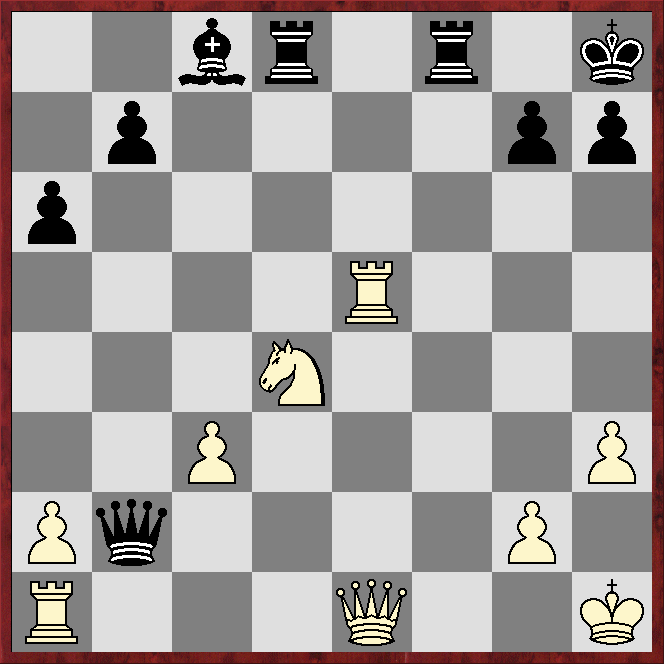
White has two isolated pawns, but the knight is strong, and the black king is probably no safer than the white one
*****
*****
*****
*****
*****
26.a4 Qb6 27.Qg3!? Qd6 28.Rae1 Bd7 29.Qh4 Qf6 30.Qg3 Qf4 31.Qxf4 Rxf4 32.Rd5 Rff8 33.Re7!? Bxa4 34.Rg5 Rd7 35.Rgxg7 Rxe7 36.Rxe7
How would you assess this rook-and-minor-piece ending?
*****
*****
*****
*****
*****
Black has a protected passed pawn that is on the farside from the kings, and has what is usually the better minor piece for cooperating with a rook. But White's rook is much more active, and the knight is well-placed. The engines reckon the position is equal.
36...Rc8 37.Rxb7 Rxc3 38.Ne6 h3
Possible is 38...Rxh3+!? as 39.gxh3 loses to 39...Bc6, but White has 39.Kg1!, eg 39...Rg3 40.Rb8+ Rg8 41.Rb6 Bb5 42.Nc7 etc.
39.Ra7 Bb5 40.Nc7 Rc6 41.Kh2!?
A draw is all but inevitable after 41.Nxb5.
41...Bc4 42.g4 a5!? 43.Ne8?!
Other moves are probably better, including activating the king with 43.Kg3.
43...Ra6 44.Rc7
The minor-piece ending after 44.Rxa6? is almost certainly winning for Black.
How should Black proceed?
*****
*****
*****
*****
*****
44...Bb5
Best, according to the engines, is 44...Bg8!?, after which they reckon Black is at least slightly better.
45.Rc8 Bxe8
Not 45...Kh7 46.Rc7+ Kg6?? 47.Rg7#.
46.Rxe8+ Kg7 47.Re3 a4 48.Ra3 Kf6 49.Kg3 Ke5 50.Kh4 Kd4 51.Kh5 Kc4 52.h4 Kb4 53.Ra1 Kb3 54.g5 hxg5
Not 54...Kb2?? 55.Rxa4 Rax4 56.g6, which wins for White.
55.hxg5 Kb2 56.Rax4 Rxa4 57.g6 Kc3 58.g7 Ra8 ½–½

Saturday, 26 October 2024

Sant Jordi Round Eight

FACED a Fide master.

Daniel Martín Rueda (2251) - Spanton (2013)
Giuoco Piano
1.e4 e5 2.Nf3 Nc6 3.Bc4 Bc5 4.d3 Nf6 5.Nbd2!?
A relatively rare continuation - there are eight more-popular moves in ChessBase's 2024 Mega database - but it has been played by grandmasters.
Relatively rare, but the position occurs 487 times in Mega24
*****
*****
*****
*****
*****
5...0-0 6.h3 d6 7.c3 a6 8.Bb3 Be6 9.Bc2 h6 10.g4!?
How should Black respond to this pawn thrust?
*****
*****
*****
*****
*****
10...Nxg4?!
Apparently a novelty, and almost certainly an unsound one, but it does give practical chances. Sergey Makarichev (2540) - ldar Ibragimov (2580), Russian Team Championship (Kazan) 1995, went 10...Nh7 11.Rg1 d5 12.exd5 Bxd5 13.Ne4 Be7 14.Qe2, with a slight edge for White, according to Stockfish17 and Dragon1 (1-0, 28 moves).
11.hxg4 Bxg4 12.Rg1
DMR spent 24 minutes on this move, which is the top choice of the engines.
12...Qd7 13.Bb3
The engines give best-play as 13.Nf1 f5 14.exf5!? Qxf5 15.d4 Qh5 16.Rxg4!? Qxg4 17.dxc5 Qxf3 18.Bb3+ Kh7 19.Qxf3 Rxf3 20.cxd6 cxd6, when they reckon Black's rook and two pawns are no match for White's two bishops.
13...Kh8 14.Qc2 f5 15.Nh4 Ne7?!
Probably better is 15...Rf6.
16.exf5 Bxf5 17.Nxf5 Bxf2+!?
Sacrificing (temporarily) a third minor piece, but it seems the best move available. There follows a forced sequence ...
18.Kxf2 Qxf5+ 19.Nf3 Qxf3+ 20.Ke1
... at the end of which the engines reckon White's two bishops give at least a slight edge over Black's knight and three pawns.
20...Rf6 21.Qe2
The engines' 21.Qh2!? may be a little stronger.
21...Raf8 22.Be3 Qh3 23.Kd2 Nf5 24.Rae1 Nxe3 25.Qxe3 Rf3
The engines suggest 25...Qxe3+ or 25...Rf2+, but give White the upper hand.
26.Qe4 Qh2+ 27.Kc1 Qf4+ 28.Qxf4 R3xf4
The engines fluctuate between the text and recapturing with the e pawn.
29.Rg2?!
Much stronger, according to the engines, is 29.d4.
29...g5 30.Be6?!
Again the engines prefer pushing the d pawn, or first doubling on the e file with 30.Rge2.
30...Kg7 31.c4?!
The game is equal, according to the engines, after 31.Reg1.
How can Black exploit White's last move?
*****
*****
*****
*****
*****
31...b6
It seems it was time to get the kingside passers rolling, and that can begin immediately with 31...h5!?, one point being 32.Rxg5? runs into 32...Kf6, after which 33.Rxh5 Kxe6 leaves Black a pawn up.
32.Kd2 a5?
Playing on the wrong side of the board, and making it easy for White to open a file there later. The engines reckon 32...h5!? and 32...Kg6 give complete equality.
33.Bd5?!
White has the upper hand after the restraining 33.Rh1, according to the engines.
33...Kf6?
The engines agree 33...g4 is completely equal. The text almost forces White to play the best move.
34.Rh1 Kg7 35.Ke2
The passed duo is fixed, so White ensures there will be no black invasion, and can then decisively open a file on the queenside
*****
*****
*****
*****
*****
35...Rh8 36.a3 Kf6 37.Rgh2 Kg7 38.b4 axb4 39.axb4 Rff8
There is no defence.
40.Ra1 Re8 41.Rf2 Rhf8 42.Rxf8 Kxf8 43.Rf1+!
The sure way to win, whereas 43.Ra8!? Rxa8 44.Bxa8 is unclear, with Dragon1 at first reckoning Black is winning, but coming to see the ending as completely drawn, whereas Stockfish17 also fluctuates, eventually coming to give White the upper hand, and finally deciding White is, after all, winning.
43...Ke7 44.Rf7+ Kd8 45.Rh7 Re7 46.Rxh6 Rg7 47.Kf3 Ke7 48.Kg4 1-0

Tuesday, 14 May 2024

Bregenz Lessons II: Blockaders Can Move!

THE following position was reached in my game from round two of the Bodensee Senioren.
Black has just castled in this Giuoco Piano position, which occurs 1,951 times in ChessBase's 2024 Mega database
*****
*****
*****
*****
*****
*****
The black king's knight is ideally placed on the blockading square d5, and Black is threatening to put pressure on the isolated queen's pawn by playing 11...Bg4.
Accordingly my opponent, rated 2015, played 11.h3!?, reaching a position occurring 264 times in Mega24.
As I noted when I posted the game, whites in the position have included old-time greats Howard Staunton, Johann Löwenthal and George MacDonnell.
In more modern times, specifically the last two years, 11.h3!? has been played by at least four players rated over 2200.
I wonder how many of these players realised the move offers a pawn?
The point is Black can reply 11...Nb6, after which the d pawn cannot be defended.
This is not the end of the world for White, who has a slight lead in development on an open board.
But Stockfish16 and Komodo14.1 prefer Black, who scores an excellent 65% in Mega24.
LESSON: blockaders can move!

Monday, 6 May 2024

Bodensee Senioren Round Two

PLAYED a German.

Horst Prüsse (2015) - Spanton (1902)
Giuoco Piano
1.e4 e5 2.Bc4 Bc5!? 3.Nf3 Nc6 4.c3 Nf6 5.d4 exd4 6.cxd4 Bb4+ 7.Bd2 Bxd2+ 8.Nbxd2 d5 9.exd5 Nxd5
This well-known position occurs 4,716 times in ChessBase's 2024 Mega database
*****
*****
*****
*****
*****
10.0-0
The mainline in Mega24 runs 10.Qb3 Nce7 11.0-0 0-0 12.Rfe1 c6, when White has at least the better side of equality, according to Stockfish16 and Komodo14.1.
10...0-0
With both sides castled, how should White proceed?
*****
*****
*****
*****
*****
11.h3!?
This sacrifices, or more likely, in many cases, drops, a pawn, but it has been played by the likes of Howard Staunton, Johann Löwenthal and George MacDonnell. However none of their opponents replied with what the engines reckon is the best move:
11...Nb6!
It is easy to overlook this possibility, which removes a blockader and leaves the black kingside looking somewhat bare.
12.d5 Nxd5
The engines slightly prefer 12...Nb4!?
13.Ne4 Nf6!?
This may be a novelty. Known moves are 13...Nce7 and especially 13...Nb6. After the latter, which is also the engines' choice, play might continue 14.Bb3 a5 15.Qc1!? a4 16.Bc2 h6, when the engines reckon White does not have enough for a pawn, but it is easy for Black to go wrong.
14.Qxd8 Nxd8
The engines slightly prefer 14...Rxd8 15.Neg5 Rf8!?
15.Nxf6+ gxf6 16.Rfe1 Be6 17.Rac1!? Bxc4 18.Rxc4 Ne6 19.Nd4!?
This is good enough for a draw, as is 19.Rg4+ and probably other moves.
19...Nxd4 20.Rxd4 Rfe8 21.Kf1 Rxe1+ 22.Kxe1 Re8+ 23.Kd2 Re6 24.Rg4+ Kf8 25.Rh4 Kg7 26.Rg4+ Kh8 27.Rc4 c6 28.Rd4 Re7 29.Rf4 Kg7 ½–½

Saturday, 30 March 2024

Fagernes Round Eight

Bjørn Dybvik (1656) - Spanton (1876)
Giuoco Piano
1.e4 e5 2.Nf3 Nc6 3.Bc4 Bc5 4.0-0 Nf6 5.d3 d6 6.h3 Na5!? 7.Bb3 Nxb3 8.axb3 a6
After a little flurry of action, how would you assess the position?
*****
*****
*****
*****
*****
Black has the bishop-pair, at least temporarily, but White has a half-open a file and a slight lead in development. Stockfish16 and Komodo14.1 reckon the game is equal.
9.Bg5!?
White could get rid of the bishop-pair with the apparent-novelty 9.Be3, but the text is perhaps more ambitious.
9....h6 10.Bh4 Be6
The engines reckon 10...g5!? gives Black a slight edge.
11.d4!? exd4 12.Nxd4
12.Qd3!? gives White just about enough compensation for a pawn, according to the engines.
12...g5 13.Nxe6
The engines prefer 13.Bg3 Nxe4 and either 14.Nc3 or 14.b4!?, the point about the latter being 14...Bxb4?? loses to 15.Nxe6 fxe6 16.Qd4.
13...fxe6 14.Bg3 Nxe4 15.Qh5+?!
White should move the king, either to h1 or h2, according to the engines, but Black would have the upper hand.
15...Kf8?
Black has a large advantage after 15...Kd7 as 16.Qf7+ is simply met by 16...Qe7.
16.Qf3+ Nf6 17.Qxb7 Kg7!?
The engines fluctuate between the text and 17...a5.
18.Rxa6 Rxa6 19.Qxa6
How would you assess this imbalanced middlegame?
*****
*****
*****
*****
*****
Black has pressure against the white king's position, and the white bishop is restricted, but it is the black king that is more exposed. Meanwhile White is a (doubled) pawn up. The engines for quite some time give White a slight edge, but come to call the position more-or-less equal.
19...Rf8 20.Qe2 e5 21.Nc3 Bd4 22.Nd1 Qe8 23.c3 Bb6 24.Ne3 Qf7?!
Probably better is 24...Ne4.
25.c4?!
Much harder to meet is 25.Nc4, eg 25...Ba7 can be answered by 26.Ra1, and after 25...Nh5 26.Bh2 the black bishop virtually has to withdraw at a7 anyway. True, the white rook cannot then take the a file, but the engines reckon 27.b4 gives at least a slight edge.
25...Ne4 26.Bh2 h5!?
This looks risky, but it keeps white pieces off the g4 and h5 squares.
27.Nd1 Nc5?
White gets an initiative after this. Instead 27...Qf5 or 27...Qg6 leaves Black with  full compensation for a pawn, according to the engines.
28.b4 Ne6 29.c5 Ba7 30.Qa6 Bb8
In three moves Black has gone from having an active bishop pressing on the white king's position to having a bishop so passive it is worse than its opposite number
*****
*****
*****
*****
*****
31.Nc3 Nd4 32.Ne4 Qf5 33.Ng3 Qg6 34.Ne2 Nf5 35.Qd3 Qf6
The engines prefer 35...g4, but give White at least the upper hand.
36.Ng3 Nxg3 37.fxg3?
A major misreading of the coming bishop-and-pawn ending.
37...Qxf1+ 38.Qxf1 Rxf1 39.Kxf1 c6!?
One of several moves that give complete equality, according to the engines.
40.g4!? hxg4 41.hxg4
The engines reckon 41.cxd6 and 41.b5!? maintain complete equality, eg 41.cxd6 Bxd6 42.b5!? cxb5 43.hxg4. Their point is that after the text Black can play 41...d5, which at first they believe gives a slight edge. But Stockfish16 comes to evaluate the position as still equal, while Komodo14.1, although preferring Black, cannot seem to make progress.
41...Kf6 42.Kd2 Kd6 43.Kd3 Kd5 44.cxd6 Bxd6 45.Bg1 Bxb4
Black has restored material equality, and has a passed pawn, but cannot make progress, according to the engines, who again call the game completely equal
*****
*****
*****
*****
*****
46.Be3 Be7 47.b3 e4+ 48.Kd2 Bf6 49.Kc2 Ke5 50.Kd2 Bd8 51.Kc2 Kf6 52.Kc3 Ke5 53.Kc4 Be7 54.Kc3 Kd5 55.Kd2 c5!?
Putting another pawn on a dark square, but I do not believe there is any other way to try to make something happen.
56.Kc3 Bf6+ 57.Kd2 Kc6 58.Kc2 Kb5 59.Bd2 Be7 60.Kb2 c4
What should White play?
*****
*****
*****
*****
*****
61.b4?!
Many moves hold the draw easily, including Kc2, Bc1, Be3 and g3. The text may also draw, but makes the position tricky for White.
61...Bf6+
Perhaps 61...Ka4 is a better try, but 62.Kc2 Bxb4 63.Bxg5 is equal, and it is not clear Black can improve. Komodo14.1 likes 62...Bf6, but Stockfish16 reckons 63.b5!? Kxb5 64.Be3 holds, and Komodo14.1 more-or-less agrees that it gives Black only a slight edge.
62.Kc2 Ka4
White to play and draw
*****
*****
*****
*****
*****
63.Be1?
White has to be prepared to give up the b pawn, eg 63.b5!? Kxb5 64.Be3, the key to the draw being to maintain the blockade of the e pawn by the bishop and the c pawn by the king. Therefore 63.Be3!? and 63.Bc1 also draw.
63...e3 64.Kd1
This loses, but there is no defence as giving up the b pawn no longer works, eg 64.b5 Kxb5 65.Bg3 Kb4 66.Be1+ c3 67.Bg3 Kc4 transposes to a lost position that arises in the game.
64...c3 65.Kc2 Kxb4 66.Bg3 Kc4 67.Be1
Or 67.Bc7 e2 68.Bg3 Kd4 69.Bf2+ Ke4 70.Bg3 Ke3 71.Be1 Be5, when White is in zugzwang.
67...Be5 68.Kd1 Kd3 69.Kc2 Ke2 0-1