Showing posts with label Fareham. Show all posts
Showing posts with label Fareham. Show all posts
Monday, 17 March 2025
Summing Up Fareham
MY score in the Fareham open of +1=4-0 (I also took a halfpoint bye) gained 18.2 ECF elo.

Fareham Round Six
THIS game sees me playing the same opponent as in round five, but with colours reversed - not so surprising in a six-round swiss with only five entries.
*****
*****
Spanton (1984) - Daniel Sullivan (2051)
Caro-Kann Tartakower
1.e4 c6 2.d4 d5 3.Nc3 dxe4 4.Nxe4 Nf6 5.Nxf6+ exf6!?
 |
| Very much the fashion - Black gets easy development and a kingside pawn-majority, at the expense of conceding White a queenside pawn-majority and central space |
*****
*****
*****
*****
White's majority is an endgame asset - a sort of mirror image of the structure that arises in the Exchange Variation of the Spanish.
Black's majority, as I understand it, has two points. The first is that, in the event of opposite-side castling (Black on the kingside, White on the queenside), Black's wall of pawns on the kingside will give the black king good protection.
The second point is that if White castles kingside, Black can advance the kingside pawns in relative safety, creating attacking chances backed by Black's easy development.
For what it is worth, Stockfish17 and Dragon1 reckon White is slightly better.
6.c3 Bd6 7.Bd3 0-0 8.Ne2
More popular in ChessBase's 2025 Mega database is 8.Qc2 and then 9.Ne2.
8...Nd7
The main line in Mega25 runs 8...Re8 9.0-0 Nd7, reaching the same position as in the game via a minor transposition.
9.0-0 Re8 10.Ng3
Here, marginally more popular is 10.Bf4 Nf8 11.Bxd6 Qxd6, and now 12.Ng3.
Here, marginally more popular is 10.Bf4 Nf8 11.Bxd6 Qxd6, and now 12.Ng3.
10...g6 11.Re1 f5!?
This may be a novelty. The engines are happy with it, and with the known 11...Rxe1+
12.Bd2 Nf8 13.Rxe8 Qxe8 14.Qf3 Be6 15.Re1 Qd8 16.a3
Playable is the desirable 16.c4, as 16...Bxg3?! 17.Qxg3 Qxd4 18.Bc3 gives White excellent compensation for a pawn.
16...Bd5 17.Qe2 b5!?
 |
| How should White proceed? |
*****
*****
*****
*****
18.c4?!
It seems manoeuvring with 18.Nf1!? or 18.Qd1!? is better.
18...bxc4 19.Bxc4 Bxg3?!
18...bxc4 19.Bxc4 Bxg3?!
Black is at least slightly better after 19...Bc7!? or 19...Ne6, according to the engines.
20.hxg3 Ne6 21.Bc3 h5!? 22.Bxd5 Qxd5
The engines prefer 22.cxd5!?
23.Qe5 Qxe5
As DS pointed out in the postmortem, Black is in trouble after 23...Rd8? 24.Qf6.
24.Rxe5 Rd8 25.Ra5 Rd7
Perhaps 25...Nxd4 is marginally better.
26.Ra6 Rc7?!
Passive rook play in endings is nearly always a mistake, when there is an active alternative, which here means 26...Nxd4.
27.Ba5 Rb7
This is much better than continuing passivity with 27...Rc8?, when 28.Rxa7 Nxd4 29.a4 is very dangerous for Black.
28.Rxc6 Nxd4!
The best move in a tricky position.
29.Rc8+ Kh7 30.Rd8?
Throwing away White's advantage. After 30.Rc7 Rxb2 (probably not 30...Rxc7?! 31.Bxc7) 31.Rxf7+ Kg8 32.Rxa7 White is no more than slightly better, according to the engines, but has the only winning chances. Note that 30.Bc3? is easily countered by 30...Ne2+ etc.
30...Nc6 31.Rd5 Nxa5
DS offered a draw.
32.Rxa5 Rxb2 33.Rxa7 Rb1+ 34.Kh2 Kg7 35.a4 Rb2 36.f3 Rb1 37.a5 Ra1 38.Ra8 g5 39.a6 g4 40.fxg4 hxg4 41.Ra7 ½–½
Fareham Round Five
Daniel Sullivan (2051) - Spanton (1984)
*****
*****
*****
*****
*****
*****
*****
*****
Réti
1.c4 e6 2.Nf3 d5 3.g3 d4!?
This is only fifth-most popular in ChessBase's 2025 Mega database (3...Nf6 is normal) but has been played by Magnus Carlsen.
4.Bg2 c5
 |
| Starting the game with four pawn moves looks suspicious, especially for Black, but there seems no way for White to immediately take advantage |
*****
*****
*****
*****
5.0-0 Nc6 6.e3 Nf6 7.exd4 cxd4 8.d3 Be7 9.Na3!? Bxa3!? 10.bxa3 0-0
 |
| Now both sides have castled, how would you assess the position? |
*****
*****
*****
*****
White's bishop-pair is pitted against Black's better pawn-structure and central space. Stockfish17 and Dragon1 reckon White is slightly better.
11.Re1 Nd7!?
Fighting to get in ...e5. After 11...Re8 12.Bf4 the move 12...Nd7 can be met by 13.Bd6!?, although the bishop may not be very stable on such an advanced post. However Dragon1 points out the possibility of 12...Ng4 13.h3 e5!?
12.Rb1 e5
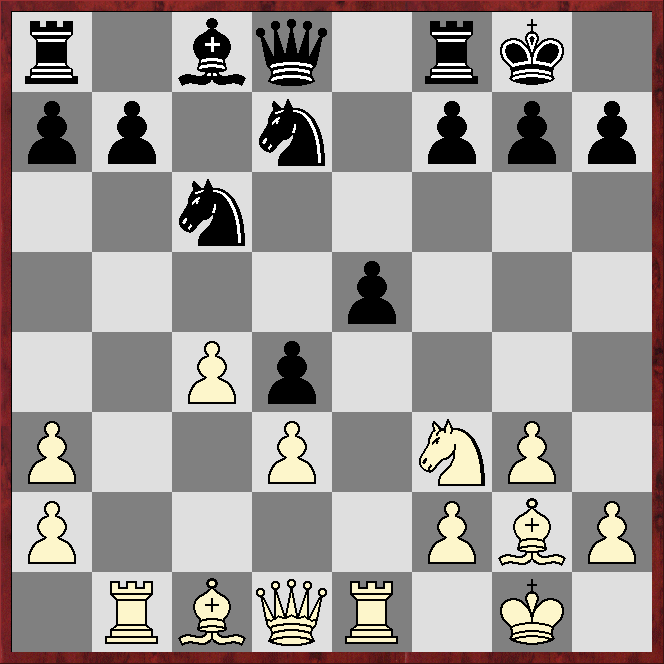 |
| Achieving the aim, but at a high cost in time - the engines reckon White is at least slightly better |
*****
*****
*****
*****
13.Ng5 h6 14.Ne4 Nf6
The engines reckon this is an improvement over the known move 14...Qc7?!, which is probably too passive. They also like the ambitious 14...f5!?
15.f4 Re8 16.Qf3
The engines suggest 16.a4!?, although not with the idea of developing the dark-square bishop to a3 (it goes to f4 or d2 in most lines). Presumably the point is to simply gain queenside space, and perhaps to take the b5 square away from Black in the event of White playing c5.
16...Nxe4 17.Qxe4 Rb8
The engines reckon 17...Qf6 gives equality.
18.f5!? f6 19.Qg4
 |
| How should Black respond? |
*****
*****
*****
*****
19...Ne7!
The only move to keep the game going. Any move of the king loses a piece to 20.Bxc6 etc.
20.Be4
After 20.Bxh6 Nxf5 21.Bd5+ Kf8 22.Bd2 Ne7 (White threatened 23.Bb4+) Black is holding on.
20...Kh7 21.Qh5 Rf8
Probably not 21...Rg8?! 22.Bxh6!? gxh6 23.Qf7+ Rg8 24.Qxf6 Nc6 (forced) 25.Qxd8 Nxd8 26.f6+.
22.g4 Qe8 23.Qh3 Kg8 24.Qg2 Qd7 25.c5!? Qc7 26.Qc2?!
The engines reckon 26.Bd2!? gives equal chances, the point being 26...Qxc5?! is incredibly risky in view of 27.Bb4 Qc7 28.Rec1.
26...Bd7 27.Bd2 Rfc8 28.Qc4+ Kh7
 |
| How should White proceed? |
*****
*****
*****
*****
29.Rec1?!
Probably better is 29.Qf7, meeting 29...Be8 with 30.Qe6. Black has to be careful, eg 29...Nc6? can be met by 30.Bxh6!?, and by the even stronger 30.g5!, when 30...hxg5? allows mate by 31.Qh5+ Kg8 32.Bd5+ etc.
29...Bc6 30.Bxc6?!
And here the engines prefer going for counterplay with 30.h4 or 30.Qf7.
30...Qxc6 31.Kf2 Qd5?!
30...Qxc6 31.Kf2 Qd5?!
Black is well on top after 31...Nd5, according to the engines.
32.Qb3?!
The engines reckon getting the queens off the board gives equality.
32...Rc7?! 33.Qxd5! Nxd5
 |
| The queenless late-middlegame is roughly equal, according to the engines |
*****
*****
*****
*****
34.Rc4?!
But it is probably easier for Black to play. Correct seems to be getting on with centralising the king by 34.Kf3, and if, as in the game, 34...Rbc8, then 35.h4 is fine as 35...Rxc5 36.Rxc5 Rxc5 37.Rxb7 is completely equal, according to the engines.
34...Rbc8 35.Rbc1 Kg8?!
The engines like 35...Ne7 and 35...h5!?, eg 35...h5!? 36.h3 (36.gxh5 Ne7) g6 as Black is better placed to take advantage of open lines on the kingside.
36.Ra4?
Much better is 36.Kf3.
36...b6 37.cxb6 axb6?
Black has a large advantage after 37...Rxc1, eg 38.bxa7 Rh1! 39.a8=Q Rxa8 40.Rxa8+ Kh7, one continuation being 41.a4 (41.Kg2 Rd1) Rxh2+ 42.Ke1 Rh1+ 43.Ke2 Ra1 44.Kf3 Rxa2 45.Be1 Nf4 etc. Alternatively 37...Bxc1? can be simply met by 38.Nxb6, when both the white rook and bishop hang.
38.Rac4 Nc3?
This loses a pawn, whereas after 38...Rxc4 39.Rxc4 Ra8 40.a4 Kf7 Black may have a slight edge.
39.Bxc3 dxc3 40.R1xc3 Rxc4 41.dxc4
 |
| How would you assess this rook-and-pawn ending? |
*****
*****
*****
*****
White's extra pawn is doubled, while Black has a protected passer - completely equal, according to the engines.
41...b5 42.c5 Kf7 43.Ke3 Ke7 44.Ke4 Rd8 45.Rb3 Rd4+ 46.Kf3 Kd7 47.Rxb5 Kc6 48.Ra5 Rf4+ 49.Kg3 Rc4?
Despite Black being two pawns down, the game remains completely equal after 49...h5 50.h3 hxg4 51.hxg4 Rf1, according to the engines.
50.Ra7 Kxc5 51.Rxg7 Kd4 52.Rg6
Even stronger seems to be 52.Rf7!?
52...e4?
Better is 52...Rc3+ 53.Kh4 Rc6, holding on to the f pawn. The reason Rf7 was probably stronger than Rg6 at move 52 is that after 52.Rf7!? Rc3+ 53.Kh4 Rc6 the white rook is ready to get behind the black e pawn.
53.Rxf6 Rc3+ 54.Kh4 e3 55.Re6 Rc2 56.Kg3 Kd3 57.h4 Rf2
 |
| White to play and win |
*****
*****
*****
*****
58.f6?
Both 58.Rxh6 and 58.h5 win easily.
58...Ke2
Black has a drawing net.
59.g5 h5 60.f7 Rf3+ 61.Kg2 Rf2+ 62.Kg3 ½–½
Sunday, 16 March 2025
Fareham Round Four
TOOK a halfpoint bye in round three.
Sicilian Maróczy Bind
1.e4 c5 2.Nf3 g6 3.c4!?
Ensuring White will get a Maróczy Bind.
3...Nc6 4.d4 cxd4 5.Nxd4 Bg7 6.Be3 Nf6 7.Nc3 d6 8.Be2 0-0 9.0-0
 |
| How would you assess this position. which occurs 19,854 times in ChessBaase's 2025 Mega database? |
*****
*****
*****
*****
White's space advantage gives a slight edge, according to Stockfish17 and Dargon1.
9...Bd7 10.f3!?
This has been played by many strong players, including Capablanca, Alekhine, Kramnik and Short, but more popular are 10.Rc1 and especially 10.Qd2.
 |
| How should Black respond? |
*****
*****
*****
*****
10...Qb6!?
The engines prefer the main continuation, 10...Nxd4, meeting 11.Bxd4 by offering an exchange of dark-square bishops with 11...Nh5!? (Dragon1 also likes 11...a6). After 12.Bxg7 Nxg7 White is left with a bad bishop, and will not find it easy to exploit the weakening of the black king's position. Nevertheless the engines give White an edge.
 |
| How should White meet Black's queen development? |
*****
*****
*****
*****
11.Na4
This is the most popular continuation in Mega25, but the engines slightly prefer 11.Kh1!?, when 11...Qxb2!? allows the queen to be trapped after 12.Na4, eg 12...Qb4? 13.Bd2 Qa3? 14.Nb5, or 12...Qa3?! 13.Bc1, when 13...Qb4 14.Bd2 transposes to the previous line. The engines suggest 12...Qxa1!? 13.Qxa1 Nxd4 14.Bxd4 Bxa4, when Black has rook, knight and pawn for the queen, but the engines give White the upper hand.
Far from clear is 11.Qd2!? Nxe4!?, although after the fireworks of 12.Nxc6 Nxd2 13.Nxe7+ Kh8 14.Bxb6 Nxf1 15.Bf2 Bxc3 16.bxc3 Rae8 (16...Rfe8?? 17.Bd4+ f6 18.Bxf6#) 17.Bd4+ f6 18.Nd5 Rxe2 19.Nxf6 Rxf6 20.Bxf6+ Kg8 21.Kxf1, the resulting position is completely equal (but there were many chances to go wrong along the way).
11...Qa5 12.Nxc6
The engines prefer 12.Nb5 or 12.Nc3, claiming a slight edge for White.
12...bxc6 13.c5!?
This had been seen in Ninh Ngo (no Fide) - Minh Hoang Pham (2479), Hanoi 1995, which continued 13...Rfd8 14.Bd2 Qc7 15.Bf4 Be6 16.Qc2, with an equal game, according to the engines (but 0-1, 59 moves).
13...d5!?
The engines reckon this is an improvement on that game.
14.e5 Ne8 15.f4 Rb8 16.b3 f6 17.Bd4?!
The engines give 17.Bg4!? Bxg4 18.Qxg4 Nc7 19.f5 with attacking chances, although they prefer Black.
17...Qc7?!
The engines reckon 17...fxe5 18.fxe5 Rxf1+ 19.Qxf1 Qd2 is very good for Black.
18.Bg4?
Too late! Instead 18.exf6 Bxf6 19.Qd2 leaves White only slightly worse, according to the engines.
18...fxe5 19.fxe5?!
Probably better is 19.Bxd7 Qxd7 20.Bxe5.
19...Rxf1+ 20.Kxf1 Rb4!?
The engines agree this is best.
21.Rc1 Qc8
Even stronger seems to be 21...Bxe5!? 22.Bxe5 Qxe5, although the engines are not sure how to meet 23.Bxd7. One line runs 23...Nf6 24.Qd2!? Rf4+ 25.Kg1 Nxd7, after which Black is a pawn up, has the better coordinated pieces and a pair of passed pawns. Trying to hold on to the extra piece with, for example, 24.Bh3 runs into 24...Rf4+ 25.Kg1 Qe3+ 26.Kh1 Ne4.
22.Bf3 Bh6!? 23.Rc3 Ng7 24.a3 Rb8
Sacing the exchange with 24...Rxd4!? 25.Qxd4 Nf5 is also tempting, but the engines disagree as to whether it is better than the text.
25.Nb2?
The engines suggest making the king safer with 25.Kg1, or opposing Black's dark-square bishop with 25.Be3, or advancing on the queenside with 25.b4.
25...Qa6+ 26.Nd3 Nf5 27.Bf2
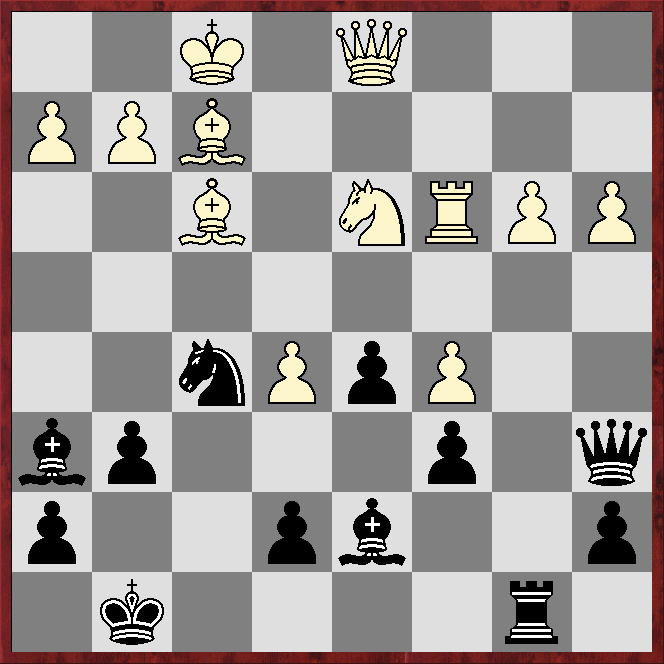 |
| How should Black proceed? |
*****
*****
*****
*****
27...d4?!
Simply taking the a3 pawn is good, but the engines also like 27...Ne3+ 28.Bxe3 Bxe3.
28.Rc4 Ne3+ 29.Bxe3 Bxe3 30.Ra4 Qb7 31.Rb4 Qc7 32.Rxb8+ Qxb8
 |
| Black has the bishop-pair and is slightly better, according to the engines, but White has queenside play |
*****
*****
*****
*****
33.b4 Qf8 34.Ke2
The engines suggest first playing 34.Qb3+, meeting 34...Kg7 with 35.Ke2.
34...Qf7 35.Qc2 g5?!
Black should slow White's queenside play with 35...a6, according to the engines.
36.a4?!
This may be too slow. Instead 36.b5! cxb5 37.c6 gives complete equality, according to the engines.
36...a6?!
The engines like 36...g4 37.Be4 Qh5, and if 38.b5 then 38...Bf5!?
37.b5 axb5 38.a5?
White has complete equality after 38.axb5, according to the engines.
38...g4 39.Be4 Be6?!
Best may be 39...Bc8!?, and if 40.Bxc6 then 40...b4, eg 41.Be4 Ba6 42.Ke1 (Black's threats included 42...Qf2+) b3 43.Qb2 Qc4 etc. Instead White should probably play the immediate 40.Ke1, although Black seems to remain on top in a sharp position.
40.a6 Bb3 41.Qb1?!
The engines reckon 41.Qb2 maintains equal chances.
41...Bc4
 |
| White to play and lose |
*****
*****
*****
*****
42.a7??
This allows mate in two.
This allows mate in two.
White had to play 42.Ke1, when the engines agree the best reply is 42...e6, but their evaluation of the position fluctuates wildly, albeit coming to give Black the upper hand.
42...Qf2+ 0-1
Fareham Round Two
Spanton (1984) - Tony Wells (2000)
*****
*****
*****
*****
Spanish Cozio
1.e4 e5 2.Nf3 Nc6 3.Bb5 Nge7 4.Nc3
This is third in popularity in ChessBase's 2025 Mega database, behind 4.c3 and especially 4.0-0.
4...Ng6 5.d4 exd4 6.Nxd4 Bc5
Stockfish17 and Dragon1 prefer the more popular 6...Nxd4!? 7.Qxd4 c6 with ...Qb6 to come.
7.Be3 Nxd4 8.Bxd4 Bxd4 9.Qxd4 0-0 10.0-0-0
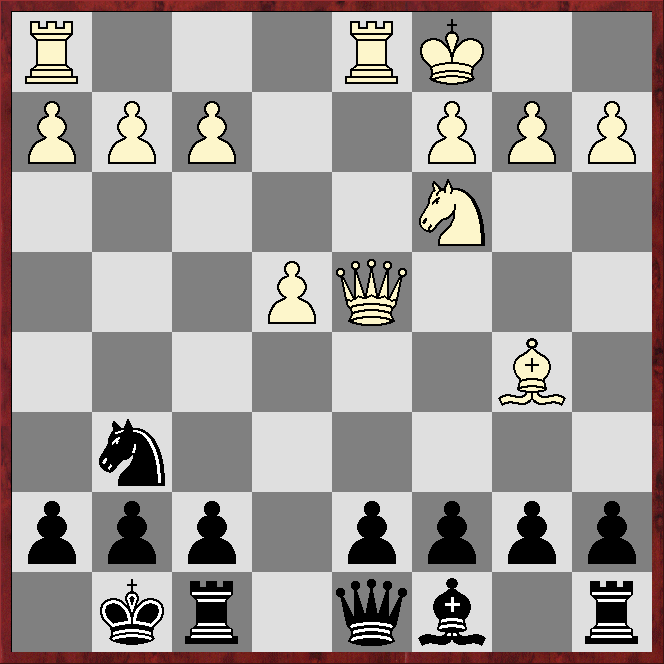 |
| Now both sides have castled, how would you assess the position? |
*****
*****
*****
*****
White's large lead in development, and central space, give the upper hand, according to the engines.
10...d6 11.h4!?
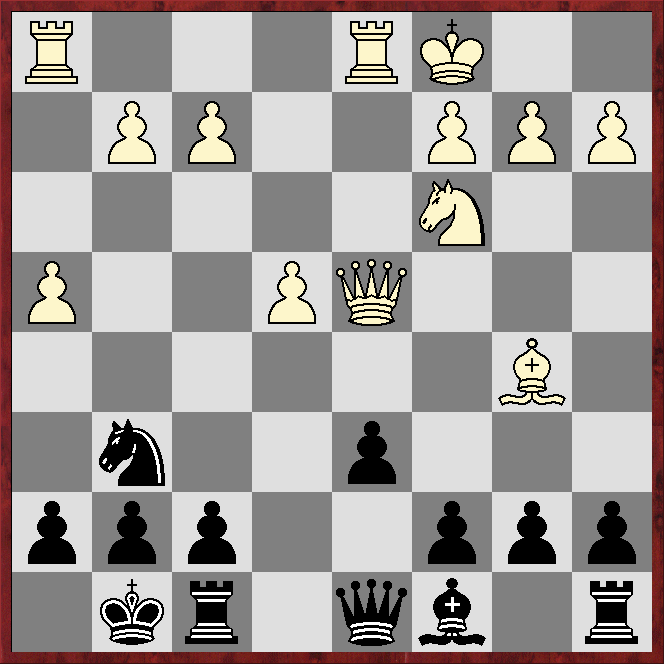 |
| How should Black react to this pawn thrust? |
*****
*****
*****
*****
11...Ne5!?
Romuald Mainka (2515) - Sergey Arkhipov (2515), Lippstadt (Germany) 1993, went 11...Nxh4 12.Qe3 Ng6 13.Qg3 c6!? 14.Rxd6 Qe7, and now 15.Bd3 would have left White with a winning advantage, according to the engines.
The text, which may be a novelty, is not liked by the engines. They suggest 11...a6 12.Be2 Nf4, but give White the upper hand.
12.f4 Ng4!? 13.h5 h6 14.Be2 a5 15.e5 a4!? 16.exd6 cxd6 17.Qxd6 Qa5!?
The engines prefer 17...Qxd6, but after 18.Rxd6 Black has no compensation for being a pawn down.
18.Rd5 Qa7 19.Qc5?!
The engines like 19.a3 or 19.Rd4.
19...Ne3?!
The engines much prefer 19...a3, albeit giving White a winning advantage.
20.Qxa7 Rxa7 21.Rd4 a3 22.Re4?!
White's advantage is a lot smaller after this. Probably best is 22.b3.
22...axb2+ 23.Kxb2 Nf5 24.Rd1?
Losing most of the rest of White's advantage. The engines give 24.Re1 Ng3 25.Re7 Nxe2 26.R1xe2, and if 26...Bg4 then 27.R2e5.
24...Ng3 25.Re5 Nxe2 26.Nxe2 Bg4 27.R1d5 Be6?!
The rook endgame after 27...Bxe2!? 28.Rxe2 Rfa8 sees Black win the pawn back and gain complete equality.
28.Ra5 Rxa5 29.Rxa5 Rd8 30.f5 Bd5 31.Nf4 Bc6 32.Ra3?!
White has a large advantage after 32.c4!, the point of which will soon become clear.
32...Rd2?
Black should be getting the king into play with ...Kf8.
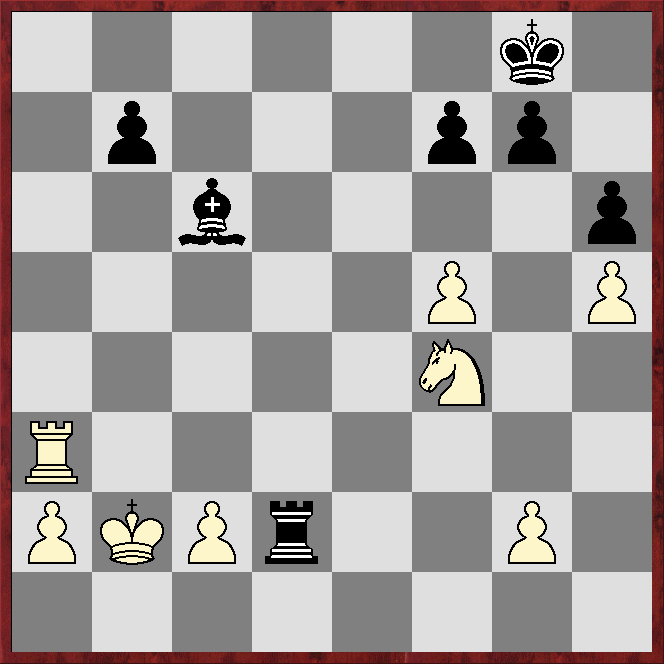 |
| How should White proceed? |
*****
*****
*****
*****
33.Rd3
White is better after this, but it misses a spectacular win with 33.Ra8+ Kh7 34.Ng6!!
33...Rf2? 34.Nd5?
Again missing the spectacular mate, this time starting with 33.Rd8+.
34...Kf8 35.Ne3 Ke7 36.g4 Rf4 37.Kc3 Ra5 38.Kb3 Re4
 |
| White remains a pawn up, but the vulnerability of the white pawns, and the superior combination of rook-and-bishop against rook-and-knight, mean Black has full compensation, according to the engines |
*****
*****
*****
*****
39.c4 Re5?!
But this is problematic. Instead Black should continue activating the king with 39...Kf6.
40.Kc3?!
Almost certainly better is 40.Nd5+, eg 40...Bxd5 41.Rxd5 Re4 42.Rb5, when White's queenside pawns will decide the game. The engines suggest 40...Kd6!?, not fearing a discovered check, but give White the upper hand.
40...Ra5 41.Kb3 Be4?
The engines reckon 41...Kf6 maintains equality.
42.Nd5+?!
Moving the attacked rook is probably better.
42...Kd6!
There is nothing immediate to fear from a discovered check.
43.Rd4?
White keeps some advantage with 43.Rd2, and if, as in the game, 43...Bxd5, then 44.Kb4! Better is 43...Bf3, but 44.g5! is strong as 44...hxg5 runs into 45.f6!, and 44...Bxh5 can be met by 45.Kb4 (the immediate 45.Nf6+ also wins). The engines suggest meeting 44.g5! with 44...Ke5, but 45.f6 gxf6 46.gxh6 Ra8 47.Nxf6! gives at least a slight edge.
43...Bxd5 44.Rxd5+ Rxd5 45.cxd5 Kxd5 46.Kb4 Kb6 47.a4 Kb6 48.a5+ Ka6
TW offered a draw.
49.Ka4 b6 50.axb6 Kxb6 51.Kb4 f6 52.Kc4 ½–½
Saturday, 15 March 2025
Fareham Round One
Jaimie Wilson (2159) - Spanton (1984)
*****
*****
*****
Giuoco Piano
1.e4 e5 2.Nf3 Nc6 3.Bc4 Bc5 4.d3 Nf6 5.c3 d6 6.0-0 Be6!?
This is a common idea in the Giuoco Piano, but it is unusual to see it this early.
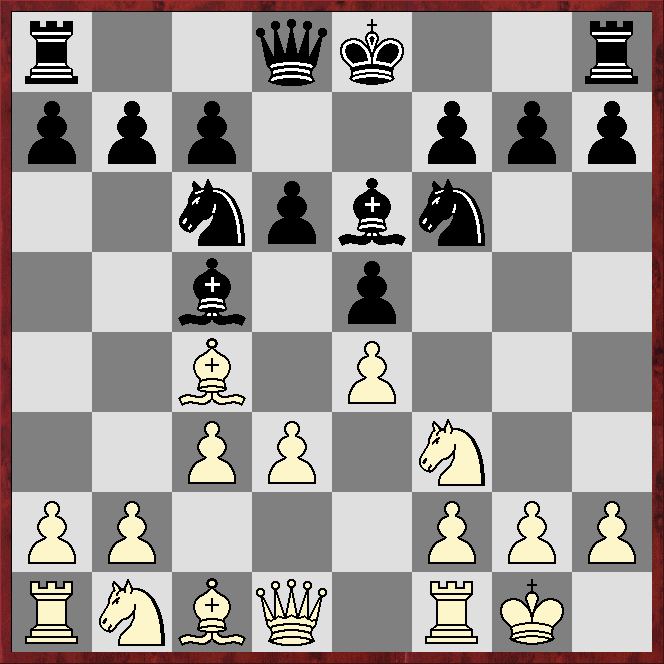 |
| How should White respond? |
*****
*****
*****
*****
7.Nbd2
The main move in ChessBase's 2025 Mega database is 7.Bb3, while Stockfish17 and Dragon1 like 7.Bxe6 fxe6 8.b4!? Bb6 and either 9.a4 or 9.Qb3. Note that 8.Qb3 can be met by 8...Qc8!?, and if 9.Ng5 then 9...Nd8!? or 9...d5, but the engines strongly dislike the gambit move 8...Qd7?!
7...0-0
7...0-0
This is the commonest move in Mega25, but the engines prefer 7...a6 or 7...a5.
8.b4!?
The engines marginally prefer this over 8.Bxe6.
8...Bb6 9.Bxe6 fxe6 10.Nc4!? Ne7?
The engines suggest 10...a6!?, but agree 11.Nxb6 cxb6 leaves White better.
11.Qb3!?
This may be a novelty. The engines prefer it over the known 11.a4.
11...Qc8!?
The engines prefer 11...Qd7, but either way Black is in trouble.
12.a4 a6 13.Ng5 d5?
Correct is 13...Ba7, albeit White is better.
14.Nxb6!?
This is enough for an advantage, but the engines reckon 14.Nxe5 is winning.
14...cxb6 15.f4?!
Black gets interesting counterplay after 15.Be3, eg 15...h6 16.Nf3 Ng6 17.Bxb6 Qc6, although White seems to be better. However the engines like attacking d5 with 15.c4!?
15...h6?!
Black is at least equal after 15...exf4 16.Bxf4 h6, according to the engines.
16.fxe5 Ng4 17.Rxf8+ Qxf8 18.Nf3 Ng6 19.Bd2!?
The engines reckon this quiet developing move is best.
19...N6xe5 20.Rf1 Qd8!? 21.h3 Nxf3+ 22.Rxf3 Nf6 23.e5 Nd7 24.d4 Rc8
 |
| How would you assess this late-middlegame? |
*****
*****
*****
*****
White's bishop is technically bad, because so many white pawns are on dark squares, but quite active, and White has the open file. The engines give White a slight edge.
25.Qd1 Qe8 26.Rg3 Kh8 27.Qg4 Qf7 28.Rf3 Qe8
Not 28...Qg8? as 29.Qh4 is strong, eg 29...Rf8 30.Rg3 Rf7 31.Bxh6! Qh7 32.Qd8+.
29.Qh4
The engines prefer 29.Rg3.
29...Kh7 30.g4 Nf8 31.Qf2
The engines recommend 31.Qh5!? Qxh5 32.gxh5, claiming equality.
31...Kg8 32.g5?! Qg6
Possibly slightly stronger is 32...h5.
33.Kh2 h5 34.Qe2 Nh7 35.Kg2?
White should probably play 35.h4, although the exposed state of the white king means Black is better.
 |
| How can Black exploit White's last move? |
*****
*****
*****
*****
35...Nxg5! 36.Bxg5
Not 36.Rg3? Qe4+.
36...Qxg5 37.Rg3 Qf5 38.Rf3 Qg6+ 39.Rg3 Qf7 40.Rf3 Qe8!?
The engines reckon the black queen should be kept active, eg 40...Qg6+ 41.Rg3 Qh6 42.Rf3 Rf8 43.Rxf8+ Kxf8, claiming Black is winning.
41.Rg3?
Better is the engines' 41.Qc2.
41...Kh7?!
Black is still better after this, but it seems ...Qxa4 is good, either immediately or after ...h4.
42.Qd3+ g6?
This throws away Black's advantage by weakening f6. Instead 42...Kg8!? gives at least the upper hand, according to the engines.
43.Rf3 Qg8 44.Rf6 Rf8 45.Qf3 Kg7 46.h4 Rf7 47.Qf4 Qf8 48.Rxf7+ Qxf7 49.Qg5 Qf5
There is nothing better, but now White can swop off into a drawn pawn-ending, despite being a pawn down and giving Black a protected passer.
50.Qxf5!? gxf5 51.Kg3 Kh6 52.Kf3 b5 53.a5
Not 53.axb5? as after 53...axb5 Black wins thanks to the b pawn giving a reserve tempo, eg 54.Kf4 Kg7! 55.Kf3 f4! 56.Kxf4 Kg6 57.Ke3 Kf5 58.Kf3 b6 59.Kg3 Ke4 60.Kh3 Kf3 etc.
53...f4!?
One last try.
54.Kxf4 Kg6 55.Kg3
But not 55.Kf3? Kf5 etc.
55...Kf5 ½–½
Friday, 8 October 2021
Lessons From Fareham V
Spanton (1979 ECF) - John F Wheeler (1983 ECF)
*****
*****
Fareham Open Round 6
Pirc
1.d4 Nf6 2.Nc3 g6 3.e4 d6 4.Nf3
This introduces the Classical System in the Pirc. It scores just 52% in ChessBase's 2021 Mega database, well behind almost every other try, including the 57% of 4.f4, the 58% of 4.f3 and the 60% of both 4.Be3 and 4.Bg5.
4...Bg7 5.Be2 0-0 6.0-0 c6!?
This is easily the most-popular continuation in Mega21, reducing White's score to 51%
7.a4
But this increases the white score to 53%, which probably goes to show that fixating on minor statistical differences early in the opening is not productive (but I find it interesting!).
7...Qc7
A common black plan in the Pirc is to play ...e5, strong-pointing the pawn there while retaining the option of capturing the white d pawn at a favourable moment, and 7...Qc7 fits in with this, as does 7...Nbd7. White often replies by pushing on with d5.
8.h3
Preventing ...Bg4. One idea Black has in many lines of the Classical System in the Pirc is to play ...Bg4 and ...Bxf3, usually after ...e5. This surrenders the bishop-pair but Black argues pawns fixed in opposition on e4 and e5, combined with the generally semi-closed nature of the position, is good for knight-play.
8...e5 9.Be3 Re8?!
Forcing White to make a decision about the d4 pawn, but the resulting positions seem to favour White. Probably better is Vasily Smyslov's 9...exd4, although the engines reckon 10.Bxd4!? gives White a slight edge.
10.dxe5!?
Quite often capturing on e5 in the Pirc is an admission by White of having, at best, equality, but here the move is strong, although the engines also like 10.d5.
10...dxe5 11.Qc1!?
Another way to avoid the queen being embarrassed on the open file is to vacate the e2 square by 11.Bc4, although that allows Black to more-or-less force a simplifying exchange with ...Be6.
11...Nbd7 12.Rd1 Nf8?!
The knight is headed for e6, from which it will eye f4 and d4 (note that a white knight on e3 would have few prospects of using f5 or d5). But the idea is too slow here, which is why the engines prefer Boris Avrukh's 12...Bf8!?
13.Bc5 N6d7
The engines prefer 13...Rd8!? 14.Rxd8 Qxd8 as 15.Nxe5 Nxe4 16.Nxe4 Bxe5 is only slightly better for White. However Stockfish14 is keen on 15.Bc4!? Ne6 (15...Be6?! runs into 16.Bxf8 and 17.Bxe6) 16.Bxe6 Bxe6 17.Nxe5 Nxe4 18.Nxf7 Bxf7 19.Nxe4, when White has won a pawn, although Komodo12.1.1 reckons the bishop-pair gives Black a fair amount of compensation. Note that in the line 15.Nxe5 Nxe4, if White plays 16.Nxf7, Black has 16...Nxc3 17.Bc4 Ne2+!, which the engines reckon is dead-equal.
14.Bd6 Qd8 15.Bc4 h6 16.a5
 |
| Black is horribly cramped |
*****
*****
*****
*****
16...Qf6
This is best, according to the engines, as 16...Be6 drops the e5 pawn while 16...b6 17.axb6 Qxb6 (17...Nxb6?? drops a piece to 18.Bxf8 as the black queen is under attack) 18.Na4 - White has other good moves - keeps Black bottled up.
17.Qe3 Ne6 18.Ne2 Bf8?
This loses a pawn, but after the engines' 18...Ng5 19.Nxg5 hxg5 20.f3 White seems well on top.
19.Bxf8 Ndxf8 20.Qxh6 Nf4?!
The engines give 20...Nc7 but reckon White is winning.
21.Nxf4 exf4 22.e5 Qf5 23.Rd4 Ne6 24.Bxe6 Bxe6 25.Rxf4
This is strong but there is an immediate win with 25.g4! fxg3 26.Rh4, eg 26...gxf2+ 27.Kxf2 Qxc2+ 28.Kg3 f5 29.Qh8+ Kf7 30.Rh7#
25...Qh5 26.Qxh5 gxh5 27.Rd1 Kg7 28.Ng5 Bd5 29.c4 Rxe5 30.cxd5 Rxg5 31.dxc6 bxc6 32.b4
 |
| Black has reduced his two-pawn deficit but is left with four isolanis |
*****
*****
*****
*****
32...Rd5
This comes to be Komodo12.1.1's top choice although Stockfish14 prefers 32...c5, when 33.h4 Re5 34.Rd7 cxb4!? gives an illusion of counterplay, but 35.Rfxf7+ Kg6 36.Rg7+ quickly extinguishes this, eg 36...Kh6 (or 36...Kf6 37.Rdf7+ Ke6 38.Re7+ Kd5 39.Rxe5+ Kxe5 40.Rb7) 37.Rh7+ Kg6 38.Rdg7+ Kf6 39.Rb7 as 39...Rxa5?? loses to 40.Rh6+ Ke5 41.Rxh5+ and 42.Rxa5.
33.Rxd5 cxd5 34.Rf5
This restores White's two-pawn advantage, whatever Black plays.
The game finished:
34...Rb8 35.Rxd5 Rxb4 36.Rxh5 Kg6 37.Rc5 Ra4 38.Kh2 Ra3 39.g3 f6 40.h4 Ra2 41.Kg2 Ra3 42.g4 Ra4 43.Kg3 Ra3+ 44.f3 Ra4 45.h5+ Kh6 46.Rf5 Kg7 47.Kh4 Ra1 48.Kg3 Ra4 49.Kf2 Ra3 50.Ke2 Rc3 51.Kd2 Rc6 52.Kd3 Rc1 53.Kd4 Ra1 54.Rb5 Kh6 55.Rf5 Kg7 56.Kc4 Rb1 57.Kc5 Rb2 58.Kc6 Rb3 59.Rf4 Rb1 60.Rd4 Rb3 61.Rd7+ Kh6 62.Rxa7 Rxf3 63.Rf7 Kg5 64.a6 Kxg4 65.a7 Ra3 66.h6 Kg5 67.h7 1-0
Thursday, 7 October 2021
Lessons From Fareham IV
Stellio* Jerome (1445 ECF) - Spanton (1979 ECF)
*The spelling "Stelio" on the ECF website is apparently wrong.
Fareham Open Round 5 (I took a half-point bye in round four on Saturday evening)
Spanish Berlin
1.e4 e5 2.Nf3 Nc6 3.Bb5 Nf6 4.0-0 Nxe4 5.Re1!?
This used to be regarded as a way to dull equality, but in the last 10 years - maybe longer - it has been used by grandmasters as a serious attempt to gain a significant advantage.
5...Nd6 6.Bxc6!?
This too has been played by GMs, but it is hard to believe giving up the bishop-pair like this can be the best continuation.
6...dxc6 7.Nxe5
The position somewhat resembles lines from the Exchange Variation of the Spanish, especially with regard to Black's pawn-structure, and Black having the bishop-pair. The big difference is White does not have a kingside pawn-majority, ie the d2 pawn would be on e4 in Spanish Exchange lines. Stockfish14 reckons Black is already slightly better, while Komodo12.1.1 calls the position dead-equal.
7...Be7 8.d4 Nf5!?
Much more popular is 8...0-0. The idea of the text is to induce White to play 9.c3, thus depriving the white queen's knight of its 'natural' development-square. However, after 8...0-0, if White plays 9.Nc3, Black can reply 9...Nf5, almost forcing the retreat 10.Nf3.
9.c3 0-0 10.Nf3!?
An unprovoked retreat, but the engines are happy with it.
10...Re8 11.Nbd2 Be6 12.b3 c5 13.Bb2 cxd4 14.Nxd4 Nxd4 15.cxd4
 |
| How would you assess this position? |
*****
*****
*****
*****
*****
Black's bishop-pair on a fairly open board, combined with White's isolani, means Black is much better although, as usual, Stockfish14 (+1.27) is more enthusiastic than Komodo12.1.1 (+0.60).
15...Qd7 16.Nf3 Rad8 17.Qc2 Bf5 18.Qc3 Ne5
The engines prefer 18...f6!? to keep the knight out of e5 as well as protecting g7.
19.Ne5 Qd5
 |
| Can White safely capture the c pawn? |
*****
*****
*****
*****
*****
Yes! The game saw ...
20.Qf3?!
... but the engines point out that 20.Qxc7! Rc8, apparently trapping the white queen, can be met by 21.Nc4, when the threat of back-rank mate makes the queen immune. Instead the engines suggest meeting 20.Qxc7! with 20...h5 21.Qc1 Re6, with good compensation, but no more, for the pawn.
The text allows queens to be traded, which almost certainly favours Black, so the engines reckon a better try than the text (apart from 20.Qxc7!) is 20.Re2.
20...Qxf3 21.Nxf3 c5 22.Rxe8+ Rxe8 23.Rd1 Re2 24.Rd2 Rxd2 25.Nxd2 cxd4?!
There is no rush to capture this pawn. The engines prefer 25...g5!?, eg 26.Kf1 Kg7!? 27.Nf3 c4!? 28.Ke2 cxb3 29.axb3 Be4, reckoning Black is well on top.
26.Nf3 d3
The engines reckon Black retains an edge by giving up the d pawn but keeping the bishop-pair, ie 26...Bb1 27.a3 Ba2 28.b4 a6!? 29.Bxd4 Bd8, although the position looks drawish.
27.Bxf6 gxf6 28.Nd2 Kf8 29.f3 Ke7 30.h4?!
White needs to activate his king, so natural - and equal, according to the engines - is 30.Kf2.
30...Kd6 31.Kf2
Not a problem for Black is 31.g4 Bd7.
31...Kc5 32.a3?
Now the black king gets to dominate the centre of the board. A better try is 32.Ke3 Kb4 33.g4 Be6 34.Kxd3, but 34...Ka3 etc looks very good for Black.
32...Kd4 33.g4 Be6 34.h5 a5 35.h6 Kc3 36.Ne4+ Kc2 37.Ke3 Bxb3
The capture of a second pawn makes the win simple.
The game finished:
38.Nd2 a4 39.f4 b5 40.f5 b4 41.axb4 a3 0-1
Wednesday, 6 October 2021
Lessons From Fareham III
Spanton (1979 ECF) - Kevin P Goater (2102)
*****
*****
Fareham Open Round 3
Slav
1.Nf3 c6 2.d4 Nf6 3.c4 d5 4.Nc3 a6!?
There are more than 17,000 examples of this move in ChessBase's 2021 Mega database, with the earliest example coming from 1929 when Mir Sultan Khan used it to score a win at the British championships in Ramsgate, Kent.
5.c5
This is the choice of Stockfish14 and Komdo12.1.1, but also popular are 5.e3, 5.a4 and 5.cxd5.
5...Bf5 6.e3!?
Rather passive, but it has been played by grandmasters. The engines like 6.Qb3 and 6.Bf4.
6...Nbd7 7.Nh4 Bg6 8.Nxg6 hxg6 9.f4!?
Preventing, at least for the foreseeable future, Black's ...e5 pawn-break, and indirectly protecting h2. The move comes to be Stockfish14's top choice.
9...e6 10.Bd3 Qc7 11.Qf3!?
The engines prefer queenside play with 11.a3 or 11.b4.
11...Be7 12.Bd2 a5 13.Na4
The engines now prefer kingside play with 13.g4.
13...b6 14.cxb6 Nxb6 15.Nxb6 Qxb6 16.Bc3 c5 17.0-0
A sensible move, but it also sets a little trap.
 |
| How should Black proceed? |
*****
*****
*****
*****
17...c4?
Black has an edge after 17...a4, 17...0-0 or 17...Rc8, according to the engines.
18.Bxc4 Ne4 19.Bd3 f5 20.Bxe4!?
Giving up the bishop-pair is double-edged, but I felt the knight was too powerful to leave on e4.
20...dxe4 21.Qe2 Kf7
The kings is relatively safe here, and Black retains pressure down the h file.
22.Rab1 Rac8 23.Qd2 a4 24.Rfd1?!
Leaving the kingside is probably a mistake. The engines prefer 24.b3 or 24.g3, but reckon Black has more-or-less full compensation for the missing pawn.
24...g5
 |
| How should White respond? |
*****
*****
*****
*****
25.g3?
This helps Black open lines. Better is 25.fxg5 Qd6 26.g3 Bxg5 with equal chances, according to the engines.
25...gxf4 26.gxf4 Rh3 27.Re1 g5 28.d5 gxf4 29.dxe6+ Qxe6 30.exf4?
Another move that does not help White's cause, but by now the game is beyond saving, eg the engines' 30.Kh1 is met by 30...f3 with an overwhelming attack.
30...Rg8+ 31.Kf1
Or 31.Kh1 e3 etc.
31...Qc4+ 32.Qe2 Rf3#
Tuesday, 5 October 2021
Lessons From Fareham II
Jaimie Wilson (2195 ECF) - Spanton (1979 ECF)
*****
Fareham Open Round 2
Maróczy Bind1,c4 c5 2.Nf3 Nc6 3.d4 exd4 4.Nxd4 g6
This allows White to set up a Maróczy Bind. There are various ways to prevent, or at least to delay, it, starting with 4...Nf6, 4...e5 and 4...Qb6.
5.e4 Bg7 6.Be3 Nf6 7.Nc3 d6 8.Be2 0-0 9.0-0 Nd7!?
My second outing with this slightly unusual system, the first being https://beauchess.blogspot.com/2021/09/lessons-from-coulsdon-iv.html
10.Qd2
This is White's commonest response in ChessBase's 2021 Mega database, but there is a lot to be said for the 10.Rc1 played against me in my first outing.
10...Nxd4 11.Bxd4 Bxd4 12.Qxd4 Qb6 13.Qd2 Ne5!?
Stockfish14 and Komodo12.1.1 prefer 13...Nf6.
14.b3
The engines reckon White has a large advantage after 14.Nd5 Qd8 15.f4.
14...Be6 15.Kh1 f6 16.f4 Nc6
Not 16...Ng4? 17.f5 Nf2+ Rxf2 18.Qxf2 fxe6, when White is wining comfortably, according to the engines.
17.Rad1 Bf7
Ensuring the pawn-thrust f5 does not come with tempo, which makes f5 less attractive as Black can reply ...Ne5.
18.Bf3 Rad8 19.Nd5 Bxd5
An 'automatic' move, but the engines prefer 19...Qc5!?
20.exd5 Nb8 21.Rfe1 Rf7 22.Re3 a5 23.Rde1
 |
| How should Black proceed? |
*****
*****
*****
*****
23...Re8
23...Re8
The engines prefer offering a pawn by 23...Qb4!?, claiming that 24.Qxb4 axb4 25.Rxe7 is only good enough for the upper hand (Stockfish14) or a slight edge (Komodo12.1.1). Indeed the engines reckon White should meet 23...Qb4!? by keeping queens on the board, eg with 24.Qe2, 24.Qc1 or 24.Qd1. I wonder if any human, certainly at club level, would seriously consider the engines' pawn sacrifice?
24.g4 Na6 25.Qe2 Nc5 26.Kg2 Qa6?
Unrealistically hoping to get in ...b5. The engines prefer 26...Qb4, with ...a4 to come.
27.g5?!
Much better, according to the engines, is 27.h4.
27...f5?
Closing the kingside condemns Black to more passivity. The engines give 27...Qb6 28.Rf1 fxg5 29.fxg5 Qd8, or immediately 27...fxg5, in both cases with prospects of counterplay.
28.h4 b6 29.h5 Qc8 30.Qf2 Qd7 31.Rh1 Rg7 32.hxg6 hxg6 33.Rh6 Kf7 34.Qh4 Reg8 35.Qe1 Qd8 36.a3 Rh8??
This loses on the spot, but after the engines' 36...Nd7 37.b4 they reckon White is positionally winning, although a breakthrough does not seem imminent.
37.Rxh8 Qxh8 38.Rxe7+ 1-0
Monday, 4 October 2021
Lessons From Fareham
Spanton (1979 ECF) - Timothy J Kett (2271 ECF)
*****
*****
*****
Fareham Round One
Spanish Exchange
1.e4 e5 3.Nf3 Nc6 3.Bb5 a6 4.Bxc6 bxc6 5.d4
The analysis engines Stockfish14 and Komodo12.1.1 strongly prefer 5.0-0, the move popularised by Bobby Fischer. It scores 54% in ChessBase's 2021 Mega database, while the text scores 48%.
5...exd4 6.Qxd4 Qxd4 7.Nxd4 c5
This move first appears in Mega21 from the 1894 world championship between Wilhelm Steinitz and Emanuel Lasker. Steinitz used it to score one of his five wins in the match.
8.Ne2 Bd7 9.Be3
Lasker preferred 9.Nbc3.
9...0-0-0 10.Nbc3
More popular is 10.Nd2!?, the main idea being, I presume, to facilitate queenside castling, which Black now prevents by playing ...
10...Bc6
... more-or-less obliging White to play ...
11.f3
This over-protection of e4 seems best, eg 11.Rd1 can be met by 11...Rxd1+ 12.Kxd1 f5 or 11...Re8 12.f3 f5.
11...b6!?
Part of a plan to fianchetto the dark-square bishop to pressurise the white queenside.
12.Kf2 g6 13.Rad1 Bg7!?
This seems to be a novelty, and one not liked by the engines at first, but Komodo12.1.1 comes to reckon the move is as good as the obvious continuations 13...Rxd1+ and 13...Re8.
14.Rxd8+ Kxd8 15.Rd1+ Kc8 16.Bg5 h6!?
This looks reckless, at first sight, but is probably fine.
17.Rd8+ Kb7 18.Bf4
Stockfish14 reckons 18.Bd2 gives White a sizeable positional advantage - more than half-a-pawn's worth - but Komodo12.1.1 claims dead-equality.
18...g5 19.Bc1 Ne7 20.Rxh8 Bxh8 21.h4
 |
| How should Black proceed? |
*****
*****
*****
*****
21...gxh4!?
The engines give a very narrow nod to 21...Bf6, but strongly dislike 21...f6!? as they reckon 22.g4 gives White the upper hand.
22.Bxh6 Ng6 23.Bg5 a5!?
The engines reckon 23...f6 maintains the balance.
 |
| How should White proceed? |
*****
*****
*****
*****
24.Nd1
The engines are hot at first for the loosening-looking 24.f4!?, but then their main line comes to be 24...Bd4+ 25.Nxd4 cxd4 26.Nd5 Bxd5 27.exd5 f5 28.a4 c6 29.Ke2 cxd5 30.Kd3 Kc6 31.Kxd4 Kc6, when White has maybe a slight edge but the position looks very drawish.
24...a4 25.c3 b5 26.Be3 Ne5
 |
| How should White proceed? |
*****
*****
*****
*****
The game finished:
27.Bg5 Ng6 28.Be3 Ne5 29.Bg5 Ng6 ½–½
Clearly not 27.Bxc5?? Nd3+.
I looked at 28.Nf4 but rejected it because of 28...Nxf4 29.Bxf4 Bf6, when the h pawn is no longer endangered and I feared the power of the bishop-pair combined with black queenside pawn-advances.
What I failed to properly consider, as far as I can recall, is 27.Nf4, when the engines reckon White has an edge, but there is a lot of play left.
Sunday, 3 October 2021
Summing Up Fareham
I CALCULATE my score in the Fareham Open of +2=1-2 (plus a half-point bye) saw me gain 7.8 ECF elo.
Fareham Open Round Six
WON on board six with white in 67 moves this afternoon against John F Wheeler (1983 ECF).
Fareham Open Round Five
I TOOK a half-point bye in last night's round four, and this morning I won on board nine with black in 41 moves against Stellio* Jerome (1445 ECF).
*The spelling on the ECF website is apparently wrong.
Saturday, 2 October 2021
Fareham Open Round Three
LOST on board six with white in 32 moves this afternoon against Kevin P Goater (2102 ECF).
Fareham Open Round Two
LOST on board four with black in 38 moves this morning against Jaimie Wilson (2195 ECF).
Friday, 1 October 2021
Fareham Open Round One
DREW on top board with white in 29 moves this evening against Timothy J Kett (2271 ECF).
Down South
AM traveling to the Hampshire town of Fareham today for a six-round Castle Chess congress at the Lysses House Hotel.
I am in the open which, like the major and minor, has six rounds (I have booked a bye for the Saturday evening). The entries can be seen here: https://castlechess.co.uk/Events/?ID=99.
As part of my preparations for this and future tournaments, I visited Primark in London's Oxford Street (the branch nearer Tottenham Court Road) to buy new luggage.
 |
| My new bag |
As you can see, it cost £24, and is the same model as my previous bag, which is being retired because the wheels have gone (it has effectively become a sled rather than wheeled luggage).
There are minor differences, including the addition of a combination lock that does not appear to lock anything, but remains excellent value.
My previous bag lasted at least five years - it may have been quite a bit longer, but I only have a vague recollection of when I bought it.
Five years may not sound very long, but it got plenty of use as - covid-permitting - I go away every month, and often more than once.
Monday, 27 September 2021
Fair Warning
ENTRIES for the coming weekend's congress at Fareham, Hants, have reached 65.
The venue hotel has a "normal maximum" of 70, so the event is near capacity.
Details at http://www.castlechess.co.uk/Events/?ID=99
Tuesday, 3 March 2020
An Unusual Line Against The Petrov
MY round-six game from the Fareham open.
Spanton (170) - Derek McGovern (154)
Petrov Defence
1.e4 e5 2.Nf3 Nf6 3.Nxe5 d6 4.Nf3 Nxe4 5.c4!?
The main line runs 5.d4 d5 6.Bd3 Nc6 7.0-0 Be7 (Black's last two moves are often played in reverse order) 8.c4, when the argument revolves around whether the black knight on e4 represents a gain of tempo, or will it be forced to retreat, or exchange itself, for a loss of time?
The text is recommended in The Chess Advantage In Black And White by Raymond Kaufman (McKay Chess Library 2004). Kaufman says 5.c4!?, like 5.d4, gives White "a tiny edge but has much less theory associated with it." He adds that its "practical results are good," and this has stood up since the book's publication - White scores 60% with 5.d4 in ChessBase's 2020 Mega database, but 64% with 5.c4!? (both numbers are well above White's usual percentage across large databases of about 55%).
David Hooper in A Complete Defence To 1 P-K4 (Pergamon Press 1967) stated: "White hopes for strong central pressure if Black plays ...P-Q4. However, by not further advancing his QP Black gets a very satisfactory game. White will merely have made a useless and in some cases a weakening pawn move."
This opinion is more or less echoed by Lasha Janjgava in The Petroff (Gambit 2001): "The idea behind this move is to obstruct ...d5, so that when White finally does attack the e4 knight (by d4 followed by Bd3) it will be forced to retreat to f6. The problem is that it is rather slow, and additionally Black can retreat the knight to g5 rather than f6. After the exchange of knights, Black will be less worried by White's space advantage and shouldn't have many problems equalising."
However, as I have pointed out, the move scores well, and has been played by strong GMs including Karjakin, Leko and Wei.
5...Be7
Easily Black's most-popular reply.
6.d4 Bg4
The main line runs 6...0-0 7.Bd3 when 7...d5 is very narrowly the most-popular move in ChessBase's 2020 Mega database, but White scores 72%.
7.h3 Bh5 8.Bd3!?
Tal played 8.Qb3 against Smyslov in a 1974 22-move draw, but Stockfish10 and Komodo10 prefer the text.
8...Nf6
If 8...Ng5!? the engines reckon White is better after 9.Bxg5 Bxg5 10.g4 Bg6 11.Qe2+ Be7 12.Nc3.
9.0-0 0-0 10.Nc3 Nc6
10...c6 11.Re1 was better for White in Yi Wei (2728) - Yankai Li (2451), Chinese team championship (Beijing) 2017 (1-0, 59 moves).
11.Be3 d5
Georg Marco - William Napier, Cambridge Springs (Pennsylvania) 1904, saw 11...Qd7 12.Be2 Rae8 13.d5 when White was better but the game was drawn.
12.c5!?
Pushing past with c4-c5, or ...c5-c4 for Black, is always controversial. I have not seen this put forward as a rule-of-thumb, but it may well be that the push-past is usually only good if it comes with tempo, typically by hitting an enemy bishop on d6 (or d3).
12...a6
Black often meets c5 with ...b6, but here 12...b6? runs into 13.Qa4, when the engines reckon best is 13...Bxf3 14.Qxc6 Be4 15.Bxe4 dxe4, after which White can win a pawn by 16.Nxe4.
The engines suggest 12...Re8 13.a3 Bf8 14.Re1 Ne4 with near-equality.
13.a3 Re8 14.b4 Bg6?!
Voluntarily giving up the pin seems strange. The engines give 14...Qd7 eg 15.Re1 Bf8 16.Be2 with a slight edge for White.
15.Bxg6 hxg6 16.Qb3!?
This proves quite difficult to meet. The d5 pawn is awkward to defend, and the white queen has latent pressure against f7.
16...Bf8?!
The engines suggest 16...Qd7 but 17.Bf4 is good, eg 17...Rad8 18.Rfe1 Bf8 19.Rxe8 Rxe8 20.Be5 Ne7 21.Re1 with continuing pressure.
17.Bg5 Ne7 18.g4!?
Denying the f5 square to the black pieces, as well as generally gaining space on the kingside.
18...c6 19.Rae1 Qc7 20.Ne2 Ne4
The engines give 20...b6, but after, for example, 21.Bf4 Qb7 22.Nc3, prefer White.
21.Bf4 Qd8 22.Ng3 Nc8
The engines suggest 22...a5, which at least gives the prospect of counterplay even though White remains better.
23.Ne5 Qf6 24.Bc1 Ng5
Komodo10 gives 24...Qe6 25.f4 f5 26.Kh2 a5 27.bxa5 Rxa5 28.Qxb7 Ne7 29.Qb3 Rb5 30.Qa2 Nc3 31.Qc2, when White is a clear pawn up.
25.Bxg5 Qxg5 26.f4 Qd8 27.Qf3 Re6?!
This cannot be good, but the engines reckon Black is lost anyway.
28.Re2 Qh4 29.f5 gxf5
Best, according to the engines, is 29...Rf6 30.Nd7 Ne7 31.Nxf6+ Qxf6 32.Qf4 g5, but Black has no compensation for the exchange.
30.Nxf5 Qh7 31.g5
Even stronger is 31.Nxf7.
31...Ne7 32.Nd6 f6 33.Qg4 f5 34.Nxf5 Nxf5 35.Rxf5 Rae8 36.Ref2 Be7 37.Rf7 Bf8? 38.Rxf8+ 1-0
Spanton (170) - Derek McGovern (154)
Petrov Defence
1.e4 e5 2.Nf3 Nf6 3.Nxe5 d6 4.Nf3 Nxe4 5.c4!?
 |
| Position after 5.c4!? |
The text is recommended in The Chess Advantage In Black And White by Raymond Kaufman (McKay Chess Library 2004). Kaufman says 5.c4!?, like 5.d4, gives White "a tiny edge but has much less theory associated with it." He adds that its "practical results are good," and this has stood up since the book's publication - White scores 60% with 5.d4 in ChessBase's 2020 Mega database, but 64% with 5.c4!? (both numbers are well above White's usual percentage across large databases of about 55%).
David Hooper in A Complete Defence To 1 P-K4 (Pergamon Press 1967) stated: "White hopes for strong central pressure if Black plays ...P-Q4. However, by not further advancing his QP Black gets a very satisfactory game. White will merely have made a useless and in some cases a weakening pawn move."
This opinion is more or less echoed by Lasha Janjgava in The Petroff (Gambit 2001): "The idea behind this move is to obstruct ...d5, so that when White finally does attack the e4 knight (by d4 followed by Bd3) it will be forced to retreat to f6. The problem is that it is rather slow, and additionally Black can retreat the knight to g5 rather than f6. After the exchange of knights, Black will be less worried by White's space advantage and shouldn't have many problems equalising."
However, as I have pointed out, the move scores well, and has been played by strong GMs including Karjakin, Leko and Wei.
5...Be7
Easily Black's most-popular reply.
6.d4 Bg4
The main line runs 6...0-0 7.Bd3 when 7...d5 is very narrowly the most-popular move in ChessBase's 2020 Mega database, but White scores 72%.
7.h3 Bh5 8.Bd3!?
Tal played 8.Qb3 against Smyslov in a 1974 22-move draw, but Stockfish10 and Komodo10 prefer the text.
8...Nf6
If 8...Ng5!? the engines reckon White is better after 9.Bxg5 Bxg5 10.g4 Bg6 11.Qe2+ Be7 12.Nc3.
9.0-0 0-0 10.Nc3 Nc6
10...c6 11.Re1 was better for White in Yi Wei (2728) - Yankai Li (2451), Chinese team championship (Beijing) 2017 (1-0, 59 moves).
11.Be3 d5
Georg Marco - William Napier, Cambridge Springs (Pennsylvania) 1904, saw 11...Qd7 12.Be2 Rae8 13.d5 when White was better but the game was drawn.
12.c5!?
Pushing past with c4-c5, or ...c5-c4 for Black, is always controversial. I have not seen this put forward as a rule-of-thumb, but it may well be that the push-past is usually only good if it comes with tempo, typically by hitting an enemy bishop on d6 (or d3).
12...a6
Black often meets c5 with ...b6, but here 12...b6? runs into 13.Qa4, when the engines reckon best is 13...Bxf3 14.Qxc6 Be4 15.Bxe4 dxe4, after which White can win a pawn by 16.Nxe4.
The engines suggest 12...Re8 13.a3 Bf8 14.Re1 Ne4 with near-equality.
13.a3 Re8 14.b4 Bg6?!
Voluntarily giving up the pin seems strange. The engines give 14...Qd7 eg 15.Re1 Bf8 16.Be2 with a slight edge for White.
15.Bxg6 hxg6 16.Qb3!?
This proves quite difficult to meet. The d5 pawn is awkward to defend, and the white queen has latent pressure against f7.
16...Bf8?!
The engines suggest 16...Qd7 but 17.Bf4 is good, eg 17...Rad8 18.Rfe1 Bf8 19.Rxe8 Rxe8 20.Be5 Ne7 21.Re1 with continuing pressure.
17.Bg5 Ne7 18.g4!?
Denying the f5 square to the black pieces, as well as generally gaining space on the kingside.
18...c6 19.Rae1 Qc7 20.Ne2 Ne4
The engines give 20...b6, but after, for example, 21.Bf4 Qb7 22.Nc3, prefer White.
21.Bf4 Qd8 22.Ng3 Nc8
The engines suggest 22...a5, which at least gives the prospect of counterplay even though White remains better.
23.Ne5 Qf6 24.Bc1 Ng5
Komodo10 gives 24...Qe6 25.f4 f5 26.Kh2 a5 27.bxa5 Rxa5 28.Qxb7 Ne7 29.Qb3 Rb5 30.Qa2 Nc3 31.Qc2, when White is a clear pawn up.
25.Bxg5 Qxg5 26.f4 Qd8 27.Qf3 Re6?!
This cannot be good, but the engines reckon Black is lost anyway.
28.Re2 Qh4 29.f5 gxf5
Best, according to the engines, is 29...Rf6 30.Nd7 Ne7 31.Nxf6+ Qxf6 32.Qf4 g5, but Black has no compensation for the exchange.
30.Nxf5 Qh7 31.g5
Even stronger is 31.Nxf7.
31...Ne7 32.Nd6 f6 33.Qg4 f5 34.Nxf5 Nxf5 35.Rxf5 Rae8 36.Ref2 Be7 37.Rf7 Bf8? 38.Rxf8+ 1-0
Subscribe to:
Posts (Atom)