Showing posts with label Spanish Cozio. Show all posts

Sunday, 27 September 2026

Hull 4NCL Round Four

Spanton (1953 ECF/1997 Fide) - Roger Greatorex (1758 ECF/1754 Fide)
Spanish Cozio
1.e4 e5 2.Nf3 Nc6 3.Bb5 Nge7
For quite some time this is Dragon1's second choice, but the engine comes to agree with Stockfish18 that the best continuation is 3...Nf6, with 3...a6 second-best (!?).
4.Nc3!?
More popular in ChessBase's 2026 Mega database are 4.c3 and especially 4.0-0, but the text is fashionable, for a reason I will explain after Black's next move.
How should Black proceed?
*****
*****
*****
*****
*****
4...Ng6!?
The 'normal' Cozio move, 4...g6, is out of favour because of 5.d4 exd4 6.Nd5!? Bg7 7.Bg5, with the upper hand for White, according to the engines.
5.d4 exd4 6.Nxd4
6.Nd5?! makes much less sense without a hole at f6.
6...Bb4 7.0-0 Bxc3?!
Black smashes White's queenside, but the resulting structure is not easy to attack, at least not before an ending, and in the meantime White has the bishop-pair and a lead in development.
8.bxc3 0-0
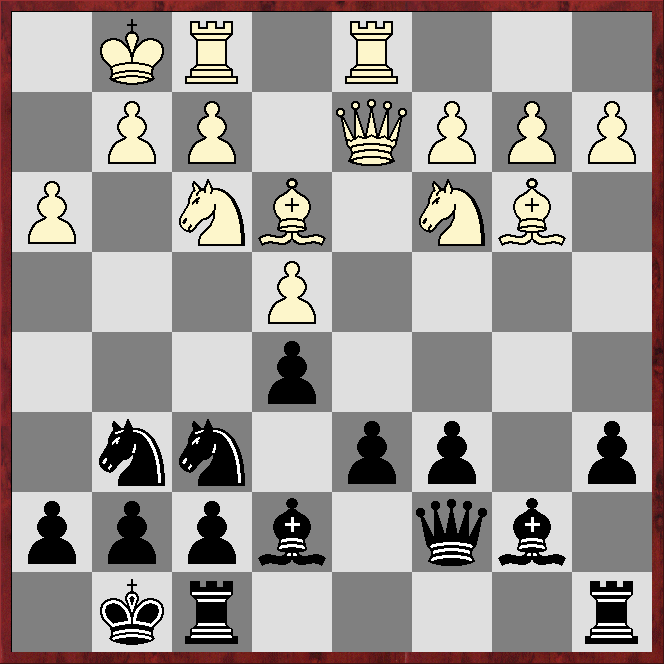
White has the upper hand (Stockfish18) or possibly a positionally won game (Dragon1, but the evaluation fluctuates, and eventually more-or-less settles on plus-over-minus)
*****
*****
*****
*****
*****
9.f4!
The engines agree this is best. White takes control of the e5 square, while preparing a kingside attack.
9...a6!?
Apparently a novelty, and preferred by the engines over 9...Nxd4, which was played in games featuring a 2200 and a 2295 as Black.
10.Bd3 d6 11.Rb1 Re8
Not 11...Rb8?? 12.Nxc6.
12.Qh5!? Nxd4?!
Not 12...Qh4? 13.Qxh4 Nxh4 14.Nxc6 bxc6 15.f5, after which the black knight has no retreat squares. But, rather than the text, the engines much prefer 12...Qe7.
13.cxd4 Nf8!?
This looks horribly passive, but it is probably best.
14.f5 Qf6
Perhaps a better way to stop White playing f6 is for Black to play 14...f6, or 14...Nd7.
15.c3 h6
White threatened to win the black queen with 16.Bg5.
16.g4
Perhaps 16.Rf3 is strongest.
16...Nh7 17.h4 g5!? 18.fxg6 Qxg6 19.Qxg6+ fxg6
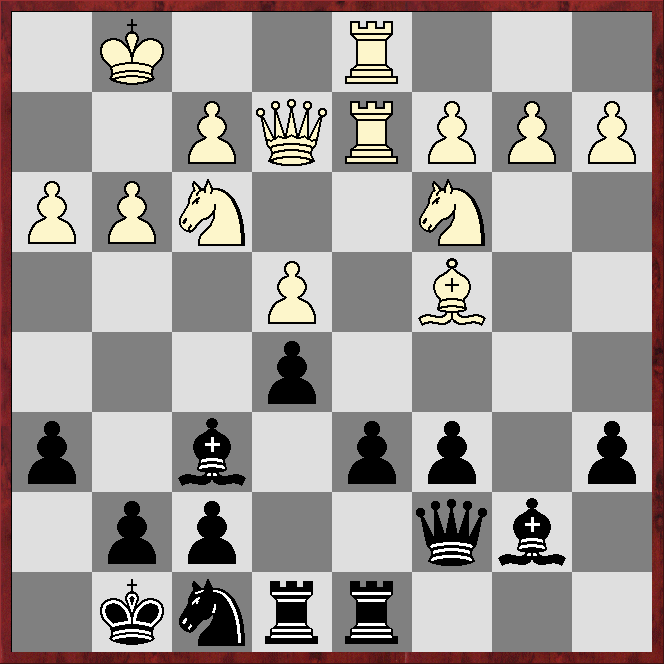
Black has foiled the mating attack, but is losing a pawn
*****
*****
*****
*****
*****
20.Bxh6 Bxg4 21.Rxb7 Re7 22.Bc4+ Kh8 23.Bxa6??
White is roughly the equivalent of being a rook up after 23.Rf7, according to the engines.
23...Bc8 24.Rfb1
The engines reckon 24.a4!? Bxb7 25.Rxb7 Rxa4 is equal, White having a pair of bishops and a pawn for the exchange. Note that 24...Rxa6!? 25.Rb8 Re8 26.Rf7 may slightly favour White, according to the engines.
24...Bxb7
But here the engines reckon 24...Ra6!? 25.Rb8 Re8 gives Black at least the better part of equality.
25.Rxb7
The engines reckon 25.Bxb7 Rb8 26.Rb3 is completely equal.
25...Rxa6!?
Black has a slight edge after 25...Rxe4, according to Dragon1, but Stockfish18 disagrees.
26.Rb8+ Nf8 27.Bxf8?!
Probably better is 27.Rxf8+ Kh7 28.Bg5.
27...Rxe4 28.Bxd6+ Kh7
Black has at least a slight edge after the somewhat counter-intuitive 28...Kg7!, according to the engines.
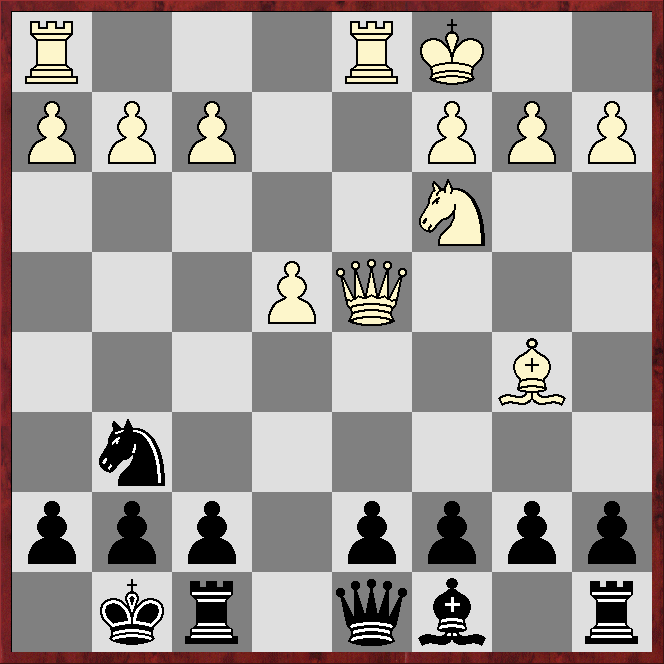
White to play and equalise
*****
*****
*****
*****
*****
29.Be5!
After 29.Bxc7 Rxa2, Dragon1 reckons Black is winning, but Stockfish18 gives Black just a slight edge. The text threatens mate.
29...g5 30.h5!? Rxe5
Forced.
31.dxe5
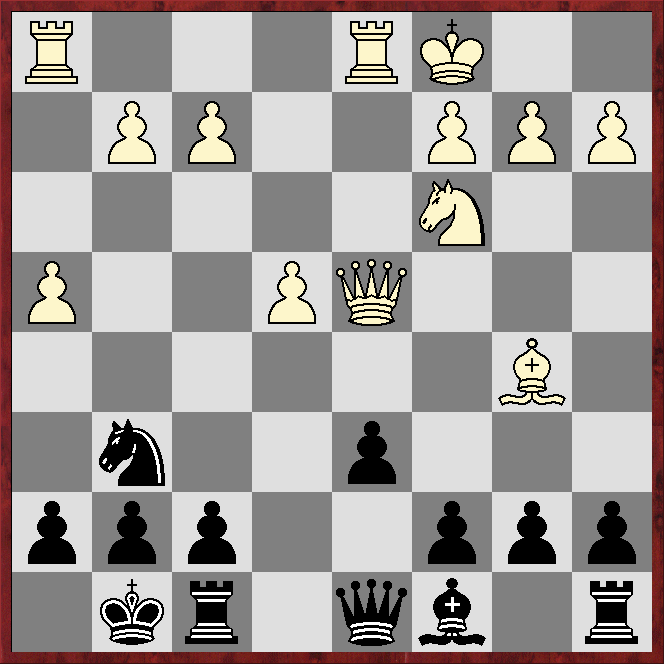
How would you assess this rook-and-pawn ending?
*****
*****
*****
*****
*****
White is two pawns up, but it is Black to move, and the black king is more active than its white counterpart. The endgame is completely equal, according to the engines.
31...Rc6?
But not any more. Three moves seem to hold the balance: 31...Rxa2, 31...Re6 and 31...Kh6
32.Rb4 Kh6 33.Re4 Re6
The central passed pawn is blockaded, and h5 is about to fall, but the black rook has become passive - White's advantage is again worth about a rook, according to the engines
*****
*****
*****
*****
*****
34.a4?
The king should be activated, eg 34.Kf2 Kxh5 35.Kg3, when Black is in zugzwang, a possible continuation being 35...Re8 (35...Kg6 36.Kg4; 35...g4 36.Kf4) 36.a4 Re6 (36...Re7 37.e6) 37.a5 Kh6 38.Kg4 Kg6 39.Re2, when Black has to give way.
34...Kxh5 35.a5
Activating the white king also only draws.
35...Kg6 36.a6?! Rxa6 37.e6 Ra8 38.Kf2 Re8
Black has the less-vulnerable passed pawn, and the more-active king, but the ending is still drawn
*****
*****
*****
*****
*****
39.Kf3 Kf6 40.Rc4 Re7 41.Kg4 Kxe6 42.Kxg5 Kd5 43.Rd4+
The only move to draw, but not so hard to find.
43...Kc5 44.Kf4
Again an only-move, according to the Syzygy endgame tablebase.
44...c6 45.Rb4 Re1 46.Re4!? Rxe4!?
The draw is easy after this, whereas care is still required after 46...Rc1, but one drawing line runs 47.Ke3!? Rxc3+ 48.Kd2, reaching a well-known drawn position, although there is nothing stopping Black playing on.
47.Kxe4 Kc4 48.Ke5 ½–½
48.Ke5 was also an only-move, after which play might have continued 48...c5 49.Kd6 Kxc3 50.Kxc5.

Monday, 23 February 2026

Openings From Weimar

THE Cozio Defence to the Spanish, 1.e4 e5 2.Nf3 Nc6 3.Bb5 Nge7, has never been a frequent visitor to the chessboard.
Wikipedia describes it as "distinctly old-fashioned and the least popular of the defences at Black's third move," albeit adding that "it remains one of the least explored variations of the Ruy Lopez."
Nevertheless, the Cozio always had a dedicated following among those wanting to play the black side of the Spanish, while at the same time avoiding the Exchange Variation, 3...a6 4.Bxc6.
But in recent times it fell further from grace, partly due to the rise of the Berlin Defence, 3...Nf6, but also due to the popularity of a variation that came to be seen as more-or-less a refutation.
However, it is too early to read the last rites over the Cozio, because it seems to be making a comeback.
Just one person played it against me in 2023, and no one tried it the following year, but in 2025 I faced the Cozio twice.
Those are small samples, but already this year I have had it played against me twice, the second time being in round one of the Thuringia seniors' championships, where I was White against Stefan Krämer (1544).
Position after 3...Nge7
*****
*****
*****
*****
*****
Before getting to my game, I want to mention Andrew Soltis's 1994 Chess Digest book, Beating The Ruy Lopez With The Fianchetto Variation.
The first three chapters cover, as the title suggests, 3...g6, but Soltis freely admits there are problems with fianchettoing so early.
He explains: "Because of the tactical problems presented by 4.c3 and 4.d4 exd4 5.Bg5, many strong players who like to play the Fianchetto Defence have adopted a different move-order."
The new move-order meant first developing the king's knight to e7, and then playing ...g6 and ...Bg7.
Soltis calls it the Improved Fianchetto, rather than the Cozio, albeit admitting the system "has been played for decades," which is arguably understating matters since 3...Nge7 goes back to at least 1836.
In that first game, White replied with 4.Nc3, but the knight move was quickly overtaken in popularity by 4.c3, 4.d4 and 4.0-0.
Even so, 4.Nc3 was still seen, with games often continuing 4...g6 5.d4 exd4 6.Nxd4 Bg7, when White probably has the first player's usual slight advantage, but Black has nothing to complain about.
That changed when players started appreciating the strength of 6.Nd5, delaying recapturing on d4 in favour of threatening mate on the move!
Tartakower met this threat with 6...Nxd5, but after 7.exd5 Qe7+ (the point behind Black's knight capture) 8.Kf1, White is winning, according to Stockfish17.1 and Dragon1, eg 8...Ne5 9.Qxd4 Bg7 10.Bf4 f6 11.Re1.
Probably a better try for Black is completing the fianchetto with 6...Bg7, but, after 7.Bg5, Black's only decent continuation is 7...h6 (7...0-0 loses to 8.Bxc6), when 8.Bf6 Bxf6 (best) 9.Nxf6+ is at least slightly better for White (Stockfish17.1), or perhaps gives White the upper hand (Dragon1).
One person to lose to it was Alexey Dreev, in 1989, so it was interesting to see what he came up with in his 2014 Chess Stars book, Anti-Spanish: The Cozio Defence.
Dreev points out that meeting 4.Nc3 with 4...Ng6, which was recommended by, among others, Alexey Suetin, allows 5.d4 exd4 6.Nxd4, where White "enters positions which are similar in their pawn-structure to the Scotch Game, but in a slightly better version because Black's knight on g6 is a bit passive."
Not surprisingly, bearing in mind his experience as Black, Dreev is not keen on meeting 4.Nc3 with 4...g6, as 5.d4 exd4 6.Nd5 (Dreev gives this move an exclamation mark) "fights for the initiative."
He instead highlights the "more modest and not so risky" 4...d6, which he describes as a "fashionable" way to transpose to the Steinitz Defence, 1.e4 e5 2.Nf3 Nc6 3.Bb5 d6, in which Nc3 has been played "too early."
The message seems to be getting through - I have played 4.Nc3 against the Cozio eight times since 2018, including at Weimar, and no one has replied 4...g6.
But half the games, including the one at Weimar, saw a reply not mentioned so far, namely 4...a6.
This has been played by Nakamura, and seems very logical - after all, a major point of 3...Nge7 is to take any possible sting out of the Exchange Variation.
Naturally, replying 5.Bxc6 is somewhat silly, although there are 49 games with this continuation in ChessBase's 2026 Mega database.
However, as Dreev points out, the usual Spanish retreat, 5.Ba4, is not forced, and he recommends 5.Bc4, which is what I played.
Dreev adds: "Following 5...b5 6.Bb3 White, in view of the threat Ng5 and his more harmoniously deployed pieces, preserves a stable positional advantage."
Alas, I met 5...b5 by capturing on f7, which gives White a pawn and a check, but that is nowhere near enough for a bishop.
The engines award White the upper hand after 6.Bb3, so, instead of 5...b5, they suggest 5...d6, and if 6.Ng5, which features in nine of 20 games to reach the position in Mega26, they give 6...d5 7.exd5 Na5, claiming White has at best the usual slight edge of the first player (and Stockfish17.1 is not even sure of that).
All in all, it seems the Cozio Defence should once again be considered a viable proposition, remaining, as Wikipedia puts it, "one of the least explored variations of the Ruy Lopez."
White players of the Spanish should make sure they are not caught by surprise.

Sunday, 15 February 2026

Weimar Round One

Spanton (1939) - Stefan Krämer (1544)
Spanish Cozio
1.e4 e5 2.Nf3 Nc6 3.Bb5 Nge7 4.Nc3 a6 5.Bc4!? b5 6.Bxf7+??
White has the upper hand after 6.Bb3, according to Stockfish17.1 and Dragon1.
6...Kxf7 7.Ng5+ Kg8
The only game to reach the position in ChessBase's 2026 Mega database saw Black blunder back with 7...Ke8??
After the text, Black is up bishop for pawn, but the engines reckon Black's advantage is worth much more
*****
*****
*****
*****
*****
8.Qf3 Qe8 9.Nd5 Nd4 10.Qg3!?
In for a penny, in for a pound.
10...Nxd5 11.exd5 Nxc2+ 12.Kd1 Nxa1
Black is rook and bishop up, and there is no guarantee of White capturing the black knight
*****
*****
*****
*****
*****
13.d4 Qg6 14.Bd2 d6
Not 14...Qb1+ 15.Ke2 Qxh1?? as 16.Qf3 mates.
15.dxe5 dxe5 16.Ke2!?
16.Qxe5 encourages Black to develop with tempo with 16...Bd6.
16...Bf5!?
Giving back the minor piece, but developing, and keeping a massive advantage.
17.Rxa1 Bd6 18.Qb3 Qh5+ 19.f3
If 19.Nf3?!, then 19...e4.
19...h6 20.Ne6 Qxh2 21.Kf2 Qh4+ 22.Kg1 Bxe6 23.dxe6 Bc5+ 24.Be3 Bxe3+ 25.Qxe3 Qd4 26.Re1 c5 27.Kh1 Qh4+
Black is up the equivalent of a queen (Dragon1), or at least more than a rook (Stockfish17.1), after 27...Qxe3 28.Rxe3 Kf8.
28.Kg1 Qd4 29.Kh1 Qh4+ ½–½

Monday, 27 October 2025

Benidorm Round Two

Miguel Penadés Ordaz (1826) - Spanton (1941)
Spanish Cozio
1.e4 e5 2.Nf3 Nc6 3.Bb5 Nge7 4.c3
This is second in popularity to 4.0-0, which is the choice of Stockfish17.1 and Dragon1, along with 4.Nc3.
4...g6
More popular is 4...a6, which is also liked by the engines, but Stockfish17.1's top choice is 4...d5, and Dragon1's top choice is the rare 4...f6!?
5.d4 exd4 6.Nxd4!?
The mainline in ChessBase's 2025 Mega database runs 6.cxd4 d5 7.exd5 Nxd5 8.0-0, with a slight edge for White, according to the engines.
6...Bg7 7.Bg5
The engines prefer 7.Nxc6 or 7.Be3.
7...0-0 8.Nxc6!?
Apparently a novelty, and marginally preferred by the engines over the known move 8.0-0.
8...bxc6 9.Be2!?
Probably not 9.Bxc6?! as after 9...dxc6 10.Qxd8 Rxd8 11.Bxe7 Black has 11...Re8, when Black is getting back the pawn and emerging with the bishop-pair and a lead in development, albeit with a smashed queenside.
9...Rb8 10.Qc1!? d5 11.exd5
The engines suggest 11.f3!? or 11.Nd2.
11...cxd5 12.0-0
Now both sides have castled, how would you assess the position?
*****
*****
*****
*****
*****
Black has a slight lead in development, and the only pawn on the two central files, giving a slight edge, according to the engines, despite Black also having an extra pawn island.
12...Bf5 13.Rd1 Re8 14.Nd2 c5 15.Nb3 c4?
Black is better after 15...Qb6, according to the engines, eg 16.Bf3 a5!? 17.Re1 Be6 18.Bxe7 Rxe7 19.Bxd5 a4 20.Bxe6 Rxe6 21.Rxe6 fxe6 22.Nd2 Qxb2.
16.Bxc4!
Winning one pawn, and threatening another.
16...Qc8 17.Bxd5!?
The engines prefer the more circumspect 17.Bf1.
The problem with the text is that after ...
17...Nxd5 18.Rxd5 Be4
... Black gets practical attacking chances in return for being two pawns down.
19.Rc5!?
The only move to keep an advantage, according to the engines, eg 19.Rd1?? Qg4 20.f3 Bxf3 is hopeless for White.
19...Qg4 20.Qf1 Be5 21.Be3 Rbd8?
The engines strongly dislike this, suggesting 21...Qe6, 21...Bd6 or 21...Ba8, albeit agreeing White is much better.
22.Nd4?
Missing the strength of 22.f3, when both 22...Qh4 and 22...Qh5 can be met by 23.Rxe5!, which is not the only winning move.
22...Qh4!?
Retreating the queen to d7, either immediately or after 22...Bd6 23.Ra5, is better, according to the engines, but Black has little to show for two pawns.
23.g3?!
The engines reckon best is 23.h5.
23...Qf6
White's king is no longer in imminent danger, but White's light-square weaknesses give Black long-term compensation
*****
*****
*****
*****
*****
24.f3 Bb7 25.Qf2 h5 26.Kg2!? g5?!
Probably more weakening than attacking. The engines reckon Black is fine after 26...Qe7.
27.Kg1 Kh8?
Better is 27...h4, when White still has difficulties.
28.Rf1 h4
A move too late.
29.f4!
The best continuation in a sharp position.
29...hxg3 30.hxg3?!
Capturing with the queen is almost certainly superior.
30...gxf4?
Better is 30...Qh6, when White has to find 31.Rc6! Bxc6 32.Nxc6 Qxc6 33.fxe5, and Black in turn needs to find 33...Rxe5! 34.Bd4 Rxd4 35.cxd4 Re7, after which 36.d5! gives White an edge, according to the engines, but no more.
31.Bxf4
White remains two pawns up, and with the much safer king
*****
*****
*****
*****
*****
31...Bxd4
Perhaps best is 31...Rd5 32.Rxd5 Bxd5, but 33.Re1 Kg7 34.Bxe5 Rxe5 35.Qxf6+! Kxf6 36.Rxe5 Kxe5 37.b3 leaves White with a comfortably winning minor-piece ending.
32.Rh5+ Kg8 33.cxd4 Qc6?
This makes it easy for White, but 33...Qxd4 34.Qxd4 Rxd4 35.Be5 forces Black to give up the exchange.
The game finished:
34.Be5 f6 35.Bxf6 Rd6 36.Rh8+ Kf7 37.Rh7+ Kg8 38.Rg7+ Kf8 39.Be5+ Rf6 40.Qxf6+ Qxf6 41.Bxf6 Re2 42.Rxb7 1-0

Sunday, 27 April 2025

English 65+ Round Six

TOOK a halfpoint bye in round five.

Spanton (1985 ECF/1922 Fide) - Geoffrey Moore (2051 ECF/1983 Fide)
Spanish Cozio
1.e4 e5 2.Nf3 Nc6 3.Bb5 Nge7 4.Nc3!?
More popular in ChessBase's 2025 Mega database are 4.c3 and especially 4.0-0.
4...a6!?
The main line in Mega25 runs 4...g6 5.d4 exd4 6.Nc3!? Bg7 7.Bg5 h6 8.Bf6 Bxf6 9.Nxf6+ Kf8 10.0-0, with at least a slight edge for White, according to Stockfish17 and Dragon1.
5.Bc4!? Ng6 6.d4 Be7!?
The engines prefer 6...exd4 or 6...Bb4.
7.d5 Nb8?!
The engines strongly dislike this, suggesting 7...Na5 or 7...b5!?
How should White proceed?
*****
*****
*****
*****
*****
8.Be3
The engines like 8.d6!?, meeting 8...cxd6 with 9.h4, and 8...Bxd6 with 9.Ng5, in both cases claiming White is winning.
8...d6 9.h3 Nd7 10.Qd2 0-0 11.Ne2?!
This gives up what remains of White's advantage, according to the engines, which suggest 11.a4.
11...c5
The engines like 11...b5 12.Bb3 Nc5!?
12.dxc6
The engines suggest fighting for the f5 square with 12.Ng3 or 12.Bd3.
12...bxc6 13.Bb3?!
This is strongly disliked by the engines, which suggest 13.h4 (not a sacrifice as Black cannot both capture h4 and defend d6).
13...Nf6 14.Nc3 Qc7 15.Rd1 Bb7 16.0-0
Now both sides have castled, how would you assess the position?
*****
*****
*****
*****
*****
Black's central pawn-majority more than offsets having an extra pawn-island. The engines give Black a slight edge.
16...Rad8 17.Bg5!
The only move that stops the black pawns rolling.
17...Nh5 18.g3?!
After 18.Bxe7 Nxe7 19.Qe3 White seems to have enough pressure to restrain Black's central pawns.
18...Nf6?!
Black has the upper hand after 18...Bxg5 19.Qxg5 Nf6, according to the engines.
19.Qe2 h6 20.Bxf6 Bxf6 21.Rd2 Rfe8 22.Rfd1 Nf8!? 23.Bc4
How should Black proceed?
*****
*****
*****
*****
*****
23...Ne6!?
The engines agree Black has no need to defend a6, which is why they equally like 23...Bc8!? But they are also fine with 23...a5.
24.Bxe6
After 24.Bxa6 Nd4 25.Nxd4 exd4 Black has more than enough compensation for a pawn.
24...Rxe6 25.Qc4
Threatening 26.Nd5.
25...Qc8 26.Kh2?!
The engines reckon 26.Qb3 gives complete equality.
26...Be7 27.Kg2!? Rf8 28.Kh2!?
The text sets a little trap, but basically I was unable to come up with an active plan.
28...Kh8
Not 28...f5? 29.Rxd6!
29.Qd3?!
Best, according to the engines, is 29.Na4!?, even though this allows 29...d5.
29...Rg6
This gives a winning advantage, according to the engines, but even stronger seems to be 29...d5!?, the point being 30.exd5? cxd5 31.Nxd5 loses to 31...e4 32.Nxe7 exd3 33.Nxc8 Bxf3 34.Rc1 Rxc8.
30.Re1 f5 31.exf5 Qxf5 32.Qxf5 Rxf5 33.Re3 Rgf6 34.Kg2 Rf8 35.g4?!
Best, according to the engines, is 35.Nh4!?, but 35...Bxh4 36.gxh4 c5+ is clearly good for Black.
35...R5f7 36.Kg3 Rd8?
Going passive throws away much of Black's advantage. The engines reckon Black is winning after 36...Kh7, eg 37.a3 a5 38.b3 Rf4 39.Rdd3 Ba6 40.Rd2 d5 41.Nd1 Bxa3.
37.Red3 Rff8 38.Nh4 Bxh4+?!
This allows equality, whereas 38...Kh7 is better for Black, although Stockfish17 is much more enthusiastic than Dragon1 about Black's position.
39.Kxh4 d5
The d pawn at last advances, but piece exchanges mean the pressure exerted by Black's central pawns is no longer critical
*****
*****
*****
*****
*****
40.Ne4 Rf4 41.Nc5 Bc8 42.f3 Rc4 43.Ne4 Kg8?!
Best seems to be 43...Bd7!?
44.a3?!
Black's position comes under intense pressure after 44.b3!? Rb4 45.Nc5 Rf4 46.Re2, eg 46...Re8 47.Kg3 Rf7 48.c4.
44...Rf8 45.Nd6 Rcf4 46.Nxc8!? Rxc8 47.Rc3 e4?
A mistake. Other moves hold, including 47...d4 and 47...Kf7.
48.fxe4 dxe4 49.Re2 g5+ 50.Kg3 Kf7?
GM offered a draw.
Superior to the text is 50...c5!? 51.Rc4 Re8!? 52.Rxc5 Re6, although White is much better.
51.h4?
After 51.Rf2 Rxf2 52.Kxf2 Black's pawn weaknesses should tell.
51...Ke6 52.hxg5 hxg5 53.Rh2 Kd5 54.Rh6 Rcf8!? 55.Rg6 Rf3+ 56.Rxf3 Rxf3+ 57.Kg2 Rf8 58.Rxg5+ Kd4
White has won a pawn, but the advanced d pawn gives enough counterplay
*****
*****
*****
*****
*****
59.Rg6 Ke3 60.Re6!? Rf2+ 61.Kg1 Rxc2 62.g5 Rxb2 63.Rxc6 Rb5 64.Rxa6 Rxg5+ 65.Kf1 Rf5+ 66.Ke1 Rf2 67.Rb6 Re2+ 68.Kf1 Ra2 69.Rb3+ Kf4 70.Ke1 ½–½

Sunday, 16 March 2025

Fareham Round Two

Spanton (1984) - Tony Wells (2000)
Spanish Cozio
1.e4 e5 2.Nf3 Nc6 3.Bb5 Nge7 4.Nc3
This is third in popularity in ChessBase's 2025 Mega database, behind 4.c3 and especially 4.0-0.
4...Ng6 5.d4 exd4 6.Nxd4 Bc5
Stockfish17 and Dragon1 prefer the more popular 6...Nxd4!? 7.Qxd4 c6 with ...Qb6 to come.
7.Be3 Nxd4 8.Bxd4 Bxd4 9.Qxd4 0-0 10.0-0-0
Now both sides have castled, how would you assess the position?
*****
*****
*****
*****
*****
White's large lead in development, and central space, give the upper hand, according to the engines.
10...d6 11.h4!?
How should Black react to this pawn thrust?
*****
*****
*****
*****
*****
11...Ne5!?
Romuald Mainka (2515) - Sergey Arkhipov (2515), Lippstadt (Germany) 1993, went 11...Nxh4 12.Qe3 Ng6 13.Qg3 c6!? 14.Rxd6 Qe7, and now 15.Bd3 would have left White with a winning advantage, according to the engines.
The text, which may be a novelty, is not liked by the engines. They suggest 11...a6 12.Be2 Nf4, but give White the upper hand.
12.f4 Ng4!? 13.h5 h6 14.Be2 a5 15.e5 a4!? 16.exd6 cxd6 17.Qxd6 Qa5!?
The engines prefer 17...Qxd6, but after 18.Rxd6 Black has no compensation for being a pawn down.
18.Rd5 Qa7 19.Qc5?!
The engines like 19.a3 or 19.Rd4.
19...Ne3?!
The engines much prefer 19...a3, albeit giving White a winning advantage.
20.Qxa7 Rxa7 21.Rd4 a3 22.Re4?!
White's advantage is a lot smaller after this. Probably best is 22.b3.
22...axb2+ 23.Kxb2 Nf5 24.Rd1?
Losing most of the rest of White's advantage. The engines give 24.Re1 Ng3 25.Re7 Nxe2 26.R1xe2, and if 26...Bg4 then 27.R2e5.
24...Ng3 25.Re5 Nxe2 26.Nxe2 Bg4 27.R1d5 Be6?!
The rook endgame after 27...Bxe2!? 28.Rxe2 Rfa8 sees Black win the pawn back and gain complete equality.
28.Ra5 Rxa5 29.Rxa5 Rd8 30.f5 Bd5 31.Nf4 Bc6 32.Ra3?!
White has a large advantage after 32.c4!, the point of which will soon become clear.
32...Rd2?
Black should be getting the king into play with ...Kf8.
How should White proceed?
*****
*****
*****
*****
*****
33.Rd3
White is better after this, but it misses a spectacular win with 33.Ra8+ Kh7 34.Ng6!!
33...Rf2? 34.Nd5?
Again missing the spectacular mate, this time starting with 33.Rd8+.
34...Kf8 35.Ne3 Ke7 36.g4 Rf4 37.Kc3 Ra5 38.Kb3 Re4
White remains a pawn up, but the vulnerability of the white pawns, and the superior combination of rook-and-bishop against rook-and-knight, mean Black has full compensation, according to the engines
*****
*****
*****
*****
*****
39.c4 Re5?!
But this is problematic. Instead Black should continue activating the king with 39...Kf6.
40.Kc3?!
Almost certainly better is 40.Nd5+, eg 40...Bxd5 41.Rxd5 Re4 42.Rb5, when White's queenside pawns will decide the game. The engines suggest 40...Kd6!?, not fearing a discovered check, but give White the upper hand.
40...Ra5 41.Kb3 Be4?
The engines reckon 41...Kf6 maintains equality.
42.Nd5+?!
Moving the attacked rook is probably better.
42...Kd6!
There is nothing immediate to fear from a discovered check.
43.Rd4?
White keeps some advantage with 43.Rd2, and if, as in the game, 43...Bxd5, then 44.Kb4! Better is 43...Bf3, but 44.g5! is strong as 44...hxg5 runs into 45.f6!, and 44...Bxh5 can be met by 45.Kb4 (the immediate 45.Nf6+ also wins). The engines suggest meeting 44.g5! with 44...Ke5, but 45.f6 gxf6 46.gxh6 Ra8 47.Nxf6! gives at least a slight edge.
43...Bxd5 44.Rxd5+ Rxd5 45.cxd5 Kxd5 46.Kb4 Kb6 47.a4 Kb6 48.a5+ Ka6
TW offered a draw.
49.Ka4 b6 50.axb6 Kxb6 51.Kb4 f6 52.Kc4 ½–½

Sunday, 1 December 2024

Benidorm Round Four

FACED an Indian junior (born 2014).

Safarullakhan Safin (1824) - Spanton (2009)
Spanish Cozio
1.e4 e5 2.Nf3 Nc6 3.Bb5 Nge7 5.d4
This is fourth-most popular in ChessBase's 2025 Mega database, the top choice being 5.0-0.
4...exd4 5.Nxd4 g6 6.c4!?
A rare continuation, setting up a sort of Maróczy Bind, but one in which Black has played ...e5 rather than ...c5.
How should Black respond?
*****
*****
*****
*****
*****
6...Bg7
There is no dramatic refutation.
7.Be3 0-0 8.0-0 f5!?
Possibly a novelty. Known moves are 8...a6 and 8...d6.
9.exf5 Nxf5 10.Nxf5 Rxf5
Now Black has broken the bind, how would you assess the position?
*****
*****
*****
*****
*****
The bind is broken, but the c4 pawn gives White a little more freedom in the centre, and White has the safer king. Dragon1 gives White a slight edge, but Stockfish17 calls the position equal.
11.Nc3 d6 12.Qd2 Ne5?!
Playing for threats against c4 and the white kingside, but probably prematurely. Sensible is getting on with development with 12...Be6.
13.Ne2?!
Passive. The engines reckon White has the upper hand after 13.f4!?, and if 13...Ng4 then 14.Bd4. They also like 13.c5.
13...Kh8?
Too slow. Black had two good moves, 13...Qh4 and 13...c6!?, eg 13...Qh4 14.Ng3 Ng4 15.h3 Nxe3 16.Qxe3 Re5 with pressure, or 13...c6!? 14.Ba4 Qh4!? 15.Bb3 a5 with multiple threats.
14.Ng3
Even stronger, according to the engines, is 14.f4.
14...Rf8?!
Almost certainly better is 14...Rf7, so 15.Bg5 can be met by moving the queen to f8 or g8, avoiding an exchange of dark-square bishops.
15.Bg5 Bf6 16.Bxf6
This is good, but even better, according to the engines, is 16.Bh6 Rf7 17.Ne4, eg 17...Bg7 18.Bxg7+ Rxg7 (18...Kxg7?! 19.f4 gives play against the black king), when Black's pieces are less well-coordinated than in the game.
16...Qxf6 17.f4 Ng4 18.h3 Nh6 19.Ne4 Qg7
Not 19...Qf5? 20.Qc3+!? Kg8 21.Rae1 with a strong attack.
20.Rae1 Nf5 21.Kh2 Nd4 22.Ba4
The engines like 22.Rd1!? Nxb5 23.cxb5, eg 23...Be6 24.Rf3 Rae8 25.Ng3!?, claiming a slight edge for White, apparently based on the vulnerability of Black's queenside pawns.
22...Bf5?!
It seems 22...Be6 equalises.
23.Ng5 h6 24.Nf3 Nc6!?
The engines prefer exchanging knights, albeit awarding White the upper hand.
25.Bxc6 bxc6 26.Re3
The engines like other lines, including 26.g4 Bd7 27.b4.
26...Rae8 27.Rfe1 Rxe3 28.Rxe3 c5!?
The engines agree this is best.
29.Qe2
After 29.Qa5 both 29...Qxb2 30.Qxc7 Qf6 31.Qxa7 Be6!? and 29...Qf7 are fine for Black, according to the engines.
29...Bd7 30.Re7 Rf7 31.Rxf7 Qxf7
How would you assess this queen-and-minor-piece ending?
*****
*****
*****
*****
*****
Black has an extra pawn-island and the more-open king, while White has a knight, which is often said to be the better minor piece for cooperating with a queen. However, the bishop has good diagonals to work on, and the knight does not have a central or advanced outpost. The engines reckon the position is completely equal.
32.Qe4 Qf5?!
Several moves maintain the balance, including the simple 32...Kg7.
33.Qa8+ Kg7 34.Kg3!
The king is safe here, and now ...Qxf4+ is not threatened.
34...g5 35.fxg5 hxg5 36.Qxa7
Black to play and (probably) hold
*****
*****
*****
*****
*****
36...c6?
Self-pinning the bishop, and meaning it will fall with check if the black queen no longer protects it. Best is 36...g4 37.hxg4 Qxg4+ 38.Kf2 Qxc4, when after 39.Qxc2 Black seems to have enough counterplay, eg 39...Qc2+ 40.Kg3 Qg6+ 41.Kf4!? Qh6+ 42.Ke4 Qe6+! 43.Kd3 Kg6!? However, this is one of those positions where one slip by Black probably hands the win to White, while the worse  White can reasonably do is draw.
37.Qc7 g4
Too late.
38.hxg4 Qxg4+ 39.Kf2 Qe6 40.a4
The passed a pawn will decide matters.
40...Kf6 41.Qd8+ Qe7 42.Qh8+ Kf7 43.a5 Qf6 44.Qxf6+ Kxf6 45.a6 Bc8 46.a7 Bb7
With the bishop tied to preventing the a pawn queening, White is effectively a piece up
*****
*****
*****
*****
*****
47.Nd2 Ke5 48.Nb3 Ba8 49.Kg3 d5!? 50.Nxc5 d4 51.Kf2 Kd6 52.Na4 Kc7 53.c5 Kb7 54.Nb6 Kxa7 55.Nxa8 Kxa8 56.Ke2 1-0

Tuesday, 21 May 2024

Winning Chess

AUSTRIAN Fide master Siegfried Neuschmied won the Bodensee Senioren with +5=2-0, gaining 25.8 rating points.
His most important game was probably in round six, when he was upfloated on board one against the clear tournament leader, Polish international master Henryk Dobosz.

Neuschmied (2234) - Dobosz (2314)
Spanish Cozio
1.e4 e5 2.Nf3 Nc6 3.Bb5 Nge7!? 4.0-0
This is easily the most popular continuation in ChessBase's 2024 Mega database, and is treated as the main move by Alexey Dreev in his 2014 Chess Stars book Anti-Spanish: The Cozio Defence.
4...g6 5.d4
Dreev pays most attention to 5.c3.
5...exd4 6.Nxd4 Bg7
"The position is not promising for White" - Dreev
*****
*****
*****
*****
*****
7.Be3 0-0 8.Nc3
How should Black proceed?
*****
*****
*****
*****
*****
8...d6
Dreev awards an exclamation mark to 8...d5, stating: "This is no doubt Black's best move and it equalises without any problems. (The text) is not so energetic and it does not clarify the situation in the centre." There is no record in Mega24 of Dobosz having played the Cozio, although he has one game with 3...g6, so it seems on this occasion he played an opening with which he was not familiar. Stockfish16 and Komodo14.1 change to yellow after 8...d6, meaning they regard it as dubious.
9.Qd2
Dreev: "White's chances seems to be preferable, thanks to his space advantage."
9...a6 10.Bxc6!? Nxc6 11.Nxc6 bxc6 12.Bh6!?
White has damaged Black's pawn-structure and now ensures Black does not have the bishop-pair as compensation.
12...f5!?
This seems to be a novelty - 12...Rb8 is known - and is not liked by the engines.
13.Bxg7 Kxg7 14.f4!? Rb8 15.b3 c5 16.Rae1 fxe4!?
This opens the c8-h3 diagonal for the bishop, but activates the knight and makes the black king look a little less safe. The engines suggest 16...Rb4, with what they reckon is a slight edge for White.
17.Nxe4 Bf5 18.Ng3 Rb4 19.c3 Rb8 20.Re3 Qf6 21.Qe2 a5 22.Qa6 Ra8 23.Qc6 Ra7 24.Rfe1
How should Black respond to White's threats?
*****
*****
*****
*****
*****
24...Bc8?
I suspect most, or at least many, club players would choose 24...Rf7, which is also the engines' choice.
25.Re7+ Kh6!?
This is best, according to the engines, but the white position is much easier to play.
26.f5
The engines reckon best is 26.Qd5!?
26...Qxc3 27.Kh1!? Bb7?
Black has better, eg 27...Bxf5, when the engines reckon that, to keep a large advantage, White needs to find 28.R7e3!?, a possible continuation being 28...Qd4 29.Rf3 Kg7 30.h3!? Qh4 31.Re8 Rxe8 32.Qxe8, with what the engines reckon is a winning attack.
28.Qd7 Rf7 29.Qe8 Bd5 30.Rxf7 Bxf7 31.Qe7
This bishop is immune because, if captured, the white rook would be hanging.
31...c6 32.Qf8+ Qg7 33.Qxd6 Bd5?!
A bad move in a bad position, but the better 33...Qd4 does not bring much relief, eg 34.Qf8+ Kg5 35.Ne4+ Kxf5 36.Nd6+ etc.
34.Qf4+ 1-0

Saturday, 15 April 2023

Lessons From Fagernes IV

MY round-four game saw Black play the Cozio Variation of the Spanish, ie 1.e4 e5 2.Nf3 Nc6 3.Bb5 Nge7, which is only the sixth-most popular Spanish continuation in ChessBase's 2023 Mega database, but nevertheless occurs 9,728 times.
The starting position of the Cozio
*****
*****
*****
*****
*****
Historically the most-popular continuations are 4.0-0, 4.c3 and 4.d4, but 4.Nc3!?, which was an Alexander Alekhine favourite, is arguably the most-critical line.
It might look innocuous, but 4...g6, the normal continuation in the Cozio, runs into 5.d4 exd4 6.Nd5!? Bg7 7.Bg5.
Then Black's most-popular reply, 7...h6, is the only way to keep the game going, according to Stockfish15.1 and Komodo14.1, but 8.Bf6 is pleasant for White.
What else can Black sensibly play?
*****
*****
*****
*****
*****
My game, after 4.Nc3!?, saw 4...Ng6, which dates back to at least 1867 and was played both times by Magnus Carlsen when he reached the position in 2020.
Despite the world champion's endorsement, the move leaves a poor impression, although it may be that the real problem goes back to 3...Nge7.
A) Position after 4...Ng6
*****
*****
*****
*****
*****
Compare the above diagram with the following one, which arises after 1.e4 e5 2.Nf3 Nc6 3.Nf3 Nf6.
B) Position after 3...Nf6
*****
*****
*****
*****
*****
I do not care how strong Carlsen is, there is no doubt diagram A) is more favourable for White than diagram B).
My game at Fagernes continued, from diagram A), 5.d4 exd4 6.Nxd4, which is similar to a Scotch Four Knights, except it is White to move, not Black, and the black king's knight is on g6 rather than f6.
After 6...Nxd4!? (Carlsen has played this) came 7.Qxd4 c6 8.Bc4 Qb6 9.Be3!?, and I went on to win, although the engines reckon Black is OK after the apparent-novelty - it does not appear in Mega23 - 9...Qxb2!?
LESSON: lots of club players, myself included, like to get out of mainlines early to try to set novel problems to their opponents. The downside of this is that sidelines tend to be either inferior, or to require precise play if the opponent knows, or finds over the board, the theory.

Wednesday, 5 April 2023

Fagernes Game Four

Spanton (1806) - Sondre Stai (1722)
Spanish Cozio
1.e4 e5 2.Nf3 Nf6 3.Bb5 Nge7 4.Nc3!?
The main moves in ChessBase's 2023 Mega database are 4.c3 and especially 4.0-0.
4...Ng6!?
Magnus Carlsen is among those who have played this, and it is quite liked by Stockfish15.1. The main move is 4...g6, but then 5.d4 exd4 6.Nd5!? is a little awkward for Black, eg 6...Bg7 7.Bg5 h6 8.Bf6 Bxf6 9.Nxf6+, or 6...Nxd5 7.exd5 Qe7+ 8.Kf1!?
Position after 4...Ng6!? - it looks similar to the Four Knights, except Black has spent two tempi putting the king's knight on g6 instead of one tempo putting it on f6
*****
*****
*****
*****
*****
5.d4 exd4 6.Nxd4 Nxd4!?
Capturing twice on d4 like this, bringing the white queen to the centre of the board, is unusual, but it has been played by the world champion.
7.Qxd4 c6 8.Bc4 Qb6 9.Be3!?
A positional pawn sacrifice.
How should Black respond?
*****
*****
*****
*****
*****
9...Qxd4
All four games in Mega23 to reach the diagrammed position saw this capture, but Stockfish15.1 and Komodo14.1 slightly prefer 9...Qxb2!?, eg 10.0-0 Qb6!? 11.f4!? Qxd4 12.Bxd4, or 10.Rb1 Qa3 11.0-0 Qd6. In both cases the engines reckon White has full compensation for a pawn.
10.Bxd4 b5 11.Be2 Nf4 12.Bf3 Ne6 13.Be3 Bb4
Jón Loftur Árnason (2500) - Tom Wedberg (2495), Oslo Schakselskap Jubilee 1984, went 13...b4 14.Nb1 a5 15.a3 Rb8 16.axb4 Bxb4+ 17.Kd1!? with a slight edge for White, according to the engines (½–½, 43 moves).
14.0-0-0
14.Bd2?! is probably unnecessarily passive.
14...0-0
After 14...Bxc3 15.bxc3 White's queenside pawn-formation is shattered but the pawns are not easy for Black to get at, and meanwhile Black has serious dark-square weaknesses.
15.e5
Threatening 16.Nxb5.
15...Bxc3
Virtually forced, as otherwise Ne4 is good for White.
16.bxc3 f6 17.exf6 Rxf6 18.Rd6 Nd8!?
The engines prefer something like 18...Kf7 (Stockfish15.1) or 18...a5 (Komodo14.1).
19.Rxf6 gxf6 20.Rd1 d5?
This allows a simple combination. The engines suggest something like 20...Kg7, albeit giving White at least the upper hand.
21.Rxd5! Nb7
There is no good move for Black, eg 21...Be6 runs into 22.Rxb5!
22.Rh5 Bd7 23.Be4 Nd6 24.Bxh7+ Kg7 25.Bd3 f5 26.Bf4 Ne4 27.f3!?
27.Bxe4!? is also winning, according to the engines, but I did not want to deal with opposite-coloured bishops.
27...Nxc3 28.Kb2 Nd5 29.Be5+ Kg6 30.Rh3 Re8 31.Rg3+ Kf7 32.f4 Nf6?
Stiffer resistance is afforded by 32...Rg8.
33.Rg5 Ne4 34.Rg7+ Ke6 35.g4 Nc5 36.Bxf5+ 1-0

Wednesday, 25 May 2022

Bregenz Round Five

WAS upfloated against a Swiss this afternoon.
A Ukrainian flag can just be seen flying above Kornmarktplatz

Spanton (1860) - Heinz Härdi (1653)
Spanish Cozio
1.e4 e5 2.Nf3 Nc6 3.Bb5 Nge7 4.Nc3!?
Efim Bogoljubow beat Alexander Alekhine with this move in their 1921 'secret' training match, and Alekhine subsequently adopted it.
4...a6!?
The mainline in ChessBase's 2022 Mega database runs 4...g6 5.d4 exd4 6.Nd5!? Bg7 7.Bg5 h6 8.Bf6 Bxf6 9.Nxf6 Kf8, when White is better, according to Stockfish14.1 and Komodo12.1.1.
5.Bc4!?
Eyeing f7.
5...Ng6
Also quite popular is 5...h6!?, but it looks slow.
6.d4 Be7!?
The engines prefer 6...exd4 7.Nxd4, and either 7...Bb4 or 7...Bc5.
7.d5!?
Only one game in Mega22 saw this continuation, but it featured the highest-rated player to reach the position after 6...Be7!?
7...Na5 8.Bd3
Erik van den Doel (2591) - Frank Erwich (2333), Leiden (Netherlands) 2010, saw 8.Bf1!? b5 9.g3 with advantage to White, according to the engines (1-0, 84 moves)
8...b5 9.Be3 0-0 10.h4!?
How should Black proceed?
*****
*****
*****
*****
10...d6
Not 10...Nxh4? 11.Nxh4 Bxh4 12.Qh5 etc.
11.h5 Nf4 12.Bxf4 exf4 13.Qd2 h6 14.Qxf4 Bf6 15.e5?!
Almost certainly an unnecessary extravagance. White has at least the upper hand after castling (either side).
15...Bxe5 16.Nxe5
Not 15...dxe5?? 16.Qe4.
16.Nxe5 dxe5 17.Qb4
17.Qe4 is met by 17...f5.
17...Nb7 18.0-0-0 Nd6 19.Nd4 f5 20.Nc5 Qg5+ 21.Kb1 e4
21...Qxg2!? is probably a playable win-of-a-pawn, but looks risky.
22.Be2 a5 23.Qd4 Qe7 25.Rde1 Qg5 26.Ne6?
Better is 26.fxe4, when the engines' mainline runs 26...fxe4 27.Nxe4 Nxe4 28.Qxe4 with advantage to White.
26...Bxe6 27.dxe6 Qe7 28.fxe4 fxe4 29.Qd5 Rad8
White to play and lose
*****
*****
*****
*****
*****
30.Bxb5??
The game is level after 30.a3 or 20.Rhf1, according to Stockfish14.1, although Komodo12.1.1 gives White a slight edge.
30...Rf5 31.Qf5 Nxf5 32.Rxe4? Ng3 0-1

Wednesday, 18 May 2022

Championship Chess

PLAYED last night in the Battersea club championship.

Spanton (1972) - Anders Lundbäck (1897)
Spanish Cozio
1.e4 e5 2.Nf3 Nc6 3.Bb5 Nge7 4.0-0
White has many ways of meeting Cozio's Defence, but castling is easily the most popular.
4...Ng6!?
This gives a strange impression - Black has spent two tempi moving the king's bishop to g6, when it could have gone to the more-central f6 in one move. Normal is 4...g6, which Alexey Dreev in Anti-Spanish: The Cozio Defence (Chess Stars, 2014) calls "no doubt the most accurate." But the text is preferred by the analysis engines Stockfish14.1 and Komodo12.1.1, and has been tried by very strong players, including Adolf Anderssen, Bent Larsen, Nigel Short and Vassily Ivanchuk. AL said it was recommended in a chess course he had taken, and contains sharp traps.
5.d4 exd4 6.Nxd4 Bc5 7.Nb3
Most popular in ChessBase's 2022 Mega database is 7.Be3, after which 7...Nxd4 8.Nxd4 Bxd4 9.Qxd4 Qg5!? introduces one of the aforementioned traps.
Position after 9...Qg5!? - how should White respond?
*****
*****
*****
*****
*****
10.Qd5 is the commonest move in Mega22, after which Alonso Zapata (2555) - Michael Rhode (2575), World Open (Philadelphia) 1993, continued 10...h6!? 11.Bc4 0-0 12.Nc3 d6 with what the engines reckon is a roughly equal position ( ½–½, 54 moves). My instinctive response, when AL showed me the position, of 10.Be2? runs into 10...Nf4 11.Bf3 Qxg2+! 12.Bxg2 Ne2+ etc. Even worse is 10.Bc4?? Nh4, while 10.Nc3??, which has been played by a 2219, also loses to 10...Nh4. Best, according to the engines, is 10.e5, after which they reckon 10...Nf4 11.g3 Ne6 12.Qe4 f5 13.Qd3 f4 14.Nc3, as has been played in two games in Mega22, is slightly better for White.
However, while 7.Be3 leads to interesting play, the engines reckon better are the text and 7.Nf5!? 0-0 8.Be3.
7...Bb6
The bishop is open to harassment on this square by the white queen's knight coming to d5, but then, as AL pointed out in the postmortem, the same is the case after 7...Be7.
8.Nc3 0-0
Black can retain the bishop-pair with 8...a6, although after 9.Bc4 0-0 10.Nd5 White was slightly better, according to the engines, in Daniel Jacobsen Kovachev (2243) - Josef Ask (2183), Rilton Cup (Stockholm) 2009-10 (but 0-1, 50 moves).
9.Nd5 Re8 10.Nxb6 axb6 11.f3 Qh4 12.g3!?
This weakens the white king's position but restricts the possibilities of the black king's knight. The engines are not keen on it, but cannot agree on what should be played. Stockfsh14.1 likes 12.Nd4 for a long time, but later prefers 12.a4 or 12.Rf2, while Komodo12.1.1 also rates 12.a4, as well as 12.Be3.
12...Qf6 13.c3 h5!?
Very interesting is Stockfish14.1's suggestion of 13...d5!?, meeting 14.exd5 with 14...Rd8, eg 15.c4?! Bh3 16.Rf2 Nce5 gives Black lots of play for a pawn. Better seems to be the defensive 15.Be2, but 15...Nce7 again gives Black decent play.
14.Nd4
Even stronger seems to be the engines' 14.f4!?, meeting 14...Rxe4 with 15.Qxh5, and 14...h4 with 15.e5.
14...Ra5?!
This is probably a waste of time. Consistent is 14...h4, when White has a slight edge at best.
15.a4 h4 16.b4 Ra8 17.Kg2
Stockfish14.1 gives the strange-looking 17.Ra3!?, eg 17...hxg3 18.hxg3 Nxd4 19.cxd4 c6 20.Be2, claiming White is on top, although Komodo12.1.1 reckons Black is equal.
17...Nce5?
A serious waste of time. The engines like 17...Re5, threatening 18...Nxd4 19.cxd4 Rxb5, or 17...d6!?, when 18.Nxc6 bxc6 19.Bxc6 Qxc3 20.Bxa8 Qxa1 21.Bc6 is unclear. Also better than the text is 17...Nxd4, preparing to free Black's light-square bishop.
18.f4 Nc6 19.e5 Qe7 20.Qd3
The engines like, among other moves, 20.Kg1!?, which means ...h3 will not come with check, and there is no knight check at f4 or h4.
20...Nxd4 21.cxd4
21.Qxd4 Rd8 is equal, according to the engines.
21...c6
Black is losing after the greedy 21...Qxb4? as both 22.f5 and 22.Ba3 are very strong.
22.Bc4 d5
How should White proceed?
*****
*****
*****
*****
*****
23.exd6?!
Opening lines seems natural, but the engines do not like it, reckoning White is only better after 23.Bb3, after which White can hope to exploit his kingside pawn majority.
23...Qxd6 24.f5 Nf8
The engines prefer 24...Ne7!?, the point being to meet 25.f6 with 25...b5! (25...Nd5 may also be fine for Black) 26.Bb3 Nd5 27.fxg7 Bg4, when White' king seems to be the one more in danger. Instead White should probably play 25.Bf4 with unclear play.
25.f6?!
Probably better is 25.Bb3, when 25...b5!? 26.a5 Nh7 is slightly better for White, according to Stockfish14.1, although Komodo12.1.1 calls the position equal.
25...gxf6
Black is fine after this, according to the engines, but they prefer 25...b5!? 26.fxg7 bxc4 27.gxf8=Q+ Qxf8 28.Qxc4, claiming Black has more than enough play for a pawn.
26.Bf4
The engines prefer 26.gxh4!?
26...Qd7
Black is better after 26...h3+ 27.Kg1 Qxb4 or 26...Qxb4 27.gxh4 Be6, according to the engines.
27.gxh4!?
The white king can find relative safety on h1.
27...Qg4+?
Best seems to be 27...b5!? 28.axb5 Rxa1 29.Rxa1 cxb5, eg 30.Bxb5 Qd5+, when the engines reckon the white king is the more endangered, or 30.Bb3 Qg4+ 31.Qg3 Ng6 32.Qxg4 Bxg4 with roughly equal chances.
28.Kh1 Ng6??
This makes matters a lot worse, whereas after 28...Qf5 or 28...Kh8 the game carries on, albeit with White much better.
29.Rg1 Bf5
Not 29...Qxf4?? as White mates in two, starting with 30.Qxg6+.
30.Rxg4 Bxd3 31.Bxd3 (1-0, 38 moves).

Wednesday, 3 November 2021

Coulsdon Autumn Daytime Round Seven

PLAYED this afternoon.

Spanton (2019 ECF/1804 Fide) - Venerando Bermudez (1737 ECF/1672 Fide)
Spanish Cozio
1.e4 Nc6 2.Nf3 e5
One point about Black's move-order is it avoids the King's Gambit. Whether Black should be trying to avoid that opening is another matter.
3.Bb5 Nge7 4.Nc3
The main moves are 4.0-0 and 4.c3, but the text is also often played by grandmasters.
4...a6
This became popular after Black experienced difficulties with 4...g6 5.d4 exd4 6.Nd5!?
5.Ba4 b5 6.Bb3 Na5?
VB had arrived at the board late, and probably should have spent more time settling down before starting the game.
7.Nxe5 Nxb3 8.axb3 d6 9.Nf3 Ng6? 10.Nxb5
Believe it or not, this may be the first move of the game not to appear in databases. A game from the semi-finals of the 2011 Algerian women's championship saw White play 10.h3?, although she went on to win.
10...Bg4 11.Nc3 Ne5?!
Probably a little better is 11...Nh4, but it should not change the outcome of the game.
12.d4 Nxf3+ 13.gxf3 Bh5 14.Qd3 Qc8 15.Bf4 Bg6 16.Nd5
Played with the coming combination in mind.
16...Qb7!?
For a while this is the top choice of both Stockfish14 and Komodo12.1.1, which only goes to show how desperate Black's position is.
How should White proceed?
*****
*****
*****
*****
*****
17.Rxa6! c6
Or 17...Rxa6 18.Qxa6 Qxa6 19.Nxc7+ etc.
18.Rxa8+ Kd7 19.Rxf8 Rxf8 20.Ne3 (1-0,  43 moves)

Thursday, 26 December 2019

Blast From The Past

I have spent every New Year since 1989 in Hastings - that is 30 New Years and counting.
Here is the first game I played there.
J Holland* (173) - Spanton (151)
Hastings Main A 1989-90, Round 1
Spanish Cozio
1.e4 e5 2.Nf3 Nc6 3.Bb5 Nge7
I was going to credit Andrew Soltis' Chess Digest book Beating The Ruy Lopez With The Fianchetto Variation for inspiring me to play Cozio's variation of the Spanish, but I see it was published in 1994.
4.0-0 g6 5.d4 exd4 6.Nxd4 Bg7 7.Be3 d5??
A novelty, and not a good one. The move still does not appear in ChessBase's Mega database. Normal is 7...0-0, as played by Steinitz, when Black has a good game.
8.exd5 Qxd5
White to play and win
*****
*****
*****
*****
*****
9.Nxc3?
White is winning after 9.Nxc6, eg 9...Qxd1 10.Nxe7+ Qd7 11.Bxd7+, or 9...bxc6 10.Qxd5 Nxd5 11.Bxc6+.
9...Qd6 10.Nxc6 bxc6 11.Bc4 0-0
Despite missing a win at move nine, White has an edge thanks to his better pawn-structure.
12.Qf3 Qf6 13.Qxf6 Bxf6 14.Bxf4 Bxc3!?
Equalising the pawn-structure, but conceding the two bishops - White still has a small advantage.
15.bxc3 Nd5 16.Be5 Re8 17.Rfe1 Be6 18.Bb3 Re7 19.Bd4 a5 20.g3!?
Ensuring White cannot be back-rank mated, and taking the f4 square away from the knight, but it is slow. Stockfish10 and Komodo10 want White to gain space with 20.c4!? Nb6 21.c5.
20...Ree8
It seems I could not come up with a plan. However, the engines' suggested 20...a4 21.Bc4 Ree8 is nothing special either.
21.f3 Bd7 22.Bc4 Rab8 23.Rxe8+ Bxe8 24.Kf2 Bd7
Not 24...Rb2?? 25.Bb3.
25.Bd3 Kf8
I offered a draw. I guess I thought my control of the b file counted for something; otherwise it is hard to see why the higher-graded player would be tempted to cease hostilities in such a position as White.
26.a3 Be6 27.h4 Rb2?? 28.c4 1-0
*I have no idea who this is. The only J Holland with an ECF grade today was not born when this game was played.

Thursday, 6 June 2019

Miniature

IT is not often that one of the best players in the world loses in under 20 moves - still less that the game ends in checkmate.
But here is an example drawn from Tartakower and du Mont's 500 Master Games Of Chess (notes in italics are algebraicised from the book).
Johannes Zukertort - Adolf Anderssen, 1865*
Spanish Cozio
One of the many tragedies which, from time to time, are enacted around the ominous square f7.
1.e4 e5 2.Nf3 Nc6 3.Bb5 Nge7
The Cozio Defence, which variation embarrasses Black's game more than any other, and which has no longer any adherents (the book was published in 1952 by G Bell & Sons - I have the 1975 Dover reprint).
4.c3
The most energetic line of play is 4.Nc3 g6 5.d4 exd4 6.Nd5 Bg2 7.Bg5 h6 8.Bf6 etc.
Less good is 4.d4 at once, because  of  4...exd4 5.Nxd4 d5, and Black frees his game.
Most popular today is 4.0-0, which has been played by Karpov, Kramnik, Shirov and Leko. The mainline runs 4...g6 5.c3 Bg7 6.d4 exd4 7.cxd4 d5 8.exd5 Nxd5 9.Re1 Be6 10.Bg5 Qd6, with a position that has been reached more than 200 times in ChessBase's 2019 Mega database. White scores well with the continuation 11.Nbd2, but there are plenty of deviations possible for both sides long before this (for instance, I have a plus score with both 5...d6!? and 8...Qxd5!?, although neither move is held in high regard).
As for "the most energetic line of play," Alexey Dreev in Anti-Spanish: The Cozio Defence (Chess Stars, 2014) implicitly rejects 4...g6, and another quite popular reply 4...Ng6. Instead he concentrates on "a more modest and not so risky move," 4...d6.
Position after 4.Nc3 d6
Dreev states: "The position resembles in its structure the Old Steinitz Defence, but with an early sortie of White's knight to c3. In this variation, Black wishes to obtain a solid and stable position and would not avoid simplifications."
I faced 4...d6 at Tunbridge Wells last year. The round-three game Spanton (163) - Freddie Hand (208) continued 5.d4 ("This is the way for him to fight for a slight opening edge" - Dreev) 5...exd4 (Dreev recommends 5...a6) 6.Nxd4 Bd7 7.0-0, which Dreev says is "one of the positions of the Steinitz Defence in which White maintains a slight but stable positional edge" (1-0, 60 moves).
Not that I remembered when I began researching this article, but I actually played 4...d6 in a training game in 1992 against the Mephisto Polgar computer. That game continued 5.d4 Bd7!? (the most popular move in Mega19, but the engines Stockfish10 and Komodo9 reckon it is a mistake) 6.d5 Nb8 7.Bg5 (the engines prefer 7.Be3 or 7.Bxd7+!?) h6 (this seems a modest improvement over 7...f6, which was played in the tournament game Mephisto Polgar - Mark van der Kraan, Dieren 1991, won by the computer in 57 moves) 8.Bxd7+ Nxd7 9.Bh4 g5 10.Bg3, when White is surely better, but the game was drawn in 38 moves.
4...d6
Here 4...d5 5.Nxe5 dxe4 is indicated.
Tartakower and du Mont were writing long before Bobby Fischer played 6.Qe2 in a blitz game in 1971, which seems to be the improvement Dreev mentions as rehabilitating 4.c3 as "a serious weapon." The Russian grandmaster goes on to state that "all Black's three possibilities (4...d5, 4...g6, 4...a6) are about equally strong." But he says the latter two moves lead to "more stable, manoeuvring positions," while 4...d5 results in "complications full of tactical tricks." He does not mention Anderssen's choice, which nevertheless is still sometimes tried by strong players.
5.d4 Bd7 6.0-0 Ng6
In his obstructed position, Black cannot afford the time for such evolutions. Better is 6...g6.
7.Ng5 h6
A fatal weakening of the position. But after 7...Be7 8.Qh5, White still has the better of it.
I wonder what Tartakower/du Mont had in mind after 7...Be7 8.Qh5 exd4, which was played in Wolfgang Benischek (2070) - Dirk Nitsche (2235) in a German inter-club match in 2002. White immediately went wrong in that game with the wildly optimistic 9.cxd4?! Nxd4 10.Nxf7?? Instead of 9.cxd4?!, the engines give 9.Bxc6, with equal chances whichever way Black recaptures on c6.
8.Nxf7?!
This works swimmingly in the game, but a coming improvement by the engines suggests White should have settled for 8.Nf3 with the more pleasant-looking position.
8...Kxf7 9.Bc4+ Ke7??
This move, which was also the choice of a player rated 1905 in a Portuguese game in 2004, is not commented on by Tartakower/du Mont, but it seems to be the real reason for Black's loss. The engines give 9...Ke8, when 10.Qh5, which is so devastating in the game, can be met by 10...Qf6. After 11.f4 exd4 12.f5, Stockfish10 gives 12...Nce5!? (Komodo9's 12...dxc3 may also be enough for a slight edge) 13.fxg6 Bg4, when White has three sensible options, 14.Bf7+, 14.Rxf6 and 14.Qxg4, but each is assessed by both engines as better for Black. There are a lot of complications here, but the bottom line is that 9...Ke8 is better than the text.
10.Qh5 Qe8?
Falling into the abyss. He should at least have played 10...Be8.
Unfortunately, as the engines point out, 10...Be8 also leads to mate, viz 11.Bg5+! hxg5 12.Qxg5+ Kd7 13.Qf5+ 14.Ke7 Qe6#.
11.Qg5+
500 Master Games Of Chess has the less aesthetically pleasing 11.Bg5+.
11...hxg5 12.Bxg5#
*The game, one of a series of non-tournament, non-match games between Zukertort and Anderssen, was apparently played at the Prussian city of Breslau (now Wrocław in Poland).