Showing posts with label Bodensee. Show all posts

Sunday, 24 May 2026

Lessons From Bregenz VII

TWO things I have a tendency to bash on about in this blog is the advantage of having the bishop-pair and the danger of giving up a good bishop when you have a bad one.
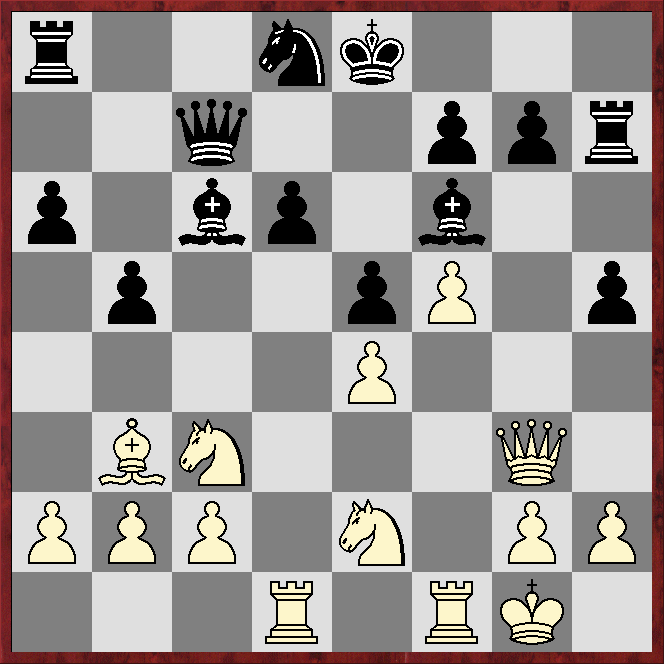
But look at the following position, which was reached in round seven, where I was Black against Bernard Logie (1822).
Black has just played 6...Qd8-b6
*****
*****
*****
*****
*****
The position occurs 40 times in ChessBase's 2026 Mega database, and in 22 of those games White continued 7.Bxc6+!?, which was also my opponent's choice, and is the top choice of Stockfish18 and Dragon1. The engines reckon the move gives White a slight edge (Stockfish18) or even the upper hand (Dragon1).
I recaptured with the pawn, which is the main line in Mega26, but the engines reckon recapturing with the queen is better.
Position after 7...Qxc6!?
*****
*****
*****
*****
*****
There is no doubt White has given up the bishop-pair, and not just on a short-term basis in the confident expectation of quickly swopping off one of Black's bishops.
There is also no doubt White has given up his better bishop, as the dark-square remainder is restricted by the pawn-chain b2-e5.
White's one advantage in the position, as it seems to me, is having extra space in the centre, which must be why the engines reckon White is better.
A good way to try to understand such a position, I believe, is to let the engines play it out against each other, so here goes.
8.dxc5!?
All seven games to reach the position in Mega26 saw 8.0-0, but the text is Stokcfish18's top choice and Dragon1's second choice (behind 8.h3).
The text makes White's dark-square bishop less bad, but also slightly opens the position, which normally favours the bishop-pair, and weakens e5.
8...Bg4!? 9.Nbd2!? e6
Not 9...Bxe5? 10.Nxe5! Bxd1 11.Nxc6, when White has won a piece.
10.b4
The engines fluctuate between 10.b4, 10.0-0 and 10.Qb3, but come to more-or-less settle on the text.
10...b6!? 11.h3 Bxf3 12.Nxf3 bxc5
The bishop-pair has gone, but Black has recaptured the pawn lost at move eight
*****
*****
*****
*****
*****
13.0-0
The engines cannot agree on which continuation is best, but this is the only move that makes both engines' top two.
13...Ne7 14.Bg5 Qc7 15.Qa4+ Nc6!?
The only move that makes both engines' top two.
16.Be3!? Qd7
Again the engines are unsure what to play, and this is the only move that makes both engines' top two.
18.Bxc5 Nxe5 19.Qd1 Nc4 20.Rc1 Rc8
I am going to leave it here as we have come a long way from the initial decision to swop bishop for knight
*****
*****
*****
*****
*****
The final position looks unclear to me, with lots of imbalances that would make for a tricky middlegame, but the engines give White a slight edge (Stockfish18) or the upper hand (Dragon1).
LESSON: there is no doubt having the bishop-pair is usually advantageous, and giving up a good bishop when you have a bad one is usually disadvantageous, but what really counts is what happens appen next, and it seems most people who have reached the position in the first diagram as White have understood what was going on rather better than I managed.

Saturday, 23 May 2026

Lessons From Bregenz VI

ONE of the hardest things to do in chess, at least at club level, is sacrificing the exchange.
Materialism is so ingrained that often the possibility of an exchange sacrifice is not even considered.
I am fairly sure that is what happened in round six, when I was White against Reinhard Döserich (1734).
The critical position arose after I played 23.Bc3-b4
*****
*****
*****
*****
*****
I vaguely considered Black might play 23...c5?!, but I thought Black's real choice lay in deciding whether to move the king's rook to g8 or h8.
My opponent surely felt the same, as he fairly quickly played 23...Rg8, but resigned shortly afterwards.
However, for Stockfish18 and Dragon1, the real choice is whether to sacrifice the exchange with 23...e5!? or 23...f5!?
They marginally prefer the former, and after 24.Bxf8 (Dragon1 prefers 24.Qh3!?, at least for a while, and both engines also strongly consider 24.Re2!?) Qxf8 Black has interesting compensation.
In my game notes I gave a line with 25.Bc2, but another possibility is 25.Re2.
Position after 25.Re2
*****
*****
*****
*****
*****
Black can pick up the a5 pawn at will, but there is no rush for that, and possibly best is 25...Qb4 26.Bc2, and now 26...Qxa5, after which, for the exchange, Black has a pawn, and opposite-colour bishops, in a position in which Black's king looks the safer.
A plausible continuation runs 27.Qe3 f5 28.Qd2!? Qxd2 29.Rexd2 e4 30.h3.
King safety is no longer a major factor, and Black still only has knight and pawn for rook, but it may be that Black's pawn-majority is the more dangerous
*****
*****
*****
*****
*****
The engines prefer White in the final diagram, but award White the better part of equality, rather than an 'official' slight edge.
LESSON: I can recommend Ari Ziegler's 2011 ChessBase DVD The Art Of The Exchange Sacrifice as a good place for inspiration (although it did not work for me in this particular game!), but there are doubtless many other good resources for learning how to sacrifice the exchange.

Friday, 22 May 2026

Lessons From Bregenz V

MY round-five game, in which I was Black against Erich Kampenhuber (1675), reached the following position after six moves.
I have just played 6...d3!?
*****
*****
*****
*****
*****
*****
*****
*****
My opponent almost instantly replied 7.exd3??, but felt obliged to resign after 7...Qf6.
The whole game took under 10 minutes, and ended with him rushing from the room, without signing scoresheets or resetting pieces.
LESSON: "Is it a trap?" should be one of the first thoughts to go through a player's mind when the opponent plays a move that seems to give up material for no good reason.

Thursday, 21 May 2026

Lessons From Bregenz IV

I HAVE mentioned before on this blog that one of grandmaster Nigel Davies's favourite pieces of advice is that the most important factor in chess is the safety of the kings.
This was well-illustrated by two moves in quick succession in round four, where I was Black against Josef Nussbaumer (1742).
The following position was reached after 15 moves.
Black has just made a recapture on d7
*****
*****
*****
*****
*****
All 11 games to reach the position in ChessBase's 2026 Mega database continued with White getting the king to safety by castling kingside.
The wisdom of this was shown in our game, after JN started pushing his queenside pawn-majority with 16.a4?, only to be met with 16...Qc6, when it is not easy to decide what to do about White's bishop.
The game saw 17.Bf2!?, which may be best - Stockfish18 and Dragon1 are unsure.
I now played 17...e4?!, and JN wisely, if belatedly, got his king to (relative) safety with 18.0-0, even though this allows 18...exf3.
The engines much prefer 17...Qc4, keeping the white king in the centre, when best might be the engines' 18.b3!? Qxb3 19.0-0, although Black is well on top.
After 27...Qc4, the problem with the natural-looking 18.Qe2 is Black has 18...e4!, when 19.Qxc4 exf3+ gives Black a winning advantage, according to the engines, eg 20.Kf1 dxc4! (this is much stronger than 20...fxg2+ 21.Kxg2 dxc4 22.Rhe1, according to the engines) 21.gxf3 Rab8 22.Ra2 Rbd8! 23.Ra1 Rd2!? 24.Rb1 Ree2!? 25.Bxa7 Rxb2. Admittedly, Black has to find some sharp moves in this line, but they do highlight the danger of a king being uncastled and exposed, even with queens off the board.
LESSON: king safety trumps everything.

Wednesday, 20 May 2026

Lessons From Bregenz III

I HAVE had the following position three times in my games.
In each case it arose after the moves 1.e4 d5 2.d4!? exd4 3.Nc3 Nf6 4.f3 Bf5!? 5.g4 Bg6 6.g5 Nd5 7.Nxe4 e6
I first had it at Guernsey in 2005, when I continued 8.Nh3!?, which was apparently a novelty, although ChessBase's 2026 Mega database has two subsequent games with the same continuation.
According to my notes, my opponent, Dutchman Peter Vorstermans (1934), suggested 8.c4, which I noted was also recommended by Gary Lane in his 2003 book Blackmar-Diemer Gambit.
I also noted that my main engines at the time, which I am pretty sure were Hiarcs1.5a and Deep Fritz7, "love 8...Bb4+, but Lane gives a ?, continuing 9.Ke2!"
There is little doubt that Lane, and presumably Vorstermans, were ahead of contemporary engines, as modern engines, eg Stockfish18 and Dragon1, flash red when ...Bb4+ is inputted. agreeing that the best reply is Ke2.
I next had the diagram position in round one at Bregenz, where I again continued 8.Nh3!?, having no recollection of the Guernsey game.
That is understandable, since there are almost 21 years and more than 3,000 games between the two encounters, although I do find it surprising, and a little disappointing, that my calculations came to the same apparently sub-optimal solution in both cases.
The third time I had the diagram position was in round three at Bregenz, where I continued 8.Ne2!?, which is again almost certainly sub-optimal, showing how little I had taken from my experience two rounds earlier.
I probably should have chosen one of the two moves liked by Stockfish18 and Dragon1, namely 8.c4 (known since at least a 1947 game of Emil Diemer's - the game is not in Mega26), and 8.h4 (the earliest encounter in Mega26 being a a 1997 game between two unrateds).
LESSON: it is good to look at your games, but it is so much better to study them.

Tuesday, 19 May 2026

Lessons From Bregenz II

IN round two of the Bodensee Seniors, in which I was Black against Olaf Hilbig (2026), the following position was reached after White's 18th move.
White has just captured on e5
*****
*****
*****
*****
*****
After 18...Bxc4 19.Qxc4 Qd5, the game is equal, but I played the active 18...Bc5??, only to realise with horror that White has 19.Ba6!?, after which Black's light-square bishop cannot be saved.
LESSON: when a  piece has left the back rank, but nevertheless has very few squares to which it can safely move, alarm bells should start ringing. Pieces, like people, need breathing room.

Monday, 18 May 2026

Lessons From Bregenz

IN round one of the Bodensee Seniors I was White against Kurt Vogel (1643).
The game began as a Scandinavian, 1.e4 d5, but I mixed things up by switching into the Blackmar-Diemer Gambit with 2.d4!?
There are 2,034 examples of this transpositional trick in ChessBase's 2026 Mega database, although, on the face of it, the trick rebounds on White as 2.d4!? scores 48%, seven percentage points lower than the mainline 2.exd5.
Then again, of all the moves after 1.e4 d5 that appear at least 100 times in Mega26, 2.d4!? records the second-highest score, so it has something going for it.
Not only that, but it has been played by grandmasters, although German GM Matthias Wahls, in a 1997 article for ChessBase, wrote: "The vast majority of Scandinavian Defence supporters are aware of the possibility of becoming involved in the BDG."
He furthered this by giving d4 a question mark, explaining that he had been taught a pawn is worth "roughly two to three tempi," whereas in the BDG White "only receives a single tempo for the sacrifice."
With all due respect, I am not sure Wahls is right about this.
After 2...dxe4 3.Nc3 Nf6 4.f3 exf3 5.Nxf3, the following position is reached 3,407 times in Mega26.
It is Black to move, but I am showing the board from White's viewpoint
Black has accepted the sacrifice by taking on f3 - until then it was still possible to decline the gambit, for example by 4...e3 (585 examples in Mega26).
After Nxf3, White has developed two pieces, against Black's one, and has opened diagonals for both white bishops, whereas Black has yet to open a diagonal for the f8 bishop.
I make that an advantage of two development tempi, and it will be three once White castles kingside, as the king's rook will land on the half-open f file.
True, it is Black to move, but even so, by my reckoning, White has the "roughly two to three tempi" that Wahls was taught is necessary for a positional pawn sacrifice.
Then again, show the diagram position to Stockfish18 and Dragon1, and they reckon Black has the upper hand, which rather supports Wahls' opinion.
Black should continue, according to the engines, with 5...c6, 5...Bf5 or 5...g6!? The last move is interesting as it was Diemer's choice when Bogoljubow played the gambit against him in 1952 at Baden-Baden. ChessBase gives the game as a White win, but Black made the last move, the final position is dead drawn, and no explanation is given as to what happened, so it is anyone's guess as to how the game ended.
Be that as it may, the main line in Mega26 runs 5...Bg4 6.h3 Bh5 (6...Bxf3 is also popular) 7.g4!? Bg6 8.Ne5 e6 9.Bg2 c6, reaching the following position.
White has developed three pieces, including a knight to the fifth rank, which, according to Tarrasch, counts as two development tempi
Black has developed two pieces, but it is White to move, and White can still castle kingside, developing the king's rook to a half-open file. Alternatively, White might castle long, in which case the queen's rook
will be developed to a half-closed file - one on which the black queen currently resides.
Again White seems to be getting "roughly two to three tempi" for a pawn.
Naturally, counting tempi is far from being the only way to evaluate opening play, and, in the diagram, after 6...c6, White has more space in the centre and on the kingside, but also a lot of holes.
This time the engines have a higher regard for White's play, rating the position as giving equal chances (Stockfish18) or at best giving Black a slight edge (Dragon1).
LESSON: as is often the case in chess, there is plenty of room for divergence of opinion, and the objective merits of a move, especially if it involves a gambit, may be very different from the practical results.

Sunday, 17 May 2026

Summing Up Bregenz

MY score of +3=1-3 in the Bodensee Seniors, for men 60+ and women 55+, lost 23.6 Fide elo.
Lake Constance - cygnets hitching a ride on Mum's back

Saturday, 16 May 2026

Bregenz Seniors Round Seven

Overnight hail and snow
FACED a Belgian.

Bernard Logie (1822) - Spanton (1911)
Sicilian Hyper-Accelerated Dragon
1.e4 c5 2.Nf3 g6 3.c3 d5 4.e5!?
Stockfish18 and Dragon1 prefer this over the more popular 4.exd5, and it scores five percentage points better in ChessBase's 2026 Mega database.
4...Nc6 5.d4 Bg7
This natural-looking move may be a little slow; the engines prefer 5...Bg4 or 5...cxd4.
6.Bb5!? Ob6!?
How should White proceed?
*****
*****
*****
*****
*****
7.Bxc6+!?
Giving up White's good bishop is the top choice of the engines.
7...bxc6
The engines reckon the less popular 7...Qxc6!? is better.
8.0-0 e6?!
The engines suggest an apparent-novelty in 8...f6!?
9.Na3 Ne7 10.Nc2 0-0
Now both sides have castled, how would you assess the position?
*****
*****
*****
*****
*****
White's central space advantage is much more important than Black's bishop-pair, according to the engines, and they reckon White has a positionally won game.
11.b4
The engines suggest 11.b3.
11...c4?!
Reducing the light-square bishop to a sorry looking piece,
12.a4
BL pressed the clock and immediately offered a draw.
12...Nf5 13.a5 Qc7 14.g4!?
This is the top choice of Stockfish18, and is also liked by Dragon1, although the latter marginally prefers 14.Bf4.
14...Ne7 15.g5!?
Again Stockfish18 approves; Dragon1 suggests 15.h4 or 15.Qe2.
15...Nf5 16.Ne3!? Nxe3
Otherwise White has 17.Ng4.
17.Bxe3 Ba6 18.Re1 Rfd8 19.Kg2 Rab8 20.Qc2 Bb5 21.h4
White I was thinking about my next move, BL offered a draw, commenting that he was tired
*****
*****
*****
*****
*****
White's advantage is worth about two pawns, according to the engines, but in human terms the advantage is surely worth much more as White can build up at leisure on the kingside, safe in the knowledge that any possible counterplay by Black will involve giving up a pawn for nebulous compensation.
½–½
This game ended a sequence for me of 11 without a draw, and I have had just two draws in my last 21 games.

Friday, 15 May 2026

Bregenz Seniors Round Six

FACED a Swiss.

Spanton (1911) - Reinhard Döserich (1734)
Caro-Kann Tartakower
1.e4 c6 2.d4 d5 3.Nc3 dxe4 4.Nxe4 Nf6 5.Nxf6+ exf6 6.Be3!? Bd6 7.Bd3 Be6
The main move in ChessBase's 2026 Mega database is 7...0-0.
8.Ne2!? Nd7!?
Stockfish18 and Dragon1 marginally prefer this over the more popular 8...0-0.
9.Nf4!?
How should Black proceed?
*****
*****
*****
*****
*****
9...Qc7?
Spanton (1982) - Brian Hewson (2062), British 65+ Championship (Liverpool) 2025, went 9...Bxf4!? 10.Bxf4 Qb6 11.0-0!? Qxd4 12.Qd2 Ne5!, with advantage to Black, according to the engines (0-1, 72 moves). However, they reckon 11.Be3!? Qxb2 12.0-0 improves, awarding White full compensation for a pawn.
Also better than the text is 9...Bf5!?, the idea being 10.Bxf5 can be met by 10...Qa5+ and 11...Qxd5.
10.Nxe6 fxe6 11.Qh5+ Ke7 12.0-0-0
With both sides having connected rooks, how would you assess the position?
*****
*****
*****
*****
*****
White's safer king and bishop-pair add up to a positionally won game, according to the engines.
12...Rae8 13.Rhe1 Kd8!?
The queenside is the safest place for the black king.
14.Kb1 g6 15.Qh3 Nb6 16.Bd2!? Qf7 17.c4 Bc7 18.Bc3
The engines like 18.a4!?, one point being 18...Nxa4? loses to 19.c5!?
18...Kc8!?
This is the engines' top choice.
19.b3 Kb8!?
And again moving the king is engine-approved.
20.Qf3 Rhf8 21.a4!? Nd7 22.a5
The engines suggest 22.c5!?, or 22.Bb4 and then c5.
22...a6
The engines reckon Black can ignore White's advancing a pawn in favour of counterplay in the centre, eg 22...e5!? 23.d5 cxd5 24.Qxd5!? Qxd5 25.cxd5 Bd6, assessing Black's position as only slightly worse. If, instead of pushing the d pawn, White tries 23.a6, the engines give 23...exd4 24.Bxd4 Ne5, after which White loses the bishop-pair, and the white king's position is looking airy.
23.Bb4
How should Black respond?
*****
*****
*****
*****
*****
23...Rg8
The engines suggest sacrificing the exchange with 23...e5!? 24.Bxf8 Qxf8, eg 25.Bc2 Qa3 26.Re2 f5!? 27.Qc3 e4, after which Black will probably pick up the a5 pawn at some stage, and have what is probably the safer king in a position with opposite-colour bishops. The engines give White a slight edge, but the position is double-edged and difficult to play for both sides.
24.Be4 Ka7
The engines like 24...Kc8!? or 24...g5!?, but give White at least the upper hand.
How should White proceed?
*****
*****
*****
*****
*****
25.Bxc6! bxc6
The engines reckon it is better not to take the bishop, but then Black is a pawn down and with a bad position.
26.Qxc6 Rc8?!
Best, according to the engines, is something like 26...Bf4 27.d5 exd5 28.Rxe8 Qxe8 29.Qxd5, but Black is losing either the knight or the bishop, after which White will be two pawns up and with a continuing attack.
27.Rxe6 1-0

Thursday, 14 May 2026

Bregenz Seniors Round Five

FACED a Swiss.

Erich Kampenhuber (1675) - Spanton (1911)
English
1.c4 e6 2.Nc3 d5 3.g3?!
There are 188 examples of this move in ChessBase's 2026 Mega database, including by a player rated over 2600, albeit at blitz, but letting Black gain space with tempo is at least questionable.
3...d4
This is better than 3..Nf6, although the latter is almost three times more common.
4.Nb5
Not 4.Ne4?? f5.
4...a6 5.Na3 Bc5!?
Stockfish18 and Dragon1 like 5...c5 and 5...e5, but the text, which is apparently a novelty, was played with the following sequence in mind.
6.b3!? d3!?
White to play and lose
*****
*****
*****
*****
*****
7.exd3??
Black is better, but not winning, after 7.Bb2 or 7.Nf3.
7...Qf6 0-1

Wednesday, 13 May 2026

Bregenz Seniors Round Four

I WAS upfloated.

Josef Nussbaumer (1742) - Spanton (1911)
Sicilian Accelerated Dragon
1.e4 c5 2.Nf3 g6 3.d4 cxd4 4.Nxd4 Nc6 5.Bc3 Bg7 6.Be3 Nf6 7.f3!?
More popular are 7.Be2 and especially 7.Bc4, but there are 8,532 examples of the text in ChessBase's 2026 Mega database, and it has been played by many grandmasters.
How should Black respond?
*****
*****
*****
*****
*****
7...0-0
It is probably too early for the Accelerated's trademark move ...d5, as White can reply to 7...d5?! with 8.Bb5.
A typical response to an early f3 in these lines is ...Qb6, and there are 367 examples of 7...Qb6? in Mega26, but it fails to 8.Nf5 Qxb2 9.Nxg7+ Kf8 10.Na4!, eg 10...Qa3 11.c3 Kxg7 12.Bc5, or, if 10...Qe5, then 11.Bh6.
8.Qd2 d5
How should White proceed?
*****
*****
*****
*****
*****
9.exd5
This is second in popularity in Mega26 to 9.Nxc6!?, which, despite its popularity, is probably not best, although it has been played at blitz by Fischer and Caruana (they both lost). Stockfish18 and Dragon1 like 9.0-0-0, claiming equal chances.
9...Nxd5 10.Nxc6 bxc6 11.Nxd5 cxd5 12.c3!?
The engines agree this is best.
12...e5 13.Bc5 Re8 14.Bb5 Bd7 15.Bxd7 Qxd7 16.a4?
It is too early to be pushing the queenside majority with this apparent-novelty. The known move is 16.0-0.
16...Qc6 17.Bf2!?
This may be the bishop's best square.
17...e4?!
Almost certainly stronger is the engines' 17...Qc4!?, preventing castling, and if 18.Qe2, then 18...e4!, eg 19.Qxc4 exf3+.
18.0-0 exf3 19.gxf3
How would you assess this middlegame?
*****
*****
*****
*****
*****
Material is equal, and both sides have two isolated pawns. White has a farside pawn-majority, but the less-safe king. The engines give Black a slight edge (Stockfish18) or the upper hand (Dragon1).
19...Re7
Dragon1 suggests 19...d4!? 20.Bxd4 Rad8, with attacking chances, but Stockfish18 reckons 21.Kg2!? is a good answer, one line continuing 21...Re5 22.Rae1!? Red5 23.Re4 Qxa4 24.b4 with unclear play.
20.Bd4 Rae8
The engines prefer 20...Bxd4, and then 21...Rae8.
21.Bxg7 Qxg7 22.Qd4+?!
White is close to equalising with 22.Rae1!?, according to the engines.
22...f6?!
This weakens the second rank, so 22...Kg8 is probably better.
23.Rf2 Qc4!?
Black should probably keep queens on, since, despite 22...f6?!, Black has the safer king.
24.Qxc4 dxc4
How would you assess this rook-and-pawn ending?
*****
*****
*****
*****
*****
Black has two pawns holding up three on the queenside, but White's kingside pawns are well-placed to make it difficult for Black to create a passer on the kingside. The engines reckon the position is equal.
25.Rd2 Rb8 26.Kf2 Reb7 27.Ra2!? f5 28.Ke3
The engines suggest 28.a5!? or 28.Kg3!?
28...Kf6 29.Rd6+
29.h4!? is preferred by the engines.
29...Ke5 30.Rd4!? Rxb2 31.Rxb2 Rxb2 32.Rxc4 Rxh2
How should White proceed?
*****
*****
*****
*****
*****
33.Rc7?
Better than the text is 33.f4+, but best is the engines' 33.Rc5+!, and if 33...Kd6, then 34.Ra5, with what they reckon is complete equality.
33...h5?
Black is winning after 33...f4+ 34.Kd3 Rf2!, according to the engines.
34.f4+ Kd6!? 35.Rxa7 h4 36.Ra6+ Kc5 37.Rxg6 h3 38.Rg5
Black to play and draw
*****
*****
*****
*****
*****
38...Kc4?
Black draws with 38...Rc2 39.Rxf5+ Kd6 40.Kd3 Rf2! (40...h2? 41.Rh5), eg 41.a5 Rf3+ 42.Kc4 h2 43.Rh5 Rxf4+ 44.Kb3 Rf2. The engines show that also drawing is 38..Kd6 39.Rxf5 Rc2, which is simply a transposition.
39.Rxf5 Rc2
Or 39...Kxc3 40.Rh5, when 40...Ra2 41.Rxh3 Rax4 is a standard winning rook-and-pawn-v-rook position with the defending king cut off from the pawn.
40.Rh5 Rxc3+ 41.Ke4
The only winning move, but not hard to find.
41...Rd3 42.f5 Ra3 43.f6 Rd3 44.a5 Rd4+
White to play and win
*****
*****
*****
*****
****8
45.Kf3!
Clearly 45.Kf5?? loses to 45...Rd5+ 46.Kg6 Rxh5 47.Rxh5 h2 etc, but the plausible 45.Ke3 only draws after 45...Rd6! as White cannot both defend the f pawn and prevent the h pawn from queening.
45...Rd1
Thanks to the white king being on f3, White can meet 45...Rd6 with 46.Rf5, without allow the h pawn to queen.
46.Kg4 Rf1 47.Kg5 Kd5!? 48.Rxh3 Ke6 49.Re3+ Kf7 50.Re7+ Kf8 51.a6 Rg1+ 52.Kf5 Rf1+ 53.Ke6 Re1+ 54.Kd6 Rf1 55.Ke6 Re1+ 56.Kd5 Rf1 57.Re6 Kf7 58.Rb6 Rd1+ 59.Kc6 Rc1+ 60.Kb5 Rb1+ 61.Kc6 Rd1 62.Kb7 Rd7+ 63.Kc8 Rd1 64.a7 Ke8 65.a8=Q 1-0

Tuesday, 12 May 2026

Bregenz Seniors Round Three

FACED a Swiss.

Spanton (1911) - Urs Scheidegger (1809)
Blackmar-Diemer Gambit
1.e4 d5 2.d4!? dxe4 3.Nc3 Nf6 4.f3 Bf5!? 5.g4 Bg6 6.g5 Nd5 7.Nxe4 e6
So far, all as in round one
*****
*****
*****
*****
*****
8.Ne2!?
This is second in popularity in ChessBase's 2026 Mega database to 8.c4, but is not liked by Stockfish18 or Dragon1.
8...f5?!
Apparently a novelty, and probably not a good one. The engines suggest 8...Nc6 or 8...h6!?
9.N4g3
White is slightly better after 9.gxf6, according to the engines, eg 9...Nxf6 10.Ng5!?, or 9...gxf6 10.c4!?, and if 10...Bb4+?!, then 11.Kf2!
9...Be7 10.f4 Bb4+?
There is no logic to this move.
11.c3 Bd6?!
The engines recommend eating humble pie with 11...Be7!?
12.Bg2 c6
How should White proceed?
*****
*****
*****
*****
*****
13.c4!?
Strong (and would have been even stronger at move 12), but needs to be followed up correctly. Also good is 13.h4.
13...Bb4+?!
The d5 knight should probably retreat to c7 or e7.
14.Bd2??
White is winning after moving the king, eg 14.Kf2!? Ne7 15.Qb3 a5 16.a3 Bd6 17.Qxb7, or 15...Qb6 16.c5 Qb5 17.Qxe6.
14...Ne3 15.Qb3
Objectively best, or rather least worst, may be 15.Bxb4!? Bxd1 16.Rxd1.
15...Nxg2+ 16.Kd1 Bxd2 17.Qxb7 Nd7 18.Kxd2 Rb8 19.Qxc6 Nh4
Even stronger is the engines' 19...Rxb2+!, eg 20.Kc1 Qb8!, and if 21.Qxg2, then 21...Qb4! 22.Rd1 Qa3!
20.Qxe6+
What should Black play?
*****
*****
*****
*****
*****
20...Kf8!
Despite the white queen looking so menacing, it is White's king that is in greater danger, which is why 20...Qe7 21.Qxe7+ Kxe7 21.b3 would be a great relief.
21.Kc2 Rb6?!
Probably better are two suggestions of the engines, 21...Qc7 and 21...h6.
22.Qe3 Qb8 23.Qa3+ Kf7 24.Nc3?
The engines give 24.Rac1!?, preparing to bring the king to (relative) safety on b1, while at the same time developing a piece.
24...Nf3?
Stronger are 24...Qxf4 and 24...Ng2.
25.Nd5?
25.Rad1 equalises (Dragon1) or comes close to it (Stockfish18).
25...Nxd4+! 26.Kd3 Rd6 27.Kxd4 Rxd5+!
This exchange sacrifice leaves the white king helpless
*****
*****
*****
*****
*****
28.cxd5 Qxf4+ 29.Kd3 Ne5+ 30.Kc2
Or 30.Ke2 Re8.
30...Qc4+
Much stronger is 30...Rc8+, but the text is plenty good enough, and Black's winning route is arguably a matter of taste.
31.Kd1?
There was more hope in 31.Qc3 f4+ 32.Kc1, eg 32...Qxc3+ 33.bxc3 fxg3 34.hxg3, when White has rook and two pawns for bishop and knight, but White's pawns are chronically weak, and the engines reckon Black's advantage is about equivalent to being up a piece.
31...Qxd5+ 32.Ke2 Qg2+ 33.Kd1
Or 33.Ke1 Nf3+.
33...Rd8+ 34.Kc1 Qd2+ 35.Kb1 f4+ 0-1

Latest Chess Pen ...

... and a badge

Monday, 11 May 2026

Bregenz Seniors Round Two

FACED a German.

Olaf Hilbig (2026) - Spanton (1911)
1.b3
1.b3 b6 2.Bb2 Bb7 3.e3 Nf6 4.f4 e6 5.Nf3 Be7 6.Be2 d5 7.0-0 0-0
With both sides having castled, how would you assess the position?
*****
*****
*****
*****
*****
The main difference is White has more space on the kingside, Black in the centre, which leads Stockfish18 and Dragon1 to award Black a slight edge.
8.d3 Bc5!?
Apparently a novelty. Known moves are 8...Nc6!?, 8...c5 and especially 8...Nbd7.
9.d4 Be7
This position occurs three times in ChessBase's 2026 Mega database, but with Black to move
*****
*****
*****
*****
*****
10.Ne5 Ne4 11.Nd2 f6 12.Ng4 f5!? 13.Ne5 Nd7
Symmetry
*****
*****
*****
*****
*****
14.Nxe4!? dxe4 15.Bc4
The engines claim White has an edge after 15.Nxd7!? Qxd7 16.g4!?
15...Bd5 16.Qe2
Here they like 16.Bxd5!? exd5 17.Qe2, again claiming a slight edge for White.
16...c6?!
After 16...Nxe5 17.dxe5 Bxc4 18.Qxc4 Qd5! Black is at least equal, according to the engines, one point being 19.Qxc7? runs into 19...Bc5!, when Black threatens to capture on e3 with check and to win the white queen.
How should White proceed?
*****
*****
*****
*****
*****
17.a4
The engines give 17.Ba6!, threatening to trap Black's light-square bishop. After 17...Nxe5 18.dxe5 c5 19.g4!? they give White a slight edge.
17...Nxe5 18.dxe5 Bc5??
The game is completely equal after 18...Bxc4 19.Qxc4 Qd5, according to the engines.
19.Ba6!? b5
The engines reckon this is best, but Black is losing a piece.
20.c4 Qb6 21.axb5 Bxe3+ 22.Kh1 Rfd8 23.cxd5 Rxd5?
Better, but still losing, is 23...cxd5.
24.bxc6! Rd2
Otherwise Black is simply a bishop down.
25.Qc4 Rxb2 26.c7 Rxb3 27.c8=Q+ Rxc8 28.Bxc8 Bd4 29.Bxe6+ 1-0

Sunday, 10 May 2026

Bregenz Seniors Round One

FACED a German.

Spanton (1911) - Kurt Vogel (1643)
Blackmar-Diemer Gambit
1.e4 d5 2.d4!?
This is strongly disliked by Stockfish18 and Dragon1, but they do not like 1...d5 either.
2...dxe4 3.Nc3 Bf5!?
This is third in popularity in ChessBase's 2026 Mega database, behind 3...e5!? and especially 3...Nf6.
How should White respond?
*****
*****
*****
*****
*****
4.f3
This was Alexander Alekhine's choice in a 1923 simul, but the engines suggest 4.g4 Bg6 and, probably, 5.Nge2 (Emil Diemer played 5,Bg2 in a 1972 game), claiming White has equalised.
4...Nf6
Alekhine - Lynn* Blount, Simul (Providence, Rhode Island) 1923, went 4...exf3 5.Qxf3!? e6 6.Qxb7 Nd7 7.Bb5 Nf6 8.Bg5 Be7?! (the engines suggest 8...Rb8 or 8...Qc8!?) 9.Bxf6?! (White is better after 9.Bxd7+, eg 9...Nxd7 10.Bxe7 Kxe7 11.0-0-0) Bxf6 10.Bxd7+ Kxd7, with equal chances, according to the engines (but 1-0, 46 moves).
After 4...Nf6 the game has reached, via transpositions, a tabiya of the BDG that occurs 846 times in Mega26 
*****
*****
*****
*****
*****
5.g4
More common is 5.fxe4!? Nxe4 6.Qf3 Nd6 7.Bf4 e6 8.0-0-0, when White has interesting compensation for a pawn, although Dragon1 (but not Stockfish18) reckons Black is still slightly better.
5...Bg6 6.g5 Nd5 7.Nxe4
Kurt Richter - Simon Rotenstein, Berlin Championship 1932, continued 7.fxe4?! Nxc3 8.bxc3 Bxe4 9.Nf3, with the upper hand for Black, according to the engines (but 1-0, 42 moves).
7...e6 8.Nh3!?
The engines prefer 8.h4, 8.c4 or 8.c3.
8...c6
This may be a novelty. Spanton (2018) - Peter Vorstermans (1934), Guernsey 2005, went 8...Be7 9.Bg2 h6 10.gxh6 Bh4+ 11.Ng3 gxh6 12.Bd2?! (White should probably castle, or play 12.Nf4) Nc6, with the upper hand for Black, according to the engines (0-1, 30 moves).
9.Bg2 Nd7 10.Qe2 N7b6 11.Bd2 Qd7 12.a4 a5 13.0-0 Be7 14.b3 0-0
Now both sides have castled, how would you assess the position?
*****
*****
*****
*****
*****
White's kingside looks a mess, but White's pawns give White more space, and White is capable of attacking on the queenside, in the centre and/or on the kingside. The engines reckon White has the upper hand (Stockfish18) or is at least slightly better (Dragon1).
15.Rad1 Qc8?!
Not a great square for the queen, and meanwhile Black is falling behind in development.
16.c4 Nc7?!
This drops a pawn, but 16...Nb4 17.Ne4 is also very good for White, according to the engines.
17.Qe1!? Bxe4?!
This probably makes matter worse.
18.fxe4 Nd7 19.Bxa5  b6 20.Bc3 Ne8 21.Qg3 Rb8 22.e5 g6!?
This is the top choice of the engines, but if 22...g6!? is really the best move in the position, it only goes to show how badly Black stands.
23.Qf3 c5
The engines give 23...b5 24.axb5 axb5 25.c5!?, with what they regard as a positionally won game for White.
24.d5 exd5?!
Natural looking, but it loses a piece, so Black had to try something like 24...Ng7 25.d6 Bd8, but with a horrible position.
25.Qxd5! 1-0
*Given as T Blount in Mega26, but it was probably Lynn Blount, champion of Providence Chess Club.

Sunday, 1 June 2025

Summing Up Bregenz

MY score of +4=0-3 in the Bodensee Senioren at Bregenz, Austria, lost 6.4 Fide elo, and means I have extended my drawless streak to 22 games.
A Zeppelin can just be seen flying over Lake Constance (Bodensee) against a foreground of Bregenz' 'floating' opera stage


Saturday, 31 May 2025

Bodensee Senioren Round Seven

FACED my second German.

Spanton (1937) - Bernhard Willin (1857)
Sicilian Sozin
1.Nc3 c5 2.Nf3 Nc6 3.e4
Offering transposition into a mainline Sicilian.
3...d6
3...e5!? takes the game into independent lines.
4.d4 cxd4 5.Nxd4 Nf6 6.Bc4
Via an unusual move-order the game has reached the starting point of the Sozin Attack against the Classical Variation of the Sicilian.
There are 24,371 examples of this position in ChessBase's 2025 Mega database
*****
*****
*****
*****
*****
6...Bd7
This is third-most popular, trailing 6...Qb6 and especially 6...e6.
Note that 6...Nxe4? is a mistake, despite occurring nine times in Mega25, the point being 7.Nxe4 d5 fails to 8.Nxc6 bxc6 9.Bb3, after which 9...dxe4? loses the black queen to 10.Bxf7+!
7.0-0 a6 8.Bb3 e6 9.Be3 Be7 10.f4 Qc7 11.f5 Nd8?
Apparently a novelty, and a not a good one. Robert Fischer - Rodolfo Tan Cardoso, Match (New York) 1957, went 11...Nxd4 12.Bxd4 b5 13.a3 e5 14.Be3 Bc6 15.Nd5 Nxd5 16.Bxd5 Bxd5 17.Qxd5 Rc8 18.c3, with a slight edge for White, according to Stockfish17 and Dragon1 (1-0, 46 moves).
12.Qf3 e5!?
This comes to be Stockfish17's top choice, and Dragon1's second choice, at least for a while (marginally behind 12...0-0), but the engines agree White has a winning attack.
13.Nde2 h5!?
The engines like this, along with 13...Nc6.
14.Qg3
The engines prefer 14.Nd5!? Nxd5 15.Bxd5, not worrying about 15...Qxc2?! 16.Rfc1 Qxb2 as 17.Rab1 Qa3 18.Rb3!? gives much more than enough for two pawns, eg 18...Qa5 (18...Qxa2?! 19.Nc3 Qa5 20.Bb6, and the black queen is trapped) 19.Nc3 Rc8 20.Bb6 Rxc3!? 21.Qxc3 Qxc3 22.Rcxc3!?, after which Black has two pawns for the exchange, but is roughly the equivalent of being down a minor piece and a pawn, according to the engines.
14...Rh7
The engines give 14...Bc6!, the point being 15.Qxg7?! lets Black force a draw by repetition, ie 15...Rg8 16.Qh6 Ng4 17.Qh7 (17.Qxh5?? Nxe3) Nf6 etc.
15.Bg5 Bc6 16.Bxf6 Bxf6 17.Rad1 b5
How should White proceed?
*****
*****
*****
*****
*****
18.Bd5
This becomes Dragon1's top choice, although Stockfish17 prefers 18.h3!? or 18.Kh1.
18...Nb7
The engines dislike this, preferring 18...h4!? or 18...Kf8!?
19.Qf3 h4 20.Kh1 Kf8!? 21.Bxc6 Qxc6 22.Nd5 Rc8
On 22...Qxc2 the engines give 23.b4, claiming White has much more than enough for a pawn.
23.Nec3!?
The engines fluctuate between this and 23.Nxf6.
23...Bd8 24.f6 g6
There does not appear to be a good continuation for Black.
25.Ne7!
Sacrificing a pawn to get at Black's king.
25...Bxe7 26.fxe7+ Kxe7
Even worse is 26...Kf8 27.Nd5 etc.
27.Nd5+ Kf8
Forced. Both 27...Ke8?! and 27...Kd7?! can be met by 28.Nf6+, while 27...Kd8? allows 28...Qf6+ and 29...Qe7#.
28.Qf6 Re8 29.Qxg6 Rg7 30.Qh6 Qxc2
White has mate in three
*****
*****
*****
*****
*****
31.Qh8+ Rg8 32.Rxf7+! Kxf7 33.Qf6#

Stretching My Legs

TAKING advantage of the first really decent day of weather, I headed round the lake (called Lake Constance in English, after the town of Konstanz, but Bodensee in German, after the town of Bodman), across the border into Bavaria, and on to Lindau island.
The island is in the distance, connected to the mainland by a causeway a bridge
It should have been just over six miles, but it was more like seven, or more, as I hugged the shore and twice found the path fenced off without warning. This necessitated retracting my steps, which added to  the distance, but not the enjoyment.
Looking back to Bregenz, with what I am fairly sure are the Swiss Alps in the background
Most of the time I was walking either on a paved footpath beside a cycle lane, or on a narrow dirt track that weaved through trees.
Unusual mural on what turned out to be an art gallery
There were several possible stops on the way for refreshment, but I did not use them (it was a different story walking back in the full heat of the afternoon).
Closer view of Lindau island
This is Ascension weekend in Austria, which means Thursday was a public holiday (even supermarkets closed), and many people take Friday off as well to create a long weekend.
Even so the island was not overly busy, apart from the most popular cafes and restaurants.
Naturally there are plenty of buildings with murals
Some more elaborate than others
The entrance to the harbour is flanked by Bavaria's only lighthouse and by a depiction of a lion from the Bavarian coat of arms
Close-up of the lighthouse
The lion viewed from the lighthouse
This 'fairytale castle' was built in the late-1300s for defence, but became the town prison