Showing posts with label English Opening. Show all posts

Thursday, 6 August 2026

British 65+ Round Four

Chris Bellers (1916 ECF/1919 Fide) - Spanton (1940 ECF/2003 Fide)
English
1.c4 e5 2.g3 Nc6 3.Nc3 g6 4.Bg2 Bg7 5.e4!?
Aiming for a Botvinnik setup, as recommended in Tony Kosten's The Dynamic English.
5...d6 6.Nge2
Nimzowitsch pioneered the V formation (e4-d3-c4) in the English, but developed the king's knight to f3. Botvinnik played the same V formation as Black against the Closed Variation of the Sicilian, but refined it by developing the king's knight to e7 rather than f6.
6...Nge7 7.0-0 0-0
Now both sides have castled, how would you assess the position, which occurs 779 times in ChessBase's 2026 Mega database?
*****
*****
*****
*****
*****
White's grip on d5 is generally regarded as at least making up for the hole at d4, and Stockfish18 and Dragon1 give White a slight edge. Note that if the white c pawn were on c2, and White had instead played d3, the position would be symmetrical. 
8.d3
Now we have reached a position occurring 2,035 times in Mega26, with White scoring 53%.
8...f5!?
The main line in Mega26 runs 8...Be6 9.Nd5 (Kosten recommends holding back on this move until Black has played ...Be6, after which Black can no longer reply ...Nxd5 - at least not while there is a knight on c6 as well as a bishop on e6) Qd7 10.Be3 f5 11.Qd2, with a slight edge for White, according to the engines.
9.Rb1 Be6
This is a little-more common in Mega26 than the restraining 9...a5.
10.Nd5 Qd7 11.b4 Nd8!?
Preparing to evict the d5 knight.
12.Bg5 Nc8!?
Spanton (2018) - Russell Finch (1650), Guernsey 2005, saw 12...Bxd5!? 13.cxd5 c6 14.d4!? cxd5 15.exd5 h6 16.Be3, after which the engines reckon 16...e4 would have kept Black's disadvantage to a minimum (1-0, 31 moves). The somewhat higher-level encounter, Normunds Miezis (2515) - Alberto Escobedo Tinajero (2370), Olympiad (Elista, Russia) 1998, went 12...Nxd5 13.cxd5 Bf7 14.d4!? fxe4 15.dxe5 Bxe5 16.Bxe4, with the upper hand for White, according to the engines (1-0, 40 moves).
13.Qd2?!
Probably better is 13.exf5!?, when the engines reckon White has at least a slight edge.
13...c6
Even stronger is first capturing on e4, and then evicting the knight, according to the engines.
14.Ndc3 Nf7 15.Be3 Ne7
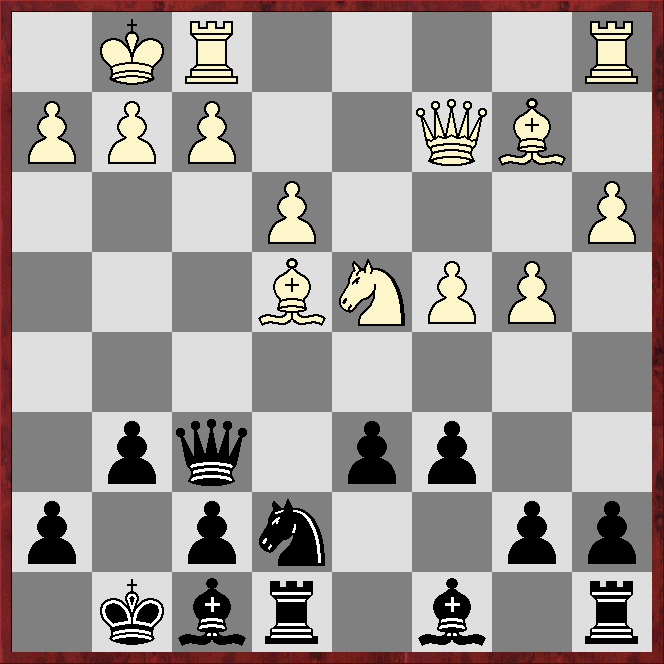
How should White proceed?
*****
*****
*****
*****
*****
16.a4!?
This apparent-novelty seems an improvement over Mária Machalová (2184) - Radomír Háčik (2158), Slovak Team Championship 2011, when 16.f4 could have been answered by 16...fxe4, with an edge for Black, according to the engines, although Black came out on top anyway in the complications following 16...d5 (0-1, 60 moves). However, possibly best is another apparent-novelty, suggested by engines, 16.b5!?
16...d5 17.cxd5
The engines give 17.exd5 cxd5 18.d4!?, claiming a slight edge for White.
17...exd5 18.exd5 Nxd5 19.Nxd5 Bxd5 20.Bxd5 Qxd5
Following a flurry of exchanges, how would you assess the middlegame?
*****
*****
*****
*****
*****
Black's position looks better, and indeed Stockfish18 gives Black a slight edge, but Dragon1 for a long time calls the game equal, before also settling on a slight edge for Black.
21.Nc3
The engines reckon White should take the open file with 21.Rbc1!?, or push on with 21.a5!?
21...Qd7
21...Qf3 22.Qd1 Qxd1 23.Rfxd1 helps White, as does 22...Qc6 23.Rc1.
After the text, Black threatens to win with 22...f4! 23.gxf4 Qg4+ 24.Kh1 exf4 25.Bxf4 (25.Bc5 Qf3+ 26.Kg1 Ng5 27.Rfe1 Qh3) Bxc3, so what should White play?
*****
*****
*****
*****
*****
22.f3!?
This is Stockfish18's second choice, behind 22.Qa2!?, when 22...Qxd3? loses to 23.Nd5!, after which the threat of 24.Rbd1 cannot be successfully met. Instead, Black should play 22...b6 or 22...Rfd8, with at least a slight edge, according to the engines. Dragon1 suggests 22.Rbc1, but 22...f4!? is still interesting, eg 23.gxf4 exf4!? 24.Bxf4 g5! 25.Bg3 h5.
22...Rfd8 23.Rfd1?
The wrong rook.
23...Qc6
The f3 pawn cannot be reasonably saved, eg 24.Kf2?! runs into 24...e4
*****
*****
*****
*****
*****
24.Rbc1
Perhaps 24.b5 is a slightly better way to give up the f3 pawn, although after 24...Qxf3 the engines reckon that, as in the game, White's best is to play for a swop of queens (with 25.Qe2).
24...Qxf3 25.Qf2
The engines marginally prefer 25.Qe2, or 25.Rf1 Qc6 26.Nb5 Qd7 27.Rc7, but in that case agree 27...Qd5 is winning.
25...Qxf2+ 26.Kxf2 Rd7 27.Ne2
Perhaps hoping to eliminate the d3 weakness, but the engines prefer active play with 27.Nb5 or 27.a5.
27...b6 28.a5
Not 28.d4? exd4 as both 28.Nxd4 and 28.Bxd4 are met by 28...Rad8.
28...bxa5 29.bxa5 Rad8 30.a6 e4 31.d4 h6?
Preparing ...Ne5, but 31...Ne5!? can be played immediately as 32.Bg5? Nd3+ 33.Rxd3 exd3 34.Bxd8 can be simply met by 34...Rxd8!, eg 35.Nf4 Bxd4+ 36.Kf3 d2 37.Rd1 Bc3, after which White is helpless. The more-prosaic 31...Rd6 is also strong.
32.Rc6?
The engines give 32.Rd2, reckoning White is no more than slightly worse.
32...Ne5!
The only winning move, but, bearing the preamble, not difficult to find.
33.Rc2??
Better is 33.Rc3, but 33...Ng4+ 34.Kg2 Nxe3+ 35.Rxe3 Bxd4 gives Black an overwhelming position.
33...Ng4+ 0-1

Monday, 29 June 2026

Lessons From Bischofsgrün VI & VII

IN round six I was White against Dieter Bauer (1787), and in round seven I was Black against Manfred Herbold (2075).
The openings were very different - an English and a Sicilian Grand Prix Attack - but there was something similar about Black's position in both games after 10 moves.
Black has just captured on c4 in the English game
Black has just pushed the e pawn in the Sicilian game
In the English game, Black has one developed piece, a knight, against White's three - a bishop and two knights.
In the Sicilian game, Black has one developed piece, a bishop, against White's, arguably, four - both rooks and both knights, and White has castled.
In both games it is White to move, so Black's lack of development is even starker.
But there is a huge difference in how Stockfish18 and Dragon1 evaluate the positions.
In the first diagram, White is winning, according to the engines, after the game's 11.0-0, and after 11.Nxc6!
In the second diagram, again according to the engines, White has the normal slight edge one associates with moving first.
Why the difference, especially in view of the discrepancy in development being greater in the second diagram, and White having a doubled and vulnerable pawn in the first diagram?
The answer is that in the first diagram, lines have been opened in the centre, which makes it easier for pieces to attack the opponent's position in general, and the opponent's king in particular.
In the second diagram, while the centre is not closed, it is definitely not open either, with both sides having eight connected pawns, and none in contact with enemy pawns.
LESSON: the importance of development increases dramatically as lines are opened.

Wednesday, 17 June 2026

Bischofsgrün Round Six

Spanton (1951) - Dieter Bauer (1787)
English
1.c4 d6 2.Nc3 e5 3.g3 f5 4.Bg2 c6!?
This is second-most popular in ChessBase's 2026 Mega database, but a very long way behind 4...Nf6.
How should White respond?
*****
*****
*****
*****
*****
5.d4
This and 5.d3 are almost equally popular, but the text scores 15 percentage points better.
5...Nd7
Stockfish18 and Dragon1 suggest 5...Nf6!? or 5...Be7, eg 5...Nf6!? 6.dxe5 dxe5 7.Qxd8+ Kxd8 8.Nf3 Nbd7, with equality (Stockfish18) or a small edge for White (Dragon1). But they dislike 5...e4, reckoning 6.f3 d5 7.Nh3!? gives White the upper hand, eg 7...Be7 8.0-0 Nf6 9.cxd5 cxd5 10.Bg5 Nc6 11.e3 0-0 12.Nf4, with tremendous pressure against Black's extended centre.
6.e4!? exd4
The engines prefer 6...fxe4.
7.Qxd4 Qb6!?
This apparent-novelty is quite liked by Stockfish18. The known move is 7...Ne5.
8.Nf3 Qxd4 9.Nxd4 Ne5 10.exf5 Nxc4?
Perhaps the engines' 10...Ne7 is best, albeit they give White the upper hand.
How should White proceed?
*****
*****
*****
*****
*****
11.0-0
Even stronger is 11.Nxc6! I rejected it because of the reply 11...Bxf5, but the engines continue 12.0-0 Nf6 13.Re1+, when material is level, but they reckon White's advantage is about the equivalent of being a piece up.
11...Nf6?
Possibly best is 11...Kf7!?, as the text allows 12.Nxc6! Bxf5 13.Re1+ with a large advantage.
12.Re1+? Kf7!?
Not 12...Be7? 13.Nxc6!
13.Ne6?!
This loses much of White's remaining advantage, according to the engines, whereas they reckon 13.b3!? Ne5 14.Ba3! is very strong, eg 14...Be7 15.f4 Ned7 16.g4!? Nxg4 17.Rxe7!? Kxe7 18.Re1+ Kf7 19.Ncb5! cxb5?! 20.Bd5+ Rf6 21.Re6+ Kf7 22.Bxd6 leads to unstoppable mate. That is a very sharp line, and Black probably does better to play 13...Nb6, when 14.a4 d5 15.a5 Nbd7 16.a6!? gives White at least the upper hand, according to the engines, but the game goes on.
13...Be7?
After 13...d5 White has only a slight edge, according to the engines.
14.Nxg7! Ne5 15.Ne6 Nd3!?
Winning the bishop-pair is apparently Black's best chance, although the engines reckon White nevertheless has a winning advantage.
16.Re3 Nxc1 17.Rxc1 Bxe6
The engines suggest 17...d5.
18.fxe6+ Kg7
Black is 'only' a pawn down, and even has hopes of getting down to opposite-colour bishops, but the engines reckon White's advantage is worth about 2.5 pawns
*****
*****
*****
*****
*****
19.Ne2!?
This is best, according to the engines.
19...Rhf8 20.Bh3 c5!? 21.Nf4 Rfd8 22.Bg2!
Now the d pawn will be blockaded, as 22...d5 runs into 23.Re5 d4 24.Nd3.
22...Rab8 23.Rd3 b6 24.Bd5 Rdc8 25.b3 a6 26.a4 Kf8!? 27.Ng2!?
The knight is headed for e3 and either f5 or c4.
27...Rc7 28.Ne3 Ra7 29.Nf5 b5 30.axb5 axb5 31.Bf3!? Rb6 32.Rcd1 Raa6 33.Bd5!? Ra5 34.Rf3!?
With the black queenside pawns blockaded or restrained, it is time to switch to the kingside.
34...Rba6 35.Kg2 Rb6!?
Black does not really have a useful move.
36.g4!? Ke8 37.g5 Nxd5 38.Rxd5 Ra7 39.h4 c4!?
This is Black's best, according to the engines, but that only shows how bad Black's position is.
40.bxc4 bxc4 41.Rc3 Rc6 42.Ne3 Ra4 43.f4 Bd8 44.Rd4 Bb6 45.Rdxc4 Raxc4 46.Rxc4 Rxc4 47.Nxc4 Bc7 48.Kf3 d5 49.Ne3 d4 50.Nd5 1-0

Tuesday, 16 June 2026

Bischofsgrün Round Five

Rolf Zens (1884) - Spanton (1951)
English/Réti
1.c4 e6 2.g3 d5 3.Bg2 d4!?
Much more popular in ChessBase's 2026 Mega database is 3...Nf6, followed by 3...c6, 3...dxc4, 3...c5, and then the text.
4.Nf3 c5 5.d3 Nf6
Stockfish18 and Dragon1 like the rarely played 5...Ne7!?, intending to meet both 6.e3 and 6.0-0 with 6...Nec6!?, eg 6.e3 Nec6!? 7.exd4 cxd4 8.0-0 Be7 9.Na3 0-0, when they reckon the game is completely equal.
6.0-0 Nc6 7.a3!?
This may be a little slow, but it has been played by grandmasters. The engines suggest 7.e3 or 7.Na3.
7...e5!?
The engines prefer 7...a5.
The position after 7...e5!? occurs 125 times in Mega26, but usually with Black to move
*****
*****
*****
*****
*****
Black has a slight edge when the position is reached with Black to move, according to the engines, but with White to move, they reckon White has a slight edge.
8.Re1
This seems to be a novelty. The engines like 8.b4!?, when Daniel Barría Zuñiga (2341) - Miran Oganian (2437), Chess.com Blitz 2022, went 8...cxb4?! 9.axb4 Bxb4 10.Nxe5! Nxe5?! 11.Qa4+ Nc6 12.Bxc6+ bxc6 13.Qxb4, after which material is equal, but White is winning, according to the engines (but 0-1, 22 moves). Instead of 8...cxb4?!, Black should probably play 8...Bd6, albeit with what the engines reckon is a slight edge for White.
8...Bd6 9.e3 0-0
Now both sides have castled, how would you assess the position?
*****
*****
*****
*****
*****
For quite some time Dragon1 reckons Black's extra space confers a slight edge, but it eventually comes to agree with Stockfish18 that chances are equal.
10.h3
The engines do not like this, advocating exchanging on d4, or getting on with development with 10.Nbd2.
10...a5
Belated, but good, although the engines also like 10...h6 (despite not liking 10.h3).
11.exd4
How should Black recapture?
*****
*****
*****
*****
*****
11...cxd4
Best, according to the engines, is 11...exd4.
12.Nbd2 Bf5!? 13.Qe2
Probably not 13.Ne4?!, as the engines reckon 13...Nxe4 14.dxe4 Be6 gives Black a positionally won game.
13...Re8 14.Nh4 Be6 15.Ne4 Nxe4 16.Qxe4 Qd7 17.Kh2
The engines suggest 17.g4 or 17.Bd2!?, eg 17.Bd2!? Bxh3 18.Bxh3 Qxh3 19.b4!? axb4 20.axb4 Rxa1 21.Rxa1 Bxb4 22.Bxb4 Nxb4 23.Qxb7, reckoning White has full compensation for a pawn.
17...a4!?
Correctly assessing Black has time for this as White is not in position to take advantage of the tempo spent to cause mischief on the kingside.
18.Bd2 f5!? 19.Qe2 Qf7 20.Nf3?!
The engines strongly dislike this, suggesting 20.Kg1!?, 20.Qd1 or 20.Rac1.
20...h6
The engines reckon Black has a positionally won game
*****
*****
*****
*****
*****
21.Ng1
The engines more-or-less come to agree 21.Rac1 is best, but also that 21...Rad8 leaves Black on top.
21...e4!
This is the very move 21.Ng1 was presumably meant to prevent.
22.Rac1
The engines reckon this is better than 22.exd4 Bxc4 23.Qf3, when, according to them, three moves with the king's rook, 23...Re5!?, 23...Re6 and 23...Rf8, are among continuations leaving Black with a winning advantage. But possibly better than the text is 22.c5!? Bxc5 23.Rac1 Ba7 24.dxe4 fxe4 25.Qxe4, even though 25...Bxh3 is clearly good for Black, and the engines reckon 25...d3!? is even better.
22...exd3
Even stronger appear to be the engines' 22...Ne5 and 22...Rad8.
23.Qxd3 Ne5?!
Best may be 23...f4 24.Rxe6!? fxg3+ 25.fxg3 Rxe6 26.Bd5 Rf8 27.Re1 Nd8, with a tricky position, but one that at least slightly favours Black, according to the engines.
24.Qxd4 Rad8
How should White proceed?
*****
*****
*****
*****
*****
25.Bd5
Not 25.Rxe5?? Bxe5 26.Qxe5 Rxd2, but possibly best is 25.Bf4!? Bb4 26.Qc3 Nd3 27.Rxe6! (an only-move, according to the engines) Qxe6 28.Bxb8 Nxc1 29.Qxc1 Qb6, when Black has two rooks for two bishops, a knight and a pawn. That is an unusual imbalance, but after best play, which the engines reckon runs something like 30.c5! (preventing both 30...Qxf2 and 30...Rxb8) Rc8 31.Qf4 Qxc5 32.Bd6 Qb5, the game, according to them, is completely equal.
25...Nc6 26.Bxe6?
White remains a pawn up after the engines' 26.Rxe6! Nxd4 27.Rxe8+ Rxe8 28.Bxf7+ Kxf7 29.Rd1.
26...Rxe6 27.Qd5
Best may be 27.Qd3!?, but 27...Be5 (27...Bxg3+!? 28.Qxg3 Rxd2 is also good for Black) 28.Qc2 Nd4 leaves Black with an advantage worth more than a minor piece, despite being a pawn down, according to the engines.
27...Bxg3+ 0-1
Premature resignation? After 27.fxg3 Rxd5 28.cxd5 Rxe1 29.Rxe1 Qxd5 Black has queen and pawn for rook and bishop, enjoying an advantage equivalent to being almost a rook ahead, according to the engines.

Thursday, 14 May 2026

Bregenz Seniors Round Five

FACED a Swiss.

Erich Kampenhuber (1675) - Spanton (1911)
English
1.c4 e6 2.Nc3 d5 3.g3?!
There are 188 examples of this move in ChessBase's 2026 Mega database, including by a player rated over 2600, albeit at blitz, but letting Black gain space with tempo is at least questionable.
3...d4
This is better than 3..Nf6, although the latter is almost three times more common.
4.Nb5
Not 4.Ne4?? f5.
4...a6 5.Na3 Bc5!?
Stockfish18 and Dragon1 like 5...c5 and 5...e5, but the text, which is apparently a novelty, was played with the following sequence in mind.
6.b3!? d3!?
White to play and lose
*****
*****
*****
*****
*****
7.exd3??
Black is better, but not winning, after 7.Bb2 or 7.Nf3.
7...Qf6 0-1

Thursday, 23 April 2026

World Team 65+ Round Five

Bo.46
  England - 5
Rtg-32
  Germany (W)
Rtg0 : 0
16.1
Freeman, Richard C P
1897-WFM
Malachowski, Margrit
1953
16.2CM
Stokes, Michael
1861-WIM
Wagner-Michel, Annett
1982
16.3
Spanton, Tim R
1908-WFM
Skibbe, Diana
1930
16.4
Marshall, Michael
1859-WFM
Kierzek, Mira
1958

Spanton (1908) - Diana Skibbe (1930)
English Botvinnik v Dutch Leningrad
1.c4 f5 2.Nc3 Nf6 3.g3 g6
Setting up the Leningrad Variation of the Dutch Defence.
4.Bg2 Bg7 5.d3 d6 6.e4
This, combined with the king's knight going to e2, constitutes the Botvinnik Setup in the English.
6...c6!?
This is second in popularity in ChessBase's 2026 Mega database to 6...Nc6. Both moves prepare ...e5, while leaving open the opportunity of recapturing on f5 with the light-square bishop if White plays exf5. However, very interesting is 6...e5 7.exf5 Bxf5!? 8.Bxb7 Nbd7 9.Bxa8 Qxa8, when, for the exchange and a pawn, Black has the bishop-pair, a lead in development, and light-square targets. Indeed, Stockfish17.1 and Dragon1 reckon White should play 9.Nf3!?, 9.Qc2 or 9.Be4.
7.Nge2 e5 8.0-0 0-0
Now both players have castled, how would you assess the position?
*****
*****
*****
*****
*****
White has a little more space on the queenside, Black on the kingside, while the white king has arguably more pawn cover than its black counterpart, although perhaps this is not important, bearing in mind Black's kingside space edge. The engines give White a slight advantage, but dependent on a specific continuation.
9.h3
Best, according to the engines, is 9.exf5!?, meeting both 9...Bxf5 and 9...gxf5 with 10.d4. The text is marginally more common in Mega26, but the engines have a sharp response in mind.
How should Black respond?
*****
*****
*****
*****
*****
9...h6
The engines suggest 9...f4!? 10.gxf4 Nh5, when they reckon 11.fxe5 dxe5 gives Black at least a slight edge, eg 11.f3!? (apparently a novelty, but best, according to the engines) Be6 12.Be3 Rf7, with a steady build-up, relying on the weakness of White's kingside as long-term compensation for a pawn. So they suggest offering the pawn back immediately with 11.f5!?, claiming equal chances.
10.Be3
This allows 10...f4!?, with similar ideas to 9...f4!?, so the engines suggest an apparent-novelty in 10.exf5!?, meeting 10...Bxf5 with 11.d4, and 10...gxf5 with 11.f4 or 11.Be3, in each case claiming White is better.
10...Be6 11.exf5!?
This may also be a novelty. The engines fluctuate in their preference between it and the known-move 11.Qd2.
11...Bxf5
This loses a tempo over those lines in which White plays exf5 before the bishop moves. However, Dragon1 rates the text and 11...gxf5 as of roughly equal strength; Stockfish17.1 prefers the pawn recapture.
12.d4 Qe7
The engines suggest 12...h5!?, 12...Na6 or 12...Nbd7.
13.Qd2
Even stronger, according to the engines, are 13.Qb3 and 13.g4!?
13...Kh7 14.Rad1 Na6 15.Kh2
The engines still like g4.
15...Rad8
How should White proceed?
*****
*****
*****
*****
*****
16.d5
This comes to be the engines' top choice, at least for a while, but they also like 16.g4!? and 16.Kg1!?
16...cxd5 17.cxd5
The engines prefer 17.Nxd5, only playing cxd5 in the event of ...Nxd5.
17...b6
The engines give 17...Nc5!?, the idea being 18.b4 can be met by 18...Nce4 19.Nxe4 Nxe4, when 20.Bxe4!? Bxe4 21.Bxa7 is possibly too much of a price to pay for a pawn.
18.f4 e4?
Perhaps played to try to keep lines closed, but it allows the white king's knight to occupy the plum d4 square. The engines prefer 18...h5!? or 18...Nc5.
19.Nd4
The engines suggest 19...Rde8, but both 20.g4 and 20.Nc6 are very good for White.
19...Bd7 20.f5 gxf5 21.Rxf5!?
The engines agree sacrificing the exchange is marginally stronger than 21.Nxf5.
21...Bxf5 22.Nxf5 Qf7
The engines are unsure whether f7 or e5 is the best square for the queen.
23.Bxh6 Bxh6
The engines give 23...e3!?, but agree that, after 24.Bxe3, White's advantage is the equivalent of being more than a piece up.
24.Qxh6+ Kg8 25.Nxe4 Nxe4 26.Bxe4 Qf6 27.Qh5 Nc5!?
This may be Black's best try. The main alternative seems to be 27...Rd7, but 28.Nh6+ Kg7 29.Ng4! Qxb2+ 30.Kg1 is crushing, eg 30...Rff7 (30...Rdf7? 31.Qh7#) 31.Qh6+ Kg8 32.Bh7+! Rxh7 33.Nf6+ Qxf6 (forced) 34.Qxf6 leaves White with queen, pawn and a continuing attack for rook and knight.
White to play and win
*****
*****
*****
*****
*****
28.Nh6+
Not the winning move, but this spoils nothing as, after ....
28...Kg7 29.Nf5+ Kg8
... the same position is reached, without Black having a chance to vary.
30.Bc2!
Preserving the bishop, and ensuring Black cannot capture on b2 with check.
30...Rde8
All moves lose.
31.Rd4
Not the only winning continuation.
31...Rf7 32.Nh6+ Kf8
Worth a try is 32...Qxh6!? as 33.Qxh6? concedes a draw to 33...Re2+ 34.Kg1 Re1+ 35.Kg2 Re2+ etc. However, 33.Rg4+ Qg7 (33...Rg7? 34.Qxe8#) 34.Rxg7+ Kxg7 35.h4! leaves White with queen, bishop and two pawns against two rooks and a knight, and with much the safer king, adding up to an advantage worth more than a rook (much more than a rook, according to Dragon1).
33.Rf4 1-0
Team Result
Freeman = Malachowski
Stokes 1-0 Wagner-Michel
Spanton 1-0 Skibbe
Marshall 0-1 Kierzek
England 5 2.5-1.5 Germany Women

Friday, 2 January 2026

Cracovia 60+ Round Seven

TOOK a halfpoint bye in the first of today's two rounds.

Spanton (1913) - Zbigniew Gregulski (1746)
English Opening
1.c4 Nf6 2.Nc3 e5 3.Nf3 d6
This is distinctly second in popularity to 3...Nc6.
4.d4 exd4!?
More popular are 4...e4 and especially 4...Nbd7, but the text is best, according to Stockfish17.1 and Dragon1.
5.Nxd4 Be7 6.e4 0-0 7.Be2 Bd7 8.0-0
Now both sides have castled, how would you assess the position?
*****
*****
*****
*****
*****
White's bind on the centre gives a space advantage that is the equivalent of being about a pawn up, according to the engines.
8...Nc6 9.Be3
Avoiding exchanges with 10.Nc2!?, an idea also seen in the Maróczy Bind in the Sicilian, is liked by the engines.
9...Re8 10.Rc1 Nxd4!?
This apparent-novelty is preferred by the engines over the known 10...a6.
11.Bxd4 Bf8 12.Qc2 g6 13.f3 Bg7 14.Rfd1 Nh5!?
How should White proceed?
*****
*****
*****
*****
*****
15.Bxg7!?
This weakens the black king's position, but swops off White's good bishop, something that is often questionable when White, as here, has a bad bishop (Chess Tip Of The Day #27 on my blog cited grandmaster Gregory Kaidanov in the US Chess Federation's magazine Chess Life: "When you have a bad bishop, don't trade the other bishop.") It was possible to keep my dark-square bishop with, for example, 15.Be3 Be5 16.g3, but the engines agree with my decision.
15...Nxg7 16.Nd5 Bc6 17.Qc3 Bxd5 18.cxd5 Rc8 19.Qb4
How should Black respond to White's queenside pressure?
*****
*****
*****
*****
*****
19...Qg5!?
Black almost certainly has to do something on the kingside as there is little chance of holding out by trying to defend the queenside. The text is Dragon1's top choice, at least for while, but Stockfish17.1 prefers 19...f5!?
20.Bf1 Nh5
The engines suggest 20...f5, or 20...Qe3+ 21.Kh1 Qb6, but agree White is at least slightly better.
It is White to move, but if it were Black to move, what would be the immediate threat?
*****
*****
*****
*****
*****
Black would have a draw by perpetual by 21...Qe3+ 22.Kh1 Ng3+! 23.hxg3 Qh6+ 24.Kg1 Qe3+ etc. But note there is no win as 23...Re5?? fails to 24.g4, eg 24...Qh6+ 25.Kg1 Qe3+ 26.Qf4+ Kh3.
21.Rc2 Qe3+ 22.Rf2 b6?!
There is no immediate need for this as White is not threatening to capture on b7 (even if it were White to move again after 22.Rf2, the capture 23.Qxb7? runs into 23...Rb8 24.Qc6 Rb2!! 25.Qxe8+ Kg7, after which Black gets the rook back, with a continuing strong attack). So Black should probably play 22...Qb6, angling for an exchange of queens (White probably should not oblige), or 22...Nf6, when capturing on b7 is again not good.
23.Rd3 Qg5
23...Qc5 24.Qxc5 dxc5! is not too bad for Black, but White again should almost certainly avoid exchanging queens.
24.Rc3 Nf4?!
The engines do not like this, suggesting 24...Re7, 24...f5 or 24...a5.
25.Kh1 Re7 26.Rfc2 f5 27.g3 Nh5
What should White play?
*****
*****
*****
*****
*****
28.Bh3?!
This activates the bishop, and pins the f5 pawn, but there is much better available, eg 28.e5! (Stockfish17.1's top choice), when 28...Rxe5 29.f4 Qg4 can be met by 30.h3! Nxg3+ 31.Kg2!, or 28...dxe5? 29.d6 c5 30.dxe7! cxb4 31.Rxc8+ and 32.e8=Q(+). Dragon1 comes to agree 28.e5! is best, but for a long time prefers the also-strong 28.f4!, when 28...Qh6 29.e5 is very good for White, while the engines reckon 28...Nxf4!? should also be met by 29.e5!, eg 29...Nxd5 30.Qb3 Rxe5 31.Rd3.
28...Nf6?!
The engines suggest 28...Qf6, claiming Black is only slightly worse.
29.Qd4!
This is best, according to the engines. Note that 29.e5? Rxe5 30.f4? Re1+ 31.Kg2 Qh5 is winning for Black.
29...Kf7 30.Rc6 h5?
The engines fluctuate between various moves, including 30...a5!?, 30...Ne8, 30...Nd7 and 30...Nh5, all of which they reckon leave White with at least the upper hand, but they agree the text is a mistake.
White to play and gain a large winning advantage
*****
*****
*****
*****
*****
31.Rxd6?
White has two very strong continuations in 31.f4 Qh6 32.e5, eg 32...Ne4 33.exd6 Nxd6 34.Rxd6!, and 31.exf5 gxf5 32.Qd3. Note that in both lines the move ...Re1+ never gives Black more than a check.
The text wins a pawn, at least temporarily, and gets a rook to the eighth rank, but the f5 pawn is no longer pinned, and the initiative goes over to Black.
31...cxd6 32.Rxc8 h4!
Black is a pawn down, but has gained complete equality, according to the engines
*****
*****
*****
*****
*****
33.f4!?
The engines for quite some time strongly dislike this, reckoning Black gets the upper hand or a slight edge (Stockfish17.1) or is even winning (Dragon1).  However, eventually they come to agree White seems to be just about all right.
Probably simplest is 33.Kg2, when 33...hxg3 34.hxg3 Nh5 35.Qf2 Nf4+ leads to a possible threefold repetition after 36.Kh2 Nd3 37.Qd4 Ne5 38.Qf2 Nd3 etc, although there are playable alternatives along the way (but the engines' evaluations never vary from complete equality).
33...Qh5 34.e5 hxg3
The alternative is 34...dxe5 35.fxe5 hxg3 36.e6+ Kg7 37.Kg2, with the same position reached in the game, but without the f4 and d6 pawns.
Analysis diagram
*****
*****
*****
*****
*****
The engines reckon best-play from this alternative position runs something like 37...Qe2+!? 38.Kxg3 f4+!? 39.Kxf4 g5+ 40.Kf5! Qf3+ 41.Ke5 Qxh3 42.Rc2 Ne8!?, when White, for being a knight down, has two advanced and connected passed pawns. Neither king is safe, and the position remains unclear, but equal chances seems the fairest verdict.
Back to the game.
35.e6+ Kg7 36.Kg2 gxh2
The engines agree that, with pawns at f4 and d6, the text is slightly better than ...Qe2+.
37.Kxg2 Qh4
Threatening to win with 38...g5.
How should White respond?
*****
*****
*****
*****
*****
38.Rd8?!
This is the engines' second choice, but probably better is 38.Kg2!?, with what the engines reckon is equality.
38...Kh7!
The engines come to agree this is best.
If 38...Rc7, then 39.Rd7+ Rxd7 40.exd7 can be met by 40...Qh8 or 40...Kh7!? 41.d8=Q Ng4+ 42.Kg2 Qxd8, in both cases with equality, according to the engines.
39.Kg2??
Necessary is 39.Rc8, although the engines reckon Black is at least slightly better after, for example, 39...Rg7.
39...Rc7 40.Qf2 Qh5+
Black does not want to swop queens, as 40...Qxf2+? 41.Kxf2 makes the e pawn dangerous, although the engines agree 41...Nxd5 gives complete equality.
41.Rf8
There is no defence.
Black to play and win
*****
*****
*****
*****
*****
41...Kg7?
Black wins easily after 41...Ne4 as either the white queen is driven off the second rank, allowing ...Rc2+, or White is reduced to 41...Rf7+ 42.Rxf7 exf7, when the simplest win is probably 43.Qxh3+!? Nxf2+ 44.Kg2 Kg7 45.f8=Q+ Kxf8 46.Kxf2, with a fairly straightforward 5v4 pawn ending.
White to play and win
*****
*****
*****
*****
*****
42.Rxf6! Kxf6?!
This allows a quick mate, but otherwise Black is a piece down and faced with a huge passed pawn on e6.
43.Qd4+ Ke7 44.Qg7+ Ke8 45.Qg8+ Ke7 46.Qf7+ 1-0

Wednesday, 1 October 2025

Miniatures 13

IN this occasional series I am going through my decisive games of 20 moves or fewer.

Tarek Fatin (204 BCF) - Spanton (151 BCF)
Barbican (London) Rapid 1989
English
1.c4 e5 2.Nc3 Nf6 3.g3 d5 4.cxd5 Nxd5 5.Bg2 Be6 6.Nf3 Nbd7?!
Black should probably play the normal move, 6...Nc6.
7.0-0 c6!?
Stockfish17 and Dragon1 much prefer developing with 7...Be7.
8.d4
How should Black proceed?
*****
*****
*****
*****
*****
8...Bd6!?
A move that still does not appear in ChessBase's 2025 Mega database. The engines like it, along with the known 8...Nxc3, preferring both moves over the other known moves, 8...f6, 8...Qc7?! and 8...exd4?!, although they reckon White has the upper hand.
9.Ne4 Qe7?
Correct is 9...Bc7.
10.Nxd6+ Qxd6 11.dxe5 Nxe5??
Losing a piece, but moving the queen also leaves White well on top.
12.e4 1-0
LESSON: self-pinning, as Black effectively did in this game, is often dangerous, and should not be done without good reason.

Wednesday, 23 July 2025

Bad Bertrich Round Six

FACED  a Luxembourger.

Pierre Christen (2008) - Spanton (1946)
English/Réti
1.c4 e6 2.g3 d5 3.Bg2 Nf6 4.Nf3 d4!?
A rare continuation - more-popular choices being 4...c5, 4...c6, 4...dxc4 and especially 4...Be7. But the text has the highest score percentagewise in ChessBase's 2025 Mega database.
5.d3
ChessBase classifies the opening as an English, but I am sure a lot of people would regard it as a Réti, and indeed the first appearance of the position after 4...d4!? in Mega25 is in the game Richard Réti - Henri Weenik, Match (game seven) Amsterdam 1928. That saw 5.0-0 c5 6.e3 Nc6 7.exd4 Nxd4!? (7...cxd4 is more usual today) 8.Nxd4 Qxd4!? (Alexei Shirov has also played this, but it is disliked by Stockfish17 and Dragon1) 9.d3 Be7 10.Nc3 0-0 11.Be3, with the upper hand for White, according to the engines (1-0, 20 moves).
5...c5
How should White proceed?
*****
*****
*****
*****
*****
6.0-0
Slightly more common in Mega25, and preferred by the engines, is 6.e4!? After 6...fxe3 the engines' idea is 7.Bxe3!?, which scores 68% in Mega25, albeit from just 11 games, while 6...Nc6 can be met by 7.e5!?
6...Nc6 7.e4?!
Too late, at least to gain any sort of advantage. White should probably play the normal Réti move 7.e3.
7...e5 8.Ne1!? Bg4!?
This seems to be a novelty. Vera Menchik - Paulino Frydman, Poděbrady (Czechoslovakia) 1936, went 8...Bd6 9.f4 Qc7 10.Na3 a6 11.f5, when Black had at least a slight edge, according to the engines (but 1-0, 50 moves).
9.f3 Bh5 10.Qb3 Qd7 11.f4 exf4 12.Bxf4 Bd6!?
What should White play?
*****
*****
*****
*****
*****
13.e5!?
This is best, according to Stockfish17, although Dragon1 marginally prefers 13.Nd2. Instead, White can grab a pawn by 13.Bxd6 Qxd6 14.Qxb7, but Black seems to get good compensation after 14...0-0 or 14...Rb8.
13...Nxe5
Not 13...Bxe5?? 14.Bxc6 etc.
14.Bxe5 Bxe5 15.Qxb7 Rb8 16.Qxd7+ Nxd7
How should White continue?
*****
*****
*****
*****
*****
17.Bc6?!
This leads to sharp play that appears to favour Black. The engines prefer 17.b3, but reckon Black's bishop-pair and space advantage give a slight edge.
17...Rxb2 18.Bxd7+?
White hopes to capitalise on Black's hanging bishops, but a better try, according to the engines, is 18.Rf5 Re2 19.Nd2!? (19.Kf1 can be met as in the game) Bg6 20.Rf2 Rxf2 21.Kxf2, although Black is clearly better.
18...Kxd7 19.Rf5 Re2 20.Kf1 Bg6 21.Rxf7+ Bxf7 22.Kxe2
White has got the pawn back, but Black's bishop-pair and lead in development give a large advantage
*****
*****
*****
*****
*****
22...Re8!?
Black has several good continuations, including 22...Bxc4!?
23.Kf2
White can do nothing to prevent ...
23...Bxc4!
... after which Black is up the equivalent of more than a minor piece, according to the engines.
24.dxc4 d3 25.Nxd3
After 25.Nc3 Bxc3 26.Rd1 Black can swop off into a pawn-ending that looks promising, but is far from clear, or, perhaps more practically, play 26...Re2+ with a large advantage, eg 27.Kf1 Kc6 28.Nxd3 Rxh2 29.a3 Ra2.
25...Bxa1 26.Nxc5
How would you assess this ending?
*****
*****
*****
*****
*****
White has a pawn for the exchange, but Black's two long-range pieces are much stronger than White's pair of knights.
26...Kd6 27.Nb3 Bf6 28.N1d2 Rc8 29.Kf3 Rc6 30.a4 Kc7!
This is best, according to the engines, the idea being to keep away from forks.
31.c5 Ra6 32.a5 Bc3 33.Nc4 Kc6
The engines prefer 33...Re6, cutting off white's king from the queenside, or 33...Rh6.
34.Ke4 Kb5?!
Black is still winning after this, according to Dragon1, but Stockfish17 is less sure. The engines suggest a move such as 34...Kd7, the point being there is no rush to convert Black's advantage - White's passed pawn is not dangerous.
35.Kd5 Kb4?
This lets White equalise, whereas after 35...Rg6 Black is winning (Dragon1) or at least has the upper hand (Stockfish17).
White to play and draw by finding an only-move
*****
*****
*****
*****
*****
36.Nb6
The engines show everything loses except 36.Nc1!, when both 37.Na2+ and 37.c6 are winning threats. Black can play 36...Kb5 (other moves are no better), but White draws easily, eg 37.Nd3 (also drawing are 37.Nd6+ and 37.Ne2) Bxa5 38.Nd6+ Ka4 39.c6 (threatens 40.Nc5+) Bb6 40.Nc5+ (anyway) Bxc5 41.Kxc5 Ra5+ 42.Kc4 Ra6 etc.
Insufficient is 36.c6 as Black has 36...Rxc6! 37.Kxc6 Kxc4 and 38...Bxa5, while 36.Nd4 Bxd4 37.Kxd4 Rh6 is also hopeless for White.
The game finished:
36...Kxb3 37.c6 Rxa5+ 38.Kd6 axb6 0-1

Friday, 18 July 2025

Bad Bertrich Round One

Spanton (1946) - Cordula Hinrichs (1683)
English
1.e4 d6 2.c4!? Nf6 3.Nc3 e5!?
Most popular in ChessBase's 2025 Mega database is 3...g6, which is arguably more in keeping with Black's apparent original intent of playing a Pirc. But it is possible Black was aiming for a variation of the Philidor, and anyway after 3...g6 4.d4 Black has to be happy with playing a King's Indian. Also, 3...g6 is not liked by Stockfish 17 and Dragon1, for what that is worth at such an early stage of the opening. By choosing the text, Black has switched into lines of the English in which White, by following up with g3, Bg2 and Nge2 - not necessarily in that order - has a Botvinnik setup in what are generally considered favourable circumstances, ie with a black pawn on e5.
4.g3 Nbd7 5.Bg2 Be7 6.Nge2 c6 7.0-0 0-0
Now both sides have castled, how would you assess the position?
*****
*****
*****
*****
*****
White has more queenside space, and the better king's bishop. Dragon1 gives White the upper hand, but Stockfish17 awards just a slight edge.
8.d4
ChessBase classifies the opening as "A53: Old Indian Defence without Nf3." There are 239 examples of the position in Mega25.
8...Qc7 9.f4!?
Is there a Four Pawns Attack against the Old Indian? Korchnoi in a 1961 game preferred the more-restrained 9.Be3.
9...Re8 10.h3
Tartakower in a 1924 game played 10.Kh1.
10...Bf8 11.g4!?
And now it is a Five Pawns Attack, which the engines are OK with.
11...exd4
This is best, according to the engines, but after ...
12.Nxd4
... White can be happy at the improved position of the white king's knight.
12...Nc5 13.Qc2 Ne6
An apparently more logical follow-up is 13...a5, but the engines reckon White has a good game anyway.
14.Be3 Nxd4 15.Bxd4 Be6!?
The bishop becomes a target here for White's pawn-advance.
16.b3
This seems better than 16.Bxf6?! gxf6, after which White is not well-placed to attack Black's smashed kingside.
16...Qe7
The engines suggest 16...h6, even though it gives White a kingside target.
17.Rae1 c5?!
This weakens the d5 square, as well as making the d pawn backward.
18.Bf2 a6?
There is no time for this. The engines suggest 18...h6!? or 18...Kh8!?, but have White well on top.
19.Bh4 Qc7 20.f5 Bc8
Forced, as 20...Bd7? 21.g5 Nh5 21.Nd5 is horrendous for Black, eg 21...Qd8 22.Bf3 g6 23.Bxh5 gxh5 24.Nf6+ Kh8 25.Qd1 leaves Black hopelessly busted.
After 20...Bc8, how should White continue?
*****
*****
*****
*****
*****
21.Bxf6!?
This may make Black's defence easier. The engines like 21.e5!? dxe5 22.g5.
21...gxf6 22.Nd5 Qd8 23.Qc3 Bg7 24.Kh1!?
The engines reckon this is slow, preferring 24.Qg3.
24...b5?!
Loosening. White 'only' has the upper hand after 24...Bd7 or 24...Re5, according to the engines.
How should White exploit Black's last move?
*****
*****
*****
*****
*****
25.Nf4
This is not bad, but the engines' 25.e5! lands Black in all sorts of trouble, despite there being three ways to capture the white pawn.
A) 25...fxe5? is worst as 26.f6 Bf8 27.Ne7+ wins the black queen's rook.
B) 25...Rxe5?! allows 26.Rxe5 dxe5 (26...fxe5? 27.f6) 27.Nxf6+ Bxf6 28.Bxa8, winning the exchange. Black can get a pawn for it with 28...bxc4 29.bxc4 Bxf5 30.gxf5 Qxa8+, but 31.Qf3 is strong.
C) 25...dxe5 is relatively best, but White has several good replies, including 26.Rd1 and 26.g5!?, eg 26.g5!? Ra7 27.Rd1 Rd7 28.gxf6 Bxf6 29.Be4!?, when White is a pawn down but winning, according to the engines.
25...Bb7 26.Nh5 Re5 27.Qd2 Qf8?!
Probably better is 27...Rb8, albeit White's pressure continues, eg 28.h4 h6 29.Re3 bxc4 30.bxc4 Bc6 31.Qe2 Bf8 32.Rg3 Qe7 33.Re1, with White retaining the upper hand, according to the engines.
28.Rg1 Rae8?!
The engines give 28...Qe7 or 28...h6.
How should White meet the threat to e4?
*****
*****
*****
*****
*****
29.Qf4?
The threat to e4 is illusory. Even if it were Black to move in the diagram, capturing on e4 would be bad, ie  29...Bxe4? 30.Bxe4 Rxe4 31.Rxe4 Rxe4 32.g5 Kh8 (there is nothing better) 33.gxf6 Bh6 34.Qg2 Re5 35.Qg7+! Bxg7 36.fxg7+ etc.
Therefore, rather than the text, the engines give 29.g5 as winning, one line running 29...fxg5 30.Qxg5 f6 31.Qh4 with a strong attack. Probably better is 29...Kh8!?, but 30.gxf6 Bh6 31.Qf2 is also winning, according to the engines.
29...Bh6??
A horrible blunder, especially when 29...h6 and 29...Qe7 give equality, according to the engines.
30.Nxf6+ Kh8 31.g5 Bxg5?!
31...Bg7 is not a great deal better.
32.Qxg5 Qe7 33.Qh6 1-0

Thursday, 3 July 2025

Bischofsgrün Round Seven

Spanton (1954) - Roland Welsch (1890)
Caro-Kann Panov-Botvinnik
1.c4 c6 2.e4 d5 3.exd5 cxd5 4.d4 Nf6 5.Nc3 e6
This is the main move in ChessBase's 2025 Mega database, but it scores three percentage points lower than the 48% of second-most popular 5...Nc6.
6.Nf3 Be7
How should White proceed?
*****
*****
*****
*****
*****
7.Bg5!?
This has been played by grandmasters, but the main line in Mega25 runs 7.cxd5 Nxd5 8.Bd3 Nc6 9.0-0 0-0 10.Re1, with a slight edge for White, according to Dragon1, although Stockfish17 calls the game equal.
7...0-0 8.Rc1!?
The main moves are 8.c5!? and especially 8.Bd3!?
How should Black respond?
*****
*****
*****
*****
*****
8...Qb6!?
Apparently a novelty, in a position in which there are eight known moves, headed by 8...Nc6.
9.Qc2
The engines suggest 9.c5!? Qxb2 10.Bd3, claiming a slight edge.
9...Nc6
The engines prefer 9...dxc4 10.Bxc4, and now 10...Nc6.
10.c5!? Qc7 11.Bb5!? Bd7 12.Bxc6!?
The point of this manoeuvre is to slow Black getting in ...e5, the classic answer to White's queenside push.
12...Bxc6 13.b4 a6 14.0-0
Now both sides have castled, how would you assess the position?
*****
*****
*****
*****
*****
Barring blunders, the game is likely to revolve around whether Black can generate central counterplay to distract White from supporting and advancing the white queenside pawn-majority. The engines give White a slight plus.
14...Bb5?
Black spends a tempo obliging the white king's rook to move to a better location, and meanwhile provides White with a tempo for advancing the a2 pawn.
15.Rfe1 Rfe8 16.a4 Bd7
Probably no better is 16...Bc4.
17.Ne5 Nh5
Offering to give up the bishop-pair in the hope of getting Black's kingside pawns rolling.
18.Bxe7 Rxe7 19.Qe2 Nf6 20.b5 axb5 21.axb5 Be8!? 22.Ra1 Qb8 23.Qb2 Rxa1 24.Rxa1 Nd7 25.Nd3 f6
At last threatening to play ...e5, although d5 has to be protected first.
26.Qa3 Bf7??
Black is positionally lost anyway, according to the engines, but this allows an immediate finish.
27.c6 1-0

Wednesday, 4 June 2025

Miniatures 3

IN this occasional series I am going through my decisive games of 20 moves or fewer.

Spanton (140 BCF) - C Sergeant*
Doncaster & District League 1980
English Four Knights
1.c4 e5 2.Nc3 Nf6 3.Nc3 Nf6 4.e3!?
I had been much taken by Raymond Keene's The Openings In Modern Theory And Practice, which came out in 1979 in hardback. One of the lines covered in the book is this interesting move in the Four Knights Variation of the English.
4...Bb4
This is the main reply, scoring 47% in ChessBase's 2025 Mega database.
5.Qc2 0-0
This is the commonest continuation, although also popular is giving up the bishop-pair with 5...Bxc3!?, when the main line in Mega25 runs 6.Qxc3 Qe7 7.a3!? d5 8.d5 8.d4 exd4 9.Nxd4 Nxd4 10.Qxd4 c5!? 11.Qh4, with an unclear position that sees Stockfish17 and Dragon1's evaluations fluctuate, but generally favouring White.
How should White proceed?
*****
*****
*****
*****
*****
6.Nd5!?
This seems to have been first played by Vasja Pirc at the 1936 Olympiad in Warsaw. He lost to Andor Lilienthal, and the move did not catch on, but it was revived in the 1960s and 1970s by, among others, Benko, Korchnoi, Miles and Keene.
6...Re8 7.a3
The main move in Mega25 is 7.Qf5!?, and this was played against me in Kevin Thurlow (2283) - Spanton (2274), States & Regions Division Two Correspondence 2021, which continued 7...d6 8.Nxf6 gxf6!? (Korchnoi and Timman beat Keene with the text in 1977, and it is probably slightly better than 8...Qxf6, played by Ljubojević in a draw against Keene, also in 1977) 9.Qh5 d5 10.Bd3!? e4 11.cxd5 Bf8 12.a3!? exd3 13.dxc6, and now I played the apparent-novelty 13...a5!? (known, and preferred by the engines, is 13...bxc6), when 14.cxb7 Bxb7 was approximately equal (½–½, 27 moves).
7...Bd6!?
The engines do not like this, preferring the main move 7...Bf8 or the rare 7...e4!?
8.Bd3
Stockfish17 prefers 8.Ng5!?, but Dragon1 fluctuates between the two moves.
8...g6?!
Probably better is 8...h6.
9.Nxf6+?!
This is the engines' second choice, at least for a while (Stockfish17 comes to promote 9.Rb1 to second place), but they much prefer 9.h4!?
9...Qxf6 10.0-0 Bf8 11.Be4 d6 12.b4 Ne7 13.d4 exd4 14.Nxd4 c6 15.Bb2
White's play along the long dark diagonal is the most significant feature of the position - Black has to be careful
*****
*****
*****
*****
*****
15...Qg5?!
Occupying the diagonal with 15...Bg7 is probably better (the reply 16.Nxc6?? would be a gross error in view of 16...Qxb2).
16.Nf3 Qg4??
Correct is 16...Qh6, so if, as in the game, 17.Qc3, Black has 17...Bg7.
17.Qc3 f6
There is no better way of preventing Qh8 with mate, but Black is anyway lost.
18.Qxf6 Rd8 19.Ng5 1-0
*I have no further details, although the ECF has an unrated CR Sergeant listed as Active and a member of NCB (presumably National Coal Board), but without a rating history.
LESSON: a fianchettoed king's position without the bishop occupying the hole at g7 (g2 for White) can be very vulnerable to play on the long diagonal.