Showing posts with label Dutch Defence. Show all posts

Thursday, 23 April 2026

World Team 65+ Round Five

Bo.46
  England - 5
Rtg-32
  Germany (W)
Rtg0 : 0
16.1
Freeman, Richard C P
1897-WFM
Malachowski, Margrit
1953
16.2CM
Stokes, Michael
1861-WIM
Wagner-Michel, Annett
1982
16.3
Spanton, Tim R
1908-WFM
Skibbe, Diana
1930
16.4
Marshall, Michael
1859-WFM
Kierzek, Mira
1958

Spanton (1908) - Diana Skibbe (1930)
English Botvinnik v Dutch Leningrad
1.c4 f5 2.Nc3 Nf6 3.g3 g6
Setting up the Leningrad Variation of the Dutch Defence.
4.Bg2 Bg7 5.d3 d6 6.e4
This, combined with the king's knight going to e2, constitutes the Botvinnik Setup in the English.
6...c6!?
This is second in popularity in ChessBase's 2026 Mega database to 6...Nc6. Both moves prepare ...e5, while leaving open the opportunity of recapturing on f5 with the light-square bishop if White plays exf5. However, very interesting is 6...e5 7.exf5 Bxf5!? 8.Bxb7 Nbd7 9.Bxa8 Qxa8, when, for the exchange and a pawn, Black has the bishop-pair, a lead in development, and light-square targets. Indeed, Stockfish17.1 and Dragon1 reckon White should play 9.Nf3!?, 9.Qc2 or 9.Be4.
7.Nge2 e5 8.0-0 0-0
Now both players have castled, how would you assess the position?
*****
*****
*****
*****
*****
White has a little more space on the queenside, Black on the kingside, while the white king has arguably more pawn cover than its black counterpart, although perhaps this is not important, bearing in mind Black's kingside space edge. The engines give White a slight advantage, but dependent on a specific continuation.
9.h3
Best, according to the engines, is 9.exf5!?, meeting both 9...Bxf5 and 9...gxf5 with 10.d4. The text is marginally more common in Mega26, but the engines have a sharp response in mind.
How should Black respond?
*****
*****
*****
*****
*****
9...h6
The engines suggest 9...f4!? 10.gxf4 Nh5, when they reckon 11.fxe5 dxe5 gives Black at least a slight edge, eg 11.f3!? (apparently a novelty, but best, according to the engines) Be6 12.Be3 Rf7, with a steady build-up, relying on the weakness of White's kingside as long-term compensation for a pawn. So they suggest offering the pawn back immediately with 11.f5!?, claiming equal chances.
10.Be3
This allows 10...f4!?, with similar ideas to 9...f4!?, so the engines suggest an apparent-novelty in 10.exf5!?, meeting 10...Bxf5 with 11.d4, and 10...gxf5 with 11.f4 or 11.Be3, in each case claiming White is better.
10...Be6 11.exf5!?
This may also be a novelty. The engines fluctuate in their preference between it and the known-move 11.Qd2.
11...Bxf5
This loses a tempo over those lines in which White plays exf5 before the bishop moves. However, Dragon1 rates the text and 11...gxf5 as of roughly equal strength; Stockfish17.1 prefers the pawn recapture.
12.d4 Qe7
The engines suggest 12...h5!?, 12...Na6 or 12...Nbd7.
13.Qd2
Even stronger, according to the engines, are 13.Qb3 and 13.g4!?
13...Kh7 14.Rad1 Na6 15.Kh2
The engines still like g4.
15...Rad8
How should White proceed?
*****
*****
*****
*****
*****
16.d5
This comes to be the engines' top choice, at least for a while, but they also like 16.g4!? and 16.Kg1!?
16...cxd5 17.cxd5
The engines prefer 17.Nxd5, only playing cxd5 in the event of ...Nxd5.
17...b6
The engines give 17...Nc5!?, the idea being 18.b4 can be met by 18...Nce4 19.Nxe4 Nxe4, when 20.Bxe4!? Bxe4 21.Bxa7 is possibly too much of a price to pay for a pawn.
18.f4 e4?
Perhaps played to try to keep lines closed, but it allows the white king's knight to occupy the plum d4 square. The engines prefer 18...h5!? or 18...Nc5.
19.Nd4
The engines suggest 19...Rde8, but both 20.g4 and 20.Nc6 are very good for White.
19...Bd7 20.f5 gxf5 21.Rxf5!?
The engines agree sacrificing the exchange is marginally stronger than 21.Nxf5.
21...Bxf5 22.Nxf5 Qf7
The engines are unsure whether f7 or e5 is the best square for the queen.
23.Bxh6 Bxh6
The engines give 23...e3!?, but agree that, after 24.Bxe3, White's advantage is the equivalent of being more than a piece up.
24.Qxh6+ Kg8 25.Nxe4 Nxe4 26.Bxe4 Qf6 27.Qh5 Nc5!?
This may be Black's best try. The main alternative seems to be 27...Rd7, but 28.Nh6+ Kg7 29.Ng4! Qxb2+ 30.Kg1 is crushing, eg 30...Rff7 (30...Rdf7? 31.Qh7#) 31.Qh6+ Kg8 32.Bh7+! Rxh7 33.Nf6+ Qxf6 (forced) 34.Qxf6 leaves White with queen, pawn and a continuing attack for rook and knight.
White to play and win
*****
*****
*****
*****
*****
28.Nh6+
Not the winning move, but this spoils nothing as, after ....
28...Kg7 29.Nf5+ Kg8
... the same position is reached, without Black having a chance to vary.
30.Bc2!
Preserving the bishop, and ensuring Black cannot capture on b2 with check.
30...Rde8
All moves lose.
31.Rd4
Not the only winning continuation.
31...Rf7 32.Nh6+ Kf8
Worth a try is 32...Qxh6!? as 33.Qxh6? concedes a draw to 33...Re2+ 34.Kg1 Re1+ 35.Kg2 Re2+ etc. However, 33.Rg4+ Qg7 (33...Rg7? 34.Qxe8#) 34.Rxg7+ Kxg7 35.h4! leaves White with queen, bishop and two pawns against two rooks and a knight, and with much the safer king, adding up to an advantage worth more than a rook (much more than a rook, according to Dragon1).
33.Rf4 1-0
Team Result
Freeman = Malachowski
Stokes 1-0 Wagner-Michel
Spanton 1-0 Skibbe
Marshall 0-1 Kierzek
England 5 2.5-1.5 Germany Women

Friday, 4 October 2024

Crete Round Four

FACED a Spaniard.

Spanton (2013) - Pedro José Maria Chidichimo (1867)
Amateur Chess Organization 50+ World Championship Group C
English v Dutch
1.c4 e6 2.Nc3 f5 3.e4!?
More popular are 3.Nf3, 3.d4 and especially 3.g3.
3...fxe4 4.Nxe4 Nf6 5.Qc2!?
A rare continuation.
5...Nc6 6.Nf3 e5!?
Apparently a novelty. It discourages a quick d4, but costs a tempo.
6.Be2 Be7 8.0-0 d6 9.b3 Bg4 10.Bb2 Qd7 11.d3!?
Stockfish17 and Dragon1 much prefer 11.Ng3 or 11.d4.
11...0-0-0!?
Now both sides have castled, who stands better?
*****
*****
*****
*****
*****
As usual with openings in which there is opposite-side castling, it is difficult to be sure whose chances are better, but the engines give White a slight edge.
12.Rab1
The engines like 12.h3!?
12...Nh5 13.b4?!
The engines call this a mistake, still preferring h3!?
How can Black take advantage of White's last move?
*****
*****
*****
*****
*****
13...Nf4
Both engines like the text, but Dragon1 prefers 13...Rhf8!?, and Stockfish17 prefers 13...Nxb4!?  After the latter I intended 14.Qb3, but then comes 14...Nf4 15.Bd1 (even worse are 15.Rfe1? Nxe2+ 16.Nxe2 Bxf3 and 15.Qxb4? Nxe2+ 16.Kh1 Bxf3) Nfxd3 16.Bc3 d5!?
14.b5 Nxe2+?
The king's knight is too valuable to swop for a passive bishop, unless something major is achieved. So better is 14...Nb8, but strongest is the engines' 14...Nb4!, virtually forcing 15.Qd1, after which the engines reckon 15...Rhf8!? gives Black the upper hand.
15.Qxe2 Nd4!? 16.Bxd4 exd4 17.h3!?
A key move, more-or-less forcing Black to give up the bishop-pair.
17...Bxf3
Possible is 17...Bh5 18.Ng3 Bg6?!, when 19.Nxd4 d5!? comes close to equalising, but instead the engines give 19.Qc2! Bf6 20.Rb3, claiming White's queenside attack is going to come long before Black can muster anything on the kingside.
18.Qxf3 h5 19.Rfe1 Rdf8 20.Qg3?!
The queen is vulnerable here, whereas 20.Qe2 gives White the upper hand, according to the engines.
20...Qf5?!
The position is unclear after 20...g5.
How should White proceed?
*****
*****
*****
*****
*****
21.b6!?
A pawn sacrifice that was highly praised by ACO resident grandmaster Spyridon Skembris, but the engines reckon even stronger is 21.Qxg7!?, which I did not seriously consider, believing it to be foolhardy in the extreme. However concrete analysis seems to support the engines' recommendation, the point being Black has to do something about the attacked bishop. As 21...Re8? 22.Qxd4 Kb8 23.Ng3 is just about hopeless, Black has to try 21...Bh4, but then 22.Qxd4 Rhg8 23.Qe3 (or 23.Kh1) holds, although the position looks hairy, at least to this human.
21...axb6 22.Rb5
The engines still prefer, albeit this time only slightly, Qxg7!?
22...Qf7 23.Rd5
Skembris's suggested 23.a4!? may be stronger.
23...Rh6 24.h4!?
Skembris praised this for gaining space, but possibly 24.Ng5 is better.
24...Rg6 25.Ng5 Bxg5 26.hxg5?!
Probably the wrong way to recapture.
How should Black proceed?
*****
*****
*****
*****
*****
26...c5
Strong is 26...c6! 27.Rxd4 Rxg5!, the point being 28.Qxg5? fails to 28...Qxf2+ 29.Kh2 Qxd4, when Black is, at least temporarily, two pawns up and has much the safer king. So White has to play 28.Qe3, but 28...Re4 leaves Black a safe pawn up. During the game I was considering 27.Rxd6?? Rxd6 28.Qxd6, but 28...Qxf2+ 29.Kh2 Qh4+ 30.Kg1 Qxe1+ 31.Kh2 Rf1 wins as White does not have perpetual check (indeed, White cannot give a single check without losing the queen).
27.f3 Kc7 28.Qh3?
The queen should maintain its pin on the d6 pawn, so the engines suggest 28.a4 or 28.Re4.
28...Re8!
This is much better than the passive 28...Rh8.
29.Rxe8 Qxe8 30.Qxh5 Qe3+
Also good is 30...Qe1+ 31.Kh2 Re6.
31.Kh2 Re6?
Black is on top after 31...Qxd3.
32.Rf5
Perhaps best is 32.Qf7+ Re7 33.Qg6 Qe6 34.Qxe6 Rxe6 35.f4 with a complicated rook-and-pawn ending that the engines reckon gives equal chances.
32...Re7
The engines' 32...b5!? looks very promising.
33.Qh8?!
This may be losing, whereas 33.Qg6 gives complete equality, according to the engines.
33...Qe6
The engines reckon 33...b5!?, giving luft for the black king, is winning, eg 34.Rf8 bxc4 35.dxc4 Kb6, although the position remains sharp.
34.Rf8 g6?!
White seems better after this, whereas 34...Qe5+ 35.f4 Qe3 36.Rc8+ Kd7 37.Rd8+ Kc7 etc draws. Possibly also OK is 34...b5!?, although the engines reckon 34. gives White a slight edge.
35.Rf6
The engines reckon 35.a4!? gives White an edge.
35...Qd7?
Black has complete equality after 35...Qe5, 35...Qe3, 35...Qe2 and 35...Qe1, according to the engines.
36.Qf8
This is good enough for an advantage, but stronger is 38.Qg8!?, according to the engines.
36...Re8 37.Qh6 Qe7
What should Black play?
*****
*****
*****
*****
*****
38.Qxg6??
White should not surrender the h file. Instead 38.Kg3, planning to meet a queen check with Kg4, allows the g6 pawn to be safely captured. Also winning, according to the engines, is 38.Kh3.
38...Rh8+ 39.Kg3
Black to play and mate in three
*****
*****
*****
*****
*****
39...Qe5+??
Correct is 39...Qe1+ 40.Kg4 (or 40.Kf4) Rh4+ 41.Kf5 Qe5#.
40.Kg4
Black is lost.
40...Rh2 41.g3 Rg2 42.Qf7+ Kb8
Or 42...Kc6 43.Qd5+ Qxd5 44.cxd5+ Kxd5 45.g6 etc.
43.Rf4!?
Other moves also win.
43...Qe1 44.Qg8+ Ka7 45.Rf8 Qxg3+ 46.Kh5 Rh2+ 47.Kg6 b5
White to play and mate in three
*****
*****
*****
*****
*****
48.Ra8+ Kb6 49.Qd8+ 1-0

Sunday, 19 March 2023

Beat The ... Delayed Dutch (part two)

IN this series I am looking at the statistically best way to play against popular opening lines.
The numbers are drawn from the 2021 edition of ChessBase's Mega database, ignoring, where possible, those results that include very few games and so are statistically insignificant.

Here I will cover 1.d4 e6 2.Nf3 f5.
Of those moves appearing at least 600 times in Mega21, the most successful, and also the most popular, is 3.g3, which scores 57%.
Position after 3.g3
Black has two popular replies.

A) 3...Nf6 (4,303 games) 
After 4.Bg2 the line splits.
A1 4...Be7 5.0-0 0-0 6.b3, after which the line splits again.
A1.1 6...d6 7.Bb2 Qe8 8.Nbd2, when A1.1a 8...Nc6 9.Ne1!? scores 88% for White, albeit from a small sample, and A1.1b 8...Qh5 9.Ne1!? scores 85% for White, albeit from a small sample.
A1.2 6...d5 7.c4 (7.Ba3 scores equally well in Mega21, but the pawn move is much preferred by Stockfish13 and Komodo12.1.1), when A1.2a 7...c6 is a transposition to A3.2 of part one, A1.2b 7...Nc6 8.Bb2 Bd7 9.Nc3 scores 86% for White, albeit from a small sample, and A1.2c 7...Ne4 8.Ne5!? Nd7 9.f3 scores 63% for White, albeit from a small sample.
A2 4...d5 5.c4 (5.0-0 scores equally well in Mega21, but the pawn move is much less common and was Kasparov's choice in the position), after which the line splits again.
A2.1 5...c6 6.Bf4!?, when A2.1a 6...Be7 7.Nbd2 0-0 8.0-0 scores 83% for White, albeit from a small sample, and A2.1b 6...Bd6 7.Bxd6 Qxd6 8.0-0 0-0 9.Nc3 Nbd7 10.Qc2 scores 90% for White, albeit from a small sample.
A2.2 5...Bd6!? 6.Bf4 scores 70% for White, albeit from a small sample.
A2.3 5...Be7 is a transposition to A3 of part one.

B) 3...b6 (397 games)
After 4.Bg2 Bb7 5.0-0 Nf6 6.c4 Be7 7.d5!? the line splits.
B1 7...0-0 8.Nd4!?, after which the line splits again.
B1.1 8...c5 9.Nb5 scores 92% for White, albeit from a small sample.
B1.2 8...Qc8!? 9.Nc3, when B1.2a 9...c5 10.Nf3 scores 100% for White, albeit from a small sample, and B1.2b 9...Na6 10.e4!? fxe4 11.Nxe4 Nxe4 12.Bxe4 scores 83% for White, albeit from a very small sample.
B2 7...exd5 8.Nd4 g6 9.cxd5 scores 93% for White.
B3 7...Qc8!? 8.Nd4 scores 90% for White, albeit from a small sample.

Saturday, 18 March 2023

Beat The ... Delayed Dutch

HERE is the first of a two-part series written, but not published, during the covid panic.

In this series I am looking at the statistically best way to play against popular opening lines.
The numbers are drawn from the 2021 edition of ChessBase's Mega database, ignoring, where possible, those results that include very few games and so are statistically insignificant.

When Black meets 1.d4 with 1...e6, many whites prefer to steer clear of the French Defence, which would arise after 2.e4, and instead continue with a move more akin to d-pawn openings.
Here I will cover 2.c4 f5, when White has three continuations that each appear more than 5,000 times in Mega21.
3.Nc3 scores 52%, and 3.Nf3 scores 53%, but most popular, and most successful statistically, is 3.g3 with 59%.
Games nearly always continue 3...Nf6 4.Bg2, at which point Black has five common continuations.
Position after 4.Bg2
A) 4...Be7 (3,790 games)
After 5.Nf3, which increases White's score to 61%, the line splits.
A1 5...0-0 6.d5!?, after which the line splits again.
A1.1 6...Bb4+ 7.Bd2 Qe7 8.Nc3 e5 9.a3 Bxc3 10.Bxc3 scores 80% for White, albeit from a small sample.
A1.2 6...Ne4 7.Nbd2 Nxd2 8.Bxd2 Bf6 9.Qc2 scores 69% for White, albeit from a small sample.
A2 5...d6 6.0-0 0-0 7.b3, after which the line splits again.
A2.1 7...Qe8 8.Nc3, when A2.1a 8...a5 9.Bb2 Na6 10.Re1 Qg6 11.e4!? scores 86% for White, albeit from a small sample, and A2.1b 8...Qh5 9.Ba3 a5 10.d5!? scores 85% for White.
A2.2 7...Ne4 8.Bb2, when A2.2a 8...Bf6 9.Nbd2 Nc6 10.Ne1!? scores 77% for White, and A2.2b 8...Nd7 9.Nc3 Ndf6 10.Nfd2 scores 68% for White, albeit from a small sample.
A2.3 7...a5 8.Nc3, when A2.3a 8...Qe8 is a transposition to A2.1a, and A2.3b 8...Ne4 9.Bb2 Nxc3 10.Bxc3 Qe8 11.Qd3 scores 57% for White, albeit from a small sample.
A3 5...d5 6.0-0, after which the line splits again.
A3.1 6...0-0 7.Qc2!? c6 8.Nbd2, when A3.1a 8...Ne4 9.Ne5 Nd7 10.Nd3!? Bf6 11.e3 scores 80% for White, albeit from a small sample, and A3.1b 8...Qe8 9.Ne5 Nbd7 10.Nd3!? Ne4 11.Nf3 g5!? 12.Rb1!? scores 88% for White, albeit from a small sample.
A3.2 6...c6 7.b3 0-0 8.Qc2!?, when A3.2a 8...Ne4 9.Ba3 scores 70% for White, and A3.2b 8...Qe8 9.Nbd2 scores 90% for White, albeit from a small sample.
A4 5...c6!? 6.0-0, after which the line splits again.
A4.1 6...0-0 7.Nbd2 d5 8.Qc2 is a transposition to A3.1.
A4.2 6...d5 is a transposition to A3.2.

B) 4...d5 (3,433 games)
White's most-popular move 5.Nf3 scores 59%, but 5.Qc2!? scores a tremendous 70%. After 5...c6 6.Nh3 the line splits.
B1 6...Bd6 7.0-0 0-0 8.Bf4, after which the line splits again.
B1.1 8...Be7!? 9.Nc3, when B1.1a 9...Nh5 10.Rad1 Nxf4 11.Nxh4 Bd6 12.e3 scores 75% for White, albeit from a very small sample, and B1.1b 9...dxc4 reaches a position in Mega21 in which White scores 75% with both 10.Rad1 and 10.e4, albeit from small samples.
B1.2 8...b6 9.Nd2 Bb7 10.Rac1 Na6 11.cxd5 scores 80% for White, albeit from a small sample.
B2 6...Be7 7.0-0 0-0 8.Nf4 scores 78% for White.

C) 4...c6 (2,474 games)
After 5.Nd2!? d5 6.Qc2!? Bd6 7.Nh3 0-0 8.Nf3!? the line splits.
C1 8...Ne4 9.0-0 Nd7 10.Nf4 Qe7 11.Nd3 b6 12.b4!? scores 75% for White, albeit from a small sample.
C2 8...b6 9.0-0, after which the line splits again.
C2.1 9...Ne4 10.Nf4 Qe7 11.Nd3, when C2.1a 11...Bb7 12.Bf4 Bxf4 13.Nxf4 scores 81% for White, albeit from a small sample, and C2.1b 11...Ba6 12.cxd5 scores 67% for White, albeit from a very small sample.
C2.2 9...Bb7 10.Bf4 scores 61% for White.
C2.3 9...Ba6 10.cxd5 cxd5 11.Bf4 scores 57% for White, albeit from a small sample.

D) 4...Bb4+ (1,333 games)
After 5.Nd2!? 0-0 6.Nf3 the line splits.
D1 6...d6 7.0-0 Bxd2 8.Qxd2!?, after which the line splits again.
D1.1 8...Qe7 9.b4!? scores 81% for White, albeit from a small sample.
D1.2 8...a5 9.b3 Qe8 10.Ba3!? scores 100% for White, albeit from a very small sample.
D2 6...d5 7.Qc2!? scores 88% for White, albeit from a small sample.
D3 6...a5!? 7.0-0 b6!? 8.Ne5 Ra7 9.Nb1!? scores 83% for White, albeit from a small sample.
D4 6...b6!? 7.a3, after which the line splits again.
D4.1 7...Bxd2 8.Nxd2!? scores 92% for White, albeit from a small sample.
D4.2 7...Be7 8.Ne5 scores 63% for White, albeit from a small sample.

E) 4...d6 (204 games)
After 5.Nf3 Be7 the line has transposed to A2.

Sunday, 7 August 2022

Lessons From Transylvania V

IN round five of the Brașov International I had white against a 1751.
The full game can be seen at B5 but here I want to concentrate on what seems a promising novelty.
The game began 1.d4 f5 2.Nc3 Nf6 3.Bb5 - in effect White is playing a Veresov against Black's Dutch Defence.
Commonest now is 3...d5, stopping a central break by White with e4.
The mainline in ChessBase's 2022 Mega database runs 4.Bxf6!? exf6 5.e3 Be6 6.Bd3 Nc6!?, which Stockfish15 and Komodo13.02 reckon may slightly favour White.
I preferred 4.e3, and there followed 4...e6 5.Bd3 Be7 6.Nh3!? 0-0 7.Nf4, after which Black went for exchanges with 7...Ne4.
The game Weiqi Zhou (2638) - Yangyi Yu (2735), China Team Championship 2016, continued 8.Bxe7 Qxe7 9.0-0 c5 10.Nce2 with equality, according to the engines (½–½, 31 moves).
But I offered a pawn with 8.h4!?
How should Black meet what seems to be a novelty?
*****
*****
*****
*****
*****
Black has two ways of accepting the gambit.
A) 8...Nxg5?! 9.hxg5 Bxg5 10.Qh5, when 10...Bh6 11.0-0-0 gives White a strong attack, according to Stockfish15, although Komodo13.02 only gives White a slight edge. The latter engine prefers 11.g4, meeting 11...Qg5 with 12.gxf5, when 12...Qxh5 13.Rxh5 Bxf4 14.exf4 looks promising for White.
Instead of 10...Bh6 Black can play 10...h6 but 11.Ng6 is good, especially as the natural-looking 11...Rf7 is hit by 12.f4 Bf6 13.g4 with what the engines agree is a winning attack.
B) The other method of accepting the gambit, 8...Bxg5 9.hxg5 Qxg5 occurred in the game, when the engines reckon best is 10.g4!?, the idea being to meet 10...Qxg4 with 11.Qxg4 fxg4 12.Nxe4 dxe4 13.Bxe4, when they reckon White has more than enough for a pawn.
Instead of capturing on g4, Black could develop with 10...Nc6, when 11.gxf5 Nxc3 12.bxc3 has to be met with 12...e5!, according to the engines, as 12...exf5 13.Kd2!? gives White a very strong attack. After 12...e5! play might go 13.Nxd5 Bxf5 and now, rather than 14.Nxc7 Rac8, the engines suggest 14.Qh5!? Qxh5 15.Rxh5 g6 16.Rh4, hovering between giving White a slight edge and calling the game equal.
With accepting the gambit looking risky, albeit playable, it is not surprising the engines prefer declining it. Stockfish15 suggests 8...Nc6!? 9.Bxe7 Nxe7!? 10.Nce2 c5 11.c3 with a roughly level game. Komodo13.02 likes 8...Nxc3 9.bxc3 c5 10.c4!? cxd4 11.exd4, and now suggests a delayed grab of the pawn with 11...Bxg5 12.hxg5 Qxg5 but gives White a slight edge after 13.Qf3 (Stockfish15 agrees).
CONCLUSION: offering a pawn at move eight is a sound gambit, and a tricky one for an unprepared opponent.

Wednesday, 27 July 2022

Brașov Round Five

UPFLOATED against another Romanian junior (born 2006) today.

Spanton (1889) - Alexia-Teodora Puia (1751)
Dutch Defence
1.d4 f5 2.Nc3!?
More popular are 2.Nf3 and especially 2.g3 and 2.c4, but the text has been tried by Garry Kasparov, Fabiano Caruana, Levon Aronian and other top grandmasters.
2...Nf6 3.Bg5 d5
A Stonewall set-up is easily the commonest response to White's system in ChessBase's 2022 Mega database.
4.e3
The mainline runs 4.Bxf6!? exf6 5.e3 Be6 6.Bd3 with an equal position, according to Stockfish15 and Komodo13.02.
4...e6 5.Bd3 Be7 6.Nh3!?
The engines do not like this, preferring 6.Nf3 or 6.Nce2!?
How should Black respond?
*****
*****
*****
*****
*****
6...0-0
This was played in all four games in Mega22 that reached the position after 6.Nh3!? The engines reckon equally good is 6...c5.
7.Nf4 Ne4
How should White proceed?
*****
*****
*****
*****
*****
8.h4!?
This positional pawn sacrifice may be a novelty. Weiqi Zhou (2638) - Yangyi Yu (2735), China Team Championship 2016, saw 8.Bxe7 Qxe7 9.0-0 c5 10.Nce2 with an equal game, according to the engines (½–½, 31 moves).
How should Black reply?
*****
*****
*****
*****
*****
8...Bxg5
The engines reckon White is much better after 8...Nxg5?! 9.Bg5 Qh5. They suggest declining the pawn, eg 8...Nc6!?, when both 9.Bxe7 Qxe7 and 9.Bxe7 Nxe7 are roughly level, but favouring White if anyone, according to the engines.
9.hxg5 Qxg5
White has more than enough for a pawn after 9...Nxg5 10.Qh5, according to the engines.
10.Rh5
The engines prefer 10.g4!?, giving White a slight edge.
10...Qg4??
Sensible is 10...Qe7 or 10...Qf6.
11.Qxg4?
This is good enough for a large advantage, but 11.Be2, as A-TP pointed out afterwards, is a complete killer.
11...fxg4 12.Nxe4 dxe4 13.Bxe4 g6 14.Rg5 Kg7 15.Bxb7?!
White is winning comfortably after 15.0-0-0 or 15.Ke2, according to the engines, while the text is unclear.
15...Bxb7 16.Nxe6+
What should Black play?
*****
*****
*****
*****
*****
16...Kh6?
Clearly White is much better - winning, according to the engines - after 16...Kf7 (or 16...Kg8) 17.Nxf8 Kxf8 18.Rxg4, but 16...Kf6 17.Nxf8 Kxg5 18.Ne6+ Kf5 19.Nxc7 Bxg2 is unclear. The engines reckon best play runs something like 20.c4!? h5 21.Nxa8 Bxa8 22.d5, when Stockfish15 gives White a slight edge but Komodo13.02 reckons the position is equal.
17.Rxg4
Threatening mate in one.
17...Kh5
Or 17...Rf5 18.Rh4+ Rh5 19.Rxh5+ gxh5 20.Nxc7 etc.
18.f3 Bxf3!?
The best chance, but losing.
19.gxf3 Rxf3 20.Rg5+ Kh4?
20...Kh6 avoids mate in the short run, but 21.0-0-0 Rh3 22.Rg3! and 23.Nxc7 wins.
21.Ke2 Rh3 22.Rag1 Rh2+
Or 22...h5 23.Nf4 Rh2+ 24.Kd3 and Nxg6#.
23.Kd3 1-0

Wednesday, 28 April 2021

Beat The ... Dutch

IN this series I am looking at the statistically best way to play against popular opening lines.
The numbers are drawn from the 2021 edition of ChessBase's Mega database, ignoring, where possible, those results that include very few games and so are statistically insignificant.

The Dutch Defence: 1.d4 f5 is currently not popular at elite levels but remains a club weapon.
White's traditionally most-popular continuation of 2.c4 scores only 50%, while the commonest move today, 2.g3, scores a much-better 58%.
But even the latter is edged out by the 59% scored by both 2.Nc3 and 2.Bg5!?
I have gone for the bishop move because it is less well-known.
Position after 2.Bg5!?
Black has seven reasonably frequent replies - the high number being a sign that theory is still coming to terms with a move that, although it has been known since at least 1870, only became popular fairly recently.

A) 2...g6 (3,159 games)
After 3.Nd2 (this and 3.Nc3 score equally well - I have gone with Nd2 because, despite having been played by Garry Kasparov, it is much less popular) Bg7 4.e4 fxe4 5.Nxe4 the line splits.
A1 5...d5 6.Nc5 b6 7.Nb3, after which the line splits again.
A1.1 7...Nh6 8.Nf3 Nf7 9.Bh4 0-0 10.Be2 scores 62% for White.
A1.2 7...Nf6 8.Nf3 0-0 9.Be2 scores 66% for White..
A2 5...Nf6 6.Ng3!? scores 67% for White.

B) 2...h6 (1,643 games)
After 3.Bh4 the line splits.
B1 3...g5 4.e3!? Nf6 5.Bg3, after which the line splits again.
B1.1 5...d6 6.Nc3, when B1.1a 6...e6 7.h4 Rg8 8.hxg6 hxg6 9.Qd2 scores 69% for White and B1.1b 6...Bg7 7.h4 g4 8.Bc4 also scores 69% for White.
B1.2 5...Bg7 6.Nc3 d6 is a transposition to B1.1b.
B2 3...c5!? 4.e4! Qb6 5.exf5 Qxb2 6.Nd2 scores 94% for White, albeit from a small sample.

C) 2...Nf6 (1,518 games)
After 3.Bxf6 exf6 4.c4!? the line splits.
C1 4...Bb4+ 5.Nc3 scores 66% for White.
C2 4...d5 5.Nc3 scores 90% for White, albeit from a small sample.

D) 2...c6 (589 games)
After 3.Nd2!? the line splits.
D1 3...Qb6 4.Ngf3 scores 83% for White, albeit from a very small sample.
D2 3...d5 4.e3, after which the line splits again.
D2.1 4...Qb6 Rb1 scores 69% for White, albeit from a small sample.
D2.2 4...Nd7 5.Bd3 scores 58% for White, albeit from a small sample.
D2.3 4...Nf6 5.Bxf6 exf6 6.Bd3 scores 86% for White.
D2.4 4...g6 5.Ngf3 scores 75% for White, albeit from a very small sample.

E) 2...d5 (387 games)
After 3.c4!? the line splits.
E1 3...c6 4.Nc3 scores 91% for White, albeit from a small sample.
E2 3...h6 4.Bf4 scores 69% for White, albeit from a small sample.

F) 2...d6 (203 games)
After 3.e4!? fxe4 4.Nc3 the line splits.
F1 4...Bf5 5.f3!? scores 92% for White, albeit from a small sample.
F2 4...Nf6 5.f3!?, after which the line splits again.
F2.1 5...exf3 6.Nxf3 Bg4 7.h3 scores 75% for White, albeit from a small sample.
F2.2 5...e3 6.Bd3 scores 80% for White, albeit from a small sample.
F3 4...d5 5.f3!? scores 100% for White, albeit from a very small sample.

G) 2...c5 (164 games)
After 3.e3!? Qb6 4.Nf3 White scores 90%, albeit from a small sample.

Wednesday, 29 January 2020

New Year - New Championship

THE top division of the Battersea club championship got underway last night, with me paired against reigning champion Paul Stokes.
Stokes (158) - Spanton (168)
Catalan/Dutch Stonewall
1.Nf3 d5 2.d4 e6 3.g3 c6
Not liked by Stockfish10 or Komodo10, it is a viable option and has been chosen by grandmasters. The main moves are 3...Nf6 and 3...c5.
4.Bg2 f5 5.0-0 Nf6 6.c4 Be7
Magnus Carlsen has played the much more popular 6...Bd6.
7.b3 0-0 8.Ba3!?
Exchanging dark-square bishops is the main plan, but is strongly disliked by the engines. I guess they regard it as too time-consuming.
8...Bxa3 9.Nxa3 Qe7 10.Nb1
More popular are 10.Nc2 and 10.Qc1!?
10...Ne4 11.Nfd2!?
The main line goes 11.Qc2 Nd7 12.Nbd2, when Black is at least equal, according to the engines.
11...e5!?
Probably a new move. The engines prefer the known 11...Nd7.
12.Nxe4 fxe4?
An 'automatic' move played much too quickly. Black seems fine after 12...dxe4, when the engines continue 13.Nc3 Rd8 14.d5 with an unclear but roughly equal position.
13.cxd5?!
White poses more problems with 13.Nc3 according to the engines. They continue 13...Be6 14.dxe5 Rd8 15.Qd4 dxc4!? 16.Qxe4, giving White the upper hand.
13...cxd5 14.Nc3 Be6?
Better is 14...Rd8 15.dxe5 Nc6 (not 15...Qxe5?? 16.Nxe4) 16.Rc1 Qxe5.
15.dxe5 Rd8 16.Rc1
Not 16.f4?? Qc5+.
16...Nc6 17.Nb5
Also strong is 17.f4.
17...Nxe5 18.Nc7 Rac8?
Black had to play the modest 18...Rab8.
How should White proceed?
*****
*****
*****
*****
*****
19.Nxe6?
19.Nxd5 wins substantial material, eg 19...Qf7 (or 19...Rxd5 20.Rxc8+) 20.Rxc8 Bxc8 21.Bxe4.
19...Qxe6 20.Qd2 Nc6 21.Qe3 Re8 22.f3 Rcd8 23.fxe4 d4!?
23...dxe4 24.Rc4.
24.Qd2 Ne5 25.Qg5 d3?!
The engines prefer 25...h6 26.Qf5 Qe7 with reasonable, if not complete, compensation for a pawn.
26.exd3 Nxd3 27.Rc2 Qb6+ 28.Kh1 Re5 29.Qg4 Ree8 30.Qe2 Ne5
Black's threats are over.
31.Rd1 Qa5?!
Almost certainly better is 31...Rxd1+ 32.Qxd1 h6, asking White how he will break the blockade.
32.Rd5 Qb6 33.Rxd8
Activating the bishop with 33.Bh3 is natural, but White is also much better after the text.
33...Rxd8 34.Rd2 Rc8 35.Bh3 Rc1+ 36.Rd1 Rc3?
Missing White's reply. After 36...Rxd1+ 37.Qxd1 Qc6 Black still has defensive chances.
37.Qh5 Nf7
Not 37...Ng6? 38.Qd5+ Kf8 39.Rf1+.
38.Qd5 Qc6?
But 38...Rc5 39.Qe6 Qxe6 40.Bxe6 Kf8 41.Rf1 Rc7 42.Kg2 also wins.
39.Be6 Qxd5 40.exd5 Kf8 41.Rf1 1-0

Friday, 28 September 2018

Double Rounder

TODAY was a double-round day in the Czech Tour's Highlands Open at the Hotel Atom, Trebic.
My two games could hardly have been more different - game one being effectively decided in the opening, game two deep in the ending.

Spanton (1923) - Jan Kalveus (1854), Round 7
English Opening v Dutch Defence
1.c4 f5 2.Nc3 Nf6 3.g3 c6!?
Not a popular choice, but it has been played by a 2418.
4.Bg2 d6!?
Aiming for a Stonewall with 4...d5 looks more natural.
5.d4
By transposition we have reached a position that occurs 127 times in ChessBase's 2018 Mega database.
Black's fifth move is surprising but has a certain logic
5...Be6?!
Threatening the c4 pawn, but this awkward-looking move was not played in any of the database games.
6.d5 Bf7 7.Qb3 Qd7 8.Nh3 g6 9.Be3 Bg7 10.Ng5 0-0 11.Rd1 h6?
It cannot be nice as Black having a White knight hanging around on g5, but the text spends a tempo to make White play a move he wanted to play anyway.
12.Nxf7 Rxf7 13.c5
White already has a winning advantage, according to my main analysis engines Stockfish9 and Komodo9.
Neither player has connected rooks, but Black is busted
13...cxd5
The engines suggest 13...Ng4 or 13...Na6, but have White winning.
14.Nxd5 Nc6 15.Nxf6+ Bxf6 16.Bd5 (1-0, 44 moves)

My second game today reached a knight-and-pawn ending after 39 moves.
White has just captured a rook on d1 in Miroslav Zacharias (1727) - Spanton (1923), Round 8
It is often said a knight-and-pawn ending is the closest you can get to a pawn-ending. This is true in the sense that it is much closer than, say, a rook-and-pawn ending is to a pawn-ending.
But really there are some major differences, not least the fact that one player may sac his knight to get rid of the opponent's last pawn.
With the help of Stockfish9 and Komodo9, and later the Nalimov six-figure endgame tablebase, I will try to use John Nunn's endgame convention to annotate these moves.
39...Ke5?
Black is much better after 39...Nf5 or 39...Ke6, but the natural-looking text turns a probable Black win into a drawn position.
40.Kd2?
Again natural-looking, but the engines give 40.Nc6+! Kd5 41.Nb4+! Kd4 (or 41...Kc5 42.Nd3+ Kd4 43.Kd2) 42.Kd2 and Black cannot make progress.
40...Kd4?
I had seen the superior 40...Kd5, which threatens to trap White's knight, but then played the king too far forward.
41.Nc6+ Kc5 42.Ne7 Kb4?!
Better seems to be 42...Nb7, but probably not winning.
43.Kc2 Kc5
Dead drawn is 43...Nf5? 44.Nxf5 gxf5 45.Kb2
44.Kc3 b4+ 45.Kd3 Nb5 46.Ke4
46.Ng8 is possibly the more sure-fire draw, eg 46...Nd4 47.Nf6 Nxb3 48.Nxh7 Kb5 49.Nf8 Nc5+ 50.Kc2 b3+ 51.Kc3 g5 52.Nh7 Ka4 53.Kb2 Nd3+ 54.Kb1
46...Nd4 47.Nd5 Nxb3 48.Nxb4?!
This may draw, but Komodo9 strongly prefers 48.Ke5. Stockfish9 reckons both moves draw.
48...Kxb4 49.Kxf4 Kc5 50.Kg5 Kd6 51.Kh6?
Almost certainly drawing was 51.Kf6, eg 51...Nd4 52.h4 Kd7 (Komodo9's best shot, but not good enough) 53.h5 gxh5 54.Kg5 Ke6 55.Kxh5 (tablebase draw)
51...Ke6 52.g4 Nd4 53.f4
MZ offered a draw in my time.
53...Kf6 54.Kxh7
Black to play and win
****
****
****
****
****
54...Ne6?
I was torn between this and the correct 54...Ne2 (54...Nf3 also wins)
55.h4?
On 55.f5, I planned 55...Ng5+ 56.Kf6 Nf7+ 57.Kh7 g5, and wins. But we both missed that White draws in this line thanks to 56.Kg8!
If I had played 54...Ne2, then 55.f5 loses trivially to 55...g5
55...Nxf4 56.Kh6 Ne6 57.g5+ Nxg5! 58.h5
Or 58.gxh5 Kf5 etc.
58...Nf7+ 0-1

Wednesday, 1 August 2018

Quick Win

GOT back to winning ways today with a short but sweet win in round four of the 50+ Seniors at the British Chess Championships in Hull.
The game was effectively over in well under 20 moves, although my opponent played on to the bitter end.
Spanton (1927) - David W Stephenson (1817)
1.d4 e6 2.Nf3 f5
The first time this position has been on the board in one of my games.
3.Bf4
This London System approach has been played by Topalov, Tal, Petrosian and Nimzowitsch.
3...Nf6 4.Nc3?!
Overwhelmingly most popular is 4.e3.
The text switches the game into what is sometimes called a Barry Attack, at least when played against the King's Indian Defence. The combination of Nc3 with Bf4 is a sort of cross between a London (Bf4 with the queen's knight usually going to d2) and a Veresov (Nc3 and Bg5).
4...d6?!
It looks tempting to play this as ...e5 would (eventually) come with tempo. But I felt it was too early to decide whether Black's d pawn belonged on d6 or d5.
Best in the postmortem seemed to be 4...Bb4 with ...Ne4 to come. White can hardly claim an advantage after this.
5.Qd3!?
Seeking to enforce e4, which Black can only prevent with 5...d5. If that is the best move, and my analysis engines quite like it, then Black's fourth was a mistake.
5...b6?
After this, Black is close to being positionally lost.
6.e4 fxe4
On 6...Ba6 I intended 7.Qe3, and if 7...Ng4, then 8.Qd2 with a good game.
7.Nxe4 Nd5
Black is well behind in development, but this move does not make the situation worse as White is obliged to move his dark-square bishop. Nevertheless it is hard to believe Black should have done anything other than got on with bringing out his minor pieces.
8.Bg3 Be7 9.c3 0-0 10.0-0-0 a5 11.h4 c5?
Stockfish9 gives 11...h6, but reckons Black has the upper hand. Komodo9 gives the same move, and has Black as almost equal (at first - it later gives White a small edge). I am pretty sure Stockfish9 is closer to the truth.
After the text, Black is lost.
12.Neg5 g6 13.Re1
I spent some time looking at 13.Nxh7!? with the idea of 13...Kxh7 14.h5. It does seem to be sound, but in the end I could not be sure, and anyway my position was so overwhelming I did not need to sac.
13...Rf6 14.h5 Nc6 15.hxg6 hxg6 16.Qe4 Rf5
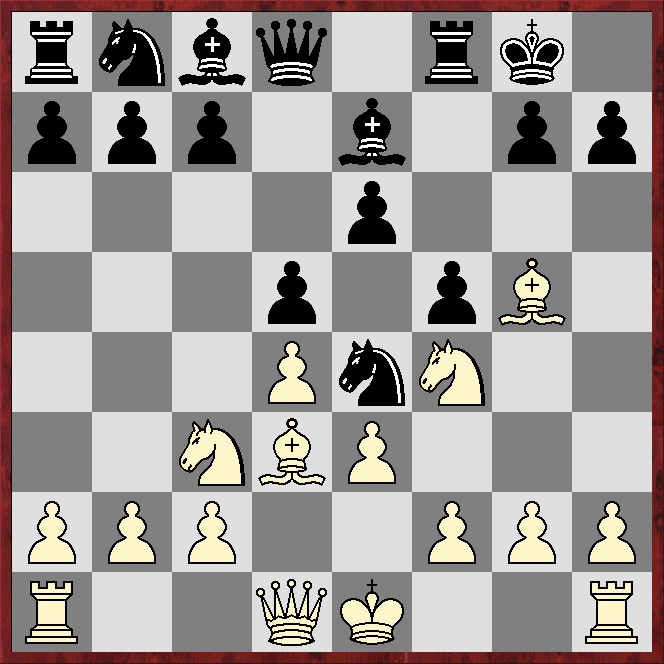
The analysis engines' choice, but there is a devastating reply.
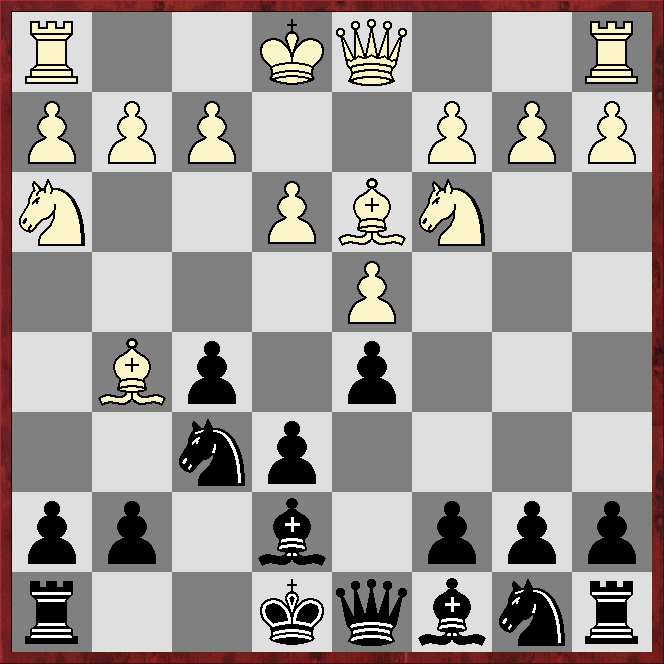
Position after 16...Rf6-f5
*
*
*
*
*
*
*
*
17.Rh8+!
Black played on with 17...Kg7, but his optimism was not rewarded.