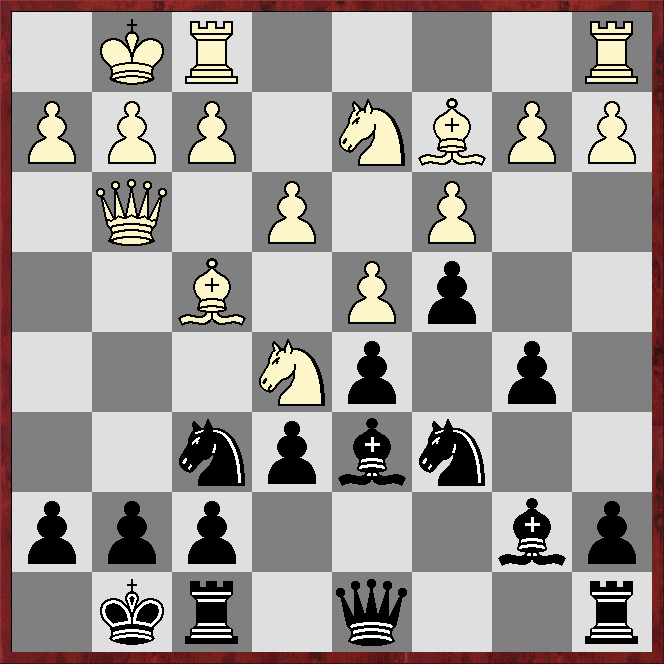
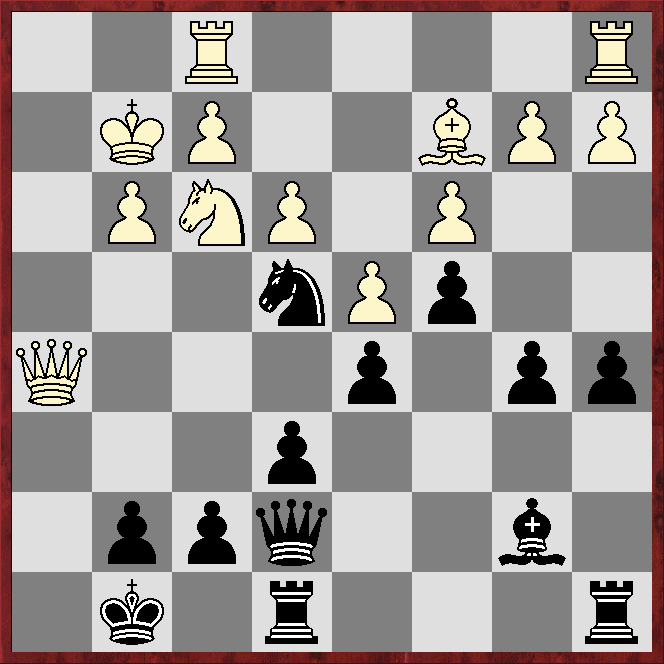
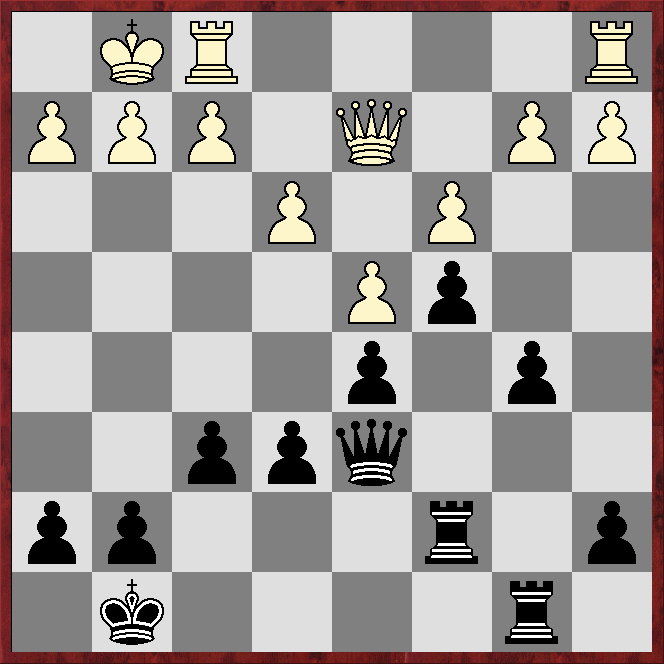
Showing posts with label London System. Show all posts

Monday, 27 April 2026

World Team 65+ Round Eight

Bo.37
  Norway - Golden Oldies
Rtg-46
  England - 5
Rtg0 : 0
27.1
Esbensen, Arnt
2169-
Freeman, Richard C P
1897
27.2
Taksrud, Vidar
1931-CM
Stokes, Michael
1861
27.3
Johnsen, Oystein
1949-
Spanton, Tim R
1908
27.4
Bjorgvik, Jan Arne
1818-
Marshall, Michael
1859

Øystein Johnsen (1949) - Spanton (1908)
London System
1.d4 d5 2.Nf3 e6 3.Bf4 Bd6 4.Bg3 Nf6 5.e3 b6 6.Nbd2 0-0 7.Bd3 Bb7
How should White proceed?
*****
*****
*****
*****
*****
8.Bh4!?
Presumably ØJ did not fancy 8.0-0 Bxg3. The main move in ChessBase's 2026 Mega database is 8.Ne5, when 8...c5 9.c3 Nc6 is equal, according to Stockfish17.1 and Dragon1.
8...Nbd7 9.0-0
With both sides having castled, how would you assess the position?
*****
*****
*****
*****
*****
The position is largely symmetrical, with the notable exception of the queens' bishops, but the engines award Black at least the better part of equality, perhaps because having the move in such a position confers a small initiative.
9...Re8
But this is not the way to pursue it, according to the engines. They suggest 9...c5 or 9...Qb8!?
10.c3 h6!?
Anticipating 11.Qc2.
11.Qc2 c5 12.b3 Rc8 13.Rac1 Qc7 14.Bg3!?
The engines fluctuate between the text, 14.Qb1 and 14.Qb2.
14...Bxg3 15.hxg3
So White has allowed ...Bxg3 anyway
*****
*****
*****
*****
*****
15...Ng4 16.e4!?
This is the classic pawn break in this sort of position, but the engines are not keen on it here.
16...dxe4
Possibly stronger is 16...cxd4, eg 17.cxd4 Qxc2 18.Bxc2!? Ndf6!?, when 19.e5 Ne4 favours Black, according to the engines, but so does 19.exd5 Nxd5.
17.Bxe4!?
The engines reckon this is better than 17.Nxe4 cxd4 18.cxd4 (18.Nxd4?! Qe5! 19.Nf3 Qh5 is risky for White) Qxc2 19.Rxc2 Rxc2 20.Bxc2 Rc8.
17...Ndf6 18.Bxb7 Qxb7 19.Rfe1 Red8 20.dxc5 Rxc5 21.Ne4 Nxe4 22.Qxe4 Qxe4 23.Rxe4 Nf6
Where should the rook go?
*****
*****
*****
*****
*****
24.Rd4!?
This is the engines' top choice.
24...Rdc8 25.c4 b5 26.Kf1 Kf8
The game is completely equal after 26...bxc4 27.Rdxc4 Rxc4 28.bxc4, according to the engines.
27.Ne1!?
This seems playable, but probably better is 27.Nd2.
27...e5 28.Rd2?!
The active 28.Rd6!? is better, according to the engines, eg 28...bxc4 29.Ra6!? cxb3 30.Rxc5 Rxc5 31.Rxa7 bxa2 32.Rxa2, when Black is a pawn up, but all the pawns are on one side of the board, and the engines reckon Black has only a slight edge.
28...cxb4 29.Rdc2
The engines prefer 29.bxc4 Rxc4 30.Rd8+!? Rxd8 31.Rxc4, when Black is again a pawn up, but with pawns on both sides of the board, giving Black at least the upper hand, according to the engines.
29...Ne4 30.b4 R5c7?!
Probably better is taking the open file with 30...Rd5!?, one point being 31.Rxc4?? Rxc4 32.Rxc4 loses to 32...Nd2+ and 33...Nxc4.
31.Ke2?
Black has at best a slight edge after 31.Re2, according to the engines.
31...Ke7 32.Ke3 f5 33.g4 g6 34.gxf5 gxf5 35.g4?!
The engines much prefer 35.Nd3!?, eg 35...Kd6 36.Nb2 Kd5 37.Rd1+ Ke6 38.Rh1 c3!? 39.Rxh6+ Kd5 40.Nd1, although after 40...f4+ Black has pressure.
35...Kf6
The engines suggest 35...c3 or 35...Nd6.
36.f3
And here they like 36.Nf3 or 36.Rd1.
36...Nd6 37.Rh2 f4+ 38.Kf2 Nf7 39.Rc3 Rd8 40.Kf1 Kg6 41.Rhc2 Rd4 42.Ra3!? Rd6 43.Rac3 Rdc6?!
The engines give 43...Rd4, and if 44.Ra3, then 44...Nd6, claiming a large advantage for Black.
44.Nd3!? a6 45.Nc5 Nd6 46.Re2 Kf6 47.Ne4+!?
Forcing a double-rook-and-pawn ending, but the engines reckon White is better off keeping knights on, challenging Black to find a way to make progress after 47.Rc1 or 47.a3.
47...Nxe4 48.Rxe4
How would you assess this ending?
*****
*****
*****
*****
*****
Dragon1 reckons Black is winning, but Stockfish17.1 gives Black only a slight edge. The practical point, however, is that unless Black gets careless and lets White create something with the 2-1 pawn-majority on the a-b files, there are only two likely outcomes - a draw or a black win.
48...Ke6 49.Re2?!
The rook is well-placed on e4. White should almost certainly be centralising the king, as far as is possible, with 49.Ke2 or 49.Ke1.
49...Rb7 50.a3 Rd7 51.Ke1?
Much better, but still losing, according to the engines, is going for counterplay with 51.Rh2.
51...Rd3 52.Rec2 Rd4?
This is probably still winning, but much stronger is 52...Rxc3 53.Rxc3 Kd5, eg 54.Kd2 Kd4 55.Kc2 Rg6!? 56.Kb2!? (56.Kd2 h5!) e4!? 57.fxe4 Rxg4.
53.Rd2 Kd5 54.Rdc2 Rc7 55.Rh2 Rc6 56.Rhc2 Re6 57.Kf2 e4 58.fxe4 Rexe4 59.Rh3 Rd3 60.Rh5+ Kd4 61.Rxh6
Black to play and win
*****
*****
*****
*****
*****
61...Rxa3?
One of the few plausible moves that does not win, whereas 61...c3, 61...Ree3 and even 61...Kd5!? win comfortably.
62.Rd6+ Ke5 63.Rc6 c3 64.R2xc3 Rxc3 65.Rxc3 Rxb4
This is a tablebase draw
*****
*****
*****
*****
*****
66.Ra3 Ke4 67.Ra6 Rb2+
White to play and draw
*****
*****
*****
*****
*****
68.Ke1?
The Syzygy endgame tablebase shows only 68.Kg1! draws.
The problem with the text will soon become apparent, whereas 68.Kf1? loses to 68...f3! (only-move), and if, as in the game, 69.g5, then 69...Kf4 (another only-move), eg 70.g6 Kg3 (a third only-move, but the easiest of the lot to find) 71.Ra1 Rh2 (71...Rf2+ also wins) 72.Kg1 f2+ 73.Kf1 Rh1+ 74.Ke2 Rxa1.
After 68.Kg1, Black can again try 68...f3, but 69.Rf6! draws, eg 69...Ke3 70.g5 Rb1+ (70...f2+ 71.Kg2) 71.Kh2 f2 72.g6, when Black has to take a draw as 72...f1=Q?? loses to 73.Rxf1 Rxf1 74.g7 etc.
68...Kf3
White cannot prevent the black king from occupying g2, as 69.Kf1? allows 69...Rb1#.
69.g5 Kg2 70.g6 f3 71.Rf6
Black to play and and maintain the win
*****
*****
*****
*****
*****
71...Rb1+?
There are two winning lines: 71...Re2+ 72.Kd1 Re7, eg 73.Rf7 f2!? (73...Re8 also wins) 74.g7 Re8 75.Rf8 f1=Q+, and 71...Rb7 72.Rf5 Re7+ 73.Kd2 f2, eg 74.Rg5+ Kh3 75.Rf5 Kg3 76.Kd3 Kg2 77.Rg5+ Kf1 78.Kd2 Rd7+ 79.Kc2 Ke2 80.Re5+ Kf3 81.Rf5+ Kg3 82.Kc3 (82.Rg5+ Kf4) Rg7 83.Rf6 Kg2 etc.
72.Kd2 f2 73.g7 Rb2+ 74.Kc1 Rb8 75.Rg6+ Kf3 76.Rf6+ Ke2 77.Re6+ Kf1 78.Rg6 Rg8 79.Kd2 Rd8+ 80.Kc3 Rc8+ 81.Kd4 Rd8+ 82.Kc5 Rc8+ 83.Kb6 Rg8
White to play and lose
*****
*****
*****
*****
*****
84.Kc7??
This loses because Black will be able to capture on g7 with check.
84...Ke2 85.Re6+ Kd3 86.Rd6+ Ke4 87.Rf6 Rxg7+ 88.Kd8 Ke3 89.Re6+ Kd2 90.Rd6+ Ke2 91.Re6+ Kf1 0-1
Team Result
Esbensen = Freeman
Taksrud 1-0 Stoke
Johnsen 0-1 Spanton
Bjorgvik = Marshall
Norway Golden Oldies 2-2 England 5

Saturday, 3 January 2026

Cracovia 60+ Round Eight

UPFLOATED against a Germany-registered player.

Józef Czarnik (1850) - Spanton (1913)
London System
1.Nf3 d5 2.d4 e6 3.Bf4 Bd6 4.Bg3 Nf6 5.e3 0-0 6.Bd3 c5 7.c3 Nc6 8.0-0
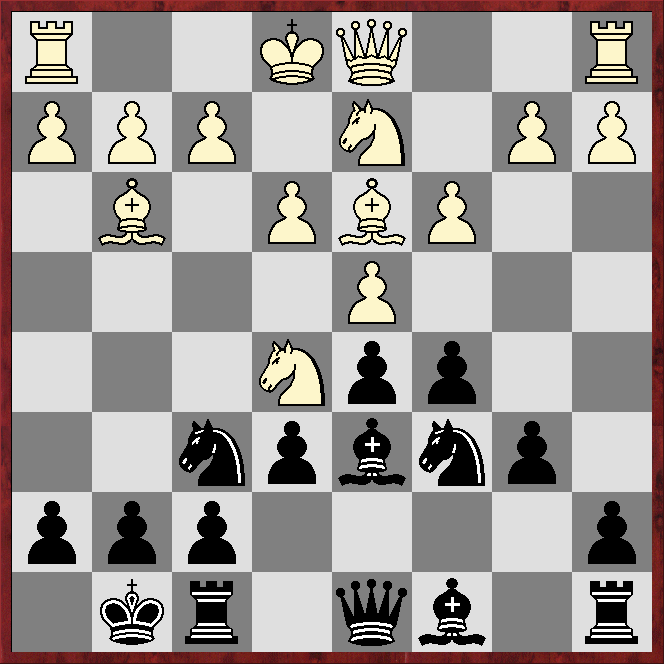
With both sides castling early, how would you assess the position?
*****
*****
*****
*****
*****
Black has a bad bishop, but a little more space on the queenside, which has enabled the black queen's knight to occupy its 'normal' square, c6, while White's will probably have to be developed to the less-active d2 square. Stockfish17.1 and Dragon1 reckon the game is equal.
8...c4!?
It seems to me that whenever I play ...c4 in such positions, the engines disapprove, and whenever I do not play it, the engines reckon it is the best move. The engines are not keen on ...c4 here, but do not condemn it either.
9.Bc2 Bxg3!?
Giving up White's good bishop, but slightly weakening the white king's position. The text is Stockfish17.1's top choice, but Dragon1 prefers 9...b5.
10.hxg3 b5
The engines suggest two apparent-novelties in 10...Qb6!? and 10...Qc7!?, narrowly preferring the latter, which transposes to a known position. Play might continue 11.Nbd2 e5 12.dxe5 Nxe5 13.Nxe5 Qxe5 14.Nf3 Qh5, when Black has opened a diagonal for the c8 bishop, but has been saddled with a backward pawn on a half-open file. Equal chances, according to the engines.
11.Nbd2
White is ready to break in the centre with e4 - how should Black react?
*****
*****
*****
*****
*****
11...e5?
An unjustified pawn sacrifice. The engines make various suggestions, including 11...Qc7, 11...Rb8, 11...b4 and 11...Bb7, but agree they all leave White slightly better.
12.Nxe5
12.dxe5? Ng4 lets Black, at least partially, off the hook.
12...Nxe5 13.dxe5 Ng4 14.e4?
The obvious 14.Nf3 is strong, and if 14...Re8, then 15.Qd4.
14...Nxe5?
Much better, according to the engines, is 14...d4 15.cxd4 Qxd4, although 16.Nf3!? Qxb2 17.Rb1 Qxa2 18.Rxb5 is tricky for both sides to play.
15.Qe2?
Again the best move is the obvious one, this time 15.exd5, after which the engines reckon White has the upper hand.
15...Re8?!
Again ...d4 seems to be the way to go, and is even better for Black, according to the engines, than it is in the note to Black's 14th move,
How should White proceed?
*****
*****
*****
*****
*****
16.f4?
Dubious is 16.exd5?! Bg4, when 17.f3? Nxf3+ is a disaster for White, but 17.Qe4 Nf3+ 18.gxf3 Rxe4 19.Bxe4 keeps White in the game. However, the engines reckon 16.Qe3 is equal.
16...Ng4 17.f5?
This makes a bad situation much worse, according to the engines, which reckon best is 17.e5, although 17...Qb6+ wins the exchange, as in the game. The main alternative is 17.Nf3!? Qb6+ 18.Nd4 Qh6 19.Nf3, when 19...dxe4 20.Nh4 Qb6+ 21.Kh1, which does not look so bad at first, but the engines reckon Black's advantage is roughly the equivalent of being up a minor piece and a pawn.
17...Qb6+ 18.Rf2 Nxf2
Even stronger is 18...Bxf5!
19.Qxf2 Qxf2+ 20.Kxf2 Bb7 21.Re1 dxe4 22.Nxe4 f6 23.Kf3 Rad8 24.Re2 Kf7
The engines point out the strength of 24...Rd3+! 25.Bxd3 cxd3 26.Re1 Rxe4!
25.g4 g6
Still strong is ...Rd3+.
26.g3 Re5 27.Kf4 Bc8?
This loses a lot of Black's advantage, and gives White a chance to complicate. Best, according to the engines, is 27...Bxe4!? 28.Bxe4 Rde8, eg 29.Kf3 Kg7!? 30.Kf4 h5!? 31.fxg6 hxg4, with ...f5 to come.
28.Ng5+??
Not only does this drop a piece, but it also misses 28.Rh2!?, after which Black probably has only one winning continuation.
Analysis diagram - position after 28.Rh2!?
*****
*****
*****
*****
*****
Black can easily go wrong, eg 28...Kg7? runs into 29.Nxf6! Kxf6 30.g5+ Kf7 (30...Kg7? 31.f6+) 31.Kxe5 Bxf5!? 32.Rxh7+ Kg8 33.Rh2, when White has at least the upper hand (Dragon1) and may even be winning (Stockfish17.1).
Protecting the h pawn with 28...Rh8?! allows 29.Nd6+ fxg6, when the engines reckon White has equalised.
However, 28...gxf5!? 29.Ng5+!? (29.Rxh7+? Kg6) Kg8 30.Nxh7 Kg7 31.g5!? Re1! 32.Nxf6 Rh8 wins, according to the engines, and the simpler 28...Bxf5!? may also give Black an advantage.
Back to the game.
28...fxg5+ 0-1

Tuesday, 2 December 2025

Benidorm Bali Round Six

FACED a Singaporean junior (born 2007).

Rahul Lakshminarasimhan (1626) - Spanton (1896)
London System
1.d4 d5 2.Nf3 e6 3.Bf4 Bd6 4.Bg3 Nf6 5.e3 Ne4!?
Stockfish17.1 and Dragon1 prefer the mainline 5...0-0, or 5...c5.
How should White respond?
*****
*****
*****
*****
*****
6.Bxd6!?
White usually plays 6.Nbd2 or 6.Bd3, eg 6.Nbd2 Nxg3 7.hxg3, when the half-open h file and 'promotion' of the h pawn to a more-central g pawn are roughly balanced by Black having the bishop-pair and more flexible kingside pawn-structure. The engines give White the better part of equality.
White has also tried 6.Bh4, when Black has 6...g5!?, as well as the more conventional 6...Be7.
6...cxd6!? 7.c4 Qa5+ 8.Nbd2
The engines come to marginally prefer 8.Nfd2!?
8...dxc4 9.Bxc4 d5 10.Bd3!?
The engines agree this apparent-novelty is a slight improvement on the known 10.Be2.
10...Nc6 11.0-0 Nxd2 12.Nxd2 0-0
Now both sides have castled, how would you assess the position?
*****
*****
*****
*****
*****
White has much the better bishop, which the engines agree gives White a slight edge, although Stockfish17.1 is less sure than Dragon1.
13.f4
This looks dangerous, but the engines prefer immediate queenside play with 13.Nb3.
13...Bd7 14.Nb3!?
A move such as 14.Rf3, 14.Nf3, or even 14.Qh5!?, intending to meet 14...g6 with 15.Qe2, would seem more consistent, but the engines reckon White 's kingside play is not dangerous, and they prefer the text.
14...Qc7!?
This invites a pin, which is why the engines suggest 14...Qd8.
15.Rc1 Rac8
This is Dragon1's top choice; Stockfish17.1 prefers 15...Rfc8!?
16.Nc5 b6?!
This is Dragon1's top choice, at least for a while, but Stockfish17.1 much prefers 16...g6 or 16...Ne7, and Dragon1 comes to agree, presumably because the text is too loosening.
17.Nxd7 Qxd7 18.Qa4
How should Black proceed?
*****
*****
*****
*****
*****
18...Rc7?
Black had to play 18...Qd6 or 18...Nb8, although neither is pleasant, and it is unclear which is better, eg 18...Qd6 19.Ba6 Rc7 20.Qa3! Qd8! (20...Qd7 21.Qc3 is much worse, according to the engines) 21.Qc3 Re8 22.Bb5 Qb8! 23.Rc2 (23.Bxc6? Rec8 equalises) Rec8 24.Rfc1 Qb7 25.f5!? exf5 26.e4!, with the upper hand for White, according to the engines, or 18...Nb8 19.Qxd7 Nxd7 20.Ba6 Ra8 21.Rc7, with pressure, but only a slight edge for White, according to Stockfish17.1, although Dragon1 again awards White the upper hand. Both lines are sharp and there are alternatives along the way.
19.Bb5 Rfc8 20.Ba6 Rcd8 21.Bb5 Rdc8
White to play and win
*****
*****
*****
*****
*****
22.Qa6?
Doubling on the c file, starting with 22.Rc3, gives a simple win, eg 22...Qd6 23.Ba6 Rd8 24.Rfc1 etc. The engines suggest 23...b5!?, but 24.Qxb5 Rb8 25.Qc5 Qd8 26.Rfc1 wins, eg 26...Rxb2 27.Qxc6! (27.Bb5 is also good enough) Rxc6 28.Rxc6, after which the black queen falls.
22...Qd8
Also drawing is 22...Qe7!?, as long as after 23.Bxc6 Black plays 23...Qd8! and not 23...Rxc6? 24.Qxc8+! etc.
23.Bxc6 Rxc6 24.Rxc6 Rxc6 25.Qxa7
White has won a pawn, but Black's activity on the open file forces a draw
*****
*****
*****
*****
*****
25...Rc2 26.Qa3 g6 27.Qb3 Qc7 28.Rf2
There is nothing better.
The game finished:
28...Rc1+ 29.Rf1 Rc2 30.Rf2 Rc1+ 31.Rf1 Rc2 ½–½

Sunday, 30 November 2025

Benidorm Bali Round Four

AFTER taking a halfpoint bye in the first of today's two rounds, I faced an Irishman.

Pat O'Hanlon (1794) - Spanton (1896)
London System
1.d4 d5 2.Bf4 e6 3.e3 Bd6 4.Nf3 Bxf4
This is the most popular continuation in ChessBase's 2026 Mega database.
5.exf4 Qd6 6.Qd2 Nf6 7.Nc3 Bd7!?
This apparent-novelty is Stockfish17.1's top choice at first, although after a while it comes to view the text and 7...0-0 as of roughly equal value. Dragon1 starts by approving of castling, but comes to prefer the text, although later it switches back to castling and to 7...a6.
8.Bd3
The engines suggest 8.0-0-0!?
8...0-0 9.0-0
Now both sides have castled, how would you assess the position?
*****
*****
*****
*****
*****
The half-open e file and control of e5 are White's compensation for having doubled f pawns. The engines reckon the game is equal.
9...c5 10.dxc5 Qxc5 11.Ne5!?
By transposition we have reached the game Nicolas Eliet (2422) - Alexei Barsov (2531), Bogny-sur-Meuse (France) 2003, which continued 11...Rd8 12.Rfe1 Nc6 13.Rad1 Be8!? 14.Ne2 Nd7 (14...Ne4!? is suggested by the engines) 15.g3 g6 16.h4, at which point a draw was agreed, although the engines reckon White is at least slightly better.
11...Nc6 12.a3 d4!?
How should White respond to this pawn thrust?
*****
*****
*****
*****
*****
13.Nxd7
This, by a small margin, is the engines' top choice, but they are also happy with other moves of the knight, including 13.Ne4 and 13.Na4.
13...Nxd7 14.Ne4 Qe7 15.Rfe1 Nf6 16.Nxf6+
White probably has a slight edge after 16.f5, according to the engines, eg 16...e5 17.Qe2 Nxe4 18.Bxe4, although Stockfish17.1 is less sure than Dragon1.
16...Qxf6 17.Be4 Rac8 18.Rad1 Rfd8 19.g3 g6 20.Qe2 Rc7 21.Bd3 Rdc8 22.h4 h5 23.Qe4 a6!? 24.Rd2 Kg7 25.Kg2 Re7 26.Rde2 Na5 27.b3!? Nc6 28.Qf3 Rec7 29.Qe4 Qe7 30.b4
The engines suggest 30.a4!?, although this gives up the b4 square.
30...Qd6 31.Qf3
Here they suggest 31.Rd2 or 31.b5!?
31...Ne7 32.Re5 Nd5
After much manoeuvring by both sides, how should White proceed?
*****
*****
*****
*****
*****
33.g4?!
A sharp try, but it may be a mistake.
33.f5!? is possibly best-met by 33...gxf5, when both 34.Qxh5 and 24.Rxd5!? lead to sharp play that seems roughly balanced.
33.Rg5 Nf6 34.f5!? exf5 35.Qxf5 also gives equal chances, according to the engines.
How should Black respond?
*****
*****
*****
*****
*****
33...f6
Best may be 33...hxg4 34.Qxg4 Rxc2! 35.Bxc2 Rxc2 36.f5 Ne3+! 37.R5xe3 dxe3 38.f6+!? Kxf6! 39.Rxe3, after which Black emerges a pawn up, but the line is very sharp and certainly hard to envisage from the diagram.
34.R5e4
Not 34.Rxe6?? Nxf4+ etc, but Stockfish17.1 suggests 34.Rxd5!?, claiming 34...Qxd5 35.Qxd5 exd5 36.f5!? gxf5 37.Bxf5 gives White full compensation for the exchange, although Dragon1 is not wholly convinced.
34...hxg4 35.Qg3
Not 35.Qxg4?? f5 36.Rxe6 Qxe6! (this is even stronger than 36...Nxf4+, as after 37.Kf1 Nxe6 White has 38.Bxf5 Nf4 39.Bxc8) 37.Rxe6 fxg4 38.Rxg6+ Kf7 39.Rxg4 Rg8.
35...f5
Possibly 35...Qc6 is stronger.
36.Re5?
Correct is 36.Rxe6!, when 36...Nxf4+?? fails to 37.Kf1. However Black has 36...Ne3+! 37.R1xe3 Qd5+, eg 38.Kg1 dxe3, although after 39.Qxe3 White has enough compensation for the exchange, according to the engines. Dragon1 slightly prefers 38.R3e4?, but Stockfish17.1 shows this is wrong, thanks to the long line 38...fxe4 39.Re5 (39.Rxe4 Re8) exd3+! 40.Rxd5 dxc2 41.f5 c1=Q 42.Qe5+ Kh6, and only now does Dragon1 realise White does not have a draw as 43.fxg6 can be met by 43...Qc6, eg 44.Kg3 d3! 45.Qg5+ Kh7 46.h5 Re8 47.h6+ Kg8 48.Qf5 Rce7, after which the Black king is safe enough, and Black is up a rook for at most two pawns.
36...Rc3
Even stronger, according to the engines, are 36...Re7 and 36...Rxc2!? 37.Bxc2 Rc3, when 38.Bd3 runs into 38...Rxd3! 39.Qxd3 Nf4+ and 40...Nxd3.
37.Kg1
The engines more-or-less come to agree this is the best try, as after 37.Rxe6 Ne3+! 38.R1xe3 Qd5+ 39.Kh2 dxe3 40.Qxe3 they reckon White does not have enough for the exchange, especially if Black finds 40...Rh8!
37...Rxa3?
Probably best is 37...Re8.
38.Rxe6 Qxf4
White to play and equalise
*****
*****
*****
*****
*****
39.Qg2
The engines give 39.Rd6! Qxg3+ 40.fxg3 Nxb4 41.Ree6 Rc7 42.Rxg6+ Kf8 43.Bxf5 Rxg3+ 44.Kh2 Rh3+ 45.Kg1 Rxh4, when Black is three pawns up, but White seems to have enough for a draw, eg 46.Rd8+ Ke7 47.Rxd4 Nc6 48.Rf4 Rh8 49.Re6+ Kd8 50.Rd6+ Ke8 51.Rxg4, after which White has won back two pawns and remains very active. Black could instead try 40...Ne3, but 41.Rxd4 Nxc2 42.Rd7+ Kh6. However 43.Ree7 Rh8 (only move) 44.Kh2 Nxb4 45.Bxf5! gxf5 46.Rd6+ Kh5 47.Rg7 forces Black to take a draw by repetition by 47...Ra2+ 48.Kg1 Ra1+ etc. Naturally there are many alternatives in these lines, but 39.Rd6! seems to hold up in all of them.
After 39.Qg2, it is Black to play and win
*****
*****
*****
*****
*****
39...Qf3?
Winning is 39...g3, eg 40.Qxg3 Qxg3+ 41.fxg3 Nxb4, when Black is two pawns to the good, and the black king does not face serious threats. Trickier is 40.fxg3 as Black is losing unless he finds 40...Rxc2! 41.gxf4 Rxg2+ 42.Kxg2 Nxf4+ and 43...Nxe6.
40.Qh2?
After 40.Qxf3 gxf3 41.Rd6 Nf4 42.Kh2 White is two pawns down, but seems to have enough activity to hold, eg 42...Rc7 43.Re5 Kf7 44.Rxd4 Nh5 45.Rd6. But the position is far from easy to play, for example winning back a pawn by 42.Rxd4? (instead of playing 42.Kh2) can be met by 42...Rxd3!, when 43.cxd3? fails to 43...Ne2+ etc, and 43.Rxd3 Nxd3 44.cxd3 gives a rook-and-pawn ending in which White is 'only' a pawn down, but every white pawn is isolated, and Black's advantage is equivalent to being about a rook up, according to the engines.
40...Nf4 41.Re7+ Kh6 42.h5 Nh3+ 43.Kf1 Rxd3!
This is strongest.
44.cxd3 Rc2
Other moves also win.
45.R7e2 Qxd3 46.hxg6 f4 0-1

Tuesday, 14 October 2025

Correspondence Chess

I PLAY correspondence chess at the Fide-recognised International Correspondence Chess Federation, mainly for various England teams.
Thanks to modern engines, most games are drawn, but occasionally a game escapes that fate, or is interesting for other reasons.

William Grummitt (1656) - Spanton (2325)
PJB (Phillip J Beckett) Celebration
London System
1.d4 d5 2.Nf3 e6 3.Bf4 Bd6 4.Bg3 Nf6 5.e3 c5 6.c3 0-0 7.Bd3 Qc7 8.Nbd2 Nbd7 9.0-0
Now both sides have castled, how would you assess the position?
*****
*****
*****
*****
*****
Black has managed to get two pawns abreast on the fourth rank, but still has to solve the problem of what to do with the bad light-square bishop. Stockfish17 and Dragon1 call the game equal.
9...Bxg3 10.hxg3 b6 11.Re1 Bb7 12.e4 cxd4!? 13.Nxd4
13.e5 dxc3 slightly favours Black, according to the engines.
13...Ne5!?
This may be a novelty, and the engines reckon it is an improvement on the known 13...Nc5.
14.Bc2 dxe4 15.Nxe4 Bxe4 16.Bxe4 Rad8 17.Qe2 Nxe4 18.Qxe4 Rd5
How has the mass-swop of minor pieces affected the balance?
*****
*****
*****
*****
*****
Black has the only pawn on the two central files, and has a kingside majority that could prove a significant middlegame factor. White has the potential endgame advantage of a farside pawn-majority. Dragon1 reckons Black is slightly better, but Stockfish17 calls the position equal.
19.f4!?
This preempts Black on the kingside, and protects the white knight's outpost, but weakens the defences of the white king.
19...Nc4!? 20.b3 Nd6 21.Qe3 Rd8 22.g4!? h5!? 23.gxh5 Nf5 24.Nxf5 Rxf5
How would you assess this heavy-piece middlegame?
*****
*****
*****
*****
*****
White has got rid of the doubled pawn, and is temporarily, but only temporarily, a pawn up. Meanwhile, Black continues to have the less-airy king. Dragon1 gives Black a slight edge; Stockfish17 still calls the game equal.
25.Rad1 Rxh5 26.c4 Qe7 27.Rd4 Qf6 28.Rxd8+ Qxd8 29.g3?!
WG offered a draw.
White's 29th move has defended f4, but left the white king looking even more airy - the engines reckon White should have played 29.Rf1 (Stockfish17) or 29.Qf3 (Dragon1)
*****
*****
*****
*****
*****
29...b5!?
This looks bonkers at first sight, but the idea is to free the d5 square for the black queen and/or rook as they hopefully close on the white king.
30.cxb5 g6!?
Giving the black king an extra square to go to in case of a check on the back rank.
31.Kg2?!
Not 31.Qxa7?? as 31...Qd5 quickly decides the game. Dragon1 suggests 31.Rf1, while Stockfish17 recommends the 'greedy' 31.a4!?, although in both cases the engines reckon Black is better after 31...Qd5.
31...Rxa5 32.Qxa7!?
The engines agree 'greed' is best, and White's queenside pawn-duo looks dangerous, but the most significant feature in the position remains the safety of the white king.
32...Rh5 33.Rf1
White can bring the queen back to defend the king with 33.Qe3?!, but 33...Qa8+ forces 34.Qe4, after which 34...Qxa2+ and 35...Qxb3 removes White's queenside pawns, leaving Black a pawn up.
33...Qd5+ 34.Rf3 Qf5
34...Qd2+ is a major alternative, and it is hard to tell which is better.
35.Qg1
Dragon1 for quite some time much prefers 35.Qb8+?! Kh7 35.Qa7, but then 35...Qh3+ 36.Kf2 Kg8!? is probably strong.
35...Qh3+ 36.Kf2 Rc5 37.Re3 Qh5!? 38.Re2!?
This is Dragon1's top choice, until it comes to agree with Stockfish17 that 38.Qe1 is better. Interestingly, having come to that conclusion, Dragon1 likes 38.Qe1 even more than Stockfish17 does, the latter reckoning there is not all that much between the two moves.
38...Rc3 39.Qg2 Qg4 40.Ke1 e5!?
Dragon1 much prefers 40...Rd3, but Stockfish17 claims 41.Qf2 holds. Meanwhile 40...Rxg3?! seems to let White off the hook after 41.Qa8+ Kg7 42.Qe4.
How should White respond?
*****
*****
*****
*****
*****
41.fxe5
The position is very difficult. The text comes to be Dragon1's choice, ahead of 41.Qd5!?, which for a long time is Stockfish17's preference. However, then 41...Qxg3+ 42.Kd2 Rc8! 43.Qxe5 Qg1 44.Re1 Qa7!? 45.Ke2 Qxa2+ 46.Kf1 Qxb3 again reaches a position in which Black is a pawn up and has much the safer king. Stockfish17 comes to suggest 41.Kd2, but 41...Rc5 looks strong. Stockfish17 then continues with 42.Qe4 Qxg3 43.Qe3 Rd5+ 44.Kc3, but then 44...Qxe3+!? 45.Rxe3 exf4 gives Black what both engines reckon is a winning rook-and-pawn ending.
41...Qd4!?
Dragon1 likes 41...Rxg3?!, claiming 42.Qe4 Qg5 43.Kd1 Rc3 44.Re1 Qc1+ 45.Ke2 Qb2+ 46.Kf1 Rg3 wins for Black, but Stockfish17's 47.e6! draws, as Black is obliged to take a draw with 47...Qf6+ 48.Ke2 Qb2+ 49.Kf1 etc. For a while Dragon1 reckons 47...Qh2? wins, but soon sees White has 48.exf7+ Kh7 49.f8=N+!, eg 49...Kg8 50.Qc4+!? Kh8 (50...Kxf8 allows a quick checkmate starting with 51.Qf4+) 51.Nxg6+!? Rxg6 52.Qd4+ Rg7 53.Re8+ Kh7 54.Qd3+ Rg6 55.Re7+ Kh6 56.Qe3+ Rg5 57.Re6+, after which the white king is mated whether it advances or falls back.
42.Kf1 Qd3 43.Kg1
Dragon1 reckons 43.Kf2 is a better try, but Black seems to have several wins, eg 43...g5!? 44.a4 (White's pieces have no good moves, so pushing pawns is the only hope) g4 45.a5 Qd4+ 46.Kf1 Rf3+, which wins the white queen as 47.Ke1 allows a mate in four: 47...Qa1+ 48.Kd2 Qb2+ 49.Kd1 Qb1+ 50.Kd2 Rd3#.
43...Rc1+ 44.Kh2 Qf5 45.Qe4
If 45.Re4, then 45...g5 wins.
45...Qh5+ 46.Kg2 Qh1+ 47.Kf2 Qg1+ 48.Kf3 Rc3+ 49.Re3 Qf1+ 50.Kg4 Rxe3 51.Qe3
Now Black has a mate-in-two, which WG allows me to play, but White is lost anyway
*****
*****
*****
*****
*****
51...Qf5+ 52.Kh4 Qh5#

Monday, 18 August 2025

Czech 65+ Open Championship Round Three

THE second of today's double-round games.

Jaroslav Lepík (1876) - Spanton (1982)
London System
1.d4 d5 2.Nf3 e6 3.Bf4 Bd6 4.Ne5!?
There are 134 examples of this move in ChessBase's 2025 Mega database, and it scores 56%, which is much better than 4.Bxd6's 42%, although trailing 4.Bg3's 57% and especially 4.e3's 61%.
How should Black respond?
*****
*****
*****
*****
*****
4...f6
This is most popular in Mega25, and, given enough time, becomes Dragon1's top choice, but Stockfish17 marginally prefers 4...Ne7.
5.Nd3 Nc6 6.e3?!
All seven games to reach the position in Mega25 feature this move, but the engines strongly favour 6.Bxd6.
6...Qe7?!
This may be a novelty, and probably not a good one.
Kayden Troff (2490) - David Antón Guijarro (2665), Chess.com Blitz 2024, went 6...Nge7 7.Bxd6 Qxd6 8.Nd2!? e5 9.c3 Bf5, with equality, according to the engines (½–½, 62 moves).
The engines suggest 6...e5!, which also seems to be a novelty, and this time a good one. I tried, but failed, to make the move work during the game. However the engines show that after 7.dxe5 fxe5 the white bishop has to retreat as 8.Nxe5?? Bxe5 9.Bxe5 Nxe5 10.Qh5+ loses to the simple 10...Nf7 (or 10...Ng6). However the retreat 8.Bg3 leaves Black with the centre.
7.Bxd6!?
The engines agree this is best.
7...cxd6!? 8.Nc3
Now ...e5 is prevented for the foreseeable future.
8...f5 9.Be2
The engines suggest 9.g4!? or the immediate 9.Nf4.
9...Nf6 10.Nf4 0-0 11.0-0
JL offered a draw.
How would you assess the position?
*****
*****
*****
*****
*****
Black has a bad bishop, and White has a well-posted knight at f4. But Black has a preponderance of pawns on the centre two files, more kingside space and a slight lead in development. The engines reckon Black is slightly better.
11...Ne4?!
But they strongly dislike this, preferring 11...Kh8 or 11...Bd7.
12.Bb5?
However, after this, Black gets on top - on the queenside, rather than what might have seemed the more promising kingside.
The engines give 12.Nxe4 dxe4 (they reckon White has the upper hand after 12...fxe4 13.f3!?) 13.d5!? Ne5 14.dxe6 Bxe6 15.Qd4, when the most significant feature of the position is probably Black's backward d pawn on a half-open file.
12...Nxc3 13.bxc3 Na5!
The c4 square will make a great outpost.
14.a4!?
This is the engines' top choice.
14...Bd7 15.c4!?
Stockfish17 fluctuates between this and 15.f3, perhaps on the basis that the pawn is doomed anyway in the long run?
15...Nxc4
Not 15...dxc4? 16.Bxd7 Qxd7 17.d5 e5 18.Ne5, with good compensation for a pawn.
16.Bxc4 dxc4 17.d5?!
This thrust is no longer good.
The engines suggest 17.a5!?, effectively isolating the black c pawn as Black does not want to make the bishop really bad by playing ...d5.
17...e5 18.Ne2 f4!? 19.exf4 exf4 20.Nd4 Qf7
Probably not 20...f3?! 21.Nxf3 Bg4 as both 22.Re1 and 22.Ra3!? leave Black with little or no advantage. However the engines prefer moving either rook to the e file.
21.Qf3
After 21.Nf3? Black has several strong moves, including 21...Qg6 and 21...Rac8.
21...Rfe8 22.Rfb1 Rab8 23.Rb4
The engines suggest taking care of White's potential back-rank problems with 23.h3, or playing 23.a5.
23...Re5 24.Rxc4
After pressing the clock, JL offered a draw.
24...Qxd5 25.Qxd5+ Rxd5
How should White proceed?
*****
*****
*****
*****
*****
26.c3?
This may look like a solid stabilising move, but it is a serious mistake. Instead 26.Rc7 gives good drawing chances, although Dragon1 reckons Black still has an edge after 26...Bg4 (Stockfish17 disagrees).
26...Rc5
Simple and strong.
After ...
27.Rxc5 dxc5
... Black no longer has an isolani, and the the knight is expelled from its central post.
28.Ne2
Black is also winning after 28.Nb5, according to the engines.
28...g5 29.Rd1?
This speeds the end. Following the game, JL suggested the better 29.f3, and after 29...Re8 developing the king with 30.Kf2. However, Black remains a pawn up and with the better minor piece for cooperating with a rook.
29...Bxa4! 30.Rd5 Re8 0-1

Friday, 11 July 2025

Lessons From Bischofsgrün: To Push Or Not To Push

IN round four I faced a dilemma common in queen's pawn openings - to push, or not to push, the c pawn.
The relevant position arose early in a London System.
White has just played 8.Bf1-d3 in Frank Wagner (1881) - Spanton (1954)
*****
*****
*****
*****
*****
Novices are often warned against playing ...c5-c4 (c4-c5 for White) on the ground that it relieves pressure on the opponent's centre.
But experience teaches there are many occasions when ...c5-c4 is good, eg in lines of the Winawer Variation of the French Defence.
Factors that favour pushing on include when it comes with tempo, usually, as in the diagram, by hitting the opponent's king's bishop.
Factors against pushing on include when it is relatively easy for the opponent to counter in the centre with e3-e4 (...e5-e6 for Black).
In the game I played 8...c4?! - after all, I thought, the move comes with tempo, and it will not be simple for White to respond with e4.
But I later discovered the move is unpopular - just two examples in ChessBase's 2025 Mega database out of 215 games to reach the position.
Not only that, but Stockfish17 and Dragon1 do not like the move, fluctuating between calling it dubious and just plain bad.
Black never did get in the move e4 - he did not need to, gaining a winning advantage on the kingside that lasted until he forced a perpetual when up the equivalent of about a queen (or even more).
LESSON: I am tempted to say the lesson here is not to play ...c4, even when it is good! More realistically, the lesson is to only push with the c pawn when sure, beyond a reasonable doubt, it is not a mistake.

Monday, 30 June 2025

Bischofsgrün Round Four

Frank Wagner (1881) - Spanton (1954)
London System
1.d4 d5 2.Nf3 e6 3.Bf4 Bd6 4.e3
Most popular by a long margin in ChessBase's 2025 Mega database is 4.Bg3, but Stockfish17 and Dragon1 fluctuate between the text and 4.Bxd6.
4...Nf6
The main line in Mega25 runs 4...Bxf4 5.exf4 Qd6 6.Qd2 Nf6, when the engines reckon 7.Nc3 gives White a slight edge.
5.Nbd2 b6 6.c3 0-0 7.Ne5!? c5 8.Bd3
How should Black proceed?
*****
*****
*****
*****
*****
8...c4?!
There are positions where ...c4 with tempo is good, and positions where ...c4 with tempo is frowned on as a club-player's move. Here the latter would seem the correct verdict - at least the move is strongly disliked by the engines. They favour the most popular move in Mega25, 8...Ba6, and 8...Qc7.
9.Bc2 Bb7 10.0-0
Now both sides have castled, how would you assess the position?
*****
*****
*****
*****
*****
The main difference between the two sides, in my opinion, is that White it is much better placed than Black for play on the kingside, particularly when the respective light-square bishops are compared. The engines give White the upper hand.
10...b5 11.Qf3!
The engines agree this is better than 11.Bg5, and much better than 11.Ndf3.
11...Nc6 12.Qg3
Even stronger, according to the engines, is 12.Qh3.
What is White's main threat, and how should it be met?
*****
*****
*****
*****
*****
If it were White to move, 13.Bh6 would give an advantage, although Black avoids losing material by replying 13...Ne8. Instead 13.Nxc6! wins a piece, eg 13...Bxf4 14.Nxd8 Bxg3 15.Nxb7.
12...Ne7?!
I rejected 12...Nh5 because of 13.Bxh7+ Kxh7 14.Qh3 g6 15.g4, but the engines claim 15...Nxe5 equalises, eg 16.dxe5 f5! 17.gxh5? g5! 18.Qg2!? Rg8 19.Bg3 Bc5, after which Black is a pawn down but has a strong kingside attack. Better is 17.exd6 fxg4 18.Qxg4, but after 18...Nxf4 19.exf4 Qxd6 Black is at least equal, according to the engines.
What should White play?
*****
*****
*****
*****
*****
13.Qf3
13.Nxf7! wins a pawn, eg 13...Rxf7 14.Bxd6 Nf5 15.Bxf5, or 13...Bxf4 14.Nxd8 Bxg3 15.Nxb7.
13...Qc7 14.Qh3
FW offered a draw.
How would you assess this middlegame?
*****
*****
*****
*****
*****
White's kingside attacking chances give at least the upper hand, according to the engines.
14...Ng6?
The engines reckon only 14...h6 prevents White gaining a winning advantage.
White to play and snaffle two pawns
*****
*****
*****
*****
*****
15.Nxg6?!
White is slightly better after this, but winning is 15.Bxg6! hxg6 16.Nxg6! fxg6 17.Qxe6+ etc.
15...hxg6 16.Bxd6
Not 16.Bxg6??, trying to enter the line in the previous note, as Black has the simple reply16...Bxf4.
16...Qxd6 17.Nf3 Nh7?
Preventing 18.Ng5, but that was hardly much of a threat as the f6 knight covers h7. Better is using the respite Black has gained from White's kingside pressure to get on with counterplay on the queenside by playing 17...b4.
18.Qg4
The engines reckon 18.Ne5 is even stronger, the idea being to follow up with f4 and g4.
18...Qe7?!
Again the engines prefer ...b4.
19.h4 a5
The engines suggest ...Nf6, either immediately or after ...Bc6.
20.h5!? Nf6
The engines recommend sacrificing a pawn, at least temporarily, by 20...f5!? 21.Qxg6 Rf6 22.Qg3 Rh6, albeit giving White the upper hand.
21.Qg5
Possibly even stronger is the engines' 21.Qh4 gxh5 22.g4.
21...gxh5 22.g3?!
Probably too slow. The engines like 22.Ne5 or 22.g4.
22...Rfe8 23.Kg2 Ne4?
Correct is 23...g6, and if 24.Rh1, then 24...Ne4, while 24.Qh6? Ng4 leaves Black on top, according to the engines.
24.Qxh5
White has regained the sacrificed pawn, and has a strong attack
*****
*****
*****
*****
*****
24...g6 25.Qh6 Qf8 26.Qh4 Kg7??
Black should probably try 26...Qg7 or 26...f6, or even 26...Qe7, hoping for a draw by repetition after 27.Qh6 Qf8, but Black can avoid this with 28.Qh3. The text leaves Black in a hopeless position.
27.Rh1 Qh8 28.Qf4 Qg8 29.Bxe4 dxe4 30.Qh6+ Kf6 31.Qg5+ Kg7
Now 32.Ne5, threatening 33.Nd7, followed by 34.Qf6#, and 33.Rh6, followed by 33.Rxg6+!, is so strong that the engines' top choice is offering the bishop by 33...Bc6!?
Instead the game finished:
32.Qh6+ Kf6 ½–½

Thursday, 17 April 2025

Bad Soden-Salmünster Round Seven

Helmut Huber (1759) - Spanton (1922)
London System
1.Nf3 d5 2.d4 e6 3.Bf4 Bd6 4.Bg3 Nf6 5.Nbd2 c5 6.c3 0-0 7.Qc2 Nc6 8.e3 b6 9.Bb5!?
This may be a novelty. Known moves are 9.Be2, 9.b3 and 9.Bd3!?
9...Bb7 10.Ne5 Rc8 11.Ndf3 Ne4 12.Nxc6 Bxc6 13.Bxc6 Rxc6 14.Qa4 Rc7
Stockfish17 suggests 14...b5!?, one line running 15.Qxb5 Rb6 16.Qe2 Bxg3!? 17.hxg3 Qb8 18.b3!? c4!? (18...Nxc3 19.Qd3 Ne4 20.dxc5) 19.Ne5 Qb7, when Dragon1 agrees with Stockfish17 that Black has more than enough compensation for a pawn.
15.Bxd6 Qxd6 16.0-0
Now both sides have castled, how would you assess the position?
*****
*****
*****
*****
*****
Black has a lead in development and a little more space on the queenside. Dragon1 gives Black a slight edge, but Stockfish17 is less sure.
16...Rb8 17.Qd1 c4 18.Ne5!? f6
The engines suggest getting on with it on the queenside by playing 18...b5.
19.Nf3
The engines suggest 19.Ng4!?, the idea being to meet 19...h5 with 19.f3, when they reckon 19...Ng3!? 20.hxg3 hxg4 21.Kf2 is equal.
19...b5 20.Nd2 Nxd2 21.Qxd2
How would you assess this heavy-piece middlegame?
*****
*****
*****
*****
*****
Black's lead in development and extra queenside space add up to a slight edge, according to Dragon1, but again Stockfish17 is less sure..
21...b4 22.Qc2
This is Dragon1's top choice for a while, but the move then drops a little behind 22.Rae1 in the evaluations. Stockfish17 also likes 22.Rae1, along with 22.e4!?
22...Rcb7
The engines suggest 22...f5!?
23.Rab1
White is completely fine after 23.cxb4 or 23.b3!?, according to the engines.
23...Qa6
How should White proceed?
*****
*****
*****
*****
*****
24.b3?!
Probably better is capturing on b4, or creating luft for the king with 24.h3 or 24.g3.
24...bxc3 25.bxc4?
Much better is 25.Ra1, although 25...cxb3 26.axb3 Qc6 27.Ra5!? Rxb3 28.Rc5 Qb6 29.Rxc3 leaves Black with the upper hand (Dragon1) or at least a slight edge (Stockfish17).
25...Qxc4?!
Immediately swopping rooks is much stronger, but the text also wins.
26.h3?!
Best is 26.Rbc1 Rc8 27.Rb1!, although 27...Rxb1 28.Rxb1 e5 29.Rd1 Rb8 is just one of several winning lines.
26...Rxb1 27.Rxb1 Rxb1+ 28.Qxb1 c2 29.Qb8+
If 29.Qc1 then 29...Qxa2 followed by ...Qb1.
29...Kf7 30.Qxa7+ Kg6 31.Qa8 c1=Q+ 32.Kh2 Qc7+ 33.g3 Qf1 34.Qe8+ Kh6 0-1

Friday, 11 April 2025

Bad Soden-Salmünster Round One

Michael Jordake (1798) - Spanton (1922)
London System
Time Control: 130 minutes with a 30-second increment
1.d4 131 d5 131 2.Nf3131 e6 131 3.Bf4 131 Bd6 131 4.Bg3 132 Nf6 132 5.e3 132 0-0 132 6.Bd3 132 c5 131 7.c3 132 b6 131 8.Nbd2!? 131
This is much more common in ChessBase's 2025 Mega database than preventing 8...Ba6 with 8.Qe2. This may be because after 8.Qe2 Black can insist on ...Ba6 by first playing 8...a5.
8...Bb7!? 131
More popular is 8...Ba6, when the main line in Mega25 runs 9.Bxa6 Nxa6 10.Qe2 Nb8!? 11.e4 Be7!? 12.0-0!? Nc6, with an equal position, according to Stockfish17 and Dragon1.
9.0-0!? 131
White usually plays 9.Ne5 before castling kingside, or 9.Qe2, giving the option of castling long.
9...Bxg3 131 10.hxg3 131 Nbd7 130 11.Re1 131 Ne4 129
This was the first point at which either of us had a think that took more than a minute off the clock
*****
*****
*****
*****
*****
12.Nf1 125 Qf6!? 126
Apparently a novelty. The known move is 12...f5.
13.N1h2 125 h5 124 14.Rc1 122 g5!? 122 15.Bb5!? 122 Nb8!? 119
After being inputted on the screen, this becomes Dragon1's second choice, albeit for a while, and later is Stockfish17's second choice, but both engines prefer 15...Rfd8.
White to play and lose
*****
*****
*****
*****
*****
16.Ne5?? 121
Both 16.Qe2 and 16.g4 keep the game equal, according to the engines.
16...Qxf2+ 119 0-1

Monday, 31 March 2025

Lessons From Bad Wörishofen

MY round-one game featured a dilemma often facing Black in the London System.
White has just played 9.Nf3-e5!? as preparation for castling short (avoiding the reply ...Bxg3)
*****
*****
*****
*****
*****
*****
*****
Black's dilemma lies in deciding what to do about the white knight that has crossed the dividing line and is well-placed to menace the black king's position.
If Black does nothing immediately, White can reinforce the knight by 10.Ndf3, or by10.f4 with possibly Ndf3 to come.
I chose to nip these threats in the bud by 9...Bxe5?!, a move that is strongly disliked by Stockfish17 and Dragon1.
After 10.dxe5 Nd7 my opponent played 11.Nf3, the game continuing 11...f6 12.exf6 Nxf6 13.0-0 Qe7 14.Ne5 Nxe5 15.Bxe5, when White has the bishop-pair, and Black is left with a bad bishop.
Nevertheless, Black has more space and is only slightly worse, according to the engines.
However, after 10...Nd7 the strongest players have tended to prefer 11.f4, and this is also the choice of the engines.
If then, as in the game, 11...f6, White has 12.Qh5, when 12...f5 13.Bh4 gives White the upper hand, according to the engines.
Seemingly better is the immediate 11...f5, when the engines agree White has the upper hand, but differ on how to exploit it, Stockfish17 suggesting 12.Nf3 or 12.Qh5, Dragon1 12.exf6.
Going back to the diagram, it is clear the engines simply do not like capturing on e5.
Instead they suggest 9...Bb7, which is also the most popular continuation in ChessBase's 2025 Mega database.
White usually responds with 10.f4, but the engines reckon 10...Ne7!? gives Black at least equality.
Their idea is that after 11.Qf3, which is easily the commonest continuation, 11...Nf5 is good.
Alexei Shirov is among those who have tried 12.Bxf5?! exf5 13.Bh4, but the engines reckon it gives Black at least the upper hand after 13...cxd4!? (this seems to be a novelty), eg 14.exd4 Qe8!?
Probably better is 12.Bf2, but then 12...Be7!? clears the way for ...Nd6 and ...Nfe4.
White could instead give up any idea of castling long by playing 11.0-0, but then both 11...Ne4 and the commoner 11...Nf5 seem to give White a fine game.
LESSON: there is no need for panic stations just because a white knight has landed on e5.