Showing posts with label Structure v Dynamism. Show all posts

Wednesday, 30 September 2026

Championship Chess

PLAYED last night in the first qualifying round of the Battersea club championship, which has a new format this season.
There are six dates for games before Christmas, after which players will be divided into three or four divisions for an additional seven possible games.
Last night's game turned out to be replete with sharp and somewhat unusual tactics.

Spanton (1953) - Stephen Welch (1411)
Caro-Kann Tartakower
1.e4 c6 2.d4 d5 3.Nc3 dxe4 4.Nxe4 Nf6 5.Nxf6+ exf6 6.Be3!?
Fourth-most popular in ChessBase's 2026 Mega database, behind 6.Bc4, 6.Nf3 and especially 6.c3.
6...Bd6 7.Bd3 0-0 8.Ne2!?
Avoiding the pin that is available to Black after 8.Nf3.
8...Bg4!?
Pinning anyway! Normal is 8...Re8.
9.h3 Bh5
How should White proceed?
*****
*****
*****
*****
*****
10.Qd2
Stockfish18 and Dragon1 like castling and 10.c4!? After the latter, they reckon 10...Bb4+ 11.Kf1!? leaves White with at least a slight edge, a possible continuation being 11...Bd6!? 12.g4!? Bg6 13.h4 Bxd3 14.Qxd3 Re8 15.h5, reaching a an imbalanced position that the engines agree favours White.
10...Re8 11.0-0 Nd7 12.c4
One of the points of 6.Be3!? is to get in c4 without spending a a tempo on c3.
12...b6 13.b4!? Qc7?!
The engines strongly dislike this, preferring 13...Bg6, albeit giving White a slight edge.
14.c5!?
Gaining space, but making the d pawn backward.
14...bxc5 15.dxc5?!
Almost certainly stronger is 14...bxc5!?, keeping Black's minor pieces out of the key e5 square, and prioritising dynamism over structure.
15...Be5
The engines give 15...Bh2+ 16.Kh1 Ne5, reckoning White has a slight edge at best.
16.Rab1 Rad8
SW offered a draw in my time.
How would you assess the position?
*****
*****
*****
*****
*****
White has the endgame advantage of a farside pawn-majority, but for now that is somewhat overshadowed by the activity of Black's pieces. Nevertheless the engines give White at least a slight edge.
17.f4?!
Premature.
How should Black respond?
*****
*****
*****
*****
*****
17...Bxe2
This is fine, but the engines highlight the strength of 17...Nxc5!, when 18.bxc5 (not 18.Bxc5?? Bxe2 19.Qxe2 Bd4+ etc) Bxe2 19.Qxe2 Bd4 leaves Black slightly better, the main line running 20.Bxh7+ (forced - 20.Rf3? loses to 20...Rxe3! 21.Rxe3 Qxf4 22.Re1 Re8) Kf8 21.Qh5 Rxe3.
18.Qe2?
Correct is 18.Bxe2, with a slight edge, according to the engines.
18...Bd4 19.Bxh7+?!
This works out well, but is objectively bad. The engines reckon White should sac the queen with 19.Bxd4!? Rxe2 20.Bxe2, when White has rook and two bishops for queen and knight, but may not be losing (the engines disagree).
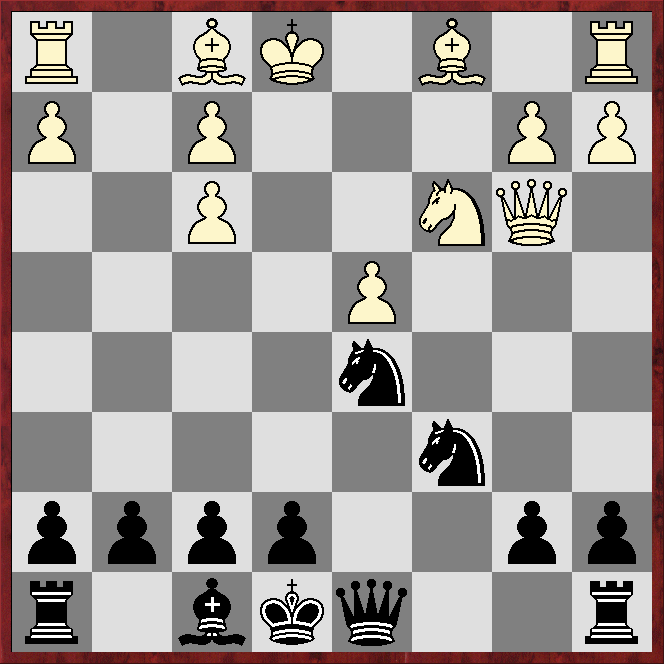
Black to play and win
*****
*****
*****
*****
*****
19...Kxh7?
Both other king moves win, eg 19...Kf8 20.Rb3 Rxe3! 21.Rxe3 Re8 22.Rf3 Rxe3! 23.Rxe3 Qxf4.
20.Qh5+ Kg8 21.Bxd4
White is a pawn up, but Black has full compensation, according to the engines
*****
*****
*****
*****
*****
21...Re4 22.Rbd1
Black to play and fully equalise
*****
*****
*****
*****
*****
22...Rde8
The engines reckon Black had to find 22...Nf8!, when both the bishop and white f pawn are en prise, so the latter falls. The problem with immediately playing 22...Rxf4 is that, after 23.Rxf4 Qxf4 24.Bf2!, the knight is pinned. Play might continue 24...Qb8 25.b5!, when 24...Qxb5 25.Qf5 Qb7 26.Qd3 leaves White up about +4.00, while 24...Ne5 25.b6! axb6 26.cxb6 is also fatal for Black in the long run, according to the engines. However, it is probably fair to say finding quite a few of these moves would tax even masters, never mind club players.
23.g3?!
Probably the wrong way to hold on to the f pawn. Correct, according to the engines, is 23.Qf3 or 23.Qg4.
23...Re2?
The engines reckon Black is equal after moves such as 23...Nf8, 23...a5 and 23...Qb7.
White to play and win
*****
*****
*****
*****
*****
24.Rf2
24.Be5! wins the exchange.
24...g6?
White is a pawn up, but only slightly better, after 24...Re1+ or a retreat such as 24...R2e4, according to the engines.
25.Rxe2!
This is one of most clearly advantageous cases of giving up a queen for two rooks, but even so I was unsure about playing it - perhaps an example of how conditioned chessplayers are to venerate the queen.
25...gxh5 26.Rxe8+
White's advantage is roughly the equivalent of being up a rook (Stockfish18) or up almost a rook and a minor piece (Dragon1).
26...Kg7
This is apparently best, while if 26...Kh7, then 27.Bf2!? is strongest, according to the engines.
27.Re7
Now the knight falls.
27...Qc8 28.Rxd7! Kg6 29.Ba1 1-0

Sunday, 27 September 2026

Hull 4NCL Round Four

Spanton (1953 ECF/1997 Fide) - Roger Greatorex (1758 ECF/1754 Fide)
Spanish Cozio
1.e4 e5 2.Nf3 Nc6 3.Bb5 Nge7
For quite some time this is Dragon1's second choice, but the engine comes to agree with Stockfish18 that the best continuation is 3...Nf6, with 3...a6 second-best (!?).
4.Nc3!?
More popular in ChessBase's 2026 Mega database are 4.c3 and especially 4.0-0, but the text is fashionable, for a reason I will explain after Black's next move.
How should Black proceed?
*****
*****
*****
*****
*****
4...Ng6!?
The 'normal' Cozio move, 4...g6, is out of favour because of 5.d4 exd4 6.Nd5!? Bg7 7.Bg5, with the upper hand for White, according to the engines.
5.d4 exd4 6.Nxd4
6.Nd5?! makes much less sense without a hole at f6.
6...Bb4 7.0-0 Bxc3?!
Black smashes White's queenside, but the resulting structure is not easy to attack, at least not before an ending, and in the meantime White has the bishop-pair and a lead in development.
8.bxc3 0-0
White has the upper hand (Stockfish18) or possibly a positionally won game (Dragon1, but the evaluation fluctuates, and eventually more-or-less settles on plus-over-minus)
*****
*****
*****
*****
*****
9.f4!
The engines agree this is best. White takes control of the e5 square, while preparing a kingside attack.
9...a6!?
Apparently a novelty, and preferred by the engines over 9...Nxd4, which was played in games featuring a 2200 and a 2295 as Black.
10.Bd3 d6 11.Rb1 Re8
Not 11...Rb8?? 12.Nxc6.
12.Qh5!? Nxd4?!
Not 12...Qh4? 13.Qxh4 Nxh4 14.Nxc6 bxc6 15.f5, after which the black knight has no retreat squares. But, rather than the text, the engines much prefer 12...Qe7.
13.cxd4 Nf8!?
This looks horribly passive, but it is probably best.
14.f5 Qf6
Perhaps a better way to stop White playing f6 is for Black to play 14...f6, or 14...Nd7.
15.c3 h6
White threatened to win the black queen with 16.Bg5.
16.g4
Perhaps 16.Rf3 is strongest.
16...Nh7 17.h4 g5!? 18.fxg6 Qxg6 19.Qxg6+ fxg6
Black has foiled the mating attack, but is losing a pawn
*****
*****
*****
*****
*****
20.Bxh6 Bxg4 21.Rxb7 Re7 22.Bc4+ Kh8 23.Bxa6??
White is roughly the equivalent of being a rook up after 23.Rf7, according to the engines.
23...Bc8 24.Rfb1
The engines reckon 24.a4!? Bxb7 25.Rxb7 Rxa4 is equal, White having a pair of bishops and a pawn for the exchange. Note that 24...Rxa6!? 25.Rb8 Re8 26.Rf7 may slightly favour White, according to the engines.
24...Bxb7
But here the engines reckon 24...Ra6!? 25.Rb8 Re8 gives Black at least the better part of equality.
25.Rxb7
The engines reckon 25.Bxb7 Rb8 26.Rb3 is completely equal.
25...Rxa6!?
Black has a slight edge after 25...Rxe4, according to Dragon1, but Stockfish18 disagrees.
26.Rb8+ Nf8 27.Bxf8?!
Probably better is 27.Rxf8+ Kh7 28.Bg5.
27...Rxe4 28.Bxd6+ Kh7
Black has at least a slight edge after the somewhat counter-intuitive 28...Kg7!, according to the engines.
White to play and equalise
*****
*****
*****
*****
*****
29.Be5!
After 29.Bxc7 Rxa2, Dragon1 reckons Black is winning, but Stockfish18 gives Black just a slight edge. The text threatens mate.
29...g5 30.h5!? Rxe5
Forced.
31.dxe5
How would you assess this rook-and-pawn ending?
*****
*****
*****
*****
*****
White is two pawns up, but it is Black to move, and the black king is more active than its white counterpart. The endgame is completely equal, according to the engines.
31...Rc6?
But not any more. Three moves seem to hold the balance: 31...Rxa2, 31...Re6 and 31...Kh6
32.Rb4 Kh6 33.Re4 Re6
The central passed pawn is blockaded, and h5 is about to fall, but the black rook has become passive - White's advantage is again worth about a rook, according to the engines
*****
*****
*****
*****
*****
34.a4?
The king should be activated, eg 34.Kf2 Kxh5 35.Kg3, when Black is in zugzwang, a possible continuation being 35...Re8 (35...Kg6 36.Kg4; 35...g4 36.Kf4) 36.a4 Re6 (36...Re7 37.e6) 37.a5 Kh6 38.Kg4 Kg6 39.Re2, when Black has to give way.
34...Kxh5 35.a5
Activating the white king also only draws.
35...Kg6 36.a6?! Rxa6 37.e6 Ra8 38.Kf2 Re8
Black has the less-vulnerable passed pawn, and the more-active king, but the ending is still drawn
*****
*****
*****
*****
*****
39.Kf3 Kf6 40.Rc4 Re7 41.Kg4 Kxe6 42.Kxg5 Kd5 43.Rd4+
The only move to draw, but not so hard to find.
43...Kc5 44.Kf4
Again an only-move, according to the Syzygy endgame tablebase.
44...c6 45.Rb4 Re1 46.Re4!? Rxe4!?
The draw is easy after this, whereas care is still required after 46...Rc1, but one drawing line runs 47.Ke3!? Rxc3+ 48.Kd2, reaching a well-known drawn position, although there is nothing stopping Black playing on.
47.Kxe4 Kc4 48.Ke5 ½–½
48.Ke5 was also an only-move, after which play might have continued 48...c5 49.Kd6 Kxc3 50.Kxc5.

Sunday, 26 April 2026

World Team 65+ Round Seven

Bo.46
  England - 5
Rtg-28
  England - 4
Rtg0 : 0
17.1
Freeman, Richard C P
1897-
Orton, Stephen L A
2117
17.2CM
Stokes, Michael
1861-
Hewson, Brian W R
2060
17.3
Spanton, Tim R
1908-
Bray, David
1990
17.4
Marshall, Michael
1859-
Hymer, Barry
1986

Spanton (1908) - David Bray (1990)
Maróczy Bind
1.e4 c5 2.Nf3 e6 3.c4 Nc6 4.d4 cxd4 5.Nxd4 Nf6 6.Nc3 Bb4 7.Nxc6 Bxc6 8.Bd3
This position occurs 1,799 times in ChessBase's 2026 Mega database
*****
*****
*****
*****
*****
8...e5 9.0-0 0-0
With both sides castling fairly early, how would you assess the position?
*****
*****
*****
*****
*****
White has set up a Maróczy Bind, but capturing on c6, at a time when Black could reply ...bxc6, means Black is better-placed than usual to break the bind with ...d5. Stockfish17.1 and Dragon1 reckon the game is equal.
10.Be3 d6
This is the main move, and was Kasparov's choice in a 1994 rapid loss to Kramnik. In his notes to the game, Kasparov gave the text a question mark, which almost certainly has more to do with the result than with the objective merits of the move. Kasparov recommended 10...Bxc3!? 11.bxc3 d6, claiming equality.
The break 10...d5!? has been tried, but after 11.exd5 (or 11.cxd5) Black is obliged to play 11...Bxc3, when 12.bxc3 cxd5 13.cxd5 (or 13.exd5) Nxd5 is not clear, but the engines give the apparent-novelty 14.Qc2!?, with chances for an advantage, eg 14...h6?! 15.Bc5 Re8 16.Rad1! is very good for White. Instead, 14...Nxe3!? 15.Bxh7+ Kh8 16.fxe3 drops a pawn, but Black gets counterplay, one line running 16...Qg5 17.Be4!? (17.Rae1? f5) Qxe3+ 18.Kh1 Rb8 19.Bd5!?, after which Black has restored material equality, and has fewer pawn islands, but the less-safe king. Stockfish17.1 calls the chances equal, although Dragon1 favours White.
11.h3
This is the commonest move in Mega26. Kramnik played 11.Na4!?, but that allowed 11...d5!?, with apparently equal chances.
11...Bxc3!?
This also equalises, according to the engines.
12.bxc3
How should Black proceed?
*****
*****
*****
*****
*****
12...c5!?
This is Dragon1's second choice, but both engines slightly prefer 13...Be6. After the text, Black has closed the centre, making White's light-square bishop very bad, and has good prospects of winning the c4 pawn. But the d pawn is backward on a half-open file, and White gets dynamic kingside chances.
13.f4 Nd7!?
This was played in three of the four games to reach the position in Mega26. The other game saw 13...Qe7.
14.f5
A 2647 played 14.Rb1!? in a blitz game, but the engines reckon Black was better after 14...exf4 15.Bxf4 Ne5, although Black, rated 2193, went on to lose.
14...f6 15.g4 Qe7 16.Qd2 Ba6 17.h4
The engines calculate White is better after 17.Rf2, 17.Rf3 or 17.a4!?
17...Nb6 18.g5
The c4 pawn can hardly be saved (18.Qe2 Qe7), but better compensation is to be had with 18.Rad1 or 18.Rf2, according to the engines, eg 18.Rad1 Bxc4 19.Bxc4+ Nxc4 20.Qe2 Nxe3 21.Qxe3, after which Black will have great difficulty mobilising the extra (backward) pawn, or 18.Rf2 Bxc4 19.g5 Bxd3 20.Qxd3 d5 21.Kh2, when the engines reckon Black has an edge, but White has dangerous kingside chances.
18...Nxc4 19.Bxc4+ Bxc4 20.Rf3 Kh8 21.Rg3
Black has to be careful, eg 21...Rg8 22.g6 h6? (22...Qb7 is better) allows 23.Bxh6!
*****
*****
*****
*****
*****
21...Rad8
The engines suggest 21...Qb7 or 21...d5!?, eg 21...d5!? 22.exd5 fxg5!? 23.Rxg5!? Rad8 24.d6!? Rxd6!? 25.Bxc5 Rxd2 26.Bxe7 Rf7!, with much the better game for Black, but there are many alternatives along the way.
22.g6
The engines fluctuate between several moves, but come to more-or-less settle on 22.h5!? or 22.Kh2.
22...d5
Not 22...h6? 23.Bxh6!, when 23...gxh6? loses to 24.Qxh6+ Kg8 25.g7 etc, but even stronger than the text may be the engines' 22...Qb7!?
23.Qd1! Kg8?
Black should play 23...dxe4 or 23...d4, the point being to meet 24.Qh5 with 24...Bg8.
24.gxh7+?
Both 24.Qh5 and 24.Kh1 are stronger, eg 24.Qh5 h6 25.Kh1 (25.Bxh6!? Be2! 26.Qxe2 gxh6 is not so clear, but probably still winning for White) d4 26.Bxh6!, when 26...Be2!? fails to 27.Qxe2 gxh6 28.g7 Rf7 29.Qh5 Rxg7 30.Rag1 (the reason for playing 25.Kh1).
24...Kh8
How should White proceed?
*****
*****
*****
*****
*****
25.Kh2
Best may be 25.Qg4, one line running 25...Rf7 26.Bc1!? Kxh7 27.h5 Rh8 28.h6 Kg8 29.Rb1, with a continuing attack, but the position is complicated, and the engines have difficulty agreeing on anything.
25...d4 26.cxd4?
But they do agree that here White had to play 26.Bc1!?
26...exd4 27.Bf4 Qxe4 28.Qg4 Qe2+ 29.Qxe2 Bxe2
With queens gone, so are White's mating chances, leaving Black with an advantage worth more than a rook, according to the engines
*****
*****
*****
*****
*****
30.Rag1 Rf7 31.h5!? Bxh5 32.Rc1 Rc8 33.Rb3 c4 34.Kg3!? Kxh7 35.Rb2 g5!? 36.fxg6+ Kxg6 37.Rd2 Rd7 38.Be3 d3 39.Rc3 Be2
Black's passed duo is temporarily blockaded, and there are opposite-colour bishops, but that is not enough to hold against three extra pawns
*****
*****
*****
*****
*****
40.Rb2 Kf5 41.Rb5+ Ke4 42.Bd2 Kd4 43.Ra3 Rc6??
White to play and win
*****
*****
*****
*****
*****
44.Kf4!?
Black's king is trapped in the middle of the board, whereas many moves. instead of 43...Rc6??, would have won, including either rook to the g file.
44...Rc5
Or 44...c3 45.Ra4+ Rc4 46.Be3#.
45.Be3+ Kd5 46.Rxc5+ Ke6 47.Bd2 1-0
Team Result
Freeman = Orton
Stokes 0-1 Hewson
Spanton 1-0 Bray
Marshall 0-1 Hymer
England 5 1.5-2.5 England 4

Monday, 6 April 2026

4NCL Easter Round Seven

TOOK a halfpoint bye in this morning's round six.

David Flynn (1867 ECF/1816 Fide) - Spanton (1944 ECF/1908 Fide)
Sicilian Hyper-Accelerated Dragon
1.e4 c5 2.Nc3 g6 3.d4 cxd4 4.Qxd4 Nf6 5.Nf3 Nc6 6.Qa4 d6 7.e5 dxe5 8.Nxe5
This position occurs 1,784 times in ChessBase's 2026 Mega database - how should Black proceed?
*****
*****
*****
*****
*****
8...Bg7!?
Offering at least one pawn. The main line in Mega26 runs 8...Bd7 9.Nxd7 Qxd7 10.Be3 Bg7 11.Rd1 Qc8!? 12.Be2 0-0 13.0-0, when White's bishop-pair and lead in development outweigh Black having the only pawn on the two centre files, according to Stockfish17.1 and Dragon1.
9.Bb5
This is the most popular move in Mega26. It is also marginally the top choice of Dragon1, and will quite possibly give White the option of grabbing two pawns. Stockfish17.1, however, for quite some time marginally prefers 9.Nxc6, before coming to see the two moves as more-or-less exactly equal. After 9.Nxc6 bxc6 10.Qxc6 Bd7, Stockfish17.1 reckons Black has sufficient compensation for a pawn, but Dragon1 gives White a slight edge.
9...0-0 10.Nxc6 bxc6 11.Bxc6 Rb8!?
Offering a second pawn. Instead 11...Bd7 12.Bxd7 Nxd7!? divides the engines as before, with Stockfish17.1 calling the position equal, while Dragon1 slightly prefers White. At move 12, instead of capturing on d7, White can also castle.
What should White play?
*****
*****
*****
*****
*****
12.0-0
This is the engines' recommendation. After 12.Qxa7!? they suggest an apparent-novelty in 12...Qd6!? (12...Bf5 is known), when 13.Bf3 Ba6 gives a sharp position with what the engines reckon are equal chances.
12...Bf5
More popular, and possibly marginally better, is 12...Qc7, while 12...a5!? has scored very well in practice.
13.Rd1 Qc7 14.Bf3 Rfc8!?
This may be new, and is the top choice of Dragon1, whereas Stcokfish17.1 prefers the known 14...a5.
15.Re1!?
Presumably in the hope of playing Bf4 without Black being able to reply ...e5. The engines suggest 15.h3 or 15.Rb1, but are fine with the text.
15...e5 16.Ne4 Bd7
The engines reckon Black should regain the sacrificed pawn immediately with 16...Nxe4 17.Bxe4 Bxe4 18.Qxe4 Qxc2.
17.Nxf6+ Bxf6 18.Qa6!? Rb6 19.Qe2 Qxc2 20.Qxc2 Rxc2
The pawn has been regained anyway, and the game is equal, according to the engines
*****
*****
*****
*****
*****
21.Be4 Rc7 22.b3 Be6 23.Bd2 Rd6
Perhaps 23...Ra6!?, with queenside pressure, is a tad better.
24.Be3 Bg7 25.Rac1 Rxc1 26.Rxc1 Ra6 27.Bb1 Ra5?!
The engines suggest 27...Bf8, 27...f5 or 27...e4!?
28.Rc5 Rxc5 29.Bxc5 a6 30.Bd3 Bc8 31.f3
Trying to centralise the king as quickly as possible, but 31.Bd6 gives White at least a slight edge, according to the engines.
31...Bf8 32.Bb6 Bb4 33.Kf2 Kf8 34.Ke3 f5 35.Bc4 Bb7 36.g3 Ke7 37.g4!? h6 38.gxf5 gxf5
Giving Black a 2-1 central pawn-majority seems a little strange, but the engines call the position completely equal
*****
*****
*****
*****
*****
39.Bd3 Bc8 40.Bc4 h5!? 41.Bd5 Be6 42.Bc6
Exchanging bishops is also OK for White, according to the engines.
42...h4!? 43.Bb7 a5 44.Bc6 Kd6 45.Bb7 Bc5+!?
There seems no other way to make progress. Dragon1 at first reckons the text gives Black the upper hand, but eventually agrees with Stockfish17.1 that the game remains equal.
46.Bxc5+ Kxc5
How should White continue?
*****
*****
*****
*****
*****
47.Kd3!?
The engines reckon both 47.f4!? e4 48.Ba6 and the immediate 47.Ba6!? are completely equal. Stockfish17.1 is also fine with the text, at least at first, but Dragon1 instantly calls it losing. Given more time, the engines come to agree it leaves Black slightly better. One point about 47.Ba6!? is that after 47...Kb4 48.Bd3 Ka3 49.Bb5 Kxa2 White has the neat trick 50.Bc4!, with what the engines reckon is complete equality.
47...Kb4
White seems to have only one drawing move
*****
*****
*****
*****
*****
48.Kc2
This looks natural, but the engines show White has to play 48.Ke3! Ka3 49.Ba6!?, again relying on the neat trick 49...Kxa2 50.Bc4!
48...Ka3 49.Kb1 Bd7 50.Bd5 Bb5 51.Kc2!?
The best try, but it should not save White.
51...Kb4!?
This may win, but other moves, eg 51...f4!?, are more convincing. However, not 51...Kxa2? 52.b4+.
52.a4?!
The engines suggest 52.Be6 f4 53.Kb2!?, but agree 53...e4!? is one of several winning moves. However, after, 54.Bg4 e3 55.a3+ Kc5 56. Kc3 Bc2 57.b4+ axb4 58.axb4+ Kd6!?, the picture is not as clear as Dragon1's assessment of +3.48 for Black makes it appear. Instead Stockfish17.1's +1.29, ie the upper hand, rather than winning, may be nearer the mark.
52...Bd7 53.Kb2 Kc5 54.Bb7 Be6 55.Kc3 f4!?
This is probably the key move, which has to be played at some point to bring home the full point.
56.Be4 Bd7
Also winning is 56...Bd5!?, but the lines get hairy, eg 57.Bxd5 Kxd5 58.Kd3 h3! 59.Kc3 e4 60.fxe4+ Kxe4 61.Kd2 f3 62.Ke1 Ke3 63.Kf1 f3, when there is no stalemate as White has to play the losing 64.b4. Alternatively, 58.b4 axb4+ 59.Kxb4 Kd4! 60.a5 e4 61.a6 e3 62.a7 e2 also loses as after 63.a8=Q Black queens with check, 63...e1=Q+, and then 64.Kb5 Qe2+ 65.Kb6 Qe6+ 66.Kc7 Qe5+ 67.Kd7 Qd5+ forces queens off, leaving Black with a winning pawn ending. Engines see these lines in the blink of a (human) eye, but over-the-board for club players it is another matter.
57.Bb7
DF offered a draw.
57...Bf5 58.Ba6
Or 58.Ba8 Be6 with ...Bd5 to come. The text is the engines' top choice.
58...e4 59.fxe4 Bxe4 60.Bc4 Bg2 61.Kd3
This lets Black get bishops off, but 61.Kd2 is also hopeless after, for example, 61...Bd5.
61...Bf1+ 62.Ke4 Bxc4 63.bxc4
Black wins the pawn race
*****
*****
*****
*****
*****
63...Kxc4 64.Kxf4 Kb4 65.Kg4 Kxa4 66.Kxh4 Kb3 67.Kg5 a4 68.h4 a3 69.h5 a2 70.h6 a1=Q 71.Kg6 Qh8 0-1

Saturday, 9 November 2024

Cap Negret Round Two

FACED a Belgian

Spanton (2009) - Bernard Logie (1845)
Caro-Kann Panov-Botvinnik
1.e4 c6 2.d4 d5 3.exd5 cxd5 4.c4 Nf6 5.Nc3 Nc6 6.Nf3 Bg4 7.cxd5 Nxd5 8.Qb3!? Bxf3 9.gxf3
This is one of the main tabiyas of the Panov-Botvinnik, occurring 3,179 times in ChessBase's 2024 Mega database
*****
*****
*****
*****
*****
9...e6 10.Qxb7 Nxd4 11.Bb5+ Nxb5 12.Qc6+ Ke7 13.Qxb5 Qd7 14.Nxd5+ Qxd5 15.Qxd5 exd5
BL offered a draw.
16.Be3 Ke6 17.0-0-0
The game is still very much in theory, this position occurring 209 times in Mega24
*****
*****
*****
*****
*****
17...Rc8+ 18.Kb1 Bc5 19.Rhe1 Bxe3!?
Possibly slightly better is 19...Kd6.
20.Rxe3+
This seems better than improving White's kingside pawn-structure.
20...Kd6 21.Ra3 Rc7 22.Ra5 Rhc8 23.Raxd5+
How would you assess the position now White has won a pawn?
*****
*****
*****
*****
*****
The key is: how much compensation does White's mangled kingside give Black? Stockfish17 reckons the game is equal, but Dragon1 gives White a slight edge.
23...Ke6 24.R5d3 h5 25.Rd6+ Ke7 26.a3 g6 27.R6d4 Kf6 28.h4 Rc4 29.a4 R8c7 30.a5 Rc2 31.R1d2 Rxd2 32.Rxd2 Rc4 33.Rd7 Rxh4 34.Rxa7
White remains a pawn up, but the engines agree the position is completely equal
*****
*****
*****
*****
*****
34...Rd4 35.a6 h4 36.Ra8 g5 37.a7 Ra4 38.b3 Ra6 39.Kb2 h3 40.b4 Kg7 41.Rc8 Rxa7 42.Rc1 Kf6 43.Kb3?
There is not time for this. Several other moves draw, including the simple 43.Rh1.
Black to play and gain a winning advantage
*****
*****
*****
*****
*****
43...Ra8!
Rooks belong behind passed pawns, especially ones that would otherwise be lost.
44.Rh1 Rh8 45.Kc4 Ke6?
The winning plan consists of going after the white kingside pawns, and at the same time supporting the black pawns, so 45..Kf5 or 45...Ke5.
46.b5 f5 47.b6 g4 48.Kc5!? Ke5 49.fxg4 fxg4 50.b7 Kf4 51.Kb6 Kf3
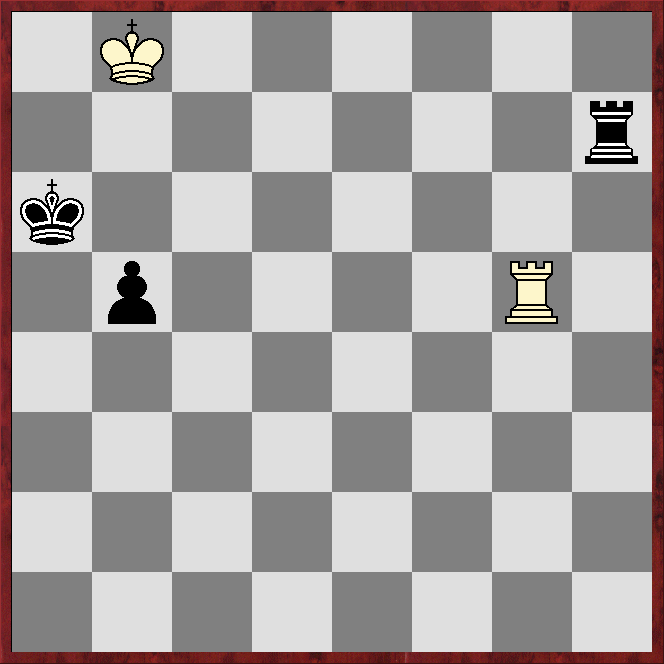
White to play and draw
*****
*****
*****
*****
*****
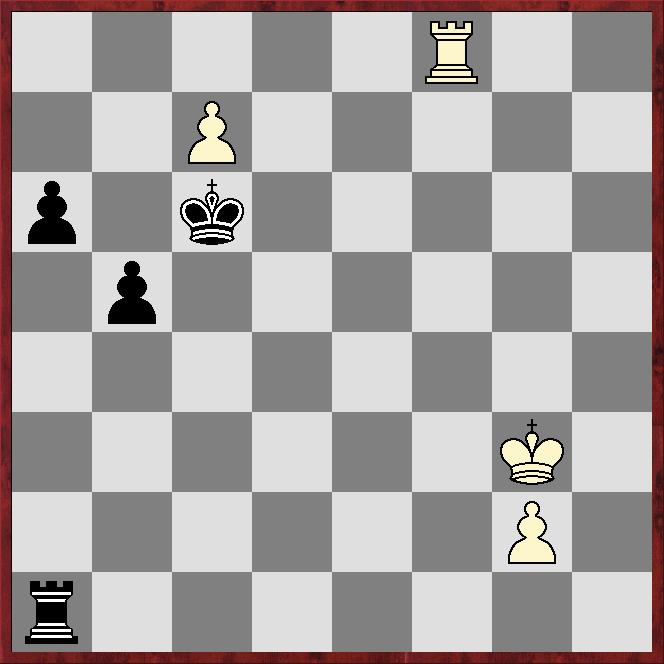
52.Rc1?
The engines show 52.Rh2!? draws, eg 52...Ke2 53.f4+ Kf1 54.f5 Kg1 55.Rc2 h2 56.f6 h1=Q 57.Rc1+ Kh2 58.Rxh1+ Kxh1 59.Ka7 Rh7 60.Ka8 Rh8+ 61.b8=Q Rxb8+ 62.Kxb8 g3, and both sides queen.
Black to play and win
*****
*****
*****
*****
*****
52...Kg2?
Both 52...h2 and 52...Rb8!? win.
53.Rc8
Black to play and draw
*****
*****
*****
*****
*****
53...Rh6+?
Drawing is 53...Rxc8!? 54.bxc8=Q h2 55.Qxg4+ Kf2, after which there is no win without Black blundering, eg 56.Qh6 Kg1 57.Qg3+ Kh1.
White to play and win
*****
*****
*****
*****
*****
54.Kc5?
The engines show that the other two king retreats, ie 54.Ka5 and 54.Kb5, win because they do not block the white rook on the c file.
54...h2 55.b8=Q h1=Q
BL offered a draw in my time.
Note that if the white king were on a5 or b5, White would now win with 56.Qg3+ Kf1 57.Rc1+ etc.
56.Qb7+
Thanks to the white king's unfortunate placement, 56.Qg3+ is only good enough for a draw, eg 56...Kf1 57.Kd4 Re6.
56...Kxf2
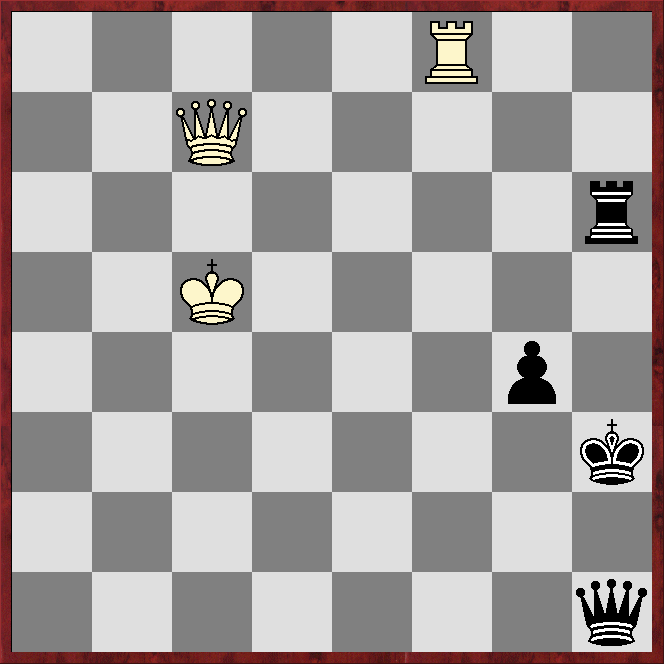
How should White proceed?
*****
*****
*****
*****
*****
57.Rf8+?
Drawing is 57.Qb2+ as the black king cannot escape checks, eg 57...Kg3 58.Qe5+ Kh4 59.Qe7+ etc.
57...Kg3 58.Qc7+ Kh3
White has run out of checks, and now the white king is extremely vulnerable, while Black has a supported pawn three squares from queening
*****
*****
*****
*****
*****
59.Qf4 Rh5+ 60.Rf5
This is best, but still losing.
60...Qg1+
But not 60...Rxf5+? as 61.Qxf5 leaves White with a tablebase draw.
61.Kd5 Qg2+ 62.Kd4 Qb2+ 63.Ke3 Qc1+ 64.Kf2 Qxf4+ 65.Rxf4 Ra5 66.Rb4 Ra2+ 67.Kg1
Black to play and win
*****
*****
*****
*****
*****
67...g3?
Winning is 67...Ra1+ 68.Kf2, after which many moves win, but simplest is 68...g3+ etc.
68.Rb1 Rg2+ 69.Kh1 Rh2+ 70.Kg1 Rg2+ ½–½

Monday, 4 November 2024

Lessons From Mallorca VI: Structure v Dynamism

MY round-six game at the Colònia de Sant Jordi U2400 reached the following instructive position shortly out of the opening.
18...Ng8-e7 has just been played in what is an Exchange Variation of the Spanish - one that has not gone well for Black
*****
*****
*****
*****
*****
*****
Black no longer has doubled c pawns, but is a tempo behind in development, and the d pawn is vulnerable unless it can be get protection by successfully advancing to d4.
*****
*****
*****
*****
*****
In order to prevent 19...d4, I played 19.c3?, which restrains the d pawn and frees the c2 square for White's king.
The move has its good points, positionally, but as my opponent pointed out after the game, White has the far superior 19.Nc3, which wins a pawn as 19...d4 can be met by 20.Na4.
LESSON: a piece-initiative, which is what 19.Nc3 gives, is often a surer way to an advantage than adjusting the pawn-structure.

Friday, 5 January 2024

Kraków Seniors Round Nine

Bogusław Czepczyński (1648) - Spanton (1743)
Catalan
1.c4 Nf6 2.Nc3 e6 3.g3 d5 4.cxd5 exd5 5.d4 c6 6.Bg2 Bd6 7.Nf3
What's in a name - or, to put it another way, what would you call this opening?
*****
*****
*****
*****
*****
After 4.cxd5 ChessBase calls it "A17: English Opening: 1...Nf6 with ...Bb4." After 7.Nf3 it changes to: "D35: Queen's Gambit Declined: Exchange Variation." I reckon it is a Catalan, albeit one in which White has captured on d5 at an unusually early stage.
7...0-0 8.0-0 Re8 9.Re1 Bg4
This is the most popular move (just) in ChessBase's 2024 Mega database, but Stockfish16 and Komodo14.1 are unimpressed, preferring 9...Bf5.
10.h3 Bh5 11.a3 a5 12.Bg5 Nbd7 13.e4!?
There is a game in Mega24 in which a 2163 played 13.Qc1. The engines much prefer the text.
13...dxe4 14.Rxe4!? Rxe4 15.Nxe4 Be7
How should White proceed?
*****
*****
*****
*****
*****
16.Nc3!?
The engines like this retreat, although they also like 16.Nxf6+ Bxf6 17.Bxf6 Nxf6 18.Qb3, claiming a tiny pull for White.
16...h6 17.Bf4 Nb6 18.g4 Bg6 19.Ne5
This is rather a good example of a position in which dynamism more than makes up for the structural weakness of having an isolated queen's pawn
*****
*****
*****
*****
*****
19...Nbd5
Preserving the bishop-pair with 19...Bh7?! looks problematic after 20.Qb3.
20.Nxg6 fxg6 21.Bg3 Bd6 22.Be5!
How should White respond?
*****
*****
*****
*****
*****
22...Qc7
This may be better than 22...Bxe5, when best-play. according to the engines, runs 23.dxe5 Nxc3 24.bxc3 Qxd1+ 25.Rxd1 Nd5 26.Bxd5+ cxd5 27.Rxd5, after which White has won a pawn, but the position is not clearcut (White has the upper hand - Komodo14.1; White has a tiny pull - Stockfish16).
23.Nxd5 Nxd5 24.Bxd5+ cxd5 25.Qb3 Qc6 26.Bxd6 Qxd6 27.Qxb7 Rxb2 28.Qa7 Rxb2 29.Qxa5
White has won a pawn, but Black is active and so is completely equal, according to the engines
*****
*****
*****
*****
*****
29...Rb3
Arguably more clearcut, but requiring a huge belief in one's calculating abilities, is the engines' 29...Rxf2!?
30.Kg2 Qe6?!
Probably better are 30...Kh7 and 30...Rd3.
31.Re1 Qf7
The only move to keep the game going.
32.Re3 Rxe3 33.fxe3
How would you assess this queen-and-pawn ending?
*****
*****
*****
*****
*****
As I understand it, two factors stand out in a queen-and-pawn ending. The first is that a passed pawn nearly always gives excellent winning chances, but these can be cancelled by having an exposed king. The engines reckon this position is equal.
33...Qe6 34.Qd2 Qa6 35.Qb2 Qd3 36.Kf2
The practical problem, from the defender's view, is that the player a pawn up can keep on probing in the knowledge that, barring a horrific blunder, the worst that can happen is the game is drawn
*****
*****
*****
*****
*****
36...h5?!
Trying for counterplay, but I probably should have stayed pat with, for example, 36...Qc4.
37.Qe2!?
The engines agree this is strong.
37...Qxa3 38.gxh5
White no longer has the 'holy grail' of a passed pawn, but is nevertheless winning, according to the engines
*****
*****
*****
*****
*****
38...Qd6!? 39.hxg6 Qh2+ 40.Ke1 Qg1+ 41.Kd2 Qxg6
I find it hard to comprehend how this position is so much better for White than the position with a passed pawn after 36.Kf2, but the engines are insistent
*****
*****
*****
*****
*****
42.Qg4 Qc6 43.Qf5 Qc4
Nevertheless, it is far from obvious, at least to me, how White should continue.
44.Qc2
The engines suggest the counterintuitive 44.Ke1!?
44...Qb4+
Apparently 44...Qf1!? gives better drawing chances.
45.Qc3 Qb8 46.Kd3
And here the engines like 46.Qc6.
46...Qb5+ 47.Kd2 Qb8 48.Kc1
Again Qc6 is the move, according to the engines.
48...Qb7 49.Qc5 Qa8 50.Kb2 Qb7+ 51.Kc3 Kh8!?
Played so that White cannot capture on d5 with check.
52.Qf8+ Kh7 53.Qf5+ g6!? 54.Qf4 Qc8+ 55.Kd2
What should Black play?
*****
*****
*****
*****
*****
55...Qc4
I thought 55...Qxh3!? 56.Qf7+ Kh6 57.Qxd5 made White's task easier, thanks to White having a pair of connected passed pawns.
However the Syzygy endgame tablebase shows the position is drawn, but there is only one move that draws
*****
*****
*****
*****
*****
In the diagrammed position Black needs to find 57...g5!! as everything else loses. So objectively I should have grabbed the h pawn at move 55, but I believe the practical chances of Black drawing from the diagram are low.
Back to the game:
56.h4 Qa2+ 57.Ke1 Qg2 58.Qg5 Qe4 59.Kf2 Qe6 60.Kg3 Qf7 61.Qf4 Qe6?
The queen should stay on the seventh rank.
White is winning anyway, but now has a sequence that puts the result beyond doubt 
*****
*****
*****
*****
*****
62.Qe5
After 62.Qc7+ Kh6 63.Qe5 Qg8 64.Qg5+ Kh7 65.h5 Qb8+ (pawn-endings are lost for Black) 66.Kh3 Qc8+ 67.Kh4 gxh5 68.Qxh5+ Black is pretty much hopeless, but 62...Kg8 63.Qe5 Qf7 64.Kg4 Qd7+ 65.Kg5 Kh7 66.h5 Qd8+ 67.Kg4 Qc8+ 68.Kf4 Qf8+ 69.Kg3 is little better.
62...Qf7 63.Kg4 Qd7+ 64.Kg5 Qd8+ 65.Kg4 Qd7+ 66.Kg3 Qf7 67.Qg5
Stockfish16's 67.h5!? seems strong, the point being that after 67...gxh5 68.Kh4 Qf2+ 69.Kxh5 White has a tablebase win.
67...Qe8?!
Almost certainly better is 67...Qf1.
68.Kf2
This time both engines suggest h5, the move I have been trying to prevent. After 62.h5!? gxh5 63.Kh4 White will recover the sacrificed pawn, leaving the black king with no cover.
68...Qf7+ 69.Ke2 Qe8?
Lack of concentration, but, as I pointed out earlier, the practical chances very much lie with the attacker in this type of ending.
70.Qxd5 Qb8 71.Qf7+ Kh8
Not 71...Kh6? as the queens come off after 72.Qf4+.
72.Qf6+
The position is a tablebase draw after 72.Qxg6? Qh2+ (or 72...Qb2+).
72...Kh7 73.Qe7+ Kh6 74.Qg5+ Kh7 75.Qf4 Qb7 76.Kf2 Qb2+ 77.Kf3 Qd2 78.Ke4 Qc2+ 79.Kf3 Qd1+ 80.Kg2 Qe2+ 81.Kh3 Qd1!?
White to play and win (ie avoid a draw by repetition)
*****
*****
*****
*****
*****
82.Qg3?
This seems the only move that does not win (apart from giving the queen away with, for example, 82.Qf3??). The engines like 82.Kg2!?, but perhaps easiest for a human to calculate is 82.Qf2.
The game finished:
82...Qh1+ 83.Kg4 Qe4+ 84.Kh3 Qh1+ 85.Qh2 Qf3+ 86.Qg3 Qh1+ ½–½