Showing posts with label Zugzwang. Show all posts

Sunday, 27 September 2026

Hull 4NCL Round Four

Spanton (1953 ECF/1997 Fide) - Roger Greatorex (1758 ECF/1754 Fide)
Spanish Cozio
1.e4 e5 2.Nf3 Nc6 3.Bb5 Nge7
For quite some time this is Dragon1's second choice, but the engine comes to agree with Stockfish18 that the best continuation is 3...Nf6, with 3...a6 second-best (!?).
4.Nc3!?
More popular in ChessBase's 2026 Mega database are 4.c3 and especially 4.0-0, but the text is fashionable, for a reason I will explain after Black's next move.
How should Black proceed?
*****
*****
*****
*****
*****
4...Ng6!?
The 'normal' Cozio move, 4...g6, is out of favour because of 5.d4 exd4 6.Nd5!? Bg7 7.Bg5, with the upper hand for White, according to the engines.
5.d4 exd4 6.Nxd4
6.Nd5?! makes much less sense without a hole at f6.
6...Bb4 7.0-0 Bxc3?!
Black smashes White's queenside, but the resulting structure is not easy to attack, at least not before an ending, and in the meantime White has the bishop-pair and a lead in development.
8.bxc3 0-0
White has the upper hand (Stockfish18) or possibly a positionally won game (Dragon1, but the evaluation fluctuates, and eventually more-or-less settles on plus-over-minus)
*****
*****
*****
*****
*****
9.f4!
The engines agree this is best. White takes control of the e5 square, while preparing a kingside attack.
9...a6!?
Apparently a novelty, and preferred by the engines over 9...Nxd4, which was played in games featuring a 2200 and a 2295 as Black.
10.Bd3 d6 11.Rb1 Re8
Not 11...Rb8?? 12.Nxc6.
12.Qh5!? Nxd4?!
Not 12...Qh4? 13.Qxh4 Nxh4 14.Nxc6 bxc6 15.f5, after which the black knight has no retreat squares. But, rather than the text, the engines much prefer 12...Qe7.
13.cxd4 Nf8!?
This looks horribly passive, but it is probably best.
14.f5 Qf6
Perhaps a better way to stop White playing f6 is for Black to play 14...f6, or 14...Nd7.
15.c3 h6
White threatened to win the black queen with 16.Bg5.
16.g4
Perhaps 16.Rf3 is strongest.
16...Nh7 17.h4 g5!? 18.fxg6 Qxg6 19.Qxg6+ fxg6
Black has foiled the mating attack, but is losing a pawn
*****
*****
*****
*****
*****
20.Bxh6 Bxg4 21.Rxb7 Re7 22.Bc4+ Kh8 23.Bxa6??
White is roughly the equivalent of being a rook up after 23.Rf7, according to the engines.
23...Bc8 24.Rfb1
The engines reckon 24.a4!? Bxb7 25.Rxb7 Rxa4 is equal, White having a pair of bishops and a pawn for the exchange. Note that 24...Rxa6!? 25.Rb8 Re8 26.Rf7 may slightly favour White, according to the engines.
24...Bxb7
But here the engines reckon 24...Ra6!? 25.Rb8 Re8 gives Black at least the better part of equality.
25.Rxb7
The engines reckon 25.Bxb7 Rb8 26.Rb3 is completely equal.
25...Rxa6!?
Black has a slight edge after 25...Rxe4, according to Dragon1, but Stockfish18 disagrees.
26.Rb8+ Nf8 27.Bxf8?!
Probably better is 27.Rxf8+ Kh7 28.Bg5.
27...Rxe4 28.Bxd6+ Kh7
Black has at least a slight edge after the somewhat counter-intuitive 28...Kg7!, according to the engines.
White to play and equalise
*****
*****
*****
*****
*****
29.Be5!
After 29.Bxc7 Rxa2, Dragon1 reckons Black is winning, but Stockfish18 gives Black just a slight edge. The text threatens mate.
29...g5 30.h5!? Rxe5
Forced.
31.dxe5
How would you assess this rook-and-pawn ending?
*****
*****
*****
*****
*****
White is two pawns up, but it is Black to move, and the black king is more active than its white counterpart. The endgame is completely equal, according to the engines.
31...Rc6?
But not any more. Three moves seem to hold the balance: 31...Rxa2, 31...Re6 and 31...Kh6
32.Rb4 Kh6 33.Re4 Re6
The central passed pawn is blockaded, and h5 is about to fall, but the black rook has become passive - White's advantage is again worth about a rook, according to the engines
*****
*****
*****
*****
*****
34.a4?
The king should be activated, eg 34.Kf2 Kxh5 35.Kg3, when Black is in zugzwang, a possible continuation being 35...Re8 (35...Kg6 36.Kg4; 35...g4 36.Kf4) 36.a4 Re6 (36...Re7 37.e6) 37.a5 Kh6 38.Kg4 Kg6 39.Re2, when Black has to give way.
34...Kxh5 35.a5
Activating the white king also only draws.
35...Kg6 36.a6?! Rxa6 37.e6 Ra8 38.Kf2 Re8
Black has the less-vulnerable passed pawn, and the more-active king, but the ending is still drawn
*****
*****
*****
*****
*****
39.Kf3 Kf6 40.Rc4 Re7 41.Kg4 Kxe6 42.Kxg5 Kd5 43.Rd4+
The only move to draw, but not so hard to find.
43...Kc5 44.Kf4
Again an only-move, according to the Syzygy endgame tablebase.
44...c6 45.Rb4 Re1 46.Re4!? Rxe4!?
The draw is easy after this, whereas care is still required after 46...Rc1, but one drawing line runs 47.Ke3!? Rxc3+ 48.Kd2, reaching a well-known drawn position, although there is nothing stopping Black playing on.
47.Kxe4 Kc4 48.Ke5 ½–½
48.Ke5 was also an only-move, after which play might have continued 48...c5 49.Kd6 Kxc3 50.Kxc5.

Thursday, 27 August 2026

European 65+ Team: Game One

Playing hall
England 3 v Finland
Spanton (2003) - Heikki Westerinen (GM 2205)
Spanish Exchange
1.e4 e5 2.Nf3 Nc6 3.Bb5 a6 4.Bxc6 dxc6 5.d4 exd4 6.Qxd4 Qxd4 7.Nxd4 Bd7 8.Nc3 0-0-0 9.Be3 Bd6 10.0-0-0
Now both sides have castled, how would you assess the position?
*****
*****
*****
*****
*****
As usual in the Exchange Variation of the Spanish, especially in lines with an early d4, the battle has quickly become a queenless-middlegame clash between Black's bishop-pair and White's better pawn-structure. Stockfish18 and Dragon1 reckon Black has the better part of equality, which is more-or-less borne out by the score from this position in ChessBase's 2026 Mega database of +13=38-17, ie Black scores 53% over 68 games.
10....Ne7 11.Nb3!? Ng6
Three games in Mega26 saw 11...b6?, when 12.Bxb6 wins a pawn, but possibly even better is 12.Rxd6!? cxd6 13.Bxb6, when Wilhelm Schönmann - Josef Lokvenc, German Chess Federation Congress (Frankfurt) 1923, continued 13...Rde8 14.Rd1 f5 15.Rxd6 fxe4 16.Nc5 Bf5 17.a4, with much more than enough for the exchange, according to the engines (1-0, 34 moves).
12.Nc5
How should Black proceed?
*****
*****
*****
*****
*****
12...Rhe8!?
Euwe preserved the bishop-pair with 12...Be8 in a 1920 game, but the engines reckon White is fine after both 13.h4 and 13.Nd3. The text is Dragon1's top choice, at least for a while, and Stockfish18 also comes to rate it highly, but the engines also like 12...h5 and 12...Nh4, and Dragon1 eventually rates Euwe's move and 12...Nh4 as equally good.
13.Nxd7 Rxd7 14.a3!?
An apparent-novelty, played to prevent 14...Bb4, but the engines prefer 14.f3, or another apparent-novelty in 14.h4!?
14...Ne5 15.f3?!
This is probably a mistake. The engines suggest 15.Bf4.
15...Nc4 16.Bf2 Bf4+ 17.Kb1
Black to play and gain at least the upper hand
*****
*****
*****
*****
*****
17...Bd2?!
Much better, according to the engines, is 17...Red8, when one of their main line runs 18.Bh4!? Rxd1+ 19.Rxd1 Rxd1+ 20.Nxd1 Bxh2, netting Black a pawn, while they agree 18.Rxd7 Rxd7 19.Nd1 Rd2 20.g3 Bh6 leaves White positionally lost.
18.Na4
Not 18.Be1? Red8, when 19.Bxd2 Rxd2 20.Rxd2 Rxd2 21.Rg1 Ne3 leaves Black winning the g2 or c2 pawn.
18...b6
White seems fine after 18...Red8 19.Nc5.
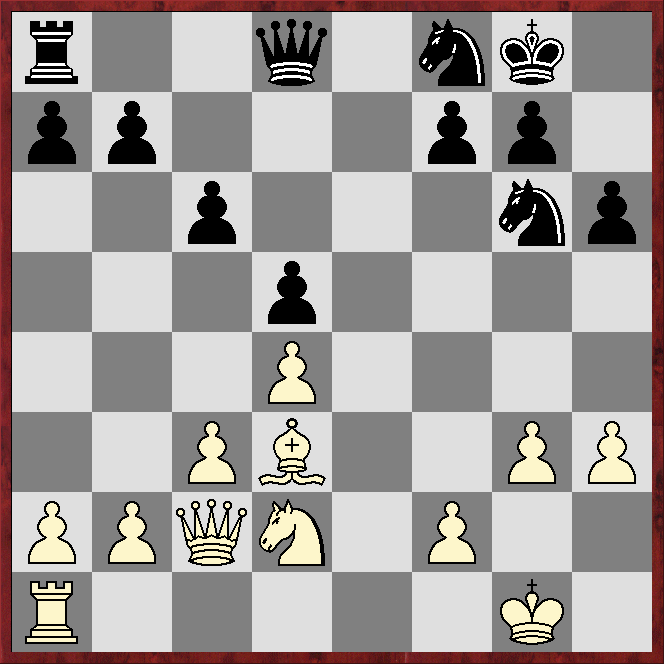
19.Ka2 Red8 20.Kb3?!
Probably better is 20.b3. I was worried that 20...Nxa3!? 21.Kxa3 Bb4+ 22.Kxb2 Rxd1 23.Rxd1 Rxd1 was strong, but the engines give Black at best a slight edge.
20...Be3!? 21.Rxd7 Rxd7 22.Bxe3?!
Almost certainly better is 22.Kxc4, eg 22...b5+ 23.Kb4 Bxf2 24.Nc3, although the engines give Black the upper hand after, for example, 24...Bd4. Black could try the immediate 22...Bxf2, but 23.Nc3 b5+ 24.Kb3 c5 is, according to the engines, only slightly better for Black.
22...Nxe3 23.Kc3
What should Black play?
*****
*****
*****
*****
*****
23...g6
Possibly best is 23...Nd1+ 24.Kb3 Rd2 25.Re1, and now either 25...g6 or 25...a5, slowly increasing the pressure. The engines also like 23...Rd6, and they agree the text leaves Black positionally winning.
24.g3 c5 25.Re1 Nd1+ 26.Kb3 c4+?!
'Clever', but premature, whereas the engines' 26...Rd2 27.h4 c4+! 28.Ka2 c3! is very strong, eg 29.Nxc3 Nxc3+ 30.bxc3 Rxc2+ 31.Kb3 Rg2 32.g4 Rf2 33.Re3 Rh2, or 29.bxc3 b5 30.Kb1!? bxa4 31.Kc1 Rg2 32.Kxd1 Rxg3.
27.Ka2 g5?!
The engines give 27...b5 and 27...Rd2, in both cases claiming complete equality.
White to play and gain at least a slight edge
*****
*****
*****
*****
*****
28.g4?!
The engines suggest 28.Kb1, eg 28...Rd6 29.Kc1 Nf2 30.Nc3, when Black's initiative is spent, and White remains with the better pawn-structure.
28...Nf2 29.Re2?!
And here the engines much prefer 29.Nc3.
29...Nh3 30.Nc3 Nf4 31.Rf2 b5 32.Kb1 c5
Perhaps best is 32...Rd6 33.Kc1 Rh6, but White seems fine after 34.Ne2.
33.Kc1 Kc7 34.Rd2?!
The engines strongly dislike this, claiming 34.Ne2 and 34.h4!? give complete equality.
34...Rd4?!
Black has an edge after this, but the engines prefer 34...Rxd2!? 35.Kxd2 b4, eg 36.Nb1 Kc6!? 37.Ke3 Ne6!? 38.h3 Kb5 39.e5!? Ka4 (threatens 40...c3!) 40.axb4 cxb4 41.Ke4 h6!? 42.Kd5 Kb5, when White does not seem to have a good move, eg 43.Nd2 c3 44.bxc3 bxc3 45.Nb3 a5 46.Nc1 Nf4+ 47.Kd4 Nxh3 48.Kxc3 Ng1, after which f3 drops, and White has to contend with a passed a pawn. That is a very long line, with many alternatives along the way, but it illustrates White's difficulties.
35.Nd1
White comes close to equalising with 35.e5!?, according to the engines.
35...Kd6 36.Ne3 Ke5
The engines suggest 36...Ke6!?, and if, as in the game, 37.Nf5, then 37...Rxd2 38.Kxd2 Ng6!?, with what they claim is the upper hand for Black.
37.Nf5 Rxd2 38.Kxd2 h5
Here too the engines suggest 38...Ng6!?, but claim only a slight edge for Black, at best, the difference between the two lines presumably being due to the black king, in the second line, blocking the black knight's access to the e5 square.
39.gxh5 Nxh5 40.Ke3 Nf4 41.Ne7 Kd6 42.Nf5+
Not 42.Nc8+?? as 42...Kd7 traps the white knight.
42...Ke5 43.Ne7 f6 44.Nf5 b4!?
How should White respond?
*****
*****
*****
*****
*****
45.axb4!?
Also holding is 45.a4, but 45.c3? loses to 45...b3 as Black has ...Nd3 to come.
45...cxb4
Black's queenside pawns are straightened out, but White has enough threats to neutralise them
*****
*****
*****
*****
*****
46.Ne7 Kd6 47.Ng8
Not 47.Nf5+? as 47...Kc5 is very strong, eg 48.Kd2 Ng6 49.Kc1!? a5 (49...Ne5?! runs into 50.h4! gxh4 51.Nxh4) 50.b3 c3 51.Kd1 Kc6!? 52.Ke2 Nf4+ 53.Kd1 Kb5 54.Nd6+ Kc5 55.Nf5 Ng2 56.Ke2 a4!? 57.bxa4 Kb6 58.Kd1 Ka5 59.Nd4 Kxa4 60.Kc1 Ka3 61.Kb1 Ne3 62.Nb5+ Ka4 63.Nd4 Nf1 64.h3 Nd2+ 65.Ka2 Ka5 66.e5!? fxe5 67.Nc6+ Kb5 68.Nxe5 Ka4, when, at the end of another long engine-generated line, White is suddenly in zugzwang. Again there were lots of alternatives along the way, but Black was having all the fun.
47...Ke5 48.Ne7 Kd6 ½–½
TEAM RESULT
Bo.13
  England 3
Rtg-4
  Finland
Rtg2 : 2
4.1
Spanton, Tim R
2003-GM
Westerinen, Heikki M.J.
2205½ - ½
4.2
Freeman, Jon A
1950-FM
Henttinen, Markku I.O.
2176½ - ½
4.3
Guilfoyle, John M
1921-
Joentausta, Hannu
2092½ - ½
4.4
Wilson, Edgar
1903-FM
Vinke, Dietmar
2042½ - ½

Wednesday, 18 February 2026

Weimar Round Four

Ralf Schober (2070) - Spanton (1939)
Bird
1.f4 c5 2.Nf3 d5 3.e3 g6 4.Bb5+!?
This is the top choice of Stockfish17.1 and Dragon1.
4...Bd7
The engines like 4...Nd7!?, although Dragon1 comes to marginally prefer the text.
5.Qe2 Nc6 6.Bxc6!?
This may be a novelty. Only castling is in ChessBase's 2026 Mega database.
6...Bxc6 7.Ne5 Qc7 8.b3 Bg7 9.Bb2 Nh6 10.0-0 0-0
With both sides having castled, how would you assess the position?
*****
*****
*****
*****
*****
White has more kingside space; Black enjoys more space on the central/queenside. White has a well-posted knight at e5, but Black's bishop-pair is a genuine asset as the knight is pinned, and so cannot simply chop on c6. The engines give Black a slight edge.
11.d3 f6?!
But this breaks the pin, and so gives up the bishop-pair - probably too high a price to pay for evicting the knight. The engines suggest 11...Nf5, 11...b5 or 11...Rad8, in each case preserving the bishops.
12.Nxc6 Qxc6 13.Nd2 Rae8
White has a slight edge after 13...e5 14.fxe5 fxe5 15.e4, according to the engines.
14.e4 e5
The engines reckon it is better to advance the e pawn only one square as, after the text, Black gets an isolated king's pawn.
15.fxe5 fxe5 16.Rxf8+ Rxf8 17.exd5 Qxd5
Black has a central isolani, which also means an extra pawn-island, and a bad bishop
*****
*****
*****
*****
*****
18.Re1 Re8 19.Qe4 Qxe4 20.Nxe4 b6 21.Nd6 Re7 22.Nc4 Nf7
All black pieces, arguably including the king, are less active than their white counterparts, but the e pawn is not in imminent danger of being captured, which is why the engines give White no more than a slight edge 
*****
*****
*****
*****
*****
23.a4 Re6 24.Kf1 Kf8 25.Ba3 Ke8 26.Re2 Kd7 27.Bb2 Kc6 28.h3 Kd5
The black king has been fully activated, helping to overprotect e5, while the white king has hardly moved, leading Stockfish17.1 to call the game equal, although Dragon1 still gives White a slight edge
*****
*****
*****
*****
*****
29.Rf2!?
Positions with a central isolani are usually easier to defend without heavy pieces on the board, but RS could presumably find no other way to try to make progress.
29...Rf6 30.Ne3+ Ke6 31.c4!?
The engines are happy with this. It makes d3 backward, but creates a potential outpost at d5.
31...Rxf2+ 32.Kxf2 h5 33.Nd5 Kd6 34.Nc3 Kc6
Not 34...Ke6? 35.Nb5 a6 36.Nc7+, or 35...a5 36.Nc7+ Kd7 37.Kc7 Ne7+, with White in each case winning at least a pawn.
35.Ne4 Kd7 36.Kf3 Nd8!?
This and 36...a5!? are the engines' top choices, but 36...Nd6!? may also be playable, although Dragon1 is doubtful.
37.Bc3 Ne6 38.g3 Kc6 39.h4 Kd7 40.Ke3 Bh6+ 41.Kf2 Bg7 42.Kf3
The white king's triangulation has brought about the same position as after 39...Kd7, but this time with Black, rather than White, to move. However, that makes no significant difference.
42...Kc6 43.Nf2
How should Black proceed?
*****
*****
*****
*****
*****
43...Kd6
Not 43...e4+? 44.Nxe4 Bxc3 45.Nxc3 Nd4+ as 46.Kf4 Nxb3 47.Kg5 wins easily for White.
44.Ke4 Nf8 45.b4!? Nd7!?
Dragon1 strongly dislikes this. Stockfish17.1 is not so sure, but the engines agree that better is 45...cxb4!? 46.Bxb4 Kc6! 47.Bxf8 Bxf8 as 48.Kxe5 Bd6+ 49.Kf6 Bxg3 50.Ne4 Bxh4 51.Kxg6 is completely equal. But note that the natural-looking 46...Ke6? loses to 47.Nh3!, eg 47...Nh7 (47...Nd7? 48.Ng5+ Kf6 49.Kd5) 48.Ng5+ Nxg5 49.hxg5 Bh8 50.Bf8 Kd7 51.a5! bxa5 52.Kd5 a4 53.c5! Kc7!? 54.c6!? Kc8 55.Ba3 Kd8 56.Ke6 Kc7 57.Kf7 Kxc6 58.Kxg6 Kd5 59.Bb2 Kc5 60.Kh7 e4 61.Bxh8 exd3 62.Bc3 a3 63.g6 a2 64.g7 d2 65.Bxd2 a1=Q, after which, despite queening first, Black has no perpetual, and cannot pick up the loose bishop, and so is lost - a long line, with several hard-to-spot moves, but the engines show much of it is more-or-less forcing.
46.b5 Nf6+ 47.Ke3 Bh6+ 48.Kf3 Ke6 49.a5
How should Black continue?
*****
*****
*****
*****
*****
49...bxa5!?
Possibly best is 49...Bf8, despite this allowing 50.a6, after which Black has to watch out for White sacrificing on c5 or b6 to get the a pawn home.
50.Bxa5
How big is White's advantage?
*****
*****
*****
*****
*****
Dragon1 gives White the upper hand, but it reckons both of Black's most plausible moves, 50...Bf8 and 50...Kd7, leave White exactly 0.75 ahead, which in endings can be a sign that the position should be drawn with best play. Stockfish17.1 gives White a slight edge, which tends to confirm that the game is holdable.
50...Bf8 51.Ne4!?
How should Black respond?
*****
*****
*****
*****
*****
51...Nxe4!
This is best, according to Stockfish17.1, despite giving White a good-v-bad bishop ending. Dragon1 reckons 51...Bd6 is equally good, but Stockfish17.1 disagrees.
52.Kxe4
The key to the ending is whether Black can avoid falling into a zugzwang that either loses a pawn or lets the white king in at d5 
*****
*****
*****
*****
*****
52...Bd6 53.Bd8 Bb8 54.Bg5 Bd6 55.Bh6 Be7 56.Bd2 Bd8 57.Be3 Be7
An only-move as 57...Bb6? loses to 58.Bf2 Kd6 59.g4! hxg4 60.Bg3 Ke6 61.Bxe5, eg 61...Bd8 62.Bg3 Bf6 63.Kf4 be7 64.Kxg4, after which Black is a pawn down and still has weaknesses.
58.Bh6 Bd6 59.Bg7 Bc7 60.Bf8 Bd6
Another only-move as 60...Bb6? loses to triangulation, eg  61.Ke3 Kf5 62.Bd6 Ke6 63.Bb8 Kf5 64.Kf3 Ke6 65.Ke4 and 66.Bxe5(+), and if 61...Kf7, then 62.Bd6 Ke6 63.Bb8 wins in the same way.
61.Bh6
Or 61.Bxd6 Kxd6, when the pawn ending is also drawn.
61...Bc7 62.Be3 Bd6 63.Bd2 Bc7 64.Bc3 Bd6 65.Ba5 Bb8 66.Bd8 Bd6 67.Ba5 ½–½

Thursday, 11 December 2025

Lessons From Benidorm IV

MY round-five game, in which I had white against Spanish junior Tarek Kaji Senas (1711), reached an instructive endgame position after 31 moves.
Black has just played 31...Bh2-e5
*****
*****
*****
*****
*****
*****
*****
Material is level and both sides have doubled and isolated queenside pawns, one of which is under immediate threat. White has the only passed pawn, but Black has potential to create a passer on a flank.
Quite often in endgames, such a flank passer appears on the queenside, when it is well-known that its power to divert an enemy king can make it decisive. But that can easily also be the case with a passer on the kingside.
The position in the diagram is completely equal, according to Stockfish17.1 and Dragon1, although their first reaction on being shown it is to slightly favour Black.
I suggest this means that, although theoretically equal, the position is easier for Black to play.
But what would be the verdict if the bishops were removed? 
Same position, but without bishops
*****
*****
*****
*****
*****
The position is still completely equal, according to the engines, but it is worth watching them play it out to see why this is the case.
Best play goes something like:*
32.Kf3 Kf7 33.Kf4 Kf6 34.e5+ Ke7 35.b4!? (this freezes Black's queenside pawns, and creates a reserve tempo in the shape of b2-b3) h6 36.h4 g5!? 37.hxg5 hxg5+ 38.Kxg5 Kxe5 39.Kg6 Kd4 40.Kf6 Kc4 41.Ke7 Kxc4 42.Kd7 c5 43.Kxc7 c4 44.Kc6 Kb3 45.Kc5 ½–½
*For most moves there are two or more continuations of equal value, and I have preferred what I reckon to be the most natural, or perhaps most human.

Going back to the first diagram, it might be thought White can draw with 32.Bc3?
After 32...Bxc3 33.bxc3 White's pawn-structure has been improved, but the game is lost.
If it were White to move, the game would be drawn, more-or-less as shown above, but the sequence 32.Bc3 Bxc3 33.bxc3 costs White a tempo, and that it is all it takes to turn a draw into a loss
*****
*****
*****
*****
*****
A likely continuation is 33...g5!? (33...Kf7 also wins) 34.Kf3 h5 35.b4 Kf7 36.e5!? Ke6 37.Ke4.
Black to play and win
*****
*****
*****
*****
*****
37...c5!
After 37...g4 38.hxg4 hxg4 39.Kf4 g3 40.Kxg3 Kxe5 41.Kf3 Kd5 42.Ke3 Kc4 the white king is in time to protect c3 with 43.Kd2, and so the game is drawn.
38.bxc5
After 38.b5 c4 39.Kd4 Black creates a winning kingside passer with 39...g4.
38...c6 39.c4 h4! 40.Kd4 g4 etc.

Again going back to the first diagram, the game continuation was 32.Kf3!? Kf7 (32...Bxb2 33.Bf4) 33.Kg4 Ke6 34.Bf4!? Bxf4 35.Kxf4, resulting in a draw.
The engines reckon White has another draw with 32.Bc1!?
I rejected it for fear of getting into zugzwang, but a sample continuation shows my fear was ungrounded, eg 32...Kf7 33.Kf3 Ke6 34.Bf4, when 34...Bxf4 35.Kxf4 reaches the same drawn position as in the game.
LESSON: 'simple' endings can be just as deep, in their own way, as a middlegame slugfest.

Saturday, 11 October 2025

Calvià Round Eight

FACED an Englishman.

Spanton (1941) - Oliver Stubbs (2195)
French Exchange
1.e4 e6 2.d4 d5 3.exd5 exd5 4.Nf3 Bd6 5.Bd3 Ne7 6.0-0 Nbc6 7.c3 Bf5!?
Much more popular in ChessBase's 2025 Mega database is 7...Bg4. The point of the text is to swop Black's 'bad' bishop for White's 'good' one, as judged by the squares the central pawns occupy.
How should White respond?
*****
*****
*****
*****
*****
8.Re1
This is the commonest continuation in Mega25, while Stockfish17 and Dragon1 marginally prefer 8.Bxf5 Nxf5 and either 9.Re1+ or 9.Qb3!? Note that the latter does not win a pawn as Black can reply 9...b6, safe in the knowledge that 10.Qxd5?? loses to 10...Bxh2+ and 11...Qxd5.
8...0-0
Now both sides have castled, how would you assess the position?
*****
*****
*****
*****
*****
The game looks balanced, and that is what the engines reckon.
9.Nh4!? Bxd3 10.Qxd3 Qd7 11.Be3 Rae8 12.Nd2 Qg4
This may be a novelty. The known move is 12...Nd8!?
13.Ndf3!?
Taking the king knight's square ... at least for the moment.
13...h6 14.h3 Qd7
Possible is 14...Qe4!?, when 15.Qxe4?? loses a piece as the h4 knight is trapped after 15...dxe4. However the white queen can simply move away, with what the engines reckon is an equal position.
15.Nh2
The engines suggest 15.Bd2!?, the idea being to meet 15...g5?! with 16.Bxg5! hxg5 17.Nxg5, gaining what seems to be a winning attack, eg 17...f5 18.Qf3! Nd8 19.Qh5 Rf7 20.Nxf7 Nxf7 21.Re2 Kg7 22.Rxe7! Rxe7 (22...Bx7? 23.Qg6+ Kf8 24.Nxf5 etc) 23.Nxf5+ Kf6 24.Nxe7 Qxe7 25.Qxd5, when White is winning on material, or 17...Ng6 18.Nxg6 fxg6 19.Qxg6+ Qg7 20.Qxg7 (20.Qxe8!? may be even stronger) Kxg7 21.Ne6+, and again White is winning on material.
15...f5 16.Bd2
The engines like this, but reckon 16.f4!? may be even stronger, despite shutting in White's bishop.
16...g5 17.N4f3 f4 18.Ng4 Kg7
Not 18...Nf5?! as after 19.Rxe8 Qxe8 (19...Rxe8?? 20.Nf6+) 20.Re1 Qg6 (20...Qf7 21.Qxf5!) 21.c4!, the engines reckon Black's position collapses, mainly thanks to the exposed black king, eg 21...h5 22.Nge5 Bxe5 23.Nxe5 Nxe5 24.Rxe5 dxc4 25.Qxc4+ Qf7 26.d5 c6 27.Qd3 Qd7 (27...cxd5?! 28.Bf8) 28.Qe2 h4 29.Qg4, when White is winning material, and still has a strong attack.
19.Nge5 Qf5 20.Qxf5 Nxf5
How would you assess this queenless middlegame?
*****
*****
*****
*****
*****
The engines at first slightly prefer White, but given plenty of time they come to the conclusion that the position is equal.
21.Nd7 Rxe1+ 22.Rxe1 Rd8 23.Nc5!? Bxc5 24.dxc5 Kf6 25.b4 b5!?
This is the engines' top choice.
26.Kh2 a5 27.a3 axb4 28.axb4
The engines prefer 28.cxb4!?
28...Ra8
Even stronger, according to the engines, is 28...Nfe7!?, and if, as in the game, 29.g3, then 29...Ng6, the idea being to keep a space-gaining pawn on f4.
29.g3 fxg3+ 30.fxg3 Ra3 31.g4 Nfe7 32.Rf1 Kg7 33.h4 gxh4 34.Nxh4 Ne5 35.Re1 N7c6 36.Rg1?
Too much flitting about with the rook. After 36.Kg2 White is fine, according to the engines, and if 36...Nxg4, then 37.Re6 Nce5 38.Bf4 Nd3 39.Bxc7, with what they reckon is an equal game.
36...d4 37.Rg3
The engines are unsure whether the text or 37.cxd4 is correct, but in either case much prefer Black.
37...Ra2?!
Stronger is 37...d3.
The problem with the text is that after ...
38.Rg2
...White threatens to win the black rook with 39.Bxh6+!
38...Kh7 39.cxd4 Nxd4 40.Kg3 Nc4 41.Bf4 Ra3+ 42.Kh2 c6 43.g5 hxg5 44.Bxg5 Nf3+ 45.Nxf3 Rxf3
How would you assess this rook-and-minor-piece ending?
*****
*****
*****
*****
*****
White has what is usually the better minor piece for cooperating with a rook, but the c6 pawn cannot be harassed by the bishop, while both the knight and black rook can attack b4. The engines reckon the position is equal.
46.Rg3 Ne5 47.Kg2
Not 47.Rxf3?? Nxf3+ and 48...Nxg5. However Dragon1, but not Stockfish17, prefers 47.Bd8.
47...Rxg3+ 48.Kxg3 Kg6
White to play and draw
*****
*****
*****
*****
*****
49.Bd2?
This almost certainly loses by force (the analysis is very difficult, even for engines), and at any rate makes White's task difficult, whereas the engines reckon both 49.Bd8 and 49.Kf4!? definitely draw, eg 49.Kf4!? Nd3 50.Ke4 Nxb4 51.Bd2 Na6 52.Ke5 Nxc5 53.Kd6!? Ne4+ (there is nothing better) 54.Kxc6 etc.
49...Kf5
What should White play
*****
*****
*****
*****
*****
50.Kf2?
This makes it easy. The engines reckon 50.Bc3!? may hold, eg 50...Ke4 51.Bxe5! Kxe5 52.Kf3 Kd4 53.Kf4 Kc4 54.Ke5 Kxb4 55.Kd6, and both sides queen. Trickier is 50...Nd3!? 51.Kf3 Nf4!?, when 52.Ke3? loses to 52...Nd5+ 53.Kd3 Nxc3 54.Kxc3 Ke4, after which b4 eventually drops. However, the engines suggest 52.Bb2 Nd5 53.Ba3 Ke5 54.Bb2+ Ke6, when 55.Ba3 Kf5! 56.Bb2 (56.Ke2 Ke4 is hopeless) Nxb4 wins for Black. But they are much less sure about the outcome after 55.Ke4!? Nxb4.
Position after 55.Ke4!? Nxb4
*****
*****
*****
*****
*****
In fact White is in zugzwang. The Syzygy endgame tablebase shows that if it were Black to move in the diagram, the position is a "cursed win," ie "mate can be forced, but a draw can be achieved under the 50-move rule." However, with White to move, the position is lost, eg after the engines' 56.Bc3 Na6 (56...Nd5 also wins) 57.Kd4 Black has the winning 57...Kf5!!, which to be fair, is suggested by Stockfish17, albeit without realising how strong the move is. The main line can be thought of as 58.Ba5 Nb8! 59.Bc7 Nd7 60.Bd6 Nf6 61.Bb8 Nd5 62.Bd6 Nf4 63.Ke3 Ne6 64.Kd3 Nd8!? 65.Kd4 Nb7 66.Bc7 Kg4!? 67.Bd6 Kf3 68.Kd3 Nd8!? 69.Bb8 Ne6 70.Bd6 Ng5!? 71.Be7 Ne4 72.Kd4 Nd2 73.Kd3 Nc4 74.Bd6 Nb2+ 75.Kc2 Na4 76.Kd3 Kf2!? 77.Kd2 Nb2 78.Be7 Kf3 79.Kc2 Nc4 80.Kd3 Kf4 81.Kd4 Kf5 82.Bf8 Nd2 83.Kd3 Nf3!? 84.Ke3 Ne5 85.Kd4 Nc4 86.Be7 Na5 87.Bd6 Ke6 88.Bf8 Nb3+ 89.Ke4 Kf6!? 90.Bd6 Nd2+ 91.Kd3 Nc4 92.Bf4 Kf5 93.Bb8 Ke6 94.Kd4 Nd2 95.Bd6 Nf3+!? 96.Ke3 Ng5! 97.Kd4 Kf5 98.Be7 Ne6+ 99.Kc3 Ke5 100.Bd6 Ke4! 101.Kb3 Kd4 102.Kb4 Kd5 103.Be7 Nc7 104.Ka5 (104.Bf8 Na6+) Kc4 105.Bd6 Nd5 106.Ka6 b4 - a pawn moves just in the nick of time, and so Black wins. Incredible stuff!
Back to the game:
50...Ke4 51.Bc3 Nd3+ 52.Ke2 Nf4+ 53.Kd2 Nd5 54.Bg7
Or 54.Kc2 Nxc3 55.Kxc3 Ke3 56.Kc2 Kd4 57.Kb3 Kd3 58.Kb2 Kc4 59.Ka3 Kc3 60.Ka2 Kxb4.
54...Nxb4 55.Kc3 Na6 56.Bf8 Kd5 57.Kb3 Nxc5+ 58.Kc3 Na6 59.Kb3 c5 60.Kc3 Nb4 61.Bg7 Nc6 62.Kb3 c4+ 63.Kc3 b4+ 64.Kb2 Nd4 65.Bf6 c3+ 66.Kb1 Kc4 67.Bg7 b3 68.Bh6 Kd3 69.Kc1 Nf3 70.Kb1 Nd2+ 0-1

Tuesday, 7 October 2025

Calvià Round Four

FACED a Latvian.

Spanton (1941) - Vjačeslavs Verņuks (1794)
King's Indian Sämisch
1.c4 Nf6 2.Nc3 g6 3.d4 Bg7 4.e4 d6 5.f3 0-0 6.Bg5!? c5 7.d5 Qa5!?
An uncommon continuation, but it has been played by Shirov, Gelfand and other strong grandmasters.
How should White respond?
*****
*****
*****
*****
*****
8.Qd2
This is easily the main move in ChessBase's 2025 Mega database, but Stockfish17 and Dragon1 prefer András Adorján's 8.a4!?
8...b5?!
A dubious positional pawn sacrifice that appears to be a novelty. Normal is 8...a6.
9.Nxb5 Qxd2+ 10.Bxd2 a6 11.Nc3
For a pawn Black has the half-open b file, a slight lead in development ... and not much else
*****
*****
*****
*****
*****
11...e6
The engines suggest 11...a5!?
12.Rb1?!
Prophylaxis, but of a feeble kind. Best may be 12.0-0-0!?
12...exd5 13.Nxd5?
This throws away all of White's advantage by helping Black attack the extended white centre.
13...Nxd5 14.cxd5 Nd7
Probably best is 14...f5.
15.Bc3
The engines prefer developing the knight, to either h3 or e2.
15...f5
The engines like 15...Ne5 or 15...Rb8.
16.Bxg7
Better is 16.exf5!? Rxf5 17.Bd3!, but I missed that 17...Rxd5?? loses to 18.Bc4.
16...Kxg7 17.Be2
Black is better after this, according to the engines. They suggest giving the pawn back by 17.exf5!? Rxf5 18.Ne2 Rxd5 19.Nc3, claiming complete equality.
17....Rb8 18.Nh3
The engines reckon 18.b3 a5 (18...fxe4 19.fxe4 lets the white knight develop smoothly at f3) 19.exf5  Rxf5 20.Nh3 Nf6!? 21.Nf2 keeps White's disadvantage to a minimum.
18...fxe4 19.fxe4 Rb4?
Black gains at least the upper hand after 19...Nf6, according to the engines, eg 20.Nf2 Re8 (also strong is 20...Nxe4!? 21.Nxe4 Bf5 etc) 21.Bf3 Bf5.
20.Nf2 Ne5 21.0-0 a5 22.b3 Bd7 23.Rbc1 Ra8
Black's pressure is reminiscent of the Benko Gambit
*****
*****
*****
*****
*****
24.Bc4 a4 25.Rc2
25.Rc3 may be better.
25...Bb5!? 26.Bxb5
Not 26.a3?? axb3! (this is even stronger than 26....Bxc4) 27.axb4 bxc2 (27...Bxc4 also wins) 28.Bxb5 cxb4, after which Black's queenside pawns triumph.
26...Rxb5
The engines reckon White's task is slightly more difficult after 26...axb3!? 27.axb3 Rxb5.
27.bxa4 Rxa4 28.Re1
The engines advise giving back the pawn with 28.Nh3!? Rxe4 29.Ng5 and 30.Ne6+, claiming equality.
28...Rbb4 29.h3 h5 30.Kh2 Ra3 31.Ree2?! Nc4?!
Black gets at least the upper hand after 31...Rb1, according to the engines, eg 32.Rcd2 Ra1 33.Nd1 h4 34.Nf2 (White has run out of useful moves) Kf6 35.Rc2 Kg5!? 36.Rcd2 Kf4 37.Nd1 c4 38.Rf2+!? Kg5!? 39.Rfe2 c3 40.Rd4 Kh5! (40...R1xa2? 41.Nxc3), after which White is in zugzwang, and probably has nothing better than 41.Rc2 R1xa2 42.Rxc3 Rxc3 43.Nxc3 Rc2, when moving the knight loses to 44...Nf3+. This is a long variation, but in any event White's position is very difficult.
32.Nd1 Ne5 33.Rc3 Rba4 34.Rxa3 Rxa3 35.Rc2 Nd3?
The engines are OK with this at first, but the knight-and-pawn ending is lost for Black, although Dragon1 takes some convincing.
Stockfish17 comes to see the position as winning for White, but Dragon1 insists it is completely equal
*****
*****
*****
*****
*****
36.Rc3 Rxc3 37.Nxc3 Kf6 38.Kg3 Ke5 39.Kf3
Only now does Dragon1 realise Black is lost 
*****
*****
*****
*****
*****
39...c4
Dragon1 originally reckoned 39...Nb2!? draws, but White wins with 40.h4! eg 40...Nc4 41.Nb1!! (a study-like only-move) Kd4 42.a4, which is not so very different from the way the game unfolds (except the game does not have the same brilliance, as the text makes White's task less demanding).
40.Ke3 h4 41.a4 Nc5 42.a5 g5 43.Nb5!?
It turns out the white knight is not tied to the defence of e4.
43...Na6
Or 43...Nxe4 44.a6 Nf6 45.Nc3 Ne8 46.a7 Nc7 47.Kf3! Na8 (47...Kd4 48.Nb5+!) 48.Kg4 Kf6 49.Nb1!? (not the only winning move) Kg6 50.Kf3 Kf5 51.Na3 c3 52.Nb5!? etc.
44.Nd4 c3 45.Nf3+ Kf6 46.Nd4 Nc5
Or 46...Ke5 47.Nf3+ Kf6 48.Kd3 Nc5+ 49.Kxc3 Nxe4+ 50.Kc4 etc.
47.Nc3 Ke5 48.Nb4 1-0

Friday, 13 June 2025

Munich 60+ Round Six

FACED an Indian.

Spanton (1954) - RR Vasudevan* (1932)
Petrov/French Exchange
1.e4 e5 2.Nf3 Nf6 3.Nxe5 d6 4.Nf3 Nxe4 5.d3!? Nf6 6.d4 d5
This position is normally reached two moves quicker via a French Defence move-order, ie 1.e4 e6 2.d4 d5 3.exd5 exd5 4.Nf3 Nf6
*****
*****
*****
*****
*****
7.Bd3 Be7
More popular is prolonging symmetry with 7...Bd6.
8.0-0 0-0
With both sides castling early, how would you assess the position?
*****
*****
*****
*****
*****
White has the more-active king's bishop, and is to move in an otherwise symmetrical position. That is enough for a slight edge, according to Dragon1, but Stockfish17 is less sure.
9.Bh5 h6 10.Bh4 Bg4 11.h3 Bh5 12.Re1 Re8 13.Nbd2 Nc6
Breaking the near-symmetry with a move not liked by the engines, which prefer 13...Nbd7.
14.c3 Nh7!?
The engines like this.
15.Bxe7 Rxe7 16.Qc2 Nf8 17.Rxe7 Nxe7 18.Ne5 Bg6!? 19.Nxg6 Nexg6 20.g3!? c6
The queenside pawn-structure remains symmetrical, and the kingside is not far from it, but White has the only long-range minor piece, which is probably at least part of the reason why the engines give White a slight edge
*****
*****
*****
*****
*****
21.Re1 Qf6 22.Kg8 Rc8!?
A 'mysterious' rook move, at least so it seemed to me during the game, but I suppose the rook might prove useful shadowing the white queen.
23.Nf3 Qd6 24.h4 Nd7 25.Re3
The engines like 25.Bxg6!? fxg6, and then 26.Re3.
25...Kf8 26.Qe2 Ne7 27.Ne5 Nxe5 28.dxe5 Qe6 29.Qh5 Rd8
How should White proceed?
*****
*****
*****
*****
*****
30.b3?!
This throws away all of White's advantage, according to the engines. They reckon White has the upper hand after 30.Re2, but agree 30.f4? d4 31.cxd4 and either 31...Qxa2 or 31...Rxd4 gives Black at least the upper hand. If 30.Re2 is met by 30...d4, they reckon 31.c4 is good for White.
30...d4 31.Bc4 Qg6
The engines prefer 31...Nd5 or 31...Qf5.
RV offered a draw in my time.
32,Qxg6 Nxg6 33.cxd4 Rxd4 34.h5 Ne7 35.Rd3
RV offered a draw.
35...Rxd3
Not 35...Re4?? 36.Rd8#.
36.Bxd3 Nd5
How would you assess this bishop-v-knight ending?
*****
*****
*****
*****
*****
White has the better minor piece for dealing with rival pawn-majorities, but Black's majority is 3-2 rather than 4-3 and is on the farside from the kings. Dragon1 gives White a slight edge, but Stockfish17 disagrees.
37.Kf3 Ke7 38.a3 f6?!
Letting White quickly get a 3-2 majority is probably unwise.
39.Ke4 fxe5?!
Conceding space is also strange.
40.Kxe5 Nf6
Dragon1 reckons White has a positionally won game; Stockfish17 is not so sure, but gives White the upper hand
*****
*****
*****
*****
*****
41.Be2 Nd7+ 42.Kf5 Ne8 43.Bc4 Kd6?
Striving for counterplay is understandable, but it is better to push the queenside pawns, starting with, for example, 43...b5!?, while keeping the king blocking its white counterpart.
44.g4 b5 45.Bg8!?
The engines agree this is best.
45...a5 46.b4?
This makes it easy for Black to gain a passed pawn, and so claim equality. Winning is 46.f4.
46...axb4 47.axb4 c5 48.f4!? cxb4
Also equal is 48...c4.
49.g5
How should Black respond?
*****
*****
*****
*****
*****
49...hxg5?
Drawing is 49...Ke7 as, after 50.gxh6 gxh6, White cannot make progress.
50.fxg5 Ke7
White to play and win
*****
*****
*****
*****
*****
51.Ke5
Winning is 51.g6!, the point being that after 51...Nd7 52.h6 gxh6 53.g7 Nf6 54.Bb3 h5 55.Kg5 h4 56.Kxh4 Kd6 57.Kg5 Ke5 58.Kg6 Black is in zugzwang. Alternatively 51...Kd6 52.Bb3 Ke7 53.h6 wins easily for White.
51...Nd7+ 52.Kd5
Returning to f5 is no better - Black draws comfortably with, among other moves, 52...Kf8 and 52...Nc5.
52...b3 53.Kd4 b2 54.Ba2 Nb6 55.Kc3 Nc4 56.Kb3 Ke6 57.h6 gxh6 58.gxh6 Kf6 59.Kb4 Kg6 60.Kxb5 ½–½
This ended my drawless streak of 30 games.
*Uses a single name and initials rather than a given name and family name.

Tuesday, 4 March 2025

Lessons From Prague

MY round-one game in the world senior team 65+ championship reached a knight-and-pawn ending in which my active king made up for being a pawn down.
Indeed in the following position I thought I was winning, as Black appears to be in zugzwang.
I have just played 44.Ke5-d5
*****
*****
*****
*****
*****
*****
However Stockfish17 and Dragon1 demonstrate there are at least five moves that draw, including the game's 44...Nf4+.
The biggest surprise to me is that one of the five drawing methods is with 44...Nd4!?, even though after 45.Nxd4 cxd4 46.Kxd4 White has a protected passed pawn.
That is normally fatal for the opponent, but the engines demonstrate that here it is not so.
Black has to play the fairly obvious 46...Kd6, when the try 47.Ke4 Ke6 48.Kf4 Kf6 49.Kg3 Kg5 50.Kh3 Kf5 51.Kh4 Kg6 gets nowhere.
The black king remains within the square of the white passer, and 52.c5 Kf6 53.Kxh5 Ke6 54.Kg5 Kd5 55.Kf5 Kxc5 56.Ke5 Kc6 57.Kd4 Kd6 also fails to make progress.
LESSON One is that a distant passed pawn can make up for a protected passer.
LESSON Two is the old but easily ignored advice that you cannot play by general principles alone ('a protected passer is a major weapon in a pawn-ending') - concrete analysis is necessary.

Thursday, 13 February 2025

Horror Show

AUSTRALIA-based Derek Roebuck publishes Patzer magazine, sometimes using posts from my blog as articles.
Today I am returning the compliment by highlighting a striking example from his magazine of the peculiarities of chess.
Black to play - can the game be saved?
*****
*****
*****
*****
*****
*****
*****
No - White is lost. Yes, White!
The winning move is 1...Qd2+, after which 2.b4?! Qd8+ is mate next move.
So White must try 2.Qb4, but 2...Qd5+ 3.Qb5 Qd6! is the clever point, putting White in zugzwang.
The white king cannot move, pushing the b pawn loses as before, while any move by the white queen either loses the queen or allows an immediate mate.
Roebuck publishes his magazine from Subiaco, a suburb of Perth, and can be contacted via derek_roebuck@hotmail.com