Bird
1.f4 c5 2.Nf3 d5 3.e3 g6 4.Bb5+!?
This is the top choice of Stockfish17.1 and Dragon1.
4...Bd7
The engines like 4...Nd7!?, although Dragon1 comes to marginally prefer the text.
5.Qe2 Nc6 6.Bxc6!?
This may be a novelty. Only castling is in ChessBase's 2026 Mega database.
6...Bxc6 7.Ne5 Qc7 8.b3 Bg7 9.Bb2 Nh6 10.0-0 0-0
 |
| With both sides having castled, how would you assess the position? |
*****
*****
*****
*****
White has more kingside space; Black enjoys more space on the central/queenside. White has a well-posted knight at e5, but Black's bishop-pair is a genuine asset as the knight is pinned, and so cannot simply chop on c6. The engines give Black a slight edge.
11.d3 f6?!
But this breaks the pin, and so gives up the bishop-pair - probably too high a price to pay for evicting the knight. The engines suggest 11...Nf5, 11...b5 or 11...Rad8, in each case preserving the bishops.
12.Nxc6 Qxc6 13.Nd2 Rae8
White has a slight edge after 13...e5 14.fxe5 fxe5 15.e4, according to the engines.
14.e4 e5
The engines reckon it is better to advance the e pawn only one square as, after the text, Black gets an isolated king's pawn.
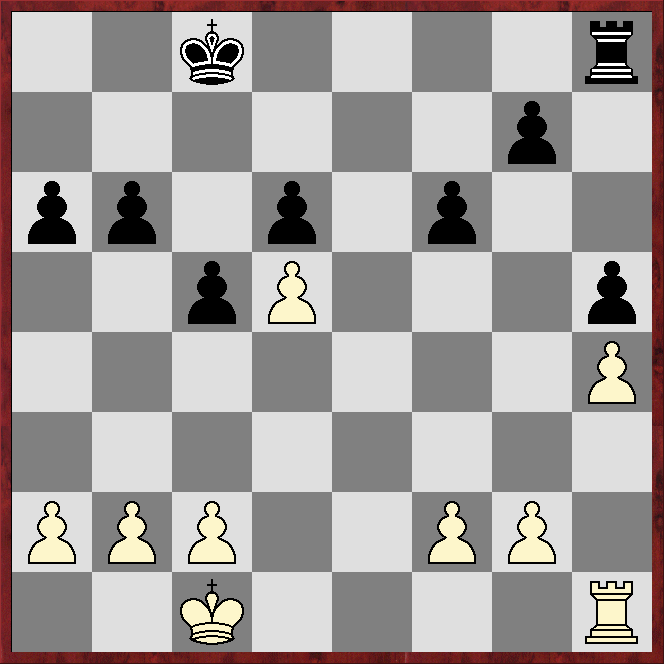
15.fxe5 fxe5 16.Rxf8+ Rxf8 17.exd5 Qxd5
 |
| Black has a central isolani, which also means an extra pawn-island, and a bad bishop |
*****
*****
*****
*****
18.Re1 Re8 19.Qe4 Qxe4 20.Nxe4 b6 21.Nd6 Re7 22.Nc4 Nf7
 |
| All black pieces, arguably including the king, are less active than their white counterparts, but the e pawn is not in imminent danger of being captured, which is why the engines give White no more than a slight edge |
*****
*****
*****
*****
23.a4 Re6 24.Kf1 Kf8 25.Ba3 Ke8 26.Re2 Kd7 27.Bb2 Kc6 28.h3 Kd5
 |
| The black king has been fully activated, helping to overprotect e5, while the white king has hardly moved, leading Stockfish17.1 to call the game equal, although Dragon1 still gives White a slight edge |
*****
*****
*****
*****
29.Rf2!?
Positions with a central isolani are usually easier to defend without heavy pieces on the board, but RS could presumably find no other way to try to make progress.
29...Rf6 30.Ne3+ Ke6 31.c4!?
The engines are happy with this. It makes d3 backward, but creates a potential outpost at d5.
31...Rxf2+ 32.Kxf2 h5 33.Nd5 Kd6 34.Nc3 Kc6
Not 34...Ke6? 35.Nb5 a6 36.Nc7+, or 35...a5 36.Nc7+ Kd7 37.Kc7 Ne7+, with White in each case winning at least a pawn.
35.Ne4 Kd7 36.Kf3 Nd8!?
This and 36...a5!? are the engines' top choices, but 36...Nd6!? may also be playable, although Dragon1 is doubtful.
37.Bc3 Ne6 38.g3 Kc6 39.h4 Kd7 40.Ke3 Bh6+ 41.Kf2 Bg7 42.Kf3
The white king's triangulation has brought about the same position as after 39...Kd7, but this time with Black, rather than White, to move. However, that makes no significant difference.
42...Kc6 43.Nf2
 |
| How should Black proceed? |
*****
*****
*****
*****
43...Kd6
Not 43...e4+? 44.Nxe4 Bxc3 45.Nxc3 Nd4+ as 46.Kf4 Nxb3 47.Kg5 wins easily for White.
44.Ke4 Nf8 45.b4!? Nd7!?
Dragon1 strongly dislikes this. Stockfish17.1 is not so sure, but the engines agree that better is 45...cxb4!? 46.Bxb4 Kc6! 47.Bxf8 Bxf8 as 48.Kxe5 Bd6+ 49.Kf6 Bxg3 50.Ne4 Bxh4 51.Kxg6 is completely equal. But note that the natural-looking 46...Ke6? loses to 47.Nh3!, eg 47...Nh7 (47...Nd7? 48.Ng5+ Kf6 49.Kd5) 48.Ng5+ Nxg5 49.hxg5 Bh8 50.Bf8 Kd7 51.a5! bxa5 52.Kd5 a4 53.c5! Kc7!? 54.c6!? Kc8 55.Ba3 Kd8 56.Ke6 Kc7 57.Kf7 Kxc6 58.Kxg6 Kd5 59.Bb2 Kc5 60.Kh7 e4 61.Bxh8 exd3 62.Bc3 a3 63.g6 a2 64.g7 d2 65.Bxd2 a1=Q, after which, despite queening first, Black has no perpetual, and cannot pick up the loose bishop, and so is lost - a long line, with several hard-to-spot moves, but the engines show much of it is more-or-less forcing.
46.b5 Nf6+ 47.Ke3 Bh6+ 48.Kf3 Ke6 49.a5
 |
| How should Black continue? |
*****
*****
*****
*****
49...bxa5!?
Possibly best is 49...Bf8, despite this allowing 50.a6, after which Black has to watch out for White sacrificing on c5 or b6 to get the a pawn home.
50.Bxa5
 |
| How big is White's advantage? |
*****
*****
*****
*****
Dragon1 gives White the upper hand, but it reckons both of Black's most plausible moves, 50...Bf8 and 50...Kd7, leave White exactly 0.75 ahead, which in endings can be a sign that the position should be drawn with best play. Stockfish17.1 gives White a slight edge, which tends to confirm that the game is holdable.
50...Bf8 51.Ne4!?
 |
| How should Black respond? |
*****
*****
*****
*****
51...Nxe4!
This is best, according to Stockfish17.1, despite giving White a good-v-bad bishop ending. Dragon1 reckons 51...Bd6 is equally good, but Stockfish17.1 disagrees.
52.Kxe4
 |
| The key to the ending is whether Black can avoid falling into a zugzwang that either loses a pawn or lets the white king in at d5 |
*****
*****
*****
*****
52...Bd6 53.Bd8 Bb8 54.Bg5 Bd6 55.Bh6 Be7 56.Bd2 Bd8 57.Be3 Be7
An only-move as 57...Bb6? loses to 58.Bf2 Kd6 59.g4! hxg4 60.Bg3 Ke6 61.Bxe5, eg 61...Bd8 62.Bg3 Bf6 63.Kf4 be7 64.Kxg4, after which Black is a pawn down and still has weaknesses.
58.Bh6 Bd6 59.Bg7 Bc7 60.Bf8 Bd6
Another only-move as 60...Bb6? loses to triangulation, eg 61.Ke3 Kf5 62.Bd6 Ke6 63.Bb8 Kf5 64.Kf3 Ke6 65.Ke4 and 66.Bxe5(+), and if 61...Kf7, then 62.Bd6 Ke6 63.Bb8 wins in the same way.
61.Bh6
Or 61.Bxd6 Kxd6, when the pawn ending is also drawn.
61...Bc7 62.Be3 Bd6 63.Bd2 Bc7 64.Bc3 Bd6 65.Ba5 Bb8 66.Bd8 Bd6 67.Ba5 ½–½