Showing posts with label Development. Show all posts

Thursday, 1 October 2026

Winning Chess

THE U2000 tournament at Hull 4NCL was won by the top seed, Wales' John Fletcher, who notched up four wins, before securing the draw he needed, as Black, in the last round to secure first outright.
Here is his win in round one, which starts with interesting opening play, after which a faulty combination by White gives Black a winning middlegame.
JF nurses it into a winning rook-and-pawn ending, which is where the fun starts, as the endgame becomes a fiendishly difficult series of positions in which first one player, then the other, has to find only-moves to save a half-point (for White) or to bring home the win (for Black).
Even Dragon1 does not understand what is going on, although, to its credit, Stockfish18 does much better.

Robert Kane (1828 ECF/1792 Fide) - John Fletcher (1999 ECF/1955 Fide)
QGD Ragozin
1.d4 Nf6 2.c4 e6 3.Nf3 d5 4.Nc3 Bb4
The Ragozin, characterised by the move 4...Bb4, is Black's third-most popular continuation at move four, behind 4...c6 and especially 4...Be7, but is the top choice of Stockfish18, and is Dragon1's equal-first choice, along with 4...c5. But the evaluation-differences between the moves are tiny, and, given more time, 4...dxc4 takes over as Dragon1's top choice, while 4...c6 becomes Stockfish18's second favourite.
5.Qa4+ Nc6 6.Ne5
The engines prefer 6.e3 or 6.cxd5.
6...Bd7 7.Nxc6
Somewhat more popular, at least in ChessBase's 2026 Mega database, is 7.Nxd7 - either way, White wins the bishop-pair.
7...Bxc3+ 8.bxc3 Bxc6 9.Qb3 0-0
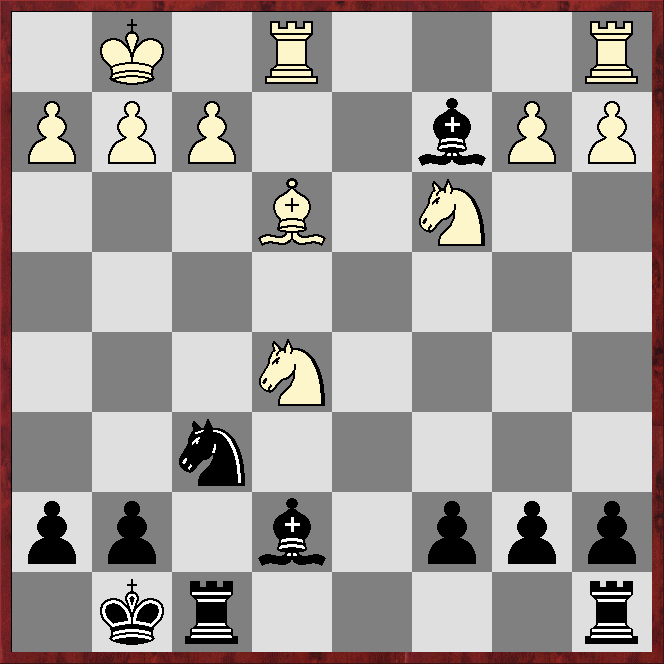
With the immediate tactics having died down, how would you assess the position?
*****
*****
*****
*****
*****
White has the bishop-pair, and can get rid of his doubled pawns at any time, but Black is well ahead on development. The engines reckon the game gives equal chances.
10.Bg5 h6 11.Bh4 g5!? 12.Bg3 Ne4 13.e3 Kg7!?
The engines are OK with this apparent-novelty, and prefer it over the known 13...h5, which was played by a 2193 in the 2003 Marseille Open.
14.c5!?
The engines much prefer 14.cxd5 or 14.f3.
14...b6 15.Be5+?
The engines reckon 15.cxb6 axb6 16.Bd3 Nxg3!? 17.hxg3 leaves Black slightly better (Stockfish18) or at best with the upper hand (Dragon1).
15...f6 16.Bxc7?
'Clever', but bad, although Black is also on top after the engines' 16.Bg3 bxc5.
16...Qxc7 17.f3
This is the point of White's combination, but after ...
17...Nxc5 18.dxc5 bxc5
... White has lost a pawn, as well as the bishop-pair.
19.Be2 Qa5 20.0-0 Rab8 21.Qc2 Ba4 22.Qc1 Bb5 23.c4 Ba6 24.f4?!
The engines suggest 24.Re1 or 24.h4!?
24...Qb4 25.fxg5 hxg5 26.Bd3 Bxc4 27.a3 Qa4 28.Bxc4 Qxc4 29.Qxc4 dxc4
How big is Black's advantage in this rook-and-pawn ending?
*****
*****
*****
*****
*****
Black's two extra pawns are doubled and isolated, but White also has weaknesses, and the engines reckon Black's advantage is roughly the equivalent of being up a minor piece.
30.Rfc1 Rb2!
The engines prefer grabbing the seventh rank over attacking the white isolanis with 30...Rb3.
31.Rxc4 Rd8 32.Rac1 Rdd2 33.Rg4 Kg6 34.Rh4 Kh5 35.Rg3?
White had to play 35.Rcc4, according to the engines.
35...Kxh4 36.Kh2 Rbc2 37.Rb1 Rd7 38.Rb8
Threatening mate in two!
38...Kh5 39.Rg8 Rc4 40.Rf3 Rf7 41.Re8 g4?!
This seriously lessens Black's advantage, whereas, after 41...Re4 or 41...Rh4+, Black is in the region of being the equivalent of a rook up, according to the engines.
42.Rf4?
The engines reckon that after 42.Rf1!? Black's advantage is 'only' about +2.50.
42...Rc3??
Black wins easily after 42...Rxf4 43.exf4 Rc7, eg 44.Rxe6 c4 45.Re1 c3 46.Rc1 c2 47.Kg3 Rc3+ 48.Kf2 Kg6, with an overwhelming position.
White to play and equalise
*****
*****
*****
*****
*****
43.Rh8+?
After 43.Rxe6, Black's material advantage is reduced to one pawn, and that, as is well-known, is often insufficient in rook-and-pawn endings, this one included, eg 43...Rxa3 can be met by 44.Rf5+ Kg6 45.Rxc5, with complete equality, according to the engines, one line running 45...a5 46.Kg3 Rg7 (defending g4 indirectly) 47.Rc4 Kf5 48.Re8, when it seems Black cannot make progress. The engines prefer 43...f5, but agree White is fine after 44.a4.
43...Kg6 44.Rg8+ Kh7 45.Rfxg4 Rxe3
White's rooks may look menacing, but Black's king is not in serious danger, and meanwhile Black is still two pawns up
*****
*****
*****
*****
*****
46.Rc8 Re5
There is nothing wrong with 46...Rxa3.
47.Rc4 Kg6 48.R8xc5 Rxc5 49.Rxc5
Now a pair of rooks has been exchanged, how big is Black's advantage?
*****
*****
*****
*****
*****
Black is not only a pawn up, but has a passed pawn that can easily be made a protected passer; the a7 pawn is easily protected (and cannot be got at by the white king); and Black's king is well-placed to support the black pawn-duo. Black's advantage is almost the equivalent of being a piece and a pawn up, according to the engines.
49...Rb7 50.Ra5 e5 51.Kg3 Kg5 52.Kf3 f5??
Impatient. Correct is 52...Re7, getting behind the passed pawn, while still protecting a7.
53.Rxe5 Rb3+
All three legal moves draw
*****
*****
*****
*****
*****
54.Kf2 Rxa3
The Syzygy endgame tablebase shows 10 of White's 18 legal moves draw
*****
*****
*****
*****
*****
55.Re8 Kf4 56.Re2?
There were still eight drawing moves - all seven rook moves along the back rank, and 56.Kg1!?
Black has one winning move
*****
*****
*****
*****
*****
56...a5!
Stockfish18 works out that this is winning, but Dragon1 does not.
57.Rc2
Again there is only one winning move
*****
*****
*****
*****
*****
57...Rd3
Syzygy, and Stockfish18, show 57...Ra4! wins. Play might continue 58.Rc5 (Dragon1 erroneously believes this draws) Ra2+ 59.Kg1 (Dragon1's idea) a4 60.Rc4+ Ke3 61.Kh2 (equal, according to Dragon1) f4! 62.Kg1, and only now does Dragon1 realise Black is winning, after 62...a3. Actually, Syzygy shows 62...Ra1+ and 62...Ra3 also win, but the most direct path to victory runs (with White putting up the most dogged resistance) 62...a3 63.Rc3+ Kd4 64.Rc3 Kc5! 65.Kh2 Kb5 66.Kg1 Kb6!? (other moves also win, but Syzygy shows this is the fastest) 67.Rb3+ Ka5 68.Rf3 Ra1+ 69.Kh2 Kb5! 70.Rb3+ Ka4 (70...Ka4 is also a good answer to, for example, 70.Rc3) 71.Rb7 (71.Rf3 Rb1 72.Rxf4+ Rb4 73.Rf2 Rc4 74.Re2 Rb3 etc) Rc172.Ra7+ Kb3 73.Rb7+ Ka2, and the rest is relatively simple, eg 74.Ra7 Rc3 75.Ra8 Ka1 76.Ra7 Rb3 etc.
58.Ra2 Rd5 59.Ra4+ Ke5 60.g3 Kd6
White has one drawing move
*****
*****
*****
*****
*****
61.Ke3
White had to play 61.g4!, forcing an ending of rook and rook's pawn versus rook - the most drawish of all rook-and-pawn endings.
Black has one winning move
*****
*****
*****
*****
*****
61...Kc6
An only-move, but is fairly easy to see other moves get Black nowhere.
62.Kf4 Kb5
Six other moves also win.
63.Ra1 a4 64.g4
Too late.
64...fxg4 65.Kxg4 Rd3 66.Kf4 a3 67.Rb1+ Kc4 68.Ke4 a2 0-1

Sunday, 27 September 2026

Hull 4NCL Round Four

Spanton (1953 ECF/1997 Fide) - Roger Greatorex (1758 ECF/1754 Fide)
Spanish Cozio
1.e4 e5 2.Nf3 Nc6 3.Bb5 Nge7
For quite some time this is Dragon1's second choice, but the engine comes to agree with Stockfish18 that the best continuation is 3...Nf6, with 3...a6 second-best (!?).
4.Nc3!?
More popular in ChessBase's 2026 Mega database are 4.c3 and especially 4.0-0, but the text is fashionable, for a reason I will explain after Black's next move.
How should Black proceed?
*****
*****
*****
*****
*****
4...Ng6!?
The 'normal' Cozio move, 4...g6, is out of favour because of 5.d4 exd4 6.Nd5!? Bg7 7.Bg5, with the upper hand for White, according to the engines.
5.d4 exd4 6.Nxd4
6.Nd5?! makes much less sense without a hole at f6.
6...Bb4 7.0-0 Bxc3?!
Black smashes White's queenside, but the resulting structure is not easy to attack, at least not before an ending, and in the meantime White has the bishop-pair and a lead in development.
8.bxc3 0-0
White has the upper hand (Stockfish18) or possibly a positionally won game (Dragon1, but the evaluation fluctuates, and eventually more-or-less settles on plus-over-minus)
*****
*****
*****
*****
*****
9.f4!
The engines agree this is best. White takes control of the e5 square, while preparing a kingside attack.
9...a6!?
Apparently a novelty, and preferred by the engines over 9...Nxd4, which was played in games featuring a 2200 and a 2295 as Black.
10.Bd3 d6 11.Rb1 Re8
Not 11...Rb8?? 12.Nxc6.
12.Qh5!? Nxd4?!
Not 12...Qh4? 13.Qxh4 Nxh4 14.Nxc6 bxc6 15.f5, after which the black knight has no retreat squares. But, rather than the text, the engines much prefer 12...Qe7.
13.cxd4 Nf8!?
This looks horribly passive, but it is probably best.
14.f5 Qf6
Perhaps a better way to stop White playing f6 is for Black to play 14...f6, or 14...Nd7.
15.c3 h6
White threatened to win the black queen with 16.Bg5.
16.g4
Perhaps 16.Rf3 is strongest.
16...Nh7 17.h4 g5!? 18.fxg6 Qxg6 19.Qxg6+ fxg6
Black has foiled the mating attack, but is losing a pawn
*****
*****
*****
*****
*****
20.Bxh6 Bxg4 21.Rxb7 Re7 22.Bc4+ Kh8 23.Bxa6??
White is roughly the equivalent of being a rook up after 23.Rf7, according to the engines.
23...Bc8 24.Rfb1
The engines reckon 24.a4!? Bxb7 25.Rxb7 Rxa4 is equal, White having a pair of bishops and a pawn for the exchange. Note that 24...Rxa6!? 25.Rb8 Re8 26.Rf7 may slightly favour White, according to the engines.
24...Bxb7
But here the engines reckon 24...Ra6!? 25.Rb8 Re8 gives Black at least the better part of equality.
25.Rxb7
The engines reckon 25.Bxb7 Rb8 26.Rb3 is completely equal.
25...Rxa6!?
Black has a slight edge after 25...Rxe4, according to Dragon1, but Stockfish18 disagrees.
26.Rb8+ Nf8 27.Bxf8?!
Probably better is 27.Rxf8+ Kh7 28.Bg5.
27...Rxe4 28.Bxd6+ Kh7
Black has at least a slight edge after the somewhat counter-intuitive 28...Kg7!, according to the engines.
White to play and equalise
*****
*****
*****
*****
*****
29.Be5!
After 29.Bxc7 Rxa2, Dragon1 reckons Black is winning, but Stockfish18 gives Black just a slight edge. The text threatens mate.
29...g5 30.h5!? Rxe5
Forced.
31.dxe5
How would you assess this rook-and-pawn ending?
*****
*****
*****
*****
*****
White is two pawns up, but it is Black to move, and the black king is more active than its white counterpart. The endgame is completely equal, according to the engines.
31...Rc6?
But not any more. Three moves seem to hold the balance: 31...Rxa2, 31...Re6 and 31...Kh6
32.Rb4 Kh6 33.Re4 Re6
The central passed pawn is blockaded, and h5 is about to fall, but the black rook has become passive - White's advantage is again worth about a rook, according to the engines
*****
*****
*****
*****
*****
34.a4?
The king should be activated, eg 34.Kf2 Kxh5 35.Kg3, when Black is in zugzwang, a possible continuation being 35...Re8 (35...Kg6 36.Kg4; 35...g4 36.Kf4) 36.a4 Re6 (36...Re7 37.e6) 37.a5 Kh6 38.Kg4 Kg6 39.Re2, when Black has to give way.
34...Kxh5 35.a5
Activating the white king also only draws.
35...Kg6 36.a6?! Rxa6 37.e6 Ra8 38.Kf2 Re8
Black has the less-vulnerable passed pawn, and the more-active king, but the ending is still drawn
*****
*****
*****
*****
*****
39.Kf3 Kf6 40.Rc4 Re7 41.Kg4 Kxe6 42.Kxg5 Kd5 43.Rd4+
The only move to draw, but not so hard to find.
43...Kc5 44.Kf4
Again an only-move, according to the Syzygy endgame tablebase.
44...c6 45.Rb4 Re1 46.Re4!? Rxe4!?
The draw is easy after this, whereas care is still required after 46...Rc1, but one drawing line runs 47.Ke3!? Rxc3+ 48.Kd2, reaching a well-known drawn position, although there is nothing stopping Black playing on.
47.Kxe4 Kc4 48.Ke5 ½–½
48.Ke5 was also an only-move, after which play might have continued 48...c5 49.Kd6 Kxc3 50.Kxc5.

Thursday, 3 September 2026

European 65+ Team: Game Eight

Mountain view
Sweden 1 v England 3
Anders Wengholm (2171) - Spanton (2003)
English Symmetrical
1.Nf3 c5 2.c4 Nc6 3.Nc3 g6 4.e3 Nf6!? 5.d4 cxd4 6.exd4
The idea of playing 4...Nf6!?, rather than the more popular 4...Bg7, is so 5.d4 cxd4 6.exd4 can be met by ...
6...d5
... when Black is playing the white side of a Tarrasch Defence to the Queen's Gambit, but with a tempo less.
How should White proceed?
*****
*****
*****
*****
*****
7.cxd5 Nxd5 8.Qb3 Nxc3 9.Bc4!? Nd5!? 10.Bxd5 e6 11.Bxc6+ bxc6
How would you asses this opening position?
*****
*****
*****
*****
*****
Black has the bishop-pair, but has an extra pawn island and is behind in development. Stockfish18 and Dragon1 reckon White is slightly better.
12.0-0 Bg7
The main line in ChessBase's 2026 Mega database runs 12...Qd5 13.Be3 f6!? 14.Rfc1 Bd6 15.Nd2, with White maintaining a slight edge, according to the engines, but there are many plausible alternatives along the way.
13.Bg5
The engines reckon the immediate 13.Bf4 gives White the upper hand.
13...f6!? 14.Bf4 g5!?
The engines are fine with this apparent-novelty, switching between it and the known 14...0-0 as their top choice, although Dragon1 comes to also like another apparent-novelty in 14...Qd5.
15.Bg3!?
The engines agree with offering the d pawn.
How should Black proceed?
*****
*****
*****
*****
*****
15...h5?!
Probably a pawn move too many. The engines suggest 15...Qd5 or 15...0-0, but reckon 15...g4?! 16.Nd2 (the engines prefer this over 16.Nh4) Qxd4? is asking for trouble, eg 17.Nc4 0-0 18.Rad1 Qe4 19.Rfe1, and either 19...Nd6 or 19...Bd6, in each case with more than enough for a pawn.
16.h4!?
The engines rate this more highly than 16.h3.
16...g4 17.Nd2 0-0
Again, taking on d4 is bad.
Now both sides have castled, how would you assess the position?
*****
*****
*****
*****
*****
Black still has the bishop-pair, but lags in development and has numerous weaknesses. The engines agree White has at least the upper hand.
18.Qe3!?
This is the engines' top choice.
18...f5 19.Nb3 Qf6 20.Bf4 Qxh4!?
This comes to be quite liked by the engines, but they eventually prefer 20...a5 or 20...c5!?
21.Rac1!?
This seems even stronger than 21.Bg5 f4 22.Bxf4 Qf6 23.Be5.
21...Qe7?!
Black should probably play 21...Bd7 or 21...Qf6, albeit with advantage to White.
22.Rxc6 e5?!
A pawn sacrifice for activity, but Black should probably settle for 22...Bd7.
23.dxe5 Bb7 24.Rd6 Be4?!
This hardly helps.
25.Rfd1 Rfd8
Not 25...Bxe5? 26.Bxe5 Qxe5 27.Qg5+.
26.Nc5 Bxe5?
A bad move in a bad position.
27.Rxd8+
By no means the only winning move.
27...Rxd8 28.Rxd8+ Qxd8 29.Bxe5
White is a knight to the good
*****
*****
*****
*****
*****
29...Qe7 30.Qb3+ Kh7 31.Qb8 g3 32.Nxe4 fxe4 33.Qc7 1-0
TEAM RESULT
Bo.7
  Sweden 1
Rtg-13
  England 3
Rtg3 : 1
5.1CM
Wengholm, Anders
2171-
Spanton, Tim R
20031 - 0
5.2
Jaderberg, Bjorn
2059-
Freeman, Jon A
1950½ - ½
5.3
Lagerborg, Krister
2041-
Guilfoyle, John M
19211 - 0
5.4CM
Soderberg, Per
2022-
Wilson, Edgar
1903½ - ½

Friday, 3 May 2024

Central London League

PLAYED on board four (of five) for Battersea 2 against Pimlico 3 in division two last night.

Spanton (1913) - Kabir Pandit (2074)
Sicilian Bb5(+)
1.e4 c5 2.Nf3 d6 3.Bb5+ Nd7 4.d4
The three most popular moves in ChessBase's 2024 Mega database are the text, 4.c3 and 4.0-0, all of which score under 50%. Of those moves occurring more than 1,000 times, the most successful percentagewise is 4.Ba4!? at 53%. The mainline in Mega24 then runs 4...Nf6 5.0-0!? e6 6.Re1 a6 7.c4 Be7 with a completely equal position, according to Stockfish16 and Komodo14.1. If 5...Nxe4 the engines reckon 6.Re1 Nf6 7.d4 cxd4 8.Nxd4 gives White more than enough for a pawn.
4...cxd4 5.Qxd4 a6 6.Bxd7+!?
White surrenders up the bishop-pair but enjoys a lead in development.
6...Bxd7 7.Nc3 Bc6 8.0-0 e5!?
Black contracts a backward d pawn and a hole at e5, relying on the bishop-pair and coming pressure down the f file.
9.Qd3 h6!?
Frederik Svane (2421) - Marco Dobrikov (2290), German Blitz Championship (Magdeburg) 2022, went 9...Be7 10.Rd1 Ngf6 11.Bg5 0-0, when the engines reckon 12.Bxf6!?, as played in three games involving lower-rated players, would have given White a slight edge (White won anyway).
10.Be3 Nf6 11.Rfd1!? Be7 12.a4 0-0
Now both sides have castled, how would you assess the position?
*****
*****
*****
*****
*****
Black has the bishop-pair, although the dark-square bishop is performing a purely defensive role. Black also has weaknesses at d5 and d6, although these may not be easy to exploit. White still has a lead in development, but Black will hope to catch up over the next few moves. The engines rate the game as equal.
13.a5 Rc8 14.Bb6 Qe8 15.h3 Bd7 16.Rac1 Be6 17.b3
The engines suggest 17.Nd2!?
17...Bd7 18.Nd5?!
This helps Black activate the f7 pawn, and therefore the black king's rook. The engines again prefer 18.Nd2!?
18...Nxd5 19.Qxd5 Rc6?!
Probably better is 19...Bc6, with the upper hand, according to the engines.
How should White proceed?
*****
*****
*****
*****
*****
20.c4
The engines like 20.Nxe5!? Be6 21.Nxc6 Bxd5 22.Nxe7+ Qxe7 23.exd5, claiming at least a slight edge for White.
20...Be6 21.Qd3 f5 22.exf5 Bxf5 23.Qd5+ Kh8 24.c5 Qg6
How should White respond to Black's threats?
*****
*****
*****
*****
*****
25.Rc4?
Necessary is 25.cxd6!? with a sharp position, eg 25...Rxd6 26.Qxb7 Bxh3!? 27.Nxe5 Qg5 28.Re1, when the game is unclear but may slightly favour White, according to the engines. Note that 25...Bxh3?? loses to 26.Nxe5.
25...Bxh3 26.Nh4 Bxh4 27.Rxh4 Be6 28.Qd3?
Better is 28.Qe4.
28...Qf6 29.Qg3 d5!
This is better than grabbing a pawn with 29...dxc5, after which 30.Re1 gives counterplay.
30.Re1 e4 31.b4 Bf5
Black is 'only' a pawn up in material terms, but the white bishop is largely out of play and the white pieces generally are uncoordinated
*****
*****
*****
*****
*****
32.Rh5 Qf7 33.Rh4 Kh7 34.Rd1 Rg6 35.Qe3 Bg4 36.Rd2 Bf3 37.g3?!
Objectively better, but still horrible, is 37.Rh2.
37...Qf6 38.Kf1
Black to play and finish in style
*****
*****
*****
*****
*****
38...Rxg3! 39.fxg3 Be2+ 40.Kg1 Qf1+ 41.Kh2 Rf2+ 42.Qxf2 Qxf2+ 43.Kh3 Bf1+ 0-1
Pimlico 3 won the match 4.5-0.5.

MY BATTERSEA SEASON 2023-4
DATE.....EVENT...........................COL..RATING..OPP'S RATING..SCORE..SEASON PERF
24/10/23 London League               B      1870         2102                   =            2102
26/10/23 Central London League  W     1870         2118                    =            2110
21/11/23 Eastman Cup                  W     1882         2118                    =            2113
14/12/23 Central London League  B      1882         2152                    0            2023
10/1/24   London League               B      1884         2130                    0           1964
11/1/24   Central London League   B      1884        2278                    1            2083
25/1/24   Central London League  W      1884        2205                    =            2100
30/1/24   Club Championship         B      1884        1809                    1            2114
1/2/24     Central London League  W      1916        2072                    0            2065
7/2/24     London League               B       1916        2298                    0            2048
8/2/24     Central London League  B       1916        1960                    0            2004
15/2/24   Central London League  B       1916        1951                    =            1999
29/2/24   Central London League  B       1916        2014                    0            1970
5/3/24     Club Championship        W      1910        1990                    1            2000
2/4/24     Club Championship        B       1924        1927                    0            1968
4/4/24     Central London League  B       1924        2123                    =            1978
16/4/24   London League               B       1924        2393                    0            1979
18/4/24   Central London League  B       1924        2329                    0            1976
23/4/24   London League               B       1924        2118                    =            1984
25/4/24   Central London League  W      1924        1997                    0            1964
30/4/24   Club Championship        W      1924        1731                    1            1972
2/5/24     Central London League  W      1913        2074                    0            1956

Saturday, 9 September 2023

Lessons From Torquay

IN round one of the Riviera afternoon open my opponent played the the sharp Schliemann Variation of the Spanish, which starts 1.e4 e5 2.Nf3 Nc6 3.Bb5 f5.
The game continued 4.d4!? fxe4 5.Bxc6 dxc6 6.Nxe5, bringing about a position in which the players have very different assets.
Position after 6.Nxe5
Black has the bishop-pair on a relatively open board, and an advanced e pawn, which gives more space but is isolated and could prove vulnerable.
White has a knight on a central outpost that cannot be challenged by a black pawn. The knight is the only developed piece and, according to Siegbert Tarrasch's teachings, it should be counted as two development tempi since it has reached the fifth rank.
So the opening has determined that the game will be a battle of the bishop-pair, which, according to Larry Kaufman's Evaluation Of Material Imbalances, is on average worth a half-pawn, against White's lead in development.
The bishop-pair is usually thought of as a long-term asset, while a lead in development is usually short-term.
Theses are general considerations, and everything depends on specific moves, with, in this case, a major complication in the status of the e pawn.
The full game can be seen here, but in this post I want to present a series of snapshots of how play developed, with the focus being on bishops versus development.
Position after my apparent novelty, 11.Bg5-e3 - both players have castled, and White has developed a rook and three minor pieces, one of which is a knight on the fifth rank; Black has also developed a rook and three minors, and so has almost caught up in development (Komodo14.1 gives Black a slight edge, while Stockfish16 gives Black the better side of equality)
Black has played a mini-combination, exchanging the advanced but isolated e pawn for the white c pawn, gaining a farside pawn-majority into the bargain - the price is that White will develop the queen's rook with tempo by playing 15.Rac1 (the engines reckon the game is completely equal)
Position after 18.Be3-g5 - Black has retreated the light-square bishop to the back rank to preserve the bishop-pair, giving White a large lead in development but with no obvious targets for exploiting the lead (the engines reckon the position remains balanced)
Position after 26.Rd1-d2 - a flurry of exchanges has brought about an ending in which Black has the bishop-pair and a farside pawn-majority, and he would be slightly better after completing development with 26...Re8 (the a7 pawn is poisoned)
Position after 33.Be3-f4 - Black still has not developed the queen's rook, and the bishop-pair has been forced to the back rank, but bishops are long-range pieces and are not especially inconvenienced by this 
The engines reckon Black would gain a slight edge, or at least have the better side of equality, by developing the rook via a7 and d7.
Instead the game saw 33...Bb7?, after which 34.Nxb6! Bab6 35.Rd7+ won a pawn and got rid of the bishop-pair (1-0, 58 moves).
LESSON: the bishop-pair is a powerful weapon, quite possibly worth a pawn on an open board with rival pawn-majorities. But a lead in development is also a powerful weapon, especially in the unusual circumstances of this game, where the lead was maintained into an ending, meaning the possibility of a tactical coup was ever-present.

Monday, 20 January 2020

Game Royal

WALKED the Royal Trail this morning, named in honour of Friedrich August II of Saxony.
"If you overcome the relatively steep ascent of the hill, you will be rewarded with beautiful views of Mariánské Lázně," according to a brochure from the town's information office.
The description is right in every respect, apart from the promised beautiful views.
Since Friedrich August's time, when he visited the area in 1834 and 1835 to make botanical studies, trees have grown to obscure the views.
One can only hope global warming will give them their come-uppance in due course.

Friedrich August's lookout point beside the romantically named Shepherd's Rest, in what the tourist board calls, somewhat improbably, Little Switzerland
But if you continue up beyond Shepherd's Rest (there is apparently no evidence shepherds ever did rest there) you will eventually come to a break in the trees.
Mariánské Lázně from above
Here is my round three game against an Israeli this afternoon in the Mariánské Lázně 50+ seniors.
Spanton (1854) - Leonid Samarin (1635)
Sicilian Closed
1.e4 c5 2.Nc3 Nc6 3.g3 g6 4.Bg2 Bg7 5.d3 d6 6.Be3 Nf6 
Most popular is 6...e6, but the text has been played by Garry Kasparov and many other strong players.
7.Qd2
First payed in 1905, this is by far the oldest known move in this position, at least according to ChessBase's 2020 Mega database. Normal today is 7.h3.
7...Qb6
On 7...Ng4 I intended 8.Bg5 h6 9.Bf4, when Stockfish10 and Komodo10 like 9...g5 10.Be3, with ...Nxe3 to follow at some point. They reckon Black is much better.
8.Nge2
Possibly a new move - it is not in Mega20.
8...Nd4 9.0-0 Qxb2
Black has a double-attack on c2.
10.Nxd4 cxd4 11.Bxd4 Qb4 12.Be3 Ng4 13.d4 Nxe3 14.fxe3
Black has the bishop-pair and better-looking pawn-structure, but White has a sizeable lead in development and more space in the centre. The engines reckon, if any player has an edge, it is Black.
14...e5!?
This looks dicey, at least to me. but seems playable.
15.Rab1 Qc4 16.Nb5 Qc6 17.Qb4 0-0
Black had to let the d6 pawn go as other moves are hopeless, eg 17...Bf8? 18.Qb3 Qd7 19.Bh3! Qxh3 (or 19...f5 20.exf5 Qc6 21.dxe5 with a very strong attack) 20.Qxf7+ Kd8 21.Qf6+ etc.
18.Nxd6 Qxc2 19.d5!
Keeping the centre closed, to restrict the black bishops, and creating a protected passed pawn.
19...Qxa2 20.Rb2?!
Almost certainly better is 20.Rf2 Qa6 21.Bf1 Qb6 22.Qxb6 axb6 23.Rxb6, getting the pawn back with an active position.
20...Qa6
Not 20...a5?? 21.Rxa2 axb4 22.Rxa8.
21.Nb5
I originally intended 21.Rbf2 but decided 21...f6 was a good-enough reply.
21...Qb6 22.Qc3 Qd8?!
Natural is 22...Bh6, highlighting the major weak point in White's camp. After 23.Re1 Rb8 24.Nc7 Qf6 25.Qa3 a6, Stockfish10 gives Black an edge, but Komodo10 reckons White has full compensation for his missing pawn.
23.Ra1 a6 24.Nc7 Rb8
Black's pieces are dangerously uncoordinated after 24...Ra7?! The engines continue 25.Rb6 h5 26.d6 with a difficult defence for Black.
25.Rxa6
Judging by his body language, LS had only seen 25.Nxa6?? Ra8.
25...b5!?
Stockfish10 comes to like this move, but Komodo10 very narrowly prefers 25...bxa6 26.Rxb8 Qd6.
26.Ra5?!
Probably better is 26.Ra7 as the text does not win the b pawn.
26...b4 27.Qc5
Not 27.Rxb4?? Rxb4 28.Qxb4 Qxc7.
27...Bh6 28.Ra7?
Stockfish10 suggests 28.h4, although still preferring Black. Komodo10 gives 28.Ra4 Qg5 29.Raxb4 Qxe3+ 30.Qxe3 Bxe3+ 31.Kh1 Rxb4 32.Rxb4 Kg7 with what it evaluates as a slight edge for Black.
28...Rb7?
White is thrown on the defensive after 28...Qg5 29.Rb3 Rd8.
29.Rxb7 Bxb7 30.d6
Probably better is 30.Rxb4!? Bxe3+ 31.Qxe3 Qxc7, when White's passed pawn seems to more than compensate for the bad bishop.
30...Bc8?!
Immediate counterplay with 30...Qg5 was probably better.
31.Rxb4
The engines like this at first but come to prefer 31.Nd5!? Be6 32.Ne7+ Kh8 33.Rxb4, giving White a slight edge.
31...Qg5 32.Nd5
I rejected the engines' 32.Kf2 because of 32...Qf6+ 33.Ke2 Bg4+, when White's king looks very vulnerable, but is maybe OK after 34.Ke1. However the engines point out 33.Ke1, when 33...Qg5 34.Rb8 seems to be holding, but no more, for White.
32...Be6 33.Ne7+?
Aggressive, at least on the surface, but now e3 cannot be defended by the white rook. I probably should have settled for protecting my back rank with 33.Rb1, when 33...Bxd5 34.Qxd5 (worse for White is 34.exd5 Qxe3+ 35.Qxe3 Bxe3+) Qxe3+ 35.Kh1 Qd2 looks very drawish.
33...Kg7?!
Missing a fine point in the position. Better is 33...Kh8!, as will soon become clear.
34.Nd5?
This loses. Correct is 34.Kh1, when 34...Qxe3 35.Qxe5+ f6 36.Qa1 Ra8! 37.Qf1 Ra7 gives Black enough compensation for his missing pawn, according to the engines. Note that if the Black king were on h8, this line would not work for White as 35.Qxe5+?? would run into 35...Bg7 with ...Qe1+ to come.
34...Bxd5 35.exd5
Black to play and win
*****
*****
*****
*****
*****
35...Qxe3+
35...Rc8!! is a killer blow. There are three main lines. The engines show White is mated after 36.Qxc8 Qxe3+ 37.Kf1 Qd3+ 38.Kf2 Be3+ 39.Kf3 Bd4+ 40.Kg4 Qe2+ 41.Bf3 Qxh2 etc. Also no good is, for example, 36.Qb6 Rc1+ 37.Bf1 Qf6. That leaves White's best try, 36.h4, but after Qxg3 37.Qxc8 Bxe3+ 38.Kh1 Qe1+ 39.Kh2 Qxb4 40.Qh3 (40.Kh3 f5) Qe1 41.Bf1 Qf2+ 42.Qg2 Qxh4+ 43.Qh3 Qg5, Black is two pawns up and with the much safer king.
36.Qxe3 Bxe3+ 37.Kf1 Bc5
Black still has winning chances as long as the rooks remain.
38.Rc4?
The engines give 38.Rb7 Rd8 39.d7, which certainly looks drawish to me. Better in this line, at first glance, seems to be 38...Bxd6, but the engines give 39.Rd7 Bc5 40.Rc7 Bb6 41.Rb7 Bd4 42.d6!? Bc5 43.Bd5 Bxd6. The point is that the black rook and king are tied to the defence of f7, so Black's two-pawn advantage is largely illusory.
38...Bxd6 39.Rc6 Rd8 40.Ke2 f5 41.Kd3 Kf7 42.Kc4?!
The king probably should not be straying from White's weak kingside, but I felt I needed to be active.
42...Ke7 43.Kb5 e4 44.Bf1 g5 45.Kc4 Ra8 46.Rb6 Kd7??
Throwing away the win, which is to be had after, for example, 46...Ra1 47.Be2 Rc1+ 48.Kb5 f4 49.gxf4 gxf4 50.Rb7+ Kf6 51.Rd7 Ke5, when the Black passers are too powerful.
The game finished:
47.Rb7+ Bc7 48.Kc5 Rb8 49.Bb5+ Kc8 50.Rxb8+ Bxb8 51.d6 e3 52.Kd5 f4 53.gxf4 gxf4 54.Be2 Kd7 55.Bg4+ Kd8 56.h4 Ba7 57.h5 h6 (LS offered a draw) 58.Ke5 Bb8 59.Ke6 Ke8 60.d7+ Kd8 61.Kf6 f3 62.Bxf3 Kxd7 63.Kf5 ½–½

Thursday, 12 September 2019

Morphy v The Petrov (part four)

PAUL Morphy's fourth game against the Petrov came in 1859, and the start of the game has quite a modern feel to it.
Morphy - Wincenty Budzyński
Café de la Régence
Petrov Defence Classical Attack
1.e4 e5 2.Nf3 Nf6 3.Nxe5 d6 4.Nf3 Nxe4 5.d4 d5 6.Bd3 Be7 7.0-0 Nc6
Morphy had played this line as Black three times in his match the previous year against Johann Löwenthal.
8.c4 Be6
This was Morphy's choice on the two occasions Löwenthal played 8.c4. David Hooper in A Complete Defence To 1 P-K4: A Study of Petroff's Defence (Pergamon Press, 1967) calls it "not so bad as its reputation."
White to make his ninth move
*****
*****
*****
*****
*****
9.Qb3!?
Löwenthal played 9.cxd5 in both games. Morphy's move, which has apparently not been repeated in master play, is not mentioned by Hooper.
9...Na5?
Immediately he has to think for himself, Budzyński goes wrong. Stockfish10 and Komodo10 like 9...0-0, and if 10.Qxb7?!, then 10...Nb4 gives Black a good game.
10.Qa4+ c6?!
The retreat 10...Nc6 seems slightly better, but Black's loss of time must hurt him.
11.Re1
Preceding this move with 11.cxd5!?, as given by the engines, looks even stronger.
11...f5
The engines prefer to offer a pawn sac by 11...0-0!, the point being that 12.cxd5 cxd5 13.Bxe4 dxe4 14.Rxe4 Rc8 gives Black good compensation in the shape of the bishop-pair and better-coordinated development. But after 11...0-0!, they reckon White gets a slight edge with 12.Qc2 or 12.c5.
12.cxd5 Bxd5 13.Bd2!
Better than 13.b4 Nc4 14.b5 Nb6.
13...Nxd2 14.Nbxd2 b5 15.Qc2 g6 16.Rxe7+?
A miscalculation. White is much better after the simple 16.a4, which brings his final piece into play without, as in the game, sacrificing material.
16...Kxe7 17.Re1+ Kf7
Best, according to the engines, was the bold 17...Kf6!, which prevents White sacrificing further material. The engines reckon White would then have insufficient compensation for the exchange. 17...Kf6! also complies with the general rule that a king is safest when snug against its own pawns.
18.Bxf5! gxf5?
Black should have declined the bishop with 18...Re8 or 18...Kg7, in either case with an unclear position.
19.Qxf5+ Qf6
The engines prefer 19...Kg7, but White has a winning attack after 20.Qg4+ Kf8 21.Re5.
20.Ne5+ Kg7 21.Qg4+ Kh6 22.Re3 Bxg2
Desperate stuff, but Black cannot avoid a quick mate in any event.
23.Kxg2 Rhg8 24.Rh3+ 1-0

Friday, 13 April 2018

Scoring 100%

ONE of the funny things about chess is that there are some openings I enjoy playing against, but when I come to check my results, I find they are nowhere near as good as I fondly imagine.
Conversely, there are other openings I feel uncomfortable against, but my results are surprisingly good.
I am sure I am not alone in feeling this way.
Last night was a good example, when I played on top board for Battersea 3 against London Deaf in division two of the Central London League.

Spanton (163) - Neil Dunlop (161)
1.e4 d5 2.exd5 Qxd5 3.Nc3 Qd6
Black's queen is more centrally placed than after the other common third moves,  ...Qa5 and ...Qd8, but also more prone to harassment by White's minor pieces
Sergei Tiviakov helped popularise 3...Qd6, although the move goes back at least to 1968 - five years before he was born.
4.d4 Nf6
One of my games saw 4...Nc6?, a move that has been chosen by at least two 2500+ players. Black is already in serious trouble after the reply 5.Nb5.
5.Nf3 c6 6.g3
The main line goes 6.Ne5 Nbd7 7.Nc4 Qc7 8.Qf3, with an initiative.
6...Bf5 7.Bg2 h6
Black prepares a retreat for the bishop, which suggests White should seriously consider pre-empting this with 7.Nh4!?
8.0-0 e6 9.Re1 Be7 10.Bf4 Qd8
So Black's queen ends up on d8 anyway.
More active was the double-edged 10...Qb4!?
11.Qe2 0-0 12.Rad1
White has a huge lead in development after 12.Rad1
White has more space and has developed all his pieces to active squares, while Black has yet to get his queen, queen's knight and rooks into play.
Despite this, my main analysis engines reckon the position is equal; Stockfish9 even minutely prefers Black.
Older (for which, read weaker) engines are more sympathetic to White's set-up. Crafty19 and Fritz5.32, for example, give White a tiny edge.
I guess the point is that Black has no weaknesses and will be able to complete development without making positional concessions.
Nevertheless, I think White's position is easier to play, and the game seemed to bear that out (1-0, 56 moves).
Checking the opening today, I see I have scored +4=0-0 against 3...Qd6, +2=0-0 against 3...Qd8, and a non-perfect, but still respectable, +8=7-3 (64%) against 3...Qa5.
And yet I know I have felt uncomfortable facing the Scandinavian, hence why I have sometimes met 1.e4 d5 with 2.d4 (scoring +2=0-1).
As the great Greavsie was wont to say about another pastime: "It's a funny old game."

Wednesday, 29 November 2017

Time To Improve

I PLAYED in a nine-round swiss in Malta from Nov 19-25.
The tournament was organised by Juergen Wempe, who also runs one of my all-time favourite events, Bad Woerishofen in Bavaria.
The Maltese open was blessed by excellent weather and very good playing conditions at the Topaz Hotel, Bugibba.
The well-lit main playing hall
My final score of +3=4-2 was sufficient to gain 21.2 Fide elo, which in itself is good enough reason to go back next year!
They say you learn most from your losses, but I think I picked up quite a bit of knowledge from the following draw.
Per Green (1973) - Spanton (1859), Malta 2017, Round 8
I had noticed in preparing for this game that PG nearly always played 1.Nf3. I intended to offer a Sicilian by replying 1...c5, to which I expected, judging by his repertoire, that he would play 2.c4. We were chatting idly before the round started, and PG made reference to the fact that I enter a lot of tournaments. I took this to be evidence that he had looked me up. So when he opened with ...
1.c4
... I decided he wanted a Symmetrical English - these days I normally reply 1...c5 to 1.c4 - but without being committed to bringing the king's knight to f3. Accordingly, I switched to another old favourite of mine, viz:
1...e6
The game proceeded:
2.g3 d5 3.Bg2 Nf6 4.Nf3 c5 5.e3
I expected 5.cxd5 or 5.d4. In fact 5.0-0 is the commonest option. The text, although looking strange to me, is also popular.
5...Nc6 6.b3
Can Black take serious advantage of White's last move?
I thought White's last was a straightforward mistake, but the position has been reached by some strong players, including Botvinnik in a consultation game against Keres.
6...dxc4 7.bxc4 Qd3 8.Qb3!
Since this loses the bishop-pair, I had thought White was practically obliged to play 8.Bf1, after which 8...Qd7 9.Bg2 would have been a clear gain-of-tempo for Black.
8...Nb4 9.Na3N
This seems to be a new move. Two games in ChessBase's 2018 Mega database feature an immediate queen swop.
9...Qxb3
It was better to get on with development, but I did not want to miss the chance of exchanging knight for bishop.
10.axb3 Nd3+ 11.Ke2 Nxc1+ 12.Rhxc1
It was around here I realised that, far from having an advantage, I could be in serious trouble. Black has the bishop-pair, but White has a massive lead in development. Even his king is well-placed for the late middlegame, with nothing to fear from Black's inactive pieces.
12...a6
Played to prevent Nb5, but it does nothing of the sort!
13.Nb5 Kd8?
For some reason I rejected the superior 13...Rb8 with hardly a second glance.
14.Ne5 Ke7 15.Nc7 Ra7
Definitely not 15...Rb8? 16.Nxa6!
16.Nb5 Ra8 17.Rd1
Black faces a tricky decision after 17.Rd1
17...Ne8
I rejected 17...Nd7 because of 18.Nxd7 Kxd7 19.d4. I rejected 17...Rb8 because of 18.Na7 Nd7 (I think I also saw 18...Bd7 19.Rxa6!) 19.Nxc8+ Rxc8 20.Bxb7.
18.d4 f6 19.Nd3 cxd4 20.exd4 Kf7 21.Re1 Rb8 22.Nc3 h5 23.h4 Nd6 24.Kd2 Nf5 25.Ne2 Be7 26.Kc3 g6
Somehow I have managed to avoid material loss while slowly getting my pieces developed. 27.Nb4?!
Nevertheless White could have maintained a clear advantage with 27.Be4 according to Stockfish8, or 27.c5 according to Komodo9. The text is presumably aimed at trying to create a passed d pawn, but instead the knight becomes the means by which Black untangles his queenside.
27...Rd8 28.Rad1 a5 29.Nc2 b6 30.Bh3 Ng7
I tried but failed to make 30...Nxd4?? work. Instead, S8 points out 30...e5!? 31.dxe5 Rxd1 32.Rxd1 fxe5, when Black's bishops are starting to get some freedom.
31.Nf4 Bd6 32.Nd3 Bb7 33.Re3 Nf5!? 34.Bxf5 exf5
34...gxf5 looked too loosening to me, but is preferred by the analysis engines.
35.d5 Re8
White wins the e6 square, but it turns out he cannot really afford this as his king is vulnerable. S8 reckons Black is clearly better after 35...Rbc8 eg 36.Kb2 b5.
Instead, I neutralised White's pressure along the e file, but after ...
36.Rde1 Rxe3 37.Rxe3 Re8 38.Rxe8 Kxe8 39.f4
... the game ended in a draw following ...
39...Bc8 40.Kd4 Ba6 41.Kc3 Bc8 42.Kb2 Ke7 43.Nd4 Bd7 44.Kc3 Kd8 45.Nc2 Bc8 46.b4 axb4+ 47.Ncxb4 Bb7 48.Nc2 Bc8 49.Nd4 Bd7 50.Kb3 Kc7 51.Nc2 Bc8 1/2-1/2.