Showing posts with label Larry Kaufman. Show all posts

Thursday, 23 November 2023

Giving Up The Bishop-Pair

Having two bishops, when the opponent has bishop and knight or two knights, is reckoned, on average, to be worth half a pawn.
The bishop-pair is often worth even more in open positions, especially endings with rival pawn-majorities.
It can be worth a lot less in middlegames with plenty of pawns, especially if the opponent has an advantage in space in the centre.
The value of half a pawn on average was calculated by international master Larry Kaufman, using a computer database, and explained in The Evaluation Of Material Imbalances, which was, I believe, originally written for the US magazine Chess Life.
It is interesting however that in what is arguably the most famous opening of them all, the Spanish or Ruy Lopez, there are well-known examples where White happily concedes the bishop-pair.
Most famous is the Exchange Variation, popularised first by Emanuel Lasker and later by Bobby Fischer: 1.e4 d5 2.Nf3 Nc6 3.Bb5 a6 4.Bxc6.
Black usually recaptures with 4...dxc6, giving the following position.
White's thematic plan is to at some point get in d4 to create a healthy 4-3 kingside majority, while Black will have a damaged 4-3 queenside majority
More recently, again in the Spanish, Vladimir Kramnik with black made good use of what became known as the Berlin Wall: 1.e4 e5 2.Nf3 Nc6 3.Bb5 Nf6 4.0-0 Nxe4 5.d4 Nd6 6.Bxc6 dxc6 7.dxe5 Nf5 8.Qxd8+ Kxd8, reaching the following position.
White has the healthier pawn-majority and has deprived Black of castling rights, but the king's pawn is less secure on e5 than on e4, and allows Black useful play on the light squares
In my round-two game at Altea I came up against another example in the Spanish of White giving up the bishop-pair, again in a line of the Berlin.
The game began 1.e4 e5 2.Nf3 Nc6 3.Bb5 Nf6 4.d3 Bc5, and here my opponent captured on c6 unprovoked.
Position after 5.Bxc6 dxc6
The move 5.Bxc6  first appears in ChessBase's 2023 Mega database in a game from 1870, but 112 years were to pass before it featured again, since when it has steadily grown in popularity, at least at high levels.
I find it hard to explain what White gets for giving up the bishop-pair.
Indeed, in The Berlin Defence by Igor Lysyj & Roman Ovetchkin (Chess Stars, 2012), the authors write: "White's last move seems to be completely harmless, since he presents voluntarily his opponent with the two-bishop advantage."
But they add: "The fact that numerous outstanding grandmasters have tried it indicates that Black faces problems, which are hardly so simple. There arises a middlegame with long positional manoeuvring and a very complicated fight."
In the book they look in some detail at 6.Nc3, 6.h3, 6.0-0 and 6.Be3.
My opponent preferred 6.Nbd2, which is easily the main move in Mega23.
I am still not sure what White achieves by the unprovoked capture, but its popularity among the elite proves it is playable, and confirms chess is a deep and apparently inexhaustible game.

Saturday, 9 September 2023

Lessons From Torquay

IN round one of the Riviera afternoon open my opponent played the the sharp Schliemann Variation of the Spanish, which starts 1.e4 e5 2.Nf3 Nc6 3.Bb5 f5.
The game continued 4.d4!? fxe4 5.Bxc6 dxc6 6.Nxe5, bringing about a position in which the players have very different assets.
Position after 6.Nxe5
Black has the bishop-pair on a relatively open board, and an advanced e pawn, which gives more space but is isolated and could prove vulnerable.
White has a knight on a central outpost that cannot be challenged by a black pawn. The knight is the only developed piece and, according to Siegbert Tarrasch's teachings, it should be counted as two development tempi since it has reached the fifth rank.
So the opening has determined that the game will be a battle of the bishop-pair, which, according to Larry Kaufman's Evaluation Of Material Imbalances, is on average worth a half-pawn, against White's lead in development.
The bishop-pair is usually thought of as a long-term asset, while a lead in development is usually short-term.
Theses are general considerations, and everything depends on specific moves, with, in this case, a major complication in the status of the e pawn.
The full game can be seen here, but in this post I want to present a series of snapshots of how play developed, with the focus being on bishops versus development.
Position after my apparent novelty, 11.Bg5-e3 - both players have castled, and White has developed a rook and three minor pieces, one of which is a knight on the fifth rank; Black has also developed a rook and three minors, and so has almost caught up in development (Komodo14.1 gives Black a slight edge, while Stockfish16 gives Black the better side of equality)
Black has played a mini-combination, exchanging the advanced but isolated e pawn for the white c pawn, gaining a farside pawn-majority into the bargain - the price is that White will develop the queen's rook with tempo by playing 15.Rac1 (the engines reckon the game is completely equal)
Position after 18.Be3-g5 - Black has retreated the light-square bishop to the back rank to preserve the bishop-pair, giving White a large lead in development but with no obvious targets for exploiting the lead (the engines reckon the position remains balanced)
Position after 26.Rd1-d2 - a flurry of exchanges has brought about an ending in which Black has the bishop-pair and a farside pawn-majority, and he would be slightly better after completing development with 26...Re8 (the a7 pawn is poisoned)
Position after 33.Be3-f4 - Black still has not developed the queen's rook, and the bishop-pair has been forced to the back rank, but bishops are long-range pieces and are not especially inconvenienced by this 
The engines reckon Black would gain a slight edge, or at least have the better side of equality, by developing the rook via a7 and d7.
Instead the game saw 33...Bb7?, after which 34.Nxb6! Bab6 35.Rd7+ won a pawn and got rid of the bishop-pair (1-0, 58 moves).
LESSON: the bishop-pair is a powerful weapon, quite possibly worth a pawn on an open board with rival pawn-majorities. But a lead in development is also a powerful weapon, especially in the unusual circumstances of this game, where the lead was maintained into an ending, meaning the possibility of a tactical coup was ever-present.

Friday, 15 January 2021

Knight v Bishop

IT has been said that chess owes much of its fascination to an amazing coincidence.
The coincidence is that two pieces with very different powers, the bishop and the knight, should nevertheless be of equal value.
Computer database analysis run by international master Larry Kaufman - now a grandmaster - showed that on average a bishop is worth 3.25 pawns, and so is a knight.
However, their values vary, depending on the position, eg a blocked position with 16 pawns would almost certainly favour the knight, while an open position with rival 3-2 pawn-majorities on the flanks would almost certainly favour the bishop.
But before a game gets down to a battle of knight versus bishop, there is another highly relevant factor to take into account: two bishops are usually worth more than two knights or a knight and bishop..
This is why annotators often highlight the win of the bishop-pair, ie when one player has two bishops and the other, for whatever reason, does not.
According to Kaufman's analysis, the bishop-pair is worth half a pawn on average.
It is often said doubled pawns are only worth 1.5 pawns. If true, this would make giving up the bishop-pair to double an opponent's pawns an even trade although, as usual, much depends on the position.
In this series I want to look at decisive games in my praxis that have got down to an ending of knight versus bishop with equal pawns.
There are none with 16 pawns on the board, so I will start with those having 14 pawns.
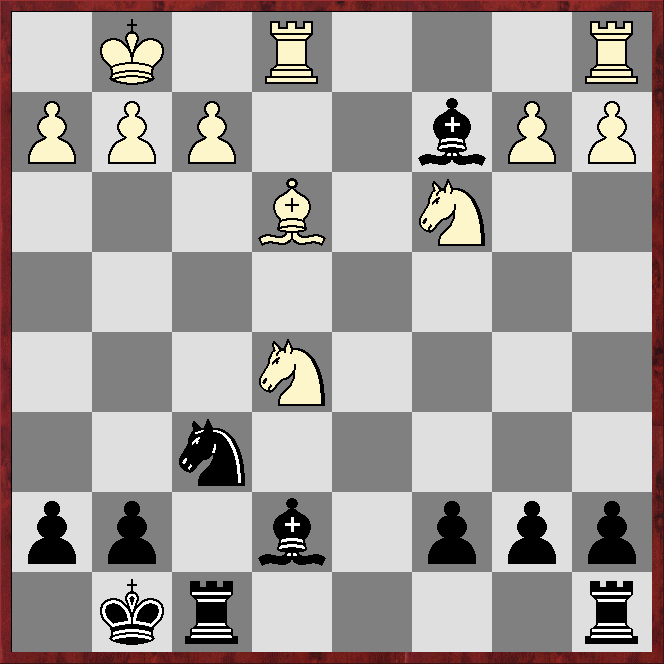
Black has just captured on g8 in Spanton (151) - K Griffiths (126), North London Autumn Major 1989. Who stands better, and by how much,
*****
*****
*****
*****
*****
*****
*****
*****
*****
*****
The pawn-structure is typical of one arising from the Exchange Variation of the Spanish. Black's four pawns on the queenside include doubled c pawns. Because of the way the white queenside pawns are set up, Black cannot make a passed pawn there by normal means. On the kingside, Black's formation is weaker than usual in that he has three isolated pawns, two of them doubled. However, White can only win if the white king can penetrate the black position, and it is not so obvious how this can be done. The analysis engine Komodo11.01 gives White a slight edge; Stockfish12 is more confident of White's chances (+1.25).
30.Kd2 c4?!
There is no need to put another pawn on a light square until obliged to do so. Generally speaking, the player with the bishop wants to keep the pawns flexible. Having said that, 30...h5!?, getting ready for mass exchanges on g4, is liked by the engines. It will be necessary at some point to develop the king, but where to? Stockfish12 suggests 30...Kg7 while Komodo11.01 narrowly prefers 30...Kf8. It is difficult for White to break through in the centre, so the former seems preferable.
31.Nc2 c5
This has the dual purpose of keeping the knight out of b4 and d4, and of preventing the white king entering the queenside via d4.
32.Ne3 Kg7 33.Ke2 f6!?
It is tempting to get rid of a doubled pawn, and this is Komodo11.01's choice, but now the knight gets access to e5, and so can invade Black's position.
34.exf6+!?
The engines prefer 33.Kf3, one point being that capturing on f6 can wait as 33...fxe5? 34.fxe5 is bad for Black.
34...Kxf6 35.Kf3 h5
Stockfish12 at first reckons White is winning while Komodo11.01 rates the position as equal. Given a little more time, they come to agree White has a slight edge.
36.Kg3 Kg6 37.Kh4 Bf7
KG offered a draw.
38.h3 Kf6?
Black had to play 38...Be6, when 39.g4? hxg4 40.hxg4 fxg4 41.Nxg4 Kf5 leaves White fighting for a draw thanks to the white king being offside. The engines give 39.g3, the point being that 39...Kh6? is a mistake because 40.g4 hxg4 41.hxg4 fxg4 42.f5! wins for White. Black should therefore drop the bishop back, eg 39...Bd7, when 40.Nd5 is only slightly better for White, according to the engines, but Black faces an unpleasant defensive task.
If White meets 38...Be6 with 39.Nf1, intending to route the knight via d2 and f3 to e5 or g5, Black has 39...Bd5, when 40.Kg3 h4+!? 41.Kxh4 Bxg2 is dead-equal, according to the engines. However White can play 40.Ne3, returning to the g3 plan.
39.g4 fxg4 40.hxg4 hxg4 41.Kxg4 Bg8
Black has no counterplay, and has to worry about his vulnerable queenside as well as the passed pawn.
42.Kf3 Ke6 43.Ke4 Bf7 44.f5+ Kd6
Worse is 44...Kf6 45.Nd5+ and 46.Nc7.
45.Kf4 Bg8 46.Ng4 Kc6 47.Ke5 b4 48.Nf6 Bf7 49.Ne4 b3 50.f6 bg6 51.Ng5 Bh5 52.f7 Bxf7 53.Nxc7 (1-0, 74 moves)

Monday, 29 June 2020

Back To The Drawing-Board?

I HAVE been trying an unusual line against the Petrov: 1.e4 e5 2.Nf3 Nf6 3.Nxe5 d6 4.Nf3 Nxe4 5.c4!?
Position after 5.c4!?
It is recommended by Larry Kaufman in The Chess Advantage In Black And White (McKay, 2004).
He writes: "It is closely related to the slightly more fashionable 5.Nc3, as both moves can lead to doubled c pawns, but it has the advantage that White is only obliged to permit the doubling when Black plays ...Nc6 first, after which the knight is poorly placed in relation to a white pawn on c3, or when he plays ...c6, which permits White to annoy the d6 pawn."
My first two outings with the line were correspondence games in which I beat a 1332 and drew with a 2458. More recently I have played it in four over-the-board games, winning all four.
Admittedly those four games were against opponents I would have been expected to beat, but nevertheless I had no reason to be dissatisfied with the line.
Then came the following correspondence game:
Spanton (2260 - England) - Nick Flew (2000 - Wales 2)
Carlos Flores Gutiérrez Team Tournament (ICCF) 2020
1.e4 e5 2.Nf3 Nf6 3.Nxe5 d6 4.Nf3 Nxe4 5.c4!? Nc6
All my previous games, except for the draw against Noire, featured 5...Be7. That is the most popular move in ChessBase's 2020 Mega database, but it allows 6.d4, which is not the end of the world for Black but does give White good central control.
6.Nc3!? Nxc3 7.dxc3
This is the main line but also possible is 7.bxc3!? followed by a quick d4 with the idea of central control.
7...g6!?
Kaufman only covers 7...Be7 and 7...Bg4. The text is slower but, based on this game at least, seems perfectly playable, in which case it is hard to see what the line offers White.
Spanton (2158) - Eric Noire (2458), IECG World Championship Semi-Final 2007, went 7...Bf5!? 8.Nd4 Nxd4 9.Qxd4!? Qe7+ 10.Be3 Qe5 11.0-0-0 Be7 12.Bd3 Qxd4 13.Bxd4 Bxd3 14.Rxd3 f6 (½–½, 30 moves).
8.Bg5 Be7 9.Bh6!?
This was played in all seven Mega20 games to reach this point.
9...Bf8 10.Be3
Gawain Jones (2640) - Shakhriyar Mamedyarov (2804), Tata Steel A (Wijk aan Zee) 2018, saw 10.Bg5 Be7 11.Bh6 Bf8 12.Bg5 ½–½.
10...Bg7 11.c5!?
This may be new. 11.Qd2 is the known continuation.
11...dxc5 12.Qxd8+ Nxd8 13.Bxc5
White's position looks promising at first glance as Black has trouble castling kingside, but this proves a minor inconvenience.
13...a6 14.Bc4 Be6 15.Bb3 Bxb3 16.axb3 Ne6 17.Be3 0-0-0 18.0-0
Opposite-side castling with a half-open a file would lead to a sharp game with queens on, but here the game fairly quickly peters out.
18...Rd5 19.b4 Rb5 20.Nd2 Bf6 21.g3 Rd5
We played a further 15 moves, but the equilibrium never looked like being disturbed, which is rather disheartening from a white perspective.
Admittedly this was a correspondence game, and it would not be so easy (for either player) to play as accurately OTB, but it seems I will need to find a radical wrinkle if I wish to continue playing 5.c4!? with serious prospects of a gaining an advantage against a prepared opponent.

Friday, 10 April 2020

New Spice (part six)

AFTER 1.d4 d5, the most-popular move at club level is probably 2.Nf3, rather than immediately playing the Queen's Gambit with 2.c4.
White might be planning to play c4 later, but often 2.Nf3 is a prelude to the Colle or, more commonly these days, the London System.
Black usually replies with something standard such as 2...Nf6 or 2...e6.
But Black can take advantage of the lack of immediate pressure on his centre by putting immediate pressure on White's centre with 2...c5.
This has been played by many grandmasters, and scores a very healthy 50% in ChessBase's 2020 Mega database - only 2...c6, with 48%, comes close to matching this.
Despite its success, the move is not something White sees often - it is only sixth-most popular in Mega20.
The first question to consider is whether White can get an advantage by accepting what is effectively a Reversed Queen's Gambit.
A) 3.dxc5!?
Vladimir Kramnik is among those who have played this move, and many of the old masters, including Pillsbury, Lasker, Alekhine, Capablanca and Flohr, tried it from time-to-time, so it should be taken seriously. Black's most-popular response is 3...e6, after which White can try to hold on to the extra pawn.
Yury Piskov (2550) - Magaram Mogomedov (2450)
Capelle-la-Grande 1994
4.b4!?
It is well-known that for Black to try to play this way in the Queen's Gambit proper, ie 1.d4 d5 2.c4 dxc4 3.e3 b5?!, is doubtful, but the question is whether the addition of 2.Nf3 makes a significant difference.
4...a5 5.c3 axb4 6.cxb4 b6
Black continues to pressurise White's queenside. It is not even a sacrifice as 6.cxb6?! Bxb4+ 7.Bd2 Qxb6 was good for Black in Ignatz von Popiel - Georg Marco, Trebitsch Memorial (Vienna) 1915, although the game was eventually drawn.
7.e4!?
This move, which is the choice of the analysis engines Stockfish10 and Komodo10, seems to have been grandmaster Piskov's new idea in keeping, at least for a while, the extra pawn.
The main alternative is probably 7.Bb2, the point being that Black cannot follow-up 7...bxc5 8.bxc5 with 8...Bxc5?? as that loses to 9.Bxg7. Instead Svetlana Petrenko (2207) - Khanim Balajayeva (2130), EU women's championship (Chakvi, Georgia), 2015, continued 8...Nf6 9.e3 (9.Qc2 Qa5+) Bxc5 10.Bd3 0-0 11.0-0 Nbd7, when Black had a slight edge thanks to her extra central pawn and pressure against a2.
7...bxc5 8.Bb2
How should Black proceed?
*****
*****
*****
*****
8...cxb4!?
This looks greedy, and Piskov must presumably have had this position on the board in his preparation, but it works out well.
9.Bb5+ Bd7 10.Bxd7+ Qxd7
White now played a move, after which the game was agreed drawn, but what was the move?
Mega20 has 11.Be5??, but that does not just look weird, it is an outright blunder as 11..dxe4 is winning for Black, eg 12.Nfd2 (12.Qxd7+?? loses a piece to 12...Nxd7) Nc6 13.Bb2 f5, when Black is two pawns up.
11.Ne5 makes more sense, although the engines reckon Black has an edge after 11...Qb5 or 11...Qb7.
At any rate, White's 4.b4!? was not a great success.
**********
A less-popular, but less-weakening, way to try to hold on to the pawn is 4.Be3.
Admittedly this blocks the e2 pawn, but White can develop his light-square bishop via g2, from where it may exert pressure on Black's centre in conjunction with the pawn-thrust c4.
Most popular now is 4...Na6, but the engines like a move played by Spanish international master Juan Mellado Trivino: 4...Nf6!?
The idea is to calmly get on with development, and fight for the central squares.
Igors Rausis (2520) - Mellado Trivino (2465)
Mondariz (Spain) 1998
5.c3!?
Threatening to tighten his hold on the pawn with b4.
A serious alternative is 5.c4, which can be met by 5...Na6 (other moves are clearly possible), whereupon 6.Nc3 Bxc5 7.Bxc5 Nxc5 led to draws in Predrag Nikolić (2605) - Yasser Seirawan (2610), World Cup (Barcelona) 1989, and Chao B Li (2703) - Jinshi Bai (2568), Chinese Team Championship 2018.
5...a5
The engines prefer 5...Be7 or 5...Qc7, not worrying about b4. For example, after 5...Be7 6.b4, they give 6...0-0 7.Nbd2 Qc7 8.g3, when both Stockfish10's 8...e5 and Komodo10's 8...Ng4 look promising.
6.c4!
The engines like this sudden switch to a more-aggressive use of the c pawn.
6...Na6 7.Nc3 Nxc5 8.cxd5 Nxd5 9.Nxd5 Qxd5 10.cxd5 exd5
White has given Black an isolated queen's pawn, and must have a slight edge, but the weakness seems well-defendable.
11.0-0-0?!
Trying to generate quick pressure on the isolani, but White's king proves vulnerable, despite the absence of queens.
11...Bf5! 12.Bxc5
'Normal' development starting with 12.g3? runs into 12...Nb3+! 13.axb3 Rc8+ 14.Bc5 Bxc5 15.Kd2 Bxf2, with a winning advantage for Black.
12...Bxc5 13.e3 Rc8 14.Bd3
Not 14.Kd2? Bb4+ 15.Ke2 Rc2+ 16.Nd2 Rxb2 etc.
14...Bxe3+ 15.Kb1 Rc1+ 16.Rxc1 Bxd3 17.Ka1 Bxc1 18.Rxc1 Ke7 19.Rc7+ Kd6 20.Rxb7
White has restored material equality, but after …
20...Rc8
… Black had activated his rook, to go along with his more-active king and minor piece, and he went on to win in 51 moves.
**********
B) 3.c3
Grabbing the pawn on c5 and trying to hold on to it tends to not work out very well.
At club level, especially if White wants to play the London System, 3.c3 is common. Black usually replies 3...e6 or 3...Nc6. The former is slightly more popular, and has been played by Magnus Carlsen, so it seems a good place to start.
Wesley So (2815) - Magnus Carlsen (2832)
Chess.com Speed blitz (2017)
4.Bf4
Entering the London is overwhelmingly the first choice, and is especially likely at club level.
4...Bd6!?
Black has a wide choice at move four, but I have chosen to concentrate on the text as it was Carlsen's choice, and has the added advantage of being less well-known than the more-popular 4...Nc6 and 4...Nf6.
5.Bg3
White helps Black's development if he plays 5.Bxd6 Qxd6, and anyway London System players are usually reluctant to give up their dark-square bishop without very good cause.
However, 5.e3 is a known idea in these sorts of positions, as 5...Bxf4 6.exf4 gives White good central control. Nimzowitsch, who had a strong positional feel, met 5.e3 with 5...Nc6, when he had this position in 1920. That game ended in a draw, but 5...Nc6 is Stockfish10's choice, and it puts the onus back on White to decide what to do about the face-off between the dark-square bishops. Delaying a decision further with 6.Nbd2!? is problematic as White ends up with doubled pawns and an isolani after 6...Bxf4 7.exf4 cxd4.
5...Nf6 6.e3 0-0 7.Nbd2
How should Black proceed?
*****
*****
*****
*****
*****
7...Qc7!?
An interesting moment. Both players have been making normal moves, and it would not have been a surprise to see 7...Nc6. But then the engines like the reply 8.Bb5!?, and so does Carlsen - he has played it six times as White. Carlsen must rate the move highly because he stuck with it despite losing the first two of those six games.
After 8.Bb5!?, the main line runs 8...Ne7!? 9.Bd3!?, which the engines reckon is nothing special, but White scores very well in Mega20. Black's second-most popular move is the provocative 8...a6!?, whereupon 9.Bxc6 bxc6 10.Qa4 is a little tricky to meet.
8.Bd3 Nbd7
Note that 8...Nc6?!, which at first glance might seem more palatable now White has spent a tempo on Bd3, runs into 9.dxc5.
9.e4?!
Opening lines in the centre when you have not castled, but your opponent has, is something most club players would shy away from. So knows not to do that, as a general rule, but must have thought he had found an exception.
Later in the same tournament, on the same day, the players reached the same position, and this time So played the normal 9.0-0. The game continued 9...b6 10.e4 Bxg3 11.hxg3 dxe4 12.Nxe4 Bb7 with a fairly equal position, which was eventually drawn.
It therefore seems the point of playing e4 early may be to deny Black the equalising option ...Bb7. But Black has other ways to at least equalise.
9...cxd4!
The immediate ...dxe4 is also reasonable as, after 10.Nxe4, Black has 10...Nxe4 11.Bxe4 Nf6 with what looks like equality.
10.cxd4 dxe4 11.Nxe4?!
It seems that gaining a tempo by flicking in the zwischenzug 11.Rc1 is better, but the position is still good for Black.
11...Nxe4 12.Bxe4 Nf6 13.Bd3 Qa5 14.Ke2
Not 14.Qd2?? Bb4, and if 14.Nd2, then Black has several pleasant options including 14...Rd8 15.0-0 Bxg3.
14...Rd8 15.Bh4!?
The engines suggest immediately getting queens off with 15.Qd2 Qxd2+ 16.Kxd2, but prefer Black after 16...b6.
15...Bd7 16.Bxf6 gxf6 17.Qd2 Qxd2+ 18.Nxd2 f5
White has succeeded in ensuring he is not the only one with a structural weakness, and he has got queens off, but Black's bishop-pair is strong (0-1, 38 moves).
**********
C) 3.e3
After 1.d4 d5 2.Nf3 c5, the move 3.e3 is very popular at all levels.
It is particularly suitable for Colle players, but is the end of the line for London System players as white's dark-square bishop gets shut in.
Black's most-popular replies are 3...Nc6 and 3...Nf6. There are more games with the former in Mega20, but the latter scores a better percentage, was Anand's choice when he reached this position, and is frequently played by former Russian champion Sergey Volkov.
It also fair to say that while one can be fairly certain the king's knight belongs on f6, it is possible the queen's knight might want to go to d7 or a6, rather than to c6, if, for example, White plays dxc5.
Sergey Kayumov (2450) - Djurabek Khamrakulov (2524)
Uzbekistan Championship (Tashkent) 2009
4.b3
White is setting up a Colle-Zukertort, a sub-system of the Colle that has largely supplanted the regular Colle, which would normally see c3 being played here.
After 4.c3, the well-established main line runs 4...e6 5.Bd3 Nc6 6.Nbd2 Bd6!? (a more-aggressive posting of this bishop than is normally advisable if White had played Bg5) 7.0-0 0-0 8.dxc5!? (White plans e4, but he does not want to be saddled with an isolated d pawn after ...cxd4, so first he captures on c5) Bxc5 9.e4.
Black's moves have been easy to find so far, but here it is useful to know that the main move is 9...Qc7, fighting for the e5 square and supporting the possible manoeuvre ...Nh5-f4, after which White usually plays 10.Qe2, reinstating the threat to play e5.
Now the main move is 10...h6, but I like the engines' choice of 10...b6!?, which is also popular with grandmasters. White now usually follows through with his threat by playing 11.e5, when 11...Ng4! allows White to play a Greek Gift sac, but it works out to Black's advantage: 12.Bxh7+ Kxh7 13.Ng5+ Kg8 14.Qxg4 Qxe5 - material is level and the black king's position has been slightly weakened, but Black dominates the centre and has the bishop-pair.
Accordingly, in several games White has resisted sacrificing on h7 and instead played 12.b4 Be7 13.Re1 f6 14.exf6 Bxf6, when Black's central pawn-duo is probably a strength rather than a weakness - Black has won all four games to reach this position in Mega20.
Position after 4.b3 - how should Black proceed?
*****
*****
*****
*****
*****
4...cxd4!
More popular is 4...Nc6, but the text is recommended by Larry Kaufman in The Chess Advantage In Black And White, and scores a better percentage in Mega20.
The point is that 4.b3 freed the b2 square for White's dark-square bishop. But if White replies to 4...cxd4! with 4.exd4, which he nearly always does, the bishop will be blocked by its own pawn fixed on d4.
If White avoids this by playing 4.Nxd4?!, then 4...e5 5.Nf3 Nc6 gives Black a classical centre that is not easily undermined.
5.exd4 Nc6 6.Bb2
Nearly always played - the point is that although the bishop is blocked by the fixed d pawn, it can support a knight going  to e5.
6...Bg4 7.Be2 e6
Kaufman recommended 7...Bxf3!?, the idea being to "thwart White's strategy of [playing Nbd2 and] bringing a knight to e5." However, White can get around this by playing Nbd2 at move six, after which a transposition to this game is likely.
8.0-0 Bd6 9.Nbd2
The game reached this position by a different move-order (it began 1.Nf3 c5), but for clarity's sake I have used the most-frequent sequence.
9...0-0 10.Ne5
White has succeeded in planting a knight on e5, but it is far from clear this does him any good.
10...Bxe2 11.Qxe2 Qb6!?
More popular is 11...Rc8, but it may be the rook is better left for the moment on a8, where it supports pressure down the a file. Indeed, the engines like 11...a5 12.a4 Qb6, marginally favouring Black.
12.Ndf3 Rad8
The engines reckon Black is better after 12...a5.
13.Rad1 Nd7 14.Rd3 h6 15.Nxd7!?
This may seem strange at first glance, but the move is quite liked by the engines, although they prefer 15.Nxc6.
White could have tried 15.a3, preventing a knight fork on b4 and so freeing the white queen's rook. The engines then give 15...Ndxe5 16.Nxe5 Qa6, with ...Rc8 and play against White's slightly rickety queenside pawns to come.
15...Rxd7 16.c4 Bb8 17.c5!?
The engines agree this is a good time for White to push past (with tempo).
17...Qc7 18.a3 b6 19.b4 bxc5 20.bxc5
The engines prefer the double-edged 20.dxc5, continuing 20...e5 21.Nh4 d4 22.Qg4 g6 23.Re1 with an edge for White.
20...Re8 21.g3 f6 22.Rad1 Na5 23.Nh4 Nc4 24.Qh5 Rdd8 25.Bc1 Qf7
This offer to exchange queens relieves the pressure on Black's position, and the game was drawn after 46 moves.
**********
D) 3.c4
This is White's most-popular continuation. It is also the sharpest, which means it will not appeal to all 1.d4 players - certainly not at club level, at any rate.
Black's usual response is 3...e6, but after 4.cxd5 exd5 5.g3, the game is transposing to the heavily theoretical Schlechter-Rubinstein System against the Tarrasch.
I am recommending the engines' choice, 3...dxc4, which has a better percentage score in Mega20.
Péter Lukács (2465) - Zoltán Németh (2355)
Hungarian Championship 1989
4.e3
The main move, but 4.d5!?, not worrying about quickly getting the pawn back, is also popular. I then like the engines' choice, 4...Nf6, which has been played by Alexei Shirov and other strong GMs. The next few moves are well mapped out for both sides, viz: 5.Nc3 e6 6.e4 exd5 (Capablanca once, in a very unlike-Capablanca move, gave up a knight by 6...Nxe4?! 7.Nxe4 exd5, giving him three pawns and the centre for a piece, but he lost) 7.e5!? (this has been played by Kasparov and Karpov, but Capablanca, now on the white side, preferred 7.exd5).
After 7.e5!?, Black usually plays 7...Nfd7, but also popular, and much preferred by the engines, is 7...Ne4!? Then the main line goes 8.Qxd5 Nxc3 9.Qxd8+ Kxd8 10.bxc3, and now I am recommending a speciality of the Spanish grandmaster Jordi Magem Badals: 10...Nc6 11.Bxc4 Be6 12.Bxe6 fxe6 13.Ng5 Ke7. Magem Badals has had this position four times (in Mega20), beating players rated 2653 and 2545, and drawing with players rated 2490 and 2468.
Alexandr Fier (2653) - Magem Badals (2564), Barcelona Casino 2009, continued: 14.f4 h6 15.Ne4 Kd7 16.Be3 b6 17.Ke2 Be7 18.Rhf1 Rhd8 19.Rf3 Ke8 20.Raf1 Rd5, which the engines reckon is level, although Magem Badals went on to win.
4...cxd4 5.Bxc4!
The most-precise move. Often seen is 5.exd4, but then 5...Be6!? proves annoying. The main line runs 6.Nc3 Nf6 7.Ne5 Nc6 8.Nxc6 bxc6 9.Qa4 Qd7 10.Bxc4 Bxc4 11.Qxc4 e6 12.0-0, when the engines reckon Black is at least equal.
How should Black proceed?
*****
*****
*****
*****
5...Qc7!
Gaining a tempo on the bishop. Try to avoid what happened in a 1997 Finnish game between two unrateds: 5...dxe3?? 6.Bxf7+ 1-0.
6.Qb3 e6 7.exd4 Nc6!?
More popular is 7...Nf6, but the text, which introduces the threat of ...Na5, may be better, although often the two lines transpose.
8.Nc3 Nf6 9.0-0 Bd7
Now ...Na5 is a serious threat as White cannot avoid an exchange of minor pieces by interpolating a check to the black king.
10.Bd3 Be7 11.Be3 0-0 12.Rac1 Rfd8
A later game, Mikhail M Ivanov (2457) - Mihajlo Stojanovic (2522), Verona 2006, saw 12...Rad8?!, which may be a case of the wrong rook, although Black did go on to win.
13.a3 Be8 14.Rfd1 Ng4
The more-conventional 14...Rac8 also seems fine.
15.Qc2 g6!?
Better may be 15...h6.
16.Qe2 Nxe3 17.fxe3
Black, with his bishop-pair, is slightly better, according to Stockfish10, but Komodo10 prefers White. The game was decided when a surprising tactical error gave Black a pawn to go with the bishops.
**********
CONCLUSIONS
When White plays the non-forcing 2.Nf3, after 1.d4 d5, Black can immediately fight for the initiative with 2...c5. This will put many whites on the back foot, leading them to play passively.
If White knows some theory, a sharp tussle can ensue, with play that should suit the tactically orientated player.
Thursday, 9 April 2020

New Spice (part five)

TIME for some new spice for Black.
After 1.e4 e5 2.Nf3, Black has two pawn-thrusts that aim to seize the initiative, even at the cost of a pawn.
The better-known is 3...f5!? - the Latvian Gambit, around which a lot of theory has grown up.
The other is 3...d5!? - the Elephant Gambit, which is less-often seen but, for what it is worth, is much more to the taste of the analysis engines Stockfish10 and Komodo10.
Both gambits have been tried by grandmasters, but only the Elephant has a GM for whom it is a major part of his repertoire (defined as a "frequent player" in ChessBase's Mega database).
Pavel Skatchkov has 28 Elephant Gambits in the 2020 edition of Mega, scoring +13=7-8.
That is impressive enough, but arguably he has done even better than those numbers suggest as his first four Elephant Gambits in the database were losses when he was still rated below 2300.
Here he is in action against Swiss grandmaster Florian Jenni.
Jenni (2519) - Skatchkov (2506)
Champions Challenge (online blitz) 2007
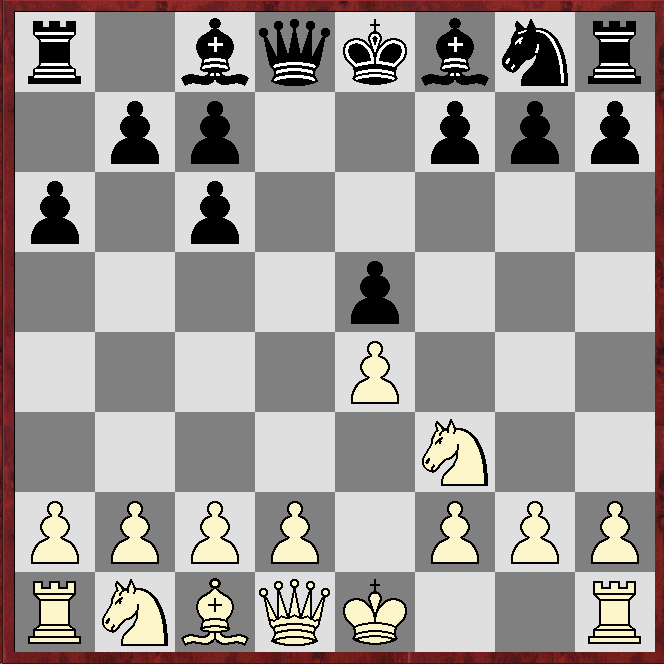
1.e4 e5 2.Nf3 d5!?
Unlike the Latvian, where 2...f5!? weakens the black kingside and is a strictly non-developing move, the Elephant opens a diagonal for Black's light-square bishop and leaves the black f pawn on its starting square.
3.Nxe5!?
This has its high-level adherents, but is nowhere near as popular as 3.exd5.
3...Bd6
Howard Staunton preferred 3...Qe7, but twice lost with that move against John Cochrane.
4.d4 dxe4 5.Nc3!?
More popular is 5.Nc4, but then 5...Nf6 6.Nxd6+ Qxd6 7.Be2 0-0 8.0-0 Nc6 9.Be3 Nd5 10.Nd2?! (10.c4 seems better) f5 (the engines reckon Black is better after 10...Nxe3 11.fxe3 Qh6) 11.c4? (11.Bc4 is better) Nxe3 12.fxe3 Qxe3 gave Black a strong game in Nikolai Kobanov (2472) - Skatchkov (2486), World Blitz Championship (Khanty-Mansiysk, Russia) 2013 (0-1, 32 moves).
5...Bxe5 6.dxe5 Qad1+ 7.Kxd1 Bf5
Three years earlier, Skatchkov had played 7...Nc6, beating a much-lower rated opponent in a game played with a more-normal time-control.
8.Nd5 Na6 9.Bxa6!?
This looks so natural, especially at blitz, but the engines prefer 9.Bb5+ or 9.Bg5.
9...0-0-0 10.Ke2
The engines reckon White has a slight edge after 10.Bc4!? c6 11.Ke2 cxd5 12.Bb3.
10...Rxd5 11.Bc4 Rc5 12.Bb3 Ne7 13.Be3 Rxe5 14.Bd4
The engines marginally prefer this to winning the pawn back with 14.Bxf7, after which they give 14...Bg4+ 15.Ke1, when it is difficult for White to get coordinated, but the engines reckon White's bishop-pair gives equality.
14...Bg4+ 15.Ke3
By inserting Bd4, White has made it possible to keep his rooks connected, but nevertheless the engines prefer 15.Kf1!?, with equality thanks to the menacing white bishops.
15...Nd5+
This is the problem with advancing the king - Black gets a tempo to block the action of White's light-square bishop.
16.Kd2 Rg5 17.h3
The engines prefer 17.Rae1, but after 17...Be6 18.Rhg1 Rd8 the e pawn cannot be taken because of threats down the d file, so White is obliged to play 19.Kc1. Then 19...Nf4 20.Bxe6+ Nxe6 21.Bc3 Nc5 sees Black keep his extra pawn, although he has trouble with coordination.
17...Be6
How should White proceed?
*****
*****
*****
*****
*****
18.Bxd5!?
Giving up the bishop-pair is rarely an easy decision, but Jenni is seeking salvation in opposite-coloured bishops. However, after …
18...Rxd5 19.Ke3 f6
… he did not restore material equality with 20.Kxe4!? because then the king's precarious position gives Black strong tactical chances, eg 20...Re8 21.c3 Rg5.
20.Bc3 Rhd8 21.g4
Good for Black is 21.Kxe4 Bf5+ followed by ...Bxc2.
21...Bf7 22.h4 h5 23.Rag1 hxg4 24.Rxg4 Rf5 25.Rh3 g6 26.Rxe4 Bd5
26...Bxa2!? looks possible as 27.b3? simply wastes a tempo: Black replies 27...Bb1 and picks up the c2 pawn. Also no good for White is 27.Ra4 Re8+ 28.Kd3 Bd5 29.Rxa7 Kb8 and 30...Rxf2.
27.Re7 Bxa2
Clearly Black has lost a tempo on 26...Bxa2. The engines reckon 27...Rf8 gives Black a tiny edge.
28.Rg3 g5 29.hxg5 fxg5 30.Re5?!
30.Be5 is a complete equaliser as 30...Rd7 is met by 31.Re8+
30...Rd5 31.Rxd5 Bxd5 32.b3 b6 33.f3 Bd5 34.Kd4 Kb7 35.Rxg5 c5+
Having battled back to an almost-certain draw, Jenni now produced a blitz howler.
36.Ke3?? Rxg5 0-1
Note that one of the peculiarities of this game is that, although the Elephant Gambit is a gambit by Black, it was Black who was a pawn up for much of the time.
**********
After 1.e4 e5 2.Nf3 d5!?, White usually plays 3.exd5.
Black's choice mainly lies between the traditional 3...e4 (by far the most-popular move), the more-modern 3...Bd6 and the somewhat strange ...Qxd5.
Grandmaster Skatchkov only plays 3...e4, as far as I can discover, which is probably as good a recommendation as any other.
White's best reply is generally acknowledge to be 4.Qe2, but that does not mean everyone plays it.
Second in popularity is 4.Nd4, after which the main line runs 4...Qxd5 5.Nb3 Nf6 6.Nc3 Qe5 7.Be2, with advantage to Black, according to Stockfish10, but level according to Komodo10.
There are 48 games in Mega20 where 4.Bb5+?? was played, including by one player rated over 2300, but White is losing a piece after 4...c6 5.dxc6 bxc6.
Much more reasonable is 4.Ne5, when the main line runs 4...Qxd5 5.d4 exd4 6.Nxd3 Nf6 7.Nc3, with an equal position, according to the engines.
But there is no doubt 4.Qe2 is normal, which Black usually meets with 4...Nf6, after which there comes a major parting of the ways.
Pavel Ponkratov (2469) - Skatchkov (2506)
Champions Challenge (online blitz) 2007
5.Nc3
This was Kasparov's choice and is White's most-popular move, but 5.d3 has been recommended in two books that many players of the white pieces will have, so I will look at that in a separate game.
5...Be7 6.Nxe4 Nxd5!?
More popular is 6...0-0, but Skatchkov played the text in all six of his games that reached this point in Mega20. The engines agree with him - just.
7.d3
The main move, but plenty of other moves have been tried. It is probably fair to say most white players, let alone most white club players, will be long out of book by now.
7...0-0 8.Qd1!?
This is obviously retrograde, but the idea is to get the queen off the sensitive e file, develop the light-square bishop and castle short, while keeping White's extra pawn.
Note that 8.g3?, trying to speed kingside castling, runs into 8...f5 9.Nc3 Bb4 with ...Re8(+) to come, and if 9.Ned2, then the immediate 9...Re8 is strong.
White could also think about castling long. 8.Bd2 Re8 9.0-0-0 f5 10.Nc3?? Nxc3 11.Bxc3 Bg5+ was a disaster for White in Boris Smirnov (2187) - Ivan Frolov (2309), Cheliabinsk (Russia) IM tournament 2016 (0-1, 20 moves), but the engines' suggested novelty 12.h4!? is very unclear.
Another preparatory move for long castling is 8.Be3, but 8...f5 is a tricky move to face, eg the engines continue 9.Ned2 Re8 10.0-0-0 Nc6 when, if anything, they prefer Black.
8...c5!?
8...Nc6?! was played in Sergei Movsesian (2721) - Maxime Vachier-Lagrave (2703), World Blitz Championship (Moscow) 2010, but White simply played Be2 and castled on the next move, after which it was difficult to see what compensation Black had for his pawn-minus (1-0, 65 moves).
More popular is 8...f5, but after 9.Ng3 Re8, then again Be2 followed by 0-0 seems good for White.
9.Be2 Nc6 10.0-0 Bf5
10...f5 was played in Petrov (-) - Skatchkov (2250), Moscow Open 1995. That game continued 11.Nc3 Nxc3 12.bxc3 Bf6 13.Bd2, when Black has good compensation for the pawn, according to the engines. Skatchkov played the very aggressive 13...g5, and after 14.Qc1?! (the engines reckon 14.d4 is better) would have had a good game if he had played the consistent 14...g4. Instead he tried 14...Qe8, and it was only after 15.Re1 that 15...g4 came. That was met with 16.d4 Kh8 (not 16...gxf3? 17.Bc4+ etc) 17.Bb5 with an excellent position for White (1-0, 28 moves).
11.Re1 Bg6!?
This may be a little slow. The engines want Black to get on with development with 11...Qc7 or 11...Re8, albeit slightly preferring White.
12.Bf1 Qd7 13.c3 h6 14.Qb3 Kh8?!
The engines prefer 14...Rad8, or even an immediate 14...f5!?
15.Bd2
The engines like levering open the centre with 15.d4!?
15...b6?
One of the ideas of ...Kh8 was, as is often the case, to play ...f5, and this should have come now, according to the engines, before White has time to strike in the centre.
16.Rad1 Rae8 17.Bc1
17.d4 is strong, according to the engines, eg 17...cxd4 18.Bb5.
17...Bd8 18.Ng3 Bc7?
Missing the danger on the d file. Much better is 18...Rxe1 to get White's queen's rook off the d file, and, if White keeps it there by playing 19.Nxe1, then 19...Na5 or 19...Bf6.
19.Rxe8 Rxe8 20.d4 cxd4
The engines prefer 20...Na5, albeit with a large advantage for White after 21.Qb5 Qxb5 22.Bxb5 Rd8 23.Ne5.
21.Nxd4 Rd8 22.Nb5 Bxg3 23.hxg3
Black is in trouble on the d file, and anyway has no compensation for his missing pawn (1-0, 67 moves).
**********
After 1.e4 e5 2.Nf3 d5 3.exd5 e4 4.Qe2 Nf6, the move 5.d3 is recommended by Larry Kaufman in The Chess Advantage In Black And White, and by Eric Schiller & John Watson in Survive & Beat Annoying Chess Openings.
Michail Kutumov (-) - Skatchkov (2370)
Krasnodar (Russia) 1997
5...Qxd5
How should White proceed?
*****
*****
*****
*****
*****
6.Nbd2
This is the most-popular move in Mega20, but Kaufman and Schiller/Watson give an exclamation mark to 6.Nfd2, which is only fourth-most popular, but was Paul Keres's choice in a 1943 game. Skatchkov has faced 6.Nfd2 four times in Mega20, with each game continuing 6...Nc6 7.Nc3 Qa5.
Two of them then saw 8.Ndxe4, after which Skatchkov's 8...Be6!? gives near equality, according to the engines, despite Black being a pawn down. Black need not fear 9.Nxf6 as he will castle long, whereupon the half-open g file works in his favour.
More challenging for Black seems to be 8.Nb3, when both of Skatchkov's games, which were played in 2004, continued 8...Qb4 9.Bd2 Be6 10.Nxe4, when the engines believe White has the upper hand. Skatchkov drew both games, but they were against opponents rated more than 180 elo lower (admittedly one of the games was only drawn because Skatchkov fell for a stalemate trick).
A possible improvement for Black, or at least an interesting practical try, is 8...Qa6!? (the engines' suggestion of 8...Qe5 is well-met by 9.dxe4), which seems to be a novelty. My idea is that after 9.dxe4, which the engines reckon is best, Black plays 9...Qxe2+ 10.Bxe2 Be6.
Then Stockfish10 quite likes 11.0-0 for White, which can be met by 11...0-0-0. Stockfish10 comes to prefer 10.Be3, which is also Komodo10's choice, which can also be met by 11...0-0-0, when White is more-or-less obliged to castle kingside (or play f3 and Kf2).
Either way, we have a game of opposite-side castling, giving practical chances for both sides. There is no doubt the engines prefer White, which is usually the case in the early stages of an Elephant Gambit, but it is the type of position Skatchkov, for one, thrives in - a feel for playing on both sides of the board is crucial.
In any event, if White knows about (or finds at the board) 6.Nfd2, and later plays 8.Nb3, then 8...Qa6!? may be Black's best practical try.
6...Nc6 7.Nxe4 Be6 8.Nxf6+ gxf6 9.Be3
Black's kingside has been smashed, but his king will find safety on the queenside, and the half-open g file will prove useful if White castles kingside.
9...0-0-0
This is a tricky position for White. He is a pawn up and has the better pawn-structure, but Black has a sizeable lead in development (he has castled and has a queen, rook, bishop and knight developed; White has not castled and, although he has three pieces developed, he will need to spend a tempo opening a diagonal for the king's bishop).
10.g3?!
Stockfish10 gives 10.a3!? Kb8 11.d4 Bc5 11.c4!? Qd6 13.0-0-0, when White has got his king to relative safety, but at the cost of contracting a backward d pawn. Black has good compensation for his pawn-minus, according to both engines.
Komodo10 gives 10.c3 Rg8 11.d4!? h5!? 12.Qd2, claiming a slight edge for White, although Stockfish10 reckons the position is equal.
10...Ne5 11.Bg2 Bb4+ 12.c3
Forced, as a king move loses to 12...Bg4.
12...Nxd3+ 13.Kf1 Bc5 14.Nd4 Qc4 15.Nxe6?!
The engines' 16.Kg1 seems to give equal chances.
15...fxe6 16.Bxc5 Qxc5 17.Be4
Attacking the knight and freeing g2 for the white king.
17...Qc4 18.b3?
Not 18.Kg2?? as 18...Nf4+ wins the white queen.
Perhaps best is 18.Re1!?, and if 18...Nxb2, then 19.Bxb7+! Kxb7 20.Rb1 with good chances to equalise as 20...Qc3? runs into 21.Rxb2+ Ka8 (forced) 22.Qe4+. However, the engines reckon 18...Rhe8 19.Bxd3 Rxd3 20.Kg2 e5 is slightly better for Black.
18...Qxc3 19.Kg2?
The engines give 19.Rb1, albeit claiming Black has a winning advantage.
19...Nf4+! 0-1
If 20.gxf4, then 20...Rhg8+ 21.Kf1 Qxa1+ is curtains.
**********
CONCLUSIONS
The Elephant Gambit is a rare bird that has considerable surprise value.
White usually goes a pawn up - he almost has to if hoping for an advantage in the opening - at the cost of lagging in development, and therefore ceding the initiative.
Computers sometimes seem to revel in this type of play for White, but most humans, especially at club level, are better off with the initiative.
Many of the old masters played the Elephant Gambit, including Staunton, Bird, Paulsen, Anderssen and Lasker.
Even today it is occasionally ventured by grandmasters, and is a mainstay in the repertoire of Russian GM Pavel Skatchkov.
It would add spice to almost anyone's play against 1.e4 e5 2.Nf3.

Sunday, 5 April 2020

New Spice

NONE of us has much idea when normal over-the-board chess activities will resume.
Some people are trying to make up for this by playing online more, but it is not the same thing.
A lot of players will, I am sure, be using their enforced absence from the board as an opportunity to spruce-up opening repertoires.
Now is a good time to remove some of the stodge and try to inject new spice into our favourite lines.
On the other hand, if we have managed to last this long without theory-laden sharp lines, why change now?
As a compromise, I am planning to put forward a number of sharp lines, often gambits, but lines which, while respectable, do not require memorising loads of theory.
For example, after 1.e4 e5 it is all-too-easy to suggest 2.f4. That would certainly add spice to most repertoires, but it requires a detailed theoretical knowledge.
Similarly, after 1.e4 e5 2.Nf3 Nc6 it is a simple matter to suggest continuing 3.d4 exd4 4.Bc4 - the Scotch Gambit.
But the Scotch Gambit has been deeply analysed for literally hundreds of years.
So instead, in part one of this series, I am starting with the Göring Gambit: 1.e4 e5 2.Nf3 Nc6 3.d4 exd4 4.c3!?
It is named after German master Carl Göring, although authors vary as to why, with some saying he introduced the line into master play, although the date of this varies.
In fact the gambit was played back in the 1840s by Howard Staunton, whose lead was followed in the 1850s by Alexander Meek and in the 1860s by Louis Paulsen and Albert Merian.
Other masters also experimented with it before the first known outings, largely unsuccessful, in the 1870s by Göring.
Be that as it may, the gambit's heyday came, long after those masters were dead, in the late 1950s and 1960s when it notched wins for the likes of Tal, Gufeld, Velimirović, Ribli, Ljubojević and, in Britain, Penrose and Levy.
The commonest response to the gambit is to accept with 4...dxc3, but Black's best results percentage-wise in ChessBase's 2020 Mega database come when it is declined with 4...d5.
I will also cover the two other main ways of declining the gambit, namely 4...d3 and 4...Nf6.
A) 4...dxc3
When George Botterill wrote Open Gambits (Batsford 1986), he felt obliged to admit he could not describe the Göring as "playable."
That verdict was effectively echoed by Larry Kaufman in The Chess Advantage In Black And White (McKay Chess Library, 2004), who recommended Black accepts the gambit as it "does not give White enough lead in development to fully offset the pawn sacrificed."
But then along came an even stronger author, Viktor Bologan, who in Bologan's Black Weapons In The Open Games (New In Chess, 2014) said he wanted to recommend acceptance but had found a sideline where he "wasn't able to find any advantage for Black."
After 4...dxc3, White can offer a second pawn with 5.Bc4!?, but I want to look at what I think can be called the main line, 5.Nxc3.
Position after 5.Nxc3
In some ways the position reminds me of the Morra Gambit in the Sicilian, except that in the diagram Black has a pawn on c7 instead of e7.
For White this is both good news (Black has less central influence) and bad news (Black is not so far behind in development, as he has opened a diagonal for his dark-square bishop).
From this it can be argued that the Morra is better than the Göring for White in the short term, but White's prospects in the long term are better in the Göring.
Jacob Yuchtman - Mikhail Tal
USSR Championship (Tbilisi) 1959
5...Bb4
Theoreticians are unanimous, as far as I can discover, in recommending this continuation for Black. Indeed Kaufman gives it in The Chess Advantage without comment.
The main alternative is 5...d6, after which 6.Bc4 is obvious and good, and the main line continues 6...Nf6 7.Qb3 Qd7! (7...Qe7 8.0-0 is embarrassing for Black in that the analysis engines Stockfish10 and Komodo10 reckon best now is 8...Qd7).
After 7...Qd7!, Whites overwhelmingly play 8.Ng5, but I am putting forward the calmer choice of the engines, namely 8.Qc2!?
This was played in a game in 2000 by German teenager Leonid Kritz - then a 'mere' 2424, but three years later a grandmaster.
The idea is that White does not need to rush matters. He has four development tempi - the knights, the queen and the light-square bishop - and has more space.
Black effectively only has two development tempi in that, while he has developed three pieces, it will take him an extra tempo to develop his light-square bishop as the c8-h3 diagonal is blocked by the black queen.
So 8.Qc2!? supports the e pawn and takes the string away from ...Na5, which would be an effective answer to 8.0-0.
A natural continuation after 8.Qc2!? is 8...Be7 9.0-0 (Kritz played 9.Bf4?! in his 2000 game and only drew) 0-0 10.Rd1!?, when the engines reckon Black's best is 10...Qe8!?, after which White's compensation is clear for all to see.
6.Bc4 d6 7.0-0
7.Ng5!? is little-played but liked by the engines at least as much as the text.
7...Bxc3
Black usually captures on c3 as soon as the knight is unpinned. Indeed Kaufman reckons Black's most precise move-order is 6...Bxc3+!? 7.bxc3 d6 so as to avoid White playing 7.Qb3, instead of 7.0-0, the idea being to meet ...Bxc3 with Qxc3.
8.bxc3 Nf6
The game reached this position by a different move-order: 1.e4 e5 2.d4 exd4 3.c3 dxc3 4.Nxc3 Nc6 5.Nf3 Bb4 6.Bc4 Nf6 7.0-0 Bxc3 8.bxc3 d6.
Botterill recommended 8...Bg4 9.Qb3 Bxf3 10.Bxf7+ Kf8 11.gxf3 Ne5 12.Bxg8 (Stockfish10 prefers 12.Bd5!?) Rxg8 13.f4 Nf3+ 14.Kg2 Nh4+ 15.Kh1 Qd7. This is a long line but, as Botterill points out, is largely forced. Known continuations are 16.f5 and 16.c4, both aimed at keeping the black queen out of h3. But the engines reckon White can ignore this threat by playing 16.f3!! The point is that 16...Qh3 is met by 17.Rf2, eg 17...b6 18.Qd5 Re8 19.Qh5 h6 20.c4 with a winning attack against the black king. For that reason, instead of 16...Qh3, the engines suggest 16...Qc6, but Black's pieces are uncoordinated, and White is winning (Stockfish10) or at least much better (Komodo10) after 17.Qe6 or 17.Bd2.
9.e5!
Alekhine played 9.Ba3 in a 1919 win over Isakov, but Penrose came unstuck with the same move against Smyslov in 1958. The text was given by Alekhine as an improvement.
9...dxe5
Kaufman recommended 9...Nxe5 10.Nxe5 dxe5, after which the engines reckon best play is 11.Qxd8+ (Kaufman only covers 11.Qb3) Kxd8 12.Bxf7 Kxe7 13.Bb3 Be6 14.c4, as seen in Yuchtman - Semyon Furman, also in the 1959 USSR Championship, but eight rounds later. The position is unclear (Stockfish10 likes Black, but Komodo10 thinks the position is equal). In the game, White's bishop-pair and Black's somewhat-exposed king helped lead to a quick draw, although both sides could easily have played on.
10.Ng5 0-0!?
Black is two pawns up, so Tal offers the exchange to get his king to safety.
11.Ba3 Qxd1 12.Raxd1 Bf5
Not 12...Rd8? 13.Bxf7+ Kh8 14.Bb3 Re8 (best) 15.Nf7+ Kg8 16.Nd6+ etc.
13.Bxf8 Rxf8 14.Rfe1 h6 15.Nf3 Bg4 16.Rb1
The engines give 16.Bb5!? e4 17.Bxc6 bxc6 18.h3 Bh5 19.g4 Bxg4 20.hxg4 exf3 21.Rd3 Nxg4 22.Rxf3 with advantage to White, even though Black has three pawns for the exchange.
16...e4 17.Nd4 Ne5 18.Bf1 c5 19.Nb5 c4?!
The engines reckon White is only slightly better after 19...Rd8.
20.f3 Bxf3!?
Tal must have planned this combination as 20...Be6?! 21.fxe4 leaves White much better.
21.gxf3 Nxf3+ 22.Kf2 Ng4+ 23.Kg3 Nxe1 24.Rxe1 f5 25.Bxc4+
White has emerged from the complications with a bishop for three pawns. The position is unclear, but the engines prefer White.
25...Kh7 26.Be2 Ne5 27.Kf4 Ng6+ 28.Ke3 f4+ 29.Kd4
29.Kxe4?! f3 30.Nxa7 (any bishop move loses the rook) fxe2 31.Rxe2 is at best equal for White.
29...Kh8?
Tal was presumably worried about a possible pin on his knight after later pushing the e pawn, but correct is a move such as 29...Nh4, with equal chances according to the engines. The text is a mistake because it gives the white rook a tempo to get out of the potential skewer on the e file.
30.Rg1 Nh4 31.Kxe4 Re8+ 32.Kd3
Now Black only has two pawns for the bishop, and only one is a passer (1-0, 40 moves).
(To be continued)

Friday, 3 April 2020

Filling Holes In A Repertoire (part two)

AFTER 1.b4, Black's commonest reply is 1...e5, which is usually met by 2.Bb2.
The main line, which has been recommended in, for example, Larry Kaufman's The Chess Advantage In Black And White, continues 2...Bxb4 3.Bxe5, when White has exchanged a flank pawn on b4 for a central pawn on e5.
This, other things being equal, should favour White, but Black argues the tempo that will be gained by hitting the white bishop on e5 is more important.
The argument seems to be valid, but there is no doubt this is a plan the vast majority of 1.b4 players will be ready to meet.
I am recommending a different plan, based on blunting the white dark-square bishop with 2...f6!?
This was popular with the old masters, including Steinitz, Pillsbury, Réti and Colle, and is still played by grandmasters today.
Another way of doing this is to start with 2...d6, but my recommendation has the advantage that it obliges White to spend a tempo dealing with the threat to his b pawn.
Or does it? Actually, no, because the replies 3.b5, 3.a3 and 3.e4!? are almost equally popular for White.
The good news is Black can meet all of them with 3...d5, in each case with similar ideas in mind.
A) 3.e4!?
This was seemingly Tartakower's invention, and it served him well.
The idea is that after 3...Bxb4, White plays 4.Bc4, highlighting Black's weaknesses on the kingside light squares. Games against Réti and Colle continued 4...Ne7 5.f4 d5 6.exd5, when Stockfish10 and Komodo10 slightly prefer Black, but the position is easier for White to play, and Tartakower won both games.
Instead I am suggesting 3...d5, aiming to deny the white light-square bishop the c4 square.
After 4.exd5 Qxd5 5.Nc3, Black can play 5...Qf7.
White now really does need to do something about the en prise b pawn.
Position after 5...Qf7
Antun Deris (2030) - Miroslav Zufic (2444)
Velika Gorica (Croatia) 2013
6.a3 Be6
Far from being weak on the kingside light squares, Black has them well-covered. Indeed it is White who has problems developing his light-square bishop to an active square.
7.Nf3 Nd7 8.Be2 0-0-0!?
Zufic is confident of outplaying his lower-rated opponent, who has not much choice but to castle on the opposite wing to Black, which will tend to increase the value of every move.
9.0-0 g5 10.d3?!
This move does not really accomplish anything. White should either have got on with it on the queenside or, perhaps more promisingly, tried to counter Black's kingside flank attack by opening the centre. The engines suggest 10.Qe1!?, and if, as in the game, 10...Ne7, then 11.d4, eg 11...g4 12.Nh4 Ng6 13.d5!? Nxh4 14.dxe6 Qxe6 15.Rd1, although White's bishop-pair and open lines probably do not make up for his pawn-minus.
10...Ne7 11.a4 Ng6 12.b5 g4 13.Nd2 h5
The key difference in the game, it seems to me, is that Black has more pieces threatening the white king than White has threatening the black king. Even so, the game finishes surprisingly quickly.
14.Nde4!?
The engines' 14.a5 may be better, but this is far from clear.
14...Nf4 15.Bc1 Rg8
The engines prefer 15...Qg7.
16.Bxf4!?
Exchanging an unmoved piece for an enemy piece that has reached your fourth rank is usually a good deal, but here the downside is that Black gets another pawn poised to break-up the white king's position.
16...exf4 17.f3 f5 18.Nf2 Bg7!?
A distraction from the kingside attack. Black's advantage remains large, but more consistent was 18...g3 or 18...Qg7.
19.Qd2 Bd4 20.Rb1 Be3 0-1
Material is level, for the moment, but White's position is hopeless, eg 21.Qe1 g3 etc.
********************************************************************
B) 3.b5
This is White's most-popular move, after 1.b4 e5 2.Bb2 f6, in ChessBase's 2020 Mega database. It is how Alexei Sokolsky played the position.
Natural and good is 3...d5, which is almost always met by 4.e3.
Normal now is 4...Be6, but I am recommending a lesser-known move that has nevertheless attracted the attention of strong players, including Vasja Pirc, Andrei Kovalev and Viktor Kupreichik, namely 4...c5!?
The first point is that 5.bxc6?! helps Black by removing the somewhat-cramping b5 pawn, and enables Black to start developing his queenside smoothly with 5...Nxc6.
More popular, and more sensible, is 5.c4, but Black can reply 5...d4, locking in the white dark-square bishop, at least for quite some time.
The most-popular move (just) is also the one that has tended to be favoured by stronger players: 5.d4, attacking the black centre in a more-forceful way.
Position after 5.d4
Karsten Volke (2480) - Viktor Kupreichik (2515)
Boleslavsky Memorial (Minsk, Belarus) 1994
5...exd4!?
Two rounds earlier in the same tournament, Volke - Andrei Kovalev (2530) saw 5...Nd7!? 6.Nc3?! cxd4 7.exd4 Bb4 8.dxe5 Nxe5 9.Qd4 Bxc3+!? 10.Qxc3 Bf5, with what the engines reckon is a roughly level position (but 0-1, 65 moves). However, White can probably improve on this at an early stage by opening the long dark-square diagonal for his b2 bishop with 6.dxe5 Nxe5 7.Nf3, which was played three years later by Jan-Joost Lindner in a win over the engine Goldbar in a tournament at The Hague.
6.exd4 c4!?
Kupreichik has found a different way to keep the long dark-square diagonal closed, while also restricting White's light-square bishop.
7.Nc3
Nc3 seems to be better in this position than at move six in the game against Kovalev.
7...Bb4 8.Qh5+ g6 9.Qf3 a6 10.g3?!
Trying to find a more-active square than e2 for the white king's bishop. The engines prefer 10.Ne2.
10...Bf5 11.Bh3 Be4
The engines reckon Black has an edge after 11...Bxc3+!? 12.Qxc3 Ne7.
12.Qe2 axb5?
Black cannot afford to ignore the pin on his light-square bishop.
13.Kf1?
White can safely win a piece after 13.f3, for example 13...f5 14.fxe4 dxe4 15.Qd2.
13...Bxc3 14.Bxc3 Ne7 15.f3 Bf5 16.Bxf5 gxf5
Black is a pawn up but has multiple weaknesses (½–½, 30 moves).
******************************************************
C) 3.a3
Once again I am recommending occupying the centre with 3...d5, after which whites overwhelmingly play 4.e3.
The main move for Black is 4...Be6, which was met by Capablanca in 1927 by 5.d4, but that has been largely superseded at the highest levels by 5.Nf3.
Position after 5.Nf3
Paweł Jaracz (2465) - Marta Michna (2365)
MK Café Cup (Koszalin, Poland) 1998
5...Bd6
It might seem strange for Black to develop both bishops before moving either knight, but the squares e6 and d6 are obvious places for the bishops, and it is possible the knights will be best developed via e7 and d7.
6.c6!?
The engines like this apparent-novelty, which leads to sharp play.
The main line can probably be thought of as being 6.d4 e4 7.Nfd2 Ne7 8.c4 c6 9.Nc3, reaching a position that favours Black, according to Stockfish10, but is equal according to Komodo10.
6...dxc4!?
After 6...c6,the game might proceed in a similar way to the previous note, but the text ensures original play.
7.Qc2 b5 8.d3!?
This is a major improvement, according to the engines, on a previous game that reached this position five years earlier, via a heavy transposition, and saw 8.a4?!, when 8...Nc6, threatening ...Nxb4, would have been strong for Black.
8....Bf5 9.e4 cxd3 10.Bxd3 Bd7 11.Nc3 a6
Black has an extra pawn, but it is backward on a half-open file and White has a large lead in development. The engines slightly prefer Black (very slightly in Komodo10's case).
12.0-0 Ne7
Premature is 12...c5?, eg 13.bxc5 Bxc5 14.Nd5 Bd6 15.a4 with a strong initiative.
13.a4!?
Aggressive, and it is Komodo10's choice, but Stockfish10 prefers 13.Rfd1.
13...Nbc6!
Not 13...Bxb4? 14.axb5, eg 14...a5 15.Bc4, when Black has long-term problems with the king.
14.axb5 Nxb4 15.Qe2 Nxd3 16.Qxd3 axb5 17.Nxb5 Rb8 18.Nxd6+ cxd6
A semi-forcing sequence has led to a position in which Black's extra pawn is still backward on a half-open file, but there are opposite coloured bishops and White maintain a lead in development.
Black now threatens the white bishop, and to play a skewer with …Bb5.
19.Qc2?
This answers both threats, but a much better way to do this is 19.Rfb1, which gets another piece into play.
19...Be6 20.Ra6?
The engines give 20.Ba3, but with a large advantage for Black after 20...0-0 21.Qd2 Rb6.
20...Qc8!
There is no adequate answer to this. The game finished:
21.Qxc8+ Bxc8 0-1

Wednesday, 26 February 2020

The Power Of Two Minor Pieces

IT is well known that a bishop and knight are, other things being equal, superior to a rook and pawn, even though the value of both pairs is 6pts by the traditional counting method (Q-9, R-5, B-3, N-3, P-1).
But consider the following position, reached after a sequence such as 1.e4 e5 2.Nf3 Nc6 3.Bc4 Nf6 4.Nc3 Bc5 5.Ng5 0-0
This position occurs 741 times in ChessBase's 2020 Mega database
In 141 games - almost a fifth of the total - White played either 6.Nxf7? or 6.Bxf7+?
Clearly the superiority of bishop and knight to rook and pawn, especially in the opening, is not so well-known as might be thought.
I believe the traditional counting method is largely to blame for this ignorance.
Database computer analysis by IM - now GM - Larry Kaufman shows the true average values are more like Q-9.75, R-5, B-3.25, N-3.25, P-1.
So giving up bishop (3.25) and knight (3.25) comes to 6.5pts.
But it is worse than this because the same computer analysis shows the bishop-pair to be worth 0.5pts, so in the example above White is giving up 7pts (B-3.25, N-3.25 and bishop-pair-0.5).
A rook is usually most powerful in endings where there are open files for it to operate on, whereas a knight is much more of a middlegame piece.
A search of my personal database reveals I have 30 times had an ending of bishop and knight versus rook, with various numbers of pawns on each side.
Some idea of the power of a rook in endgames can be gathered from the fact that in those 30 games, the player with bishop and knight won only 11 times, compared with 10 wins for the player with the rook (and nine draws).
Here is a recent correspondence example.
Black to make his 62nd move in Alexander Sherwood (2320) - Spanton (2260), 5th British Webserver team championship (division two) 2018
*****
*****
*****
*****
*****
Black has an extra pawn, and connected passers; White has a farside passed pawn.
62...Rb8
62...Rd8 is met by 63.Nc6, preventing ...d4.
63.Nb5 h4 64.Kf2 Kg5 65.Ke3 Re8+ 66.Kf2
White offered a draw.
66...Kf6 67.f4 g5 68.fxg5+ Kxg5 69.Nc7 Re5
69...Rd8?? 70.Ne6+.
70.Nb5 Kf4 71.a5 d4
There is no other way to make progress.
72.Nxd4 Rxa5 73.Bg6 Ra8 74.Bf7 Ke4
White to play and draw
*****
*****
*****
*****
*****
75.Bxc4!?
This shocks - assuming analysis engines can be shocked - Komodo10 and Stockfish10, whose evaluation changes from a small edge for Black to Black is winning.
But after …
75...Kxd4
… AS successfully claimed a draw, which indeed it is according to the Nalimov endgame tablebase (but I bet he would not have played 75.Bxc4!? over the board!).

Friday, 7 February 2020

The Power Of Two Rooks

TWO rooks are better than a queen, except in those cases where they aren't.
OK, that is not very helpful, except it does highlight the point that, as usual in chess, everything depends on the situation on the board.
Traditionally a rook is given the value of five pawns, and a queen the value of nine pawns, so two rooks, other things being equal, are a pawn better than a queen.
But database computer analysis by IM - now GM - Larry Kaufman found a queen is really worth, on average, 9.75 pawns.
In other words, a queen is more-or-less as valuable as two rooks, so everything really does depend on the game position.

Factors Favouring The Queen
1. Loose pawns. The queen is by far the most mobile chess piece. In effect it is a rook ranging horizontally and vertically, a bishop that can operate on either colour, and a king that attacks every adjacent square. Unprotected pawns are particularly vulnerable to a queen darting about.
2. Exposed enemy king. The player with two rooks is often in trouble if his king is not sheltered behind friendly pawns. This is because the queen can speed around the board even quicker than usual by checking the king to effectively gain a tempo. If all else fails, the player with the queen may be able to bail out to a draw via perpetual check.
3. Play on both sides of the board. The queen's mobility makes it easy to switch threats between wings.
4. Other pieces. The more other pieces there are on the board, the more this tends to favour the queen. This is partly because the queen is equally at home in a middlegame as in an ending, and partly because a queen normally needs a friendly piece to help create mating threats. In this context a knight can be particularly effective.

Factors Favouring The Rooks
1. Pawn chains. A pawn-chain only needs a rook protecting its base for the whole chain to be invulnerable to a queen.
2. Coordination. Rooks grow massively in strength if they are coordinated (another way of putting this is that rooks lose a lot of their combined strength if they are not in touch with each other).
3. Endings. Rooks operate best on open files, whereas in a middlegame a rook may not be worth much more, if anything, than a well-placed minor piece.
4. Bishops. A rook and bishop combine well because there is no redundancy - one operates on ranks and files, the other on diagonals. A queen can also be powerful in combination with a bishop - think of the two of them operating as a battery on a long diagonal - but there is some redundancy as they both run, at least partly, on diagonals.

Here is a game in which the rooks triumph, albeit with a major assist from the clock, despite many of the above factors favouring the queen. I will only lightly annotate the mistake-strewn early stages (before the diagram).
Spanton (164) - Adrian Waldock (142)
Sutton 1996
Sicilian Alapin
1.e4 c5 2.c3 d5 3.exd5 Qxd5 4.d4 Nf6 5.Nf3 Bg4 6.Nbd2!?
Normal is 6.Be2 but the text has been played by Shirov, Tiviakov, Adams and other strong grandmasters.
6...e6 7.Bc4 Qd7 8.Qb3 a6?
Better is 8...Nc6 or 8...cxd4.
9.Ne5 Qc7 10.a4?
10.Qa4+ Nc6 11.Bb5 Rc8 12.Bxc6+ bxc6 13.Nxg4 Nxg4 14.dxc5 Qe5+ 15.Qe4 Bxc5 was roughly level in Alessio Valsecchi (IM 2412) - Joan Fluvià Poyatos (IM 2491), Badalona (Spain) 2013, although White quickly blundered.
Stockfish10 and Komodo10 give 10.Nxg4 Nxg4 11.Ne4 (not 11.Bxe6?? fxe6 12.Qxe6+ Qe7) Be7 (if 11...cxd4, then 12.Bxe6! fxe6 13.Qxe6+ Be7 14.Qxg4 with a strong position) 12.Be2 h5 13.dxc5 with a large advantage for White.
10...Nc6?!
Black should probably preserve the light-square bishop, eg by 10...Bh5.
11.Nxg4 Nxg4 12.Qd1?!
This retreat leaves the bishop on c4 loose and vulnerable.
12...Nf6 13.Nf3?
Better is 13.dxc5 Bxc5 14.Nf3.
13...cxd4 14.0-0
Or 14.cxd4 Rd8 with advantage to Black.
14...Be7?
Black could safely remain a pawn up after 14...dxc3.
15.Qe2?
Correct is 15.Nxd4.
15...0-0?
Again ...dxc3 is safe and good.
16.cxd4 Rac8 17.Rd1 Nb4 18.b3 Nfd5 19.Bb2 Nf4 20.Qe4 Nfd5 21.Rac1 Qd8 22.h4 Nf6 23.Qe2 Nbd5
Black offered a draw.
24.Ne5 g6 25.Re1 Kg7 26.Rcd1 h5 27.Bc1!? Ng8
White is better after 27...Nc3 28.Qe3, but the engines' 27...b5!? seems to favour Black, eg 28.axb5 axb5 29.Bd3 Nc3 30.Qe3 Ng8.
28.Rd3 Bxh4!?
Having twice failed to take a safe pawn, Black now grabs a potentially hot one.
29.Rh3 Bg5 30.Bxg5 Qxg5 31.Rg3 Qh6
Black offered a draw.
32.Nxf7??
Missing how vulnerable the e1 rook is to a skewer.
32...Rxf7 33.Qxe6 Rxc4 34.bxc4 Re7 35.cxd5
Best, both objectively and from a practical view, but Black is completely winning.
35...Rxe6 36.dxe6 Qd2 37.Ree3 Qxd4??
This costs Black his knight. Any other reasonable move is winning.
38.e7 Nxe7 39.Rxe7+ Kf6
A pure two-rooks versus queen ending.
Black is a pawn up and there is play on both wings, but the rooks can easily be coordinated and the white king is relatively safe.
40.Rge3
Possible is 40.Rxb7 as 40...Qxa4? 41.Rb6+ is good for White. But 40...Qd1+ 41.Kh2 Qd6 looks dead-drawn, and I presume, bearing in mind the relative grades, I wanted to try to avoid simplification.
40...Qd1+ 41.Re1
Not 41.Kh2?? Qd6+.
41...Qxa4 42.Rxb7 a5
Black offered a draw.
43.Rb6+ Kg5 44.Re5+ Kh6 45.Rbb5 Qd1+ 46.Kh2 a4 47.Ra5 Qg4 48.Re3 Qf4+ 49.Kg1 Qb4 50.Ra8 Qb1+ 51.Kh2 Qb4
Black offered a draw.
52.Ra6 Qb8+ 53.g3 h4!?
Stockfish10 reckons this keeps the draw in hand, but Komodo10 now has White slightly better.
54.Rxa4 hxg3+ 55.Rxg3 Qb6
Black offered a draw.
56.Rh4+ Kg7 57.Rg2
The active 57.Re3 poses more of a challenge to Black, but it seems he should be fine, eg 57...Qf6 58.Kg3 Qd6+ 59.Kg2 Qd5+ 60.Rhe4 Kf6.
57...Qd6+ 58.f4 Qe6 1-0
Black's flag fell as he made his 58th move.

Thursday, 19 December 2019

Northwick Park Round 5

Spanton (1951/168) - Robert Akeya-Price (1880/175)
Nimzo-Indian
1.d4 Nf6 2.c4 e6 3.Nc3 Bb4 4.Bd2
White scores very poorly with this move in ChessBase's 2020 Mega database. But breaking a pin is logical, and the move has served me well in limited duty over 17 years, having scored +9=1-3 with it. In those games my average elo (Fide or converted ECF) was 1976, and I performed to a rating of 2046. That is a rating-plus of 70pts - exactly double White's normal rating-plus (based on database computer analysis by IM - now GM - Larry Kaufman).
4...0-0
The main reply. There is no need for Black to immediately commit to a plan of action.
5.Nf3 b6
Nimzowitsch preferred 5...d6 in a 1923 game, but switched to the text four years later. He won both games, but they were against lesser opposition.
6.e3 Bb7 7.Bd3 d6
Black is prepared to give up his dark-square bishop as long as he is ready to fight for the central dark squares with his pawns.
8.0-0 Nbd7 9.a3 Bxc3 10.Bxc3 Ne4 11.Rc1
Tony Miles played Stockfish10's choice, 11.Bxe4!?, in a 1996 win over Ivan Morovic Fernandez (2575) at the Capablanca Memorial in Cuba.
11...f5 12.b4 Qf6?!
I expected 12...Nxc3 13.Rxc3, when Stockfish10 and Komodo10 reckon Black is at least equal.
13.Ba1 Qg6 14.Ne1
Planning f3. The engines prefer 14.d5!? e5 (14...exd5?! 15.cxd5 Bxd5? 16.Rxc7 is good for White),when Stockfish10 gives 15.Nh4 Qg5 16.g3!? g6 17.f4 with a large edge for White, although Komodo10 is much-less impressed.
14...c5?
This loses a pawn. The engines quite like the prophylactic retreat 14...Nef6!?, albeit preferring White.
15.Bxe4 fxe4 16.dxc5 bxc5 17.Qxd6 Rfd8?
Black gets into more trouble after this, but the engines' 17...Qe8 leaves White well on top.
18.Qc7 Rab8 19.Rd1 Qe8?
Better was 19...Qf7, but it is easy to come up with bad moves in a bad position.
20.Nc2 e5 21.b5 Nb6?
The engines suggest 21...Ba8 or 21...Bc8, but in each case with a winning advantage for White.
22.Bxe5 Nd7 23.Bc3?!
Even stronger is 23.Rxd7 Rxd7 24.Qxb8 Qxb8 25.Bxb8, and if 25...Rd2, then 26.Na1 leaves White a piece up and winning on the queenside.
23...Ba8 24.Qxa7 Rb7 25.Qa4 Nb6 26.Qb3 Rd3 27.Rxd3?
White is still much better after this, but the move gives Black unnecessary counterplay.
27...exd3 28.Ne1?
Better is the engines' 28.Nd4! cxd4 29.Bxd4, when White has four pawns for a knight, and is about to win the d3 pawn.
28...Rd7 29.Bd2 Qe4 30.Nf3?
30.Qc3 keeps an edge as 30...Qxc4? loses to 31.Qe5, when Black has too many loose pieces, while 30...Nxc4? runs into 31.f3 Qd5 32.Rf2, when White has more-or-less consolidated a two-pawn advantage.
30...Nxc4
It was only after moving that I saw the strength of 30...Rf7!? White's best seems to be 31.Ne1 Nxc4 32.Qc3 Nxd2 33.Qxd2, but after 33...Rd7 Black has lots of pressure, despite being two pawns down. The engines reckon 30...Rd6!? is also strong.
31.Rc1?!
31.Rd1 looks stronger.
31...Bd5 32.Qc3 Qg4?!
Stockfish10's 32...Ra7 and Komodo10's 32...Qg6 seem to give Black good counterplay.
33.h3 Qg6
Black offered a draw.
34.Ne1 Ra7 35.Ra1 Qf6?
White is only a little better after 35...Nxd2 36.Qxd2 c4 37.Qb4, according to Komodo10, although Stockfish10 has White winning.
White to make his 36th move
*****
*****
*****
*****
*****
36.Qxd3! Qxa1?
Better is 36...Nb6, but White is three pawns up and out of danger after 37.Bc3.
37.Qxd5+ Kf8 38.Qxc4 Qxa3 39.Nf3 (1-0, 90 moves)