Showing posts with label Petrov Defence. Show all posts

Tuesday, 1 July 2025

Bischofsgrün Round Five

I WAS upfloated.

Spanton (1954) - Rüdiger Schönrock (1884)
Petrov
1.e4 e5 2.Nf3 Nf6 3.Nxe5 d6 4.Nf3 Nxe4 5.d3!? Nf6 6.d4 Be7!?
More popular in ChessBase's 2025 Mega database is 6...d5, transposing into the Exchange Variation of the French.
7.Bd3 Bg4 8.h3 Bh5 9.0-0 0-0
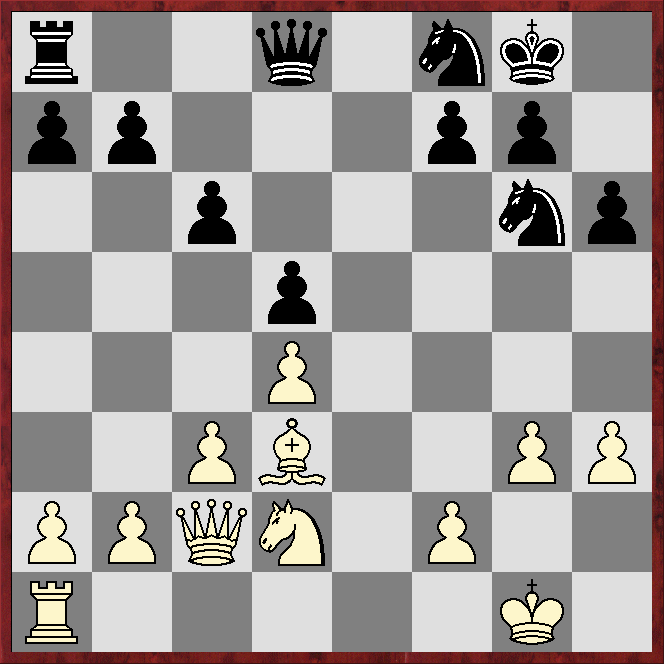
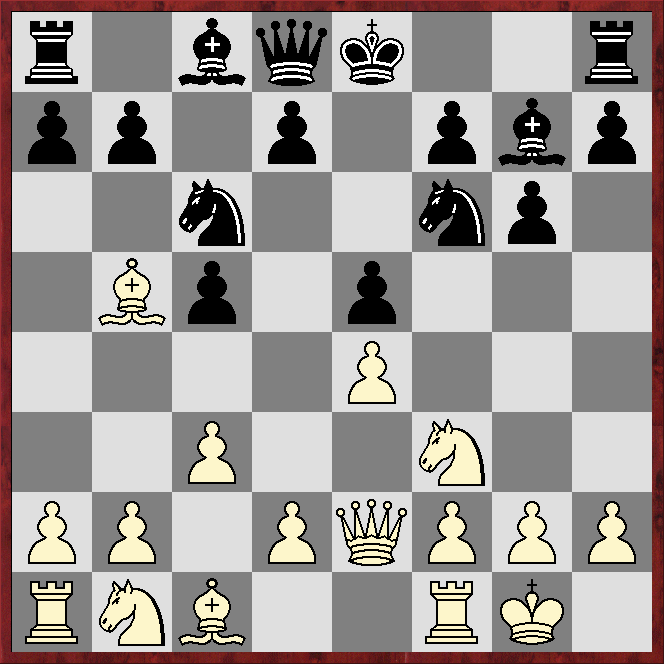
Now both sides have castled, how would you assess the position?
*****
*****
*****
*****
*****
White has more space in the centre, giving a slight edge, according to Stockfish17 and Dragon1.
10.c4 Nc6 11.Be3 Nb4!? 12.Be2 d5!?
After 12...Bg6 13.Na3, Black may be for choice, but better is the engines' 13.Ne1!?, and also better, as RS pointed out in the postmortem, is 13.Nh4. My planned 13.Nc3!? Nc2 14.Rc1 Nxe3 15.fxe3 loses the bishop-pair but strengthens White's centre, and also seems playable.
13.a3 Nc6 14.Nc3 dxc4!?
How should White respond? 
*****
*****
*****
*****
*****
15.d5!?
The engines dislike this, preferring 15.g4!? Bg6 16.Bxc4, claiming a slight edge for White. Also reasonable is 15.Bxc4 as 15...Bxf3 16.Qxf3 Nxd4 17.Qxb7 gives White at least a slight edge, according to the engines. However they reckon Black should meet 15.Bxc4 by getting on with development with 15...Qd7, giving what they reckon are equal chances.
15...Na5
The engines narrowly prefer this over 15...Bxf3 16.Qxf3 Ne5.
16.g4!?
The engines fluctuate between the text and 16.Qa4.
16...Bg6 17.Ne5?!
This is strongly disliked by the engines. They suggest 17.Qa4 b6 18.Bxc4, claiming equality.
17...Bd6 18.Nxc4?
Winning back the pawn, but allowing Black to exchange his offside knight. The engines give 18.Nxg6, but much prefer Black.
18...Nxc4
Even stronger seems to be the engines' 18...Nxg4!?, eg 19.hxg4 Nxc4 20.Bxc4 Qh4. Both 19.Nxa5 and 19.Nxd6 are probably better tries, but in both cases 19...Nxe3 looks to be winning.
19.Bxc4 Ne4 20.Nxe4 Bxe4 21.Qd4?!
Probably better is 21.f3, intending 22.Qd2, or immediately 21.Qd2, with the possibility of f3 to come.
21...f5!?
Protecting the light-square bishop and preparing to bring the king's rook into the attack against an increasingly vulnerable-looking white king.
How should White proceed?
*****
*****
*****
*****
*****
22.g5
This seems best. Definitely bad is 22.f3? as Black has 22...Qh4!, while 22.gxf5? can also be met by 22...Qh4.
22...f4
The engines' 22...Qe8 may be even stronger.
23.Qxe4
Black to play and win
*****
*****
*****
*****
*****
23...Qxg5+?!
This looks promising, but Black has a defence, whereas the simple 23...fxe3 leaves White in insurmountable difficulties, according to the engines, eg 24.Qxe3? Rf4! puts White's bishop and g pawn en prise, and after, say, 25.Rac1 Qxg5+ 26.Qg3 Qf6 27.Qe3 Kh8! (keeping queens on the board) White's position collapses. A better try is 24.f4, but the engines' 24...Qe8! is strong, eg 25.Qe6+ Kh8 26.Qxe8 Raxe8 27.Be2 Bxf4 gives Black a pawn advantage, and with more White weaknesses to target.
24.Qg2 Qxg2+
I was worried about 24...Qe5 25.Bd2 f3? 26.Qg3 Qd4?, missing 27.Bc3!, when White remains a piece up.
25.Kxg2 fxe3 26.fxe3 Rae8 ½–½
ADDENDUM (7/7/25): my original analysis around moves 18-19 was seriously flawed, but has now been improved.

Friday, 13 June 2025

Munich 60+ Round Six

FACED an Indian.

Spanton (1954) - RR Vasudevan* (1932)
Petrov/French Exchange
1.e4 e5 2.Nf3 Nf6 3.Nxe5 d6 4.Nf3 Nxe4 5.d3!? Nf6 6.d4 d5
This position is normally reached two moves quicker via a French Defence move-order, ie 1.e4 e6 2.d4 d5 3.exd5 exd5 4.Nf3 Nf6
*****
*****
*****
*****
*****
7.Bd3 Be7
More popular is prolonging symmetry with 7...Bd6.
8.0-0 0-0
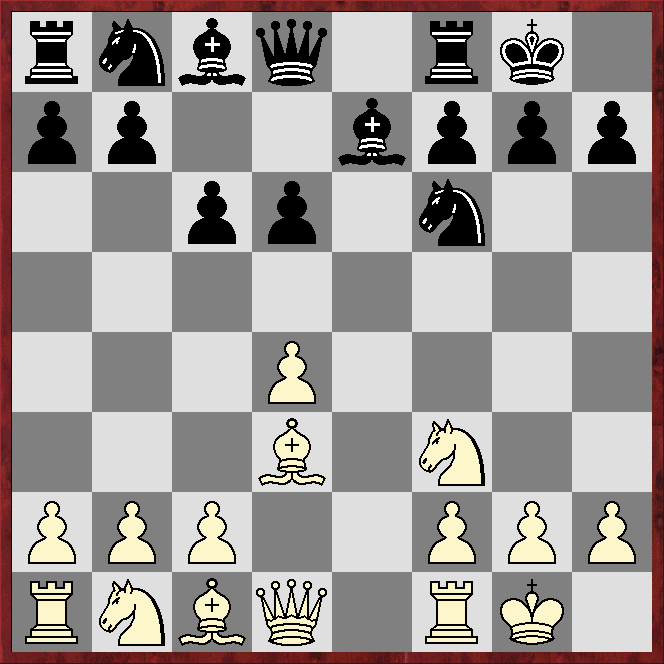
With both sides castling early, how would you assess the position?
*****
*****
*****
*****
*****
White has the more-active king's bishop, and is to move in an otherwise symmetrical position. That is enough for a slight edge, according to Dragon1, but Stockfish17 is less sure.
9.Bh5 h6 10.Bh4 Bg4 11.h3 Bh5 12.Re1 Re8 13.Nbd2 Nc6
Breaking the near-symmetry with a move not liked by the engines, which prefer 13...Nbd7.
14.c3 Nh7!?
The engines like this.
15.Bxe7 Rxe7 16.Qc2 Nf8 17.Rxe7 Nxe7 18.Ne5 Bg6!? 19.Nxg6 Nexg6 20.g3!? c6
The queenside pawn-structure remains symmetrical, and the kingside is not far from it, but White has the only long-range minor piece, which is probably at least part of the reason why the engines give White a slight edge
*****
*****
*****
*****
*****
21.Re1 Qf6 22.Kg8 Rc8!?
A 'mysterious' rook move, at least so it seemed to me during the game, but I suppose the rook might prove useful shadowing the white queen.
23.Nf3 Qd6 24.h4 Nd7 25.Re3
The engines like 25.Bxg6!? fxg6, and then 26.Re3.
25...Kf8 26.Qe2 Ne7 27.Ne5 Nxe5 28.dxe5 Qe6 29.Qh5 Rd8
How should White proceed?
*****
*****
*****
*****
*****
30.b3?!
This throws away all of White's advantage, according to the engines. They reckon White has the upper hand after 30.Re2, but agree 30.f4? d4 31.cxd4 and either 31...Qxa2 or 31...Rxd4 gives Black at least the upper hand. If 30.Re2 is met by 30...d4, they reckon 31.c4 is good for White.
30...d4 31.Bc4 Qg6
The engines prefer 31...Nd5 or 31...Qf5.
RV offered a draw in my time.
32,Qxg6 Nxg6 33.cxd4 Rxd4 34.h5 Ne7 35.Rd3
RV offered a draw.
35...Rxd3
Not 35...Re4?? 36.Rd8#.
36.Bxd3 Nd5
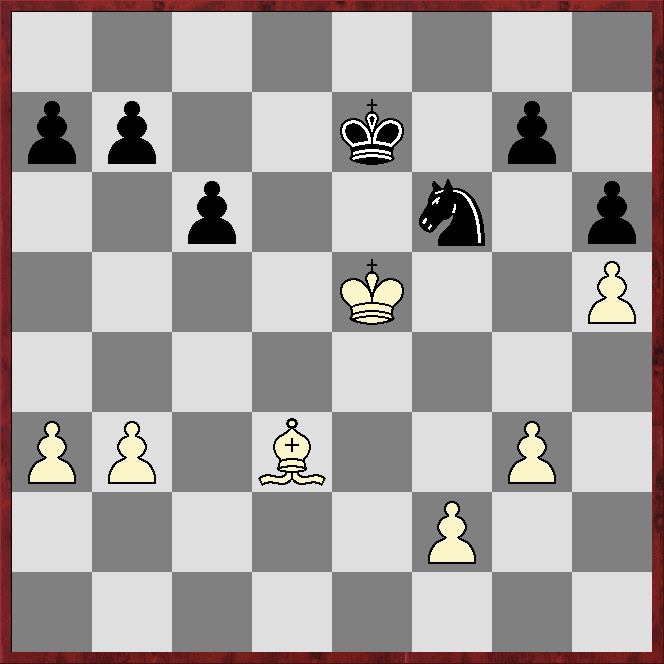
How would you assess this bishop-v-knight ending?
*****
*****
*****
*****
*****
White has the better minor piece for dealing with rival pawn-majorities, but Black's majority is 3-2 rather than 4-3 and is on the farside from the kings. Dragon1 gives White a slight edge, but Stockfish17 disagrees.
37.Kf3 Ke7 38.a3 f6?!
Letting White quickly get a 3-2 majority is probably unwise.
39.Ke4 fxe5?!
Conceding space is also strange.
40.Kxe5 Nf6
Dragon1 reckons White has a positionally won game; Stockfish17 is not so sure, but gives White the upper hand
*****
*****
*****
*****
*****
41.Be2 Nd7+ 42.Kf5 Ne8 43.Bc4 Kd6?
Striving for counterplay is understandable, but it is better to push the queenside pawns, starting with, for example, 43...b5!?, while keeping the king blocking its white counterpart.
44.g4 b5 45.Bg8!?
The engines agree this is best.
45...a5 46.b4?
This makes it easy for Black to gain a passed pawn, and so claim equality. Winning is 46.f4.
46...axb4 47.axb4 c5 48.f4!? cxb4
Also equal is 48...c4.
49.g5
How should Black respond?
*****
*****
*****
*****
*****
49...hxg5?
Drawing is 49...Ke7 as, after 50.gxh6 gxh6, White cannot make progress.
50.fxg5 Ke7
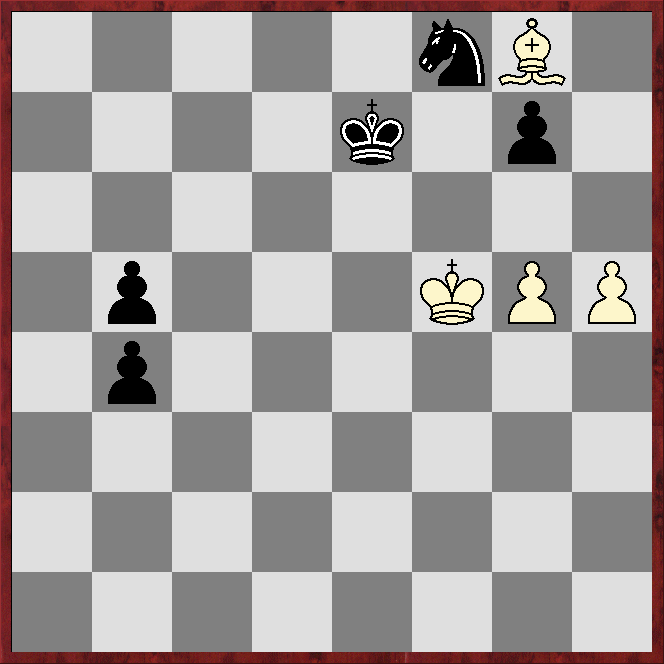
White to play and win
*****
*****
*****
*****
*****
51.Ke5
Winning is 51.g6!, the point being that after 51...Nd7 52.h6 gxh6 53.g7 Nf6 54.Bb3 h5 55.Kg5 h4 56.Kxh4 Kd6 57.Kg5 Ke5 58.Kg6 Black is in zugzwang. Alternatively 51...Kd6 52.Bb3 Ke7 53.h6 wins easily for White.
51...Nd7+ 52.Kd5
Returning to f5 is no better - Black draws comfortably with, among other moves, 52...Kf8 and 52...Nc5.
52...b3 53.Kd4 b2 54.Ba2 Nb6 55.Kc3 Nc4 56.Kb3 Ke6 57.h6 gxh6 58.gxh6 Kf6 59.Kb4 Kg6 60.Kxb5 ½–½
This ended my drawless streak of 30 games.
*Uses a single name and initials rather than a given name and family name.

Friday, 25 April 2025

English 65+ Round Three

TOOK a halfpoint bye in round two.

Spanton (1985 ECF/1922 Fide) - Chris Leeson (1750 ECF)
Petrov
1.e4 e5 2.Nf3 Nf6 3.Nxe5 d6 4.Nf3 Nxe4 5.d3!? N6 6.d4 c6!? 7.Bd3 Be7 8.0-0 0-0
Now both sides have castled, how would you assess the position?
*****
*****
*****
*****
*****
White, at least for now, has more space and a more-active king's bishop - enough for a slight edge, according to Stockfish17 and Dragon1.
9.h3!?
The engines like this, the idea being to restrict Black's light-square bishop.
9...h6!? 10.Nh4!?
The engines prefer developing with 10.Bf4 or 10.Re1.
10...d5 11.Nf5 Bxf5 12.Bxf5
White has won the bishop-pair, but it has cost tempi.
12...Nbd7 13.Nd2 Qc7 14.Nf3 Bd6 15.Be3 Bf4!? 16.Re1 Rae8 17.Qd2 Bxe3 18.Rxe3 Rxe3 19.Qxe3 Re8 20.Qd2 Ne4 21.Bxe4 Rxe4 22.Re1 Rxe1+ 23.Qxe1 Kf8
The bishop-pair is long gone, the pawn-structure is symmetrical, and occupation of the open file brings no advantage
*****
*****
*****
*****
*****
24.Qb4+ Ke8 25.Qa3 a6 26.Qd3 Qf4!? 27.Qe2+ Kf8 28.c3 Qf5 29.a3 Qe6!? 30.Qxe6 fxe6 31.Kf1 Ke7 32.Ke2 Kf6
CL offered a draw.
How would you assess the knight-and-pawn ending?
*****
*****
*****
*****
*****
Completely equal, according to the engines.
33.Ke3 g5 34.h4 g4 35.Nh2 Kf5 36.Nf1 e5 37.Ng3+ Ke6 38.dxe5 Nxe5
Recapturing with the king also maintains equality.
39.Kf4 c5
39...Nd3+?! 40.Kxg4 probably favours White, or at best (for Black) is equal.
40.b3 b5 41.Nf5 Nd3+ 42.Kxg4 Nf2+ 43.Kf4 Nd3+ 44.Kg4 Nf2+ ½–½

Saturday, 2 November 2024

Lessons From Mallorca V: Double Trouble

THERE are several lines in double-e-pawn openings in which White gets a chance to use the king's knight to capture Black's pawn on e5.
Probably the best-known is in the Petrov: 1.e4 e5 2.Nf3 Nf6, when White's commonest, and possibly best, continuation is 3.Nxe5.
White does not try to gain a material advantage by hanging onto the pawn, but rather to gain a positional advantage after Black levels material by capturing on e4.
There are other openings, however, where White's capturing on e5 only really makes sense if the idea is to hang onto the pawn.
These lines tend to be double-edged in that being a pawn up will likely be a significant advantage in any ending, and, since the capture gives White a central pawn-majority, may well be a very useful advantage in the middlegame.
However, if White proves unable to hold onto the pawn, Black will probably have at least equalised, and may well gain an advantage.
An example of this occurred in my round-five game at the Colònia de Sant Jordi U2400, which reached the following position after six moves (it arose from the Rossolimo Variation of the Sicilian, but the central structure is that of a double-e-pawn opening).
Black has just played 6...Bg7!?
*****
*****
*****
*****
*****
The game continued 7.Bxc6!? bxc6 8.Nxe5 0-0!?
Castling is probably Black's best move, as trying to win the pawn back with 8...Qe7 can be countered by 9.Nf3!, when either capture on e4 is a blunder that loses a piece.
There followed 9.d3 Re8 10.Nf3 d5, reaching a position that also occurred in two relatively high-level games, Ilya Smirin (2594) - Pavel Eljanov (2655), Netanya (Israel) 2019, and Sayantan Das (2459) - Adham Fawzy (2490), Guwahati (India) 2022.
Those games saw 11.Bg5 Qb6 12.Bxf6 Bxf6, after which Black is slightly better (Dragon1) or at least has the better side of equality (Stockfish17), and Black went on to win both games.
I preferred 11.e5!?, which may be a novelty.
Position after 11.e5!?
*****
*****
*****
*****
*****
The engines suggest 11...Nd7 or 11...Bg4, awarding Black at least equal chances.
My opponent chose 11...Ba6, and after the further moves 12.Re1 Ng4 13.Bf4 it might be thought White has successfully held onto the extra pawn on e5 as it seems to be overprotected - attacked thrice, but defended four times.
However this is illusory, as Black showed with 13...Nxe5!?, when after 14.Nxe5 f6 15.Qd2 fxe5 Black gets back the pawn and emerges with the bishop-pair and control of the centre.
The engines agree Black is better
*****
*****
*****
*****
*****
Now it may be that slight improvements can be found for both sides, but as this position and the two high-level games show, White's play after grabbing the pawn is not easy.
LESSON: before spending tempi with the aim of winning a pawn in the opening, even an important central pawn, it is essential to consider all the opponent's options for counterplay. Grabbing such a pawn may be an example where the old joke applies: "Don't do it, even if it is sound!"

Saturday, 31 August 2024

Riviera Round One

Spanton (1931 ECF/1980 Fide) - Matthew R Wilson (1850 ECF/1805 Fide)
Petrov
1.e4 e5 2.Nf3 Nf6 3.Nxe5 d6 4.Nf3 Nxe4 5.d3!? Nf6 6.d4 Be7!?
The main continuation, 6...d5, transposes to the Exchange Variation of the French: 1.e4 e6 2.d4 d5.3.exd5 exd5 4.Nf6 Nf6, albeit with two more pairs of moves played.
After the text, how should White proceed?
*****
*****
*****
*****
*****
7.c4!?
Carlsen, Kasparov, Kramnik and So are among big names who have preferred 7.Bd3.
7...0-0 8.Bd3 c5!?
Probably a novelty, and possibly not a good one, although Stockfish16.1 and Dragon1 are OK with it.
9.d5 Re8 10.0-0
Now both sides have castled, how would you assess the position?
*****
*****
*****
*****
*****
The most significant feature of the position is White's central space advantage, which confers a slight edge, according to the engines.
10...Bg4 11.h3 Bh5
The engines prefer 11...Bxf3!? 12.Qxf3 Nbd7.
12.Bf4 Bf8 13.Nbd2 Nbd7 14.g4!?
This is liked by the engines', along with 14.Qb3!?
14...Bg6 15.Bxg6 hxg6 16.Re1 Rxe1+ 17.Qxe1 b5!
This is the engines' top choice, although they still give White an edge.
18.b3 Qa5 19.Ne4
The engines suggest 19.Qc1!? or 19.Bh2!?
 Qxe1+ 20.Rxe1 Nxe4 21.Rxe4
How would you assess this ending?
*****
*****
*****
*****
*****
White has more space and the more-active pieces, but Black has annoying pressure against the white queenside. The engines reckon White has the better side of equality.
21...Nf6?!
But the engines dislike this, presumably because it does not help on the side of the board where Black is better. Instead they give 21...Nb6 22.Nd2 a5 with an initiative, eg 23.cxb5 a4! 24.Nc4 axb3! 25.axb3 Nxd5 26.Bxd6 Nc3 27.Re5 Nxb5 28.Bxf8 Kxf8 29.Rxc5 Nd4, claiming good compensation for a pawn.
22.Re3 Re8
Dragon1 suggests 22...b4, but awards White the upper hand. Stockfish16.1 gives 22...a5!? 23.g5 Nd7 (23...Nh5 24.Bh2), but also reckons White gets the upper hand, after 24.cxb5 or 24.Nd2.
23.Rxe8 Nxe8 24.cxb5!?
Giving up the d5 pawn, and thus leaving Black with a potential protected passer, to create a farside pawn-majority.
24...Nc7 25.a4 Nxd5
Can White sacrifice the bishop to push home a pawn?
*****
*****
*****
*****
*****
No, as 26.a5?? Nxf4 27.b6 axb6 28.axb6 loses to 28...d5 etc, while 28.a6 loses to 28...Nd5 or 28...Ne6.
26.Be3 Be7
Not 26...Nxe3? as, after 27.fxe3, Black's bad bishop cannot cope with the white knight and queenside pawn-majority.
27.Kf1 Kf8 28.Ke2 Nb4?
This encourages White to play a move that was coming anyway, only now it comes with the gain of two tempi. On 28...Ke8, which is probably best, I planned 29.Bd2 and 30.Kd3, with what seem promising winning chances.
29.Bd2 Nd5
Forced.
30.Kd3 Ke8 31.Ng5 Nf6?!
Black can swop off the bad bishop, but the resulting bishop-v-knight ending seems winning for White. Perhaps best is 31...Nc7!?, although the engines reckon 32.h4!? is very strong, and other moves also leave Black in difficulties.
32.Ne4 d5!?
Other moves also lose.
33.Nc3 d4 34.Ne4 Nd7 35.f4 Nf6 36.Nxf6+ gxf6
Or 36...Bxf6 37.b4.
37.Kc4 Kd7 38.a5 g5 39.f5 Bd6 40.Bc1 Kc7 41.Bd2
It was still possible to go wrong, eg 41.Ba3 Kb7 42.Bxc5?? Bxc5 43.Kxc5 d3 etc.
41...Kd7 42.a6 Be7 43.b6 1-0

Friday, 26 July 2024

Perking Up The Petrov

THE Petrov Defence 1.e4 e5 2.Nf3 Nf6 is undergoing something of a revival, both over the board and at correspondence.
The latter may not be much of a surprise as the Petrov seems to me to be  one of those defences where Black can be slightly worse for quite a few moves, but in positions very manageable with the help of engines.
Over the board the Petrov was extremely popular at high levels until the rise of the Berlin Wall in the Spanish.
Perhaps one reason for the Petrov's revival is repetition-fatigue settling in with the Berlin.
Another reason may be the discovery that after 3.Nxe5 Black can get away with the 'duffers' move' 3...Nxe4!?
Indeed Stockfish16.1 and Dragon1 reckon ...Nxe4 is only slightly inferior to the mainline ...d6, and the former has the advantage of perhaps causing whites to let their guard down.
Polish Fide master Kamil Plitchta has produced a video for Chessable on this line, which no doubt is helping the revival.
I have also noticed a rise in whites ignoring 3.Nxe5 in favour of 3.d4, after which the most popular continuation is 3...Nxe4
Position after 3...Nxe4
*****
*****
*****
*****
*****
White has three main replies.
Stockfish16.1 and Dragon1 quite like 4.Nxe5, which occurs 723 times in ChessBase's 2024 Mega database, scoring 53%.
Given enough time, the engines come to marginally prefer 4.Bd3, which occurs 8,388 times in Mega24 and scores 61%.
Between these two moves is 4.dxe5, which occurs 1,560 times in Mega24, scoring 57%, and which I have seen a few times recently in club-level chess.
The pawn capture is also increasing in popularity among the elite, the usual continuation being 4.... d5 5.Nbd2.
It is here that Fabiano Caruana introduced the shocking 5...Qd7!? in a win over Nikita Vitiugov at Grenke (Germany) 2018.
Position after 5...Qd7!?
*****
*****
*****
*****
*****
I have not been able to find any analysis explaining the idea behind 5...Qd7!?, which scores an impressive 47% in Mega24 and may be an additional factor in the revival of the Petrov.
However, I suspect one major point is that after 5...Qd7!? White is no longer threatening the deeply disrupting 6.Nxe4 dxe4 7.Qxd8+.
Most popular has been 6.Bd3, threatening to win a pawn, but after 6...Nc5 White has generally continued 7.Be2, with a completely equal position, according to Stockfish16.1, although Dragon1 gives White a tiny pull.
CONCLUSION: new ideas are helping to revive the Petrov, and the defence can be expected to increase in frequency at club level over the coming months.

Sunday, 7 April 2024

Tegernsee Round Two

FOR the first time in six games I got the white pieces.

Spanton (1886) - Willi Roth (1780)
Petrov
1.e4 e5 2.Nf3 Nf6 3.Nxe4 d6 4.Nf3 Nxe4 5.d3!?
There are 3,517 examples of this move in ChessBase's 2024 Mega database, including by Magnus Carlsen and Garry Kasparov.
5...Nf6 6.d4 Bg4
With 6...d5 Black transposes to a position normally reached via the Exchange Variation of the French.
7.h3 Bh5 8.Bd3 Nc6 9.c3 Qe7+ 10.Be3 Nd5 11.Qe2 Nxe3 12.fxe3
How would you assess this imbalanced opening position?
*****
*****
*****
*****
*****
Black has acquired the bishop-pair, but the manoeuvre has cost time and has strengthened White's centre. Stockfish16 and Komodo14.1 agree White has an edge.
12...Bxf3?!
This, for a while, is Stockfish16's second choice, but giving up the bishop-pair unprovoked is strange. The engines prefer 12...0-0-0.
13.Qxf3 Qh4+!? 14.g3 Qg5 15.h4 Qe7
The positive result of Black's queen-play is it makes kingside castling riskier for White, but more significant is that the position is similar to after 13.Qxf3, but with White to move rather than Black 
*****
*****
*****
*****
*****
16.Bb5 Kd8?
Much better is castling, after which Black is two moves away from connecting rooks. In the game Black does eventually connect rooks, but at an inopportune time.
17.Nd2 a6!?
The engines are OK with this, which only shows how bad Black's position is.
18.Bxc6 bxc6 19.Qxc6! Qxe3+?
Much better is 19...Rb8, but after 20.0-0-0 White is well on top.
20.Kd1 Qxg3
The black queen's rook cannot be saved without losing the queen to Re1.
21.Re1!?
This is plenty good enough, but even stronger is the obvious 21.Qxa8+ Kd7, and then 22.Re1.
The game finished:
21...Qg4+ 22.Kc1 Be7 23.Qxa8+ Kd7 24.Qxh8 Qxh4 25.Kc2 Qh6 26.Rxe7+! Kxe7 27.Re1+ 1-0

Sunday, 26 March 2023

4NCL Weekend Four: Game Two

PLAYED on board one (of six) for Wessex Some Stars B against Crowthorne B in division four today.

Spanton (1976 ECF/1835 Fide) - Peter Tart (1951 ECF/1863 Fide)
Petrov
1.e4 e5 2.Nf3 Nf6 3.Nxe5 Nxe4!?
This well-known "beginners' mistake" is the second-most popular continuation in ChessBase's 2023 Mega database.
There are 2,331 examples of this position in Mega23 - how should White respond?
*****
*****
*****
*****
*****
4.Qe2
This seems best, although Stockfish15.1 and Komodo14.1 also like 4.d4. At first glance 4.Nxf7?? might look good in view of 4...Kxf7? 5.Qh5+ g6 6.Qd5+ Kg7 7.Qxe4, but the engines reckon Black has good compensation for a pawn, and anyway has a winning improvement in the shape of 4...Qe7.
4...Qe7 5.Qxe4 d6 6.d4 dxe5 7.Qxe5!?
Possibly better is 7.dxe5. The problem with the text is it lets Black free a diagonal with tempo for Black's dark-square bishop.
7...Qxe5+ 8.dxe5 Nc6 9.Bf4 Bf5 10.Bb5!?
Black was fine after 10.c3 0-0-0 11.Nd2 Nxe5!? 12.Bxe5 Re8 in Aleks Bancarewicz (1920) - Marek Chomczyk (2327), Polish Blitz Championship (Suwałki) 2022 (0-1, 29 moves).
10...Bxc2 11.Nc3 0-0-0 12.0-0 Nd4 13.Rac1 Bb4 14.Bg5!? a6!? 15.Bxd8 axb5
How should White proceed?
*****
*****
*****
*****
*****
16.Bg5?
Black is better after this. The engines give 16.Bxc7 Bxc3 17.bxc3 Ne2+ 18.Kh1 Nxc1 19.Rxc1 Kxc7 20.Rxc2, when White is a pawn up but cannot hold on to it after 20...Re8, eg 21.f4 f6 22.Re2 (22.exf6?? Re1#) fxe5 23.fxe5 Kc6 etc.
16...Bxc3 17.Rxc2
Or 17.bxc3 Ne2+ 18.Kh1 Nxc1 19.Rxc1 Bf5, after which Black has the upper hand, according to the engines.
17...Nxc2 18.bxc3 Na3 19.f4
19.Rd1 stops quick activation of the black king, but the engines reckon Black has the upper hand.
19...Kd7 20.Kf2 Nc4 21.Rd1+ Ke6!?
The engines give Black at least a slight edge after 21...Kc6.
22.Rd8?
Preventing the black rook from harassing the a2 pawn, but the right way to do this is 22.Bd8!?.
22...Rxd8 23.Bxd8 c6 24.Ke2?
This loses material. Instead 24.Kf3 keeps the game going, eg 24...Nd2+ 25.Ke2 Ne4 26.Kd3 Nc5+ 27.Kd4.
24...Kf5 25.Kf3
Almost certainly worse is 25.Ke2?! Ke4.
25...Nd2+ 26.Ke3 Nf1+ 27.Kf3 Nxh2+ 28.Kg3 Nf1+ 29.Kf2 Nd2 30.Ke3 Nc4+!?
The engines agree this is best.
31.Kf3 h5 32.Be7 Nb6 33.Bh4 Nd5 0-1

Monday, 27 June 2022

Morphing The French XXVI

MY 26th attempt to play against the French Defence in the style of Paul Morphy.

A bronze statue of the Wawel dragon, which according to legend terrorised medieval Kraków until killed by a sulphur-filled decoy cow left as bait by the sons of King Krak

Spanton (1861) - Mateusz Skomiał (2063)
Kraków U2200
Petrov/French Exchange
1.e4 e5 2.Nf3 Nf6 3.Nxe5 d6 4.Nf3 Nxe4 5.d3!? Nf6 6.d4 d5
This position is normally reached in two fewer moves, viz 1.e4 e6 2.d4 d5 3.exd5 exd5 4.Nf3 Nf6
*****
*****
*****
*****
*****
7.Bd3 c5!?
An interesting way to unbalance the position. More common are 7...Bg4, 7...Be7 and especially 7...Bd6.
8.0-0 c4 9.Re1+ Be7 10.Bf1 0-0 11.b3
It is generally considered desirable to attack a centre such as Black's as quickly as possible before Black can consolidate his space advantage.
11...cxb3
There are five examples of 11...b5?! in ChessBase's 2022 Mega database, including three games where Black was rated over 2100, but 12.a4 is a strong answer.
12.axb3 Nc6 13.h3!?
This has been played by grandmasters, and is second in popularity to 13.Ne5!? in Mega22, but I suspect Morphy would have strived to find something more dynamic.
13...Ne4 14.Ba3 Bxa3 15.Nxa3 Qf6 16.c4 Bf5?!
Black should probably reinforce his isolani with 16...Be6, although the engines reckon White would be slightly better.
17.Nc2?!
Almost certainly too passive. I think I rejected 17.Nb5 because of 17...dxc4 18.bxc4 Rad8, but 19.d5 leaves White well on top.
17...Rad8 18.c5!?
The engines prefer 18.Bd3 or 18.Ne3.
18...Ng5 19.Nxg5 Qxg5 20.Bd3?
A simple oversight.
20...Bxh3 21.Qf3
Not 21.Bxh7+?? Kxh7 22.Qd3+ Bf5.
21...Be6 22.b4 a6 23.b5 axb5 24.Bxb5
Black is a pawn up but his weak queenside pawns mean White has drawing chances
*****
*****
*****
*****
*****
24...Rb8!?
This may look horribly passive but the engines are OK with it.
25.Rab1 h6 26.Rb2 Bg4 27.Qg3 Rbe8 28.Reb1?!
This lets Black get rid of his somewhat bad bishop. White more-or-less has full compensation for a pawn after 28.Rxe8 Rxe8 29.Ne3, according to the engines.
28...Bf5! 29.Qxg5 hxg5 30.Rd1 Bxc2 31.Rxc2 Re4 32.Bxc6
Perhaps 32.Rcd2 is better, but Black has an advantage.
32...bxc6 33.Rb2 Rfe8 34.Kf1?
The engines prefer 24.f3!? even though this weakens e3. The text leaves the white king vulnerable to play down the h file
34...g4 35.Rb6?!
This may give the illusion of counterplay, but Black's reply is a move Black wants to play anyway. The white rook was almost certainly better left defending the kingside.
35...R8e6 36.Rb8+ Kh7 37.Rc8 Rh6 38.Kg1 Rf6 39.Rd2 g3 40.fxg3 Re1+ 0-1

Tuesday, 5 April 2022

Tegernsee R3 Game

PLAYED on March 28.

Spanton (1912) - Marcel Marentini (2053)
Senioren Cup
Petrov
1.e4 e5 2.Nf3 Nf6 3.Nxe5 d6 4.Nxf7?!
This gambit has been tried by very strong players, including Carlsen, Short, Topalov, Ivanchuk and Morozevich, but is probably just bad.
4...Kxf7 5.d4
The 'obvious' 5.Bc4 seems to be excellently answered by 5...d5!?
5...c5!?
Not 5...Nxe4?? as 6.Qh5+ wins back the piece.
6.Bc4+
More popular is 6.dxc5, when Black should probably reply 6...d5!? or 6...Qa5.
6...d5!? 7.exd5 Bd6
Black has given up a third pawn but White probably does not have enough compensation for a piece, although the position is not clear
8.dxc5
The main line, albeit from a small sample of games, runs 8.0-0 cxd4 9.Qxd4, when Stockfish14 reckons Black is winning but Komodo12.1.1 gives Black only a slight edge.
8...Qa5+!?
This was probably a good time for ...Re8+, ensuring the black king can fall back to g8 without blocking in the king's rook, but the text is also fine.
9.Nc3 Qxa5 10.Be2 a6 11.Be3 Qc7 12.Qd2 Nbd7 13.0-0-0 b5 14.g4
How would you assess this position?
*****
*****
*****
*****
*****
Middlegame positions with kings on opposite sides of the board are often hard to evaluate. Here White has the safer king and has more scope for pawn-play. But Black is a knight up, albeit for three pawns, so in effect has two possible ways of winning: a) direct attack, b) simplification. The engines much prefer Black.
14...b4 15.Na4 Ne4 16.Qd3 Ndc5 17.Nxc5 Nxc5 18.Bxc5!? Qxc5 19.Qf3+
How should Black proceed?
*****
*****
*****
*****
*****
19...Ke7!?
Brave! Komodo12.1.1 - but not Stockfish14 - prefers 19...Kg8, but then Black for quite some time will be effectively playing the exchange down in that his king's rook will struggle to get into the game.
20.Rhe1 Kd8 21.Qf7?
The engines prefer 21.Bd3 or 21.Kb1. The text wastes valuable time.
21...Ra7 22.Qh5 Re7
Black is undoubtedly winning.
23.Bd3 Rxe1 24.Rxe1 Qxf2 25.Qg5+ Qf6 26.Qh5
Objectively better, according to the engines, is 26.Qxf6+, but best is probably Resigns.
The game finished:
26...g6 27.Qh3 h5 28.Rf1 Qe5 29.Qh4+ g5 30.Qf2 Qf4+ 31.Qd2 Qxf1+!? 0-1

Monday, 7 March 2022

One Queen Good, Two Queens Better ... But Are They Enough?

HERE is another flawed but exciting encounter from 500 Master Games Of Chess by Savielly Tartakower and Julius du Mont.
White wins the black queen and later promotes a pawn to gain a second queen, but Black also has chances.
Notes in italics are algebraicised from the book.

Robert Franz - Carl Mayet
Berlin 1858
Bishop's Opening
1.e4 e5 2.Bc4 Nf6
This is the active defence which first tarnished the reputation of this opening and caused it to disappear almost altogether from the modern repertory.
3.Nf3
An identical position occurs in Petrov's Defence after 1.e4 e5 2.Nf3 Nf6, and now 3.Bc4, instead of the accepted continuations 3.Nxe5 or 3.d4 or 3.Nc3.
3...Nxe4 4.Nxe5!?
This recovers the pawn but allows Black to obtain a footing in the centre (4...d5). Better is the sacrifice of a pawn for the sake of a prospective attack by 4.Nc3.
The text, which is Stockfish14.1's choice, scores just 33% in ChessBase's 2022 Mega database, against 53% for 4.Nc3, which Komodo12.1.1 marginally prefers over 4.d3.
4...d5
Throwing back the bishop, and hoping later on to get rid of the knight as well.
5.Bb3?!
The engines much prefer 5.Be2.
How should Black proceed?
*****
*****
*****
*****
*****
5...Be6
5...Qg5!?, as apparently first played by Johannes Zukertort in an 1862 club game against an unknown opponent, is very hard to meet. That game continued 6.0-0? (the commonest move in Mega22, but already losing) Qxe5 7.d3 B d6 8.g3 Ng5 9.Re1 Nf3+ 10.Kf1? Bh3#. The engines reckon White should probably play 6.d3, but 6...Qxg2 7.Qf3 Qxf3 8.Nxf3 Nf6 was very good for Black in Yury Krasnov (2368) - Vladimir Afromeev (2573), Igriashvili Memorial (Tula, Russia) 2006 (0-1, 51 moves).
6.0-0 Bd6 7.d4 Qf6?
7...f6 would be faulty on account of 8.Qh5+ g6 (8...Ke7 9.Nd3 etc) 9.Nxg6 Bf7 10.Bxd5 etc. The simplest would be 7...0-0.
It seems correct that 7...f6?! (the engines recommend 7...0-0 or 7...Nc6) is faulty, but 10.Bxd5? allows Black to survive with 10...Bxg6. Instead the engines reckon 10.Nc3!? is strong, and if 10...Bxg6 then 11.Qxd5, eg 11...f5 (this is best, according to the engines) 12.Qe6+ Qe7 (12...Kf8?? 13.Bh6#) 13.Qc8+ Qd8 14.Qxb7 Nd7 15.Nb5 Rb8 16.Nxd6+ cxd6 17.Qxa7, when White has four pawns and a bishop for a pair of knights, and Black's king is exposed.
8.f4?
Guarding the outpost and threatening 9.f5, which incites Black to take immediate countermeasures.
The engines show 8.f3 greatly embarrasses Black's awkward piece-configuration, eg 8...Ng5 9.Nc3 c6 10.f4 Ne4 11.f5 Nxc3 12.bxc3 Bd7 13.Qh5! Be7 14.Qe2! 0-0 15.Ng4, or 9...Nc5 10.Ng4 Bxg4 11.fxg4 Qh4 12.g3 Bxg3 13.Qe2+ Ne6 14.hxg3 Qxg3+ 15.Qg2.
8...c5?
Meaning to reply to 9.f5 by 9...cxd4 10.fxe6 Qxe5 etc. A passive and more cautious course would be 8...c6 9.f5 Bc8.
The engines reckon 8...c6 9.f5 Bc8 is good for White after, for example, 10.Nd2, while the first line is a disaster for Black, as shown below. They reckon Black needs to play 8...Nc6 or possibly 8...0-0!?
9.Ba4+?!
Far more troublesome than 9.c3 because of 9...Nc6, with the threat 10...cxd4 11.cxd4 Nxd4.
The engines reckon 9.c3 Nc6?! (they prefer 9...0-0) fails to 10.f5, but this is academic as White has 9.f5 cxd4 10.fxe6 Qxe5 (as given in the book after Black's eighth move) 11.exf7+ Kf8 12.Bf4 Qe6 13.Bxd6+ Qxd6 14.Qxd4 with a strong attack.
9...Ke7?!
Forfeiting castling with a good grace, for if 9...Nd7 [then] 10.f5 cxd4 11.fxe6 Qxe5 12.exd7+, winning a piece. The most rational continuation, however, is 9...Bd7.
The engines reckon 9...Bd7 10.c4 is good for White, and so prefer 9...Nc6!?, meeting 10.Nxc6 with 10...Bd7, and 10.Bxc6 bxc6 11.Nxc6 with 11...0-0. In the last line Black is a pawn down but has a handy lead in development.
10.c4
Instead of being content with the solid 10.c3, White throws his forces into the turmoil.
10...dxc4?
If 10...cxd4 11.cxd5 Bxd5 12.Nc3 etc, White has the advantage.
12.Nc3??  is a blunder that leaves Black on top after 12...dxc3 13.Qxd5 Bc5+, the point being 14.Kh1? results in mate, viz 14...Ng3+! 15.hxg3 Qh6#. However the engines reckon 12.Nd2 does give White an advantage. In any event 10...cxd4 is better than the text.
11.Qc2
Even stronger, according to the engines, is 11.Qe1.
11...Bf5
With the counterthreat of 12...Ng3. If 11...Bd5 [then] 12.Re1, winning a piece, eg 12...Qf5 13.Nc3 etc, or 12...Bxe5 13.Rxe4 etc.
12.Qxc4
Here again White could have maintained a pressure by 12.g4 or 12.Re1, eg [after 12.Re1] 12...Bxe5 13.Rxe4 etc, or 12...Ng3 13.Ng4+ etc.
12...cxd4 13.Qb5 b6 14.Re1 Bc5 15.b4
Both sides display much imagination.
After a complicated opening, Black is a pawn up but White has the safer king and is winning, according to the engines
*****
*****
*****
*****
*****
15...a6 16.Qc4 b5 17.Qd5 Bxb4 18.Rxe4 Bxe4 19.Qxe4 Rc8
Intrepid play. The following alternatives would lead to nothing: 20...Ng4+ 21.Qe6, or 20...Nc6+ 21.Kd8 [this must be a typo for 21.Kf8 or 21.Kd6, both of which win for Black] etc.
20.Qb7+
Winning the adverse queen by force. The continuation 20.Bd2 (or 20.Ba3 or 20.Bb2) is playable.
20...Kd8?!
The engines reckon 20...Nd7 is less catastrophic.
21.Nxf7+ Qxf7 22.Qxf7 Rxc1+ 23.Kf2 Nd7 24.Bb3
Or 24.Qg8+ Bf8 25.Bb3 Kc7, and White still has to cope with difficulties.
24...Kc7 25.Qxg7 Bc5
Although Black has only a rook for a queen, he never relaxes his threats.
26.f5
Better is 26.Be6 at once.
26...Re8 27.Be6 Re7 28.Qg3+ Kb7 29.Qd3 Kb6 30.a4 Ne5 31.a5+ Kc7 32.Qe4 d3+ 33.Kg3 Bd6 34.Qa8!? Nc6+ 35.Kh4 Be5!?
Objectively Black should probably prefer 35...Rxe6 36.fxe6 d2 37.Nxd2 Rxa1, after which White's material advantage is 'only' queen and pawn for rook and bishop, but the position is much simplified, so reducing Black's swindling chances.
36.Qc8+ Kd6 37.Nd2?
White is still winning after this, but much stronger is 37.Ra3, maintaining his queen-for-rook advantage.
37...Bxa1
By hard work Black has doubled the compensation for his lost queen, but now White's passed f pawn is showing enterprise.
38.Ne4+ Ke5
White to play and win
*****
*****
*****
*****
*****
39.f6?
Winning, according to the engines, is 39.Nf2!, eg 39...Kd6 (39...d2 40.Qg8 seems even better for White) 40.Nxd3 Rd1 41.Nf2 Rd4+ 42.Kg3, while 39.Nd2 is apparently good enough for a draw after 39...Kf4! 40.Nb3.
39...Rxe6 40.f7 Rh6+ 41.Kg5 Rg6+ 42.Kh5
Black to play and win
*****
*****
*****
*****
*****
42...Kxe4
There is no answer to the engines' 42...Rf1!, eg 43.Qe8+ Kd5 44.Ng3 Rxg3! 45.hxg3 Bg7 etc, or 43.Ng4 d2 44.Nf3+ Rxf3 45.gxf3 Rf6 etc.
43.f8=Q
The balance of power between two queens and two rooks, bishop and knight does not tell the whole tale. Black's passed and advanced d pawn represents a permanent asset.
Black to play and draw
*****
*****
*****
*****
*****
43...Be5?
Black has to play 43...Bf6! to block the f file, according to the engines, but not 43...Rf6? as then White has 44.Qg4+
White to play and win
*****
*****
*****
*****
*****
44.Qf3+?
A cursory glance at the position makes it hard to believe that the two white queens cannot, between them, engineer a perpetual check.
The position is indeed now drawn, according to the engines, but 44.Qf2 is good for White and even more convincing is 44.Qcf5+, eg 44...Kd4 45.Qf2+ Kd5 46.Q8f7+ Kd6 47.Qxh7.
44...Kd4 45.Qcf5 Rc3 46.Q3e4+ Kc5 47.Qf8+?!
Best seems to be Stockfish14.1's 47.Qe1!?, but the myriad of possibilities makes it hard even for engines to be definite.
47...Rd6 48.Qf2?!
Best may be 48.Qe1!?, but then 48...b4 is winning, according to Stockfish14.1, although Komodo12.1.1 only gives Black a slight edge.
48...Rd4 49.Qf8+ Bd6 50.Qf2 d2
The charter of victory.
51.Qxc6+ Kxc6 52.Qxd4 Rc5+ 53.Kh6 Rd5 54.Qb6+ Kd7 55.Qb7+ Ke6 56.Qc8+ Ke5 57.Qh8+
The checks also eventually run out after 57.Qc3+ or 57.Qe8+
57...Kf4 58.Qf6+ Ke4 59.Qf3+ Kd4 60.Kxh7
Or 60.Qf2+ Kc3 61.Qf3+ Rd3 62.Qf6+ Kc2 etc.
60...Kc4 61.Qe4+ Rd4 62.Qc2+ Kd5 63.Qf5+ Be5 64.Qf3+ Kc4 65.Qd1
A queen's agony.
Also insufficient is 65.Qe2+ Kc3 66.Qf3+ Rd3 67.Qc6+ Kb2 etc.
65...Rd3 66.h4 Bc3 67.h5 Re3 68.Qf1+ Kb3 69.Qd1+ Kb2 0-1

Tuesday, 6 April 2021

Beat The ... Petrov

IN this series I am looking at the statistically best way to play against popular opening lines.
The numbers are drawn from the 2021 edition of ChessBase's Mega database, ignoring, where possible, those results that include very few games and so are statistically insignificant.

The Petrov 1.e4 e5 2.Nf3 Nf6 has largely fallen out of favour as a drawing weapon at the top level, replaced by the Berlin Variation of the Spanish.
But it retains its popularity at club level, where it is played for a win rather than mainly hoping to split a point.
White's commonest continuation is 3.Nxe5, but its excellent score of 59% is eclipsed by the 62% of 3.d4.
Position after 3.d4
Black has two major replies.

A) 3...Nxe4 (8,322 games)
White scores 61% with 4.Bd3, rising to 63% after 4...d5 5.dxe5!? (6.Nxe5 is much more popular but 'only' scores 62%).
Here the line splits.
A1 5...Nc5
White has three reasonably popular responses, the most successful being the least popular - by a small margin - 6.Nc3.
Black usually plays 6...c6, as the second-most common continuation, 6....Nxd3+ 7.Qxd3 c6 8.Bg5, wins the bishop-pair but leaves White with a huge lead in development and scoring 67%.
After 6...c6, the number of games is not statistically significant, but White scores best, 63%, with the restricting 7.h3.
A2 5...Be7
White scores 69% with 6.0-0, rising to 76% after 6...0-0 7.c4 and 6...Nc6 7.Nc3, but falling, albeit marginally, to 68% after 6...Nc5 7.Be2.
A3 5...Nc6
White scores 58% with 6.0-0, rising to 66% after 6...Bg4 7.Nc3, 76% after 6...Be7 7.Nc3 and 60%, albeit from a small sample, after 6...Bc5 7.Nc3.

B) 3...exd4 (2,338 games)
White scores 68% with the main continuation, 4.e5.
Here the line splits.
B1 4...Nxe4 5.Qxd4 d5 6.exd6 Nxd6, when White scores 68% with 7.Nc3 Nc6 8.Qf4.
B2 4...Nd5 5.Qxd4 Nb6 6.Nc3 Nc6 7.Qe4 scores an amazing 82% for White.
B3 4...Qe7 5.Be2 also scores 82% for White.

Wednesday, 28 October 2020

'Secret' Gambit Repertoire For White (part three)

THERE are many gambits for White after 1.e4 e5, two of the best-known being the King's Gambit (2.f4) and the Danish Gambit (2.d4 exd4 3.c3).
I am recommending a line so little-known that I reckon most chess players would struggle to name it, and an even larger proportion would struggle to spell the name correctly even if they vaguely knew it*.
It starts with the moves 2.Bc4 Nf6 3.d4!?
White has a very good chance of getting this on the the board as 2...Nf6 is easily the most-played reply to the Bishop's Opening (2.Bc4) - it occurs 67.6% of the time in ChessBase's 2020 Mega database.
But 3.d4!? is considered so dangerous that Larry Kaufman, in his classic book The Chess Advantage In Black And White (McKay 2004), cited it as a reason for his recommending Black meet the Bishop's Opening with 2...Nc6.
You can understand his point - 3.d4!? scores 59% in Mega20, and has had the seal of approval of being played by Magnus Carlsen.
Here is a rather embarrassing example of how quickly things can go wrong for Black.

Chris Rice (166 BCF) - Spanton (ungraded)
North London Spring 1989
1.e4 e5 2.Bc4 Nf6 3.d4!? Nxe4?!
This is probably a mistake already, although Mega20 has 13 examples of it being chosen by players rated 2300+.
4.dxe5 Bc5?
Bad. Probably best is 4...c6 to stop White's next.
5.Qd5!
A simpler way to an advantage, albeit not as good as the text, is the prosaic 5.Bxf7+ Kxf7 6.Qd5+ etc.
5...Bxf2+ 6.Kf1 Qh4
The only move that prevents mate and defends both of Black's en-prise pieces.
7.Qxf7+ Kd8 8.Nc3 Nxc3 9.Nf3 1-0
The final position - Black either loses the queen or allows 10.Bg5#

So what should Black play?
Here are Black's most-popular responses in Mega20.

Black declines the second pawn with 4...Nc6
3...exd4 4.Nf3
Probably premature is 4.e5?! thanks to the reply 4...d5.
The position after 4.Nf3 can also arise from a Petrov move-order: 1.e4 e5 2.Nf3 Nf6 3.d4 exd4 4.Bc4.
4...Nc6
Declining the second pawn is normal, but I will cover the critical 4...Nxe4!? below.
5.e5
We have reached a mainline position that also arises in the Two Knights Defence: 1.e4 e5.2.Nf3 Nc6 3.Bc4 Nf6 4.d4 exd4 5.e5. Clearly, if you know your opponent is unfamiliar with the Two Knights, eg he meets the Italian Game (1.e4 e5 2.Nf3 Nc6 3.Bc4) with 3...Bc5, there is a good chance he will already be out of his known theory.
5...d5
This is often the crucial reply in double-e pawn openings when White plays e5.
6.Bb5 Ne4 7.Nxd4 Bd7 8.Bxc6 bxc6
More than 5,000 games reach this position in Mega20, with White scoring a healthy 55% by continuing 9.0-0.
White's most obvious plan is to launch a kingside attack (Black will almost certainly castle short), using his kingside pawn-majority. But endgames should also favour White as Black has queenside weaknesses.

Black grabs the e pawn
4...Nxe4!? 5.Qxd4 Nf6 6.Nc3!?
More popular is 6.Bg5 but the text scores much better in Mega20, is preferred by my main analysis engines Stockfish12 and Komodo11.01 and has been the choice of strong players including Frank Marshall, Boris Avrukh (2625) and Ruifeng Li (2535).
6...Nc6 7.Qh4 Be7 8.Bg5
White scores 52% in this position from a small sample size in Mega20. The engines reckon White has full compensation for the pawn deficit, which should give good practical chances.

Black gives a check
4...Bb4 5.c3
5.Bd2!? is a playable alternative, eg 5...Bxd2 6.Nbd2 when White's lead in development gives decent compensation for Black's extra, but doubled, pawn.
5...dxc3 6.bxc3
Again White has an interesting alternative, this time with 6.0-0, which has been played by Ruifeng Li and Josef Přibyl.
6...Bc5
Some strong players have tried 6...d5!? After 7.exd5 Bd6 8.0-0 0-0 the game Josef Přibyl - Vladimír Tichý, Prague U26 Championship 1968, continued 9.Bg5 Bg4 10.h3 Bh5 11.Nbd2 h6 12.Bxf6!? Qxf6 13.Ne4 Qf4 14.Nxd6 cxd6!? 15.Qd4 Qxd4 16.Nxd4 with perhaps a tiny edge for White (1-0, 59 moves).
7.e5 d5
The only move, eg 7...Qe7? fails to 8.0-0 Ng4 9.Bg5.
8.exf6 dxc4 9.Qe2+!?
This seems more effective than 9.Qxd8+ Kxd8 10.fxg7 Re8+.
9...Be6 10.fxg7 Rg8
Alexandra Kosteniuk coolly castled here in a blitz game, but also interesting is a suggestion from the engines: 11.Ng5 Qe7 12.Nxe6 Qxe6 13.Qxe6+ fxe6 14.Nd2!?

Black develops in Italian-style
4...Bc5 5.0-0
Equally popular is 5.e5!?
5...0-0 6.e5 Ne4?
This is the commonest move in Mega20, but it is a losing mistake. Black should try 6...d5, when Alexandra Kosteniuk (2557) - Antoaneta Stefanova (2500), Huai'an IMSA Women's Blitz (Jiangsu, China) 2017, saw 7.Bb3!? Ne4 8.c3 Bb6 9.cxd4 when White is better, but the game was drawn in 46 moves.
7.Bd5 Nxf2 8.Rxf2 d3 9.Qxd3 Bxf2+ 10.Kxf2
Material is almost level (Black has rook and pawn for two minor pieces), but White's lead in development and the bishop-pair on an open board give a big advantage, according to the engines.

Black immediately hits back in the centre
4...d5!? 5.exd5 Nxd5
This line was tested as far back as Harry Pillsbury - Frank Marshall, Paris 1900, which continued 5...Bb4+ 6.c3 Qe7+ 7.Be2!? dxc3 8.bxc3 Bc5 with a roughly level game (but 0-1, 30 moves).
6.0-0!?
This seems stronger than the more-popular 6.Qxd4.
6...Nb6!?
Other moves are more-usually seen, but the engines reckon this is Black's best try.
7.Bg5! f6
This ugly move is virtually forced, eg 7...Be7?! runs into 8.Bxe7 Qxe7 9.Re1 Be6 10.Bxe6 fxe6 11.Nxd4 etc.
8.Re1+ Be7 9.Bb3
White has a pleasant advantage as Black dare not capture the g5 bishop, eg 9....fxg5? 10.Nxg5 Rf8 (the engines' second-best line for Black runs 10...Qd6?! 11.Nf7) 11.Qh5+ g6 12.Qxh7 with a winning attack. Best play, according to the engines, continues 12...Qd6 13.Nd2 Kd8!? 14.Nf7+ (14.Nde4 is also very strong) Rxf7 15.Bxf7 when White has more-or-less regained his sacrificed material and has an ongoing attack.

Black holds on to the d4 pawn
4...c5!? 5.0-0 Nc6 6.Ng5 Ne5
Not 6...d5? 7.exd5 Nxd5 8.Qh5 g6 9.Qf3.
7.Bb3 h6 8.f4! hxg5 9.fxe5 Qc7 10.Bxg5 Qxe5 11.Bf4
Black remains a pawn up, but it is doubled and White has more than enough compensation.

Black avoids 2...Nf6
There are 27,941 examples in Mega20 of Black playing 2...Nf6 after 1.e4 e5 2.Bc4.
The next most-popular moves are 2...Nc6 (recommended by Kaufman) with 7,112 games and 2...Bc5 with 3,954 games.
In both cases I suggest White continues 3.Nf3.
After 1.e4 e5 2.Bc4 Nc6 3.Nf3 Nf6 4.d4 exd4 the game has transposed to the Two Knights Defence considered above under Black declines the second pawn with 4...Nc6.
Black could avoid this with 4...Nxe4?!, but then 5.dxe5 is strong. Even worse is 4...Nxd4? 5.Bxf7+! etc.
If Black instead plays 3...Bc5 we reach the starting position of the Giuoco Piano. We are also likely to reach this position from the move-order 1.e4 e5 2.Bc4 Bc5 3.Nf3 Nc6.
White could continue with Evans' Gambit (4.b4!?) or with 4.c3 Nf6 5.d4 exd4 6.cxd4 Bb4+ 7.Nc3!?, but blacks should be prepared for these gambits.
Instead I am recommending 4.0-0, which is almost always met with 4...Nf6, after which 5.d4!? is an interesting gambit.
Black has three main responses.
A) 5...Nxd4?! 6.Nxe5 0-0 7.Be3 Ne6 8.Bxe6 Bxe3 9.Bxf7+ with a winning advantage for White.
6....0-0 is overwhelmingly the most-popular try in Mega20, but in view of what is a semi-forcing losing line for Black, Stockfish12 and Komodo11.01 give 6...Qe7!?, after which the simplest way to an advantage for White is 7.Bxf7+ Kf8 8.Nd3.
B) 5...exd4 6.e5 d5 7.exf6 dxc4 8.fxg7!? (Nigel Short has played this move, which the engines agree is slightly better than the more-popular 8.Re1+) Rg8 9.Bg5!? (again the preference of Short and the engines over the very-slightly more-popular 9.Re1+) Be7 (this is most popular and is best, according to the engines) 10.Bxe7 Kxe7. The king capture is more-or-less forced, according to the engines, but now White gets a good game with 11.Re1+.
C) 5...Bxd4!? (this far-from-obvious move is almost certainly Black's best reply) 6.Nxd4 Nxd4 7.f4 d6 8.fxe5 dxe5 9.Bg5. White has the bishop-pair and open lines for a pawn. Most popular now is 9...Be6 but 10.Na3 gives White full compensation, according to the engines. They suggest 9...Qe7, one point of which is ...Qc5 might come with a nasty threat. It is not clear how White should proceed. Komodo11.01 gives 10.Na3, which has proved most popular in practice; Stockfish12 suggests the prophylactic 10.Kh1!? An interesting alternative, only appearing once in Mega20, is 10.Qd3!?, which deals with the ...Qc5 threat by protecting White's light-square bishop. The engines reckon best-play then goes 10...Be6 11.Bxe6 Nxe6 12.Bxf6 gxf6 13.Nc3 c6, when Black is still a (doubled) pawn up but is under continuing pressure. One plausible line given by Stockfish12 runs 14.Rf2 Rd8 15.Qe3 Qc5 16.Qxc5 Nxc5 17.Raf1 Nd7, when Black still has a slight material edge but his pieces are uncoordinated and White has full compensation, according to both engines..

*1.e4 e5 2.Bc4 Nf6 3.d4!? is the Urusov Gambit, named after 19th-century Russian Prince Sergei Semyonovich Urusov.
Thursday, 2 July 2020

Back To The Drawing-Board (part four)?

WHEN the world champion plays a gambit, the world pays attention, even if the game is at blitz.
Magnus Carlsen (2882) - Yangyi Yu (2752)
St Louis Blitz 2019
1.e4 e5 2.Nf3 Nf6 3.Nxe5 d6 4.Nxf7!? Kxf7 5.d4 c5!? 6.Nc3!?
So far as in Aleksei Pridorozhni (2589) - Semen Khanin (2485), Voronezh (Russia) 2018, which saw 6...Nc6: https://beauchess.blogspot.com/2020/07/back-to-drawing-board-part-three.html
6...cxd4 7.Bc4+ Ke8!?
This apparent novelty is not liked by the analysis engines Stockfish11 and Komodo11.01, which prefer a known move, 7...d5!?
8.Qxd4 Nc6 9.Qe3 Qb6 10.Qg3
It is hard to place much faith in the engines' 10.Qxb6 axb6 11.Be3.
10...Nd4!?
The engines reckon much better is 10...Qd4, which forces White to spend a tempo safeguarding his attacked light-square bishop.
11.0-0 Be6 12.Bxe6 Nxe6 13.Nd5 Qc6
Possible is 13...Nxd5 14.exd5 Nc5 although the black king is left looking very exposed. Definitely bad is 13...Nxe4?? 14.Qg4.
14.Nxf6+
The engines suggest 15.Qh3 Kf7 16.Nxf6 gxf6 17.Qh5+, although still preferring Black.
14...gxf6 15.Qg4 Ke7!?
By no means an obvious move but it seems to be strong. The king looks reasonably safe on e7, but how will Black develop his kingside?
16.Bd2 h5 17.Qg6?!
The queen becomes a target here, so perhaps 17.Qf5 was better.
How should Black proceed?
*****
*****
*****
*****
*****
17...Bh6! 18.Bc3
If 18.Bxh6 then 18...Rag8 regains the temporarily sacrificed piece.
18...Raf8 19.Rfe1 Bf4 20.Rad1 Be5
Black has completed development and solidified his position.
The game finished:
21.Re3 Rfg8 22.Qf5 Nf4 23.Bxe5 dxe5 24.h4 Nxg2 25.Rg3 Ne3 0-1
Cochrane's Gambit in the Petrov is not easy for either side to play. Tactics dominate well into the middlegame, which often makes for quick decisions.
I would suggest that for club players it could make an interesting choice for games with relatively fast time-controls, including weekend congresses and evening league matches.

Wednesday, 1 July 2020

Back To The Drawing-Board (part three)?

IT is interesting to see what has been happening between strong players in the line 1.e4 e5 2.Nf3 Nf6 3.Nxe5 d6 4.Nxf7!?, which is generally known as the Cochrane Gambit after 19th-century Scottish barrister John Cochrane.
Here is a relatively recent high-level game at a normal time-control.
Aleksei Pridorozhni (2589) - Semen Khanin (2485)
Voronezh (Russia) 2018
4...Kxf7 5.d4
Lasha Janjgava in The Petroff (Gambit 2001) says 5.Bc4+ is "suspect" in view of 5...d5! (less popular than 5...Be6 and 5...Ke8 in ChessBase's 2020 Mega database, but apparently a lot stronger) 6.exd5 Bd6 when White has three pawns for a knight, but the black king will find safety on g8 without blocking the h8 rook.
Janjgava says of the 4.Nxf7!? line in general: "Theoretically speaking, there isn't much to commend the sacrifice, but White's central control is quite good and Black has considerable long-term difficulties in finding a safe haven for his king."
5...c5!?
This somewhat odd-looking countergambit was unknown when David Hooper wrote A Complete Defence To 1 P-K4 - A Study Of Petroff's Defence (Pergamon 1967). It seems to have been first played at a high level in the early 1980s, the idea being to diminish the power of the white centre.
6.Nc3!?
After the obvious 6.dxc5 the analysis engines Stockfish11 and Komodo11.01 reckon Black gets a big advantage with 6...d5!? 7.e5 Qe8.
6...Nc6
Both players have lots of choice early on in this variation as there are plenty of byways where theory has not made a definite pronouncement.
7.Bc4+
Closing lines with 7.d5?! Nd4 is probably wrong. White needs a fluid centre to create threats before Black can get his king to safety and win comfortably on material.
7...d5!?
Offering a third pawn, at least temporarily, but the alternatives were not attractive as 7...Be6?? drops a piece while 7...Ke8 does nothing for Black's development or king safety.
8.Nxd5
An improvement on 8.exd5? Nxd4, when Black had the sensitive e6 square well-covered in Bolivar Ribeiro Gonzalez (2317) - Simão Poscidônio Dias (2029), Rio de Janeiro Zonal 2011 (0-1, 50 moves).
8...Be6
One month later the game Miroslav Marković (2470) - Miodrag R Savic (2545), Novi Sad 2018, saw 8...Na5 9.Nxf6+ Nxc4 10.Nd5 cxd4 11.Qxd4 Nb6 12.0-0 Nxd5 13.c4!? Qf6 14.e5 Nf4 15.Bxf4 when White's three pawns for a piece proved insufficient compensation (0-1, 39 moves).
9.Bg5 cxd4 10.0-0 Be7 11.Nxe7 Qxe7 12.Bd3
White has two pawns and the bishop-pair for a piece and Black's king is still not completely safe
12...h6 13.Bh4 g5 14.Bg3 h5 15.f4 h4 16.Be1
Both players have been going for it, but here the engines prefer 16.fxg5!? when 16...hxg3 17.Rxf6+ looks dangerous for Black.
16...Bg4
Komodo11.01 suggests developing the queen's rook with 16...Rag8, while Stockfish11 likes 16...Ke8!?, but the consequences of both moves are unclear.
17.Qd2 gxf4 18.h3 Rag8!? 19.hxg4 Rxg4 20.Rxf4 Qd6 21.Rf5 Ne5
At the cost of giving back the piece and emerging a pawn down, Black has taken over the initiative.
22.Qb4 Qe6??
A blunder. Black had to exchange queens, when the position remains unclear.
23.Qb3?
The simple 23.Qxb7+ is strong but the engines reckon White's advantage is overwhelming after the quiet developing move 23.Bd2, when White is ready to play Raf1 as well as threatening the loose pawns on b7 and d4.
23...Qxb3 24.axb3 Ke6 25.Ra5!
Not 25.Rxa7? Nxe4.
25...Nc6?
Black's disadvantage is much smaller after 25...Nfd7, according to the engines.
26.Bc4+ Ke7 27.e5 Nd7 28.Rb5
Also very strong is 28.Rf7+.
28...h3 29.g3 h2+ 30.Kh1 Re4 31.Bd2 Ncxe5
There is nothing better, according to the engines. As Janjgava warned can happen, Black has failed to find a long-term safe-haven for his king.
32.Bb4+ Ke8 33.Rxb7 a5 
Not much better is 33...Nxc4 34.bxc4.
34.Bxa5 Nxc4 35.bxc4 Re2 36.Ra7 Rh3 37.Bb4 Rxc2
Or 37...Kd8 38.Rg5.
38.Ra8+ (1-0, 54 moves)
I imagine much of the game was played in time trouble, which gives added weight to Jangjava's observation that "a tactically minded player might be tempted by the sacrifice" 4.Nxf7!?