Showing posts with label Queen sacrifice. Show all posts

Wednesday, 30 September 2026

Championship Chess

PLAYED last night in the first qualifying round of the Battersea club championship, which has a new format this season.
There are six dates for games before Christmas, after which players will be divided into three or four divisions for an additional seven possible games.
Last night's game turned out to be replete with sharp and somewhat unusual tactics.

Spanton (1953) - Stephen Welch (1411)
Caro-Kann Tartakower
1.e4 c6 2.d4 d5 3.Nc3 dxe4 4.Nxe4 Nf6 5.Nxf6+ exf6 6.Be3!?
Fourth-most popular in ChessBase's 2026 Mega database, behind 6.Bc4, 6.Nf3 and especially 6.c3.
6...Bd6 7.Bd3 0-0 8.Ne2!?
Avoiding the pin that is available to Black after 8.Nf3.
8...Bg4!?
Pinning anyway! Normal is 8...Re8.
9.h3 Bh5
How should White proceed?
*****
*****
*****
*****
*****
10.Qd2
Stockfish18 and Dragon1 like castling and 10.c4!? After the latter, they reckon 10...Bb4+ 11.Kf1!? leaves White with at least a slight edge, a possible continuation being 11...Bd6!? 12.g4!? Bg6 13.h4 Bxd3 14.Qxd3 Re8 15.h5, reaching a an imbalanced position that the engines agree favours White.
10...Re8 11.0-0 Nd7 12.c4
One of the points of 6.Be3!? is to get in c4 without spending a a tempo on c3.
12...b6 13.b4!? Qc7?!
The engines strongly dislike this, preferring 13...Bg6, albeit giving White a slight edge.
14.c5!?
Gaining space, but making the d pawn backward.
14...bxc5 15.dxc5?!
Almost certainly stronger is 14...bxc5!?, keeping Black's minor pieces out of the key e5 square, and prioritising dynamism over structure.
15...Be5
The engines give 15...Bh2+ 16.Kh1 Ne5, reckoning White has a slight edge at best.
16.Rab1 Rad8
SW offered a draw in my time.
How would you assess the position?
*****
*****
*****
*****
*****
White has the endgame advantage of a farside pawn-majority, but for now that is somewhat overshadowed by the activity of Black's pieces. Nevertheless the engines give White at least a slight edge.
17.f4?!
Premature.
How should Black respond?
*****
*****
*****
*****
*****
17...Bxe2
This is fine, but the engines highlight the strength of 17...Nxc5!, when 18.bxc5 (not 18.Bxc5?? Bxe2 19.Qxe2 Bd4+ etc) Bxe2 19.Qxe2 Bd4 leaves Black slightly better, the main line running 20.Bxh7+ (forced - 20.Rf3? loses to 20...Rxe3! 21.Rxe3 Qxf4 22.Re1 Re8) Kf8 21.Qh5 Rxe3.
18.Qe2?
Correct is 18.Bxe2, with a slight edge, according to the engines.
18...Bd4 19.Bxh7+?!
This works out well, but is objectively bad. The engines reckon White should sac the queen with 19.Bxd4!? Rxe2 20.Bxe2, when White has rook and two bishops for queen and knight, but may not be losing (the engines disagree).
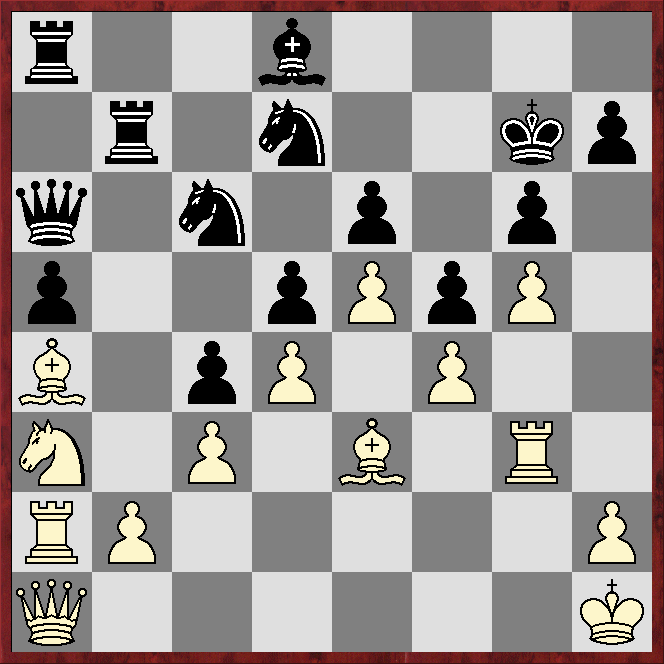
Black to play and win
*****
*****
*****
*****
*****
19...Kxh7?
Both other king moves win, eg 19...Kf8 20.Rb3 Rxe3! 21.Rxe3 Re8 22.Rf3 Rxe3! 23.Rxe3 Qxf4.
20.Qh5+ Kg8 21.Bxd4
White is a pawn up, but Black has full compensation, according to the engines
*****
*****
*****
*****
*****
21...Re4 22.Rbd1
Black to play and fully equalise
*****
*****
*****
*****
*****
22...Rde8
The engines reckon Black had to find 22...Nf8!, when both the bishop and white f pawn are en prise, so the latter falls. The problem with immediately playing 22...Rxf4 is that, after 23.Rxf4 Qxf4 24.Bf2!, the knight is pinned. Play might continue 24...Qb8 25.b5!, when 24...Qxb5 25.Qf5 Qb7 26.Qd3 leaves White up about +4.00, while 24...Ne5 25.b6! axb6 26.cxb6 is also fatal for Black in the long run, according to the engines. However, it is probably fair to say finding quite a few of these moves would tax even masters, never mind club players.
23.g3?!
Probably the wrong way to hold on to the f pawn. Correct, according to the engines, is 23.Qf3 or 23.Qg4.
23...Re2?
The engines reckon Black is equal after moves such as 23...Nf8, 23...a5 and 23...Qb7.
White to play and win
*****
*****
*****
*****
*****
24.Rf2
24.Be5! wins the exchange.
24...g6?
White is a pawn up, but only slightly better, after 24...Re1+ or a retreat such as 24...R2e4, according to the engines.
25.Rxe2!
This is one of most clearly advantageous cases of giving up a queen for two rooks, but even so I was unsure about playing it - perhaps an example of how conditioned chessplayers are to venerate the queen.
25...gxh5 26.Rxe8+
White's advantage is roughly the equivalent of being up a rook (Stockfish18) or up almost a rook and a minor piece (Dragon1).
26...Kg7
This is apparently best, while if 26...Kh7, then 27.Bf2!? is strongest, according to the engines.
27.Re7
Now the knight falls.
27...Qc8 28.Rxd7! Kg6 29.Ba1 1-0

Monday, 12 February 2024

4NCL Weekend Three, Game Two

PLAYED on board two (of six) for Wessex B against Oxford 3 in division four yesterday.

Cameron Davis (1860 ECF/1925 Fide) - Spanton (1916 ECF/1766 Fide)
New London
1.d4 d5 2.Bf4 e6 3.e3 Bd6 4.Qg4!?
There ae only 47 examples of this move in ChessBase's 2024 Mega database, but it scores 60%, three percentage points more than the 1.218 examples of 4.Bg3.
How should Black respond?
*****
*****
*****
*****
*****
4...g6!?
After 4...Nf6 5.Qxg7 Rg8 6.Qh6, Stockfish16 and Komodo14.1 reckon Black does not have enough compensation for a pawn. The text leaves holes on the black kingside, but has the immediate threat of ...e5.
5.Qf3 Bxf4 6.Qxf4 Qd6 7.Ne2!?
This apparent-novelty is liked by the engines. Anthony Atanasov (2189) - Yahli Sokolovsky (2394), Chess.com Blitz 2022, went 7.Qxd6 cxd6 8.h4 Nf6 9.c4 dxc4 10.Bxc4, with an equal game, according to the engines (but 0-1, 45 moves).
7...b6
Black can grab two pawns with 7...Qb4+!? 8.Nbc3 Qxb2 9.Rb1 Qxc2, when 10.Qxc7 Nc6 11.Rc1 Qb2 12.Rb1 Qc2 etc is a perpetual, and 13.Rxb7 Nge7 14.Rb1 is also completely equal, according to the engines. However Stockfish16 comes up with a major improvement in 10.Qe5! f6 11.Qxc7, when 11...Nc6? fails to 12.Qg7. That leaves 11...Ne7, but then 12.Qc5!? seems strong, after which best may be 12...g5!? 13.Rc1 Qb2 14.Nd1 Qb6 15.Qxc8+!? Nxc8 16.Rxc8+ Kf7 17.Rxh8, giving White rook, bishop and knight for queen and pawn. Alternatively Black can sac back the queen with 16...Qd8!? 17.Rxd8+ Kxd8, giving White bishop and knight for rook and pawn, and, according to the engines, again leaving White on top.
8.Qxd6 cxd6 9.Nf4 Ba6 10.Bxa6 Nxa6 11.h4 h5 12.c3 Nh6!? 13.a4 Nc7 14.Na3 Kd7 15.Nb5 a6 16.Nxc7 Kxc7 17.Ke2 ½–½
Oxford 3 won the match 4.5-1.5.

Tuesday, 7 March 2023

Bad Wörishofen Game Four

Spanton (1835) - Frank Baensch (1663)
Modern Defence/Hippopotamus Defence
1.e4 g6 2.d4 d6 3.Nc3 Bg7 4.f4 e6!? 5.Nf3 a6 6.a4 Nd7 7.Be3 Ne7
Black has set up a line of the Hippopotamus Defence, which is itself a specialised version of the Modern Defence
*****
*****
*****
*****
*****
*****
8.Bd3 0-0 9.0-0 c5
Arguably 9...b6 is a purer form of the Hippo, but Stockfish15 and Komodod13.02 marginally prefer the text.
10.Qd2 Qb6!?
This may be a novelty. Bulgarian grandmaster Vasil Spasov (2578) played 10...cxd4 at the 2006 Olympiad in Turin, one point being 11.Bxd4!? runs into 11...Bxd4+!? 12.Nxd4 Qb6 13.Qf2 Qxb2, when it is not clear if White has enough for a pawn.
11.a5 Qc6
Not 11...Qxb2?? 12.Rfb1.
12.Qf2 c4!? 13.Be2 d5 14.e5
The fluid centre has suddenly closed - White's main chances generally lie on the kingside, while Black's lie on the queenside, but both players will need to take counter-measures on the opposite flank
*****
*****
*****
*****
*****
14...f6 15.Qh4!? Nf5 16.Qf2 b6
An obvious alternative is winning the bishop-pair with 16...Nxe3, but that would swop a (currently) well-placed knight for a bad bishop.
17.Bd2!?
Preserving the bishop-pair at the cost of a tempo so g4 will force the black king's knight to retreat.
17...Bb7 18.g4 Nh6!?
The engines prefer 18...Ne7.
How should White respond?
*****
*****
*****
*****
*****
19.Qh4
The engines like sacrificing the queen with 19.exf6!? Nxg4 20.fxg7 Nxf2 21.gxf8=Q+ Rxf8 22.Rxf2, claiming White is winning. Black can avoid this with 19...Nxf6!?, but then 20.Ne5 is even stronger for White, according to the engines.
19...f5?!
The engines reckon 19...Nf7 equalises.
20.g5
Even stronger may be the engines' 20.Ng5.
20...Nf7 21.Ne1 bxa5 22.Rf3 Rfe8 23.Rh3 Nf8 24.Rxa5 Qb6 25.Ra2
Possibly stronger is 25.Na4!?, when 25...Qxd4+?? 26.Be3 traps the black queen as 26...Qe4 is met by 27.Nc5.
25...Bc6
Again 25...Qxd4+?? is met by 26.Be3.
26.Nf3 Re7
In this position FB offered a draw
*****
*****
*****
*****
*****
27.Qe1 a5 28.Qe1 Rea7 29.Na4 Bxa4 30.Rxa4
White has won the bishop-pair, but neither prelate has much scope in this closed position
*****
*****
*****
*****
*****
30...Nd8 31.Kh1 Nc6 32.c3 Rb8 33.Bc1 Qb3 34.Ne1?!
Keeping the black queen out of c2, but White should probably play something like 34.Rg3, and if 34...Qc2 then 35.Rg2 or 35.Nd2.
Has Black a winning combination?
*****
*****
*****
*****
*****
Probably. The winning move seems to be 34...Nxd4!?, when 35.Be3 Nc2 36.Nxc2 Qxc2 37.Bxa7?! runs into 37...Rxb2. Better may be 37.Bd1, but 37...Qe4+ 38.Kg1 Rab7 39.Ra2 d4! is strong, one line being 40.Bd2 (40.Bxd4? Qe1+ 41.Kg2 Qd2+ 42.Kh1 Rxb2) a4! 41.Bf3 Qd3 42.Qc1 dxc3 43.Bxc3 Rb3 with the very nasty threat of ...Rxc3! This is long and sharp, and the engines point out White has an alternative in 35.Ra3!?, when they reckon Black should sacrifice the queen with 35...Nxe2!? 36.Rxb3, claiming 36...Rxb3 leaves Black on top.
34...Nd7 35.Ra3 Qb6 36.Bd1 Bf8 37.Ra2 Be7
One line suggested by the engines runs 37...a4!? 38.Rxa4 Rba8 39.Rxa7 Rxa7 40.Qb1 Qa5, after which White is a pawn up but most of the white pieces are cowering on the back rank.
38.Rg3 Kg7 39.Ba4 Rba8 40.Nc2?!
Probably better is 40.Qb1.
How can Black exploit White's last move?
*****
*****
*****
*****
*****
40...Bd8
The engines give 40...Nb4!? 41.cxb4 axb4 42.b3 Qb7, claiming Black has at least a slight edge despite being a-piece-for-a-pawn down, eg 43.Bd2 Nb6!? 44.Nxb4 Nxa4 45.bxa4 Bxb4 46.Bxb4 Qxb4, after which material equality has been restored and Black has the initiative.
41.Na3 Rb7 42.Be3 Qa6
How should White proceed?
*****
*****
*****
*****
*****
43.h4!
Virtually all the pieces (apart from the kings) are concentrated on the queenside, but White has more central space to facilitate switching flanks.
43...Nf8 44.Qg1 Rab8 45.Qh2 Ne7 46.Bc1 Ng8 47.h5 Kh8 48.hxg6 Nxg6 49.Be8!? Rg7 50.Rh3 Rbb7
Black's defence has held for the present, but White can still probe
*****
*****
*****
*****
*****
51.Qe2 Rbe7 52.Bxg6 Rxg6 53.b3!?
Switching back to queenside play now a black rook and knight are awkwardly placed on the kingside.
53...Rc7 54.bxc4 dxc4 55.Nc2 Qb7+ 56.Kh2 Qb1
For one horrible moment I thought I was losing a piece
*****
*****
*****
*****
*****
57.Ra1 Qb3?
White is much better, according to the engines, after the superior 57...Qb5 or 57...Qb7, but the text drops a pawn for no good reason.
58.Rxa5 Qb6 59.Ra1 Qb3?!
Probably better is 59...Ne7.
60.d5! exd5 61.Nd4 Qb7 62.Nxf5 Ne7 63.Nd6 Qb8 64.f5 Nxf5!?
This is best, according to the engines, but hopeless.
The game finished:
65.Nxf5 Rf7 66.Nd6 Re7 67.Qh5 Rxd6!? 68.exd6 Qxd6+ 69.Kg2 Qe5 70.Re3 Qg7 71.Qe8+!? Rxe8 72.Rxe8+ Qg8 73.Rxg8+ Kxg8 74.Ra8 1-0