Showing posts with label Hippopotamus Defence. Show all posts

Thursday, 7 September 2023

Riviera Round Five

Spanton (1852) - Alan Barton (1888)
1.Nc3/Owen's Defence/Hippopotamus
1.Nc3 e6 2.d4 b6 3.e4 Bb7 4.Bd3 Ne7
Probably not 4...f5?! 5.exf5 Bxg2?! 6.Qh5+ g6 (6...Ke7? Qg5+ and Qxg2) 7.fxg6 Bg7 (7...Nf6? 8.g7+ Bxh1 9.Qxh7) 8.gxh7+ Kf8, after which 9.hxg8=Q+?! is most popular in ChessBase's 2023 Mega database, but Stockfish16 and Komodo14.1 reckon White should get on with development, eg 9.Nf3!? Nf6 10.Qh4 Bxh1 11.Ne5!, as in Michael Yeo (2170) - Arnold Mundal (1937), European Team Senior Championship, Dresden 2013, which finished quickly: 11...Nc6 12.Bg5 Qe8 13.Bxf6 Nxe5 14.Bxg7+ Kxg7 15.dxe5 Qf8? 16.Qg5+ 1-0.
5.Nf3 g6 6.Bg5 Bg7 7.Qd2 h6 8.Be3 d6 9.0-0-0!?
As is fairly well-known, it can be dangerous to castle early in closed positions, and while this position is not closed it is certainly not open either - however Black cannot easily castle kingside without losing the h6 pawn, so I decided castling long was OK
*****
*****
*****
*****
*****
9...Nd7 10.h4 a6
Black's setup with fianchettoed bishops and the knights on d7 and e7 is known as the Hippopotamus - the engines reckon White is slightly better
*****
*****
*****
*****
*****
11.Rhe1 Nf6 12.Nh2
Not just preventing ...Ng4, but also preparing kingside expansion.
12...Qd7 13.Kb1 b5 14.f3 0-0-0
How would you assess the position now both sides have castled?
*****
*****
*****
*****
*****
White's extra space gives more manoeuvring room, and the white king is probably safer, but pieces and pawns are yet to come into action and there are lots of ideas available to both players. The engines reckon White has the upper hand.
15.g4 h5 16.g5 Ne8 17.f4?!
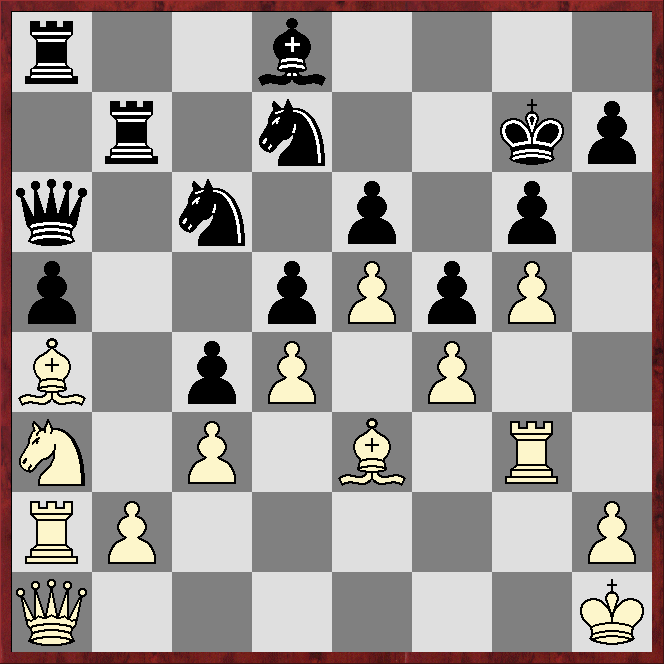
The engines much prefer 17.Ne2 or 17.Be2.
Black to play and at least equalise, according to the engines
*****
*****
*****
*****
*****
17...Kb8
The engines give 17...d5!?, and if, as happens in the game next move, it is met by e5, then 18...c5!? seems to work as 19.dxc5!? runs into 19...d4, although this is not completely clear after 20.Be4 Bxe4 21.Nxe4 dxe3 22.Qc1. Instead of 18.e5, which is liked by Komodo14.1, albeit with the intention of meeting 18...c5!? with 19.a3 or 19.Bf1, Stockfish16 gives 18.exd5 Nxd5 19.Nxd5 Bxd5, but claims Black is slightly better (Komodo14.1 reckons the position is equal). Some of the lines are quite sharp, and especially seem so after the quiet start to the game, but 17...d5!? seems promising.
18.Qf2 d5 19.e5 Nc6
Not 19...c5? 20.dxc5 d4 as White has 21.Be4.
20.Bd2
To discourage ...Na5.
20...Bf8
Black can play ...Na5 as a positional pawn sacrifice, but 21.Nxb5 Nc4 22.Nc3 almost certainly leaves Black with insufficient compensation.
21.Nf3 Ng7 22.Ne2 Rc8 23.Nc1 Nb4!? 24.Bxb4 Bxb4 25.c3 Be7 26.Nb3 Qc6!? 27.Na5 Qb6 28.b4 Bc6 29.Qe2 Bd7
Threatening to relieve some of the pressure with 30...c5!
30.Nb3 Rhd8 31.Kb2 c6 32.Ra1 Rc7 33.a4 Ra7 34.Ra2 Rc8?!
Probably better is 34...Kc7, meeting 35.Rea1 with 35...Rda8.
35.Rea1 Rcc7 36.Nc5 Kc8
Not 36...Bxc5? 37.dxc5 Qb7 38.axb5 etc.
37.Nd2 Kd8 38.Ndb3 Bc8 39.Na5 Ke8?!
The engines reckon Black should play something like 39...Bd7, but reckon White is positionally winning. The text allows a combination.
White to play and win
*****
*****
*****
*****
*****
40.Nab7?
Very strong is 40.Nxc6!, eg 40...Rxc6 41.axb5 Rcc7 42.Na4 and 43.b6. Other moves, for example 40.Ra3, maintain White's pressure.
40...Raxb7!?
If 40...Bxb7? then 41.a5 traps the black queen, although after 41...Qxc5 it is not clear if White can break through, But better than the text, which allows White an extra option, may be 40...Rcxb7 41.Nxb7 Bxb7, which is a transposition to the game.
41.Nxb7
White may have an edge after the engines' 41.axb5!? Rb8 42.Nxa6 Bxa6 43.Rxa6 Qb7 44.bxc6 Rxc6 45.Ra7 Qc8 46.Ba6.
41...Rxb7 42.a5 Qd8 43.Qc2 Nf5 44.Bxf5 exf5 45.Re1 Be6 46.Raa1 ½–½
The engines reckon Black has the upper hand, but there seems no way for Black to break out of the pawn-chain.

Monday, 8 May 2023

ACO 65+ Game Six

Spanton (1804) - Robert Kane (1745)
Modern Defence (Hippopotamus)
1.e4 d6 2.d4 g6 3.Nc3 a6!? 4.f4 Bg7 5.Nf3 Nd7
The Hippopotamus commonly features Black fianchettoing the bishops and developing the knights to d7 and e7. Meanwhile pawns are pushed forward one square, and Black in general waits to see how White sets up, particularly in regard to where the white king goes. Much more popular after 5.Nf3 in ChessBase's 2023 Mega database is 5...b5, but that would not be a Hippopotamus.
6.Bc4 e6
As RK pointed out afterwards, Black must defend against the threat of 7.Bxf7+!, when 7...Kxf7 loses the queen after both 8.Ke8 Ne6 and 8.Kf8 Ne6+, while even worse is 7...Kf6? 8.Nd5#.
7.a4
Even stronger seems to be 7.f5!?, eg 7...Nb6 8.fxg6!?, when 8...Nxc4?! 9.gxf7+ Kxf7 10.0-0 gives a winning attack, according to the engines.
7...h6!?
There is just one example of this move in Mega23. Meanwhile 7...Ne7, which appears 33 times, scores 56%.
8.a5
Anantha Anulkumar (1932) - Grinath Haridas (1977), British Championship 2017 (Llandudno), went 8.0-0 Ne7 10.Be3 b6 11.Qe2 0-0 with a slight edge to White, according to Stockfish15.1 and Komodo14.1, although the game was agreed drawn after just six more moves.
How should Black proceed?
*****
*****
*****
*****
*****
8...b5!?
More in keeping with the Hippopotamus is 8...Ne7. Indeed, purists would probably say the the game has left the realm of the Hippopotamus. The engines narrowly prefer the 'pure' hippo move.
9.axb6 Nxb6 10.Bd3 Bb7 11.0-0
Committing the king to the kingside, now that the queenside looks unsafe for either monarch.
11...Nf6 12.f5!? exf5 13.exf5 g5
Leaving the f5 pawn to blunt the white bishop, while also creating the possibility of using the black g pawn as a spearhead in an attack on the white kingside.
14.Re1+
Which way should the black king go?
*****
*****
*****
*****
*****
14...Kf8
RK said he rejected 14...Kd7 because of 15.Ne5+!? After the forced 15...dxe5 16.dxe5 Black can hardly save the king's knight by 16...Nfd5?! as 17.Nxd5 Nxd5 18.f6 Bf8 19.Bf5+ gives White a winning attack, according to the engines.
15.Qe2 Qd7!?
Komodo14.1 prefers this over attempts to save the a pawn, but Stockfish15.1 quite likes 15...a5.
16.Bxa6 g4!?
White's king's knight becomes sidetracked after this, but enters the vicinity of the black king, and Black remains a pawn down. Instead 16...Bxa6 17.Rxa6 Rxa6 18.Qxa6 Qxf5 is slightly better for White, according to the engines.
17.Nh4 c6?!
This time the engines reckon ...Bxa6 is definitely better.
18.Be3 Kg8 19.Bxb7 Qxb7
The engines prefer first exchanging rooks and then capturing on b7.
20.Rxa8+ Qxa8 21.Qd3 Kh7 22.Bf4 Qd8
The engines prefer 22...Re8!?, one point being 23.Rxe8 Qxe8 24.Bxd6?? loses to 24...Qe1+ 25.Qf1 Qxh4.
23.Ne4!? Nxe4?
Much better is 23...Re8, with complete equality (Stockfish15.1) or at worst a slight disadvantage (Komodo14.1).
24.f6 Re8 25.Rxe4 Rxe4 26.Qxe4+ Kg8 27.Nf5 Qxf6 28.Ne7+?
White is winning after 28.Bxd6, according to the engines.
28...Kf8 29.Nf5 d5 30.Qd3 Nc4?
Much better is 30...Qe6.
31.b3 Nb2
There is nothing better as 31...Nb6, for example, is met by 32.Be5.
What should White play?
*****
*****
*****
*****
*****
32.Qc3??
This turns a winning position into a losing one. Correct is 32.Qf1, rounding up the trapped black knight later, and if 32...Qxf5?? then 33.Bd6+ etc.
32...Qxf5 33.Bd6+ Kg8 34.Qxb2 Qe4
Threatening mate in one.
35.Qc1 Qxd4+ 36.Kf1 Qa1
The engines prefer a less-committal move, such as 36...Kh7.
37.Qxa1 Bxa1 38.Ke2
How should Black continue?
*****
*****
*****
*****
*****
38...Kg7?
This natural-looking move throws away the win, according to the engines, which like 38...f5. The problem with the text will quickly become clear.
39.Kd3 Kf6!?
This is OK, according to the engines, but it makes sense to save the black bishop, for example by 39...Bb2 etc. However, after 40.c3 Bc1 comes 41.Kd4 with good counterplay.
40.c3
The black bishop is trapped, but the game is completely equal, according to the engines
*****
*****
*****
*****
*****
40...h5 41.Bc5 Ke5 42.Bd4+ Kd6 43.b4
Black to play and draw
*****
*****
*****
*****
*****
43...Bb2?
Both 43...g3!? and 43...Ke6 draw, according to the engines, eg 43...g3!? 44.hxg3 Ke6 45.Kc2 Kf5 46.Kb1 Kg4 47.Kxa1 Kxg3 48.Bf6 Kxg2 49.Kb2 Kg3 50.Kc2 h4 51.Kd3 h3 52.Be5+ Kg2 53.Kd4 f5 54.Ke3 h2 55.Bxh2 Kxh2 56.Kf4 Kg2 57.Kxf5 Kf3 58.Ke5 Ke3 59.Kd6 Kd3 60.Kxc6 Kxc3 etc.
44.Kc2 Ba3 45.Be3 c5?
This makes White's task easier.
46.Bxc5+ Ke5
Or 46...Kc6 47.Be3 Kb5 48.Kb3 d4 49.c4+ and Bd2.
47.Be3 Ke4 48.Bh6 f5 49.Kb3 d4
Or 49...Bxb4 50.cxb4 f4 51.Bxf4! Kxf4 52.b5 Ke5 53.g3 d4 54.b6 Kd6 55.Kc4 etc.
50.Kxa3 d3 51.g3 h4 52.b5 Kf3 53.b6 hxg3 54.hxg3 Kxg3 55.b7 1-0

Tuesday, 7 March 2023

Bad Wörishofen Game Four

Spanton (1835) - Frank Baensch (1663)
Modern Defence/Hippopotamus Defence
1.e4 g6 2.d4 d6 3.Nc3 Bg7 4.f4 e6!? 5.Nf3 a6 6.a4 Nd7 7.Be3 Ne7
Black has set up a line of the Hippopotamus Defence, which is itself a specialised version of the Modern Defence
*****
*****
*****
*****
*****
*****
8.Bd3 0-0 9.0-0 c5
Arguably 9...b6 is a purer form of the Hippo, but Stockfish15 and Komodod13.02 marginally prefer the text.
10.Qd2 Qb6!?
This may be a novelty. Bulgarian grandmaster Vasil Spasov (2578) played 10...cxd4 at the 2006 Olympiad in Turin, one point being 11.Bxd4!? runs into 11...Bxd4+!? 12.Nxd4 Qb6 13.Qf2 Qxb2, when it is not clear if White has enough for a pawn.
11.a5 Qc6
Not 11...Qxb2?? 12.Rfb1.
12.Qf2 c4!? 13.Be2 d5 14.e5
The fluid centre has suddenly closed - White's main chances generally lie on the kingside, while Black's lie on the queenside, but both players will need to take counter-measures on the opposite flank
*****
*****
*****
*****
*****
14...f6 15.Qh4!? Nf5 16.Qf2 b6
An obvious alternative is winning the bishop-pair with 16...Nxe3, but that would swop a (currently) well-placed knight for a bad bishop.
17.Bd2!?
Preserving the bishop-pair at the cost of a tempo so g4 will force the black king's knight to retreat.
17...Bb7 18.g4 Nh6!?
The engines prefer 18...Ne7.
How should White respond?
*****
*****
*****
*****
*****
19.Qh4
The engines like sacrificing the queen with 19.exf6!? Nxg4 20.fxg7 Nxf2 21.gxf8=Q+ Rxf8 22.Rxf2, claiming White is winning. Black can avoid this with 19...Nxf6!?, but then 20.Ne5 is even stronger for White, according to the engines.
19...f5?!
The engines reckon 19...Nf7 equalises.
20.g5
Even stronger may be the engines' 20.Ng5.
20...Nf7 21.Ne1 bxa5 22.Rf3 Rfe8 23.Rh3 Nf8 24.Rxa5 Qb6 25.Ra2
Possibly stronger is 25.Na4!?, when 25...Qxd4+?? 26.Be3 traps the black queen as 26...Qe4 is met by 27.Nc5.
25...Bc6
Again 25...Qxd4+?? is met by 26.Be3.
26.Nf3 Re7
In this position FB offered a draw
*****
*****
*****
*****
*****
27.Qe1 a5 28.Qe1 Rea7 29.Na4 Bxa4 30.Rxa4
White has won the bishop-pair, but neither prelate has much scope in this closed position
*****
*****
*****
*****
*****
30...Nd8 31.Kh1 Nc6 32.c3 Rb8 33.Bc1 Qb3 34.Ne1?!
Keeping the black queen out of c2, but White should probably play something like 34.Rg3, and if 34...Qc2 then 35.Rg2 or 35.Nd2.
Has Black a winning combination?
*****
*****
*****
*****
*****
Probably. The winning move seems to be 34...Nxd4!?, when 35.Be3 Nc2 36.Nxc2 Qxc2 37.Bxa7?! runs into 37...Rxb2. Better may be 37.Bd1, but 37...Qe4+ 38.Kg1 Rab7 39.Ra2 d4! is strong, one line being 40.Bd2 (40.Bxd4? Qe1+ 41.Kg2 Qd2+ 42.Kh1 Rxb2) a4! 41.Bf3 Qd3 42.Qc1 dxc3 43.Bxc3 Rb3 with the very nasty threat of ...Rxc3! This is long and sharp, and the engines point out White has an alternative in 35.Ra3!?, when they reckon Black should sacrifice the queen with 35...Nxe2!? 36.Rxb3, claiming 36...Rxb3 leaves Black on top.
34...Nd7 35.Ra3 Qb6 36.Bd1 Bf8 37.Ra2 Be7
One line suggested by the engines runs 37...a4!? 38.Rxa4 Rba8 39.Rxa7 Rxa7 40.Qb1 Qa5, after which White is a pawn up but most of the white pieces are cowering on the back rank.
38.Rg3 Kg7 39.Ba4 Rba8 40.Nc2?!
Probably better is 40.Qb1.
How can Black exploit White's last move?
*****
*****
*****
*****
*****
40...Bd8
The engines give 40...Nb4!? 41.cxb4 axb4 42.b3 Qb7, claiming Black has at least a slight edge despite being a-piece-for-a-pawn down, eg 43.Bd2 Nb6!? 44.Nxb4 Nxa4 45.bxa4 Bxb4 46.Bxb4 Qxb4, after which material equality has been restored and Black has the initiative.
41.Na3 Rb7 42.Be3 Qa6
How should White proceed?
*****
*****
*****
*****
*****
43.h4!
Virtually all the pieces (apart from the kings) are concentrated on the queenside, but White has more central space to facilitate switching flanks.
43...Nf8 44.Qg1 Rab8 45.Qh2 Ne7 46.Bc1 Ng8 47.h5 Kh8 48.hxg6 Nxg6 49.Be8!? Rg7 50.Rh3 Rbb7
Black's defence has held for the present, but White can still probe
*****
*****
*****
*****
*****
51.Qe2 Rbe7 52.Bxg6 Rxg6 53.b3!?
Switching back to queenside play now a black rook and knight are awkwardly placed on the kingside.
53...Rc7 54.bxc4 dxc4 55.Nc2 Qb7+ 56.Kh2 Qb1
For one horrible moment I thought I was losing a piece
*****
*****
*****
*****
*****
57.Ra1 Qb3?
White is much better, according to the engines, after the superior 57...Qb5 or 57...Qb7, but the text drops a pawn for no good reason.
58.Rxa5 Qb6 59.Ra1 Qb3?!
Probably better is 59...Ne7.
60.d5! exd5 61.Nd4 Qb7 62.Nxf5 Ne7 63.Nd6 Qb8 64.f5 Nxf5!?
This is best, according to the engines, but hopeless.
The game finished:
65.Nxf5 Rf7 66.Nd6 Re7 67.Qh5 Rxd6!? 68.exd6 Qxd6+ 69.Kg2 Qe5 70.Re3 Qg7 71.Qe8+!? Rxe8 72.Rxe8+ Qg8 73.Rxg8+ Kxg8 74.Ra8 1-0

Friday, 28 May 2021

Calvià (part eight)

Spanton (1793) - Enrique Fernando Asensio Ramos (2070)
Calvià U2350 Round 8
Hippopotamus Defence
1.e4 g6 2.Nc3 Bg7 3.Nf3 a6
Eight games reach this position in ChessBase's 2021 Mega database, but none saw:
4.a4
However we return to theory after ...
4...b6 5.d4 Bb7 6.Bc4
... when this move reaches a position my analysis engines Stockfish13 and Komodo12.1.1 reckon is very favourable for White, although 6.Bc4 scores just 33% in Mega21.
6...h6 7.h3
Again the game leaves known theory, although not for long.
My idea with the text was to rule out Black playing ...Nf6-g4. Stockfish13 gives White the upper hand; Komodo12.1.1 has White slightly better.
6...e6 8.Bf4 d6 9.Qd2 Ne7 10.h4!?
With g4 unlikely to be visited by a black piece any time soon, or so I thought, it seemed fine to use the h pawn to gain kingside space.
10...Nd7
A picturesque position after 10...Nd7
11.b4!?
Once again leaving known theory, and this time for good. Known moves are 11.0-0, 11.0-0-0 and 11.Kf1!?
11...Nf6 12.Bd3 Ng4
So a black piece occupies g4 after all. The position is dead-equal, according to the engines.
13.a5!?
The engines dislike this, preferring 13.0-0.
13...b5 14.Rd1 0-0 15.0-0 Qc8 16.Ne2 Rd8 17.h5!? e5 18.Be3
I wanted to play 18.hxg6!? exf4 19.gxf7+ Kxf7 20.Nxf4, but did not believe it. However the engines reckon Black's exposed king gives White more than enough compensation. Indeed they reckon Black should reject the piece sacrifice and instead play 18...fxg6, 18...Nxg6 or 18...f5.
18...f5 19.exf5?
The engines give 19.d5, and if 19...f4 they reckon 20.Bxf4 exf4 21.Nxf4 again gives White good compensation. But in this line they like 19...c6 or 19...Rf8.
19...e4 20.Bxe4 Bxe4 21.fxg6
White has three pawns for a bishop, whereas in previous lines he only had two, but the engines reckon here Black is clearly winning.
21...Rf8 22.Nf4?!
Better, according to the engines, is 22.Nh4, 22.Bf4 or even 22.Ng5!?
22...Nd5 23.Ne1 Qf5 24.Nxd5 Bxd5 25.f3 Rae8 26.fxg4!?
It is hard to come up with anything significantly better.
26...Qxf1+ 27.Kh2 Rxe3!? 28.Qxe3 Rf2 29.Rd2 Rxd2 30.Qxd2 Bf6 31.Qxh6?
This speeds the end, which came after:
31...Qxe1 32.Qh7+ Kf8 33.g7+ Bxg7 34.Qf5+ Bf7 35.Kh3 Qe3+ 36.Kh4 Qe1+ 37.Kh3 Qh1+ 38.Kg3 Bxd4 39.Qe4 Be5+ 40.Kf2 Qh4+ 0-1

Sunday, 31 March 2019

Championship Clash

CONTINUING to go through the October 2005 edition of Chess magazine, I came across this interesting opening from round eight of the British Championship.
Andrew Greet (2425) - Stuart Conquest (2503)
Hippopotamus Defence, 150 Attack
1.d4 g6 2.e4 Bg7 3.Nc3 d6 4.Be3
Greet comments: "I have always enjoyed playing the '150 Attack' against the Pirc and Modern, although I get the feeling that Black should be OK if he plays precisely."
4.Be3 has been played by Kasparov, Anand and many other strong players, and is easily the most popular move in ChessBase's 2019 Mega database.
4...a6 5.Nf3 Nd7
Greet: "I found this to be a slightly annoying move order."
6.Bc4
Greet: "Usually 6.Bd3 would be the preferred square, but after the specific move-order chosen by Black I was slightly concerned about 6...c5!? 7.d5 (otherwise Black gets a fairly comfortable Dragon after ...cxd4 as my bishop would be misplaced on d3) 7...b5 with unclear play."
Most popular is 6.Qd2, which is thematic for the 150 Attack, but the analysis engines Stockfish10 and Komodo9 much prefer Greet's move.

Greet says "Black must do something about the threat of Bxf7+," but is he right?
*****
*****
*****
*****
*****
Yes.
6...e6
Out of 87 games in Mega19, 78 feature this move.
The point is that the 'natural-looking' 6...Ngf6? runs into 7.Bxf7+! (the preliminary 7.e5 is also good) Kxf7 8.Ng5+. Now 8...Ke8 and 8...Kf8 lose the queen to 9.Ne6+. That leaves 8...Kg8, but after 9.Ne6+ Qe8 10.Nxc7 Qd8 11.Nxa8, White has a rook and two pawns for a bishop. True, White's a8 knight looks doomed, and Black has the bishop-pair, but White must be much better.
How should the game proceed?
*****
*****
*****
*****
*****
Stockfish10 and Komodo9 agree the main line would go 11...b5 12.e5 Bb7!? (12...Ne8 13.Qf3 is even worse, according to the engines, but might be the best practical chance in a game between humans) 13.exf6 Nxf6 14.f3 Qxa8, when White is an exchange and a pawn up.
Going back to the position after 12.e5, I think the best practical chance would be 12...Ne8, but after 13.Qf3 it is far from clear that Black will after all win the knight on a8.
After the game's 6...e6, play continued:
7.a4 b6 8.0-0 Ne7 9.Qd2 h6 10.h3 Bb7 11.Rfe1 Nf6 12.Bf4?!
This may be a mistake as it gives Black a tempo for kingside play. The engines much prefer 12.d5 or 12.Bd3!?
12...g5!
Greet's punctuation.
13.Bh2 g4 14.hxg4 Nxg4 15.Bg3
Four years later the game Anh Dung Nguyen (2500) - Huan Hoang Canh (2378), Vietnamese Championship qualifier, was agreed drawn here, suggesting strong players very much like Black's kingside attacking chances. Stockfish10 reckons the position is dead equal, while Komodo9 prefers White.
15...Ng6 16.Nh2?!
The engines reckon this is a mistake, wanting White to get on with it in the centre or on the queenside.
16...h5 17.Rad1 Kf8!?
This seems to be almost a waiting move. I guess Conquest wanted to get his king off the central files to give himself more flexibility in case of White playing d5 or e5.
18.Qe2 Qg5 19.Nf3 Qe7 20.Nh2!?
This is the engines' choice, but it means Black has developed his queen to e7 without loss of tempo.
20...Nf6 21.Nf1?!
The engines still want White to get on with it in the centre, giving 12.e5 with unclear play.
21...h4
Stockfish10 at first gives Black a winning advantage after this move, but given sufficient time it slowly comes to have Black as just slightly better. Komodo9 also prefers Black, but only by about a fifth of a pawn.
22.Bh2 Bh6?!
Komodo9 prefers Greet's suggestion of 22...h3, when best seems to be the horrible-looking 23.g3, but Stockfish10 reckons Black has time to consolidate his queenside with 22...a5.
The frequent differences in the engines' evaluations highlight how unclear these positions can be (even as I type this, Stockfish10 comes round to liking 22...h3, at one point reckoning it gives Black a winning advantage).
23.Qf3 Nh7
Greet says 23...Kg7 was better. The engines give 23...h3!? or 23...Bg5, but disagree on how much Black is better (if at all).
24.Qh5
Greet is harsh on this, saying he should have played 24.Rd3. The engines are not so sure.
24...Nf6 25.Qf3 Kg7 26.Qh3
Greet calls this "quite a senseless move," but does not give an alternative, and it is Komodo9's second-choice (behind continuing redeployment of the king's knight with 26.Ne3).
26...Rag8!
Neither engine suggests this move, but, once shown it, Stockfish10 comes to very much rate it. I give it an exclamation mark because of the engines' initial indifference, but to me it looks like the type of move many club players would instinctively choose.
27.d5?
"This achieves nothing," says Greet. Perhaps more importantly, it allows Black to seal the centre, which is the normal source of counterplay when an opponent is attacking down a flank.
27...e5 28.Ne3
How should Black proceed?
*****
*****
*****
*****
*****
*****
28...Bxe3!
Giving up his bad-but-active bishop in a position that does not seem promising for White's bishop-pair. On top of this, Conquest has seen a tactical point.
29.fxe3?
This loses an exchange (can you see how?) but, as Greet says, 28.Qxe3 Ng4 "would have left Black well and truly in control."
29...Bc8 30.Qf3 Bg4 (0-1, 49 moves)

Tuesday, 5 March 2019

Longest Decisive Game Without A Capture (continued)

WHAT grandmaster Larry Evans apparently did not know when writing his column for the October 2001 edition of Chess Life was that the record set in 1993 for the longest decisive game without a capture had been beaten by a couple of unrateds not long after it was set.
Reinhard Nuber - Roland Keckeisen
Oberschwaben B 1994
Hippopotamus Defence
1.e4 b6 2.d4 e6 3.Bd3 Bb7 4.Nf3 g6 5.0-0 Bg7 6.Nbd2 Nge7 7.Re1 0-0 8.Nf1 d6 9.Qe2 Nd7 10.Bg5 Qe8 11.Rad1 a5 12.c3 Rc8 13.Ng3 Kh8
A typical-looking Hippo
White has completed his development, including bringing his rooks to the centre files, without allowing himself to be provoked into overreaching.
Black presumably hopes White will present a target. Meanwhile he quietly manoeuvres with his pieces on the back two ranks. He has no obvious weaknesses, but is passive and lacks space.
14.Qd2 Ng8 15.h3 e5 16.Bc2 h6 17.Be3 Rd8 18.Nh2 Kh7 19.f4
White is at last ready to take some action on the kingside. This is often the critical point in Hippo games.
19...f6
My main analysis engines strongly dislike the text, but reckon White is better anyway after 19...c5  (Stockfish10) or 19...Ngf6 (Komodo9). They also reckon 19...Qe7 keeps White's advantage within manageable bounds.
20.Qf2 Ne7 21.Rd2 Rh8 22.f5
This has been in the air since White's 19th move. It is clear Black's king is less safe.
22...g5 23.Bd1 Rb8!? 24.Bh5 Qf8
More consistent with Black's last move was 24...Qd8 or 24...Qc8.
25.Ng4
An immediate 25.Bg6+ was possible, taking advantage of Black's undefended knight at d7, eg 25...Nxg6 26.fxg6+ Kg8 (26...Kxg6 27.Qf5+ etc) 27.Qe2 with a very strong attack.
25...Ba6 26.Red1 b5 27.b4 a4 28.a3 Bb7 29.Rd3 Nc6?
This allows mate. Black was positionally lost anyway, but should have made White prove it.
30.Bg6+ Kg8 31.Qa2+ 1-0
This beats the Gual Pascual - Bates game by one half-move. But Bates still holds the record for the longest decisive game won by Black without a capture...unless someone knows otherwise.