Showing posts with label Larry Evans. Show all posts

Monday, 10 June 2024

I Am #1! (part three)

THERE is a silly but fun pastime at the end of a college football season in the United States where boosters of even the lowliest university set out to prove that their school is really number one or, as it is usually written, #1!
For example, in 2022 the national championship game was won by the team I support, Georgia Bulldogs.
But during the season they lost to Alabama Crimson Tide, who in turn had lost to Texas A&M, who lost to Mississippi State, who lost to Memphis Tigers, etc, etc.
Eventually the chain leads to one of the lowliest teams in the land, which can thus make a claim to be #1!
It is possible to play a similar game in chess, by which you trace your wins up to a victory over a reigning world champion, thus putting yourself in position to claim, however far-fetched the claim may be, to be #1!
The third link in my chain comes from round five of the 1951 Wertheim Memorial, New York.

Max Euwe - Larry Evans
Queen's Indian
1.d4 Nf6 2.c4 e6 3.Nf3 b6 4.g3 Bb7 5.Bg2 Be7 6.0-0 0-0 7.Nc3 Ne4 8.Qc2 Nxc3 9.Qxc3
There are 4,629 examples of this position in ChessBase's 2024 Mega database
*****
*****
*****
*****
*****
9...f5
This is the commonest move in Mega24, narrowly ahead of 9...c5.
10.Ne1!?
But this invitation to exchange light-square bishops is only sixth-most popular in Mega24. It seems to have been introduced into master play at Carlsbad 1929 by Karl Glig against Euwe.
10...Bxg2 11.Nxg2 Bf6
Euwe played 11...Qe8, drawing in 31 moves.
12.Be3 d6!?
This seems to have been a novelty, and makes no other appearance in Mega24, but seems reasonable.
13.Qc2 Qc8 14.Nf4 c6 15.Qb3 g5!? 16.Nh5 Be7 17.c5!? d5!? 18.cxb6 axb6
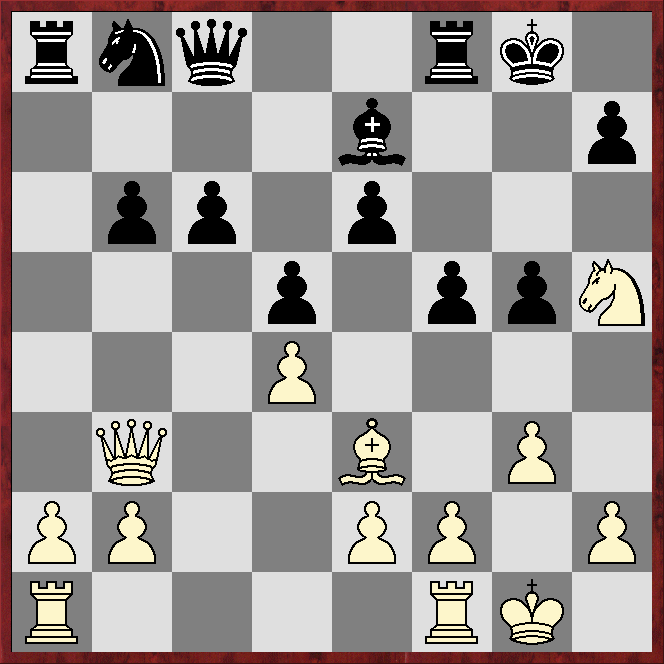
How should White proceed?
*****
*****
*****
*****
*****
19.f3!?
After 19.Qxb6!? c5 20.dxc5 Nc6 Black's queenside pressure, combined with White's out-of-play knight, gives more than enough compensation for two pawns, according to Stockfish16 and Komodo14.1. However the engines reckon White should prefer 19.Rac1 or 19.a4, slowing Black's queenside play.
19...Nd7
Black is at least slightly better after 19...c5, according to the engines.
20.g4!? Qa6 21.Qc2 Qc4!? 22.Qxc4 dxc4 23.f4 fxg4 24.fxg5 Rxf1+ 25.Kxf1 b5
How would you assess this ending?
*****
*****
*****
*****
*****
It looks a mess, and it may well be the players were unsure who stood better, but the engines give Black the upper hand.
26.Kg2 Nb6 27.Kg3 b4 28.Kxg4 b3 29.d5?
Activating the bishop, but at too high a cost. The engines suggest 29.a4, or retreating the bishop to d2 or c1.
29...Nxd5 30.Bd4 bxa2 31.Nf6+ Bxf6 32.gxf6 Nb4
White is busted
*****
*****
*****
*****
*****
33.Kf4 Kf7 34.Be5 Nc2 35.Rd1 a1=Q 36.Rd7+ Ke8 37.Re7+ Kf8 38.Rxh7 Qf1+ 39.Kg3 Qf5 0-1

Sunday, 9 June 2024

I Am #1! (part two)

THERE is a silly but fun pastime at the end of a college football season in the United States where boosters of even the lowliest university set out to prove that their school is really number one. or, as it is usually written, #1!
For example, in 2022 the national championship game was won by the team I support, Georgia Bulldogs.
But during the season they lost to Alabama Crimson Tide, who in turn had lost to Texas A&M, who lost to Mississippi State, who lost to Memphis Tigers, etc, etc.
Eventually the chain leads to one of the lowliest teams in the land, which can thus make a claim to be #1!
It is possible to play a similar game in chess, by which you trace your wins up to a victory over a reigning world champion, thus putting yourself in position to claim, however far-fetched the claim may be, to be #1!
The second link in my chain comes from the 12th round of the 1948 US Open at Baltimore, Maryland.

Larry Evans - George Kramer
Queen's Pawn Game
1.d4 d5 2.Nf3 Nf6 3.g3 g6 4.c4 dxc4!?
This may have been a novelty. Known moves were 4...Bg7 and 4...c6.
5.Bg2 Bg7 6.0-0 0-0 7.Na3
There are 4,328 examples of this position in ChessBase's 2024 Mega database
*****
*****
*****
*****
*****
7...Nbd7 8.Nxc4 c6 9.b3 Nb6 10.Nce5 Nfd7 11.Bb2
Stockfish16 and Komodo14.1 reckon 11.Nd3!? leaves White with the upper hand.
11...Nxe5 12.Nxe5 Nd7 13.Nd3 Qb6 14.e3 Re8 15.Qc2 e5 16.dxe5 Nxe5 17.Nxe5 Bxe5 18.Bxe5 Rxe5
Now the flurry of tactics is over, who stands better?
*****
*****
*****
*****
*****
The engines reckon the position is completely equal.
19.Rfd1 Bf5 20.Qb2 Rae8 21.Rd2 Qc7 22.Rad1 c5!?
Gaining space, but White's light-square bishop was biting on granite before this.
23.Rd6 Qe7 24.Qd2 Kg7 25.Qc3 Kg8 26.R1d2 b6 27.Bc6 Rc8 28.e4
How should Black proceed?
*****
*****
*****
*****
*****
28...Bh3?!
The engines reckon Black had to find 28...Re6! 29.Rd7 Qf6, although they prefer White.
29.f4
The engines' 29.Bd5! is strong, eg 29...Rf8 30.f3 Re8 31.Bc4 Bc8 32.h4, when White's more-active heavy pieces and kingside majority pose Black problems.
29...Re6 30.Rxe6 Bxe6 31.Bb5 Rf8 32.Bf1 Bg4 33.Bg2 Be6 34.Bf1 Re8 35.Bg2 Rb8 36.Bf1 Rf8 37.Bg2 Rc8 38.Bf1 Rb8 39.Bg2 Rf8 40.Bf1 Rb8 41.Bb5!?
After much inconsequential toing-and-froing, White decides to play on.
41...Rf8 42.Bc6!?
The engines suggest 42.Qd3.
42...Rc8
Black gets an edge after 42...c4!? (threatening to win the white bishop by 43....Qc5+ etc) 43.Bd5 Bxd5 44.exd5 Qe1+ 45.Kg2 Re8, although the engines' 46.d6! seems to hold, eg 46...Re2+ 47.Rxe2 Qxc3?? loses to 47.d7 etc. So the engines give 46...cxb3! 47.Qb2 (47.axb3?? loses as now 47...Re2+ 47.Rxe2 Qxc3 48.d7 loses to 48...Qc6+ and 49...Qxd7) bxa2, when 48.d7 Rd8 49.Qxa2 Qe4+ leaves Black with at least the better part of equality.
43.Bd5 Bxd5 44.exd5 Qe1+ 45.Kg2 Re8
The engines agree the position is completely equal, but it is a position in which a mistake is easilly made
*****
*****
*****
*****
*****
46.Qc2 Qe4+!?
Keeping queens on may be more circumspect.
47.Qxe4 Rxe4 48.d6 Re8 49.Kf3
The engines reckon 49.g4!? may give a tiny pull.
49...f5 50.d7 Rd8
What should White play?
*****
*****
*****
*****
*****
51.Rd1?
The engines reckon 51.g4 maintains complete equality.
51...Kf7 52.Ke3?!
It is not clear if White can save the game, but he had to generate counterplay for the coming loss of the d pawn, eg 52.g4, although 52...fxg4+ 53.Kxg4 Ke6 is good for Black.
52...Ke6 53.a4 Rxd7 54.Ra1 Rd4 55.a5 Rb4 56.Rb1 Kd5 57.Kd3?!
White is lost anyway, but this allows a simple combination.
57...Rxb3+ 58.Rxb3 c4+ 0-1

Tuesday, 3 October 2023

Refuting The King's Gambit IV

NOT withstanding his Bust of the King's Gambit in The American Chess Quarterly, Fischer had a surprise in store two years later when he faced Larry Evans, one of the driving forces behind the magazine.

Fischer - Evans
US Championship (New York) 1963
King's Gambit
1.e4 e5 2.f4!? exf4 3.Bc4!?
Fischer's choice of the Bishop's version of the King's Gambit over the much-more popular Knight's could hardly have been predicted by Evans, who responded with the principled:
3...Qh4+
The point of White's beginnerish-looking play is that after ...
4.Kf1
... White will gain time hitting the black queen.
4...d6 5.Nc3!?
According to Viktor Bologan in Bologan's Black Weapons In The Open Games (New In Chess 2014), "Fischer was not satisfied with this move, mostly because he was caught by surprise when Black answered with ..."
5...Be6
... which Bologan awards an exclamation mark.
Unfortunately Bologan does not explain how Fischer would have varied, and the latter's games in ChessBase's 2023 Mega database are no help as subsequent opponents did not play the queen check. Perhaps Fischer would have played the natural 5.Nf3, when the main move in ChessBase's 2023 Mega database, 5...Qh5, is disliked by Stockfish16 and Komodo14.1 on account of 6.Nc3, eg 6...Be6 7.Be2 Nf6 8.d4 with an unclear position.
6.Qe2 c6!?
This may be a tad slow. The engines reckon Black should develop a knight, eg 6...Nd7, and if 7.Nb5, perhaps the move Evans was worried about, then 7...0-0-0!?, when 8.Nxa7+ Kb8 9.Nb5 Ngf6 leaves Black powerfully ahead in development and equal on material.
7.Nf3 Qe7 8.d4 Bxc4 9.Qxc4 g5!?
The engines agree with 9...g5!?, which is about opening a diagonal for the black bishop as much as holding on to the f4 pawn
*****
*****
*****
*****
*****
10.e5
Hoping to open lines to exploit White's lead in development and the awkward line-up of the black monarchs on the e file.
10...d5
Keeping lines closed, and doing it with tempo on the white queen.
11.Qd3
The engines prefer 11.Qb3!?
11...Na6 12.Ne2!? Nb4 13.Qd1 0-0-0 14.c3 Na6
How should White proceed?
*****
*****
*****
*****
*****
15.h4!?
Playing on the side where your king has its address is usually frowned on, but Fischer, I presume, wanted to get at Black's awkward pawn-structure before Black could complete development and be better placed to defend it.
15...g4 16.Nh2 h5 17.Nxf4 Qxh4?
Temporarily winning a pawn, but the engines prefer 17...Qd7!?
18.Kg1
Freeing a square for the h2 knight, and protecting the king's rook.
18...Nh6 19.Nf1 Qe7 20.Nxh5
White has won his pawn back and threatens to go a pawn up.
20...Rg8 21.Nfg3 Rg6?!
The rook is a target here. The engines suggest 21...c5 or 21...Qe6.
22.Nf4 Rg5 23.Be3 Nc7?!
The engines suggest 23...f6.
24.Qd2 Rg8
Again the engines suggest ...f6, but it seems Black is losing material no matter what, eg 24...f6 25.exf6 Qxf6 26.Nfh5.
25.Nfe2
After a series of what seem sub-optimal moves, Black is losing  a piece.
25...f6 26.exf6 Qxf6 27.Bxh6 (1-0, 36 moves)

Tuesday, 5 March 2019

Longest Decisive Game Without A Capture (continued)

WHAT grandmaster Larry Evans apparently did not know when writing his column for the October 2001 edition of Chess Life was that the record set in 1993 for the longest decisive game without a capture had been beaten by a couple of unrateds not long after it was set.
Reinhard Nuber - Roland Keckeisen
Oberschwaben B 1994
Hippopotamus Defence
1.e4 b6 2.d4 e6 3.Bd3 Bb7 4.Nf3 g6 5.0-0 Bg7 6.Nbd2 Nge7 7.Re1 0-0 8.Nf1 d6 9.Qe2 Nd7 10.Bg5 Qe8 11.Rad1 a5 12.c3 Rc8 13.Ng3 Kh8
A typical-looking Hippo
White has completed his development, including bringing his rooks to the centre files, without allowing himself to be provoked into overreaching.
Black presumably hopes White will present a target. Meanwhile he quietly manoeuvres with his pieces on the back two ranks. He has no obvious weaknesses, but is passive and lacks space.
14.Qd2 Ng8 15.h3 e5 16.Bc2 h6 17.Be3 Rd8 18.Nh2 Kh7 19.f4
White is at last ready to take some action on the kingside. This is often the critical point in Hippo games.
19...f6
My main analysis engines strongly dislike the text, but reckon White is better anyway after 19...c5  (Stockfish10) or 19...Ngf6 (Komodo9). They also reckon 19...Qe7 keeps White's advantage within manageable bounds.
20.Qf2 Ne7 21.Rd2 Rh8 22.f5
This has been in the air since White's 19th move. It is clear Black's king is less safe.
22...g5 23.Bd1 Rb8!? 24.Bh5 Qf8
More consistent with Black's last move was 24...Qd8 or 24...Qc8.
25.Ng4
An immediate 25.Bg6+ was possible, taking advantage of Black's undefended knight at d7, eg 25...Nxg6 26.fxg6+ Kg8 (26...Kxg6 27.Qf5+ etc) 27.Qe2 with a very strong attack.
25...Ba6 26.Red1 b5 27.b4 a4 28.a3 Bb7 29.Rd3 Nc6?
This allows mate. Black was positionally lost anyway, but should have made White prove it.
30.Bg6+ Kg8 31.Qa2+ 1-0
This beats the Gual Pascual - Bates game by one half-move. But Bates still holds the record for the longest decisive game won by Black without a capture...unless someone knows otherwise.

Monday, 4 March 2019

Longest Decisive Game Without A Capture

GOING through an old copy of Chess Life, the magazine of the US Chess Federation, I was surprised to see English international master Richard Bates credited as being the winner of the longest chess game to end decisively without a capture.
The game is given in grandmaster Larry Evans' column in the October 2001 issue of the magazine, albeit without notes (presumably for space reasons).
Antonio Gual Pascual (2350) - Bates (2235)
Lloyds Bank (London) 1993
King's Indian Defence
1.d4 Nf6 2.c4 g6 3.Nc3 Bg7 4.e4 d6. 5.Nge2!?
This move has been played by at least four world champions (or world-champions-to-be), Euwe, Botvinnik, Anand and Carlsen, scoring 57% in ChessBase's 2019 Mega database.
5...c6 6.f3 a6 7.Be3 Nbd7 8.a4 a5 9.Qd2 0-0 10.Rd1 Qc7 11.Nc1 e5 12.d5 Ne8 13.Nb3 c5 14.Bd3 f5 15.Qc2
The engines do not like this, reckoning White is much better after 15.Nb5 or the spoil-sport 15.exf5.
15...Nb6 16.Ra1 Qf7 17.Nb5 Nd7 18.Nd2 Nb8 19.Qc3 b6 20.Ke2!?
20.0-0 might have been better, but note that 20.0-0-0, although maybe desirable in view of the blocked nature of the queenside, is impossible - the queen's rook has already moved.
20...Na6 21.Raf1 Nb4 22.Bb1 Qe7 23.h4 f4 24.Bf2 Nf6 25.Rfg1 Nh5 26.Nf1 Rf7 27.Kd1 Qf8
Any idea who, if anyone, stands better?
*****
*****
*****
*****
*****
Positional battles with a full board of pieces are difficult for computers to assess as well as for humans. Komodo9 reckons Black has the upper hand, but Stockfish10 prefers White after a consolidating move such as 28.b3 or 28.Qd2.
28.Bd3 Kh8 29.Be2 Kg8
I am guessing time trouble was playing its part, especially in view of White's next move.
30.Kc1?? Na2+ 0-1
to be continued