Showing posts with label Max Euwe. Show all posts

Tuesday, 11 June 2024

I Am #1! (part four)

THERE is a silly but fun pastime at the end of a college football season in the United States where boosters of even the lowliest university set out to prove that their school is really number one or, as it is usually written, #1!
For example, in 2022 the national championship game was won by the team I support, Georgia Bulldogs.
But during the season they lost to Alabama Crimson Tide, who in turn had lost to Texas A&M, who lost to Mississippi State, who lost to Memphis Tigers, etc, etc.
Eventually the chain leads to one of the lowliest teams in the land, which can thus make a claim to be #1!
It is possible to play a similar game in chess, by which you trace your wins up to a victory over a reigning world champion, thus putting yourself in position to claim, however far-fetched the claim may be, to be #1!
The final link in my chain comes from Max Euwe's 1935 world championship match against world champion Alexander Alekhine. Below is his quickest win, which came in game 12.

Euwe - Alekhine
Grünfeld
1.d4 Nf6 2.c4 g6 3.Nc3 d5 4.Qb3!?
This is sixth-most popular in ChessBase's 2024 Mega database, well behind 4.Nf3 and especially 4.cxd5, but was cutting-edge in 1935.
4...dxc4!?
This surrender-of-the-centre is the commonest continuation.
5.Qxc4 Bg7
In game two of the match, Alekhine lost with 5...Be6. He switched to the text in game four, and won. After that he started playing the Slav, returning to the Grünfeld in this game, when the score stood in his favour +5=3-3.
6.e4
Euwe played 6.Bf4 in game four.
6...0-0 7.Nf3 a6!?
Cecil Purdy, the first world correspondence champion, gave this move a double-question mark, claiming it "seems to be based on an extraordinary miscalculation." He quotes Grigory Levenfish as giving 7...b6!!, although it is not clear who has awarded the exclamation marks (probably Purdy).
Stockfish16 and Kokmodo14.1 like the text, and 7...Nc6, the former being today's commonest continuation.
8.Bf4 b5!?
Should White grab the proffered pawn?
*****
*****
*****
*****
*****
9.Qxc7
Stockfish16 and Komodo14.1 agree this is best - necessary, even, if White is to get any edge out of the opening.
9...Qe8?
This is given an exclamation mark by an anonymous annotator in Mega24, but the move is a mistake. Black scores an excellent 63% in Mega24 after 9...Qxc7, the mainline running 10.Bxc7 Bb7 11.e5!? Nd5 12.Nxd5 Bxd5 13.Be2 Rc8, when Black has at least the better part of equality.
Purdy thought "Alekhine's original intention was presumably to play 9...Qxc7 10.Bxc7 b4 and win the e pawn, overlooking that 11.Na4 would threaten Nb6!" Purdy added: "Sheer lassitude." Others put Alekhine's play down to the fact it was his birthday*, and he had been celebrating earlier than was wise, especially for a 43-year-old.
Put simply, in both lines White is a pawn up. However, after 9...Qe8? Black's queen is awkwardly placed, and is arguably more inconvenienced than its opposite number, while after 9...Qxc7 10.Bxc7 Black will gain time on White's dark-square bishop and generate pressure against White's centre.
10.Be2
Possibly even stronger is the engines' 10.e5.
10...Nc6
10...b4 would seem to be an improvement, eg 11.Nd5 (11.Na4?? Qxa4) Nxd5 (11...Nxe4? 12.Nb6) 12.cxd5 Qd8!?
11.d5
The engines prefer 11.e5!? Nh5 12.Be3.
11...Nb4?!
The anonymous ChessBase annotator recommends "11...e5!" without further comment. The move is almost certainly an improvement on the text, but after 12.dxc6 exf4 13.e5 Ng4 the engines give 14.Nd5 Nxe5!? 15.Ne7+ Kh8 16.Nxe5 Bf6 17.0-0-0 Qxe7 18.Qxe7 Bxe7 19.Nd7, claiming the upper hand for White.
12.0-0 Nxe4!?
Desperation, but it may be there is already nothing better, although Purdy reckoned 12...Bg4 "might have prolonged the agony." Either way, the black queen's knight is trapped, so Alekhine sacrifices the other knight for two pawns, albeit in a position in which Black is already a pawn down.
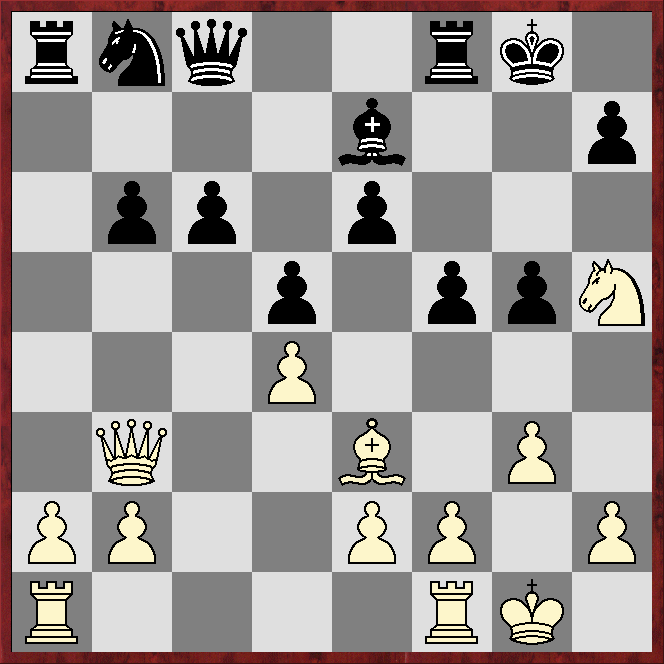
13.Nxe4 Nxd5 14.Qc1 Bf5 15.Ng3 Rc8 16.Qd2 Nxf4 17.Qxf4
Black has a pawn and the bishop-pair, but they do not add up to a piece
*****
*****
*****
*****
*****
17...Bc2
As is pointed out in Mega24, Black can get mated after 17...Bxb2?!, ie 18.Nxf5 Bxa1? 19.Qh6 gxf5 20.Ng5. Better is 18...gxf5, but 19.Qxf5 keeps the white queen's rook safe as White threatens 20.Bd3 and 20.Ng5.
18.Qb4 Qd8 19.Ne1 Ba4!?
Preserving the bishop-pair, but at a cost.
20.Rb1 Bd4?!
This seems to make the situation worse, but the engines' suggestion of 20...Bc2!? would hardly have inspired Alekhine.
21.Nf3 Bc5 22.Qh4 Bc2
The bishop escapes entombment, but the whole manoeuvre has cost time.
23.Rbc1 f6!?
Prevents Ng5
24.Bc4+!?
This seems even better than 24.Rxc2 Bxf2+ 25.Rxf2 Rxc2.
24...bxc4 25.Qxc4+ Kg7 26.Qxc2
Now Black has neither a pawn nor the bishop-pair, and could resign to spare himself more agony
*****
*****
*****
*****
*****
26...Qa5 27.Qe2 e5
Probably not 27...Qxa2?! 28.Rxc5! Rxc5 29.Qxe7+ etc.
28.a3 Be7 29.Nd4!? Rxc1 30.Rxc1 Kh8 31.Nc6 Qc7 32.Qxa6 Rc8 33.Nf1 Rb8 34.Nxe7! Qxe7
Not 34...Qxc1? 35.Qxf6#.
35.Rc8+ Rxc8 38.Qxc8+ 1-0
*Alekhine was born in Moscow on October 31, 1892, at a time when Russia was still using the Julian calendar. This game was played on October 19, 1933, according to the Gregorian calendar, which had been adopted in most of Europe centuries earlier, and in Russia in 1918.

Monday, 10 June 2024

I Am #1! (part three)

THERE is a silly but fun pastime at the end of a college football season in the United States where boosters of even the lowliest university set out to prove that their school is really number one or, as it is usually written, #1!
For example, in 2022 the national championship game was won by the team I support, Georgia Bulldogs.
But during the season they lost to Alabama Crimson Tide, who in turn had lost to Texas A&M, who lost to Mississippi State, who lost to Memphis Tigers, etc, etc.
Eventually the chain leads to one of the lowliest teams in the land, which can thus make a claim to be #1!
It is possible to play a similar game in chess, by which you trace your wins up to a victory over a reigning world champion, thus putting yourself in position to claim, however far-fetched the claim may be, to be #1!
The third link in my chain comes from round five of the 1951 Wertheim Memorial, New York.

Max Euwe - Larry Evans
Queen's Indian
1.d4 Nf6 2.c4 e6 3.Nf3 b6 4.g3 Bb7 5.Bg2 Be7 6.0-0 0-0 7.Nc3 Ne4 8.Qc2 Nxc3 9.Qxc3
There are 4,629 examples of this position in ChessBase's 2024 Mega database
*****
*****
*****
*****
*****
9...f5
This is the commonest move in Mega24, narrowly ahead of 9...c5.
10.Ne1!?
But this invitation to exchange light-square bishops is only sixth-most popular in Mega24. It seems to have been introduced into master play at Carlsbad 1929 by Karl Glig against Euwe.
10...Bxg2 11.Nxg2 Bf6
Euwe played 11...Qe8, drawing in 31 moves.
12.Be3 d6!?
This seems to have been a novelty, and makes no other appearance in Mega24, but seems reasonable.
13.Qc2 Qc8 14.Nf4 c6 15.Qb3 g5!? 16.Nh5 Be7 17.c5!? d5!? 18.cxb6 axb6
How should White proceed?
*****
*****
*****
*****
*****
19.f3!?
After 19.Qxb6!? c5 20.dxc5 Nc6 Black's queenside pressure, combined with White's out-of-play knight, gives more than enough compensation for two pawns, according to Stockfish16 and Komodo14.1. However the engines reckon White should prefer 19.Rac1 or 19.a4, slowing Black's queenside play.
19...Nd7
Black is at least slightly better after 19...c5, according to the engines.
20.g4!? Qa6 21.Qc2 Qc4!? 22.Qxc4 dxc4 23.f4 fxg4 24.fxg5 Rxf1+ 25.Kxf1 b5
How would you assess this ending?
*****
*****
*****
*****
*****
It looks a mess, and it may well be the players were unsure who stood better, but the engines give Black the upper hand.
26.Kg2 Nb6 27.Kg3 b4 28.Kxg4 b3 29.d5?
Activating the bishop, but at too high a cost. The engines suggest 29.a4, or retreating the bishop to d2 or c1.
29...Nxd5 30.Bd4 bxa2 31.Nf6+ Bxf6 32.gxf6 Nb4
White is busted
*****
*****
*****
*****
*****
33.Kf4 Kf7 34.Be5 Nc2 35.Rd1 a1=Q 36.Rd7+ Ke8 37.Re7+ Kf8 38.Rxh7 Qf1+ 39.Kg3 Qf5 0-1

Thursday, 3 September 2020

Champion Of Champions (part six)

HERE is the tournament bracket after five matches.

Round of 16               Quarter-Finals
1. Steinitz
v----------------------------Carlsen
16. Carlsen (+102.5)

8.Tal (+8.5)
v----------------------------Tal
9.Petrosian

6. Botvinnik (+66)
v----------------------------Botvinnik
11. Fischer

13. Kasparov
v----------------------------Alekhine
4. Alekhine (+21.5)

3. Capablanca
v----------------------------Kramnik
14. Kramnik (+12)

5. Euwe
v--------------------------
12. Karpov

7. Smyslov
v--------------------------
10. Spassky

15. Anand
v--------------------------
2. Lasker

Round of 16
Match Six: Euwe v Karpov
Game One
Max Euwe - Anatoly Karpov
Nimzo-Indian
1.d4 Nf6 2.c4 e6 3.Nc3
The first time in this tournament White has allowed a Nimzo-Indian.
3...Bb4 4.Qc2 0-0 5.Bg5!?
Karpov has not faced 5.Bg5!?
Stockfish11 and Komodo11.01 are unimpressed with Euwe's opening play, evaluating the position as dead-equal, giving the Dutch world champion an uphill task in game two.

Game Two
Anatoly Karpov - Max Euwe
QGD Semi-Tarrasch
1.d4 Nf6 2.c4 e6 3.Nf3
No Nimzo-Indian this time.
3...d5 4.Nc3 c5!?
Aggressive play by Euwe. He preferred this over 4...c6 by 17 games to 16 in ChessBase's 2020 Mega database.
5.cxd5 Nxd5 6.e4 Nxc3 7.bxc3 cxd4 8.cxd4 Bb4+
Euwe reached the position after 8.cxd4 twice as Black, playing 8...Nc6 in a 1932 draw against Flohr and the text in a 1937 draw against Alekhine. The text is chosen on tiebreak by having been played more recently.
9.Bd2 Bxd2+ 10.Qxd2 0-0 11.Rc1
As far as we can go
The engines give Karpov an averaged advantage of +11.5, meaning he wins the match by the same score.
Here is the updated tournament bracket.

Round of 16               Quarter-Finals
1. Steinitz
v----------------------------Carlsen
16. Carlsen (+102.5)

8.Tal (+8.5)
v----------------------------Tal
9.Petrosian

6. Botvinnik (+66)
v----------------------------Botvinnik
11. Fischer

13. Kasparov
v----------------------------Alekhine
4. Alekhine (+21.5)

3. Capablanca
v----------------------------Kramnik
14. Kramnik (+12)

5. Euwe
v----------------------------Karpov
12. Karpov (+11.5)

7. Smyslov
v--------------------------
10. Spassky

15. Anand
v--------------------------
2. Lasker

Sunday, 12 July 2020

Champion Repertoire (part five)

MAX Euwe won the world title from Alekhine in 1935 and lost it back to him two years later.
He has something of a reputation today for being a solid player - dour even - but in his heyday was regarded as an openings expert and top-class tactician, which makes a repertoire based on his games of particular interest to club players.
White
Open 1.d4 and meet the Nimzo-Indian: 1...Nf6 2.c4 e6 3.Nc3 Bb4 with 4.Qc2. The most-popular reply in Euwe's games in ChessBase's 2020 Mega database is 4...c5, against which he scored a remarkable 89% with 5.dxc5. Black's most-popular answer to this was 5...Nc6, against which Euwe seems to have introduced the now-standard manoeuvre 6.Nf3 Bxc5 7.Bg5. Today blacks more often play 5...0-0, against which Euwe varied his replies, although his first choice was 6.Bf4 Bxc5 7.e3 Nc6 8.Nf3.
Against 4...d5 he scored 60% with both 5.a3 and 5.cxd5. Perhaps play the former as it the less-popular move today, the standard continuation after 5.a3 being 5...Bxc3+ 6.Qxc3 Ne4 7.Qc2 c5 8.dxc5 Nc6, after which Euwe used 9.cxd5 to beat Najdorf at Mar del Plata 1947.
Against 4...0-0 Euwe tried four different moves, not looking convincing with any of them. Perhaps most consistent with the rest of the repertoire is 5.a3, which Euwe used to draw with Unzicker and Pachman when he was well past his prime.
Against 3...d5, often reached through the Queen's Gambit Declined move-order: 1...d5 2.c4 e6 3.Nc3 Nf6, he scored 67% from the mainline tabiya after 4.Bg5 Be7 5.e3 Nbd7 6.Nf3 0-0 7.Rc1.
Against the Slav: 1...d5 2.c4 c6 he scored 88% in the Semi-Slav line 3.Nf3 Nf6 4.Nc3 e6 5.e3. In the pure Slav line 4...dxc4 he scored 79% with 5.a4 Bf5 6.e3.
Against the Queen's Gambit Accepted: 2...dxc4 he scored 70% with 3.Nf3, intending to meet the main reply 3...Nf6 with 4.e3 e6 5.Bxc4 c5 6.0-0.
Against attempts to play the King's Indian or Grünfeld via 1...Nf6 2.c4 g6 he liked to counter-fianchetto with 3.g3 Bg7 4.Bg2 0-0, scoring 62% with 5.Nc3, which allows a King's Indian but rules out a Grünfeld. Some opponents went for a sort of Grünfeld with 4...d5 5.cxd5 Nxd5 but Euwe scored 60% with 6.e4.
Against the Benoni: 2...c5 he scored 75%  with the standard 3.d5.
Black v 1.e4
Play 1...e5 with the aim of meeting the mainline Spanish: 2.Nf3 Nc6 3.Bb5 a6 4.Ba4 Nf6 5.0-0 with the Open Variation: 5...Nxe4. After the normal 6.d4 b5 7.Bb3 d5 8.dxe5 Be6 the vast majority of Euwe's opponents played what is still the main move, 9.c3. Euwe usually replied 9...Be7, scoring heavily with 10...0-0 against both 10.Nbd2 and 10.Be3. Euwe also played 9...Be7 against the three other ninth moves he faced: 9.Qe2, 9.Nbd2 and 9.Be3.
If White prevented the Open Variation by playing the Wormald Attack: 5.Qe2, Euwe scored 70% with 5...b5 6.Bb3 Bc5.
A more-popular way of preventing the Open Variation in his day was 5.Nc3, Euwe's games usually continuing 5...Be7 6.0-0 b5 7.Bb3, against which he won all three games when proceeding with 7...0-0.
He scored heavily against the Exchange Variation: 4.Bxc6, replying 4...dxc6 and early always castling long, but he never faced the modern move 5.0-0.
Euwe normally played 3...Bc5 against the Italian: 3.Bc4, and usually met 4.c3 with closed lines starting with 4...Bb6 or 4...Qe7, scoring a much higher percentage with the latter.
In the Spanish Four Knights: 3.Nc3 Nf6 4.Bb5 he was happy going down the main line: 4...Bb4 5.0-0 0-0 6.d3 d6 7.Bg5 Bxc3, but had equal success with the much less-well known 7....Ne7, which has been tried by Carlsen.
He was also happy playing the main line in the Scotch Four Knights: 4.d4 exd4 5.Nxd4 Bb4 6.Nxc6 bxc6 7.Bd3 d5 8.exd5 cxd5 9.0-0 0-0 10.Bg5, but avoided 10...c6 in favour of trying to push the c pawn two squares, if allowed, after 10...Be6 11.Qf3 Be7.
He did not face the pure Scotch: 3.d4 exd4 4.Nxd4 often but usually replied 4...Nf6.
Against the Scotch Gambit: 4.Bc4 he won all three games in which he played the sharp 4...Nf6.
Against the Ponziani: 3.c3 he scored a win and a loss with 3...d5 but a win and a draw with 3...Nf6.
Against the mainline Vienna: 2.Nc3 Nf6 3.f4 d5 4.fxe5 Nxe4 5.Nf3 he scored 70% with 5...Be7.
Euwe always accepted the King's Gambit: 2.f4, playing 3...Nc6 in the one game that continued 2...exf4 3.Bc4. He varied against 3.Nf3 - perhaps try 3...Be7!? with which he scored a win and a draw, and which has also been played by Kasparov.
Black v 1.d4 and Others
After 1.d4 Nf6 2.c4 he generally went for a Nimzo-Indian with 2...e6 3.Nc3 Bb4 or a Queen's Gambit Declined with 3...d5 but scored 22 percentage points higher with 2...g6. However White replied he nearly always went for a King's Indian set-up with 3...Bg7, 4...0-0 and 5...d6. The main exception to this was in the line 3.Nc3 Bg7 4.Nf3 0-0 5.g3, which he met with 5...d5 all four times he faced it, winning all four games.
Against 2.Nf3 he again scored highly with 2...g6.
Against the English: 1.c4 he liked 1...Nf6, usually meeting 2.Nc3, 2.g3 and 2.Nf3 with 2...e6 or 2...g6. He scored better with the latter, which fits in with 2...g6 against 1.d4 and 2.c4/Nf3.
Against 1.Nf3 he mainly switched between 1...d5 and 1...Nf6 but the latter is the better choice for the repertoire laid out here.

Some club players are put off the King's Indian by the Four Pawns Attack, but Euwe won all three times he faced it.
Here he makes the task look ridiculously easy playing for Rotterdam against Edgard Colle of Antwerp.
Colle - Euwe
City Match (Antwerp) 1926
1.c4 Nf6 2.d4 g6 3.Nc3 Bg7 4.e4 0-0 5.f4
The tempting 5.e5!? has been played by Karpov, albeit in a simul (he could only draw), but Black is reckoned to have a comfortable time of it after Fischer's 5...Ne8 6.f4 d6 7.Nf3 dxe5.
5...d6 6.Nf3 c5
This is the main move, and has been played by Kasparov, but Kasparov has also tried 6...Na6!?
7.d5 e6 8.Bd3!?
Colle had recently twice played what is today very much the main line, namely 8.Be2 exd5 9.cxd5.
8...exd5 9.cxd5 Qb6!?
Euwe seems to have introduced this move, which prevents early castling by White, in a win over Friedrich Sämisch the previous year. Various moves are tried today but most popular is 9...Re8. The text is only sixth-most popular in Mega20.
10.Bc2
Clearly not 10.0-0?? c4, but Sämisch - Euwe, Wiesbaden Viermeister 1925, saw 10.Nd2 Ng4 11.Nc4 Qd8 12.Be2 (12.0-0?? Qh4) h5 with an unclear position.
10...c4 11.Qe2 Re8 12.Ba4?
This hit on the rook does not inconvenience Black and merely costs White time in a sharp position..
12...Bd7 13.Bxd7
The analysis engines Stockfish11 and Komodo11.01 prefer 13.e5 or 13.Be3 but still give Black a winning advantage, eg 13.Be3 Qa5 14.Bc2 b5 with a strong initiative.
13...Nbxd7
Can White's game be saved?
*****
*****
*****
*****
*****
14.Nd2
It may be Colle intended 14.Be3 Qa5 15.Nd2, preparing kingside castling, but then saw Black simply has 15...Nxe4 as, despite appearances, the e pawn is only defended once.
14...Nxe4! 15.Ncxe4
Even worse is 15.Nxc4 Nxc3 as after 16.Nxb6 comes 16...Rxe2+ 17.Kf1 Nxb6 and Black emerges a knight  up with an attack.
15...Rac8
There is no rush to win back the piece.
16.Kf1 f5 17.Nxc4 Rxc4 18.Nf6+
Black has an overwhelming attack after 18.Qxc4 Rxe4, eg 19.Qc8+ Nf8 20.Qc2 Bd4 21.Qd3 (to stop 21...Qb5+) Nd7 etc.
18...Nxf6 19.Qxc4 Ng4 0-1
There is no defence as preventing mate on e2 with 20.Qc2 runs into 20...Qb5+.

Thursday, 31 October 2019

Ponzing About (part five)

Max Euwe - Abraham Speijer
Netherlands Team Championship 1923-4
1.e4 e5 2.Nf3 Nc6 3.c3 Nf6
Black's most popular reply to the Ponziani, but it scores much less well than the sharper 3...d5. However Speijer had played the latter against Euwe in their match two years earlier, losing a tactical battle that included opposite-side castling.
4.d4 d6!?
Not a particularly common choice, but it has been played by Smyslov and Tal.
5.d5!?
White does not get much from 5.dxe5 dxe5 6.Qxd8+ Nxd8 7.Nxe5 Nxe4, although White went on to win in Saveilly Tartakower - Lajos Steiner, Schlechter Memorial 1923. The main alternative to Euwe's move is 5.Bb5 Bd7 6.0-0, with what looks like a good Spanish.
5...Nb8
More popular is 5...Ne7, when Black can choose a King's Indian set-up with ...g6 and ...Bg7, or continue with …Ng6. However the text was Tigran Petrosian's choice in a win over Alexander Tolush at the 1957 Soviet Championship.
6.Bd3 Nbd7
Petrosian preferred 6...g6, while the main move has come to be 6...Be7.
7.h3!?
I presume this is prophylaxis against a pin by ...Bg4 after ...Nc5.
7...Nc5 8.Bc2 a5
Not 8...Ncxe4?? 9.Bxe4 Nxe4 10.Qa4+.
9.b4 Ncd7
9...Ncxe4!? is very sharp. One line given by Stockfish10 and Komodo10 runs 10.Qe2 Bf5 11.g4 Bg6 12.g5 Be7 13.gxf6 Nxf6, when the engines reckon Black has reasonable compensation for the piece.
10.0-0 g6 11.Be3 Bg7 12.Nbd2 0-0 13.Qc1 b6 14.Re1 Nh5 15.Nf1 Nf4 16.a3 Ba6 17.Qd2 Qe7 18.g3 Nh5 19.Bh6!?
This can be a controversial decision in this type of position. Black's king is weakened by losing its fianchettoed bishop, but White is giving up his better bishop.
19...Bxh6!?
Another controversial decision. There was a lot to be said for leaving White to make the exchange.
20.Qxh6 Qf6 21.Kg2 Qg7 22.Qd2 Bxf1+!?
Black's queenside light squares are weakened by this exchange, but the large number of pawns on the board favours knights, and Speijer may have had hopes of engineering a good-knight-v-bad-bishop ending.
23.Rxf1 f6 24.Qe2 Ra7 25.Qc4 Rc8 26.Rfb1 Nf8 27.Nd2 Rca8 28.Ba4 axb4 29.Bc6 bxc3 30.Bxa8 cxd2 31.Bc6
A tricky imbalance has arisen in which Black has a pair of knights and two pawns for rook and bishop. The engines reckon White is slightly better. Certainly the d2 pawn is unlikely to last long.
31...Qh6 32.Rd1 g5?!
A strange-looking move whose main purpose seems to be to give the f8 knight a square to go to. The engines suggest 32...Qg5 33.a4 f5 with what they reckon is a slight edge for White.
33.Qe2
There is no rush to take the d2 pawn - it cannot be saved.
33...Ng6 34.Qg4 Ng7
Stockfish10 gives 34...Ne7 35.Qe6+  Kf8 36.Bb5 Ng7 37.Qd7 f5 38.exf5 Ngxf5 39.a4 with a large advantage for White. Komodo10 suggests 34...f5!? 35.Qxf5 Nhf4+ 36.Kh2 (36.gxf4?? Nh4+) Ne7 37.Qg4 Nd3 38.Rxd2, when Black is a clear exchange down.
35.Rxd2 Ne7 36.Re2 f5 37.exf5 Qf6 38.a4 h5 39.Qc4 Ngxf5 40.a5?
The engines give 40.Rd1 Nxc6 41.Qxc6, when Black does not have enough for the exchange.
40...Nd4 41.Rb2 Qf3+ 42.Kg1 Qe4 43.Qc1 Nf3+ 44.Kf1 Nf5?
Black had a forced draw with 44...Nxc6 45.Qxc6 (or 45.dxc6) Nh2+ 46.Kg1 Nf3+ etc.
45.Qb1! Qc4+
The sequence 45...Nh2+ 46.Kf1 Nf3+ is no longer a draw because White has 47.Kh1, after which queens are coming off. If 45...Qxb1+, White has 46.Rbxb1! as 46...Nd2+ 47.Kg2 Nxb1 fails to 48.axb6! Rxa1 49.b7.
46.Kg2 N3d4 47.axb6?
The right idea, but the wrong execution. Correct is 47.Ra4 Qc3 and now 48.axb6, eg 48...Rxa4 49.bxc7 Ne7 50.c8=Q+ Nxc8 51.Qg6+ Kh8 52.Qe8+ Kg7 53.Rb7+ and mates.
47...Rxa1 48.Qxa1 Nxc6?
Black has drawing chances after 48...Qd3 and after 48...cxb6.
49.Qa8+ Kh7 50.Qxc6 Qe4+
Or 50...Qxc6 51.dxc6 cxb6 52.c7 Ne7 53.Rxb6 etc.
51.Kh2 Nd4
51...cxb6 52.Qd7+ Kg6 53.Rxb6 Qxd5 54.g4 etc.
52.Qxc7+ Kg8 53.Qc3 Nf3+ 54.Qxf3 Qxf3 55.b7 1-0
The Ponziani seems a good choice for tactical players. Euwe was far more than just a tactician, but he certainly out-calculated Speijer in this encounter.