Showing posts with label QGD Semi-Tarrasch. Show all posts

Thursday, 28 May 2026

Bad Neuenahr Round Two

FACED a Fide master.

Kuno Thiel (2095) - Spanton (1911)
QGD Semi-Tarrasch
1.Nf3 d5 2.d4 e6 3.c4 Nf6 4.Nc3 c5 5.cxd5 cxd4!? 6.Nxd4!?
More popular are 6.Qa4+ and especially 6.Qxd4.
6...exd5!?
After this the game soon transposes into a main tabiya of the pure Tarrasch, whereas Stockfish18 and Dragon1 prefer keeping the game in independent Semi-Tarrasch lines with 6...Nxd5.
7.g3 Nc6 8.Bg2
This position, which occurs 1,817 times in ChessBase's 2026 Maga database, more normally arises from the move-order 1.d4 d5 2.c4 e6 3.Nc3 c5 4.cxd5 exd5 5.Nf3 Nc6 6.g3 Nf6 7.Bg2 cxd4 8.Nxd4
*****
*****
*****
*****
*****
8...Bc5 9.Nxc6!?
More popular is 9.Nb3, when Black can hold on to the d pawn with 9...Bb4, albeit probably having to give up the bishop-pair, or can offer the d pawn with 9...Bb6!?, eg 10.Nxd5 Be6 11.e4 Bg4 12.f3 Be6 13.Nxb6 Qxb6, with an unclear game.
9...bxc6 10.0-0 0-0
Now both sides have castled, how would you assess the position?
*****
*****
*****
*****
*****
Black has more space in the centre, but Black's extra pawn island, and the vulnerability of the c and d pawns on half-open files, are probably more significant, which is presumably why the engines give White at least the better part of equality.
11.Na4 Bd6
Stockfish18 marginally prefers 11...Bb6!?, which Keres used to draw with Smyslov at the 1956 Candidates; Dragon1 disagrees.
12.Be3 Qe7 13.Qc2!? Bd7 14.Nc5 Rfe8 15.Rfe1
The engines like grabbing the bishop-pair with 15.Nxd7!?
15...Rab8 16.Rac1 Rec8!?
The engines suggest 16...Bg4!?
17.b3 Rb5!? 18.Bd4 Bg4!?
Here the engines prefer 18...Bxc5!? or 18...Be6.
19.e4 dxe4?
Possibly best is 19...Bxc5 20.Bxc5 Qd8, albeit White is on top.
20.Nxe4 Nd5?
Better, but still very good for White, is 20...Nxe4.
21.Nf6+!? 1-0
Premature resignation? Possibly, although after 21...Nxf6 22.Rxe7 Bxe7 the engines assess White's advantage as worth more than a piece.

Thursday, 9 April 2026

Thoughts On Daventry

IT can be argued there are two types of chess book - those that should be studied, and those that can be consumed using the read-and-nod method.
The latter is a disparaging description of how many club players treat every chess book they buy.
Instead of trying to improve with the help of hard graft, we have a tendency to hope the contents of a book can somehow be absorbed through a process akin to osmosis.
I cannot recall where I first came across the term "read-and-nod," but there are some chess books that it is OK not to study too seriously.
One is Andrew Soltis's Transpo Tricks In Chess (Batsford, 2007).
The book is optimistically subtitled Finesse Your Chess And Win
The blurb on the back cover explains: "A transposition is a known position reached by a different move-order than usual. There are transpositional tricks in all openings, but this is the first book devoted to them." 
I was able to use a 'transpo trick' in my round-one game of the Four Nations Chess League's Easter Congress, where I had black against Phil Watkinson (1682 ECF/1717 Fide).
He did not have many published games, but from what I could find I came to the following conclusions.
A) He always opens1.d4, and nearly always follows up with 2.c4.
B) If I play my normal stuff, the game would begin 1.d4 d5 2.c4 e6 3.Nc3 Nf6 4.cxd5 - the Exchange Variation of the Queen's Gambit.
C) In the Exchange he likes to develop the king's knight at e2, which is generally regarded as more dangerous for Black than developing it at f3.
D) There was a possibility that if I varied by, for example, playing 1...Nf6, he might vary in turn with the Trompowsky (2.Bg5), although, to be fair, both games in which he played 2.Bg5 were when Black opened with 1...f5.
The game began, as expected, with 1.d4, to which I replied 1...e6.
I reasoned that the chances of a confirmed 1.d4 player continuing with 2.e4 were small, and that anyway he would not have been familiar with the resulting French Defence positions (I should have checked before the game to see if PW played the French as Black, but omitted to do that).
There was a possibility he would avoid 2.c4 in favour of some anti-Dutch idea as 1.d4 e6 2.c4 is a move-order often played by blacks wanting a Dutch, which would come with 2...f5, while avoiding the Staunton Gambit (1.d4 f5 2.e4) and the fashionable 1.d4 f5 2.Bg5.
However, PW stuck to his guns with 2.c4, when I could have got back into my normal repertoire with 2...d5, after which there might well have come 3.Nc3 Nf6 4.cxd5.
Instead I played 2...Nf6, 'threatening' a Nimzo-Indian Defence. If 3.Nc3 had appeared, I would almost certainly have replied 3...d5, having gained nothing from my move-order.
But instead PW played 3.Nf3, perhaps expecting a Queen's Indian (3...b6) or Bogo-Indian (3...Bb4+).
However, I continued 3...d5, when 4.cxd5 would have been a QGD Exchange, but one in which White had already committed the king's knight to f3.
Instead he played 4.Nc3, when 4...Be7, 4...c6 and 4...Nbd7 can all lead to main lines of the Queen's Gambit Declined, while 4...Bb4 is a Ragozin.
I chose arguably Black's sharpest continuation, 4...c5, and met the mainline 5.cxd5 with 5...cxd4!?, which is less common, but sharper, than 5...exd5 and 5...Nxd5.
It is possible PW knew the line as he played 6.Qa4+!? quite quickly, and met 6...Bd7 more-or-less immediately with the admittedly forced 7.Qxd4.
White, at least temporarily, is a pawn up after 7.Qxd4
*****
*****
*****
*****
*****
However, I suspect he was in unchartered waters as, after 7...exd5, he took quite some time before eventually regaining the pawn-plus with 8.Nxd5, the point being Black then has 8...Qa5+ 9.Nc3 Nc6, with decent compensation, and I went on to win, helped, I am sure, by my greater familiarity with the resulting positions.
Now, it could be argued that, outrating my opponent by almost 200 Fide, and comfortably more than 200 ECF, I had no need to use a 'transpo trick' to help win the game.
Then again, I have my fair share of losses to players rated much lower than PW, and, at least on this occasion, the strategy worked.

Friday, 3 April 2026

4NCL Easter Round One

Phil Watkinson (1682 ECF/1717 Fide) - Spanton (1944 ECF/1908 Fide)
QGD Semi-Tarrasch
1.d4 e6 2.c4 Nf6 3.Nf3 d5 4.Nc3 c5 5.cxd5 cxd4!?
Much more popular in ChessBase's 2026 Mega database are 5...exd5 and especially 5...Nxd5, but the text is, by a small margin, the top choice of Stockfish17.1 and Dragon1
*****
*****
*****
*****
*****
6.Qa4+!?
The main line in Mega26 runs 6.Qxd4 exd5 7.Bg5 Be7 8.e3 0-0 9.Be2 Nc6 10.Qd3 h6 11.Bh4 Qb6 12.0-0!?, with equal chances, according to the engines.
6...Bd7 7.Qxd4
The point of White's queen manoeuvre is that the bishop at d7 interferes with Black's fight for the d5 square
*****
*****
*****
*****
*****
7...exd5 8.Nxd5
More common, but scoring 11 percentage points less in Mega26, is declining the pawn with 8.Bg5!?
8...Qa5+ 9.Nc3 Nc6 10.Qd1
This is most popular, but the engines also like a move not in Mega26, 10.Qd3!?, eg 10...0-0-0 11.Bd2 Bg4 12.Qb5!? Qxb5 13.Nxb5 Ne4!?, when they reckon Black has enough for a pawn, but no more. However, note that 10.Qd2?!, also apparently a novelty, is problematic for White after both 10...0-0-0 and 10...Bb4.
10...Ne4 11.Bd2
If 11.Qd5, Black has 11...Qxd5!? 12.Nxd5, and then the engines suggest an apparent-novelty in 12...Nb4!?, after which 13.Nxb4 Bxb4+ 14.Bd2 (not 14.Nd2? Rc8!) Nxd2 15.Nxd2 0-0 gives Black good compensation for a pawn, according to the engines.
11...Nxd2 12.Qxd2 Bb4!?
This may be a novelty. Harry Golombek - Stuart Milner-Barry, British Championship (Brighton) 1938, went 12...0-0-0 13.Nd5? Qxd5?? (13...Nb4! wins) 14.Qxd5 Bb4 15.Nd2 Be6 16.Qxd8+?! (16.Qg5!? is preferred by the engines) Rxd8 17.0-0-0 (1-0, 31 moves). Best after 12...0-0-0 may be the surprising retreat 13.Qc1!?, when Cliff Wichman (2319) - Konstantin Cebulla (2054), Staufer Open (Schwäbisch Gmünd) 2017, continued 13...Bf5 14.a3, with what the engines reckon may be a slight edge for White.
13.e4?!
The engines prefer 13.Rc1 or 13.e3, claiming a slight edge for White.
13...0-0-0 14.Bd3?!
It is hard to come up with an acceptable suggestion, the engines fluctuating between several moves, but possibly best is 14.Qc2, although 14...Bg4 15.Be2 Bxf3!? 16.Bxf3 Nd4 gives Black the upper hand, according to the engines.
14...Bg4 15.0-0?
The engines give 15.Rd1 or 15.0-0-0, but agree Black is well on top.
15...Bxf3 16.gxf3 Ne5
White is losing a piece
*****
*****
*****
*****
*****
17.Qc2 Bxc3 18.Rfd1 Rxd3 19.Rxd3 Nxd3 20.Qxd3 Qg5+ 21.Kf1 Be5 22.Qd5 Rd8 23.Qc5+ Kb8 24.Rc1 Qf4 25.Kg2?
White is lost anyway, but this makes matters much worse.
25...Qxh2+ 26.Kf1 Bd4 27.Qc2 Bb6 28.b4 Qh1+ 29.Ke2 Qg2 30.Rf1 Qg5 31.a4 a5!? 32.b5 Qc5 33.Qb2 Qd4 34.Qc2 Rc8 35.Qa2 Qc4+ 36.Qxc4 Rxc4 37.Ra1 Rc2+ 38.Ke1 Rxf2 39.Ra3 h5 0-1

Saturday, 14 February 2026

Miniatures 26

IN this occasional series I am going through my decisive games of 20 moves or fewer.

J Martin (140 BCF) - Spanton (147 BCF)
London (Barbican) Rapid 1990
QGD Semi-Tarrasch
1.d4 d5 2.Nf3 Nf6 3.c4 e6 4.Nc3 c5 5.cxd5 Nxd5 6.Nxd5!?
This occurs 143 times in ChessBase's 2026 Mega database, and has been played by grandmasters, but more popular are 6.g3, 6.e3 and especially 6.e4.
6...Qxd5 7.e3 Nc6 8.Bb5 Bd7
Benoît Colin - Alexander Alekhine, Bern 1932, went 8...cxd4 8.Qxd4?? Qxb5 0-1.
9.0-0 cxd4 10.Bxc6
Stockfish17.1 and Dragon1 suggest making a gambit of it with 10.Qe2!?
10...Bxc6 11.Qxd4 Be7!?
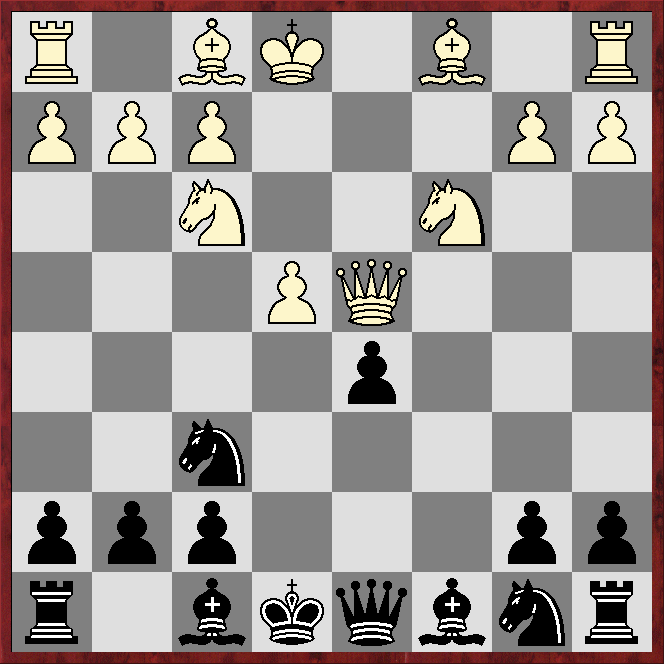
Can White safely grab the g pawn?
*****
*****
*****
*****
*****
My opponent thought so, but he was wrong.
12.Qxg7? 0-0-0!?
Offering a second pawn, but it too is poisoned.
13.Qe5
The engines suggest 13.Re1 or 13.e4, but agree Black is winning.
13...Rhg8 14.Qxd5 Bxd5
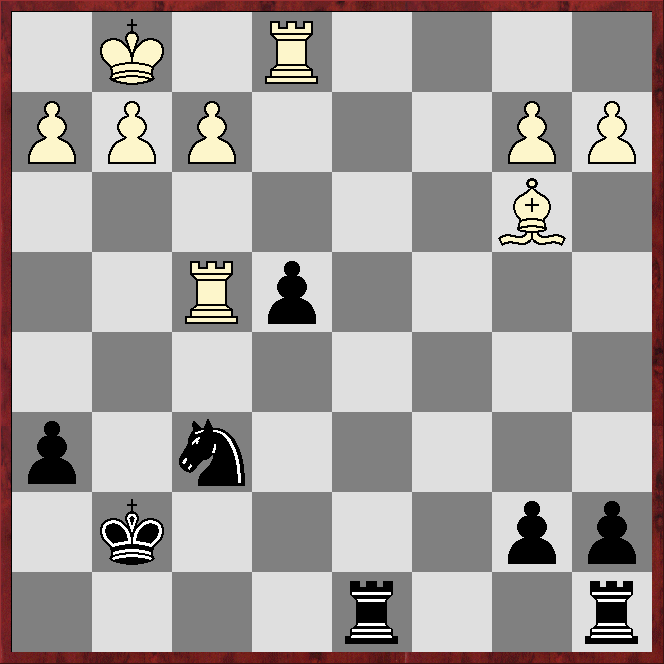
Queens are off the board, but Black still has strong pressure against White's kingside, the obvious immediate threat being ...Bxf3.
15.Kh1
The engines give 15.e4!? Bxe4 16.Ne1, but 16...Rd1 leaves Black with a large advantage.
Black to play and win
*****
*****
*****
*****
*****
16...Rxg2!
Not the only way to win, but the most convincing.
17.Kxg2 Rg8+ 18.Kh3 Bxf3 0-1
Mate cannot be prevented.
LESSON: grabbing a pawn in front of your castled king often gives the opponent lots of compensation.

Tuesday, 23 December 2025

All About That Bass VI

MOST of us have an opponent against whom nothing seems to work.
When the opponent is considerably stronger, this is not surprising, but when ratings are not so different, the results are harder to explain.
My biggest bogeyman is probably John Bass, whose record against me is +6=1-0.
Seven games is not a huge sample, but such a poor performance on my part must signify something.
So in this mini-series I am looking at my games against JB to try to discover what is going on.
The following game came 35 years after our first two encounters, in both of which he opened with 1.e4.

Bass (1951) - Spanton (1916)
Central London League Division Two 2024
QGD Semi-Tarrasch
1.d4 d5 2.c4 e6 3.Nc3 Nf6 4.Nf3 c5 5.cxd5 cxd4!?
5...cxd4!? is a sharp line, marginally preferred over the mainline 5...Nxd5 by Stockfish17.1 and Dragon1
*****
*****
*****
*****
*****
6.Qa4+!?
More popular is the straightforward 6.Qxd4.
6...Bd7 7.Qxd4
The point of White's manoeuvre is to oblige Black's light-square bishop to interfere with Black's coverage of the d5 square, but this does not prove important.
7...exd5 8.Bg5 Nc6 9.Qd2 Be6 10.e3
White cannot win the d pawn, for example 10.Bxf6 Bxf6 11.Nxd5?? Bxd5 12.Qxd5 Bb4+ 13.Nd2 Qxb2 14.Rd1 Rd8 etc.
10...Be7 11.Bb5 0-0 12.0-0
Now both sides have castled, how would you assess the position?
*****
*****
*****
*****
*****
It looks like a typical IQP position - imbalanced, but with equal chances, according to the engines.
12...Ne4!? 13.Nxe4 dxe4 14.Bxe7!?
The engines reckon this apparent-novelty is a marginal improvement on the known 14.Qxd8.
14...Nxe7 15.Nd4 Nf5 16.Rfd1 Nxd4 17.Qxd4 Qxg5!?
The engines suggest 17...Qxd4 18.Rxd4 Rac8!?
18.Be2 f5?!
Probably better is 18...Rfe8 or 18...Qf6!?
19.g3 Rfd8 20.Qa4 a6?!
The engines much prefer 20...Qf6 or 20...h6.
21.Qb4 Rab8 22.a3
White has a positionally won game after 22.h4 Qf6 23.Rxd8+ Qxd8 24.Rd1, according to the engines.
22...Qf6
The engines reckon 22...Kf7!? is best.
23.Rxd8+ Qxd8 24.Rd1 Qc7 25.Rd6 a5!? 26.Qd4 Kf7!?
How should White proceed?
*****
*****
*****
*****
*****
27.Kg2
Even stronger is 27.Rxe6! Kxe6 28.Bc4+ Ke7 29.Qxg7+, eg 29...Kd6 (29...Kd8 30.Qf8+ Kd7 31.Qxf5+) 30.Qf6+ Kc5 31.Qd4+ Kc6 32.Bd5+ etc.
27...b6?
Better is 27...Rc8 or 27...Re8.
28.Qe5
This is winning, but again Rxe6 is even stronger.
28...Re8 29.Qd4?!
Stronger is 29.Bb5 or 29.b4, but not 29.Rxe6?? Qxe5.
29...Rb8?
29...Qc5 was a chance to get out of the worst of Black's troubles.
30.Qe5 Re8 31.Qd4?! ½–½
LESSON: my lucky let-off does not conceal the fact that, first, I was first outplayed positionally, and then tactically.

Monday, 10 November 2025

Cap Negret Round Three

Salvador Freijedo Álvarez (2123) - Spanton (1896)
QGD Semi-Tarrasch
1.d4 d5 2.Nf3 e6 3.c4 Nf6 4.Nc3 c5
This is fifth in popularity, behind 4...Nbd7, 4...Bb4, 4...c6 and especially 4...Be7.
5.e3
The main move is 5.cxd5, but there are 3,721 examples of the text in ChessBase's 2025 Mega database.
5...Nc6 6.cxd5 exd5
How should White proceed?
*****
*****
*****
*****
*****
7.Be2
This is the commonest continuation in Mega25, but Stockfish17.1 and Dragon1 marginally prefer 7.Bb5, when the main line in Mega25 runs 7...Bd6 8.dxc5 Bxc5 9.0-0 0-0 10.b3, with a slight edge for White (Dragon1), or at least the better part of equality (Stockfish17.1).
7...c4!?
This is Dragon1'a top choice by a small margin over the much more popular 7...cxd4, which is Stockfish17.1's recommendation.
8.0-0
This is the normal continuation, and the engines' preference. The problem with 8.b3!?, immediately attacking the advanced pawn, is that Black has the pinning 8...Bb4.
8...Bb4 9.Bd2 0-0
Now both sides have castled, how would you assess the position?
*****
*****
*****
*****
*****
White has a slight lead in development, but the game is probably going to hinge on how White deals with Black's space-gaining queenside pawn-majority. Stockfish17.1 gives White a slight edge; Dragon1 calls the game equal.
10.b3 Bxc3 11.Bxc3 Ne4
Possibly 11...b5 is a little better.
12.Rc1
This seems to be a novelty. The engines like 12.Be1!?, while three queen moves have been tried - to e1, c1 and c2.
12...Nxc3 13.Rxc3 b5 14.bxc4 Qa5 15.Rc1 bxc4
The engines reckon 15...dxc4?! strongly favours White after 16.a4!
16.Nd2?!
The engines give 16.e4!? dxe4 17.Rxc4, claiming equal chances.
16...Re8?!
Black has at least a slight edge, according to the engines, after 16...Rb8, occupying the open file.
17.Bf3
How should Black respond?
*****
*****
*****
*****
*****
17...Bb7!?
Preparing a pawn sacrifice for active play.
Note that in the diagram, White threatens 18.Nxc4, when 18...dxc4? makes matters worse as 19.Bxc6 wins back the piece and forks the black rooks.
The aggressive 17...c3? leaves Black in trouble after the simple 18.Nb3, and even worse is 17...Qxa2?? 18.Bxd5.
The engines recommend 17...Bd7, with what they reckon is equality.
18.Rb1 Rab8!?
Not 18...Nd8? 19.Nxc4!, but the engines suggest 18...Ba6, again with equal chances.
19.Nxc4!
The engines agree White has to accept the sacrifice to gain an advantage.
19...dxc4 20.Rxb7! Rxb7
The engines' 20...Nb4!? may be slightly better.
21.Bxc6 Reb8 22.Bxb7 Rxb7
How would you assess this heavy-piece late-middlegame?
*****
*****
*****
*****
*****
White is a pawn up, but Black's more-advanced passer is dangerous. Dragon1 reckons White is winning; Stockfish17.1 gives White only a slight edge. If the engines are given extra time to study the position, Stockfish17.1 comes for a while to give White the upper hand, but reverts to awarding only a slight edge. Dragon1, meanwhile, downgrades White's advantage to enjoying the upper hand.
23.Qc2
At first both engines reckon 23.Qf3 is best, but Dragon1 comes to prefer the text.
23...c3 24.Qe4
Dragon1 is convinced 24.Rc1 is much stronger; Stockfish17.1 is less sure. Note that 24.Rc1 does not threaten to immediately capture on c3 as White (as well as Black) has back-rank problems.
24...Rb8 25.g3 g6
This is good enough for equality, according to the engines, which reckon 25...Qxa2 also equalises.
White to play and lose
*****
*****
*****
*****
*****
26.Qe5??
Various moves maintain complete equality, according to the engines, including 26.Qc6, 26.Rc1 and 26.h4.
26...Qxe5 27.dxe5 c2 0-1

Friday, 2 August 2024

British 65+ Round Four

Gerald Moore (2128 ECF/2057 Fide) - Spanton (1919 ECF/1928 Fide)
QGD Semi-Tarrasch
1.c4 e6 2.Nc3 d5 3.d4 Nf6 4.Nf3 c5 5.cxd5 cxd4!? 6.Qxd4 exd5 7.Bg5
The mainline in ChessBase's 2024 Mega database runs 7.e4!? dxe4 8.Qxd8+ Kxd8 9.Ng5 Be6 10.Nxe6+ fxe6 11.Bg5, with a slight edge for White, according to Dragon1, although Stockfish16.1 calls the position equal.
7...Be7 8.e3 Nc6 9.Bb5 0-0 10.Qd2 Be6 11.0-0 Ne4!? 12.Nxe4 dxe4 13.Qxd8 Bxd8 14.Bxd8
How should Black proceed?
*****
*****
*****
*****
*****
14...Rfxd8?!
The engines prefer 14...exf3, claiming complete equality.
15.Bxc6 bxc6 16.Nd4 Bd5 17.Rfc1 Rab8?!
This probably only encourages White to play a useful move. The engines give 17...h5, and if 18.Nxc6 Bxc6 19.Rxc6 they reckon 19...Rd2 provides decent compensation, albeit preferring White.
18.b3 Rdc8?!
Almost certainly better is 18...Rb6.
19.Rc5 Rb7 20.Rac1 Rbc7 21.b4!? Bxa2 22.Nxc6 Kf8?
The engines much prefer 22...Ra8 23.Nxa7! Rxc5 24.Rxc5 Be6, although they reckon White is winning.
23.Nxa7 Rxc5 24.bxc5 Ra8 25.Nb5 Ke7
The engines suggest 25...Be6, but White has 26.Nc7 etc.
26.Nc3 Ke6
Even worse is 26...f5? 27.Ra1.
27.Nxe4 Rc8 28.f3 h6 29.Kf2 f5 30.Nd6 Rc7 31.Ke2 Rc6 32.Kd3 Kd5? 33.Nxf5 Rxc5 1-0

Saturday, 8 June 2024

I Am #1!

THERE is a silly but fun pastime at the end of a college football season in the United States when boosters of even the lowliest university set out to prove their school is really number one or, as it is usually written, #1!
For example, in 2022 the national championship game was won by the team I support, Georgia Bulldogs.
But during the season they lost to Alabama Crimson Tide, who in turn had lost to Texas A&M, who lost to Mississippi State, who lost to Memphis Tigers, etc, etc.
Eventually the chain leads to one of the lowliest teams in the land, which can thus make a claim to be #1!
It is possible to play a similar game in chess, by which you trace your wins up to a victory over a reigning world champion, thus putting yourself in position to claim, however far-fetched the claim may be, to be #1!
My chain starts with the following game in round two of the 1996 US Open at Alexandria, Virginia.

George Kramer (2312) - Spanton (2054)*
QGD Semi-Tarrasch
1.d4 Nf6 2.c4 e6 3.Nc3 d5 4.Nf3 c5 5.cxd5 cxd4!? 6.Qa4+!?
Most popular in ChessBase's 2024 Mega database is 6.Qxd4. The point of the text is to oblige Black to put a piece on d7 where, White hopes, its positioning will be awkward.
6...Bd7 7.Qxd4 exd5
How should White proceed?
*****
*****
*****
*****
*****
8.Bg5
This is the commonest move in Mega24, but the game's move-order lets White grab a pawn with 8.Nxd5!? However, after 8...Qa5+ 9.Nc3 Nc6 Black has obvious compensation; Stockfish16 and Komodo14.1 reckon chances are equal.
8...Nc6 9.Qe3+!?
This seems to have been a novelty. Known moves were 9.Bxf6 and 9.Qd2.
9...Be6 10.0-0-0?
The white king proves too vulnerable on the queenside. The engines prefer 10.Nd4, when Humpy Koneru (2574) - Anna Muzychuk (2534), Women's Candidates (Monaco) 2022, continued 10...Bc5 11.Nxe6 Bxe3 12.Nxd8 Bxg5 13.Nxc6 bxc6, with an equal position, according to the engines (½–½, 34 moves).
10...Be7 11.h3
My notes show Fritz5 recommended 11.Bxf6 Bxf6 12.Rxd5!? Qe7 13.Rb5, claiming equality. However Stockfish16 and Komodo14.1 reckon Black is winning.
11...0-0 12.Qd2 Qa5 13.e3 Rac8 14.Kb1 Nb4
Black's attack is coming first.
15.a3 Bf5+ 16.e4
Not 16.Kc1?? Na2#, and also no improvement is 16.Ka1 Nc2+ 17.Ka2 Bxa3!
16...dxe4 17.axb4 Bxb4 18.Bd3!? exf3
Capturing on c3, with rook or bishop, is even stronger, according to the engines.
19.Bxf6 gxf6 20.Qf4
This is better than 20.Bxf5?!, which allows 20...Bxc3 etc.
20...Bxd3+ 21.Rxd3 Bxc3 22.bxc3 Rxc3 23.Rxc3 Qxc3 24.gxf3
The complications are over, and Black's extra pawns (and the exposed white king) should decide matters unless White can somehow conjure a draw by repetition or provoke a blunder
*****
*****
*****
*****
*****
24...Rc8 25.Rg1+ Kh8 26.Qg4 Qd3+ 27.Ka1 Qa6+ 28.Kb1 Qb5+ 29.Ka1 Qe5+ 30.Kb1 f5 31.Qg5 Qb5+ 32.Ka1 Qa6+ 33.Kb1 Qg6 0-1
*US Chess Federation ratings.

Friday, 10 May 2024

Bodensee Senioren Round Six

FACED an Austrian Fide master.

Frank Belke (2200) - Spanton (1902)
QGD Semi-Tarrasch
1.d4 d5 2.c4 e6 3.Nc3 Nf6 4.Nf3 c5 5.cxd5 cxd4!? 6.Qxd4 Nxd5!?
The mainline in ChessBase's 2024 Mega database runs 6...exd5 7.e4!? dxe4!? 8.Qxd8+ Kxd8 9.Ng5 Be6 10.Nxe6 fxe6 11.Bg5, when Stockfish16 reckons the position is equal, but Komodo14.1 fluctuates between equality and a slight edge for White.
7.Nxd5
This scores an excellent 63% in Mega24, but the more popular 7.e4 scores 67%.
7...Qxd5 8.Qxd5 exd5
How would you assess this IQP position?
*****
*****
*****
*****
*****
With queens and a pair of knights exchanged, Black is highly unlikely to generate attacking chances, which, as I understand it, means the IQP is more of a weakness than a strength. The engines give White a slight edge.
9.e3!? Nc6 10.Bb5!? a6 11.Ba4 Bb4+!?
The engines are OK with this, but as a general rule the player with an IQP should not be seeking to swop off his better bishop.
12.Bd2 Bxd2+ 13.Kxd2 b5 14.Bb3 Be6 15.Nd4!? Nxd4 16.exd4 Kd7
Now both players have isolated queen's pawns, the major (effectively only) difference between the sides is White has a good bishop and Black a bad one
*****
*****
*****
*****
*****
17.a4 Kd6 18.Rhc1 Rhc8 19.Rxc8 Rxc8 20.axb5 axb5 21.Ra6+ Kc7!
As will become soon become clear, this is much better than the 'obvious' 21...Rc6?, allowing an exchange of rooks.
22.f4 Kb7 23.Ra1 Kc6?
The game is equal after, for example, 23...g6, according to the engines.
24.Rc1+ Kd6 25.Rxc8 Bxc8 26.Kc3 Bf5 27.Kb4 Kc6
The rook-and-bishop ending was drawn, but this bishop ending is lost, according to Stockfish16, although Komodo14.1 at first gives White 'only' the upper hand
*****
*****
*****
*****
*****
28.Ka5 Bd3 29.Bd1 g6
It seems there is no defence. Black can hold the b pawn for now, as long as the black bishop stays on the c4-f1 diagonal, but White can force concessions on the kingside, after which it is a matter of time before the black position collapses.
30.g3 Bf1 31.g4 Bd3 32.g5 Bc4 33.h4 Bd3 34.Bg4 Kc7
If 34...Bc4 then 35.f5 is strong.
35.h5 Kc6 36.h6 Kc7 37.Bf3 Kc6 38.Bg2 Be2 39.Bh3 Bd3 40.Bg4 Kc7 41.Kb4 Kc6 42.Bh3 Kd6 43.Kc3 Bc4
If 43...Bb1 then 44.Bf1.
44.f5 Be2 45.fxg6 fxg6 46.Bc8 Bf3 47.Bf5!? Be4
If 47...gxf5 then 48.g6 etc.
48.Bg4 Bg2 49.Kb4 1-0
The position is hopeless: 49...Bf1 loses to 50.Bf5!, and 49...Kc6 loses to 50.Be6 followed by Bg8 etc.

Friday, 16 February 2024

Central London League

PLAYED on board two (of five) for Battersea 2 against Railsport in division two last night.

John Bass (1951) - Spanton (1916)
QGD Semi-Tarrasch
1.d4 d5 2.c4 e6 3.Nc3 Nf6 4.Nf3 c5 5.cxd5 cxd4!? 6.Qa4+!?
The main move in ChessBase's 2024 Mega database is 6.Qxd4, which scores 58%, compared with the text's 64%.
6...Bd7 7.Qxd4 exd5
How should White proceed?
*****
*****
*****
*****
*****
8.Bg5
White can grab a pawn with 8.Nxd5!?, but 8...Qa5+ 9.Nc3 Nc6 gives promising compensation.
8...Nc6
Also possible is 8...Be7, as 9.Bxf6 Bxf6 10.Qxd5 0-0 again gives decent compensation for a pawn.
9.Qd2
9.Bxf6 Nxd4 10.Bxd8 Nxf3+ (10...Nc2+?1 11.Kd2 Nxa1 12.Bg5 is almost certainly good for White) 11.exf3 Rxd8 12.Nxd5 Bc6 again sees Black getting good compensation.
9...Be6
Moving the same piece twice, but it is difficult to avoid this, although possible is 9...Bb4!?, the idea being to meet 10.a3 with 10...Ne4!?, creating a sharp position that Stockfish16 and Komodo14.1 reckon is equal, eg 11.Bxd8 Bxc3!? 12.Qxc3 Nxc3 13.Bh4 Ne4. However after the further 14.Rd1 Be6 Black has moved the light-square bishop twice anyway.
10.e3 Be7 11.Bb5 0-0 12.0-0
Now both sides have castled, how would you assess the position?
*****
*****
*****
*****
*****
This is a common IQP position with all the pieces still on the board and only two pairs of pawns having been exchanged. Unlike in the Tarrasch proper, where White's light-square bishop usually bears down on the isolani from g2, Black's setup is not under strong pressure. The engines reckon the chances are equal.
12...Ne4!? 13.Nxe4 dxe4 14.Bxe7!?
This may be a novelty. Both games in Mega24 to reach the position saw 14.Qxd8 Bxd8, with what the engines reckon is complete equality.
14...Nxe7
White gets a slight pull after 14...Qxe7 15.Bxc6.
15.Nd4 Nf5 16.Rfd1 Nxd4 17.Qxd4 Qg5!?
Threatening the white light-square bishop as well as putting pressure on the white kingside, but the engines prefer 17...Qxd4, the idea being to give up the e4 pawn, eg 18.Rxd4 Rac8 19.Rxe4 Rc2, although Komodo14.1 reckons Black does not have full compensation.
18.Be2 f5?!
This looks aggressive, but is probably weakening. One suggestion of the engines is 18...Rfe8!?
19.g3 Rfd8 20.Qa4 a6?!
Restricting White's bishop, but weakening b7. The engines suggest 20...Qf6 or 20...h6!?
21.Qb4 Rab8!?
This may be best, but when such a passive move is the best available, it is usually a bad sign. However 21...b5 - Stockfish16's top choice - is also very unpleasant for Black, after 22.a4.
22.a3
Even stronger, according to the engines, is 22.h4!? Qf6 23.Rxd8+ Qxd8 24.Rd1.
22...Qf6?!
The engines prefer 22...Kf7!?, but give White at least a slight edge.
23.Rxd8+ Qxd8 24.Rd1 Qc7 25.Rd6 a5 26.Qd4 Kf7
How should White continue?
*****
*****
*****
*****
*****
27.Kg2
This is good for a large advantage, but the engines prefer sacrificing the exchange with 27.Rxe6!? After 27...Kxe6 28.Bc4 Ke7 29.Qxg7+ White picks up at least two pawns and has much the safer king.
27...b6
The exchange sacrifice still works after this, so the engines instead suggest 27...Rc8 or 27...Re8, but reckon White is positionally winning.
28.Qe5!?
Komodo14.1 reckons this is even stronger than capturing on e6.
28...Re8 29.Qd4
29.Bb5 is very strong, eg 29...Re7 30.Bd7!? Bxd7 31.Rf6+ gxf6 32.Qxc7, but not 29.Rxe6?? Qxe5 etc.
29...Rb8?
Black has drawing chances after 29...Qc5.
30.Qe5 Re8 31.Qd4? ½–½
Battersea 2 won the match 4-1.

MY BATTERSEA SEASON 2023-4
DATE.....EVENT...........................COL..RATING..OPP'S RATING..SCORE..SEASON PERF
24/10/23 London League               B      1870         2102                   =            2102
26/10/23 Central London League  W     1870         2118                    =            2110
21/11/23 Eastman Cup                  W     1882         2118                    =            2113
14/12/23 Central London League  B      1882         2152                    0            2023
10/1/24   London League               B      1884         2130                    0           1964
11/1/24   Central London League   B      1884        2278                    1            2083
25/1/24   Central London League  W      1884        2205                    =            2100
30/1/24   Club Championship         B      1884        1809                    1            2114
1/2/24     Central London League  W      1916        2072                    0            2065
7/2/24     London League               B       1916        2298                    0            2048
8/2/24     Central London League  B       1916        1960                    0            2004
15/2/24   Central London League  B       1916        1951                    =            1999

Tuesday, 19 September 2023

World Senior Teams Round One

Matthias Kierzek (Germany - 2165) - Spanton (England 2 - 1850)
Board Four
QGD Semi-Tarrasch
1.d4 d5 2.c4 e6 3.Nf3 Nf6 4.Nc3 c5 5.cxd5 cxd4!? 6.Qxd4 exd5 7.e4!?
This is probably the critical continuation, all-but-guaranteeing White a slmall but long-lasting edge in a queenless middlegame.
7...dxe4!?
Stockfish16 and Komodo14.1 marginally prefer this over the more-popular 7...Nc6 8.Bb5, when the mainline in ChessBase's 2023 Mega database continues 8...dxe4 9.Qxd8+ Kxd8 10.Ng5 Be6 and either 11.0-0 or 11.Nxe6, in both cases with probably a slight edge for White.
8.Qxd8+ Kxd8 9.Ng5 Ke7!?
This may be a novelty. The engines prefer 9...Be6 10.Nxe6+ fxe6 and either 11.Bg5 or 11.Bc4, reckoning White has the better side of equality.
10.Bc4 Be6
How should White proceed?
*****
*****
*****
*****
*****
11.Bxe6!?
The engines much prefer this to keeping the bishop-pair with 11.Nxe6.
11...fxe6 12.0-0 h6 13.Ngxe4 Nxe4 14.Nxe4 Kf7 15.Rd1 Be7 16.Bf4 Rc8 17.Nd6+ Bxd6 18.Rxd6
What should Black play?
*****
*****
*****
*****
*****
18...Rc4?
Black's back rank is too weak for this. The engines give 18...Re8, eg 19.Rad1 Nc6 20.Be3, awarding White a slight edge.
19.g3 g5 20.Be3 Rc8 21.Rad1 Ke7 22.h4 Rg8?!
The engines prefer 22...Kf6 or 22...gxh4, but White is on top.
23.hxg5 hxg5 24.Rd8!
There is no satisfactory answer to this, eg 24...Rxd8?! loses to 25.Bxg5+ Kxf7 26.Rxd8.
24...Nc6 25.Bxg5+ Kf7 26.R1d7+ Kg6 27.Rxg8+ Rxg8 28.Be3 Rg7!?
The passive 28...Rb8 is also deeply unpleasant.
29.Rxg7+ Kxg7
White is 'only' a pawn up, but easily winning
*****
*****
*****
*****
*****
30.Kf1 Kf6 31.Ke2 Kf5 32.f3 Ke5 33.Kd3 Kd5 34.g4 a6 35.f4 e5?!
Trying for counterplay in the hope of creating tactical chances, but the white connected passed pawns are too strong.
36.f5 e4+ 37.Kc3 b5 38.f6 Ne5 39.g5
Not 39.Bd4?? b4+ etc.
39...Ng6 40.b4 Nf8 41.Bc5 Ng6 42.f7 1-0
Full Team Result (England 2 had white on odd boards)
1. John M Quinn (2077) ½–½ Arndt Miltner (FM 2253)
2. Geoffrey H James (2082) ½–½ Clemens Werner (FM 2237)
3. Brian Valentine (1907) 0-1 Hans-Joachim Vatter (FM 2215)
4. Tim Spanton (1850) 0-1 Matthias Kierzek (2165)
Germany won 3-1.

Thursday, 13 July 2023

European Senior Team (65+) Round Two

Peter R Wood (England 65+ 2 - 1944) - Spanton (England 65+ 3 - 1800)
Board Three
QGD Semi-Tarrasch
1.d4 d5 2.Nf3 e6 3.c4 Nf6 4.Nc3 c5 5.e3!?
The main move is 5.cxd5, but Magnus Carlsen has often played the text.
5...Nc6 6.a3
Carlsen has reached the position after 5...Nc6 eight times in ChessBase's 2023 Mega database, always playing 6.cxd5!?, but the text is more common.
6...a6
There are 2,186 examples of this position in Mega23 - how should White continue?
*****
*****
*****
*****
*****
7.dxc5
This is by far and away the most popular continuation.
7...Bxc5 8.b4 Ba7 9.Be2!?
The mainline in Mega23 runs 9.Bb2 0-0 10.Qc2 Qe7 11.Rd1 Rd8 12.Be2 dxc4 13.Rxd8+ Nxd8 14.Bc4 b5 15.Bd3 Bb7 with equality, according to Stockfish16 and Komodo14.1.
9...0-0 10.0-0 dxc4 11.Qxd8
Robert Kempiński (2510) - Bernhard Schmidt (2275), Biel (Switzerland) 1996, went 11.Bxc4 b5 12.Bd3 Qe7 13.Bb2 Bb7 14.Ne4 Nxe4 15.Bxe4 Rac8 16.Rc1 with maybe a slight edge for White, according to the engines (Komodo14.1 is sure of it, but Stockfish16 fluctuates between equality and plus-over-equals). Kempiński went on to win in 25 moves.
11...Rxd8 12.Bxc4 b5 13.Be2!?
This may be a novelty, the known move being 13.Bb3.
How would you assess this queenless middlegame?
*****
*****
*****
*****
*****
The position is symmetrical, apart from the positions of the king's bishops and rooks. During the game both players thought Black, who is to move, is better, but the engines call the game completely equal.
13...e5!?
And now they reckon White is slightly better, or at least has the better side of equality.
How should White proceed?
*****
*****
*****
*****
*****
14.Rd1
Best, according to the engines is 14.a4!?, eg 14...Nxb4 15.axb5 e4 16.Ng5 axb5 17.Ngxe4 Nxe4 18.Nxe4, after which Black's passed pawn may be more of a weakness than a strength. The engines suggest 14...bxa4 15.Rxa4, and either 15...Bb7 or 15...h6, albeit preferring White.
14...Bf5 15.Bb2 e4 16.Ne1 Be6 17.Rxd8+ Rxd8 18.Rd1 Rxd1 19.Bxd1 Kf8?!
Almost certainly better is 19...Bf5, but best, according to the engines, is 19...Bb8!?, the idea being to meet 20.Bc2 with 20...Be5.
20.Bc2 Bf5
How does White get an advantage?
*****
*****
*****
*****
*****
21.g4?!
Both 21.Ne2 and 21.Nf3!? give at least a slight edge, according to the engines.
21...Bxg4
Possibly even better is 21...Nxg4!? 22.Nxe4 Nge5.
22.Nxe4 Nxe4 23.Bxe4 Bd7 24.Nd3 f5 25.Bd5 g6 26.Ne5
White gains the bishop-pair with 26.Nc5 Bxc5 27.dxc5, but would then have four pawn-islands against Black's two.
26...Nxe5 27.Bxe5 Bc8 28.Kg2 Bb6 29.Kf3 Bd8 30.Ke2 ½–½
FULL TEAM RESULT
Stephen Orton (2133) 1-0 Richard Freeman (1987)
John Quinn (2061) ½ David Tucker (1898)
Peter R Wood (1944) ½ Tim Spanton (1800)
Stephen M Williams (1793) 0-1 Robert Kane (1723)
England 65+ 2 2-2 England 65+ 3

Monday, 3 July 2023

Lessons From Prague 2

THE position in the first diagram below arises from a line in the Semi-Tarrasch that runs (minor transpositions are possible) 1.d4 d5 2.c4 e6 3.Nc3 Nf6 4.Nf3 c5 5.cxd5 cxd4!? 6.Qxd4 exd5 7.e4!? Nc6 8.Bb5 dxe4 9.Qxd8+ Kxd8 10.Ng5.
In this position I have always played 10...Be6, but I am aware 10...Ke8 and 10...Ke7!? are also possible
At Prague with black in round two I played the related line 1.d4 d5 2.c4 e6 3.Nc3 Nf6 4.Nf3 c5 5.cxd5 cxd4!? 6.Qxd4 exd5 7.e4!? dxe4!? 8.Qxd8+ Kxd8 9.Ng5 (see the game for the exact move-order), reaching the following position.
This is the same position as in the first diagram, but without the moves ...Nc6 and Bb5
Previously I have always continued 9...Be6, but, drawing on the analogy with the first diagram, I decided to keep the bishop-pair and played 9...Ke8?
It was only after playing it that I considered what would happen if White replied 10.Bc4, which is indeed what happened, after which White recovers his pawn and has the better position.
Note that, if in the first diagram, Black plays 10...Ke8, then 11.Bc4?! would be fairly pointless as Black has, among other satisfactory moves, 11...Ne5.
LESSON: similar positions are just that - similar, not the same. What applies in one need not necessarily be true in a similar but different position.

Friday, 23 June 2023

Prague Open Round Two

PLAYED a Czech Fide master this afternoon.

Josef Obsivac (2276) - Spanton (1824)
QGD Semi-Tarrasch
1.d4 d5 2.Nf3 e6 3.c4 Nf6 4.Nc3 c5 5.cxd5 cxd4 6.Qxd4 exd5 7.e4!?
This is generally considered, from a theoretical view, the critical continuation.
How should Black respond?
*****
*****
*****
*****
*****
7...dxe4!?
The mainline in ChessBase's 2023 Mega database runs 7...Nc6 8.Bb5 dxe4 9.Qxd8+ Kxd8 10.Ng5 Be6!?, followed by either 11.Nxe6+ or 11.0-0, with Stockfish15.1 and Komodo14.1 giving White a slight pull. They marginally prefer the text.
8.Qxd8+ Kxd8 9.Ng5 Ke8?
The mainline in Mega23 runs 9...Be6 10.Nxe6 fxe6 11.Bg5 Nc6 12.0-0-0+ with an equal position according to the engines, although Komodo14.1 comes close to giving White a slight edge. The text makes the f7 pawn undefendable.
10.Bc4 Bb4 11.0-0!?
This is best, according to the engines.
11...Nc6 12.Bxf7+ Kf8
Almost certainly not 12...Ke7?! as 13.Nd5+ Nxd5 14.Bxd5 leaves e4 undefendable.
13.Bc4 Ne5?!
The engines much prefer 13...Na5 or 13...Bf5.
14.Bb3 Bf5 15.Be3
Even stronger, according to the engines, is 15.Nd5.
15...h6!?
This is best, according to the engines, but after ...
16.Ne6+ Bxe6 17.Bxe6 Ke7 18.Bb3
... they reckon White has the upper hand.
18...Rhd8 19.Rac1 Neg4?
Better is the obvious 19...Nd3.
20.Bf4 g5 21.Bg3
White threatens to win the queen's knight with h3.
21...Bxc3 22.Rxc3 Nd5 23.Rc5 Nf4?!
Probably better is 25...Ngf6, but the engines reckon White is still winning.
24.Re1 Nf6 25.Re5+ Kf8 26.Rf5 Kg7 27.Bxf4 gxf4
Worse is 27...Kg6? 28.Rxf6+ Kxf6 29.Be3.
28.Rxf4
White is a pawn up, has the better minor piece and has a target at e4
*****
*****
*****
*****
*****
28...Rd2 29.f3 exf3?!
Almost certainly better are the engines' 29...Re8 and 29...a5.
The game finished:
30.Re7+ Kg6 31.Rxf3 Rc8 32.Bf7+ Kg5 33.Re5+ Kg4 34.Be6+ 1-0

Thursday, 11 May 2023

ACO 65+ Game Seven

Martin Schaefer (1921) - Spanton (1804)
QGD Semi-Tarrasch
1.d4 d5 2.c4 e6 3.Nc3 Nf6 4.Nf3 d5 5.cxd5 cxd4!?
This seems to have become popular round the same time strong engines started evaluating the move as roughly on a par with 5...Nxd5 and 5...exd5.
6.Qxd4 exd5
How should White proceed?
*****
*****
*****
*****
*****
7.Bg5
This looks natural and is not a bad move, but the most popular continuation in Chessbase's 2023 Mega database is 7.e4!?, after which the mainline in Mega23 runs 7...Nc6 8.Bb5 dxe4 9.Qxd8+ Kxd8 10.Ng5 Be6!? with a slight edge for White, according to Stockfish15.1 and Komodo14.1.
7...Be7 8.e3 Nc6 9.Bb5 0-0 10.Qd3!?
Most popular in Mega23 is 10.Qa4, while Anatoly Karpov in a 1998 simul preferred 10.Bxc6.
10...Be6 11.0-0 Qb6
Andrey Zhigalko (2586) - Artyom Manukyan (2046), Asrian Memorial (Yerevan, Armenia) 2015, went 11...h6 12.Bh4 Nb4 13.Qb1 Qb6 14.Rd1 Rad8!? 15.Nd4 with a slight edge for White, according to the engines, but the game, despite the huge rating gulf, was agreed drawn after 43 moves.
12.a3 Rfd8!?
The engines strongly dislike this, preferring 12...a6 or 12...h6.
13.Rfd1
White has the upper hand after 13.Na4!?, according to the engines.
13...h6 14.Bh4 Rac8 15.h3 Ne4
This resource typically arises for Black in Semi-Tarrasch positions with an IQP.
What should White play?
*****
*****
*****
*****
*****
16.Na4?!
Best, according to the engines, is 16.Bxc6 Bxh4 17.Nxh4, and after both 17...bxc6 and 18...Nxc3 they reckon the game is equal. Also reasonable is 16.Bxe7 Nxe7 17.Nd4, although the engines reckon 17...Nxc3 18.bxc3 gives Back the better side of equality.
16...Qc7 17.Bxe7 Nxe7!
Seeking to take advantage of the awkward placing of the white minor pieces on the queenside
*****
*****
*****
*****
*****
18.Qf1!? a6 19.Bd3 Qa5
This seems better than 19...b5, one point being 20.Nc3 Nxc3 21.bxc3 Qxc3 22.a4!? is equal, according to the engines.
20.b3 b5 21.Nb2 Qc3 22.Qe2 Qxb3
The engines prefer building up with 22...Nc6!?
23.Nd4 Qc3
How can White equalise, or at least come close to doing so?
*****
*****
*****
*****
*****
24.Rdc1
The engines reckon White should play 24.a4!?, eg 24...Qc5 25.Nxe6 fxe6 26.Qg4 with good counterplay.
24...Qa5!?
I rejected 24...Qxc1+ 25.Rxc1 Rxc1+ because I feared the imbalance would give White practical chances. However, after ...
25.Nxe6 fxe6 26.Bxe4 fxe4 27.Qg4 Rxc1+ 28.Rxc1 Qxa3 29.Qxe6+
... White has counterplay.
29...Kf8
The engines reckon safety-first with 29...Kh8!? is better.
30.Rc2 Qd6
Letting the e4 pawn go but keeping a 2-0 queenside majority.
31.Qxe4 Qd5
The engines reckon Black should be getting on with it on the queenside, claiming Black has the upper hand after 31...a5.
32.Qf4+ Qf5 33.Qxf5 Nxf5 34.g4 Ne7 35.Kf1 Kf7
Again the engines prefer ...a5, claiming the text leaves the game equal.
36.Ke2 Ke6 37.Nd3 Kd6 38.Nf4 Rc8 39.Rd2+ Kc6 40.Ne6 g6 41.f4 Re8
Komodo14.1 reckons White now has a slight edge, although Stockfish15.1 still calls the game equal
*****
*****
*****
*****
*****
42.e4 Nc8?!
This is probably too slow. The engines much prefer 42...a5 or 42...b4.
43.f5 Nd6
White to play and get a winning advantage
*****
*****
*****
*****
*****
44.Ra2?
Good seems to be 44.Kf3, but best almost certainly is 44.e5!, eg 44...Nc4 45.Rd8 Re7 46.fxg6! Rxe6 47.g7 Rxe5+ 48.Kd3 Rg5 49.g8=Q Rxg8 50.Rxg8, after which the engines reckon Black cannot cope with White's kingside pawns and exchange advantage.
44...Nxe4 45.Kf3
After 45.Rxa6+ Kb7 46.Ra3 gxf5 47.gxf5 Ng5 the position is equal, according to the engines, in a similar way as to happens in the game.
45...gxf5 46.gxf5 Ng5+ 47.Nxg5 hxg5 48.Rxa6+ Kd5 49.Kg4 Ke5!?
Stockfish15.1 is happy with this, but Komodo14.1 claims White now has the upper hand. The latter engine prefers 49...b4.
50.Rb6 Rg8 51.Rxb5+ Kf6
The Syzygy endgame tablebase shows this position is drawn, but it clearly is much easier for White to play
*****
*****
*****
*****
*****
52.Rb6+ Kf7
Other moves lose.
53.Rh6
Black to play and draw
*****
*****
*****
*****
*****
53...Rg7?
Six moves draw: Ke7, Ra8, Rb8, Rc8, Rd8 and Re8.
White to play and win
*****
*****
*****
*****
*****
54.Kh5
In the postmortem grandmaster Spyridon Skembris did not see anything wrong with this move. But later, when he asked me to show the game as part of his afternoon lecture, I was able to tell him White has a winning move in the diagrammed position, and after a little thought he came up with the correct 54.Rh8! The point is the black rook cannot sensibly move, and if  54...Kf6 White has 55.Ra8 (other moves also win), eg 55...Rh7 56.Ra6+ Ke5 57.Kxg5 Rxh3 58.f6 Rg3+ 59.Kh6! (only-move) Rf3 60.Kg7, after which White reaches a winning Lucena position. Alternatively 54...Ke7 55.Ra8 Kd6 leaves White with a host of winning moves, including the simple 56.f6.
54...Rg8
An only-move, but a fairly obvious one.
55.Rb6 Rh8+ 56.Kg4
If 56.Kxg5 Black captures on h3 and will reach a drawing Philidor position, eg 56...Rxh3 57.Rb7+ Kf8 58.f6 Rg3+ 59.Kf5 Ra3 60.Ke6 Ra6+ etc.
56...Rh4+ 57.Kg3 Rf4 ½–½

Friday, 4 November 2022

Dresden Game Eight

Jürgen Bussler (1881) - Spanton (1764)
QGD Semi-Tarrasch
1.d4 d5 2.c4 e6 3.Nc3 Nf6 4.Nf3 c5 5.dxc5!?
This has been played by grandmasters but is nowhere near as popular as 5.Bg5, 5.e3 and especially 5.cxd5.
5...Bxc5 6.e3
This has also been played by GMs but the usual idea is to give Black an IQP by 6.cxd5 etc. Steinitz tried 6.a3!? in an 1897 game.
6...0-0 7.Be2 dxc4 8.Qxd8 Rxd8 9.Bxc4 Nc6 10.0-0 a6
The position is symmetrical, except Black has got in the extra moves ...Rxd8 and ...a6
*****
*****
*****
*****
*****
11.Rd1
This is Stockfish15's choice (Komodo13.02 prefers 11.a3), but after ...
11...Rxd1+ 12.Nxd1
... it is hard to believe Black does not have an edge.
12...b5 13.Be2 Bb7 14.Bd2
JB offered a draw in my time (just). Heinz Rudnik (2196) - Ingvar Ásmundsson (2288), European Seniors Individual (Bad Homburg, Germany) 2005, saw 14.b3 Rd8 15.Bb2 Nb4 16.h3 Nd3 17.Bd4?! Bxf3 18.Bxf3?! Bxd4 19.exd4 Rxd4 (0-1, 53 moves).
14...Ne4 15.Be1 Nb4
The engines prefer the modest 15...Be7!?
16.Nc3 Rd8 17.Rd1?
The engines reckon White is fine after, for example, 17.Nxe4 Bxe4 18.Rc1
17...Rxd1 18.Bxd1 Nxc3 19.Bxc3
This is slightly better than 19.bxc3 as Black then gets a passed a pawn with 19...Nxa2 - the black knight cannot be trapped, eg 20.Bc2 b4.
19...Nxa2 20.Ba5 Kf8 21.Kf1 Bd5 22.Ne5 Bb4 23.Bb6 Ke7 24.f3 Bd6 25.Nd3 Nb4
Capturing a second pawn with 25...Bxh2 is also possible as the bishop cannot be trapped, but the text is good enough to keep what the engines reckon is a winning advantage.
26.Be2?
There was nothing better than allowing further simplification with 26.Nxb4.
26...Nxd3 27.Bxd3 Bxh2 0-1

Monday, 31 October 2022

Dresden Game Four

Steen Juul Mortensen (1901) - Spanton (1764)
QGD Semi-Tarrasch
1.d4 d5 2.c4 e6 3.Nf3 Nf6 4.Nc3 c5 5.cxd5 cxd4!? 6.Qa4+!?
The mainline in ChessBase's 2022 Mega database runs 6.Qxd4 exd5 7.e4!? Nc6 8.Bb5 dxe4 9.Qxd8+ Kxd8 10.Ng5, reaching a position Stockfish15 and Komodo13.02 reckon favours White.
6...Bd7 7.Qxd4 exd5
How should White proceed?
*****
*****
*****
*****
*****
8.Bg5
This is the commonest move in Mega22, but grabbing a pawn with 8.Nxd5!? is also possible, although 8...Qa5+ 9.Nc3 Nc6 gives Black decent compensation.
8...Nc6
Black can play 8...Be7!?, when 9.Bxf6!? Bxf6 10.Qxd5 0-0 again gives Black reasonable compensation for a pawn.
9.Qd2 Be6 10.e3 Be7 11.Be2 Ne4!?
This may be a novelty. Normal is 11...0-0.
12.Nxe4 dxe4 13.Bxe7 Qxe7 14.Nd4 0-0-0?
Better is 14...Nxd4 or 14...Bd7, eg 14...Nxd4 15.Qxd4 0-0!? (15...f5 16.Bh5+ Kf8 probably slightly favours White) 16.Qxe4 Qf6 17.Qxb7!? Rab8!? 18.Qxa7 Rxb2 19.Qd4 (only move, according to the engines) Qxd4 20.exd4 Bxa2, when Black has recovered two of the three sacrificed pawns and seems to have enough compensation for the third.
15.Nxc6 bxc6 16.Ba6+ Kb8 17.Qc3 Qc7
The engines' 17...Bc8!? may be better.
18.0-0
Not 18.Qxg7?? Qa5+ etc.
18...f6!? 19.Rfc1
Probably even stronger is 19.Qb4+!?, eg 19...Qb6 20.Qxe4 Bd5 21.Qa4, when White is a pawn up and with much the safer king.
19...Bd5 20.b4 Qb6 21.Be2 Ka8 22.a4 Rb8 23.Rab1
Even better may be 23.b5!? cxb5 24.axb5, when the engines reckon Black has to oppose on the c file, but 24...Rhc8 25.Qxc8!? Rxc8 26.Rxc8+ Kb7 27.Rcc1 is comfortably winning for White, according to the engines.
23...Rhc8 24.a5 Qb7 25.Qd4 a6 26.Rc5 Qa7 27.Qc3
I was worried about 27.Bc4, eg 27...Bxc4 28.Qxc4 leaves Black unable to defend both the c and e pawns. Stockfish15 suggests 27...Bf7!?, when 28.Qe4?? fails to 28...Bg6, but instead White can play 28.h3 to solve back-rank mate problems and remain with a winning position.
27...Qb7 28.Qd4 ½–½