Showing posts with label Don Giovanni. Show all posts

Monday, 10 July 2023

Lessons From Prague 9

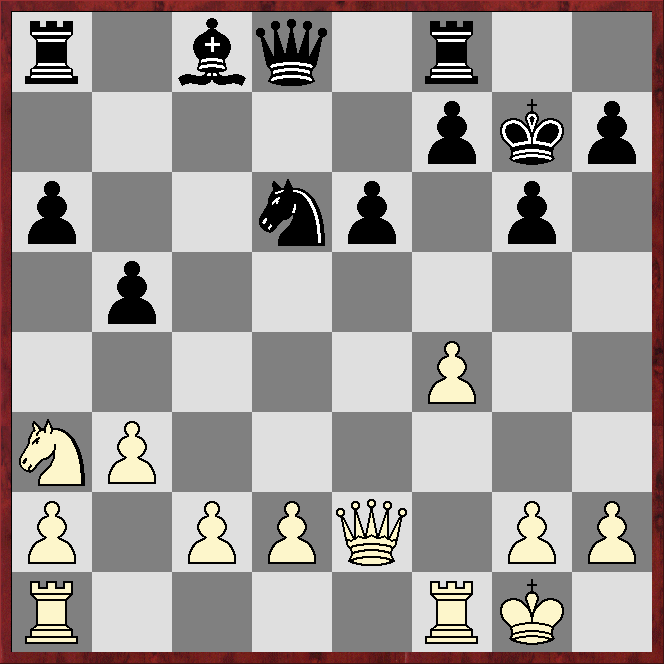
IN round nine with white, after six moves of the Modern Defence, 1.e4 g6 2.d4 Bg7 3.Nc3 c6!? 4.f4 d5 5.e5 Nh6 6.Nf3 f6, I reached the following position.
How should White proceed?
*****
*****
*****
*****
*****
*****
*****
*****
Stockfish15.1 and Komodo14.1 reckon White is at least slightly better.
White's advantage stems from having more central space, and that space advantage can be maintained without effort by developing a bishop or, as Stockish15.1 suggests, by 7.h3.
Instead I played 7.exf6?!, and after 7...exf6 the engines reckon Black is at least level.
I had originally intended continuing 8.Qe2+, thinking White must have an edge after 8...Qe7 9.Qxe7+ Kxe7.
Not only is an such edge doubtful - the black king has a safe square at f7 - but Black can instead play 8...Kf7, when the line-up of white king and queen on the e file, with the white king unable to immediately castle, can only favour Black.
LESSON: when surrendering an advantage, in this case's White's extra central space, one must be sure of getting something tangible, and of at least equal value, in return.

Sunday, 9 July 2023

Lessons From Prague 8

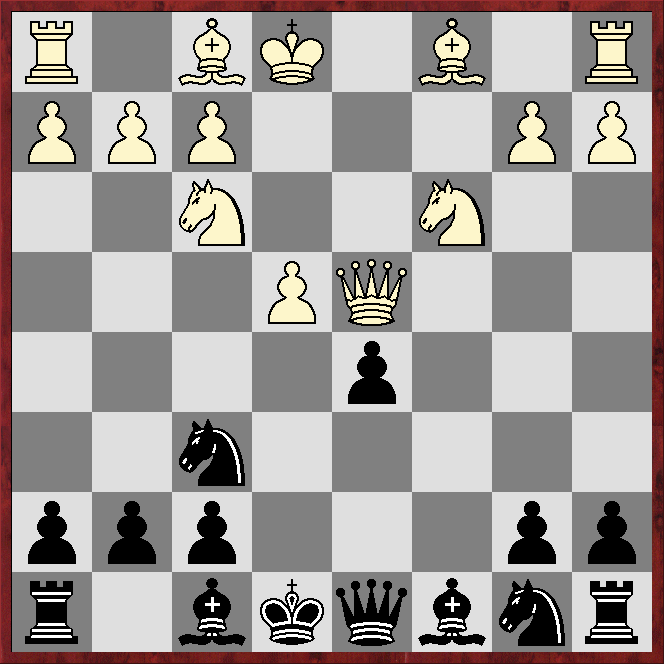
IN round eight with Black I faced the Grand Prix Attack in the Sicilian, reaching the following position after the moves 1.e4 c5 2.Nc3 Nc6 3.f4 g6 4.Nf3 Bg7 5.Bc4 e6 6.0-0 Nge7 7.Qe1!? Nd4!? 8.Nxd4 cxd4 9.Nb5!?
How should Black proceed?
*****
*****
*****
*****
*****
*****
*****
I played 9...0-0?!, after which 10.Nd6 (the game saw White push his e pawn) is at least equal.
What Black should play is 9...d5 10.exd5 exd5, which I rejected because if White captures for a second time on d5 and Black replies 11...Qxd5??, White wins with 12.Nc7+.
I missed, although I knew the idea from similar lines in the Sicilian, that after 11.Bxd5?? Black has the zwischenzug 11...a6, winning one of White's fifth-rank pieces.
LESSON: I knew the right idea in the diagrammed position, but failed to recall it at the board. Nevertheless Black's ninth move was obviously going to be critical, and it was incumbent on me to devote enough time to properly work out what was going on.

Saturday, 8 July 2023

Lessons From Prague 7

IN round seven I reached the following promising position with black.
White has just captured on e5
*****
*****
*****
*****
*****
*****
*****
*****
*****
Both players have three pieces in play, but White has also castled and so has a slight lead in development.
However it is Black to move, and the simple and safe 11...0-0 gives Black at least equality, according to Stockifsh15.1 and Komodo14.1.
Instead I played the greedy-ish 11...Qc7?!, putting pressure on e5 and c4.
Even if White were obliged to play the retreat 12.Nf3?!, it is far from clear that Black can afford to grab a pawn with 12...Qxc4?!, after which the black queen will be harassed and Black still has to spend a tempo on castling.
My opponent played 12.a3, which is enough for at least a slight edge, while 12.Qa4+ may be even better.
The game continued 12...Nc6 13.Nxc6 bxc6 14.d3, after which I really should have castled.
Instead I grabbed an open file with 14...Rb8?, after which 15.Nd2 put White in position to take advantage of the unfortunate line-up of black pieces on the h2-b8 diagonal.
LESSON: delaying castling in fairly open positions is a risky business. One must be sure the potential gain from another manoeuvre, or from a combination, outweighs the possible tactical disadvantages.

Friday, 7 July 2023

Lessons From Prague 6

IN round six with white I reached the following position that Stockfish15.1 and Komodo14.1 reckon is completely equal.
Black has just played 40...Qe7-e2
*****
*****
*****
*****
*****
*****
*****
*****
I saw that 41.Qc5 leads to a simple draw, but instead I played 41.Qe3!?, reasoning that Black would probably play 41...Qc4, when 42.Qe5 is also a draw, although Black has to display a modicum of care.
Instead the game went 41...Qxe3!? 42.fxe3, which I had assumed, on general principles would be at least equal, and might well favour White as Black's pawn-structure is inferior.
However I had failed to properly take into account one of the most important factors in a pawn-ending, ie the activity of the kings.
After 42...Kf6 43.Kf2 Kg5 44.Kf3 Black keeps complete equality with 44...f5, but my opponent tried for more with 44...Kf5!?
Objectively this may be inferior, but I was worried about allowing ...Ke4.
I found the correct 45.g4+ hxg4 46.hxg4+ Kg5 47.e4 dxe4+ 48.Kxe4, while noting that after 48...Kxg4 White is a pawn down.
Following 49.d5 f5+ I faced a critical decision, although I did not realise it.
The game continued 50.Ke5? f4, after which both players queened and I failed to hold a pawn-down queen-and-pawn ending that endgame tablebases show is a draw.
Correct is 50.Kd4 f4 51.d6 f3 52.Ke3, which leads to 52...Kg3 53.d7 f2 54.d8=Q f1=Q.
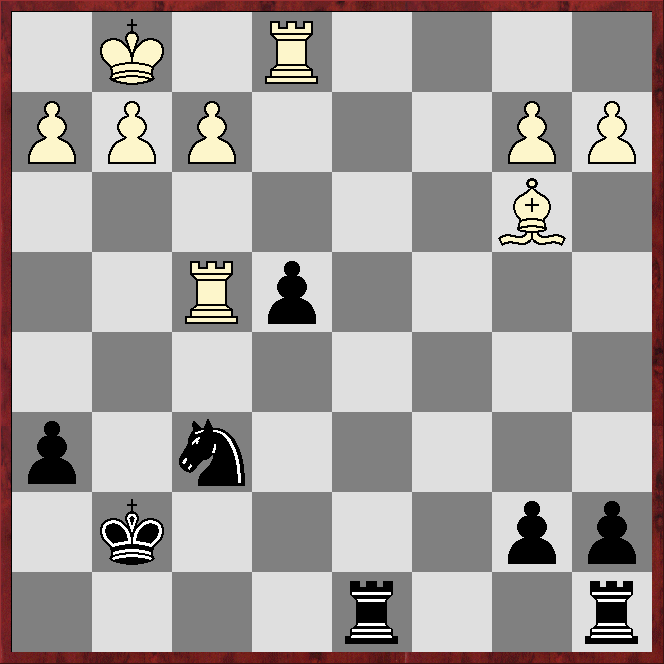
As in the game, both sides have castled, and Black is a pawn up - but only temporarily 
*****
*****
*****
*****
*****
White can continue 55.Qd6+, after which White will win the h pawn.
True, the resulting position is drawn, as the Syzgy  tablebase shows, but the difficulty of Black's position can be gauged from the fact Komodo14.1 believes White is winning.
Throughout this ending I repeatedly misassessed the position, varying from undue optimism to undue pessimism, and rarely resorted to detailed concrete analysis.
LESSON: David Bronstein summed up the dangers of this type of faulty thinking when he said that "to lose one's objective attitude to a position nearly always means ruining your game."

Thursday, 6 July 2023

Lessons From Prague 5

IN round five with white I gained the bishop-pair and had the better pawn-structure, but Stockfish15.1 and Komodo14.1 reckon the following position is equal.
I have just played 17.c3
*****
*****
*****
*****
*****
Stockfish15.1 recommends 17...Nf6, claiming more-or-less complete equality, although Komodo14.1 is not so convinced.
The latter engine prefers 17...c5, although this time Stockfish15.1 doubts that the position is equal.
At any rate both moves are better than the 'clever' 17...Nc5?, which my opponent said afterwards he recognised as bad immediately on playing it.
The point is 18.Bxf5 wins a pawn, and although 18...gxf5 (the engines reckon this is better than 18...Nd7) 19.dxc5 cost me the bishop-pair and gave me a compromised queenside pawn-majority, White is very much on top.
LESSON: as with my round-four game, playing ...Nc5 is another example, albeit in a slightly different form, of 'automatic' thinking. White saw that immediately capturing the knight would not win a piece, and so assumed ...Nc5 did not lose material, but he missed Black's simple zwischenzug.

Wednesday, 5 July 2023

Lessons From Prague 4

IN round four with black I played an 'automatic' developing move that allowed my opponent to immediately gain a substantial advantage.
White has just played 8.Nd2
*****
*****
*****
*****
*****
*****
*****
*****
Reasonable is 8...Nxd2, while Stockfish15.1 and Komodo14.1 recommend 8...Bh3!?
Instead I played 8...e6? (technically this is not a developing move in that it does not develop a piece, but it opens a diagonal for Black's light-square bishop and it is normal to refer to such a move as developing).
After 9.Nxe4 dxe4 (9...Bxe4?! 10.Bxe4 dxe4 loses a pawn to 11.Qxd7+ Kxd7 12,0-0-0+ and 13.Rd4) 10.Qxd7+ Kxd7 11.0-0-0+ White was ahead in development and had a target at e4.
LESSON: there are genuinely forced moves in chess, and they usually should be played quickly, but playing an 'automatic' move quickly brings to mind the humorous title of  international master Willy Hendriks' popular improvement book, Move First, Think Later. Playing like that is a good way to come up with blunders.

Tuesday, 4 July 2023

Lessons From Prague 3

IN round three I had a golden opportunity with white to beat a player rated almost 300 elo higher.
White to play and win
*****
*****
*****
*****
*****
*****
*****
*****
*****
White is a pawn up and has attacking chances against the black king.
Accordingly I played 26.Qd4? I knew Black could meet this with 26...Rf7, but I reasoned an exchange of rooks would not harm my position.
Stockfish15.1 and Komodo14.1 reckon this is good enough for a win, but later positional inaccuracies meant the game was drawn.
Instead I could have won on the spot with 26.g4, after which the black queen has only one move that does not leave it en prise, namely 26...Qb1+.
But then comes 27.Rc1, and if 27...Qxb3 then 28.Qd4 leads to mate, eg 28...Rf7 29.Rxf7 Kxf7 30.Qf6+ Kg8 31.Bh6 etc.
Admittedly 26.g4 is slightly counterintuitive at first sight as White moves a pawn in front of the king and weakens the white position on the f file, but these factors are trivial when compared with the benefits of the move.
LESSON: when an enemy piece, especially a major one, is short of squares, be extra sure to look at ways of hitting it.

Monday, 3 July 2023

Lessons From Prague 2

THE position in the first diagram below arises from a line in the Semi-Tarrasch that runs (minor transpositions are possible) 1.d4 d5 2.c4 e6 3.Nc3 Nf6 4.Nf3 c5 5.cxd5 cxd4!? 6.Qxd4 exd5 7.e4!? Nc6 8.Bb5 dxe4 9.Qxd8+ Kxd8 10.Ng5.
In this position I have always played 10...Be6, but I am aware 10...Ke8 and 10...Ke7!? are also possible
At Prague with black in round two I played the related line 1.d4 d5 2.c4 e6 3.Nc3 Nf6 4.Nf3 c5 5.cxd5 cxd4!? 6.Qxd4 exd5 7.e4!? dxe4!? 8.Qxd8+ Kxd8 9.Ng5 (see the game for the exact move-order), reaching the following position.
This is the same position as in the first diagram, but without the moves ...Nc6 and Bb5
Previously I have always continued 9...Be6, but, drawing on the analogy with the first diagram, I decided to keep the bishop-pair and played 9...Ke8?
It was only after playing it that I considered what would happen if White replied 10.Bc4, which is indeed what happened, after which White recovers his pawn and has the better position.
Note that, if in the first diagram, Black plays 10...Ke8, then 11.Bc4?! would be fairly pointless as Black has, among other satisfactory moves, 11...Ne5.
LESSON: similar positions are just that - similar, not the same. What applies in one need not necessarily be true in a similar but different position.

Sunday, 2 July 2023

Lessons From Prague

IN round one I had white against a junior rated more than 400 elo higher.
Nevertheless I soon achieved what Stockfish15.1 and Komodo14.1 reckon is a winning position.
Black to make his 16th move
*****
*****
*****
*****
*****
*****
*****
*****
White is a pawn up and has a promising attack against the exposed black king.
I think many club players would try to defend on the kingside, while hoping the presence of queens would later give chances of complications that a much lower-rated opponent could go wrong in.
However, Black presumably reasoned that being a pawn down is not his major problem - the possibility of getting mated is.
Accordingly he played 16...Qe8!?, which the engines agree is the best move.
There followed 17.Qxe8 Rfxe8 18.Bxg7 Kxg7,  after which the position is transformed.
Black remains a pawn down and is still losing, according to the engines, but there is no longer any danger of a mating attack
Not only is the black king safe, but it is slightly better placed than the white king for central action. Black also has the only active rook.
The game carried on for another 23 moves, but Black achieved a draw, something that I suspect not many people would have been willing to bet on from the position in the first diagram.
LESSON: seeking complications is not the only way to save a lost game. It is more important to identify the main problem with a position, and to rectify that.

Saturday, 1 July 2023

Summing Up Prague

MY score in the open of +2=4-3 gained exactly 33 Fide elo.
Sightseeing and fishing on the Vltava

Friday, 30 June 2023

Prague Open Round Nine

PLAYED a Czech Fide master in today's final round.

Spanton (1824) - Václav Pacl (2004)
Modern
1.e4 g6 2.d4 Bg7 3.Nc3 c6!?
The main move is 3...d6, but there are 17,772 examples of the text in ChessBase's 2023 Mega database, and its score of 48% is two percentage points better than the main move. 
4.f4 d5 5.e5 Nh6
The mainline in Mega23 runs 5...h5!? 6.Nf3 Nh6 (6...Bg4 is also popular) 7.Be3 Bg4 8.h3 Bxf3 9.Qxf3 with the upper hand for White, according to Stockfish15.1 and Komodo14.1
6.Nf3 f6
How should White proceed?
*****
*****
*****
*****
*****
7.exf6?!
The engines strongly dislike this, and they are probably right. White loses his central space advantage, which remains after simple development, eg 7.Bd3, 7.Be3 or 7.Be2.
7...exf6 8.Be2!?
This has been played by a 2369, but it may be overly cautious. The engines prefer 8.Bd3 or 8.h3. Note that Black is fine after 8.Qe2+?! Qe7 9.Qxe7+ Kxe7 as the king will find a safe-enough haven on f7. But probably better is 8...Kf7 as 9.Be3? Re8 is very unpleasant for White.
8...0-0 9.0-0 Re8 10.Re1 Be6 11.Be3 Ng4 12.Bd3 Nxe3!?
Black takes the bishop-pair, but it is White's bad bishop that is exchanged. The bishop-pair is a long-term asset but it does not have much immediate value in a semi-closed position like this. 
13.Rxe3 Bh6 14.g3 Nd7 15.Qe2 Nf8 16.Re1 Qd7 17.Nd1!?
This is the engines' top choice. One point is to continue with Nf2 to cover the h3 and g4 squares.
17...Bf7 18.Qf2 Ne6 19.c3 Ng7 20.Rxe8+ Rxe8 21.Rxe8+ Qxe8 22.Ne3 Qd7 23.Qc2 Ne8 24.Kg2 Nd6 25.b3 b5 24.b4 Qe6 25.Nf1 Ne4 26.N1d2 Nd6
Or 26...Nxd2 27.Qxd2 with complete equality, according to the engines.
27.Nf1 Ne4 28.N1d2 Nd6 29.Nf1 Ne4 30.N1d2 Nd6 ½–½

Thursday, 29 June 2023

Prague Open Round Eight

PLAYED a South African junior (born 2012) this afternoon.

Michael Schwartz (1237) - Spanton (1824)
Sicilian Grand Prix Attack
1.e4 c5 2.Nc3 Nc6 3.f4 g6 4.Nf3 Bg7 5.Bc4 e6
Black's position has several holes - can White take advantage of this?
*****
*****
*****
*****
*****
6.0-0
This is the most popular continuation in ChessBase's 2023 Mega database, but White has many other possibilities, including the sharp 6.f5!?, when the mainline in Mega23 runs 6...Nge7 7.fxe6 fxe6 8.d3 d5 9.Bb3 b5!? with equal chances, according to Stockfish15.1 and Komodo14.1.
The latter engine suggests 6.e5!?, and if 6...d6 then 7.Qe2, although Stockfish15.1's reply of 7...Nge7 splits the engines after 8.Ne4 dxe5 9.fxe5 Nxe5 10.Nxe5 Bxe5. Komodo14.1 reckons White has full compensation for a pawn, but Stockfish15.1 gives Black at least a slight edge.
Instead of castling or pushing a pawn to the fifth rank, Stockfish15.1 suggests 6.d3 Nge7 7.0-0 0-0 8.Bb3!?, but gives Black the better side of equality.
6...Nge7 7.Qe1!?
The mainline in Mega23 runs 7.d3 0-0 8.Qe1 d5 9.Bb3 Nd4 10.Nxd4 cxd4 11.Ne2 dxe4 12.dxe4 with equality, according to Komodo14.1, although Stockfish15.1 reckons 12...b5!? gives Black a slight edge.
7...Nd4!?
Much more popular is 7...0-0, when White usually replies 8.d3, transposing into the previous note.
8.Nxd4 cxd4 9.Nb5!?
The engines much prefer 9.Ne2.
How should Black proceed?
*****
*****
*****
*****
*****
9...0-0?!
Ukrainian grandmaster Andrey Vovk played the text in a 2009 rapid game, but almost certainly better is 9...d5 10.exd5 exd5, the point being 11.Bxd5?? loses to 11...a6 (but not 11...Qxd5?? 12.Nc7+).
10.e5
MS offered a draw.
Possibly better than the text is 10.Nd6, when 10...Qc7 11.e5 Nf5 12.Nxf5 exf5 is equal, according to the engines, but Black must avoid 12...Qxc4? 13.d3, eg 13...Qc5 14.Nxg7 Kxg7 and either 15.Qh4 or 15.f5!?, in each case with a very strong-looking attack.
10...d5!?
This temporary pawn sacrifice may be a novelty, but at any rate is an improvement on Martina Skogvall (2100) - Vovk (2512), Warsaw AIG Life Rapid 2009, which saw 10...Qb6, when the engines reckon 11.Bd3 or 11.b3 would have given White at least a slight edge.
11.exd6?!
The engines prefer 11.Bd3 or 11.Be2, but give Black a slight edge.
11...Nf5 12.b3?!
The engines suggest 12.g4!? but much prefer Black.
12...a6
Probably not 12...Nxd6?! as 13.Nxd6 Qxd6 14.a4 leaves Black with at best a slight edge, according to the engines. However White should avoid 13.Ba3 Nxc4 14.Bxf8?? Bxf8 15.bxc4 as 15...a6 traps the white knight.
13.Na3 Nxd6 14.Bb2 b5 15.Be2??
White has to play 15.Bd3, although the engines believe Black is positionally winning.
15...d3 16.Bxg7 dxe2 17.Qxe2 Kxg7
White is down a pawn for a piece, and it soon gets much worse
*****
*****
*****
*****
*****
18.Rae1 Nf5 19.g4 Qd4+ 20.Kh1?? Bb7+ 21.Rf3 Nh4 22.c3 Qxf4 (0-1, 33 moves)

Wednesday, 28 June 2023

Prague Open Round Seven

PLAYED a Swede this afternoon.

Tobias Pettersson (2090) - Spanton (1824)
Réti
1.c4 e6 2.Nf3 d5 3.e3
Richard Réti liked to play 3.g3, although there is a game from 1923 when he tried 3.b3. He won the latter game, and scored +7=1-1 with 3.g3 in games in ChessBase's 2023 Mega database.
3...c5 4.b3 d4!?
Stockfish15.1 and Komodo14.1 like this grab of space.
5.exd4 cxd4 6.g3 Nc6 7.Bg2 e5 8.0-0 Bd6 9.Re1 Nge7
How should White proceed?
*****
*****
*****
*****
*****
10.b4!?
A common idea in lines of the Réti where Black pushes on with ...d4.
10...Nxb4 11.Nxe5 Qc7?!
The engines strongly dislike this, preferring castling.
12.a3
Also quite promising is 12.Qa4+ Bd7 13.Nxd7 Qxd7 and 14.Qb3 with a slight edge, according to the engines, but not 14.Qxd7+ Kxd7 15.Bxb7? Nc2!
12...Nc6
The engines prefer 12...Na6!?
13.Nxc6 bxc6 14.d3 Rb8?
Grabbing an open file but creating an unfortunate line-up on the h2-b8 diagonal. Again better is castling.
15.Nd2 0-0
Black can prevent Ne4 with 15...f5?, but then 16.Qh5+ is extremely strong.
16.Ne4
The engines point out 16.c5! Bxc5 17.Ne4 with Bf4 to come, and if 17...Rb5 then 18.a4 Ra5 19.Nxc5 Rxc5 20.Ba3 Re5 21.Rxe5 Qxe5 22.Qe1 Qxe1+ 23.Rxe1 etc.
16...Ng6 17.h4 c5?
Better is 17...f6, although the engines reckon 18.h5 Ne5 19.Bf4 gives White the upper hand, eg 19...h6 20.c5 Be7 21.Rc1 Be6 22.Nd2!?, threatening to continue with 23.Nf3 or 23.Qa4.
18.h5 Ne5 19.h6
Even stronger is 19.Nxd6 Qxd6 20.Rxe5! Qxe5 21.Bf4 and 22.Bxb8.
19...Bg4 20.Qd2
This is better than 20.f3 Bf5, after which Black is probably fine.
What should Black play?
*****
*****
*****
*****
*****
20...f5??
Black is just about still in the game after 20...Be7 (20...f6 is also much better than the text), eg 21.Qf4 f6 22.hxg7 Rf7, although White has at least the upper hand, according to the engines.
21.Nxd6 Qxd6 22.Qg5 g6 23.Bf4
This wins easily enough, but the engines give 23.Rxe5!, the point being 23...Qxe5 24.Bf4 leads to mate, eg 24...Qe6 25.Bxb8 Rxb8 26.Bd5 etc.
23...Rfe8 24.Rxe5 Rxe5 25.f3 Rb2!?
Desperately trying to create tactical counterplay.
26.Bxe5 Qxe5 27.Qd8+ Kf7 28.Qd7+ Kf8 29.Qg7+
Not 29.fxg4?? Qe3+ with a draw by repetition.
29...Qxg7 30.hxg7+ Kxg7 31.fxg4
Black can get a second pawn, but it is not enough for a piece
*****
*****
*****
*****
*****
31...Rd2?
Now White invades via the open b file. More resistance was put up by 31...fxg4.
The game finished:
32.Bf1 fxg4 33.Rb1 h5 34.Rb7+ Kf6 35.Rxa7 g5 36.Rc7 h4 37.Rc6+ Kg7 38.Rxc5 Kh6 39.Re5 Kh5 40.gxh4 Kxh4 41.Re2 Rxd3 42.Rh2+ Rh3 43.c5!? Kg3 44.Bxh3 1-0

Tuesday, 27 June 2023

Prague Open Round Six

PLAYED a German this afternoon.

Spanton (1824) - Sebastian Leidorf (2045)
French Exchange
1.e4 e6 2.d4 d5 3.exd5 exd5 4.Nf3 Nf6 5.Bd3 c5!?
An interesting way to create an imbalance. It dates back to at least 1858, when it was played by Wilfried Paulsen, elder brother of the more-famous Louis.
6.0-0!?
6.dxc5 Bxc5 is considered fine for Black as a tempo has not been 'wasted' on playing ...Be7 or ...Bd6.
6...c4 7.Re1+ Be7 8.Bf1 0-0
Now both sides have castled, how would you assess the position, and what should White play?
*****
*****
*****
*****
*****
Black has more space on the queenside, but White can quickly attack that space with b3, after which Black probably has nothing better than giving up the space with ...cxb3, as will be played in the game. Certainly 9.b3 is the most popular continuation in ChessBase's 2023 Mega database. However Garry Kasparov (2770) - Viktor Korchnoi (2610), Tilburg (Netherlands) 1991, went 9.Bg5!? Bg4 10.h3 Bxf3!? 11.Qxf3 Nc6 12.c3 with a slight edge for White, according to Stockfish15.1 and Komodo14.1 (1-0, 45 moves). The engines suggest 10...Be6!? as an improvement.
9.b3 cxb3
Probably not 9...b5?! 10.a4.
10.axb3 Nc6
How should White continue?
*****
*****
*****
*****
*****
11.Ba3!?
Most popular in Mega23 is 11.Ne5, although the engines evaluate the position as equal. Komodo14.1 reckons 11.Bd3 and 11.c3 gives White an edge. Stockfish15.1 fluctuates between several moves, including 11.c3, 11.Bb2!?, 11.Bf4 and 11.h3, but is less confident White has much of an advantage.
11...Re8
This is not in Mega23 but is liked by the engines, which also like 11...Bxa3!? with probably ...Bg4 to follow.
12.h3 Bf5 13.Bd3 Be4 14.c3 Rc8 15.Ng5!? Bxa3!?
SL took about 27 minutes on this move, which is the top choice of the engines.
16.Nxa3 Bxd3 17.Qxd3 h6 18.Rxe8+ Qxe8 19.Nf3 a6 20.Re1 Qf8 21.Nb1 Na5 22.Nfd2 b5 23.b4 Nc4 24.Nxc4 Rxc4?!
The engines reckon Black is at least equal after 24...bxc4.
25.Nd2 Rc7 26.Nb3 Re7
What should White play (give yourself a big pat on the back if you find the engines' top choice)?
*****
*****
*****
*****
*****
27.Re3
The engines reckon White is slightly better after 27.Rf1!?, a move that did not cross my mind.
27...Rxe3 28.Qxe3 Qd6 29.Nc5 Kf8!?
The engines do not like this, much preferring 29...Qb6.
30.g3 Nd7 31.Qe2 g6 32.Qg4 Nf6 33.Qc8+ Kg7
How should White proceed?
*****
*****
*****
*****
*****
34.Nxa6
If 34.Qxa6 then 34...Qxa6 35.Na6 Ne4 is probably OK for Black. However the engines reckon 34.Qb7 gives at least a slight edge. A plausible, albeit long and non-forcing, continuation runs 34...g5!? 35.Kg2 h5 36.Qc8!? Kg6 37.Nd3 Kg7 38.Qf5 Ne4 39.Nc5 Qf6 40.Qxf6+ Nxf6 41.h4 Kg6 42.hxg5 Kxg5 43.Kf3, after which Komodo14.1 gives White the upper hand, but Stockfish15.1 reckons Black is only slightly worse.
34...Ne4 35.Nc7 Kh7 36.Ne8 Qe7 37.Qc6 Nxc3!?
Black has an easy draw with 37...Nxg3 etc. The text is an attempt to play for more.
38.Nf6+ Kg7 39.Nh5+ gxh5 40.Qxc3 Qe2 41.Qe3!?
An easy draw is to be had with 41.Qc5, obliging Black to take a draw by repetition. I played the text under the assumption the coming pawn-ending was probably better for White, or at least equal.
41...Qxe3!? 42.fxe3 Kf6
Black has the more-active king, and that seems to fully compensates for the black pawn-weaknesses
*****
*****
*****
*****
*****
43.Kf2 Kg5 44.Kf3 Kf5!?
Komodo14.1 strongly dislikes this, but Stockfish15.1 only partly agrees. They do, however, agree 44...f5 is completely equal.
45.g4+ hxg4+ 46.hxg4+ Kg5 47.e4 dxe4+ 48.Kxe4 Kxg4 49.d5 f5+ 50.Ke5?
White keeps an edge, according to the engines, with 50.Kd4, although the Syzygy endgame tablebase shows the position is drawn after both moves. After 50.Kd4 the engines' continue 50...f4 51.d6 f3 52.Ke3 Kg3 53.d7 f2 54.d8=Q f1=Q 55.Qd6+, claiming at least a slight edge for White. However all four possible king moves draw, according to Syzygy, eg 55...Kg2 56.Qg6+ Kh2 57.Qxh6+ Kg3, and White cannot make progress. The problem with the text is that after it only Black can play for a win.
50...f4 51.d6 f3 52.d7 f2 53.d8=Q f1=Q 54.Qg8+ Kh4 55.Qd8+ Kg3 56.Qg8+ Kh2 57.Qb8!? Qc4 58.Kf5+ Kg2 59.Qb7+ Kf2 60.Qa7+ Ke2 61.Qe7+ Kd2
White to play and draw
*****
*****
*****
*****
*****
62.Qg7
The only drawing move, Syzygy shows, is 62.Qc5!
62...h5 63.Kg5?
This allows an immediate win, but the ending is lost anyway.
63...Qg4+ 0-1

Monday, 26 June 2023

Prague Open Round Five

Played a Czech this afternoon.

Spanton (1824) - Jiří Plešek (2005)
Caro-Kann Tartakower
1.e4 c6 2.d4 d5 3.Nc3 dxe4 4.Nxe4 Nf6 5.Nxf6+ exf6 6.Be3!?
There are 410 examples of this move in ChessBase's 2023 Mega database, including being played by Ian Nepomniachtchi, Wesley So and Michael Adams, but the text is a lot less popular than 6.Bc4, 6.Nf3 and especially 6.c3.
How should Black respond?
*****
*****
*****
*****
*****
6...Bd6
This is easily the most popular move in Mega23, but Komodo14.1 marginally prefers 6...Qb6!?, trying to take immediate advantage of White's last move. After the main continuation 7.Qc1 Bd6 8.Bd3 0-0 Komodo14.1 gives White a slight edge, but Stockfish15.1, which does not suggest 6...Qb6!?, calls the position equal.
7.Bd3 0-0 8.Ne2 Re8 9.0-0 Nd7 10.Ng3
So has twice played 10.c4 Nf8 11.Ng3 in wins over 2600+ opponents.
10...g6 11.Ne4!?
This may be a novelty. It comes to be Komodo14.1's top choice, although Stockfish15.1 prefers the known move 11.Re1.
11...Bf8!?
The engines prefer this and 11...Be7 to staying on the b8-h2 diagonal with 11...Bb8 or 11...Bc7.
12.Bf4
The engines suggest 12.c4 f5 13.Nc3, and if 13...Nf6 then 14.Be2!?, but agree the position is equal.
12...f5 13.Nd6 Re6
Komodo14.1 suggests grabbing a pawn with 13...Bxd6!? 14.Bxd6 Nf6 15.Bb4 Qxd4 16.Bc3 Qd6, but accepts White has full compensation.
Has White a strong combination?
*****
*****
*****
*****
*****
Probably not, although there are two lines worth investigating.
A) 14.Nxf7?! Kxf7 15.Bc4 seems to fail to 15...Nf6 16.Bxe6+ Bxe6, when White's rook and pawn are unlikely to be enough for Black's bishop and knight, especially as Black also has a useful-looking bishop-pair, and the black king is safe.
B) 14.Nxf5?! gxf5 15.Bxf5 Re8 (15...Re7 may be fine too) 16.Qg4+ (Komodo14.1 at first reckons this gives equal chances, but that is almost certainly not the case) Kh8, and there does not seem to be a convincing continuation for White, eg 17.Bg5 Be7 18.Qh5 is answered by 18...Nf8.
14.Nxc8 Rxc8
How would you assess this middlegame?
*****
*****
*****
*****
*****
White has the bishop-pair and better pawn-structure, but according to the engines the position is completely equal. I guess the point is the position is not one in which the white bishops have great scope, and meanwhile the knight has promising squares at e4 and d5.
15.Re1!?
More circumspect is 15.c3.
15...Rxe1+ 16.Qxe1 Bg7
Black can hit two unprotected pawns with 16...Qb6, when 17.Qc3 is an awkward defence, eg 17...Bg7 18.Be5 Bxe5!? 19.dxe5 Nc5!? 20.Re1 Rd8, after which Komodo14.1 gives Black a slight edge although Stockfish15.1 calls the game equal.
Also interesting is 17.c3!?, eg 17...Qxb2 18.Rb1 Qxa2 19.Rxb7, when again Komodo14.1 gives Black a slight edge but Stockfish15.1 reckons White has good compensation for a pawn. However the engines suggest meeting 17.c3!? with 17...c5!?, eg 18.d5 c4 19.Bf1 Nf6 20.Be3 Bc5 21.Bxc5, when it is not clear which recapture is better, and again the engines do not agree on their evaluation of the resulting positions.
17.c3 Nc5?
JP said afterwards that immediately on playing this move he saw what was wrong with it.
18.Bxf5 gxf5 19.dxc5 Qe8 20.Kf1 Bf8 21.Bd6 Qxe1+ 22.Rxe1 f6!? 23.c4 Kf7 24.Re3 Rd8 25.Bxf8 Kxf8
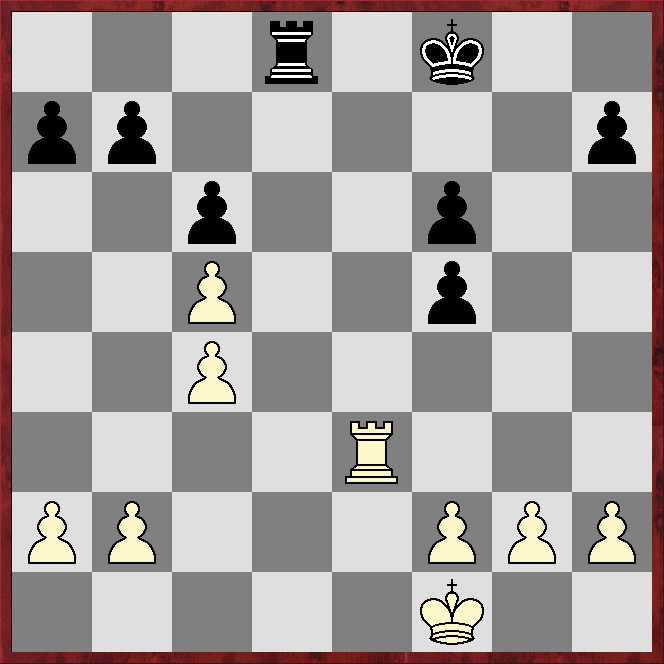
Black has got down to a rook-and-pawn ending, but is it saveable?
*****
*****
*****
*****
*****
White's extra pawn is part of a majority that cannot make a passer with normal play. Black's bigger problem, I believe, is that there are three isolanis, two of which are doubled. The engines agree White is winning.
26.Ke2 Rd4 27.b3 Kf7 28.Rh3 Kg6 29.Rd3
Can Black exchange rooks and prevent the white king entering the black position?
*****
*****
*****
*****
*****
The short answer seems to be No, eg 29...Rxd3?! 30.Kxd3 Kg5 31.Ke3 a6 32.Kf3 a5 33.h4+! etc.
29...Re4+ 30.Re3 Re5
Allowing an exchange on e4 is hopeless, eg 30...Kg5 31.Rxe4 fxe4 32.Ke3 f5 33.Kd4 Kf6 34.b4 Ke6 35.Ke3 Ke5 36.g3 a6 37.a3 h5 38.h4 Ke6 39.Kf4 Kf6 40.a4 etc.
31.Kd3!?
Also winning easily enough is 31.b4.
31...Rxc5
Or 31...Kf7 32.Kd4 Ke6 33.b4, eg 33...a6 34.g3 h6 35.f4!? Rxe3 36.Kxe3 Kd7 37.Kd4 Kd7 38.Kc3 Kc7 39.Kb3 Kb8 40.Ka4 Kc7 41.Ka5 Kc8 42.Kb6 Kb8 43.a4 Kc8 44.b5 etc.
32.Re7 Ra5
Perhaps 32...Re5!?, going for counterplay, gives better practical chances in the sense White could be panicked into trying to defend the white kingside. However the engines are not keen, and objectively it is pretty hopeless. One line runs 33.Rxb7 Re1 34.Rxa7 Rg1 35.Ra8 Kg7 36.g3 Rg2 37.a4 Rxf2 38.b4 Rxh2 39.b5 cxb5 40.axb5, after which the queenside pawns cannot be stopped.
33.a4 b6 34.Rc7 b5!?
Or 34...c5 35.Ke3 Kg5 36.h4+!
35.axb5 cxb5 36.c5
This pawn cannot be stopped.
The game finished:
36...Ra3 37.Kc3 a5 38.Kb2 b4 39.Ra7 1-0

Sunday, 25 June 2023

Prague Open Round Four

PLAYED a Czech this afternoon.

Luděk Mészáros (2060) - Spanton (1824)
Queen's Pawn Game
1.Nf3 d5 2.g3 Nc6 3.d4 Bf5 4.Bg2 Qd7!?
How should White respond?
*****
*****
*****
*****
*****
5.Bf4
The mainline in ChessBase's 2023 Mega database runs 5.0-0 Bh3 6.c4 Bxg2 7.Kxg2 e6 8.Nc3 with a slight edge for White, according to Stockfish15.1 and Komodo14.1.
5...Nf6
The engines strongly dislike this natural-looking move.
6.Ne5!?
This seems to be a novelty and is Komodo14.1's top choice, at least for a while, although it comes to marginally prefer 6.0-0, which is also Stockfish15.1's recommendation.
6...Nxe5 7.dxe5 Ne4 8.Nd2 e6?
The engines like 8...Bh3!?
9.Nxe4
How should Black recapture?
*****
*****
*****
*****
*****
9...dxe4
After 9...Bxe4?! 10.Bxe4 dxe4 11.Qxd7+ Kxd7 12.0-0-0+ Black cannot save the e4 pawn.
10.Qxd7+ Kxd7 11.0-0-0+ Kc6!?
Pushing the king ahead of its pawns in the late opening/early middlegame is rarely without risk, even with queens off the board, and here it involves a positional pawn sacrifice.
12.f3 Be7
Not 12...exf3?? 13.Bxf3+ Kb6 11.Be3+ (the immediate 11.Rd7 is also good) Bc5!? (this is best, according to the engines) 12.Bxd5+ Kxc5 13.Rd7 etc.
13.fxe4 Bg6
How would you assess this middlegame?
*****
*****
*****
*****
*****
White is a pawn up but has tripled e pawns, and both players' bishops have limited scope with no good-looking pawn-breaks. Komodo14.1 for quite some time reckons White is winning, but comes to agree with Stockfish15.1 that White 'only' has the upper hand.
14.Rd3 b6 15.Rhd1 Rhd8 16.Bf3 Kb7 17.c4 Rac8
This is so ...c6 or ...c5 can be played, as right now 17...c6??, for example, loses to the simple 18.Rd7+.
18.Kc2 a5 19.a3 a4!?
This pawn could prove weak but it severely hampers White's chances of a successful queenside pawn-advance.
20.h4 h5 21.h6 Bh7 22.Rd7?!
This allows simplification that almost certainly favours Black. The engines suggest something like 22.g4 c6 23.Kc3 Kc7 24.Rg1 Bc5 25.Rg2 g5!? 26.hxg6 Bxg6 27.Rh2 b5!? 28.Rxh6, after which White is two pawns up. However following 28...Rb8 29.Rh1 b4+ 30.axb4 Rxb4 31.Rhd1 Rdb8!? 32.Rd7+ Kc8 33.Rd8+ Kb7 34.Rxb8 Kxb8 it is not clear White can make progress (Stockfish15.1 calls the position equal, and although Komodo14.1 gives White the upper hand, this assessment may be more-or-less on material considerations alone).
22...Rxd7 23.Rxd7 Re8 24.Kc3 Kc6 25.Rd1 Ra8 26.g4 Ra5 27.Rg1 Bg5?!
Probably better is 27...Kd7 28.g5 hxg5 29.Bxg5 g6, eg 30.Bxe7 Kxe7 31.Kd4 gxh5 32.Bxh5 Ra8 33.Rg7 c5+ 34.Ke3 Bg8, after which Black may well be holding.
28.Bxg5 hxg5
What should White play?
*****
*****
*****
*****
*****
29.Kd4
The engines give 29.Rd1!, eg 29...Rxe5 30.Rd4 f6 31.Kd3 b5 (quiet moves allow 32.Rd8) 32.cxb5+ (32.Rd8?! allows counterplay with 32...Kc5) 32.cxb5+ Rxb5 33.Rxa4 Rb8 34.Ra6+ Kd7 35.b4, after which the white queenside pawns are very strong.
29...Ra8 30.h6?!
This allows complete equality, according to the engines. One line suggested by them runs 30.Rc1 Rd8+ 31.Kc3 Kc5 32.e3 Rd7, although White seems unable to make progress.
30...gxh6 31.Rh1 Rd8+ 32.Kc3 Bg6 33.Rxh6 Kc5 34.e3 c6 35.Rh2 b5 36.cxb5 cxb5 37.Rh1 Kb6 38.b3!?
A last try, but it leads to nothing.
38...axb3 39.Rb1 Rc8+ 40.Kd3 Rd8+ 41.Kc3 Rc8+ 42.Kd3 Rd8+ 43.Kc3 ½–½

Saturday, 24 June 2023

Prague Open Round Three

PLAYED a Slovak this afternoon.

Spanton (1824) - Stanislav Slacky (2100)
Alekhine
1.e4 Nf6 2.e5 Nd5 3.d4 d6 4.c4 Nb6 5.exd6 exd6
This is slightly less popular and scores marginally worse than 5...cxd6 in ChessBase's 2023 Mega database.
6.Nc3 Nc6
The mainline runs 6...Be7 7.Bd3 Nc6 8.Nge2 Bg4 and either 9.Be3 or 9.f3, with White enjoying an advantage in either case, according to Stockfish15.1 and Komodo14.1.
7.d5!?
Gaining space, but this move is only fourth-most popular in Mega23, behind 7.Nf3, 7.h3 and especially 7.Be3.
7...Qe7+!?
The engines prefer the more-common 7...Ne5.
8.Be3
The engines prefer 8.Be2 Ne5 9.f4 (Stockfish15.1 also likes 9.a4) Ng4 10.Qd4 c5!? 11.Qe4 Qxe4 12.Nxe4 with what they reckon is at least a slight edge.
8...Ne5 9.Be2 Bd7
Not 9...Nexc4?? 10.Bxc4 Nxc4 11.Qa4+ and Qxc4.
10.b3 g6
How should White proceed?
*****
*****
*****
*****
*****
11.a4
The e5 knight has no squares it can go to, but there seems no way to exploit this, eg 11.f4?! leaves the white dark-square bishop unprotected, so Black can reply 11...Ng4 or 11...Nf3+.
If 11,Bd4?! then 11...Bg7 is fine as 12.f4 can be met by 12...c5 13.dxc6 Bxc6, when g2 is vulnerable.
If 11.Qd4?! then again 11...Bg7 as 12.f4?? loses to 12...Nf3+ etc.
Vladimir Akopian (2675) - Parham Maghsoodloo (2576), Sharjah Masters (United Arab Emirates) 2017, saw 11.Nf3 Bg7 12.Nxe5 Bxe5 13.Qd2 0-0 14.0-0 with White having the upper hand, according to the engines (but ½–½, 56 moves).
11...Bg7 12.Rc1 a5 13.Nf3
Not 13.Bxb6?! cxb6 14.Qd4?? Nf3+ etc.
13...Nxf3+ 14.Bxf3 0-0 15.0-0 f5?!
This does Black's light-square bishop no favours, and weakens e6.
16.Qd2 Be8?!
Probably better is 16...Rfe8, although that is not consistent with Black's previous move.
17.Rfe1 Qd8 18.Ne2
The knight heads for e6.
18...Nd7 19.Nd4 f4!?
This is the engines' top choice.
20.Bxf4 Bxd4 21.Qxd4 Nc5
The engines suggest 21...Qf6 22.Qxf6 Rxf6 but reckon White is winning.
22.Rc3 Bd7 23.Qd2 Qf6 24.Bg5 Qf7?
The engines reckon 24...Qh8!? or 24...Qg7!? is better, but losing.
25.Re7 Qf5 26.Qd4?
White is still on top after this, but as SS pointed out after the game, 26.g4 wins the black queen.
26...Rf7 27.Rxf7 Kxf7 28.Qf4?!
Acquiescing in an exchange of queens makes little sense when Black has much the weaker king. The engines give 28.Qh4 Kg8 29.h3.
28...Re8 29.Kf1 Qxf4 30.Bxf4 Bf5 31.Be3 b6 32.Bxc5?!
Probably better is the engines' 32.g4!?
32...bxc5 33.Bd1 Re5 34.Rf3 Kg7 35.Re3?!
As SS remarked afterwards, I swopped off the wrong pieces.
35...Rxe3 36.fxe3 Kf6 37.Kf2 g5
SS offered a draw.
38.Ke1 Be4 39.g3 Ke5 40.Kd2 h6
SS offered a draw.
41.Be2 Bf5 42.g4 Bd7 43.Bf3 Be8 44.Be2 Bd7 ½–½

Friday, 23 June 2023

Prague Open Round Two

PLAYED a Czech Fide master this afternoon.

Josef Obsivac (2276) - Spanton (1824)
QGD Semi-Tarrasch
1.d4 d5 2.Nf3 e6 3.c4 Nf6 4.Nc3 c5 5.cxd5 cxd4 6.Qxd4 exd5 7.e4!?
This is generally considered, from a theoretical view, the critical continuation.
How should Black respond?
*****
*****
*****
*****
*****
7...dxe4!?
The mainline in ChessBase's 2023 Mega database runs 7...Nc6 8.Bb5 dxe4 9.Qxd8+ Kxd8 10.Ng5 Be6!?, followed by either 11.Nxe6+ or 11.0-0, with Stockfish15.1 and Komodo14.1 giving White a slight pull. They marginally prefer the text.
8.Qxd8+ Kxd8 9.Ng5 Ke8?
The mainline in Mega23 runs 9...Be6 10.Nxe6 fxe6 11.Bg5 Nc6 12.0-0-0+ with an equal position according to the engines, although Komodo14.1 comes close to giving White a slight edge. The text makes the f7 pawn undefendable.
10.Bc4 Bb4 11.0-0!?
This is best, according to the engines.
11...Nc6 12.Bxf7+ Kf8
Almost certainly not 12...Ke7?! as 13.Nd5+ Nxd5 14.Bxd5 leaves e4 undefendable.
13.Bc4 Ne5?!
The engines much prefer 13...Na5 or 13...Bf5.
14.Bb3 Bf5 15.Be3
Even stronger, according to the engines, is 15.Nd5.
15...h6!?
This is best, according to the engines, but after ...
16.Ne6+ Bxe6 17.Bxe6 Ke7 18.Bb3
... they reckon White has the upper hand.
18...Rhd8 19.Rac1 Neg4?
Better is the obvious 19...Nd3.
20.Bf4 g5 21.Bg3
White threatens to win the queen's knight with h3.
21...Bxc3 22.Rxc3 Nd5 23.Rc5 Nf4?!
Probably better is 25...Ngf6, but the engines reckon White is still winning.
24.Re1 Nf6 25.Re5+ Kf8 26.Rf5 Kg7 27.Bxf4 gxf4
Worse is 27...Kg6? 28.Rxf6+ Kxf6 29.Be3.
28.Rxf4
White is a pawn up, has the better minor piece and has a target at e4
*****
*****
*****
*****
*****
28...Rd2 29.f3 exf3?!
Almost certainly better are the engines' 29...Re8 and 29...a5.
The game finished:
30.Re7+ Kg6 31.Rxf3 Rc8 32.Bf7+ Kg5 33.Re5+ Kg4 34.Be6+ 1-0

Thursday, 22 June 2023

Prague Open Round One

PLAYED an American junior (b 2009) this afternoon.

Spanton (1824) - Neeraj Harish (2231)
Sicilian Bb5(+)
1.e4 c5 2.Nf3 Nc6 3.Bb5 g6 4.c3 Nf6 5.Qe2 Bg7 6.d4 cxd4 7.cxd4 d5 8.e5 Ne4 9.0-0 0-0 10.Nbd2
The mainline in ChessBase's 2023 Mega database runs 10.Nc3!? Nxc3 11.bxc3 Na5, after which White is slightly better, according to Stockfish15.1 and Komodo14.1.
10...Bf5!?
The engines reckon the obvious 10...Nxd2 11.Bxd2 is equal.
11.Bxc6!?
Giving up the bishop-pair to get a small initiative.
11...bxc6 12.Nh4
How should Black respond?
*****
*****
*****
*****
*****
12...Rb8?
Erkki Havansi - Heikki Westerinen, Zonal (Halle, East Germany) 1967, went 12...Qb6 13.Nxf5 gxf5 14.Nb3 a5 15.Be3 a4 16.Nc1 a3 17.b3 f6 18.f3?! f4 19.fxe4 fxe3 20.Qxe3 fxe5 with a large advantage for Black, according to the engines (0-1, 39 moves).
They suggest 12...Be6!? 13.Nxe4 dxe4 14.Qxe4 Bd5, claiming Black has full compensation for a pawn.
White seems to have an edge after 12...Nxd2 13.Bxd2, but not as big as after the text.
13.Nxf5 gxf5?!
Probably better is 13...Nxd2 as after the move played ...
14.Nb3
... leaves Black with major difficulties trying to save his knight.
14...h6!?
This is best, according to Stockfish15.1, although Komodo14.1 narrowly prefers 14...a5!?
15.Qh5
Not 15.h4?!, hoping to trap the black knight with a quick f3 as that would allow the forking ...Ng3.
15...f6 16.Bxh6 Qe8!?
Accepting a pawn-down queenless middlegame in return for ensuring White has no mating attack.
17.Qxe8
The engines fluctuate between the text and keeping queens on with 17.Qh3!?
Rfxe8 18.Bxg7 Kxg7
How would you assess the position?
*****
*****
*****
*****
*****
Black is more active but that is not enough to offset being a pawn down, according to the engines, which reckon White is winning.
19.f3
They prefer 19.Rfc1!?
19...Ng5 20.exf6+ Kxf6 21.Rac1 Rec8 22.Rc2 Ne6 23.Rfc1?!
Black can defend the c pawn well enough, which is why the engines give 23.Re1, with Rce2 to come.
23...Rb6
The engines suggest sacrificing the exchange with 23...Rxb3!? 24.axb3 Nxd4, after which they reckon only 25.Rf2 gives White an edge.
24.Kf2 Ra6
How should White proceed?
*****
*****
*****
*****
*****
25.Nc5!?
This is Komodo14.1's top choice, at least for a while, but whatever is played it seems the active black queen's rook and knight give decent compensation for a pawn.
25...Nxc5 26.Rxc5 Rxa2 27.Rxc6+ Rxc6 28.Rxc6+ e6 29.Rc2 f4
The engines reckon the rook-and-pawn ending is completely equal
*****
*****
*****
*****
*****
30.Ke2 Ra4 31.Kd3 Rb4 32.Rd2 a5 33.Kc3 Rc4+ 34.Kb3 Rb4+ 35.Kc3
After 35.Ka3 White will be able to play b3, but as soon as the king heads back to the centre with Kb2, Black has ...a4.
35...Rc4+ 36.Kd3 Rb4 37.g3 fxg3 38.hxg3 Kf5 39.Ke3 Rb3+ 40.Kf2 Rb4 41.Ke3 ½–½

Morning Exercise

PRAGUE old town is about a 45-minute walk from the Don Giovanni hotel.
I used Google Maps on my mobile to get there along what seemed quite a twisty route, but found I was able to retrace my steps easily enough later without using the app.
The 14th-century clock tower at the old town hall
The route may theoretically be a little shorter if one cuts through Olšany cemetery, originally built for plague victims in 1680 but later extended to cover about 125 acres.
I was too early to use the 'shortcut' on my way from the hotel - the cemetery opens at 08:00 - but took it on the way back.
Shorter on the map does not necessarily mean quicker as there is so much to see

Perhaps it is just as well the gates are shut at night