Showing posts with label Central pawn-majority. Show all posts

Monday, 6 April 2026

4NCL Easter Round Seven

TOOK a halfpoint bye in this morning's round six.

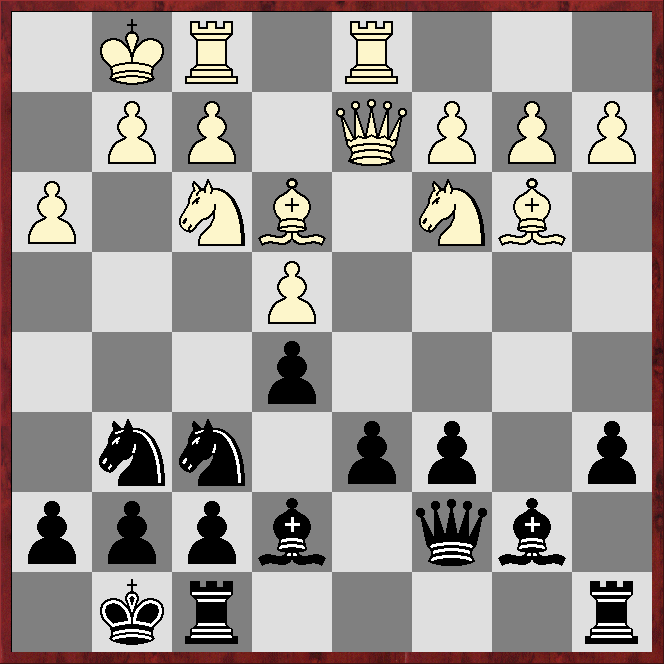
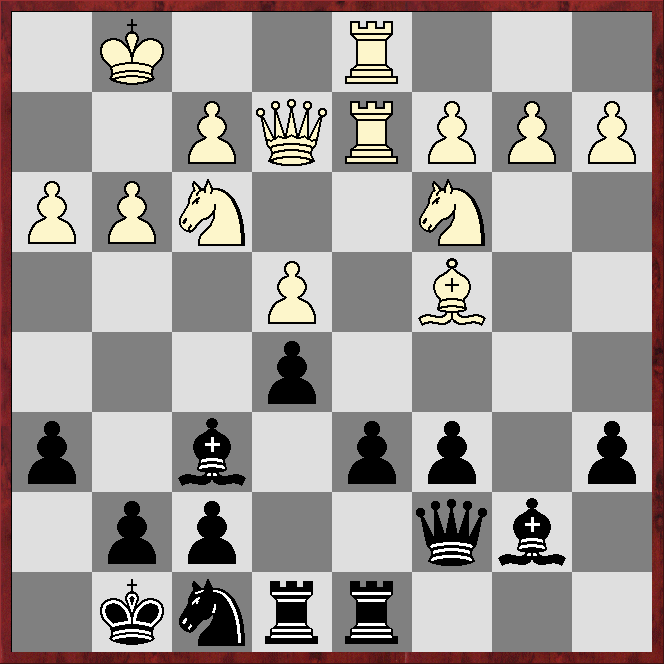
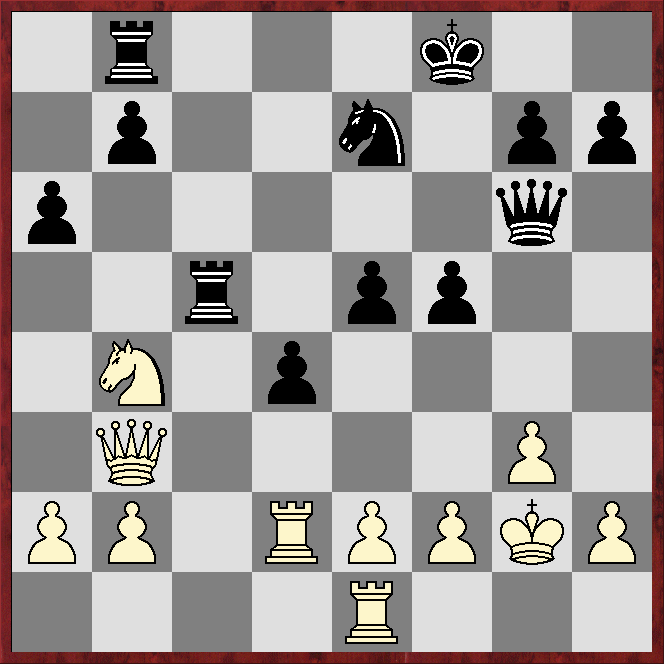
David Flynn (1867 ECF/1816 Fide) - Spanton (1944 ECF/1908 Fide)
Sicilian Hyper-Accelerated Dragon
1.e4 c5 2.Nc3 g6 3.d4 cxd4 4.Qxd4 Nf6 5.Nf3 Nc6 6.Qa4 d6 7.e5 dxe5 8.Nxe5
This position occurs 1,784 times in ChessBase's 2026 Mega database - how should Black proceed?
*****
*****
*****
*****
*****
8...Bg7!?
Offering at least one pawn. The main line in Mega26 runs 8...Bd7 9.Nxd7 Qxd7 10.Be3 Bg7 11.Rd1 Qc8!? 12.Be2 0-0 13.0-0, when White's bishop-pair and lead in development outweigh Black having the only pawn on the two centre files, according to Stockfish17.1 and Dragon1.
9.Bb5
This is the most popular move in Mega26. It is also marginally the top choice of Dragon1, and will quite possibly give White the option of grabbing two pawns. Stockfish17.1, however, for quite some time marginally prefers 9.Nxc6, before coming to see the two moves as more-or-less exactly equal. After 9.Nxc6 bxc6 10.Qxc6 Bd7, Stockfish17.1 reckons Black has sufficient compensation for a pawn, but Dragon1 gives White a slight edge.
9...0-0 10.Nxc6 bxc6 11.Bxc6 Rb8!?
Offering a second pawn. Instead 11...Bd7 12.Bxd7 Nxd7!? divides the engines as before, with Stockfish17.1 calling the position equal, while Dragon1 slightly prefers White. At move 12, instead of capturing on d7, White can also castle.
What should White play?
*****
*****
*****
*****
*****
12.0-0
This is the engines' recommendation. After 12.Qxa7!? they suggest an apparent-novelty in 12...Qd6!? (12...Bf5 is known), when 13.Bf3 Ba6 gives a sharp position with what the engines reckon are equal chances.
12...Bf5
More popular, and possibly marginally better, is 12...Qc7, while 12...a5!? has scored very well in practice.
13.Rd1 Qc7 14.Bf3 Rfc8!?
This may be new, and is the top choice of Dragon1, whereas Stcokfish17.1 prefers the known 14...a5.
15.Re1!?
Presumably in the hope of playing Bf4 without Black being able to reply ...e5. The engines suggest 15.h3 or 15.Rb1, but are fine with the text.
15...e5 16.Ne4 Bd7
The engines reckon Black should regain the sacrificed pawn immediately with 16...Nxe4 17.Bxe4 Bxe4 18.Qxe4 Qxc2.
17.Nxf6+ Bxf6 18.Qa6!? Rb6 19.Qe2 Qxc2 20.Qxc2 Rxc2
The pawn has been regained anyway, and the game is equal, according to the engines
*****
*****
*****
*****
*****
21.Be4 Rc7 22.b3 Be6 23.Bd2 Rd6
Perhaps 23...Ra6!?, with queenside pressure, is a tad better.
24.Be3 Bg7 25.Rac1 Rxc1 26.Rxc1 Ra6 27.Bb1 Ra5?!
The engines suggest 27...Bf8, 27...f5 or 27...e4!?
28.Rc5 Rxc5 29.Bxc5 a6 30.Bd3 Bc8 31.f3
Trying to centralise the king as quickly as possible, but 31.Bd6 gives White at least a slight edge, according to the engines.
31...Bf8 32.Bb6 Bb4 33.Kf2 Kf8 34.Ke3 f5 35.Bc4 Bb7 36.g3 Ke7 37.g4!? h6 38.gxf5 gxf5
Giving Black a 2-1 central pawn-majority seems a little strange, but the engines call the position completely equal
*****
*****
*****
*****
*****
39.Bd3 Bc8 40.Bc4 h5!? 41.Bd5 Be6 42.Bc6
Exchanging bishops is also OK for White, according to the engines.
42...h4!? 43.Bb7 a5 44.Bc6 Kd6 45.Bb7 Bc5+!?
There seems no other way to make progress. Dragon1 at first reckons the text gives Black the upper hand, but eventually agrees with Stockfish17.1 that the game remains equal.
46.Bxc5+ Kxc5
How should White continue?
*****
*****
*****
*****
*****
47.Kd3!?
The engines reckon both 47.f4!? e4 48.Ba6 and the immediate 47.Ba6!? are completely equal. Stockfish17.1 is also fine with the text, at least at first, but Dragon1 instantly calls it losing. Given more time, the engines come to agree it leaves Black slightly better. One point about 47.Ba6!? is that after 47...Kb4 48.Bd3 Ka3 49.Bb5 Kxa2 White has the neat trick 50.Bc4!, with what the engines reckon is complete equality.
47...Kb4
White seems to have only one drawing move
*****
*****
*****
*****
*****
48.Kc2
This looks natural, but the engines show White has to play 48.Ke3! Ka3 49.Ba6!?, again relying on the neat trick 49...Kxa2 50.Bc4!
48...Ka3 49.Kb1 Bd7 50.Bd5 Bb5 51.Kc2!?
The best try, but it should not save White.
51...Kb4!?
This may win, but other moves, eg 51...f4!?, are more convincing. However, not 51...Kxa2? 52.b4+.
52.a4?!
The engines suggest 52.Be6 f4 53.Kb2!?, but agree 53...e4!? is one of several winning moves. However, after, 54.Bg4 e3 55.a3+ Kc5 56. Kc3 Bc2 57.b4+ axb4 58.axb4+ Kd6!?, the picture is not as clear as Dragon1's assessment of +3.48 for Black makes it appear. Instead Stockfish17.1's +1.29, ie the upper hand, rather than winning, may be nearer the mark.
52...Bd7 53.Kb2 Kc5 54.Bb7 Be6 55.Kc3 f4!?
This is probably the key move, which has to be played at some point to bring home the full point.
56.Be4 Bd7
Also winning is 56...Bd5!?, but the lines get hairy, eg 57.Bxd5 Kxd5 58.Kd3 h3! 59.Kc3 e4 60.fxe4+ Kxe4 61.Kd2 f3 62.Ke1 Ke3 63.Kf1 f3, when there is no stalemate as White has to play the losing 64.b4. Alternatively, 58.b4 axb4+ 59.Kxb4 Kd4! 60.a5 e4 61.a6 e3 62.a7 e2 also loses as after 63.a8=Q Black queens with check, 63...e1=Q+, and then 64.Kb5 Qe2+ 65.Kb6 Qe6+ 66.Kc7 Qe5+ 67.Kd7 Qd5+ forces queens off, leaving Black with a winning pawn ending. Engines see these lines in the blink of a (human) eye, but over-the-board for club players it is another matter.
57.Bb7
DF offered a draw.
57...Bf5 58.Ba6
Or 58.Ba8 Be6 with ...Bd5 to come. The text is the engines' top choice.
58...e4 59.fxe4 Bxe4 60.Bc4 Bg2 61.Kd3
This lets Black get bishops off, but 61.Kd2 is also hopeless after, for example, 61...Bd5.
61...Bf1+ 62.Ke4 Bxc4 63.bxc4
Black wins the pawn race
*****
*****
*****
*****
*****
63...Kxc4 64.Kxf4 Kb4 65.Kg4 Kxa4 66.Kxh4 Kb3 67.Kg5 a4 68.h4 a3 69.h5 a2 70.h6 a1=Q 71.Kg6 Qh8 0-1

Saturday, 7 February 2026

Correspondence Chess

I PLAY correspondence chess at the Fide-recognised International Correspondence Chess Federation.
Thanks to the strength of modern engines, most games are drawn, but occasionally a game escapes that fate, or is interesting for other reasons.

Spanton (2330) - Alex Tupper (1662)
British Correspondence Chess Championship Reserves
QGD Exchange
1.d4 d5 2.c4 e6 3.Nc3 Nf6 4.cxd5 Nxd5!?
Bobby Fischer was fond of this move, claiming, if I recall rightly, it made a change from the tedium of normal lines of the Exchange Variation of the Queen's Gambit Declined.
5.e4 Nxc3  6.bxc3 c5 7.Nf3 cxd4 8.cxd4 Bb4+ 9.Bd2 Bxd2+ 10.Qxd2
This is something of a tabiya for the variation, occurring 4,701 times in ChessBase's 2026 Mega database
*****
*****
*****
*****
*****
10...0-0 11.Bc4 Nd7!?
This is the main continuation. The knight will (eventually) land on f6, protecting the kingside.
12.0-0
Now both sides have castled, how would you assess the position?
*****
*****
*****
*****
*****
White has a large lead in development, more space and a central pawn-majority, but Black has no weaknesses, and enjoys a farside majority that could be useful in an ending. Dragon1 gives White a slight edge, but Stockfish17.1 calls the position equal.
12...b6 13.Rfe1 Bb7 14.Rad1 Rc8 15.Bb3 Re8 16.h3!? h6!?
Pushing the h pawn looks like the type of move played by relative beginners, afraid of being back-rank mated, but the continuation (for both sides) has been played by grandmasters.
17.Re3 Nf6 18.Qe2 Qc7 19.Ne5 b5!? 20.Ng4!? Nxg4 21.hxg4!? Qf4!? 22.d5!?
This may be a novelty - Stockfish17.1 reckons it is a small improvement on 22.Qxb5 (Dragon1's top choice) Bxe4 23.d5, which occurred in José Fernando Cuenca Jiménez (2480) - Pedro Antonio Ginés Esteo (2477), Spanish Team Championship 2024. That game continued 23...exd5 24.Bxd5 Re5 25.Qb7 Rce8, with complete equality, according to Stockfish17.1, although Dragon1 slightly favours White (½–½, 31 moves). Whites have also tried 22.Re1 and 22.g3.
22...exd5 23.exd5 Rxe3 24.fxe3 Qe5 25.e4
How should Black proceed?
*****
*****
*****
*****
*****
25...a6?!
This natural-looking move is strongly disliked by the engines. They suggest 25...Rc7.
26.Qf2!
The threat to play d6 is hard to meet.
26...Rd8
Since 26...Qxe4? fails to 27.d6, and 26...Rc7? runs into 27.Qf5!, eg 27...Qxf5 28.gxf5 Kf8 29.e5 Rd7 30.d6 Ke8 31.e6 fxe6 32.fxe6 Rd8 33.Bc2, the engines reckon the text is best, especially as 26...Qd6 27.e5! Qxd6 28.d6 Qf6 also fails, eg 29.Rf1 Qxf2+ 30.Rxf2 Rf8 31.Rxf7! Rxf7 32.d7 etc.
27.Qf5 Qc7?
27...Qxf5?! runs into similar problems as in the previous note, but 27...Qg3 keeps the game going, eg if 28.Rf1, then 28...Qc7 is good, since d6 is not as effective as in the game, and 29.Qh5 (admittedly not the only try) Rd6 30.Qe5 Qb6+ 31.Kh2 Qd8 leaves White at least slightly better, but not winning, according to the engines.
28.d6 Qd7 29.e5 Bc8 30.Qf4 Qa7+ 31.Kh2 Rf8
The engines suggest 31...Be6, but 32.Bxe6 fxe6 33.Rc1 Qf7 34.Qxf7+ Kxf7 35.Rc7+ gives White a comfortably winning rook-and-pawn ending, while 33...Rd7 can be met by 34.Rc8+ Kh7 35.Qe4+ g6 36.Qc6 and Rc7.
32.Rf1 Qb7 33.e6 Bxe6!? 34.Bxe6 fxe6!? 35.Qxf8+ Kh7 36.Rf7 Qxf7!? 37.Qxf7 1-0

Sunday, 1 February 2026

Kidlington U2000 Round Four

FACED a junior (born 2016).

Aviraj Bhaduri (1707) - Spanton (1929)
Sicilian Hyper-Accelerated Dragon
1.e4 c5 2.Nf3 g6 3.c3 d5!?
The main line in ChessBase's 2026 Mega database runs 3...Bg7 4.d4 cxd4 5.cxd4 d5 6.e5, with at least a slight edge for White, according to Stockfish17.1 and Dragon1.
4.exd5 Qxd5 5.Bb5+!?
This trails 5.Be2, 5.Na3 and especially 5.d4 in popularity.
5...Bd7 6.Bxd7+ Nxd7 7.d4 Ngf6 8.0-0 Bg7 9.Be3 cxd4 10.Qxd4 0-0
Now both sides have castled, how would you assess the position?
*****
*****
*****
*****
*****
Black has the only pawn on the two centre files, which could be a middlegame asset, while White has the possible endgame asset of a farside pawn-majority. The engines reckon the position is equal. 
11.Re1!?
They much prefer 11.Rd1 or 11.Na3.
11...Rfe8
The engines reckon 11...e5 12.Qxd5 Nxd5 gives Black the upper hand.
12.Na3 a6 13.Nc4 b5 14.Nb6 Qxd4 15.Bxd4 Nxb6 16.Bxb6 Nd5 17.Bd4 e6 18.Bxg7 Kxg7
How would you assess this late-middlegame position?
*****
*****
*****
*****
*****
Black has more space on the queenside, but the only other major difference between the two sides is the rival pawn-majorities. The engines agree the game is equal.
19.g3 Rec8 20.Rec1 Rc7 21.Rc2 Rac8 22.Rac1 Kf6
Not 22...Nb4 23.Rd2 Nxa2? 24.Ra1 Nxc3 25.bxc3 Rxc3 as, after 26.Kg2, White is well-placed to blockade, and ultimately destroy, Black's connected passers.
23.a3 h5 24.Kf1 g5!? 25.Ke2 g4!? 26.Nd2 Ke7 27.Kd3 f5 28.c4 bxc4+ 29.Rxc4 Rxc4 30.Rxc4 Rxc4 31.Nxc4
How would you assess this knight-and-pawn ending?
*****
*****
*****
*****
*****
White's queenside majority looks dangerous, but the engines reckon the position is completely equal.
31...f4?
But this is the wrong plan. Instead 31...Nf6, eyeing the e4 square, keeps White in check.
32.Ke4 f3 33.Ne3?
White is winning after 33.Ke5, according to the engines.
How should Black proceed?
*****
*****
*****
*****
*****
33...Nb6
The engines prefer a move I dismissed without bothering to analyse, namely 33...Nxe3!? I assumed 34.Kxe3 gave White a winning pawn ending. However, after 34...e5!? 35.Ke4 Ke6 36.b4 Kd6 37.a4 Ke6 38.b5 axb5 39.axb5 (39.a5?? loses to 39...Kd6) Kd6 40.b6 Kc6 41.Kxe5 Kxb7 42.Kf5 Kc5 43.Kg5 Kd4 44.Kxh5 Kd3 45.Kxg4 Ke2 46.h4 Kxf2 47.h5 Kg2 48.h6 f2 49.h7 f1=Q 50.h8=Q Qf3+, the game is drawn.
34.b3 Nd7!?
The text is for a long time strongly disliked by Dragon1, but the move seems to be fine. However, the engines are sure Black maintains complete equality with 34...Kd6, one point being 35.Kf4? loses to 35...Nd5+, eg 36.Nxd5 Kxd5! 37.Kg5 e5 38.Kxh5 e4 39.Kxg4 Kd4 40.h4 Kd3 41.h5 e3 etc.
35.b4 Nb6 36.Nd1!?
The engines for quite some time marginally prefer this over 36.Ke5, but come to view the two moves as equal.
36...Nc4 37.a4 Nb6
Going after the h2 pawn with 37...Nd2+? does not work, eg 38.Kf4 Nf1? 39.Kg5 Nxh2 40.Ne3!? Kd6 41.Kxh5. Slightly better is 38...Kf6, but 39.Ke3 Nf1 40.Kd4, with b5 to come, wins for White.
How should White proceed?
*****
*****
*****
*****
*****
38.Nc3
Interesting is 38.a5!? Nd5 39.b5 axb5 40.a6 Nc7 41.a7, but both 41...b4 and 41...Kd6 seem to hold.
The engines suggest 38.Kf4!? Kf6 (38...Nxa4? 39.Kg5 Nb6 40.Nc3! is very good for White, and if 40...Nd5 41.Nxd5+ exd5, White wins with 42.Kxh5 d4 43.Kxg4 etc), and now 39.Nc3, when 39...e5+ 40.Ke4 Ke6 transposes to the final position in the game, except with White, rather than Black, to move. The engines reckon White has to continue 41.a5!?, when Dragon1's 41...Nd7?! loses, according to Stcokfish17.1, but 41...Nc4 42.b5!? axb5 43.a6 b4!? 44.a7 Nb6 45.Na4 Na8 seems to hold.
38...Kd6 39.Kd4
39.Kf4 Nd5+ 40.Nxd5 exd5! is completely equal, according to the engines.
39...e5+ 40.Kd3 Ke6 41.Ke4 ½–½

Wednesday, 26 November 2025

Championship Chess

Played in the Battersea club championship last night.

Alan Palmer (1817) - Spanton (1891)
Sicilian Hyper-Accelerated Dragon
1.e4 c5 2.Nf3 g6 3.d4 cxd4 4.Qxd4 Nf6 5.Nc3 Nc6 6.Qa4 d6 7.Bd3
The main line in ChessBase's 2025 Mega database runs 7.e5!? dxe5 8.Nxe5 Bd7 9.Nxd7 Qxd7 10.Be3, when White has the bishop-pair and, according to Stockfish17.1 and Dragon1, a slight edge.
How should Black meet 7.Bd3, which occurs three times in ChessBase's 2025 Mega database?
*****
*****
*****
*****
*****
7...Bg7
Although the position has only been reached three times in Mega26, three moves have been played: the text, 7...Nd7!? and 7...Bd7.
8.Nd5!?
A delayed e5 has been played, but the engines like the reply 8...Nd7!?
8...0-0
Again the engines like 8...Nd7!?
9.Nxf6 Bxf6 10.c3 d5
The engines suggest 10...Bg4, one point being 11.Nd4?! runs into 11...Nxd4 12.cxd4 Bd7!, eg 13.Qb4 a5!? 14.Qxb7 Bxd4, when Black has a positionally won game, according to the engines.
11.0-0
Now both sides have castled, how would you assess the position?
*****
*****
*****
*****
*****
The main difference between the two sides may be that Black has an extra pawn on the two centre files, which could be why the engines for quite some time give Black the better part of equality. However, while Dragon1 sticks to this, Stockfish17.1 gradually comes to give Black a slight edge, but then flips to almost dead-eye equality.
11...e5?!
However the engines agree this is wrong, preferring 11...d4!? After 12.Nxd4 Nxd4 13.cxd4 Qxd4 14.Qxd4 Bxd4, Black's central majority has gone, but Black has a little pressure against the white queenside.
12.Bh6 Re8 13.h3
13.exd5 Qxd5 14.Be4 gives White an initiative.
13...d4 14.cxd4 exd4 15.Rfe1 Bd7 16.a3!? Qb6 17.b4!? Ne5 18.Qd1 Nxd3 19.Qxd3
How would you assess this middlegame?
*****
*****
*****
*****
*****
Black has the bishop-pair and an isolated, but passed, centre pawn. White has a kingside pawn-majority that could give middlegame attacking chances against Black's king. The engines agree the position offers equal chances.
19...Bb5 20.Qd2 d3
The engines suggest 20...Bc6, pressurising the e pawn, or 20...Bh8!?, making sure e5 does not come with tempo.
21.Be3
21.e5 gives White a slight edge, according to the engines.
21...Qa6!?
Not just overprotecting d3, but putting pressure on a3.
22.Bd4 Bxd4 23.Nxd4 Rac8
White to play and lose
*****
*****
*****
*****
*****
24.f3??
'Consolidation', but it sets up a fatal pin. The engines give 24.Nxb5 or 24.a4!?, in each case claiming equality.
24...Qb6 25.Qf2 Ba4!?
From a4 the bishop eyes the passed pawn's queening square, prevents the retreat Nb3 and, also importantly, as will be seen later, protects e8.
26.Rac1 Rcd8?!
Black is still winning after this, but much better is 26...Red8.
27.Rc5
Possibly better is 27.Rc4, although Dragon1 is a lot less sure about this than Stcokfsih17.1. A sample continuation: 27...Rd7 28.e5!? Rd5!? 29.Re4 Rdxe5, after which White has saved the knight but not, according to the engines, the game.
27...Qf6?
Much stronger is 27...Rxd4! 28.Qxd4 Rd8 etc, or 27...Rd7 with ...Red8 to come.
28.e5 Qe7
How should White proceed?
*****
*****
*****
*****
*****
29.e6?
Best is 29.Re4, eg 29...f5 30.exf6 Qxf6 31.Rxe8+ Rxe8 32.f4, after which the knight has a retreat square, and Black only retains a slight edge, according to the engines.
29...fxe6 30.Rf1?!
This passivity does not help, but either recapture on e6 can be met by ...d2.
30...b6 31.Re5 Qd6 32.Re4 e5 33.Qa2+ Kg7 34.Rfe1
Or 34.Nb3 Qd5 35.Rb1 Bxb3, with pushing the d pawn to come.
34...exd4 35.Rxe8 Rxe8 0-1
My Battersea Season 2025-6
Date       Event  Colour  Rating  Opp's Rating  Score  Season's Perf
16/9/25   CLL       W       1936         1952             0           1552
18/9/25   CLL       W       1936         1797             =           1675
16/10/25 CLL       W       1889         2047             0           1665
23/10/25 CLL       B        1889         1823             1           1805
18/11/25  LL         W       1891         1980             =           1840
20/11/25  CLL      W       1891         1866             1            1911
25/11/25  BCC     B        1891         1817             1            1955           
CLL: Central London League
LL: London League
BCC - Battersea club championship

Sunday, 27 April 2025

English 65+ Round Six

TOOK a halfpoint bye in round five.

Spanton (1985 ECF/1922 Fide) - Geoffrey Moore (2051 ECF/1983 Fide)
Spanish Cozio
1.e4 e5 2.Nf3 Nc6 3.Bb5 Nge7 4.Nc3!?
More popular in ChessBase's 2025 Mega database are 4.c3 and especially 4.0-0.
4...a6!?
The main line in Mega25 runs 4...g6 5.d4 exd4 6.Nc3!? Bg7 7.Bg5 h6 8.Bf6 Bxf6 9.Nxf6+ Kf8 10.0-0, with at least a slight edge for White, according to Stockfish17 and Dragon1.
5.Bc4!? Ng6 6.d4 Be7!?
The engines prefer 6...exd4 or 6...Bb4.
7.d5 Nb8?!
The engines strongly dislike this, suggesting 7...Na5 or 7...b5!?
How should White proceed?
*****
*****
*****
*****
*****
8.Be3
The engines like 8.d6!?, meeting 8...cxd6 with 9.h4, and 8...Bxd6 with 9.Ng5, in both cases claiming White is winning.
8...d6 9.h3 Nd7 10.Qd2 0-0 11.Ne2?!
This gives up what remains of White's advantage, according to the engines, which suggest 11.a4.
11...c5
The engines like 11...b5 12.Bb3 Nc5!?
12.dxc6
The engines suggest fighting for the f5 square with 12.Ng3 or 12.Bd3.
12...bxc6 13.Bb3?!
This is strongly disliked by the engines, which suggest 13.h4 (not a sacrifice as Black cannot both capture h4 and defend d6).
13...Nf6 14.Nc3 Qc7 15.Rd1 Bb7 16.0-0
Now both sides have castled, how would you assess the position?
*****
*****
*****
*****
*****
Black's central pawn-majority more than offsets having an extra pawn-island. The engines give Black a slight edge.
16...Rad8 17.Bg5!
The only move that stops the black pawns rolling.
17...Nh5 18.g3?!
After 18.Bxe7 Nxe7 19.Qe3 White seems to have enough pressure to restrain Black's central pawns.
18...Nf6?!
Black has the upper hand after 18...Bxg5 19.Qxg5 Nf6, according to the engines.
19.Qe2 h6 20.Bxf6 Bxf6 21.Rd2 Rfe8 22.Rfd1 Nf8!? 23.Bc4
How should Black proceed?
*****
*****
*****
*****
*****
23...Ne6!?
The engines agree Black has no need to defend a6, which is why they equally like 23...Bc8!? But they are also fine with 23...a5.
24.Bxe6
After 24.Bxa6 Nd4 25.Nxd4 exd4 Black has more than enough compensation for a pawn.
24...Rxe6 25.Qc4
Threatening 26.Nd5.
25...Qc8 26.Kh2?!
The engines reckon 26.Qb3 gives complete equality.
26...Be7 27.Kg2!? Rf8 28.Kh2!?
The text sets a little trap, but basically I was unable to come up with an active plan.
28...Kh8
Not 28...f5? 29.Rxd6!
29.Qd3?!
Best, according to the engines, is 29.Na4!?, even though this allows 29...d5.
29...Rg6
This gives a winning advantage, according to the engines, but even stronger seems to be 29...d5!?, the point being 30.exd5? cxd5 31.Nxd5 loses to 31...e4 32.Nxe7 exd3 33.Nxc8 Bxf3 34.Rc1 Rxc8.
30.Re1 f5 31.exf5 Qxf5 32.Qxf5 Rxf5 33.Re3 Rgf6 34.Kg2 Rf8 35.g4?!
Best, according to the engines, is 35.Nh4!?, but 35...Bxh4 36.gxh4 c5+ is clearly good for Black.
35...R5f7 36.Kg3 Rd8?
Going passive throws away much of Black's advantage. The engines reckon Black is winning after 36...Kh7, eg 37.a3 a5 38.b3 Rf4 39.Rdd3 Ba6 40.Rd2 d5 41.Nd1 Bxa3.
37.Red3 Rff8 38.Nh4 Bxh4+?!
This allows equality, whereas 38...Kh7 is better for Black, although Stockfish17 is much more enthusiastic than Dragon1 about Black's position.
39.Kxh4 d5
The d pawn at last advances, but piece exchanges mean the pressure exerted by Black's central pawns is no longer critical
*****
*****
*****
*****
*****
40.Ne4 Rf4 41.Nc5 Bc8 42.f3 Rc4 43.Ne4 Kg8?!
Best seems to be 43...Bd7!?
44.a3?!
Black's position comes under intense pressure after 44.b3!? Rb4 45.Nc5 Rf4 46.Re2, eg 46...Re8 47.Kg3 Rf7 48.c4.
44...Rf8 45.Nd6 Rcf4 46.Nxc8!? Rxc8 47.Rc3 e4?
A mistake. Other moves hold, including 47...d4 and 47...Kf7.
48.fxe4 dxe4 49.Re2 g5+ 50.Kg3 Kf7?
GM offered a draw.
Superior to the text is 50...c5!? 51.Rc4 Re8!? 52.Rxc5 Re6, although White is much better.
51.h4?
After 51.Rf2 Rxf2 52.Kxf2 Black's pawn weaknesses should tell.
51...Ke6 52.hxg5 hxg5 53.Rh2 Kd5 54.Rh6 Rcf8!? 55.Rg6 Rf3+ 56.Rxf3 Rxf3+ 57.Kg2 Rf8 58.Rxg5+ Kd4
White has won a pawn, but the advanced d pawn gives enough counterplay
*****
*****
*****
*****
*****
59.Rg6 Ke3 60.Re6!? Rf2+ 61.Kg1 Rxc2 62.g5 Rxb2 63.Rxc6 Rb5 64.Rxa6 Rxg5+ 65.Kf1 Rf5+ 66.Ke1 Rf2 67.Rb6 Re2+ 68.Kf1 Ra2 69.Rb3+ Kf4 70.Ke1 ½–½

Sunday, 7 July 2024

Bad Herrenalb Round Three

I WAS downfloated against an opponent who took a half-point bye in round one.

Mario Born (2152) - Spanton (1928)
Queen's Pawn Game
1.d4 d5 2.Nf3 e6 3.g3 c5!?
White's move-order suggests he is angling for a Catalan, but without letting Black play an early ...dxc4, which has been cited as a relatively simple equalising line.
How should White respond?
*****
*****
*****
*****
*****
4.Bg2
This is by far the most popular move in ChessBase's 2024 Mega database, and becomes the top choice of Dragon1, although for some time the engine prefers the peculiar 4.dxc5!? Stockfish16.1 suggests 4.c4, continuing 4...dxc4 5.Qa4+ Nd7!? 6.Qxc4 a6 7.dxc5 Bxc5 8.Bg2, rating the position as completely equal.
4...cxd4!?
Much more popular are 4...Nf6 and especially 5...Nc6, but the text, which has been played by Garry Kasaprov, can be thought of as an anti-Catalan continuation.
5.0-0 Nf6 6.Nxd4 e5!? 7.Nb5
The mainline in Mega24 runs 7.Nb3 Be6 8.Bg5 Nbd7 9.Nc3 Be7 10.e4!? dxe4 11.Nxe4 Nxe4 12.Bxe7 Qxe7 13.Bxe4 Nf6 14.Bg2 0-0, with complete equality, according to the engines.
7...a6 8.N5a3!?
The engines prefer retreating the knight to c3.
8...Be7
This may be a novelty. The engines reckon Black is better after 8...Nc6 or 8...Be6.
9.c4
The engines suggest 9.Bg5.
How should Black proceed?
*****
*****
*****
*****
*****
9...d4!?
This seems best. The position now resembles a Réti, albeit one in which the Réti knight has been transported from f3 to a3.
10.Bg5 0-0 11.Bxf6!?
This is the top choice of the engines.
11...Bxf6 12.Nd2 Nc6 13.Qb3!?
MB offered a draw.
How would you assess the position?
*****
*****
*****
*****
*****
*****
Black has the bishop-pair and a central pawn-majority, together with more space in the centre. White has more pieces developed, a queenside space advantage and the endgame advantage of a farside pawn-majority. The engines give Black the upper hand.
13...Na5 14.Qd3 Nc6 15.Qb3 Qc7 16.Rac1 Be6 17.Bd5!?
This is the engines' top choice.
17...Bh3 18.Rfe1 Bg5 19.Rcd1 Rab8 20.Nc2 Ne7 21.Bg2 Bxg2 22.Kxg2
The bishop-pair has gone, but Black retains a good advantage.
22...Rfc8?!
This seems to largely let White off the hook, whereas 22...b5 is very strong, the point being 23.cxb5?! Rxb5 is winning for Black, eg 24.Qd3 Rxb2, or 24.Qa4 Bxd2 25.Rxd2 Rxb2.
23.Ne4?!
Probably better is the engines' 23.e3, eg 23...b5 24.exd4 bxc4 25.Qf3 Rxb2 26.Ne4 h6 27.Qc3 Qb7 28.dxe5, with an unclear position that the engines reckon gives equal chances.
23...Qc6 24.Qf3 Bh6 25.Nb4 Qg6
Not 25...Qxc4? 26.Nd6 etc.
26.c5!? f5!? 27.Qb3+ Kf8!?
Not 27.Kh8? Nd6 28.Rf8 Nd5 with a strong initiative.
28.Nd2 Bxd2 29.Rxd2 Rxc5
Black is a sound pawn up
*****
*****
*****
*****
*****
30.Nd3 Rb5 31.Qa3 Rc8 32.Kg1?!
There probably was not time for this. The engines suggest 32.e3 or 32.f4!?, but give Black the upper hand.
32...Qb6 33.Rc1
The engines suggest 33.Red1 or 33.b4, but agree Black has a positionally won game.
33...Rxc1+ 34.Nxc1 Ra5 35.Qd3 Qc6 36.Rc2 Rc5 37.Rxc5 Qxc5 38.Nb3 Qc6?!
This allows White an equalising chance, whereas 38...Qb4, among other moves, maintains an advantage, according to the engines.
How does White equalise?
*****
*****
*****
*****
*****
39.Qd2
The engines show 39.f4! breaks up Black's centre and so equalises, eg 39...exf4 40.Nxd4 Qc1+ 41.Kg2 fxg3 42.Nxf5 Nxf5 43.Qxf5+ with perpetual check.
39...b6 40.f4?!
A move late, and with much less effect thanks to the white queen being on d2 (as will soon become clear). However, after the engines' 40.e3 dxe3 41.Qxe3 Qd6 Black remains a sound pawn up.
How does Black gain a large advantage?
*****
*****
*****
*****
*****
40...Nd5!
There is no good answer to this. MB spent 21 minutes on his next, but defied grandmaster John Nunn's 20-minute rule (see yesterday's game for a brief explanation of this rule) by coming up with what Dragon1 reckons is best.
41.Kf2!?
Stockfish16.1 for quite some time agrees this is best, but comes to slightly prefer 41.e4 and 41.Qc1, albeit reckoning Black is the equivalent of more than a minor piece ahead.
41...Ne3 42.Qc1 Qxc1
This is stronger than 42...Qg2+ 43.Ke1 Qf1+ etc. However the engines reckon that, instead of 43...Qf1+, Black gets an even larger advantage with 43...b5!?
43.Nxc1 exf4 44.Nb3 Nd1+ 45.Kf3 fxg3 46.hxg3 Nxb2 47.Nxd4 g6 48.Ne6+ Kf7 49.Ng5+ Kg7 50.Ke3 h6 51.Ne6+ Kf7 52.Nc7 a5 53.Kd4 h5 54.Nd5 Ke6!? 55.Nxb6
White is now 'only' one pawn down, but Black can create a winning passer on the h file
*****
*****
*****
*****
*****
55...g5 56.Nd5 a4 57.Nc3 h4 58.gxh4 gxh4 59.e4!? h3 60.Ne2 h2 61.Ng3 f4 62.Nh1 Nd1 63.Kd3 Ke5 64.Kd2 Ne3 65.Nf2 Nf1+ 66.Kd3 Ng3?? 67.Ng4+ ½–½

Tuesday, 25 June 2024

Bischofsgrün Round Five

Spanton (1942) - Paul Stümer (2069)
Sicilian Accelerated Dragon
1.e4 c5 2.Nf3 Nc6 3.d4 cxd4 4.Nxd4 g6 5.Nc3 Bg7 6.Nxc6!? bxc6 7.Bc4 Qc7!?
There are four more-popular moves in ChessBase's 2024 Mega database, but the text is the top choice, albeit by a tiny margin, of Stockfish16, and the equal-top choice, along with 7...Qa5, of Komodo14.1.
8.0-0 Nf6 9.Re1 d6 10.f3 0-0
Now both sides have castled, how would you assess the position?
*****
*****
*****
*****
*****
White has more space in the centre, but Black has a central pawn-majority. Komodo14.1 calls the game equal, but Stockfish16 gives Black a slight edge.
11.Be3 Nd7!?
Possibly a novelty. Known moves are 11...Bb7 and 11...a5.
12.f4!? Nf6!? 13.h3 Nxe4!?
A well-known equalising combination, although here it gives chances of an advantage.
14.Nxe4 d5
How should White proceed?
*****
*****
*****
*****
*****
15.Bd4!?
This may be best. Komodo14.1 reckons so, but Stockfish16 fluctuates between the text, 15.Nc5 and 15.c3.
The problem with 15.Bxd5?! is that after 15...cxd5 16.Qxd5 Be6 Black gets an initiative to go along with the bishop-pair - more than enough compensation for being, at least temporarily, a pawn down, according to the engines.
15...Bxd4+ 16.Qxd4 Qxf4 17.Bxd5 cxd5 18.Qxd5 Bf5!?
After 18...Be6 19.Qg5 White may have a small pull.
19.Qd2 Qe5 20.Nc3 Qc5+ 21.Qf2 Rfc8 22.Qxc5 Rxc5 23.Rxe7 Bxc2
Not 23...Rb8 24.Rxa7 Rxb2?? 25.Na4.
24.Rf1 Bf5 25.g4 Be6 26.Ne4 Rc2 27.Ng5
Black to play and get a slight edge
*****
*****
*****
*****
*****
27...Bxa2
More promising is 27...Bd5, eg 28.Rd1 Bxa2 29.Rdd7 Rf8 30.Rxa7 Rxb2. The game should probably end in a draw, but only Black has winning chances.
28.Nxf7 Bxf7 29.Rfxf7 Rd8 30.Rg7+ ½–½

Thursday, 17 November 2022

Brno Game Five

Spanton (1771) - Per Green (1918)
Veresov
1.d4 Nf6 2.Nc3 d5 3.Bg5 c5!?
Most popular in ChessBase's 2022 Mega database are 3...Bf5, 3...e6, which allows a transposition to the French Defence, and especially 3...Nbd7.
4.e3
The mainline in Mega22 runs 4.Bxf6!? gxf6 5.e3 Nc6 6.Qh5!? e6 7.0-0-0!? with an equal position, according to Stockfish15 and Komodo13.02.
4...cxd4 5.Qxd4!?
Trying to capitalise on White's lead in development. The engines prefer 5.Bxf6 or 5.exd4.
5...Nc6 6.Bb5 Bd7 7.Bxc6
This seems better than 7.Qh4, as played in Vinh Bui (2488) - Péter Prohászka (2495), Budapest GM Tournament 2009, which continued 7...e6 8.Nf3 Be7 9.0-0 h6 with a slight edge for Black, according to the engines (0-1, 24 moves).
7...Bxc6 8.Nf3 Qa5?!
This may be a mistake. The engines prefer 8...Ne4 or 8...e6.
9.b4!? Qd8 10.0-0?!
This is probably too slow. The engines give 10.Bxf6!? gxf6 11.b5 Bd7, and now 12.0-0 or 12.Nxd5 Bxb5 13.c4, but not 12.Qxd5?! as 12...Rc8!? is difficult to meet.
10...e6
The engines' 10...Ne4!? seems stronger.
11.Ne5 h6 12.Bxf6 gxf6 13.Nxc6 bxc6 14.Rfd1 Bd6 15.Rab1 Rg8!?
The engines prefer 15...Be5 or 15...Qc7.
16.Qh4!?
The engines prefer 16.Ne2.
16...Rg6
The engines give 16...f5!?, the point being 17.Qxh6? Be5 with ...Rh8 to come is terrible for White, while 17.Qxd8+ gets the queens off, which must favour Black as the white king is much the safer of the two monarchs.
17.e4 Be7 18.exd5 cxd5 19.Qd4 h5 20.h3!?
Preventing ...Rg4 and more-or-less eliminating the danger of a back-rank mate.
20...Qb8 21.Ne2 Bd6?
The engines reckon Black is better after 21...Qe5, again pursuing the policy of getting queens off, whereas the text lets White advance the backward c pawn.
22.c4
How should Black respond?
*****
*****
*****
*****
*****
22...Rg5?
I expected 22...Be5, when one line given by the engines runs 23.Qc5 dxc4 24.Qc6+ Kf8 25.Rbc1, claiming at least the upper hand for White.
23.Qxf6 Rf5 24.Qh8+ Bf8!?
Keeping queens on probably gives the best practical chance, although the engines prefer 24...Ke7 or 24...Kd7.
25.Nd4
Probably even stronger is 25.Ng3 Qe5 26.Qh7.
25...Rg5
How should White proceed?
*****
*****
*****
*****
*****
26.c5?!
Almost certainly stronger are 26.cxd5 and 26.Nf3 followed by cxd5.
26...Qf4 27.Nb5?
Best, according to the engines, is 27.Rb3, intending Re3 or Rf3.
Black to play and draw
*****
*****
*****
*****
*****
27...Kd7?
Black could have bailed out with 27...Qf3 28.g3 Rxg3+ 29.fxg3 Qxg3+, after which the white king cannot escape checks.
28.Qc3 Bg7 29.c6+ Ke8 30.Qe3
Not 30.Qc5? Be5.
30...Qxe3 31.fxe3 Be5 32.Rdc1 a6?!
The engines prefer 32...Rg3, but give White at least a slight edge.
33.Nd4 Bc7
The bishop is a good blockader, but White's 3-1 queenside pawn-majority is potent.
34.a4 Ke7 35.Rb2?!
Defending g2 from a doubling of the black rooks on the g file and from the black queen's rook coming to a2, but it seems there was no need, the engines giving 35.b5 axb5 36.Nxb5!, eg 36...Kd8 37.Nxc7 Kxc7 38.Rb7+ Kc8 39.Rxf7 Rxa4 40.Rb1 with a large advantage.
35...e5 36.Nf3 Rg3 37.Kh1 Kd6 38.b5 axb5 39.axb5 Bb6
What should White play?
*****
*****
*****
*****
*****
40.Nh4
This is strong, but even stronger is 40.c7! Bxc7 41.b6 Bd8 42.b7 Rb8 43.Rc8 Bc7 (I saw this far, but missed the winning continuation) 44.Rxb8 Bxb8 45.Rc2.Bc7 46.Kh2 Rg6 (other moves are no better) 47.Nxe5! Kxe5 48.Rxc7 Rb6 49.Rxf7, leaving White two pawns up in a rook-and-pawn ending.
40...Rgg8
Both 40...Rxe3?? and 40...Bxg3?? are met by 41.Nf5+
41.Rd1
Almost certainly better is 41.e4!?, eg 41...dxe4 42.c7! Kd7 43.Rd2+ Kc8 44.Nf5, or 41....d4 42.Rf2! Rgf8 43.Rf6+ Kc7 44.Rf5.
41...Ke6 42.Rb3?!
Probably better are the engines' 42.Rbd2 and 42.Rf1.
42...Ra4
The engines reckon Black has equalised
*****
*****
*****
*****
*****
43.Nf3 Ra2 44.Rd2 Ra1+?!
Exchanging a pair of rooks seems to simplify Black's task.
45.Kh2 f6 46.Rc2 Rc8 47.Kg3 Ra4 48.Ne1?!
Probably better is 48.h4!?
48...f5
Starting to roll Black's central pawn-majority, but the engines prefer 48...h4+!? followed by ...e4.
49.Nd3 Kd6
Black can probably restore material equality with 49...Bxe3!?
50.Nb4 Rg8+?!
The rook should probably be left opposite the c pawn.
51.Kf3?
White has at least a slight edge after 51.Kh2, according to the engines.
51...Ra5?
Winning, according to the engines, is 51...e4+, eg 52.Kf4 Ra1 53.Rbb2 Bc7, or 52.Kf2 d4! 53.Rd2 f4.
52.Na6
The engines give 52.c7!? Bxc7 53.Rbc3 e4+ 54.Kf2 Bd8 55.Rc6+ Kd7 56.Nxd5 with at least a slight edge for White.
52...Rc8?
The game is completely equal after 52...Ra1. according to the engines.
White to play and win
*****
*****
*****
*****
*****
53.c7! Bxc7
Black's best chance seems to be 53...Kd7!?, but 54.Nb8 Ke8 55.Rc6 e4+ 56.Kf4! Bxc7+ 57.Kf5 Rxb8 58.Rxc7 Rxab5 59.Rxb5 Rxb5 60.Ke6 is a winning rook-and-pawn ending, according to the engines.
54.Rc6+ Kd7 55.Nc5+ Ke8?
This makes it easier than it need be, although after 55...Ke7 56.Na6 e4+ 57.Ke2 White is also winning.
56.b6 e4+ 57.Ke2 Ra2+ 58.Kd1 Rca8?! 59.bxc7 1-0

Wednesday, 2 November 2022

Dresden Game Six

Joachim Just (1957) - Spanton (1764)
New London
1.d4 d5 2.Bf4 e6 3.e3 Bd6 4.Nf3!?
More popular in ChessBase's 2022 Mega database are 4.Bxd6 and especially 4.Bg3, but the text is also played by grandmasters.
4...b6!?
Attempting to refute White's play with 4...Bxf4 leaves Black slightly worse, according to Stockfish15 and Komodo13.02.
5.Nbd2 Bb7
The engines reckon White gets at least a slight edge after 5...Ba6?! 6.Bxa6 Nxa6 7.c4.
6.Bd3 Nf6 7.0-0 0-0 8.Ne5!? Ne4 9.c3 Nd7 10.Qc2!?
This may be a novelty. Known moves are 10.Nxd7 and 10.f3.
How should Black proceed?
*****
*****
*****
*****
*****
10...Nxd2!?
By no means the only move, but it effectively makes 10.Qc2 a loss of tempo.
11.Qxd2
Not 11.Bxh7+?? as White loses a piece after 11...Kh8.
11...Bxe5?!
The engines strongly dislike this, preferring 11...f6 (Komodo13.02) or 11...a5 (Stockfish15).
12.dxe5 f6 13.exf6 Nxf6
It is hard to say whether this or 13...gxf6!? is better.
How would you assess the position?
*****
*****
*****
*****
*****
White has the bishop-pair, while Black has more space in the centre and a central pawn-majority. But there is a certain looseness about the black position, and the engines reckon White has the upper hand.
14.Qc2 Qe7 15.Bg5 h6 16.Bh4 e5 17.Be2?!
A puzzling retreat. The engines much prefer attacking the black centre with 17.c4.
17...g5!?
Double-edged (as this move almost always is). The engines like central play with 17...c5.
18.Qg6+!?
Getting queens off can enhance the power of the bishops, which become the only pieces that can move diagonally. Also, Black's space advantage could have led to an attack in which a queen might have played a prominent role. On the other hand the black king's position looks a lot less airy without queens. The engines prefer 18.Bg3, although by a small margin in Komodo13.02's case.
18...Qg7 19.Qxg7+ Kxg7 20.Bg3 Rae8!?
This may be the wrong rook in that it soon moves to d8.
21.Rad1!?
Perhaps White should preserve the bishop-pair by 21.f3 or 21.h3.
21...Ne4 22.f3 Nxg3 23.hxg3 Rd8 24.Rd2 Rf6 25.Rfd1 Rfd6 26.c4!?
The engines are OK with this move, partly, perhaps, because Black can anyway force through ...d4 after playing ...c5.
26...d4 27.exd4 exd4
The engines reckon Black is slightly better after 27...Rxd4 28.Rxd4 exd4.
28.Bd3 Re8 29.Re2?!
Probably better are 29.Kf2 and the engines' 29.c5!? bxc5 30.Rc1.
29...Rxe2 30.Bxe2 Re6 31.Kf2 c5 32.b4?!
Black is only slightly better after 32.g4, according to the engines.
How should Black respond?
*****
*****
*****
*****
*****
32...Kf6?!
Almost certainly stronger is 32...Re3, eg 33.Rb1 Ba6 34.b5 Bc8, when the threat of 35.Ra3 Rb2 36.Be6 Rd2 37.Rc3 seemingly cannot be avoided.
33.Rd3 Ke5 34.b5 Bc8 35.Ra3
The engines suggest 35.g4, albeit preferring Black.
35...Re7 36.Bd3?!
Again the engines want to seize kingside space with g4.
36...a5
Winning, according to the engines, is 36...h5!?
37.bxa6 Ra7 38.Rb3?!
Again g4 was apparently necessary.
38...Rxa6 39.Rb2 Bf5 40.Re2+ Kf6 41.Bxf5 Kxf5 42.g4+ Kf6 43.Rb2 Ke5 44.Re2+ Kd6 45.Rb2 Ke5 ½–½
You might think a draw by repetition cannot be safely avoided, and you would be none the wiser if using an old engine such as Fritz5.32, which for quite some time reckons in the final position Black has a slight edge, but no more. However, given more time Fritz5.32 changes its assessment to Black having the upper hand. In other words it is dimly seeing what Stockfish15 sees instantly and Komodo13.02 almost as fast: Black is winning after 45.Rb2 (and after 43.Rb2 for that matter), eg 45...Ra4! 46.Rxb6+ Ke5 47.Rxh6 Rxa2+ 48.Ke1 d3 49.g3 Kd4 50.f4 Kc3 etc. Slightly better, perhaps, is 47.Rb2 but 47...Rxc4 wins, eg 48.g3 Ra4 49.Ke2 c4 50.Rb5+ Kd6 51.Rb2 Ra3 etc.

Wednesday, 4 August 2021

Most Extraordinary Finish To A Game You May Ever See

TODAY I faced a Polish teen aged 18 or 19.

Spanton (1808) - Adam Stefański (1447)
Wrocław B Round 5
Nimzo-Indian
1.d4 Nf6 2.c4 e6 3.Nc3 Bb4 4.Bd2!?
Breaking the pin has become fashionable, but Bd2, which at this point scores just 39% in ChessBase's 2021 Mega database, is usually played a little later.
4...0-0 5.Nf3 b6 6.e3 Bb7
Joseph Blackburne reached this position at least twice in the 19th century. Berthold Englisch - Blackburne, London 1883, saw 7.Be2, but James Mason - Blackburne, Paris 1878, continued with ...
7.Bd3 d5 8.0-0
Mason preferred 8.cxd5, which is more popular in Mega21, but Smyslov and Korchnoi are among those who have played the text. Incidentally, Blackburne drew both the games quoted.
8...Nbd7?!
There are 112 examples of this move in Mega21, but it may be a mistake. Can you see why?
Position after 8...Nbd7?!
*****
*****
*****
*****
*****
9.Rc1
Robert Byrne, in a 1965 game, is the first in Mega21 to have played 9.Nxd5!? After the more-or-less forced 9...Nxd5 10.cxd5 Bxd2 11.dxe6 White is winning a pawn, although Byrne only manged to draw his game. The analysis engines Stockfish14 and Komodo12.1.1 give best-play after 11.dxe6 as 11...Bxf3 12.gxf3 fxe6 13.Qxd2, when Black cannot play 13...Rxf3?? because of 14.Be4.
9...Rc8 10.Qa4
Still playable is Nxd5, although it does not win a pawn as after 10...Bxd5 11.cxd5 Bxd2 the rook on c1 is threatened.
10...a5 11.Rfd1!?
Placing a rook opposite an opponent's queen is usually a good thing to do, but here it gives Black an unbalancing option.
11...dxc4 12.Bxc4 Bxf3!? 13.gxf3
Who stands better?
*****
*****
*****
*****
*****
The position is difficult to assess. There is no doubt the black king is safer than its white counterpart, but it is not so clear whether Black can get at the white king. Meanwhile White has the bishop-pair, a central pawn-majority and hopes of exploiting Black's queenside light-square weaknesses.
13...Nd5?!
Black should probably attack the white centre, and simultaneously solve the problem of the backward c pawn, by playing 13...c5. The engines continue 14.Ba6 Ra8 15.Bb5 Qe7 with what they reckon is an equal position.
The text looks natural in that it opens the d8-h4 diagonal for the black queen, and it sets a trap: 14.Nxd5 exd5 15.Bxd5?? Bxd2 16.Rxd2 Qg5+ etc. However, after ...
14.e4 Nxc3 15.bxc3
... White has a good game.
But this is not the final word. The engines reckon Black should play 14...c6!?, when the threat of ...b5 gives White at best a slight edge, they conclude. Going further back, they reckon 14.Nxd5 is playable, and may be White's best move, as long as 14...exd5 is met by 15.Bxb4 axb4 and either 16.Bb5 or 16.Bf1.
15...Be7 16.e5!?
Depriving black's pieces, specifically the knight and the king's rook, of use of the f6 square. But I felt wrong playing it, and believed (correctly) the engines would not like it. They reckon White is doing better after 16.Ba6 Rb8 17.Qc6.
16...c6!
This drives White's pieces back and seems to more-or-less solve the problem of Black's light-square weaknesses.
17.Qc2
17.Bd3?! Nxe5! 18.Bxh7+ Kxh7 19.dxe5 probably favours Black.
17...b5 18.Bd3 f5?
*****
*****
*****
*****
*****
19.Kh1?
I saw 19.Qb3 but did not play it because I thought 19...Kf7? was an adequate answer, missing 20.Bxf5. I played the text instead because it is a useful move and I hoped AS might respond with 19...Kh8, when I felt 20.Qb3 would win the e6 pawn in a simple way.
19...Nb6
But I was wrong anyway as after 19...Kh8 20.Qb3 Black has 20...Nxe5!
20.Rg1?!
The ingredients for a successful kingside attack are probably not there. The engines reckon White should play in the centre-queenside with 20.c4, which one way or another stops the black queen taking up a dominating position on d5, eg 20...bxc4 21.Bxc4 Nxc4 22.Qxc4, when 22...Qd5 can be safely met by exchanging queens or by 23.Kg2.
20...Kh8
This and 20...Qd5 are both good.
21.Rg2
Again the engines prefer c4, and they now also like 21.Be3.
21...Qd5 22.Rg3 c5!?
The white centre is collapsing.
23.Bxb5 cxd4 24.c4 Qxe5
*****
*****
*****
*****
*****
25.Re1??
The engines give 25.a4, but prefer Black after 25...Nd5 26.Re1 Qd6 27.Bxa5 Nf4 (Komodo12.1.1) or 25...Qd6 26.Bxa5 Nd7 27.Rcg1 Bf6 (Stockfish14).
25...Qd6??
25...Qxb5 wins on the spot.
26.Bxa5 e5?
Black keeps a large advantage after 26...Nd7, according to the engines.
27.Bxb6 Qxd6 28.Bd7
28.Rxe5 Bd6 29.Re6 Qxb5 30.cxb5 Rxc2 31.Rxd6 Rxa2 32.Rxd4 Rb2 is very drawish.
28...Qb4!
Gaining time by attacking both c4 and e1.
29.Rc1 f4?
It is better to give up the f pawn with 29...Rc7, but better still is the engines' 29...d3! 30.Qxd3 (only move) Rcd8, eg 31.Rcg1 g6 32.Rd1 with a sharp but apparently roughly equal position.
30.Rh3 h6 31.Bxc8 Rxc8
*****
*****
*****
*****
*****
32.Rh5?
Correct is 32.Qf5. I missed that after 32...Rxc4 White has 33.Rcg1 with what seems to be a winning position.
32...Bf6
The engines reckon Black has more-or-less equal chances with 32...Qa3! 33.Kg2 d3.
33.Qb3?
Very strong is 33.Qg6, the point being that after 33...Rxc4? Black is getting mated, eg 34.Rxh6+! gxh6 35.Qxf6+ Kh7 36.Rg1 etc. Also winning in this variation is 34.Qe8+ Kh7 35.Rg1 etc.
33...Qd2
White to play and lose
*****
*****
*****
*****
*****
34.Kg2?? Qe2?? 35.Rc2 Qd1 36.Rb2
Black to play and lose
*****
*****
*****
*****
*****
36...e4?? 1-0

Tuesday, 5 January 2021

Garry Kasparov's Forgotten Weapon Against The Queen's Gambit (part eight)

KASPAROV lost with the white pieces in the first game of his Candidates semi-final match against Viktor Korchnoi, but in game two he had the chance to play his new favourite weapon against the Queen's Gambit.
Korchnoi (2600) - Kasparov (2690)
Candidates Semi-Final Game 2 (London) 1983
1.d4 d5 2.c4 e6 3.Nf3!?
Once again a player avoids 3.Nc3 against Kasparov. In his career Korchnoi was almost twice as likely to play 3.Nc3, and he also frequently reached the position after 3.Nc3 by a transposition from the English. Korchnoi was not a fan of the Catalan - if someone met his 3.Nf3 with 3...Nf6 he almost always played 4.Nc3 rather than 4.g3. Perhaps there was no particular reason for favouring Nf3 on this occasion, or perhaps it was a psychological reference to Tony Miles having played the move the last time Kasparov faced 1.d4.
3...c5 4.cxd5 exd5 5.g3
This is more common than 5.Nc3 in Mega20.
5...Nf6
Much more popular is 5...Nc6 but most games reach the same Tarrasch tabiya.
6.Bg2 Be7 7.0-0 0-0 8.Nc3 Nc6
So here we are again, and Korchnoi goes for the absolute main line.
9.Bg5 cxd4 10.Nxd4 h6 11.Be3 Re8
Korchnoi with the black pieces preferred 11...Bg4 in a 1957 USSR Championship draw with Boris Spassky, who also played 11...Bg4 early in his career when reaching this position with the black pieces (but Spassky later switched to the text).
12.a3!?
A very unusual choice - it seems to have been a novelty - but one that was to be adopted up by Vasily Smyslov. One point of the move is to take the b4 square away from the black queen's knight; another is to prepare possible queenside expansion. The downside is that the move is a little slow, but White argues that the IQP is firmly blockaded and there is no need to rush as the long-term structural advantage lies with White.
12...Be6
This is Komodo11.01's choice. Stockfish12 prefers 12...Bg4, while 12...Bf8 has also proved popular, albeit from a small sample-size.
13.Qb3
13.Nxe6 and 13.Kh1 will be covered in later games.
13...Qd7 14.Nxe6!? fxe6
Black no longer has an isolani and has a central pawn-majority, but White has the bishop-pair and fewer pawn-islands.
15.Rad1 Bd6
The bishop is more active on d6, and it breaks the rook's pin on the d pawn.
16.Bc1!?
This retreat makes e4 possible.
16...Kh8
Kasparov gets his king off the diagonal of the white queen in anticipation of White levering the centre with 17.e4.
Position after 16...Kh8
17.Qa4!?
The consistent 17.e4 has to be met by 17...d4, according to the engines, when 18.Nb5 e5 19.Nxd6 Qxd6 20.Qxb7 Rab8 does not give Black enough compensation for a pawn, they reckon. Korchnoi was well-known for grabbing pawns and holding on for dear life, which makes it surprising he did not go in for this. However Black is not forced to play 18...e5. Instead he can move the bishop, eg 18...Bc5, when the engines give 19.e5!? Nxe5 20.Be3 Nc6 21.Qc4, after which White regains the pawn and has a slight edge, according to the engines. Another possibility is 18...Bb8 19.f4 e5 20.Nc3, again with what they reckon is an edge for White.
17...Qe7 18.e3 a6 19.Qh4!? Rac8 20.e4 d4 21.Ne2 e5 22.Bh3 Rc7 23.Bg5 Kg8 24.Bxf6 Qxf6 25.Qxf6!? gxf6
White has the better bishop and fewer pawn-islands, but endings will be problematic while Black has a protected passed d pawn.
26.Nc1 Na5 27.Nd3 Nb3 28.Bf5 a5 29.Kg2 Kg7 30.Kh3 Ree7 31.Nc1 ½–½