Showing posts with label Baden-Württemberg Senior Championship. Show all posts

Wednesday, 24 July 2024

Lessons From Bad Herrenalb IX

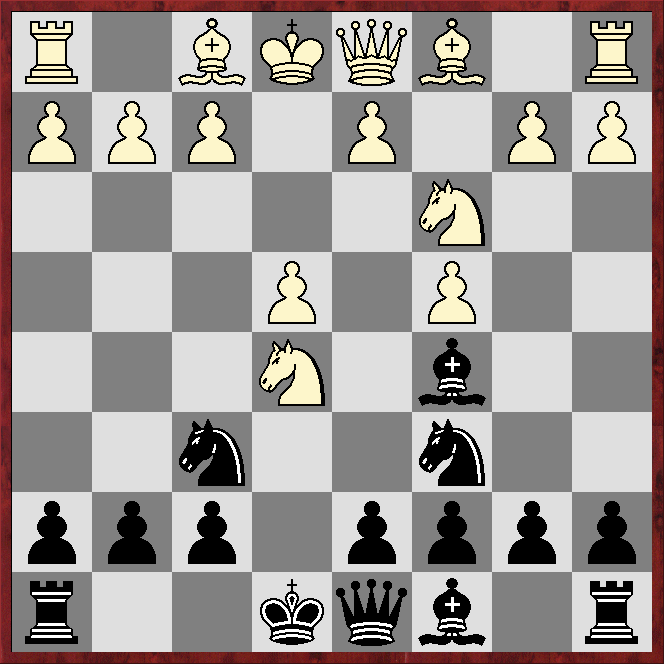
MY round-nine game reached the following Maróczy Bind position.
I have just played 16...a5, threatening 17...a4
*****
*****
*****
*****
*****
The pawn push ...a4 would not be the end of the world for White, but it does weaken the Bind and is probably best prevented.
I expected 17.Rb1, while Stockfish16.1 and Dragon1 very marginally prefer 17.Qb2. In both cases the idea is to meet ...a4 with b4.
My opponent chose 17.Bd1!?
The move more-or-less physically stops ...a4, but it undevelops the bishop and disconnects the white rooks.
The latter point is in some ways the more serious as one of the main tasks in the opening is to get the rooks connected.
Indeed, once rooks are connected the opening can be thought of as over, since achieving the connection normally means the player has developed all the minor pieces and the queen, and has castled.
Hence my opponent's move could be argued as taking White from the middlegame back to the opening.
Having said all that, the engines are perfectly happy with 17.Bd1!?
Dragon1 at first even reckons White has a slight edge, but fairly soon comes to agree with Stockfish16.1 that the position is equal.
However, the position in much harder for a human to play than is the case after 17.Rb1 or 17.Qb2.
This was dramatically illustrated by the game continuation 17...Qb4 18.Qd4 b5 19.Qb6!? Rfc8 20.Nb1? bxc4 21.Qxb4?! axb4 22.Rxc4 Bb5 (0-1, 37 moves).
LESSON: undeveloping moves, especially in ways that discoordinate other pieces, are fraught with danger.

Tuesday, 23 July 2024

Lessons From Bad Herrenalb VIII

IN round eight I reached the following position as White.
Black has just played 18...g5?! 
*****
*****
*****
*****
*****
*****
*****
*****
*****
I replied 19.Bg3?!, which gives a pleasant advantage, but the game was drawn on move 36.
I wanted to capture on g5, but after Black recaptures and White continues 20.Qh5 there are quite a few continuations to consider, all of which must work for White if the capture on g5 is to prove correct.
Easily dismissed is 20...Bxd2? as that unprotects the f6 square, so White has 21.Qxf7+ Kh8 22.Qf6#.
Stockfish16.1 reckons best is 20...Rxd2, but calculates that 21.Qxg5+ and 22.Rxd2 leaves White the equivalent of more than a minor piece ahead.
Dragon1 fluctuates between Stockfish16.1's choice and 20...Bg6, but reckons that after the latter White is the equivalent of almost a rook ahead on playing 21.Qxg5.
The move that stopped me playing 20.Bxg5! was 20...h6. On 21.Qxf7+ Kh8 I missed that 22.Rxd8+ wins. The point is 22...Bxd8 allows 23.Qg8#, so Black has to give up the queen with 22...Qxd8, but 23.Rxd8+ Rxd8 24.Qxf5 is overwhelming.
LESSON: when most lines of a winning combination work, but one line seems not to, it is worth spending a lot of time ensuring there is not after all a way to make the combination sound.

Monday, 22 July 2024

Lessons From Bad Herrenalb VII

MY round-seven game was completely equal, according to Stockfish16.1 and Dragon1, for most of its duration.
After much manoeuvring, we reached this position, with me to make my 48th move
*****
*****
*****
*****
*****
*****
*****
*****
After a fair bit of thought I played 48...Qc2+ and offered a draw, which was accepted.
I took some time because I was considering playing ...Qd4 in the hope White would go wrong.
If I had played the move, what should the outcome have been?
*****
*****
*****
*****
*****
What had caught my attention was a win for Black after 48...Qd4? 49.Qxd4 exd4 50.Ke2 Kf6 51.Kd3? Ke5 and 52...Kxd4.
However I eventually spotted it is White who should win, by playing 51.Kd2 with Kd3 and Kxd4 to come.
LESSON: pawn-endings are in a way the simplest of all endings in that nothing can move more than a square at a time (apart from pawns still in their starting position), but in another way they are the most complicated in that a subtle subtle nuance can turn a win into a loss, which is why players are often warned not to swop off into such an ending unless absolutely certain of the outcome.

Sunday, 21 July 2024

Lessons from Bad Herrenalb VI

IN round six I reached the following position as White.
Stockfish16.1 and Dragon1 give White a slight edge
*****
*****
*****
*****
*****
I continued 18.Rae1?, only to lose a pawn to 18...g5 19.Be3 Nxe5.
LESSON: advanced pawns are usually an asset as they give pieces more space to operate in, but they can be vulnerable as they can be more difficult to protect.

Saturday, 20 July 2024

Lessons From Bad Herrenalb V

THE following position was reached in my round-five game.
I have just played 14...Rfd8?
*****
*****
*****
*****
*****
At first glance this might be thought a typical IQP position.
Black has an isolated queen's pawn, but it is not under pressure, and the only black piece awaiting development is the queen's rook.
White has blockaded the isolani, but the knight on e2 is somewhat passive and none of the white heavy pieces has been developed.
But first impressions can be deceptive - here especially, as Black is lost!
The key is finding the move 15.Nf5, unblockading the d pawn but attacking both d6 and g7.
Black's best reply, according to Stockfish16.1 and Dragon1 is 15...Qd7!?, but they reckon 16.Bxf6 gxf6 (16...Qxf5!? loses the exchange) 17.Neg3 gives White a winning attack.
If instead 15...g6, White has 16.Nxg7! Kxg7 17.Nf4 Qf5 18.g4 with Nh5+ to come.
The game saw 15.Rc1? Ba7? 16.Nf4? Rac8?, both players oblivious to the critical nature of the position.
Finally my opponent played 17.Nf5, giving him an advantage worth more than a minor piece, according to the engines.
LESSON: the queen is as sensitive as it is powerful. The need to preserve it can create combinational chances for the opponent.

Friday, 19 July 2024

Lessons from Bad Herrenalb IV

THE lesson from my round-four game is the same as from round one.
Indeed, Black makes the identical dubious move, ...e5, albeit in a very different position.
In round one I here played 6...e5?!, and would have been at a disadvantage if my opponent had found, or had known, the clever reply 7.b4!?
In round four my opponent was Black, and here played 8...e5?!
That brings about a position occurring 77 times in ChessBase's 2024 Mega database, but in the vast majority of times it is Black to move.
In other words, Black has played ...e5 without spending a tempo on ...e6.
When that is the case, Stockfish16.1 and Dragon1 still like White's space advantage, reckoning White has the upper hand, being the equivalent of just over a pawn ahead.
But when it is White to move, as in my game, Dragon1 at first awards White a positionally won game, but backs down a little, agreeing with Stockfish16.1 that White's advantage is worth almost 1.4 pawns.
LESSON: moving a pawn or a piece for the second time in the opening needs to be justified by something the opponent has done. The fact that the move is desirable does not make it sound.

Thursday, 18 July 2024

Lessons From Bad Herrenalb III

IN round three I largely outplayed an opponent rated 224 elo higher.
He was so disgusted with his position as White that he offered a draw on move 13.
Thirty moves later we got down to a knight-and-pawn ending, eventually reaching the following position.
Black to play and win
*****
*****
*****
*****
*****
Numerous moves preserve Black's winning advantage, including 66...f3, 66...a3 and 66...Ne3.
I uncorked 66...Ng3??, and immediately saw I would have to concede a draw as White has 67.Ng4+.
LESSON: never relax. When your advantage is so large that opponents have no realistic hope of saving themselves, only your carelessness can change the 'inevitable' outcome.

Wednesday, 17 July 2024

Lessons From Bad Herrenalb II

MY round-two game in the Baden-Württemberg 60+ championship began as a Nimzowitsch System in the English: 1.e4 c5 2.Nc3 Nf6 3.Nf3 Nc6 4.e4!?
There are 4,666 examples of this position in ChessBase's 2024 Mega database
*****
*****
*****
*****
*****
*****
*****
Black replied 4...Bc5, which occurs 1,630 times in Mega24, second only to 4...Bb4's 1,748 times.
I continued 5.Nxe5!?, which, judging by body language, caught my opponent by surprise, although, since his rating is 2063, I am sure he is familiar with the basic idea.
When Black plays ...Nxe4, intending, after Nxe4 to play ...d5, forking the knight on e4 and a bishop on c4, it is with the idea of equalising the game.
When, as in this game, White plays the similar Nxe5, it is usually in the hope of achieving a slight plus.
The difference can be explained by White enjoying the advantage of the move, which is normally more potent in the early stages of a game.
Position after 5.Nxe5!?
*****
*****
*****
*****
*****
The mainline in Mega24 runs 5...Nxe5 6.d4 Bb4 7.dxe5 Nxe4 8.Qf3 Nxc3 9.bxc3 Ba5 10.Bf4, which at best gives White a tiny edge (Dragon1 calls the position completely equal).
My opponent played 5...Bxf2!?, which is clearly tempting as it occurs 194 times in Mega24 and has been the choice of 14 players rated over 2300.
However after 6.Kxf2 Nxe5 7.d4 White has the bishop-pair and the centre.
True, White has lost castling rights, and after 7...Neg4+ 8.Kg1 has difficulties developing the king's rook.
But the advanced black knight is easily driven away, and the white king is not in danger, so it is not so surprising that Dragon1 and Stockfish16.1 reckon White has a positionally won game.
LESSON: allowing the well-known forking combination Nxe5 (...Nxe4 for Black) can be embarrassing, but lashing out with ...Bxf2+ (Bxf7+ for White) is rarely a good idea. Losing the bishop-pair and control of the centre is much more significant than depriving the opponent of castling rights.

Tuesday, 16 July 2024

Lessons From Bad Herrenalb

BEGINNERS are warned not to move the same piece twice in the opening.
Naturally it is taken as read that there are occasions where something has to be moved for a second time, a common example being when a white bishop on g5 is challenged by ...h6.
But this second tempo can be justified by the fact Black has spent on tempo on pushing the h pawn.
And this is the key point - moving a unit for the second time is often not a good idea if the move is only desirable.
The move usually needs to be justified by some action the opponent has taken, typically spending a tempo, or leaving something unguarded.
My round-one game at Bad Herrenalb reached the following position in a Réti after White played 6.d3.
This position occurs 215 times in ChessBase's 2024 Mega database
*****
*****
*****
*****
*****
The most popular continuations are 6...Be7 and especially 6...Bc5.
I preferred 6...e5!?, which has been played by grandmasters rated over 2700, including world champion Liren Ding, albeit 10 years.
At first glance the move looks good - Black gains space in the centre, supports the advanced d pawn and opens the c8-h3 diagonal for Black's light-square bishop.
But the move violates the beginners' rule against moving a piece, or in this case a pawn, twice in the opening.
Not only that, but it is at an early stage of the opening, when such offences are more likely to be serious, and it is Black who is breaking the rule, which is significant because White is a  tempo up by virtue of having the first move.
The position after 6...e5!? occurs 1,071 times in Mega24, but that is largely because the vast majority of those games reach the position with Black to move.
That makes a huge difference, with Stockfish16.1 and Dragon1 reckoning Black is at least equal.
But the position with White to move gets a very different assessment, with the engines giving White the upper hand.
In the game my opponent replied 7.a3, evidently hoping to get in 8.b4, which I stopped with 7...a5.
However it turns out Black's lost tempo means White can play the immediate 7.b4!?
The obvious point is that 7...Nxb4 can be met by 8.Nxe5, an exchange that clearly favours White.
The much less-obvious point is that 7...Bxb4 can also be met by 8,Nxe5!
After 8...Nxe5 9.Qa4+ White, one way or another, captures the black dark-square bishop, eg 9...Nc6 10.Bxc6+ bxc6 11.Qxb4 with the upper hand for White, according to the engines.
LESSON: moving a pawn or piece for the second time in the opening needs to be justified by something the opponent has done.

Sunday, 14 July 2024

Summing Up Bad Herrenalb

MY score of +3=5-1 in the Baden-Württemberg 60+ championship gained 36.6 Fide elo and won a 50-euro third-place rating prize.

Saturday, 13 July 2024

Bad Herrenalb Round Nine

Erwin Illner (2045) - Spanton (1928)
Sicilian Maróczy Bind
1.e4 c5 2.Nf3 g6 3.c4!?
Ensuring White can get in a Maróczy Bind.
3...Nc6 4.d4 cxd4
Actually Black can avoid the Bind, for example by playing 4...d6?!, but that would surely be a case of the cure being worse than the ailment.
5.Nxd4 Bg7 6.Be3 Nf6 7.Nc3 d6 8.Be2 0-0 9.0-0
Now both sides have castled, how would you assess the position, which occurs 18,859 times in ChessBase's 2024 Mega database?
*****
*****
*****
*****
*****
Allowing the Maróczy Bind used to be regarded as tantamount to a positional blunder. Theory is no longer so condemnatory, but White's space advantage is worth a slight edge, according to Stockfish16.1 and Dragon1.
9...Bd7 10.Rc1!?
This is a common move in the Bind, although here it is not liked by the engines. The mainline in Mega24 runs 10.Qd2 Nxd4 11.Bxd4 Bc6 12.f3 with what the engines reckon is at least a slight edge.
10...Nxd4 11.Bxd4 Bc6 12.f3 Nd7!?
Anyone unfamiliar with the Maróczy Bind might find this surprising, as Black is offering to exchange the fianchettoed bishop. But the text is second in popularity to 12...a5 in Mega24, and White usually responds 13.Be3!? The point is that after ...
13.Bxg7 Kxg7
... White has swopped off his good bishop, and it will not be easy for White to get at the newly weakened h6 square. Nevertheless the engines still prefer White.
14.b3
The mainline in Mega24 runs 14.Qd4+ Kg8 15.Rfd1 Qb6 16.Qxb6 Nxb6 with a slight edge for White (Dragon1) or at least the better side of equality (Stockfish16.1).
14...Qb6+ 15.Kh1 Nf6!?
The black king's knight usually goes to c5 in these lines, often preceded by the move ...a5.
16.Qd2 a5
How should White meet Black's threat to play ...a4, putting pressure on b3 and readying an opening of the a file?
*****
*****
*****
*****
*****
17.Bd1!?
The engines are fine with this, but undeveloping the bishop while unconnecting the white rooks seems strange. The engines marginally prefer 17.Rb1 or 17.Qb2!?
17...Qb4 18.Qd4 b5 19.Qb6!?
The engines suggest 19.Be2 or 19.Rb1, in both cases claiming equality.
19...Rfc8 20.Nb1?
Another undeveloping move, and this time it is definitely a mistake. The engines give 20.Qd4, eg 20...bxc4 21.bxc4 Bd7!? 22.Be2 Qc5 23.Qxc5 Rxc5 with a slight edge for Black.
20...bxc4 21.Qxb4?!
Better. according to the engines, are 21.Qe3 and 21.Qd4, but in both cases Black ensures the gain of a pawn by answering 21...cxb3.
21...axb4 22.Rxc4 Bb5 23.Rxc8 Rxc8 24.Rg1
White loses a piece after 24.Re1 Rc1 25.Nd2 Be2, but the engines reckon the effectively-forced text is not much better.
24...Rc1
Even stronger is 24...Ra8, but the text is good enough.
25.Nd2?!
Probably better is 25.a4, although after 25...Bd3 26.Nd2 Ra1 27.g4!? Nd7 White is horribly tied down and lost, according to the engines.
25...Ra1 26.g3 Rxa2 27.Nf1 Rf2!?
This forces simplification that frees White's game a little but also makes Black's task easier.
28.Ne3 Be2 29.Bxe2 Rxe2 30.Nd1 Nd7 31.Rg2 Re1+!?
An important nuance. Getting the rooks off is good for Black, but it is much better, as will be seen, if f3 is left unprotected.
32.Rg1 Rxg1+ 33.Kxg1 Nc5 34.Ne3 Nxb3 35.Nc2 Nd2 36.Nxb4 Nxf3+ 37.Kg2 Nd2 0-1

Friday, 12 July 2024

Bad Herrenalb Round Eight

Spanton (1928) - Fedor Duschatskiy (2049)
Philidor
1.Nc3 e5 2.Nf3 d6 3.d4 Nd7 4.e4
This position is usually reached via the move-order 1.e4 e5 2.Nf3 d6 3.d4 Nd7 4.Nc3, although in that case 4.Bc4 is more popular

*****
*****
*****
*****
*****
4...Ngf6 5.Bc4 Be7 6.0-0
Slightly favouring Black, according to Stockfish16.1, is 6.Ng5 0-0 7.Bxf7+!? Rxf7 8.Ne6 Qe8 9.Nxc7 Qd8 10.Nxa8, although Dragon1 reckons the chances are equal.
6...0-0 7.h3!?
This is Dragon1's top choice; Stockfish16.1 prefers 7.a4 or 7.Re1.
7...c6 8.a4
There are 2,338 examples of this position in ChessBase's 2024 Mega database - how should Black continue?
*****
*****
*****
*****
*****
8...Nxe4!?
Most popular in Mega24 is 8...b6, while the engines like the relatively obscure 8...Re8!?
9.Nxe4 d5 10.Nxe5
This seems best. The problem with 10.Bd3 is that, after 10...dxe4 11.Bxe4, Black has a pleasant choice between the apparent-novelty 11...f5 and the known 11...Nf6.
10...Nxe5 11.dxe5 dxe4
The engines slightly prefer winning the bishop-pair with 11...dxc4.
12.Qe2 Qd4?!
This may be new. The engines prefer the known 12...Bf5.
13.Bf4 Bf5
The engines reckon 13...Qxb2?! 14.Rab1!?, with Qxe4 to come, is very good for White.
14.c3 Qd7 15.Rfd1 Qc8 16.Rd2 Rd8 17.Rad1 a5?!
The engines strongly dislike this, albeit they concede their suggested 17...Rxd2 18.Qxd2 h6 leaves White with at least the upper hand after 19.Qe2 or 19.Be3.
18.Bb3
Preparing to win the black e pawn, but even stronger, according to the engines, is 18.Rxd8+ Bxd8 19.g4!?, and if 19...Bg6 then 20.Qd2, eg 20...Bc7 21.Qd7 Kf8 22.e6!? with a huge attack.
18...g5?!
Probably better is the engines' 18...Rxd2 19.Rxd2 b5.
How should White proceed?
*****
*****
*****
*****
*****
19.Bg3?!
White is much better after this, but winning is 19.Bxg5! Bxg5 20.Qh5, eg 20...Bxd2? 21.Qxh7+ Kh8 22.Qf6#, or 20...h6 21.Qxf7+ Kh8 22.Rxd8+ etc, or 20...Bg6 (probably best) 21.Qxg5 Rxd2 22.Rxd2 with a pawn-plus and a big positional advantage.
19...Rxd2 20.Rxd2 Qe8 21.Bc2
Even stronger, according to the engines, is 21.e6!? fxe6 22.Be5.
21...Rd8 22.Rxd8 Qxd8 23.Bxe4 Bxe4 24.Qxe4 Qd1+ 25.Kh2 Qb3
How would you assess this queen-and-bishop ending?
*****
*****
*****
*****
*****
White is, at least temporarily, a pawn up, but the key to the position seems to be the relative safety of the two kings. The engines reckon White is winning.
26.Qf5!
The engines agree this is best.
26...Qxb2 27.Qc8+?!
Almost certainly better is 27.e6. I rejected it because of 27...f6?! (27...fxe6 is probably better), but after 28.Qxa5 the engines give White a huge advantage, eg 28...Qb3 29.Qa8+ Kg7 30.Qc8 Qxa4 31.Qe8 Qa3 32.Qf7+ Kh6 33.h4 Qc5 34.hxg5+ fxg5 35.f4 etc.
27...Kg6 28.e6?
White has the upper hand after 28.Qc7 or 28.Qd7, according to the engines.
28...Qxc3 29.Qc7 Kf6 30.exf7 Kxf7 31.Qxb7 Qc5 32.Qb3+ Qd5?!
Probably moving the king is better.
33.Qb1?!
The engines reckon the bishop ending after 33.Qxd5+ cxd5 34.Bc7 Bb4 35.Bb6 is much better for White.
33...Kg7 34.Qb7 Kf7 35.h4 h6 36.Qb1!?
Or 36.h5 g4 (other moves also hold the balance).
36...gxh4 ½–½
The position is completely equal, according to the engines.

Thursday, 11 July 2024

Bad Herrenalb Round Seven

Karl Brettschneider (1983) - Spanton (1928)
English Symmetrical
1.c4 c5 2.Nc3 Nc6 3.g3 g6 4.Bg2 Bg7 5.e3 Bxc3!?
This radical imbalancing of the position has been played by grandmasters, but is not liked by Stockfish16.1 and Dragon1. Whichever way White recaptures, the battle usually revolves around whether the white dark-square bishop can get usefully into play.
6.bxc3 f5 7.Ne2 Nf6 8.0-0 b6!?
This is not in ChessBase's 2024 Mega database, but ...b6 is typically played in this variation. Known moves are 8...0-0, 8...Qc7 and 8...d6.
9.a4
The engines like 9.Nf4, eg 9...0-0 10.d3 Bb7 11.e4!? fxe4 12.dxe4 Ne5 13.Re1 with what they reckon is a slight edge for White.
9...Bb7 10.d3 0-0
Now both sides have castled, how would you assess the position?
*****
*****
*****
*****
*****
The engines give White a slight edge, perhaps because they reckon White's bishop-pair is worth more than Black's better pawn-structure.
11.f3!?
White wants to get in e4, to free the dark-square bishop, without the doubled c pawns becoming isolated.
11...Qc7 12.e4 fxe4
The engines much prefer 12...e5 or 12...Rf7.
13.fxe4 Nh5 14.Bh6
The engines give White the upper hand after 14.Nf4!? Nxf4 15.gxf4.
14...Rxf1+ 15.Qxf1 Ne5 16.Nf4 Ng4 17.Nxh5 Nxh6 18.Nf4 e5 19.Nd5 Bxd5 20.cxd5!?
The engines marginally prefer this over 20.exd5.
20...Rf8 21.Qe2 d6
The engines suggest 21...c4!?, the point being Black is decidedly better after 22.dxc4? Qc5+ 23.Kh1 Rf2. However they reckon 22.d4! maintains equality.
22.Bh3 Kg7 23.Be6
KB offered a draw.
How would you assess the position?
*****
*****
*****
*****
*****
The engines reckon the position is completely equal.
23...Qe7 24.Kg2 Nf7 25.Bxf7 Rxf7
I played on for another 23 moves, before conceding the draw, but the engines' evaluation never varied from 0.00.

Wednesday, 10 July 2024

Bad Herrenalb Round Six

Spanton (1928) - Walter Schneider (2032)
Caro-Kann Gurgenidze
1.e4 c6 2.d4 d5 3.Nc3 g6!?
Overwhelmingly more popular is 3...dxe4, but the text has been played by Garry Kasparov, and is a speciality of Gata Kamsky. It scores a very good 50% in ChessBase's 2024 Mega database - two percentage points more than the mainline.
How should White respond?
*****
*****
*****
*****
*****
4.e5!?
Stockfish16.1 and Dragon1 agree this is best, although more popular are 4.h3 and especially 4.Nf3.
4...h5!?
Black's score rises to 51% after this.
5.Nf3 Nh6 6.Bf4 Bg4!?
This apparent novelty, albeit in an obscure position, is the top choice of the engines.
7.Be2!?
The engines strongly dislike this, much preferring 7.h3 and 7.Bd3.
7...e6 8.Qd2 Nf5 9.h3!? Bxf3 10.Bxf3 Nh4 11.Ke2!?
The engines do not like this.
11...Nd7 12.g3 Nxf3
The engines reckon Black has at least a slight edge after 12...Nf5!?
13.Kxf3 a6!?
This may be too slow. The engines suggest playing on the kingside with 13...Bg7 or 13...h4.
14.Kg2 c5 15.Ne2
How should Black proceed?
*****
*****
*****
*****
*****
15...cxd4
Gaining space with 15...c4?! is very much disliked by the engines, presumably because, by taking pressure off the centre, Black leaves White more-or-less a free hand on the kingside.
16.Nxd4 Rc8 17.c3 Be7 18.Rae1?
White is at least slightly better after 18.h4, according to the engines.
18...g5 19.Be3 Nxe5
Black has won a pawn, but White has compensation worth about a half-pawn, according to the engines
*****
*****
*****
*****
*****
20.Qe2 Nc6 21.Rhf1 Nxd4!? 22.Bxd4 Bf6!? 23.Bxf6 Qxf6
Black has simplified the position, but the consequence is White's remaining pieces are better coordinated than Black's, and the black king is less safe than White's.
24.f4 Rc4!?
The engines suggest 24...Rc6 or 24...gxf4 25.Rxf4 Qg7, in each case claiming equality.
25.fxg5 Qxg5 26.Qf3
White may have a slight pull after 26.Rxf7!
26...Rc7 27.h4 Qg6 28.Qxd5
Now White has levelled the material, how would you assess the position?
*****
*****
*****
*****
*****
Black has an extra pawn-island, but Black is to move and that conveys an initiative, which the engines reckon is enough for equality.
28...Rg8 29.Qe5 Rd7 30.Rf2 Qd3?!
Safer is seeking an exchange of queens with 30...Qg7.
How should White proceed?
*****
*****
*****
*****
*****
31.Re3
Promising is 31.Qb8+ Rd8 32.Qc7, eg 32...Qg6 33.Re3 Rd7 34.Qe5, although there is no immediate win of material.
31...Qd5+ 32.Re4 Qxe5 33.Rxe5
How would you assess this rook-and-pawn ending?
*****
*****
*****
*****
*****
Black has an extra pawn-island, but has the only protected passer. The engines reckon the game is completely equal.
33...Rd3 34.Rf3 Rxf3!?
34...Rd2+ looks a simpler way to draw, assuming Black is happy with that, but the engines agree the text is fine too.
35.Kxf3 Rh8 36.Rg5 Rh7!?
36...Ke7 avoids giving up the back rank.
37.c4
37.Rg8+ Kd7 38.Ke4 may be enough for a tiny pull, although Stockfish16.1 reckons the game is still equal (Dragon1 awards White a slight edge).
37...f6 38.Ra5 e5 39.Rd5 Ke7 ½–½
The final position is completely equal, according to the engines.

Venue

The tournament is held in Bad Herrenalb's kurhaus

Playing conditions are very good

Tuesday, 9 July 2024

Bad Herrenalb Round Five

FACED a Swiss.

Hansuli Remensberger (2068) - Spanton (1928)
QGD Normal Position
1.c4 e6 2.Nf3 d5 3.e3!?
There are 4,489 examples of this move in ChessBase's 2024 Mega database.
3...Nf6 4.Nc3 c5 5.cxd5
How should Black recapture?
*****
*****
*****
*****
*****
5...exd5
This is over three times more popular than 5...Nxd5 in Mega24, but Magnus Carlsen has preferred the latter, and the moves are of roughly equal value, according to Stockfish16.1 and Dragon1.
6.d4 Nc6
This position can arise from many move-orders, the commonest probably being 1.d4 d5 2.c4 e6 3.Nc3 Nf6 4.Nf3 c5 5.e3 Nc6 6.cxd5 exd5
*****
*****
*****
*****
*****
7.Bb5 Be7 8.0-0 0-0 9.dxc5 Bxc5 10.b3 Bg4 11.Be2!? a6!?
The engines like this, along with 11...Re8.
12.Bb2 Qd6 13.Nd4
How should Black proceed?
*****
*****
*****
*****
*****
13...Bxe2
This may be a novelty. The engines suggest 13...Bxd4!? 14.Bxg4 Be5 15.f4 Nxg4 16.Qxg4 Bf6, claiming equality.
14.Ncxe2 Rfd8?
Capturing on d4 is much better.
White to play and get a winning advantage
*****
*****
*****
*****
*****
15.Rc1?
White has an edge after this, but decisive is 15.Nf5, eg 15...Qe6 16.Nxg7! Kxg7 17.Nf4 Qf5 18.g4 and 19.Nh5+ etc.
15...Ba7?
Again, capturing on d4 is better, either immediately or after 15...Ng4 16.Ng3.
16.Nf4?
Nf5 still wins.
16...Rac8? 17.Nf5
At last!
17...Qd7
How should White proceed?
*****
*****
*****
*****
*****
18.Nxg7
Even stronger is the simple 18.Bxf6 Qxf5 (18...gxf6?? 19.Qg4+ mates) 19.Bxd8, and the engines' 18.Nh6+ with Bxf6 to follow.
18...d4!
This keeps the game going, whereas 18...Kxg7? is hopeless in view of 19.Nh5+.
19.Ngh5 Qf5 20.Nxf6+ Qxf6 21.Qg4+ Qg7 22.Qxg7+ Kxg7 23.Ne2 Kg8 24.exd4 Nxd4 25.Ng3
How big is White's advantage?
*****
*****
*****
*****
*****
Black is not just a pawn down, but also has two isolanis. Black's only compensation is a slight lead in development. The engines reckon White is the equivalent of 1.5 pawns ahead.
25...Ne6?!
Black has better, eg 25...Rxc1!? 26.Rxc1 Nc6, but then the engines reckon 27.Bc3 is winning.
26.Bf6 Re8 27.Nf5 Bc5 28.Rc3 Nf4
28...Bxf2+?? 29.Rxf2 Rxc3 fails because White has the backward-bishop move 30.Bxc3.
29.Rg3+ Ng6 30.Ne3!? Bxe3 31.Rxe3 Rxe3 32.fxe3
How would you assess this rook-and-minor-piece ending?
*****
*****
*****
*****
*****
White has the better minor piece for cooperating with a rook, and has the better pawn-structure. The engines reckon White's advantage has grown to the equivalent of two pawns.
32...Re8 33.Rd1!?
Can Black safely capture the e pawn?
*****
*****
*****
*****
*****
After 33...Rxe3? 34.Rd8+ Nf8 35.Kf2 the knight eventually falls, eg 35...Re4 36.Bb2 b5 37.Bd4 etc.
33...Ne5 34.Rd5 Nc6 35.Kf2 Re6 36.Bc3 Kf8 37.Rd7 b5 38.a3 Ke8 39.Rd5 Rh6 40.h3 Ke7 41.e4 Ke6 42.Kf3 f6?!
Putting a pawn on the same colour complex as the enemy bishop in this type of ending is rarely a good idea, and this is probably not an exception.
43.Rc5 Kd6 44.b4 Ne5+ 45.Bxe5+ fxe5
How would you assess this rook-and-pawn ending?
*****
*****
*****
*****
*****
White is a sound pawn up in an otherwise largely symmetrical position. The engines reckon White's advantage is worth at least a minor piece.
46.a4?!
The engines do not like this, preferring a slower approach, eg 46.Rc8 Rf6+ 47.Ke2 Rg6 48.g4 Rh6 49.Rc3, followed by slowing advancing White's kingside majority.
46...Rf6+ 47.Ke3 Rg6?!
Probably better is 47...bxa4 48.Ra5 Kd7.
48.axb5 axb5
What should White play?
*****
*****
*****
*****
*****
49.Rxb5!?
This is Stockfish16.1's top choice, but Dragon1 much prefers 49.Kf3 or 49.Kf2.
49...Rxg2 50.Rb6+ Kc7
Dragon1 at first reckons 50...Kd7 is close to equalising, but comes to agree with Stockfish16.1 that all king moves lose.
51.Rh6 Rb2 52.Rxh7+ Kb6 53.Rh5 Rxb4 54.Rxe5 Rb3+ 55.Kf4 Rxh3
White to play and win by finding an only-move
*****
*****
*****
*****
*****
56.Rd5!
The Syzygy endgame tablebase shows this is the only winning move, eg 56.Kf5 Kc6! leaves White unable to make progress, one simple line running 57.Re6+ Kc7 58.e5 Rf3+ 59.Ke4 Kxe6 etc.
56...Kc6 57.Rd1 Rh4+ 58.Kf5 Rh5+ 59.Kg4 Rh2 60.e5 Re2 61.Kf5 Rf2+ 62.Ke6 Kc7 63.Ke7 Re2 64.Rc1+ Kb6 65.e6 Re3 66.Kd7 Rd3+ 67.Ke8 Re3 68.e7 Re2 69.Rc4 Re1 70.Kf7 Rf1+ 71.Ke6 Re1+ 72.Kf6 Kb5 73.Rc8 Rf1+ 74.Kg5 1-0

What A Drag

GERMANY does not have a pub culture, or at least not one as we know it in Britain.
It is uncommon to find a place that is just for drinking alcohol - usually bars double up as restaurants, where eaters and drinkers mix more-or-less freely, often at the same communal tables.
So I was surprised to find a bar, Mo's Felsenkeller (note the English-language apostrophe) in Bad Herrenalb.
I watched the Germany-Spain football game there on Friday, surrounded by passionate German fans - and, again to my surprise, surrounded by passionate smokers.
It turns out that in Baden-Württemberg smoking is allowed in bars smaller than 75 square metres, which is why I later came across a restaurant that had a separate smoking bar.
Mo's Felsenkeller (literal translation: Rock Cellar) has another oddity - it only opens Monday-Friday
There are some other restrictions, apart from the size of the bar - under-18s are banned, and, in theory at least, hot food must not be served.

Monday, 8 July 2024

Bad Herrenalb Round Four

Spanton (1928) - Michael Cichy (2034)
Franco-Benoni
1.d4 Nf6 2.Nc3 e6 3.e4 c5!?
How should White respond?
*****
*****
*****
*****
*****
*****
4.d5
This is probably objectively best, but there are interesting alternatives.
4.Nf3 cxd4 transposes to a mainline ...e6 Sicilian.
4.e5 can be successfully met by 4...cxd4.
4.dxc5 Bxc5 5.e5 is good for White, but Black can improve, eg 4...Nc6! 5.Be3 Qa5.
4...d6 5.Nf3 a6 6.a4 Be7 7.Be2 0-0 8.0-0
Now both sides have castled, how would you assess the position?
*****
*****
*****
*****
*****
White has more space in the centre and is ahead on development. The c4 square could prove a useful outpost, especially for a white knight, and the b6 square might turn out to be a black weakness. However, Stockfish16.1 and Dragon1 reckon White is only slightly better.
8...e5?!
This represents the loss of a tempo.
There are 77 examples of this position in ChessBase's 2024 Mega database, but in most of them it is Black to move
*****
*****
*****
*****
*****
9.Nd2!? Ne8
Most popular in Mega24 is 9...Nbd7.
10.Nc4 Nd7
On 10...f5 both 11.a5 and the engines' 11.f4!? look good.
11.a5 Bg5!? 12.Ra3 Bxc1 13.Qxc1
Black has swopped his bad bishop for White's good one, but what next?
*****
*****
*****
*****
*****
13...b5!?
This is the engines' top choice, along with ...b6, which comes to the same thing.
14.axb6 Nxb6 15.Na5 Qc7
How should White proceed?
*****
*****
*****
*****
*****
16.Qa1!?
This may not be best. The engines like 16.Qd2, and if, as in the game, 16...f5, then 17.exf5 Rxf5 18.Rfa1 with strong pressure against the black queenside. The text also pressurises the queenside, but leaves the white kingside less well-protected.
16...f5 17.f3 Nf6 18.Qa2 Kh8!? 19.Nc4 g6 20.Nxb6
The engines reckon 20.Nd2!? c4 21.Kh1 is at least slightly better for White.
20...Qxb6 21.Ra1!?
White can get away with this, but more prudent is 21.Kh1 or 21.Qb3.
21...fxe4 22.fxe4 c4+ 23.Kh1 Bg4 24.Rxa6
Capturing on c4, with queen or bishop, leaves the game completely equal, according to the engines.
24...Rxa6 25.Qxa6 Qxa6 26.Rxa6 Bxe2 27.Nxe2 Nxe4 28.Kg1 Rb8
Not 28...Rf2? 29.Nc3! Rf4 30.g3 Rg4 31.Nxe4 Rxe4 32.Kf2!, after which the d6 pawn drops.
White to play and draw
*****
*****
*****
*****
*****
29.Nc3!
The passive 29.Ra2? runs into 29...Rb5, after which d5 falls.
29...Nxc3 30.bxc3 Rb2
Or 30...Rb1+ 31.Kf2 Rc1 32.Rxd6 Rxc2+ 33.Ke3 Rxc3+ 34.Ke4 with complete equality, according to the engines.
31.Rxd6 Rxc2 32.Re6 Rxc3 33.Rxe5 Rd3 34.Re4 ½–½

Sunday, 7 July 2024

Bad Herrenalb Round Three

I WAS downfloated against an opponent who took a half-point bye in round one.

Mario Born (2152) - Spanton (1928)
Queen's Pawn Game
1.d4 d5 2.Nf3 e6 3.g3 c5!?
White's move-order suggests he is angling for a Catalan, but without letting Black play an early ...dxc4, which has been cited as a relatively simple equalising line.
How should White respond?
*****
*****
*****
*****
*****
4.Bg2
This is by far the most popular move in ChessBase's 2024 Mega database, and becomes the top choice of Dragon1, although for some time the engine prefers the peculiar 4.dxc5!? Stockfish16.1 suggests 4.c4, continuing 4...dxc4 5.Qa4+ Nd7!? 6.Qxc4 a6 7.dxc5 Bxc5 8.Bg2, rating the position as completely equal.
4...cxd4!?
Much more popular are 4...Nf6 and especially 5...Nc6, but the text, which has been played by Garry Kasaprov, can be thought of as an anti-Catalan continuation.
5.0-0 Nf6 6.Nxd4 e5!? 7.Nb5
The mainline in Mega24 runs 7.Nb3 Be6 8.Bg5 Nbd7 9.Nc3 Be7 10.e4!? dxe4 11.Nxe4 Nxe4 12.Bxe7 Qxe7 13.Bxe4 Nf6 14.Bg2 0-0, with complete equality, according to the engines.
7...a6 8.N5a3!?
The engines prefer retreating the knight to c3.
8...Be7
This may be a novelty. The engines reckon Black is better after 8...Nc6 or 8...Be6.
9.c4
The engines suggest 9.Bg5.
How should Black proceed?
*****
*****
*****
*****
*****
9...d4!?
This seems best. The position now resembles a Réti, albeit one in which the Réti knight has been transported from f3 to a3.
10.Bg5 0-0 11.Bxf6!?
This is the top choice of the engines.
11...Bxf6 12.Nd2 Nc6 13.Qb3!?
MB offered a draw.
How would you assess the position?
*****
*****
*****
*****
*****
*****
Black has the bishop-pair and a central pawn-majority, together with more space in the centre. White has more pieces developed, a queenside space advantage and the endgame advantage of a farside pawn-majority. The engines give Black the upper hand.
13...Na5 14.Qd3 Nc6 15.Qb3 Qc7 16.Rac1 Be6 17.Bd5!?
This is the engines' top choice.
17...Bh3 18.Rfe1 Bg5 19.Rcd1 Rab8 20.Nc2 Ne7 21.Bg2 Bxg2 22.Kxg2
The bishop-pair has gone, but Black retains a good advantage.
22...Rfc8?!
This seems to largely let White off the hook, whereas 22...b5 is very strong, the point being 23.cxb5?! Rxb5 is winning for Black, eg 24.Qd3 Rxb2, or 24.Qa4 Bxd2 25.Rxd2 Rxb2.
23.Ne4?!
Probably better is the engines' 23.e3, eg 23...b5 24.exd4 bxc4 25.Qf3 Rxb2 26.Ne4 h6 27.Qc3 Qb7 28.dxe5, with an unclear position that the engines reckon gives equal chances.
23...Qc6 24.Qf3 Bh6 25.Nb4 Qg6
Not 25...Qxc4? 26.Nd6 etc.
26.c5!? f5!? 27.Qb3+ Kf8!?
Not 27.Kh8? Nd6 28.Rf8 Nd5 with a strong initiative.
28.Nd2 Bxd2 29.Rxd2 Rxc5
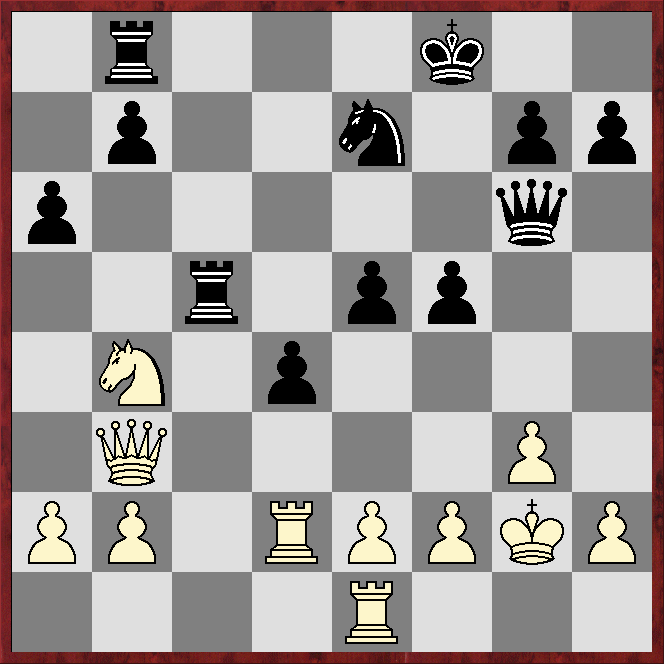
Black is a sound pawn up
*****
*****
*****
*****
*****
30.Nd3 Rb5 31.Qa3 Rc8 32.Kg1?!
There probably was not time for this. The engines suggest 32.e3 or 32.f4!?, but give Black the upper hand.
32...Qb6 33.Rc1
The engines suggest 33.Red1 or 33.b4, but agree Black has a positionally won game.
33...Rxc1+ 34.Nxc1 Ra5 35.Qd3 Qc6 36.Rc2 Rc5 37.Rxc5 Qxc5 38.Nb3 Qc6?!
This allows White an equalising chance, whereas 38...Qb4, among other moves, maintains an advantage, according to the engines.
How does White equalise?
*****
*****
*****
*****
*****
39.Qd2
The engines show 39.f4! breaks up Black's centre and so equalises, eg 39...exf4 40.Nxd4 Qc1+ 41.Kg2 fxg3 42.Nxf5 Nxf5 43.Qxf5+ with perpetual check.
39...b6 40.f4?!
A move late, and with much less effect thanks to the white queen being on d2 (as will soon become clear). However, after the engines' 40.e3 dxe3 41.Qxe3 Qd6 Black remains a sound pawn up.
How does Black gain a large advantage?
*****
*****
*****
*****
*****
40...Nd5!
There is no good answer to this. MB spent 21 minutes on his next, but defied grandmaster John Nunn's 20-minute rule (see yesterday's game for a brief explanation of this rule) by coming up with what Dragon1 reckons is best.
41.Kf2!?
Stockfish16.1 for quite some time agrees this is best, but comes to slightly prefer 41.e4 and 41.Qc1, albeit reckoning Black is the equivalent of more than a minor piece ahead.
41...Ne3 42.Qc1 Qxc1
This is stronger than 42...Qg2+ 43.Ke1 Qf1+ etc. However the engines reckon that, instead of 43...Qf1+, Black gets an even larger advantage with 43...b5!?
43.Nxc1 exf4 44.Nb3 Nd1+ 45.Kf3 fxg3 46.hxg3 Nxb2 47.Nxd4 g6 48.Ne6+ Kf7 49.Ng5+ Kg7 50.Ke3 h6 51.Ne6+ Kf7 52.Nc7 a5 53.Kd4 h5 54.Nd5 Ke6!? 55.Nxb6
White is now 'only' one pawn down, but Black can create a winning passer on the h file
*****
*****
*****
*****
*****
55...g5 56.Nd5 a4 57.Nc3 h4 58.gxh4 gxh4 59.e4!? h3 60.Ne2 h2 61.Ng3 f4 62.Nh1 Nd1 63.Kd3 Ke5 64.Kd2 Ne3 65.Nf2 Nf1+ 66.Kd3 Ng3?? 67.Ng4+ ½–½