Showing posts with label Philidor Defence. Show all posts

Monday, 15 June 2026

Bischofsgrün Round Four

FACED a Dutchman.

Spanton (1951) - Stef van Kesteren (1861)
Philidor
1.e4 e5 2.Nf3 d6 3.d4 exd4 4.Nxd4 Nf6 5.Nc3 Be6 6.Be2 0-0 7.Be3 Nc6
Stockfish18 and Dragon1 suggest 7...Re8 or 7...c5!?
8.0-0
Now both sides have castled, how would you assess the position?
*****
*****
*****
*****
*****
White's space advantage gives a slight edge, according to the engines.
8...Bd7 9.f4 Nxd4 10.Bxd4 Bc6 11.Bf3 a6 12.Qd2 Nd7!? 13.Rae1 Bf6 14.e5?
Dropping a pawn. White has a slight edge after any reasonable move, according to the engines.
14...dxe5 15.fxe5?!
The engines reckon this makes matters worse.
15...Nxe5 16.Bxc6
Not 16.Bxe5?? Qxd2.
16...Nxc6 17.Be3 Qxd2 18.Bxd2
Black is 'only' a pawn up, but Black's advantage is worth nearer a minor piece, according to the engines
*****
*****
*****
*****
*****
18...Nb4?!
But this throws away much of the advantage. Instead, the black rooks should be brought into play, starting with 18...Rad8 or 18...Rfd8.
19.Ne4
Best seems to be the engines' 19.Re4!?, one point being 19...Nxc2 can be met by 20.Rxf6! gxf6 21.Nd5, when the engines reckon Black no longer has an advantage. However, calmer moves, such as 19...c5, 19...Nc6 and 19...Bxc3, give Black the upper hand, according to the engines.
19...Bd4+ 20.Kh1 Nxc2 21.Rc1 Ne3
The engines suggest 21...f5 or 21...Rae8.
22.Bxe3 Bxe3 23.Rxc7
White's pieces are more active, but Black remains a pawn up, and has the generally-better minor piece for working with rooks
*****
*****
*****
*****
*****
Black is winning, according to the engines.
23...b5 24.Nd6 Bd4!?
The engines agree this is best.
25.b3 Be5 26.Rc6 Bxd6?
This greatly reduces Black's winning chances, which would remain after, for example, 26...f6.
27.Rxd6 Rfd8 28.Rfd1 Rxd6 29.Rxd6
Dragon1 gives Black a slight edge, but Stockfish18's verdict of equal is probably nearer the mark
*****
*****
*****
*****
*****
29...Kf8 30.Kg1 Ke7 31.Rb6 Ra7 32.a4 bxa4 33.bxa4 a5 34.Kf2 Rc7 35.Rb5 Rc2+ 36.Kf3 Rc3+ 37.Kf2 Rc2+ ½–½

Friday, 13 March 2026

Bad Wörishofen Senioren Round One

THIS game ended a streak in which I had seven consecutive blacks.

Spanton (1919) - Detlef Sombetzki (1577)
Pirc/Philidor
1.e4 d6 2.d4 Nf6 3.Nc3 Nbd7 4.f4 e5 5.Nf3 exf4!?
The main line in ChessBase's 2026 Mega database runs 5...exd4 6.Qxd4 c6 7.Be3 d5!? 8.exd5 Bc5!? 9.Qd3 Qe7!? 10.Nd4 Nb6 11.dxc6 bxc6 12.0-0-0, when Black does not have enough for a pawn, according to Stockfish17.1 and Dragon1.
6.Bxf4 Nb6
The engines suggest 6...Be7, although Stockfish17.1 fluctuates between the text and 6...c6 as its second choice. Dragon1 definitely prefers 6...c6 as a second choice; indeed, if given enough time, it prefers 6...c6 to 6...Be7.
7.Bd3 h6
Possibly a novelty. The known moves are 7...Bg4 and 7...Be7.
8.0-0 Be7 9.Qd2 Bd7 10.Rae1
Now White is fully mobilised, how would you assess the position?
*****
*****
*****
*****
*****
White's large lead in development and central space advantage give a positionally won game, according to the engines.
10...Nh5 11.Be3 c6 12.a4 a5 13.b3!?
The fact that a consolidating move like this is not only possible, but is possibly the best move in the position, according to Stockfish17.1, demonstrates Black's lack of counterplay. However, I should add that, given more time, Stockfish17.1 comes to fluctuate between the text and Dragon1's preference, 13.d5.
13...g5!?
Trying to take advantage of the white king's knight having no safe square to which it can move.
How should White respond?
*****
*****
*****
*****
*****
14.d5
Also strong is 14.Qf2, and there are other moves that maintain a large white advantage.
14...c5 15.e5!? 0-0
Not 15...g4? 16.exd6!
16.exd6 Bxd6 17.Ne4 Bf4 18.c4!?
Simple consolidation. Now White has a potential endgame advantage, as well as continuing middlegame chances.
18...Bxe3+ 19.Qxe3 Nf4 20.Bb1
Possibly even stronger is the double-sacrifice 20.Nfxg5!? hxg5 21.Rxf4!?
20...Re8 21.Qc3!? 1-0
Black lost on time (the time control is 40 moves in 90 minutes, plus 30 minutes to finish, with a 30-second increment throughout). The engines reckon Black's best is to give up the exchange with 21...Rxe4!?, but White keeps a winning advantage.
Shrine near Dorschhausen

Monday, 8 September 2025

Miniatures 6

IN this occasional series I am going through my decisive games of 20 moves or fewer.

L Filipowicz (175 BCF) - Spanton (ungraded)
North London Spring Congress 1989
Philidor Countergambit
1.e4 e5 2.Nf3 d6 3.d4 f5?!
Stockfish17 and Dragon1 strongly dislike this gambit, preferring 3...Nf6, 3...Nd7 or 3...exd4.
How should White respond?
*****
*****
*****
*****
*****
4.Nc3
This is the main move in ChessBase's 2025 Mega database, but the engines prefer 4.Bc4 or 4.exf5!?
4...Nf6?!
Almost certainly better is the most popular continuation, 4...fxe4.
5.dxe5 Nxe4 6.Bc4!?
The engines agree this is best.
6...Nxc3 7.bxc3 c6?
Better, but still losing, according to the engines, is 7...d5!? 8.Bxd5 Be7.
8.exd6 Qxd6 9.Bg5
Probably even stronger is 9.0-0, but either way White's lead in development and safer king are decisive.
9...h6
Getting queens off is preferred by the engines, but 9...Qxd1+ 10.Rxd1 increases Black's development advantage.
10.Qe2+ Be7 11.Rd1 Qc7 12.Bxe7 Qxe7 13.Ne5 h5? 14.Bf7+ 1-0
LESSON: when playing an opening that is sharp, but dodgy, success is unlikely without knowing the basic theory and ideas.

Friday, 14 February 2025

League Chess

PLAYED on board two (of five) for Battersea against Hammersmith 2 in Central London League Division Two last night.

Spanton (1986) - Luke Barron (1998)
Philidor
1.Nf3 d6 2.d4 Nf6 3.Nc3 Nbd7 4.e4 e5
By a slightly unusual move-order the game has reached a mainline position from the Philidor that occurs 33,000 times in ChessBase's 2025 Mega database
*****
*****
*****
*****
*****
5.Bc4 Be7 6.0-0
The sharp line 6.Ng5 0-0 7.Bxf7+!? Rxf7 8.Ne6 Qe8 9.Nxc7 Qd8 10.Nxa8 slightly favours Black after 10...b5!?, according to Stockfish17 and Dragon1.
6...c6 7.a4 Qc7 8.Qe2
The main line in Mega25 runs 8.Re1 h6 9.h3 Nf8!? 10.Be3, with a slight edge for White, according to the engines.
8...a5
Commonest in Mega25 is 8...h6, while the engines suggest 8...0-0 or 8...exd4.
9.Bb3!? h6 10.Nh4?
Known moves are 10.Rd1, 10.Qc4 and 10.dxe5.
10...exd4 11.Qc4!?
Retreating the knight is probably objectively better.
11...dxc3 12.Qxf7+ Kd8 13.Ng6 Ne5 14.Nxe5 dxe5 15.Rd1+?
The engines prefer 15.Qxg7 Rh7 16.Rd1+ Bd7 17.Qg6, reaching the same position as in the game but giving Black fewer options.
15...Bd7
Blocking the check by developing a piece looks natural, but the engines recommend 15...Bd6!, obliging the white queen to retreat.
16.Qxg7 Rh7
This is the only move for an advantage, according to the engines, but it is a winning advantage.
17.Qg6 Kc8!?
The engines agree this is also best.
18.Be3
Perhaps 18...Bxh6 is better.
18...Qd8!?
Entering a pin looks suspicious, but the engines are OK with it, although preferring 18...Kb8 and 18...c5!?
19.Be6 Qh8?
Black is still winning after 19...cxb2 or `19...Bf8, according to the engines.
How should White proceed?
*****
*****
*****
*****
*****
20.Rxd7?
Better is 20.Qf5, when 20...Bd8 gives a murky position, but Black has at least a slight edge, according to the engines.
20...Nxd7 21.Rd1 Bg5 22.Bb6?!
The bishop is loose here, but there is no satisfactory continuation, eg 22.Qf5 Bxe3 23.fxe3 Kc7 leaves Black a rook-for-pawn up as both 24.Bxd7 Rd8 and 24.Rxd7+ Rxd7 25.Bxd7 cxb2 are hopeless for White.
What should Black play?
*****
*****
*****
*****
*****
22...Bd2?
There are several winning moves, including 22...Ra6 and 22...cxb2.
23.bxc3?
The engines agree 23.Bf5 gives complete equality.
Black to play and win
*****
*****
*****
*****
*****
23...Bxc3??
This turns a winning position into a losing one. Both 23...Kb8 and 23...Ra6 win.
24.Qf5 Bd4?!
Relatively best seems to be 24...Ra6, but 25.Bxd7+ Kb8 26.Be3 gives White a winning advantage, according to the engines, despite White being the exchange down for a pawn.
White to play and win
*****
*****
*****
*****
*****
25.Rxd4! exd4 26.Qf4 Qd8
Forced.
27.Bxd8 Kxd8 28.Bxd7+ 1-0
The match was drawn 2.5-2.5.

MY BATTERSEA SEASON 2024-5
DATE.....EVENT...........................COL..RATING..OPP'S RATING..SCORE..SEASON PERF
12/9/24..Central London League....W......1933..........1886................1............2286
26/9/24..Central London League....B.......1933..........2112................1............2399
15/10/24.Club Championship.........W......1968..........1578................1............2259*
31/10/24.Central London League...B.......1968..........1867.................0...........2061*
19/11/24.London League...............W.......1957..........1991................1............2127*
21/11/24.Central London League....B.......1957..........2035................=...........2112*
27/11/24.London League...............W.......1957..........1723................=...........2056*
12/12/24.Central London League....B.......1965..........2153................0...........2018*
7/1/25.....Club Championship.........B.......1958..........1785................1...........2037*
9/1/25.....Central London League....B.......1958..........1851................0...........1978
14/1/25....Eastman Cup.................B........1958..........2052................1............2021*
28/1/25....London League..............B........1958..........1766................1............2033*
4/2/25......London League..............B........1980..........1757................1............2043*
6/2/25......Central London League..W.......1980..........1932................0............2006*
11/2/25....Central London League..B........1986..........2178................=............2018*
13/2/25....Central London League.W........1986..........1998................1............2042*
*My season's performance is slightly better than this as my win against a 1578 is a 1978 performance, lowering my average despite me winning.

Monday, 20 January 2025

Mariánské Lázně Round Three

FACED a German.

Spanton (1946) - Michael Osswald (1787)
Philidor
1.Nc3 e5 2.Nf3 d6 3.d4 exd4 4.Nxd4 g6!? 5.e4
By transposition the game has reached a mainline of Philidor's Defence, the position occurring 1,355 times in ChessBase's 2025 Mega database
*****
*****
*****
*****
*****
5...Bg7 6.Be3 Nf6 7.Be2!?
The main move in Mega25 is 7.Qd2, and if 7...Ng4?! Stockfish17 and Dragon1 reckon 8.Bg5 gives White a positionally won game. Instead they prefer 7...Nc6!? or the much more popular 7...0-0.
7...Qe7!?
Castling is normal.
8.0-0!? Nxe4?!
Probably too greedy.
How should White respond?
*****
*****
*****
*****
*****
9.Nxe4?!
White has good compensation for a pawn after this, but the engines much prefer 9.Nd5!?, meeting 9...Qd8 with 10.Bf3 (other moves are also good).
9...Qxe4 10.Re1 0-0 11.Bf3
Where should the black queen go?
*****
*****
*****
*****
*****
11...Qe5
The engines fluctuate between the text and 11...Qe8.
12.Qd2
One point of 11...Qe5 is White's dark-square bishop cannot move as Black replies 12...Qxd4.
12...c6 13.Rad1
White has completed development while Black still has the queenside to develop
*****
*****
*****
*****
*****
13...Qe7?!
This is probably just a waste of time, while 13...Nd7 leaves White only slightly better, according to the engines.
14.Bf4
Possibly even stronger is 14.Bg5.
14...Qc7?!
On 14...Qf6 I intended the quiet 15.c3!?, which prevents Black exchanging queens on d4 and sets up the deadly 16.Bg5. The engines reckon Black should give back the pawn with 15...h6!?
Best may be 14...Be5!?, although the engines give White the upper hand, one line running 15.b4!? Re8 16.c4 Bd7 17.Bg5 h6 18.Bh6 with continuing pressure.
15.Nb3
Even stronger is the engines' 15.Nb5!
15...Be5!?
An only-move, according to the engines, but not a square Black wants his fianchettoed bishop to occupy.
16.Bh6 Re8
Not 16...Rd8? 17.Rxe5!
17.Qf4?
The relatively straightforward 17.Qxd6! Qxd6 (forced) 18.Rxd6 wins the pawn back and leaves White with at least a slight edge, according to the engines. Note Black cannot continue 18...Bxh2+?? 19.Kxh2 Rxe1+?? as White has 20.Rd8+ Re8 21.Rxe8#.
17...Bd7?
Black is at least slightly better after 17...Nd7, according to the engines.
18.Rxe5! 1-0

Monday, 30 December 2024

Kraków Round Four

I WAS downfloated.

Spanton (2011) - Stanisław Tomalak (1750)
Philidor/Pirc
1.Nc3 Nf6 2.d4 d6 3.e4 Nbd7 4.f4 e5!?
Technically the opening is considered to come under the Pirc banner, but the idea of playing ...e5, while allowing White to deprive Black of castling rights, is common in the Philidor, although the Philidor arises after the moves 1.e4 e5 2.Nf3 d6, usually ruling out an early f4
*****
*****
*****
*****
*****
5.dxe5!?
Theory considers 5.Nf3 a more promising way of trying for a significant advantage.
5...dxe5 6.fxe5 Nxe5 7.Qxd8+ Kxd8
There are 356 examples of this position in ChessBase's 2025 Mega database - who stands better, if anyone, and by how much?
*****
*****
*****
*****
*****
Both Stockfish17 and Dragon1 reckon the position is equal - indeed Stockfish17, at least for a time, has Black 0.04 ahead. I guess the point is that losing castling rights is not such a big deal with queens off the board, and Black has a slight lead in development, while White has an isolated pawn.
8.Bf4
This is the most popular continuation in Mega25, but the strongest players have tended to prefer 8.Bg5 or 8.Nf3.
8...Bd6 9.0-0-0 Ke7 10.Nf3!?
How should Black proceed?
*****
*****
*****
*****
*****
10...Nxf3!?
Dragon1 at first regards this as a mistake, while Stockfish17 is happy enough with it. However, given enough time, both engines come to award White a slight edge, whereas they reckon winning the bishop-pair with 10...Nd3+! keeps the game equal.
11.Bxd6+ cxd6 12.gxf3 Bd7
The engines suggest 12...Be6!?, and if 13.Nb5 then 13...Rhd8 or 13...d5.
13.Bg2!?
A 'mysterious' bishop move, but there really is not a great alternative destination for White's light-square bishop.
13...Rhd8 14.Rhe1 Bc6
What should White play?
*****
*****
*****
*****
*****
15.Nd5+?!
White is at least slightly better after 15.Rd4 or 15.f4, according to the engines.
15...Bxd5
More-or-less forced, but good.
16.exd5+ Kf8 17.Re2?!
Stockfish17 suggests getting the bishop on on decent diagonal with 17.Bh3, while Dragon1, with a similar idea in mind, prefers 17.Bf1!?
17...Re8 18.Rxe8+ Rxe8 ½–½
I could not justify playing on. White's only decent move, according to the engines, is 19.c4, although they reckon that leaves Black with the upper hand (Dragon1) or at least a slight edge (Stockfish17), while they reckon every other move gives Black a positionally won game.

Sunday, 10 November 2024

Cap Negret Round Four

FACED a fellow England-registered player after taking a half-point bye in round three.

Spanton (2009) - Raymond Wynarczyk (1843)
Philidor
1.e4 d6 2.d4 Nf6 3.Nc3 e5!?
This is the top choice of Stockfish17 and Dragon1.
4.Nf3!?
As is fairly well-known, White gets little from 4.dxe5 dxe5 5.Qxd8+. The text is more popular in ChessBase's 2024 Mega database, and is preferred by the engines.
4...Nbd7 5.Bc4 Be7 6.0-0 0-0
Now both sides have castled, how would you assess the position?
*****
*****
*****
*****
*****
The engines reckon White's extra space in the centre and freer development give a slight edge. 
7.h3 c6 8.Re1!?
Overwhelmingly more popular is 8.a4.
8...b5 9.Bb3 a5 10.a4 b4 11.Nb1 c5!?
This may be a novelty. Known moves are 11...h6!? and 11...Qc7.
How should White respond?
*****
*****
*****
*****
*****
12.dxe5!
This is the only move to give White any sort of advantage, according to the engines.
12...Nxe5 13.Bf4?!
Probably the wrong follow-up. The engines reckon White should fix the centre with 13.Nxe5, eg 13...dxe5 14.Nd2 Qc7 15.Qe2, when the c4 square makes a fine outpost for a white minor piece.
13...Bb7
The engines like 13...c4!?,  when 14.Ba2?! loses the exchange to 14...b3! 15.cxb3 Nd3 etc, while 14.Bxe5 cxb3 15.Bd4 bxc2 gives Black at least a pull, according to the engines, despite Black having an isolated d6 pawn on a half-open file.
14.Nbd2 Qc7 15.Bxe5!? dxe5
Black has the bishop-pair, but the dark-square bishop is bad and White has the c4 outpost
*****
*****
*****
*****
*****
16.Qe2 Ba6?!
This is easily countered. The engines prefer 16...g6!?, while Stockfish17's top choice is the positional pawn sacrifice 16...c4!? 17.Bxc4 Bc5, after which the dark-square bishop is active, and White's extra pawn on c2 is somewhat vulnerable.
17.Bc4 Bb7 18.Rac1!? Rac8 19.b3 Nd7?!
RW offered a draw.
20.Ba6
Even stronger seems to be 20.Bd5.
20...Bf6?
Better is 20...Bxa6 21.Qxa6 Nb8 and ...Nc6, but even so the engines give White at least a slight edge.
21.Bxb7 Qxb7 22.Nc4 Qc7 23.Rcd1 Nb6 24.Nxb6 Qxb6 25.Rd5 Rfe8 26.Qc4
Even stronger, according to the engines, is 26.Nd2, intending Nc4.
26...Re6 27.Red1 g6 28.g4!? h6 29.h4 Be7!?
How should White proceed?
*****
*****
*****
*****
*****
30.Rxe5?!
Missing the point of Black's play. White already has a winning position, according to the engines, and should ratchet up the pressure, eg 30.Kg2 Qb8 31.Rd7 Rd8 32.R1d5 Rxd7 33.Rxd7, although there is no immediate breakthrough.
30...Rxe5 31.Nxe5 Qf6 32.Rd5!
The only move to maintain an advantage - other moves leave Black with at least a slight edge, according to the engines.
32...Rd8
The engines give 32...Qf4!? 33.Qe2 Bd6!? 34.Rxd6 Qxe5 35.Rd5, although White remains a sound pawn up.
33.Rxd8+?
Other moves are better, including 33.Kf1, according to the engines, one point being 33...Qxh4?? loses to 34 Rxd8+ Bxd8 35.Qxf7+ Kh8 36.Nxg6#.
33...Bxd8 34.Qxc5
Better may be 34.Nd3 Qxh4 35.e5, but at best White has only a slight edge, according to the engines.
34...Bb6 35.Qc8+
Not 35.Nd7?? Qa1+ etc.
35...Kg7 36.Nd3 Qxh4
RW offered a draw.
Should the draw offer be accepted?
*****
*****
*****
*****
*****
The position is completely equal, according to the engines, as long as White plays 37.Kg2!? or 37.e5.
37.Qd7?!
How should Black proceed?
*****
*****
*****
*****
*****
37...h5
The engines reckon 37...Qh3!? gives at least a slight edge.
38.gxh5 gxh5?
Both 38...Qxh5 and 38...Qg5+ 39.Kf1 Qxh5 give complete equality, according to the engines.
39.Qf5 f6?!
The engines' 39...Bd4 is probably better.
40.Kg2?!
Almost certainly better is 40.Kf1.
40...Qg5+?!
The engines much prefer 40...Kh6!?
41.Qxg5+?!
It seems only 41.Kh3!? gives winning chances, eg 41...Qxf5+ 42.exf5 Kh6 43.f4, although this too may be drawn.
41...fxg5
Black is a pawn down, but the ending is completely equal, according to the engines
*****
*****
*****
*****
*****
42.Ne5 Bc7 43.Nc4 g4 44.Ne3 Be5 45.f3 gxf3+ 46.Kxf3 Kf6 47.Nc4 Bc7 48.Nb2!? Ke5 49.Nd3+ Kd4 50.Nf4?!
What should Black play?
*****
*****
*****
*****
*****
50...Bd6
Not 50...Kc3?? 51.Nd5+ etc, but Black has at least a slight edge, according to the engines, after 50...Bxf4!? 51.Bxf4 h4 52.e5 h3 53.e6 h2 54.e7 h1=Q 55.e8=Q Qh4+, eg 56.Kf3! (an only-move, as 56.Kf5?! Kc3 wins for Black, according to the engines, one line running 57.Qc6+ Kb2 58.Ke5 Qh2+ etc) Qh3+ 57.Kf4 Qh2+ 58.Kg4 Qxc2, when Black has the advantage, but it is probably not a winning one, although the position looks difficult for White to defend.
51.Ne2+ Ke5 52.Ke3!? h4!? 53.Nf4 Bc5+ 54.Kf3 h3!? 55.Nxh3 Kd4 56.Nf4 Kc3 57.Nd3 Be7 58.Ne5 Bd6 59.Nc4 Bc7 60.Nd3 Kd2 61.e5
Black to play and draw
*****
*****
*****
*****
*****
61...Bxe5!
The only move, but clear enough.
The game finished:
62.Nc4+ Kc2 63.Nxa5 Bc7 64.Nc6 Kxb3 65.a5 Bxa5 66.Nxb4 ½–½

Friday, 12 July 2024

Bad Herrenalb Round Eight

Spanton (1928) - Fedor Duschatskiy (2049)
Philidor
1.Nc3 e5 2.Nf3 d6 3.d4 Nd7 4.e4
This position is usually reached via the move-order 1.e4 e5 2.Nf3 d6 3.d4 Nd7 4.Nc3, although in that case 4.Bc4 is more popular

*****
*****
*****
*****
*****
4...Ngf6 5.Bc4 Be7 6.0-0
Slightly favouring Black, according to Stockfish16.1, is 6.Ng5 0-0 7.Bxf7+!? Rxf7 8.Ne6 Qe8 9.Nxc7 Qd8 10.Nxa8, although Dragon1 reckons the chances are equal.
6...0-0 7.h3!?
This is Dragon1's top choice; Stockfish16.1 prefers 7.a4 or 7.Re1.
7...c6 8.a4
There are 2,338 examples of this position in ChessBase's 2024 Mega database - how should Black continue?
*****
*****
*****
*****
*****
8...Nxe4!?
Most popular in Mega24 is 8...b6, while the engines like the relatively obscure 8...Re8!?
9.Nxe4 d5 10.Nxe5
This seems best. The problem with 10.Bd3 is that, after 10...dxe4 11.Bxe4, Black has a pleasant choice between the apparent-novelty 11...f5 and the known 11...Nf6.
10...Nxe5 11.dxe5 dxe4
The engines slightly prefer winning the bishop-pair with 11...dxc4.
12.Qe2 Qd4?!
This may be new. The engines prefer the known 12...Bf5.
13.Bf4 Bf5
The engines reckon 13...Qxb2?! 14.Rab1!?, with Qxe4 to come, is very good for White.
14.c3 Qd7 15.Rfd1 Qc8 16.Rd2 Rd8 17.Rad1 a5?!
The engines strongly dislike this, albeit they concede their suggested 17...Rxd2 18.Qxd2 h6 leaves White with at least the upper hand after 19.Qe2 or 19.Be3.
18.Bb3
Preparing to win the black e pawn, but even stronger, according to the engines, is 18.Rxd8+ Bxd8 19.g4!?, and if 19...Bg6 then 20.Qd2, eg 20...Bc7 21.Qd7 Kf8 22.e6!? with a huge attack.
18...g5?!
Probably better is the engines' 18...Rxd2 19.Rxd2 b5.
How should White proceed?
*****
*****
*****
*****
*****
19.Bg3?!
White is much better after this, but winning is 19.Bxg5! Bxg5 20.Qh5, eg 20...Bxd2? 21.Qxh7+ Kh8 22.Qf6#, or 20...h6 21.Qxf7+ Kh8 22.Rxd8+ etc, or 20...Bg6 (probably best) 21.Qxg5 Rxd2 22.Rxd2 with a pawn-plus and a big positional advantage.
19...Rxd2 20.Rxd2 Qe8 21.Bc2
Even stronger, according to the engines, is 21.e6!? fxe6 22.Be5.
21...Rd8 22.Rxd8 Qxd8 23.Bxe4 Bxe4 24.Qxe4 Qd1+ 25.Kh2 Qb3
How would you assess this queen-and-bishop ending?
*****
*****
*****
*****
*****
White is, at least temporarily, a pawn up, but the key to the position seems to be the relative safety of the two kings. The engines reckon White is winning.
26.Qf5!
The engines agree this is best.
26...Qxb2 27.Qc8+?!
Almost certainly better is 27.e6. I rejected it because of 27...f6?! (27...fxe6 is probably better), but after 28.Qxa5 the engines give White a huge advantage, eg 28...Qb3 29.Qa8+ Kg7 30.Qc8 Qxa4 31.Qe8 Qa3 32.Qf7+ Kh6 33.h4 Qc5 34.hxg5+ fxg5 35.f4 etc.
27...Kg6 28.e6?
White has the upper hand after 28.Qc7 or 28.Qd7, according to the engines.
28...Qxc3 29.Qc7 Kf6 30.exf7 Kxf7 31.Qxb7 Qc5 32.Qb3+ Qd5?!
Probably moving the king is better.
33.Qb1?!
The engines reckon the bishop ending after 33.Qxd5+ cxd5 34.Bc7 Bb4 35.Bb6 is much better for White.
33...Kg7 34.Qb7 Kf7 35.h4 h6 36.Qb1!?
Or 36.h5 g4 (other moves also hold the balance).
36...gxh4 ½–½
The position is completely equal, according to the engines.

Monday, 8 April 2024

Tegernsee Round Three

Spanton (1886) - Wolfgang Polster (2159)
1.Nc3/Philidor
1.Nc3 e5 2.Nf3 d6 3.d4 Nd7 4.e4
The game has transposed to the Hanham Variation in the Philidor, the normal move-order being 1.e4 e5 2.Nf3 d6 3.d4 Nd7 4.Nc3
However, in that move-order, rather than playing 4.Nc3, White usually prefers 4.Bc4, which Stockfish16 and Komodo14.1 reckon gives at least a slight edge.
4...c6 5.Bc4 Be7 6.0-0 Ngf6 7.Re1 0-0
Now both sides have castled. how would you assess the position?
*****
*****
*****
*****
*****
There are 6,865 examples of this position in ChessBase's 2024 Mega database. White has more space in the centre, and the white minor pieces are more harmoniously placed, but Black has no weaknesses and has maintained e5 as a strongpoint. The engines give White a slight edge.
8.a4 Nxe4?
Playing a well-known equalising combination, except it does not work here. The mainline in Mega24 runs 8...b6 9.d5 cxd5 10.Nxd5 Bb7 11.b3!? Rc8 12.Re2!?, by which point Black has equalised, according to the engines, but there are many attractive alternatives for both sides along the way.
9.Rxe4 d5 10.Bxd5 exd4!?
This apparent-novelty is Komodo14.1's top choice, but Stockfish16 prefers the known 10...cxd5, after which 11.Nxd5 f5 12.Re1 e4 13.Bf4! Nf6 14.Nxe7+ Qxe7 15.Ne5 left Black without compensation for a pawn in Jan Timman (2549) - Ib Skovgaard (1911), Helsingør Xtracon, Denmark (1-0, 27 moves). Also known is 10...Nf6?, but 11.Bb3 Nxe4 12.Nxe4 is winning for White.
11.Nxd4 cxd5 12.Nxd5
Black's bishop-pair is not enough compensation for being a pawn down and behind in development
*****
*****
*****
*****
*****
12...Bc5?!
Almost certainly better are the engines' 12...Bf6 and 12...Bh4!?
13.b4
Even stronger seems to be the blunt 13.Qh5, when the simple 14.Rh4 is a big threat.
13...Bd6?!
The engines reckon Black should give back the bishop-pair by 13...Nb6, when 14.bxc5 Nxd5 15.Bb2 is winning, according to the engines, but there is a lot of play left.
14.Nf5 Be5?!
And here the engines again suggest giving back the bishop-pair, for the sake of getting on with development, eg 14...Ne5 15.Nxd6 Qxd6, but White seems to have several strong moves, including 16.b5, 16.Bf4 and 16.f4!?
Can you find a winning combination for White?
*****
*****
*****
*****
*****
The position looks like some sort of sacrifice must work, but it seems not.
15.Ra3
This is winning, but the engines like 15.Nfe7+ Kh8 16.Qh5 Nf6 17.Qxe5 Nxe4 18.Bb2!? f6 19.Qxe4, and 15.Qh5 Nf6 (15...Kh8 16.Nfe7+ is a transposition to the previous line) 16.Nfe7+ Kh8, which is also a transposition. Other moves win too.
15...g6 16.Rh3 Re8 17.Nh6+ Kf8
Or 17...Kg7 18.Nxf7!? (18.Ng4 is also very strong) Kxf7 19.Rxh7+ Kg8 20.Qd2 Nf8 21.Ne7+ Rxe7 22.Qxd8 Rxh7 23.Qd5+ etc.
18.f4?
This throws away much of White's advantage. Again 18.Nxf7!? is strong, as is 18.Rf3 since 18...Bxh2+?! 19.Kxh2 Rxe4 fails to 20.Rxf7+ Ke8 21.Rxh7, while 18...Nf6 loses to both 19.Bg5 and 19.Rxf6, among other moves.
18...Nf6 19.Rxe5
The engines slightly prefer 19.Rd3!?
19...Rxe5?
White has the upper hand after 19...Bxh3 20.Rxe8+ Kxe8 (worse is 20...Qxe8? 21.Nxf6 Qe7 22.Nxh7+ Kg7 23.Ng5 etc) 21.Nxf6+ Qxf6 22.gxh3 Qxb6+ 23.Kf1 Qxb4 24.Qd5, according to the engines, but neither king is safe.
20.fxe5 Qxd5
Also losing are 20...Nxd5 21.Rd3 (or 21.Rf3!?) and 20...Bxh3 exf6.
21.Rd3 Qxe5
The material balance has been restored, but Black is lost
*****
*****
*****
*****
*****
22.Re3
Possibly even stronger is 22.Rd8+ Ne8 23.Qd2!? with the threat of Ng4!, when ...Bxg4 loses the exchange (at least).
22...Qc7 23.Bb2 Ne8
There is no defence, eg 23...Nh5 24.Be5 Qb6 25.Bd6+ Kg7 26.Bc5 Qc6 27.Nxf7! Kxf7 28.Re7+ and mate follows.
24.Qd4 f6 25.Qd5 Kg7
Or 25...Qg7?! 26.Qc5+ etc.
26.Rxe8 Kxh6 27.Bxf6 Qb6+
Or 27...Qf4 28.Bc3 Qc1+ Re1 etc.
28.Bd4 Be6 29.Bxb6 1-0

Friday, 25 August 2023

Northumbria Round Three

Faced a Spanish junior (born 2010)

Spanton (1858 Fide/1919 ECF) - Nicholas Kowalski Rubiales (1694 Fide/1708 ECF)
Philidor
1.e4 d6 2.d4 Nf6 3.Nc3 Nbd7 4.f4 e5 5.Nf3
Considered harmless is 5.fxe5 dxe5 6.dxe5 Nxe5 7.Qxd8+, as after 7...Kxd8 the black king is not in danger.
5...exd4 6.Qxd4
The queen is not easily harassed here, so the text is much more popular than 6.Nxd4.
6...c6 7.Be2
Normal is 7.Be3, one point being 7...Ng4 can be met by 8.Bg1.
How should Black proceed?
*****
*****
*****
*****
*****
7...Qb6
Stockfish16 and Komodo14.1 reckon Black equalises with 7...d5!?, eg 8.exd5 Bc5 9.Qd3 Nd5 10.Nxd5 cxd5, when 11.Qxd5!? is risky in view of 11...Qa5+, eg 12.Qd2 Qb6! with obvious compensation.
8.Qxb6 Nxb6?!
Probably better is 8...axb6, the half-open a file, and the fact the a pawn now covers two squares instead of one, being more than enough compensation for doubled pawns.
9.a4 Bg4 10.a5 Nbd7 11.h3 Bxf3 12.Bxf3
White's bishop-pair and extra space are positionally winning (Stockfish16), or at least give the upper hand (Komodo14.1)
*****
*****
*****
*****
*****
12...g6?!
Since the dark-square bishop needs to defend the weak d pawn, the text is almost certainly a waste of time and weakening.
13.Be3 Be7?!
Black probably needs to play 13...a6.
14.0-0?!
Much stronger is 14.a6, eg 14...b6 runs into 15.e5.
14...0-0?!
Again ...a6 is probably necessary.
15.Rad1
Still good is a6, but the text is also positionally winning, according to the engines.
15...a6 16.g4 Ne8 17.Na4 Bd8 18.b4 Bc7 19.c4 Rd8 20.Rd3
Even stronger is 20.c5, eg 20...dxc5 21.Nxc5 Nxc5 22.Rxd8 Bxd8 23.Bxc5, winning the exchange. One suggestion of the engines is 20...g5!? 21.fxg5 Ne5, but they agree White is winning.
20...Nef6 21.Rfd1!? Rfd8 22.c5
This is strong, but best seems to be the engines' 22.Bb6!?, eg 22...Bxb6+ 23.axb6 Nxe4 24.Bxe4 Rxe4 25.Rxd6, or 22...Nxb6 23.axb6 Bb8 24.Nc5 Re7 25.e5 Ne8 26.Ne4.
22...Nxe4 23.cxd6 Nxd6 24.Kf2?
Black cannot avoid losing significant material after the engines' 24.Bf2.
24...Nf8?
The engines reckon 24...Nc4 and 24...Nf6 equalise.
25.Nc5?
Easily winning is 25.Bb6.
25...Ne6?!
The engines reckon 25...Nc4 and 25...h6 keep Black's disadvantage to a minimum.
26.Nxb7??
White is much better after 26.Nxe6 Rxe6 27.f5.
26...Nxc7 27.Bxc6 Rxd3 28.Rxd3 Rb8
Even stronger is 28...Rd8!
29.Rd7
What should Black play?
*****
*****
*****
*****
*****
29...Nbd8
Probably better is the engines' 29...Nd6!?
30.f5 Nxc6?!
Probably better are 30...Bf4 and 30...Rxb4!?
31.fxe6 Be5?!
Not 31...Be8?? as 32.exf7+ mates, but Black should probably have given the piece back by 31...fxe6 32.Rxc7, when 32...Nxb4 leaves Black a pawn up, but White has the better pieces.
32.exf7+ Kh8 33.Bc5
The engines prefer putting the king on a light square, for example 33.Ke2!?
33...Bg7 34.Rc7?
Better is 34.Rd6 Ne5 35.Rxa6. After 35...Nxf7? 36.Rb6 the white queenside pawns are too strong, so Black has to play 35...Nd3+ and 35...Nxc5, when the engines reckon White has just a slight edge.
34...Bd4+ 35.Bxd4 Nxd4 36.Re7?!
White is equal after 36.Ke3 or 36.Rb7!?, according to the engines.
36...Rf8 37.Ra7 Nc6 38.Rxa6 Rxf7+ 39.Ke2 Nxb4 40.Rb6 Nd5 41.Rd6?!
There are more drawing chances, according to the engines, with 41.Rb8+ Kg7 42.a6.
41...Nf4+ 42.Kd2 Nxh3 43.a6 Kg7 44.Rb6 Kh6 45.Rb7 Rf2+ 46.Ke3 Ra2 47.a7 Rc3+ 48.Kd4 Nf2 49.g5+ Kxg5 50.Rxh7
Black to play and win
*****
*****
*****
*****
*****
50...Kg4
The engines give the only winning move as 50...Ra5!
51.Kc5 Ne4+ 52.Kb6 g5
White to play and draw
*****
*****
*****
*****
*****
53.Kb7??
The obvious 53.Rh8 is one of several moves that draw.
53...Nd6+ 54.Kb8
Or 54.Kc6 Nb8 etc, while 54.Ka8, hoping for stalemate, loses to 54...Rc3.
54...Rb3+ 55.Kc7 Nb5+ 56.Kc6 Nxa7 57.Rxa7 Rd3 58.Rg7 Kh4 59.Kc5 g4 60.Kc4 Rd8 0-1

Tuesday, 30 May 2023

The Philidor Imbalance

A POPULAR line in modern chess starts 1.e4 d6 2.d4 Nf6 3.Nc3, and now, rather than 3...g6 (the Pirc) or 3...c6 (the Pribyl), Black is increasingly playing 3...e5!?
This is sometimes also classified as a Pirc, but should, in my opinion, be regarded as a branch of the Philidor.
One interesting point is that strong engines, for example Stockfish15.1 and Komodo14.1, regard ...e5 as the best continuation, and I am sure this is one reason why the variation has become popular.
Not so long ago, the idea of allowing White to capture on e5 and then d8, denying Black castling rights, would have been more-or-less dismissed out of hand.
How should White proceed?
*****
*****
*****
*****
*****
I have had the diagram position seven times with white.
Twice I captured on e5, but the other five times I developed the king's knight to f3.
My choice has not been irrational, at least if praxis is considered.
In ChessBase's 2023 Mega database, the knight development occurs 18,206 times, with White scoring 56%, while capturing on e5 occurs 8,477 times, with White scoring 45%.
The five times I played Nf3, I won twice (both against lower-rated opponents) and lost thrice (all against higher-rated opponents).
My average rating in those games was 1879, but my performance rating was 1780.
Both times I played dxe5 I drew (both opponents were higher-rated). My average rating was 1941, but my performance rating was 2150.
These are small sample sizes, but give food for thought.
The continuation 4.dxe5 dxe5 5.Qxd8+ is certainly logical, and after 5...Kxd8 White must have a slight edge.
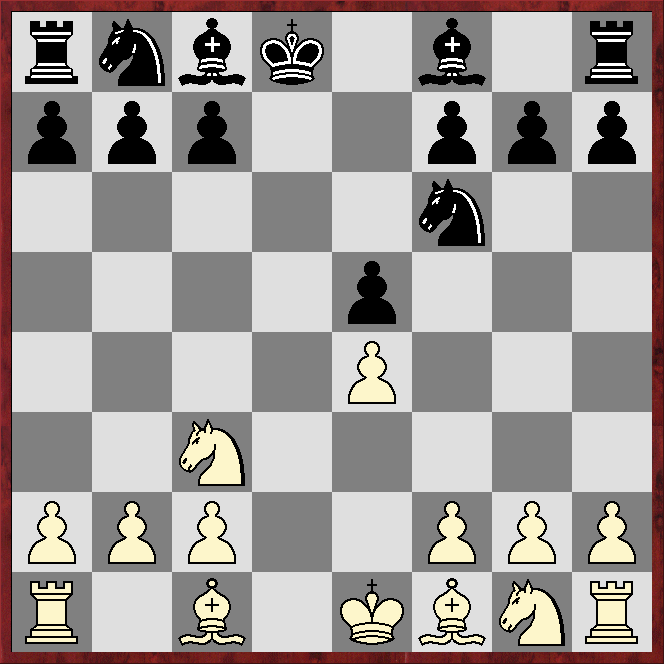
White is for choice, whatever the statistics say
*****
*****
*****
*****
*****
My two games with 4.dxe5 illustrate the problems a higher-rated black faces in playing for a win.

Spanton (1908) - Peter Poobalasingam (2243)
Southend Easter 2016
1.d4 d6 2.e4 Nf6 3.Nc3 e5!? 4.dxe5 dxe5 5.Qxd8+ Kxd8 6.Nf3
Most popular is 6.Bg5, for which see the next game. Also more popular than the text is 6.Bc4, when the mainline in Mega23 runs 6...Be6!? 7.Bxe6 fxe6 8.f3 Bd6!? 9.Be3 Ke7, after which the engines reckon White is at least slightly better, but Black scores a respectable 47%.
6...Bd6 7.Bc4 Ke7
This probably keeps more play in the position than 7...Be6!?
8.Bg5 c6 9.h3 h6 10.Bh4 Be6 11.Bxe6 Kxe6 12.0-0-0
Now White has castled, how would you assess the position?
*****
*****
*****
*****
*****
The engines agree any theoretical edge White has has withered away. But with queens off the board, and a more-or-less symmetrical pawn-structure without weaknesses, it is going to be hard for either side to make progress.
12...Bb4 13.Bxf6 Kxf6 14.Ne2 Ke6 15.Ng3 g6 16.Rd3 Na6 17.c3 Bcx5 18.Rd2 Rad8 19.Rhd1 Bb6 20.Rxd8 Bxd8!?
Presumably trying to keep some play in the position.
21.Kc2 Nc5 22.Nd2 Bh4 23.Nh1 f5 24.exf5+ gxf5 25.Nc4 e4 26.g3 Bg5 27.g4?!
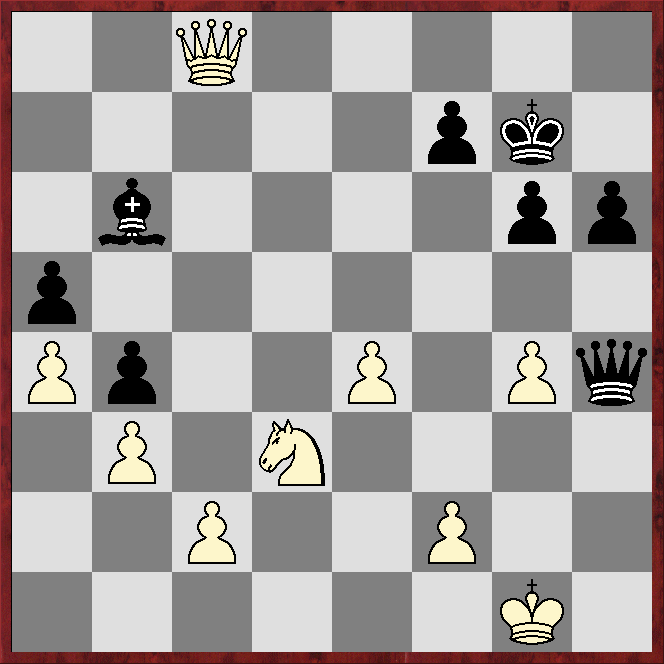
The engines prefer 27.Rd6+ Ke7 28.Rd1.
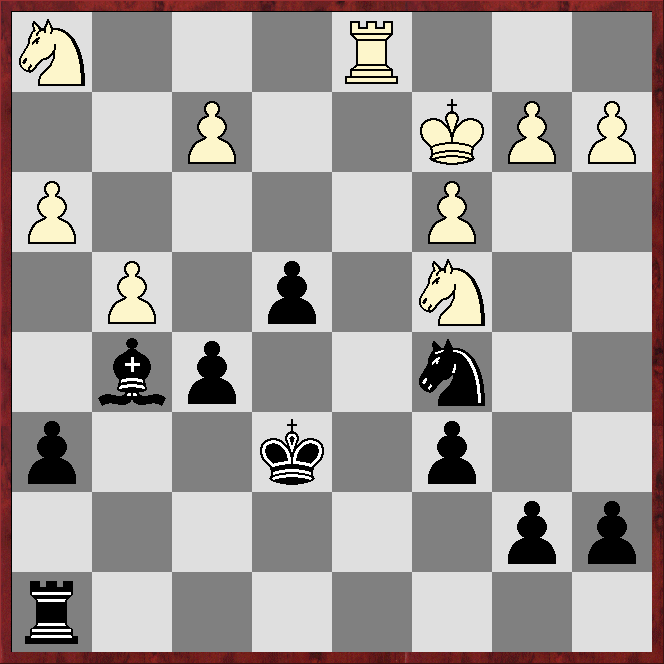
How should Black continue?
*****
*****
*****
*****
*****
27...e4?!
Creating a 2-1 central majority, but leaving the position completely equal, according to the engines, which reckon 27...fxg4 28.hxg4 Rd8!? 29.Rxd8 Bxd8 30.Ng3 Kd5 31.Nd2 Bh4 32.Nf5 Bxf2 33.Nxh6 e3 gives Black at least the upper hand.
28.b4 Nd7 29.Nd6 Nf6?!
Defending the e pawn, but the engines reckon it is better to let it go, eg 29...Ne5 30.Nxe4 Be7, when the threat of ...h5 gives good compensation.
30.Nxb7 Nd5?
Black had to play 30...h5 or 30...Ke7, albeit conceding a slight edge, according to the engines.
31.Nc5+ Ke5 32.Nd7+?!
Strong, according to the engines, is 32.Rd4.
32...Ke6?!
Seemingly better is 32...Kd6.
33.Nc5+ Ke5 34.Nd7+?! Ke6?! ½–½

Spanton (1975) - Anthony Higgs (2058)
McArthur Cup Semi-Final (Hastings & St Leonards at Horsham) 2020
1.d4 Nf6 2.Nc3 d6 3.e4 e5!?
As can be seen, there are several ways to reach the starting position of the first diagram above.
4.dxe5 dxe5 5.Qxd8+ Kxd8 6.Bg5 Ke8?
The main move in Mega23 is 6...Be6, after which White scores just 41%, although the engines reckon 7.0-0-0+ Nd7 8.f4!? gives White a slight edge.
7.Bxf6 gxf6 8.Nd5 Bd6 9.Nxf6+ Kf8
White has won a pawn, for which the bishop-pair is insufficient compensation, although I failed to convert my advantage
CONCLUSION: the Philidor Imbalance scores well for Black, but a higher-rated player employing it runs a very real risk of being unable to generate winning chances.

Saturday, 13 May 2023

ACO World Amateur Game One

Spanton (1804) - Wiebe de Witte (1891)
Philidor
1.e4 d6 2.d4 Nf6 3.Nc3 e5!?
Not only is this playable, it is the best move in the position, according to Stockfish15.1 and Komodo14.1.
4.Nf3
After 4.dxe5 dxe5 5.Qxd8+ Kxd8 the mainline in ChessBase's 2023 Mega database runs 6.Bg5 Be6 7.0-0-0+ Nd7 8.Nf3 Kc8 9.a3, after which White scores a feeble 29%.
4...Nbd7 5.Bc4 Be7
How should White continue?
*****
*****
*****
*****
*****
6.0-0
This is very much the main move in Mega23, but fascinating is 6.Ng5 0-0 7.Bxf7+!? Rxf7 8.Ne6 Qe8 9.Nxc7 Qd8 10.Nxa8 (not 10.Ne6? Qb6), after which White has a rook and two pawns for a bishop (and a knight to come). Stockfish15.1 reckons the position is equal, but Komodo14.1 gives a slight edge to Black.
Analysis position after 10.Nxa8 - I suspect the player who has studied this imbalanced position the most would have a big advantage in practical play
*****
*****
*****
*****
*****
6...0-0 7.a4 c6 8.Re1 h6!?
This may seem a non-move, or a half-move as Garry Kasparov is fond to say, but it has been played by grandmasters and is the top choice of Stockfish15.1 (Komodo14.1 prefers 8...exd4).
9.a5 Rb8 10.h3 b5 11.axb6 axb6
What should White play?
*****
*****
*****
*****
*****
12.d5?!
This seems to be a novelty, and probably not a good one. The engines like 12.Bd3 and 12.b4!?, in each case giving White a slight edge.
12...b5 13.Bf1
The engines slightly prefer 13.dxc6 bxc4 14.cxd7 Bxd7 15.Nd2, claiming equality.
13...b4 14.Nb1?!
And here they prefer 14.dxc6 bxc3 15.cxd7 cxb2 16.Bxb2 Qxd7, giving Black at best a slight edge.
14...cxd5 15.exd5
The d5 pawn cannot be held, but White can make Black pay a high price for winning it
*****
*****
*****
*****
*****
15...Nb6 16.c4 bxc3 17.Nxc3 Bb7 18.Ra5 Ra8 19.Rb5?!
I underestimated how much compensation White gets after 19.b4 Rxa5 20.bxa5 Nbxd5 21.Nxd5 Nxd5. Indeed the engines reckon Black should play 19...Nbd7 or 19...Qc7.
19...Ba6 20.Rb4 Bxf1!? 21.Kxf1!? Ra5 22.Qb3 Nbxd5 23.Nxd5 Rxd5?!
Probably better is 23...Nxd5.
24.Rb7 Re8 25.Be3 Qa5 26.Rc1 Qa6+ 27.Kg1 Rd3 28.Qb4?
This loses a second pawn, after which there is no way back. Correct is 28.Qb5 Qxb5 29.Rxb5, when Black is better but White's outside passed pawn and better bishop give counterplay.
28....Nd5 29.Qb5 Qxb5 30.Rxb5 Nxe3 31.fxe3 Rxe3 32.Kf2 Re4 33.Rb7 Rf4 34.g3 Rf6 35.Ke2 d5 36.Rcc7 Bd6 37.Rd7 Rc8 38.Ne1?!
Less passive are 38.Rb6 and 38.Nd2, but Black is still winning, according to the engines.
38...e4 39.Rb6 Be5 40.Rxf6 Bxf6 41.Rxd5 Bxb2 42.Rd2 Be5 43.g4 g6 44.Rd5 Bg3 45.Rd4 f5 46.gxf5 gxf5 47.Ng2 Rc2+ 48.Rd2?! Rxd2+ 49.Kxd2 Kf7 (0-1, 58 moves).