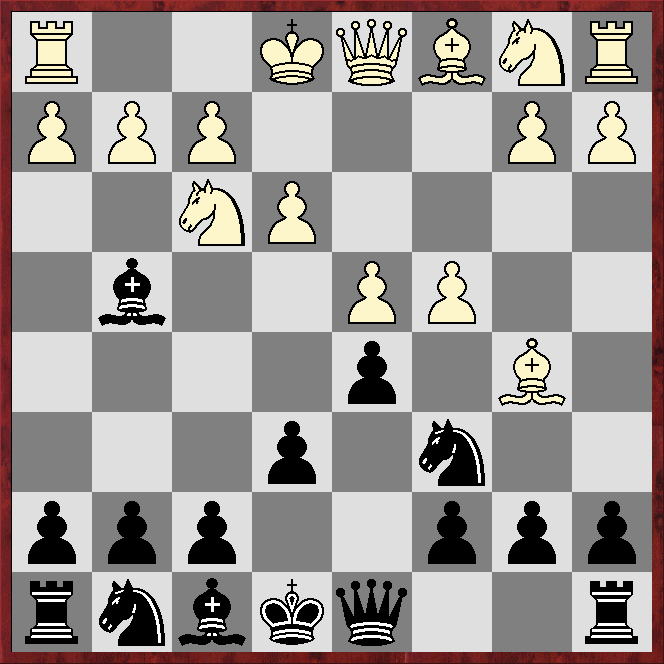
Showing posts with label Knight-pair. Show all posts

Monday, 6 October 2025

Calvià Round Two

FACED a Dutchman.

Spanton (1941) - Guido Jansen (2153)
English Symmetrical
1.c4 c5 2.g3 g6 3.Bg2 Bg7 4.Nc3 Nc6 5.d3 e6 6.Bxc6!?
A controversial move, for obvious reasons - the idea is to play against Black's hemmed-in light-square bishop
*****
*****
*****
*****
*****
6...bxc6 7.f4 Ne7 8.Nf3 0-0 9.Qc2?!
Probably a novelty, and probably not a good one. Stockfish17 and Dragon1 like the known 9.e4, or 9.0-0.
9...Nf5 10.e3 d5 11.Kf2?!
The king will not be safe here if Black manages to open the position. The engines suggest 11.Na4 or 11.0-0.
11...d4
The engines like 11...Re8, with ...e5 to come, or the immediate 11...e5!?
12.Ne4?!
12.e4 is necessary, according to the engines.
12...dxe3+ 13.Bxe3 Nxe3 14.Kxe3
Black to play and gain what the engines reckon is a winning advantage
*****
*****
*****
*****
*****
14...Bd4+?
Black has the upper hand after 14...Rb8 or 14...Re8, according to the engines, but they give 14...e5!? as winning, eg 15.Nxe5 Re8 16.Kf2 Bh3!? with a strong attack.
15.Ke2?!
I almost certainly should have captured on d4. After 15.Nxd4 cxd4+ 16.Kf2 the white king looks safe, while 15...Qxd4 16.Kd2!? gives White a slight edge, according to the engines.
15...f5!? 16.Ned2 Bg7?!
The engines like 16...e5!?, when 17.Nxe5?! Bxe5 18.fxe5 f4 gives Black a strong attack. Instead, they reckon 17.Nxd4 cxd4!? leaves Black only slightly better.
17.Rae1!?
Leaving room for the king to go to d1 without disconnecting the rooks.
17...Qd6 18.Kd1 Rb8 19.b3 Rb7 20.Ne5 g5!? 21.Ndf3 gxf4?!
This almost certainly weakens Black's king more than it usefully opens lines for Black's pieces.
22.gxf4 a5
The engines prefer 22...Bd7.
23.a4
White can dispense with this in favour of 23.Rhg1!?, according to the engines.
23...Bd7 24.Rhg1 Be8 25.Rg5 Kh8 26.Qc3!?
Self-pinning, but eyeing the black king and so restricting Black's options.
26...h6 27.Rg3 Bh5 28.Kc2 Rfb8?
Black is more-or-less equal after 28...Bxf3 29.Rxf3 Kh7, according to the engines.
How should White proceed?
*****
*****
*****
*****
*****
29.Reg1! Rg8?
Even worse are 29...Rxb3?? 30.Nf7+ Bxf7 31.Qxg7# and 29...Bxf3 30.Rxg7 Rxg7 31.Nf7+ with mate next move. However the engines give relatively best as 29...Rf8 30.Rxg7 Rxg7 31.Rxg7 Kxg7 32.Nd7+ Kg8 33.Nxf8 Qxf8 34.Ne5, although they agree the queen-and-minor-piece ending is winning for White, thanks to Black's numerous pawn-weaknesses and less-safe king.
30.Rh3 Bxf3
White to play and win
*****
*****
*****
*****
*****
31.Rxh6+?
This wins the black queen, but not the game. Winning is 31.Nf7+! Kh7 (31...Rxf7?? 32.Rxh6#) 32.Rxg7+! Rxg7 33.Rxh6+ Kg8 34.Nxd6.
31...Bxh6 32.Nf7+ Kh7 33.Nxd6 Rxg1 34.Nxb7
White has queen, knight and pawn for rook and two bishops, but the vulnerability of the white king means the position is completely equal, according to the engines
*****
*****
*****
*****
*****
34...Rg2+ 35.Kb1 Rg1+ 36.Kc2
Not 36.Ka2?? Bg7 etc.
36...Bd1+ 37.Kb1?
Correct is 37.Kc1, and if, as in the game, 37...Bxb3+, then 38.Kd2 Bxf4+ 39.Ke2 Bd1+ 40.Kf2 Rh1 41.Qf6 Rxh2+ is completely equal, according to the engines, although tricky for both sides to play. Instead 37...Bxf4+ 38.Kb1 draws because Black no longer has the potential skewer ...Bg7.
37...Bb3+ 38.Kb2 Bg7 39.Kxb3 Bxc3 40.Kxc3 Ra1
Even stronger are 40...Rf1 and 40...e5!?, according to the engines.
41.Nxa5?!
Objectively better may be 41.Nxc5!?, but after 41...Kg6 42.Nxe6 Black gets a passed pawn with 42...Rxa4. White can instead play 42.Kd4, but the engines reckon Black has several winning lines, eg 42...Kf6 43.h4 Rf1 44.Ke3 Rh1 45.Nb3 Rh3+!? 46.Ke2 Rxh4 47.Nxa5 c5 48.Nb3 Rxf4 49.Nxc5 e5!? 50.a5 Rh4 51.Nd7+ Ke6 52.Nc5+ Ke7 53.Ke3 Rh2 54.Nb7 Ra2 55.Kf3 Rb2 56.a6 Ra2 57.Nc5 Ra5 etc - a long line, but Black is winning fairly comfortably throughout, according to the engines.
41...Rxa4
The engines show 41...e5! is much stronger.
42.Nb3?
Better is 42.Nb7, with the same idea of attacking c5 while preventing ...Ra5.
42...Ra2?
Winning is 42...Ra3 43.Kb2 Rxb3+! 44.Kxb3 Kg6 45.Ka4 Kh5 46.h3 e5!
43.Nxc5 Re2 44.Kd4 Kg6 45.Nd7
An only-move, but easy enough to find.
45...Rxh2 46.Ne5+ Kf6 47.Nxc6 Rh4 48.Ke3 Rh3+ 49.Ke2
Not 49.Kd4? Rf3.
49...Rh4 50.Ke3 Rh3+ ½–½

Friday, 25 August 2023

Northumbria Round Three

Faced a Spanish junior (born 2010)

Spanton (1858 Fide/1919 ECF) - Nicholas Kowalski Rubiales (1694 Fide/1708 ECF)
Philidor
1.e4 d6 2.d4 Nf6 3.Nc3 Nbd7 4.f4 e5 5.Nf3
Considered harmless is 5.fxe5 dxe5 6.dxe5 Nxe5 7.Qxd8+, as after 7...Kxd8 the black king is not in danger.
5...exd4 6.Qxd4
The queen is not easily harassed here, so the text is much more popular than 6.Nxd4.
6...c6 7.Be2
Normal is 7.Be3, one point being 7...Ng4 can be met by 8.Bg1.
How should Black proceed?
*****
*****
*****
*****
*****
7...Qb6
Stockfish16 and Komodo14.1 reckon Black equalises with 7...d5!?, eg 8.exd5 Bc5 9.Qd3 Nd5 10.Nxd5 cxd5, when 11.Qxd5!? is risky in view of 11...Qa5+, eg 12.Qd2 Qb6! with obvious compensation.
8.Qxb6 Nxb6?!
Probably better is 8...axb6, the half-open a file, and the fact the a pawn now covers two squares instead of one, being more than enough compensation for doubled pawns.
9.a4 Bg4 10.a5 Nbd7 11.h3 Bxf3 12.Bxf3
White's bishop-pair and extra space are positionally winning (Stockfish16), or at least give the upper hand (Komodo14.1)
*****
*****
*****
*****
*****
12...g6?!
Since the dark-square bishop needs to defend the weak d pawn, the text is almost certainly a waste of time and weakening.
13.Be3 Be7?!
Black probably needs to play 13...a6.
14.0-0?!
Much stronger is 14.a6, eg 14...b6 runs into 15.e5.
14...0-0?!
Again ...a6 is probably necessary.
15.Rad1
Still good is a6, but the text is also positionally winning, according to the engines.
15...a6 16.g4 Ne8 17.Na4 Bd8 18.b4 Bc7 19.c4 Rd8 20.Rd3
Even stronger is 20.c5, eg 20...dxc5 21.Nxc5 Nxc5 22.Rxd8 Bxd8 23.Bxc5, winning the exchange. One suggestion of the engines is 20...g5!? 21.fxg5 Ne5, but they agree White is winning.
20...Nef6 21.Rfd1!? Rfd8 22.c5
This is strong, but best seems to be the engines' 22.Bb6!?, eg 22...Bxb6+ 23.axb6 Nxe4 24.Bxe4 Rxe4 25.Rxd6, or 22...Nxb6 23.axb6 Bb8 24.Nc5 Re7 25.e5 Ne8 26.Ne4.
22...Nxe4 23.cxd6 Nxd6 24.Kf2?
Black cannot avoid losing significant material after the engines' 24.Bf2.
24...Nf8?
The engines reckon 24...Nc4 and 24...Nf6 equalise.
25.Nc5?
Easily winning is 25.Bb6.
25...Ne6?!
The engines reckon 25...Nc4 and 25...h6 keep Black's disadvantage to a minimum.
26.Nxb7??
White is much better after 26.Nxe6 Rxe6 27.f5.
26...Nxc7 27.Bxc6 Rxd3 28.Rxd3 Rb8
Even stronger is 28...Rd8!
29.Rd7
What should Black play?
*****
*****
*****
*****
*****
29...Nbd8
Probably better is the engines' 29...Nd6!?
30.f5 Nxc6?!
Probably better are 30...Bf4 and 30...Rxb4!?
31.fxe6 Be5?!
Not 31...Be8?? as 32.exf7+ mates, but Black should probably have given the piece back by 31...fxe6 32.Rxc7, when 32...Nxb4 leaves Black a pawn up, but White has the better pieces.
32.exf7+ Kh8 33.Bc5
The engines prefer putting the king on a light square, for example 33.Ke2!?
33...Bg7 34.Rc7?
Better is 34.Rd6 Ne5 35.Rxa6. After 35...Nxf7? 36.Rb6 the white queenside pawns are too strong, so Black has to play 35...Nd3+ and 35...Nxc5, when the engines reckon White has just a slight edge.
34...Bd4+ 35.Bxd4 Nxd4 36.Re7?!
White is equal after 36.Ke3 or 36.Rb7!?, according to the engines.
36...Rf8 37.Ra7 Nc6 38.Rxa6 Rxf7+ 39.Ke2 Nxb4 40.Rb6 Nd5 41.Rd6?!
There are more drawing chances, according to the engines, with 41.Rb8+ Kg7 42.a6.
41...Nf4+ 42.Kd2 Nxh3 43.a6 Kg7 44.Rb6 Kh6 45.Rb7 Rf2+ 46.Ke3 Ra2 47.a7 Rc3+ 48.Kd4 Nf2 49.g5+ Kxg5 50.Rxh7
Black to play and win
*****
*****
*****
*****
*****
50...Kg4
The engines give the only winning move as 50...Ra5!
51.Kc5 Ne4+ 52.Kb6 g5
White to play and draw
*****
*****
*****
*****
*****
53.Kb7??
The obvious 53.Rh8 is one of several moves that draw.
53...Nd6+ 54.Kb8
Or 54.Kc6 Nb8 etc, while 54.Ka8, hoping for stalemate, loses to 54...Rc3.
54...Rb3+ 55.Kc7 Nb5+ 56.Kc6 Nxa7 57.Rxa7 Rd3 58.Rg7 Kh4 59.Kc5 g4 60.Kc4 Rd8 0-1

Thursday, 4 May 2023

ACO 65+ Game Three

Spanton (1804) - Frans Erwich (1885)
Spanish Berlin
1.e4 e5 2.Nf3 Nc6 3.Bb5 Nf6 4.Qe2!?
This is fourth-most popular behind 4.Nc3, 4.d3 and especially 4.0-0 in ChessBase's 2023 Mega database, but it has been played by top grandmasters and scores a very good 60%.
How should Black respond?
*****
*****
*****
*****
*****
4...d6
This is popular, but the mainline in Mega23 runs 4...Bc5 5.c3 0-0 6.0-0 Re8 (6...d6 is almost as popular, and has been played by Garry Kasparov) 7.d3, after which Black is at least equal, according to Stockfish15.1 and Komodo14.1.
5.d4 exd4 6.Nxd4
6.e5!? can lead to sharp play, eg 6...dxe5 7.Nxe5 Bb4+!? 8.c3 0-0!? 9.Bxc6 bxc6 10.cxb4 Re8 11.0-0 occurred in Miguel Quinteros (2555) - Lubomir Kavalek (2545), IBM-17 (Amsterdam) 1977, with an unclear position (0-1, 29 moves).
6...Bd7
How should White proceed?
*****
*****
*****
*****
*****
7.Bxc6!?
The engines slightly prefer capturing with the knight.
7...bxc6 8.e5!?
The strongest players to reach the position have castled or played 8.Nc3.
8...dxe5 9.Qxe5
What should Black play?
*****
*****
*****
*****
*****
9...Qe7
All three games to reach the diagrammed position in Mega23 saw the text, but the engines suggest an apparent novelty, 9...Be7!? Greek grandmaster Spyridon Skembris, who is available to go over players' games at this tournament, said the latter move is faulty because Black loses the bishop-pair after 10.Nf5, but the engines point out that 10...Bxf5 11.Qxf5 Qd5 practically forces 12.Qxd5. Then 12...cxd5 leaves Black with a slight lead in development and the only pawn on the centre two files, but with three pawn-islands against White's two.
10.Bf4 0-0-0 11.0-0
Now both sides have castled, how would you assess the position?
*****
*****
*****
*****
*****
Black has the bishop-pair but a shattered queenside, the latter meaning White has the safer king. However the last point will almost certainly prove irrelevant as Black can immediately get queens off the board. The engines reckon Black is slightly better.
11...Qxe5 12.Bxe5 Ng4 13.Nf3 Nxe5 14.Nxe5 Be8 15.Nc3 f6
On 15...Rd2 I intended 16.Rac1 followed by expelling the black rook.
16.Nd3 Bg6 17.Rfd1!?
This looks strange, at least at first glance, but it leaves the queen's rook free to defend c2. The engines are unsure, fluctuating over which rook should go to d1.
17...Bd6 18.g3 h5 19.h3
The engines are not keen on this, preferring 19.h4 or, now the black king's bishop blocks the e file, 19.Re1.
19...Bf5 20.Kg2 g5 21.Re1 Rhe8 22.Rxe8 Rxe8 23.Re1 Rxe1 24.Nxe1
How would you assess this battle of bishop-pair versus knight-pair?
*****
*****
*****
*****
*****
White's knights will struggle to find good outposts, but White has the better pawn-structure and does not have to cope with rival pawn-majorities. Nevertheless the bishops have open lines, and the engines agree Black is slightly better.
24...Kd7 25.f3 Bg6 26.Ne4 Be7 27.Nd3 Bf7 28.Kf2?!
White may just be able to get away with this (it was a complete oversight by me), but simpler is 28.b3.
28...Bxa2 29.b3 Bb1 30.Ne1 Bb4 31.Nxf6+ Ke6
How should White continue?
*****
*****
*****
*****
*****
32.Nd3?
I rejected 32.Nxh5 Bxe1+ 33.Kxe1 Bxc2 34.b4 because of 34...Kd5, missing that White gains a tempo with 35.Kd2, and if 35...Bg6 then 36.Nf6+ is good enough for complete equality, according to the engines, as 36...Kc4?! runs into 37.h4. However 34...c5!? is promising for Black, so the engines suggest offering the b pawn, for example by 34.f4!?, again claiming complete equality.
How can Black exploit White's last move
*****
*****
*****
*****
*****
32...Bc3?
Both ...Be7 and ...c5 seem to be winning, eg 32...c5 33.Ne4 Bxc2 34.Ndxc5+ Bxc5+ 35.Nxc5+ Kd5, when Black has bishop-versus-knight with rival pawn-majorities. The engines prefer 34.Ke3, but 34...Kd5 is strong, eg 35.f4 gxf4+ 36.Nxf4+ Kc6 37.Nd2 (if 37.Nxh5 then Bxb3, after which the a pawn is too fast) a5 38.Nxh5 c4! 39.Nxc4 Bxb3 with the usual consequences for knights against bishops when there are rival pawn-majorities.
33.Nxh5
Perhaps better is 33.Ne4!?
33...Bxc2 34.Ke3
Black has a remarkable resource that gives the upper hand, according to the engines
*****
*****
*****
*****
*****
34...Kd5
This hands the advantage over to White, but in a way that is hard to spot.
Terrible is 34...Bxc3?? 35.Nc5+ etc, but 34...Kd6 seems to be enough for a slight edge.
However 34...c5! creates major problems for White, eg 35.Nxc5+ Kd5 36.Na6 Bxb3 37.Nxc7 Kc4 38.Na6 (stopping ...a5, at least for the moment) Kb5 39.Nc7+ Kc6 40.Kd3 (40.Na6 Bc4) Bb2 41.Na6 Kb6 42.Nb4 a5 43.Nc2 Bf7 with ...Bg6(+) to come. There are many alternatives along the way, but all seem good for Black.
After 34...Kd5 it is White's turn to have a remarkable resource
*****
*****
*****
*****
*****
35.f4
This looks natural, but there is 35.Nf6+!, which more-or-less forces 35...Bxf6 36.Nb4+ Ke5 37.Nxc2, when the engines reckon White, if anyone, is better.
35...Bd1?
As grandmaster Skembris pointed out, it is time to take the b pawn, which holds up Black's queenside pawns. After 35...Bxb3 36.fxg5 Bd4+ 37.Kd2 the engines reckon Black may have a tiny edge.
36.fxg5! Bd4+ 37.Kd2 Bxh5?
Black is equal after 37...Bxb3, according to the engines.
38.Nf4+ Ke4 39.Nxh5 Ke4?
This makes it easy for White, as does 39...Kf3? 40.g6 etc. Best is 39...Be3+, although 40.Kc3 Bxg5 41.g4 looks promising.
40.Nf4 Bf2
Not 40...Kxg5? 41.Ne6+ etc.
41.g6 Kf6 42.h4 Kg7 43.Ke2 1-0
Black has no defence against what has become a white kingside pawn-avalanche.

Wednesday, 3 May 2023

ACO 65+ Game One

Spanton (1804) - Herbert Bornand (1684)
Nimzo-Indian
1d4 Nf6 2.c4 e6 3.Nc3 Bb4 4.Bd2!?
As I have pointed out before, John Emms in Easy Guide To The Nimzo-Indian (Cadogan, 1998) wrote: "Despite over 15 years' experience of playing the Nimzo-Indian, I cannot remember ever facing 4.Bd2. Indeed, all I can remember is that it has been heavily slagged off in the popular [chess] press. The criticism runs along the lines of 'this move is just too passive'. My opinion is that any move which serves a useful purpose (in this case unpinning) must be treated with some respect. In fact I'd go as far to say that this move is quite deceptive: it looks worse than it is."
The move has certainly soared in popularity since then, with 6,471 examples in ChessBase's 2023 Mega database, of which less than a thousand are from before 1998. Nevertheless White's score of 39% is far from inspiring.
4...c5 5.e3 0-0 6.Nf3
How should Black proceed?
*****
*****
*****
*****
*****
6...d6!?
White's play has not been forcing, so Black has a big choice. Most popular are 6...cxd4, 6...d5 and 6...b6, but the text is most successful percentagewise, scoring 70%.
7.Bd3 Nbd7 8.0-0 e5!?
This logical-looking follow-up to Black's previous play may be a novelty. Salem Saleh (2682) - Viktor Dmitrenko (2444), Chess.com Blitz 2021, went 8...b6 9.a3 Bxc3 10.Bxc3 with a slight edge for White, according to Stockfish15.1 and Komodo14.1 (1-0, 28 moves).
9.Qc2 Re8 10.dxe5 dxe5 11.e4
The engines suggest 11.Ng5!?
11...Nf8
The knight heads (presumably) for d4, but if that is indeed its destination then perhaps a better way of achieving its is via 11...Nb8. However the text has the advantage that the knight can also play on the kingside with ...Ng6.
12.a3 Bxc3 13.Bxc3
White has pressure against e5, but the symmetrical pawn-structure and fixed centre do not do the bishop-pair any favours
*****
*****
*****
*****
*****
13...Ng6 14.Rfd1 Qe7
Interesting is 14...Bg4, with the idea of ...Bxf3 to try to show the knight-pair is superior to the bishops.
15.h3 Nh5 16.Bf1 a5
The engines suggest meeting the consistent 16...Nhf4 with 17.b4, resulting in what they consider is a completely equal game. 
How should White continue?
*****
*****
*****
*****
*****
17.Nxe5!? Nxe5 18.Bxe5
What should Black play?
*****
*****
*****
*****
*****
18....Bxh3?
The engines reckon Black has fair compensation for a pawn after 18...Qxe5 19.Rd5 Qe7 20.Rxh5 Be6. Certainly Black has the better bishop, and the white king's rook is awkwardly placed.
19.Bd6 Qg5 20.Rd5 Qg6
Or 20...f5 21.Qd3 Bg4 22.f3.
21.Rxh5 Qxh5 22.gxh3
Two bishops are almost always much stronger than a rook
*****
*****
*****
*****
*****
22...Re6?!
Probably better is 22...Qg6+ 23.Bg3 Qxe4, but the engines reckon White is winning comfortably.
23.Bg3 Rg6 24.Rd1 Qe5!? 25.Rd5 Qe7
Or 25...Rxg3+!? 26.fxg3 Qxg3+ 27.Bg2.
26.Kh2 Re8 27.Bg2 Re6 28.Qd2 h6!?
If 28...b6 then 29.e5 with Rd7 and Bd5 to come.
29.Rd7 Qf6 30.e5 1-0

Saturday, 11 March 2023

Bad Wörishofen Game Eight

Spanton (1835) - Mathias Schädler (1843*)
Spanish Exchange
1.e4 e5 2.Nf3 Nc6 3.Bb5 a6 4.Bxc6 dxc6 5.d4 exd4 6.Qxd4 Qxd4 7.Nxd4 Bd7 8.Be3 0-0-0 9.Nc3!?
The main move in Chessbase's 2023 Mega database is 9.Nd2, but Stockfish15 and Komodo13.02 narrowly prefer the text.
9...Ne7 10.f3 f6 11.Rd1!?
Planning to keep the king in the centre  - a favourite strategy of Emanuel Lasker.
11...Ng6 12.Kf2 h5 13.Nb3 b6 14.Nd4 Ne5 15.Rhe1 g6 16.Nce2 c5 17.Nb3 g5 18.Nc3 c6 19.Nc1!?
Accepting that Black can swop knight for bishop to bring about a battle of bishop-pair against knight-pair. The engines do not like this.
19...Nc4 20.Nd3 Bd6
Black has a large advantage after 20...Nxe3, according to the engines.
How should White proceed?
*****
*****
*****
*****
*****
21.Kg1
The engines reckon 21.e5!? equalises, eg 21...Nxe5 22.Ne4 Nxd3+ 23.Rxd3 Bxh2 24.Nxf6 (24.g3? h4) Be5 25.Bxg5 Bxb2 26.Kf1 with what the engines claim is enough activity to fully compensate for being a pawn down.
21...Nxe3 22.Rxe3 c4 23.Nf3 Bf4 24.Ree1 Be6!?
This is the top choice of Komodo13.02 (Stockfish15 prefers 24...Be5), but it is double-edged as allowing rooks to come off brings about an ending in which Black has the only long-range pieces, but White has the superior pawn-structure.
25.Rxd8+ Rxd8 26.Rd1 Rd2!? 27.Rxd2 Bxd2 28.Nfd1 Bf4 29.Ne2 Bd6 30.g3!?
The only realistic way for White to win is by advancing the kingside pawns, but this is not easy when the bishops can switch between pressurising each wing and even pressurise both wings at the same time.
30...Bc5+ 31.Kg2 Kc7 32.h3 b5 33.c3 Bd6 34.Nd4 Bd7 35.Ne3 Be5 36.Ne2 Kb6 37.f4 Bc7 38.fxg5!?
Creating a passed but isolated pawn.
38...fxg5 39.Nf5 Be5 40.Ned4 b4 41.Ne2 a5
The white passer is blockaded, and Black enjoys pressure against the white queenside
*****
*****
*****
*****
*****
42.Kf3 c5 43.h4?!
White should probably hold tight with 43.Ke3, or advance with 43.g4.
43...gxh4?!
Even stronger seems to be 43...g4+, or 43...bxc3 followed by 44...g4+.
44.gxh4 Kc7?!
The king should probably be adding to the queenside pressure by 44...Kb5.
45.Nf4?!
White is equal after 45.Ne3, according to the engines.
What should Black play?
*****
*****
*****
*****
*****
45...Bxf5!?
Giving up the bishop-pair is Komodo13.02's top choice for a while, but the engines come to agree that best is 45...a4!?, eg 46.Nd5+ Kc6 47.Nfe3 Bg4+ 48.Kf2 a3! 49.Nxc4 axb2 50.Nxb2 bxc3 51.Nd3 Bd4+ 52.Kg2 Bd1 53.Kg3 c2 54.a4 Bb2 etc.
46.exf5 Kd6
Black no longer has the bishop-pair, but the remaining bishop is stronger than the knight
*****
*****
*****
*****
*****
47.Nxh5?
The knight should not be decentralised like this. Best, according to the engines, is 47.f6!? Bxf6, and now 48.Nxh5, the point being the knight gains a tempo with which to recentralise. However after 48...Bxh4 the engines reckon Black is winning, eg 49.Nf4 Bf6 50.Ne2 Kd5 51.a3 Bg7 52.Nf4+ Kc6 53.axb4 cxb4 54.Ne2 Bxc3! 55.bxc3 b3 etc.
Black to play and win
*****
*****
*****
*****
*****
47...Bxc3??
The right idea, but bad timing turns a win into a loss. Probably simplest is 47...b3 48.a3 Bxc3! etc, but also winning is 47...a4, eg 48.Ke3 Bxc3! 49.bxc3 b3 50.axb3 a3 etc.
48.bxc3 b3 49.axb3 cxb3 50.Nf6
White wins thanks to having a possible check on e4
*****
*****
*****
*****
*****
50...Ke5
Or 50...b2 51.Ne4+ Ke5 52.Nd2 Kxf5 53.Nb1 etc.
51.Ne4 a4 52.f6 b2 53.Nd2 a3 54.f7!?
This wins easily enough, but simplest is 54.Nc4+ Kxf6 55.Nxa3, after which White will in due course promote either the h or c pawn.
54...a2 55.f8=Q a1=Q 56.Qxc5+ (1-0, 80 moves)
*German rating. MS does not have a Fide elo, and he told me before the game that this was his first tournament.

Monday, 20 February 2023

Graz Game Three

Stefanos Loukopoulos (1130) - Spanton (1883)
Chigorin
1.Nf3 Nc6 2.d4 d5 3.c4
Via a slightly unusual move-order we have reached the starting point of what is arguably the mainline of the Chigorn Defence to the Queen's Gambit. There are 11,191 games with this position in ChessBase's 2023 Mega database.
3...Bg4 4.cxd5 Bxf3 5.gxf3 Qxe5 6.e3 e5 7.Nc3 Bb4 8.Bd2 Bxc3 9.bxc3
This is probably the first point at which either player had to think
*****
*****
*****
*****
*****
9...Nf6!?
Mikhail Chigorin in his games never seems to have never reached the diagram position, which first occurs in Mega23 in Siegbert Tarrasch - Emanuel Schiffers, Nürnberg 1896. That continued 9...exd4, which remained the main reply for the best part of a century. However,  it came to be felt, by some masters at least, that exchanging helps White's bishop-pair. Nevertheless it is not until 1971 that another move, 9...Qd6, appears in Mega23 in the game Oscar Panno - Albin Planinc, Mar del Plata (Argentina). The idea of the queen retreat is, at the cost of a tempo, it prevents White immediately expanding in the centre. The queen move quickly overtook capturing in popularity, and there are now almost twice as many games in Mega23 with 9...Qd6 as there are with 9...exd4. But a new twist was added in 2007 when Alexander Morozevich, in The Chigorin Defence According To Morozevich (New In Chess) recommended the text. I have played all three moves, with my record, prior to this game, being +1=0-2 with the capture, +4=1-4 with the queen retreat and +0=1-1 with the knight development. Rating-wise, my best performance has undoubtedly been with the queen retreat, which seems marginally preferred by Stockfish15 and Komodo13.02 over capturing, albeit their evaluations do fluctuate.
10.c4
The time control at Graz is 90 minutes with a 30-second increment. SL's clock was down to 86 minutes before he arrived at the board, but after the text it was back up to 89 minutes, suggesting he had seriously prepared for me.
10...Qd6 11.d5 Ne7
A major alternative is 11...Nb8!?, intending redeployment at c5.
12.Rb1 b6
White is winning after 12...0-0-0? 13.Qb3 b6 14.Bb4, according to the engines.
13.e4?!
This may be a novelty. The mainline in Mega23 runs 13.Bb4 c5 14.dxc6 Qxd1+ 15.Rxd1 Nxc6, as in Anish Giri (2642) - Nigel Short (2685), Euwe Memorial Match 2010. That continued 16.Ba3 Rd8 17.Bd6?! (17.Rc1 and 17.Bd3 give White at least the upper hand, according to the engines) Nd4! 18.c5 bxc5 19.Rxd4!? cxd4 20.Bb5+ Nd7 21.Rg1 a6 22.Ba4 g6 23.Ke2 f6, after which the engines reckon White has full compensation for his material deficit (1-0, 41 moves). The text gains space in the centre but leaves White's pawn-structure less flexible, which makes it harder for White to open the position for the bishops.
13...0-0 14.a4?!
Now another pawn becomes fixed. Probably better is 14.Bb4.
14...a5
Even stronger, according to the engines, is to start using the knight-pair, eg by aiming to occupy the f4 outpost created by White's 13th move.
15.Qc1 Nd7
One of the points of playing 11...Ne7, rather than 11...Nb8!?, is to redeploy the king's knight to c5, so making possible ...f5 to develop the king's rook. This is particularly attractive now ...f5 would create a lever against e4.
16.Rg1 Nc5 17.Ra1?
Correct is 17.Qc2, but Black is on top, according to the engines. Note 17.Bh6? is easily met by 17...Ng6, with ...Nxa4 to follow.
17...Nb3 18.Qb2 Nxa1 19.Qxa1
Slovak grandmaster Ján Markoš, in a recent ChessBase article, states that an active bishop-pair can "often" match rook and knight, so the position is not a trivial win
*****
*****
*****
*****
*****
19...Rae8 20.h4 f5 21.Bc3?!
Consistent is 21.h5. The text is easily met in such a way that the white king is in the not-so-distant sights of Black's heavy pieces.
21...Ng6 22.h5 Nf4
This knight covers all the possible development squares of the king's bishop, so White has little hope of playing with an active bishop-pair.
23.Bb2 Rf7 24.Rh1 fxe4 25.fxe4 Qf6 26.Rh2 Nxh5! 27.Qd1 Nf4 28.Bc1 Rd8 29.Be3 Qd6 30.Qb3 Qb4 (0-1, 41 moves)
It is easy to critique the moves of a player rated 700+ elo lower. But I think this game is an example of preparation leading a player into a position he did not understand, For better or worse, SL probably should have stuck to an opening with which he was more familiar.

Tuesday, 19 July 2022

Lessons From South Wales IV

IN round four at the South Wales International I had black against a 2125.
The full game can be seen at S4 but here I will concentrate on what I should have played instead of blundering a pawn on move five.
The game began as a Colle, 1d4 d5 2.Nf3 Nc6 3.e3, which I combatted with the Chigorin-style 3...Bg4, one idea of which is to play for a quick ...e5.
White countered with 4.Bb5, to which I replied with the main move in ChessBase's 2022 Mega database, 4...e6.
The continuation 5.c4 first appears in Mega22 as recently as 1996.
How should Black respond?
*****
*****
*****
*****
*****
The position resembles a mainline Chigorin with Nf3, except the white light-square bishop has been developed outside of the pawn chain.
I played 5...a6?, losing a pawn to 6.Bxc6+ bxc6 7.Qa4 Ne7 8.Ne5 Bh5 9.Nc3 (not 9.Nxc6?? Qd7) f6 10.Nxc6.
The most popular continuation in Mega22 is 5...Bb4+ 6.Bd2 Bxd2+ 7.Nbxd2 Ne7, reaching a position Stockfish15 and Komodo13.02 reckon favours White. One line given by them runs 8.cxd5 exd5 9.Qb3!? (probably a novelty) Rb8 10.h3, when the engines agree White has a slight edge.
They instead recommend 5...Qd7!?, when Nenad Sulava (2466) - Igor Miladinović (2501), Ano Liosia (Athens) 1999, saw 6.exd5 Qxd5?! 7.Qa4?! Bxf3 8.Nc3!? Bd1! 9.Kxd1?! Qxg2 10.d5?? Qxh1+ (0-1, 26 moves). Many probable improvements are available on this play, starting as early as move six. Miladinović is a Chigorin specialist, but the more-normal Chigorin move 6...exd5 is the way to go, according to the engines. They continue 7.h3 Bxf3!? 8.Qxf3 f5!? 9.Nc3 Nf6 10.Bd2 Bb4!? 11.a3 Bxc3 12.Bx3 0-0 13.0-0 Ne4, when the white bishop-pair is a negligible factor. Stockfish15 gives White a slight edge, but Komodo13.02 at first reckons the position is equal, although it comes to more-or-less agree with Stockfish15.
CONCLUSION: almost anything is better than the game's 5...a6?, but moves such as 5...Qd7!? and 7...Bxf3!? are somewhat counter-intuitive, so it is probably fair to say White's position is easier to play.

Saturday, 2 July 2022

Kraków Round Eight

FACED an Englishman yesterday.
Side street in the old town

Spanton (1861) - Victor Rumsey (1809)
U2200
Spanish Exchange
1.e4 e5 2.Nf3 Nc6 3.Bb5 a6 4.Bxc6 dxc6 5.d4 exd4 6.Qxd4 Qxd4 7.Nxd4 c5
This move first appears in ChessBase's 2022 Mega database in game 13 of the 1894 world championship between Emanuel Lasker and Wilhelm Steinitz.
8.Ne2 Bd7 9.Nbc3 0-0-0 10.Bf4 Bc6 11.f3
The Lasker-Steinitz game continued 11.0-0 Nf6 12.f3 Be7 with a level position, according to Stockfish15 and Komodo13.02 (but 0-1, 55 moves).
11...Ne7 12.Kf2 h5 13.Rad1 Ng6 14.Rxd8+ Kxd8 15.Rd1+ Kc8
How should White proceed?
*****
*****
*****
*****
*****
16.h3!?
The engines slightly prefer preserving the bishop with 16.Be3 or 16.Bc1!?
After ...
16...Nxf4 17.Nxf4
... the game features the somewhat unusual matchup of bishop-pair versus knight-pair (much more common is bishop-pair versus bishop and knight).
With rival pawn-majorities, the bishop-pair is nearly always better but here the situation is not so clear as there are 14 pawns on the board - the more the better, as far as knights are concerned - and the black majority is compromised. Stockfish15 reckons Black is slightly better; Komodo13.02 gives Black the better side of equality.
17...Bd6 18.Nfe2 h4 19.Nd5 Rd8 20.Ne3 Re8 21.Nf5 Be5 22.c3
Playable is 22.Nxh4 Bxb2 23.c3, although 23...Rd8 ensures the dark-square bishop is not trapped.
22...g5 23.Nc1 b6 24.Nd3 Bf6 25.Nh6
What should Black do about the threat to f7?
*****
*****
*****
*****
*****
25...Re7?!
Maybe better is the passive 25...Rg8, preserving the bishop-pair, but probably best is the engines' 25...Bd7!?, eg 26.Nxf7 Be6 27.Nh6 Bxa2, when White has a protected passed pawn but the black queenside majority can now make a passer too.
26.Ng8 Re6 27.Nxf6 Rxf6
How would you assess this rook-and-minor-piece ending?
*****
*****
*****
*****
*****
VR said after the game he thought his remaining bishop would prove quite active. Komodo13.02 reckons the position is dead-equal, while Stockfish15 gives White a miniscule edge. I am not sure engines really get this type of ending, and in any case I believe only White can realistically push for a win.
28.Ne5?!
But a tactical oversight changes everything ...
28...Be8?
... or should have, although the position is not completely clear. After 28...Bxe4 the engines agree best-play runs 29.Rd7 Bb1 30.Rxf7 Rd6 31.f4 Rd2+, when Stockfish15 reckons 32.Rxb2 Bxa2 gives Black a slight edge, but Komodo13.02 calls the position dead-equal. In any event, this was White's best try as after the passive text White is well on top.
29.Rd5 c6
The engines disagree about how to meet 29...Rd6!? Stockfish15 claims 30.a3!? Rxd5 31.exd5 is winning for White, but Komodo13.02 at first only gives White a slight edge, later reckoning White has the upper hand. Instead Komodo13.02 claims30.Rxd6 cxd6 31.Nc4 gives White the upper hand, but Stockfish15 reckons White only has a slight edge.
30.Rd2 Re6 31.Nc4 Kc7 32.Ne3 Bd7 33.a3 b5 34.g3
With the white queenside pawns in the V formation that makes it impossible for Black to create a passer by pawn-action alone, it is time to activate the kingside majority.
34...hxg3+ 35.Kxg3 Rh6 36.Rh2 Kd8 37.h4 gxh4+ 38.Rxh4 Rg6+ 39.Kf2 a5 40.Rh5 c4 41.Rh2 Ke7 42.f4 Rd6 43.Ke2 Rg6 44.Rg2 Rh6
White to play and win
*****
*****
*****
*****
45.f5!
The engines agree this is the only way to make progress. The backwardness of the e pawn is not significant. What counts is the restriction of the bishop and the chance for the white king and knight to advance.
45...Rh5
A better try may be the engines' 45...Rh1!?, but 46.Kf3 seems good enough, probably with play similar to the game.
46.Kf3 Rh3+ 47.Kf4 Rh4+ 48.Ng4 f6
Now the rooks come off, but 48...Rh8 49.Rh2 Rb8 is also hopeless, eg 50.e5, when Stockfish15 reckons best if the obviously losing 50...Bxf5.
49.Rh2 Rxh2 50.Nxh2
The game finished:
50...Kd6 51.Ng4 Ke7 52.e5 fxe5+ 53.Kxe5 Bxf5!? 54.Kxf5 Kd6 55.Ne5 Kd5 56.Kf4 Kd6 57.Ke4 Kc5 58.Nf3 b4 59.a4 1-0

Friday, 26 October 2018

Bishop Pair v Knight Pair

EVERY serious chess player knows the bishop-pair usually conveys an advantage, or at least the prospect of an advantage to come.
Sometimes people joke about having the knight-pair, but can the knight-pair sometimes be an asset?

Black to make his 27th move in Spanton (1923) - John Wager (2029), Guernsey Round Six
A computer-run database study by IM Larry Kaufman - now a GM - showed the bishop-pair to be on average worth half-a-pawn more than bishop-and-knight or two knights.
In the diagram position, the knights are favoured by there being 14 pawns on the board, but the bishops benefit from the position being an endgame with no major pieces.
My main analysis engines, Komodo9 and Stockfish9, at first think Black has a small edge, but the more time they have to look at the position, the more they like Black. K9 comes to put Black the equivalent of virtually a pawn ahead, while S9 reckons the advantage is nearer a pawn-and-a-half.
27...h5
Black wants to open lines for his bishops.
In the post-mortem, JW thought 27...f6, with the same idea of opening lines, might have been better, but the engines prefer the text.
28.gxh5
I did not consider 28.Nh2 for long - such a passive move would almost certainly be worse.
28...gxh5 29.h4 Bf5
The light-square bishop eyes White's a pawn. If the latter advances, it becomes vulnerable to the dark-square bishop.
30.Kf2 e6
White's c pawn is also vulnerable, to the manoeuvre ...Bf8-a3-b2.
31.Ng5
Aiming to block the light-square bishop's action by playing e4.
31...f6
Opening more lines.
32.exf6
Better than 32.e4? dxe4 33.exf6 Bxf6 34.Ndxe4 Bxe4 35.Nxe4 Bxh4+, when Black emerges a pawn up, as in the game, but with a good bishop rather than a bad one.
32...Bxf6 33.e4?!
This loses a pawn, but I felt might give practical chances as White gets knight v bad bishop.
Objectively better may have been 33.Kf3 or 33.Kg3, but the position still massively favours Black.
33...Bxg5 34.hxg5 Bxe4
I was more worried about 34...dxe4!? Komodo9 agrees, but Stockfish9 prefers the text.
The ending has reached a new phase. Black has traded the bishop-pair for the win of a pawn, but is left with a bad bishop (all the black pawns are on the same coloured squares as the bishop)
35.Kg3
White ends up in zugzwang after 35.Nxe4? dxe4 36.Ke3 Kg7 37.Kxe4 Kg6 38.Kf4 a3.
35...Kg7
After this natural move, both engines for a while think the position is drawn … but it isn't!
36.a3 Kg6 37.Kf4
No improvement is 37.Kh4, although Black needs to find the idea 37...Bh1 38.Nf1 e5!, eg 39.dxe5 d4! etc.
37...h4 38.Kg4 h3 39.Kxg3 Kxh5 40.Kg3 Kf5 41.Nf1 Bd3
During the game, I thought Black should have pushed his e pawn immediately, but the text is stronger.
42.Nd2 e5 43.dxe5 Kxe5 44.Kf2
44.Kf3 is simply met by 44...d4.
44...Kf4
The engines show 44...d4!? is still playable, eg 45.Nf3+ Ke4 46.Nxd4 b4! 47.axb4 a3 48.Nb3 a2 49.Ke1 Bc2 50.Na1 Kd3 51.b5 Kxc3, and the pawn promotes.
45.Nf3 Bc4 46.Nd2 Bd3 47.Nf3 Bc2?
There was still a win by losing a tempo with 47...Bf1! 48.Nd2 Bc4, when 49.Nf3 allows 49...Ke4 while 49.Ke1 allows 49...Ke3.
The text hopes for 48.Ke2? Bd1!, but after …
48.Nd4
… Black has nothing better than …
48...Bd3
… which would allow a three-fold repetition, so a draw was agreed.