Showing posts with label Newcastle. Show all posts
Showing posts with label Newcastle. Show all posts
Tuesday, 29 August 2023
Summing Up Northumbria
MY score in the Challengers (U2000 Fide) of +2=3-4, including a full-point bye, lost 51.8 Fide elo and 56.4 ECF elo.

Northumbria Round Nine
FACED a Scottish junior (born 2009).
*****
*****
*****
*****
Tushar Roul (1494 Fide/1597 ECF) - Spanton (1858 Fide/1919 ECF)
Spanish Berlin
1.e4 e5 2.Nf3 Nc6 3.Bb5 Nf6 4.d3 Bc5
 |
| Magnus Carlsen has played seven different moves in this position - can you guess them all? |
*****
*****
*****
*****
Carlsen has played 5.c3, 5.Bxc6!?, 5.Nbd2, 5.Nc3, 5.Bg5, 5.Ba4!? and:
5.0-0
Most popular in ChessBase's 2023 Mega database is 5.c3.
5...Nd4 6.Nxd4 Bxd4 7.Re1?!
This may be a novelty. Carlsen seems to have only played the mainline 7.c3.
7...c6 8.Ba4 d6
This may be enough for a tiny pull, but probably better is 8...Qb6!? with a double-attack on f2 and b2. Best-play, according to Stockfish16 and Komodo14.1, continues 9.Qd2!? and either 9...Bxb2 10.Bxb2 Qxb2 11.Bb3!?, with a sharp position that seems to favour Black, or 9...Ng4!? 10.Rf1 Bxb2 11.Bxb2 Qxb2 and 12.Bb3!? or 12.Nc3, again with a sharp position that seems to favour Black.
9.h3!?
The engines give 9.c3 Bb6 10.Be3.
9...Be6
Stockfish16 suggests 9...g5!?, while Komodo14.1 again likes ...Qb6!?
10.c3 Bb6 11.d4 0-0 12.Bg5 h6 13.Bh4 Qe7 14.dxe5 dxe5 15.Nd2 Rad8 16.Qe2 Rd7 17.Bb3 Rfd8 18.Red1 Rd3 19.Bc2 R3d7 20.Bg3 Bc7 21.Nf3 Qc5 22.Rxd7 Rxd7 23.Bb3 Bxb3 24.axb3 a6 25.b4 Qe7
 |
| How would you assess this late-middlegame position? |
*****
*****
*****
*****
White has pressure against e5, while Black occupies the open file. The engines reckon the position is completely equal.
26.Qe3 Nh5 27.Kf1?!
Bishops are not particularly powerful in this position as there are so many pawns on the board and the centre is fixed, but White probably should not allow his kingside pawn-formation to be damaged, although he does end up with knight against bad-ish bishop.
27...Nxg3 28.fxg3 Qd8 29.Ke2?
Better is 29.Qe2.
29...Bb6 30.Qc1 Qf6?
Strong is 30...Rd3, eg 31.Qc2 Re3+ 32.Kf1 Qf6 33.Rd1 (the engines reckon either this or 33.Ra3!? is best) 33...Rxf3+! 34.gxf3 Qxf3+ 35.Ke1 Qxg3+ with Black getting much more than enough for the exchange.
31.Qc2 Qe6 32.b3 Qe7 33.Rd1 Rxd1 34.Qxd1 c5 35.c4!? cxb4 36.Qd5 Qc5 37.Qxc5 Bxc5 38.Nxe5
 |
| How would you assess this minor-piece ending? |
*****
*****
*****
*****
Black has fewer pawn-islands and has hopes of creating a queenside passer, but White's knight will be able to use d5 as a strong outpost. The engines reckon Black has the better side of equality.
38...f6 39.Nd3 b6 40.Kf3 Bd6 41.g4!?
The engines prefer 41.Nf4 or 41.Ke3.
41...Kf7 42.Ke3 Ke6 43.Ne1
TR offered a draw.
43...Be5 44.Kd3 a5 45.Nc2 Bd6 46.Nd4 Ke5 47.g3
TR offered a draw.
47...g6 48.Nc6+ Ke6 49.Nd4+ Kd7 50.Ne2 Be5 51.Nf4 Bg5 52.Nd5
TR offered a draw in my time (just).
52...Kc6 53.Ne7+
Possibly better is the engines' 53.h4!? Kc5 54.h5.
53...Kc5 54.Nd5?!
Probably better is 54.h4, and if, as in the game, 54...b5, then 55.cxb5 Kxb5 56.Ng8 gives sufficient counterplay. However Black has 54...a4! 55.bxa4 b3 with promising play (Stockfish16 reckons White may be holding; Komodo14.1 gives Black the upper hand).
54...b5 55.cxb5 Kxb5 56.Kc2 a4 57.bxa4+ Kxa4 58.Nb6+ Kb5
The engines reckon 58...Ka3 wins, but I do not think it does.
 |
| Position after 58...Ka3 |
*****
*****
*****
*****
The engines' mainline after 58...Ka3 runs 59.Nc4+ Ka2 60.Na5 Bc7 61.Nb3 Bxg3 62.Nc1+ Ka3 63.Nb3 Be5 64.Nd2 Ka2 65.Nb3, after which Komodo14.1 reckons Black's advantage is worth +2.04, while Stockfish16 reckons Black is about +6.00, but there seems no way for Black to make progress. But see Comments below.
Back to the game:
59.Nd5 Kc4 60.Ne3+ Kd4 61.Nf5+
TR offered a draw.
61...Kxe4 62.Kb3 Kf3
Or 62...h5 63.Kxb4 (63.gxh5?? Kxf5) hxg4 64.hxg4 Kf3 65.Nh6 Kxg3, reaching a position similar to what is reached in the game. Komodo14.1 suggests instead 65...Bd6+!?, but 66.Kc4 Bf8 67.Ng8 Bg7 68.Ne7 Kxg4, but 69.Kd5 is a tablebase draw, although this may have given better practical chances.
63.Kxb4 Bxg3 64.Kc4
TR offered a draw in my time (just).
64...Kg2 65.Nxh6 Kxh3 66.Kd5 Be5 67.Ke4 Kg3 68.Kf5 Kf3 69.Ng8 Bd4 70.Nh6 Ke3 71.Ng8 Be5 72.Nh6 Kf3 ½–½
Monday, 28 August 2023
Northumbria Round Eight
Spanton (1858 Fide/1919 ECF) - Nicholas Fallowfield (1875 Fide/1930 ECF)
*****
*****
*****
*****
*****
Alekhine
1.e4 Nf6 2.e5 Nd5 3.d4 d6 4.c4 Nb6 5.exd6 cxd6 6.Nc3 g6 7.Be3 Bg7 8.Rc1 0-0 9.b3
 |
| Some of White's moves will probably have looked odd to those unfamiliar with Alekhine's Defence, but there are 2,660 examples of this position in ChessBase's 2023 Mega database |
*****
*****
*****
*****
One of the points of White's play is Black at some point may want to grab a bigger share of the centre by playing ...d5. If that happens it is often desirable to reply c5, and White wants to do this without allowing Black in turn to reply ...Nc4. Whether White's somewhat artificial-looking manoeuvres are worth it is another matter, but Stockfish16 and Komodo14.1 reckon the diagrammed position is slightly better for White.
9...Bf5!?
More popular are 9...e5 and especially 9...Nc6, but the text is easily the most successful percentagewise, scoring 53% in Mega23 against 9...e5's 41% and 9...Nc6's 34%.
10.Bd3!?
This is something of a sideline, the most popular moves being 10.Be2 and 10.Nf3.
10...Bxd3 11.Qxd3 d5!?
As advertised, although after ...
12.c5 Nc8
... White is ahead on development and has more queenside space. On the other hand Black has the better bishop and perhaps has hopes of forcing through the lever ...e5. The engines slightly prefer White.
13.Nf3 Nc6 14.Bf4!?
This may be a novelty. The known move is 14.0-0, when Nodirbek Abdusattorov (2608) - Javokhir Sindarov (2513), Central Asia U20 Championship (Tashkent, Uzbekistan) 2019, continued 14...e6 15.a3 N8e7 16.b4 a6 17.Na4, after which Komodo14.1 at first gives White the upper hand, while Stockfish16 gives White a slight edge. However, the more time the engines are given to look at the position, the more they like Black's chances, albeit preferring White, who went on to win in 49 moves. Note that meeting 14.0-0 with 14...e5?! runs into 15.dxe5, uncovering the weakness of d5.
 |
| How should Black respond to the apparent novelty? |
*****
*****
*****
*****
14...Nxd4!?
The engines suggest 14...e6.
15.Nxd4 e5 16.0-0!?
Best, according to the engines, is 16.Bxe5 Bxe5 17.0-0, after which Black's IQP is passed but well-blockaded, and meanwhile White has a fairly mobile queenside pawn-majority.
16...exf4 17.Rfd1 Re8
Black equalises with 17...Ne7, according to the engines.
 |
| How should White proceed? |
*****
*****
*****
*****
18.c6!?
This leads to interesting play, but the engines prefer 18.Qf3.
18...Bxd4?
Better are 18...Rb8 and 18...Ne7.
19.cxb7 Bxf2+ 20.Kf1?!
This is good enough for an advantage, but there was no need to be so cute. After 20.Kxf2 Qb6+ 21.Qd4 Qxb7 White has 22.Nxd5, threatening two deadly forks (at f6 and c7), and Black cannot prevent both.
20...Rb8 21.bxc8=Q Rxc8 22.Kxf2
 |
| White is up a knight for two pawns, but Black has practical chances based on the passed d pawn, the weakness of the white king, and the outpost at e3 |
*****
*****
*****
*****
22...Re3 23.Qd2!
This is best as 23.Qxd5? loses to 23...Qh4+ 24.Kg1 Rcxc3, the point being 25.Rxc3?? fails to 25...Re1+ 26.Rxe1 Qxe1#. If White tries 24.Kf1!?, hoping for 24...Qxh2 25.Ne2, after which White is at least equal, Black wins with 24...Rce8.
23...d4! 24.Nb5?
Also incorrect is 24.Qxd4? as 24...Qxd4 25.Rxd4 R(either)xc3 26.Rxc3 Rxc3 draws. But note that 24...Qh4+ can be met by 25.Kf1!, when 25...Rce8? fails to 26.Nd5, while 25...Qxh2 26.Ne2 is at least slightly better for White.
24...Qh4+?
The engines reckon 24...d3 25.Rxc8 Qxc8 26.Kf1 Qc5 27.Nc3 f3 is completely equal, and also 24...Rxc1 25.Rxc1 d3, albeit both lines involve sharp play.
25.Kg1 Rxc1 26.Rxc1
Not 26.Qxc1? Re2 27.Rf1 f3!
26...d3 27.Nd4 Qd8 28.Qc3 Qd5 29.Qb4 Kg7 30.Rd1?
Both 30.Rc8 and 30.Nf3 are winning.
30...Qe4 31.Qc3 Kh6?
The engines reckon Black is worse, but not losing, after 31...f6.
32.Nf3?
Strong is 32...Rf1.
 |
| Black to play and win |
*****
*****
*****
*****
32...Rxf3!
The rook cannot be taken, eg 33.gxf3? Qe3+ results in a very easily won queen-and pawn-ending.
I struggled on with 33.Qd2 Qd4+ 34.Kh1 Rf2 35.Qe1 Qe3. 36.Qb4, but eventually lost on time as I was about to be mated (0-1, 51 moves).
Sunday, 27 August 2023
Northumbria Round Seven
FACED a junior (born 2013) in today's single-round.
*****
*****
*****
*****
*****
Sujan Nargund (1480 Fide/1580 ECF) - Spanton (1858 Fide/1919 ECF)
French Tarrasch
1.e4 e6 2.d4 d5 3.Nd2 a6!?
There are five much-more popular moves in ChessBase's 2023 Mega database. The text first appears in a 1948 game, but was later tried by, among others, Mikhail Botvinnik.
4.Ngf3 c5
One of the ideas behind 3...a6!? is to play ...c5 without allowing the reply Bb5+.
5.exd5 exd5 6.Be2
A little-more popular in Mega23, but less successful percentage-wise, is 6.dxc5 Bxc5 7.Nb3 Bb6 8.Bd3 Qe7+ 9.Qe2, with White maybe having a slight edge, according to Stockfish16 and Komodo14.1.
6...Nc6
The main move in Mega23 is 6...c4!?, but 6...Nf6 and the text are also popular.
7.c3!?
 |
| 7.c3!? may be a novelty, but has a drawback, as will become clear, although the position after it has been reached 14 times in Mega23 via other move-orders |
*****
*****
*****
*****
7...Nf6 8.0-0 cxd4 9.cxd4 Bd6
 |
| The pawn-structure is more-or-less equal, but the black queen's knight and king's bishop are better placed for it than their white counterparts |
*****
*****
*****
*****
10.Re1 0-0 11.Nb3!?
Ukrainian grandmaster Yuriy Kryvoruchko played 11.Nf1 in a 2008 rapid game, but the engines prefer the text.11...Ne4 12.Bd3 Re8 13.a3!?
Presumably played so Qc2 cannot be met by ...Nb4.
13...Bg4
 |
| How should White proceed? |
*****
*****
*****
*****
14.Be2?!
Although this is the third time the white king's bishop has moved, breaking the pin on the king's knight seems a natural thing to do. The engines suggest 14.Be3.
14...Qf6
The other obvious queen move, 14...Qc7, can be met by 15.g3. Black is better after both moves, but the engines point out the strength of 14...Bxf3! 15.Bxf3 Bxh2+ 16.Kxh2 (less damaging, according to the engines, is 16.Kf1!?, but that leaves Black up a pawn and with a continuing attack) Qh4+ 17.Kg1 Qxf2+ 18.Kh2 Qg3++ 19.Kg1 Nf2 with very strong play.
15.h3?!
Another natural-looking move, but again it allows a strong sacrificial combination, and this time I find it.
 |
| Black to play and win |
*****
*****
*****
*****
15...Bxh3!
The start of a double-piece sacrifice.
16.gxh3 Qg6+ 17.Kh1??
This allows mate-in-one. Critical is 17.Kf1.
 |
| Position that would arise after 17.Kf1 |
*****
*****
*****
*****
I had planned 17...Nxf2! (the engines reckon 17...Qf5 is also good) 18.Kxf2 Qg3+ 19.Kf1 Qxh3+, after which, materially, Black only has three pawns for bishop and knight, but the attack is winning, eg 20.Kg1 Qg3+ 21.Kf1 Re6 22.Qd3 Qh3+ 23.Kf2 Bg3+ 24.Kg1 Bxe1 25.Nxe1 Rg6+ 26.Kf2 Qh4+ 27.Ke3 Qg5+ 28.Kf2 Qg1+ 29.Kf3 Qg3#.
The game finished with a much quicker mate:
17...Nf2#
Saturday, 26 August 2023
Northumbria Round Five
BOTTOM-board clash.
*****
*****
*****
Spanton (1858 Fide/1919 ECF) - Richard Porter (1800 Fide/1885 ECF)
QGD Exchange
1.d4 d5 2.c4 e6 3.Nc3 Nf6 4.cxd5 exd5 5.Bg5 c6 6.e3 h6 7.Bf4!?
The main move is 7.Bh4, but the text and 7.Bxf6!? are also tried from time-to-time.
7...Bd6 8.Bxd6 Qxd6
 |
| How would you judge the exchange of Black's good bishop for White's technically bad, but active, bishop? |
*****
*****
*****
*****
It is hard to say whom the exchange favours. Stockfish16 reckons White now has a slight edge, while Komodo14.1 calls the position equal.
9.Bd3 0-0 10.Qc2 Re8 11.Nf3 Nbd7 12.0-0 Nf8 13.a3 a5 14.Ne5 Ng4 15.Nxg4 Bxg4 16.Na4!?
The Minority Attack is not White's only queenside plan in this type of position.
16...Bh5 17.Nc5 b6 18.Na4 Nd7 19.Rac1 b5 20.Nc5 Nxc5 21.Qxc5 Re6!
This is Black's only defence, eg 21...Qxc5? 22.Rxc5 Re6 23.Rfc1 Ra6 loses to White capturing on d5 or b5.
22.Rc3
If 22.Bf5, then 22...Rf6 holds, but not 22...Qxc5 23.Rxc5 Rf6 24.Bd7 etc, nor 23...Rd6 24.Rfc1 etc.
 |
| How should Black proceed? |
*****
*****
*****
*****
22...Qd8!
Black avoids an exchange of queens, which would largely nullify Black's kingside counterplay, and at the same time highlights the awkwardness of White having a queen as a lead attacker along a file that can be defended by a lesser piece.
Black avoids an exchange of queens, which would largely nullify Black's kingside counterplay, and at the same time highlights the awkwardness of White having a queen as a lead attacker along a file that can be defended by a lesser piece.
23.Rc1!? Bg6 24.Qc2 Qg5 25.Qd2
If 25.f4, hoping for 26.f5, then simply 25...Bxd3.
25...Bxd3 26.Qxd3 Rg6 27.g3 h5 28.h4!?
Possible, as 28...Qxh4?? loses to 29.Qxg6 etc.
28...Qf6 29.Rc5 Re8 30.Rfc1?!
Probably safer is 30.Kg2.
30...Qf3
During the game I was more worried about 30...Rf6, thinking it facilitated ...Qxh4, but the engines give 31.Kg2, and if 31...Qxh4 then 32.Rxc6.
31.Rxc6
The engines reckon 31.Qf1!? may be slightly better.
 |
| Black to play and gain a maybe winning advantage |
*****
*****
*****
*****
31...Rxg3+
This is enough for a draw, but the engines point out the strength of 31...Rxe3!, eg 32.Qxe3 Rxg3+ 33.Kf1 Qg2+ 34.Ke1 Rxe3+ 35.fxe3 Qxb2, after which Black has queen and two pawns for a pair of rooks, and White has numerous weak pawns. Best seems to be the engines' 32.Qf1!?, but after 32...Rxc6 33.Rxc6 Re2 the engines reckon Black has at least a slight edge.
32.fxg3 Qxg3+ 33.Kf1 Qf3+ 34.Kg1
Now 34...Rxe3?? loses to 35.Rc8+ Re8 36.Rxe8#, but also disastrous is 34...Re4?? 35.Rc8+ Kh7 36.Re8.
34...Qg3+ ½–½
Friday, 25 August 2023
Northumbria Round Four
FACED a Scot.
*****
Chris Sykes (1766 Fide/1990 ECF) - Spanton (1858 Fide/1919 ECF)
New London
1.d4 d5 2.Bf4 e6 3.e3 Bd6 4.Bg3 Nf6 5.Nd2 b6 6.Bd3 Bb7 7.Ngf3 Ne4!?
Swedish grandmaster Nils Grandelius has three games in ChessBase's 2023 Mega database that reach the position after 7.Ngf3. In the first two he played 7...Nbd7, but then switched to the text.
 |
| How should White respond? |
*****
*****
*****
*****
8.Bxe4!?
Commonest in Mega23 is 8.c3. Stockfish16 and Komodo14.1 suggest the apparent novelty 8.c4!?, but they are also OK with other moves, eg 8.Rc1.
8...dxe4 9.Ne5 Nd7!?
This may be new. Known moves are 9...0-0 and 9...Bxe5!?
10.Qg4!? Nxe5
The engines reckon Black may have an edge after 10...0-0.
11.dxe5 Bf8 12.0-0-0 h5!? 13.Qe2 h4 14.Bf4 g5??
Correct is 14...Qe7, when 15.Qb5+ Qd7!? (not 15...c6? 16.Qe2 as 16...c5 can be met by 17.Nxe4! with Nd6+ to come) 16.Qxd7+ Kxd7 17.Nxe4 Ke8 leaves Black a pawn down but with the bishop-pair and good play, eg 18.f3 Bxe4 19.fxe4 Be7 should be fine for Black. If instead 18.Nc3 then both 18...Bxg2 and 18...h3!? are available.
15.Nxe4 Qc8
Objectively better is giving up the queen.
16.Nf6+ Ke7 17.Bxg5 Bh6 1-0
Northumbria Round Three
Faced a Spanish junior (born 2010)
Spanton (1858 Fide/1919 ECF) - Nicholas Kowalski Rubiales (1694 Fide/1708 ECF)
Philidor
1.e4 d6 2.d4 Nf6 3.Nc3 Nbd7 4.f4 e5 5.Nf3
Considered harmless is 5.fxe5 dxe5 6.dxe5 Nxe5 7.Qxd8+, as after 7...Kxd8 the black king is not in danger.
5...exd4 6.Qxd4
The queen is not easily harassed here, so the text is much more popular than 6.Nxd4.
6...c6 7.Be2
Normal is 7.Be3, one point being 7...Ng4 can be met by 8.Bg1.
 |
| How should Black proceed? |
*****
*****
*****
*****
7...Qb6
Stockfish16 and Komodo14.1 reckon Black equalises with 7...d5!?, eg 8.exd5 Bc5 9.Qd3 Nd5 10.Nxd5 cxd5, when 11.Qxd5!? is risky in view of 11...Qa5+, eg 12.Qd2 Qb6! with obvious compensation.
8.Qxb6 Nxb6?!
Probably better is 8...axb6, the half-open a file, and the fact the a pawn now covers two squares instead of one, being more than enough compensation for doubled pawns.
9.a4 Bg4 10.a5 Nbd7 11.h3 Bxf3 12.Bxf3
 |
| White's bishop-pair and extra space are positionally winning (Stockfish16), or at least give the upper hand (Komodo14.1) |
*****
*****
*****
*****
12...g6?!
Since the dark-square bishop needs to defend the weak d pawn, the text is almost certainly a waste of time and weakening.
13.Be3 Be7?!
Black probably needs to play 13...a6.
14.0-0?!
14.0-0?!
Much stronger is 14.a6, eg 14...b6 runs into 15.e5.
14...0-0?!
Again ...a6 is probably necessary.
15.Rad1
Still good is a6, but the text is also positionally winning, according to the engines.
15...a6 16.g4 Ne8 17.Na4 Bd8 18.b4 Bc7 19.c4 Rd8 20.Rd3
Even stronger is 20.c5, eg 20...dxc5 21.Nxc5 Nxc5 22.Rxd8 Bxd8 23.Bxc5, winning the exchange. One suggestion of the engines is 20...g5!? 21.fxg5 Ne5, but they agree White is winning.
20...Nef6 21.Rfd1!? Rfd8 22.c5
This is strong, but best seems to be the engines' 22.Bb6!?, eg 22...Bxb6+ 23.axb6 Nxe4 24.Bxe4 Rxe4 25.Rxd6, or 22...Nxb6 23.axb6 Bb8 24.Nc5 Re7 25.e5 Ne8 26.Ne4.
22...Nxe4 23.cxd6 Nxd6 24.Kf2?
Black cannot avoid losing significant material after the engines' 24.Bf2.
24...Nf8?
The engines reckon 24...Nc4 and 24...Nf6 equalise.
25.Nc5?
Easily winning is 25.Bb6.
25...Ne6?!
The engines reckon 25...Nc4 and 25...h6 keep Black's disadvantage to a minimum.
26.Nxb7??
White is much better after 26.Nxe6 Rxe6 27.f5.
26...Nxc7 27.Bxc6 Rxd3 28.Rxd3 Rb8
Even stronger is 28...Rd8!
29.Rd7
 |
| What should Black play? |
*****
*****
*****
*****
29...Nbd8
Probably better is the engines' 29...Nd6!?
30.f5 Nxc6?!
Probably better are 30...Bf4 and 30...Rxb4!?
31.fxe6 Be5?!
Not 31...Be8?? as 32.exf7+ mates, but Black should probably have given the piece back by 31...fxe6 32.Rxc7, when 32...Nxb4 leaves Black a pawn up, but White has the better pieces.
32.exf7+ Kh8 33.Bc5
The engines prefer putting the king on a light square, for example 33.Ke2!?
33...Bg7 34.Rc7?
Better is 34.Rd6 Ne5 35.Rxa6. After 35...Nxf7? 36.Rb6 the white queenside pawns are too strong, so Black has to play 35...Nd3+ and 35...Nxc5, when the engines reckon White has just a slight edge.
34...Bd4+ 35.Bxd4 Nxd4 36.Re7?!
White is equal after 36.Ke3 or 36.Rb7!?, according to the engines.
36...Rf8 37.Ra7 Nc6 38.Rxa6 Rxf7+ 39.Ke2 Nxb4 40.Rb6 Nd5 41.Rd6?!
There are more drawing chances, according to the engines, with 41.Rb8+ Kg7 42.a6.
41...Nf4+ 42.Kd2 Nxh3 43.a6 Kg7 44.Rb6 Kh6 45.Rb7 Rf2+ 46.Ke3 Ra2 47.a7 Rc3+ 48.Kd4 Nf2 49.g5+ Kxg5 50.Rxh7
 |
| Black to play and win |
*****
*****
*****
*****
50...Kg4
The engines give the only winning move as 50...Ra5!
51.Kc5 Ne4+ 52.Kb6 g5
 |
| White to play and draw |
*****
*****
*****
*****
53.Kb7??
The obvious 53.Rh8 is one of several moves that draw.
53...Nd6+ 54.Kb8
Or 54.Kc6 Nb8 etc, while 54.Ka8, hoping for stalemate, loses to 54...Rc3.
54...Rb3+ 55.Kc7 Nb5+ 56.Kc6 Nxa7 57.Rxa7 Rd3 58.Rg7 Kh4 59.Kc5 g4 60.Kc4 Rd8 0-1
Thursday, 24 August 2023
Northumbria Round One
FACED a teen (born 2004).
*****
*****
*****
*****
*****
*****
Spanton (1858 Fide/1919 ECF) - Owen Crawford (no Fide/1740 ECF)
Veresov
1.Nc3 Nf6 2.d4 d5 3.Bg5 g6!?
This is only the seventh commonest continuation in ChessBase's 2023 Mega database, which is slightly surprising when one considers how popular kingside fianchetto systems are against 1.d4.
4.Qd2 Bg7 5.Bh6 Bxh6 6.Qxh6 c5 7.dxc5!? Qa5 8.0-0-0!? Qxc5 9.e3
 |
| How should Black proceed? |
*****
*****
*****
*****
9...a6!?
This apparent novelty - known moves are 9...Nc6 and 9...Bg4 - is the top choice of Stockfish16 and Komodo14.1.
10.Nf3 Bg4 11.Be2 Nbd7 12.h3 Bxf3 13.Bxf3 Rc8?
Over optimistic. The obvious 13...e6 is better, as is 13...Nb6,
 |
| How should White continue? |
*****
*****
*****
*****
14.Rd2?
Naturally not 14.Nxd5?? Qxc2#, but 14.Bxd5 safely wins a pawn. I rejected it because of 14...b5, missing that 15.Rd2, among other moves, is fine as 15...b4?! can be met by either 16.Ne4 or 16.Na4.
14...Qa5 15.Kb1 Ne5
 |
| What should White play? |
*****
*****
*****
*****
16.Rhd1?
This would have been the best reply to 15...Nc5?, but here it is disastrous. The engines reckon the game is equal after both 16.Rd4 and 16.Rxd5!?
 |
| How can Black punish White's error? |
*****
*****
*****
*****
16...Rxc3!
16...Rxc3!
This is winning, according to the engines.
17.Rxd5!
The best try. After 17.Bxd5 Rc8 Black is piece-for-pawn up.
17...Nxd5?
The simple 17...Rc5 is much better. White can keep the game going with either 18.Rd8+!? Qxd8 19.Rxd8+ Kxd8 20.Bxb7, or 18.Rxc5 Qxc5 19.Bxb7, but in both cases Black's material advantage should tell.
18.Bxd5?
After 18.Qg7 Rf8 19.Qxe5 Rc8 20.Rxd5 White is the exchange down, but has a pawn and superior coordination.
18...Rd3!?
This may be better - the engines disagree - than the simple 18...Rc5.
19.cxd3 Qxd5
 |
| Black has emerged from the complications up a knight for a pawn, and White is doomed once the black rook gets into play |
*****
*****
*****
*****
20.Qg7 Rf8 21.e4
No improvement is 21.Qxh7 Qxg2.
21...Qb5 22.f4 Nc6 23.Qc3 Qa4 24.Rc1 Kd7 25.Qg7 Rc8!
White has found a way to quickly get the rook into play.
26.Qxf7
This sets up a beautiful finish, but White was lost anyway.
 |
| Black to play and finish in style |
*****
*****
*****
*****
26...Nb4! 27.Rxc8 Qd1+ 28.Rc1 Qd3+ 29.Ka1 Nc2+ 0-1
Wednesday, 23 August 2023
Challenging Schedule
THERE are now 49 entries in the Challengers, which makes it the largest of the seven sections at the Northumbria congress.
The time control for the Fide-rated tournaments is all moves in 90 minutes, with a 30-second increment throughout.
The playing schedule has minor quirks, which hopefully will not catch out participants.
Thursday - 10:00 & 15:00
Friday - 12:00 & 17:00
Saturday - 10:00 & 15:00
Sunday - 15:00
Monday - 12:00 & 17:00
Players must register their attendance by email by 20:00 this evening.
Tuesday, 22 August 2023
Northern Challenge
AM making final preparations for traveling to Newcastle tomorrow for Tim Wall's annual Northumbria congress.
There are, it seems, seven sections: four Fide-rated nine-round tournaments, a five-round ECF tournament, a GM-norm tournament and a tournament variously labelled WGM and IM.
I have entered the Challengers, which is for players with a Fide rating U2000, or with no Fide rating (one entrant does not have Fide standard rating and has a blitz one over 2000, but his ECF standard rating is well under 1800).
I have played in four previous editions of this congress (covid scuppered 2020), without much success.
YEAR RATING SCORE RATING PERFORMANCE
2018 1901 +1=3-5 1772
2019 1836 +4=3-2 1874
2021 1736 +5=1-3 1737
2022 1822 +2=0-7 1555
Wednesday, 14 September 2022
Lessons From Newcastle IX
IN round nine at the Northumbria Challengers (U2000 Fide) I had White against a Ukrainian junior rated 1717 ECF/1575 Fide.
*****
The full game can be seen at N9 but here I want to look at the opening, which was a Moscow Variation of the Sicilian.
It began 1.e4 c5 2.Nf3 d6 3.Bb5+ Bd7 4.Bxd7+ Qxd7, reaching a position occurring 21,905 times in ChessBase's 2022 Mega database.
After 5.0-0 Nc6 the most popular continuations are 6.c3, 6.c4, 6.d4 and 6.Re1, but I played 6.Qe2!?
The idea is to support the e4 pawn with the queen while allowing the king's rook to shadow the black queen from d1. Meanwhile White holds back on deciding whether to go for a Maróczy Bind or build a centre with c3 and d4.
The game continued 6...Nf6 7.Rd1 e6.
 |
| How should White proceed? |
*****
*****
*****
*****
From a theoretical view the Maróczy Bind is considered most effective when Black develops the dark-square bishop at e7, which is why just 18 out of 266 games that reach the diagram in Mega22 see the continuation 8.c3. On the other hand if Black goes for a fianchetto with 7...g6 the bind is considered less effective, which is why 118 out of 128 games in Mega22 see 7...g6 met with 8.c3.
The game went 8.d4 cxd4 9.Nxd4, and now 9...Be7 is normal but my opponent played 9...Nxd4!? 10.Rxd4 Qc6?! (10....Rc8!? is probably better), which also occurred in the stem game, Nicolas Rossolimo - Haije Kramer, Hoogovens (Beverwijk, Netherlands) 1950.
One point of Black's last move is it discourages 11.c4?! - setting up a Maróczy Bind - as Black can reply 11...e5, although White gets some compensation for the pawn after, say, 12.Rd1 Qxe4 13.Be3 or 12.Rd1 Nxe4 13.Nd2.
I continued 11.Nc3, which has also been played by Ulf Andersson, but more convincing is Rossolimo's 11.Rc4, after which his game against Kramer went 11...Qd7 12.Nc3 Rc8 13.Rxc8+ Qxc8 14.Bf4 Qc6 15.Rd1, when White's lead in development and pressure against e6 gave him at least a slight edge, according to Stockfish15 and Komodo13.02 (1-0, 37 moves).
CONCLUSION: Bb5(+) lines against the Sicilian have the reputation in some circles of not being critical, or at least of not being sharp. But this game confirms what is probably the more-prevalent impression that both sides need to play precisely to get something out of the opening.
Tuesday, 13 September 2022
Lessons From Newcastle VIII
IN round eight of the Northumbria Challengers (U2000 Fide) I had black against a player rated 1762 ECF/1689 Fide.
The full game can be seen at N8 but here I want to concentrate on the opening, which was a Giuoco Piano.
It began 1.e4 e5 2.Nf3 Nc6 3.Bc4 Bc5 4.c3 Nf6 5.d4 exd4 and now came the somewhat unusual 6.b4!?
 |
| There are 189 examples of this position in ChessBase's 2022 Mega database |
*****
*****
*****
*****
*****
I played 6...Bb6, but it is interesting that not only have grandmasters also tried 6...Be7!? but the latter scores an excellent 60% in Mega22, eight percentage points better than my choice.
The main continuation after ...Bb6 is 7.e5, and the game continued 7...d5 8.Bb5?! Ne5 9.cxd4 0-0, which Stockfish15 and Komodo13.02 reckon gives Black at least the upper hand.
Almost certainly better is 8.exf6 dxc4 9.Qe2+ Be6 10.b5, although the engines still give Black an edge.
However Black has a possible improvement earlier in 7...Ne4!? The main reply in Mega22 is 8.Bd5!?, when Daniil Dubov (2702) - Sergey Karjakin (2752), Russian Championship (Moscow) 2020, continued 8...Nxc3 9.Nxc3 dxc3 10.Bg5 Ne7 11.0-0 h6 with Black having the upper hand, according to the engines (but 1-0, 38 moves).
A better try for White, according to the engines, is 8.0-0, when Lawrence Trent (2246) - Jure Borišek (2241). European Chess Union U16 Championship (Peniscola, Spain) 2002, continued 8...0-0 9.b5 Ne7, after which White should probably play 10.cxd4 (the game saw 10.Nxd4?! and resulted in a 21-move win for Black), although the engines reckon 10...d5 11.exd6 Nxd6 is slightly better for Black.
CONCLUSION: as with many lines in the Giuoco Piano in which White aggressively pushes with 5.d4, play is sharp but seems to favour Black.
Monday, 12 September 2022
Lessons From Newcastle VII
IN round seven of the Northumbria Challengers (U2000 Fide) I had white against a player rated 1932 ECF/1752 Fide.
*****
The full game can be seen at N7 but here I want to look at a key moment in the opening, which was a Steinitz Variation of the French Defence.
The game began 1.Nc3 d5 2.d4 e6 3.e4 Nf6 4.e5 Nfd7 5.Nf3 c5, reaching a position occurring 7,874 times in ChessBase's 2022 Mega database.
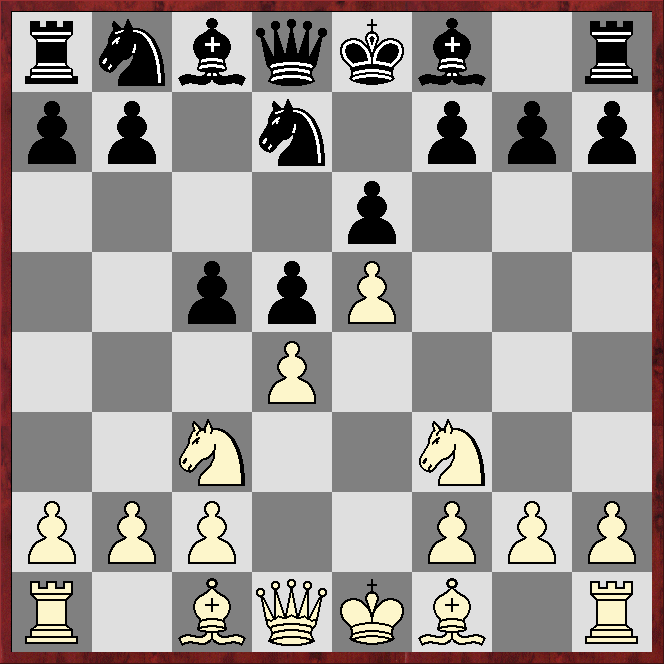 |
| How should White proceed? |
*****
*****
*****
*****
I played 6.dxc5, which occurs 4,908 time in Mega22. That is 62.3% of the time, but is there a reasonable alternative that does not capture away from the centre and helps Black's development?
An obvious try is 6.Be3, which occurs 832 times in Mega22 and has been played by Igors Rausis (2515). The game Rausis - Emmanuel Bricard (2485), Philidor Memorial (Paris) 1995, continued 6..Nc6 7.Bb5 cxd4 8.Nxd4!? Qc7 9.f4 with an equal position, according to Stockfish15 and Komodo13.02 (½–½, 23 moves). But the engines reckon Black has a major improvement in 8...Ndxe5!?, the idea being to meet 9.f4 with 9...a6, eg 10.fxe5 axb5 11.Ncxb5. Now 11...Nxe5 12.Bf4 gives White good play for a pawn, according to the engines, but they reckon Black is at least slightly better after getting on with development by 11...Bd7 or 11...Be7.
The immediate 6.Bb5 occurs 747 times in Mega22 and was a favourite of Georgian grandmaster Bukhuti Gurgenidze, who has 10 games in Mega22, scoring +6=3-1. After 6...Nc6 7.0-0 Gurgenidze's games do not feature 7...cxd4!?, which may be Black's best continuation. The point is 8.Nxd4 again allows 8...Ndxe5!?, when Walter Arencibia Rodríguez (2485) - Alexey Dreev (2570), World Team Championship (Luzern, Switzerland) 1993, saw 9.f4 Nd7 10.f5!? Bc5 11.Bxc6 bxc6 12.fxe6 fxe6 13.Na4 Bxd4+ 14.Qxd4 with at least a tiny pull for White (but 0-1, 44 moves). However the engines reckon 9...a6!? is a major improvement, giving Black a slight edge. Black can also play 7...a6, when Gurgenidze scored three-out-of-three with 8.Bxc6 bxc6 9.Na4, although he did not meet 9...cxd4 10.Qxd4 c5, which Komodo13.02 reckons gives Black a slight edge (Stockfish15 reckons 11.Qg4 equalises).
Developing the other bishop with 6.Bg5 occurs 415 times in Mega22, with Black usually replying 6...Qb6, leading to sharp play. The mainline runs 7.dxc5 Bxc5 8.Qd2, when the greedy 8...Qxb2? is punished by 9.Rb1 Qa3 10.Nb5 Qxa2 11.Nc7+ Kf8 12.Rc1 with Nxa8 to come. Rather than grabbing a pawn Black should probably develop with 8...Nc6, when 9.0-0-0!? ups the ante. After 9...Bxf2!? 10.Na4 Qb4 11.Qxf2 Qxa4 White had reasonable compensation in Dejan Marjanović (2157) - Dragan Kosić (2528), Bosnia & Herzegovina Team Championship (Jahorina) 2012, and went on to split the point despite being massively outrated. Black can also win a pawn by 9...N(either)xe5 10.Nxe5 Nxe5, but 11.Na4 gives good compensation, according to the engines. Perhaps Black's best is 9...Qa5, when the engines suggest the novelty 10.Be3!?, one line running 10...Be7!? 11.Kb1 0-0 12.Qe1!? a6 13.h4 with an unclear position.
The move the engines like most is 6.Ne2!?, which occurs 337 times in Mega22. After 6...Nc6 White can hold the centre with 7.c3, transposing to a mainline position appearing 1,408 times in Mega22. Analysing such a position is outside the scope of this post, but for what it is worth the engines' chief variation continues 7...Be7 8.a3 0-0, which the engines reckon is equal but which scores an excellent 63% for White in Mega22. Black can cut across White's reinforcing plan with 6...cxd4!?, when 7.Nexd4 Nc6 is equal, according to the engines.
CONCLUSION: Siegbert Tarrasch recommended 5.Nf3, rather than the commoner 5.f4, to which he attached a question mark in his 1931 book Das Schachspiel, although as far as I can discover he only played 5.Nf3 once, it an 1892 club match. Over-the-board he usually played 5.f4 before famously giving up on 3.Nc3 in favour of 3.Nd2. After 5...c5 the reply 6.dxc5 is automatic for many players and is certainly what most blacks will expect. But I think the analysis in this post shows White has viable alternatives, even if blacks have little to fear from a theoretical view as long as they avoid risky pawn-grabbing.
Sunday, 11 September 2022
Lessons From Newcastle VI
IN round six of the Northumbria Challengers (U2000 Fide) I had black against a player rated 2010 ECF/1937 Fide.
*****
Now compare this with the line 9.Rd1+ Ke8 10.b3.
White's set-up in the two diagrams is exactly the same, but Black in the game position has two extra tempi: ...Be6 and ...h6.
The full game can be seen at N6 but here I want to concentrate on an instructive moment in the opening, which was a Berlin Defence to the Spanish.
It began 1.e4 e5 2.Nf3 Nc6 3.Bb5 Nf6 4.0-0 Nxe4 5.d4 Nd6 6.Bxc6 dxc6 7.dxe5 Nf5 8.Qxd8+ Kxd8.
 |
| The main tabiya of the Berlin Wall |
*****
*****
*****
*****
*****
The main continuation in ChessBase's 2022 Mega database is 9.Nc3, while Stockfish15 likes 9.h3 and Komodo13.02 prefers 9.Rd1+.
The game saw 9.Bg5+!?, which at first glance may seem a good move - after all White has developed a minor piece with tempo.
In addition, after 9...Ke8 - the main reply in Mega22 - the black king can no longer go the queenside, at least in the short and medium term.
In addition, after 9...Ke8 - the main reply in Mega22 - the black king can no longer go the queenside, at least in the short and medium term.
This can be argued as an achievement for White in that there are important lines in the Berlin Wall in which Black develops the light-square bishop, plays ...Kc8 and later, after playing ...b6 and ...c5, redeploys the king via b7 to the active square c6.
So far, so promising, but the position is rather more complicated than this makes it seem.
The game continued 10.Rd1 Be6, and now came 11.b3, the point being to meet 11...h6 with 12.Bc1.
 |
| Position after 12.Bc1 |
 |
| Position after 10.b3 |
The former is obviously a useful developing move, while the latter is a defensive move often played by Black in the Berlin Wall to control g5.
None of this is fatal for White's chances, but it does help show why 9.Bg5+ appears 157 times in Mega22 while 9.Rd1+ occurs 804 times.
The latter has been tried by Carlsen, Caruana, Kamsky and many other top players, while the highest rated player to try 9.Bg5+ is a 2382, although admittedly it was reasonably popular with quite strong players in the pre-elo era.
Saturday, 10 September 2022
Lessons From Newcastle V
IN round five of the Northumbria Challengers (U2000 Fide) I had black against a player rated 1831 ECF/1803 Fide.
*****
The full game can be seen at N5 but here I want to concentrate on the opening, which was a Berlin Defence to the Spanish.
After 1.e4 e5 2.Nf3 Nc6 3.Bb5 Nf6 4.d3 Bc5 5.0-0 Nd4 6.Nxd4 Bxd4 7.c3 Bb6 the game reached a position occurring 526 times in ChessBase's 2022 Mega database.
 |
| How should White proceed? |
*****
*****
*****
*****
No fewer than 14 moves have been tried, with most popular being 8.Nd2 and 8.Bg5, but the game saw White expand on the queenside with 8.a4!?, when there came 8...c6 9.Bc4 0-0.
Here Aleksandra Maltsevskaya (2382) - Jung Min Seo (2453), Chess.com Blitz 2021, continued 10.Bg5 h6 11.Bh4 g5!? 12.Bg3 d5 13.exd5 cxd5 14.Bb3 with approximate equality, according to Stockfish15 and Komodo13.02 (but 1-0, 31 moves).
The engines agree with 10.Bg5, but their second choice is my opponent's 10.h3!?, which seems to be a novelty and may be a little slow.
The point is Black is ready to play 10...d5 with tempo. The reply 11.exd5 is more or less forced, and I continued with 11...Nxd5, leaving White with a semi-backward d pawn on a half-open file.
White played 12.Kh2?, which is asking for trouble. The engines prefer 12.Nd2 but reckon Black has a slight edge (Stockfish15) or the better part of equality (Komodo13.02) after 12...Bf5 or 12...Bc7!?
The lesson here is that even in a closed system of the Berlin, which White chose with 4.d3, piece-play can be sharp, and a wasted tempo is likely to prove troublesome.
Tuesday, 6 September 2022
Lessons From Newcastle IV
IN round four of the Northumbria Challengers (U2000 Fide) I had white against a player rated 1893 ECF/1767 Fide.
*****
The full game can be seen at N4 but here I want to concentrate on how Black, despite playing natural-looking moves, got a lost position, according to Stockfish15, after just six moves.
The game began with 1.Nc3, which occurs 23,950 times in ChessBaase's 2022 Mega database.
Black has a wide choice of replies. A Sicilian fan, for example, might well choose 1...c5, while a double-e pawn player can be happy with 1...e5, especially if White continues 2.e4.
However I chose 2.Nf3 which, according to Mega22, was first played by Napoleon Bonaparte in 1804.
His opponent replied 2...d6 but my opponent preferred the more popular 2...Nc6.
Now 3.e4 Nf6 would be a Four Knights, but I kept the game in independent lines with 3.d4, after which 3...exd4 4.Nxd4 brings about a position in which Black already has to be careful.
 |
| How should Black proceed? |
*****
*****
*****
*****
The plausible 4...d5?! was played against me last month by Jiří Řehák (1749 Fide) in the fifth round of the Czech Seniors Open Championship, but after 5.Bf4 Black is in trouble. The engines suggest 5...a6, which is the commonest continuation in Mega22, but 6.e4 leaves White better. The game saw 5...Nxd4 but 6.Qxd4 gave White a positionally won game, according to Stockfish15 (Komodo13.02 allows White 'only' the upper hand).
The plausible 4...d5?! was played against me last month by Jiří Řehák (1749 Fide) in the fifth round of the Czech Seniors Open Championship, but after 5.Bf4 Black is in trouble. The engines suggest 5...a6, which is the commonest continuation in Mega22, but 6.e4 leaves White better. The game saw 5...Nxd4 but 6.Qxd4 gave White a positionally won game, according to Stockfish15 (Komodo13.02 allows White 'only' the upper hand).
A better try is 4...Bc5, but 5.Nf5!? gives interesting play, eg 5...Qf6 was met by 6.g4!? in Rudolf Bräuning (2305) - Jura Bibik (2230), Württemberg Championship (Schramberg) 1993, continuing 6...Bb4!? 7.Bd2 Nge7, when the engines reckon 8.a3 Ba5 9.Nxe7 Nxe7 10.e4 would have been completely equal (the game was drawn anyway in 27 moves). A more conventional approach would be 6.e4, when Anatoly Karpov is among those who have continued 6...Nge7. After the further moves 7.Ne3!? d6 8.Bd3 the engines suggest 8...Ne5, which goes back to Louis Paulsen - Adolf Anderssen, Match Game Four (Leipzig) 1876. That game continued 9.0-0 c6 10.Kh1 Bxe3?! 11.Bxe3, after which the bishop-pair and the slightly awkward placing of the black queen seem to give White an edge.
My game saw Black's most popular continuation, 4...Nf6, to which I replied 5.Bg5. Black broke the pin with 5...Be7?!, which is probably a mistake although it has been played by Yuri Vovk (2545), Yuriy Kryvoruchko (2710) and Samuel Sevian (2654). The problem for Black is what to do after 6.Nf5.
Komodo13.02 approves of the game continuation 6...0-0, but after 7.Nxe7+ Qxe7 8.Nd5 Black's kingside gets smashed open.
Stockfish15 reckons ...0-0 leaves White positionally winning, and instead suggests 6...h6!?, but 7.Nxg7+ Kf8 8.Bxf6 Bxf6 9.Nh5 leaves Black with insufficient compensation for a pawn.
Going back to the position after Bg5, the engines suggest 5...Bb4!?, when 6.Nxc6 bxc6 7.Qd4 gave White a slight edge in Joel Benjamin (2575) - John Nunn (2585), Lloyds Bank (London) 1987, according to Stockfish15, although Komodo13.02 reckons the position is equal. That game continued 7...Be7 8.e4 0-0 9.Bd3 h6 10.Bh4 d5 11.e5 Ng4 12.Bxe7 Qxe7 13.f4 f6 14.0-0 fxe5 15.fxe5 Rxf1+ 16.Rxf1 Qxe5 17.Qxe5 Nxe5 18.Re1 Nxd3 19.cxd3, when White probably had enough for a pawn (1-0, 97 moves).
There are lots of alternatives along the way for both sides in these lines, but it is fair to say 1.Nc3 e5 2.Nf3 leads to original and interesting play that is not easy to navigate over the board.
Monday, 5 September 2022
Lessons From Newcastle III
IN round three of the Northumbria Challengers (U2000 Fide) I had black against a player rated 1810 ECF/1559 Fide.
*****
The full game can be seen at N3 but here I want to concentrate on the key point in the opening, which was a Giuoco Piano.
After 1.e4 e5 2.Nf3 Nc6 3.Bc4 Bc5 4.c3 Nf6 5.d3 a6 White expanded on the queenside with 6.b4!? Ba7 7.a4.
The further moves 7...0-0 8.0-0 reached a position in which Stockfish15 and Komodo13.02 reckon Black can hit back in the centre with 8...d5!?
I played the more solid, and more popular, 8...d6, bringing the game to a position occurring 111 times in ChessBase's 2022 Mega database.
There is no consensus on how White should proceed - 13 different moves appear in Mega22. The engines suggest 9.Nbd2 or the game continuation 9.h3.
I decided White's play was a little slow, and tried to take advantage of this with the apparent-novelty 9...Nh5!? (the main move in Mega22 is 9...Ne7, when the engines reckon White may have a tiny pull).
 |
| How should White respond to Black's kingside play? |
*****
*****
*****
*****
Thanks to the pin on the f2 pawn, White must take into consideration the possibility of ...Ng3 as well ...Nf4. However the engines reckon if it were Black's turn the best move would be ...Qf6.
White can counter all these threats with 10.Bg5, when the pin on the f7 pawn prevents ...f6, and so Black has nothing better than 10...Nf6, according to the engines, which means White would in effect have played two moves in a row (9.h3 and 9.Bg5).
In the game White could not resist grabbing a pawn with 10.Nxe5, but after 10...Nxe5 11.Qxh5 Nxc4 12.dxc4 Black had obvious compensation for a pawn in the shape of the bishop-pair and a superior pawn-structure.
Sunday, 4 September 2022
Lessons From Newcastle II
IN round two of the Northumbria Challengers (U2000 Fide) I had white against an Iranian rated 2013 ECF/1622 Fide.
The full game cane be seen at N2 but here I want to look at the final stage.
 |
| White to play and draw |
*****
*****
*****
*****
*****
Black is a pawn up and there are rival passed pawns on opposite sides of the board, which favours the side with the long-range bishop. But White's passer is further advanced and White should be able to draw, according to Stockfish15 and Komodo13.02.
55.Kxd6?
White had to play 55.Ke4 or possibly 55.Kc6?!
The engines are most sure of 55.Ke4, eg 55...h5 56.Nd5 (only move) Bb4 57.Nf6+ (57.Nxb4?? cxb4 58.a5 h4 59.a6 h3 60.a7 h2 61.a8=Q h1=Q+ etc) Kg5 58.Nxh5! Kxh5 59.Kd5 Kg5 60.Kxd6 Kf6 61.a5 etc.
The move 55.Kc6?! also seems to draw although Komodo13.02 for quite some time reckons it loses, and the lines are much trickier for White to play. After 55...h5 56.Nd5 Bb4 57.Nf6+ White draws as in the previous line. Black can try 56...h4!? but 57.Nxc3 (only move) h3 58.Nd5 h2 59.a5 (White's last two moves could be played in reverse order) h1=Q 60.a6 (only move) seems to give White a fortress - at least the engines are sure it does. Instead of immediately pushing the h pawn, the engines suggest 55...Kf5, but White still seems OK, eg 56.Nd5 Bd2 57.Kb5 h5 58.a5 Bxa5+ (only move) 59.Kxa5 h4 60.Ne3+ (only move) Ke4 61.Nf1 (only move) d5 62.Kb5 d4 63.Kxc5 d3 64.Kb4 h3 65.c5 h2 66.c6 h1=Q 67.Ng3+ Kd5 68.Nxh1 d2 69.c7 d1=Q 70.c8=Q Qb1+ etc (but not 70...Qxh1?? 71.Qb7+).
The main problem with the text is the white king can no longer help to intercept the h pawn.
The game continued:
55...h5 56.Nd5 h4!
Offering the bishop seems the only way to win, but it wins relatively easily.
57.Ne3+
Or 57.Nxc3 h3 58.Ne4 h2 59.a5 Kf3 60.Ng5+ Ke3 etc.
57...Kf3 58.Nf1 Kg2 59.Ne3+ Kf3 60.Nf1 h3 62.Kxc5 Kf2 63.Nh2 Be5!? 64.Ng4+ Kg3 65.Ne3
There is no fortress after 65.Nxe5 h2.
65...Bf4 66.Nf5+ Kg4 0-1
Saturday, 3 September 2022
Lessons From Newcastle
IN round one of the Northumbria Challengers I was repaired with black against a Mexican from the Masters rated 2168 ECF/2071 Fide
*****
*****
The full game cane be seen at N1 but here I want to concentrate on an unusual twist that occurred in the opening, which was the Berlin Defence to the Spanish.
After 1.e4 e5 2.Nf3 Nc6 3.Bb5 Nf6 White chose the second-most popular continuation, 4.d3.
There are 12,479 examples of this move in ChessBase's 2022 Mega database, a long way behind the 26,976 examples of 4.0-0, which usually leads to the Berlin Wall after 4...Nxe4.
I replied 4...Bc5 and the game continued 5.0-0 Nd4 (5...d6 is the main move in Mega22).
 |
| Position after 5...Nd4 |
*****
*****
*****
*****
Before this game I had reached the diagram position as black 11 times. The first nine featured 6.Nxd4, which is by far the most popular move in Mega22, but the last three, including this game, saw 6.Bc4!?
Stockfish15, but not Komodo13.02, marginally prefers Bc4, so what is the idea?
The first reasonably high-level game to feature the move was Heikki Westerinen - Dick van Geet, IBM B (Amsterdam) 1970.
It continued 6...d6 7.c3 Nxf3+ 8.Qxf3 Bg4 9.Qg3 and now White was rewarded when the dubious 9...Qd7?! was played.
The problem for Black is that 10.h3 cannot be met by 10...Bh5?? as two pieces are hanging after 11.Qxg7.
So Black played 10...h5!?, after which the engines disagree as to whether the black dark-square bishop can be captured.
Komodo13.02 reckons 11.hxg4 hxg4 12.b4 Bb6 13.a4 wins for White, but Stockfish15 continues 13...Nh5, claiming Black has the upper hand.
Perhaps understandably, Westerinen preferred 11.d4!?, which the engines agree gives White the upper hand.
The game continued 11...exd4 12.cxd4 Bxd4 13.Qd3 Bb6, after which White safely grabbed the bishop with 14.hxg4, giving White at least the upper hand, according to the engines (but ½–½, 36 moves).
Despite White's success in the opening, 6.Bc4!? did not attract much attention at high levels until the game Viktor Kupreichik (2505) - Yuri Malinin (2335), Chigorin Memorial (Saint Petersburg) 1998.
After 6...d6 the Belarusian grandmaster treated the position in Two Knights-style by playing 7.Ng5?!, presumably missing the effectiveness of 7...Bg4, when 8.Nxf7 loses to 8...Bxd1 9.Nxd8 Rxd8 10.Rxd1 Nxc2, and 8.Bxf7+ loses to 8...Ke7 9.Qd2 (or 9.Qe1) h6.
Kupreichik tried 8.Qd2 but 8....h6! 9.Nxf7 Qd7 leaves White unable to play 10.Nxh8 as 10...Nxf3+ 11.gxf3 Bxf3 leads to a quick mate for Black.
Instead the game saw 10.Kh1 Bf3! 11.Qe3 (11.gxf3 Nxf3 and ...Qh3) Ng4 12.Nxh8 - this is best, according to the engines, but after 12...Nxe3 13.fxe3 Bxg2+! 14.Kxg2 Qg4+ 15.Kh1 Nxc2 White could have resigned, although Kupreichik held out for another 21 moves.
Clearly Kupreichik's 7.Ng5?! cannot be recommended, but it does seem right for both players to treat the position in Italian Game-style.
The move ...d6 in reply to Bc4 is natural, but I preferred 6...Nxf3!?
This may seem strange at first as Black has spent three tempi with this knight only to exchange it in such a way that White gets to develop the queen for free with 7.Qxf3.
However things are not quite so simple in that White has also 'wasted' a tempo in taking two moves to put the light-square bishop on c4.
In addition Black has swopped the slightly passive queen's knight - it was defending e5 - for the slightly more active white king's knight - it was attacking e5.
Finally, the white queen is not necessarily well-placed on f3, where it blocks the white f pawn and will be shadowed by a black rook in the event of Black castling kingside.
One sign that Black may be on the right track is that the game has transposed to a position in Mega22 in which sometimes it is White to move.
I played 7...d6, and there followed 8.Nc3 c6.
 |
| There are three games with this position in Mega22 |
*****
*****
*****
*****
Melikset Khachiyan (2480) - František Vrána (2250), Pardubice (Czechia) 1996, went 9.Be3 Bb6 10.h3 Be6 11.Rad1!? with an equal game, according to Stockfish15 and Komodo13.02 (but 1-0, 38 moves).
Veljko Draganić (2294) - Jiři Jirka (2415), MNT (Soznia, Montenegro) 2004, saw 9.a4 h6 10.Be3 Qe7 11.a5 0-0 12.Bxc5 dxc5 13.Qe3, when the engines reckon White may be slightly better (but 0-1, 37 moves).Melikset Khachiyan (2480) - František Vrána (2250), Pardubice (Czechia) 1996, went 9.Be3 Bb6 10.h3 Be6 11.Rad1!? with an equal game, according to Stockfish15 and Komodo13.02 (but 1-0, 38 moves).
Jörg Schmidt (2112) - Norbert Westphal (1965), World Seniors 50+ Team Championship (Dresden) 2016, continued 9.h3 Qe7 10.Bb3 Be6 11.Be3 Nd7!? 12.Ne2 0-0 with a roughly level game that was drawn in 33 moves.
My opponent played 9.h3, and I replied 9...a5, which gives the black dark-square bishop a retreat square at a7, gains space and threatens to win the white light-square bishop with ...b5 etc.
This was countered by 10.a4, after which 10...Be6 11.Be3 Bxe3 12.Qxe3 (12.fxe3?! Bxc4 13.dxc4) 0-0
gave a middlegame position the engines reckon is level.
However White has to be careful - the game saw 13.f4? exf4 14.Rxf4 Nh5 15.Rf2 d5 with advantage to Black.
Subscribe to:
Posts (Atom)